• #rsisb
    Roll no.247
    Story post .9
    Foundation level


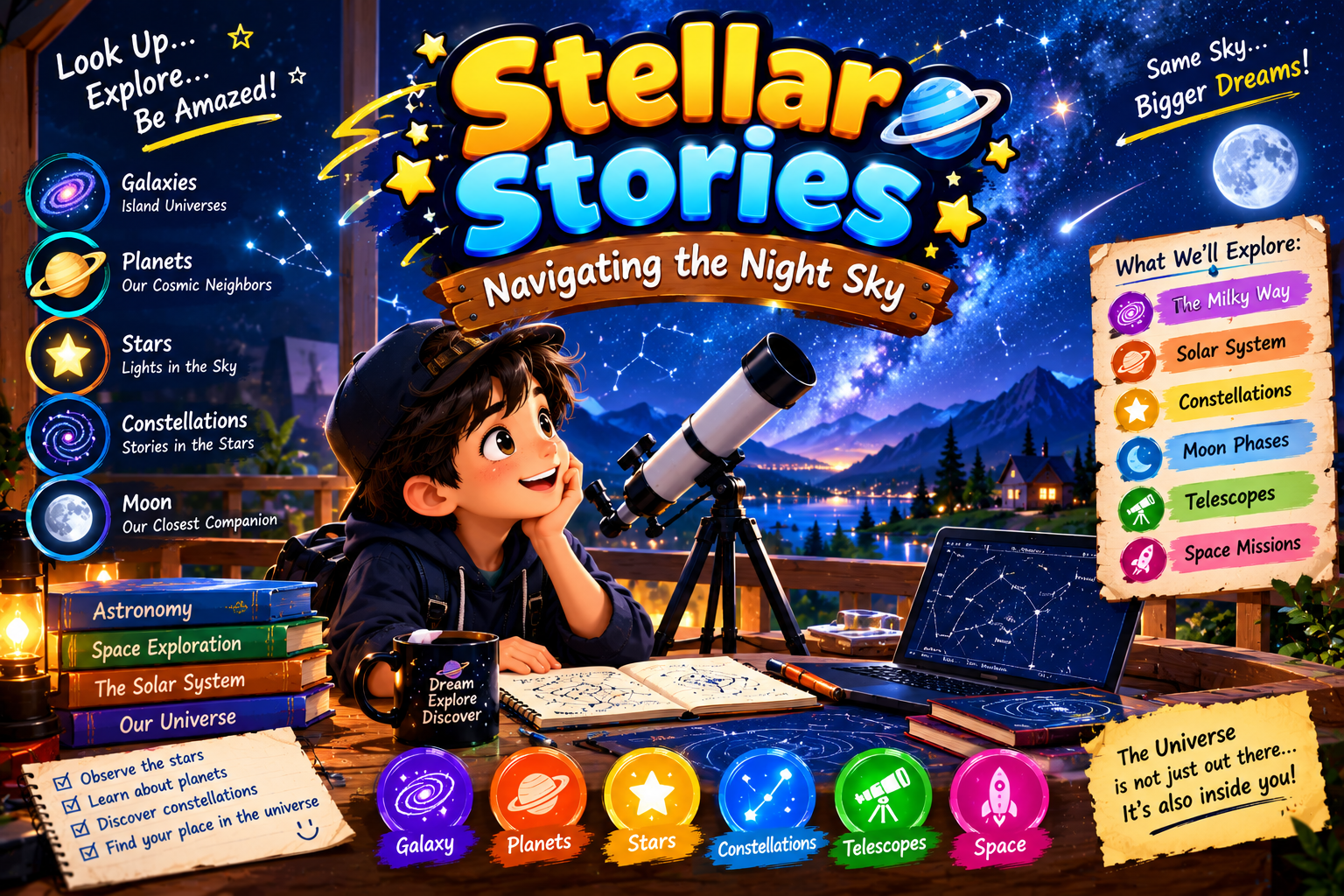
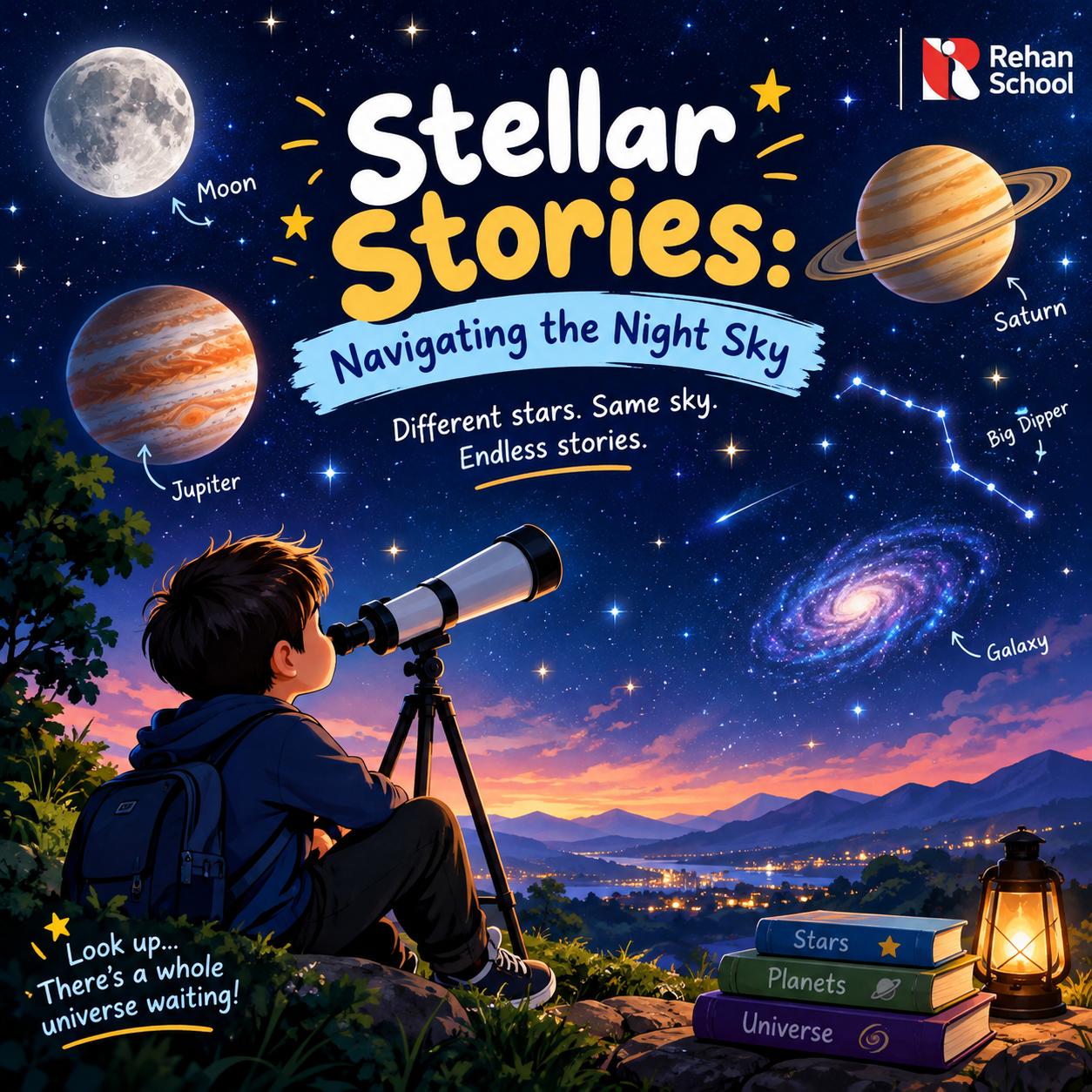
    **Stellar Stories: Navigating the Night Sky**

    **Welcome to Stellar Stories, where the magic of the universe comes alive!** Have you ever looked up at the night sky and wondered how many stars are shining above you? Have you ever imagined traveling through space, discovering distant planets, exploring beautiful galaxies, and learning the secrets hidden among the stars? If yes, then get ready for an amazing journey through the wonders of the cosmos!

    The night sky is like a giant storybook filled with countless stars, fascinating constellations, mysterious planets, and breathtaking galaxies. Every tiny point of light tells us something about our incredible universe. From the bright North Star to the beautiful patterns of Orion's Belt , the sky has inspired explorers, scientists, dreamers, and storytellers for thousands of years.

    **Discover the Wonders of the Night Sky!**

    **Stars:** Learn about the glowing balls of hot gas that light up the universe. Some stars are much larger than our Sun, while others are smaller and cooler. Every star has its own fascinating story!

    **Planets:** Explore the amazing worlds of our solar system, from Mercury's scorching surface to Neptune's distant, deep-blue atmosphere. Discover how planets move around the Sun and why Earth is such a special place for life.

    **Galaxies:** Imagine billions of stars gathered together in enormous cosmic cities! Our home galaxy, the Milky Way, contains stars, planets, gas, and dust, all connected by gravity. Just think about how enormous the universe really is!

    **Constellations:** Discover how people connect stars into recognizable patterns in the sky. These patterns have helped people tell stories, recognize seasons, and navigate throughout history.

    **The Moon:** Observe our closest celestial neighbor and discover why it changes appearance throughout the month. Learn about its phases, its craters, and its important role in Earth's natural systems.

    **Meteors and Comets:** Discover the spectacular streaks of light called meteors and learn about icy comets that travel through space, sometimes developing beautiful glowing tails near the Sun.

    ‍ **Become a Young Space Explorer!**

    You don't need a giant telescope or a spaceship to begin exploring the universe! You can start by looking at the night sky, learning the names of bright stars, identifying visible constellations, and observing the Moon. A simple sky map or astronomy app can help you understand what you're seeing.

    **Why Is Astronomy Important?**

    Astronomy teaches us to ask questions, observe carefully, think scientifically, and search for answers. It helps us understand Earth's place in the universe and reminds us that learning never has to stop. Every discovery begins with curiosity!

    Imagine standing beneath a sky filled with sparkling stars, wondering what exists beyond the worlds we already know. Somewhere out there, new mysteries are waiting to be explored, new discoveries are waiting to be made, and new questions are waiting for curious minds like yours!

    **Remember:** The universe is vast, beautiful, and full of wonders. Keep looking up, keep asking questions, and never stop exploring! Your next great discovery might begin with one simple question: *What's out there?*

    Let's make learning about space exciting, inspiring, and fun! Share this post with your friends and family, encourage young explorers to discover astronomy, and spread the wonder of the night sky across the world.

    **Tell us in the comments!**
    Which would you love to explore first: the Moon, Mars, Saturn's rings, or a distant galaxy?

    Like | Comment | Share | Follow for more amazing stories, educational adventures, science facts, and discoveries!

    **Stellar Stories: Every Star Has a Story, and Every Explorer Has a Question!**

    ━━━━━━━━━━━━━━━━━━━━

    **HASHTAGS**

    #StellarStories #NavigatingTheNightSky #NightSky #Astronomy #SpaceExploration #ExploreTheUniverse #Stars #Planets #Galaxies #MilkyWay #Constellations #Moon #SolarSystem #SpaceScience #ScienceForKids #YoungScientists #YoungExplorers #SpaceLovers #AstronomyForBeginners #LearnAboutSpace #EducationalContent #ScienceEducation #DiscoverTheUniverse #CosmicWonders #Universe #SpaceFacts #Stargazing #Telescope #Astrophysics #ScienceIsFun #Curiosity #KeepLearning #DreamBig #ExploreAndDiscover #KnowledgeIsPower #InspiringMinds #StoryPost #EducationalPost #CreativeLearning #SpaceAdventure #FutureAstronomers #WonderOfTheUniverse #KeepLookingUp
    #rsisb Roll no.247 Story post .9 Foundation level 🌌✨ **Stellar Stories: Navigating the Night Sky** 🌟🔭 🌠🌌 **Welcome to Stellar Stories, where the magic of the universe comes alive!** 🚀✨ Have you ever looked up at the night sky and wondered how many stars are shining above you? 🌟 Have you ever imagined traveling through space, discovering distant planets, exploring beautiful galaxies, and learning the secrets hidden among the stars? 🌍🪐🌌 If yes, then get ready for an amazing journey through the wonders of the cosmos! 🚀💫 🌙✨ The night sky is like a giant storybook filled with countless stars, fascinating constellations, mysterious planets, and breathtaking galaxies. Every tiny point of light tells us something about our incredible universe. 🌟📖 From the bright North Star ⭐ to the beautiful patterns of Orion's Belt 🌠, the sky has inspired explorers, scientists, dreamers, and storytellers for thousands of years. 🔭🌌 **Discover the Wonders of the Night Sky!** 🌟 **Stars:** Learn about the glowing balls of hot gas that light up the universe. Some stars are much larger than our Sun, while others are smaller and cooler. Every star has its own fascinating story! ☀️✨ 🪐 **Planets:** Explore the amazing worlds of our solar system, from Mercury's scorching surface to Neptune's distant, deep-blue atmosphere. Discover how planets move around the Sun and why Earth is such a special place for life. 🌍🚀 🌌 **Galaxies:** Imagine billions of stars gathered together in enormous cosmic cities! Our home galaxy, the Milky Way, contains stars, planets, gas, and dust, all connected by gravity. Just think about how enormous the universe really is! 🌠💫 ⭐ **Constellations:** Discover how people connect stars into recognizable patterns in the sky. These patterns have helped people tell stories, recognize seasons, and navigate throughout history. 🧭🌟 🌙 **The Moon:** Observe our closest celestial neighbor and discover why it changes appearance throughout the month. Learn about its phases, its craters, and its important role in Earth's natural systems. 🌕🔭 ☄️ **Meteors and Comets:** Discover the spectacular streaks of light called meteors and learn about icy comets that travel through space, sometimes developing beautiful glowing tails near the Sun. ☄️✨ 🧑‍🚀🚀 **Become a Young Space Explorer!** You don't need a giant telescope or a spaceship to begin exploring the universe! 🌌🔭 You can start by looking at the night sky, learning the names of bright stars, identifying visible constellations, and observing the Moon. A simple sky map or astronomy app can help you understand what you're seeing. 📱⭐ 🌍💡 **Why Is Astronomy Important?** Astronomy teaches us to ask questions, observe carefully, think scientifically, and search for answers. It helps us understand Earth's place in the universe and reminds us that learning never has to stop. Every discovery begins with curiosity! 🧠🔬✨ 🌠 Imagine standing beneath a sky filled with sparkling stars, wondering what exists beyond the worlds we already know. Somewhere out there, new mysteries are waiting to be explored, new discoveries are waiting to be made, and new questions are waiting for curious minds like yours! 🚀🌌 💫 **Remember:** The universe is vast, beautiful, and full of wonders. Keep looking up, keep asking questions, and never stop exploring! Your next great discovery might begin with one simple question: *What's out there?* 🌟🔭🌍 ❤️🌌 Let's make learning about space exciting, inspiring, and fun! Share this post with your friends and family, encourage young explorers to discover astronomy, and spread the wonder of the night sky across the world. 🌎🚀✨ 👇 **Tell us in the comments!** 💬 🌟 Which would you love to explore first: the Moon, Mars, Saturn's rings, or a distant galaxy? 🪐🌙🔴🌌 👍 Like | 💬 Comment | 🔄 Share | ⭐ Follow for more amazing stories, educational adventures, science facts, and discoveries! 🌌✨ **Stellar Stories: Every Star Has a Story, and Every Explorer Has a Question!** 🚀🌟 ━━━━━━━━━━━━━━━━━━━━ 🏷️ **HASHTAGS** 🌠 #StellarStories #NavigatingTheNightSky #NightSky #Astronomy #SpaceExploration #ExploreTheUniverse #Stars #Planets #Galaxies #MilkyWay #Constellations #Moon #SolarSystem #SpaceScience #ScienceForKids #YoungScientists #YoungExplorers #SpaceLovers #AstronomyForBeginners #LearnAboutSpace #EducationalContent #ScienceEducation #DiscoverTheUniverse #CosmicWonders #Universe #SpaceFacts #Stargazing #Telescope #Astrophysics #ScienceIsFun #Curiosity #KeepLearning #DreamBig #ExploreAndDiscover #KnowledgeIsPower #InspiringMinds #StoryPost #EducationalPost #CreativeLearning #SpaceAdventure #FutureAstronomers #WonderOfTheUniverse #KeepLookingUp 🌌🔭🚀✨🌟🪐🌙💫
    0 Commenti 0 condivisioni 150 Views
  • #rsisb
    Roll No 253
    Foundation Level
    Story Post 24

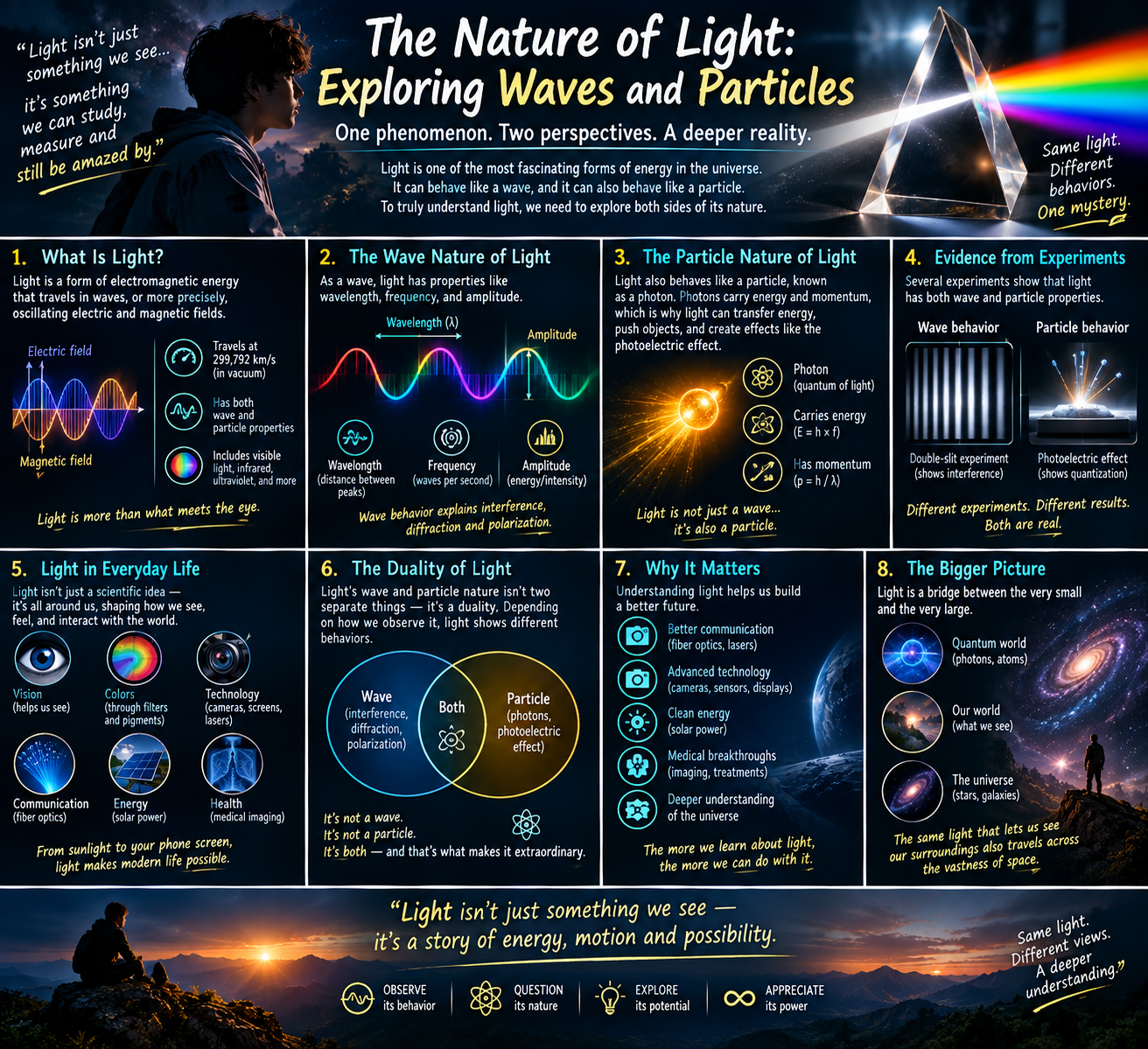
    # The Nature of Light: Exploring Waves and Particles

    Imagine standing beneath a night sky filled with stars.

    Every photon reaching your eyes has traveled across space carrying information from distant worlds. Light allows us to see, measure, communicate, explore, and understand the universe itself.

    But light is far stranger than it first appears.

    Sometimes it behaves like a **wave** .

    Sometimes it behaves like a **particle** .

    And understanding this strange dual nature changed our picture of reality forever.

    ---

    # 1. What Is Light?

    Light is a form of **electromagnetic radiation**—energy carried through oscillating electric and magnetic fields.

    In empty space, electromagnetic waves travel at approximately:

    ### **299,792 kilometers per second**

    That's the speed of light in vacuum.

    Visible light is only a small part of the electromagnetic spectrum.

    Beyond what our eyes can see are:

    Radio waves
    Microwaves
    Infrared
    Visible light
    Ultraviolet
    🩻 X-rays
    Gamma rays

    So light isn't simply what we see.

    ### **It's an enormous family of electromagnetic phenomena.**

    ---

    # 2. The Wave Nature of Light

    When light behaves as a wave, we can describe it using several important properties:

    **Wavelength** — the distance between successive wave peaks
    **Frequency** — how many oscillations occur each second
    **Amplitude** — related to the wave's intensity

    These properties help explain many familiar phenomena.

    **Interference** occurs when waves combine.
    **Diffraction** occurs when waves spread around openings or obstacles.
    **Polarization** describes the orientation of electromagnetic oscillations.

    The wave model explains behaviors that are difficult to understand if we imagine light only as tiny particles.

    ---

    # 3. The Particle Nature of Light

    But the story doesn't end there.

    Light can also behave as if it arrives in discrete packets of energy called **photons**.

    A photon is a quantum of electromagnetic radiation.

    Its energy is related to frequency:

    ### **E = h × f**

    And its momentum is related to its wavelength:

    ### **p = h / λ**

    This particle-like behavior helps explain phenomena such as the **photoelectric effect**, where light can transfer energy to electrons.

    So light isn't simply a smooth continuous wave.

    At the quantum level, energy can be exchanged in discrete amounts.

    ### **Light has another side—and it's quantum.**

    ---

    # 4. Evidence From Experiments

    The strange nature of light isn't merely philosophical.

    Experiments demonstrate it.

    ### Double-Slit Experiment

    When light passes through two narrow openings, an **interference pattern** can appear—strong evidence of wave-like behavior.

    ### Photoelectric Effect

    When light strikes certain materials, it can eject electrons. This behavior is explained using photons and quantized energy.

    Different experiments reveal different aspects of light.

    And that's one of the most fascinating things about physics:

    ### **The same phenomenon can reveal different behaviors depending on how we investigate it.**

    ---

    # 5. Light in Everyday Life

    Light isn't something that exists only inside physics laboratories.

    It's everywhere.

    **Vision** — allows us to see the world
    **Colors** — arise from how different wavelengths interact with matter
    **Cameras** — convert light into images
    **Screens** — produce controlled patterns of light
    **Fiber optics** — carry information using light
    **Solar panels** — convert light energy into electrical energy
    🩻 **Medical imaging** — uses electromagnetic radiation to see inside the body

    From sunrise to smartphone screens…

    ### **Modern civilization depends heavily on our ability to control light.**

    ---

    # 6. The Duality of Light

    Here lies the great mystery.

    Light can display **wave-like behavior**

    and

    **particle-like behavior** .

    This is known as **wave-particle duality**.

    It's important to understand that this doesn't mean light is literally switching between being a classical wave and a classical particle like two separate objects.

    Instead, quantum physics gives us a deeper framework in which classical wave and particle descriptions each capture different aspects of light's behavior.

    ### **Two perspectives. One quantum reality.**

    ---

    # 7. Why Understanding Light Matters

    Learning how light behaves has transformed technology.

    **Communication** — fiber-optic networks
    **Science** — spectroscopy and microscopy
    **Imaging** — cameras and sensors
    **Energy** — solar technology
    **Medicine** — lasers and diagnostic imaging
    **Astronomy** — studying distant stars and galaxies

    When astronomers observe light from a distant star, they aren't simply seeing brightness.

    They can analyze the light's wavelengths and learn about the star's:

    Temperature
    Chemical composition
    Motion
    Environment

    ### **Light carries information across space.**

    ---

    # 8. The Bigger Picture

    Light connects the microscopic and the cosmic.

    At the quantum scale, photons interact with atoms and electrons.

    At human scales, light allows us to see and communicate.

    Across astronomical distances, light travels from stars and galaxies to our telescopes.

    In many ways, light is our messenger from the universe.

    When we look at a distant galaxy, we are receiving photons that may have traveled for millions or billions of years before reaching Earth.

    ### **Looking at the universe means looking at ancient light.**

    ---

    # The Final Thought

    Light is more than something that illuminates a room.

    It is energy.
    It is information.
    It is electromagnetic radiation.
    It has quantum behavior.
    And it is one of the most important tools we have for exploring reality.

    From a photon interacting with an electron…

    to sunlight crossing space…

    to the glow of a distant galaxy…

    ### **Light connects the smallest scales of nature with the largest.**

    So the next time you see sunlight streaming through a window , a rainbow , or stars shining overhead , remember:

    **You aren't simply seeing light.**

    You're witnessing one of the universe's most fascinating mysteries—a phenomenon that behaves in ways far stranger and more beautiful than our everyday experience suggests.

    # **Light isn't just something we see—it's a story of energy, motion, information, and possibility.** ∞


    Asma Shaheen EducationWali
    Saima Empowerment Wali
    Mishaal TrainingWali
    #rsisb Roll No 253 Foundation Level Story Post 24 # 🌈⚡ The Nature of Light: Exploring Waves and Particles Imagine standing beneath a night sky filled with stars. 🌌✨ Every photon reaching your eyes has traveled across space carrying information from distant worlds. Light allows us to see, measure, communicate, explore, and understand the universe itself. 🔭👁️📡 But light is far stranger than it first appears. Sometimes it behaves like a **wave** 🌊. Sometimes it behaves like a **particle** ⚛️. And understanding this strange dual nature changed our picture of reality forever. 🧠🌌 --- # 💡🌌 1. What Is Light? Light is a form of **electromagnetic radiation**—energy carried through oscillating electric and magnetic fields. ⚡🧲 In empty space, electromagnetic waves travel at approximately: ### 🚀 **299,792 kilometers per second** That's the speed of light in vacuum. Visible light 👁️🌈 is only a small part of the electromagnetic spectrum. Beyond what our eyes can see are: 📻 Radio waves 📡 Microwaves 🔥 Infrared 🌈 Visible light ☀️ Ultraviolet 🩻 X-rays ☢️ Gamma rays So light isn't simply what we see. ### **It's an enormous family of electromagnetic phenomena.** 🌌⚡ --- # 🌊🔬 2. The Wave Nature of Light When light behaves as a wave, we can describe it using several important properties: 〰️ **Wavelength** — the distance between successive wave peaks ⚡ **Frequency** — how many oscillations occur each second 📈 **Amplitude** — related to the wave's intensity These properties help explain many familiar phenomena. 🌈 **Interference** occurs when waves combine. 🔍 **Diffraction** occurs when waves spread around openings or obstacles. 🕶️ **Polarization** describes the orientation of electromagnetic oscillations. The wave model explains behaviors that are difficult to understand if we imagine light only as tiny particles. --- # ⚛️✨ 3. The Particle Nature of Light But the story doesn't end there. Light can also behave as if it arrives in discrete packets of energy called **photons**. ⚛️💡 A photon is a quantum of electromagnetic radiation. Its energy is related to frequency: ### **E = h × f** ⚡ And its momentum is related to its wavelength: ### **p = h / λ** 🌊⚛️ This particle-like behavior helps explain phenomena such as the **photoelectric effect**, where light can transfer energy to electrons. So light isn't simply a smooth continuous wave. At the quantum level, energy can be exchanged in discrete amounts. ### **Light has another side—and it's quantum.** 🌌⚛️ --- # 🧪🔍 4. Evidence From Experiments The strange nature of light isn't merely philosophical. Experiments demonstrate it. ### 🌊 Double-Slit Experiment When light passes through two narrow openings, an **interference pattern** can appear—strong evidence of wave-like behavior. 🌊〰️ ### ⚡ Photoelectric Effect When light strikes certain materials, it can eject electrons. This behavior is explained using photons and quantized energy. ⚛️🔋 Different experiments reveal different aspects of light. And that's one of the most fascinating things about physics: ### **The same phenomenon can reveal different behaviors depending on how we investigate it.** 🔬✨ --- # 👁️🌈 5. Light in Everyday Life Light isn't something that exists only inside physics laboratories. It's everywhere. 🌍☀️ 👁️ **Vision** — allows us to see the world 🌈 **Colors** — arise from how different wavelengths interact with matter 📷 **Cameras** — convert light into images 📱 **Screens** — produce controlled patterns of light 🌐 **Fiber optics** — carry information using light ☀️ **Solar panels** — convert light energy into electrical energy 🩻 **Medical imaging** — uses electromagnetic radiation to see inside the body From sunrise to smartphone screens… ### **Modern civilization depends heavily on our ability to control light.** 💡🌍 --- # 🌊⚛️ 6. The Duality of Light Here lies the great mystery. Light can display **wave-like behavior** 🌊 and **particle-like behavior** ⚛️. This is known as **wave-particle duality**. It's important to understand that this doesn't mean light is literally switching between being a classical wave and a classical particle like two separate objects. Instead, quantum physics gives us a deeper framework in which classical wave and particle descriptions each capture different aspects of light's behavior. ### **Two perspectives. One quantum reality.** 🌌✨ --- # 🚀🔬 7. Why Understanding Light Matters Learning how light behaves has transformed technology. 📡 **Communication** — fiber-optic networks 🔬 **Science** — spectroscopy and microscopy 📷 **Imaging** — cameras and sensors ☀️ **Energy** — solar technology 🩺 **Medicine** — lasers and diagnostic imaging 🚀 **Astronomy** — studying distant stars and galaxies When astronomers observe light from a distant star, they aren't simply seeing brightness. They can analyze the light's wavelengths and learn about the star's: 🌡️ Temperature 🧪 Chemical composition 💨 Motion 🌌 Environment ### **Light carries information across space.** --- # 🌌🔭 8. The Bigger Picture Light connects the microscopic and the cosmic. At the quantum scale, photons interact with atoms and electrons. ⚛️🔬 At human scales, light allows us to see and communicate. 👁️📱 Across astronomical distances, light travels from stars and galaxies to our telescopes. 🌟🔭 In many ways, light is our messenger from the universe. When we look at a distant galaxy, we are receiving photons that may have traveled for millions or billions of years before reaching Earth. 🌌⏳ ### **Looking at the universe means looking at ancient light.** ✨ --- # 🌅💡 The Final Thought Light is more than something that illuminates a room. It is energy. ⚡ It is information. 📡 It is electromagnetic radiation. 🌊 It has quantum behavior. ⚛️ And it is one of the most important tools we have for exploring reality. 🔭 From a photon interacting with an electron… to sunlight crossing space… to the glow of a distant galaxy… ### **Light connects the smallest scales of nature with the largest.** 🌌⚛️ So the next time you see sunlight streaming through a window ☀️, a rainbow 🌈, or stars shining overhead ⭐, remember: **You aren't simply seeing light.** You're witnessing one of the universe's most fascinating mysteries—a phenomenon that behaves in ways far stranger and more beautiful than our everyday experience suggests. 🌊⚛️✨ # 🌈🌌 **Light isn't just something we see—it's a story of energy, motion, information, and possibility.** ⚡🔬∞ Asma Shaheen EducationWali Saima Empowerment Wali Mishaal TrainingWali
    0 Commenti 0 condivisioni 3750 Views
  • RSIF 8

    Roll no 93

    Story post no 34

    Task topic: "Stellar Stories: Navigating the Night Sky".Bilkul Yeh **“Stellar Stories: Navigating the Night Sky”** ke liye long description hai:


    **Stellar Stories: Navigating the Night Sky**


    Look up at the night sky and you will see much more than twinkling lights. Above us is a vast universe filled with stars, planets, galaxies, constellations, meteors, and countless mysteries waiting to be explored.


    For thousands of years, humans have looked toward the stars for **direction, knowledge, inspiration, and answers**. Ancient travelers used the night sky to navigate, while astronomers today use powerful telescopes and advanced technology to study objects billions of light-years away.


    **Stars** are enormous glowing objects that produce their own light and energy.


    **Planets** orbit stars and come in many different sizes and types.


    **Meteors** are streaks of light created when space rocks enter Earth's atmosphere and heat up.


    **Constellations** are patterns of stars that people have recognized and named throughout history.


    **Galaxies** are enormous collections of stars, gas, dust, and other matter. Our home galaxy is the **Milky Way**.


    One familiar pattern in the sky is the **Big Dipper**, which is part of the larger constellation Ursa Major. It has helped people recognize directions and identify other stars in the night sky.


    The night sky connects us with both the past and the future. Ancient civilizations created stories about the stars, while modern scientists continue searching for new worlds and learning more about our universe.


    **So, the next time you look up, remember:**

    There is a whole universe waiting to be explored.


    **Look up. Stay curious. Keep discovering.**


    #StellarStories #NightSky #Astronomy #Space #Universe #Stars #Planets #Galaxies #MilkyWay #Constellations #BigDipper #Meteor #Science #ScienceEducation #AstronomyLovers #SpaceExploration #STEM #Learning #DiscoverTheUniverse #ExploreSpace #EducationalPost

    RSIF 8 Roll no 93 Story post no 34 Task topic: "Stellar Stories: Navigating the Night Sky".Bilkul 👍 Yeh **“Stellar Stories: Navigating the Night Sky”** ke liye long description hai: 🌌⭐ **Stellar Stories: Navigating the Night Sky** 🔭 Look up at the night sky and you will see much more than twinkling lights. Above us is a vast universe filled with stars, planets, galaxies, constellations, meteors, and countless mysteries waiting to be explored. For thousands of years, humans have looked toward the stars for **direction, knowledge, inspiration, and answers**. Ancient travelers used the night sky to navigate, while astronomers today use powerful telescopes and advanced technology to study objects billions of light-years away. ⭐ **Stars** are enormous glowing objects that produce their own light and energy. 🪐 **Planets** orbit stars and come in many different sizes and types. ☄️ **Meteors** are streaks of light created when space rocks enter Earth's atmosphere and heat up. ✨ **Constellations** are patterns of stars that people have recognized and named throughout history. 🌌 **Galaxies** are enormous collections of stars, gas, dust, and other matter. Our home galaxy is the **Milky Way**. One familiar pattern in the sky is the **Big Dipper**, which is part of the larger constellation Ursa Major. It has helped people recognize directions and identify other stars in the night sky. The night sky connects us with both the past and the future. Ancient civilizations created stories about the stars, while modern scientists continue searching for new worlds and learning more about our universe. 🔭 **So, the next time you look up, remember:** There is a whole universe waiting to be explored. 🌟 **Look up. Stay curious. Keep discovering.** #StellarStories #NightSky #Astronomy #Space #Universe #Stars #Planets #Galaxies #MilkyWay #Constellations #BigDipper #Meteor #Science #ScienceEducation #AstronomyLovers #SpaceExploration #STEM #Learning #DiscoverTheUniverse #ExploreSpace #EducationalPost
    0 Commenti 0 condivisioni 2693 Views
  • #rsisb
    Roll NO:232
    Foundation level student.
    Story post:11

    **Stellar Stories: Navigating the Night Sky**

    Get ready for an amazing journey beyond our planet and into the mysterious beauty of the **night sky!** Join us as we explore shining stars , fascinating constellations , planets , the Moon , and other incredible objects across the universe.

    In this exciting educational adventure, we’ll learn how people have used the stars to **navigate, tell stories, understand seasons, and explore the universe** throughout history. We’ll discover how constellations form recognizable patterns and how astronomers use powerful telescopes to study objects that are millions or even billions of light-years away.

    From the sparkling stars above us to distant galaxies , the night sky reminds us that the universe is vast, beautiful, and full of mysteries waiting to be discovered.

    **Look Up • Explore the Stars • Discover the Universe • Keep Wondering!**

    Join us on this stellar adventure and let your curiosity take you beyond Earth and into the incredible world of astronomy!

    #StellarStories #NightSky #Astronomy #Stars #Space #Universe #Constellations #Planets #Moon #Galaxy #SpaceExploration #AstronomyForKids #Science #ScienceEducation #STEM #Learning #EducationalVideo #FunLearning #ExploreSpace #DiscoverTheUniverse #StarGazing #YoungAstronomers #Cosmos
    #rsisb Roll NO:232 Foundation level student. Story post:11 🌌✨ **Stellar Stories: Navigating the Night Sky** 🔭⭐ Get ready for an amazing journey beyond our planet and into the mysterious beauty of the **night sky!** 🚀🌠 Join us as we explore shining stars ⭐, fascinating constellations 🌌, planets 🪐, the Moon 🌙, and other incredible objects across the universe. In this exciting educational adventure, we’ll learn how people have used the stars to **navigate, tell stories, understand seasons, and explore the universe** throughout history. 🧭📚🌍 We’ll discover how constellations form recognizable patterns and how astronomers use powerful telescopes 🔭 to study objects that are millions or even billions of light-years away. From the sparkling stars above us ✨ to distant galaxies 🌌, the night sky reminds us that the universe is vast, beautiful, and full of mysteries waiting to be discovered. 🌠🪐 🌟 **Look Up • Explore the Stars • Discover the Universe • Keep Wondering!** 🔭🚀 Join us on this stellar adventure and let your curiosity take you beyond Earth and into the incredible world of astronomy! 🌍➡️🌌💫 #StellarStories #NightSky #Astronomy #Stars #Space #Universe #Constellations #Planets #Moon #Galaxy #SpaceExploration #AstronomyForKids #Science #ScienceEducation #STEM #Learning #EducationalVideo #FunLearning #ExploreSpace #DiscoverTheUniverse #StarGazing #YoungAstronomers #Cosmos 🌌🔭⭐🪐🌙🌠🚀🧭✨🌍📚🔬💫
    0 Commenti 0 condivisioni 2313 Views
  • #rsisb
    Roll no.239
    Story post no.29
    Foundation Level

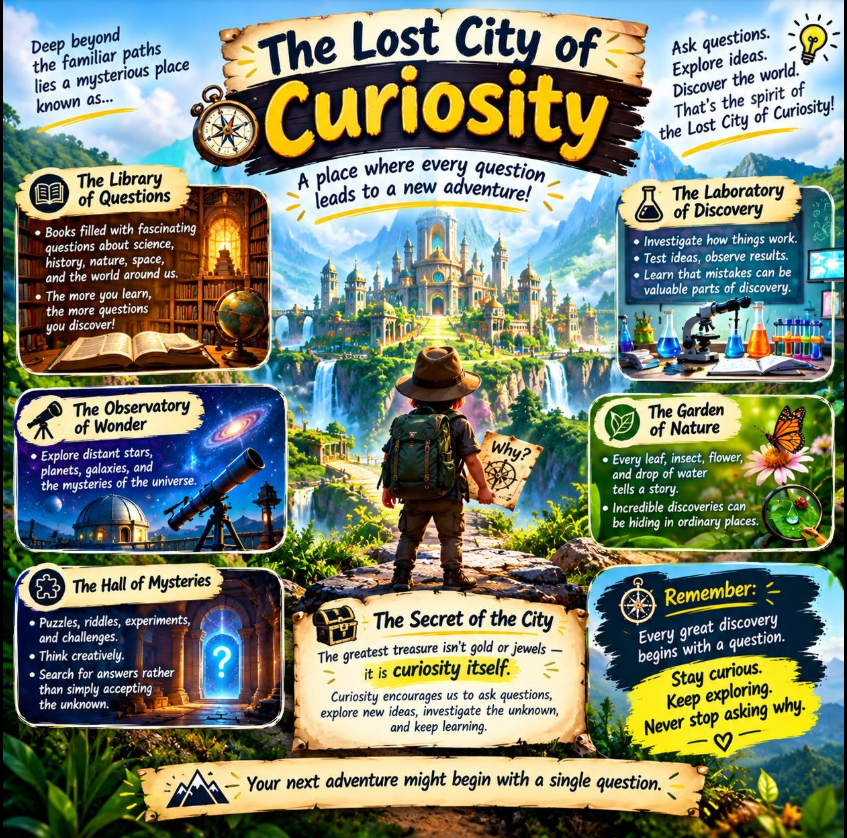
    Deep beyond the familiar paths lies a mysterious place known as **The Lost City of Curiosity**—a city where every doorway leads to a question, every discovery creates another mystery, and every explorer is encouraged to ask, **“Why?”**

    **The Library of Questions**
    Its enormous library contains books filled with fascinating questions about science, history, nature, space, and the world around us. The more you learn, the more questions you discover!

    **The Laboratory of Discovery**
    Here, explorers investigate how things work, test ideas, observe results, and learn that mistakes can be valuable parts of discovery.

    **The Observatory of Wonder**
    Look through the giant telescopes and explore distant stars, planets, galaxies, and the mysteries of the universe.

    **The Garden of Nature**
    Every leaf, insect, flower, and drop of water tells a story. The garden reminds visitors that incredible discoveries can be hiding in ordinary places.

    **The Hall of Mysteries**
    Puzzles, riddles, experiments, and challenges encourage explorers to think creatively and search for answers rather than simply accepting the unknown.

    **The Secret of the City**
    The greatest treasure isn't gold or jewels—it is **curiosity itself**. Curiosity encourages us to ask questions, explore new ideas, investigate the unknown, and keep learning.

    **Remember:**
    Every great discovery begins with a question. **Stay curious. Keep exploring. Never stop asking why.**

    **Your next adventure might begin with a single question.**

    #TheLostCityOfCuriosity #Curiosity #Science #Learning #Discovery #Education #Explore #Wonder #STEM #Knowledge #Imagination #ScienceEducation #LearningAdventure #DidYouKnow #KeepExploring
    #rsisb Roll no.239 Story post no.29 Foundation Level Deep beyond the familiar paths lies a mysterious place known as **The Lost City of Curiosity**—a city where every doorway leads to a question, every discovery creates another mystery, and every explorer is encouraged to ask, **“Why?”** 🤔 📚 **The Library of Questions** Its enormous library contains books filled with fascinating questions about science, history, nature, space, and the world around us. The more you learn, the more questions you discover! 🔬 **The Laboratory of Discovery** Here, explorers investigate how things work, test ideas, observe results, and learn that mistakes can be valuable parts of discovery. 🌌 **The Observatory of Wonder** Look through the giant telescopes and explore distant stars, planets, galaxies, and the mysteries of the universe. 🌠 🌿 **The Garden of Nature** Every leaf, insect, flower, and drop of water tells a story. The garden reminds visitors that incredible discoveries can be hiding in ordinary places. 🧩 **The Hall of Mysteries** Puzzles, riddles, experiments, and challenges encourage explorers to think creatively and search for answers rather than simply accepting the unknown. 💡 **The Secret of the City** The greatest treasure isn't gold or jewels—it is **curiosity itself**. Curiosity encourages us to ask questions, explore new ideas, investigate the unknown, and keep learning. 🌟 **Remember:** Every great discovery begins with a question. **Stay curious. Keep exploring. Never stop asking why.** 🗺️ **Your next adventure might begin with a single question.** #TheLostCityOfCuriosity #Curiosity #Science #Learning #Discovery #Education #Explore #Wonder #STEM #Knowledge #Imagination #ScienceEducation #LearningAdventure #DidYouKnow #KeepExploring
    0 Commenti 0 condivisioni 1461 Views
  • Day: -104

    Roll No: 006

    Level: Foundation

    Title: The Blueprint of Existence

    The laboratory was quiet, save for the low hum of the sequencing machines and the persistent click of Maya’s pen against her notebook. On the monitor, billions of nitrogenous bases flickered in glowing cyan—A, T, C, G—a silent language written four billion years ago.

    For centuries, humanity looked up at the stars to understand where we came from, building telescopes to peer into the void. But as Maya watched the double helix render across her screen, she knew the real ledger of our origins wasn't written in dust and plasma. It was coiled tightly inside every nucleus of every living cell on Earth.

    "Still trying to read the first page?"

    Maya turned. Dr. Aris stood in the doorway, two mugs of cold coffee in hand. He set one on her desk, his gaze lingering on the digital rendering of RNA strands folding over themselves in a simulated primordial tide pool.

    "It’s the transition that gets me," Maya said, tracing the curve of the ribbon on her screen. "RNA was the pioneer—acting as both the blueprint and the engine in the primitive soup. But it was fragile. Volatile. How did life take that impossible leap from chaotic chemistry to the absolute permanence of DNA?"

    Aris smiled, pulling up a chair. "By inventing memory. RNA lived in the moment, reacting and replicating in hydrothermal heat. But DNA was built to endure. It dropped an oxygen atom, twisted into a double helix, and locked the master copy in a vault. It stopped just reacting to the world and started remembering it."

    They sat in silence for a moment, surrounded by data streams containing the genetic blueprints of thousands of species—from ancient deep-sea archaebacteria to modern human genomes. Every single one used the exact same four-letter alphabet, a continuous, unbroken chain of code passed down through unfathomable millennia, surviving mass extinctions, ice ages, and cosmic bombardments.

    "We think of history as monuments, books, and empires," Maya whispered, adjusting her glasses. "But none of those last. Empires crumble to dust. Books burn."

    "And yet," Aris added quietly, "a sequence forged in a primordial tide pool fou
    Day: -104 Roll No: 006 Level: Foundation Title: The Blueprint of Existence The laboratory was quiet, save for the low hum of the sequencing machines and the persistent click of Maya’s pen against her notebook. On the monitor, billions of nitrogenous bases flickered in glowing cyan—A, T, C, G—a silent language written four billion years ago. For centuries, humanity looked up at the stars to understand where we came from, building telescopes to peer into the void. But as Maya watched the double helix render across her screen, she knew the real ledger of our origins wasn't written in dust and plasma. It was coiled tightly inside every nucleus of every living cell on Earth. "Still trying to read the first page?" Maya turned. Dr. Aris stood in the doorway, two mugs of cold coffee in hand. He set one on her desk, his gaze lingering on the digital rendering of RNA strands folding over themselves in a simulated primordial tide pool. "It’s the transition that gets me," Maya said, tracing the curve of the ribbon on her screen. "RNA was the pioneer—acting as both the blueprint and the engine in the primitive soup. But it was fragile. Volatile. How did life take that impossible leap from chaotic chemistry to the absolute permanence of DNA?" Aris smiled, pulling up a chair. "By inventing memory. RNA lived in the moment, reacting and replicating in hydrothermal heat. But DNA was built to endure. It dropped an oxygen atom, twisted into a double helix, and locked the master copy in a vault. It stopped just reacting to the world and started remembering it." They sat in silence for a moment, surrounded by data streams containing the genetic blueprints of thousands of species—from ancient deep-sea archaebacteria to modern human genomes. Every single one used the exact same four-letter alphabet, a continuous, unbroken chain of code passed down through unfathomable millennia, surviving mass extinctions, ice ages, and cosmic bombardments. "We think of history as monuments, books, and empires," Maya whispered, adjusting her glasses. "But none of those last. Empires crumble to dust. Books burn." "And yet," Aris added quietly, "a sequence forged in a primordial tide pool fou
    0 Commenti 0 condivisioni 1012 Views
  • #rsisb
    Roll no.239
    maya no.17
    Foundation Level
    The **sky** is one of the most familiar yet mysterious parts of our world. Every day, we look upward and see a constantly changing canvas of **blue, white, gray, orange, red, and black**. It gives us clouds, sunlight, rainbows, stars, the Moon, and endless inspiration. But have you ever stopped to think about the simple word **“sky”** itself? Where did it come from, and how did it become the word we use for the vast space above our heads?
    The story of the word **“sky”** is as fascinating as the sky itself. The English word has ancient roots and changed its meaning over time. Interestingly, its earlier connections were related to **clouds and the atmosphere**, before it developed into the broader meaning we use today—the seemingly endless expanse above the Earth.
    Scientifically, the sky is closely connected to Earth's **atmosphere**. The atmosphere scatters sunlight, making the daytime sky usually appear blue. During sunrise and sunset, the sky can transform into beautiful shades of **red, orange, pink, and purple**. At night, when sunlight no longer brightens our side of the Earth, we can observe the Moon, stars, and sometimes distant planets.
    The sky also plays an important role in helping us understand **weather and climate**. Dark clouds may warn us of approaching rain or storms, while clear skies often suggest calmer weather. By observing the sky, humans have learned about changing seasons, wind patterns, rainfall, and other natural events for thousands of years.
    Beyond science, the sky has always held a special place in **human imagination and culture**. Ancient civilizations watched the stars to understand the passing of time and to navigate across land and sea. Poets and writers have used the sky as a symbol of **freedom, hope, mystery, dreams, and limitless possibilities**.
    Many popular expressions also use the word “sky.” For example, **“The sky is the limit”** encourages us to believe that there are no limits to what we can achieve. **“Reach for the sky”** inspires people to dream big and aim high. These expressions show how deeply the sky is connected with human ambition and imagination.
    Today, technology has brought us even closer to understanding the sky. Airplanes allow us to travel through it, satellites observe Earth from above, and telescopes help scientists explore objects far beyond our atmosphere. Yet, despite all our scientific knowledge, looking at a clear night sky can still fill us with wonder.
    However, the beauty of the sky is also affected by environmental challenges. **Air pollution and light pollution** can make the sky appear hazy and reduce our ability to see stars. Protecting our environment and keeping the air clean helps preserve not only our health but also the natural beauty above us.
    **“Sky” – The Word That Stretches Beyond Horizons** is more than a topic about a simple English word. It is a journey through **language, history, science, nature, culture, imagination, and human curiosity**. The sky reminds us that while we may stand on the ground, our thoughts, dreams, and questions can travel far beyond the horizon.
    So, the next time you look upward, take a moment to appreciate the changing world above you. The sky is not just something we see—it is a source of **wonder, inspiration, knowledge, and endless possibilities**.
    ### **Hashtags**
    #Sky #BeyondHorizons #WordHistory #EnglishLanguage #LanguageLearning #Nature #Science #Atmosphere #BlueSky #NightSky #Stars #Clouds #Sunset #Sunrise #HumanCuriosity #Explore #LearnEnglish #Vocabulary #LanguageHistory #SkyIsTheLimit #DreamBig #Inspiration #Education #Knowledge #NatureLovers #Environment #Astronomy #Weather #BeautifulSky #EndlessPossibilities
    #rsisb Roll no.239 maya no.17 Foundation Level The **sky** is one of the most familiar yet mysterious parts of our world. Every day, we look upward and see a constantly changing canvas of **blue, white, gray, orange, red, and black**. It gives us clouds, sunlight, rainbows, stars, the Moon, and endless inspiration. But have you ever stopped to think about the simple word **“sky”** itself? Where did it come from, and how did it become the word we use for the vast space above our heads? The story of the word **“sky”** is as fascinating as the sky itself. The English word has ancient roots and changed its meaning over time. Interestingly, its earlier connections were related to **clouds and the atmosphere**, before it developed into the broader meaning we use today—the seemingly endless expanse above the Earth. Scientifically, the sky is closely connected to Earth's **atmosphere**. The atmosphere scatters sunlight, making the daytime sky usually appear blue. During sunrise and sunset, the sky can transform into beautiful shades of **red, orange, pink, and purple**. At night, when sunlight no longer brightens our side of the Earth, we can observe the Moon, stars, and sometimes distant planets. 🌅🌙⭐ The sky also plays an important role in helping us understand **weather and climate**. Dark clouds may warn us of approaching rain or storms, while clear skies often suggest calmer weather. By observing the sky, humans have learned about changing seasons, wind patterns, rainfall, and other natural events for thousands of years. Beyond science, the sky has always held a special place in **human imagination and culture**. Ancient civilizations watched the stars to understand the passing of time and to navigate across land and sea. Poets and writers have used the sky as a symbol of **freedom, hope, mystery, dreams, and limitless possibilities**. Many popular expressions also use the word “sky.” For example, **“The sky is the limit”** encourages us to believe that there are no limits to what we can achieve. **“Reach for the sky”** inspires people to dream big and aim high. These expressions show how deeply the sky is connected with human ambition and imagination. 🚀✨ Today, technology has brought us even closer to understanding the sky. Airplanes allow us to travel through it, satellites observe Earth from above, and telescopes help scientists explore objects far beyond our atmosphere. Yet, despite all our scientific knowledge, looking at a clear night sky can still fill us with wonder. However, the beauty of the sky is also affected by environmental challenges. **Air pollution and light pollution** can make the sky appear hazy and reduce our ability to see stars. Protecting our environment and keeping the air clean helps preserve not only our health but also the natural beauty above us. 🌱🌎 **“Sky” – The Word That Stretches Beyond Horizons** is more than a topic about a simple English word. It is a journey through **language, history, science, nature, culture, imagination, and human curiosity**. The sky reminds us that while we may stand on the ground, our thoughts, dreams, and questions can travel far beyond the horizon. So, the next time you look upward, take a moment to appreciate the changing world above you. The sky is not just something we see—it is a source of **wonder, inspiration, knowledge, and endless possibilities**. ☁️🌅🌌 ### 🔖 **Hashtags** #Sky #BeyondHorizons #WordHistory #EnglishLanguage #LanguageLearning #Nature #Science #Atmosphere #BlueSky #NightSky #Stars #Clouds #Sunset #Sunrise #HumanCuriosity #Explore #LearnEnglish #Vocabulary #LanguageHistory #SkyIsTheLimit #DreamBig #Inspiration #Education #Knowledge #NatureLovers #Environment #Astronomy #Weather #BeautifulSky #EndlessPossibilities ☁️🌍✨
    0 Commenti 0 condivisioni 8263 Views 6
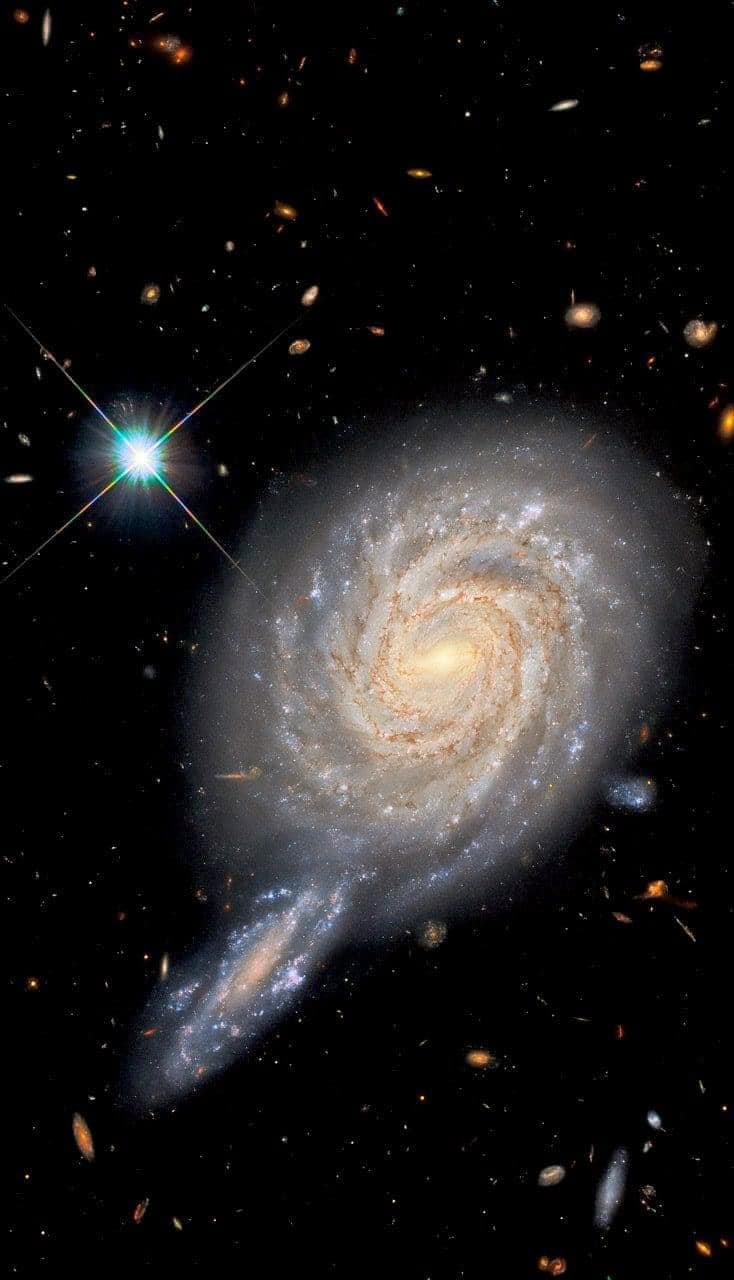
  • Hard to believe my eyes !

    The larger spiral galaxy NGC 105 is about 215 million light years away.

    Captured by #hubbletelescope via Ishmal Khan
    Hard to believe my eyes ! The larger spiral galaxy NGC 105 is about 215 million light years away. Captured by #hubbletelescope via Ishmal Khan
    0 Commenti 0 condivisioni 809 Views
  • Innovation is 90% failure.
    Copy is 90% success.
    Copying and integrating multiple proven ideas is the key to new Innovation.

    By copying wheels to luggage bags, you get trolley bags.

    By copying the telescope as handles, you adapt to heights of users.

    So copy shamelessly and go forward to solve all the problems of society.

    Today, we have all the technologies and business solutions to end poverty.

    We just need more people to copy these proven solutions and implement them.

    The www.bophub.org will help you connect problems and solutions.

    Please contact Jack Sim for collaboration
    Innovation is 90% failure. Copy is 90% success. Copying and integrating multiple proven ideas is the key to new Innovation. By copying wheels to luggage bags, you get trolley bags. By copying the telescope as handles, you adapt to heights of users. So copy shamelessly and go forward to solve all the problems of society. Today, we have all the technologies and business solutions to end poverty. We just need more people to copy these proven solutions and implement them. The www.bophub.org will help you connect problems and solutions. Please contact Jack Sim for collaboration
    0 Commenti 0 condivisioni 32 Views
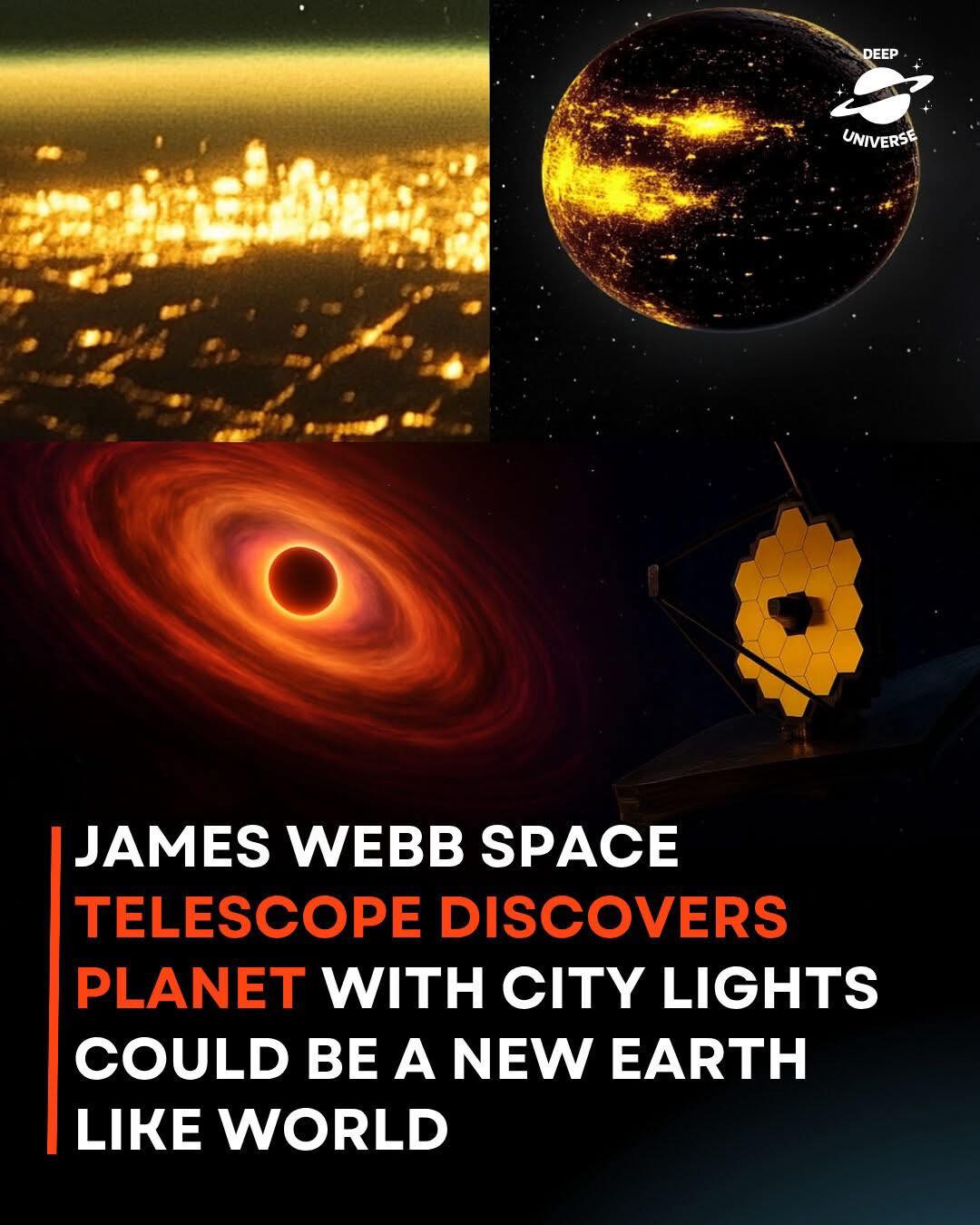
  • In a discovery that feels straight out of science fiction the James Webb Space Telescope has detected a planet with visible city lights, hinting at the possibility of an advanced civilization. This extraordinary finding has astronomers and space enthusiasts around the world buzzing with excitement and speculation about a potential new Earth.

    The planet, located many light-years away, appears to have illuminated areas similar to city lights on Earth, suggesting the presence of artificial structures. Scientists are analysing the data to determine whether these lights could indeed be signs of intelligent life or if there might be a natural explanation. The images captured by the James Webb telescope are some of the clearest ever taken of a distant exoplanet, offering an unprecedented glimpse into another world.

    Experts are calling this discovery “historic” and “mind-blowing” as it may provide the first concrete evidence of life beyond our solar system. Space enthusiasts are sharing the news widely across social media, sparking discussions about extraterrestrial life, colonization, and the future of interstellar exploration.

    The potential new Earth could offer clues about planetary formation, habitability, and the possibility of advanced civilizations elsewhere in the universe. The discovery also raises fascinating questions about how life might develop under different conditions and whether humans could one day visit or communicate with these distant worlds.

    While more research is needed to confirm the origins of the city-like lights, the James Webb Space Telescope’s findings have already captured global attention. Millions are eagerly following updates, hoping for more evidence of extraterrestrial life or advanced civilizations.

    This breakthrough reminds us that the universe is vast and full of mysteries waiting to be uncovered. The detection of city lights on a distant planet could mark a turning point in humanity’s understanding of life beyond Earth and inspire generations of scientists and explorers to come.

    #JamesWebbTelescope #NewEarth #ExoplanetDiscovery #AlienLife #CityLightsInSpace #SpaceMystery
    In a discovery that feels straight out of science fiction the James Webb Space Telescope has detected a planet with visible city lights, hinting at the possibility of an advanced civilization. This extraordinary finding has astronomers and space enthusiasts around the world buzzing with excitement and speculation about a potential new Earth. The planet, located many light-years away, appears to have illuminated areas similar to city lights on Earth, suggesting the presence of artificial structures. Scientists are analysing the data to determine whether these lights could indeed be signs of intelligent life or if there might be a natural explanation. The images captured by the James Webb telescope are some of the clearest ever taken of a distant exoplanet, offering an unprecedented glimpse into another world. Experts are calling this discovery “historic” and “mind-blowing” as it may provide the first concrete evidence of life beyond our solar system. Space enthusiasts are sharing the news widely across social media, sparking discussions about extraterrestrial life, colonization, and the future of interstellar exploration. The potential new Earth could offer clues about planetary formation, habitability, and the possibility of advanced civilizations elsewhere in the universe. The discovery also raises fascinating questions about how life might develop under different conditions and whether humans could one day visit or communicate with these distant worlds. While more research is needed to confirm the origins of the city-like lights, the James Webb Space Telescope’s findings have already captured global attention. Millions are eagerly following updates, hoping for more evidence of extraterrestrial life or advanced civilizations. This breakthrough reminds us that the universe is vast and full of mysteries waiting to be uncovered. The detection of city lights on a distant planet could mark a turning point in humanity’s understanding of life beyond Earth and inspire generations of scientists and explorers to come. #JamesWebbTelescope #NewEarth #ExoplanetDiscovery #AlienLife #CityLightsInSpace #SpaceMystery
    0 Commenti 0 condivisioni 3461 Views
Pagine in Evidenza