• #rsisb
    Roll NO:232
    Foundation level student.
    Story post:20

    ### Description

    **The Journey of “Quarantine”: From Venetian Ports to Global Health**

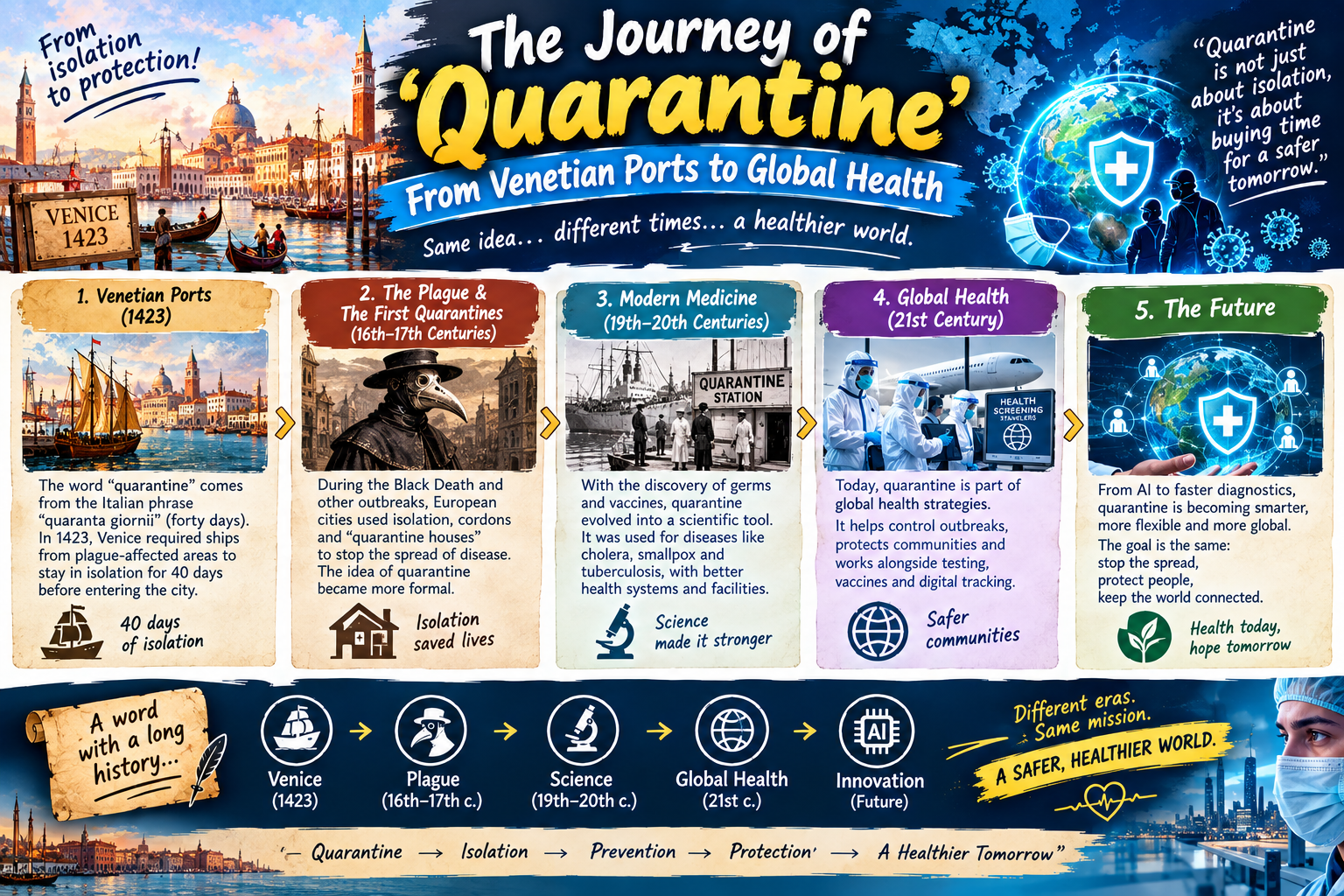
    Have you ever wondered where the word **“quarantine”** came from? The story takes us back centuries to Venetian ports, where maritime communities developed measures to reduce the spread of infectious diseases.

    Explore how the idea behind quarantine evolved over time and became an important part of public health around the world. From historic ports to modern health systems, this fascinating journey shows how language, history, and science can connect in unexpected ways.

    ### Hashtags

    #Quarantine #HistoryOfQuarantine #PublicHealth #HealthHistory #MedicalHistory #History #Science #GlobalHealth #Venice #VenetianHistory #Epidemiology #HealthScience #DiseasePrevention #HistoryFacts #Education #Learning #ScienceEducation #WorldHistory #DidYouKnow #ExploreHistory

    ### Emojis


    #rsisb Roll NO:232 Foundation level student. Story post:20 ### 🦠 Description **The Journey of “Quarantine”: From Venetian Ports to Global Health** ⚓🌍📜 Have you ever wondered where the word **“quarantine”** came from? 🤔 The story takes us back centuries to Venetian ports, where maritime communities developed measures to reduce the spread of infectious diseases. ⚓🚢 Explore how the idea behind quarantine evolved over time and became an important part of public health around the world. 🌎🏥📚 From historic ports to modern health systems, this fascinating journey shows how language, history, and science can connect in unexpected ways. 🔬✨ ### 🔖 Hashtags #Quarantine #HistoryOfQuarantine #PublicHealth #HealthHistory #MedicalHistory #History #Science #GlobalHealth #Venice #VenetianHistory #Epidemiology #HealthScience #DiseasePrevention #HistoryFacts #Education #Learning #ScienceEducation #WorldHistory #DidYouKnow #ExploreHistory ### 🌟 Emojis ⚓🚢🌍📜🏥🔬🦠🧪🧭📚✨🌎🏛️⏳🔎💡🌐🩺🛡️📖
    0 Yorumlar 0 hisse senetleri 648 Views
  • Untitled recording - 2026-09-30T221838.220RSIF 8

    Roll no 93

    Short documentary no5

    Task topic:"The Journey of 'Quarantine': From Venetian Ports to Global Health".

    Bilkul Yeh aapki documentary ke liye **long social media description** hai:


    **The Journey of “Quarantine”: From Venetian Ports to Global Health**


    Have you ever wondered where the word **“quarantine”** came from?


    In this documentary, we explore the fascinating history of quarantine—from its origins in the busy ports of medieval Venice to its important role in modern global health.


    The word “quarantine” comes from the Italian word **“quaranta,” meaning forty**. During times of plague and other infectious diseases, ships and travelers could be kept separated from communities to reduce the risk of spreading illness.


    Over the centuries, quarantine developed into an important public-health practice. As international travel and trade expanded, countries created organized systems to monitor and isolate people who might have been exposed to infectious diseases.


    Today, quarantine is part of a much larger public-health system that includes testing, vaccination, disease surveillance, medical treatment, and prevention.


    The COVID-19 pandemic also showed the world how important public-health measures can become during a global health emergency.


    This documentary takes us through the history, meaning, and evolution of quarantine and shows how an idea that began centuries ago continues to influence public health today.


    **Watch the full documentary and discover the incredible journey of quarantine!**


    **What you will learn:**

    • The origin of the word “quarantine”

    • Its connection to Venice and maritime travel

    • Why forty days became historically significant

    • How quarantine practices developed over time

    • The role of quarantine in modern public health

    • How global health systems respond to infectious diseases


    **Key Message:**

    The history of quarantine reminds us that protecting public health is not a new challenge. For centuries, people have searched for ways to prevent diseases from spreading and protect their communities.


    From Venetian ports to a connected modern world, the journey of quarantineUntitled recording - 2026-09-30T221838.220RSIF 8

    Roll no 93

    Short documentary no5

    Task topic:"The Journey of 'Quarantine': From Venetian Ports to Global Health".

    Bilkul Yeh aapki documentary ke liye **long social media description** hai:


    **The Journey of “Quarantine”: From Venetian Ports to Global Health**


    Have you ever wondered where the word **“quarantine”** came from?


    In this documentary, we explore the fascinating history of quarantine—from its origins in the busy ports of medieval Venice to its important role in modern global health.


    The word “quarantine” comes from the Italian word **“quaranta,” meaning forty**. During times of plague and other infectious diseases, ships and travelers could be kept separated from communities to reduce the risk of spreading illness.


    Over the centuries, quarantine developed into an important public-health practice. As international travel and trade expanded, countries created organized systems to monitor and isolate people who might have been exposed to infectious diseases.


    Today, quarantine is part of a much larger public-health system that includes testing, vaccination, disease surveillance, medical treatment, and prevention.


    The COVID-19 pandemic also showed the world how important public-health measures can become during a global health emergency.


    This documentary takes us through the history, meaning, and evolution of quarantine and shows how an idea that began centuries ago continues to influence public health today.


    **Watch the full documentary and discover the incredible journey of quarantine!**


    **What you will learn:**

    • The origin of the word “quarantine”

    • Its connection to Venice and maritime travel

    • Why forty days became historically significant

    • How quarantine practices developed over time

    • The role of quarantine in modern public health

    • How global health systems respond to infectious diseases


    **Key Message:**

    The history of quarantine reminds us that protecting public health is not a new challenge. For centuries, people have searched for ways to prevent diseases from spreading and protect their communities.


    From Venetian ports to a connected modern world, the journey of quarantine
    Untitled recording - 2026-09-30T221838.220RSIF 8 Roll no 93 Short documentary no5 Task topic:"The Journey of 'Quarantine': From Venetian Ports to Global Health". Bilkul 👍 Yeh aapki documentary ke liye **long social media description** hai: 🌍 **The Journey of “Quarantine”: From Venetian Ports to Global Health** Have you ever wondered where the word **“quarantine”** came from? 🤔 In this documentary, we explore the fascinating history of quarantine—from its origins in the busy ports of medieval Venice to its important role in modern global health. The word “quarantine” comes from the Italian word **“quaranta,” meaning forty**. During times of plague and other infectious diseases, ships and travelers could be kept separated from communities to reduce the risk of spreading illness. Over the centuries, quarantine developed into an important public-health practice. As international travel and trade expanded, countries created organized systems to monitor and isolate people who might have been exposed to infectious diseases. Today, quarantine is part of a much larger public-health system that includes testing, vaccination, disease surveillance, medical treatment, and prevention. The COVID-19 pandemic also showed the world how important public-health measures can become during a global health emergency. This documentary takes us through the history, meaning, and evolution of quarantine and shows how an idea that began centuries ago continues to influence public health today. 🎥 **Watch the full documentary and discover the incredible journey of quarantine!** 📚 **What you will learn:** • The origin of the word “quarantine” • Its connection to Venice and maritime travel • Why forty days became historically significant • How quarantine practices developed over time • The role of quarantine in modern public health • How global health systems respond to infectious diseases 💡 **Key Message:** The history of quarantine reminds us that protecting public health is not a new challenge. For centuries, people have searched for ways to prevent diseases from spreading and protect their communities. 🌎 From Venetian ports to a connected modern world, the journey of quarantineUntitled recording - 2026-09-30T221838.220RSIF 8 Roll no 93 Short documentary no5 Task topic:"The Journey of 'Quarantine': From Venetian Ports to Global Health". Bilkul 👍 Yeh aapki documentary ke liye **long social media description** hai: 🌍 **The Journey of “Quarantine”: From Venetian Ports to Global Health** Have you ever wondered where the word **“quarantine”** came from? 🤔 In this documentary, we explore the fascinating history of quarantine—from its origins in the busy ports of medieval Venice to its important role in modern global health. The word “quarantine” comes from the Italian word **“quaranta,” meaning forty**. During times of plague and other infectious diseases, ships and travelers could be kept separated from communities to reduce the risk of spreading illness. Over the centuries, quarantine developed into an important public-health practice. As international travel and trade expanded, countries created organized systems to monitor and isolate people who might have been exposed to infectious diseases. Today, quarantine is part of a much larger public-health system that includes testing, vaccination, disease surveillance, medical treatment, and prevention. The COVID-19 pandemic also showed the world how important public-health measures can become during a global health emergency. This documentary takes us through the history, meaning, and evolution of quarantine and shows how an idea that began centuries ago continues to influence public health today. 🎥 **Watch the full documentary and discover the incredible journey of quarantine!** 📚 **What you will learn:** • The origin of the word “quarantine” • Its connection to Venice and maritime travel • Why forty days became historically significant • How quarantine practices developed over time • The role of quarantine in modern public health • How global health systems respond to infectious diseases 💡 **Key Message:** The history of quarantine reminds us that protecting public health is not a new challenge. For centuries, people have searched for ways to prevent diseases from spreading and protect their communities. 🌎 From Venetian ports to a connected modern world, the journey of quarantine
    0 Yorumlar 0 hisse senetleri 307 Views
  • #rsisb
    Roll no.239
    Story post no.19
    Foundation Level


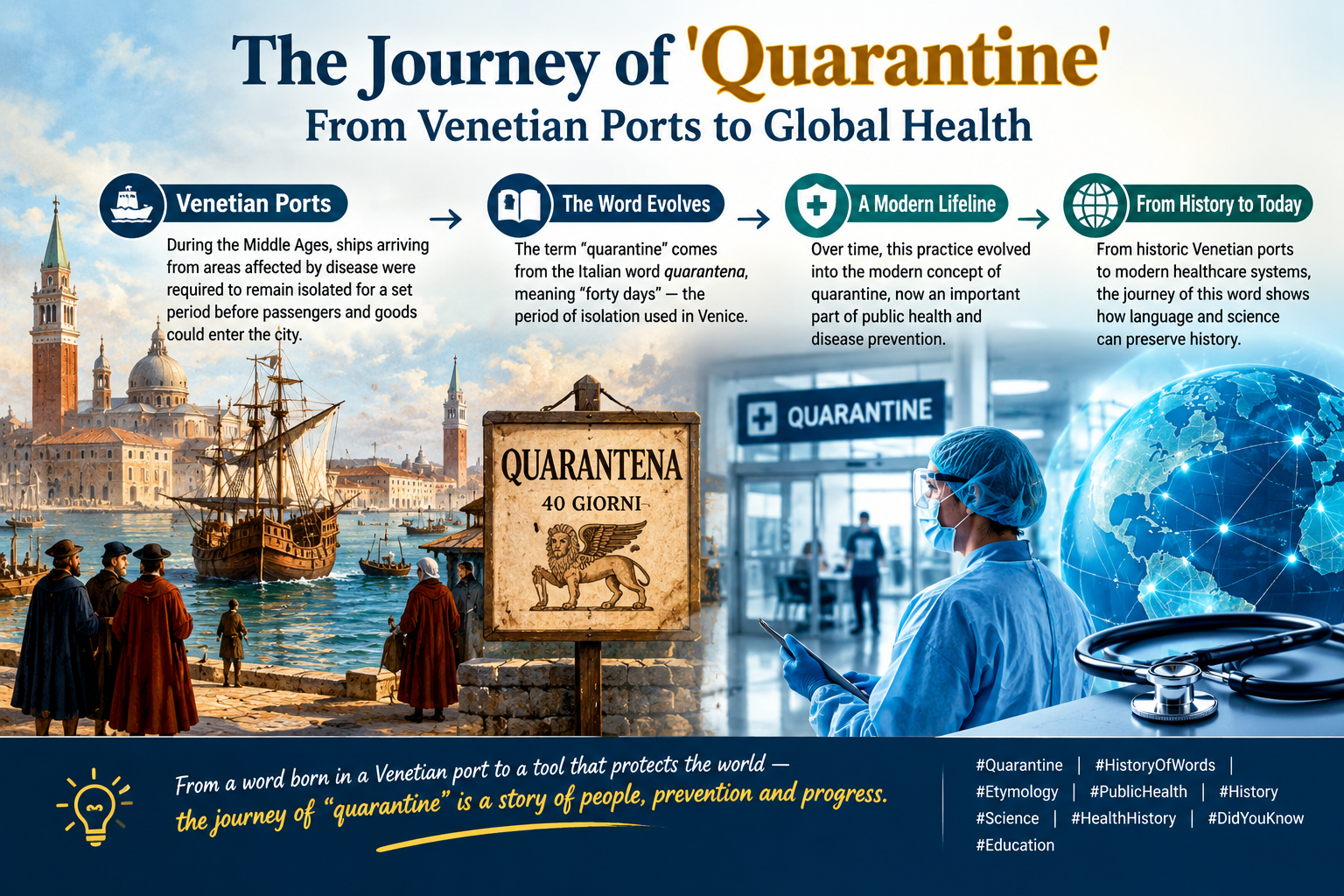
    Did you know the word **“quarantine”** has its roots in Venice? During the Middle Ages, ships arriving from areas affected by disease were required to remain isolated for a set period before passengers and goods could enter the city.

    Over time, this practice evolved into the modern concept of **quarantine**, now an important part of public health and disease prevention.

    From historic Venetian ports to modern healthcare systems, the journey of this word shows how language and science can preserve history.

    #Quarantine #HistoryOfWords #Etymology #PublicHealth #History #Science #HealthHistory #DidYouKnow #Education
    #rsisb Roll no.239 Story post no.19 Foundation Level Did you know the word **“quarantine”** has its roots in Venice? During the Middle Ages, ships arriving from areas affected by disease were required to remain isolated for a set period before passengers and goods could enter the city. Over time, this practice evolved into the modern concept of **quarantine**, now an important part of public health and disease prevention. 🧪🏥 From historic Venetian ports to modern healthcare systems, the journey of this word shows how language and science can preserve history. #Quarantine #HistoryOfWords #Etymology #PublicHealth #History #Science #HealthHistory #DidYouKnow #Education
    0 Yorumlar 0 hisse senetleri 233 Views
  • Bye Bye Pensacola !! Hello Venice Florida
    Bye Bye Pensacola !! Hello Venice Florida
    0 Yorumlar 0 hisse senetleri 208 Views
  • Good Bye Venice, Florida - Hello Miami !!
    Good Bye Venice, Florida - Hello Miami !!
    0 Yorumlar 0 hisse senetleri 672 Views
  • The Quran, the holy book of Islam, has been an important part of the Islamic faith for over 1400 years. However, it was not until the invention of the printing press in the 15th century that the Quran was able to be printed and disseminated on a large scale. This article will explore the history of the printed Quran and its impact on the Islamic faith and culture.

    The first known printed Quran was produced in Venice, Italy in 1537 by an Italian printer named Gabriele Giolito. Prior to this, the Quran was primarily transmitted through hand-written manuscripts. The process of copying the Quran by hand was a time-consuming and labor-intensive task, and as a result, only a limited number of copies were produced. The invention of the printing press changed this, as it allowed for the mass production of copies of the Quran.

    The first printed Quran was met with mixed reactions from the Muslim community. Some saw it as a way to make the Quran more widely available and accessible to the masses, while others feared that the printed Quran would lead to errors and inaccuracies in the text. However, as the technology and techniques for printing improved, the quality and accuracy of the printed Quran also improved.

    The printed Quran also had a significant impact on the spread of Islam. With the ability to produce large numbers of copies, the Quran was able to reach a wider audience and the faith was able to spread more rapidly. The printed Quran also allowed for the development of the first Quran commentaries and exegesis, which helped to deepen the understanding of the Quran among scholars and the general public.

    In the modern era, the printed Quran continues to play an important role in the Islamic faith. The mass production of the Quran has made it more widely available and accessible to people around the world. Additionally, advances in printing technology have allowed for the production of high-quality, accurate copies of the Quran, ensuring that the text is preserved for future generations.

    In conclusion, the history of the printed Quran is a testament to the power of technology and its ability to shape and disseminate religion. The printed Quran has played a crucial role in the spread of Islam and continues to be an important part of the Islamic faith today.
    The Quran, the holy book of Islam, has been an important part of the Islamic faith for over 1400 years. However, it was not until the invention of the printing press in the 15th century that the Quran was able to be printed and disseminated on a large scale. This article will explore the history of the printed Quran and its impact on the Islamic faith and culture. The first known printed Quran was produced in Venice, Italy in 1537 by an Italian printer named Gabriele Giolito. Prior to this, the Quran was primarily transmitted through hand-written manuscripts. The process of copying the Quran by hand was a time-consuming and labor-intensive task, and as a result, only a limited number of copies were produced. The invention of the printing press changed this, as it allowed for the mass production of copies of the Quran. The first printed Quran was met with mixed reactions from the Muslim community. Some saw it as a way to make the Quran more widely available and accessible to the masses, while others feared that the printed Quran would lead to errors and inaccuracies in the text. However, as the technology and techniques for printing improved, the quality and accuracy of the printed Quran also improved. The printed Quran also had a significant impact on the spread of Islam. With the ability to produce large numbers of copies, the Quran was able to reach a wider audience and the faith was able to spread more rapidly. The printed Quran also allowed for the development of the first Quran commentaries and exegesis, which helped to deepen the understanding of the Quran among scholars and the general public. In the modern era, the printed Quran continues to play an important role in the Islamic faith. The mass production of the Quran has made it more widely available and accessible to people around the world. Additionally, advances in printing technology have allowed for the production of high-quality, accurate copies of the Quran, ensuring that the text is preserved for future generations. In conclusion, the history of the printed Quran is a testament to the power of technology and its ability to shape and disseminate religion. The printed Quran has played a crucial role in the spread of Islam and continues to be an important part of the Islamic faith today.
    0 Yorumlar 0 hisse senetleri 979 Views
  • Book burning incidents have taken place throughout history for ideological reasons. The burning of the Bible has also occurred in Europe. Here are some notable incidents of Bible burning in Europe:
    Martin Luthers 1534 German translation of the Bible was burned in Catholic-dominated parts of Germany in 1624, by order of the Pope
    1
    .
    In 1553, the Talmud was publicly burned in Venice, Italy, which was a center for the printing of Jewish books
    1
    .
    In 1568, there was a lesser-known burning of Jewish books in Venice, Italy
    1
    .
    In 1490, a number of Hebrew Bibles and other Jewish books were burned at the behest of the Spanish Inquisition
    1
    .
    In 1522, the authorities at Leiden ordered the confiscation of all Lutheran works in the town, but apparently did not burn them
    1
    .
    The first mass book burning in the North was in 1521 in the ecclesiastical territory of Utrecht. The first mass book burning in Amsterdam took place later, in 1526. Thereafter, public book burning remained part of life in the Habsburg Empire
    1
    .
    In recent years, there have been incidents of burning the Bible in Europe. Here are some examples:
    In January 2023, a man named Erinipuzha Mustafa burned the Bible in Kerala, India, in revenge over the desecration of the Quran in Europe
    3
    .
    In April 2017, a UK rabbi-politician burned the Christian Bible on the eve of Passover, sparking controversy in the British media
    5
    .
    In July 2023, a request was filed to burn the Torah and Bible outside the Israeli embassy in Sweden, following the burning of a Quran outside a mosque in Stockholm
    2
    .
    Some commentators have suggested that burning holy books should be illegal, as it is a manifestation of a phenomenon widespread across European countries that are on their way to becoming post-Christian
    6
    . In Malaysia, the prime minister has stated that the burning of any religious book or text, including the Quran, the Bible, or the Hindu holy texts, will not be tolerated
    6
    . In 2010, a high court judge banned the burning of religious books in South Africa, and the following year, a UK court jailed a man for burning the Quran in public
    6
    .
    Book burning incidents have taken place throughout history for ideological reasons. The burning of the Bible has also occurred in Europe. Here are some notable incidents of Bible burning in Europe: Martin Luther's 1534 German translation of the Bible was burned in Catholic-dominated parts of Germany in 1624, by order of the Pope 1 . In 1553, the Talmud was publicly burned in Venice, Italy, which was a center for the printing of Jewish books 1 . In 1568, there was a lesser-known burning of Jewish books in Venice, Italy 1 . In 1490, a number of Hebrew Bibles and other Jewish books were burned at the behest of the Spanish Inquisition 1 . In 1522, the authorities at Leiden ordered the confiscation of all Lutheran works in the town, but apparently did not burn them 1 . The first mass book burning in the North was in 1521 in the ecclesiastical territory of Utrecht. The first mass book burning in Amsterdam took place later, in 1526. Thereafter, public book burning remained part of life in the Habsburg Empire 1 . In recent years, there have been incidents of burning the Bible in Europe. Here are some examples: In January 2023, a man named Erinipuzha Mustafa burned the Bible in Kerala, India, in revenge over the desecration of the Quran in Europe 3 . In April 2017, a UK rabbi-politician burned the Christian Bible on the eve of Passover, sparking controversy in the British media 5 . In July 2023, a request was filed to burn the Torah and Bible outside the Israeli embassy in Sweden, following the burning of a Quran outside a mosque in Stockholm 2 . Some commentators have suggested that burning holy books should be illegal, as it is a manifestation of a phenomenon widespread across European countries that are on their way to becoming post-Christian 6 . In Malaysia, the prime minister has stated that the burning of any religious book or text, including the Quran, the Bible, or the Hindu holy texts, will not be tolerated 6 . In 2010, a high court judge banned the burning of religious books in South Africa, and the following year, a UK court jailed a man for burning the Quran in public 6 .
    0 Yorumlar 0 hisse senetleri 1347 Views
  • History of Interest

    The story of bank interest is tied closely to the history of money, finance, and lending, dating back thousands of years. Here’s a brief overview:

    1. Ancient Origins

    • Early Lending Practices: The concept of interest has roots in ancient Mesopotamia around 3000 BCE, where agricultural communities would borrow seeds or livestock, and lenders expected repayment with a surplus. This surplus was the earliest form of interest.
    • Code of Hammurabi: In Babylon around 1750 BCE, the Code of Hammurabi formalized rules around loans and interest rates. Interest was usually paid in the form of crops or goods, and the rates were capped by law.
    • Ancient Greece & Rome: The Greeks and Romans had well-developed banking systems, including moneylenders. Interest was accepted, though there were often debates about fairness, with rates regulated by law.

    2. Religious Views on Interest

    • Judaism: In the Hebrew Bible (Old Testament), charging interest to fellow Jews was prohibited, but it was allowed with foreigners.
    • Christianity: Early Christian teachings considered interest (usury) immoral. The Catholic Church banned usury in the Middle Ages, leading to Jewish communities often filling the role of moneylenders in Europe.
    • Islam: In Islamic finance, charging or paying interest (riba) is strictly forbidden. Islamic banking follows Sharia law, using profit-sharing models instead.

    3. Medieval Europe

    • Rise of Moneylenders: In the Middle Ages, Italian city-states like Venice and Florence developed banking systems, despite religious prohibitions. Moneylenders often charged interest, but the rates were capped, and excessive interest was frowned upon.
    • Medici Bank: In the 15th century, the Medici family of Florence established one of the first major banks, using creative methods to collect “fees” instead of direct interest to comply with religious restrictions.

    4. Modern Banking (17th - 19th Century)

    • Bank of England: Established in 1694, the Bank of England was one of the first central banks, using interest as a tool to manage national debt and support economic growth.
    • Fractional Reserve Banking: This system, where banks lend out more money than they have in deposits, became widespread. It increased the use of interest as a means to generate profits for banks and incentivize savings for depositors.
    • Industrial Revolution: Interest became a fundamental tool in financing factories, railroads, and other major industrial projects. It helped foster the growth of modern capitalism.

    5. 20th Century to Present

    • Global Central Banks: The 20th century saw the rise of central banks globally, using interest rates to control inflation, unemployment, and economic stability. The U.S. Federal Reserve, for example, adjusts interest rates to influence the economy.
    • Interest on Savings & Loans: Modern banks offer interest on savings accounts as a way to attract deposits. On the flip side, they charge interest on loans to make a profit, pay depositors, and cover operating costs.
    • Subprime Crisis (2008): A significant example of interest-related issues was the 2008 financial crisis, partially caused by risky subprime mortgages with adjustable interest rates. This led to a massive global economic downturn.

    Types of Interest Today

    • Simple Interest: Calculated only on the principal amount of a loan or investment.
    • Compound Interest: Calculated on the principal and on any interest already earned or charged, leading to exponential growth or debt.
    • Fixed vs. Variable Interest Rates: Loans can have a fixed rate (unchanging) or a variable rate (fluctuates with the market).

    Why Do Banks Charge Interest?

    • Profit for Operations: Banks charge interest to make profits, cover operational costs, and pay interest to depositors.
    • Compensation for Risk: Lending involves risk; interest compensates lenders for the potential of borrowers defaulting.
    • Inflation Hedge: Interest helps protect lenders from inflation, which reduces the value of money over time.
    • Encourages Savings: Offering interest on deposits encourages people to save money, providing funds that banks can use for loans.

    The concept of interest has evolved from simple lending practices to a complex financial tool, affecting economies, religions, and societies throughout history. Today, it remains a crucial part of modern financial systems, shaping everything from individual savings to global monetary policy.
    History of Interest The story of bank interest is tied closely to the history of money, finance, and lending, dating back thousands of years. Here’s a brief overview: 1. Ancient Origins • Early Lending Practices: The concept of interest has roots in ancient Mesopotamia around 3000 BCE, where agricultural communities would borrow seeds or livestock, and lenders expected repayment with a surplus. This surplus was the earliest form of interest. • Code of Hammurabi: In Babylon around 1750 BCE, the Code of Hammurabi formalized rules around loans and interest rates. Interest was usually paid in the form of crops or goods, and the rates were capped by law. • Ancient Greece & Rome: The Greeks and Romans had well-developed banking systems, including moneylenders. Interest was accepted, though there were often debates about fairness, with rates regulated by law. 2. Religious Views on Interest • Judaism: In the Hebrew Bible (Old Testament), charging interest to fellow Jews was prohibited, but it was allowed with foreigners. • Christianity: Early Christian teachings considered interest (usury) immoral. The Catholic Church banned usury in the Middle Ages, leading to Jewish communities often filling the role of moneylenders in Europe. • Islam: In Islamic finance, charging or paying interest (riba) is strictly forbidden. Islamic banking follows Sharia law, using profit-sharing models instead. 3. Medieval Europe • Rise of Moneylenders: In the Middle Ages, Italian city-states like Venice and Florence developed banking systems, despite religious prohibitions. Moneylenders often charged interest, but the rates were capped, and excessive interest was frowned upon. • Medici Bank: In the 15th century, the Medici family of Florence established one of the first major banks, using creative methods to collect “fees” instead of direct interest to comply with religious restrictions. 4. Modern Banking (17th - 19th Century) • Bank of England: Established in 1694, the Bank of England was one of the first central banks, using interest as a tool to manage national debt and support economic growth. • Fractional Reserve Banking: This system, where banks lend out more money than they have in deposits, became widespread. It increased the use of interest as a means to generate profits for banks and incentivize savings for depositors. • Industrial Revolution: Interest became a fundamental tool in financing factories, railroads, and other major industrial projects. It helped foster the growth of modern capitalism. 5. 20th Century to Present • Global Central Banks: The 20th century saw the rise of central banks globally, using interest rates to control inflation, unemployment, and economic stability. The U.S. Federal Reserve, for example, adjusts interest rates to influence the economy. • Interest on Savings & Loans: Modern banks offer interest on savings accounts as a way to attract deposits. On the flip side, they charge interest on loans to make a profit, pay depositors, and cover operating costs. • Subprime Crisis (2008): A significant example of interest-related issues was the 2008 financial crisis, partially caused by risky subprime mortgages with adjustable interest rates. This led to a massive global economic downturn. Types of Interest Today • Simple Interest: Calculated only on the principal amount of a loan or investment. • Compound Interest: Calculated on the principal and on any interest already earned or charged, leading to exponential growth or debt. • Fixed vs. Variable Interest Rates: Loans can have a fixed rate (unchanging) or a variable rate (fluctuates with the market). Why Do Banks Charge Interest? • Profit for Operations: Banks charge interest to make profits, cover operational costs, and pay interest to depositors. • Compensation for Risk: Lending involves risk; interest compensates lenders for the potential of borrowers defaulting. • Inflation Hedge: Interest helps protect lenders from inflation, which reduces the value of money over time. • Encourages Savings: Offering interest on deposits encourages people to save money, providing funds that banks can use for loans. The concept of interest has evolved from simple lending practices to a complex financial tool, affecting economies, religions, and societies throughout history. Today, it remains a crucial part of modern financial systems, shaping everything from individual savings to global monetary policy.
    0 Yorumlar 0 hisse senetleri 978 Views
  • The Origin Story of Coffee — A Story Essay

    Long before coffee filled cafés, fueled office mornings, and became the world’s favorite stimulant, it was simply a mystery growing on the slopes of distant mountains.
    The legend begins not in Europe or Arabia, but in the green highlands of Ethiopia.

    ⸻

    Chapter 1 — The Goat Who Wouldn’t Sleep

    Hundreds of years ago, a young Ethiopian goat herder named Kaldi noticed something strange.

    Every afternoon, his goats wandered toward a certain shrub with bright red berries.
    They chewed the berries… and suddenly became wild with energy—jumping, running, dancing, refusing to sleep.

    Kaldi tasted the berries himself.

    A warm surge of alertness ran through him.
    Something powerful lived inside those tiny red cherries.

    He told the local monk, who boiled the berries into a drink.
    That night, the monk stayed awake through all his prayers without feeling tired.

    The news spread:

    “A magical berry has been found in the mountains.
    A berry that keeps the mind awake.”

    This was the first whisper of coffee.

    ⸻

    Chapter 2 — The Monks of Yemen Discover a Secret Weapon

    By the 1400s, coffee cherries traveled across the Red Sea into Yemen, specifically the port city of Mocha, which would later lend its name to mocha coffee.

    Yemeni Sufi monks discovered that the drink helped them stay awake during long nights of worship and meditation.

    They roasted the beans…
    ground them…
    and boiled them into a dark, heavenly liquid.

    This was the birth of true brewed coffee.

    From the monasteries of Yemen, coffee spread to the mosques, the marketplaces, and the streets.

    Mocha became the world’s first coffee capital.

    ⸻

    Chapter 3 — The World’s First Coffeehouses

    Coffeehouses—called qahwah khaneh—opened first in Mecca, Medina, and then across the Islamic world.
    They became places where:
    • Scholars debated
    • Poets recited verses
    • Merchants planned deals
    • Friends met
    • Ideas were exchanged freely

    Coffeehouses became known as “Schools of the Wise.”

    But not everyone liked this freedom…

    Some conservative jurists feared that coffeehouses spread unconventional ideas.
    Some rulers feared political discussions.
    So bans came and went.

    But even when coffee was condemned, smuggled, or forbidden, people refused to give it up.

    The drink was too powerful.
    Too inspiring.
    Too loved.

    ⸻

    Chapter 4 — Coffee Reaches Istanbul and Changes the Empire

    By the 1500s, coffee reached Constantinople (Istanbul), capital of the Ottoman Empire.

    There it became a phenomenon.

    The Ottomans perfected the art of making strong, finely ground Turkish coffee.
    Lavish coffeehouses appeared on every street—so influential that sultans feared them, sometimes even banning them.

    But nothing could stop coffee.
    It became woven into Turkish culture, marriage rituals, and daily life.

    The Ottomans helped spread coffee across three continents.

    ⸻

    Chapter 5 — Smugglers, Sailors, and the Coffee of Europe

    The Arabs tried to protect the coffee plant by banning the export of fertile seeds.

    But one day, a clever Indian pilgrim named Baba Budan smuggled seven seeds under his clothes and carried them to India.

    Those seven seeds broke the monopoly and transformed the world.

    Soon:
    • The Dutch planted coffee in Indonesia
    • The French grew it in the Caribbean
    • The Portuguese spread it to Brazil

    Brazil’s climate proved perfect, and it eventually became the largest coffee producer on Earth—a title it still holds today.

    Coffee had gone global.

    ⸻

    Chapter 6 — Europe Falls in Love

    Europe first heard of coffee as “the Arab wine.”

    It arrived in Venice, then London, Paris, Vienna, and beyond.
    At first, people feared it—priests called it the “bitter invention of Satan.”

    But soon, coffeehouses became the center of European business and culture.

    In London, they were called “penny universities” because for one penny, you could buy a cup of coffee and learn more from the conversations there than at an actual university.

    Ideas that shaped revolutions, trading companies, newspapers, literature, and science were born over cups of coffee.

    ⸻

    Chapter 7 — From a Wild Cherry to the World’s Most Beloved Drink

    Today, coffee is:
    • A $100+ billion global industry
    • The second-most traded commodity after oil
    • The morning ritual of billions
    • A symbol of connection, creativity, and comfort

    But behind every steaming cup lies a story that began with goats in Ethiopia, monks in Yemen, merchants in Istanbul, sailors in Europe, and farmers in Brazil.

    It is a story of discovery, resistance, love, trade, and transformation.

    ⸻

    One-Line Summary

    Coffee started as a mysterious berry in the mountains of Ethiopia…
    became a spiritual drink in Yemen…
    a social revolution in Istanbul…
    an intellectual engine in Europe…
    and finally the global heartbeat of modern life.

    ☕ The Origin Story of Coffee — A Story Essay Long before coffee filled cafés, fueled office mornings, and became the world’s favorite stimulant, it was simply a mystery growing on the slopes of distant mountains. The legend begins not in Europe or Arabia, but in the green highlands of Ethiopia. ⸻ 🌱 Chapter 1 — The Goat Who Wouldn’t Sleep Hundreds of years ago, a young Ethiopian goat herder named Kaldi noticed something strange. Every afternoon, his goats wandered toward a certain shrub with bright red berries. They chewed the berries… and suddenly became wild with energy—jumping, running, dancing, refusing to sleep. Kaldi tasted the berries himself. A warm surge of alertness ran through him. Something powerful lived inside those tiny red cherries. He told the local monk, who boiled the berries into a drink. That night, the monk stayed awake through all his prayers without feeling tired. The news spread: “A magical berry has been found in the mountains. A berry that keeps the mind awake.” This was the first whisper of coffee. ⸻ 🕌 Chapter 2 — The Monks of Yemen Discover a Secret Weapon By the 1400s, coffee cherries traveled across the Red Sea into Yemen, specifically the port city of Mocha, which would later lend its name to mocha coffee. Yemeni Sufi monks discovered that the drink helped them stay awake during long nights of worship and meditation. They roasted the beans… ground them… and boiled them into a dark, heavenly liquid. This was the birth of true brewed coffee. From the monasteries of Yemen, coffee spread to the mosques, the marketplaces, and the streets. Mocha became the world’s first coffee capital. ⸻ ☕ Chapter 3 — The World’s First Coffeehouses Coffeehouses—called qahwah khaneh—opened first in Mecca, Medina, and then across the Islamic world. They became places where: • Scholars debated • Poets recited verses • Merchants planned deals • Friends met • Ideas were exchanged freely Coffeehouses became known as “Schools of the Wise.” But not everyone liked this freedom… Some conservative jurists feared that coffeehouses spread unconventional ideas. Some rulers feared political discussions. So bans came and went. But even when coffee was condemned, smuggled, or forbidden, people refused to give it up. The drink was too powerful. Too inspiring. Too loved. ⸻ 🌍 Chapter 4 — Coffee Reaches Istanbul and Changes the Empire By the 1500s, coffee reached Constantinople (Istanbul), capital of the Ottoman Empire. There it became a phenomenon. The Ottomans perfected the art of making strong, finely ground Turkish coffee. Lavish coffeehouses appeared on every street—so influential that sultans feared them, sometimes even banning them. But nothing could stop coffee. It became woven into Turkish culture, marriage rituals, and daily life. The Ottomans helped spread coffee across three continents. ⸻ 🚢 Chapter 5 — Smugglers, Sailors, and the Coffee of Europe The Arabs tried to protect the coffee plant by banning the export of fertile seeds. But one day, a clever Indian pilgrim named Baba Budan smuggled seven seeds under his clothes and carried them to India. Those seven seeds broke the monopoly and transformed the world. Soon: • The Dutch planted coffee in Indonesia • The French grew it in the Caribbean • The Portuguese spread it to Brazil Brazil’s climate proved perfect, and it eventually became the largest coffee producer on Earth—a title it still holds today. Coffee had gone global. ⸻ ☕ Chapter 6 — Europe Falls in Love Europe first heard of coffee as “the Arab wine.” It arrived in Venice, then London, Paris, Vienna, and beyond. At first, people feared it—priests called it the “bitter invention of Satan.” But soon, coffeehouses became the center of European business and culture. In London, they were called “penny universities” because for one penny, you could buy a cup of coffee and learn more from the conversations there than at an actual university. Ideas that shaped revolutions, trading companies, newspapers, literature, and science were born over cups of coffee. ⸻ 🔥 Chapter 7 — From a Wild Cherry to the World’s Most Beloved Drink Today, coffee is: • A $100+ billion global industry • The second-most traded commodity after oil • The morning ritual of billions • A symbol of connection, creativity, and comfort But behind every steaming cup lies a story that began with goats in Ethiopia, monks in Yemen, merchants in Istanbul, sailors in Europe, and farmers in Brazil. It is a story of discovery, resistance, love, trade, and transformation. ⸻ ✨ One-Line Summary Coffee started as a mysterious berry in the mountains of Ethiopia… became a spiritual drink in Yemen… a social revolution in Istanbul… an intellectual engine in Europe… and finally the global heartbeat of modern life.

    0 Yorumlar 0 hisse senetleri 1479 Views
  • ** Coffee — The Bitter Invention of Satan

    A Detailed Story Essay**

    There was a time, not very long ago, when coffee—the drink that fuels mornings, conversations, creativity, and entire nations—was treated as something dark, dangerous, and devilish.

    A time when priests warned the faithful…
    Sultans feared rebellion…
    Scholars debated night and day…
    And a single cup of coffee could get you thrown out of society.

    This is the dramatic, twisting, unforgettable story of why coffee was once called:

    “The bitter invention of Satan.”

    ⸻

    Chapter 1 — A Strange New Drink Arrives in Europe

    It begins in the 1600s.

    Ships were returning from the trading ports of Mocha, Cairo, and Istanbul.
    Among spices and silks, sailors brought back sacks of dark, mysterious beans.

    Europe had never seen anything like this.

    When roasted, the beans released a smell so powerful people walked toward it without thinking.
    When brewed, the drink was black, strong, and bitter—nothing like beer, wine, or milk.

    People whispered:
    • “Is it a medicine?”
    • “A poison?”
    • “A foreign magic?”

    And some, especially conservative clergymen in Italy, said something more dramatic:

    “This bitter drink must be the invention of Satan himself.”

    Why?

    Because coffee did something they did not trust:
    it woke people up.

    And an awakened population is always dangerous to those who value obedience over curiosity.

    ⸻

    Chapter 2 — Why Coffee Was Feared

    Coffee made people alert.
    Focused.
    Talkative.
    Energetic.

    It kept them awake late into the night—not just to pray, but to think.
    To discuss.
    To question.

    In a Europe where the Church controlled information and kings controlled society, a drink that sharpened the mind was deeply suspicious.

    Priests claimed:
    • “Coffee leads people to sinful conversations.”
    • “It encourages gossip and argument.”
    • “It pulls men away from wine, which is blessed.”
    • “It comes from Muslim lands—beware!”

    To many, coffee symbolized:
    • foreign influence,
    • free thought,
    • new ideas,
    • and the independence of the mind.

    And nothing scared authorities more.

    ⸻

    Chapter 3 — The Pope Must Decide

    The controversy reached Rome.

    By 1600, coffee was so popular that Pope Clement VIII was forced to address it.
    The Church was divided:
    • Some cardinals insisted coffee was a demonic drink from the land of the infidels.
    • Others said it was harmless.
    • Merchants begged for it to be allowed—they were making fortunes.
    • Priests warned that drinking it risked the soul.

    So the Pope did something brilliant:
    He asked to taste it himself.

    Servants roasted the beans.
    Ground them.
    Poured the dark, aromatic liquid into a cup of fine porcelain.

    Clement VIII lifted it, smelled it, and took a sip.

    Silence.

    Then he smiled.

    And he famously said:

    “This drink is so delicious that it would be a shame to let the unbelievers have exclusive use of it.
    We shall baptize it.”

    With that moment, the Church blessed coffee.

    The drink that was once “the invention of Satan” became the official drink of Europe’s thinkers and priests.

    ⸻

    Chapter 4 — The Coffeehouses That Terrified Kings

    Even after the Pope approved it, rulers were troubled.

    In London, Paris, Vienna, and Venice, coffeehouses suddenly appeared—places where people gathered to talk freely.

    Inside these buzzing rooms:
    • Scientists debated new theories
    • Philosophers challenged old ideas
    • Merchants planned business deals
    • Writers shared poetry
    • Citizens criticized their leaders

    They were nicknamed “penny universities” because for the price of one penny, a person could sit with the smartest minds and learn more than any classroom could teach.

    To governments, this was dangerous.
    Too much freedom.
    Too much intelligence.
    Too much possibility.

    So kings tried to ban coffeehouses.

    But people refused.

    Coffee was no longer a drink—
    it had become a symbol of free thought.

    ⸻

    Chapter 5 — Coffee Travels East and Sparks Fear Again

    While Europe was drinking happily, the Ottoman world was struggling with its own fear of coffee.

    Coffeehouses in Istanbul became centers of political discussion.
    Sultans worried they might inspire rebellion.
    So bans were declared:
    • “Coffee is sinful.”
    • “Coffee leads to immorality.”
    • “Coffee creates troublemakers.”

    One Sultan—Murad IV—took the harshest approach:
    he banned coffee completely and punished drinkers severely.

    Coffee was not just a drink now.
    It was a revolution in a cup.

    And every authority that feared revolution tried to destroy it.

    ⸻

    Chapter 6 — How Coffee Won

    But ideas cannot be killed.
    And neither can the drink that fuels ideas.

    Over time:
    • Priests reversed their positions
    • Scholars accepted its benefits
    • Doctors prescribed it
    • Sultans abandoned bans
    • Merchants grew rich
    • Poets wrote verses about it

    Coffee went from “devil’s brew” to the drink of enlightenment.

    It powered:
    • the scientific revolution,
    • the Enlightenment era,
    • the Ottoman Golden Age,
    • and later the rise of modern cafés.

    Today, it is one of the most loved beverages in the world.

    The “bitter invention of Satan” became the sweet inspiration of humanity.

    ⸻

    One-Line Moral

    Every great idea is first feared, then resisted, then accepted, and finally celebrated—
    just like coffee.
    **☕ Coffee — The Bitter Invention of Satan A Detailed Story Essay** There was a time, not very long ago, when coffee—the drink that fuels mornings, conversations, creativity, and entire nations—was treated as something dark, dangerous, and devilish. A time when priests warned the faithful… Sultans feared rebellion… Scholars debated night and day… And a single cup of coffee could get you thrown out of society. This is the dramatic, twisting, unforgettable story of why coffee was once called: “The bitter invention of Satan.” ⸻ 🌑 Chapter 1 — A Strange New Drink Arrives in Europe It begins in the 1600s. Ships were returning from the trading ports of Mocha, Cairo, and Istanbul. Among spices and silks, sailors brought back sacks of dark, mysterious beans. Europe had never seen anything like this. When roasted, the beans released a smell so powerful people walked toward it without thinking. When brewed, the drink was black, strong, and bitter—nothing like beer, wine, or milk. People whispered: • “Is it a medicine?” • “A poison?” • “A foreign magic?” And some, especially conservative clergymen in Italy, said something more dramatic: “This bitter drink must be the invention of Satan himself.” Why? Because coffee did something they did not trust: it woke people up. And an awakened population is always dangerous to those who value obedience over curiosity. ⸻ 🔥 Chapter 2 — Why Coffee Was Feared Coffee made people alert. Focused. Talkative. Energetic. It kept them awake late into the night—not just to pray, but to think. To discuss. To question. In a Europe where the Church controlled information and kings controlled society, a drink that sharpened the mind was deeply suspicious. Priests claimed: • “Coffee leads people to sinful conversations.” • “It encourages gossip and argument.” • “It pulls men away from wine, which is blessed.” • “It comes from Muslim lands—beware!” To many, coffee symbolized: • foreign influence, • free thought, • new ideas, • and the independence of the mind. And nothing scared authorities more. ⸻ 🕍 Chapter 3 — The Pope Must Decide The controversy reached Rome. By 1600, coffee was so popular that Pope Clement VIII was forced to address it. The Church was divided: • Some cardinals insisted coffee was a demonic drink from the land of the infidels. • Others said it was harmless. • Merchants begged for it to be allowed—they were making fortunes. • Priests warned that drinking it risked the soul. So the Pope did something brilliant: He asked to taste it himself. Servants roasted the beans. Ground them. Poured the dark, aromatic liquid into a cup of fine porcelain. Clement VIII lifted it, smelled it, and took a sip. Silence. Then he smiled. And he famously said: “This drink is so delicious that it would be a shame to let the unbelievers have exclusive use of it. We shall baptize it.” With that moment, the Church blessed coffee. The drink that was once “the invention of Satan” became the official drink of Europe’s thinkers and priests. ⸻ 🏛️ Chapter 4 — The Coffeehouses That Terrified Kings Even after the Pope approved it, rulers were troubled. In London, Paris, Vienna, and Venice, coffeehouses suddenly appeared—places where people gathered to talk freely. Inside these buzzing rooms: • Scientists debated new theories • Philosophers challenged old ideas • Merchants planned business deals • Writers shared poetry • Citizens criticized their leaders They were nicknamed “penny universities” because for the price of one penny, a person could sit with the smartest minds and learn more than any classroom could teach. To governments, this was dangerous. Too much freedom. Too much intelligence. Too much possibility. So kings tried to ban coffeehouses. But people refused. Coffee was no longer a drink— it had become a symbol of free thought. ⸻ ☕ Chapter 5 — Coffee Travels East and Sparks Fear Again While Europe was drinking happily, the Ottoman world was struggling with its own fear of coffee. Coffeehouses in Istanbul became centers of political discussion. Sultans worried they might inspire rebellion. So bans were declared: • “Coffee is sinful.” • “Coffee leads to immorality.” • “Coffee creates troublemakers.” One Sultan—Murad IV—took the harshest approach: he banned coffee completely and punished drinkers severely. Coffee was not just a drink now. It was a revolution in a cup. And every authority that feared revolution tried to destroy it. ⸻ 🌅 Chapter 6 — How Coffee Won But ideas cannot be killed. And neither can the drink that fuels ideas. Over time: • Priests reversed their positions • Scholars accepted its benefits • Doctors prescribed it • Sultans abandoned bans • Merchants grew rich • Poets wrote verses about it Coffee went from “devil’s brew” to the drink of enlightenment. It powered: • the scientific revolution, • the Enlightenment era, • the Ottoman Golden Age, • and later the rise of modern cafés. Today, it is one of the most loved beverages in the world. The “bitter invention of Satan” became the sweet inspiration of humanity. ⸻ ✨ One-Line Moral Every great idea is first feared, then resisted, then accepted, and finally celebrated— just like coffee.
    0 Yorumlar 0 hisse senetleri 980 Views
Arama Sonuçları