• Training centers / tuition centers suggestion to open to train for Facebook, amazon and google future employees !

    #Facebook #google #suggestion #employees #amazon
    #future #centers
    Training centers / tuition centers suggestion to open to train for Facebook, amazon and google future employees ! #Facebook #google #suggestion #employees #amazon #future #centers
    0 Kommentare 0 Anteile 156 Ansichten
  • #rsisb
    Roll no.239
    Story post no.22
    Foundation Level


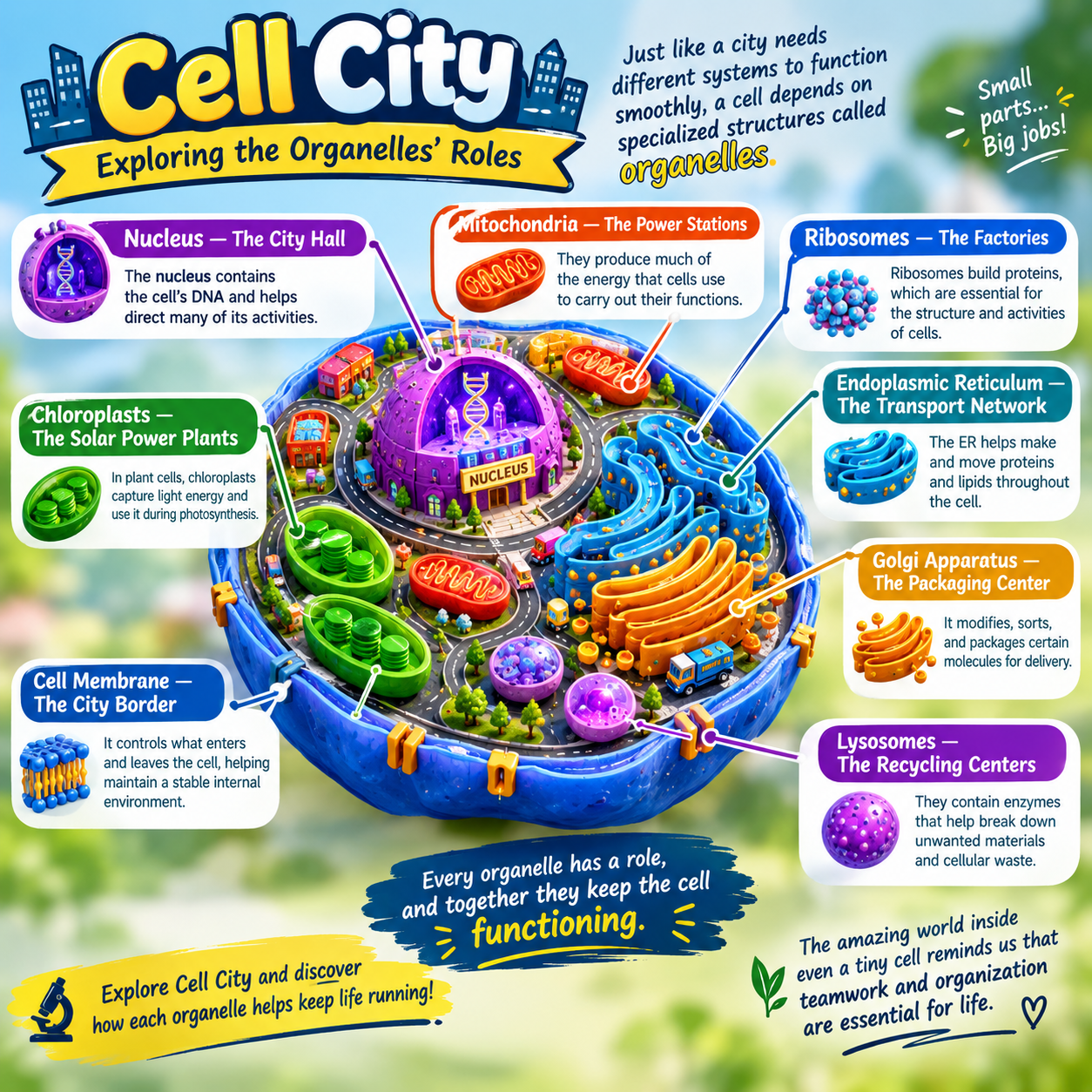
    Imagine a living cell as a busy, well-organized city where every building, worker, and department has an important job. Welcome to **Cell City**!

    Just like a city needs different systems to function smoothly, a cell depends on specialized structures called **organelles**.

    **Nucleus — The City Hall**
    The nucleus contains the cell’s DNA and helps direct many of its activities.

    **Mitochondria — The Power Stations**
    They produce much of the energy that cells use to carry out their functions.

    **Ribosomes — The Factories**
    Ribosomes build proteins, which are essential for the structure and activities of cells.

    **Endoplasmic Reticulum — The Transport Network**
    The ER helps make and move proteins and lipids throughout the cell.

    **Golgi Apparatus — The Packaging Center**
    It modifies, sorts, and packages certain molecules for delivery.

    **Lysosomes — The Recycling Centers**
    They contain enzymes that help break down unwanted materials and cellular waste.

    **Cell Membrane — The City Border**
    It controls what enters and leaves the cell, helping maintain a stable internal environment.

    **Chloroplasts — The Solar Power Plants**
    In plant cells, chloroplasts capture light energy and use it during photosynthesis.

    Every organelle has a role, and together they keep the cell functioning. The amazing world inside even a tiny cell reminds us that **teamwork and organization are essential for life.**

    **Explore Cell City and discover how each organelle helps keep life running!**

    #CellCity #CellBiology #Organelles #Biology #Science #ScienceEducation #BiologyFacts #CellStructure #Mitochondria #Nucleus #Ribosomes #GolgiApparatus #Chloroplasts #Learning #DidYouKnow #education
    #rsisb Roll no.239 Story post no.22 Foundation Level Imagine a living cell as a busy, well-organized city where every building, worker, and department has an important job. Welcome to **Cell City**! 🏙️ Just like a city needs different systems to function smoothly, a cell depends on specialized structures called **organelles**. 🏛️ **Nucleus — The City Hall** The nucleus contains the cell’s DNA and helps direct many of its activities. ⚡ **Mitochondria — The Power Stations** They produce much of the energy that cells use to carry out their functions. 🏭 **Ribosomes — The Factories** Ribosomes build proteins, which are essential for the structure and activities of cells. 🚚 **Endoplasmic Reticulum — The Transport Network** The ER helps make and move proteins and lipids throughout the cell. 📦 **Golgi Apparatus — The Packaging Center** It modifies, sorts, and packages certain molecules for delivery. ♻️ **Lysosomes — The Recycling Centers** They contain enzymes that help break down unwanted materials and cellular waste. 🚪 **Cell Membrane — The City Border** It controls what enters and leaves the cell, helping maintain a stable internal environment. 🌿 **Chloroplasts — The Solar Power Plants** In plant cells, chloroplasts capture light energy and use it during photosynthesis. Every organelle has a role, and together they keep the cell functioning. The amazing world inside even a tiny cell reminds us that **teamwork and organization are essential for life.** 🌱🔬 ✨ **Explore Cell City and discover how each organelle helps keep life running!** #CellCity #CellBiology #Organelles #Biology #Science #ScienceEducation #BiologyFacts #CellStructure #Mitochondria #Nucleus #Ribosomes #GolgiApparatus #Chloroplasts #Learning #DidYouKnow #education
    0 Kommentare 0 Anteile 1003 Ansichten
  • #rsisb
    Roll no.239
    Story post no.8
    Foundation Level


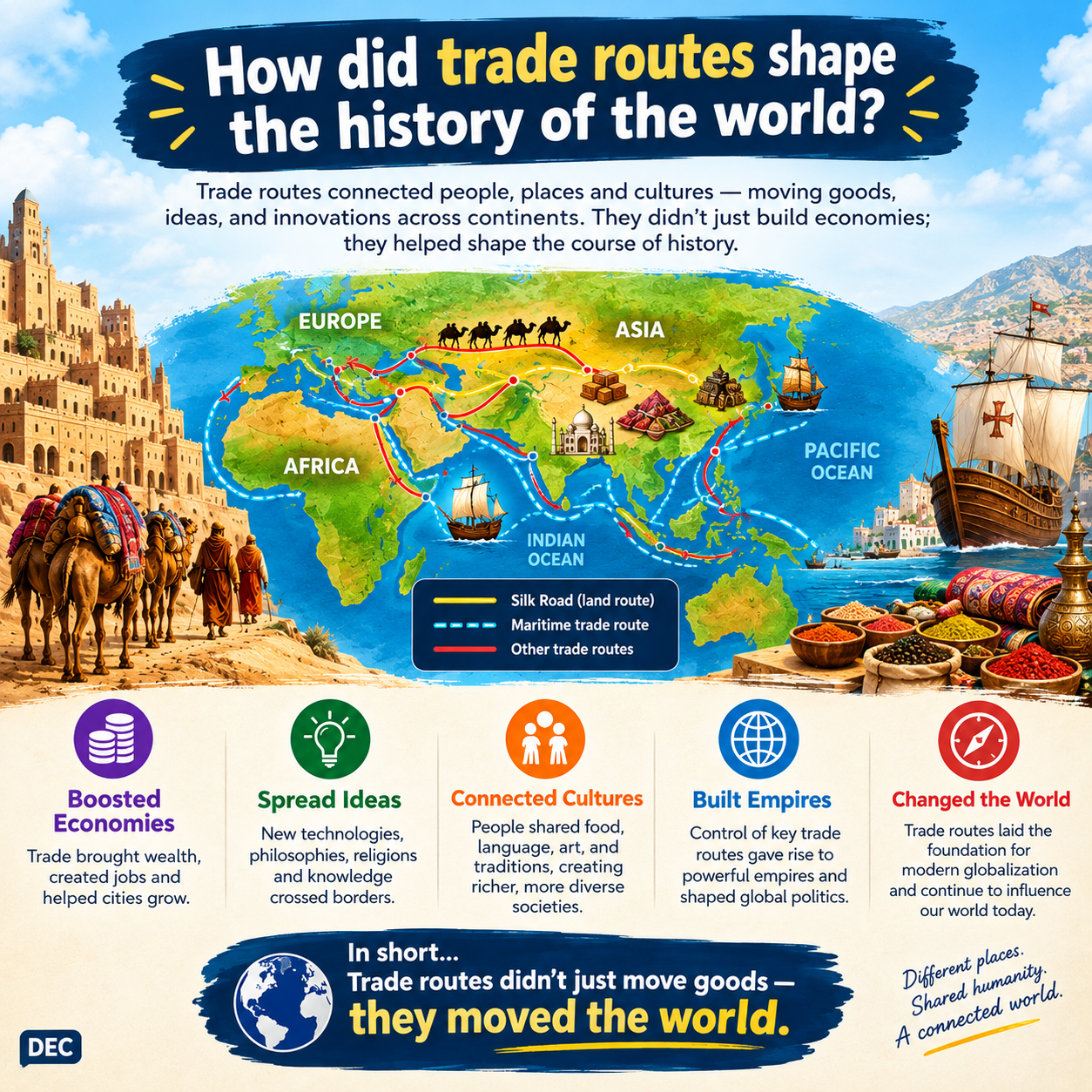
    Long before modern airplanes, highways, and the internet connected the world, **trade routes brought distant communities together**. From ancient caravan paths across Asia and Africa to maritime routes across the Indian Ocean and Mediterranean Sea, these networks helped transform human history.

    **Trade routes moved much more than goods.**
    Silk, spices, gold, precious stones, textiles, metals, food, and other valuable products traveled across continents. But along with these goods came something equally important: **ideas, technologies, languages, beliefs, traditions, and knowledge**.

    **They helped economies grow.**
    Cities located along important routes often became busy centers of trade. Merchants, craftsmen, sailors, and travelers created new economic opportunities, while ports and marketplaces connected producers and consumers across great distances.

    **They spread knowledge and innovation.**
    Technologies, scientific ideas, navigation techniques, agricultural practices, and inventions could travel from one region to another. Trade networks therefore helped knowledge move across cultural and geographic boundaries.

    **They connected different cultures.**
    People from different societies met in markets, ports, and trading cities. These encounters encouraged cultural exchange and influenced food, clothing, art, architecture, languages, and traditions.

    **They influenced the rise of cities and empires.**
    Controlling important trade routes could provide wealth and strategic advantages. As a result, powerful states and empires competed to control important roads, ports, and commercial centers.

    **Maritime trade changed global connections.**
    Sea routes across the Indian Ocean and other waterways allowed merchants to transport large quantities of goods between distant regions. Over time, expanding maritime networks helped create increasingly interconnected economies.

    **The legacy continues today.**
    Modern global trade, international shipping, major ports, and interconnected economies are part of a much longer history of people exchanging goods and ideas across borders.

    **In short:** Trade routes did not simply move products from one place to another. They helped **move people, ideas, technology, cultures, and knowledge**, creating connections that shaped the history of the world.

    **History reminds us that the world has been connected for thousands of years.**

    #TradeRoutes #WorldHistory #HistoryFacts #SilkRoad #AncientHistory #GlobalHistory #Geography #CulturalExchange #HistoryEducation #LearnHistory #DidYouKnow #WorldCivilizations #MaritimeTrade #Education #STEM #SocialStudies #HistoryLovers #KnowledgeIsPower #ChatGPT
    #rsisb Roll no.239 Story post no.8 Foundation Level Long before modern airplanes, highways, and the internet connected the world, **trade routes brought distant communities together**. From ancient caravan paths across Asia and Africa to maritime routes across the Indian Ocean and Mediterranean Sea, these networks helped transform human history. 🧭 **Trade routes moved much more than goods.** Silk, spices, gold, precious stones, textiles, metals, food, and other valuable products traveled across continents. But along with these goods came something equally important: **ideas, technologies, languages, beliefs, traditions, and knowledge**. 💰 **They helped economies grow.** Cities located along important routes often became busy centers of trade. Merchants, craftsmen, sailors, and travelers created new economic opportunities, while ports and marketplaces connected producers and consumers across great distances. 💡 **They spread knowledge and innovation.** Technologies, scientific ideas, navigation techniques, agricultural practices, and inventions could travel from one region to another. Trade networks therefore helped knowledge move across cultural and geographic boundaries. 🤝 **They connected different cultures.** People from different societies met in markets, ports, and trading cities. These encounters encouraged cultural exchange and influenced food, clothing, art, architecture, languages, and traditions. 🏛️ **They influenced the rise of cities and empires.** Controlling important trade routes could provide wealth and strategic advantages. As a result, powerful states and empires competed to control important roads, ports, and commercial centers. 🌊 **Maritime trade changed global connections.** Sea routes across the Indian Ocean and other waterways allowed merchants to transport large quantities of goods between distant regions. Over time, expanding maritime networks helped create increasingly interconnected economies. 🌎 **The legacy continues today.** Modern global trade, international shipping, major ports, and interconnected economies are part of a much longer history of people exchanging goods and ideas across borders. ✨ **In short:** Trade routes did not simply move products from one place to another. They helped **move people, ideas, technology, cultures, and knowledge**, creating connections that shaped the history of the world. 📚 **History reminds us that the world has been connected for thousands of years.** #TradeRoutes #WorldHistory #HistoryFacts #SilkRoad #AncientHistory #GlobalHistory #Geography #CulturalExchange #HistoryEducation #LearnHistory #DidYouKnow #WorldCivilizations #MaritimeTrade #Education #STEM #SocialStudies #HistoryLovers #KnowledgeIsPower #ChatGPT
    0 Kommentare 0 Anteile 2068 Ansichten
  • #rsisb
    Roll No.240
    Story Post No.24
    Foundation Level

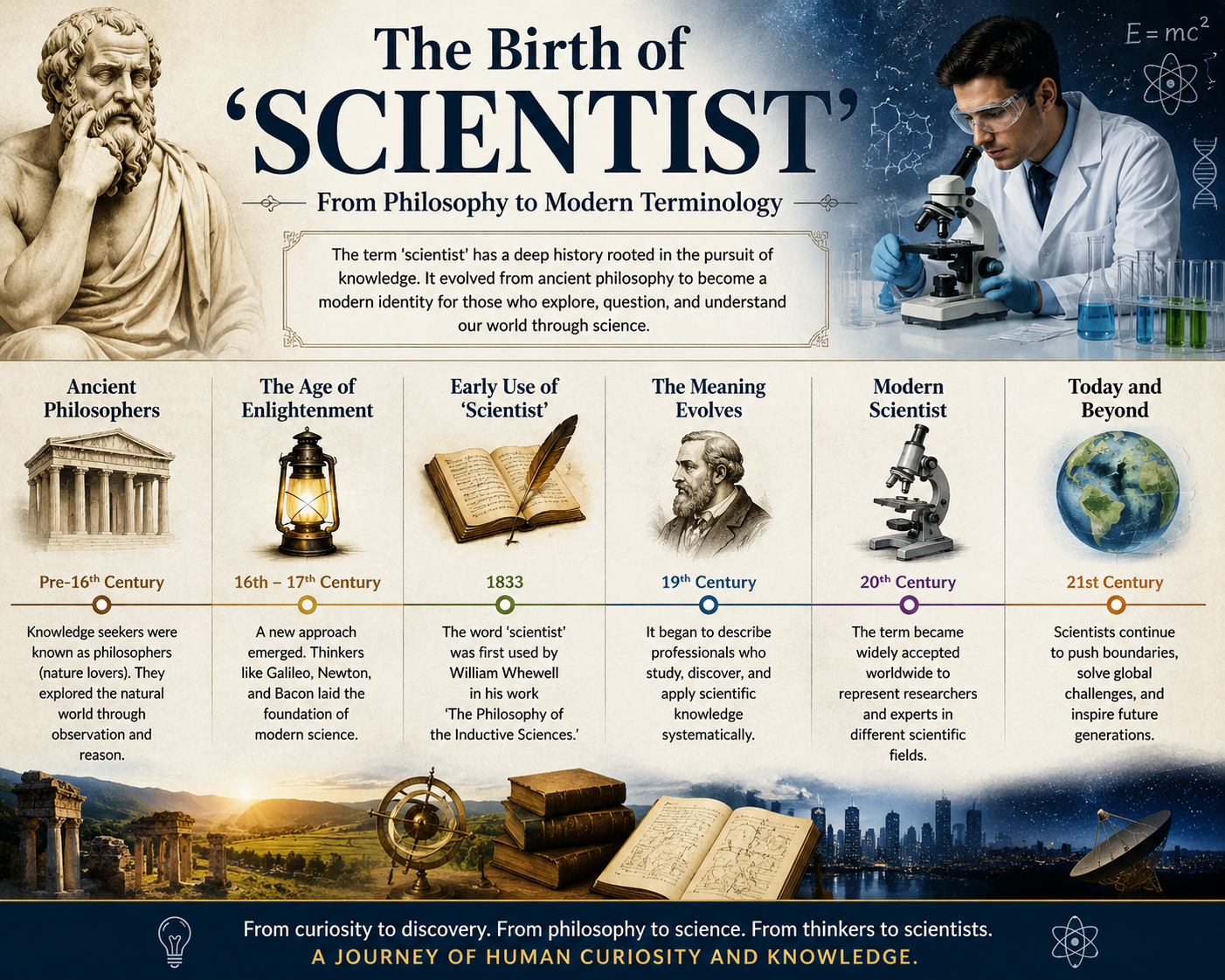
    The word “scientist” may sound like a modern term, but the journey behind it is connected to centuries of human curiosity, philosophy, observation, experimentation, and the search for knowledge.

    Long before the word “scientist” became common, people who studied the natural world were often known as philosophers, scholars, natural philosophers, mathematicians, and thinkers. They asked important questions about nature, the universe, life, matter, motion, and the world around them.

    From the thinkers of the ancient world to the scholars of the Renaissance and the Scientific Revolution, humans continued developing new ways to understand nature. Observation became more important, experiments became more systematic, and evidence gradually became a central part of scientific inquiry.

    During the 18th and 19th centuries, many different branches of knowledge began becoming more specialized. Physics, chemistry, biology, astronomy, geology, and other fields developed their own methods, discoveries, and communities of researchers.

    A major moment in terminology came in the 19th century, when the word “scientist” was introduced as a useful name for people engaged in scientific study. The term is widely associated with William Whewell, who used it in 1833. This helped provide a new, unified word for researchers working across different areas of science.

    The evolution of this word reflects something bigger than language. It represents the changing way humanity organized knowledge and recognized scientific work. The transition from “natural philosopher” to “scientist” shows how science gradually became a distinct and organized field of study.

    Today, scientists work in laboratories, universities, hospitals, observatories, research centers, engineering facilities, and many other places around the world. They investigate everything from tiny cells and molecules to distant galaxies and the origins of the universe.

    Modern science continues to grow through curiosity, evidence, teamwork, technology, and a willingness to ask difficult questions. Every discovery begins with someone wondering, “Why?”, “How?”, or “What if?”

    The story of the word “scientist” reminds us that human knowledge is always evolving. What began with simple curiosity and philosophical questioning gradually developed into the powerful and diverse scientific world we know today.

    From thinkers to researchers. From philosophy to science. From questions to discoveries.

    Science is not only about finding answers—it is also about continuing to ask better questions.

    A journey from curiosity to discovery, and from philosophy to modern science.

    #TheBirthOfScientist #Scientist #HistoryOfScience #ScienceHistory #ScientificRevolution #Philosophy #NaturalPhilosophy #WilliamWhewell #1833 #ModernScience #ScienceEducation #ScientificTerminology #Science #Scientists #Research #Discovery #Curiosity #Knowledge #Learning #Education #STEM #Physics #Chemistry #Biology #Astronomy #Geology #Innovation #Experimentation #ScientificThinking #CriticalThinking #HumanKnowledge #HistoryOfKnowledge #ScienceJourney #FromPhilosophyToScience #ScienceFacts #EducationalContent #LearningJourney #ExploreScience #DiscoverScience

    Rehan School Islamabad Campus
    Asma Shaheen EducationWali
    Irum Asim
    Saima Happinesswali

    #rsisb Roll No.240 Story Post No.24 Foundation Level The word “scientist” may sound like a modern term, but the journey behind it is connected to centuries of human curiosity, philosophy, observation, experimentation, and the search for knowledge. 🧠🔎 Long before the word “scientist” became common, people who studied the natural world were often known as philosophers, scholars, natural philosophers, mathematicians, and thinkers. 🏛️📜 They asked important questions about nature, the universe, life, matter, motion, and the world around them. From the thinkers of the ancient world to the scholars of the Renaissance and the Scientific Revolution, humans continued developing new ways to understand nature. 🌌🌍📖 Observation became more important, experiments became more systematic, and evidence gradually became a central part of scientific inquiry. 🔬🧪✨ During the 18th and 19th centuries, many different branches of knowledge began becoming more specialized. Physics, chemistry, biology, astronomy, geology, and other fields developed their own methods, discoveries, and communities of researchers. 🧬⚗️🌠 A major moment in terminology came in the 19th century, when the word “scientist” was introduced as a useful name for people engaged in scientific study. The term is widely associated with William Whewell, who used it in 1833. 📜🔬 This helped provide a new, unified word for researchers working across different areas of science. The evolution of this word reflects something bigger than language. It represents the changing way humanity organized knowledge and recognized scientific work. 🌟📚 The transition from “natural philosopher” to “scientist” shows how science gradually became a distinct and organized field of study. Today, scientists work in laboratories, universities, hospitals, observatories, research centers, engineering facilities, and many other places around the world. 🌍🧪🔭 They investigate everything from tiny cells and molecules to distant galaxies and the origins of the universe. 🧬🦠🌌 Modern science continues to grow through curiosity, evidence, teamwork, technology, and a willingness to ask difficult questions. 💡🤝🚀 Every discovery begins with someone wondering, “Why?”, “How?”, or “What if?” The story of the word “scientist” reminds us that human knowledge is always evolving. What began with simple curiosity and philosophical questioning gradually developed into the powerful and diverse scientific world we know today. 🌱➡️🔬➡️🌍 ✨ From thinkers to researchers. From philosophy to science. From questions to discoveries. ✨ Science is not only about finding answers—it is also about continuing to ask better questions. 🔎💡 🌟 A journey from curiosity to discovery, and from philosophy to modern science. 🌟 #TheBirthOfScientist #Scientist #HistoryOfScience #ScienceHistory #ScientificRevolution #Philosophy #NaturalPhilosophy #WilliamWhewell #1833 #ModernScience #ScienceEducation #ScientificTerminology #Science #Scientists #Research #Discovery #Curiosity #Knowledge #Learning #Education #STEM #Physics #Chemistry #Biology #Astronomy #Geology #Innovation #Experimentation #ScientificThinking #CriticalThinking #HumanKnowledge #HistoryOfKnowledge #ScienceJourney #FromPhilosophyToScience #ScienceFacts #EducationalContent #LearningJourney #ExploreScience #DiscoverScience 🔬📚🧠🌍✨🔭🧪🚀💡🌟 Rehan School Islamabad Campus Asma Shaheen EducationWali Irum Asim Saima Happinesswali

    0 Kommentare 0 Anteile 7072 Ansichten
  • Any discussion of ideas and thoughts should be encouraged as long it does NOT lead to any violence or hate, even if it is controversial/different/unconventional/out of our comfort zone. Many of the historic cities built by Islamic Kingdoms were centers of learning that created amazing science, architecture and literature. Think about many Muslim poets - Sufi Babas, we all grew up reading and even read today. Lets us all pray that we continue to have a open hearted conversation and discussion on all issues/topics. I have met Malala. And I CELEBRATE her as a leader and as a voice of millions who do not have a voice. I also worry about her losing out on playing in the backyards, parks and simply being a young child. But having seen the impact she has has made - this is her personal sacrifice for the greater good. May God keep her safe and bless her with long peaceful life. Amen.

    Amit Kanodia
    Any discussion of ideas and thoughts should be encouraged as long it does NOT lead to any violence or hate, even if it is controversial/different/unconventional/out of our comfort zone. Many of the historic cities built by Islamic Kingdoms were centers of learning that created amazing science, architecture and literature. Think about many Muslim poets - Sufi Babas, we all grew up reading and even read today. Let's us all pray that we continue to have a open hearted conversation and discussion on all issues/topics. I have met Malala. And I CELEBRATE her as a leader and as a voice of millions who do not have a voice. I also worry about her losing out on playing in the backyards, parks and simply being a young child. But having seen the impact she has has made - this is her personal sacrifice for the greater good. May God keep her safe and bless her with long peaceful life. Amen. Amit Kanodia
    0 Kommentare 0 Anteile 1771 Ansichten
  • Looking for American Local call centers who do inbound and outbound sales for b2b products, know anyone ?
    Looking for American Local call centers who do inbound and outbound sales for b2b products, know anyone ?
    0 Kommentare 0 Anteile 382 Ansichten
  • One of the earlier Mayor of Karachi told me that they have 40 buildings Empty, and they can give the space for things that can help the city.

    I strongly urge you guys to think of making Makers Spaces, Startup Incubators, Co working spaces, Tech Training Centers, and other things ... Your rent would be free, just have to make sure you are able to do this, I am willing to help if you are 110% ready to do this
    One of the earlier Mayor of Karachi told me that they have 40 buildings Empty, and they can give the space for things that can help the city. I strongly urge you guys to think of making Makers Spaces, Startup Incubators, Co working spaces, Tech Training Centers, and other things ... Your rent would be free, just have to make sure you are able to do this, I am willing to help if you are 110% ready to do this
    0 Kommentare 0 Anteile 847 Ansichten
  • I would like to donate 10 computer centers in libraries in Karachi can you please connect me to them
    I would like to donate 10 computer centers in libraries in Karachi can you please connect me to them
    0 Kommentare 0 Anteile 300 Ansichten
  • Are there any hair cutting training and certification centers in Karachi ?
    Are there any hair cutting training and certification centers in Karachi ?
    0 Kommentare 0 Anteile 219 Ansichten
  • This was made for our internal team and for learning how to work with americans for Pakistani people

    if you know any call center friends, these are some tips for them on the American Culture

    #Callcenterstafftips
    This was made for our internal team and for learning how to work with americans for Pakistani people if you know any call center friends, these are some tips for them on the American Culture #Callcenterstafftips
    0 Kommentare 0 Anteile 394 Ansichten
Suchergebnis