• #rsisb
    Roll NO:232
    Foundation level student.
    Story post:52

    ### Description

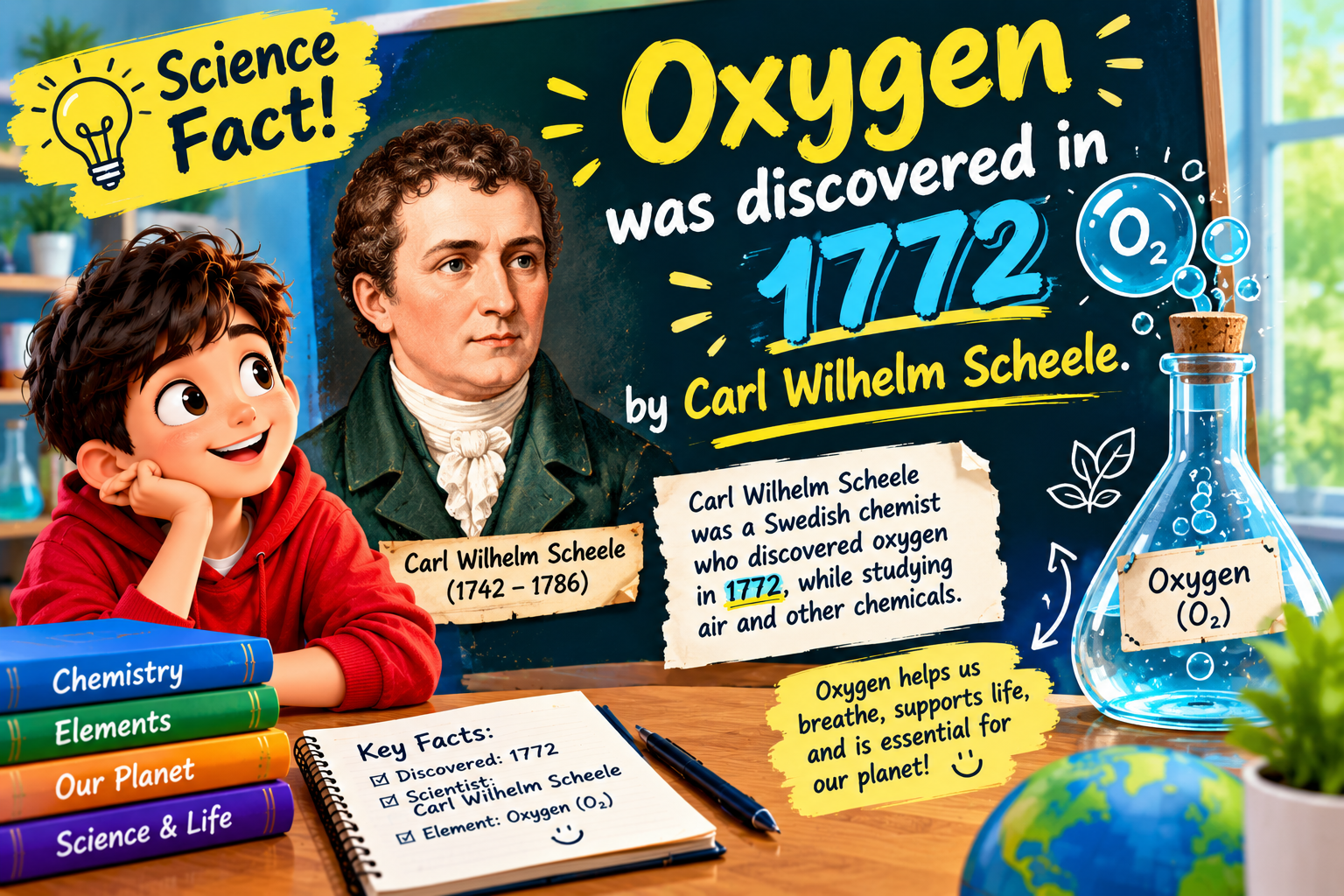
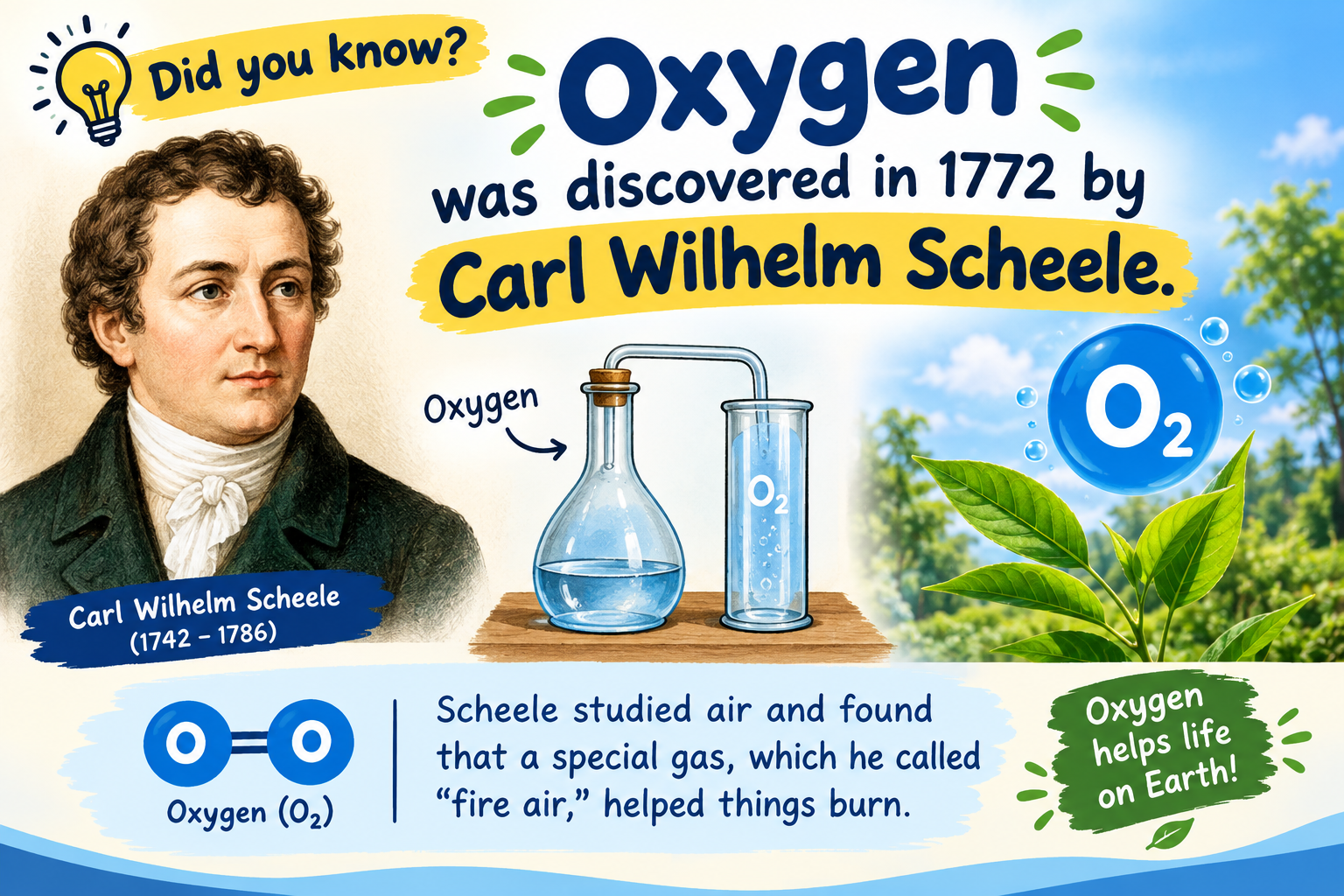
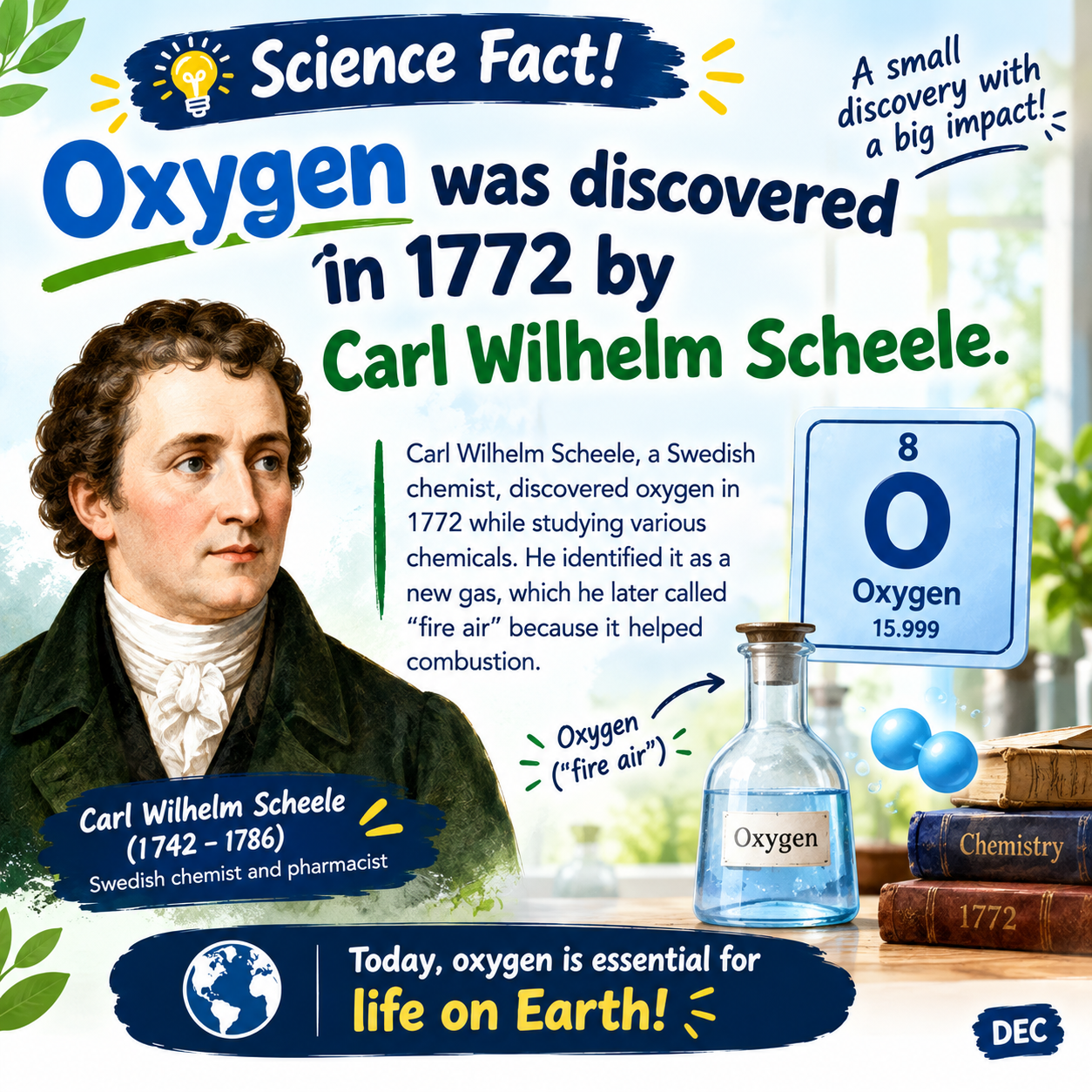
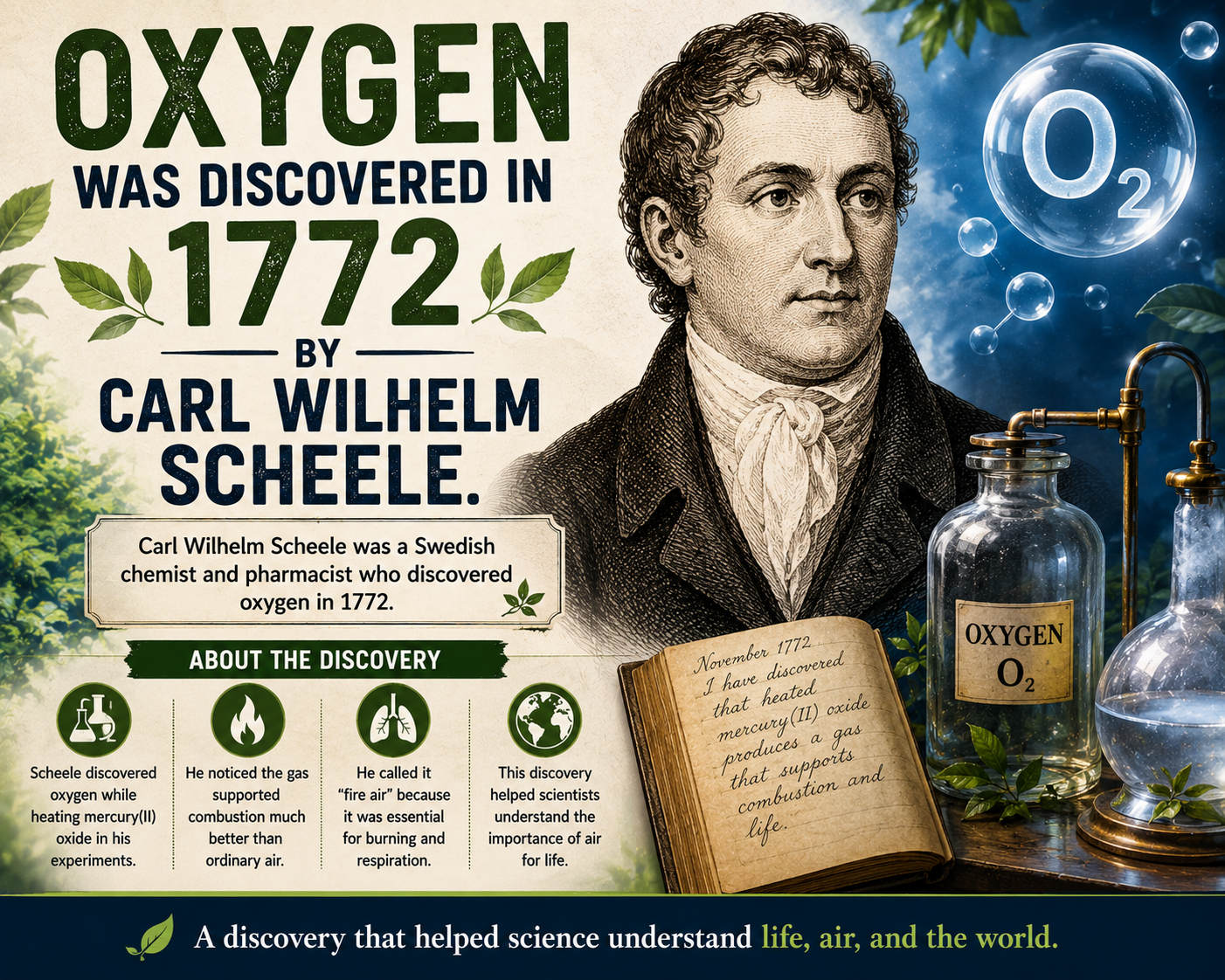
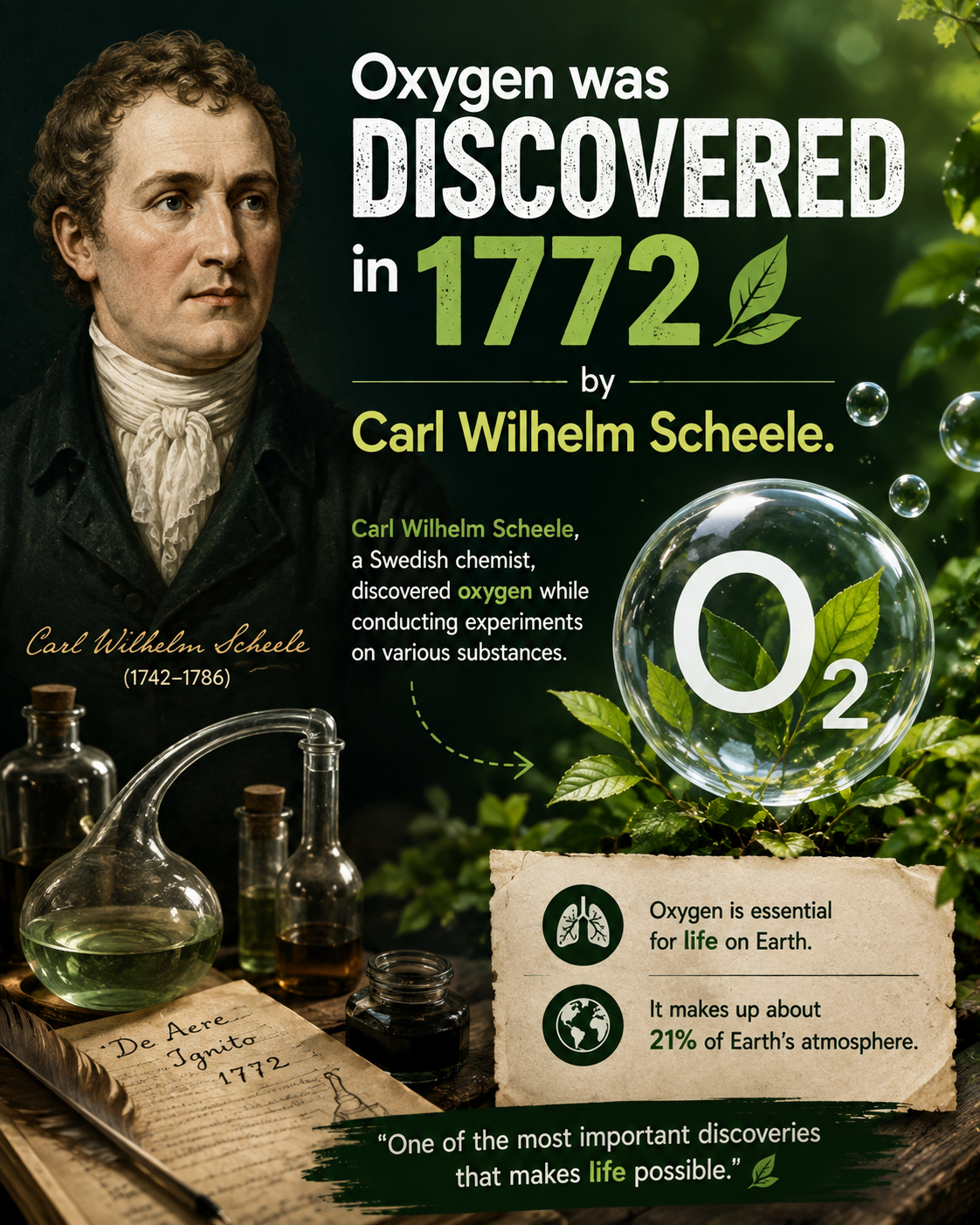
    **“Oxygen Was Discovered in 1772 by Carl Wilhelm Scheele.”**

    Did you know that oxygen has a fascinating history? Swedish chemist **Carl Wilhelm Scheele** produced oxygen in experiments around **1772** and called it “fire air” because it supported combustion.

    Although Scheele’s work was important, the history of oxygen’s discovery is shared with other scientists. **Joseph Priestley independently produced and studied oxygen in 1774**, and **Antoine Lavoisier later helped establish oxygen’s role in combustion and respiration and gave the element its modern name.**

    This story shows how scientific discoveries often develop through the work of several scientists over time.

    **Keep exploring science—every discovery begins with curiosity and a question!**

    ### Hashtags

    #Oxygen #CarlWilhelmScheele #ScienceFacts #Chemistry #HistoryOfScience #DidYouKnow #AmazingFacts #ScienceHistory #ChemistryFacts #LearnSomethingNew #ScienceIsFun #Education #Knowledge #Curiosity #STEM #KeepLearning

    ### Emojis


    #rsisb Roll NO:232 Foundation level student. Story post:52 ### πŸ”¬ Description **“Oxygen Was Discovered in 1772 by Carl Wilhelm Scheele.”** πŸ§ͺ🌍✨ Did you know that oxygen has a fascinating history? πŸ€―πŸ”¬ Swedish chemist **Carl Wilhelm Scheele** produced oxygen in experiments around **1772** and called it “fire air” because it supported combustion. πŸ”₯πŸ§ͺ Although Scheele’s work was important, the history of oxygen’s discovery is shared with other scientists. **Joseph Priestley independently produced and studied oxygen in 1774**, and **Antoine Lavoisier later helped establish oxygen’s role in combustion and respiration and gave the element its modern name.** πŸ§ πŸ“š This story shows how scientific discoveries often develop through the work of several scientists over time. πŸŒŸπŸ”¬ **Keep exploring science—every discovery begins with curiosity and a question!** πŸš€πŸ’‘πŸŒ± ### πŸ”– Hashtags #Oxygen #CarlWilhelmScheele #ScienceFacts #Chemistry #HistoryOfScience #DidYouKnow #AmazingFacts #ScienceHistory #ChemistryFacts #LearnSomethingNew #ScienceIsFun #Education #Knowledge #Curiosity #STEM #KeepLearning ### 😊 Emojis πŸ§ͺπŸ”¬πŸ’¨πŸ”₯πŸŒπŸ“šπŸ§ πŸ’‘βœ¨πŸŒŸπŸš€βš—οΈπŸ˜ŠπŸ”ŽπŸŒ±πŸ“–
    0 Comments 0 Shares 263 Views
  • #fire
    #fire
    0 Comments 0 Shares 71 Views
  • #rsisb
    ROll
    Story post no.63
    Foundation Level

    ### Oxygen: A Fascinating Discovery!

    **Oxygen was independently discovered by several scientists, including Carl Wilhelm Scheele, who produced it around 1772.** Scheele called it “fire air” because it supported combustion.

    Later, **Joseph Priestley independently produced oxygen in 1774**, and **Antoine Lavoisier** helped establish its role in combustion and respiration and gave it the name *oxygen*.

    This discovery transformed our understanding of **chemistry, breathing, combustion, and life itself**.

    #Oxygen #ScienceHistory #CarlWilhelmScheele #Chemistry #ScienceFacts #Discoveries #LearningIsFun #AmazingScience


    Asma Shaheen EducationWali
    Saima Empowerment Wali
    Irum Asim Leadershipwali
    #rsisb ROll Story post no.63 Foundation Level ### πŸ§ͺ Oxygen: A Fascinating Discovery! 🌬️ **Oxygen was independently discovered by several scientists, including Carl Wilhelm Scheele, who produced it around 1772.** Scheele called it “fire air” because it supported combustion. πŸ”₯ Later, **Joseph Priestley independently produced oxygen in 1774**, and **Antoine Lavoisier** helped establish its role in combustion and respiration and gave it the name *oxygen*. βš—οΈπŸŒ This discovery transformed our understanding of **chemistry, breathing, combustion, and life itself**. 🫁✨ #Oxygen #ScienceHistory #CarlWilhelmScheele #Chemistry #ScienceFacts #Discoveries #LearningIsFun #AmazingScience πŸ§ͺπŸ”¬πŸŒŽ Asma Shaheen EducationWali Saima Empowerment Wali Irum Asim Leadershipwali
    0 Comments 0 Shares 532 Views
  • #rsisb
    Roll no.239
    Image with Chat gpt no.11
    Foundation Level


    In around **1772**, Swedish chemist and pharmacist **Carl Wilhelm Scheele** produced and studied a gas that we now know as **oxygen**. He called it **“fire air”** because he observed that it strongly supported combustion.

    Scheele’s experiments helped reveal that the air around us was not simply one single substance. Instead, it contained different gases with different properties. His work became an important part of the development of modern chemistry.

    **Who was Carl Wilhelm Scheele?**
    Carl Wilhelm Scheele (1742–1786) was a Swedish chemist and pharmacist known for his experimental work with many substances. He investigated gases, minerals, acids, and other chemicals and made several important observations during his scientific career.

    **Why is oxygen so important?**
    Oxygen is essential for most forms of life on Earth. Humans and many other organisms use oxygen during **cellular respiration**, a process that helps cells release energy from food. Oxygen also plays an important role in combustion and many chemical reactions.

    **A fascinating part of the story:**
    The history of oxygen’s discovery involved more than one scientist. Scheele investigated oxygen around **1772**, while **Joseph Priestley** independently produced and studied the gas in **1774**. Later, **Antoine Lavoisier** helped establish oxygen’s role in combustion and respiration and gave the element its name.

    **Quick facts:**
    Element: **Oxygen**
    Chemical symbol: **O**
    Atomic number: **8**
    Scheele’s work: **around 1772**
    Scheele’s name for it: **“Fire air”**
    Oxygen is essential for life and many natural and chemical processes.

    From a laboratory experiment centuries ago to our understanding of the atmosphere today, the discovery of oxygen shows how scientific knowledge develops through **careful observation, experimentation, and the work of multiple scientists**.

    **Science is full of discoveries that changed the way we understand our world!**

    **Learn. Explore. Question. Discover.**

    #ScienceFact #Oxygen #CarlWilhelmScheele #Chemistry #ScienceHistory #ChemistryFacts #DidYouKnow #ScienceEducation #LearnScience #PhysicsAndChemistry #Biology #STEM #ScientificDiscovery #HistoryOfScience #ChemicalElements #OxygenDiscovery #Education #Knowledge #FunScience #DEC
    #rsisb Roll no.239 Image with Chat gpt no.11 Foundation Level In around **1772**, Swedish chemist and pharmacist **Carl Wilhelm Scheele** produced and studied a gas that we now know as **oxygen**. He called it **“fire air”** because he observed that it strongly supported combustion. πŸ”₯ Scheele’s experiments helped reveal that the air around us was not simply one single substance. Instead, it contained different gases with different properties. His work became an important part of the development of modern chemistry. πŸ§ͺπŸ“š πŸ”Ž **Who was Carl Wilhelm Scheele?** Carl Wilhelm Scheele (1742–1786) was a Swedish chemist and pharmacist known for his experimental work with many substances. He investigated gases, minerals, acids, and other chemicals and made several important observations during his scientific career. 🌬️ **Why is oxygen so important?** Oxygen is essential for most forms of life on Earth. Humans and many other organisms use oxygen during **cellular respiration**, a process that helps cells release energy from food. Oxygen also plays an important role in combustion and many chemical reactions. πŸ“– **A fascinating part of the story:** The history of oxygen’s discovery involved more than one scientist. Scheele investigated oxygen around **1772**, while **Joseph Priestley** independently produced and studied the gas in **1774**. Later, **Antoine Lavoisier** helped establish oxygen’s role in combustion and respiration and gave the element its name. 🌟 **Quick facts:** πŸ”Ή Element: **Oxygen** πŸ”Ή Chemical symbol: **O** πŸ”Ή Atomic number: **8** πŸ”Ή Scheele’s work: **around 1772** πŸ”Ή Scheele’s name for it: **“Fire air”** πŸ”Ή Oxygen is essential for life and many natural and chemical processes. From a laboratory experiment centuries ago to our understanding of the atmosphere today, the discovery of oxygen shows how scientific knowledge develops through **careful observation, experimentation, and the work of multiple scientists**. 🌍🧠 πŸ’‘ **Science is full of discoveries that changed the way we understand our world!** πŸ“š **Learn. Explore. Question. Discover.** πŸ”¬βœ¨ #ScienceFact #Oxygen #CarlWilhelmScheele #Chemistry #ScienceHistory #ChemistryFacts #DidYouKnow #ScienceEducation #LearnScience #PhysicsAndChemistry #Biology #STEM #ScientificDiscovery #HistoryOfScience #ChemicalElements #OxygenDiscovery #Education #Knowledge #FunScience #DEC
    0 Comments 0 Shares 1045 Views
  • #RSTA
    #Task Call Maye Post
    #Class: Foundation Level
    #Day No: 149
    #Made By Me

    Total Post:21

    Description

    Completed the task **“Talk with Annie: ‘Wood’ – The Backbone of Early Civilization (25 min).”**
    In this conversation, we talked about the importance of wood in early human life, how people used it for homes, tools, fire, boats, and many other things. This topic helped me understand how wood made life easier and played an important role in the development of early civilizations.

    RSTA TalkWithAnnie Wood Learning MadeByMe
    #RSTA #Task Call Maye Post #Class: Foundation Level #Day No: 149 #Made By Me Total Post:21 Description Completed the task **“Talk with Annie: ‘Wood’ – The Backbone of Early Civilization (25 min).”** 🌳πŸͺ΅ In this conversation, we talked about the importance of wood in early human life, how people used it for homes, tools, fire, boats, and many other things. This topic helped me understand how wood made life easier and played an important role in the development of early civilizations. ✨ RSTA TalkWithAnnie Wood Learning MadeByMe
    0 Comments 0 Shares 435 Views 7
  • RSIF8
    Roll no 68
    Task no 147
    Task topic;“Wood” – The Backbone of Early Civilization**

    Wood played a vital role in the development of early human civilization. From homes and tools to boats, bridges, furniture, and firewood, people depended on wood for everyday life. It helped communities build, travel, create, and survive.

    This topic explores how wood became one of the most important natural resources in human history and shaped the growth of early societies.
    RSIF8 Roll no 68 Task no 147 Task topic;“Wood” – The Backbone of Early Civilization** Wood played a vital role in the development of early human civilization. From homes and tools to boats, bridges, furniture, and firewood, people depended on wood for everyday life. It helped communities build, travel, create, and survive. 🌍πŸͺ΅ This topic explores how wood became one of the most important natural resources in human history and shaped the growth of early societies.
    0 Comments 0 Shares 291 Views 1
  • #rsisb
    Roll no.247
    Call annie.18
    Foundation level

    **“Wood” – The Backbone of Early Civilization | 25-Minute Learning Journey**

    Wood is one of the oldest and most important natural materials used by humanity. Long before modern technology, steel, concrete, and plastic transformed our world, people depended on trees and wood for survival, creativity, shelter, transportation, tools, and everyday life.

    In this fascinating **25-minute exploration**, we travel back through history to discover how wood helped early civilizations grow, adapt, and build their communities. From simple wooden tools and shelters to boats, bridges, furniture, weapons, wheels, and farming equipment, wood played a remarkable role in human development.

    **Why was wood so important?**
    Wood was relatively easy to find, shape, cut, carve, and transport. Early humans learned to use different types of trees for different purposes, turning a natural resource into useful objects that made life easier and helped communities become more organized.

    Wood also provided an important source of fuel. Fire helped people cook food, stay warm, protect themselves, and eventually develop new technologies such as pottery and metalworking. The relationship between humans, trees, fire, and technology became an important part of civilization.

    **Wood and Transportation**
    One of the most exciting developments was the use of wood to create boats and other forms of transportation. Wooden boats allowed people to travel across rivers, lakes, and seas, encouraging exploration, trade, communication, and cultural exchange.

    **Wood and Shelter**
    Wood became an essential building material for homes, villages, storage structures, roofs, doors, and other buildings. As communities developed, woodworking skills became increasingly valuable, allowing people to construct stronger and more useful structures.

    **Wood and Human Creativity**
    Wood was not simply a material for survival—it became a medium for creativity. People carved decorations, created musical instruments, made furniture, constructed tools, and produced objects that reflected their cultures and traditions.

    **Wood and the Growth of Civilization**
    The story of wood is also the story of human innovation. By learning how to select, shape, join, preserve, and use wood, people developed practical skills that contributed to agriculture, construction, transportation, craftsmanship, and trade.

    This 25-minute lesson encourages us to look at an ordinary piece of wood in a completely different way. A wooden table, chair, pencil, door, or boat may seem simple today, but behind these objects lies thousands of years of human knowledge, experimentation, craftsmanship, and discovery.

    **A Lesson for Today**
    Understanding the historical importance of wood also reminds us of our responsibility toward forests and the environment. Trees provide habitats, help support ecosystems, and play an important role in our planet’s natural systems. Learning about wood means learning not only about the past, but also about how we can use natural resources responsibly in the future.

    Join us on this educational journey through history and discover how **wood became one of the foundations of human civilization**. From ancient tools to magnificent wooden structures, from forests to communities, the story of wood reveals how humans transformed the resources around them into the foundations of everyday life.

    **Watch, learn, explore, and discover the incredible story behind one of humanity’s oldest materials!**

    #Wood #HistoryOfWood #EarlyCivilization #HumanHistory #AncientCivilizations #History #Education #Learning #Science #Nature #Trees #Forests #Woodworking #AncientHistory #HumanInnovation #Technology #Archaeology #Culture #Craftsmanship #NaturalResources #EnvironmentalAwareness #LearningJourney #EducationalVideo #HistoryLesson #Civilization #Innovation #Knowledge #ExploreHistory #WoodenTools
    #rsisb Roll no.247 Call annie.18 Foundation level 🌳 **“Wood” – The Backbone of Early Civilization | 25-Minute Learning Journey** πŸͺ΅πŸΊ Wood is one of the oldest and most important natural materials used by humanity. Long before modern technology, steel, concrete, and plastic transformed our world, people depended on trees and wood for survival, creativity, shelter, transportation, tools, and everyday life. 🌍🌳 In this fascinating **25-minute exploration**, we travel back through history to discover how wood helped early civilizations grow, adapt, and build their communities. πŸ•οΈπŸ  From simple wooden tools and shelters to boats, bridges, furniture, weapons, wheels, and farming equipment, wood played a remarkable role in human development. πŸ›ΆπŸ› οΈ 🌲 **Why was wood so important?** Wood was relatively easy to find, shape, cut, carve, and transport. Early humans learned to use different types of trees for different purposes, turning a natural resource into useful objects that made life easier and helped communities become more organized. πŸ”₯ Wood also provided an important source of fuel. Fire helped people cook food, stay warm, protect themselves, and eventually develop new technologies such as pottery and metalworking. The relationship between humans, trees, fire, and technology became an important part of civilization. πŸ”₯🍲 πŸ›Ά **Wood and Transportation** One of the most exciting developments was the use of wood to create boats and other forms of transportation. Wooden boats allowed people to travel across rivers, lakes, and seas, encouraging exploration, trade, communication, and cultural exchange. πŸŒŠβ›΅ 🏠 **Wood and Shelter** Wood became an essential building material for homes, villages, storage structures, roofs, doors, and other buildings. As communities developed, woodworking skills became increasingly valuable, allowing people to construct stronger and more useful structures. πŸ‘πŸ”¨ πŸ› οΈ **Wood and Human Creativity** Wood was not simply a material for survival—it became a medium for creativity. People carved decorations, created musical instruments, made furniture, constructed tools, and produced objects that reflected their cultures and traditions. 🎡🎨πŸͺ‘ 🌍 **Wood and the Growth of Civilization** The story of wood is also the story of human innovation. By learning how to select, shape, join, preserve, and use wood, people developed practical skills that contributed to agriculture, construction, transportation, craftsmanship, and trade. This 25-minute lesson encourages us to look at an ordinary piece of wood in a completely different way. A wooden table, chair, pencil, door, or boat may seem simple today, but behind these objects lies thousands of years of human knowledge, experimentation, craftsmanship, and discovery. πŸ”πŸ§ βœ¨ 🌱 **A Lesson for Today** Understanding the historical importance of wood also reminds us of our responsibility toward forests and the environment. Trees provide habitats, help support ecosystems, and play an important role in our planet’s natural systems. Learning about wood means learning not only about the past, but also about how we can use natural resources responsibly in the future. πŸŒ³πŸŒŽπŸ’š πŸ“š Join us on this educational journey through history and discover how **wood became one of the foundations of human civilization**. From ancient tools to magnificent wooden structures, from forests to communities, the story of wood reveals how humans transformed the resources around them into the foundations of everyday life. 🌳πŸͺ΅πŸΊβœ¨ πŸ’‘ **Watch, learn, explore, and discover the incredible story behind one of humanity’s oldest materials!** #Wood #HistoryOfWood #EarlyCivilization #HumanHistory #AncientCivilizations #History #Education #Learning #Science #Nature #Trees #Forests #Woodworking #AncientHistory #HumanInnovation #Technology #Archaeology #Culture #Craftsmanship #NaturalResources #EnvironmentalAwareness #LearningJourney #EducationalVideo #HistoryLesson #Civilization #Innovation #Knowledge #ExploreHistory #WoodenTools 🌳πŸͺ΅πŸ“šπŸŒβœ¨
    0 Comments 0 Shares 6117 Views 11
  • #rsisb
    Roll No.240
    Image With Chatgpt No.6
    Foundation Level

    Oxygen is one of the most important elements for life on Earth, but its discovery was the result of careful experiments, curiosity, and scientific investigation.

    In 1772, Swedish chemist and pharmacist Carl Wilhelm Scheele identified a gas that behaved differently from ordinary air. He found that this gas strongly supported combustion and played an important role in the processes we now understand as respiration and burning.

    Scheele referred to the gas as “fire air” because of its ability to support combustion. His experiments helped reveal that air was not simply one single substance, but a mixture containing different gases.

    The story of oxygen’s discovery is a fascinating example of how science develops through observation and experimentation. Scientists investigate materials, record their observations, test ideas, and gradually build a better understanding of the natural world.

    Although Scheele discovered oxygen independently, the recognition and naming of oxygen as an element also involved other scientists, including Joseph Priestley and Antoine Lavoisier. Their work helped establish oxygen’s role in combustion and contributed to the development of modern chemistry.

    Oxygen is represented by the chemical symbol O and has the atomic number 8. It is essential for aerobic respiration in humans and many other organisms. Without oxygen, most familiar forms of complex life could not survive.

    The discovery of oxygen changed the way scientists understood air, combustion, chemistry, and life. It became an important part of the scientific revolution in chemistry and helped researchers develop a much clearer understanding of chemical reactions.

    This story also reminds us that major scientific discoveries often happen through patience, careful observation, and a willingness to ask questions. Every experiment can reveal something new, and every discovery can open the door to further knowledge.

    From “fire air” to oxygen, the journey of discovery changed chemistry forever.

    Science teaches us that the world around us is full of mysteries waiting to be explored. Whether studying gases, atoms, cells, planets, or living organisms, curiosity is often the first step toward discovery.

    Question. Observe. Experiment. Discover. Learn.

    #Oxygen #DiscoveryOfOxygen #CarlWilhelmScheele #ScienceHistory #HistoryOfScience #Chemistry #ChemicalElements #OxygenDiscovery #1772 #ScientificDiscovery #ScienceEducation #ChemistryFacts #ScienceFacts #LearnScience #ScientificRevolution #Combustion #Air #Respiration #ChemistryHistory #STEM #Education #LearningJourney #ScienceExperiment #ScientificThinking #Research #Discovery #Knowledge #Innovation #Curiosity #ExploreScience #ScienceLovers #EducationalContent #Scientists #ChemicalScience #ModernChemistry #ScienceJourney #HistoryOfChemistry

    Rehan School Islamabad Campus
    Asma Shaheen EducationWali
    Irum Asim
    Saima Happinesswali

    #rsisb Roll No.240 Image With Chatgpt No.6 Foundation Level Oxygen is one of the most important elements for life on Earth, but its discovery was the result of careful experiments, curiosity, and scientific investigation. 🌱🫁πŸ”₯ In 1772, Swedish chemist and pharmacist Carl Wilhelm Scheele identified a gas that behaved differently from ordinary air. He found that this gas strongly supported combustion and played an important role in the processes we now understand as respiration and burning. πŸ”₯πŸ§ͺ Scheele referred to the gas as “fire air” because of its ability to support combustion. His experiments helped reveal that air was not simply one single substance, but a mixture containing different gases. πŸŒ¬οΈπŸ”¬ The story of oxygen’s discovery is a fascinating example of how science develops through observation and experimentation. Scientists investigate materials, record their observations, test ideas, and gradually build a better understanding of the natural world. πŸ“šπŸ”ŽπŸ’‘ Although Scheele discovered oxygen independently, the recognition and naming of oxygen as an element also involved other scientists, including Joseph Priestley and Antoine Lavoisier. Their work helped establish oxygen’s role in combustion and contributed to the development of modern chemistry. βš—οΈπŸ§ πŸŒ Oxygen is represented by the chemical symbol O and has the atomic number 8. It is essential for aerobic respiration in humans and many other organisms. 🫁🌿🐾 Without oxygen, most familiar forms of complex life could not survive. The discovery of oxygen changed the way scientists understood air, combustion, chemistry, and life. 🌎πŸ”₯πŸ”¬ It became an important part of the scientific revolution in chemistry and helped researchers develop a much clearer understanding of chemical reactions. This story also reminds us that major scientific discoveries often happen through patience, careful observation, and a willingness to ask questions. πŸ’­βž‘οΈπŸ”¬βž‘οΈπŸ’‘ Every experiment can reveal something new, and every discovery can open the door to further knowledge. ✨ From “fire air” to oxygen, the journey of discovery changed chemistry forever. ✨ Science teaches us that the world around us is full of mysteries waiting to be explored. πŸŒπŸ”Ž Whether studying gases, atoms, cells, planets, or living organisms, curiosity is often the first step toward discovery. πŸš€πŸ“š 🌟 Question. Observe. Experiment. Discover. Learn. 🌟 #Oxygen #DiscoveryOfOxygen #CarlWilhelmScheele #ScienceHistory #HistoryOfScience #Chemistry #ChemicalElements #OxygenDiscovery #1772 #ScientificDiscovery #ScienceEducation #ChemistryFacts #ScienceFacts #LearnScience #ScientificRevolution #Combustion #Air #Respiration #ChemistryHistory #STEM #Education #LearningJourney #ScienceExperiment #ScientificThinking #Research #Discovery #Knowledge #Innovation #Curiosity #ExploreScience #ScienceLovers #EducationalContent #Scientists #ChemicalScience #ModernChemistry #ScienceJourney #HistoryOfChemistry πŸ”¬πŸ§ͺ🌍πŸ”₯πŸ«πŸ“šπŸ’‘βœ¨πŸš€πŸŒ± Rehan School Islamabad Campus Asma Shaheen EducationWali Irum Asim Saima Happinesswali
    0 Comments 0 Shares 7099 Views
  • #rsisb
    Roll no.239
    Coding task no.13
    Foundation Level


    A **Simple Chat Application** is a basic software project that allows two or more users to communicate by sending and receiving messages in real time.

    It is a great project for learning important programming concepts such as **user interfaces, networking, databases, and real-time communication**.

    ### Key Features

    * Send and receive messages
    * User login or username system
    * Online/offline status
    * Message timestamps
    * Notifications
    * Chat history

    ### Technologies You Can Use

    * **HTML, CSS & JavaScript** for the frontend
    * **Node.js** for the backend
    * **Socket.IO** for real-time messaging
    * **Firebase** for authentication and database services

    Building a simple chat application is an excellent way to understand how modern messaging platforms work. Start small, learn the basics, and gradually add more advanced features!

    #ChatApplication #WebDevelopment #Programming #JavaScript #NodeJS #SocketIO #Coding #Developer #TechProject #LearnToCode
    #rsisb Roll no.239 Coding task no.13 Foundation Level A **Simple Chat Application** is a basic software project that allows two or more users to communicate by sending and receiving messages in real time. πŸ“±πŸ’» It is a great project for learning important programming concepts such as **user interfaces, networking, databases, and real-time communication**. ### ✨ Key Features * πŸ’¬ Send and receive messages * πŸ‘€ User login or username system * 🟒 Online/offline status * πŸ“… Message timestamps * πŸ”” Notifications * πŸ—‚οΈ Chat history ### πŸ› οΈ Technologies You Can Use * **HTML, CSS & JavaScript** for the frontend * **Node.js** for the backend * **Socket.IO** for real-time messaging * **Firebase** for authentication and database services Building a simple chat application is an excellent way to understand how modern messaging platforms work. πŸš€ Start small, learn the basics, and gradually add more advanced features! #ChatApplication #WebDevelopment #Programming #JavaScript #NodeJS #SocketIO #Coding #Developer #TechProject #LearnToCode πŸ’»πŸš€
    0 Comments 0 Shares 3297 Views
  • RSISB
    Roll No: 209
    Image with ChatGPT No.7


    Did you know? Oxygen was discovered in 1772 by Carl Wilhelm Scheele, a Swedish chemist who called it “fire air” because it supported combustion. His discovery helped shape our understanding of chemistry and the air we breathe every day!

    Science is full of fascinating discoveries—keep learning, keep exploring, and stay curious!

    #Oxygen #CarlWilhelmScheele #ScienceFacts #DidYouKnow #Chemistry #HistoryOfScience #AmazingFacts #Science #Discovery #LearnSomethingNew #Curiosity #Education
    RSISB Roll No: 209 Image with ChatGPT No.7 πŸ§ͺ🌍 Did you know? Oxygen was discovered in 1772 by Carl Wilhelm Scheele, a Swedish chemist who called it “fire air” because it supported combustion. πŸ”₯🫁 His discovery helped shape our understanding of chemistry and the air we breathe every day! πŸŒ¬οΈπŸ”¬βœ¨ Science is full of fascinating discoveries—keep learning, keep exploring, and stay curious! πŸš€πŸ“š #Oxygen #CarlWilhelmScheele #ScienceFacts #DidYouKnow #Chemistry #HistoryOfScience #AmazingFacts #Science #Discovery #LearnSomethingNew #Curiosity #Education πŸ§ͺπŸ”¬πŸŒβœ¨
    0 Comments 0 Shares 2553 Views
More Results