



• #rsisb
    roll no.247
    Story post no.13
    Foundation Level

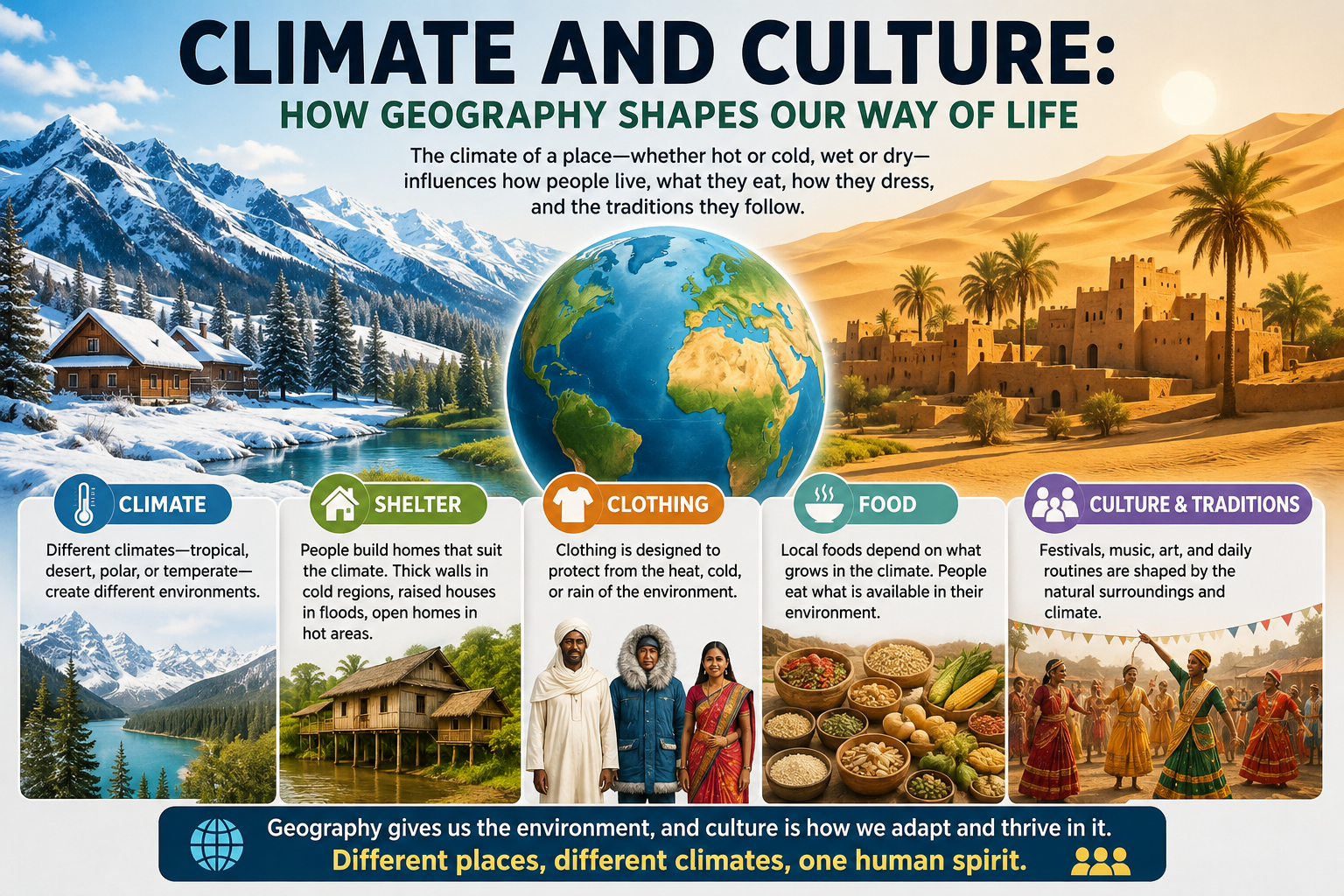
    **Climate and Culture: How Geography Shapes Our Way of Life**

    Our planet is a beautiful mosaic of mountains, deserts, forests, rivers, coastlines, and plains—and each environment influences the way people live, work, eat, dress, build homes, celebrate traditions, and connect with one another.

    Climate and geography are much more than physical features on a map. They help shape human culture and everyday life. In cold regions, people may develop warm clothing, insulated homes, and traditions suited to long winters. In hot and dry areas, communities often adapt with lightweight clothing, shaded spaces, water-saving practices, and lifestyles suited to intense heat. Near rivers and fertile plains, agriculture can become an important part of life, while coastal communities may develop strong connections with fishing, sailing, and the sea.

    Geography also influences food and traditions. Different climates allow different crops to grow, creating unique cuisines and agricultural practices around the world. From rice-growing regions to wheat-producing plains, from tropical fruits to mountain crops, the natural environment provides resources that become part of local identity.

    Even architecture reflects geography. People have developed creative ways to build homes that protect them from heat, cold, rain, wind, and other environmental conditions. These adaptations show how human creativity and nature can work together.

    Most importantly, studying climate and culture helps us understand and appreciate the incredible diversity of human societies. Every community has its own story, traditions, knowledge, and ways of adapting to its surroundings. By learning about these differences, we can develop greater respect for cultures around the world and recognize how deeply connected people are to the places they call home.

    **Geography shapes our surroundings, climate influences our choices, and culture reflects how people adapt, create, and thrive.** Let’s explore our world with curiosity, respect, and a deeper appreciation for the relationship between people and the planet!

    #ClimateAndCulture #Geography #Culture #OurWorld #HumanGeography #Climate #GeographyMatters #CulturalDiversity #WorldCultures #Environment #Nature #PeopleAndPlanet #SustainableLiving #GlobalAwareness #Education #Learning #ExploreTheWorld #GeographyEducation #CulturalHeritage #Community #Earth #OurPlanet #EnvironmentalAwareness #Diversity #KnowledgeIsPower
    #rsisb roll no.247 Story post no.13 Foundation Level 🌍🌦️ **Climate and Culture: How Geography Shapes Our Way of Life** 🏔️🌊🌾 Our planet is a beautiful mosaic of mountains, deserts, forests, rivers, coastlines, and plains—and each environment influences the way people live, work, eat, dress, build homes, celebrate traditions, and connect with one another. 🌎✨ Climate and geography are much more than physical features on a map. They help shape human culture and everyday life. In cold regions, people may develop warm clothing, insulated homes, and traditions suited to long winters. ❄️🏠🧥 In hot and dry areas, communities often adapt with lightweight clothing, shaded spaces, water-saving practices, and lifestyles suited to intense heat. ☀️🏜️💧 Near rivers and fertile plains, agriculture can become an important part of life, while coastal communities may develop strong connections with fishing, sailing, and the sea. 🌊🐟🚤 Geography also influences food and traditions. 🌾🍲 Different climates allow different crops to grow, creating unique cuisines and agricultural practices around the world. From rice-growing regions to wheat-producing plains, from tropical fruits to mountain crops, the natural environment provides resources that become part of local identity. 🌱🥭🌾 Even architecture reflects geography. 🏘️🏔️ People have developed creative ways to build homes that protect them from heat, cold, rain, wind, and other environmental conditions. These adaptations show how human creativity and nature can work together. 🌿🏡💡 Most importantly, studying climate and culture helps us understand and appreciate the incredible diversity of human societies. 🤝🌍 Every community has its own story, traditions, knowledge, and ways of adapting to its surroundings. By learning about these differences, we can develop greater respect for cultures around the world and recognize how deeply connected people are to the places they call home. ❤️🌎 🌟 **Geography shapes our surroundings, climate influences our choices, and culture reflects how people adapt, create, and thrive.** Let’s explore our world with curiosity, respect, and a deeper appreciation for the relationship between people and the planet! 🌍💚 #ClimateAndCulture #Geography #Culture #OurWorld #HumanGeography #Climate #GeographyMatters #CulturalDiversity #WorldCultures #Environment #Nature #PeopleAndPlanet #SustainableLiving #GlobalAwareness #Education #Learning #ExploreTheWorld #GeographyEducation #CulturalHeritage #Community #Earth #OurPlanet #EnvironmentalAwareness #Diversity #KnowledgeIsPower 🌍
    0 Yorumlar 0 hisse senetleri 2587 Views
  • #rsisb
    Roll no.239
    Story Post no.29
    Foundation Level

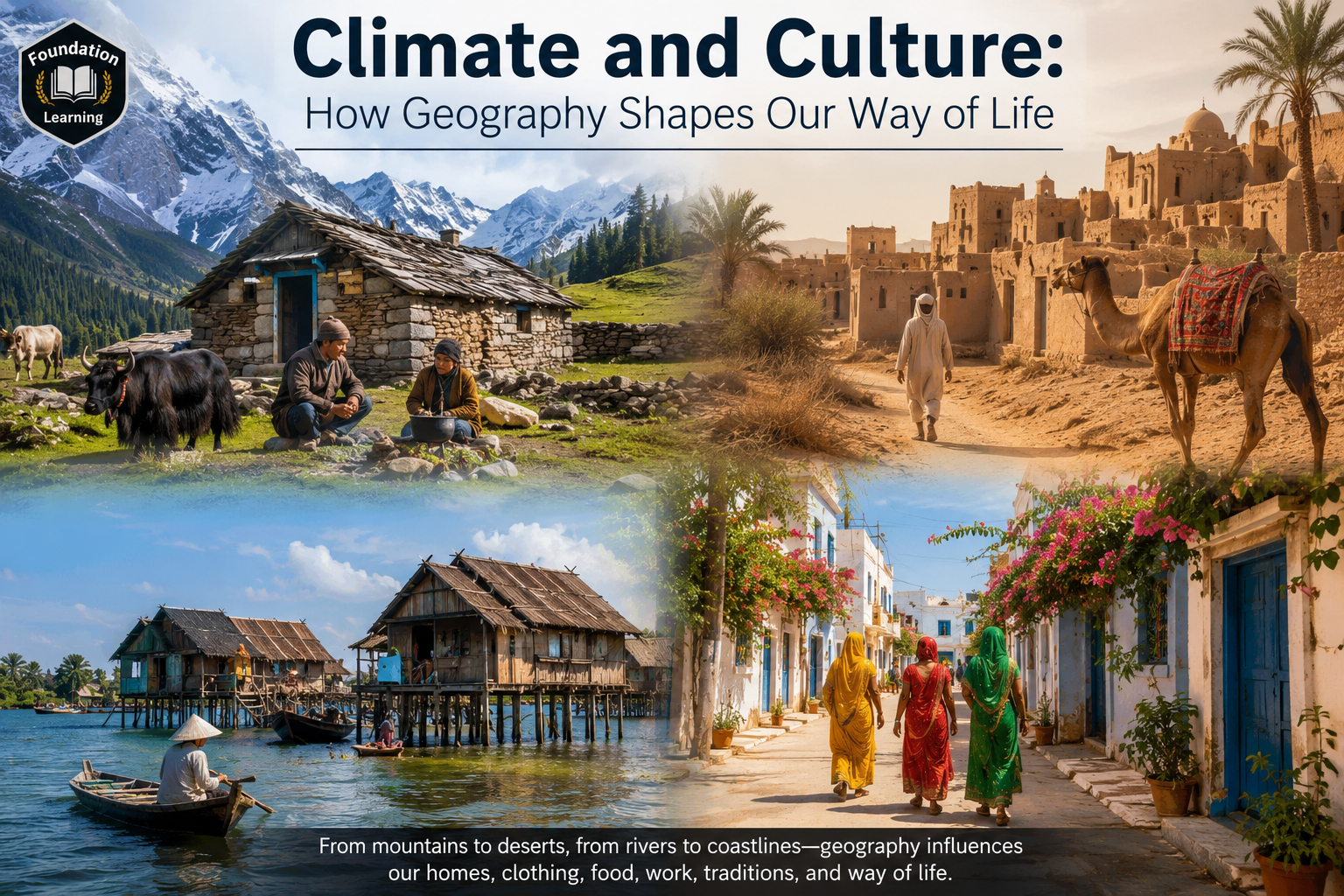
    **Climate and Culture: How Geography Shapes Our Way of Life**

    Climate and geography play a major role in shaping how people live, work, eat, dress, build homes, and celebrate traditions. From hot deserts to cold mountains and from coastal regions to fertile plains, the environment around us influences many aspects of human life.

    Different climates encourage different lifestyles. In cold regions, people may build insulated homes and wear warm clothing, while in hot areas, homes and daily routines often adapt to high temperatures. Geography also influences agriculture, transportation, occupations, and the foods that become part of local traditions.

    Culture develops through the interaction between people and their surroundings. Rivers can support farming and the growth of cities, mountains can shape communities and traditions, and coastal areas often develop strong connections to fishing and trade.

    However, geography does not completely determine culture. People adapt, innovate, migrate, and exchange ideas with others. Modern technology has also allowed communities to overcome many environmental limitations.

    Understanding the relationship between climate and culture helps us appreciate why societies around the world are so diverse. **Our environment influences the way we live, but human creativity determines how we adapt to it.**
    #rsisb Roll no.239 Story Post no.29 Foundation Level **Climate and Culture: How Geography Shapes Our Way of Life** Climate and geography play a major role in shaping how people live, work, eat, dress, build homes, and celebrate traditions. From hot deserts to cold mountains and from coastal regions to fertile plains, the environment around us influences many aspects of human life. Different climates encourage different lifestyles. In cold regions, people may build insulated homes and wear warm clothing, while in hot areas, homes and daily routines often adapt to high temperatures. Geography also influences agriculture, transportation, occupations, and the foods that become part of local traditions. Culture develops through the interaction between people and their surroundings. Rivers can support farming and the growth of cities, mountains can shape communities and traditions, and coastal areas often develop strong connections to fishing and trade. However, geography does not completely determine culture. People adapt, innovate, migrate, and exchange ideas with others. Modern technology has also allowed communities to overcome many environmental limitations. Understanding the relationship between climate and culture helps us appreciate why societies around the world are so diverse. **Our environment influences the way we live, but human creativity determines how we adapt to it.**
    0 Yorumlar 0 hisse senetleri 1599 Views
  • Mohsin Dharsi writes

    I would be host at Karachi. Shopping, camping, boating, fishing, crabing, water sports, horse riding, camelback riding, beach huts, 18 holes floodlights golfing, Gorakh hills visit 6000 ft high hill in the mid of sindh and many more fun..... Offcourse at genuine costs, my services as planner free. SAFETY & SECURITY:Pakistan is all safe and let me say as safe as any other country in world, about 200 million people live in this Country, earn their living. All restaurants are full past midnights. Arent there any no go areas in western cities? Yes there are places in NY, where we cant even think of going in day time. Is terrorism only in Pakistan or these attacks are only in Pakistan? Are street crimes only in Pakistan? Burglars do their activities, only in this country ?Vehicles thefts, accidents, fires etc does not happen elsewhere in the world?
    Mohsin Dharsi writes I would be host at Karachi. Shopping, camping, boating, fishing, crabing, water sports, horse riding, camelback riding, beach huts, 18 holes floodlights golfing, Gorakh hills visit 6000 ft high hill in the mid of sindh and many more fun..... Offcourse at genuine costs, my services as planner free. SAFETY & SECURITY:Pakistan is all safe and let me say as safe as any other country in world, about 200 million people live in this Country, earn their living. All restaurants are full past midnights. Aren't there any no go areas in western cities? Yes there are places in NY, where we can't even think of going in day time. Is terrorism only in Pakistan or these attacks are only in Pakistan? Are street crimes only in Pakistan? Burglars do their activities, only in this country ?Vehicles thefts, accidents, fires etc does not happen elsewhere in the world?
    0 Yorumlar 0 hisse senetleri 541 Views
  • Have you been to Ibrahim Hyderi fishing village ? Nasirshah Ourashi can be your tour guide if you go there on Sunday :) Go and get some fresh fish and lobsters
    Have you been to Ibrahim Hyderi fishing village ? Nasirshah Ourashi can be your tour guide if you go there on Sunday :) Go and get some fresh fish and lobsters
    0 Yorumlar 0 hisse senetleri 200 Views
  • Any fisherman or fishing village residents here ?
    Any fisherman or fishing village residents here ?
    0 Yorumlar 0 hisse senetleri 114 Views
  • Karachi was reputedly founded as "Kolachi" by Baloch tribes from Balochistan and Makran, who established a small fishing community in the area.[3] Descendants of the original community still live in the area on the small island of Abdullah Goth, which is located near the Karachi Port. The original name "Kolachi" survives in the name of a well-known Karachi locality named Mai Kolachi in Balochi. Mirza Ghazi Beg, the Mughal administrator of Sindh, is among the first historical figures credited for the development of coastal Sindh (consisting of regions such as the Makran coast and the Indus delta),[where?] including the cities of Thatta, Bhambore and Karachi. The ancient names of Karachi included: Krokola, Barbarikon, Nawa Nar, Rambagh, Kurruck, Karak Bander, Auranga Bandar, Minnagara, Kolachi, Morontobara, Kolachi-jo-Goth, Banbhore, Debal, Barbarice and Kurrachee.[4][5]
    Karachi was reputedly founded as "Kolachi" by Baloch tribes from Balochistan and Makran, who established a small fishing community in the area.[3] Descendants of the original community still live in the area on the small island of Abdullah Goth, which is located near the Karachi Port. The original name "Kolachi" survives in the name of a well-known Karachi locality named Mai Kolachi in Balochi. Mirza Ghazi Beg, the Mughal administrator of Sindh, is among the first historical figures credited for the development of coastal Sindh (consisting of regions such as the Makran coast and the Indus delta),[where?] including the cities of Thatta, Bhambore and Karachi. The ancient names of Karachi included: Krokola, Barbarikon, Nawa Nar, Rambagh, Kurruck, Karak Bander, Auranga Bandar, Minnagara, Kolachi, Morontobara, Kolachi-jo-Goth, Banbhore, Debal, Barbarice and Kurrachee.[4][5]
    0 Yorumlar 0 hisse senetleri 791 Views
  • Jhak Marne is a Marathi phrase which translates to fishing.
    During fishing, person has to sit idle, doing nothing, till a fish arrives and gets stuck to the anchor.
    So Jhak marna indirectly means killing time.
    Jhak Marne is a Marathi phrase which translates to fishing. During fishing, person has to sit idle, doing nothing, till a fish arrives and gets stuck to the anchor. So Jhak marna indirectly means killing time.
    0 Yorumlar 0 hisse senetleri 123 Views
  • Once upon a time, there was a little boy named Ali who was very afraid of making mistakes. He was so afraid of getting things wrong that he never took any risks or tried anything new.

    One day, Alis parents decided to take him on a camping trip in the beautiful mountains of Pakistan. Ali was excited to explore the great outdoors, but he was also nervous about all the new things he might encounter.

    As they set up camp, Alis dad handed him a tent pole and asked him to help out. Ali was so afraid of messing up that he held the tent pole carefully and worked slowly and cautiously. But as he was putting the pole into the ground, he accidentally hit his dads foot!

    "Oh no!" Ali cried out. "Im so sorry, Dad!"

    But to Alis surprise, his dad just laughed.

    "Its okay, son," he said. "Making mistakes is part of the learning process. You have to make mistakes to learn."

    Ali was relieved to hear this, and he began to relax a little. Over the next few days, he tried new things like hiking, fishing, and even cooking over the fire. And yes, he made some mistakes along the way - like getting lost on a hiking trail, catching a tree branch instead of a fish, and burning his food!

    But every time he made a mistake, his dad just laughed and helped him learn from it. And soon, Ali realized that making mistakes wasnt so scary after all. In fact, it could be kind of funny!

    By the end of the camping trip, Ali had learned a lot about himself and the world around him. And he had even learned to laugh at his own mistakes instead of being afraid of them.

    From then on, Ali was a little more willing to take risks and try new things. And whenever he made a mistake, he just laughed and said, "Oops! I guess Im still learning!" And that is how Ali learned that making mistakes is a natural part of life, and that it is okay to laugh at yourself and keep trying.
    Once upon a time, there was a little boy named Ali who was very afraid of making mistakes. He was so afraid of getting things wrong that he never took any risks or tried anything new. One day, Ali's parents decided to take him on a camping trip in the beautiful mountains of Pakistan. Ali was excited to explore the great outdoors, but he was also nervous about all the new things he might encounter. As they set up camp, Ali's dad handed him a tent pole and asked him to help out. Ali was so afraid of messing up that he held the tent pole carefully and worked slowly and cautiously. But as he was putting the pole into the ground, he accidentally hit his dad's foot! "Oh no!" Ali cried out. "I'm so sorry, Dad!" But to Ali's surprise, his dad just laughed. "It's okay, son," he said. "Making mistakes is part of the learning process. You have to make mistakes to learn." Ali was relieved to hear this, and he began to relax a little. Over the next few days, he tried new things like hiking, fishing, and even cooking over the fire. And yes, he made some mistakes along the way - like getting lost on a hiking trail, catching a tree branch instead of a fish, and burning his food! But every time he made a mistake, his dad just laughed and helped him learn from it. And soon, Ali realized that making mistakes wasn't so scary after all. In fact, it could be kind of funny! By the end of the camping trip, Ali had learned a lot about himself and the world around him. And he had even learned to laugh at his own mistakes instead of being afraid of them. From then on, Ali was a little more willing to take risks and try new things. And whenever he made a mistake, he just laughed and said, "Oops! I guess I'm still learning!" And that is how Ali learned that making mistakes is a natural part of life, and that it is okay to laugh at yourself and keep trying.
    0 Yorumlar 0 hisse senetleri 406 Views
  • The coldest city in the world !

    Yakutia, also known as the Sakha Republic, is a vast and sparsely populated region in northeastern Siberia, Russia. It is the largest subnational governing body in the world, covering an area of approximately 3.1 million square kilometers (1.2 million square miles), which is roughly the size of India. Here are some key points about Yakutia:

    1. Geography

    • Yakutia is located in northeastern Russia and is part of the Siberian Federal District.
    • It is characterized by extreme climatic conditions, including one of the coldest inhabited places on Earth, Oymyakon, where temperatures can drop below -60°C (-76°F).
    • The region is dominated by taiga (boreal forests), tundra, and permafrost, with large rivers like the Lena, Yana, and Indigirka running through it.

    2. Population

    • Despite its large size, Yakutia has a population of just over 950,000 people, making it one of the least densely populated areas in the world.
    • The majority of the population resides in the capital city, Yakutsk, which is the coldest city in the world.

    3. Ethnic Composition

    • The region is home to the Yakuts (Sakha people), a Turkic ethnic group, along with Russians, Ukrainians, and other indigenous peoples such as the Evenks and Evens.
    • The Sakha language, alongside Russian, is an official language of the republic.

    4. Economy

    • Yakutia is rich in natural resources, including diamonds, gold, coal, and natural gas. It is one of the world’s largest diamond producers.
    • The challenging climate and remote location make resource extraction difficult and expensive.
    • Traditional livelihoods, such as reindeer herding, fishing, and hunting, are still practiced by indigenous communities.

    5. Culture

    • Yakutia has a rich cultural heritage, with traditional music, throat singing, and crafts playing significant roles in its identity.
    • Festivals like Ysyakh, a Yakutian New Year celebration held during the summer solstice, highlight the region’s customs and traditions.
    • The Sakha people have a strong connection to nature and spirituality, often reflected in their art and literature.

    6. Tourism

    • Yakutia is a destination for adventure tourism, attracting visitors interested in its breathtaking landscapes, such as the Lena Pillars (a UNESCO World Heritage Site), and its unique climate.
    • Winter tourism offers experiences like ice fishing, dog sledding, and exploring permafrost caves.

    7. Challenges

    • The extreme climate and remote location pose significant challenges to infrastructure, transportation, and daily life.
    • Melting permafrost due to climate change is affecting buildings, roads, and ecosystems in the region.
    The coldest city in the world ! Yakutia, also known as the Sakha Republic, is a vast and sparsely populated region in northeastern Siberia, Russia. It is the largest subnational governing body in the world, covering an area of approximately 3.1 million square kilometers (1.2 million square miles), which is roughly the size of India. Here are some key points about Yakutia: 1. Geography • Yakutia is located in northeastern Russia and is part of the Siberian Federal District. • It is characterized by extreme climatic conditions, including one of the coldest inhabited places on Earth, Oymyakon, where temperatures can drop below -60°C (-76°F). • The region is dominated by taiga (boreal forests), tundra, and permafrost, with large rivers like the Lena, Yana, and Indigirka running through it. 2. Population • Despite its large size, Yakutia has a population of just over 950,000 people, making it one of the least densely populated areas in the world. • The majority of the population resides in the capital city, Yakutsk, which is the coldest city in the world. 3. Ethnic Composition • The region is home to the Yakuts (Sakha people), a Turkic ethnic group, along with Russians, Ukrainians, and other indigenous peoples such as the Evenks and Evens. • The Sakha language, alongside Russian, is an official language of the republic. 4. Economy • Yakutia is rich in natural resources, including diamonds, gold, coal, and natural gas. It is one of the world’s largest diamond producers. • The challenging climate and remote location make resource extraction difficult and expensive. • Traditional livelihoods, such as reindeer herding, fishing, and hunting, are still practiced by indigenous communities. 5. Culture • Yakutia has a rich cultural heritage, with traditional music, throat singing, and crafts playing significant roles in its identity. • Festivals like Ysyakh, a Yakutian New Year celebration held during the summer solstice, highlight the region’s customs and traditions. • The Sakha people have a strong connection to nature and spirituality, often reflected in their art and literature. 6. Tourism • Yakutia is a destination for adventure tourism, attracting visitors interested in its breathtaking landscapes, such as the Lena Pillars (a UNESCO World Heritage Site), and its unique climate. • Winter tourism offers experiences like ice fishing, dog sledding, and exploring permafrost caves. 7. Challenges • The extreme climate and remote location pose significant challenges to infrastructure, transportation, and daily life. • Melting permafrost due to climate change is affecting buildings, roads, and ecosystems in the region.
    0 Yorumlar 0 hisse senetleri 771 Views
  • Easiest country in the world to migrate to ! Paraguay

    Paraguay, a landlocked country in South America, is often overlooked but offers many benefits to migrants, especially those seeking permanent residency with a straightforward process. Here’s a detailed overview of Paraguay:

    Geography and Climate

    • Location: Paraguay is bordered by Argentina, Brazil, and Bolivia. Its central location makes it a key part of South America.
    • Capital: Asunción.
    • Climate: Subtropical to tropical climate with warm, humid summers and mild winters. The country experiences significant rainfall, especially in the eastern regions.

    Key Benefits of Moving to Paraguay

    1. Ease of Residency:
    • Paraguay offers one of the simplest pathways to permanent residency in the world.
    • You can apply for permanent residency with minimal requirements, such as proof of income or a $5,000 deposit in a Paraguayan bank.
    2. Cost of Living:
    • Paraguay is one of the most affordable countries in South America.
    • Housing, food, transportation, and utilities are very inexpensive compared to Western countries.
    3. Peaceful Lifestyle:
    • Paraguay is known for its relaxed and slow-paced lifestyle, ideal for retirees or those seeking a peaceful environment.
    4. Tax Benefits:
    • Paraguay has a territorial tax system, meaning you’re only taxed on income earned within the country. Foreign income is tax-free.
    • The corporate tax rate is also low, making it attractive to entrepreneurs.
    5. Natural Beauty:
    • Paraguay has diverse landscapes, from the lush rainforests of the east to the arid Chaco region in the west.
    • The Paraguay River divides the country and offers opportunities for boating and fishing.
    6. Residency as a Path to Citizenship:
    • After three years of residency, you can apply for Paraguayan citizenship, which grants you visa-free travel to over 140 countries.

    Residency in Paraguay

    a. Permanent Residency Requirements:

    • A valid passport.
    • A clean criminal record.
    • Proof of economic solvency (such as a $5,000 deposit in a Paraguayan bank).
    • A medical certificate.
    • Apostilled documents, including birth certificate and marriage certificate (if applicable).

    b. Process:

    1. Enter Paraguay on a tourist visa (if required for your nationality).
    2. Open a bank account in Paraguay and deposit $5,000.
    3. Submit all required documents to the immigration office in Asunción.
    4. Wait for approval, which usually takes 2-3 months.
    5. Once approved, you’ll receive your permanent residency card.

    Living in Paraguay

    1. Cost of Living:

    • Rent for a one-bedroom apartment in the city center: $200–$400.
    • Monthly groceries: $150–$200.
    • Transportation (buses and taxis): Extremely affordable, with bus fares around $0.40.

    2. Language:

    • The official languages are Spanish and Guaraní. Learning basic Spanish is essential for integration, as English is not widely spoken.

    3. Healthcare:

    • Public healthcare is free but can be basic. Many expats prefer private healthcare, which is affordable and of good quality.

    4. Safety:

    • Paraguay is generally safe, but petty theft can occur in urban areas. Rural regions are peaceful and welcoming.

    Economy and Opportunities

    • Paraguay has a growing economy, with agriculture being the dominant sector (soybeans, beef, and corn).
    • There are opportunities for entrepreneurs in agriculture, renewable energy, and trade.
    • The government offers incentives for foreign investors, particularly in the Free Trade Zone.

    Culture and Society

    • Paraguay has a rich cultural heritage blending indigenous Guaraní and Spanish influences.
    • Music, especially harp and guitar-based folk music, is a vital part of Paraguayan culture.
    • Popular dishes include sopa paraguaya (a type of cornbread) and asado (barbecue).

    Challenges

    1. Bureaucracy:
    • Paperwork and processes can sometimes be slow and require patience.
    2. Language Barrier:
    • Non-Spanish speakers may find it challenging to communicate and integrate initially.
    3. Limited Public Infrastructure:
    • While the cost of living is low, public services such as roads and utilities may not meet Western standards.

    Who Should Consider Paraguay?

    • Retirees: Those seeking a peaceful and affordable lifestyle.
    • Digital Nomads: Paraguay’s territorial tax system is a major draw for those earning income abroad.
    • Entrepreneurs: The low cost of doing business and growing economy offer many opportunities.
    • Investors: Real estate and agriculture provide lucrative options.
    Easiest country in the world to migrate to ! Paraguay 🇵🇾 Paraguay, a landlocked country in South America, is often overlooked but offers many benefits to migrants, especially those seeking permanent residency with a straightforward process. Here’s a detailed overview of Paraguay: Geography and Climate • Location: Paraguay is bordered by Argentina, Brazil, and Bolivia. Its central location makes it a key part of South America. • Capital: Asunción. • Climate: Subtropical to tropical climate with warm, humid summers and mild winters. The country experiences significant rainfall, especially in the eastern regions. Key Benefits of Moving to Paraguay 1. Ease of Residency: • Paraguay offers one of the simplest pathways to permanent residency in the world. • You can apply for permanent residency with minimal requirements, such as proof of income or a $5,000 deposit in a Paraguayan bank. 2. Cost of Living: • Paraguay is one of the most affordable countries in South America. • Housing, food, transportation, and utilities are very inexpensive compared to Western countries. 3. Peaceful Lifestyle: • Paraguay is known for its relaxed and slow-paced lifestyle, ideal for retirees or those seeking a peaceful environment. 4. Tax Benefits: • Paraguay has a territorial tax system, meaning you’re only taxed on income earned within the country. Foreign income is tax-free. • The corporate tax rate is also low, making it attractive to entrepreneurs. 5. Natural Beauty: • Paraguay has diverse landscapes, from the lush rainforests of the east to the arid Chaco region in the west. • The Paraguay River divides the country and offers opportunities for boating and fishing. 6. Residency as a Path to Citizenship: • After three years of residency, you can apply for Paraguayan citizenship, which grants you visa-free travel to over 140 countries. Residency in Paraguay a. Permanent Residency Requirements: • A valid passport. • A clean criminal record. • Proof of economic solvency (such as a $5,000 deposit in a Paraguayan bank). • A medical certificate. • Apostilled documents, including birth certificate and marriage certificate (if applicable). b. Process: 1. Enter Paraguay on a tourist visa (if required for your nationality). 2. Open a bank account in Paraguay and deposit $5,000. 3. Submit all required documents to the immigration office in Asunción. 4. Wait for approval, which usually takes 2-3 months. 5. Once approved, you’ll receive your permanent residency card. Living in Paraguay 1. Cost of Living: • Rent for a one-bedroom apartment in the city center: $200–$400. • Monthly groceries: $150–$200. • Transportation (buses and taxis): Extremely affordable, with bus fares around $0.40. 2. Language: • The official languages are Spanish and Guaraní. Learning basic Spanish is essential for integration, as English is not widely spoken. 3. Healthcare: • Public healthcare is free but can be basic. Many expats prefer private healthcare, which is affordable and of good quality. 4. Safety: • Paraguay is generally safe, but petty theft can occur in urban areas. Rural regions are peaceful and welcoming. Economy and Opportunities • Paraguay has a growing economy, with agriculture being the dominant sector (soybeans, beef, and corn). • There are opportunities for entrepreneurs in agriculture, renewable energy, and trade. • The government offers incentives for foreign investors, particularly in the Free Trade Zone. Culture and Society • Paraguay has a rich cultural heritage blending indigenous Guaraní and Spanish influences. • Music, especially harp and guitar-based folk music, is a vital part of Paraguayan culture. • Popular dishes include sopa paraguaya (a type of cornbread) and asado (barbecue). Challenges 1. Bureaucracy: • Paperwork and processes can sometimes be slow and require patience. 2. Language Barrier: • Non-Spanish speakers may find it challenging to communicate and integrate initially. 3. Limited Public Infrastructure: • While the cost of living is low, public services such as roads and utilities may not meet Western standards. Who Should Consider Paraguay? • Retirees: Those seeking a peaceful and affordable lifestyle. • Digital Nomads: Paraguay’s territorial tax system is a major draw for those earning income abroad. • Entrepreneurs: The low cost of doing business and growing economy offer many opportunities. • Investors: Real estate and agriculture provide lucrative options.
    0 Yorumlar 0 hisse senetleri 1029 Views
Arama Sonuçları