• #rsisb
    Roll no 248
    Foundation level
    Talk with AI no 3
    **Talk with AI — Learn, Explore & Connect! **

    Today, I am going to have an exciting session called **“Talk with AI”**! In this session, I will explore how Artificial Intelligence (AI) works, ask interesting questions, and learn how AI can help us in education, business, creativity, and everyday life.

    **Watch Me Live!**
    YouTube — Join the live session.
    LinkedIn — Share ideas and connect with learners.
    Facebook — Watch the recorded session.
    Instagram — Explore highlights and updates.
    TikTok — Enjoy short clips and key moments.

    My goal is to learn new skills, improve my communication, build confidence, and inspire others to explore the world of AI. Every day is a new opportunity to learn something amazing!

    Let's learn, grow, and explore the future together!

    **Follow, Like, Share, and Support My Learning Journey!**

    #TalkWithAI #ArtificialIntelligence #AI #ChatGPT #LiveStreaming #YouTubeLive #LinkedInLive #Facebook #Instagram #TikTok #DigitalLearning #Technology #FutureOfAI #LearningJourney #StudentLife #DigitalSkills #Innovation #KeepLearning #RehanSchool #LearnWithAI
    #rsisb Roll no 248 Foundation level Talk with AI no 3 🎙️🤖 **Talk with AI — Learn, Explore & Connect! 🚀🌍** Today, I am going to have an exciting session called **“Talk with AI”**! 🎉 In this session, I will explore how Artificial Intelligence (AI) works, ask interesting questions, and learn how AI can help us in education, business, creativity, and everyday life. 🧠💡 📺 **Watch Me Live!** 🔴 YouTube — Join the live session. 💼 LinkedIn — Share ideas and connect with learners. 📘 Facebook — Watch the recorded session. 📸 Instagram — Explore highlights and updates. 🎵 TikTok — Enjoy short clips and key moments. My goal is to learn new skills, improve my communication, build confidence, and inspire others to explore the world of AI. 🌟 Every day is a new opportunity to learn something amazing! Let's learn, grow, and explore the future together! 🚀💻 **Follow, Like, Share, and Support My Learning Journey!** ❤️🙌 #TalkWithAI #ArtificialIntelligence #AI #ChatGPT #LiveStreaming #YouTubeLive #LinkedInLive #Facebook #Instagram #TikTok #DigitalLearning #Technology #FutureOfAI #LearningJourney #StudentLife #DigitalSkills #Innovation #KeepLearning #RehanSchool #LearnWithAI 🤖🌍🚀
    0 Comments 0 Shares 5 Views 0
  • **Roll No: 2**
    **Batch: 14**
    **Book: ACCL**
    **Task No: 120**

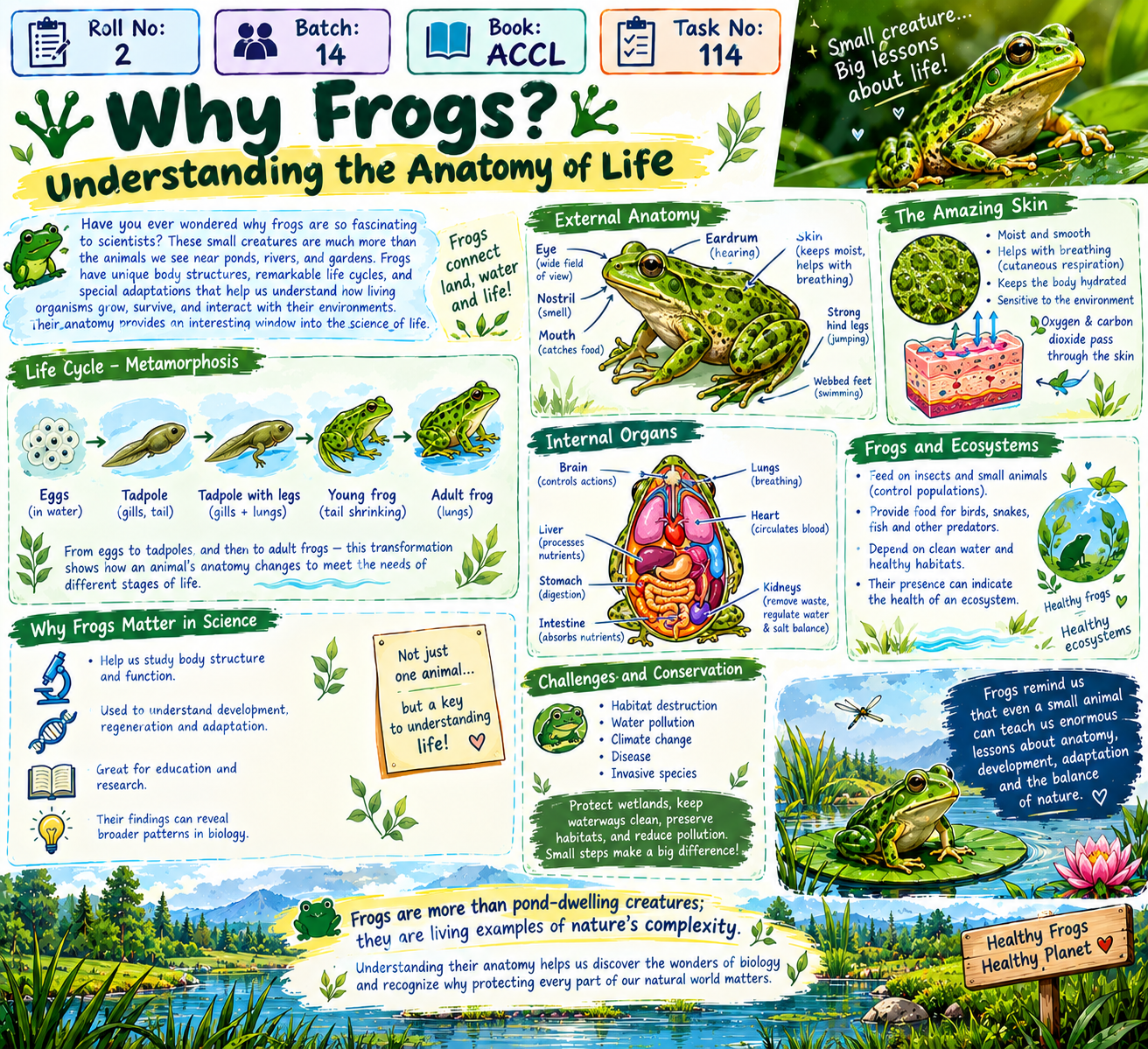
    # Why Frogs? Understanding the Anatomy of Life

    Have you ever wondered why frogs are so fascinating to scientists? These small creatures are much more than the animals we see near ponds, rivers, and gardens. Frogs have unique body structures, remarkable life cycles, and special adaptations that help us understand how living organisms grow, survive, and interact with their environments. Their anatomy provides an interesting window into the science of life.

    A frog's body is designed for life both in water and on land. Its body generally has a broad head, a short trunk, strong hind legs, and webbed feet in many species. These features help frogs jump, swim, and move through their habitats. Their eyes are positioned to provide a wide field of view, while their sensitive hearing helps them detect sounds, including the calls of other frogs.

    One of the most interesting features of frogs is their skin. Unlike the dry, scaly skin of many reptiles, frog skin is usually moist and plays an important role in their survival. Many frogs can exchange gases through their skin as well as through their lungs. This process, called **cutaneous respiration**, allows oxygen and carbon dioxide to pass across the skin under suitable conditions. Their skin also helps maintain moisture, making a healthy habitat especially important for them.

    Frogs have a fascinating life cycle called **metamorphosis**. Many begin life as eggs in water. The eggs hatch into tadpoles, which usually have tails and breathe mainly through gills. As they develop, they grow legs, their lungs develop, and their bodies gradually change into those of adult frogs. The tail is usually absorbed during development. This transformation demonstrates how an animal's anatomy changes to meet the needs of different stages of life.

    The internal organs of a frog also reveal important biological principles. Its heart circulates blood through the body, carrying oxygen and nutrients to tissues. The digestive system breaks down food, while the kidneys help remove waste and regulate water and salt balance. The brain and nervous system coordinate movement, senses, and responses to the environment. Each organ works with other systems to keep the animal alive.

    Frogs are also valuable to ecosystems. Many feed on insects and other small animals, helping influence populations of these organisms. Frogs themselves provide food for birds, snakes, fish, and other predators. Because many frogs depend on suitable water and land habitats, changes in their populations can provide clues about environmental conditions. Scientists therefore study frogs to learn more about biodiversity, habitat quality, and ecosystem health.

    Another reason frogs are important is their role in scientific research and education. Their anatomy helps students explore the structure and function of organs, compare different vertebrates, and understand biological systems. Researchers also study frog development, regeneration in certain species, communication, and adaptation. Such research can reveal broader patterns in biology, although findings from frogs do not always apply directly to humans.

    Unfortunately, many frog species face challenges such as habitat destruction, water pollution, climate change, disease, and invasive species. Protecting wetlands, keeping waterways clean, preserving natural habitats, and reducing pollution can help support frog populations and the many other organisms that share their ecosystems. Caring for frogs is one way of caring for the wider web of life.

    Frogs remind us that even a small animal can teach us enormous lessons about anatomy, development, adaptation, and the balance of nature. By observing their bodies and studying their life cycles, we gain a deeper appreciation of how living systems work together.

    **Frogs are more than pond-dwelling creatures; they are living examples of nature's complexity. Understanding their anatomy helps us discover the wonders of biology and recognize why protecting every part of our natural world matters. **

    \#Frogs #AnatomyOfLife #Biology #LifeCycle #AnimalScience #Biodiversity #ACCL #Batch14 #Task114
    **Roll No: 2** **Batch: 14** **Book: ACCL** **Task No: 120** # 🐸🔬 Why Frogs? Understanding the Anatomy of Life 🌿💚 Have you ever wondered why frogs are so fascinating to scientists? 🐸🌎 These small creatures are much more than the animals we see near ponds, rivers, and gardens. Frogs have unique body structures, remarkable life cycles, and special adaptations that help us understand how living organisms grow, survive, and interact with their environments. Their anatomy provides an interesting window into the science of life. 🔬✨ A frog's body is designed for life both in water and on land. 💧🌱 Its body generally has a broad head, a short trunk, strong hind legs, and webbed feet in many species. These features help frogs jump, swim, and move through their habitats. Their eyes are positioned to provide a wide field of view, while their sensitive hearing helps them detect sounds, including the calls of other frogs. 🦵👀 One of the most interesting features of frogs is their skin. Unlike the dry, scaly skin of many reptiles, frog skin is usually moist and plays an important role in their survival. 🐸💦 Many frogs can exchange gases through their skin as well as through their lungs. This process, called **cutaneous respiration**, allows oxygen and carbon dioxide to pass across the skin under suitable conditions. Their skin also helps maintain moisture, making a healthy habitat especially important for them. Frogs have a fascinating life cycle called **metamorphosis**. 🥚➡️🐟➡️🐸 Many begin life as eggs in water. The eggs hatch into tadpoles, which usually have tails and breathe mainly through gills. As they develop, they grow legs, their lungs develop, and their bodies gradually change into those of adult frogs. The tail is usually absorbed during development. This transformation demonstrates how an animal's anatomy changes to meet the needs of different stages of life. 🌱🔄 The internal organs of a frog also reveal important biological principles. ❤️ Its heart circulates blood through the body, carrying oxygen and nutrients to tissues. The digestive system breaks down food, while the kidneys help remove waste and regulate water and salt balance. The brain and nervous system coordinate movement, senses, and responses to the environment. Each organ works with other systems to keep the animal alive. 🧠🫀 Frogs are also valuable to ecosystems. 🦟🌿 Many feed on insects and other small animals, helping influence populations of these organisms. Frogs themselves provide food for birds, snakes, fish, and other predators. Because many frogs depend on suitable water and land habitats, changes in their populations can provide clues about environmental conditions. Scientists therefore study frogs to learn more about biodiversity, habitat quality, and ecosystem health. 🌍🔎 Another reason frogs are important is their role in scientific research and education. 📚🔬 Their anatomy helps students explore the structure and function of organs, compare different vertebrates, and understand biological systems. Researchers also study frog development, regeneration in certain species, communication, and adaptation. Such research can reveal broader patterns in biology, although findings from frogs do not always apply directly to humans. Unfortunately, many frog species face challenges such as habitat destruction, water pollution, climate change, disease, and invasive species. 🌧️🏞️ Protecting wetlands, keeping waterways clean, preserving natural habitats, and reducing pollution can help support frog populations and the many other organisms that share their ecosystems. Caring for frogs is one way of caring for the wider web of life. 💚♻️ Frogs remind us that even a small animal can teach us enormous lessons about anatomy, development, adaptation, and the balance of nature. By observing their bodies and studying their life cycles, we gain a deeper appreciation of how living systems work together. 🐸🌎🔬 **Frogs are more than pond-dwelling creatures; they are living examples of nature's complexity. Understanding their anatomy helps us discover the wonders of biology and recognize why protecting every part of our natural world matters. 🐸🧬🌿✨** \#Frogs #AnatomyOfLife #Biology #LifeCycle #AnimalScience #Biodiversity #ACCL #Batch14 #Task114 🐸🔬🌍

    0 Comments 0 Shares 19 Views
  • Unlock the future with robots: boost productivity, save time, and spark creativi

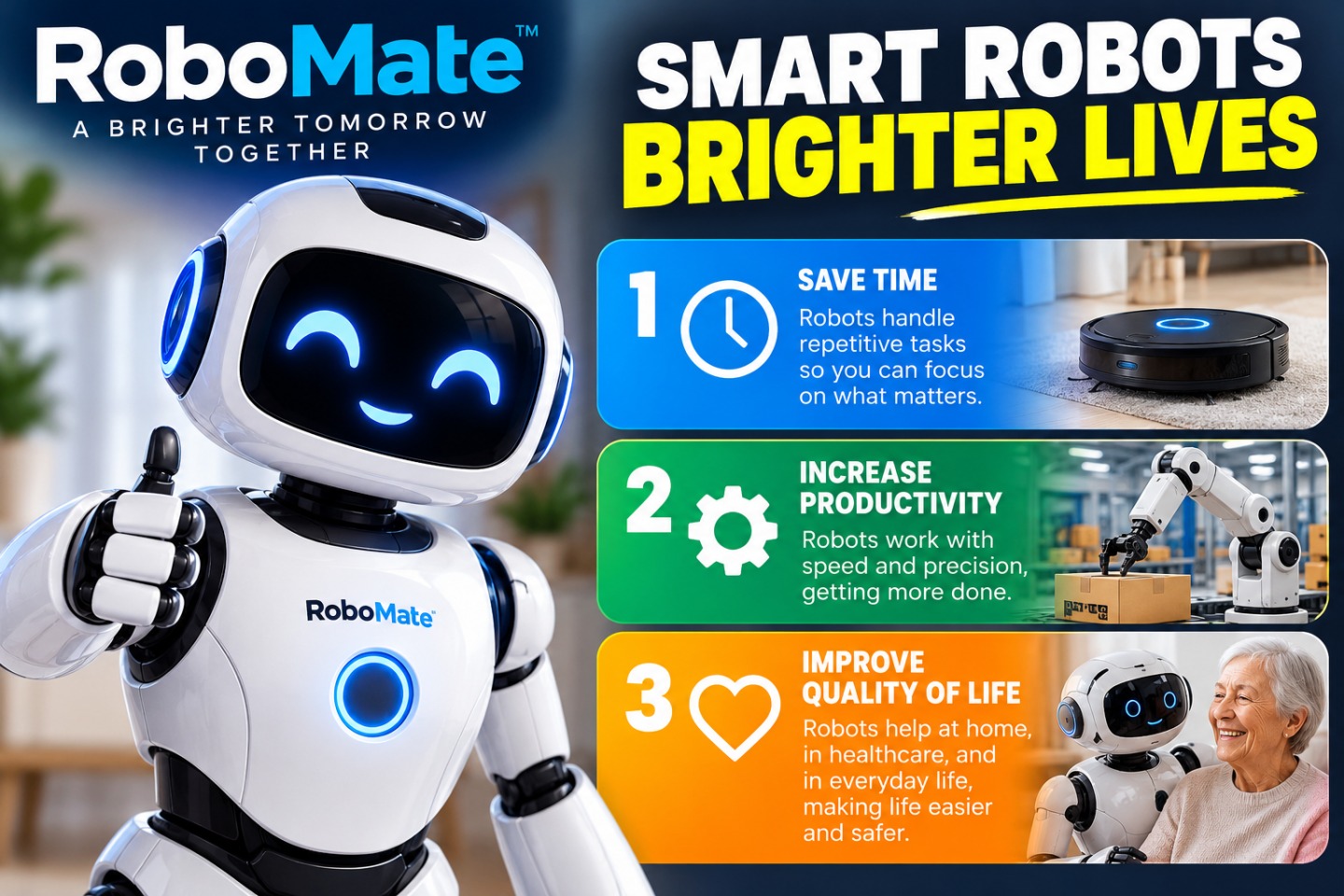
    Unlock the future with robots: boost productivity, save time, and spark creativity

    #robotics #futuretech #automation #innovation #techsavvy #productivity #fridayvibes #techtrends
    Unlock the future with robots: boost productivity, save time, and spark creativi Unlock the future with robots: boost productivity, save time, and spark creativity 🤖✨ #robotics #futuretech #automation #innovation #techsavvy #productivity #fridayvibes #techtrends
    0 Comments 0 Shares 11 Views
  • Unlock the future: robots boost productivity, safety, and creativity

    Unlock the future: robots boost productivity, safety, and creativity

    #robotics #futuretech #automation #innovation #productivity #safety #creativity #techtrends #fridayvibes
    Unlock the future: robots boost productivity, safety, and creativity 🤖✨ Unlock the future: robots boost productivity, safety, and creativity 🤖✨ #robotics #futuretech #automation #innovation #productivity #safety #creativity #techtrends #fridayvibes
    0 Comments 0 Shares 14 Views
  • he

    #he
    he #he
    0 Comments 0 Shares 8 Views
  • #rsisb
    Roll no 248
    Foundation level
    Story post no 40
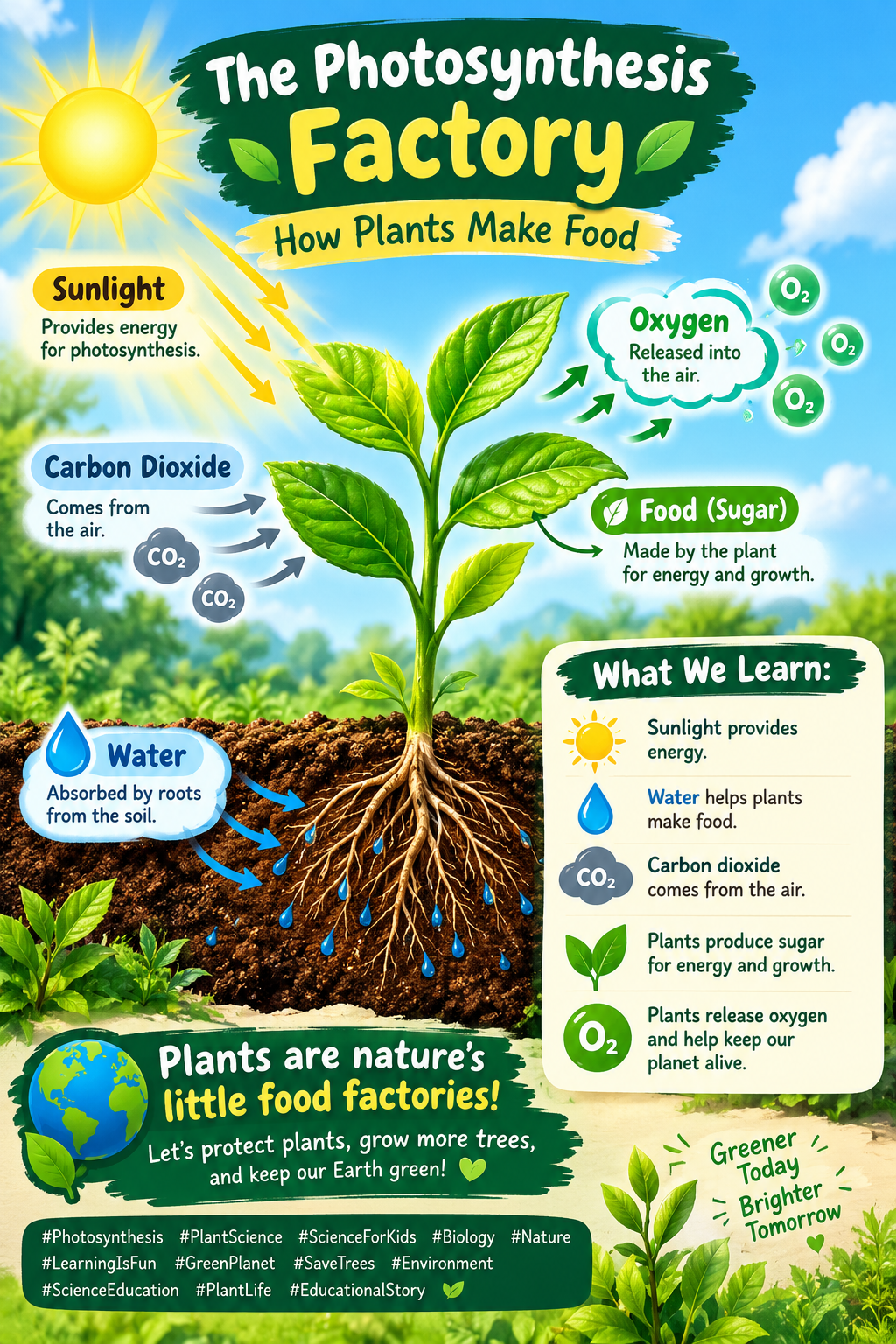
    **The Photosynthesis Factory: How Plants Make Food! **

    Have you ever wondered how plants make their own food? Welcome to the amazing Photosynthesis Factory!

    Plants use sunlight , water , and carbon dioxide to make their own food through a process called **photosynthesis**. During this amazing process, plants release oxygen 🫧, which humans and animals need to breathe!

    **What can we learn?**
    Sunlight provides energy.
    Water helps plants make food.
    Carbon dioxide comes from the air.
    Plants produce sugar for energy and growth.
    Plants release oxygen and help keep our planet alive.

    **Remember:** Plants are nature's little food factories! Let's protect plants, grow more trees, and keep our Earth green!

    #Photosynthesis #PlantScience #ScienceForKids #Biology #Nature #LearningIsFun #GreenPlanet #SaveTrees #Environment #ScienceEducation #PlantLife #EducationalStory
    #rsisb Roll no 248 Foundation level Story post no 40 🌿🏭 **The Photosynthesis Factory: How Plants Make Food! ☀️🌱** Have you ever wondered how plants make their own food? 🤔🌿 Welcome to the amazing Photosynthesis Factory! 🏭🌱 Plants use sunlight ☀️, water 💧, and carbon dioxide 🌬️ to make their own food through a process called **photosynthesis**. During this amazing process, plants release oxygen 🫧, which humans and animals need to breathe! 🌍💚 🍃 **What can we learn?** ✨ Sunlight provides energy. 💧 Water helps plants make food. 🌬️ Carbon dioxide comes from the air. 🍬 Plants produce sugar for energy and growth. 💚 Plants release oxygen and help keep our planet alive. 🌎 **Remember:** Plants are nature's little food factories! Let's protect plants, grow more trees, and keep our Earth green! 🌳💚 #Photosynthesis #PlantScience #ScienceForKids #Biology #Nature #LearningIsFun #GreenPlanet #SaveTrees #Environment #ScienceEducation #PlantLife #EducationalStory 🌿🌱☀️💚
    0 Comments 0 Shares 63 Views
  • #rsisb
    Roll no . 257
    ChatGPT Image. 18
    Foundation level


    **Dream It. Believe It. Achieve It.**

    Every great achievement begins with a dream! Dreaming gives us a vision of what we want to become and inspires us to take the first step toward our goals. No matter how big your dreams are, always believe in yourself, keep learning, and never stop trying!

    **“Dream it.”**

    These two simple words carry a powerful message: imagine the future you want to create! Whether your dream is to become a scientist , a teacher ‍, a programmer , an artist , a doctor , or an entrepreneur , every dream starts with an idea in your mind.

    Remember that dreams don't become reality in one day. You need patience, dedication, hard work, and the courage to keep moving forward. Every small step you take today can bring you closer to your goals tomorrow.

    Learn something new every day.
    Set goals and work toward them.
    Turn your ideas into action.
    Believe in your abilities.
    Learn from your mistakes.
    Never be afraid to try something new!

    Sometimes the journey may feel difficult, and you might face challenges along the way. But challenges can teach you valuable lessons and help you grow stronger. Don't give up on your dreams just because success takes time. Keep improving, stay curious, and make every day an opportunity to learn something useful.

    **Your dreams matter!** Start with an idea, take one small step, and keep building your future with confidence. The world is full of possibilities waiting to be explored!

    **Dream big. Start small. Keep going. Make it happen!**

    #DreamIt #DreamBig #BelieveInYourself #Motivation #Inspiration #NeverGiveUp #PositiveThinking #KeepLearning #PersonalGrowth #SuccessMindset #FutureGoals #CreativeThinking #StudentLife #LearningJourney #BeYourBest #DailyMotivation #ChaseYourDreams #StayPositive #HardWorkPaysOff #MakeItHappen
    #rsisb Roll no . 257 ChatGPT Image. 18 Foundation level ✨🌟 **Dream It. Believe It. Achieve It.** 🌟✨ 💭🌈 Every great achievement begins with a dream! 🚀✨ Dreaming gives us a vision of what we want to become and inspires us to take the first step toward our goals. 🌍💡 No matter how big your dreams are, always believe in yourself, keep learning, and never stop trying! 💪📚 🌟 **“Dream it.”** 💭 These two simple words carry a powerful message: imagine the future you want to create! 🎯 Whether your dream is to become a scientist 🔬, a teacher 👩‍🏫, a programmer 💻, an artist 🎨, a doctor 🩺, or an entrepreneur 🚀, every dream starts with an idea in your mind. 💡 🌱 Remember that dreams don't become reality in one day. You need patience, dedication, hard work, and the courage to keep moving forward. 💪🔥 Every small step you take today can bring you closer to your goals tomorrow. 📈✨ 📖 Learn something new every day. 🎯 Set goals and work toward them. 💡 Turn your ideas into action. 🌈 Believe in your abilities. 🤝 Learn from your mistakes. 🚀 Never be afraid to try something new! Sometimes the journey may feel difficult, and you might face challenges along the way. 🌧️ But challenges can teach you valuable lessons and help you grow stronger. 🌻 Don't give up on your dreams just because success takes time. Keep improving, stay curious, and make every day an opportunity to learn something useful. 📚🌟 🌍✨ **Your dreams matter!** Start with an idea, take one small step, and keep building your future with confidence. The world is full of possibilities waiting to be explored! 🚀💫 💖 **Dream big. Start small. Keep going. Make it happen!** 💖 #DreamIt #DreamBig #BelieveInYourself #Motivation #Inspiration #NeverGiveUp #PositiveThinking #KeepLearning #PersonalGrowth #SuccessMindset #FutureGoals #CreativeThinking #StudentLife #LearningJourney #BeYourBest #DailyMotivation #ChaseYourDreams #StayPositive #HardWorkPaysOff #MakeItHappen 🌟🚀💭✨🌈💪📚🎯
    0 Comments 0 Shares 51 Views
  • RSIF8
    Roll no: 09
    Canva post no: 27
    Canva post topic: "Believe You Can, and You’re Halfway There"--- Theodore Roosevelt.

    Believe You Can, and You’re Halfway There!
    Believe in yourself, trust your journey, and never give up on your dreams! Every great achievement begins with the courage to believe that you can do it. Challenges may come your way, but with confidence, determination, and a positive mindset, you can overcome obstacles and reach your goals.
    Remember, success starts in your mind! Take the first step, keep moving forward, and let your belief in yourself guide you toward greatness.
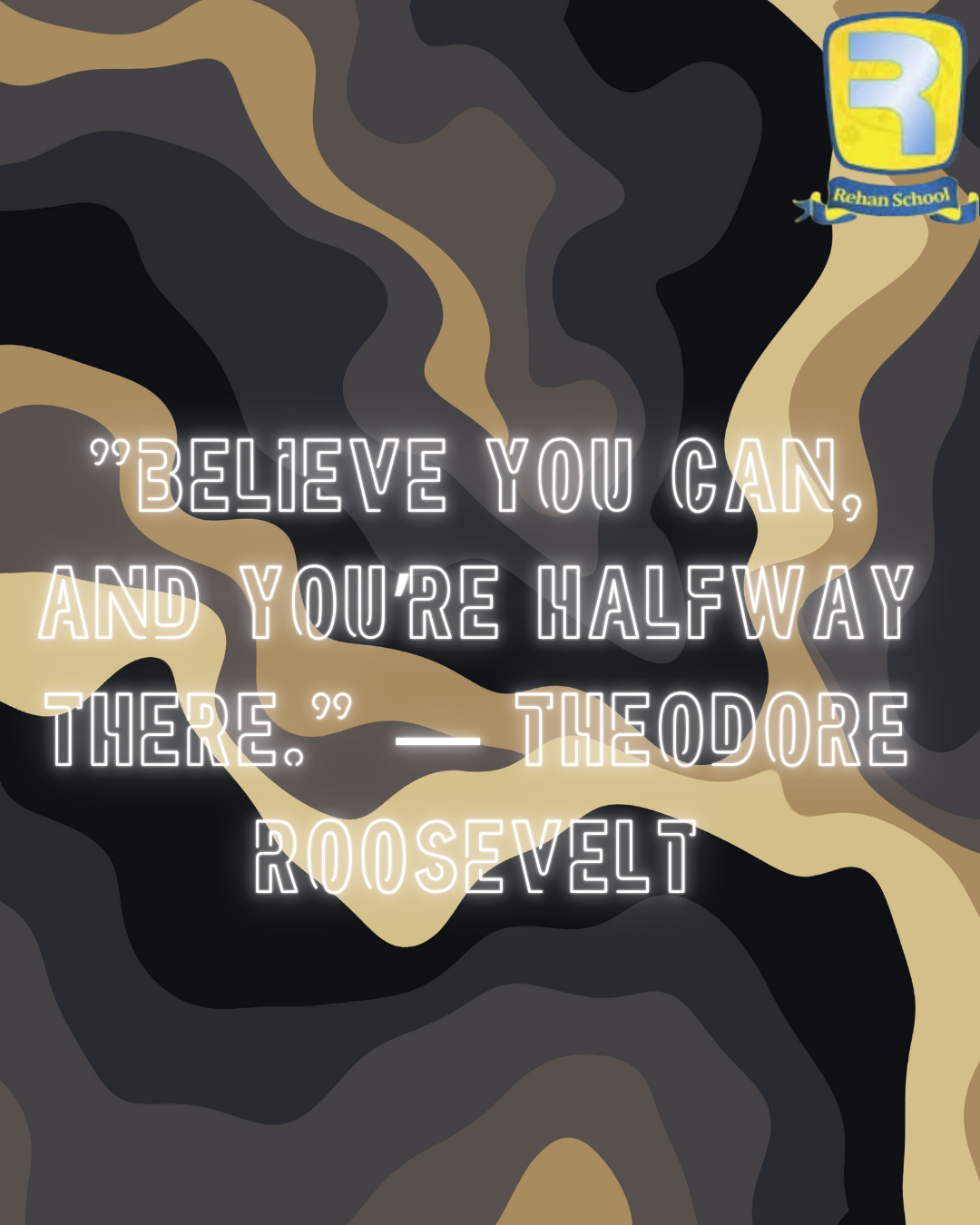
    “Believe you can, and you’re halfway there.” — Theodore Roosevelt
    #BelieveInYourself #TheodoreRoosevelt #Motivation #PositiveMindset #SelfConfidence #NeverGiveUp #DreamBig #SuccessMindset #DailyMotivation #PersonalGrowth #Inspiration #KeepGoing #BelieveAndAchieve
    RSIF8 Roll no: 09 Canva post no: 27 Canva post topic: "Believe You Can, and You’re Halfway There"--- Theodore Roosevelt. ✨🌟 Believe You Can, and You’re Halfway There! 🌟✨ 💫 Believe in yourself, trust your journey, and never give up on your dreams! 💖 Every great achievement begins with the courage to believe that you can do it. 💪🚀 Challenges may come your way, but with confidence, determination, and a positive mindset, you can overcome obstacles and reach your goals. 🎯🌈 🌸 Remember, success starts in your mind! 🧠✨ Take the first step, keep moving forward, and let your belief in yourself guide you toward greatness. 💕🔥 💬 “Believe you can, and you’re halfway there.” — Theodore Roosevelt 🌟 #BelieveInYourself 💖 #TheodoreRoosevelt ✨ #Motivation 🚀 #PositiveMindset 🌈 #SelfConfidence 💪 #NeverGiveUp 🔥 #DreamBig 🌟 #SuccessMindset 🎯 #DailyMotivation 💫 #PersonalGrowth 🌱 #Inspiration 💕 #KeepGoing 🏆 #BelieveAndAchieve 💯
    0 Comments 0 Shares 54 Views
  • #rsisb
    Roll no. 247
    Story post . 18
    Foundation level

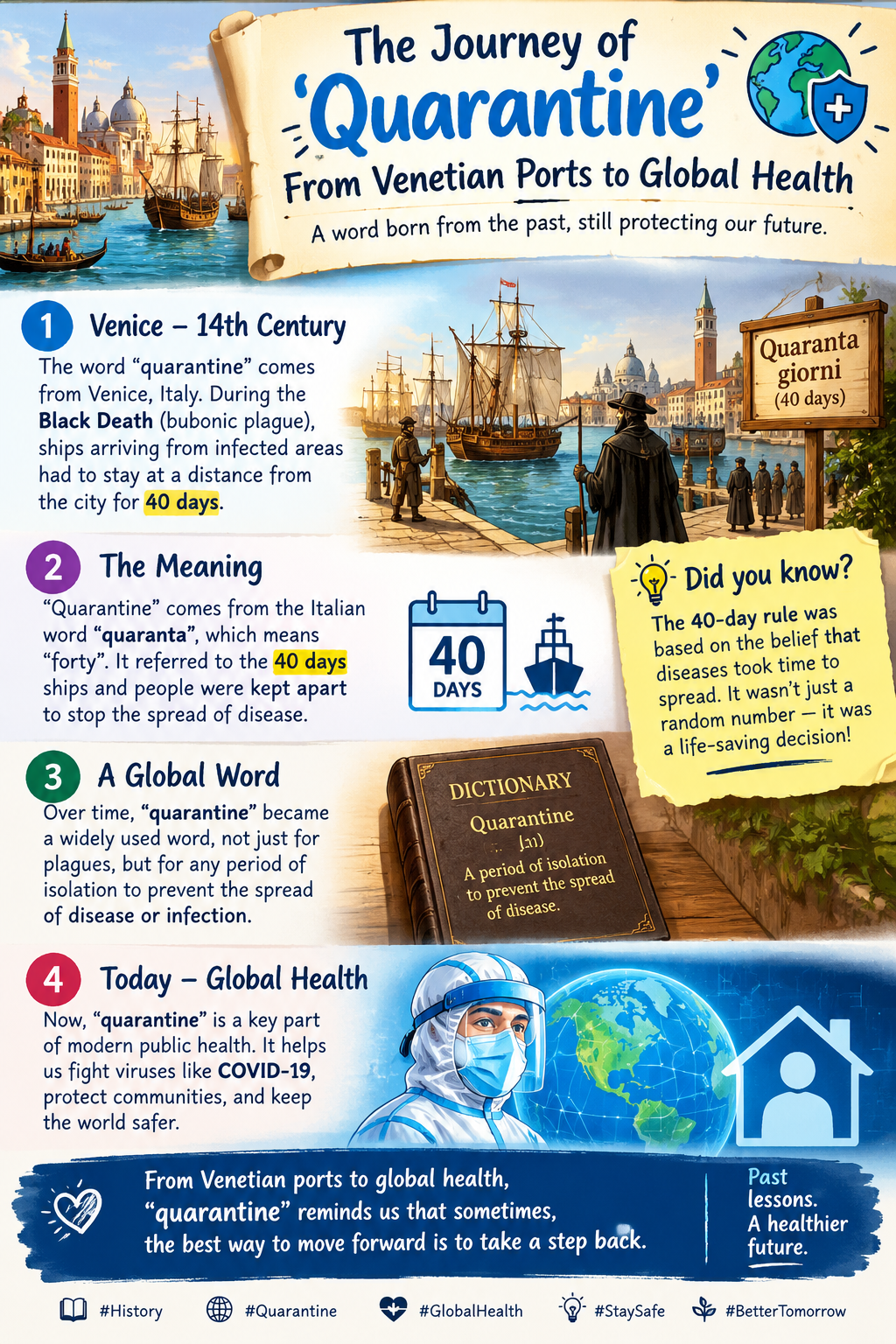
    **The Journey of “Quarantine”: From Venetian Ports to Global Health **

    **Have you ever wondered where the word “quarantine” came from?** Today, we use the word quarantine when people stay apart from others for a period of time to help prevent the spread of infectious diseases. But did you know that this word has a fascinating history that goes back hundreds of years?

    **The Story Begins in Venice!**

    The journey of the word *quarantine* takes us back to the busy port cities of Venice, Italy, during the 14th century. Venice was an important center of international trade, where ships arrived from different parts of the world carrying goods, travelers, and sailors. However, ships could also bring infectious diseases into crowded cities.

    To reduce the risk of disease spreading, authorities required certain arriving travelers and sailors to wait for a period before entering the city. The Italian word *quaranta* means **forty**, and the term *quarantina* referred to a period of forty days. This practice helped give us the English word **“quarantine.”**

    **How Did Quarantine Change the World?**

    Over time, quarantine became an important public health measure. During outbreaks of infectious diseases, authorities used isolation and quarantine practices to help protect communities. As medical science developed, people gained a better understanding of how diseases spread and how to reduce transmission.

    ‍ Today, quarantine and isolation have different meanings:
    **Quarantine:** Separating or restricting the movement of people who may have been exposed to an infectious disease.
    **Isolation:** Keeping people who are infected or ill apart from others to help prevent the spread of disease.

    These measures may be used alongside vaccination, testing, good hygiene, and other public health strategies, depending on the disease and the situation.

    **What Can We Learn from This Story?**

    The history of quarantine teaches us that language, science, and human society are connected. A word that began with a forty-day waiting period in historical maritime trade became part of the vocabulary of global health!

    It also reminds us that communities have worked for centuries to protect public health. Learning about the past helps us understand the importance of scientific knowledge, responsible decisions, cooperation, and caring for one another.

    **A Small Word, A Big History!**

    From the historic Venetian ports to modern hospitals and public health systems, the journey of “quarantine” shows how a simple word can carry centuries of history, challenges, and discoveries.

    Keep asking questions, exploring history, and discovering the amazing stories hidden behind everyday words!

    **Question for You:** Did you know that the word “quarantine” is connected to the Italian word for forty? Share your thoughts in the comments!

    Like, share, and save this post if you enjoy learning interesting facts about history, language, and science!

    #️⃣ **Hashtags:**

    #TheJourneyOfQuarantine #HistoryOfWords #Quarantine #VeniceHistory #ItalianHistory #WordOrigins #Etymology #GlobalHealth #PublicHealth #MedicalHistory #HistoryAndScience #ScienceEducation #HealthAwareness #InfectiousDiseases #LearningIsFun #EducationalPost #KnowledgeIsPower #DiscoverHistory #DidYouKnow #InterestingFacts #WorldHistory #LanguageLearning #StoryPost #KeepLearning #ExploreAndDiscover
    #rsisb Roll no. 247 Story post . 18 Foundation level 🌍📜 **The Journey of “Quarantine”: From Venetian Ports to Global Health 🚢🦠** ✨📚 **Have you ever wondered where the word “quarantine” came from?** 🤔🌎 Today, we use the word quarantine when people stay apart from others for a period of time to help prevent the spread of infectious diseases. But did you know that this word has a fascinating history that goes back hundreds of years? 🏛️⏳ 🚢🇮🇹 **The Story Begins in Venice!** 🏰✨ The journey of the word *quarantine* takes us back to the busy port cities of Venice, Italy, during the 14th century. Venice was an important center of international trade, where ships arrived from different parts of the world carrying goods, travelers, and sailors. 🌍⚓ However, ships could also bring infectious diseases into crowded cities. 🛡️⏰ To reduce the risk of disease spreading, authorities required certain arriving travelers and sailors to wait for a period before entering the city. The Italian word *quaranta* means **forty**, and the term *quarantina* referred to a period of forty days. This practice helped give us the English word **“quarantine.”** 📖🔍 🦠💡 **How Did Quarantine Change the World?** 🌍🏥 Over time, quarantine became an important public health measure. During outbreaks of infectious diseases, authorities used isolation and quarantine practices to help protect communities. As medical science developed, people gained a better understanding of how diseases spread and how to reduce transmission. 🔬👩‍⚕️ Today, quarantine and isolation have different meanings: ✅ **Quarantine:** Separating or restricting the movement of people who may have been exposed to an infectious disease. ✅ **Isolation:** Keeping people who are infected or ill apart from others to help prevent the spread of disease. 🌐🩺 These measures may be used alongside vaccination, testing, good hygiene, and other public health strategies, depending on the disease and the situation. 💭✨ **What Can We Learn from This Story?** 📚🌟 The history of quarantine teaches us that language, science, and human society are connected. A word that began with a forty-day waiting period in historical maritime trade became part of the vocabulary of global health! 🌍🚢 🧠💡 It also reminds us that communities have worked for centuries to protect public health. Learning about the past helps us understand the importance of scientific knowledge, responsible decisions, cooperation, and caring for one another. ❤️🤝 🎯📖 **A Small Word, A Big History!** From the historic Venetian ports to modern hospitals and public health systems, the journey of “quarantine” shows how a simple word can carry centuries of history, challenges, and discoveries. 🚢➡️🏥 🌟 Keep asking questions, exploring history, and discovering the amazing stories hidden behind everyday words! 🔎📚✨ 💬 **Question for You:** Did you know that the word “quarantine” is connected to the Italian word for forty? 🤔👇 Share your thoughts in the comments! ❤️ Like, 🔄 share, and 📌 save this post if you enjoy learning interesting facts about history, language, and science! #️⃣ **Hashtags:** #TheJourneyOfQuarantine #HistoryOfWords #Quarantine #VeniceHistory #ItalianHistory #WordOrigins #Etymology #GlobalHealth #PublicHealth #MedicalHistory #HistoryAndScience #ScienceEducation #HealthAwareness #InfectiousDiseases #LearningIsFun #EducationalPost #KnowledgeIsPower #DiscoverHistory #DidYouKnow #InterestingFacts #WorldHistory #LanguageLearning #StoryPost #KeepLearning #ExploreAndDiscover 🌍📚🔬✨
    0 Comments 0 Shares 90 Views
  • Rsif8
    Roll No 30
    Poat No 6
    Learning with Mrs Zoya · mrszoya.com
    **Learning Japanese with Zoya: How to Say “World” in Japanese **
    In this video, I had an interesting interview with Zoya, where I asked her how to say the English word **“World” in Japanese**.
    I learned that “World” in Japanese is **世界 (Sekai)**. It is a useful Japanese word that helps us learn more about the language and culture of Japan.
    Learning a new language is a fun way to explore different cultures, discover new words, and improve our communication skills. Through this interview, I am learning Japanese one word at a time with the help of AI.
    Watch the video to join my language-learning journey and discover how easy and enjoyable learning Japanese can be!
    Thank you for watching. Don't forget to like, share, and subscribe for more educational videos and AI conversations.
    #LearnJapanese #Sekai #JapaneseLanguage #InterviewWithAI #ZoyaAI #LanguageLearning #LearnWithAI #EducationalVideo
    Rsif8 Roll No 30 Poat No 6 Learning with Mrs Zoya · mrszoya.com **Learning Japanese with Zoya: How to Say “World” in Japanese 🇯🇵🌍** In this video, I had an interesting interview with Zoya, where I asked her how to say the English word **“World” in Japanese**. I learned that “World” in Japanese is **世界 (Sekai)**. It is a useful Japanese word that helps us learn more about the language and culture of Japan. Learning a new language is a fun way to explore different cultures, discover new words, and improve our communication skills. Through this interview, I am learning Japanese one word at a time with the help of AI. Watch the video to join my language-learning journey and discover how easy and enjoyable learning Japanese can be! Thank you for watching. Don't forget to like, share, and subscribe for more educational videos and AI conversations. #LearnJapanese #Sekai #JapaneseLanguage #InterviewWithAI #ZoyaAI #LanguageLearning #LearnWithAI #EducationalVideo
    0 Comments 0 Shares 49 Views 1
More Results