• #rsisb
    Roll No 253
    Foundation Level
    Story Post 25


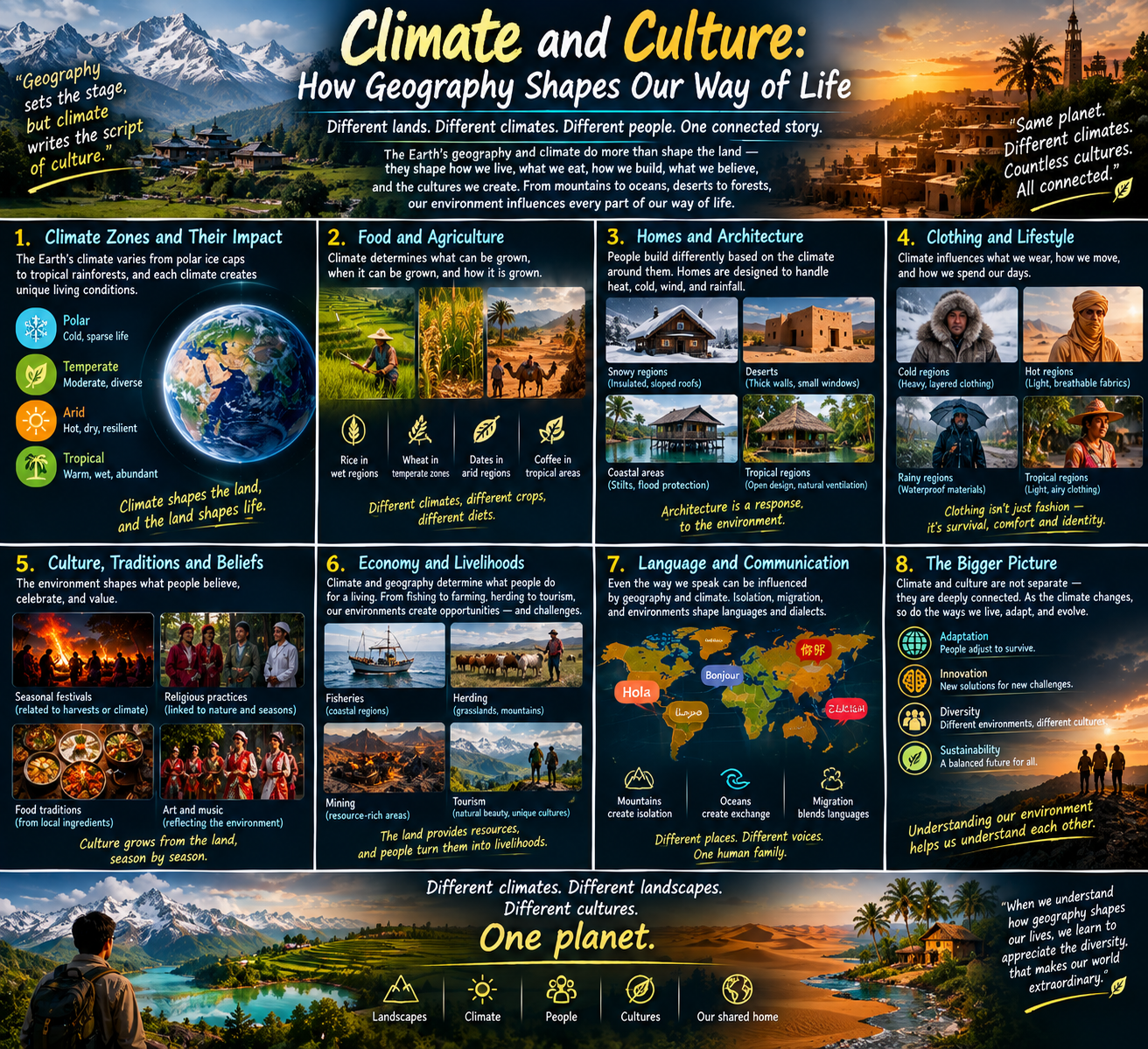
    # Climate and Culture: How Geography Shapes Our Way of Life

    Imagine placing a person in a frozen mountain valley , then moving them to a scorching desert , a tropical rainforest , or a coastline .

    The landscape changes.

    The weather changes.

    And gradually, **the way people live changes too.** ‍‍

    Where we live influences what we eat , what we grow , how we build our homes , what we wear , how we earn a living , and even how communities develop traditions and identities.

    ---

    # 1. Climate Zones and Their Impact

    Earth contains an incredible variety of climates.

    **Polar regions** — extremely cold and often sparsely populated
    **Temperate regions** — moderate temperatures and diverse ecosystems
    **Arid regions** — hot or dry conditions with limited rainfall
    **Tropical regions** — warm temperatures and often abundant rainfall

    These environments create different opportunities and challenges for human societies.

    ### **The climate shapes the environment—and people adapt to it.**

    ---

    # 2. Food and Agriculture

    Climate has a major influence on what can be grown and how agriculture is practiced.

    Rice thrives in many warm, water-rich environments.
    Wheat grows widely across temperate regions.
    Dates are well adapted to hot, dry climates.
    Coffee grows particularly well in suitable tropical highland environments.

    These crops don't just provide food.

    They can become part of a community's:

    Cuisine
    Economy
    Festivals
    ‍‍‍ Traditions
    History

    ### **Different environments create different relationships with food.**

    ---

    # 3. Homes and Architecture

    Look at houses around the world and you'll often find clues about their environment.

    **Cold regions** may use insulation and steep roofs to handle snow and retain heat.

    **Desert regions** may use thick walls, shaded spaces, and smaller openings to reduce heat.

    **Coastal regions** may use raised structures to reduce exposure to flooding.

    **Tropical regions** often benefit from designs that encourage ventilation and manage heavy rainfall.

    Architecture is therefore more than appearance.

    ### **Buildings are often human responses to climate.**

    ---

    # 4. Clothing and Lifestyle

    What people wear is also influenced by their environment.

    Cold climates → layered and insulating clothing
    Hot climates → lightweight, breathable fabrics
    Rainy climates → water-resistant materials

    But clothing isn't only about weather.

    It can also express:

    Identity
    Tradition
    Culture
    ‍‍ Community
    History

    ### **Clothing can be both practical and cultural.**

    ---

    # 5. Culture, Traditions, and Beliefs

    The environment can influence cultural practices in subtle and powerful ways.

    Seasonal changes may shape festivals.

    Harvest periods can become important community celebrations.

    Local ingredients can influence traditional cuisine.

    Natural landscapes may become part of stories, art, music, and cultural traditions.

    Over generations, people develop ways of understanding and responding to the environments around them.

    ### **Culture grows through the interaction between people, place, and history.**

    ---

    # 6. Economy and Livelihoods

    Geography also influences how people make a living.

    Coastal communities may depend on fishing.
    Mountain regions may support tourism or livestock herding.
    Fertile areas can support agriculture.
    Resource-rich regions may develop mining industries.
    Beautiful landscapes can attract tourism.

    Climate doesn't determine a person's occupation by itself—technology, markets, history, politics, and many other factors matter too.

    But geography can create **opportunities and constraints** that shape economic life.

    ---

    # 7. Language and Communication

    Human geography can even influence how languages develop and spread.

    Mountains and difficult terrain can sometimes separate communities, allowing linguistic differences to develop over time.

    Rivers, oceans, migration, trade, and cities can connect people and encourage languages to interact.

    Languages carry traces of human movement and cultural exchange.

    ### **Different places can create different voices—while connection brings them together.**

    ---

    # 8. The Bigger Picture

    Climate and culture aren't isolated subjects.

    They are part of a much larger system.

    Climate influences environments.
    Environments provide resources and constraints.
    ‍‍ People adapt and innovate.
    Communities develop ways of living.
    Traditions and identities evolve.
    Migration and technology create new connections.

    And these relationships are constantly changing.

    Climate patterns shift.
    Technology advances.
    Cities grow.
    People migrate. ‍
    Cultures interact.

    ### **Human societies are always adapting to a changing world.**

    ---

    # The Bigger Lesson

    There is no single way to live.

    Across our planet, humans have created extraordinary diversity in response to different landscapes, climates, histories, and social conditions.

    From mountain villages to desert communities …

    From tropical islands to northern settlements …

    People have found creative ways to build homes, grow food, form communities, and create cultures.

    Yet beneath all that diversity is something we share:

    ### **One planet. One interconnected human story.**

    When we understand how geography and climate influence human life, we gain a deeper appreciation for why cultures can be so different—and why they are all part of the same extraordinary world.

    # **Different climates. Different landscapes. Different cultures. One planet.**


    Asma Shaheen EducationWali
    Saima Empowerment Wali
    Mishaal TrainingWali
    #rsisb Roll No 253 Foundation Level Story Post 25 # 🌍🌦️ Climate and Culture: How Geography Shapes Our Way of Life Imagine placing a person in a frozen mountain valley 🏔️❄️, then moving them to a scorching desert 🏜️☀️, a tropical rainforest 🌴🌧️, or a coastline 🌊🐚. The landscape changes. The weather changes. And gradually, **the way people live changes too.** 🧑‍🤝‍🧑🌎 Where we live influences what we eat 🍚, what we grow 🌾, how we build our homes 🏠, what we wear 👕, how we earn a living 💼, and even how communities develop traditions and identities. 🎭🎶 --- # 🌡️🌍 1. Climate Zones and Their Impact Earth contains an incredible variety of climates. ❄️ **Polar regions** — extremely cold and often sparsely populated 🌿 **Temperate regions** — moderate temperatures and diverse ecosystems 🏜️ **Arid regions** — hot or dry conditions with limited rainfall 🌴 **Tropical regions** — warm temperatures and often abundant rainfall These environments create different opportunities and challenges for human societies. ### **The climate shapes the environment—and people adapt to it.** 🌱🧠 --- # 🌾🍎 2. Food and Agriculture Climate has a major influence on what can be grown and how agriculture is practiced. 🌱☀️💧 Rice thrives in many warm, water-rich environments. 🍚 Wheat grows widely across temperate regions. 🌾 Dates are well adapted to hot, dry climates. 🌴 Coffee grows particularly well in suitable tropical highland environments. ☕ These crops don't just provide food. They can become part of a community's: 🍽️ Cuisine 💼 Economy 🎉 Festivals 👨‍👩‍👧‍👦 Traditions 🏛️ History ### **Different environments create different relationships with food.** 🌍🍴 --- # 🏠🏔️ 3. Homes and Architecture Look at houses around the world and you'll often find clues about their environment. 🔍🌎 🏔️ **Cold regions** may use insulation and steep roofs to handle snow and retain heat. 🏜️ **Desert regions** may use thick walls, shaded spaces, and smaller openings to reduce heat. 🌊 **Coastal regions** may use raised structures to reduce exposure to flooding. 🌴 **Tropical regions** often benefit from designs that encourage ventilation and manage heavy rainfall. Architecture is therefore more than appearance. ### **Buildings are often human responses to climate.** 🏠🌦️ --- # 👕🌬️ 4. Clothing and Lifestyle What people wear is also influenced by their environment. 🧥☀️ ❄️ Cold climates → layered and insulating clothing ☀️ Hot climates → lightweight, breathable fabrics 🌧️ Rainy climates → water-resistant materials But clothing isn't only about weather. It can also express: 🎨 Identity 🕌 Tradition 🎭 Culture 👨‍👩‍👧 Community 📜 History ### **Clothing can be both practical and cultural.** 👕🌍 --- # 🎭🌿 5. Culture, Traditions, and Beliefs The environment can influence cultural practices in subtle and powerful ways. Seasonal changes may shape festivals. 🌱🌾🎉 Harvest periods can become important community celebrations. 🌾🥁 Local ingredients can influence traditional cuisine. 🍲🌶️ Natural landscapes may become part of stories, art, music, and cultural traditions. 🏔️🎶🎨 Over generations, people develop ways of understanding and responding to the environments around them. ### **Culture grows through the interaction between people, place, and history.** 🌍❤️ --- # 💼🌾 6. Economy and Livelihoods Geography also influences how people make a living. 🌊 Coastal communities may depend on fishing. 🐟 🏔️ Mountain regions may support tourism or livestock herding. 🐐 🌾 Fertile areas can support agriculture. ⛏️ Resource-rich regions may develop mining industries. 🏝️ Beautiful landscapes can attract tourism. Climate doesn't determine a person's occupation by itself—technology, markets, history, politics, and many other factors matter too. But geography can create **opportunities and constraints** that shape economic life. 🌎💼 --- # 🗣️🌍 7. Language and Communication Human geography can even influence how languages develop and spread. 🗣️✨ Mountains and difficult terrain can sometimes separate communities, allowing linguistic differences to develop over time. 🏔️ Rivers, oceans, migration, trade, and cities can connect people and encourage languages to interact. 🌊🚢🏙️ Languages carry traces of human movement and cultural exchange. ### **Different places can create different voices—while connection brings them together.** 🗺️🗣️ --- # 🔄🌱 8. The Bigger Picture Climate and culture aren't isolated subjects. They are part of a much larger system. 🔗🌍 🌦️ Climate influences environments. 🌱 Environments provide resources and constraints. 👨‍👩‍👧 People adapt and innovate. 🏠 Communities develop ways of living. 🎭 Traditions and identities evolve. 🌍 Migration and technology create new connections. And these relationships are constantly changing. Climate patterns shift. 🌡️ Technology advances. 💻 Cities grow. 🏙️ People migrate. 🚶‍♂️ Cultures interact. 🤝 ### **Human societies are always adapting to a changing world.** --- # 🌍✨ The Bigger Lesson There is no single way to live. Across our planet, humans have created extraordinary diversity in response to different landscapes, climates, histories, and social conditions. 🏔️🏜️🌴🌊 From mountain villages 🏔️ to desert communities 🏜️… From tropical islands 🌴 to northern settlements ❄️… People have found creative ways to build homes, grow food, form communities, and create cultures. Yet beneath all that diversity is something we share: ### 🌎 **One planet. One interconnected human story.** When we understand how geography and climate influence human life, we gain a deeper appreciation for why cultures can be so different—and why they are all part of the same extraordinary world. 🌍🤝❤️ # 🌦️🏔️🏜️🌴 **Different climates. Different landscapes. Different cultures. One planet.** 🌎✨ Asma Shaheen EducationWali Saima Empowerment Wali Mishaal TrainingWali
    0 Yorumlar 0 hisse senetleri 765 Views
  • #rsisb
    Roll No 253
    Foundation Level
    Story Post 24

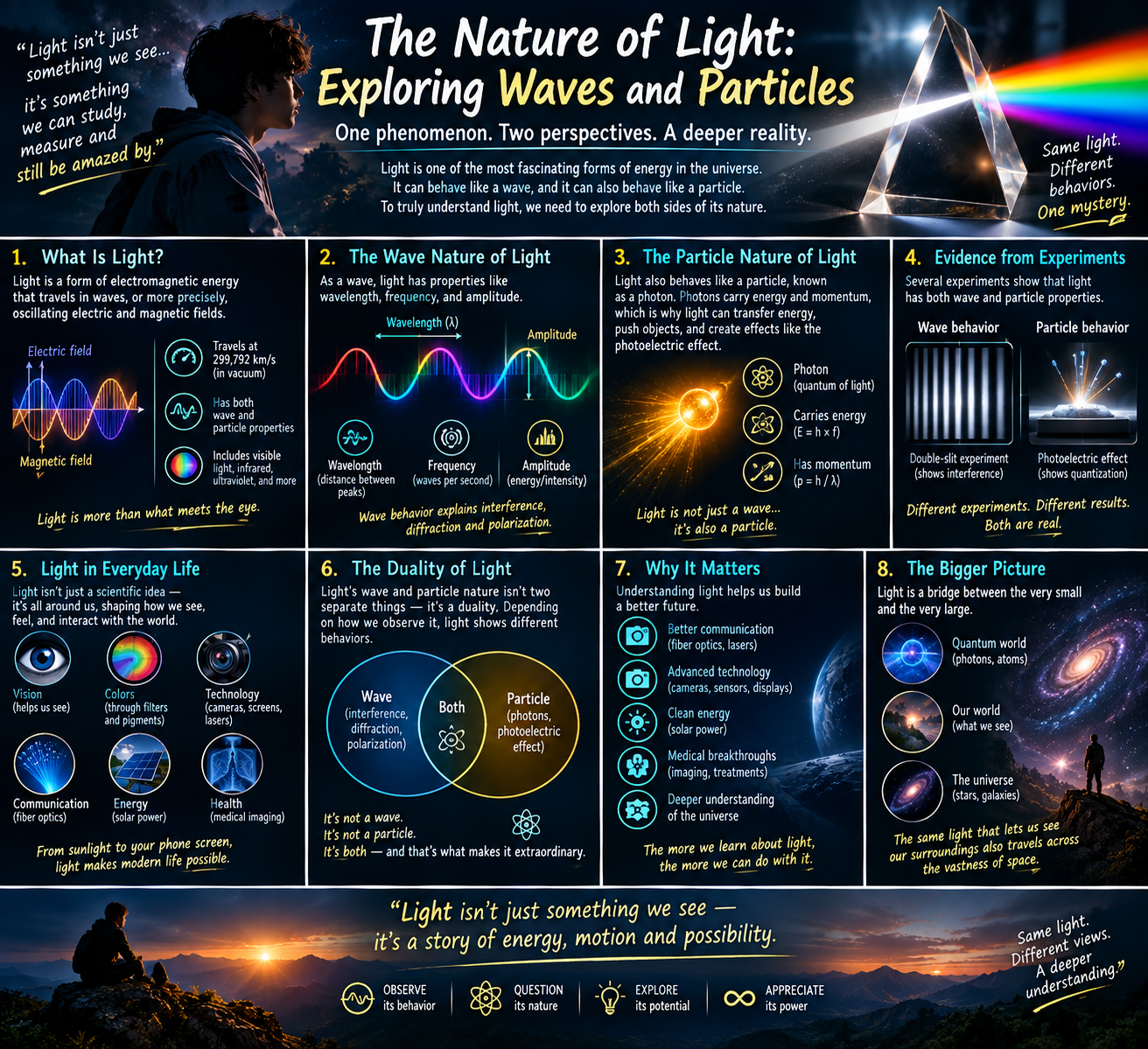
    # The Nature of Light: Exploring Waves and Particles

    Imagine standing beneath a night sky filled with stars.

    Every photon reaching your eyes has traveled across space carrying information from distant worlds. Light allows us to see, measure, communicate, explore, and understand the universe itself.

    But light is far stranger than it first appears.

    Sometimes it behaves like a **wave** .

    Sometimes it behaves like a **particle** .

    And understanding this strange dual nature changed our picture of reality forever.

    ---

    # 1. What Is Light?

    Light is a form of **electromagnetic radiation**—energy carried through oscillating electric and magnetic fields.

    In empty space, electromagnetic waves travel at approximately:

    ### **299,792 kilometers per second**

    That's the speed of light in vacuum.

    Visible light is only a small part of the electromagnetic spectrum.

    Beyond what our eyes can see are:

    Radio waves
    Microwaves
    Infrared
    Visible light
    Ultraviolet
    🩻 X-rays
    Gamma rays

    So light isn't simply what we see.

    ### **It's an enormous family of electromagnetic phenomena.**

    ---

    # 2. The Wave Nature of Light

    When light behaves as a wave, we can describe it using several important properties:

    **Wavelength** — the distance between successive wave peaks
    **Frequency** — how many oscillations occur each second
    **Amplitude** — related to the wave's intensity

    These properties help explain many familiar phenomena.

    **Interference** occurs when waves combine.
    **Diffraction** occurs when waves spread around openings or obstacles.
    **Polarization** describes the orientation of electromagnetic oscillations.

    The wave model explains behaviors that are difficult to understand if we imagine light only as tiny particles.

    ---

    # 3. The Particle Nature of Light

    But the story doesn't end there.

    Light can also behave as if it arrives in discrete packets of energy called **photons**.

    A photon is a quantum of electromagnetic radiation.

    Its energy is related to frequency:

    ### **E = h × f**

    And its momentum is related to its wavelength:

    ### **p = h / λ**

    This particle-like behavior helps explain phenomena such as the **photoelectric effect**, where light can transfer energy to electrons.

    So light isn't simply a smooth continuous wave.

    At the quantum level, energy can be exchanged in discrete amounts.

    ### **Light has another side—and it's quantum.**

    ---

    # 4. Evidence From Experiments

    The strange nature of light isn't merely philosophical.

    Experiments demonstrate it.

    ### Double-Slit Experiment

    When light passes through two narrow openings, an **interference pattern** can appear—strong evidence of wave-like behavior.

    ### Photoelectric Effect

    When light strikes certain materials, it can eject electrons. This behavior is explained using photons and quantized energy.

    Different experiments reveal different aspects of light.

    And that's one of the most fascinating things about physics:

    ### **The same phenomenon can reveal different behaviors depending on how we investigate it.**

    ---

    # 5. Light in Everyday Life

    Light isn't something that exists only inside physics laboratories.

    It's everywhere.

    **Vision** — allows us to see the world
    **Colors** — arise from how different wavelengths interact with matter
    **Cameras** — convert light into images
    **Screens** — produce controlled patterns of light
    **Fiber optics** — carry information using light
    **Solar panels** — convert light energy into electrical energy
    🩻 **Medical imaging** — uses electromagnetic radiation to see inside the body

    From sunrise to smartphone screens…

    ### **Modern civilization depends heavily on our ability to control light.**

    ---

    # 6. The Duality of Light

    Here lies the great mystery.

    Light can display **wave-like behavior**

    and

    **particle-like behavior** .

    This is known as **wave-particle duality**.

    It's important to understand that this doesn't mean light is literally switching between being a classical wave and a classical particle like two separate objects.

    Instead, quantum physics gives us a deeper framework in which classical wave and particle descriptions each capture different aspects of light's behavior.

    ### **Two perspectives. One quantum reality.**

    ---

    # 7. Why Understanding Light Matters

    Learning how light behaves has transformed technology.

    **Communication** — fiber-optic networks
    **Science** — spectroscopy and microscopy
    **Imaging** — cameras and sensors
    **Energy** — solar technology
    **Medicine** — lasers and diagnostic imaging
    **Astronomy** — studying distant stars and galaxies

    When astronomers observe light from a distant star, they aren't simply seeing brightness.

    They can analyze the light's wavelengths and learn about the star's:

    Temperature
    Chemical composition
    Motion
    Environment

    ### **Light carries information across space.**

    ---

    # 8. The Bigger Picture

    Light connects the microscopic and the cosmic.

    At the quantum scale, photons interact with atoms and electrons.

    At human scales, light allows us to see and communicate.

    Across astronomical distances, light travels from stars and galaxies to our telescopes.

    In many ways, light is our messenger from the universe.

    When we look at a distant galaxy, we are receiving photons that may have traveled for millions or billions of years before reaching Earth.

    ### **Looking at the universe means looking at ancient light.**

    ---

    # The Final Thought

    Light is more than something that illuminates a room.

    It is energy.
    It is information.
    It is electromagnetic radiation.
    It has quantum behavior.
    And it is one of the most important tools we have for exploring reality.

    From a photon interacting with an electron…

    to sunlight crossing space…

    to the glow of a distant galaxy…

    ### **Light connects the smallest scales of nature with the largest.**

    So the next time you see sunlight streaming through a window , a rainbow , or stars shining overhead , remember:

    **You aren't simply seeing light.**

    You're witnessing one of the universe's most fascinating mysteries—a phenomenon that behaves in ways far stranger and more beautiful than our everyday experience suggests.

    # **Light isn't just something we see—it's a story of energy, motion, information, and possibility.** ∞


    Asma Shaheen EducationWali
    Saima Empowerment Wali
    Mishaal TrainingWali
    #rsisb Roll No 253 Foundation Level Story Post 24 # 🌈⚡ The Nature of Light: Exploring Waves and Particles Imagine standing beneath a night sky filled with stars. 🌌✨ Every photon reaching your eyes has traveled across space carrying information from distant worlds. Light allows us to see, measure, communicate, explore, and understand the universe itself. 🔭👁️📡 But light is far stranger than it first appears. Sometimes it behaves like a **wave** 🌊. Sometimes it behaves like a **particle** ⚛️. And understanding this strange dual nature changed our picture of reality forever. 🧠🌌 --- # 💡🌌 1. What Is Light? Light is a form of **electromagnetic radiation**—energy carried through oscillating electric and magnetic fields. ⚡🧲 In empty space, electromagnetic waves travel at approximately: ### 🚀 **299,792 kilometers per second** That's the speed of light in vacuum. Visible light 👁️🌈 is only a small part of the electromagnetic spectrum. Beyond what our eyes can see are: 📻 Radio waves 📡 Microwaves 🔥 Infrared 🌈 Visible light ☀️ Ultraviolet 🩻 X-rays ☢️ Gamma rays So light isn't simply what we see. ### **It's an enormous family of electromagnetic phenomena.** 🌌⚡ --- # 🌊🔬 2. The Wave Nature of Light When light behaves as a wave, we can describe it using several important properties: 〰️ **Wavelength** — the distance between successive wave peaks ⚡ **Frequency** — how many oscillations occur each second 📈 **Amplitude** — related to the wave's intensity These properties help explain many familiar phenomena. 🌈 **Interference** occurs when waves combine. 🔍 **Diffraction** occurs when waves spread around openings or obstacles. 🕶️ **Polarization** describes the orientation of electromagnetic oscillations. The wave model explains behaviors that are difficult to understand if we imagine light only as tiny particles. --- # ⚛️✨ 3. The Particle Nature of Light But the story doesn't end there. Light can also behave as if it arrives in discrete packets of energy called **photons**. ⚛️💡 A photon is a quantum of electromagnetic radiation. Its energy is related to frequency: ### **E = h × f** ⚡ And its momentum is related to its wavelength: ### **p = h / λ** 🌊⚛️ This particle-like behavior helps explain phenomena such as the **photoelectric effect**, where light can transfer energy to electrons. So light isn't simply a smooth continuous wave. At the quantum level, energy can be exchanged in discrete amounts. ### **Light has another side—and it's quantum.** 🌌⚛️ --- # 🧪🔍 4. Evidence From Experiments The strange nature of light isn't merely philosophical. Experiments demonstrate it. ### 🌊 Double-Slit Experiment When light passes through two narrow openings, an **interference pattern** can appear—strong evidence of wave-like behavior. 🌊〰️ ### ⚡ Photoelectric Effect When light strikes certain materials, it can eject electrons. This behavior is explained using photons and quantized energy. ⚛️🔋 Different experiments reveal different aspects of light. And that's one of the most fascinating things about physics: ### **The same phenomenon can reveal different behaviors depending on how we investigate it.** 🔬✨ --- # 👁️🌈 5. Light in Everyday Life Light isn't something that exists only inside physics laboratories. It's everywhere. 🌍☀️ 👁️ **Vision** — allows us to see the world 🌈 **Colors** — arise from how different wavelengths interact with matter 📷 **Cameras** — convert light into images 📱 **Screens** — produce controlled patterns of light 🌐 **Fiber optics** — carry information using light ☀️ **Solar panels** — convert light energy into electrical energy 🩻 **Medical imaging** — uses electromagnetic radiation to see inside the body From sunrise to smartphone screens… ### **Modern civilization depends heavily on our ability to control light.** 💡🌍 --- # 🌊⚛️ 6. The Duality of Light Here lies the great mystery. Light can display **wave-like behavior** 🌊 and **particle-like behavior** ⚛️. This is known as **wave-particle duality**. It's important to understand that this doesn't mean light is literally switching between being a classical wave and a classical particle like two separate objects. Instead, quantum physics gives us a deeper framework in which classical wave and particle descriptions each capture different aspects of light's behavior. ### **Two perspectives. One quantum reality.** 🌌✨ --- # 🚀🔬 7. Why Understanding Light Matters Learning how light behaves has transformed technology. 📡 **Communication** — fiber-optic networks 🔬 **Science** — spectroscopy and microscopy 📷 **Imaging** — cameras and sensors ☀️ **Energy** — solar technology 🩺 **Medicine** — lasers and diagnostic imaging 🚀 **Astronomy** — studying distant stars and galaxies When astronomers observe light from a distant star, they aren't simply seeing brightness. They can analyze the light's wavelengths and learn about the star's: 🌡️ Temperature 🧪 Chemical composition 💨 Motion 🌌 Environment ### **Light carries information across space.** --- # 🌌🔭 8. The Bigger Picture Light connects the microscopic and the cosmic. At the quantum scale, photons interact with atoms and electrons. ⚛️🔬 At human scales, light allows us to see and communicate. 👁️📱 Across astronomical distances, light travels from stars and galaxies to our telescopes. 🌟🔭 In many ways, light is our messenger from the universe. When we look at a distant galaxy, we are receiving photons that may have traveled for millions or billions of years before reaching Earth. 🌌⏳ ### **Looking at the universe means looking at ancient light.** ✨ --- # 🌅💡 The Final Thought Light is more than something that illuminates a room. It is energy. ⚡ It is information. 📡 It is electromagnetic radiation. 🌊 It has quantum behavior. ⚛️ And it is one of the most important tools we have for exploring reality. 🔭 From a photon interacting with an electron… to sunlight crossing space… to the glow of a distant galaxy… ### **Light connects the smallest scales of nature with the largest.** 🌌⚛️ So the next time you see sunlight streaming through a window ☀️, a rainbow 🌈, or stars shining overhead ⭐, remember: **You aren't simply seeing light.** You're witnessing one of the universe's most fascinating mysteries—a phenomenon that behaves in ways far stranger and more beautiful than our everyday experience suggests. 🌊⚛️✨ # 🌈🌌 **Light isn't just something we see—it's a story of energy, motion, information, and possibility.** ⚡🔬∞ Asma Shaheen EducationWali Saima Empowerment Wali Mishaal TrainingWali
    0 Yorumlar 0 hisse senetleri 668 Views
  • #rsisb
    Roll No 253
    Foundation Level
    Story Post 23

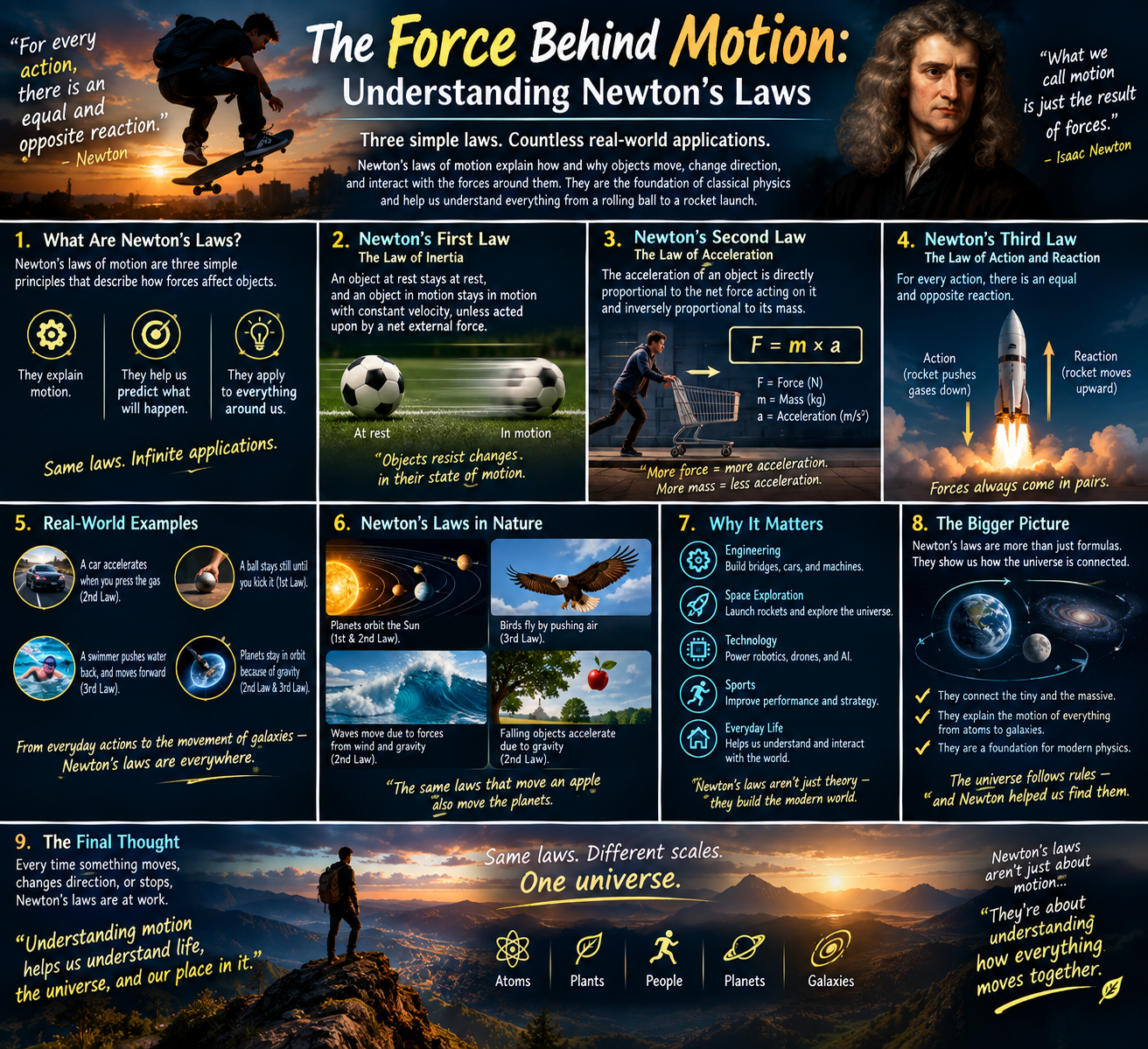
    # The Force Behind Motion: Understanding Newton’s Laws

    Imagine watching a football fly through the air , a car accelerate down a road , a rocket launch into space , or planets orbiting a star .

    These events may appear completely different—but beneath them is the same fundamental idea:

    ## **Forces control motion.**

    More than three centuries ago, **Isaac Newton** developed three laws that transformed our understanding of how objects move and interact. These laws became the foundation of classical mechanics and remain essential to physics, engineering, astronomy, and countless technologies today.

    ---

    # 1. What Are Newton's Laws?

    Newton's three laws describe the relationship between:

    **Force**
    **Mass**
    **Acceleration**
    **Motion**

    Together, they help us explain why objects remain still, why they accelerate, and how forces interact.

    From a rolling ball to a spacecraft , the same fundamental principles apply.

    ### **Three simple laws. Infinite applications.**

    ---

    # 2. Newton's First Law — The Law of Inertia

    Newton's First Law states that an object at rest remains at rest, while an object in motion continues moving at constant velocity unless acted upon by a net external force.

    This property is called **inertia**.

    Imagine a football sitting on the ground.

    It stays there until you kick it.

    Once moving, it won't naturally change its motion unless another force acts on it—such as friction, air resistance, or another object.

    A car requires braking to stop.
    A ball slows because of friction.
    Objects in space can continue moving with very little resistance.

    ### **Objects resist changes in their state of motion.**

    ---

    # 3. Newton's Second Law — The Law of Acceleration

    The second law explains how force changes motion.

    Its famous equation is:

    # **F = m × a**

    Where:

    **F** = Force
    **m** = Mass
    **a** = Acceleration

    This means that increasing the net force on an object generally increases its acceleration, while increasing the object's mass makes the same force produce less acceleration.

    Imagine pushing an empty shopping cart .

    It accelerates easily.

    Now fill it with heavy objects.

    The same push produces less acceleration.

    ### **More net force → more acceleration.**

    ### **More mass → less acceleration for the same force.**

    This simple relationship powers everything from vehicle design to rocket engineering .

    ---

    # 4. Newton's Third Law — Action and Reaction

    Newton's Third Law states:

    ### **For every action, there is an equal and opposite reaction.**

    Forces always occur through interactions between objects.

    Consider a rocket.

    The engine pushes hot gases downward and backward.

    The gases exert an equal and opposite force on the rocket, pushing it upward.

    The same principle appears everywhere:

    A swimmer pushes water backward → the water pushes the swimmer forward.
    A bird pushes air downward → the air helps push the bird upward.
    You push the ground backward → the ground pushes you forward.

    ### **Forces come in pairs.**

    ---

    # 5. Newton's Laws in Everyday Life

    You don't need a laboratory to see Newton's laws.

    They are happening around you constantly.

    **Cars:** Engine force changes speed and direction.
    **Sports:** Kicking a ball changes its motion.
    **Swimming:** Pushing water creates forward motion.
    **Cycling:** Pedaling produces forces that accelerate the bicycle.
    **Falling objects:** Gravity changes their motion.
    **Skateboards:** Pushing against the ground creates movement.

    Everyday motion is essentially a continuous interaction between forces.

    ---

    # 6. Newton's Laws in Nature

    Newton's laws don't stop at Earth.

    They also help describe motion throughout the universe.

    Planets orbit stars.
    Moons orbit planets.
    Comets travel through space.
    Waves respond to forces.
    Birds generate lift through interactions with air.
    Objects accelerate under gravity.

    The same physics that explains a falling apple can help describe the motion of enormous celestial bodies.

    ### **From apples to planets, the same laws operate across nature.**

    ---

    # 7. Why Newton's Laws Matter

    Newton's laws are more than equations in a textbook.

    They are essential tools for understanding and designing the physical world.

    **Engineering** — bridges, buildings, vehicles, and machines
    **Space exploration** — rockets, spacecraft, and orbital motion
    **Technology** — robots, drones, and automated systems
    **Sports science** — movement, speed, and performance
    **Transportation** — cars, aircraft, and trains

    Modern technology depends heavily on our ability to predict how forces produce motion.

    ---

    # 8. The Bigger Picture

    Newton's laws reveal something remarkable:

    The universe is not simply a collection of random movements.

    Objects interact through measurable forces.

    From microscopic particles to massive planets and galaxies , physics provides mathematical relationships that help us understand motion.

    The scale may change.

    The objects may change.

    But the underlying principles remain incredibly powerful.

    ### **Tiny or massive. Fast or slow. Earth or space. Motion follows physical laws.**

    ---

    # 9. The Final Thought

    Every time something moves…

    Every time something accelerates…

    Every time something changes direction…

    **Newton's laws are there.**

    A skateboard rolling down a street
    A bird taking flight
    A rocket leaving Earth
    A planet orbiting the Sun

    Different events.

    Different scales.

    One underlying framework.

    ## **Same laws. Different scales. One universe.**

    Understanding motion isn't just about solving equations.

    It's about understanding **how the physical world moves, interacts, and holds together.**

    ### **Once you understand the forces behind motion, the world around you begins to move in a whole new way.**


    Asma Shaheen EducationWali
    Saima Empowerment Wali
    Mishaal TrainingWali
    #rsisb Roll No 253 Foundation Level Story Post 23 # ⚡🌌 The Force Behind Motion: Understanding Newton’s Laws Imagine watching a football fly through the air ⚽, a car accelerate down a road 🚗💨, a rocket launch into space 🚀, or planets orbiting a star 🪐✨. These events may appear completely different—but beneath them is the same fundamental idea: ## **Forces control motion.** ⚡🧲 More than three centuries ago, **Isaac Newton** developed three laws that transformed our understanding of how objects move and interact. These laws became the foundation of classical mechanics and remain essential to physics, engineering, astronomy, and countless technologies today. 🔬⚙️🌍 --- # 🧠⚡ 1. What Are Newton's Laws? Newton's three laws describe the relationship between: ⚡ **Force** 🧱 **Mass** 💨 **Acceleration** 🏃 **Motion** Together, they help us explain why objects remain still, why they accelerate, and how forces interact. From a rolling ball 🎾 to a spacecraft 🚀, the same fundamental principles apply. ### **Three simple laws. Infinite applications.** 🌌 --- # 🛑➡️ 2. Newton's First Law — The Law of Inertia Newton's First Law states that an object at rest remains at rest, while an object in motion continues moving at constant velocity unless acted upon by a net external force. This property is called **inertia**. 🧱⚡ Imagine a football sitting on the ground. ⚽ It stays there until you kick it. Once moving, it won't naturally change its motion unless another force acts on it—such as friction, air resistance, or another object. 🚗 A car requires braking to stop. ⚽ A ball slows because of friction. 🛰️ Objects in space can continue moving with very little resistance. ### **Objects resist changes in their state of motion.** --- # 💨⚙️ 3. Newton's Second Law — The Law of Acceleration The second law explains how force changes motion. Its famous equation is: # **F = m × a** ⚡ Where: **F** = Force 🧲 **m** = Mass ⚖️ **a** = Acceleration 💨 This means that increasing the net force on an object generally increases its acceleration, while increasing the object's mass makes the same force produce less acceleration. Imagine pushing an empty shopping cart 🛒. It accelerates easily. Now fill it with heavy objects. The same push produces less acceleration. ### **More net force → more acceleration.** ### **More mass → less acceleration for the same force.** This simple relationship powers everything from vehicle design 🚗 to rocket engineering 🚀. --- # 🚀🔥 4. Newton's Third Law — Action and Reaction Newton's Third Law states: ### **For every action, there is an equal and opposite reaction.** ⚡ Forces always occur through interactions between objects. Consider a rocket. 🚀 The engine pushes hot gases downward and backward. The gases exert an equal and opposite force on the rocket, pushing it upward. ⬆️🔥 The same principle appears everywhere: 🏊 A swimmer pushes water backward → the water pushes the swimmer forward. 🦅 A bird pushes air downward → the air helps push the bird upward. 🚶 You push the ground backward → the ground pushes you forward. ### **Forces come in pairs.** 🔗⚡ --- # 🌍⚽ 5. Newton's Laws in Everyday Life You don't need a laboratory to see Newton's laws. They are happening around you constantly. 🚗 **Cars:** Engine force changes speed and direction. ⚽ **Sports:** Kicking a ball changes its motion. 🏊 **Swimming:** Pushing water creates forward motion. 🚲 **Cycling:** Pedaling produces forces that accelerate the bicycle. 🍎 **Falling objects:** Gravity changes their motion. 🛹 **Skateboards:** Pushing against the ground creates movement. Everyday motion is essentially a continuous interaction between forces. --- # 🌌🪐 6. Newton's Laws in Nature Newton's laws don't stop at Earth. They also help describe motion throughout the universe. 🌌 🪐 Planets orbit stars. 🌙 Moons orbit planets. ☄️ Comets travel through space. 🌊 Waves respond to forces. 🦅 Birds generate lift through interactions with air. 🍎 Objects accelerate under gravity. The same physics that explains a falling apple can help describe the motion of enormous celestial bodies. ### **From apples to planets, the same laws operate across nature.** 🍎➡️🪐 --- # ⚙️🚀 7. Why Newton's Laws Matter Newton's laws are more than equations in a textbook. They are essential tools for understanding and designing the physical world. 🏗️ **Engineering** — bridges, buildings, vehicles, and machines 🚀 **Space exploration** — rockets, spacecraft, and orbital motion 🤖 **Technology** — robots, drones, and automated systems 🏃 **Sports science** — movement, speed, and performance 🚗 **Transportation** — cars, aircraft, and trains Modern technology depends heavily on our ability to predict how forces produce motion. --- # 🌌🔭 8. The Bigger Picture Newton's laws reveal something remarkable: The universe is not simply a collection of random movements. Objects interact through measurable forces. ⚛️🧲 From microscopic particles 🔬 to massive planets 🪐 and galaxies 🌌, physics provides mathematical relationships that help us understand motion. The scale may change. The objects may change. But the underlying principles remain incredibly powerful. ### **Tiny or massive. Fast or slow. Earth or space. Motion follows physical laws.** ⚡🌍🌌 --- # 🌅⚡ 9. The Final Thought Every time something moves… Every time something accelerates… Every time something changes direction… **Newton's laws are there.** 🧠⚡ A skateboard rolling down a street 🛹 A bird taking flight 🦅 A rocket leaving Earth 🚀 A planet orbiting the Sun ☀️🪐 Different events. Different scales. One underlying framework. ## 🌌 **Same laws. Different scales. One universe.** Understanding motion isn't just about solving equations. It's about understanding **how the physical world moves, interacts, and holds together.** ⚛️🌍✨ ### **Once you understand the forces behind motion, the world around you begins to move in a whole new way.** ⚡🔬🌌 Asma Shaheen EducationWali Saima Empowerment Wali Mishaal TrainingWali
    0 Yorumlar 0 hisse senetleri 752 Views
  • #rsisb
    Roll No 253
    Foundation Level
    Story Post 22
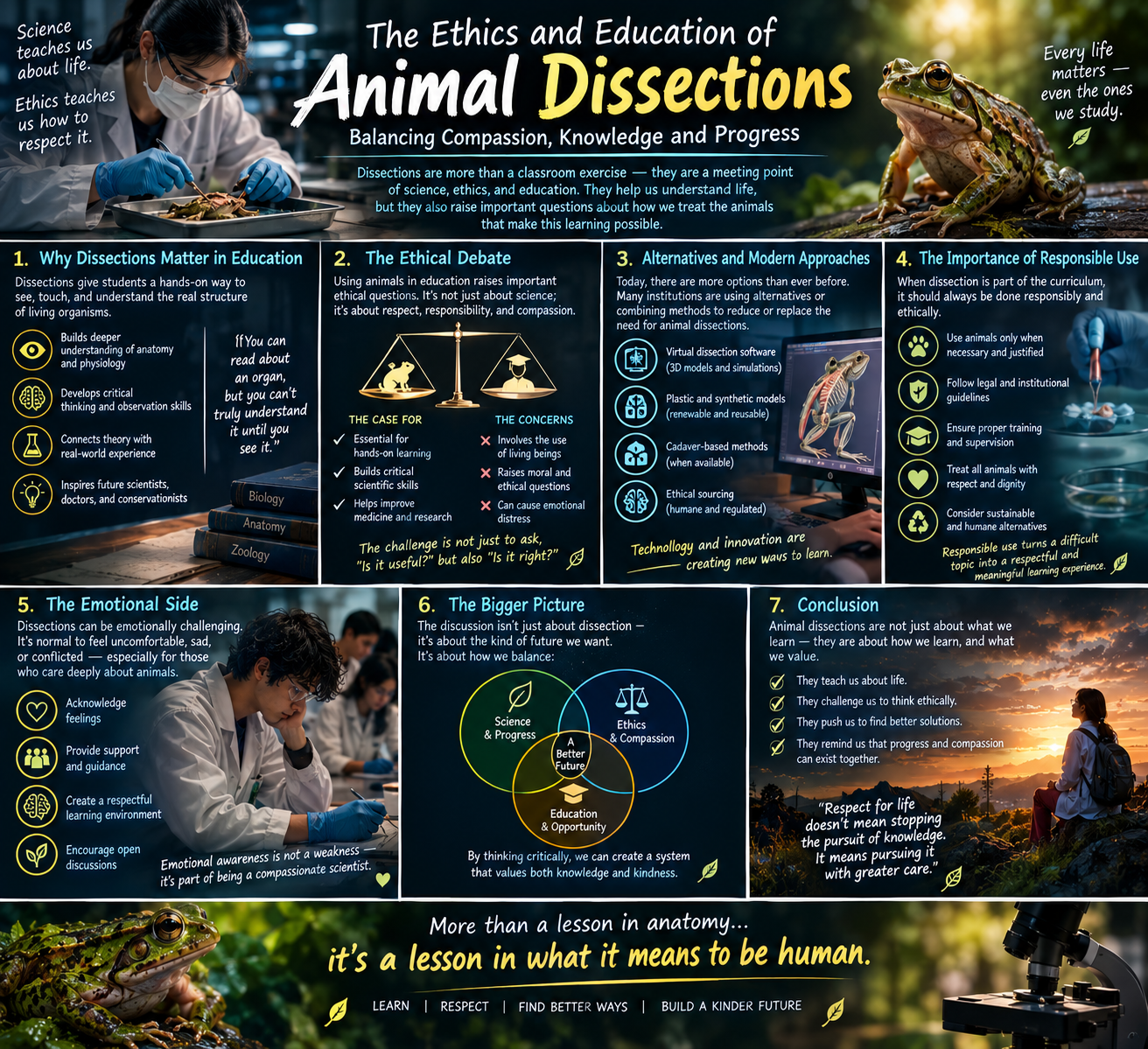
    # The Ethics and Education of Animal Dissections

    ## Balancing Knowledge, Compassion, and Scientific Progress

    Animal dissections have long been used to help students understand anatomy, physiology, and the remarkable complexity of living organisms.

    But dissection is more than a scientific technique.

    It also raises an important question:

    ### **How can we learn about life while treating life with respect?**

    Understanding both the educational value and the ethical considerations surrounding dissections allows us to approach biology with greater knowledge, responsibility, and compassion.

    ---

    ## 1. Why Dissections Matter in Education

    Dissections can provide students with a direct way to explore biological structures that are difficult to fully understand through diagrams or textbooks alone.

    They can help learners:

    Observe real anatomy
    Develop critical thinking
    Understand organ relationships
    Connect theory with physical structures
    Build curiosity about living systems

    Instead of simply memorizing the location of an organ, students can investigate how structures are positioned and connected.

    ### **It turns biological concepts into something tangible.**

    ---

    ## 2. The Ethical Debate

    Using animals for education creates a genuine ethical discussion.

    On one side, supporters may point to the educational benefits of direct anatomical study.

    On the other, concerns include:

    The use of living organisms
    Animal welfare
    Moral responsibility
    Whether alternatives can provide similar educational value

    The central question isn't simply:

    **“Is it useful?”**

    It is also:

    ### **“Is it justified, and can the same learning goals be achieved another way?”**

    Considering both questions encourages students to think scientifically **and ethically**.

    ---

    ## 3. Alternatives and Modern Approaches

    Technology has created new ways to study anatomy without always relying on traditional dissection.

    Modern educational approaches can include:

    Virtual dissection software
    3D anatomical models
    Synthetic or plastic models
    Interactive simulations
    Microscopic analysis
    High-quality anatomical imagery

    These tools can allow students to explore structures repeatedly, change viewpoints, and investigate complex systems in ways that may be difficult with a physical specimen.

    ### **Technology is creating new possibilities for learning.**

    ---

    ## 4. The Importance of Responsible Use

    When animal specimens are used for education or research, responsibility is essential.

    Important principles include:

    Following relevant laws and institutional guidelines
    Providing proper training and supervision
    Using animals only when scientifically or educationally justified
    Treating specimens respectfully
    Considering sustainable and humane alternatives

    Responsible scientific education isn't simply about obtaining knowledge.

    It is about **how that knowledge is obtained.**

    ---

    ## 5. The Emotional Side

    Dissection can affect students differently.

    Some may feel fascinated by anatomy.
    Others may feel uncomfortable.
    Some may experience sadness or conflict because they care deeply about animals.

    These reactions shouldn't automatically be dismissed.

    A respectful educational environment can encourage students to:

    Acknowledge their emotions
    Discuss concerns openly
    Support one another
    Maintain scientific curiosity
    Develop compassion

    ### **Emotional awareness can be part of becoming a responsible scientist.**

    ---

    # 6. The Bigger Picture

    The debate surrounding animal dissection isn't simply about choosing **science or compassion**.

    It is about finding ways for:

    **Scientific progress**
    **Ethical responsibility**
    **Education**
    **Compassion**

    to coexist.

    The goal is to create learning environments where students can develop strong scientific knowledge while also thinking carefully about the consequences of scientific practices.

    ### **Knowledge and compassion don't have to be opposites.**

    ---

    ## 7. What Dissections Can Teach Us

    When conducted appropriately, anatomical study can teach lessons that extend beyond individual organs.

    It can teach us about:

    The complexity of life
    Biological organization
    Interconnected systems
    Evolution and adaptation
    Scientific observation
    Ethical decision-making

    A specimen can become more than an anatomy lesson.

    It can become an opportunity to ask **how we learn, why we learn, and what responsibilities come with knowledge.**

    ---

    # 8. The Real Question

    Perhaps the deepest question isn't simply:

    **“Should animals be dissected?”**

    It is:

    How can we improve biological education?
    How can we reduce unnecessary harm?
    Which alternatives can provide meaningful learning?
    How should scientists balance discovery with responsibility?
    How can future generations learn with greater compassion?

    These questions don't have to end scientific exploration.

    They can make scientific exploration **more thoughtful.**

    ---

    # The Bigger Lesson

    Animal dissections can teach us about anatomy—but the discussion surrounding them can teach us something even larger.

    ### **Science teaches us how life works.**

    ### **Ethics asks us how we should treat it.**

    ### **Education gives us the opportunity to understand both.**

    The future of science isn't only about discovering more.

    It's also about learning to discover **responsibly.**

    So when we look inside an organism to understand its anatomy, we should also look beyond the specimen and consider the larger picture:

    **Respect life.**
    **Pursue knowledge.**
    **Think critically.**
    **Explore better alternatives.**
    **Build a more compassionate future.**

    ## **More than a lesson in anatomy—it's a lesson in what it means to learn responsibly.**


    Asma Shaheen EducationWali
    Saima Empowerment Wali
    Mishaal TrainingWali
    #rsisb Roll No 253 Foundation Level Story Post 22 # 🐸🔬 The Ethics and Education of Animal Dissections ## 🌿⚖️ Balancing Knowledge, Compassion, and Scientific Progress Animal dissections have long been used to help students understand anatomy, physiology, and the remarkable complexity of living organisms. 🧬🫀🔬 But dissection is more than a scientific technique. It also raises an important question: ### **How can we learn about life while treating life with respect?** 🐾❤️ Understanding both the educational value and the ethical considerations surrounding dissections allows us to approach biology with greater knowledge, responsibility, and compassion. --- ## 🎓🔬 1. Why Dissections Matter in Education Dissections can provide students with a direct way to explore biological structures that are difficult to fully understand through diagrams or textbooks alone. 📚➡️🔬 They can help learners: 👁️ Observe real anatomy 🧠 Develop critical thinking 🫀 Understand organ relationships 🔬 Connect theory with physical structures 🌱 Build curiosity about living systems Instead of simply memorizing the location of an organ, students can investigate how structures are positioned and connected. ### **It turns biological concepts into something tangible.** ✨ --- ## ⚖️🐾 2. The Ethical Debate Using animals for education creates a genuine ethical discussion. On one side, supporters may point to the educational benefits of direct anatomical study. 🎓🔬 On the other, concerns include: 🐾 The use of living organisms ❤️ Animal welfare 🧠 Moral responsibility 🌱 Whether alternatives can provide similar educational value The central question isn't simply: **“Is it useful?”** It is also: ### **“Is it justified, and can the same learning goals be achieved another way?”** ⚖️ Considering both questions encourages students to think scientifically **and ethically**. --- ## 💻🧬 3. Alternatives and Modern Approaches Technology has created new ways to study anatomy without always relying on traditional dissection. 🚀🔬 Modern educational approaches can include: 💻 Virtual dissection software 🧊 3D anatomical models 🧫 Synthetic or plastic models 🖥️ Interactive simulations 🔬 Microscopic analysis 📚 High-quality anatomical imagery These tools can allow students to explore structures repeatedly, change viewpoints, and investigate complex systems in ways that may be difficult with a physical specimen. ### **Technology is creating new possibilities for learning.** 💡🌍 --- ## 🧤🐸 4. The Importance of Responsible Use When animal specimens are used for education or research, responsibility is essential. ⚖️🔬 Important principles include: 📜 Following relevant laws and institutional guidelines 🎓 Providing proper training and supervision 🐾 Using animals only when scientifically or educationally justified ❤️ Treating specimens respectfully ♻️ Considering sustainable and humane alternatives Responsible scientific education isn't simply about obtaining knowledge. It is about **how that knowledge is obtained.** --- ## 💭❤️ 5. The Emotional Side Dissection can affect students differently. Some may feel fascinated by anatomy. 🔬 Others may feel uncomfortable. 😟 Some may experience sadness or conflict because they care deeply about animals. 🐾❤️ These reactions shouldn't automatically be dismissed. A respectful educational environment can encourage students to: 🧠 Acknowledge their emotions 💬 Discuss concerns openly 🤝 Support one another 🔬 Maintain scientific curiosity ❤️ Develop compassion ### **Emotional awareness can be part of becoming a responsible scientist.** --- # 🌍⚖️ 6. The Bigger Picture The debate surrounding animal dissection isn't simply about choosing **science or compassion**. It is about finding ways for: 🔬 **Scientific progress** ⚖️ **Ethical responsibility** 🎓 **Education** ❤️ **Compassion** to coexist. The goal is to create learning environments where students can develop strong scientific knowledge while also thinking carefully about the consequences of scientific practices. ### **Knowledge and compassion don't have to be opposites.** 🌱✨ --- ## 🧬📚 7. What Dissections Can Teach Us When conducted appropriately, anatomical study can teach lessons that extend beyond individual organs. It can teach us about: 🫀 The complexity of life 🧬 Biological organization 🔗 Interconnected systems 🌱 Evolution and adaptation 🔬 Scientific observation ⚖️ Ethical decision-making A specimen can become more than an anatomy lesson. It can become an opportunity to ask **how we learn, why we learn, and what responsibilities come with knowledge.** 🧠✨ --- # 🌅🌎 8. The Real Question Perhaps the deepest question isn't simply: **“Should animals be dissected?”** It is: ❓ How can we improve biological education? ❓ How can we reduce unnecessary harm? ❓ Which alternatives can provide meaningful learning? ❓ How should scientists balance discovery with responsibility? ❓ How can future generations learn with greater compassion? These questions don't have to end scientific exploration. They can make scientific exploration **more thoughtful.** 🔬❤️ --- # 🐸💚 The Bigger Lesson Animal dissections can teach us about anatomy—but the discussion surrounding them can teach us something even larger. ### **Science teaches us how life works.** 🔬 ### **Ethics asks us how we should treat it.** ⚖️ ### **Education gives us the opportunity to understand both.** 🎓 The future of science isn't only about discovering more. It's also about learning to discover **responsibly.** 🌍🧬 So when we look inside an organism to understand its anatomy, we should also look beyond the specimen and consider the larger picture: 🐾 **Respect life.** 🔬 **Pursue knowledge.** 🧠 **Think critically.** 💡 **Explore better alternatives.** 🌱 **Build a more compassionate future.** ## ✨ **More than a lesson in anatomy—it's a lesson in what it means to learn responsibly.** 🐸🔬❤️ Asma Shaheen EducationWali Saima Empowerment Wali Mishaal TrainingWali
    0 Yorumlar 0 hisse senetleri 766 Views
  • Exploring Student Startups & Innovation!

    Today, I had the opportunity to attend a tech event at PC Hotel, Karachi, where talented students showcased their startups, ideas, and innovative projects.

    It was inspiring to see young entrepreneurs turning their ideas into real solutions and confidently presenting what they are building. Events like these provide a great opportunity to learn, connect, and discover new ideas.

    I also captured some memorable moments from the event through videos and pictures.

    What are you working on?
    If you’re building a startup, developing a project, or working on an innovative idea, I’d love to hear about it. Tell me about your startup in the comments!

    #StudentStartups #Startups #Innovation #Technology #YoungEntrepreneurs #Entrepreneurship #TechEvent #Karachi #StartupCommunity
    🚀 Exploring Student Startups & Innovation! Today, I had the opportunity to attend a tech event at PC Hotel, Karachi, where talented students showcased their startups, ideas, and innovative projects. It was inspiring to see young entrepreneurs turning their ideas into real solutions and confidently presenting what they are building. Events like these provide a great opportunity to learn, connect, and discover new ideas. I also captured some memorable moments from the event through videos and pictures. 📸🎥 💡 What are you working on? If you’re building a startup, developing a project, or working on an innovative idea, I’d love to hear about it. Tell me about your startup in the comments! #StudentStartups #Startups #Innovation #Technology #YoungEntrepreneurs #Entrepreneurship #TechEvent #Karachi #StartupCommunity
    0 Yorumlar 0 hisse senetleri 290 Views
  • RSIF8
    Roll no.29
    Task no.4
    Task Topic: How to create a YouTube account

    Starting your journey on YouTube is incredibly easy! Because YouTube is owned by Google, your passport to the platform is simply a Google Account. Whether you want to subscribe to your favorite creators, save playlists, or start uploading your own videos, here is exactly how to set up your account in just a few minutes.

    **Step 1: Sign In with Google**
    First, open your web browser and head over to YouTube.com, or simply open the YouTube app on your mobile device. Click the "Sign In" button located in the top right-hand corner of the screen. Enter your existing Google or Gmail credentials to log in. If you do not have a Google account yet, click "Create account" and follow the quick prompts to set one up.

    **Step 2: Access the Channel Creation Menu**
    Once you are logged in, look at the top right corner of the page where your profile icon is located. Click on your profile picture, and a dropdown menu will appear. From this menu, click on the option that says "Create a channel."

    **Step 3: Choose Your Account Type**
    You will now see a prompt asking how you want to create your channel. You have two choices:

    * **Personal Channel:** Choose this if you want to use your own name and profile picture.
    * **Brand/Business Channel:** Choose this if you want to use a custom name, a business name, or if you plan to have multiple people manage the account with you in the future.

    **Step 4: Customize and Launch**
    Name your channel, upload a profile picture, and add a brief bio to your "About" section telling viewers what your channel is all about. Once you click "Create," your brand new YouTube account is fully active and ready for action!

    ---

    #YouTube #HowTo #YouTubeTutorial #CreateAccount #TechTips ContentCreator #NewChannel #TechGuide #YouTubeCommunity
    RSIF8 Roll no.29 Task no.4 Task Topic: How to create a YouTube account Starting your journey on YouTube is incredibly easy! Because YouTube is owned by Google, your passport to the platform is simply a Google Account. Whether you want to subscribe to your favorite creators, save playlists, or start uploading your own videos, here is exactly how to set up your account in just a few minutes. **Step 1: Sign In with Google** First, open your web browser and head over to YouTube.com, or simply open the YouTube app on your mobile device. Click the "Sign In" button located in the top right-hand corner of the screen. Enter your existing Google or Gmail credentials to log in. If you do not have a Google account yet, click "Create account" and follow the quick prompts to set one up. **Step 2: Access the Channel Creation Menu** Once you are logged in, look at the top right corner of the page where your profile icon is located. Click on your profile picture, and a dropdown menu will appear. From this menu, click on the option that says "Create a channel." **Step 3: Choose Your Account Type** You will now see a prompt asking how you want to create your channel. You have two choices: * **Personal Channel:** Choose this if you want to use your own name and profile picture. * **Brand/Business Channel:** Choose this if you want to use a custom name, a business name, or if you plan to have multiple people manage the account with you in the future. **Step 4: Customize and Launch** Name your channel, upload a profile picture, and add a brief bio to your "About" section telling viewers what your channel is all about. Once you click "Create," your brand new YouTube account is fully active and ready for action! --- #YouTube ✨#HowTo #YouTubeTutorial #CreateAccount #TechTips 🚀ContentCreator #NewChannel 🎥 #TechGuide #YouTubeCommunity📱
    0 Yorumlar 0 hisse senetleri 404 Views
  • RSIF8
    Roll no.29
    Task no.2
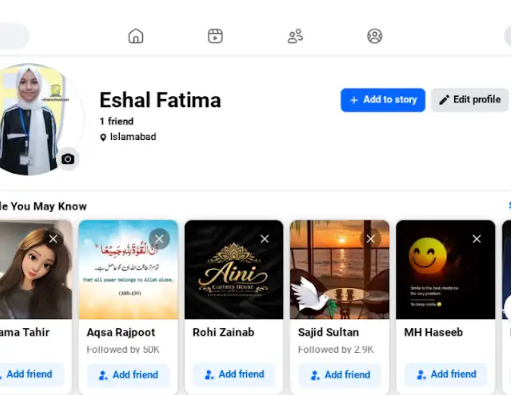
    Task Topic: How To make A Facebook account and set it up

    1. Go to Facebook 1-2 minutes.
    Open the Facebook app on your phone, or visit *facebook.com* on a computer web browser. Click on *"Create new account"* or *"Sign Up"*.


    2. *Enter your basic info:* 2 minutes.
    Type in your *first and last name*, your *mobile number or email address*, a *strong password*, your *date of birth*, and your *gender*.

    > *Note:* Facebook requires your real name to help keep the community safe, though you can adjust your display privacy later.


    3. *Confirm your account:* 1 minute.
    Facebook will send a verification code to your email or phone number via SMS. *Enter that code* into the box on your screen to officially activate your account.


    4. *Upload a profile picture:* 2 minutes.
    Choose a clear photo of yourself so friends and family can recognize you. You can upload a photo directly from your device or take a new one.


    5. *Adjust your privacy settings:* 5 minutes.
    Go to *Settings & Privacy* > *Privacy Checkup*. Here, you can change your default post sharing from "Public" to *"Friends"* so only people you approve can see what you post.


    Enjoy Your Facebook Journey

    #Facebook #SocialMedia #ConnectWithFriends #TechTips #FacebookSetup #StayConnected #fyp
    RSIF8 Roll no.29 Task no.2 Task Topic: How To make A Facebook account and set it up 1. Go to Facebook 1-2 minutes. Open the Facebook app on your phone, or visit *facebook.com* on a computer web browser. Click on *"Create new account"* or *"Sign Up"*. 2. *Enter your basic info:* 2 minutes. Type in your *first and last name*, your *mobile number or email address*, a *strong password*, your *date of birth*, and your *gender*. > *Note:* Facebook requires your real name to help keep the community safe, though you can adjust your display privacy later. 3. *Confirm your account:* 1 minute. Facebook will send a verification code to your email or phone number via SMS. *Enter that code* into the box on your screen to officially activate your account. 4. *Upload a profile picture:* 2 minutes. Choose a clear photo of yourself so friends and family can recognize you. You can upload a photo directly from your device or take a new one. 5. *Adjust your privacy settings:* 5 minutes. Go to *Settings & Privacy* > *Privacy Checkup*. Here, you can change your default post sharing from "Public" to *"Friends"* so only people you approve can see what you post. Enjoy Your Facebook Journey #Facebook #SocialMedia #ConnectWithFriends #TechTips #FacebookSetup #StayConnected #fyp
    0 Yorumlar 0 hisse senetleri 379 Views
  • ہر case صرف ایک file نہیں ہوتا۔

    اس کے پیچھے documents، dates، evidence اور legal issues کی پوری story ہو سکتی ہے۔

    اصل challenge یہ ہے کہ ان سب چیزوں کو ایک clear picture میں کیسے دیکھا جائے۔

    Rehan Law AI + Legal Technology کے ذریعے اسی legal journey کو زیادہ organized بنانے کے vision پر کام کر رہا ہے۔

    KNOW YOUR CASE BEFORE YOU FIGHT IT.

    www.rehanlaw.com
    ⚖️ ہر case صرف ایک file نہیں ہوتا۔ اس کے پیچھے documents، dates، evidence اور legal issues کی پوری story ہو سکتی ہے۔ اصل challenge یہ ہے کہ ان سب چیزوں کو ایک clear picture میں کیسے دیکھا جائے۔ 🤖 Rehan Law AI + Legal Technology کے ذریعے اسی legal journey کو زیادہ organized بنانے کے vision پر کام کر رہا ہے۔ KNOW YOUR CASE BEFORE YOU FIGHT IT. 🌐 www.rehanlaw.com
    0 Yorumlar 0 hisse senetleri 130 Views 7
  • ہر case کی اپنی ایک story ہوتی ہے۔

    Facts.
    Documents.
    Dates.
    Evidence.
    People.

    لیکن جب information مختلف جگہوں پر بکھری ہو تو case کو organized رکھنا مشکل ہو سکتا ہے۔

    Rehan Law کا vision ہے کہ AI + Legal Technology کے ذریعے case-related information کو زیادہ structured اور organized بنایا جائے۔

    AI Assistance
    Case Organization
    Documents
    Case Management

    TURN COMPLEX CASE INFORMATION INTO A CLEARER PICTURE.

    REHAN LAW
    SMART LAW. BETTER FUTURE.

    www.rehanlaw.com

    آپ کے خیال میں case management میں سب سے زیادہ مشکل کیا ہے؟
    ⚖️ ہر case کی اپنی ایک story ہوتی ہے۔ Facts. Documents. Dates. Evidence. People. لیکن جب information مختلف جگہوں پر بکھری ہو تو case کو organized رکھنا مشکل ہو سکتا ہے۔ Rehan Law کا vision ہے کہ AI + Legal Technology کے ذریعے case-related information کو زیادہ structured اور organized بنایا جائے۔ 🤖 AI Assistance 📂 Case Organization 📄 Documents ⚖️ Case Management TURN COMPLEX CASE INFORMATION INTO A CLEARER PICTURE. REHAN LAW SMART LAW. BETTER FUTURE. 🌐 www.rehanlaw.com 👇 آپ کے خیال میں case management میں سب سے زیادہ مشکل کیا ہے؟
    0 Yorumlar 0 hisse senetleri 121 Views
  • RSIF8
    Roll no:14
    canva post no:22
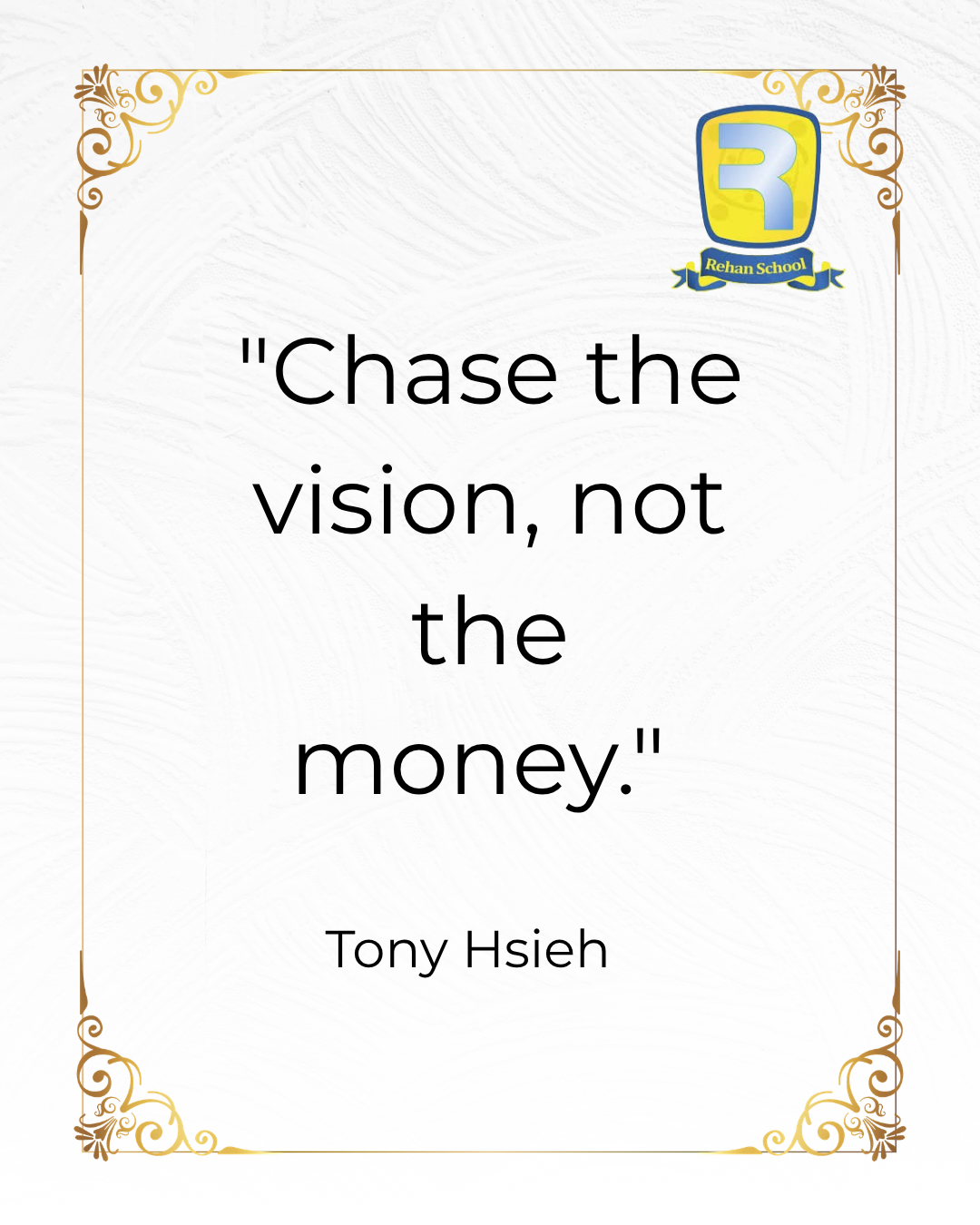
    canva post topic:"Chase the vision, not the money." — Tony Hsieh
    **TASK COMPLETED SUCCESSFULLY!**
    **“Chase the vision, not the money.” — Tony Hsieh**
    This powerful quote highlights the importance of having a **clear vision, meaningful goals, and a strong sense of purpose**. Money can be an important part of success, but focusing only on financial rewards can sometimes distract us from the bigger picture. A strong vision gives us direction and inspires us to create something valuable.
    True progress begins when we know **what we want to build, why it matters, and what impact we want to make**. When we focus on developing our skills, solving problems, creating value, and staying committed to our goals, financial opportunities can become one part of a much larger journey.
    Building a meaningful future requires **patience, creativity, discipline, consistency, and the courage to keep moving forward** even when results are not immediate. Every small step toward a worthwhile vision can bring us closer to achieving something we can genuinely be proud of.
    **Focus on the vision. Create value. Keep learning. Stay consistent. Let your purpose guide your journey.**
    This quote reminds us that success is not only measured by what we earn, but also by **what we create, what we learn, and the positive difference we make along the way**.
    **Dream with purpose. Work with passion. Chase the vision.**
    **TASK COMPLETED WITH DEDICATION, CREATIVITY, AND A VISION FOR SUCCESS!**
    #Motivation #TonyHsieh #ChaseTheVision #Vision #SuccessMindset #Inspiration #Entrepreneurship #GoalSetting #DreamBig #HardWork #Dedication #Leadership #PersonalGrowth #SelfImprovement #GrowthMindset #PositiveMindset #Success #Purpose #Creativity #Consistency #Productivity #NeverGiveUp #DailyMotivation #InspirationalQuotes #TaskCompleted
    RSIF8 Roll no:14 canva post no:22 canva post topic:"Chase the vision, not the money." — Tony Hsieh 🌟 **TASK COMPLETED SUCCESSFULLY!** 🌟 💭 **“Chase the vision, not the money.” — Tony Hsieh** This powerful quote highlights the importance of having a **clear vision, meaningful goals, and a strong sense of purpose**. Money can be an important part of success, but focusing only on financial rewards can sometimes distract us from the bigger picture. A strong vision gives us direction and inspires us to create something valuable. 🚀💡 True progress begins when we know **what we want to build, why it matters, and what impact we want to make**. When we focus on developing our skills, solving problems, creating value, and staying committed to our goals, financial opportunities can become one part of a much larger journey. 🎯📈 Building a meaningful future requires **patience, creativity, discipline, consistency, and the courage to keep moving forward** even when results are not immediate. Every small step toward a worthwhile vision can bring us closer to achieving something we can genuinely be proud of. 💪🌱 ✨ **Focus on the vision. Create value. Keep learning. Stay consistent. Let your purpose guide your journey.** ✨ This quote reminds us that success is not only measured by what we earn, but also by **what we create, what we learn, and the positive difference we make along the way**. 🌍🏆 🔥 **Dream with purpose. Work with passion. Chase the vision.** 🔥 🏆 **TASK COMPLETED WITH DEDICATION, CREATIVITY, AND A VISION FOR SUCCESS!** 🏆 #Motivation #TonyHsieh #ChaseTheVision #Vision #SuccessMindset #Inspiration #Entrepreneurship #GoalSetting #DreamBig #HardWork #Dedication #Leadership #PersonalGrowth #SelfImprovement #GrowthMindset #PositiveMindset #Success #Purpose #Creativity #Consistency #Productivity #NeverGiveUp #DailyMotivation #InspirationalQuotes #TaskCompleted
    0 Yorumlar 0 hisse senetleri 687 Views
Arama Sonuçları