• #rsisb
    Roll no. 247
    Song no. 12
    Foundation level

    **Conservation Laws: Matter and Energy in Balance**

    Welcome to an exciting musical journey through the amazing world of science!

    This song is inspired by the fascinating scientific topic **“Conservation Laws: Matter and Energy in Balance.”** It explores one of the most important principles of physics and chemistry: matter and energy cannot simply be created or destroyed; they can only change form or be transferred from one place to another.

    Through beautiful Urdu-inspired musical storytelling, this song explains how everything in our universe is connected. From the smallest particles to the biggest stars, matter and energy continuously transform and move while following the laws of nature.

    **What will you learn from this song?**

    The Law of Conservation of Matter.
    The Law of Conservation of Energy.
    How matter changes from one state to another.
    How energy transforms from one form into another.
    The importance of balance in nature and the universe.
    How science helps us understand our beautiful world.

    **Created with Suno.ai**

    I used Suno.ai to explore the creative combination of science, music, and education. My goal is to make scientific ideas easier to understand through enjoyable and meaningful music.

    **A Message for Everyone:**

    Nature follows its own beautiful rules. Energy changes, matter transforms, and everything remains connected through the amazing balance of our universe. Science is not just something we study in books; it is all around us!

    Let's learn science, enjoy music, and discover the wonders of our universe!

    #ConservationLaws #MatterAndEnergy #ScienceSong #SunoA
    #rsisb Roll no. 247 Song no. 12 Foundation level 🎵🌍 **Conservation Laws: Matter and Energy in Balance** ⚖️✨ Welcome to an exciting musical journey through the amazing world of science! 🔬🎶 This song is inspired by the fascinating scientific topic **“Conservation Laws: Matter and Energy in Balance.”** It explores one of the most important principles of physics and chemistry: matter and energy cannot simply be created or destroyed; they can only change form or be transferred from one place to another. 🌱⚡ Through beautiful Urdu-inspired musical storytelling, this song explains how everything in our universe is connected. From the smallest particles to the biggest stars, matter and energy continuously transform and move while following the laws of nature. 🌌🌟 🧪 **What will you learn from this song?** 🔹 The Law of Conservation of Matter. 🔹 The Law of Conservation of Energy. 🔹 How matter changes from one state to another. 🔹 How energy transforms from one form into another. 🔹 The importance of balance in nature and the universe. 🔹 How science helps us understand our beautiful world. 🎼 **Created with Suno.ai** I used Suno.ai to explore the creative combination of science, music, and education. My goal is to make scientific ideas easier to understand through enjoyable and meaningful music. 🎧❤️ 🌍 **A Message for Everyone:** Nature follows its own beautiful rules. Energy changes, matter transforms, and everything remains connected through the amazing balance of our universe. Science is not just something we study in books; it is all around us! 🚀🔭 Let's learn science, enjoy music, and discover the wonders of our universe! 🎵📚 #ConservationLaws #MatterAndEnergy #ScienceSong #SunoA
    0 Комментарии 0 Поделились 203 Просмотры 9
  • #rsisb
    Roll no. 247
    Song no. 12
    Foundation level

    **Conservation Laws: Matter and Energy in Balance**

    Welcome to an exciting musical journey through the amazing world of science!

    This song is inspired by the fascinating scientific topic **“Conservation Laws: Matter and Energy in Balance.”** It explores one of the most important principles of physics and chemistry: matter and energy cannot simply be created or destroyed; they can only change form or be transferred from one place to another.

    Through beautiful Urdu-inspired musical storytelling, this song explains how everything in our universe is connected. From the smallest particles to the biggest stars, matter and energy continuously transform and move while following the laws of nature.

    **What will you learn from this song?**

    The Law of Conservation of Matter.
    The Law of Conservation of Energy.
    How matter changes from one state to another.
    How energy transforms from one form into another.
    The importance of balance in nature and the universe.
    How science helps us understand our beautiful world.

    **Created with Suno.ai**

    I used Suno.ai to explore the creative combination of science, music, and education. My goal is to make scientific ideas easier to understand through enjoyable and meaningful music.

    **A Message for Everyone:**

    Nature follows its own beautiful rules. Energy changes, matter transforms, and everything remains connected through the amazing balance of our universe. Science is not just something we study in books; it is all around us!

    Let's learn science, enjoy music, and discover the wonders of our universe!

    #ConservationLaws #MatterAndEnergy #ScienceSong #SunoAI #ScienceAndMusic #Physics #Chemistry #LawOfConservationOfMatter #LawOfConservationOfEnergy #EnergyTransformation #MatterTransformation #LearnThroughMusic #EducationalSong #ScienceEducation #Universe #Nature #CreativeLearning #StudentLife #LearningIsFun #ScientificDiscovery #Education #RehanSchool #RSISB
    #rsisb Roll no. 247 Song no. 12 Foundation level 🎵🌍 **Conservation Laws: Matter and Energy in Balance** ⚖️✨ Welcome to an exciting musical journey through the amazing world of science! 🔬🎶 This song is inspired by the fascinating scientific topic **“Conservation Laws: Matter and Energy in Balance.”** It explores one of the most important principles of physics and chemistry: matter and energy cannot simply be created or destroyed; they can only change form or be transferred from one place to another. 🌱⚡ Through beautiful Urdu-inspired musical storytelling, this song explains how everything in our universe is connected. From the smallest particles to the biggest stars, matter and energy continuously transform and move while following the laws of nature. 🌌🌟 🧪 **What will you learn from this song?** 🔹 The Law of Conservation of Matter. 🔹 The Law of Conservation of Energy. 🔹 How matter changes from one state to another. 🔹 How energy transforms from one form into another. 🔹 The importance of balance in nature and the universe. 🔹 How science helps us understand our beautiful world. 🎼 **Created with Suno.ai** I used Suno.ai to explore the creative combination of science, music, and education. My goal is to make scientific ideas easier to understand through enjoyable and meaningful music. 🎧❤️ 🌍 **A Message for Everyone:** Nature follows its own beautiful rules. Energy changes, matter transforms, and everything remains connected through the amazing balance of our universe. Science is not just something we study in books; it is all around us! 🚀🔭 Let's learn science, enjoy music, and discover the wonders of our universe! 🎵📚 #ConservationLaws #MatterAndEnergy #ScienceSong #SunoAI #ScienceAndMusic #Physics #Chemistry #LawOfConservationOfMatter #LawOfConservationOfEnergy #EnergyTransformation #MatterTransformation #LearnThroughMusic #EducationalSong #ScienceEducation #Universe #Nature #CreativeLearning #StudentLife #LearningIsFun #ScientificDiscovery #Education #RehanSchool #RSISB 🎶🌍🔬⚡
    0 Комментарии 0 Поделились 365 Просмотры 6
  • #rsisb Roll no:232 Foundation level student. Song No:5 ⚖️🎵 **Conservation Laws: Matter and Energy in Balance – Educational Song 🔬** In this creative and educational song, I explore two important scientific principles: the Law of Conservation of Matter and the Law of Conservation of Energy. 🌍⚡ This song explains how matter and energy cannot simply be created or destroyed; instead, they change forms and move from one place to another. Through interesting examples and music, I learned how these conservation laws work in our everyday lives and why they are important in science. 🧪💡 Let's discover the amazing world of science and make learning fun through music! 🎶🚀 **Hashtags:** #ConservationLaws #MatterAndEnergy #LawOfConservation #ScienceSong #EducationalSong #Physics #Chemistry #ScienceEducation #EnergyTransformation #Matter #LearnWithMusic #CreativeLearning #SunoAI #ExploreScience #KnowledgeIsPower ⚛️🔬⚡🎵 Irum Asim Leadershipwali Asma Shaheen EducationWali https://www.facebook.com/share/v/18nLkKgLqg/
    WWW.FACEBOOK.COM
    Facebook
    #rsisb Roll no:232 Foundation level student. Song No:5 ⚖️🎵 **Conservation Laws: Matter and Energy in Balance – Educational Song 🔬** In this creative and educational song, I explore two important...
    0 Комментарии 0 Поделились 786 Просмотры
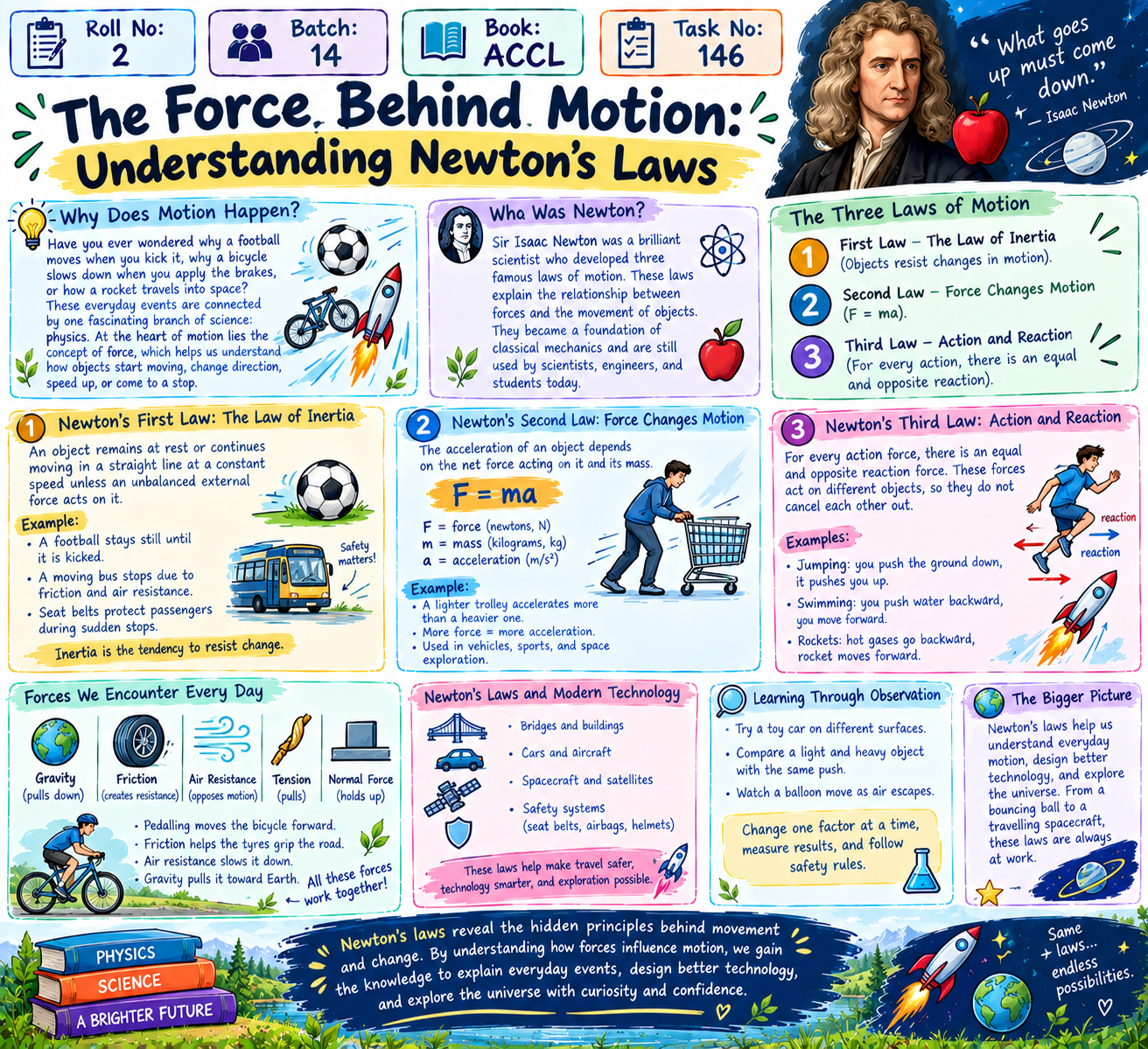
  • **Roll No: 2**
    **Batch: 14**
    **Book: ACCL**
    **Task No: 153**

    # The Force Behind Motion: Understanding Newton’s Laws

    Have you ever wondered why a football moves when you kick it, why a bicycle slows down when you apply the brakes, or how a rocket travels into space? These everyday events are connected by one fascinating branch of science: physics. At the heart of motion lies the concept of **force**, which helps us understand how objects start moving, change direction, speed up, or come to a stop.

    One of the most important scientists in the history of physics was **Sir Isaac Newton**. Through his work, Newton developed three famous laws of motion that explain the relationship between forces and the movement of objects. These laws became a foundation of classical mechanics and continue to help scientists, engineers, and students understand the physical world around them.

    ## Newton’s First Law: The Law of Inertia

    Newton’s first law states that an object remains at rest or continues moving in a straight line at a constant speed unless an unbalanced external force acts on it. This tendency to resist changes in motion is called **inertia**.

    Imagine a football resting on the ground. It will remain still until someone kicks it or another force acts upon it. Once the ball begins moving, friction between the ball and the ground, along with air resistance, gradually slows it down. Without these opposing forces, the ball would continue moving at a constant velocity.

    You can also notice inertia when a moving bus suddenly brakes. Passengers may feel their bodies move forward because their bodies tend to maintain their previous motion. Seat belts help protect passengers by providing a force that restrains their movement. This shows how Newton’s first law explains both everyday experiences and important safety features.

    ## Newton’s Second Law: Force Changes Motion

    Newton’s second law explains how an unbalanced force changes an object’s motion. The acceleration of an object depends on the net force acting on it and its mass. For an object with constant mass, the relationship is written as:

    [
    \boxed{F = ma}
    ]

    Here, (F) represents the net force, (m) represents mass, and (a) represents acceleration. Force is measured in newtons (N), mass in kilograms (kg), and acceleration in metres per second squared ((\text{m/s}^2)).

    Consider pushing an empty shopping trolley and then pushing a heavily loaded one. The empty trolley usually accelerates more easily because it has less mass. If the same net force acts on two objects, the object with less mass experiences greater acceleration. Similarly, increasing the net force on an object of constant mass increases its acceleration.

    This law is essential in engineering, transport, sports, and space exploration. Engineers use it to calculate how much force is needed to accelerate vehicles, while athletes use the principles of force and acceleration when running, jumping, and throwing objects. ‍

    ## Newton’s Third Law: Action and Reaction

    Newton’s third law states that **for every action force, there is an equal and opposite reaction force**. These two forces act on different objects, so they do not cancel each other out.

    Think about what happens when you jump. Your feet push down against the ground, and the ground pushes upward on you. This upward force helps you rise into the air. The same principle explains how swimmers move forward by pushing water backward.

    Rockets provide another remarkable example. A rocket expels hot gases backward at high speed, and the gases exert an opposite force on the rocket, pushing it forward. This principle works even in the vacuum of space because the rocket does not need air to push against. Its motion results from the interaction between the rocket and the expelled gases.

    ## Forces We Encounter Every Day

    Forces are all around us, even when we do not notice them. Gravity pulls objects toward Earth, friction acts between surfaces in contact, and air resistance opposes an object moving through the atmosphere. Tension in a rope can pull an object, while a normal force from a supporting surface helps hold an object up.

    These forces often work together. For example, when a cyclist travels along a road, pedalling produces forward motion, friction helps the tyres grip the road, air resistance opposes movement, and gravity pulls the cyclist toward Earth. ‍ Understanding how these forces interact helps explain why the bicycle speeds up, slows down, or turns.

    ## Newton’s Laws and Modern Technology

    Newton’s laws are important far beyond the classroom. Engineers apply them when designing bridges, cars, aircraft, and machines. Scientists use them to predict the motion of many objects, while space agencies apply mechanics to plan spacecraft trajectories and study the movement of satellites.

    These laws also help improve safety. Seat belts, airbags, helmets, and vehicle safety systems are designed with an understanding of motion, forces, and changes in momentum. Although modern physics includes ideas beyond Newton’s laws, his work remains extremely useful for understanding everyday motion and many engineering problems.

    ## Learning Through Observation

    You do not need a complicated laboratory to begin exploring Newton’s laws. You can observe a toy car rolling across different surfaces, compare how a light and a heavier object respond to the same gentle push, or watch a balloon move as air escapes from it. Such simple observations can help connect scientific ideas with real experiences.

    When conducting experiments, it is important to change one factor at a time where possible, measure results carefully, and follow appropriate safety precautions. By observing patterns and asking questions, students can develop critical thinking skills and discover how physics explains the world around them.

    Newton’s laws teach us that motion is not random. The movement of a bouncing ball, a speeding bicycle, a swimming person, and a travelling spacecraft can all be understood by investigating forces and their effects.

    **Newton’s laws reveal the hidden principles behind movement and change. By understanding how forces influence motion, we gain the knowledge to explain everyday events, design better technology, and explore the universe with curiosity and confidence. **

    \#NewtonsLaws #ForceAndMotion #Physics #Science #Inertia #Acceleration #SpaceExploration #ACCL #Batch14 #Task146
    **Roll No: 2** **Batch: 14** **Book: ACCL** **Task No: 153** # 🚀⚙️ The Force Behind Motion: Understanding Newton’s Laws 🍎🌍 Have you ever wondered why a football moves when you kick it, why a bicycle slows down when you apply the brakes, or how a rocket travels into space? 🚲⚽🚀 These everyday events are connected by one fascinating branch of science: physics. At the heart of motion lies the concept of **force**, which helps us understand how objects start moving, change direction, speed up, or come to a stop. One of the most important scientists in the history of physics was **Sir Isaac Newton**. 🍎🔭 Through his work, Newton developed three famous laws of motion that explain the relationship between forces and the movement of objects. These laws became a foundation of classical mechanics and continue to help scientists, engineers, and students understand the physical world around them. ## ⚖️ Newton’s First Law: The Law of Inertia Newton’s first law states that an object remains at rest or continues moving in a straight line at a constant speed unless an unbalanced external force acts on it. This tendency to resist changes in motion is called **inertia**. 🧱✨ Imagine a football resting on the ground. ⚽ It will remain still until someone kicks it or another force acts upon it. Once the ball begins moving, friction between the ball and the ground, along with air resistance, gradually slows it down. Without these opposing forces, the ball would continue moving at a constant velocity. You can also notice inertia when a moving bus suddenly brakes. 🚌 Passengers may feel their bodies move forward because their bodies tend to maintain their previous motion. Seat belts help protect passengers by providing a force that restrains their movement. This shows how Newton’s first law explains both everyday experiences and important safety features. ## 💪 Newton’s Second Law: Force Changes Motion Newton’s second law explains how an unbalanced force changes an object’s motion. The acceleration of an object depends on the net force acting on it and its mass. For an object with constant mass, the relationship is written as: [ \boxed{F = ma} ] Here, (F) represents the net force, (m) represents mass, and (a) represents acceleration. Force is measured in newtons (N), mass in kilograms (kg), and acceleration in metres per second squared ((\text{m/s}^2)). 🔬📐 Consider pushing an empty shopping trolley and then pushing a heavily loaded one. 🛒 The empty trolley usually accelerates more easily because it has less mass. If the same net force acts on two objects, the object with less mass experiences greater acceleration. Similarly, increasing the net force on an object of constant mass increases its acceleration. This law is essential in engineering, transport, sports, and space exploration. Engineers use it to calculate how much force is needed to accelerate vehicles, while athletes use the principles of force and acceleration when running, jumping, and throwing objects. 🏃‍♂️🏀 ## 🔄 Newton’s Third Law: Action and Reaction Newton’s third law states that **for every action force, there is an equal and opposite reaction force**. These two forces act on different objects, so they do not cancel each other out. 🌍⚡ Think about what happens when you jump. Your feet push down against the ground, and the ground pushes upward on you. This upward force helps you rise into the air. 🦘 The same principle explains how swimmers move forward by pushing water backward. Rockets provide another remarkable example. 🚀 A rocket expels hot gases backward at high speed, and the gases exert an opposite force on the rocket, pushing it forward. This principle works even in the vacuum of space because the rocket does not need air to push against. Its motion results from the interaction between the rocket and the expelled gases. ## 🌎 Forces We Encounter Every Day Forces are all around us, even when we do not notice them. Gravity pulls objects toward Earth, friction acts between surfaces in contact, and air resistance opposes an object moving through the atmosphere. 🪂🌬️ Tension in a rope can pull an object, while a normal force from a supporting surface helps hold an object up. These forces often work together. For example, when a cyclist travels along a road, pedalling produces forward motion, friction helps the tyres grip the road, air resistance opposes movement, and gravity pulls the cyclist toward Earth. 🚴‍♂️ Understanding how these forces interact helps explain why the bicycle speeds up, slows down, or turns. ## 🛰️ Newton’s Laws and Modern Technology Newton’s laws are important far beyond the classroom. Engineers apply them when designing bridges, cars, aircraft, and machines. 🏗️🚗 Scientists use them to predict the motion of many objects, while space agencies apply mechanics to plan spacecraft trajectories and study the movement of satellites. These laws also help improve safety. Seat belts, airbags, helmets, and vehicle safety systems are designed with an understanding of motion, forces, and changes in momentum. Although modern physics includes ideas beyond Newton’s laws, his work remains extremely useful for understanding everyday motion and many engineering problems. ## 🧠 Learning Through Observation You do not need a complicated laboratory to begin exploring Newton’s laws. You can observe a toy car rolling across different surfaces, compare how a light and a heavier object respond to the same gentle push, or watch a balloon move as air escapes from it. 🎈🧪 Such simple observations can help connect scientific ideas with real experiences. When conducting experiments, it is important to change one factor at a time where possible, measure results carefully, and follow appropriate safety precautions. By observing patterns and asking questions, students can develop critical thinking skills and discover how physics explains the world around them. Newton’s laws teach us that motion is not random. The movement of a bouncing ball, a speeding bicycle, a swimming person, and a travelling spacecraft can all be understood by investigating forces and their effects. 🌌⚙️ **Newton’s laws reveal the hidden principles behind movement and change. By understanding how forces influence motion, we gain the knowledge to explain everyday events, design better technology, and explore the universe with curiosity and confidence. 🚀🌍💡** \#NewtonsLaws #ForceAndMotion #Physics #Science #Inertia #Acceleration #SpaceExploration #ACCL #Batch14 #Task146 ⚙️🚀📚

    0 Комментарии 0 Поделились 2052 Просмотры
  • RSIF8
    Roll no:14
    song no:17
    song topic:Calculus: The Journey of Numbers and Sacred Spaces

    Calculus: The Journey of Numbers and Sacred Spaces

    Welcome to **Calculus: The Journey of Numbers and Sacred Spaces**, an inspiring exploration of mathematics, patterns, change, and the hidden beauty of the universe! Calculus is one of the most powerful branches of mathematics, helping us understand how things change, how quantities accumulate, and how mathematical principles connect the world around us.

    In this educational journey, we explore the fascinating concepts of **limits, derivatives, and integrals**. Discover how derivatives help us understand motion and changing quantities, while integrals allow us to calculate areas, volumes, and accumulated values. From the movement of planets to the design of magnificent buildings, calculus helps explain many wonders of nature, science, and architecture.

    The idea of sacred spaces adds another dimension to our journey, inviting us to appreciate the geometry, symmetry, proportions, and patterns found in temples, mosques, and other meaningful architectural spaces. These connections reveal how mathematics can inspire both scientific understanding and artistic creativity.

    *What Will You Discover?*
    The basic principles of calculus.
    The importance of limits and continuity.
    How derivatives explain rates of change.
    How integrals help measure areas and quantities.
    The relationship between mathematics, geometry, architecture, and the beauty of nature.

    Whether you are a student, a mathematics enthusiast, or someone curious about the universe, this topic will inspire you to see numbers from a new perspective. Every equation opens a door to discovery, and every pattern reminds us of the remarkable order found in the world around us.

    *Explore the journey where mathematics meets beauty, knowledge, and wonder!*

    Like, share, and subscribe for more educational content about mathematics, science, geometry, and the mysteries of our universe.

    #Calculus #Mathematics #Derivatives #Integrals #Limits #SacredGeometry #MathematicalPatterns #ScienceEducation #Geometry #LearningJourney
    RSIF8 Roll no:14 song no:17 song topic:Calculus: The Journey of Numbers and Sacred Spaces 📐 Calculus: The Journey of Numbers and Sacred Spaces ✨ Welcome to **Calculus: The Journey of Numbers and Sacred Spaces**, an inspiring exploration of mathematics, patterns, change, and the hidden beauty of the universe! 🌌🔢 Calculus is one of the most powerful branches of mathematics, helping us understand how things change, how quantities accumulate, and how mathematical principles connect the world around us. In this educational journey, we explore the fascinating concepts of **limits, derivatives, and integrals**. Discover how derivatives help us understand motion and changing quantities, while integrals allow us to calculate areas, volumes, and accumulated values. From the movement of planets to the design of magnificent buildings, calculus helps explain many wonders of nature, science, and architecture. 🪐🏛️ The idea of sacred spaces adds another dimension to our journey, inviting us to appreciate the geometry, symmetry, proportions, and patterns found in temples, mosques, and other meaningful architectural spaces. These connections reveal how mathematics can inspire both scientific understanding and artistic creativity. 🌟 *What Will You Discover?* The basic principles of calculus. The importance of limits and continuity. How derivatives explain rates of change. How integrals help measure areas and quantities. The relationship between mathematics, geometry, architecture, and the beauty of nature. Whether you are a student, a mathematics enthusiast, or someone curious about the universe, this topic will inspire you to see numbers from a new perspective. Every equation opens a door to discovery, and every pattern reminds us of the remarkable order found in the world around us. 🎓 *Explore the journey where mathematics meets beauty, knowledge, and wonder!* 👍 Like, share, and subscribe for more educational content about mathematics, science, geometry, and the mysteries of our universe. #Calculus #Mathematics #Derivatives #Integrals #Limits #SacredGeometry #MathematicalPatterns #ScienceEducation #Geometry #LearningJourney
    0 Комментарии 0 Поделились 853 Просмотры 2
  • RSIF8
    Roll no:14
    song no:17
    song topic:Calculus: The Journey of Numbers and Sacred Spaces

    # Calculus: The Journey of Numbers and Sacred Spaces

    Welcome to **Calculus: The Journey of Numbers and Sacred Spaces**, an inspiring exploration of mathematics, patterns, change, and the hidden beauty of the universe! Calculus is one of the most powerful branches of mathematics, helping us understand how things change, how quantities accumulate, and how mathematical principles connect the world around us.

    In this educational journey, we explore the fascinating concepts of **limits, derivatives, and integrals**. Discover how derivatives help us understand motion and changing quantities, while integrals allow us to calculate areas, volumes, and accumulated values. From the movement of planets to the design of magnificent buildings, calculus helps explain many wonders of nature, science, and architecture.

    The idea of sacred spaces adds another dimension to our journey, inviting us to appreciate the geometry, symmetry, proportions, and patterns found in temples, mosques, and other meaningful architectural spaces. These connections reveal how mathematics can inspire both scientific understanding and artistic creativity.

    **What Will You Discover?**
    - The basic principles of calculus.
    - The importance of limits and continuity.
    - How derivatives explain rates of change.
    - How integrals help measure areas and quantities.
    - The relationship between mathematics, geometry, architecture, and the beauty of nature.

    Whether you are a student, a mathematics enthusiast, or someone curious about the universe, this topic will inspire you to see numbers from a new perspective. Every equation opens a door to discovery, and every pattern reminds us of the remarkable order found in the world around us.

    **Explore the journey where mathematics meets beauty, knowledge, and wonder!**

    Like, share, and subscribe for more educational content about mathematics, science, geometry, and the mysteries of our universe.

    #Calculus #Mathematics #Derivatives #Integrals #Limits #SacredGeometry #MathematicalPatterns #ScienceEducation #Geometry #LearningJourney
    RSIF8 Roll no:14 song no:17 song topic:Calculus: The Journey of Numbers and Sacred Spaces # 📐 Calculus: The Journey of Numbers and Sacred Spaces ✨ Welcome to **Calculus: The Journey of Numbers and Sacred Spaces**, an inspiring exploration of mathematics, patterns, change, and the hidden beauty of the universe! 🌌🔢 Calculus is one of the most powerful branches of mathematics, helping us understand how things change, how quantities accumulate, and how mathematical principles connect the world around us. In this educational journey, we explore the fascinating concepts of **limits, derivatives, and integrals**. Discover how derivatives help us understand motion and changing quantities, while integrals allow us to calculate areas, volumes, and accumulated values. From the movement of planets to the design of magnificent buildings, calculus helps explain many wonders of nature, science, and architecture. 🪐🏛️ The idea of sacred spaces adds another dimension to our journey, inviting us to appreciate the geometry, symmetry, proportions, and patterns found in temples, mosques, and other meaningful architectural spaces. These connections reveal how mathematics can inspire both scientific understanding and artistic creativity. 🌟 **What Will You Discover?** - The basic principles of calculus. - The importance of limits and continuity. - How derivatives explain rates of change. - How integrals help measure areas and quantities. - The relationship between mathematics, geometry, architecture, and the beauty of nature. Whether you are a student, a mathematics enthusiast, or someone curious about the universe, this topic will inspire you to see numbers from a new perspective. Every equation opens a door to discovery, and every pattern reminds us of the remarkable order found in the world around us. 🎓 **Explore the journey where mathematics meets beauty, knowledge, and wonder!** 👍 Like, share, and subscribe for more educational content about mathematics, science, geometry, and the mysteries of our universe. #Calculus #Mathematics #Derivatives #Integrals #Limits #SacredGeometry #MathematicalPatterns #ScienceEducation #Geometry #LearningJourney
    0 Комментарии 0 Поделились 766 Просмотры 0
  • #rsisb Roll No:232 Foundation level student. Movie review No:2 # 🎬 Movie Review — Gandhi 🕊️ ## 📝 Description Today, I watched the historical movie **"Gandhi"**, which tells the inspiring story of Mahatma Gandhi, one of the most influential leaders in India's struggle for independence. 🇮🇳✨ This movie highlights Gandhi's philosophy of non-violence, peace, truth, and justice. It shows how he encouraged people to stand up against injustice through peaceful protests and non-violent resistance. Despite facing many challenges, Gandhi remained committed to his principles and continued working for freedom. The biggest lesson I learned from this movie is that **peace, patience, truth, and determination can make a powerful difference in society.** Gandhi's life teaches us that we do not always need violence to bring change; peaceful actions and strong beliefs can also inspire millions of people. This movie also helped me understand an important part of India's history and the power of leadership. It inspired me to think about how we can solve problems peacefully, respect others, and stand up for what is right. **My key takeaway:** We should always speak the truth, treat others with respect, and try to solve conflicts through peace rather than violence. 🕊️🌍 Thank you for reading my movie review! ❤️ Keep learning, keep growing, and keep exploring history through movies. 📚🎥 ## 🏷️ Hashtags #Gandhi #MovieReview #MahatmaGandhi #HistoricalMovie #IndianHistory #FreedomStruggle #Peace #NonViolence #TruthAndJustice #Leadership #Inspiration #Motivation #LifeLessons #EducationalContent #LearningThroughMovies #History #StudentLife ## 😊 Emojis 🎬 🎥 📚 🕊️ 🇮🇳 🌍 ✨ 💡 🤝 ❤️ 🌟 🙏 Irum Asim Leadershipwali Asma Shaheen EducationWali Rehan School Islamabad Campus https://www.facebook.com/share/v/19QhGUurMM/
    WWW.FACEBOOK.COM
    Facebook
    #rsisb Roll No:232 Foundation level student. Movie review No:2 # 🎬 Movie Review — Gandhi 🕊️ ## 📝 Description Today, I watched the historical movie **"Gandhi"**, which tells the inspiring story...
    0 Комментарии 0 Поделились 1372 Просмотры
  • #rsisb Roll No:232 Foundation level student. Movie review No:1 # 🎬 Movie Review — Jinnah 🇵🇰 ## 📝 Description Today, I watched the historical movie **"Jinnah"**, which tells the inspiring story of Quaid-e-Azam Muhammad Ali Jinnah, the founder of Pakistan. 🇵🇰✨ This movie highlights his struggles, leadership, determination, and dedication to creating a separate homeland for Muslims of the Indian subcontinent. It shows how he faced many challenges but remained committed to his mission. The biggest lesson I learned from this movie is that **strong determination, courage, honesty, and leadership can help us achieve great goals.** Quaid-e-Azam's life teaches us to believe in our dreams, work hard, and never give up when facing difficulties. This movie also helped me understand the importance of Pakistan's history and the sacrifices made for our country. I feel proud to learn about the life and achievements of Quaid-e-Azam Muhammad Ali Jinnah. ❤️🇵🇰 **My key takeaway:** We should follow Quaid-e-Azam's principles of Unity, Faith, and Discipline in our daily lives. 💚 ## 🏷️ Hashtags #Jinnah #MovieReview #QuaidEAzam #MuhammadAliJinnah #Pakistan #PakistanHistory #FounderOfPakistan #UnityFaithDiscipline #HistoricalMovie #Leadership #Inspiration #Motivation #NeverGiveUp #LearningThroughMovies #EducationalContent #StudentLife #ProudPakistani 🇵🇰 ## 😊 Emojis 🎬 🎥 📚 🇵🇰 💚 ❤️ ✨ 🌟 💪 🎯 🤝 🫡 Irum Asim Leadershipwali Asma Shaheen EducationWali Rehan School Islamabad Campus https://www.facebook.com/share/v/1EzTR5k6Kd/
    WWW.FACEBOOK.COM
    Facebook
    #rsisb Roll No:232 Foundation level student. Movie review No:1 # 🎬 Movie Review — Jinnah 🇵🇰 ## 📝 Description Today, I watched the historical movie **"Jinnah"**, which tells the inspiring story...
    0 Комментарии 0 Поделились 1368 Просмотры
  • RSIF8
    Roll no:14
    canva post no:67
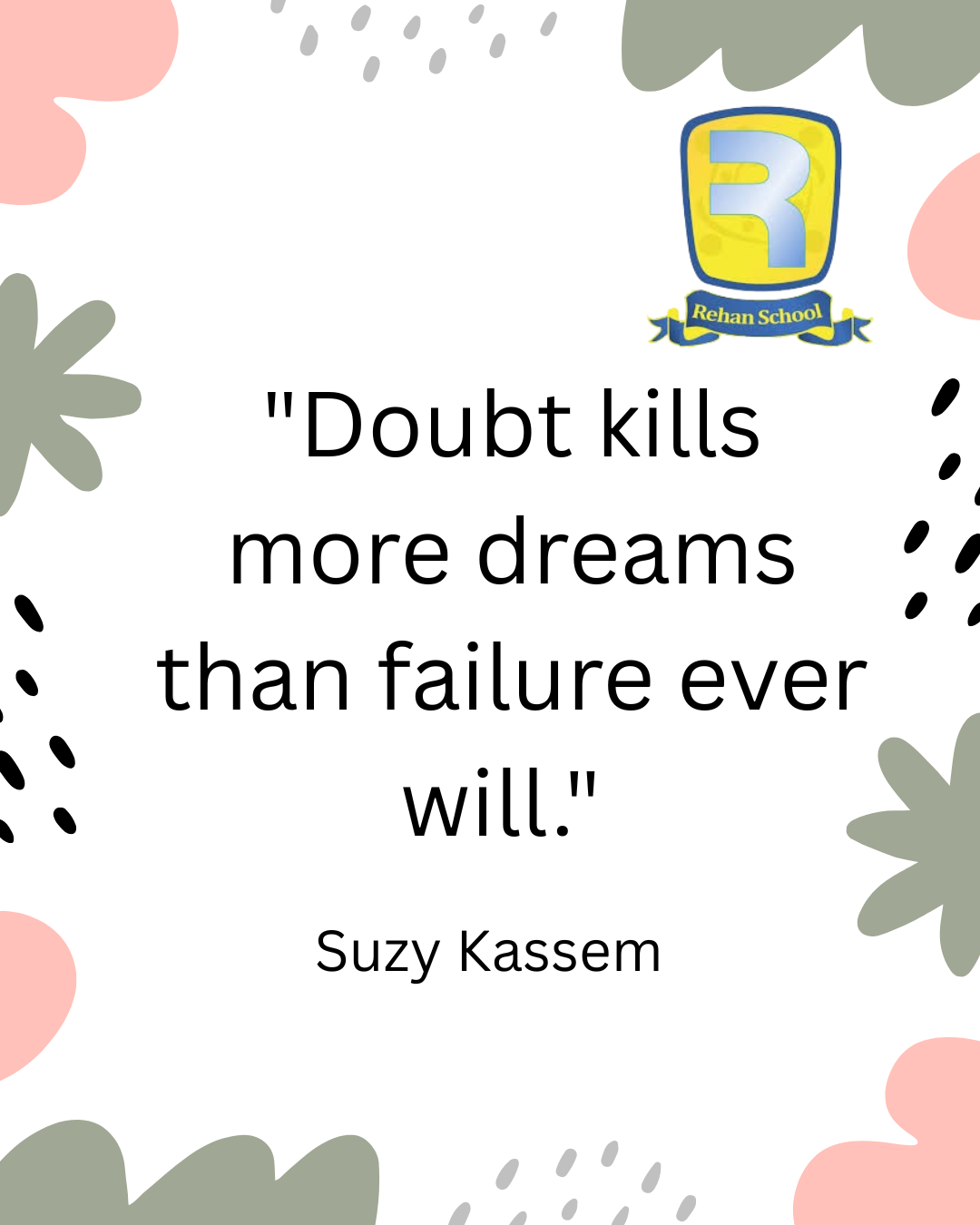
    canva post topic:"Doubt kills more dreams than failure ever will." — Suzy Kassem

    **Sound Waves: The Physics of Hearing and Communication**

    Welcome to the fascinating world of sound waves, where physics explains how we hear, speak, listen to music, and communicate with one another! Sound is more than just noise; it is a form of energy that travels through a medium such as air, water, or solids in the form of mechanical waves.

    **What Are Sound Waves?**

    Sound waves are produced when an object vibrates, causing nearby particles to vibrate and transfer energy from one place to another. These waves travel through compressions and rarefactions, allowing sound to reach our ears. Unlike light waves, sound waves need a medium to travel and cannot move through a vacuum.

    **How Do We Hear Sound?**

    Our hearing system is an amazing example of science in action! When sound waves enter the outer ear, they travel through the ear canal and make the eardrum vibrate. Tiny bones in the middle ear transmit these vibrations to the cochlea in the inner ear, where they are converted into electrical signals. The auditory nerve carries these signals to the brain, which interprets them as sounds.

    **Key Properties of Sound Waves:**

    **Frequency:** Determines the pitch of a sound, whether it is high or low. It is measured in hertz (Hz).

    **Amplitude:** Determines the loudness of a sound.

    **Wavelength:** Represents the distance between two consecutive points in a wave, such as compressions.

    **Speed:** Sound travels through air at approximately 343 meters per second at 20°C.

    **Sound Waves in Communication**

    Sound waves play an essential role in our everyday lives. Human speech allows us to share ideas and emotions, music brings creativity and expression, and technologies such as telephones, radios, sonar, and voice communication systems help connect people across the world.

    **Why Is Understanding Sound Important?**

    Learning about sound waves helps us understand the science behind hearing, musical instruments, noise reduction, medical ultrasound, and modern communication technologies. It also shows how physics connects scientific principles with the experiences we encounter every day.

    **Discover the invisible waves that bring voices to our ears and connect people, ideas, and the world!**

    Like, Share, and Follow for more interesting science topics, educational content, and fascinating discoveries!

    #SoundWaves #Physics #ScienceEducation #Hearing #Communication #Acoustics #WaveMotion #SoundPhysics #EducationalContent #ScienceFacts #LearningIsFun #Technology #ExploreScience
    RSIF8 Roll no:14 canva post no:67 canva post topic:"Doubt kills more dreams than failure ever will." — Suzy Kassem 🔊 **Sound Waves: The Physics of Hearing and Communication** 🌊🎧 Welcome to the fascinating world of sound waves, where physics explains how we hear, speak, listen to music, and communicate with one another! 🌍✨ Sound is more than just noise; it is a form of energy that travels through a medium such as air, water, or solids in the form of mechanical waves. 🔬 **What Are Sound Waves?** Sound waves are produced when an object vibrates, causing nearby particles to vibrate and transfer energy from one place to another. These waves travel through compressions and rarefactions, allowing sound to reach our ears. Unlike light waves, sound waves need a medium to travel and cannot move through a vacuum. 👂 **How Do We Hear Sound?** Our hearing system is an amazing example of science in action! When sound waves enter the outer ear, they travel through the ear canal and make the eardrum vibrate. Tiny bones in the middle ear transmit these vibrations to the cochlea in the inner ear, where they are converted into electrical signals. The auditory nerve carries these signals to the brain, which interprets them as sounds. 📚 **Key Properties of Sound Waves:** 🔹 **Frequency:** Determines the pitch of a sound, whether it is high or low. It is measured in hertz (Hz). 🔹 **Amplitude:** Determines the loudness of a sound. 🔹 **Wavelength:** Represents the distance between two consecutive points in a wave, such as compressions. 🔹 **Speed:** Sound travels through air at approximately 343 meters per second at 20°C. 📡 **Sound Waves in Communication** Sound waves play an essential role in our everyday lives. Human speech allows us to share ideas and emotions, music brings creativity and expression, and technologies such as telephones, radios, sonar, and voice communication systems help connect people across the world. 💡 **Why Is Understanding Sound Important?** Learning about sound waves helps us understand the science behind hearing, musical instruments, noise reduction, medical ultrasound, and modern communication technologies. It also shows how physics connects scientific principles with the experiences we encounter every day. 🌟 **Discover the invisible waves that bring voices to our ears and connect people, ideas, and the world!** 👍 Like, Share, and Follow for more interesting science topics, educational content, and fascinating discoveries! #SoundWaves #Physics #ScienceEducation #Hearing #Communication #Acoustics #WaveMotion #SoundPhysics #EducationalContent #ScienceFacts #LearningIsFun #Technology #ExploreScience 🔬🎧
    0 Комментарии 0 Поделились 2148 Просмотры
  • RSIF8
    Roll no:14
    story no:24
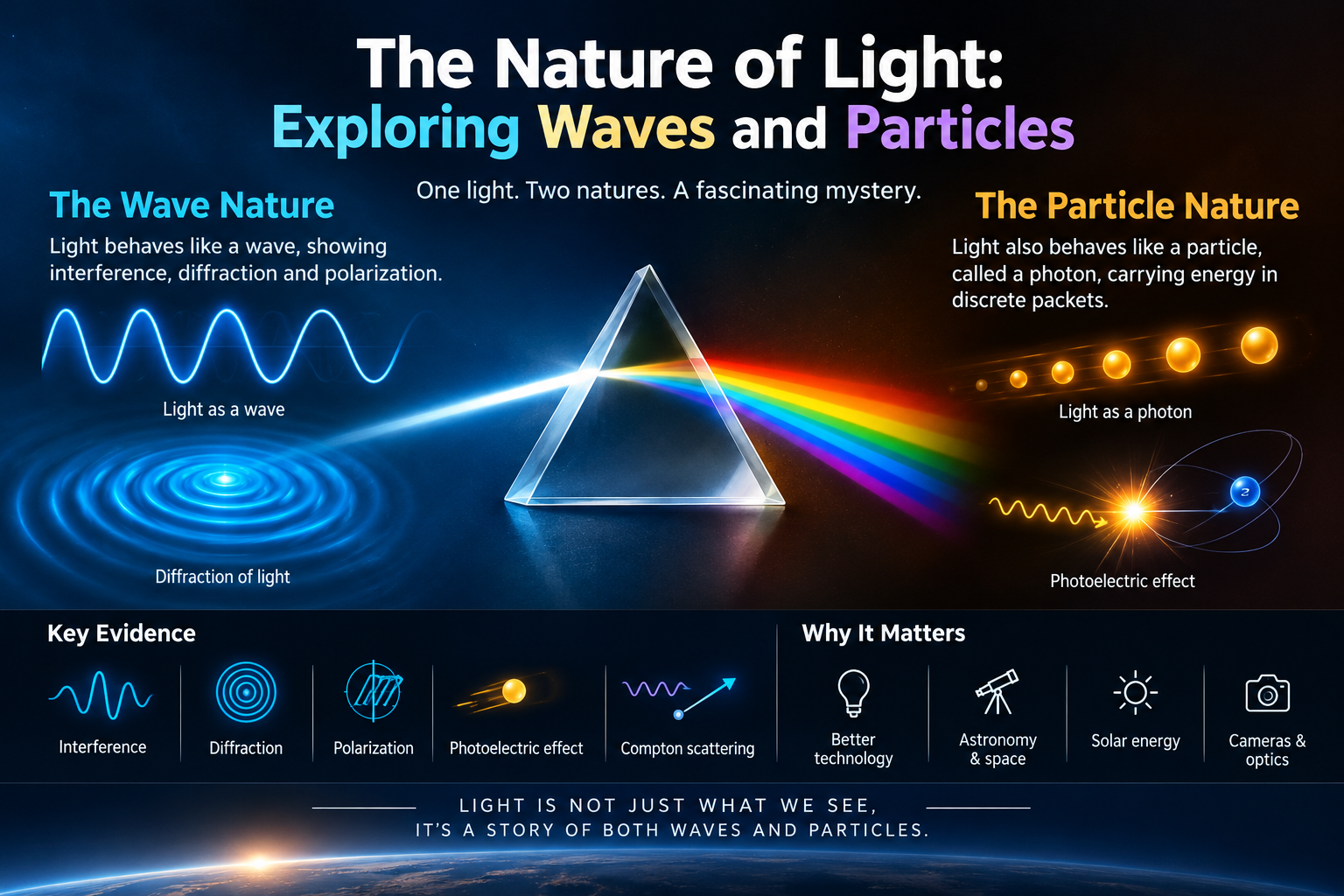
    story topic:The Nature of Light: Exploring Waves and Particles

    **The Nature of Light: Exploring Waves and Particles**

    Have you ever wondered what light really is? How does sunlight travel across millions of kilometers through space, how do rainbows form, and how can light behave like both a wave and a particle? The nature of light is one of the most fascinating topics in physics, revealing the extraordinary connection between the visible world and the mysterious laws of quantum mechanics. From the light that illuminates our homes to the distant stars shining in the universe, light plays an essential role in understanding the world around us.

    **1. The Wave Nature of Light **

    For many years, scientists have studied light as a wave because it demonstrates important wave-like properties. Light can undergo interference, diffraction, and polarization. Interference occurs when light waves overlap and combine, producing patterns of brightness and darkness. Diffraction happens when light spreads around an obstacle or passes through a narrow opening. Polarization describes the orientation of light's oscillations and helps us understand how light interacts with different materials.

    These properties demonstrate that the wave model is essential for explaining many optical phenomena. From colorful patterns created by thin films to the operation of polarized sunglasses, the wave nature of light has many applications in everyday life and modern technology.

    **2. The Particle Nature of Light **

    Light also behaves in ways that reveal its particle nature. In quantum physics, light energy is exchanged in discrete packets called **photons**. Each photon carries energy determined by its frequency, described by the equation **E = hf**, where E represents energy, h is Planck's constant, and f is frequency.

    The photoelectric effect provides important evidence for this particle nature. When light of a suitable frequency strikes certain materials, it can release electrons from their surfaces. This phenomenon helped scientists understand that light energy is transferred in individual quanta rather than always behaving like a continuous wave.

    Another important example is Compton scattering, in which photons exchange energy and momentum with electrons. These discoveries transformed our understanding of light and helped establish the foundations of quantum physics.

    **3. Wave-Particle Duality: Two Sides of Light**

    One of the most remarkable discoveries in science is that light cannot be fully explained by treating it only as a classical wave or only as a classical particle. Its behavior depends on the physical process being investigated and how it is measured. This concept is known as **wave-particle duality**.

    Experiments involving interference reveal wave-like patterns, while experiments involving photon detection show that light energy is detected in discrete units. Quantum mechanics brings these observations together into a more complete description of nature. Rather than being an ordinary wave or a tiny classical object, light is a quantum phenomenon with properties that challenge our everyday intuition.

    **4. How Do We Discover the Secrets of Light?**

    Scientists use carefully designed experiments to explore the behavior of light. Prisms separate white light into different colors, optical instruments measure its properties, and advanced detectors record individual photons. Interference experiments reveal patterns that cannot be explained by simple particle models, while photoelectric experiments demonstrate the importance of quantized energy.

    The work of scientists such as Isaac Newton, Thomas Young, Max Planck, Albert Einstein, and Arthur Compton helped build our modern understanding of light. Their discoveries show how scientific knowledge develops through observation, experimentation, mathematical reasoning, and new ideas.

    **5. Why Is the Nature of Light Important?**

    Understanding light is essential to many technologies that shape modern life. Lasers are used in medicine, manufacturing, and scientific research. Fiber-optic cables transmit information across the world using pulses of light. Solar panels convert light energy into electrical energy, while cameras and telescopes help us capture images and explore distant objects in space.

    The principles of light are also important in astronomy, microscopy, optical communication, quantum technologies, and the study of the universe. By investigating how light behaves, scientists can examine distant galaxies, study the structure of matter, and develop new tools that improve our understanding of nature.

    **6. Light: Connecting Science and the Universe**

    Light is much more than what allows us to see. It carries information about distant stars, reveals the composition of celestial objects, and provides clues about the physical processes occurring throughout the cosmos. By analyzing the light received from distant galaxies, astronomers can learn about their temperatures, chemical compositions, and motion.

    At the smallest scales, the study of photons helps scientists investigate the quantum world and understand how energy interacts with matter. From the smallest laboratory experiments to the largest astronomical observations, light connects different areas of science in extraordinary ways.

    **Conclusion: The Extraordinary Mystery of Light**

    The study of light demonstrates how nature can be far more complex than it first appears. Its wave-like properties explain interference, diffraction, and polarization, while its particle-like properties help explain the photoelectric effect and Compton scattering. Together, these discoveries form an important part of our modern understanding of physics.

    Learning about wave-particle duality encourages us to question assumptions, explore scientific evidence, and appreciate the discoveries that continue to expand human knowledge. Every beam of sunlight, every shining star, and every photon detected by a scientific instrument reminds us that there is still much to discover about the universe.

    **Light Is More Than What We See—It Is a Window into the Fundamental Nature of Reality!**

    If you enjoyed this science topic, share it with others and continue exploring the fascinating world of physics. Stay curious, keep asking questions, and never stop learning!

    #NatureOfLight #WaveParticleDuality #Physics #QuantumPhysics #ScienceEducation #Photons #LightWaves #PhotoelectricEffect #ComptonScattering #Optics #Astronomy #ScientificDiscoveries #STEMEducation #LearnPhysics #ScienceExplained #EducationalContent #WavesAndParticles
    RSIF8 Roll no:14 story no:24 story topic:The Nature of Light: Exploring Waves and Particles 🌟 **The Nature of Light: Exploring Waves and Particles** 🌈🔬 Have you ever wondered what light really is? How does sunlight travel across millions of kilometers through space, how do rainbows form, and how can light behave like both a wave and a particle? The nature of light is one of the most fascinating topics in physics, revealing the extraordinary connection between the visible world and the mysterious laws of quantum mechanics. From the light that illuminates our homes to the distant stars shining in the universe, light plays an essential role in understanding the world around us. 🌍✨ 💡 **1. The Wave Nature of Light 🌊** For many years, scientists have studied light as a wave because it demonstrates important wave-like properties. Light can undergo interference, diffraction, and polarization. Interference occurs when light waves overlap and combine, producing patterns of brightness and darkness. Diffraction happens when light spreads around an obstacle or passes through a narrow opening. Polarization describes the orientation of light's oscillations and helps us understand how light interacts with different materials. These properties demonstrate that the wave model is essential for explaining many optical phenomena. From colorful patterns created by thin films to the operation of polarized sunglasses, the wave nature of light has many applications in everyday life and modern technology. ⚛️ **2. The Particle Nature of Light ✨** Light also behaves in ways that reveal its particle nature. In quantum physics, light energy is exchanged in discrete packets called **photons**. Each photon carries energy determined by its frequency, described by the equation **E = hf**, where E represents energy, h is Planck's constant, and f is frequency. The photoelectric effect provides important evidence for this particle nature. When light of a suitable frequency strikes certain materials, it can release electrons from their surfaces. This phenomenon helped scientists understand that light energy is transferred in individual quanta rather than always behaving like a continuous wave. Another important example is Compton scattering, in which photons exchange energy and momentum with electrons. These discoveries transformed our understanding of light and helped establish the foundations of quantum physics. 🔬 **3. Wave-Particle Duality: Two Sides of Light** One of the most remarkable discoveries in science is that light cannot be fully explained by treating it only as a classical wave or only as a classical particle. Its behavior depends on the physical process being investigated and how it is measured. This concept is known as **wave-particle duality**. Experiments involving interference reveal wave-like patterns, while experiments involving photon detection show that light energy is detected in discrete units. Quantum mechanics brings these observations together into a more complete description of nature. Rather than being an ordinary wave or a tiny classical object, light is a quantum phenomenon with properties that challenge our everyday intuition. 🌈 **4. How Do We Discover the Secrets of Light?** Scientists use carefully designed experiments to explore the behavior of light. Prisms separate white light into different colors, optical instruments measure its properties, and advanced detectors record individual photons. Interference experiments reveal patterns that cannot be explained by simple particle models, while photoelectric experiments demonstrate the importance of quantized energy. The work of scientists such as Isaac Newton, Thomas Young, Max Planck, Albert Einstein, and Arthur Compton helped build our modern understanding of light. Their discoveries show how scientific knowledge develops through observation, experimentation, mathematical reasoning, and new ideas. 🚀 **5. Why Is the Nature of Light Important?** Understanding light is essential to many technologies that shape modern life. Lasers are used in medicine, manufacturing, and scientific research. Fiber-optic cables transmit information across the world using pulses of light. Solar panels convert light energy into electrical energy, while cameras and telescopes help us capture images and explore distant objects in space. The principles of light are also important in astronomy, microscopy, optical communication, quantum technologies, and the study of the universe. By investigating how light behaves, scientists can examine distant galaxies, study the structure of matter, and develop new tools that improve our understanding of nature. 🌍 **6. Light: Connecting Science and the Universe** Light is much more than what allows us to see. It carries information about distant stars, reveals the composition of celestial objects, and provides clues about the physical processes occurring throughout the cosmos. By analyzing the light received from distant galaxies, astronomers can learn about their temperatures, chemical compositions, and motion. At the smallest scales, the study of photons helps scientists investigate the quantum world and understand how energy interacts with matter. From the smallest laboratory experiments to the largest astronomical observations, light connects different areas of science in extraordinary ways. 💫 **Conclusion: The Extraordinary Mystery of Light** The study of light demonstrates how nature can be far more complex than it first appears. Its wave-like properties explain interference, diffraction, and polarization, while its particle-like properties help explain the photoelectric effect and Compton scattering. Together, these discoveries form an important part of our modern understanding of physics. Learning about wave-particle duality encourages us to question assumptions, explore scientific evidence, and appreciate the discoveries that continue to expand human knowledge. Every beam of sunlight, every shining star, and every photon detected by a scientific instrument reminds us that there is still much to discover about the universe. ✨ **Light Is More Than What We See—It Is a Window into the Fundamental Nature of Reality!** 🔭🌌 👍 If you enjoyed this science topic, share it with others and continue exploring the fascinating world of physics. Stay curious, keep asking questions, and never stop learning! #NatureOfLight #WaveParticleDuality #Physics #QuantumPhysics #ScienceEducation #Photons #LightWaves #PhotoelectricEffect #ComptonScattering #Optics #Astronomy #ScientificDiscoveries #STEMEducation #LearnPhysics #ScienceExplained #EducationalContent #WavesAndParticles 🌈🔬🚀
    0 Комментарии 0 Поделились 7448 Просмотры
Расширенные страницы