• ACCL PORTAL
    DAY 69
    BOOK 1
    STORY POST
    Acids and Bases: The Balance of Nature
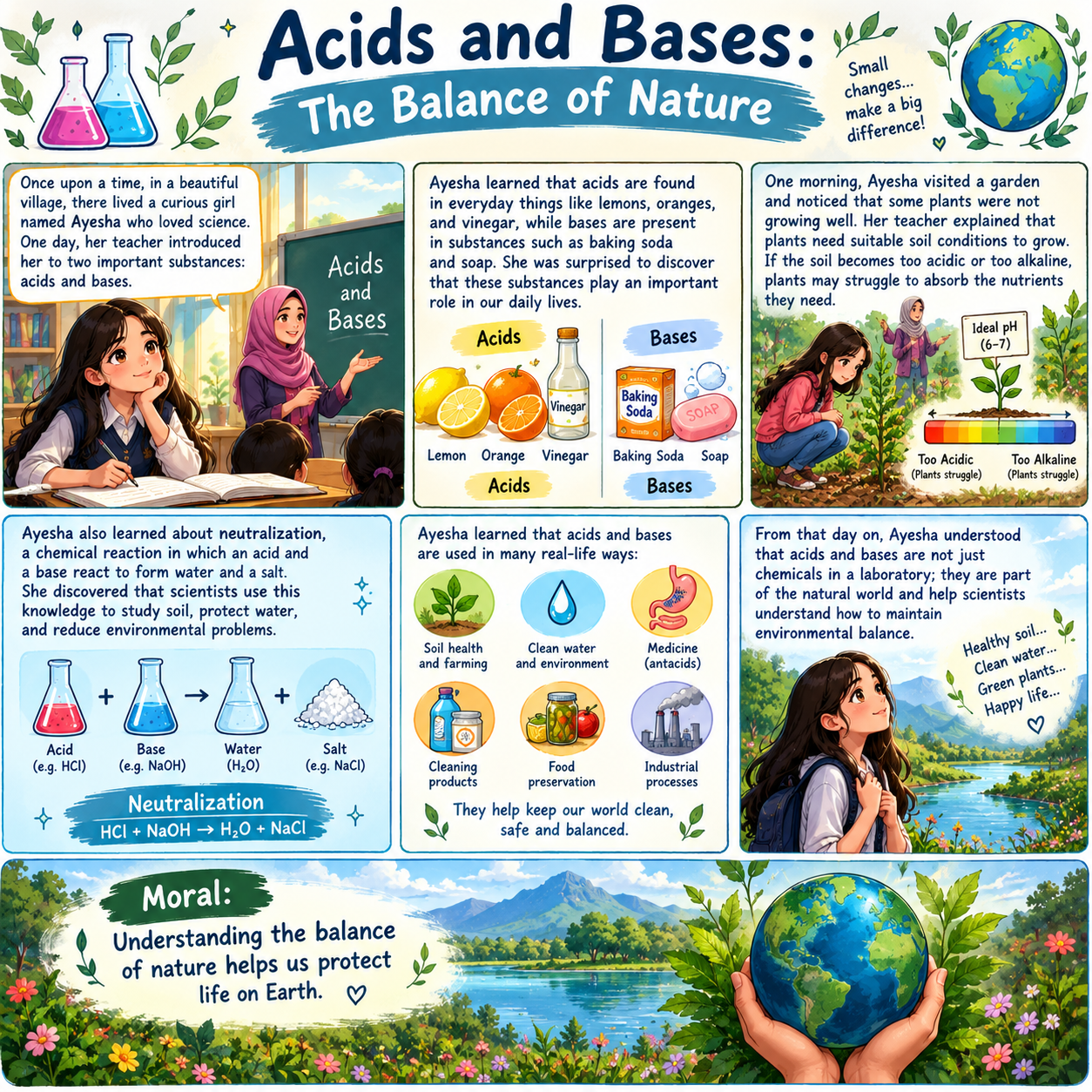
    Once upon a time, in a beautiful village, there lived a curious girl named Ayesha who loved science. One day, her teacher introduced her to two important substances: acids and bases.
    Ayesha learned that acids are found in everyday things like lemons, oranges, and vinegar, while bases are present in substances such as baking soda and soap. She was surprised to discover that these substances play an important role in our daily lives.
    One morning, Ayesha visited a garden and noticed that some plants were not growing well. Her teacher explained that plants need suitable soil conditions to grow. If the soil becomes too acidic or too alkaline, plants may struggle to absorb the nutrients they need.
    Ayesha also learned about neutralization, a chemical reaction in which an acid and a base react to form water and a salt. She discovered that scientists use this knowledge to study soil, protect water, and reduce environmental problems.
    From that day on, Ayesha understood that acids and bases are not just chemicals in a laboratory; they are part of the natural world and help scientists understand how to maintain environmental balance.
    **Moral:** *Understanding the balance of nature helps us protect life on Earth.*
    ACCL PORTAL DAY 69 BOOK 1 STORY POST Acids and Bases: The Balance of Nature Once upon a time, in a beautiful village, there lived a curious girl named Ayesha who loved science. One day, her teacher introduced her to two important substances: acids and bases. Ayesha learned that acids are found in everyday things like lemons, oranges, and vinegar, while bases are present in substances such as baking soda and soap. She was surprised to discover that these substances play an important role in our daily lives. One morning, Ayesha visited a garden and noticed that some plants were not growing well. Her teacher explained that plants need suitable soil conditions to grow. If the soil becomes too acidic or too alkaline, plants may struggle to absorb the nutrients they need. Ayesha also learned about neutralization, a chemical reaction in which an acid and a base react to form water and a salt. She discovered that scientists use this knowledge to study soil, protect water, and reduce environmental problems. From that day on, Ayesha understood that acids and bases are not just chemicals in a laboratory; they are part of the natural world and help scientists understand how to maintain environmental balance. **Moral:** *Understanding the balance of nature helps us protect life on Earth.*
    0 Reacties 0 aandelen 589 Views
  • **Roll No: 2**
    **Batch: 14**
    **Book: ACCL**
    **Task No: 130**

    # Peering Inside: The Role of Dissections in Understanding Life

    Have you ever wondered how scientists discover what lies inside a living organism and how its different organs work together? The human body and the bodies of other animals contain many complex structures that cannot be fully understood by looking only at their outer appearance. Dissection is one scientific method that helps students and researchers explore internal anatomy and understand the remarkable organization of life.

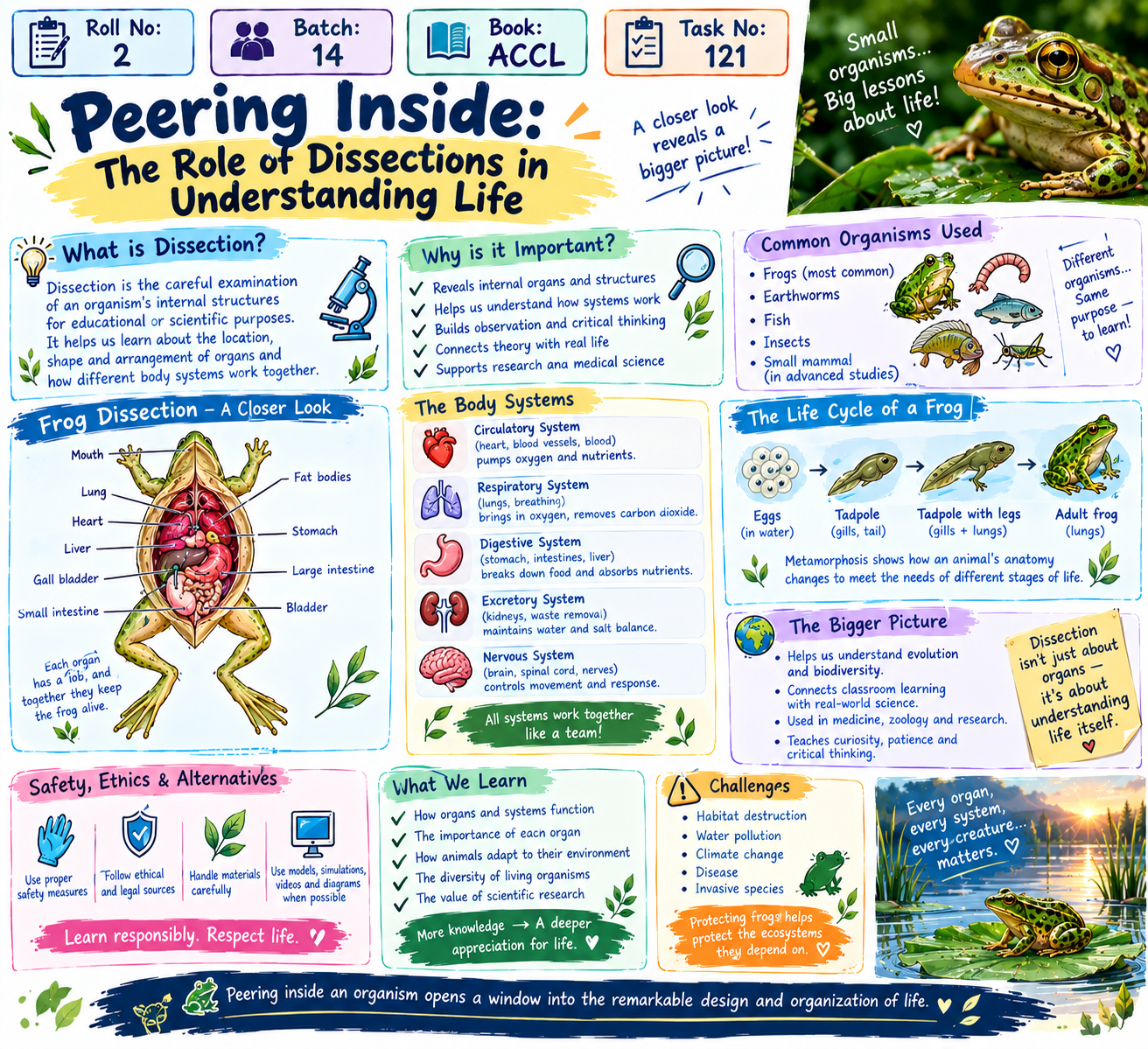
    **Dissection is the careful examination of an organism's internal structures for educational or scientific purposes.** It helps us learn about the location, shape, and arrangement of organs and how different body systems work together. By studying anatomy, we can better understand how living organisms obtain energy, breathe, circulate blood, digest food, and respond to their surroundings.

    One commonly discussed example in biology education is frog dissection. Frogs are interesting study organisms because they have many organ systems that can be compared with those of other vertebrates. Their bodies are adapted for movement on land and in water, and their anatomy provides useful opportunities to study how organs perform different functions. Observing frog anatomy can help students understand the relationship between body structure and survival.

    The circulatory system is an important area of anatomical study. The heart pumps blood through blood vessels, helping transport oxygen, nutrients, and other substances around the body. The respiratory system supports gas exchange, while the digestive system breaks down food so that the body can absorb useful nutrients. These systems work together to supply cells with the materials and energy they need.

    The nervous system is equally fascinating. It includes the brain, spinal cord, and nerves, which coordinate movement, process information, and help organisms respond to changes in their environments. The excretory system also plays an essential role by removing waste products and maintaining the balance of water and salts. Studying these systems reveals that every organ has a specific role, yet no organ works entirely alone.

    Dissection can also connect classroom learning with real-world science. Medical professionals study anatomy to understand the human body, while zoologists investigate the structures of different animal species. Researchers use many methods, including imaging, microscopy, computer models, and carefully conducted anatomical studies, to investigate how organisms function. These approaches have helped expand our knowledge of health, development, and biodiversity.

    Although dissection can be a valuable learning method, science education must also emphasize responsibility and respect for life. Schools and laboratories should follow appropriate safety procedures, use legally and ethically sourced specimens, and handle materials carefully. Whenever possible, students may also learn through digital simulations, anatomical models, videos, and diagrams. These alternatives can explain many internal structures without requiring the use of preserved specimens.

    The study of anatomy helps us appreciate the diversity of living organisms. Different species have different body structures because they have adapted to different environments and ways of life. Comparing these structures allows scientists to investigate evolution, understand biological similarities, and discover how organisms meet the challenges of survival.

    Dissection teaches more than the names of organs. It encourages observation, patience, careful reasoning, and the ability to connect scientific evidence with biological explanations. It also reminds us that scientific knowledge grows through asking questions, examining evidence, and learning from reliable methods rather than making assumptions.

    **Peering inside an organism opens a window into the remarkable design and organization of life. By studying anatomy responsibly, we deepen our understanding of biology, appreciate the connections between body systems, and learn why every discovery should be guided by curiosity, care, and respect for the natural world. **

    \#Dissection #Anatomy #Biology #ScienceEducation #AnimalScience #LearningThroughScience #ACCL #Batch14 #Task121
    **Roll No: 2** **Batch: 14** **Book: ACCL** **Task No: 130** # πŸ”¬πŸ§¬ Peering Inside: The Role of Dissections in Understanding Life 🐸🌿 Have you ever wondered how scientists discover what lies inside a living organism and how its different organs work together? πŸ”πŸ«€ The human body and the bodies of other animals contain many complex structures that cannot be fully understood by looking only at their outer appearance. Dissection is one scientific method that helps students and researchers explore internal anatomy and understand the remarkable organization of life. 🌍✨ **Dissection is the careful examination of an organism's internal structures for educational or scientific purposes.** πŸ”¬ It helps us learn about the location, shape, and arrangement of organs and how different body systems work together. By studying anatomy, we can better understand how living organisms obtain energy, breathe, circulate blood, digest food, and respond to their surroundings. πŸ“šπŸ§  One commonly discussed example in biology education is frog dissection. 🐸 Frogs are interesting study organisms because they have many organ systems that can be compared with those of other vertebrates. Their bodies are adapted for movement on land and in water, and their anatomy provides useful opportunities to study how organs perform different functions. Observing frog anatomy can help students understand the relationship between body structure and survival. The circulatory system is an important area of anatomical study. ❀️ The heart pumps blood through blood vessels, helping transport oxygen, nutrients, and other substances around the body. The respiratory system supports gas exchange, while the digestive system breaks down food so that the body can absorb useful nutrients. These systems work together to supply cells with the materials and energy they need. ⚑🫁 The nervous system is equally fascinating. 🧠 It includes the brain, spinal cord, and nerves, which coordinate movement, process information, and help organisms respond to changes in their environments. The excretory system also plays an essential role by removing waste products and maintaining the balance of water and salts. Studying these systems reveals that every organ has a specific role, yet no organ works entirely alone. Dissection can also connect classroom learning with real-world science. πŸ₯ Medical professionals study anatomy to understand the human body, while zoologists investigate the structures of different animal species. Researchers use many methods, including imaging, microscopy, computer models, and carefully conducted anatomical studies, to investigate how organisms function. These approaches have helped expand our knowledge of health, development, and biodiversity. πŸ”¬πŸ“– Although dissection can be a valuable learning method, science education must also emphasize responsibility and respect for life. πŸ’š Schools and laboratories should follow appropriate safety procedures, use legally and ethically sourced specimens, and handle materials carefully. Whenever possible, students may also learn through digital simulations, anatomical models, videos, and diagrams. These alternatives can explain many internal structures without requiring the use of preserved specimens. The study of anatomy helps us appreciate the diversity of living organisms. 🐸🐟🐦 Different species have different body structures because they have adapted to different environments and ways of life. Comparing these structures allows scientists to investigate evolution, understand biological similarities, and discover how organisms meet the challenges of survival. Dissection teaches more than the names of organs. It encourages observation, patience, careful reasoning, and the ability to connect scientific evidence with biological explanations. πŸ§ͺπŸ’‘ It also reminds us that scientific knowledge grows through asking questions, examining evidence, and learning from reliable methods rather than making assumptions. **Peering inside an organism opens a window into the remarkable design and organization of life. By studying anatomy responsibly, we deepen our understanding of biology, appreciate the connections between body systems, and learn why every discovery should be guided by curiosity, care, and respect for the natural world. πŸ”¬πŸŒΏπŸŒŽ** \#Dissection #Anatomy #Biology #ScienceEducation #AnimalScience #LearningThroughScience #ACCL #Batch14 #Task121 πŸ§¬πŸ”¬πŸ’š
    0 Reacties 0 aandelen 3228 Views
  • **Roll No: 2**
    **Batch: 14**
    **Book: ACCL**
    **Task No: 120**

    # Why Frogs? Understanding the Anatomy of Life

    Have you ever wondered why frogs are so fascinating to scientists? These small creatures are much more than the animals we see near ponds, rivers, and gardens. Frogs have unique body structures, remarkable life cycles, and special adaptations that help us understand how living organisms grow, survive, and interact with their environments. Their anatomy provides an interesting window into the science of life.

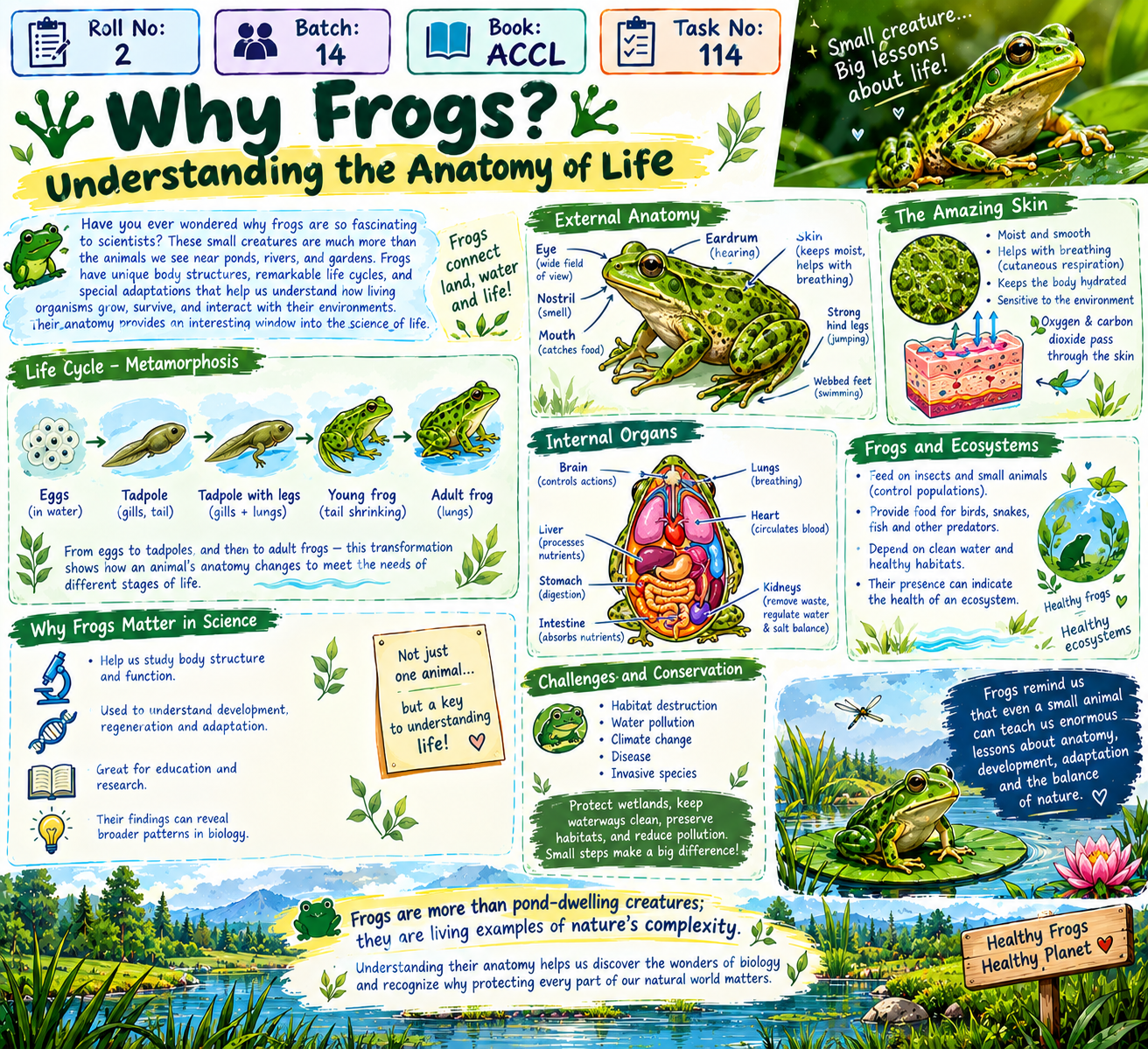
    A frog's body is designed for life both in water and on land. Its body generally has a broad head, a short trunk, strong hind legs, and webbed feet in many species. These features help frogs jump, swim, and move through their habitats. Their eyes are positioned to provide a wide field of view, while their sensitive hearing helps them detect sounds, including the calls of other frogs.

    One of the most interesting features of frogs is their skin. Unlike the dry, scaly skin of many reptiles, frog skin is usually moist and plays an important role in their survival. Many frogs can exchange gases through their skin as well as through their lungs. This process, called **cutaneous respiration**, allows oxygen and carbon dioxide to pass across the skin under suitable conditions. Their skin also helps maintain moisture, making a healthy habitat especially important for them.

    Frogs have a fascinating life cycle called **metamorphosis**. Many begin life as eggs in water. The eggs hatch into tadpoles, which usually have tails and breathe mainly through gills. As they develop, they grow legs, their lungs develop, and their bodies gradually change into those of adult frogs. The tail is usually absorbed during development. This transformation demonstrates how an animal's anatomy changes to meet the needs of different stages of life.

    The internal organs of a frog also reveal important biological principles. Its heart circulates blood through the body, carrying oxygen and nutrients to tissues. The digestive system breaks down food, while the kidneys help remove waste and regulate water and salt balance. The brain and nervous system coordinate movement, senses, and responses to the environment. Each organ works with other systems to keep the animal alive.

    Frogs are also valuable to ecosystems. Many feed on insects and other small animals, helping influence populations of these organisms. Frogs themselves provide food for birds, snakes, fish, and other predators. Because many frogs depend on suitable water and land habitats, changes in their populations can provide clues about environmental conditions. Scientists therefore study frogs to learn more about biodiversity, habitat quality, and ecosystem health.

    Another reason frogs are important is their role in scientific research and education. Their anatomy helps students explore the structure and function of organs, compare different vertebrates, and understand biological systems. Researchers also study frog development, regeneration in certain species, communication, and adaptation. Such research can reveal broader patterns in biology, although findings from frogs do not always apply directly to humans.

    Unfortunately, many frog species face challenges such as habitat destruction, water pollution, climate change, disease, and invasive species. Protecting wetlands, keeping waterways clean, preserving natural habitats, and reducing pollution can help support frog populations and the many other organisms that share their ecosystems. Caring for frogs is one way of caring for the wider web of life.

    Frogs remind us that even a small animal can teach us enormous lessons about anatomy, development, adaptation, and the balance of nature. By observing their bodies and studying their life cycles, we gain a deeper appreciation of how living systems work together.

    **Frogs are more than pond-dwelling creatures; they are living examples of nature's complexity. Understanding their anatomy helps us discover the wonders of biology and recognize why protecting every part of our natural world matters. **

    \#Frogs #AnatomyOfLife #Biology #LifeCycle #AnimalScience #Biodiversity #ACCL #Batch14 #Task114
    **Roll No: 2** **Batch: 14** **Book: ACCL** **Task No: 120** # πŸΈπŸ”¬ Why Frogs? Understanding the Anatomy of Life πŸŒΏπŸ’š Have you ever wondered why frogs are so fascinating to scientists? 🐸🌎 These small creatures are much more than the animals we see near ponds, rivers, and gardens. Frogs have unique body structures, remarkable life cycles, and special adaptations that help us understand how living organisms grow, survive, and interact with their environments. Their anatomy provides an interesting window into the science of life. πŸ”¬βœ¨ A frog's body is designed for life both in water and on land. πŸ’§πŸŒ± Its body generally has a broad head, a short trunk, strong hind legs, and webbed feet in many species. These features help frogs jump, swim, and move through their habitats. Their eyes are positioned to provide a wide field of view, while their sensitive hearing helps them detect sounds, including the calls of other frogs. πŸ¦΅πŸ‘€ One of the most interesting features of frogs is their skin. Unlike the dry, scaly skin of many reptiles, frog skin is usually moist and plays an important role in their survival. πŸΈπŸ’¦ Many frogs can exchange gases through their skin as well as through their lungs. This process, called **cutaneous respiration**, allows oxygen and carbon dioxide to pass across the skin under suitable conditions. Their skin also helps maintain moisture, making a healthy habitat especially important for them. Frogs have a fascinating life cycle called **metamorphosis**. πŸ₯šβž‘️🐟➑️🐸 Many begin life as eggs in water. The eggs hatch into tadpoles, which usually have tails and breathe mainly through gills. As they develop, they grow legs, their lungs develop, and their bodies gradually change into those of adult frogs. The tail is usually absorbed during development. This transformation demonstrates how an animal's anatomy changes to meet the needs of different stages of life. πŸŒ±πŸ”„ The internal organs of a frog also reveal important biological principles. ❀️ Its heart circulates blood through the body, carrying oxygen and nutrients to tissues. The digestive system breaks down food, while the kidneys help remove waste and regulate water and salt balance. The brain and nervous system coordinate movement, senses, and responses to the environment. Each organ works with other systems to keep the animal alive. πŸ§ πŸ«€ Frogs are also valuable to ecosystems. 🦟🌿 Many feed on insects and other small animals, helping influence populations of these organisms. Frogs themselves provide food for birds, snakes, fish, and other predators. Because many frogs depend on suitable water and land habitats, changes in their populations can provide clues about environmental conditions. Scientists therefore study frogs to learn more about biodiversity, habitat quality, and ecosystem health. πŸŒπŸ”Ž Another reason frogs are important is their role in scientific research and education. πŸ“šπŸ”¬ Their anatomy helps students explore the structure and function of organs, compare different vertebrates, and understand biological systems. Researchers also study frog development, regeneration in certain species, communication, and adaptation. Such research can reveal broader patterns in biology, although findings from frogs do not always apply directly to humans. Unfortunately, many frog species face challenges such as habitat destruction, water pollution, climate change, disease, and invasive species. 🌧️🏞️ Protecting wetlands, keeping waterways clean, preserving natural habitats, and reducing pollution can help support frog populations and the many other organisms that share their ecosystems. Caring for frogs is one way of caring for the wider web of life. πŸ’šβ™»οΈ Frogs remind us that even a small animal can teach us enormous lessons about anatomy, development, adaptation, and the balance of nature. By observing their bodies and studying their life cycles, we gain a deeper appreciation of how living systems work together. πŸΈπŸŒŽπŸ”¬ **Frogs are more than pond-dwelling creatures; they are living examples of nature's complexity. Understanding their anatomy helps us discover the wonders of biology and recognize why protecting every part of our natural world matters. 🐸🧬🌿✨** \#Frogs #AnatomyOfLife #Biology #LifeCycle #AnimalScience #Biodiversity #ACCL #Batch14 #Task114 πŸΈπŸ”¬πŸŒ
    0 Reacties 0 aandelen 4600 Views
  • ACCL Day 167
    Climate and Culture: How Geography Shapes Our Way of Life

    In a small village nestled between snowy mountains and a crystal-blue river lived three friends: Ayan, Zara, and Mikael. Even though they were from the same land, their lifestyles were completely different—because of where they lived.

    Ayan lived high in the mountains, where the winters were long and harsh. Snow covered the roofs, and the winds howled like wolves. People there wore thick woolen clothes, built strong wooden houses, and ate warm soups and dried meats to survive the cold. Life was tough, so the community became very close-knit. Everyone helped each other gather wood, store food, and fix homes before the heavy snowfall.

    Zara lived in the sunny plains below. Her village had wide fields, golden crops, and warm breezes. People wore light, colorful clothes and celebrated many outdoor festivals. Their food was fresh—vegetables, fruits, and grains—because the fertile land made farming easy. The climate allowed them to grow and trade crops, making their culture rich in traditions and celebrations.

    Mikael lived near the coast, where salty waves crashed against the shore. His life revolved around the sea. The people there built boats, learned to fish, and became excellent sailors. Their houses were designed to withstand storms, and their cuisine was full of seafood. They developed music and dances inspired by the rhythm of the waves.

    One day, the three friends met at a cultural festival. They shared their foods, clothes, music, and stories. As they talked, they realized something beautiful:

    The mountains taught strength and unity.
    The plains encouraged celebration and abundance.
    The sea inspired adventure and creativity.

    Different climates had shaped different cultures, traditions, and ways of life—but together, they created a richer, more colorful world.

    The friends understood that geography doesn’t just shape the land—it shapes the people, their habits, their beliefs, and even their happiness.

    And from that day on, they promised to learn from each other's cultures and respect every lifestyle shaped by nature.

    Our environment shapes us—but together, we shape the world.
    ACCL Day 167 🌍 Climate and Culture: How Geography Shapes Our Way of Life 🌦️ In a small village nestled between snowy mountains and a crystal-blue river lived three friends: Ayan, Zara, and Mikael. Even though they were from the same land, their lifestyles were completely different—because of where they lived. Ayan lived high in the mountains, where the winters were long and harsh. Snow covered the roofs, and the winds howled like wolves. People there wore thick woolen clothes, built strong wooden houses, and ate warm soups and dried meats to survive the cold. Life was tough, so the community became very close-knit. Everyone helped each other gather wood, store food, and fix homes before the heavy snowfall. Zara lived in the sunny plains below. Her village had wide fields, golden crops, and warm breezes. People wore light, colorful clothes and celebrated many outdoor festivals. Their food was fresh—vegetables, fruits, and grains—because the fertile land made farming easy. The climate allowed them to grow and trade crops, making their culture rich in traditions and celebrations. Mikael lived near the coast, where salty waves crashed against the shore. His life revolved around the sea. The people there built boats, learned to fish, and became excellent sailors. Their houses were designed to withstand storms, and their cuisine was full of seafood. They developed music and dances inspired by the rhythm of the waves. One day, the three friends met at a cultural festival. They shared their foods, clothes, music, and stories. As they talked, they realized something beautiful: The mountains taught strength and unity. The plains encouraged celebration and abundance. The sea inspired adventure and creativity. Different climates had shaped different cultures, traditions, and ways of life—but together, they created a richer, more colorful world. The friends understood that geography doesn’t just shape the land—it shapes the people, their habits, their beliefs, and even their happiness. And from that day on, they promised to learn from each other's cultures and respect every lifestyle shaped by nature. 🌍✨ Our environment shapes us—but together, we shape the world.
    0 Reacties 0 aandelen 2123 Views
  • **Roll No: 2**
    **Batch: 14**
    **Book: ACCL**
    **Task No: 69**

    # Acids and Bases: The Balance of Nature

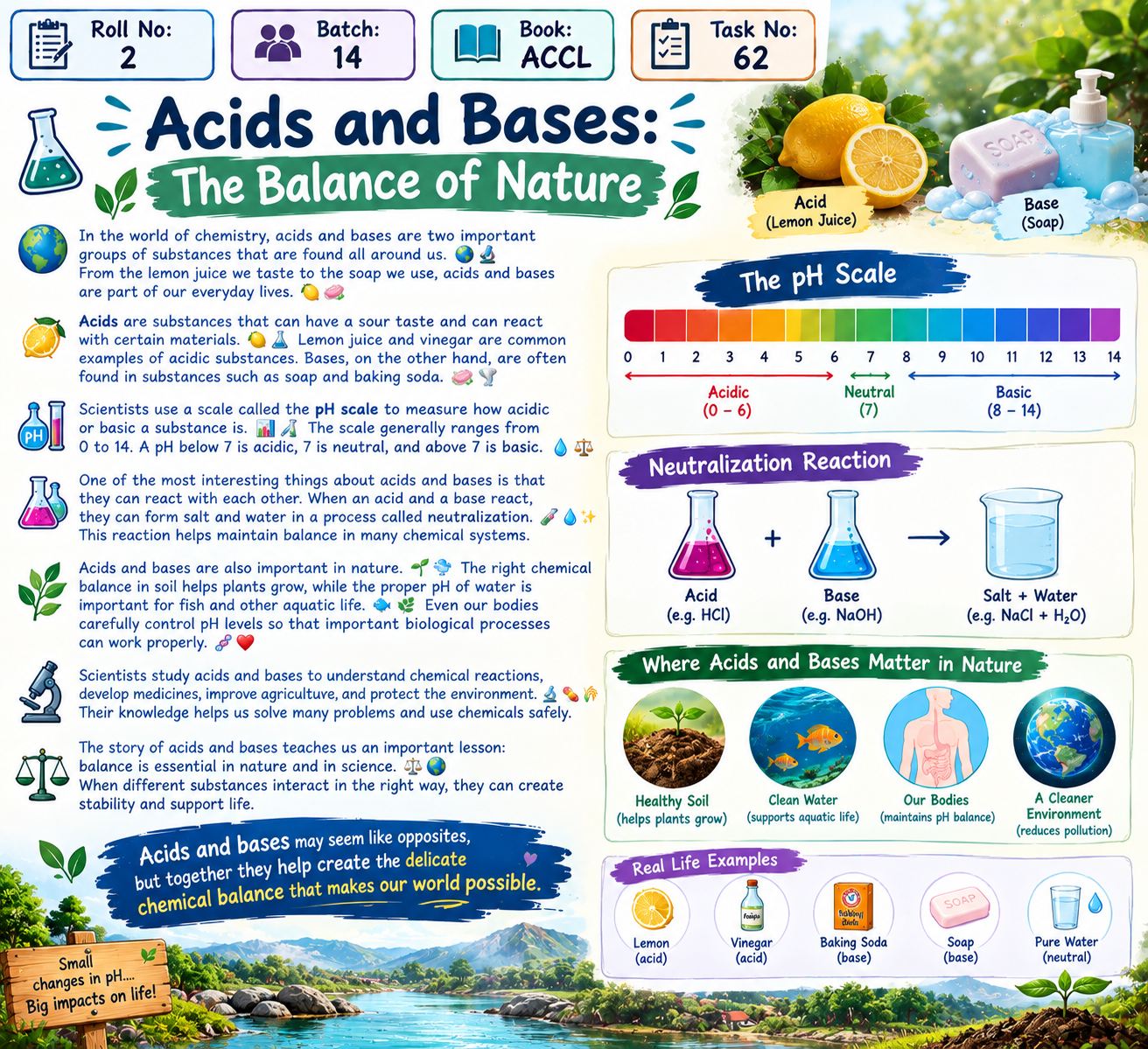
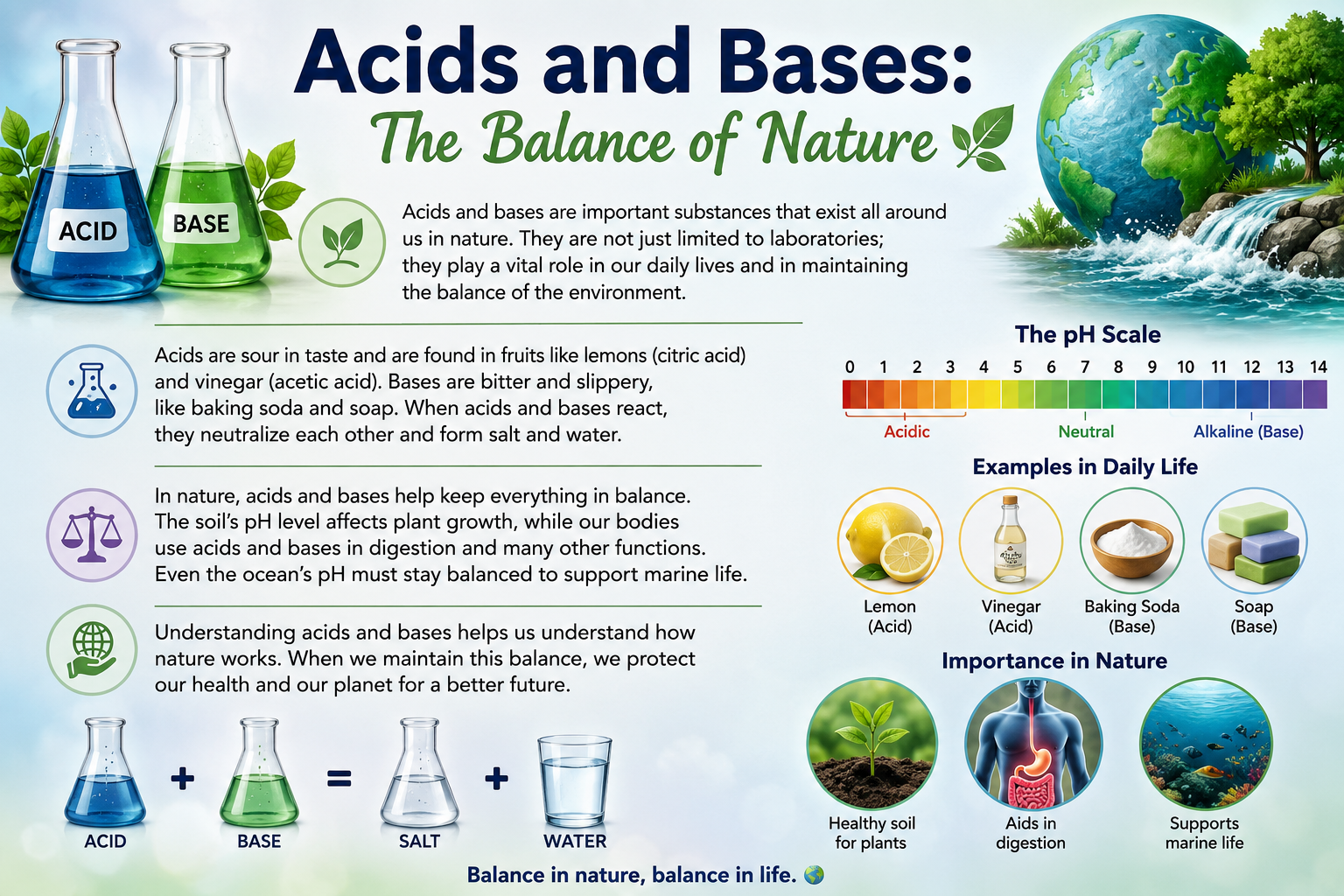
    In the world of chemistry, acids and bases are two important groups of substances that are found all around us. From the lemon juice we taste to the soap we use, acids and bases are part of our everyday lives.

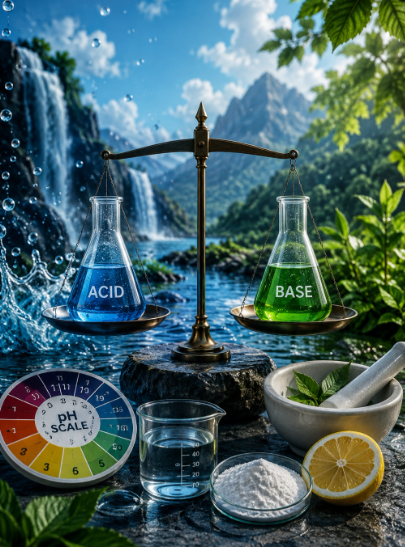
    Acids are substances that can have a sour taste and can react with certain materials. Lemon juice and vinegar are common examples of acidic substances. Bases, on the other hand, are often found in substances such as soap and baking soda.

    Scientists use a scale called the **pH scale** to measure how acidic or basic a substance is. The scale generally ranges from **0 to 14**. A pH below 7 is acidic, 7 is neutral, and above 7 is basic.

    One of the most interesting things about acids and bases is that they can react with each other. When an acid and a base react, they can form **salt and water** in a process called neutralization. This reaction helps maintain balance in many chemical systems.

    Acids and bases are also important in nature. The right chemical balance in soil helps plants grow, while the proper pH of water is important for fish and other aquatic life. Even our bodies carefully control pH levels so that important biological processes can work properly.

    Scientists study acids and bases to understand chemical reactions, develop medicines, improve agriculture, and protect the environment. Their knowledge helps us solve many problems and use chemicals safely.

    The story of acids and bases teaches us an important lesson: **balance is essential in nature and in science.** When different substances interact in the right way, they can create stability and support life.

    **Acids and bases may seem like opposites, but together they help create the delicate chemical balance that makes our world possible. **
    **Roll No: 2** **Batch: 14** **Book: ACCL** **Task No: 69** # πŸ§ͺ Acids and Bases: The Balance of Nature πŸŒΏβš–οΈ In the world of chemistry, acids and bases are two important groups of substances that are found all around us. πŸŒπŸ”¬ From the lemon juice we taste to the soap we use, acids and bases are part of our everyday lives. πŸ‹πŸ§Ό Acids are substances that can have a sour taste and can react with certain materials. πŸ‹βš—οΈ Lemon juice and vinegar are common examples of acidic substances. Bases, on the other hand, are often found in substances such as soap and baking soda. 🧼πŸ₯„ Scientists use a scale called the **pH scale** to measure how acidic or basic a substance is. πŸ“ŠπŸ§ͺ The scale generally ranges from **0 to 14**. A pH below 7 is acidic, 7 is neutral, and above 7 is basic. πŸ’§βš–οΈ One of the most interesting things about acids and bases is that they can react with each other. When an acid and a base react, they can form **salt and water** in a process called neutralization. πŸ§ͺπŸ’§βœ¨ This reaction helps maintain balance in many chemical systems. Acids and bases are also important in nature. 🌱🌧️ The right chemical balance in soil helps plants grow, while the proper pH of water is important for fish and other aquatic life. 🐟🌿 Even our bodies carefully control pH levels so that important biological processes can work properly. 🧬❀️ Scientists study acids and bases to understand chemical reactions, develop medicines, improve agriculture, and protect the environment. πŸ”¬πŸ’ŠπŸŒΎ Their knowledge helps us solve many problems and use chemicals safely. The story of acids and bases teaches us an important lesson: **balance is essential in nature and in science.** βš–οΈπŸŒ When different substances interact in the right way, they can create stability and support life. **Acids and bases may seem like opposites, but together they help create the delicate chemical balance that makes our world possible. πŸ§ͺ🌎✨**
    0 Reacties 0 aandelen 1889 Views
  • RSIF8
    Roll no:85
    Task no:69
    Task topic:Acids and Bases: The Balance of Nature
    Have you ever wondered why a lemon tastes sour, why soap feels slippery, or how our stomach digests food? The answer lies in the fascinating world of acids and bases. These substances are found everywhere—in nature, in our homes, and even inside our bodies. Together, they help maintain the delicate balance that supports life on Earth.
    Acids are substances that usually taste sour and have a pH below 7. Common examples include citric acid in lemons, acetic acid in vinegar, and hydrochloric acid in the stomach, which helps digest food. Bases, on the other hand, usually have a pH above 7 and feel slippery. Baking soda, soap, and many cleaning products are everyday examples of bases.
    One of the most amazing things about acids and bases is that they can neutralize each other. When an acid reacts with a base, they produce salt and water. This neutralization process is important in many areas of life, from treating acidic soil for better farming to making medicines that reduce excess stomach acid.
    Nature depends on the balance between acids and bases. Healthy soil has the right pH for plants to grow, rivers and oceans need balanced pH levels to support aquatic life, and our bodies carefully regulate pH so that organs and enzymes can function properly. Even a small change in this balance can affect living organisms.
    Understanding acids and bases helps us appreciate how chemistry works in everyday life. They are not just laboratory chemicals—they are essential to cooking, cleaning, farming, medicine, and the environment. By learning about them, we gain a deeper understanding of the natural world and the scientific principles that keep it in harmony
    RSIF8 Roll no:85 Task no:69 Task topic:Acids and Bases: The Balance of Nature Have you ever wondered why a lemon tastes sour, why soap feels slippery, or how our stomach digests food? The answer lies in the fascinating world of acids and bases. These substances are found everywhere—in nature, in our homes, and even inside our bodies. Together, they help maintain the delicate balance that supports life on Earth. Acids are substances that usually taste sour and have a pH below 7. Common examples include citric acid in lemons, acetic acid in vinegar, and hydrochloric acid in the stomach, which helps digest food. Bases, on the other hand, usually have a pH above 7 and feel slippery. Baking soda, soap, and many cleaning products are everyday examples of bases. One of the most amazing things about acids and bases is that they can neutralize each other. When an acid reacts with a base, they produce salt and water. This neutralization process is important in many areas of life, from treating acidic soil for better farming to making medicines that reduce excess stomach acid. Nature depends on the balance between acids and bases. Healthy soil has the right pH for plants to grow, rivers and oceans need balanced pH levels to support aquatic life, and our bodies carefully regulate pH so that organs and enzymes can function properly. Even a small change in this balance can affect living organisms. Understanding acids and bases helps us appreciate how chemistry works in everyday life. They are not just laboratory chemicals—they are essential to cooking, cleaning, farming, medicine, and the environment. By learning about them, we gain a deeper understanding of the natural world and the scientific principles that keep it in harmony
    0 Reacties 0 aandelen 2178 Views
  • **RSLC ROLL NO 80#**
    **FOUNDATION LEVEL Batch 06#**
    **DAY 69 — TASK 69**
    https://paki.com/content/uploads/photos/2026/09/educator_3c8c776746553cde41b0a5614ee8f9a2_cropped.png
    # Acids and Bases: The Balance of Nature

    Have you ever wondered why lemons taste sour or why soap feels slippery? The answer lies in **acids and bases**!

    Acids are substances that often taste sour. For example, **lemon juice and vinegar** contain acids. Bases are different. They can feel slippery and are found in things like **soap and baking soda**.

    Acids and bases are important in nature and in our daily lives. Our stomach uses acid to help digest food, while plants and soil depend on the right balance of chemicals to grow properly. Scientists use the **pH scale** to measure how acidic or basic something is.

    The amazing thing is that acids and bases can balance each other. When an acid and a base react, they can form **salt and water**. This process is called **neutralization**.

    ### Moral:

    **Balance is important in nature and in life. Too much or too little of something can cause problems, but the right balance helps everything work properly.**

    ### Hashtags:

    #AcidsAndBases #Chemistry #Science #PHScale #SciencePost
    **RSLC ROLL NO 80#** **FOUNDATION LEVEL Batch 06#** **DAY 69 — TASK 69** https://paki.com/content/uploads/photos/2026/09/educator_3c8c776746553cde41b0a5614ee8f9a2_cropped.png # πŸ§ͺ Acids and Bases: The Balance of Nature Have you ever wondered why lemons taste sour or why soap feels slippery? πŸ€” The answer lies in **acids and bases**! Acids are substances that often taste sour. For example, **lemon juice and vinegar** contain acids. Bases are different. They can feel slippery and are found in things like **soap and baking soda**. Acids and bases are important in nature and in our daily lives. Our stomach uses acid to help digest food, while plants and soil depend on the right balance of chemicals to grow properly. Scientists use the **pH scale** to measure how acidic or basic something is. The amazing thing is that acids and bases can balance each other. When an acid and a base react, they can form **salt and water**. This process is called **neutralization**. πŸŒ±βš—οΈ ### 🌟 Moral: **Balance is important in nature and in life. Too much or too little of something can cause problems, but the right balance helps everything work properly.** ### 🏷️ Hashtags: #AcidsAndBases #Chemistry #Science #PHScale #SciencePost
    0 Reacties 0 aandelen 2403 Views
  • RSIF8
    Roll, no 77
    story post no 32
    story topic : Chemistry Quest: Elements of Everyday Life.
    **Chemistry Quest: Elements of Everyday Life**

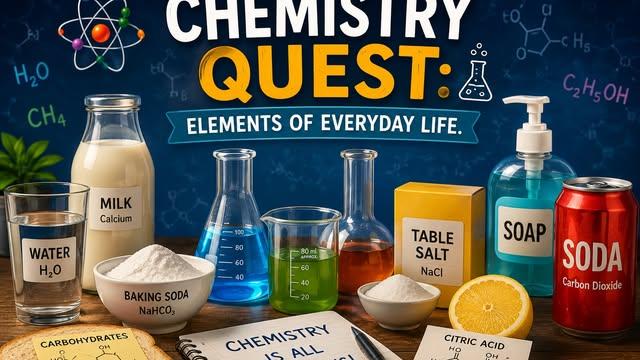
    Chemistry is not just found in laboratories—it is all around us! From the water we drink and the food we eat to soap , salt , baking soda, and the air we breathe , chemistry plays an important role in our everyday lives. Join the **Chemistry Quest** and discover how amazing science is hidden in the simplest things around us!

    #ChemistryQuest #EverydayChemistry #ScienceIsEverywhere #LearnChemistry #ScienceLearning #Elements #ChemistryLovers #ExploreScience #Education #LearnAndDiscover #ScienceFun
    RSIF8 Roll, no 77 story post no 32 story topic : Chemistry Quest: Elements of Everyday Life. πŸ§ͺ🌍 **Chemistry Quest: Elements of Everyday Life** πŸ”¬βœ¨ Chemistry is not just found in laboratories—it is all around us! πŸ§ͺ🏠 From the water we drink πŸ’§ and the food we eat 🍎 to soap 🧼, salt πŸ§‚, baking soda, and the air we breathe 🌬️, chemistry plays an important role in our everyday lives. πŸš€πŸ“š Join the **Chemistry Quest** and discover how amazing science is hidden in the simplest things around us! πŸ”¬πŸ’‘πŸŒŸ #ChemistryQuest πŸ§ͺ #EverydayChemistry πŸ”¬ #ScienceIsEverywhere 🌍 #LearnChemistry πŸ“š #ScienceLearning πŸ’‘ #Elements #ChemistryLovers 🧬 #ExploreScience πŸš€ #Education #LearnAndDiscover 🌟 #ScienceFun πŸ§ͺ✨
    0 Reacties 0 aandelen 2031 Views
  • MohsinRSF8
    song title no:8
    Rool no:13
    Class: Foundation level

    Sure! Here is a **long English description** for your social media post:

    **Chemical Bonding: The Relationship of Molecules**

    Chemistry is one of the most fascinating branches of science because it helps us understand the materials, substances, and processes that surround us every day. From the water we drink and the air we breathe to the food we eat and the objects we use, everything is connected to atoms and molecules. But how do these tiny particles come together to form the world around us? The answer lies in **chemical bonding**.

    My song, **“Chemical Bonding: The Relationship of Molecules,”** presents this important chemistry concept in a creative, simple, and enjoyable way. Through this song, I have tried to explain how atoms interact with each other, how electrons are involved in bonding, and how different atoms combine to form molecules and compounds.

    Atoms are extremely small, but the relationships between them have a huge impact on the properties of matter. Atoms can form different types of chemical bonds depending on how their electrons interact. These bonds help determine the structure, stability, and many properties of the substances around us.

    One important type is **covalent bonding**, where atoms share electrons with each other. This type of bonding plays an important role in the formation of many molecules. Water is a familiar example in which hydrogen and oxygen atoms are connected through covalent bonds. Many other substances that are essential to life also depend on this type of bonding.

    Another important type is **ionic bonding**. In this type of bonding, one atom transfers electrons to another atom. This creates positively and negatively charged ions that attract each other. Sodium and chlorine provide a common example, forming sodium chloride, which is the salt we use in everyday life.

    We can also learn about **metallic bonding**, which helps explain the special properties of metals. The way electrons are arranged and shared among metal atoms contributes to characteristics such as electrical conductivity, strength, and metallic appearance.
    MohsinRSF8 song title no:8 Rool no:13 Class: Foundation level Sure! ❀️ Here is a **long English description** for your social media post: πŸ§ͺ🎡 **Chemical Bonding: The Relationship of Molecules** 🎡πŸ§ͺ Chemistry is one of the most fascinating branches of science because it helps us understand the materials, substances, and processes that surround us every day. From the water we drink and the air we breathe to the food we eat and the objects we use, everything is connected to atoms and molecules. But how do these tiny particles come together to form the world around us? The answer lies in **chemical bonding**. My song, **“Chemical Bonding: The Relationship of Molecules,”** presents this important chemistry concept in a creative, simple, and enjoyable way. Through this song, I have tried to explain how atoms interact with each other, how electrons are involved in bonding, and how different atoms combine to form molecules and compounds. πŸŽΆπŸ”¬ Atoms are extremely small, but the relationships between them have a huge impact on the properties of matter. Atoms can form different types of chemical bonds depending on how their electrons interact. These bonds help determine the structure, stability, and many properties of the substances around us. One important type is **covalent bonding**, where atoms share electrons with each other. This type of bonding plays an important role in the formation of many molecules. Water is a familiar example in which hydrogen and oxygen atoms are connected through covalent bonds. Many other substances that are essential to life also depend on this type of bonding. πŸ’§ Another important type is **ionic bonding**. In this type of bonding, one atom transfers electrons to another atom. This creates positively and negatively charged ions that attract each other. Sodium and chlorine provide a common example, forming sodium chloride, which is the salt we use in everyday life. πŸ§‚ We can also learn about **metallic bonding**, which helps explain the special properties of metals. The way electrons are arranged and shared among metal atoms contributes to characteristics such as electrical conductivity, strength, and metallic appearance. βš™οΈβœ¨
    0 Reacties 0 aandelen 2050 Views 86
  • Mohsin #RSF8
    #Storypost8
    Class: Foundation level
    Made by Me
    rool no:13

    ## ** Story Post Title: Acids and Bases: The Balance of Nature**

    **Acids and Bases: The Balance of Nature**

    Nature is built on balance, and one of the most fascinating examples of this balance is the relationship between **acids and bases**. Although they have opposite properties, both are essential for life on Earth. From the food we eat to the water we drink, from the soil that grows our crops to the blood flowing through our bodies, acids and bases work together to maintain harmony in the natural world.

    Acids are substances that release hydrogen ions and often have a sour taste, while bases release hydroxide ions and are usually bitter or slippery to the touch. When an acid and a base react, they form **salt and water**, a process called **neutralization**. This reaction helps maintain stability in many natural and industrial processes.

    Our bodies also depend on this delicate balance. For example, human blood maintains a nearly constant pH level, allowing organs to function properly. Even a small change in this balance can affect our health. In nature, rainwater, oceans, rivers, and soil all rely on the correct pH to support plants, animals, and aquatic life.

    Acids and bases are not just laboratory chemicals—they are part of our everyday lives. Lemon juice, vinegar, oranges, baking soda, toothpaste, soap, and many household products all demonstrate the amazing role these substances play in our daily routines.

    Learning about acids and bases helps us understand how science explains the world around us. It teaches us that balance is not only important in chemistry but also in life itself. Just as nature thrives through harmony, we too can achieve success by maintaining balance in our thoughts, actions, and decisions.

    **Science shows us that every reaction has a purpose, and every balance creates a stronger, healthier world. Keep learning, stay curious, and discover the wonders hidden in everyday life!**

    #Science #Chemistry #AcidsAndBases #BalanceOfNature #LearningEveryDay #Education #STEM #Nature #Curiosity #Knowledge #RSF8
    Mohsin #RSF8πŸŽ“βœ¨ #Storypost8 Class: Foundation level πŸ“š Made by Me πŸ’»πŸš€ rool no:13 ## **πŸ“– Story Post Title: Acids and Bases: The Balance of Nature** πŸ§ͺ🌿 **Acids and Bases: The Balance of Nature** 🌿πŸ§ͺ Nature is built on balance, and one of the most fascinating examples of this balance is the relationship between **acids and bases**. Although they have opposite properties, both are essential for life on Earth. From the food we eat to the water we drink, from the soil that grows our crops to the blood flowing through our bodies, acids and bases work together to maintain harmony in the natural world. Acids are substances that release hydrogen ions and often have a sour taste, while bases release hydroxide ions and are usually bitter or slippery to the touch. When an acid and a base react, they form **salt and water**, a process called **neutralization**. This reaction helps maintain stability in many natural and industrial processes. Our bodies also depend on this delicate balance. For example, human blood maintains a nearly constant pH level, allowing organs to function properly. Even a small change in this balance can affect our health. In nature, rainwater, oceans, rivers, and soil all rely on the correct pH to support plants, animals, and aquatic life. Acids and bases are not just laboratory chemicals—they are part of our everyday lives. Lemon juice, vinegar, oranges, baking soda, toothpaste, soap, and many household products all demonstrate the amazing role these substances play in our daily routines. Learning about acids and bases helps us understand how science explains the world around us. It teaches us that balance is not only important in chemistry but also in life itself. Just as nature thrives through harmony, we too can achieve success by maintaining balance in our thoughts, actions, and decisions. 🌍 **Science shows us that every reaction has a purpose, and every balance creates a stronger, healthier world. Keep learning, stay curious, and discover the wonders hidden in everyday life!** πŸ”¬βœ¨ #Science #Chemistry #AcidsAndBases #BalanceOfNature #LearningEveryDay #Education #STEM #Nature #Curiosity #Knowledge #RSF8πŸŽ“βœ¨
    0 Reacties 0 aandelen 3151 Views
Zoekresultaten