• Day 12
    story post
    Roll no:10
    foundation level
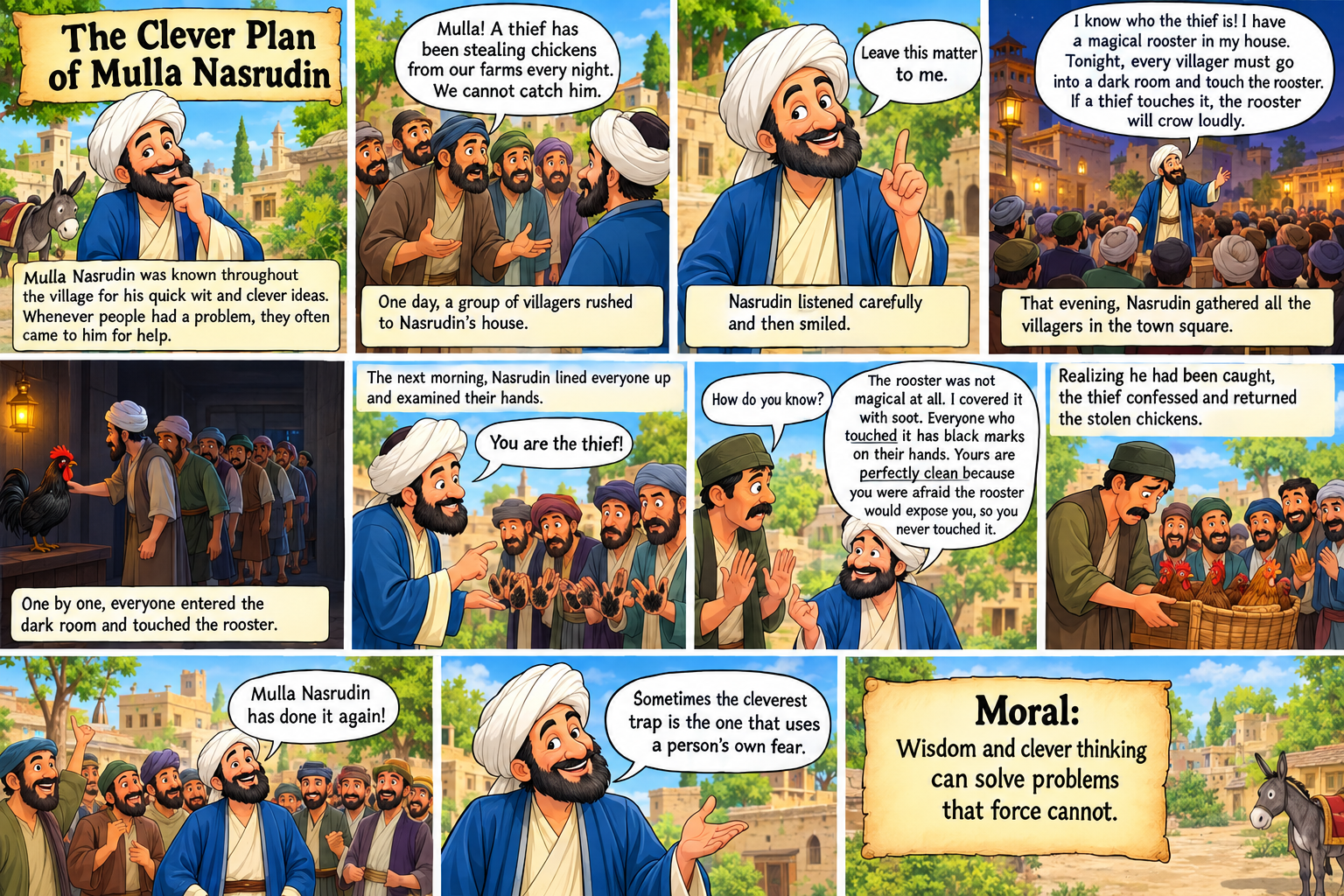
    Mulla Nasrudin was known throughout the village for his quick wit and clever ideas. Whenever people had a problem, they often came to him for help.
    One day, a group of villagers rushed to Nasrudin's house.
    “Mulla!” they cried. “A thief has been stealing chickens from our farms every night. We cannot catch him.”
    Nasrudin listened carefully and then smiled.
    “Leave this matter to me,” he said.
    That evening, Nasrudin gathered all the villagers in the town square.
    “I know who the thief is,” he announced. “I have a magical rooster in my house. Tonight, every villager must go into a dark room and touch the rooster. If a thief touches it, the rooster will crow loudly.”
    The villagers were amazed. One by one, everyone entered the dark room and touched the rooster.
    The next morning, Nasrudin lined everyone up and examined their hands.
    Suddenly, he pointed at one man.
    “You are the thief!”
    The man looked shocked. “How do you know?”
    Nasrudin laughed.
    “The rooster was not magical at all. I covered it with soot. Everyone who touched it has black marks on their hands. Yours are perfectly clean because you were afraid the rooster would expose you, so you never touched it.”
    Realizing he had been caught, the thief confessed and returned the stolen chickens.
    The villagers cheered.
    “Mulla Nasrudin has done it again!” they said.
    Nasrudin smiled and replied, “Sometimes the cleverest trap is the one that uses a person's own fear.”
    **Moral:** Wisdom and clever thinking can solve problems that force cannot. See less
    Shared
    Day 12 story post Roll no:10 foundation level Mulla Nasrudin was known throughout the village for his quick wit and clever ideas. Whenever people had a problem, they often came to him for help. One day, a group of villagers rushed to Nasrudin's house. “Mulla!” they cried. “A thief has been stealing chickens from our farms every night. We cannot catch him.” Nasrudin listened carefully and then smiled. “Leave this matter to me,” he said. That evening, Nasrudin gathered all the villagers in the town square. “I know who the thief is,” he announced. “I have a magical rooster in my house. Tonight, every villager must go into a dark room and touch the rooster. If a thief touches it, the rooster will crow loudly.” The villagers were amazed. One by one, everyone entered the dark room and touched the rooster. The next morning, Nasrudin lined everyone up and examined their hands. Suddenly, he pointed at one man. “You are the thief!” The man looked shocked. “How do you know?” Nasrudin laughed. “The rooster was not magical at all. I covered it with soot. Everyone who touched it has black marks on their hands. Yours are perfectly clean because you were afraid the rooster would expose you, so you never touched it.” Realizing he had been caught, the thief confessed and returned the stolen chickens. The villagers cheered. “Mulla Nasrudin has done it again!” they said. Nasrudin smiled and replied, “Sometimes the cleverest trap is the one that uses a person's own fear.” **Moral:** Wisdom and clever thinking can solve problems that force cannot. See less Shared
    0 Commenti 1 condivisioni 114 Views
  • RSIF8
    Roll no:17
    Story post no:32
    Topic:Story Post — "Geo's Journey: Mapping the World". Generate an image and post on all platforms.

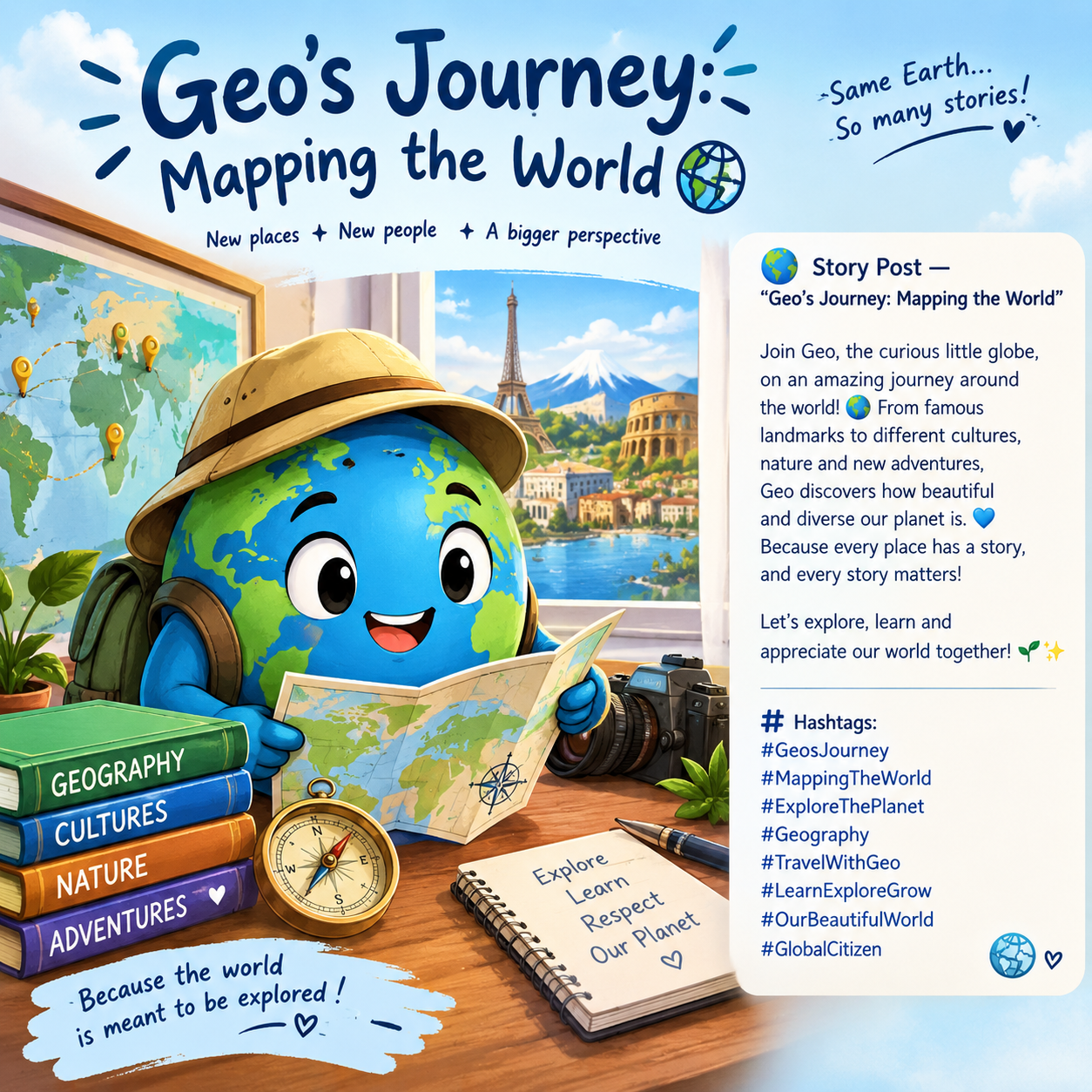
    **Geo’s Journey: Mapping the World!**

    Join Geo on an exciting journey around our amazing planet! From beautiful landmarks and different cultures to fascinating places and natural wonders, every destination has a story to tell.

    Let’s explore, learn, and discover the world together!
    Because every place is special, and every story matters!

    #GeosJourney #MappingTheWorld #ExploreThePlanet #Geography #TravelWithGeo #LearnExploreGrow #OurBeautifulWorld #GlobalCitizen
    RSIF8 Roll no:17 Story post no:32 Topic:Story Post — "Geo's Journey: Mapping the World". Generate an image and post on all platforms. 🌍✨ **Geo’s Journey: Mapping the World!** πŸ—ΊοΈπŸ’™ Join Geo on an exciting journey around our amazing planet! πŸŒŽπŸŽ’ From beautiful landmarks and different cultures to fascinating places and natural wonders, every destination has a story to tell. πŸ”οΈπŸ›οΈπŸŒ΄ Let’s explore, learn, and discover the world together! πŸš€πŸ“šπŸŒ Because every place is special, and every story matters! πŸ’«β€οΈ #GeosJourney #MappingTheWorld #ExploreThePlanet #Geography #TravelWithGeo #LearnExploreGrow #OurBeautifulWorld #GlobalCitizen 🌍✨
    0 Commenti 0 condivisioni 555 Views
  • RSIF8
    ROLL # 108
    TASK 22
    CALL ANNIE #02
    **“Okay” – The Story Behind the World’s Favorite Word**
    Have you ever wondered where the simple word **“Okay”** came from? This short and interesting story explores the surprising history of one of the world’s most widely recognized words.
    The word **“OK”** first appeared in print in 1839 as a humorous abbreviation of **“oll korrect,”** a playful misspelling of “all correct.” It later became even more widely known through the 1840 U.S. presidential campaign of Martin Van Buren, whose nickname was **“Old Kinderhook.”**
    Today, we use **“Okay”** to express agreement, understanding, acceptance, or that everything is fine. From a newspaper joke to everyday conversations around the world, the journey of “Okay” is truly fascinating.
    Watch the video to discover the story behind this little word with a big history
    RSIF8 ROLL # 108 TASK 22 CALL ANNIE #02 **“Okay” – The Story Behind the World’s Favorite Word** Have you ever wondered where the simple word **“Okay”** came from? This short and interesting story explores the surprising history of one of the world’s most widely recognized words. The word **“OK”** first appeared in print in 1839 as a humorous abbreviation of **“oll korrect,”** a playful misspelling of “all correct.” It later became even more widely known through the 1840 U.S. presidential campaign of Martin Van Buren, whose nickname was **“Old Kinderhook.”** Today, we use **“Okay”** to express agreement, understanding, acceptance, or that everything is fine. From a newspaper joke to everyday conversations around the world, the journey of “Okay” is truly fascinating. Watch the video to discover the story behind this little word with a big history
    0 Commenti 0 condivisioni 182 Views 9
  • RSIF8
    Roll no: 99
    Story post no: 26
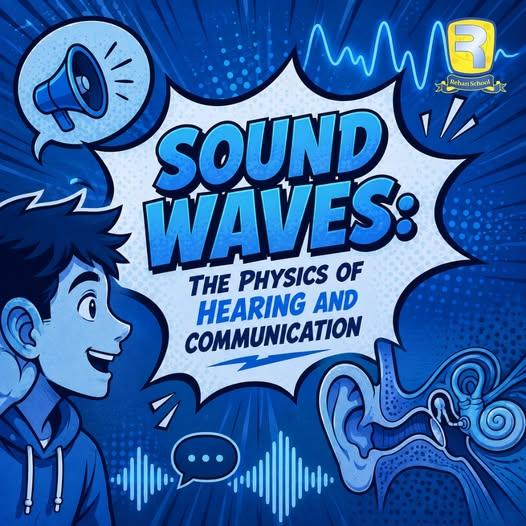
    Story topic: Sound Waves: The Physics of Hearing and Communication
    Sound waves are vibrations that travel through a medium such as air, water, or solids. These waves allow us to hear everything from music and speech to the sounds of nature and our surroundings.
    Our ears play an amazing role in converting these vibrations into signals that the brain can understand. From the vibration of the eardrum to the movement of tiny structures inside the ear, physics and biology work together to make hearing and communication possible.
    #SoundWaves #Physics #Hearing #Communication #Science #PhysicsEducation #Waves #Acoustics #LearnScience #Education
    RSIF8 Roll no: 99 Story post no: 26 Story topic: Sound Waves: The Physics of Hearing and Communication Sound waves are vibrations that travel through a medium such as air, water, or solids. These waves allow us to hear everything from music and speech to the sounds of nature and our surroundings. Our ears play an amazing role in converting these vibrations into signals that the brain can understand. From the vibration of the eardrum to the movement of tiny structures inside the ear, physics and biology work together to make hearing and communication possible. #SoundWaves #Physics #Hearing #Communication #Science #PhysicsEducation #Waves #Acoustics #LearnScience #Education
    0 Commenti 0 condivisioni 266 Views
  • RSIF8
    Roll no: 99
    Story post no: 25
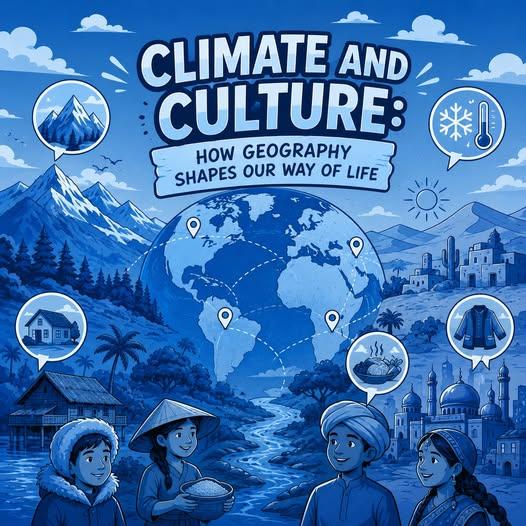
    Story topic: Climate and Culture: How Geography Shapes Our Way of Life
    Climate and geography have a powerful influence on how people live, work, and build communities. From the clothes we wear and the food we eat to the homes we build and the activities we enjoy, our surroundings often shape our everyday lives.
    Different regions develop unique cultures as people adapt to their environments. Mountains, deserts, rivers, coastlines, and changing climates all contribute to the traditions, lifestyles, and ways of living that make communities around the world so diverse.
    #Climate #Geography #Culture #Environment #HumanGeography #Science #GeographyEducation #ClimateScience #LearnScience #Education
    RSIF8 Roll no: 99 Story post no: 25 Story topic: Climate and Culture: How Geography Shapes Our Way of Life Climate and geography have a powerful influence on how people live, work, and build communities. From the clothes we wear and the food we eat to the homes we build and the activities we enjoy, our surroundings often shape our everyday lives. Different regions develop unique cultures as people adapt to their environments. Mountains, deserts, rivers, coastlines, and changing climates all contribute to the traditions, lifestyles, and ways of living that make communities around the world so diverse. #Climate #Geography #Culture #Environment #HumanGeography #Science #GeographyEducation #ClimateScience #LearnScience #Education
    0 Commenti 0 condivisioni 234 Views
  • **“Be yourself; everyone else is already taken.” — Oscar Wilde**

    In a world where people often compare themselves to others, this quote reminds us of something truly powerful: **you don’t need to become someone else to be valuable.**

    Your personality, your dreams, your journey, your strengths, and even the things that make you different are part of what makes you **uniquely you.** Don’t spend your life trying to fit into someone else’s expectations. Instead, focus on becoming the best version of yourself.

    There will always be people who are more successful, more popular, or different from you—but their journey is not your journey. ‍ Your path has its own purpose, and your story deserves to be written in your own way.

    Be confident in who you are.
    Stay true to your values.
    Keep learning and growing.
    And never be afraid to stand out.

    **You were not created to be a copy. You were created to be yourself.** ‍

    Believe in yourself, embrace your uniqueness, and keep moving forward.
    ✨ **“Be yourself; everyone else is already taken.” — Oscar Wilde** ✨ In a world where people often compare themselves to others, this quote reminds us of something truly powerful: **you don’t need to become someone else to be valuable.** 🌟 Your personality, your dreams, your journey, your strengths, and even the things that make you different are part of what makes you **uniquely you.** πŸ’« Don’t spend your life trying to fit into someone else’s expectations. Instead, focus on becoming the best version of yourself. 🌱 There will always be people who are more successful, more popular, or different from you—but their journey is not your journey. 🚢‍β™‚οΈβœ¨ Your path has its own purpose, and your story deserves to be written in your own way. πŸ“–β€οΈ Be confident in who you are. πŸ’ͺ Stay true to your values. 🧭 Keep learning and growing. 🌱 And never be afraid to stand out. 🌟 **You were not created to be a copy. You were created to be yourself.** ❀️‍πŸ”₯ Believe in yourself, embrace your uniqueness, and keep moving forward. πŸš€βœ¨
    0 Commenti 0 condivisioni 268 Views
  • RSIF8
    Roll no: 99
    Story post no: 24
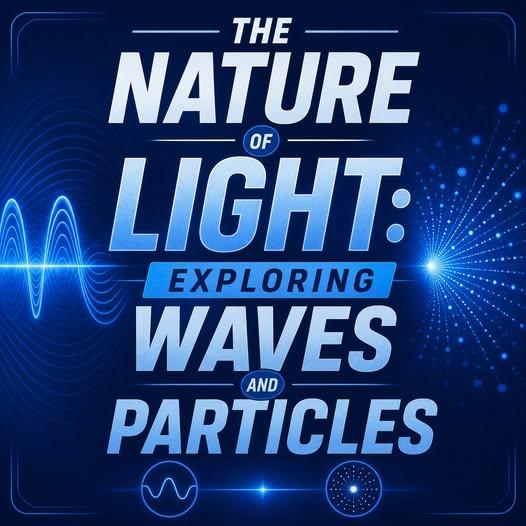
    Story topic: The Nature of Light: Exploring Waves and Particles
    Light is one of the most fascinating phenomena in physics. It allows us to see the world around us, carries energy across vast distances, and plays a fundamental role in technologies ranging from cameras to fiber-optic communication.
    One of the most remarkable discoveries in modern physics is that light can behave both as a wave and as a particle. Its wave nature explains phenomena such as interference, diffraction, and polarization, while its particle nature is described through photons, which carry discrete amounts of energy.
    Understanding the dual nature of light helps us explore the deeper principles of quantum physics and reveals how the same phenomenon can behave in different ways depending on how it is observed.
    #NatureOfLight #Physics #Light #WaveParticleDuality #QuantumPhysics #Photon #ScienceEducation #PhysicsEducation #STEM #LearnPhysics #Education
    RSIF8 Roll no: 99 Story post no: 24 Story topic: The Nature of Light: Exploring Waves and Particles Light is one of the most fascinating phenomena in physics. It allows us to see the world around us, carries energy across vast distances, and plays a fundamental role in technologies ranging from cameras to fiber-optic communication. One of the most remarkable discoveries in modern physics is that light can behave both as a wave and as a particle. Its wave nature explains phenomena such as interference, diffraction, and polarization, while its particle nature is described through photons, which carry discrete amounts of energy. Understanding the dual nature of light helps us explore the deeper principles of quantum physics and reveals how the same phenomenon can behave in different ways depending on how it is observed. #NatureOfLight #Physics #Light #WaveParticleDuality #QuantumPhysics #Photon #ScienceEducation #PhysicsEducation #STEM #LearnPhysics #Education
    0 Commenti 0 condivisioni 305 Views
  • RSIF8
    Roll no: 99
    Story post no: 23
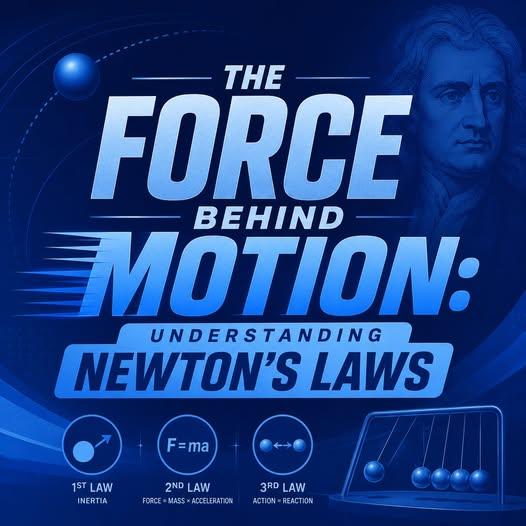
    Story topic: The Force Behind Motion: Understanding Newton's Laws
    Newton’s laws of motion form the foundation of classical mechanics and help us understand how forces affect the movement of objects. From a moving car to a falling object, these laws explain motion in everyday life and across the universe.
    The First Law introduces inertia, explaining that an object remains at rest or in motion unless acted upon by an external force. The Second Law connects force, mass, and acceleration through the equation F = ma. The Third Law states that every action has an equal and opposite reaction.
    Together, Newton’s laws provide a powerful framework for understanding motion and show how simple principles can explain complex physical phenomena.
    #NewtonLaws #Physics #Newton #Motion #Force #ClassicalMechanics #ScienceEducation #PhysicsEducation #STEM #LearnPhysics #Education
    RSIF8 Roll no: 99 Story post no: 23 Story topic: The Force Behind Motion: Understanding Newton's Laws Newton’s laws of motion form the foundation of classical mechanics and help us understand how forces affect the movement of objects. From a moving car to a falling object, these laws explain motion in everyday life and across the universe. The First Law introduces inertia, explaining that an object remains at rest or in motion unless acted upon by an external force. The Second Law connects force, mass, and acceleration through the equation F = ma. The Third Law states that every action has an equal and opposite reaction. Together, Newton’s laws provide a powerful framework for understanding motion and show how simple principles can explain complex physical phenomena. #NewtonLaws #Physics #Newton #Motion #Force #ClassicalMechanics #ScienceEducation #PhysicsEducation #STEM #LearnPhysics #Education
    0 Commenti 0 condivisioni 311 Views
  • RSIF8
    Roll no: 99
    Story post no: 22
    Story topic: The Ethics and Education of Animal Dissections
    Animal dissections have long been used in biology education to help students understand anatomy and the functions of different body systems. They provide an opportunity to observe biological structures directly and connect theoretical knowledge with practical learning.
    However, dissections also raise important ethical questions about animal welfare, respect for living organisms, and the responsible use of animals in education. Modern biology education encourages students to consider these ethical responsibilities while exploring alternative methods such as digital simulations and models.
    By balancing scientific learning with ethical awareness, we can develop a deeper understanding of both biology and our responsibility toward living organisms.
    #AnimalDissection #Biology #Anatomy #AnimalEthics #LifeScience #ScienceEducation #BiologyEducation #STEM #LearnBiology #Education
    RSIF8 Roll no: 99 Story post no: 22 Story topic: The Ethics and Education of Animal Dissections Animal dissections have long been used in biology education to help students understand anatomy and the functions of different body systems. They provide an opportunity to observe biological structures directly and connect theoretical knowledge with practical learning. However, dissections also raise important ethical questions about animal welfare, respect for living organisms, and the responsible use of animals in education. Modern biology education encourages students to consider these ethical responsibilities while exploring alternative methods such as digital simulations and models. By balancing scientific learning with ethical awareness, we can develop a deeper understanding of both biology and our responsibility toward living organisms. #AnimalDissection #Biology #Anatomy #AnimalEthics #LifeScience #ScienceEducation #BiologyEducation #STEM #LearnBiology #Education
    0 Commenti 0 condivisioni 302 Views
  • RSIF8
    Roll no: 99
    Story post no: 21
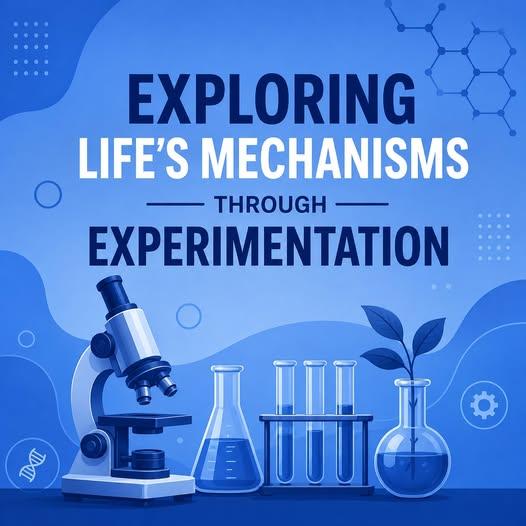
    Story topic: Exploring Life's Mechanisms Through Experimentation
    Experimentation is an essential part of biology that helps us understand how living organisms function. By conducting experiments, scientists can observe biological processes, test ideas, and discover how different systems interact with one another.
    From studying cells and enzymes to observing plant growth and biological reactions, experiments allow us to explore the mechanisms that make life possible. Through careful observation and investigation, we can turn questions into knowledge and gain a deeper appreciation for the complexity of living systems.
    #BiologyExperiments #Biology #LifeScience #Science #Experimentation #BiologyEducation #STEM #LearnBiology #ScienceEducation #Education
    RSIF8 Roll no: 99 Story post no: 21 Story topic: Exploring Life's Mechanisms Through Experimentation Experimentation is an essential part of biology that helps us understand how living organisms function. By conducting experiments, scientists can observe biological processes, test ideas, and discover how different systems interact with one another. From studying cells and enzymes to observing plant growth and biological reactions, experiments allow us to explore the mechanisms that make life possible. Through careful observation and investigation, we can turn questions into knowledge and gain a deeper appreciation for the complexity of living systems. #BiologyExperiments #Biology #LifeScience #Science #Experimentation #BiologyEducation #STEM #LearnBiology #ScienceEducation #Education
    0 Commenti 0 condivisioni 201 Views
Pagine in Evidenza