• #rsisb
    Roll no.231
    story post no.98
    FOundation Level
    ### The Photosynthesis Factory: How Plants Make Food
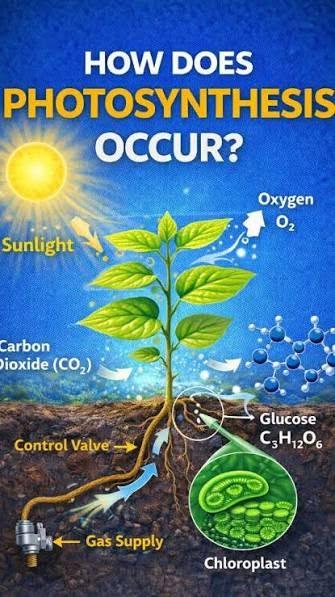
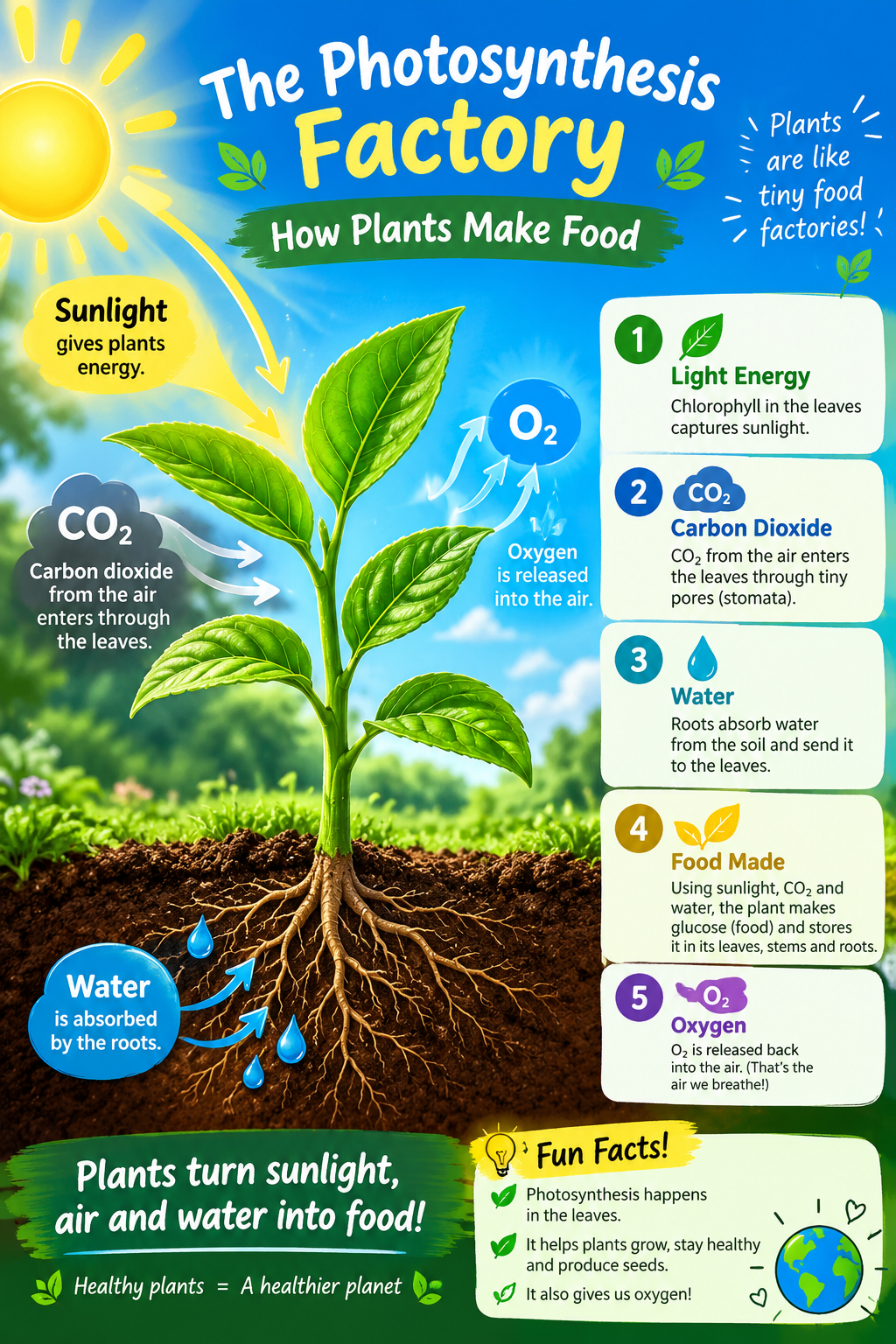
    Imagine every green plant has a tiny **food factory** inside its leaves! This amazing process is called **photosynthesis**. Plants use **sunlight, water, and carbon dioxide** to produce glucose, a type of sugar that provides stored chemical energy for growth and survival.
    ๎ˆ€genui๎ˆ‚{"learning_viz":{"type_id":"PHOTOSYNTHESIS","initial_values":{"lightIntensity":"high","carbonDioxide":"medium","water":"medium"}}}๎ˆ
    The process mainly takes place in structures called **chloroplasts**, which contain the green pigment **chlorophyll**. Chlorophyll absorbs light energy from the Sun.
    Plants take in **carbon dioxide** from the air through tiny openings in their leaves called **stomata**, while their roots absorb **water** from the soil. These ingredients are used to make glucose, and **oxygen is released** into the atmosphere.
    Photosynthesis is essential for life because plants provide food and release much of the oxygen that living organisms depend on.
    #Photosynthesis #PlantScience #Biology #Chlorophyll #Plants #Science #Nature #Learning #Education #PhotosynthesisFactory
    Asma Shaheen EducationWali
    Saima Empowerment Wali
    Irum Asim Leadershipwali
    #rsisb Roll no.231 story post no.98 FOundation Level ### ๐ŸŒฑโ˜€๏ธ The Photosynthesis Factory: How Plants Make Food Imagine every green plant has a tiny **food factory** inside its leaves! ๐Ÿญ๐ŸŒฟ This amazing process is called **photosynthesis**. Plants use **sunlight, water, and carbon dioxide** to produce glucose, a type of sugar that provides stored chemical energy for growth and survival. โ˜€๏ธ๐Ÿ’ง๐ŸŒฌ๏ธ ๎ˆ€genui๎ˆ‚{"learning_viz":{"type_id":"PHOTOSYNTHESIS","initial_values":{"lightIntensity":"high","carbonDioxide":"medium","water":"medium"}}}๎ˆ The process mainly takes place in structures called **chloroplasts**, which contain the green pigment **chlorophyll**. Chlorophyll absorbs light energy from the Sun. ๐ŸŒž๐Ÿƒ Plants take in **carbon dioxide** from the air through tiny openings in their leaves called **stomata**, while their roots absorb **water** from the soil. These ingredients are used to make glucose, and **oxygen is released** into the atmosphere. ๐ŸŒ๐Ÿ’š Photosynthesis is essential for life because plants provide food and release much of the oxygen that living organisms depend on. ๐ŸŒฑ๐Ÿซโœจ #Photosynthesis #PlantScience #Biology #Chlorophyll #Plants #Science #Nature #Learning #Education #PhotosynthesisFactory ๐ŸŒฟ๐Ÿ”ฌโ˜€๏ธ Asma Shaheen EducationWali Saima Empowerment Wali Irum Asim Leadershipwali
    0 Comments 0 Shares 475 Views
  • #rsisb
    Roll no. 247
    Story post . 25
    Foundation level

    **The Photosynthesis Factory: How Plants Make Food **

    Welcome to the amazing world of plants! Have you ever wondered how plants make their own food without going to a kitchen or a grocery store? The answer is **PHOTOSYNTHESIS!**

    Imagine every green plant as a tiny natural food factory! The leaves work like solar-powered machines, using sunlight , water , and carbon dioxide (COโ‚‚) from the air to produce glucose, a type of sugar that provides energy for the plant. During this amazing process, plants also release oxygen (Oโ‚‚) into the air, which humans and many other living things need to breathe!

    **How Does the Photosynthesis Factory Work?**

    **Step 1: Sunlight — The Power Source!**
    Sunlight provides the energy plants need to make their food.

    **Step 2: Water — The Essential Ingredient!**
    Plants absorb water from the soil through their roots.

    **Step 3: Carbon Dioxide — From the Air!**
    Plants take in carbon dioxide through tiny openings in their leaves called stomata.

    **Step 4: Chlorophyll — The Green Magic!**
    Chlorophyll is the green pigment in leaves that absorbs light energy.

    **Step 5: Making Food!**
    Using light energy, plants turn water and carbon dioxide into glucose, which they use for energy and growth. They also release oxygen!

    **Why Is Photosynthesis Important?**

    Plants provide food for people and animals.
    They release oxygen that supports life on Earth.
    They help remove carbon dioxide from the atmosphere.
    They support food chains and healthy ecosystems.
    They help keep our planet green, beautiful, and full of life!

    Isn't nature incredible? Every green leaf is part of a wonderful living factory that helps support life on Earth. The next time you see a tree, a flower, or a little green plant, remember the amazing science happening inside its leaves!

    **Today's Science Fact:** Photosynthesis shows us how plants use sunlight to make their own food and help sustain life on our planet!

    **Protect plants, grow more trees, save nature, and keep our planet green!** Every plant matters!

    Like , Share , and Comment : What is your favorite plant, and why do you love it?

    #Photosynthesis #PhotosynthesisFactory #HowPlantsMakeFood #PlantScience #ScienceForKids #LearnScience #Biology #NatureLovers #GreenPlanet #PlantLife #ScienceEducation #AmazingNature #SaveTrees #ProtectNature #EnvironmentalAwareness #STEMEducation #EducationalPost #DiscoverScience #GreenEarth #KeepLearning
    #rsisb Roll no. 247 Story post . 25 Foundation level ๐ŸŒฟ๐Ÿญ **The Photosynthesis Factory: How Plants Make Food ๐ŸŒฑโ˜€๏ธ** ๐ŸŒ๐Ÿ’š Welcome to the amazing world of plants! Have you ever wondered how plants make their own food without going to a kitchen or a grocery store? ๐Ÿค”๐ŸŒฟ The answer is **PHOTOSYNTHESIS!** ๐ŸŒž๐Ÿƒ ๐Ÿญ๐ŸŒฑ Imagine every green plant as a tiny natural food factory! The leaves work like solar-powered machines, using sunlight โ˜€๏ธ, water ๐Ÿ’ง, and carbon dioxide (COโ‚‚) from the air ๐ŸŒฌ๏ธ to produce glucose, a type of sugar that provides energy for the plant. During this amazing process, plants also release oxygen (Oโ‚‚) into the air, which humans and many other living things need to breathe! ๐ŸŒŽ๐Ÿ’š ๐Ÿ”ฌ๐Ÿƒ **How Does the Photosynthesis Factory Work?** โ˜€๏ธ **Step 1: Sunlight — The Power Source!** Sunlight provides the energy plants need to make their food. ๐ŸŒžโšก ๐Ÿ’ง **Step 2: Water — The Essential Ingredient!** Plants absorb water from the soil through their roots. ๐ŸŒฑ๐Ÿ’ฆ ๐ŸŒฌ๏ธ **Step 3: Carbon Dioxide — From the Air!** Plants take in carbon dioxide through tiny openings in their leaves called stomata. ๐Ÿƒ๐Ÿ”ฌ ๐Ÿ’š **Step 4: Chlorophyll — The Green Magic!** Chlorophyll is the green pigment in leaves that absorbs light energy. ๐ŸŒฟโœจ ๐Ÿฌ **Step 5: Making Food!** Using light energy, plants turn water and carbon dioxide into glucose, which they use for energy and growth. They also release oxygen! ๐ŸŒฑ๐Ÿฌ๐Ÿ’จ ๐ŸŒŽ๐Ÿ’š **Why Is Photosynthesis Important?** ๐ŸŒณ Plants provide food for people and animals. ๐Ÿ’จ They release oxygen that supports life on Earth. ๐ŸŒ They help remove carbon dioxide from the atmosphere. ๐ŸŽ They support food chains and healthy ecosystems. ๐ŸŒฟ They help keep our planet green, beautiful, and full of life! ๐Ÿคฉ๐ŸŒฑ Isn't nature incredible? Every green leaf is part of a wonderful living factory that helps support life on Earth. The next time you see a tree, a flower, or a little green plant, remember the amazing science happening inside its leaves! ๐ŸŒณ๐Ÿ”ฌโ˜€๏ธ ๐Ÿ’ก **Today's Science Fact:** Photosynthesis shows us how plants use sunlight to make their own food and help sustain life on our planet! ๐ŸŒฑ๐Ÿ’š **Protect plants, grow more trees, save nature, and keep our planet green!** ๐ŸŒ๐ŸŒณ Every plant matters! ๐Ÿ“ข Like ๐Ÿ‘, Share ๐Ÿ”„, and Comment ๐Ÿ’ฌ: What is your favorite plant, and why do you love it? ๐ŸŒป๐ŸŒต๐ŸŒน #Photosynthesis #PhotosynthesisFactory #HowPlantsMakeFood #PlantScience #ScienceForKids #LearnScience #Biology #NatureLovers #GreenPlanet #PlantLife #ScienceEducation #AmazingNature #SaveTrees #ProtectNature #EnvironmentalAwareness #STEMEducation #EducationalPost #DiscoverScience #GreenEarth #KeepLearning ๐ŸŒฟ๐ŸŒ๐Ÿ”ฌโ˜€๏ธ๐Ÿ’š
    0 Comments 0 Shares 4188 Views
  • #rsisb
    Roll no 248
    Foundation level
    Story post no 40
    **The Photosynthesis Factory: How Plants Make Food! **

    Have you ever wondered how plants make their own food? Welcome to the amazing Photosynthesis Factory!

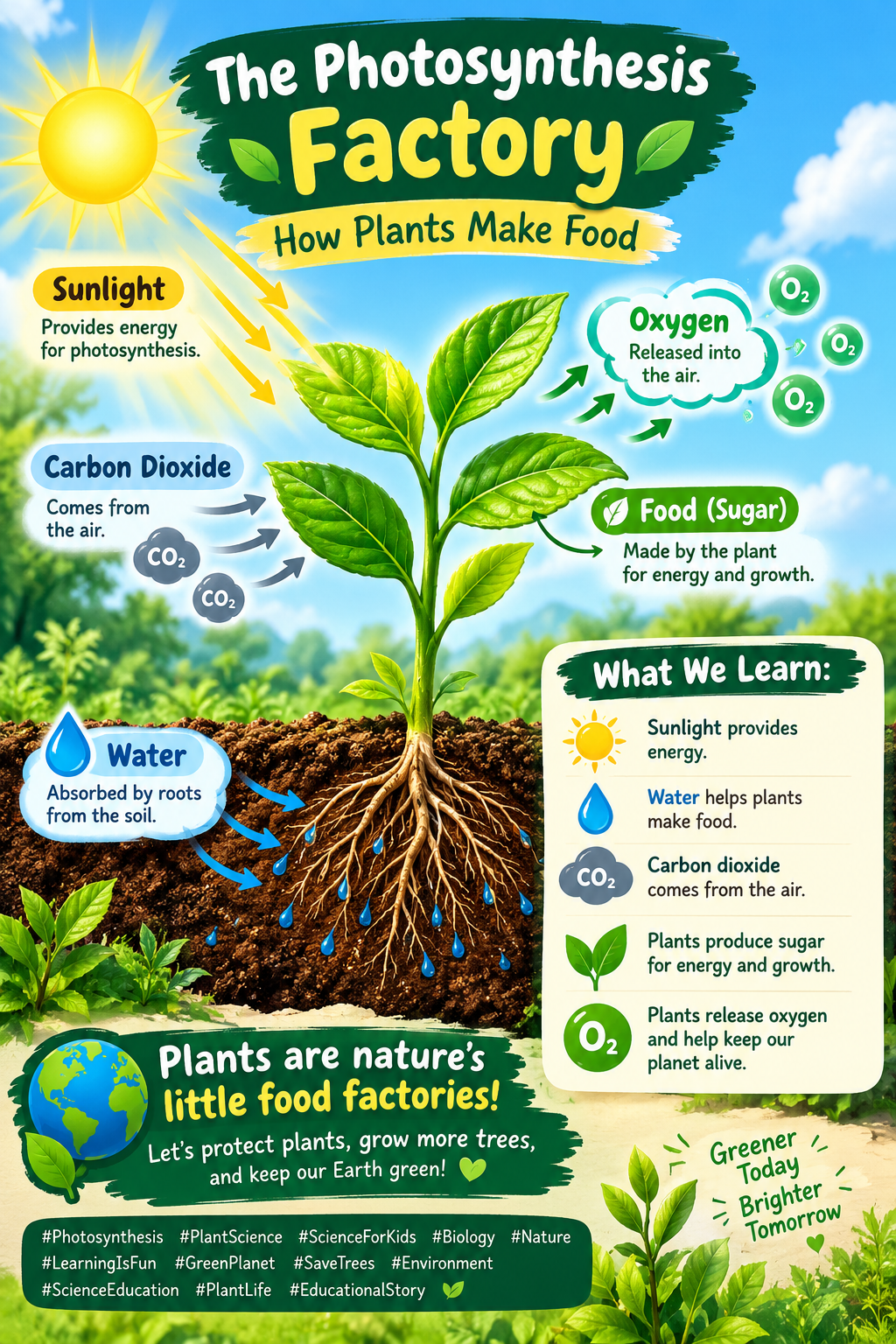
    Plants use sunlight , water , and carbon dioxide to make their own food through a process called **photosynthesis**. During this amazing process, plants release oxygen ๐Ÿซง, which humans and animals need to breathe!

    **What can we learn?**
    Sunlight provides energy.
    Water helps plants make food.
    Carbon dioxide comes from the air.
    Plants produce sugar for energy and growth.
    Plants release oxygen and help keep our planet alive.

    **Remember:** Plants are nature's little food factories! Let's protect plants, grow more trees, and keep our Earth green!

    #Photosynthesis #PlantScience #ScienceForKids #Biology #Nature #LearningIsFun #GreenPlanet #SaveTrees #Environment #ScienceEducation #PlantLife #EducationalStory
    #rsisb Roll no 248 Foundation level Story post no 40 ๐ŸŒฟ๐Ÿญ **The Photosynthesis Factory: How Plants Make Food! โ˜€๏ธ๐ŸŒฑ** Have you ever wondered how plants make their own food? ๐Ÿค”๐ŸŒฟ Welcome to the amazing Photosynthesis Factory! ๐Ÿญ๐ŸŒฑ Plants use sunlight โ˜€๏ธ, water ๐Ÿ’ง, and carbon dioxide ๐ŸŒฌ๏ธ to make their own food through a process called **photosynthesis**. During this amazing process, plants release oxygen ๐Ÿซง, which humans and animals need to breathe! ๐ŸŒ๐Ÿ’š ๐Ÿƒ **What can we learn?** โœจ Sunlight provides energy. ๐Ÿ’ง Water helps plants make food. ๐ŸŒฌ๏ธ Carbon dioxide comes from the air. ๐Ÿฌ Plants produce sugar for energy and growth. ๐Ÿ’š Plants release oxygen and help keep our planet alive. ๐ŸŒŽ **Remember:** Plants are nature's little food factories! Let's protect plants, grow more trees, and keep our Earth green! ๐ŸŒณ๐Ÿ’š #Photosynthesis #PlantScience #ScienceForKids #Biology #Nature #LearningIsFun #GreenPlanet #SaveTrees #Environment #ScienceEducation #PlantLife #EducationalStory ๐ŸŒฟ๐ŸŒฑโ˜€๏ธ๐Ÿ’š
    0 Comments 0 Shares 1514 Views
  • #rsisb
    roll no. 247
    Documentary no. 4
    Foundation level

    **The Photosynthesis Factory: How Plants Make Food**

    Have you ever wondered how plants make their own food without going to a kitchen or eating like humans? Nature has its own amazing food factory, and it works inside the green leaves of plants! In this documentary, **“The Photosynthesis Factory: How Plants Make Food,”** we will explore the fascinating scientific process called *photosynthesis* and discover how plants use sunlight, water, and carbon dioxide to produce their food.

    **What Is Photosynthesis?**

    Photosynthesis is the natural process through which green plants make their own food using energy from sunlight. Plants absorb water from the soil through their roots, take in carbon dioxide from the air through tiny openings in their leaves called stomata, and capture sunlight with the help of a green pigment called chlorophyll.

    These ingredients work together to produce glucose, a type of sugar that provides food and energy for the plant. Oxygen is also released into the atmosphere, helping support life on Earth! Isn't that amazing?

    **Inside the Photosynthesis Factory!**

    Imagine every green leaf as a tiny natural factory! Inside plant cells are special structures called chloroplasts,
    #rsisb roll no. 247 Documentary no. 4 Foundation level ๐ŸŒฟ๐ŸŒž **The Photosynthesis Factory: How Plants Make Food** ๐ŸŒฑ๐ŸŽฌ ๐ŸŒ๐Ÿ’š Have you ever wondered how plants make their own food without going to a kitchen or eating like humans? ๐Ÿƒ๐Ÿค” Nature has its own amazing food factory, and it works inside the green leaves of plants! ๐ŸŒฑโœจ In this documentary, **“The Photosynthesis Factory: How Plants Make Food,”** we will explore the fascinating scientific process called *photosynthesis* and discover how plants use sunlight, water, and carbon dioxide to produce their food. โ˜€๏ธ๐Ÿ’ง๐ŸŒฌ๏ธ ๐ŸŒž **What Is Photosynthesis?** ๐ŸŒฟ Photosynthesis is the natural process through which green plants make their own food using energy from sunlight. ๐ŸŒฑโ˜€๏ธ Plants absorb water from the soil through their roots, take in carbon dioxide from the air through tiny openings in their leaves called stomata, and capture sunlight with the help of a green pigment called chlorophyll. ๐Ÿƒ๐Ÿ’š These ingredients work together to produce glucose, a type of sugar that provides food and energy for the plant. Oxygen is also released into the atmosphere, helping support life on Earth! ๐ŸŒ๐Ÿ’จ Isn't that amazing? ๐Ÿคฉ ๐Ÿญ **Inside the Photosynthesis Factory!** ๐Ÿ”ฌ Imagine every green leaf as a tiny natural factory! ๐ŸŒฟ๐Ÿญ Inside plant cells are special structures called chloroplasts,
    0 Comments 0 Shares 926 Views
  • **Roll No: 2**
    **Batch: 14**
    **Book: ACCL**
    **Task No: 104**

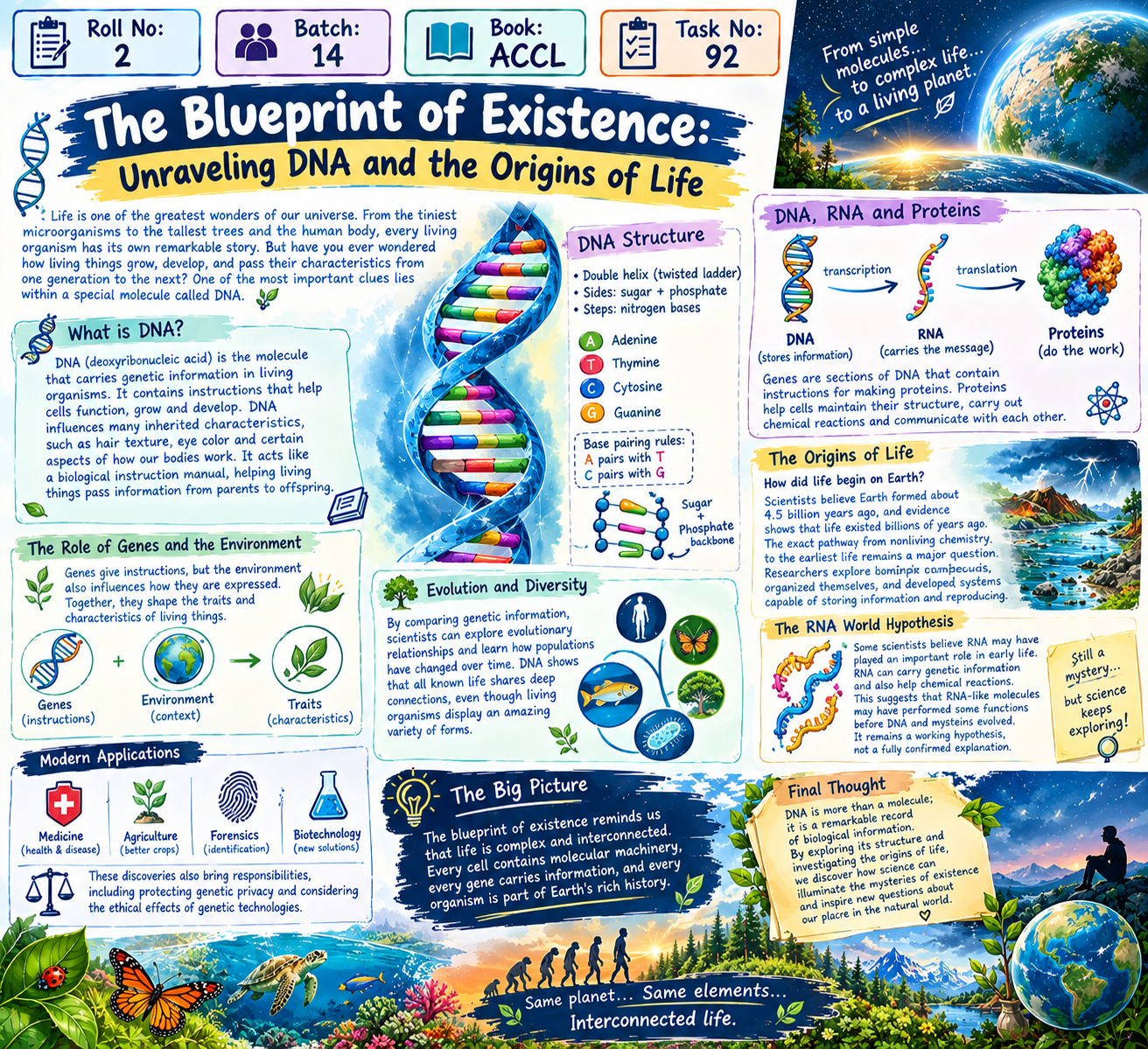
    # The Blueprint of Existence: Unraveling DNA and the Origins of Life

    Life is one of the greatest wonders of our universe. From the tiniest microorganisms to the tallest trees and the human body, every living organism has its own remarkable story. But have you ever wondered how living things grow, develop, and pass their characteristics from one generation to the next? One of the most important clues lies within a special molecule called **DNA**.

    **DNA, or deoxyribonucleic acid, is the molecule that carries genetic information in living organisms.** It contains instructions that help cells function, grow, and develop. DNA influences many inherited characteristics, such as natural hair texture, eye color, and certain aspects of how our bodies work. It acts like a biological instruction manual, helping living things pass information from parents to offspring.

    The structure of DNA is fascinating. It resembles a twisted ladder called a **double helix**. Its sides are made of sugar and phosphate molecules, while its steps contain pairs of chemical bases: adenine, thymine, cytosine, and guanine. These bases follow specific pairing rules: adenine pairs with thymine, while cytosine pairs with guanine. The order of these bases stores genetic information in a form that cells can use.

    DNA works closely with other molecules inside cells. Sections of DNA called **genes** contain instructions for making functional products, often proteins. Proteins perform countless important jobs, including helping cells maintain their structure, carry out chemical reactions, and communicate with one another. This relationship between DNA, RNA, and proteins is a central part of modern biology.

    But how did life begin on Earth? Scientists believe that Earth formed about 4.5 billion years ago, and evidence indicates that life existed billions of years ago. However, the exact pathway through which nonliving chemistry gave rise to the earliest life remains an important scientific question. Researchers investigate how simple molecules might have formed more complex compounds, how these compounds could have organized themselves, and how early systems capable of storing information and reproducing might have developed.

    One area of research explores the possibility that **RNA played an important role in early life**. RNA can carry genetic information, and certain RNA molecules can also help chemical reactions occur. This has led to the RNA-world hypothesis, which suggests that RNA-like molecules may have performed some functions before modern DNA-and-protein systems evolved. It remains an active scientific hypothesis, not a fully confirmed explanation of life's origin.

    The study of DNA also helps scientists understand the diversity of life. By comparing genetic information from different organisms, researchers can investigate evolutionary relationships and learn how populations have changed over generations. DNA evidence supports the scientific understanding that all known life shares deep connections through evolution, even though living organisms display an extraordinary variety of forms.

    Modern DNA research has transformed medicine, agriculture, forensics, and biotechnology. Scientists can study genetic variations, investigate inherited conditions, identify organisms, improve crops, and develop new research methods. These discoveries also bring important responsibilities, including protecting genetic privacy and considering the ethical effects of genetic technologies.

    The blueprint of existence reminds us that life is both complex and interconnected. Every cell contains molecular machinery, every gene carries information, and every organism is part of Earth's rich history. Although many questions about the earliest beginnings of life remain unanswered, careful experiments, observations, and discoveries continue to expand our understanding.

    **DNA is more than a molecule; it is a remarkable record of biological information. By exploring its structure and investigating the origins of life, we discover how science can illuminate the mysteries of existence and inspire new questions about our place in the natural world. **

    \#DNA #OriginsOfLife #Biology #Genetics #Science #Evolution #ACCL #Batch14 #Task92
    **Roll No: 2** **Batch: 14** **Book: ACCL** **Task No: 104** # ๐Ÿงฌ๐ŸŒ The Blueprint of Existence: Unraveling DNA and the Origins of Life ๐Ÿ”ฌโœจ Life is one of the greatest wonders of our universe. From the tiniest microorganisms to the tallest trees and the human body, every living organism has its own remarkable story. ๐ŸŒฑ๐Ÿฆ ๐ŸŒณ But have you ever wondered how living things grow, develop, and pass their characteristics from one generation to the next? One of the most important clues lies within a special molecule called **DNA**. **DNA, or deoxyribonucleic acid, is the molecule that carries genetic information in living organisms.** ๐Ÿงฌ It contains instructions that help cells function, grow, and develop. DNA influences many inherited characteristics, such as natural hair texture, eye color, and certain aspects of how our bodies work. It acts like a biological instruction manual, helping living things pass information from parents to offspring. ๐Ÿ“–๐Ÿ”ฌ The structure of DNA is fascinating. It resembles a twisted ladder called a **double helix**. ๐ŸŒ€ Its sides are made of sugar and phosphate molecules, while its steps contain pairs of chemical bases: adenine, thymine, cytosine, and guanine. These bases follow specific pairing rules: adenine pairs with thymine, while cytosine pairs with guanine. The order of these bases stores genetic information in a form that cells can use. DNA works closely with other molecules inside cells. ๐Ÿงช Sections of DNA called **genes** contain instructions for making functional products, often proteins. Proteins perform countless important jobs, including helping cells maintain their structure, carry out chemical reactions, and communicate with one another. This relationship between DNA, RNA, and proteins is a central part of modern biology. โš™๏ธ๐Ÿงซ But how did life begin on Earth? ๐ŸŒŽ Scientists believe that Earth formed about 4.5 billion years ago, and evidence indicates that life existed billions of years ago. However, the exact pathway through which nonliving chemistry gave rise to the earliest life remains an important scientific question. Researchers investigate how simple molecules might have formed more complex compounds, how these compounds could have organized themselves, and how early systems capable of storing information and reproducing might have developed. ๐Ÿ”ญ๐Ÿงช One area of research explores the possibility that **RNA played an important role in early life**. RNA can carry genetic information, and certain RNA molecules can also help chemical reactions occur. This has led to the RNA-world hypothesis, which suggests that RNA-like molecules may have performed some functions before modern DNA-and-protein systems evolved. It remains an active scientific hypothesis, not a fully confirmed explanation of life's origin. ๐Ÿงฌ๐Ÿ’ก The study of DNA also helps scientists understand the diversity of life. ๐ŸŒฟ๐Ÿฆ๐Ÿฆ‹ By comparing genetic information from different organisms, researchers can investigate evolutionary relationships and learn how populations have changed over generations. DNA evidence supports the scientific understanding that all known life shares deep connections through evolution, even though living organisms display an extraordinary variety of forms. Modern DNA research has transformed medicine, agriculture, forensics, and biotechnology. ๐Ÿฅ๐ŸŒพ Scientists can study genetic variations, investigate inherited conditions, identify organisms, improve crops, and develop new research methods. These discoveries also bring important responsibilities, including protecting genetic privacy and considering the ethical effects of genetic technologies. โš–๏ธ๐Ÿ”ฌ The blueprint of existence reminds us that life is both complex and interconnected. Every cell contains molecular machinery, every gene carries information, and every organism is part of Earth's rich history. Although many questions about the earliest beginnings of life remain unanswered, careful experiments, observations, and discoveries continue to expand our understanding. ๐ŸŒŒ๐Ÿ“š **DNA is more than a molecule; it is a remarkable record of biological information. By exploring its structure and investigating the origins of life, we discover how science can illuminate the mysteries of existence and inspire new questions about our place in the natural world. ๐Ÿงฌ๐ŸŒ๐Ÿ’š** \#DNA #OriginsOfLife #Biology #Genetics #Science #Evolution #ACCL #Batch14 #Task92 ๐Ÿ”ฌ๐Ÿงฌโœจ
    0 Comments 0 Shares 3411 Views
  • #rsisb
    Roll no.239
    Story post no.27
    Foundation Level

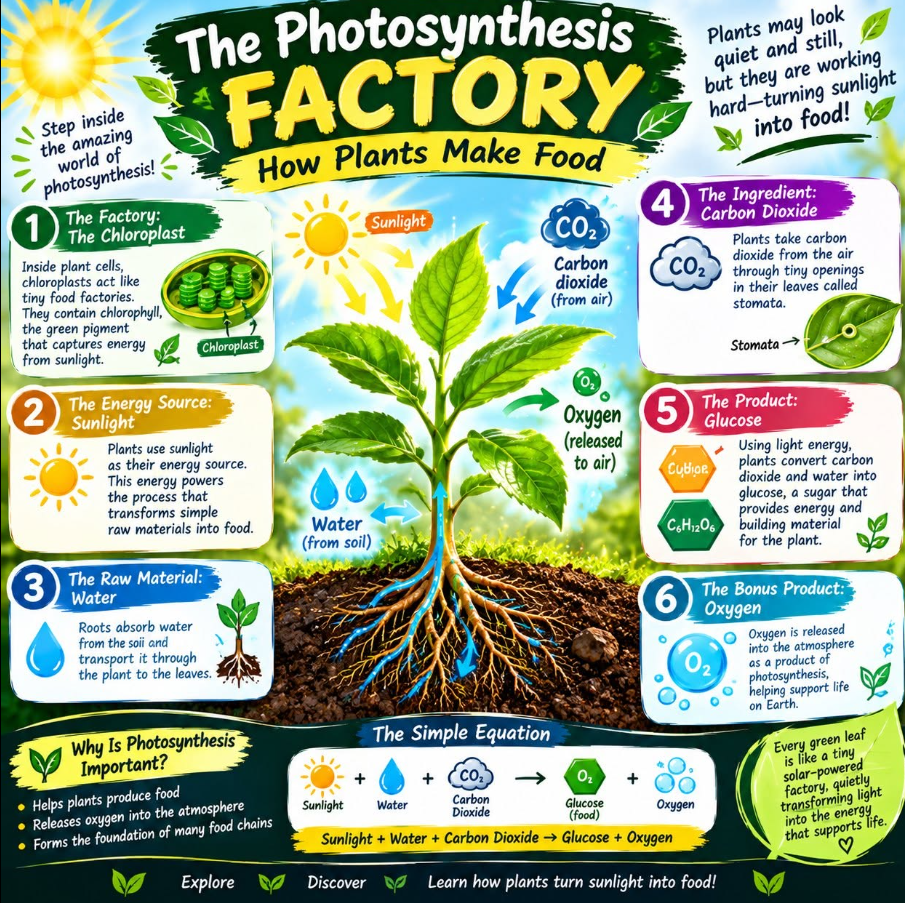
    Have you ever wondered how plants make their own food? Step inside the amazing **Photosynthesis Factory** and discover one of nature’s most important processes!

    **The Factory: The Chloroplast**
    Inside plant cells, chloroplasts act like tiny food factories. They contain **chlorophyll**, the green pigment that captures energy from sunlight.

    **The Energy Source: Sunlight**
    Plants use sunlight as their energy source. This energy powers the process that transforms simple raw materials into food.

    **The Raw Material: Water**
    Roots absorb water from the soil and transport it through the plant to the leaves.

    **The Ingredient: Carbon Dioxide**
    Plants take carbon dioxide from the air through tiny openings in their leaves called **stomata**.

    **The Product: Glucose**
    Using light energy, plants convert carbon dioxide and water into **glucose**, a sugar that provides energy and building material for the plant.

    **The Bonus Product: Oxygen**
    Oxygen is released into the atmosphere as a product of photosynthesis, helping support life on Earth.

    **Why Is Photosynthesis Important?**
    Photosynthesis is fundamental to life because it helps plants produce food and contributes oxygen to Earth’s atmosphere. It also forms the foundation of many food chains.

    **The amazing process can be summarized simply:**
    Sunlight + Water + Carbon Dioxide → Glucose + Oxygen

    **Every green leaf is like a tiny solar-powered factory, quietly transforming light into the energy that supports life.**

    **Explore. Discover. Learn how plants turn sunlight into food!**

    #Photosynthesis #PlantBiology #Biology #Science #Plants #Chloroplasts #Chlorophyll #ScienceEducation #BiologyFacts #Nature #Botany #STEM #Learning #DidYouKnow #ScientificDiscovery
    #rsisb Roll no.239 Story post no.27 Foundation Level Have you ever wondered how plants make their own food? Step inside the amazing **Photosynthesis Factory** and discover one of nature’s most important processes! ๐ŸŒฟโœจ ๐Ÿญ **The Factory: The Chloroplast** Inside plant cells, chloroplasts act like tiny food factories. They contain **chlorophyll**, the green pigment that captures energy from sunlight. โ˜€๏ธ **The Energy Source: Sunlight** Plants use sunlight as their energy source. This energy powers the process that transforms simple raw materials into food. ๐Ÿ’ง **The Raw Material: Water** Roots absorb water from the soil and transport it through the plant to the leaves. ๐ŸŒฌ๏ธ **The Ingredient: Carbon Dioxide** Plants take carbon dioxide from the air through tiny openings in their leaves called **stomata**. ๐Ÿฌ **The Product: Glucose** Using light energy, plants convert carbon dioxide and water into **glucose**, a sugar that provides energy and building material for the plant. ๐Ÿ’จ **The Bonus Product: Oxygen** Oxygen is released into the atmosphere as a product of photosynthesis, helping support life on Earth. ๐ŸŒฑ **Why Is Photosynthesis Important?** Photosynthesis is fundamental to life because it helps plants produce food and contributes oxygen to Earth’s atmosphere. It also forms the foundation of many food chains. ๐Ÿ”ฌ **The amazing process can be summarized simply:** โ˜€๏ธ Sunlight + ๐Ÿ’ง Water + ๐ŸŒฌ๏ธ Carbon Dioxide → ๐Ÿฌ Glucose + ๐Ÿ’จ Oxygen โœจ **Every green leaf is like a tiny solar-powered factory, quietly transforming light into the energy that supports life.** ๐ŸŒฟ **Explore. Discover. Learn how plants turn sunlight into food!** #Photosynthesis #PlantBiology #Biology #Science #Plants #Chloroplasts #Chlorophyll #ScienceEducation #BiologyFacts #Nature #Botany #STEM #Learning #DidYouKnow #ScientificDiscovery
    0 Comments 0 Shares 2527 Views
  • Level 01 Work Book 01
    Day 15
    Task Canva post 50
    Topic Mulla Nasruddin and the Tasty Pudding

    One day, Mulla Nasruddin decided to make something special. He gathered milk, rice, sugar, and cardamom and started cooking a delicious pudding.

    Soon, the sweet smell spread throughout the neighborhood. His neighbors came to his house and asked, “Mulla, what are you making?”

    Mulla smiled and said, “It’s a special pudding, and I’m sure everyone will want some!”

    When the pudding was ready, Mulla shared it with his neighbors. Everyone loved it and praised its delicious taste. They asked him to teach them how to make it.

    Mulla laughed and said, “Of course! A good thing becomes even better when we share it with others.”

    Moral:

    Happiness and success grow when we share them with others.

    #MullaNasruddin #MoralStory #EnglishStory #StoryTime #LifeLessons #LearningThroughStories #FunnyStories #Wisdom #SharingIsCaring #CreativeLearning

    @followers
    Tania Khan Mentorship Wali
    Mohsin Rathore Seo Wala
    Imran Khan Street Wala
    Shazia Javed Educationwali
    Hafsa Noor
    Rehan School Korangi Campus
    Rafia Remotejobwali
    Level 01 Work Book 01 Day 15 Task Canva post 50 Topic Mulla Nasruddin and the Tasty Pudding One day, Mulla Nasruddin decided to make something special. He gathered milk, rice, sugar, and cardamom and started cooking a delicious pudding. Soon, the sweet smell spread throughout the neighborhood. His neighbors came to his house and asked, “Mulla, what are you making?” Mulla smiled and said, “It’s a special pudding, and I’m sure everyone will want some!” When the pudding was ready, Mulla shared it with his neighbors. Everyone loved it and praised its delicious taste. They asked him to teach them how to make it. Mulla laughed and said, “Of course! A good thing becomes even better when we share it with others.” Moral: Happiness and success grow when we share them with others. #MullaNasruddin #MoralStory #EnglishStory #StoryTime #LifeLessons #LearningThroughStories #FunnyStories #Wisdom #SharingIsCaring #CreativeLearning @followers Tania Khan Mentorship Wali Mohsin Rathore Seo Wala Imran Khan Street Wala Shazia Javed Educationwali Hafsa Noor Rehan School Korangi Campus Rafia Remotejobwali
    0 Comments 0 Shares 1734 Views
  • Level 01 Work Book 01
    Day 15
    Task Canva post 49
    Topic Mulla Nasruddin and the Tasty Pudding

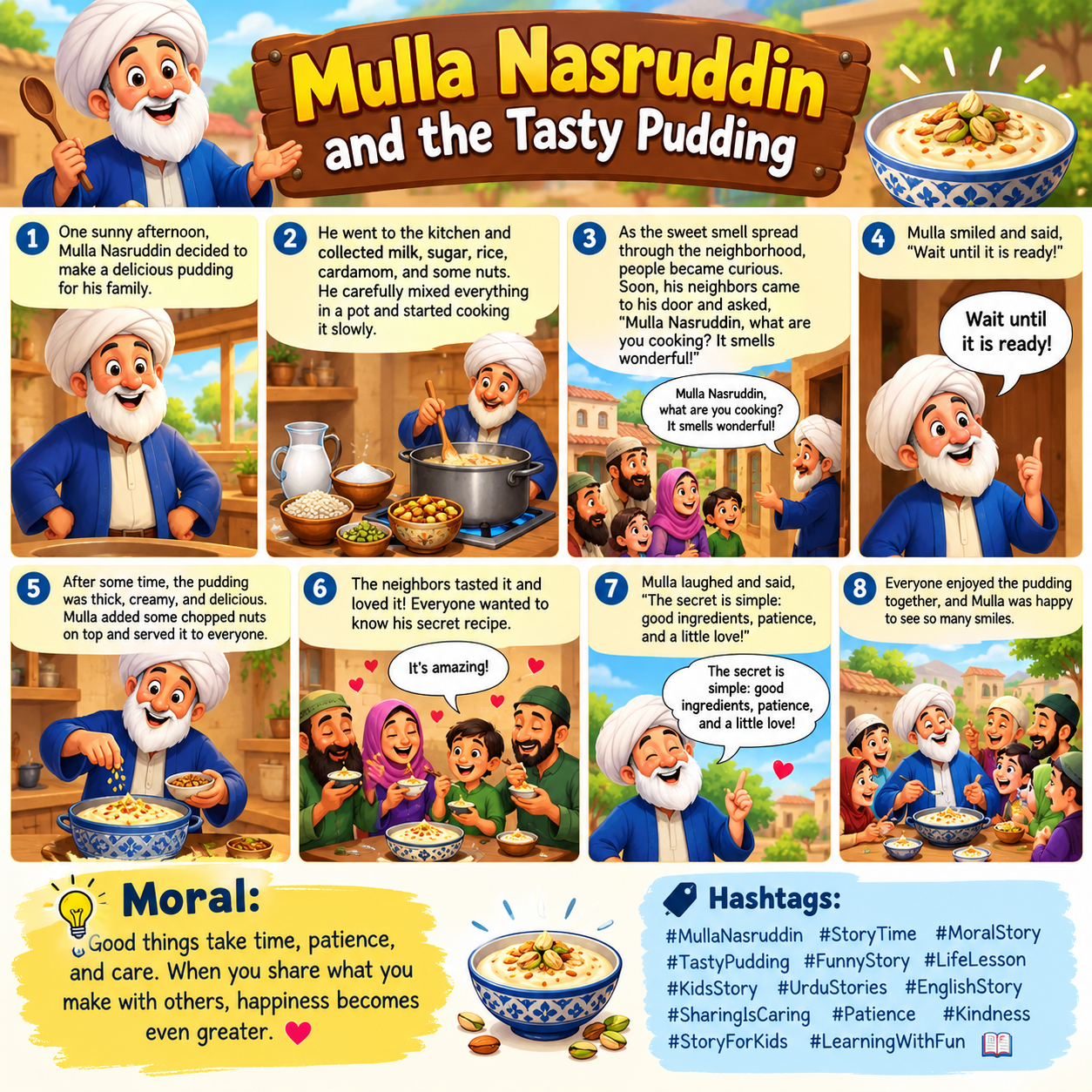
    One sunny afternoon, Mulla Nasruddin decided to make a delicious pudding for his family. ‍

    He went to the kitchen and collected milk, sugar, rice, cardamom, and some nuts. He carefully mixed everything in a pot and started cooking it slowly.

    As the sweet smell spread through the neighborhood, people became curious. Soon, his neighbors came to his door and asked, “Mulla Nasruddin, what are you cooking? It smells wonderful!”

    Mulla smiled and said, “Wait until it is ready!”

    After some time, the pudding was thick, creamy, and delicious. Mulla added some chopped nuts on top and served it to everyone.

    The neighbors tasted it and loved it! Everyone wanted to know his secret recipe.

    Mulla laughed and said, “The secret is simple: good ingredients, patience, and a little love!” ‍

    Everyone enjoyed the pudding together, and Mulla was happy to see so many smiles.

    Moral:

    Good things take time, patience, and care. When you share what you make with others, happiness becomes even greater.

    #MullaNasruddin #StoryTime #MoralStory #TastyPudding #FunnyStory #LifeLesson #KidsStory #UrduStories #EnglishStory #SharingIsCaring #Patience #Kindness #StoryForKids #LearningWithFun

    @followers
    Tania Khan Mentorship Wali
    Mohsin Rathore Seo Wala
    Imran Khan Street Wala
    Shazia Javed Educationwali
    Level 01 Work Book 01 Day 15 Task Canva post 49 Topic ๐Ÿฎ Mulla Nasruddin and the Tasty Pudding One sunny afternoon, Mulla Nasruddin decided to make a delicious pudding for his family. ๐Ÿ‘จ‍๐Ÿณโœจ He went to the kitchen and collected milk, sugar, rice, cardamom, and some nuts. ๐Ÿฅ›๐Ÿš๐ŸŒฐ He carefully mixed everything in a pot and started cooking it slowly. As the sweet smell spread through the neighborhood, people became curious. ๐Ÿ‘ƒ๐Ÿ˜‹ Soon, his neighbors came to his door and asked, “Mulla Nasruddin, what are you cooking? It smells wonderful!” ๐Ÿ ๐Ÿ‘€ Mulla smiled and said, “Wait until it is ready!” ๐Ÿ˜„ After some time, the pudding was thick, creamy, and delicious. ๐Ÿฎโค๏ธ Mulla added some chopped nuts on top and served it to everyone. The neighbors tasted it and loved it! ๐Ÿ˜๐Ÿ‘ Everyone wanted to know his secret recipe. Mulla laughed and said, “The secret is simple: good ingredients, patience, and a little love!” โค๏ธ๐Ÿ‘จ‍๐Ÿณ Everyone enjoyed the pudding together, and Mulla was happy to see so many smiles. ๐Ÿ˜Š๐Ÿฎ ๐ŸŒŸ Moral: Good things take time, patience, and care. When you share what you make with others, happiness becomes even greater. โค๏ธ๐Ÿค #MullaNasruddin #StoryTime #MoralStory #TastyPudding #FunnyStory #LifeLesson #KidsStory #UrduStories #EnglishStory #SharingIsCaring #Patience #Kindness #StoryForKids #LearningWithFun ๐Ÿ“šโœจ๐Ÿฎ @followers Tania Khan Mentorship Wali Mohsin Rathore Seo Wala Imran Khan Street Wala Shazia Javed Educationwali
    0 Comments 0 Shares 2924 Views
  • Life is like having a cup of coffee...we lift the cup take a sip and find no sugar...too lazy to go for the sugar...we some how manage with that sugarless cup...on finishing we discover undissolved sugar crystals settled at the bottom...thats how life is...many a times we tend to take things for granted and not make any effort to value what is around or within us...its time to look around may be the sweetness we are looking for is closer than we think...effort=action=success

    Rani Wemel
    Life is like having a cup of coffee...we lift the cup take a sip and find no sugar...too lazy to go for the sugar...we some how manage with that sugarless cup...on finishing we discover undissolved sugar crystals settled at the bottom...that's how life is...many a times we tend to take things for granted and not make any effort to value what is around or within us...it's time to look around may be the sweetness we are looking for is closer than we think...effort=action=success Rani Wemel
    0 Comments 0 Shares 606 Views
  • Anyone wants to give me a ride from #Houston Airport to Sugarland Tomorrow 9 pm ?
    Anyone wants to give me a ride from #Houston Airport to Sugarland Tomorrow 9 pm ?
    0 Comments 0 Shares 354 Views
More Results