


• #rsisb
    Roll no.239
    Miss zoya no. 20
    Foundation Level

    Hello, everyone! Welcome to my new video. My name is Subhan, and I am a Foundation Level student at Rehan School Islamabad Bahria Campus. Today, I am very excited to share an interesting topic with you: **Red and Green**. In this video, I will explore these two beautiful colors, their meanings, their importance in our daily lives, and the different ways we see them in the world around us.
    Colors are an important part of our lives. Every day, we see different colors in nature, schools, homes, clothes, books, toys, flowers, fruits, and many other things. Colors make our world look beautiful, interesting, and full of life. They also help us recognize objects, understand signs, express creativity, and communicate different messages.
    ## The Meaning and Importance of Red
    Red is a bright, powerful, and eye-catching color. It is often associated with love, energy, courage, excitement, and strong emotions. We can see red in roses, apples, strawberries, tomatoes, flags, decorations, and many other things.
    Red is also important for safety. In traffic lights, red tells drivers and pedestrians to stop. Red warning signs can alert people to danger and remind them to be careful. This shows that colors are not only beautiful but can also help protect our lives.
    In art and drawing, red can make a picture look bold and attractive. Artists use red to highlight important objects, create contrast, and express different feelings. Red is also used in celebrations and decorations in many cultures around the world.
    ## The Meaning and Importance of Green
    Green is a refreshing and beautiful color that we often associate with nature, plants, trees, grass, and growth. When we look at green forests, gardens, and fields, we can see the beauty of the natural world.
    Green plants are very important for life on Earth. Plants help produce oxygen, provide food, support wildlife, and contribute to healthy ecosystems. Trees also provide shade and shelter for many living things. By planting trees, protecting forests, and keeping our surroundings clean, we can help care for our planet.
    Green is also used in traffic lights. A green signal generally means that traffic may proceed when it is safe to do so. Green symbols are often used to represent nature, environmental awareness, and environmentally friendly activities.
    In drawings and paintings, green helps artists show leaves, grass, gardens, mountains, and beautiful landscapes. It can make artwork look fresh, peaceful, and natural.
    ## Red and Green in Our Daily Lives
    \#RedAndGreen #JapaneseLearning #Aka #Midori #LearnJapanese #Colors #Education #StudentLife #Confidence #NewVideo #KeepLearning
    #rsisb Roll no.239 Miss zoya no. 20 Foundation Level Hello, everyone! Welcome to my new video. My name is Subhan, and I am a Foundation Level student at Rehan School Islamabad Bahria Campus. Today, I am very excited to share an interesting topic with you: **Red and Green**. In this video, I will explore these two beautiful colors, their meanings, their importance in our daily lives, and the different ways we see them in the world around us. Colors are an important part of our lives. Every day, we see different colors in nature, schools, homes, clothes, books, toys, flowers, fruits, and many other things. Colors make our world look beautiful, interesting, and full of life. They also help us recognize objects, understand signs, express creativity, and communicate different messages. ## 🔴 The Meaning and Importance of Red Red is a bright, powerful, and eye-catching color. It is often associated with love, energy, courage, excitement, and strong emotions. We can see red in roses, apples, strawberries, tomatoes, flags, decorations, and many other things. Red is also important for safety. In traffic lights, red tells drivers and pedestrians to stop. Red warning signs can alert people to danger and remind them to be careful. This shows that colors are not only beautiful but can also help protect our lives. In art and drawing, red can make a picture look bold and attractive. Artists use red to highlight important objects, create contrast, and express different feelings. Red is also used in celebrations and decorations in many cultures around the world. ## 🟢 The Meaning and Importance of Green Green is a refreshing and beautiful color that we often associate with nature, plants, trees, grass, and growth. When we look at green forests, gardens, and fields, we can see the beauty of the natural world. Green plants are very important for life on Earth. Plants help produce oxygen, provide food, support wildlife, and contribute to healthy ecosystems. Trees also provide shade and shelter for many living things. By planting trees, protecting forests, and keeping our surroundings clean, we can help care for our planet. Green is also used in traffic lights. A green signal generally means that traffic may proceed when it is safe to do so. Green symbols are often used to represent nature, environmental awareness, and environmentally friendly activities. In drawings and paintings, green helps artists show leaves, grass, gardens, mountains, and beautiful landscapes. It can make artwork look fresh, peaceful, and natural. ## 🌍 Red and Green in Our Daily Lives \#RedAndGreen #JapaneseLearning #Aka #Midori #LearnJapanese #Colors #Education #StudentLife #Confidence #NewVideo #KeepLearning
    0 Commentarios 0 Acciones 3235 Views 3
  • RSIF 8

    Roll no 93

    Story post no 28

    Story post topic: "Penny's Piggy Bank: A Tale of Economics". **Penny’s Piggy Bank: A Tale of Economics**


    Once upon a time, a young girl named **Penny** received a cute piggy bank. At first, she wanted to spend all her money on toys, sweets, and little treats. But then she decided to try something different—she would start saving a little money every week.


    As Penny’s piggy bank became heavier, she discovered an important lesson: **small savings can grow into something meaningful when we are patient and consistent.** She also began to understand that money is not only about spending. It is about making choices, planning ahead, managing resources, and thinking about future goals.


    One day, Penny had saved enough money to buy something she truly wanted—a new set of art supplies. She realized that waiting and saving had helped her make a smarter choice and achieve her goal.


    **Penny’s story teaches us:**


    Save a little for the future.

    Make a plan before spending.

    Use money wisely.

    Set goals and work toward them.

    Learn how resources can grow.

    Make thoughtful choices every day.


    Economics may sound like a complicated subject, but Penny shows us that we can learn its basic ideas through everyday life. **Saving, spending, planning, choosing, and setting goals are all part of understanding economics.**


    The biggest lesson from Penny is simple: **small steps today can help build a stronger tomorrow.**


    **Save a little. Make smart choices. Build a better future!**


    #PennysPiggyBank #Economics #MoneyLessons #FinancialLiteracy #SavingMoney #SmartChoices #Education #Learning #KidsLearning #StoryPost #MoneyManagement #FuturePlanning #GrowthMindset #RehanSchool #RehanCodingWithAI
    RSIF 8 Roll no 93 Story post no 28 Story post topic: "Penny's Piggy Bank: A Tale of Economics".🐷💰 **Penny’s Piggy Bank: A Tale of Economics** 📚 Once upon a time, a young girl named **Penny** received a cute piggy bank. At first, she wanted to spend all her money on toys, sweets, and little treats. But then she decided to try something different—she would start saving a little money every week. As Penny’s piggy bank became heavier, she discovered an important lesson: **small savings can grow into something meaningful when we are patient and consistent.** She also began to understand that money is not only about spending. It is about making choices, planning ahead, managing resources, and thinking about future goals. One day, Penny had saved enough money to buy something she truly wanted—a new set of art supplies. She realized that waiting and saving had helped her make a smarter choice and achieve her goal. 🌱 **Penny’s story teaches us:** 💰 Save a little for the future. 📝 Make a plan before spending. 🧠 Use money wisely. 🎯 Set goals and work toward them. 📈 Learn how resources can grow. 🌟 Make thoughtful choices every day. Economics may sound like a complicated subject, but Penny shows us that we can learn its basic ideas through everyday life. **Saving, spending, planning, choosing, and setting goals are all part of understanding economics.** The biggest lesson from Penny is simple: **small steps today can help build a stronger tomorrow.** 🐷💡 **Save a little. Make smart choices. Build a better future!** #PennysPiggyBank #Economics #MoneyLessons #FinancialLiteracy #SavingMoney #SmartChoices #Education #Learning #KidsLearning #StoryPost #MoneyManagement #FuturePlanning #GrowthMindset #RehanSchool #RehanCodingWithAI
    0 Commentarios 0 Acciones 2797 Views
  • #rsisb
    Roll No:79
    Story Post No:84

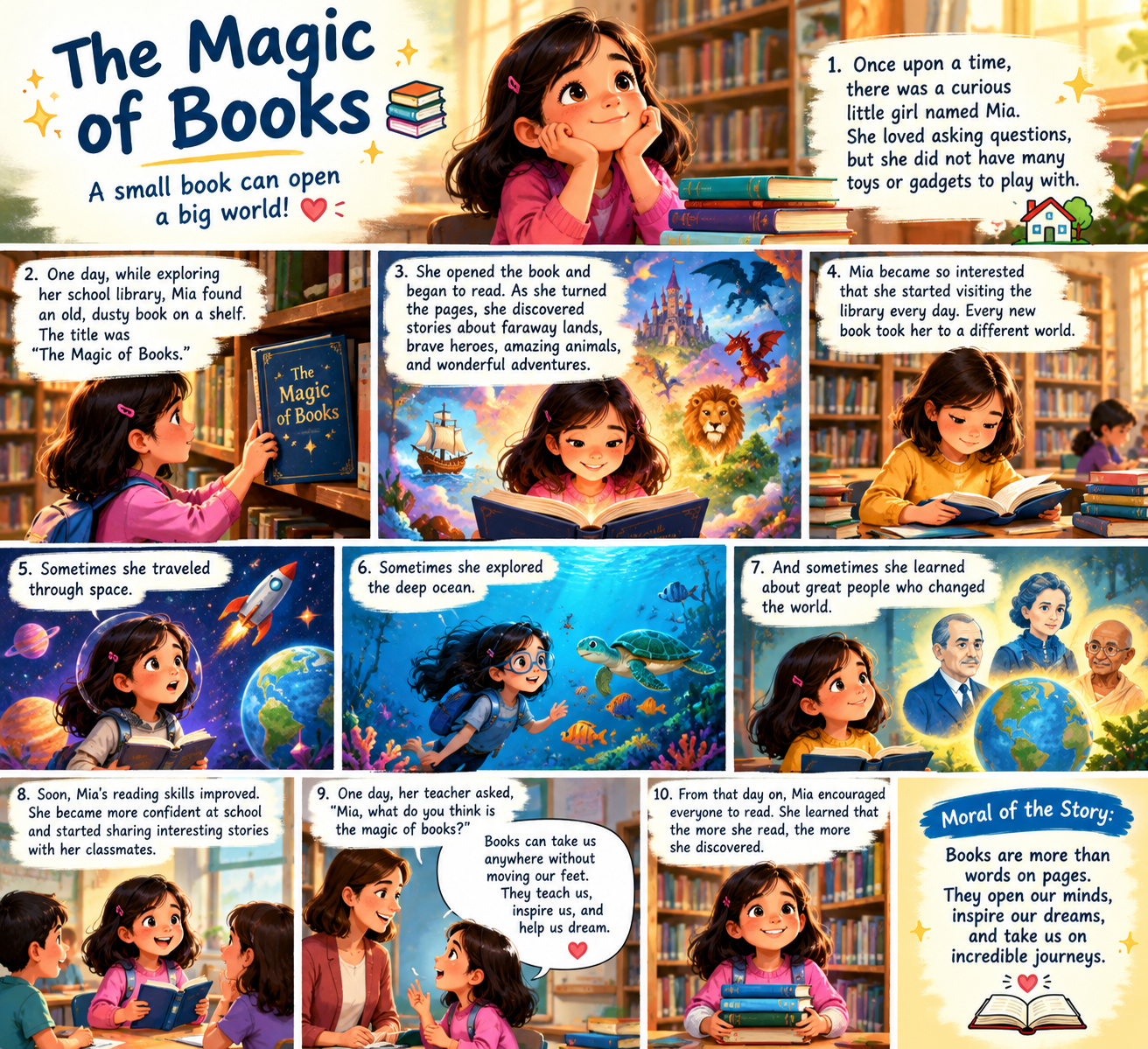
    The Magic of Books

    Once upon a time, there was a curious little girl named Mia. She loved asking questions, but she did not have many toys or gadgets to play with.

    One day, while exploring her school library, Mia found an old, dusty book on a shelf. The title was “The Magic of Books.”

    She opened the book and began to read. As she turned the pages, she discovered stories about faraway lands, brave heroes, amazing animals, and wonderful adventures. ‍

    Mia became so interested that she started visiting the library every day. Every new book took her to a different world. Sometimes she traveled through space. Sometimes she explored the deep ocean. And sometimes she learned about great people who changed the world.

    Soon, Mia's reading skills improved. She became more confident at school and started sharing interesting stories with her classmates.

    One day, her teacher asked, “Mia, what do you think is the magic of books?”

    Mia smiled and replied, “Books can take us anywhere without moving our feet. They teach us, inspire us, and help us dream.”

    Her teacher smiled proudly. She said, “Exactly! Books are magical because every page can open a new world.”

    From that day on, Mia encouraged everyone to read. She learned that the more she read, the more she discovered.

    Moral of the Story:

    Books are more than words on pages. They open our minds, inspire our dreams, and take us on incredible journeys.
    #rsisb Roll No:79 Story Post No:84 📚✨ The Magic of Books Once upon a time, there was a curious little girl named Mia. 👧 She loved asking questions, but she did not have many toys or gadgets to play with. 🏡 One day, while exploring her school library, Mia found an old, dusty book on a shelf. 📖✨ The title was “The Magic of Books.” She opened the book and began to read. As she turned the pages, she discovered stories about faraway lands, brave heroes, amazing animals, and wonderful adventures. 🌍🦁🦸‍♀️ Mia became so interested that she started visiting the library every day. 📚❤️ Every new book took her to a different world. Sometimes she traveled through space. 🚀🌌 Sometimes she explored the deep ocean. 🌊🐠 And sometimes she learned about great people who changed the world. 🌟 Soon, Mia's reading skills improved. 📝📖 She became more confident at school and started sharing interesting stories with her classmates. 😊👫 One day, her teacher asked, “Mia, what do you think is the magic of books?” 🤔 Mia smiled and replied, “Books can take us anywhere without moving our feet. They teach us, inspire us, and help us dream.” 💭✨ Her teacher smiled proudly. 😊 She said, “Exactly! Books are magical because every page can open a new world.” 📖🌎 From that day on, Mia encouraged everyone to read. She learned that the more she read, the more she discovered. 🌟📚 🌈 Moral of the Story: Books are more than words on pages. They open our minds, inspire our dreams, and take us on incredible journeys. 📚💫❤️
    0 Commentarios 0 Acciones 1512 Views
  • Kindly watch this video of a poor area of Pakistan, and guide what their principal mr Rehmat Ullah Rehmat can do with the kids on making education more fun and practical for these future brains.

    HE does not have much budget, so he wants guidance on things, that will cost him any money, ie how to make toys from garbage, how to paint walls with the kids with cartoons and characters, or wall of ideas where they can write there idea without their names, or a big black and white board where they can paint, without any one asking them what they are painting, or graffiti

    :) what are your suggestions ? :)
    Kindly watch this video of a poor area of Pakistan, and guide what their principal mr Rehmat Ullah Rehmat can do with the kids on making education more fun and practical for these future brains. HE does not have much budget, so he wants guidance on things, that will cost him any money, ie how to make toys from garbage, how to paint walls with the kids with cartoons and characters, or wall of ideas where they can write there idea without their names, or a big black and white board where they can paint, without any one asking them what they are painting, or graffiti :) what are your suggestions ? :)
    0 Commentarios 0 Acciones 423 Views
  • I am very heart broken today, I try very very hard based on what I know, to do what I can for others, but no matter HOW HARD I try, I seem to be like that Older brother, whos brothers are not happy with him and blame him for everything.

    I wish there was a cave somewhere, Where I can just go and HIDE from the world, and just live my life...

    I want to apologize to everyone, who has learned anything from me, Kindly un-learn it as it is all false based on what others may tell you. I am stupid and crazy to dream bigger than other people around me, and I should not show others to dream, I Dream of a Pakistan where everyone makes minimum of at least $300 a month to $1000 a month, So I am sorry for dreaming that, I am sorry for teaching and sharing the rotten bad knowledge of failures that I know of my life, which is useless for everyone who wishes to fail on their own, and learn only and only from the failures, thus making success even farther away from how far it really is.

    I am sorry for paying people money, to actually learn on the job, and I am sorry for giving gifts from my own pocket, which I could use to buy toys and expensive stuff for my own family and myself, Just like all other smart businessmen do.

    I am sorry to share my life how I live so others can see that I am no other than anyone else, and they too can live like me if they chose to, But I am so sorry for showing this way.

    But Most I am sorry to my own parents and family, for not spending enough time with them, and spending it with others, in Hope that one day, they can do what I do, and I can just go and hide in my cave.

    I am tired, very very very tired of doing all I do, answering hundreds of people every day, which feels like being Jim Carrey ~ in the movie God Almighty where no matter how many wishes I try to answer, they just do not stop, and yet I wake up to days where JUST THAT ONE PERSON who was I miss Spelled a word with will come back and hunt me down for hours that I am some jackass :)

    So you all, I AM A BIG Jackass, A fool, A stupid dreamer who DARED To dream.

    Do forgive me all, who have been hurt by my deeds, as NO MATTER how Hard I try, it is just not enough!

    I will try to learn to focus on my self and closest to me more again. May God give me the strength to do so.

    I will soon be closing my personal facebook account, and hand over the Rehan Allahwala page to someone to manage, so you may want to like it if you want.
    I am very heart broken today, I try very very hard based on what I know, to do what I can for other's, but no matter HOW HARD I try, I seem to be like that Older brother, who's brothers are not happy with him and blame him for everything. I wish there was a cave somewhere, Where I can just go and HIDE from the world, and just live my life... I want to apologize to everyone, who has learned anything from me, Kindly un-learn it as it is all false based on what other's may tell you. I am stupid and crazy to dream bigger than other people around me, and I should not show other's to dream, I Dream of a Pakistan where everyone makes minimum of at least $300 a month to $1000 a month, So I am sorry for dreaming that, I am sorry for teaching and sharing the rotten bad knowledge of failures that I know of my life, which is useless for everyone who wishes to fail on their own, and learn only and only from the failures, thus making success even farther away from how far it really is. I am sorry for paying people money, to actually learn on the job, and I am sorry for giving gift's from my own pocket, which I could use to buy toys and expensive stuff for my own family and myself, Just like all other smart businessmen do. I am sorry to share my life how I live so other's can see that I am no other than anyone else, and they too can live like me if they chose to, But I am so sorry for showing this way. But Most I am sorry to my own parents and family, for not spending enough time with them, and spending it with others, in Hope that one day, they can do what I do, and I can just go and hide in my cave. I am tired, very very very tired of doing all I do, answering hundreds of people every day, which feels like being Jim Carrey ~ in the movie God Almighty where no matter how many wishes I try to answer, they just do not stop, and yet I wake up to days where JUST THAT ONE PERSON who was I miss Spelled a word with will come back and hunt me down for hours that I am some jackass :) So you all, I AM A BIG Jackass, A fool, A stupid dreamer who DARED To dream. Do forgive me all, who have been hurt by my deeds, as NO MATTER how Hard I try, it is just not enough! I will try to learn to focus on my self and closest to me more again. May God give me the strength to do so. I will soon be closing my personal facebook account, and hand over the Rehan Allahwala page to someone to manage, so you may want to like it if you want.
    0 Commentarios 0 Acciones 706 Views
  • Do you like to make cars, aeroplanes, toys, machines, or anything mechanical ?

    Then this is the club for you to join, make friends, and learn with each other.

    Mechanical Makers Club
    Do you like to make cars, aeroplanes, toys, machines, or anything mechanical ? Then this is the club for you to join, make friends, and learn with each other. Mechanical Makers Club
    0 Commentarios 0 Acciones 214 Views
  • My Conscience Is Dying A Slow Death.
    By Javaid Jabbar.

    Sometimes in the darkest hour of the night I call on my conscience to see if it is still breathing. Its dying a slow and gradual death
    every single day.

    When I pay for a meal in a fancy restaurant
    an amount which is perhaps the monthly income of the guard who holds the door open, I quickly shrug away that thought. My conscience dies a little.

    When I buy vegetables from the vendor and his son "Chhotu" (a small child who should be studying at school)
    smilingly weighs the potatoes, I look the other way. My conscience dies a little.

    When Im all decked up in a designer suit (a suit that costs a bomb)
    and I see a woman at the crossing in torn clothes, trying unsuccessfully to save her dignity, I immediately roll up my window. My conscience dies a little.

    When I buy expensive gifts for my children and returning home I see half-clad naked children with empty stomachs and hungry eyes selling toys at the red traffic signal, I try to save my conscience by buying some. Yet, my conscience dies a little more.

    When my sick maid who cant come to work sends her daughter to work by making her miss school, I know I should tell the little girl to go to school, but then I look at the loaded sink full of dirty dishes and I tell myself that is just for a couple of days. My conscience dies a little more.

    When I hear about a rape or a murder of a child, I feel sad, yet a little thankful that its not my child. I cannot look at myself in the mirror. My conscience dies a little more.

    When people fight over caste, creed, and religion and I feel hurt and helpless, I tell myself that my country is going to the dogs, and I conveniently blame the corrupt politicians, absolving myself of all responsibilities. My conscience dies a little more.

    When my city is choked and breathing is dangerous in the smog ridden metropolis I take my car to work daily, not taking the public transport, or car pooling. One less car wont make a difference, I tell myself. My conscience dies a little more.

    So when in the darkest hour of the night I visit my conscience and find that it is still breathing I am surprised because bit by bit, day by day, I try to kill it and bury it with my very own hands.
    My Conscience Is Dying A Slow Death. By Javaid Jabbar. Sometimes in the darkest hour of the night I call on my conscience to see if it is still breathing. It's dying a slow and gradual death every single day. When I pay for a meal in a fancy restaurant an amount which is perhaps the monthly income of the guard who holds the door open, I quickly shrug away that thought. My conscience dies a little. When I buy vegetables from the vendor and his son "Chhotu" (a small child who should be studying at school) smilingly weighs the potatoes, I look the other way. My conscience dies a little. When I'm all decked up in a designer suit (a suit that costs a bomb) and I see a woman at the crossing in torn clothes, trying unsuccessfully to save her dignity, I immediately roll up my window. My conscience dies a little. When I buy expensive gifts for my children and returning home I see half-clad naked children with empty stomachs and hungry eyes selling toys at the red traffic signal, I try to save my conscience by buying some. Yet, my conscience dies a little more. When my sick maid who can't come to work sends her daughter to work by making her miss school, I know I should tell the little girl to go to school, but then I look at the loaded sink full of dirty dishes and I tell myself that is just for a couple of days. My conscience dies a little more. When I hear about a rape or a murder of a child, I feel sad, yet a little thankful that it's not my child. I cannot look at myself in the mirror. My conscience dies a little more. When people fight over caste, creed, and religion and I feel hurt and helpless, I tell myself that my country is going to the dogs, and I conveniently blame the corrupt politicians, absolving myself of all responsibilities. My conscience dies a little more. When my city is choked and breathing is dangerous in the smog ridden metropolis I take my car to work daily, not taking the public transport, or car pooling. One less car won't make a difference, I tell myself. My conscience dies a little more. So when in the darkest hour of the night I visit my conscience and find that it is still breathing I am surprised because bit by bit, day by day, I try to kill it and bury it with my very own hands. 🎭🎭🎭🎭🎭🎭🎭🎭
    0 Commentarios 0 Acciones 1064 Views
  • 3 6 9 !

    Step 1: Who Was Nikola Tesla?

    Nikola Tesla was a super-smart scientist and inventor. He invented things like the stuff that helps bring electricity to your home (alternating current) and even dreamed about free energy for the whole world! But Tesla wasn’t just about machines—he believed the universe had secrets that could be unlocked with numbers.

    Step 2: Why Are 3, 6, and 9 Special?

    Tesla believed that 3, 6, and 9 were the “key to the universe.” Why?
    • Math Magic: If you look at numbers and patterns, you’ll see 3, 6, and 9 show up everywhere!
    • Add up the angles in a triangle: 180° (1+8+0=9).
    • Look at a circle: 360° (3+6+0=9).
    • Even the planets in space move in cycles that repeat these numbers.
    • Energy and Vibrations: Tesla thought the whole universe is made of energy, like invisible waves moving around. He believed 3, 6, and 9 control how these waves work, kind of like music notes control a song.

    Step 3: How to Think Like Tesla Using 369

    Here’s how you can use the 369 code to grow your brain and think like Tesla:

    1. Practice Creative Thinking (The Power of 3)
    • Tesla said the number 3 is about ideas and imagination. Every day, try to think of 3 new ideas:
    • A new invention (What could make homework faster?).
    • A better way to solve a problem (How to clean your room faster?).
    • Something funny or creative (Design a robot that tells jokes!).

    2. Work in Harmony (The Power of 6)
    • The number 6 is about balance and teamwork. Tesla believed working in harmony with others helps big ideas grow.
    • Think of 6 things every day you can do to help others—like sharing, being kind, or working with your friends on a fun project.

    3. Finish Big Goals (The Power of 9)
    • The number 9 is about finishing what you start. Tesla worked on ideas for years until they were perfect.
    • Pick one big goal, like building a model, drawing a big idea, or learning something new. Work on it a little every day. When you finish, celebrate!

    Step 4: Manifesting Your Ideas

    Here’s a fun trick Tesla might have liked:
    1. Write down what you really want (like inventing something cool).
    2. Use the 369 Method to make your dream stronger:
    • In the morning, write it 3 times (e.g., “I will invent something amazing!”).
    • In the afternoon, write it 6 times.
    • At night, write it 9 times.
    3. Keep doing this every day! This helps you focus your mind and imagination, just like Tesla did.

    Step 5: Have Fun With Experiments

    Tesla loved experiments. Start small:
    • Try making a simple battery with a lemon and some wires.
    • Build a toy motor with magnets and learn how electricity works.
    • Think about how things around you could work better, like your toys or gadgets.

    Step 6: Learn Like Tesla

    To be like Tesla, keep learning about:
    • Science: Electricity, energy, and machines.
    • Math: Patterns and numbers are everywhere.
    • Nature: Tesla loved learning from animals, trees, and the stars.

    Final Tip: Be Curious, Stay Kind

    Tesla was curious about everything, but he also wanted to help the world. To be like him:
    • Keep asking questions: “Why does this work?” “How can I make it better?”
    • Always think about how your inventions can make the world a better place.

    Now go out there and start creating! Who knows? You might discover something amazing and become the next Tesla!
    3 6 9 ! Step 1: Who Was Nikola Tesla? Nikola Tesla was a super-smart scientist and inventor. He invented things like the stuff that helps bring electricity to your home (alternating current) and even dreamed about free energy for the whole world! But Tesla wasn’t just about machines—he believed the universe had secrets that could be unlocked with numbers. Step 2: Why Are 3, 6, and 9 Special? Tesla believed that 3, 6, and 9 were the “key to the universe.” Why? • Math Magic: If you look at numbers and patterns, you’ll see 3, 6, and 9 show up everywhere! • Add up the angles in a triangle: 180° (1+8+0=9). • Look at a circle: 360° (3+6+0=9). • Even the planets in space move in cycles that repeat these numbers. • Energy and Vibrations: Tesla thought the whole universe is made of energy, like invisible waves moving around. He believed 3, 6, and 9 control how these waves work, kind of like music notes control a song. Step 3: How to Think Like Tesla Using 369 Here’s how you can use the 369 code to grow your brain and think like Tesla: 1. Practice Creative Thinking (The Power of 3) • Tesla said the number 3 is about ideas and imagination. Every day, try to think of 3 new ideas: • A new invention (What could make homework faster?). • A better way to solve a problem (How to clean your room faster?). • Something funny or creative (Design a robot that tells jokes!). 2. Work in Harmony (The Power of 6) • The number 6 is about balance and teamwork. Tesla believed working in harmony with others helps big ideas grow. • Think of 6 things every day you can do to help others—like sharing, being kind, or working with your friends on a fun project. 3. Finish Big Goals (The Power of 9) • The number 9 is about finishing what you start. Tesla worked on ideas for years until they were perfect. • Pick one big goal, like building a model, drawing a big idea, or learning something new. Work on it a little every day. When you finish, celebrate! Step 4: Manifesting Your Ideas Here’s a fun trick Tesla might have liked: 1. Write down what you really want (like inventing something cool). 2. Use the 369 Method to make your dream stronger: • In the morning, write it 3 times (e.g., “I will invent something amazing!”). • In the afternoon, write it 6 times. • At night, write it 9 times. 3. Keep doing this every day! This helps you focus your mind and imagination, just like Tesla did. Step 5: Have Fun With Experiments Tesla loved experiments. Start small: • Try making a simple battery with a lemon and some wires. • Build a toy motor with magnets and learn how electricity works. • Think about how things around you could work better, like your toys or gadgets. Step 6: Learn Like Tesla To be like Tesla, keep learning about: • Science: Electricity, energy, and machines. • Math: Patterns and numbers are everywhere. • Nature: Tesla loved learning from animals, trees, and the stars. Final Tip: Be Curious, Stay Kind Tesla was curious about everything, but he also wanted to help the world. To be like him: • Keep asking questions: “Why does this work?” “How can I make it better?” • Always think about how your inventions can make the world a better place. Now go out there and start creating! Who knows? You might discover something amazing and become the next Tesla!
    0 Commentarios 0 Acciones 1537 Views
  • Ah, the story of Honda is pure cinematic magic — part kung-fu hustle, part engineering wizardry, and a whole lot of “never give up even if your factory burns down… twice.”

    Here’s how Honda became HONDA:

    ⸻

    1. The Early Grit of Soichiro Honda (Born 1906)
    • Soichiro Honda was a Japanese blacksmith’s son who loved speed, sound, and breaking rules.
    • As a kid, he made his own toys from scrap metal and skipped school to watch airplanes.
    • In his teens, he became a mechanic, and later opened a garage — fixing race cars.

    ⸻

    2. First Try: Pistons for Toyota (1937)
    • Honda started a company called Tokai Seiki to make piston rings (engine parts).
    • His goal? Supply Toyota.
    • But Toyota rejected his first batch — poor quality.
    • So what did he do?
    Went back to school to learn metallurgy… then came back with improved designs.
    Toyota said YES.

    ⸻

    3. World War II Wrecks Everything
    • His factory was bombed twice, and then an earthquake leveled it.
    • Did he give up? Nope. He sold the remains to Toyota and started fresh.

    ⸻

    4. Birth of Honda Motor Company – 1948
    • Post-war Japan needed cheap transport.
    • Honda attached a tiny engine to a bicycle. It was clunky… but it worked.
    • That little machine became the “Super Cub”, the bestselling motorbike in human history (over 100 million sold!).

    His motto: “Success is 99% failure.”

    ⸻

    5. Going Global

    Motorcycles:
    • Entered the U.S. market in the 1950s.
    • Americans were like “Japanese bikes? Meh.”
    • So Honda launched a friendly, clean-cut campaign:
    “You meet the nicest people on a Honda.”
    • BAM! Motorcycles were now cool and not just for bikers with tattoos.

    Cars:
    • In 1963, Honda launched its first car, the T360 mini truck.
    • In 1972, it dropped the legendary Honda Civic — cheap, fuel-efficient, and perfectly timed for the 1973 oil crisis.

    ⸻

    6. Innovation Machine
    • First Japanese company to build cars in the U.S. (Ohio, 1982).
    • Built ASIMO, the walking robot.
    • Created HondaJet, motorcycles, lawnmowers, engines… even a robot that could dance.

    ⸻

    Summary of the Honda Hustle:

    Year Milestone
    1906 Soichiro Honda born
    1937 Starts making piston rings
    1948 Honda Motor Co. founded
    1958 Honda Super Cub revolutionizes bikes
    1963 First car (T360) launched
    1972 Civic hits global fame
    1982 First U.S. factory opens
    2000s Enters aviation, robotics, green tech

    ⸻

    Key to Honda’s Success?
    • Engineering obsession
    • Failure-friendly culture
    • Global thinking
    • Human-first design — fun, efficient, and unbreakable
    Ah, the story of Honda is pure cinematic magic — part kung-fu hustle, part engineering wizardry, and a whole lot of “never give up even if your factory burns down… twice.” 🔥🏍️💪 Here’s how Honda became HONDA: ⸻ 🧒 1. The Early Grit of Soichiro Honda (Born 1906) • Soichiro Honda was a Japanese blacksmith’s son who loved speed, sound, and breaking rules. • As a kid, he made his own toys from scrap metal and skipped school to watch airplanes. • In his teens, he became a mechanic, and later opened a garage — fixing race cars. ⸻ 🏎️ 2. First Try: Pistons for Toyota (1937) • Honda started a company called Tokai Seiki to make piston rings (engine parts). • His goal? Supply Toyota. • But Toyota rejected his first batch — poor quality. • So what did he do? 👉 Went back to school to learn metallurgy… then came back with improved designs. 👉 Toyota said YES. ⸻ 💣 3. World War II Wrecks Everything • His factory was bombed twice, and then an earthquake leveled it. • Did he give up? Nope. He sold the remains to Toyota and started fresh. ⸻ 🏍️ 4. Birth of Honda Motor Company – 1948 • Post-war Japan needed cheap transport. • Honda attached a tiny engine to a bicycle. It was clunky… but it worked. • That little machine became the “Super Cub”, the bestselling motorbike in human history (over 100 million sold!). ⚙️ His motto: “Success is 99% failure.” ⸻ 🌍 5. Going Global 🏍️ Motorcycles: • Entered the U.S. market in the 1950s. • Americans were like “Japanese bikes? Meh.” • So Honda launched a friendly, clean-cut campaign: “You meet the nicest people on a Honda.” • BAM! Motorcycles were now cool and not just for bikers with tattoos. 🚗 Cars: • In 1963, Honda launched its first car, the T360 mini truck. • In 1972, it dropped the legendary Honda Civic — cheap, fuel-efficient, and perfectly timed for the 1973 oil crisis. ⸻ 🧠 6. Innovation Machine • First Japanese company to build cars in the U.S. (Ohio, 1982). • Built ASIMO, the walking robot. • Created HondaJet, motorcycles, lawnmowers, engines… even a robot that could dance. ⸻ 🔁 Summary of the Honda Hustle: Year Milestone 1906 Soichiro Honda born 1937 Starts making piston rings 1948 Honda Motor Co. founded 1958 Honda Super Cub revolutionizes bikes 1963 First car (T360) launched 1972 Civic hits global fame 1982 First U.S. factory opens 2000s Enters aviation, robotics, green tech ⸻ 💥 Key to Honda’s Success? • 🧠 Engineering obsession • 💥 Failure-friendly culture • 🌍 Global thinking • 💡 Human-first design — fun, efficient, and unbreakable
    0 Commentarios 0 Acciones 1331 Views
  • India & Pakistan: A Tale of Two Siblings

    In 1947, two siblings were born on the same day — India and Pakistan.
    They started with almost the same toys: the same railway system, the same education style, the same hospitals, even the same languages. But over 77 years, their paths have gone in different directions.

    ⸻

    Where India Runs Ahead
    1. Life Expectancy
    India today lives to about 70 years, while Pakistan stops at 68. It’s only a 2-year gap, but in human lives, that’s millions of birthdays missed.
    2. Infant Mortality
    In India, 26 babies per 1,000 don’t make it. In Pakistan, it’s still 54. That means Pakistan is living in India’s 1990s past.
    3. Median Age
    Indians are on average 29 years old, Pakistanis only 20. India looks like a grown-up young adult, while Pakistan is still a teenager.
    4. Electricity Access
    India lights up 98% of homes, Pakistan only about 80%. In some Pakistani villages, evenings still end when the sun sets.
    5. Internet Penetration
    India has 48% of people online, Pakistan only 30%. Imagine one sibling talking to the whole world, the other still struggling to get a signal.
    6. Human Development Index (HDI)
    India stands at 0.64, Pakistan at 0.54. That’s the difference between a university student and a struggling school kid.
    7. Industrial Scale
    India’s economy is ten times bigger — $3.7 trillion vs $375 billion. One sibling has become a giant, the other is still a teenager trying to start a business.

    ⸻

    Where Pakistan Surprises India
    1. Urbanization
    More Pakistanis live in cities (39%) than Indians (36%). Pakistan, though smaller, is moving to towns faster.
    2. Mobile Data Prices
    Pakistan sells 1 GB for 12–36 cents; India sells it around 17 cents. Both are cheap, but Pakistan matches or beats India here. For Americans paying $5–6, both siblings look like geniuses.
    3. Youthful Energy
    Pakistan’s average age is 20.6. India’s is 28.7. That means Pakistan has the youngest sibling on the block, full of raw energy and potential.
    4. Solar Power Share
    Pakistan gets 14% of its electricity from solar, India about 7%. In renewable adoption, Pakistan has taken a surprising lead.
    5. Freelancing
    Both are top freelancing nations, but Pakistan punches far above its weight. On Fiverr and Upwork, Pakistan’s youth compete neck-to-neck with India, even though India has 7 times more people.

    ⸻

    The Story of Today

    So today, India is like the elder sibling who went to college, got a stable job, and is building skyscrapers. Pakistan is like the younger sibling: still struggling with basics — health, electricity, education — but suddenly brilliant in odd places: internet costs, freelancing, solar energy, and youthful drive.

    Both started the race together, but they are running on different tracks. India’s path looks steadier; Pakistan’s looks chaotic but full of hidden shortcuts.

    And just like real siblings — they fight, they compete, but deep down, they can’t ignore each other. The future of South Asia is not one without the other.
    India & Pakistan: A Tale of Two Siblings In 1947, two siblings were born on the same day — India and Pakistan. They started with almost the same toys: the same railway system, the same education style, the same hospitals, even the same languages. But over 77 years, their paths have gone in different directions. ⸻ Where India Runs Ahead 1. Life Expectancy India today lives to about 70 years, while Pakistan stops at 68. It’s only a 2-year gap, but in human lives, that’s millions of birthdays missed. 2. Infant Mortality In India, 26 babies per 1,000 don’t make it. In Pakistan, it’s still 54. That means Pakistan is living in India’s 1990s past. 3. Median Age Indians are on average 29 years old, Pakistanis only 20. India looks like a grown-up young adult, while Pakistan is still a teenager. 4. Electricity Access India lights up 98% of homes, Pakistan only about 80%. In some Pakistani villages, evenings still end when the sun sets. 5. Internet Penetration India has 48% of people online, Pakistan only 30%. Imagine one sibling talking to the whole world, the other still struggling to get a signal. 6. Human Development Index (HDI) India stands at 0.64, Pakistan at 0.54. That’s the difference between a university student and a struggling school kid. 7. Industrial Scale India’s economy is ten times bigger — $3.7 trillion vs $375 billion. One sibling has become a giant, the other is still a teenager trying to start a business. ⸻ Where Pakistan Surprises India 1. Urbanization More Pakistanis live in cities (39%) than Indians (36%). Pakistan, though smaller, is moving to towns faster. 2. Mobile Data Prices Pakistan sells 1 GB for 12–36 cents; India sells it around 17 cents. Both are cheap, but Pakistan matches or beats India here. For Americans paying $5–6, both siblings look like geniuses. 3. Youthful Energy Pakistan’s average age is 20.6. India’s is 28.7. That means Pakistan has the youngest sibling on the block, full of raw energy and potential. 4. Solar Power Share Pakistan gets 14% of its electricity from solar, India about 7%. In renewable adoption, Pakistan has taken a surprising lead. 5. Freelancing Both are top freelancing nations, but Pakistan punches far above its weight. On Fiverr and Upwork, Pakistan’s youth compete neck-to-neck with India, even though India has 7 times more people. ⸻ The Story of Today So today, India is like the elder sibling who went to college, got a stable job, and is building skyscrapers. Pakistan is like the younger sibling: still struggling with basics — health, electricity, education — but suddenly brilliant in odd places: internet costs, freelancing, solar energy, and youthful drive. Both started the race together, but they are running on different tracks. India’s path looks steadier; Pakistan’s looks chaotic but full of hidden shortcuts. And just like real siblings — they fight, they compete, but deep down, they can’t ignore each other. The future of South Asia is not one without the other.
    0 Commentarios 0 Acciones 748 Views
Resultados de la búsqueda