• RSIF8
    Roll no.38
    Documentary task no.1
    topic: The Evolution of “Robot”: From Czech Play to Tech Terminology
    The word “robot” was first used in a Czech play in 1920. Today, robots are an important part of our lives. They help us in factories, hospitals, schools, and homes. Robots make our work easier and faster. Technology is growing every day, and robots are becoming smarter.
    Lesson: Technology can make our lives easier and better.
    #Robot #Technology #HistoryOfRobots #ArtificialIntelligence #Innovation #Learning #FutureTechnology
    RSIF8 Roll no.38 Documentary task no.1 topic:🤖 The Evolution of “Robot”: From Czech Play to Tech Terminology The word “robot” was first used in a Czech play in 1920. Today, robots are an important part of our lives. They help us in factories, hospitals, schools, and homes. Robots make our work easier and faster. Technology is growing every day, and robots are becoming smarter. 🚀✨ Lesson: Technology can make our lives easier and better. 🌟 #Robot #Technology #HistoryOfRobots #ArtificialIntelligence #Innovation #Learning #FutureTechnology 🤖💻
    0 Commentarii 0 Distribuiri 555 Views 2
  • rehan school urdu bazar
    roll no 11
    foundation level
    ### Paragraph 1: The Power of Wind
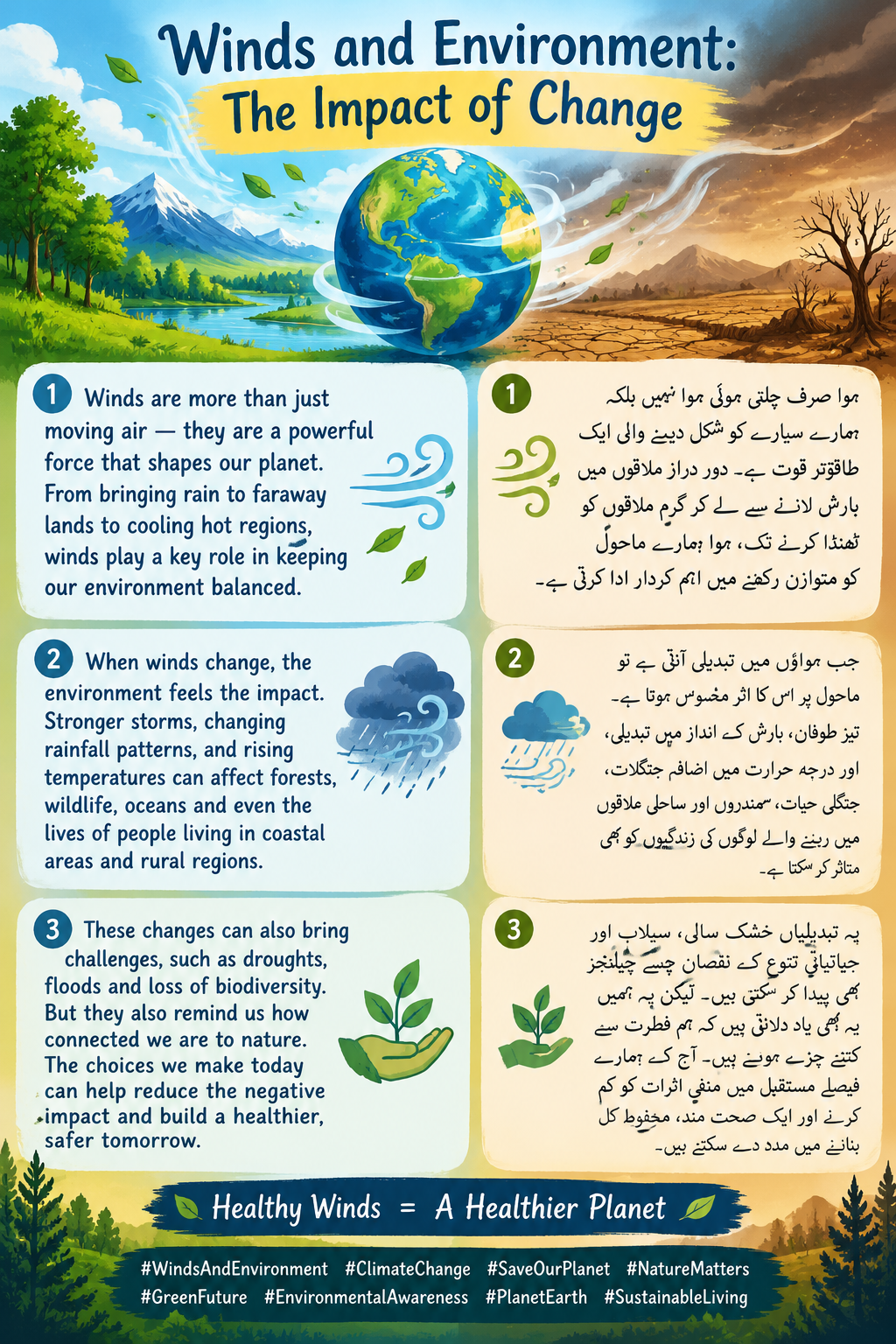
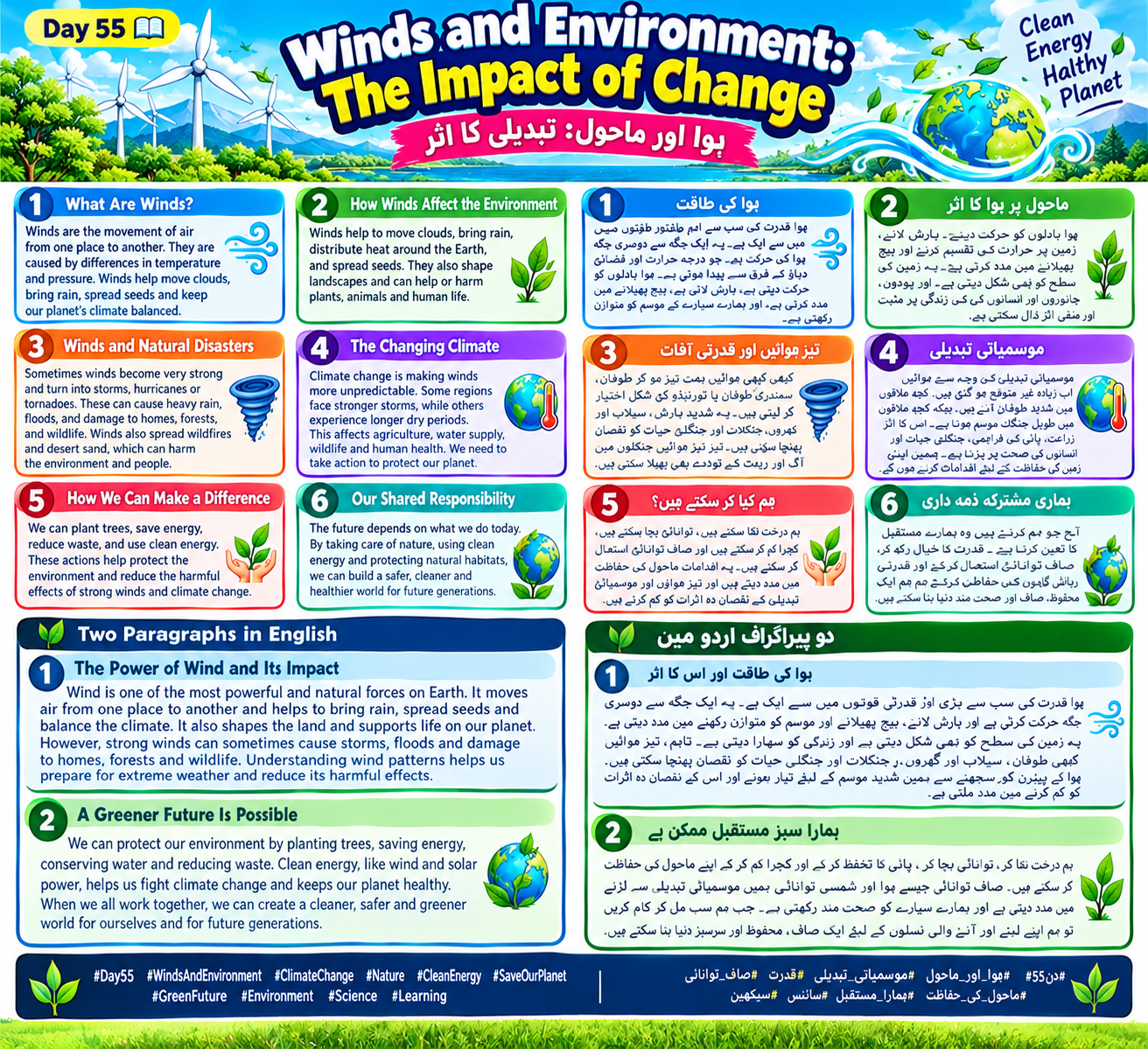
    Wind is an important part of our environment. It moves air from one place to another and helps keep our planet balanced. Wind brings rain, cools hot places, and helps plants spread their seeds. It also plays an important role in changing weather.
    ### Paragraph 2: How Winds Affect Nature
    When winds become stronger or change direction, they can affect the weather. Strong winds may bring storms, heavy rain, or dust. These changes can affect forests, animals, oceans, and people. Coastal areas and rural communities can be especially affected by severe weather.
    ### Paragraph 3: The Challenges of Change
    Changes in weather can cause problems such as droughts, floods, and damage to plants and wildlife. Strong storms can destroy homes and trees. These challenges remind us that nature is delicate and that we must take care of our environment.
    ### Paragraph 4: Protecting Our Planet
    We can help protect our planet by planting trees, reducing pollution, saving energy, and using clean energy such as wind power. Every small action matters. If we work together, we can build a greener and healthier future for everyone.
    **Healthy Winds, Healthy Planet!**### پیراگراف 1: ہوا کی طاقت
    ہوا ہمارے ماحول کا ایک اہم حصہ ہے۔ یہ ایک جگہ سے دوسری جگہ حرکت کرتی ہے اور ہماری زمین کے قدرتی توازن کو برقرار رکھنے میں مدد دیتی ہے۔ ہوا بارش لانے، گرم علاقوں کو ٹھنڈا کرنے اور پودوں کے بیج پھیلانے میں اہم کردار ادا کرتی ہے۔
    ### پیراگراف 2: ہواؤں کے قدرت پر اثرات
    جب ہواؤں کی رفتار بڑھ جاتی ہے یا ان کا رخ بدل جاتا ہے تو موسم بھی متاثر ہو سکتا ہے۔ تیز ہوائیں طوفان، شدید بارش یا گردوغبار کا سبب بن سکتی ہیں۔ ان تبدیلیوں سے جنگلات، جانوروں، سمندروں اور انسانوں کی زندگی متاثر ہوتی ہے۔
    ### پیراگراف 3: تبدیلی کے چیلنجز
    موسمی تبدیلیوں کی وجہ سے خشک سالی، سیلاب اور پودوں و جنگلی حیات کو نقصان پہنچ سکتا ہے۔ شدید طوفان گھروں اور درختوں کو تباہ کر سکتے ہیں۔ یہ مسائل ہمیں یاد دلاتے ہیں کہ قدرت بہت قیمتی ہے اور ہمیں اپنے ماحول کی حفاظت کرنی چاہیے۔
    ### پیراگراف 4: اپنے سیارے کی حفاظت
    ہم درخت لگا کر، آلودگی کم کرکے، توانائی بچا کر اور ہوا سے بجلی پیدا کرکے اپنے سیارے کی حفاظت میں مدد دے سکتے ہیں۔ ہماری ہر چھوٹی کوشش اہم ہے۔ اگر ہم سب مل کر کام کریں تو ہم آنے والی نسلوں کے لیے ایک صاف ستھرا اور صحت مند ماحول بنا سکتے ہیں۔
    **صحت مند ہوائیں، صحت مند زمین!** See less
    rehan school urdu bazar roll no 11 foundation level ### Paragraph 1: The Power of Wind Wind is an important part of our environment. It moves air from one place to another and helps keep our planet balanced. Wind brings rain, cools hot places, and helps plants spread their seeds. It also plays an important role in changing weather. ### Paragraph 2: How Winds Affect Nature When winds become stronger or change direction, they can affect the weather. Strong winds may bring storms, heavy rain, or dust. These changes can affect forests, animals, oceans, and people. Coastal areas and rural communities can be especially affected by severe weather. ### Paragraph 3: The Challenges of Change Changes in weather can cause problems such as droughts, floods, and damage to plants and wildlife. Strong storms can destroy homes and trees. These challenges remind us that nature is delicate and that we must take care of our environment. ### Paragraph 4: Protecting Our Planet We can help protect our planet by planting trees, reducing pollution, saving energy, and using clean energy such as wind power. Every small action matters. If we work together, we can build a greener and healthier future for everyone. **Healthy Winds, Healthy Planet!**### پیراگراف 1: ہوا کی طاقت ہوا ہمارے ماحول کا ایک اہم حصہ ہے۔ یہ ایک جگہ سے دوسری جگہ حرکت کرتی ہے اور ہماری زمین کے قدرتی توازن کو برقرار رکھنے میں مدد دیتی ہے۔ ہوا بارش لانے، گرم علاقوں کو ٹھنڈا کرنے اور پودوں کے بیج پھیلانے میں اہم کردار ادا کرتی ہے۔ ### پیراگراف 2: ہواؤں کے قدرت پر اثرات جب ہواؤں کی رفتار بڑھ جاتی ہے یا ان کا رخ بدل جاتا ہے تو موسم بھی متاثر ہو سکتا ہے۔ تیز ہوائیں طوفان، شدید بارش یا گردوغبار کا سبب بن سکتی ہیں۔ ان تبدیلیوں سے جنگلات، جانوروں، سمندروں اور انسانوں کی زندگی متاثر ہوتی ہے۔ ### پیراگراف 3: تبدیلی کے چیلنجز موسمی تبدیلیوں کی وجہ سے خشک سالی، سیلاب اور پودوں و جنگلی حیات کو نقصان پہنچ سکتا ہے۔ شدید طوفان گھروں اور درختوں کو تباہ کر سکتے ہیں۔ یہ مسائل ہمیں یاد دلاتے ہیں کہ قدرت بہت قیمتی ہے اور ہمیں اپنے ماحول کی حفاظت کرنی چاہیے۔ ### پیراگراف 4: اپنے سیارے کی حفاظت ہم درخت لگا کر، آلودگی کم کرکے، توانائی بچا کر اور ہوا سے بجلی پیدا کرکے اپنے سیارے کی حفاظت میں مدد دے سکتے ہیں۔ ہماری ہر چھوٹی کوشش اہم ہے۔ اگر ہم سب مل کر کام کریں تو ہم آنے والی نسلوں کے لیے ایک صاف ستھرا اور صحت مند ماحول بنا سکتے ہیں۔ **صحت مند ہوائیں، صحت مند زمین!** See less
    0 Commentarii 0 Distribuiri 671 Views
  • #rsisb Roll No:232 Foundation level student. Documentary No:20 ## 🎬 Documentary: Remarkable Inventions That Changed Everyday Life 💡🌍 ### 📖 Description 💡 **Discover the incredible inventions that transformed our world and changed the way we live!** 🚀 Welcome to *Remarkable Inventions That Changed Everyday Life*, an exciting educational documentary exploring the brilliant ideas and discoveries that have shaped human history. From the invention of the wheel to smartphones and artificial intelligence, every invention has played an important role in making our lives easier, faster, and more connected. 🌍✨ In this documentary, we will explore how electricity transformed homes and industries, how the telephone revolutionized communication, and how computers and the internet changed the way we learn, work, and share information. ⚡☎️💻 We will also discover the impact of the printing press, the light bulb, automobiles, airplanes, and modern medical technologies. Each invention tells a fascinating story of human creativity, curiosity, and problem-solving. 📚🚗✈️ But innovation never stops! Today, scientists, engineers, and inventors continue to develop new technologies that could shape our future. From robotics to artificial intelligence and renewable energy, the possibilities are endless. 🤖🔬🌱 This documentary will inspire you to think creatively, appreciate the inventions we use every day, and understand how one simple idea can make a lasting difference in the world. 🌟 **Remember: Every great invention begins with curiosity, imagination, and the courage to try something new!** Join us on this amazing journey through the history of inventions that changed everyday life. 🚀💡 ### 🏷️ Hashtags #RemarkableInventions #HistoryOfInventions #AmazingDiscoveries #Technology #Innovation #ScienceAndTechnology #HumanCreativity #GreatInventors #EverydayLife #History #ArtificialIntelligence #Internet #Electricity #LightBulb #Telephone #ComputerTechnology #FutureInnovation #EducationalDocumentary #LearningJourney #KnowledgeIsPower ### 🌟 Emojis 💡 ⚙️ 🔬 💻 📱 ⚡ ☎️ 🚗 ✈️ 🤖 🧠 🌍 🚀 📚 🌟 ✨ Irum Asim Leadershipwali Asma Shaheen EducationWali Rehan School Islamabad Campus https://www.facebook.com/share/v/19WGP9BW2d/
    WWW.FACEBOOK.COM
    Facebook
    #rsisb Roll No:232 Foundation level student. Documentary No:20 ## 🎬 Documentary: Remarkable Inventions That Changed Everyday Life 💡🌍 ### 📖 Description 💡 **Discover the incredible inventions...
    0 Commentarii 0 Distribuiri 1311 Views
  • accl book
    rehan school urdu bazar campus
    roll no 16
    foundation leval
    PAGE 1 — ENGLISH STORY
    Winds and Environment: The Impact of Change
    Paragraph 1: The Power of Wind
    Wind is one of the most important natural forces on our planet. It is created when air moves from one place to another because of differences in temperature and air pressure. Wind helps move clouds across the sky, brings rain to many regions, and spreads seeds from one place to another. It also helps balance temperatures and influences weather conditions around the world. Gentle winds make the weather pleasant, while strong winds can sometimes become dangerous storms. Although we cannot see the wind itself, we can observe its effects on trees, rivers, oceans, and the environment around us. Wind is a powerful part of nature that supports life in many different ways.
    Paragraph 2: How Wind Affects the Environment
    Wind plays a major role in shaping our environment and supporting living things. It helps plants spread their seeds, moves moisture through the atmosphere, and influences rainfall in different regions. Wind also affects oceans by helping create waves and contributing to the movement of ocean currents. However, extremely strong winds can damage forests, destroy crops, break trees, and damage houses and buildings. Dust storms can reduce air quality and make it difficult for people and animals to breathe comfortably. Changes in wind patterns can also affect farming, water supplies, and wildlife habitats. Understanding these effects helps scientists study the environment and prepare communities for changing weather conditions.
    Paragraph 3: Climate Change and Natural Disasters
    Climate change is affecting weather patterns in many parts of the world. Rising temperatures can influence atmospheric circulation and may change the strength, timing, and location of certain winds and storms. Powerful winds can contribute to hurricanes, cyclones, and other severe weather events that bring heavy rainfall and flooding. These disasters can damage homes, roads, farms, and natural habitats. Farmers may lose crops, families may be forced to leave their homes, and animals may lose the places where they live. Scien
    33s
    accl book rehan school urdu bazar campus roll no 16 foundation leval PAGE 1 — ENGLISH STORY Winds and Environment: The Impact of Change Paragraph 1: The Power of Wind Wind is one of the most important natural forces on our planet. It is created when air moves from one place to another because of differences in temperature and air pressure. Wind helps move clouds across the sky, brings rain to many regions, and spreads seeds from one place to another. It also helps balance temperatures and influences weather conditions around the world. Gentle winds make the weather pleasant, while strong winds can sometimes become dangerous storms. Although we cannot see the wind itself, we can observe its effects on trees, rivers, oceans, and the environment around us. Wind is a powerful part of nature that supports life in many different ways. Paragraph 2: How Wind Affects the Environment Wind plays a major role in shaping our environment and supporting living things. It helps plants spread their seeds, moves moisture through the atmosphere, and influences rainfall in different regions. Wind also affects oceans by helping create waves and contributing to the movement of ocean currents. However, extremely strong winds can damage forests, destroy crops, break trees, and damage houses and buildings. Dust storms can reduce air quality and make it difficult for people and animals to breathe comfortably. Changes in wind patterns can also affect farming, water supplies, and wildlife habitats. Understanding these effects helps scientists study the environment and prepare communities for changing weather conditions. Paragraph 3: Climate Change and Natural Disasters Climate change is affecting weather patterns in many parts of the world. Rising temperatures can influence atmospheric circulation and may change the strength, timing, and location of certain winds and storms. Powerful winds can contribute to hurricanes, cyclones, and other severe weather events that bring heavy rainfall and flooding. These disasters can damage homes, roads, farms, and natural habitats. Farmers may lose crops, families may be forced to leave their homes, and animals may lose the places where they live. Scien 33s
    0 Commentarii 0 Distribuiri 927 Views
  • #rsisb
    Roll no.279
    story post no.24
    Foundation Level

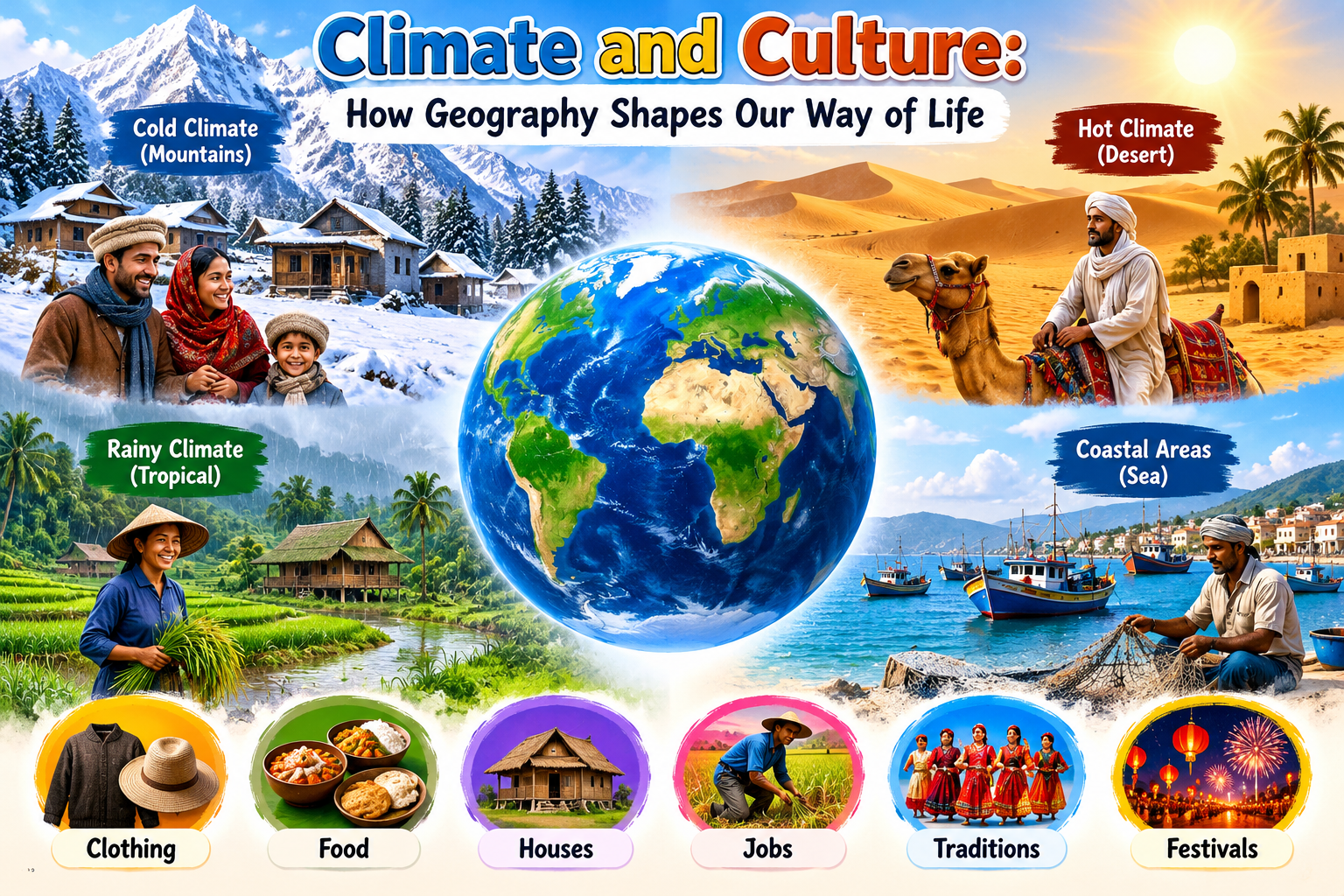
    # Climate and Culture: How Geography Shapes Our Way of Life

    Once upon a time, there was a beautiful village surrounded by tall mountains, green fields, and clear rivers. The people living there had a special way of life because of their climate and geography.

    In cold areas, people wore warm clothes, built strong houses, and enjoyed hot meals. In hot deserts, people wore light clothes, lived in specially designed homes, and drank plenty of water. In rainy regions, people used umbrellas, grew rice, and built houses to protect themselves from heavy rain.

    Geography also influenced people's food, jobs, traditions, and festivals. Farmers grew crops in fertile lands, while people living near the sea often worked as fishermen.

    One day, a young student named Ali realized that climate and geography shape how people live, work, dress, eat, and celebrate. Although people live in different environments, every culture is special and deserves respect.

    Moral: Our planet's diversity makes life beautiful. By understanding different climates and cultures, we can learn to respect and appreciate people around the world!
    Asma Shaheen EducationWali
    Saima Empowerment Wali
    Irum Asim Leadershipwali
    #rsisb Roll no.279 story post no.24 Foundation Level # 🌍 Climate and Culture: How Geography Shapes Our Way of Life 🌦️🏔️ Once upon a time, there was a beautiful village surrounded by tall mountains, green fields, and clear rivers. 🌳🏞️ The people living there had a special way of life because of their climate and geography. In cold areas, people wore warm clothes, built strong houses, and enjoyed hot meals. 🧥🏠☕ In hot deserts, people wore light clothes, lived in specially designed homes, and drank plenty of water. 🏜️☀️ In rainy regions, people used umbrellas, grew rice, and built houses to protect themselves from heavy rain. 🌧️☂️🌾 Geography also influenced people's food, jobs, traditions, and festivals. 🎭🍲 Farmers grew crops in fertile lands, while people living near the sea often worked as fishermen. 🌾🚜🐟 One day, a young student named Ali realized that climate and geography shape how people live, work, dress, eat, and celebrate. 🌎💚 Although people live in different environments, every culture is special and deserves respect. 🤝❤️ Moral: 🌱 Our planet's diversity makes life beautiful. By understanding different climates and cultures, we can learn to respect and appreciate people around the world! 🌍✨ Asma Shaheen EducationWali Saima Empowerment Wali Irum Asim Leadershipwali
    0 Commentarii 0 Distribuiri 1025 Views
  • RSIF8
    Roll no:14
    story no:24
    story topic:Climate and Culture: How Geography Shapes Our Way of Life

    # Climate and Culture: How Geography Shapes Our Way of Life

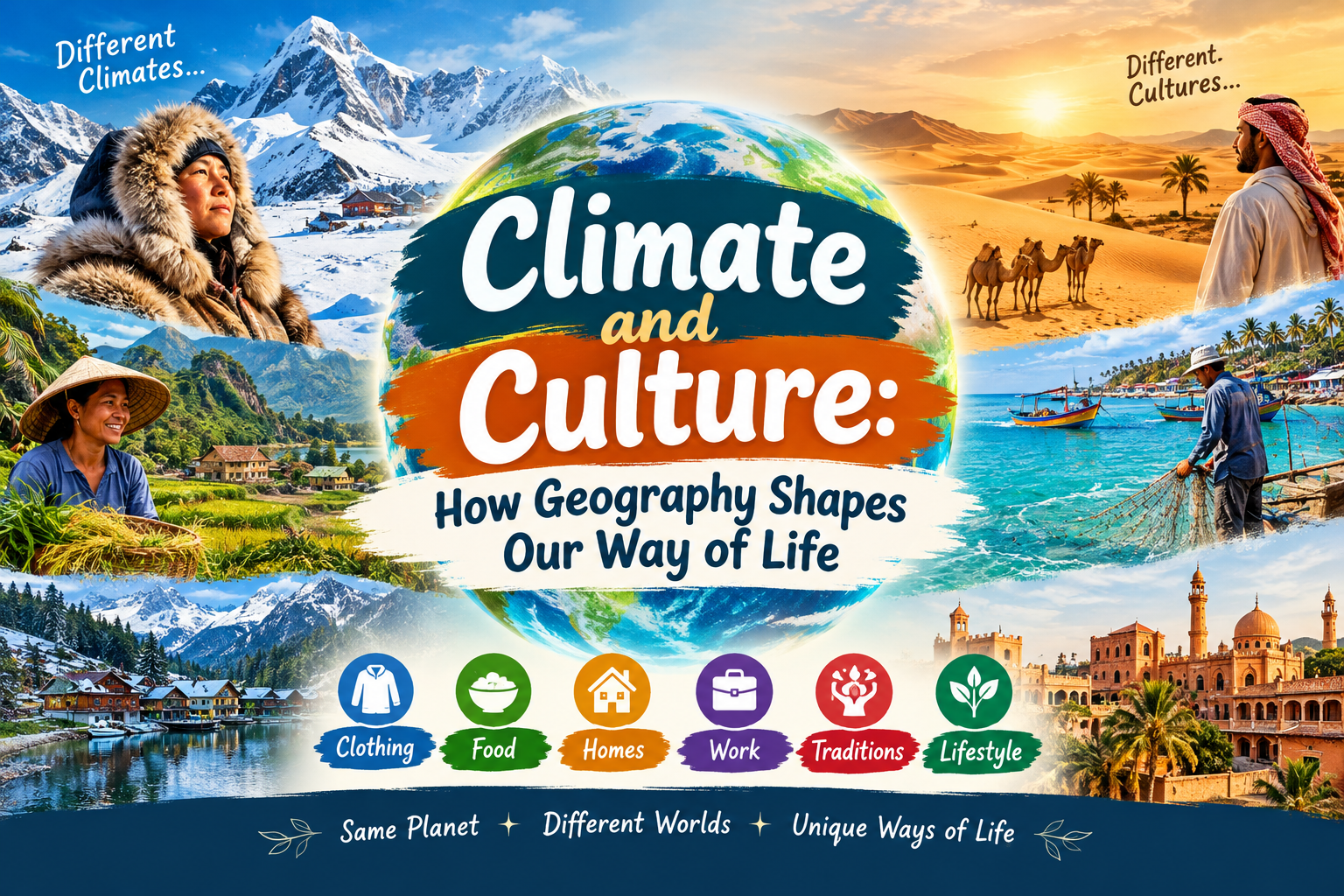
    How does the environment around us influence the way we live, dress, eat, work, and celebrate? **“Climate and Culture: How Geography Shapes Our Way of Life”** explores the fascinating relationship between climate, geography, and human culture. From freezing mountains to hot deserts, every region of the world has unique environmental conditions that shape the lifestyles, traditions, and customs of its people.

    Climate plays an important role in determining the types of clothing people wear, the food they eat, the houses they build, and the activities they enjoy. In colder regions, people often wear warm clothing and construct homes designed to retain heat. In hot areas, lightweight clothing and buildings that provide shade and ventilation help people adapt to high temperatures. Similarly, rainfall, soil fertility, and access to water influence agriculture, occupations, and local economies.

    Geography also contributes to the development of languages, festivals, architecture, and cultural traditions. Communities living near rivers and oceans may depend on fishing and maritime trade, while people in mountainous areas may develop traditions connected to farming, livestock, and mountain life. These differences make every culture unique and demonstrate how closely human societies are connected to the natural world.

    This topic helps students understand the importance of environmental adaptation, cultural diversity, and sustainable living. It encourages us to appreciate different ways of life and recognize how people respond creatively to the opportunities and challenges presented by their surroundings.

    **Discover how our planet shapes our traditions, influences our choices, and connects geography with the beautiful diversity of human life!**

    Watch, learn, and explore the incredible connection between climate, culture, and the world we share.

    #ClimateAndCulture #Geography #HumanGeography #ClimateChange #CulturalDiversity #Environment #WorldCultures #GeographyEducation #SocialStudies #NatureAndCulture #SustainableLiving #EducationalContent #LearningIsFun #OurWorld
    RSIF8 Roll no:14 story no:24 story topic:Climate and Culture: How Geography Shapes Our Way of Life # 🌍 Climate and Culture: How Geography Shapes Our Way of Life 🌦️🏡 How does the environment around us influence the way we live, dress, eat, work, and celebrate? **“Climate and Culture: How Geography Shapes Our Way of Life”** explores the fascinating relationship between climate, geography, and human culture. From freezing mountains to hot deserts, every region of the world has unique environmental conditions that shape the lifestyles, traditions, and customs of its people. 🌎✨ Climate plays an important role in determining the types of clothing people wear, the food they eat, the houses they build, and the activities they enjoy. In colder regions, people often wear warm clothing and construct homes designed to retain heat. In hot areas, lightweight clothing and buildings that provide shade and ventilation help people adapt to high temperatures. Similarly, rainfall, soil fertility, and access to water influence agriculture, occupations, and local economies. 🌧️🏔️☀️ Geography also contributes to the development of languages, festivals, architecture, and cultural traditions. Communities living near rivers and oceans may depend on fishing and maritime trade, while people in mountainous areas may develop traditions connected to farming, livestock, and mountain life. These differences make every culture unique and demonstrate how closely human societies are connected to the natural world. 🌊🌾 This topic helps students understand the importance of environmental adaptation, cultural diversity, and sustainable living. It encourages us to appreciate different ways of life and recognize how people respond creatively to the opportunities and challenges presented by their surroundings. 🌱🤝 💡 **Discover how our planet shapes our traditions, influences our choices, and connects geography with the beautiful diversity of human life!** 🌟 Watch, learn, and explore the incredible connection between climate, culture, and the world we share. #ClimateAndCulture #Geography #HumanGeography #ClimateChange #CulturalDiversity #Environment #WorldCultures #GeographyEducation #SocialStudies #NatureAndCulture #SustainableLiving #EducationalContent #LearningIsFun #OurWorld
    0 Commentarii 0 Distribuiri 3014 Views
  • RSIF8
    Roll no:14
    song no:14
    song topic:"You are never too old to set another goal or dream a new dream." — C.S. Lewis

    # The Physics of Everyday Life: How Science Affects Our World

    Discover the amazing connection between science and our everyday lives with **“The Physics of Everyday Life: How Science Affects Our World”** — an educational and inspiring song that explores how physics shapes the world around us!

    From the light that brightens our homes to the electricity that powers our devices, physics is everywhere. It explains gravity, motion, sound, heat, energy, and the fascinating forces that make our universe work.

    This song takes listeners on an exciting journey through the wonders of science, showing how physics helps us understand everyday activities, modern technology, transportation, and the natural world.

    Perfect for students, teachers, science enthusiasts, and curious minds, this song makes learning physics enjoyable, memorable, and fun. Let the rhythm of music inspire you to explore scientific discoveries, ask questions, and uncover the secrets of nature!

    **Learn through music, explore through science, and discover the physics behind every moment of life!**

    Listen, learn, and enjoy the incredible world of physics!

    **#Physics #EverydayPhysics #ScienceSong #EducationalMusic #LearnThroughMusic #ScienceEducation #PhysicsInDailyLife #STEMEducation #ScienceAndTechnology #LearningIsFun #EducationalSong #ExploreScience**
    RSIF8 Roll no:14 song no:14 song topic:"You are never too old to set another goal or dream a new dream." — C.S. Lewis # 🎵 The Physics of Everyday Life: How Science Affects Our World 🌍🔬 Discover the amazing connection between science and our everyday lives with **“The Physics of Everyday Life: How Science Affects Our World”** — an educational and inspiring song that explores how physics shapes the world around us! ⚡🎶 From the light that brightens our homes to the electricity that powers our devices, physics is everywhere. It explains gravity, motion, sound, heat, energy, and the fascinating forces that make our universe work. 🌞💡 This song takes listeners on an exciting journey through the wonders of science, showing how physics helps us understand everyday activities, modern technology, transportation, and the natural world. 🚗✈️🌊 Perfect for students, teachers, science enthusiasts, and curious minds, this song makes learning physics enjoyable, memorable, and fun. Let the rhythm of music inspire you to explore scientific discoveries, ask questions, and uncover the secrets of nature! 🧪📚 ✨ **Learn through music, explore through science, and discover the physics behind every moment of life!** 🎧 Listen, learn, and enjoy the incredible world of physics! **#Physics #EverydayPhysics #ScienceSong #EducationalMusic #LearnThroughMusic #ScienceEducation #PhysicsInDailyLife #STEMEducation #ScienceAndTechnology #LearningIsFun #EducationalSong #ExploreScience**
    0 Commentarii 0 Distribuiri 1911 Views 5
  • #rsisb
    Roll no.239
    Miss zoya no. 20
    Foundation Level

    Hello, everyone! Welcome to my new video. My name is Subhan, and I am a Foundation Level student at Rehan School Islamabad Bahria Campus. Today, I am very excited to share an interesting topic with you: **Red and Green**. In this video, I will explore these two beautiful colors, their meanings, their importance in our daily lives, and the different ways we see them in the world around us.
    Colors are an important part of our lives. Every day, we see different colors in nature, schools, homes, clothes, books, toys, flowers, fruits, and many other things. Colors make our world look beautiful, interesting, and full of life. They also help us recognize objects, understand signs, express creativity, and communicate different messages.
    ## The Meaning and Importance of Red
    Red is a bright, powerful, and eye-catching color. It is often associated with love, energy, courage, excitement, and strong emotions. We can see red in roses, apples, strawberries, tomatoes, flags, decorations, and many other things.
    Red is also important for safety. In traffic lights, red tells drivers and pedestrians to stop. Red warning signs can alert people to danger and remind them to be careful. This shows that colors are not only beautiful but can also help protect our lives.
    In art and drawing, red can make a picture look bold and attractive. Artists use red to highlight important objects, create contrast, and express different feelings. Red is also used in celebrations and decorations in many cultures around the world.
    ## The Meaning and Importance of Green
    Green is a refreshing and beautiful color that we often associate with nature, plants, trees, grass, and growth. When we look at green forests, gardens, and fields, we can see the beauty of the natural world.
    Green plants are very important for life on Earth. Plants help produce oxygen, provide food, support wildlife, and contribute to healthy ecosystems. Trees also provide shade and shelter for many living things. By planting trees, protecting forests, and keeping our surroundings clean, we can help care for our planet.
    Green is also used in traffic lights. A green signal generally means that traffic may proceed when it is safe to do so. Green symbols are often used to represent nature, environmental awareness, and environmentally friendly activities.
    In drawings and paintings, green helps artists show leaves, grass, gardens, mountains, and beautiful landscapes. It can make artwork look fresh, peaceful, and natural.
    ## Red and Green in Our Daily Lives
    \#RedAndGreen #JapaneseLearning #Aka #Midori #LearnJapanese #Colors #Education #StudentLife #Confidence #NewVideo #KeepLearning
    #rsisb Roll no.239 Miss zoya no. 20 Foundation Level Hello, everyone! Welcome to my new video. My name is Subhan, and I am a Foundation Level student at Rehan School Islamabad Bahria Campus. Today, I am very excited to share an interesting topic with you: **Red and Green**. In this video, I will explore these two beautiful colors, their meanings, their importance in our daily lives, and the different ways we see them in the world around us. Colors are an important part of our lives. Every day, we see different colors in nature, schools, homes, clothes, books, toys, flowers, fruits, and many other things. Colors make our world look beautiful, interesting, and full of life. They also help us recognize objects, understand signs, express creativity, and communicate different messages. ## 🔴 The Meaning and Importance of Red Red is a bright, powerful, and eye-catching color. It is often associated with love, energy, courage, excitement, and strong emotions. We can see red in roses, apples, strawberries, tomatoes, flags, decorations, and many other things. Red is also important for safety. In traffic lights, red tells drivers and pedestrians to stop. Red warning signs can alert people to danger and remind them to be careful. This shows that colors are not only beautiful but can also help protect our lives. In art and drawing, red can make a picture look bold and attractive. Artists use red to highlight important objects, create contrast, and express different feelings. Red is also used in celebrations and decorations in many cultures around the world. ## 🟢 The Meaning and Importance of Green Green is a refreshing and beautiful color that we often associate with nature, plants, trees, grass, and growth. When we look at green forests, gardens, and fields, we can see the beauty of the natural world. Green plants are very important for life on Earth. Plants help produce oxygen, provide food, support wildlife, and contribute to healthy ecosystems. Trees also provide shade and shelter for many living things. By planting trees, protecting forests, and keeping our surroundings clean, we can help care for our planet. Green is also used in traffic lights. A green signal generally means that traffic may proceed when it is safe to do so. Green symbols are often used to represent nature, environmental awareness, and environmentally friendly activities. In drawings and paintings, green helps artists show leaves, grass, gardens, mountains, and beautiful landscapes. It can make artwork look fresh, peaceful, and natural. ## 🌍 Red and Green in Our Daily Lives \#RedAndGreen #JapaneseLearning #Aka #Midori #LearnJapanese #Colors #Education #StudentLife #Confidence #NewVideo #KeepLearning
    0 Commentarii 0 Distribuiri 3185 Views 3
  • RSIf8
    Roll Number: 49
    Story post no.33
    Story post topic:Chemistry Quest — Elements of Everyday Life

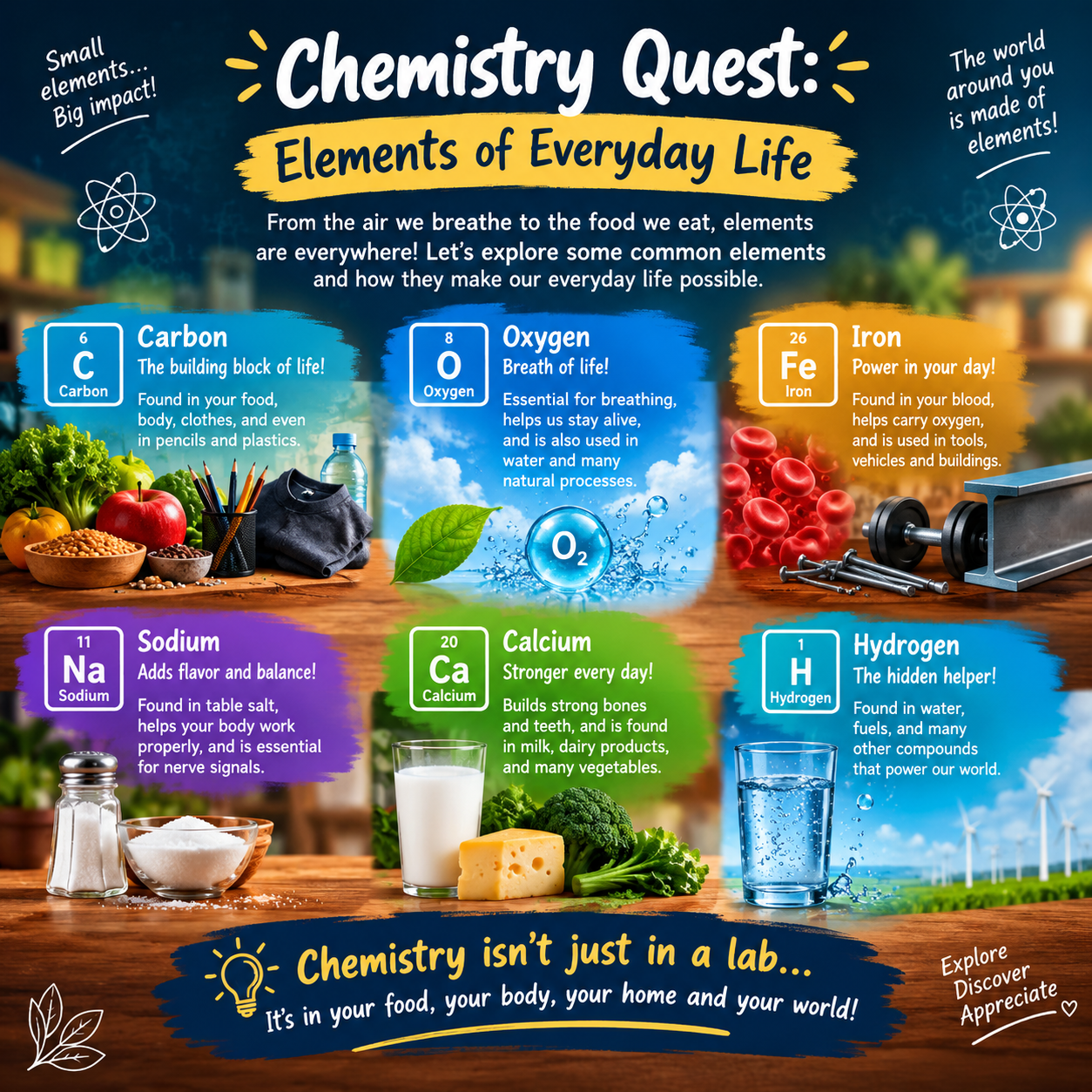
    Have you ever wondered how chemistry makes our everyday lives possible? From the air we breathe to the food we eat, chemical elements are all around us! This exciting story post explores the fascinating role of elements such as Carbon, Oxygen, Iron, Sodium, Calcium, and Hydrogen in our daily lives.

    Through this creative learning journey, I discovered how carbon is found in living things, oxygen is essential for breathing, iron helps our bodies carry oxygen, sodium supports important body functions, calcium strengthens our bones and teeth, and hydrogen is a key component of water.

    This activity helped me understand that chemistry is not limited to laboratories; it is an important part of our bodies, homes, nature, and the world around us. Learning about these elements makes science more interesting and helps us appreciate the wonders of everyday life!

    Small elements, big impact! Let's explore, discover, and appreciate the chemistry all around us.

    #ChemistryQuest #ElementsOfEverydayLife #Chemistry #ScienceEducation #ChemicalElements #Carbon #Oxygen #Iron #Sodium #Calcium #Hydrogen #CreativeLearning #ClassFoundation #RSf8
    RSIf8 Roll Number: 49 Story post no.33 Story post topic:Chemistry Quest — Elements of Everyday Life ⚗️✨ Have you ever wondered how chemistry makes our everyday lives possible? From the air we breathe to the food we eat, chemical elements are all around us! 🌿💧 This exciting story post explores the fascinating role of elements such as Carbon, Oxygen, Iron, Sodium, Calcium, and Hydrogen in our daily lives. Through this creative learning journey, I discovered how carbon is found in living things, oxygen is essential for breathing, iron helps our bodies carry oxygen, sodium supports important body functions, calcium strengthens our bones and teeth, and hydrogen is a key component of water. 🔬🧬 This activity helped me understand that chemistry is not limited to laboratories; it is an important part of our bodies, homes, nature, and the world around us. Learning about these elements makes science more interesting and helps us appreciate the wonders of everyday life! 💡📚 Small elements, big impact! Let's explore, discover, and appreciate the chemistry all around us. 🚀🌱 #ChemistryQuest #ElementsOfEverydayLife #Chemistry #ScienceEducation #ChemicalElements #Carbon #Oxygen #Iron #Sodium #Calcium #Hydrogen #CreativeLearning #ClassFoundation #RSf8
    0 Commentarii 0 Distribuiri 3198 Views
  • RSIF8
    Roll no:14
    story no:24
    story topic:The Nature of Light: Exploring Waves and Particles

    **The Nature of Light: Exploring Waves and Particles**

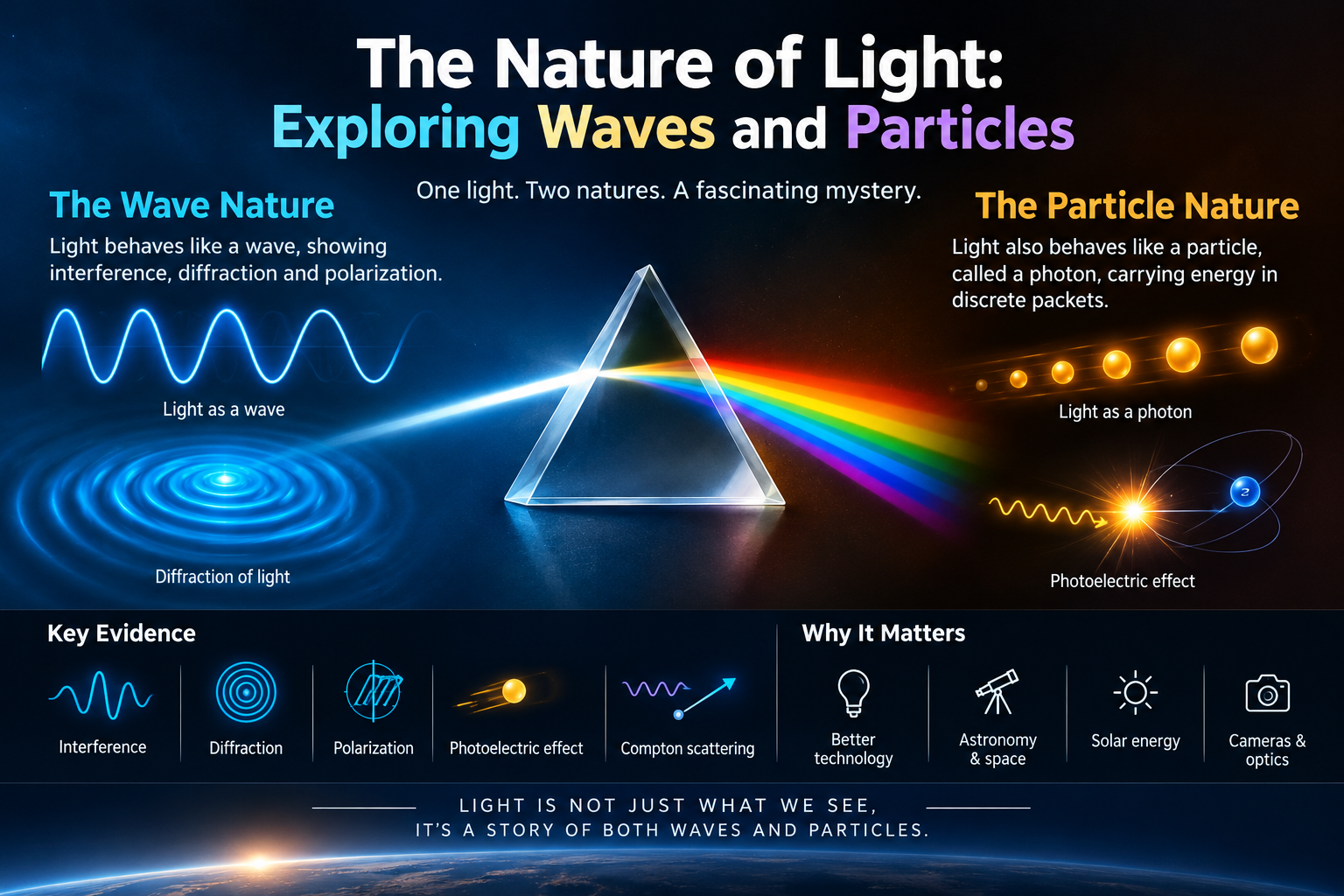
    Have you ever wondered what light really is? How does sunlight travel across millions of kilometers through space, how do rainbows form, and how can light behave like both a wave and a particle? The nature of light is one of the most fascinating topics in physics, revealing the extraordinary connection between the visible world and the mysterious laws of quantum mechanics. From the light that illuminates our homes to the distant stars shining in the universe, light plays an essential role in understanding the world around us.

    **1. The Wave Nature of Light **

    For many years, scientists have studied light as a wave because it demonstrates important wave-like properties. Light can undergo interference, diffraction, and polarization. Interference occurs when light waves overlap and combine, producing patterns of brightness and darkness. Diffraction happens when light spreads around an obstacle or passes through a narrow opening. Polarization describes the orientation of light's oscillations and helps us understand how light interacts with different materials.

    These properties demonstrate that the wave model is essential for explaining many optical phenomena. From colorful patterns created by thin films to the operation of polarized sunglasses, the wave nature of light has many applications in everyday life and modern technology.

    **2. The Particle Nature of Light **

    Light also behaves in ways that reveal its particle nature. In quantum physics, light energy is exchanged in discrete packets called **photons**. Each photon carries energy determined by its frequency, described by the equation **E = hf**, where E represents energy, h is Planck's constant, and f is frequency.

    The photoelectric effect provides important evidence for this particle nature. When light of a suitable frequency strikes certain materials, it can release electrons from their surfaces. This phenomenon helped scientists understand that light energy is transferred in individual quanta rather than always behaving like a continuous wave.

    Another important example is Compton scattering, in which photons exchange energy and momentum with electrons. These discoveries transformed our understanding of light and helped establish the foundations of quantum physics.

    **3. Wave-Particle Duality: Two Sides of Light**

    One of the most remarkable discoveries in science is that light cannot be fully explained by treating it only as a classical wave or only as a classical particle. Its behavior depends on the physical process being investigated and how it is measured. This concept is known as **wave-particle duality**.

    Experiments involving interference reveal wave-like patterns, while experiments involving photon detection show that light energy is detected in discrete units. Quantum mechanics brings these observations together into a more complete description of nature. Rather than being an ordinary wave or a tiny classical object, light is a quantum phenomenon with properties that challenge our everyday intuition.

    **4. How Do We Discover the Secrets of Light?**

    Scientists use carefully designed experiments to explore the behavior of light. Prisms separate white light into different colors, optical instruments measure its properties, and advanced detectors record individual photons. Interference experiments reveal patterns that cannot be explained by simple particle models, while photoelectric experiments demonstrate the importance of quantized energy.

    The work of scientists such as Isaac Newton, Thomas Young, Max Planck, Albert Einstein, and Arthur Compton helped build our modern understanding of light. Their discoveries show how scientific knowledge develops through observation, experimentation, mathematical reasoning, and new ideas.

    **5. Why Is the Nature of Light Important?**

    Understanding light is essential to many technologies that shape modern life. Lasers are used in medicine, manufacturing, and scientific research. Fiber-optic cables transmit information across the world using pulses of light. Solar panels convert light energy into electrical energy, while cameras and telescopes help us capture images and explore distant objects in space.

    The principles of light are also important in astronomy, microscopy, optical communication, quantum technologies, and the study of the universe. By investigating how light behaves, scientists can examine distant galaxies, study the structure of matter, and develop new tools that improve our understanding of nature.

    **6. Light: Connecting Science and the Universe**

    Light is much more than what allows us to see. It carries information about distant stars, reveals the composition of celestial objects, and provides clues about the physical processes occurring throughout the cosmos. By analyzing the light received from distant galaxies, astronomers can learn about their temperatures, chemical compositions, and motion.

    At the smallest scales, the study of photons helps scientists investigate the quantum world and understand how energy interacts with matter. From the smallest laboratory experiments to the largest astronomical observations, light connects different areas of science in extraordinary ways.

    **Conclusion: The Extraordinary Mystery of Light**

    The study of light demonstrates how nature can be far more complex than it first appears. Its wave-like properties explain interference, diffraction, and polarization, while its particle-like properties help explain the photoelectric effect and Compton scattering. Together, these discoveries form an important part of our modern understanding of physics.

    Learning about wave-particle duality encourages us to question assumptions, explore scientific evidence, and appreciate the discoveries that continue to expand human knowledge. Every beam of sunlight, every shining star, and every photon detected by a scientific instrument reminds us that there is still much to discover about the universe.

    **Light Is More Than What We See—It Is a Window into the Fundamental Nature of Reality!**

    If you enjoyed this science topic, share it with others and continue exploring the fascinating world of physics. Stay curious, keep asking questions, and never stop learning!

    #NatureOfLight #WaveParticleDuality #Physics #QuantumPhysics #ScienceEducation #Photons #LightWaves #PhotoelectricEffect #ComptonScattering #Optics #Astronomy #ScientificDiscoveries #STEMEducation #LearnPhysics #ScienceExplained #EducationalContent #WavesAndParticles
    RSIF8 Roll no:14 story no:24 story topic:The Nature of Light: Exploring Waves and Particles 🌟 **The Nature of Light: Exploring Waves and Particles** 🌈🔬 Have you ever wondered what light really is? How does sunlight travel across millions of kilometers through space, how do rainbows form, and how can light behave like both a wave and a particle? The nature of light is one of the most fascinating topics in physics, revealing the extraordinary connection between the visible world and the mysterious laws of quantum mechanics. From the light that illuminates our homes to the distant stars shining in the universe, light plays an essential role in understanding the world around us. 🌍✨ 💡 **1. The Wave Nature of Light 🌊** For many years, scientists have studied light as a wave because it demonstrates important wave-like properties. Light can undergo interference, diffraction, and polarization. Interference occurs when light waves overlap and combine, producing patterns of brightness and darkness. Diffraction happens when light spreads around an obstacle or passes through a narrow opening. Polarization describes the orientation of light's oscillations and helps us understand how light interacts with different materials. These properties demonstrate that the wave model is essential for explaining many optical phenomena. From colorful patterns created by thin films to the operation of polarized sunglasses, the wave nature of light has many applications in everyday life and modern technology. ⚛️ **2. The Particle Nature of Light ✨** Light also behaves in ways that reveal its particle nature. In quantum physics, light energy is exchanged in discrete packets called **photons**. Each photon carries energy determined by its frequency, described by the equation **E = hf**, where E represents energy, h is Planck's constant, and f is frequency. The photoelectric effect provides important evidence for this particle nature. When light of a suitable frequency strikes certain materials, it can release electrons from their surfaces. This phenomenon helped scientists understand that light energy is transferred in individual quanta rather than always behaving like a continuous wave. Another important example is Compton scattering, in which photons exchange energy and momentum with electrons. These discoveries transformed our understanding of light and helped establish the foundations of quantum physics. 🔬 **3. Wave-Particle Duality: Two Sides of Light** One of the most remarkable discoveries in science is that light cannot be fully explained by treating it only as a classical wave or only as a classical particle. Its behavior depends on the physical process being investigated and how it is measured. This concept is known as **wave-particle duality**. Experiments involving interference reveal wave-like patterns, while experiments involving photon detection show that light energy is detected in discrete units. Quantum mechanics brings these observations together into a more complete description of nature. Rather than being an ordinary wave or a tiny classical object, light is a quantum phenomenon with properties that challenge our everyday intuition. 🌈 **4. How Do We Discover the Secrets of Light?** Scientists use carefully designed experiments to explore the behavior of light. Prisms separate white light into different colors, optical instruments measure its properties, and advanced detectors record individual photons. Interference experiments reveal patterns that cannot be explained by simple particle models, while photoelectric experiments demonstrate the importance of quantized energy. The work of scientists such as Isaac Newton, Thomas Young, Max Planck, Albert Einstein, and Arthur Compton helped build our modern understanding of light. Their discoveries show how scientific knowledge develops through observation, experimentation, mathematical reasoning, and new ideas. 🚀 **5. Why Is the Nature of Light Important?** Understanding light is essential to many technologies that shape modern life. Lasers are used in medicine, manufacturing, and scientific research. Fiber-optic cables transmit information across the world using pulses of light. Solar panels convert light energy into electrical energy, while cameras and telescopes help us capture images and explore distant objects in space. The principles of light are also important in astronomy, microscopy, optical communication, quantum technologies, and the study of the universe. By investigating how light behaves, scientists can examine distant galaxies, study the structure of matter, and develop new tools that improve our understanding of nature. 🌍 **6. Light: Connecting Science and the Universe** Light is much more than what allows us to see. It carries information about distant stars, reveals the composition of celestial objects, and provides clues about the physical processes occurring throughout the cosmos. By analyzing the light received from distant galaxies, astronomers can learn about their temperatures, chemical compositions, and motion. At the smallest scales, the study of photons helps scientists investigate the quantum world and understand how energy interacts with matter. From the smallest laboratory experiments to the largest astronomical observations, light connects different areas of science in extraordinary ways. 💫 **Conclusion: The Extraordinary Mystery of Light** The study of light demonstrates how nature can be far more complex than it first appears. Its wave-like properties explain interference, diffraction, and polarization, while its particle-like properties help explain the photoelectric effect and Compton scattering. Together, these discoveries form an important part of our modern understanding of physics. Learning about wave-particle duality encourages us to question assumptions, explore scientific evidence, and appreciate the discoveries that continue to expand human knowledge. Every beam of sunlight, every shining star, and every photon detected by a scientific instrument reminds us that there is still much to discover about the universe. ✨ **Light Is More Than What We See—It Is a Window into the Fundamental Nature of Reality!** 🔭🌌 👍 If you enjoyed this science topic, share it with others and continue exploring the fascinating world of physics. Stay curious, keep asking questions, and never stop learning! #NatureOfLight #WaveParticleDuality #Physics #QuantumPhysics #ScienceEducation #Photons #LightWaves #PhotoelectricEffect #ComptonScattering #Optics #Astronomy #ScientificDiscoveries #STEMEducation #LearnPhysics #ScienceExplained #EducationalContent #WavesAndParticles 🌈🔬🚀

    0 Commentarii 0 Distribuiri 6863 Views
Sponsorizeaza Paginile