• RSIF8
    Roll no 94
    Call annie no 14
    Call annie topic
    Just had an insightful 25-minute conversation with Annie on "Whatever – A Journey Through Indifference." We explored how the word "whatever" can reflect indifference, affect relationships, influence communication, and shape our attitude toward life.

    This discussion helped me understand the importance of being present, caring about others, and expressing thoughts with intention rather than dismissing situations with a simple "whatever." Every conversation is an opportunity to learn, grow, and connect.

    Thank you to everyone who joined the live session and shared their thoughts! Your support and engagement make these discussions even more meaningful.

    #WhateverAJourneyThroughIndifference #LiveDiscussion #TalkWithAnnie #PersonalGrowth #CommunicationSkills #MindsetMatters #LearningJourney #SelfAwareness #YouthDevelopment #SocialMediaLive #PositiveThinking #GrowthMindset #Inspiration #Education #PakistanZindabad
    RSIF8 Roll no 94 Call annie no 14 Call annie topic 🎙️✨ Just had an insightful 25-minute conversation with Annie on "Whatever – A Journey Through Indifference." We explored how the word "whatever" can reflect indifference, affect relationships, influence communication, and shape our attitude toward life. 🌱💭 This discussion helped me understand the importance of being present, caring about others, and expressing thoughts with intention rather than dismissing situations with a simple "whatever." Every conversation is an opportunity to learn, grow, and connect. 🤝💡 Thank you to everyone who joined the live session and shared their thoughts! Your support and engagement make these discussions even more meaningful. ❤️🎥 #WhateverAJourneyThroughIndifference #LiveDiscussion #TalkWithAnnie #PersonalGrowth #CommunicationSkills #MindsetMatters #LearningJourney #SelfAwareness #YouthDevelopment #SocialMediaLive #PositiveThinking #GrowthMindset #Inspiration #Education #PakistanZindabad 🇵🇰✨
    0 Yorumlar 0 hisse senetleri 192 Views 4
  • **Roll No: 2**
    **Batch: 14**
    **Book: ACCL**
    **Task No: 145**

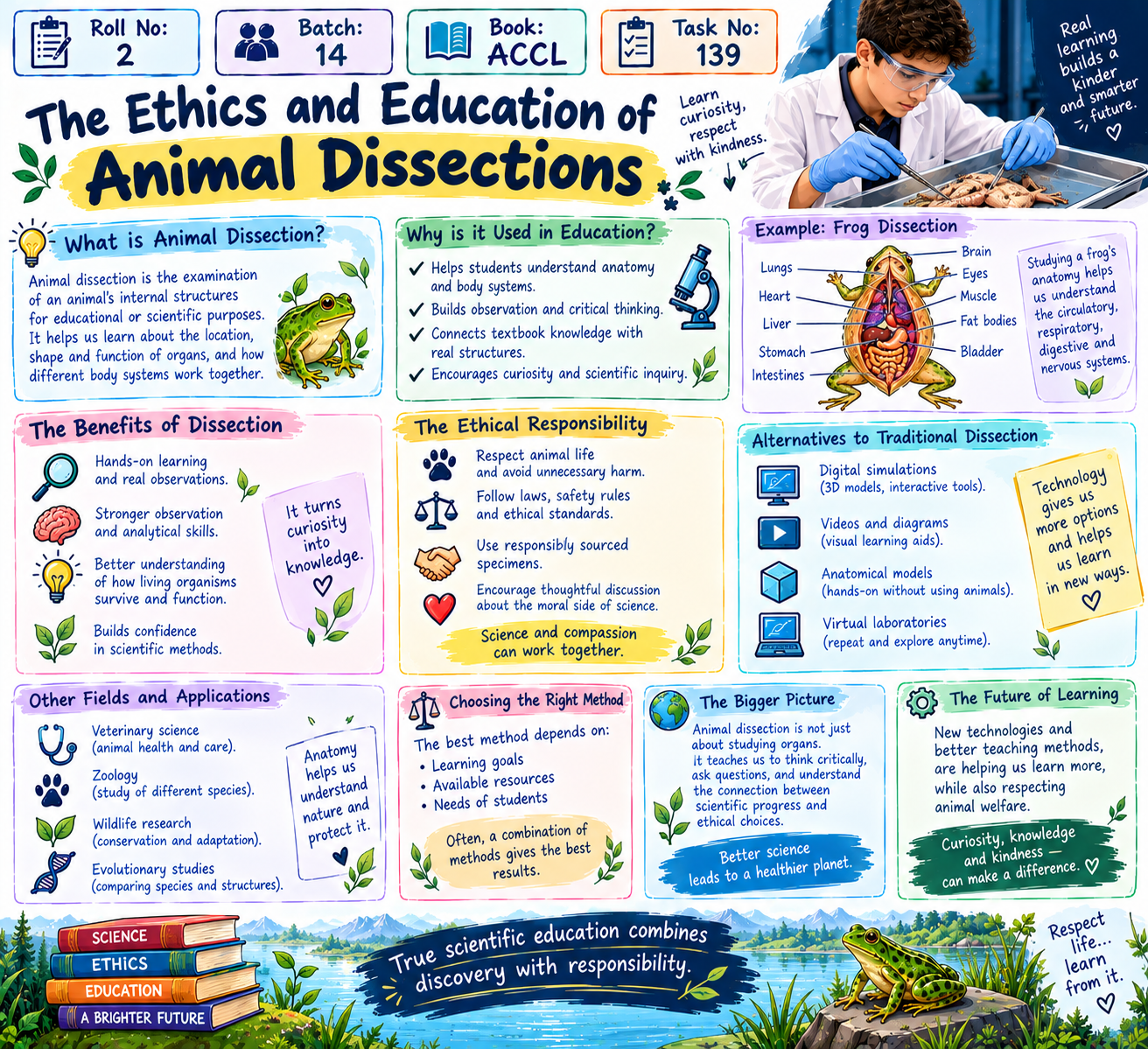
    # The Ethics and Education of Animal Dissections

    Have you ever wondered how students learn about the internal structures of animals and why science education places importance on understanding life responsibly? Animal dissection has been used in biology classrooms and scientific research to help learners explore anatomy, examine organs, and understand how different body systems function. However, it also raises important questions about animal welfare, ethical responsibility, and the best ways to teach scientific concepts.

    **Animal dissection is the examination of an animal's internal structures for educational or scientific purposes.** By studying anatomy, students can learn how organs are arranged and how body systems work together. For example, examining the anatomy of a frog can help learners understand the circulatory, respiratory, digestive, and nervous systems. These observations connect information from textbooks with the physical structures found in living organisms.

    One major benefit of dissection is that it encourages active learning. Instead of only memorizing the names of organs, students can observe anatomical structures, compare their shapes and positions, and ask questions about their functions. This process can strengthen observation skills, critical thinking, and scientific understanding. It also helps learners recognize that every organ has a role in supporting the survival of an organism.

    Nevertheless, **education must balance scientific learning with respect for animal life.** Animals are living organisms with their own biological needs, and their use in education should be considered carefully. Teachers and institutions should follow applicable laws, safety rules, and ethical standards. Specimens should be obtained responsibly, and unnecessary harm should be avoided. Students should also be encouraged to discuss the moral responsibilities that accompany scientific discovery.

    Fortunately, modern technology provides several alternatives to traditional dissection. Digital simulations allow students to explore three-dimensional anatomical models, examine virtual organs, and study body systems through interactive activities. Videos, diagrams, anatomical models, and virtual laboratories can also make complex concepts easier to understand. These approaches may reduce the need for physical specimens while offering flexible opportunities for repeated learning.

    The best educational method can depend on the learning objective, available resources, and the needs of students. A physical specimen may provide certain observations that a diagram cannot fully reproduce, while a digital model may allow students to rotate structures, zoom in on details, and repeat an activity without using another specimen. Combining different teaching methods can provide a richer understanding of anatomy and biology.

    Animal dissection also connects classroom education with wider scientific fields. Knowledge of anatomy contributes to veterinary science, zoology, wildlife research, and the study of animal health. Comparing anatomical structures across species can help scientists investigate adaptation and evolutionary relationships. Such knowledge can also support conservation efforts by improving our understanding of animals and the environments in which they live.

    Ethics should remain an important part of every scientific learning experience. Students should be able to ask questions, understand why a particular method is being used, and learn about alternatives where appropriate. Teachers can create respectful classrooms by explaining the educational purpose of activities, ensuring proper supervision, and encouraging thoughtful discussion. Scientific progress is strongest when curiosity is combined with compassion and responsibility.

    Another important lesson is that science continues to develop. New technologies and educational methods provide opportunities to improve the way anatomy is taught. By evaluating the effectiveness of different approaches, educators can choose methods that support learning while taking animal welfare seriously. This ongoing evaluation reflects the scientific habit of questioning, testing, and improving established practices.

    Ultimately, the ethics and education of animal dissections are about more than studying organs. They encourage students to think critically about scientific methods, recognize the value of responsible research, and understand the relationship between knowledge and moral choices. Learning biology should deepen both our understanding of nature and our respect for living organisms.

    **True scientific education combines discovery with responsibility. By studying anatomy thoughtfully, considering ethical alternatives, and respecting animal welfare, we can develop knowledgeable learners who value both scientific progress and the natural world. **

    #AnimalDissection #AnimalEthics #Biology #ScienceEducation #AnimalWelfare #Anatomy #ACCL #Batch14 #Task139
    **Roll No: 2** **Batch: 14** **Book: ACCL** **Task No: 145** # 🐸🔬 The Ethics and Education of Animal Dissections 🌿📚 Have you ever wondered how students learn about the internal structures of animals and why science education places importance on understanding life responsibly? 🧬🔍 Animal dissection has been used in biology classrooms and scientific research to help learners explore anatomy, examine organs, and understand how different body systems function. However, it also raises important questions about animal welfare, ethical responsibility, and the best ways to teach scientific concepts. **Animal dissection is the examination of an animal's internal structures for educational or scientific purposes.** 🔬 By studying anatomy, students can learn how organs are arranged and how body systems work together. For example, examining the anatomy of a frog can help learners understand the circulatory, respiratory, digestive, and nervous systems. These observations connect information from textbooks with the physical structures found in living organisms. 🐸🫀 One major benefit of dissection is that it encourages active learning. 📖 Instead of only memorizing the names of organs, students can observe anatomical structures, compare their shapes and positions, and ask questions about their functions. This process can strengthen observation skills, critical thinking, and scientific understanding. It also helps learners recognize that every organ has a role in supporting the survival of an organism. Nevertheless, **education must balance scientific learning with respect for animal life.** 💚 Animals are living organisms with their own biological needs, and their use in education should be considered carefully. Teachers and institutions should follow applicable laws, safety rules, and ethical standards. Specimens should be obtained responsibly, and unnecessary harm should be avoided. Students should also be encouraged to discuss the moral responsibilities that accompany scientific discovery. ⚖️🌱 Fortunately, modern technology provides several alternatives to traditional dissection. 💻🧬 Digital simulations allow students to explore three-dimensional anatomical models, examine virtual organs, and study body systems through interactive activities. Videos, diagrams, anatomical models, and virtual laboratories can also make complex concepts easier to understand. These approaches may reduce the need for physical specimens while offering flexible opportunities for repeated learning. The best educational method can depend on the learning objective, available resources, and the needs of students. 🏫 A physical specimen may provide certain observations that a diagram cannot fully reproduce, while a digital model may allow students to rotate structures, zoom in on details, and repeat an activity without using another specimen. Combining different teaching methods can provide a richer understanding of anatomy and biology. Animal dissection also connects classroom education with wider scientific fields. 🏥 Knowledge of anatomy contributes to veterinary science, zoology, wildlife research, and the study of animal health. Comparing anatomical structures across species can help scientists investigate adaptation and evolutionary relationships. Such knowledge can also support conservation efforts by improving our understanding of animals and the environments in which they live. 🌍🐦 Ethics should remain an important part of every scientific learning experience. Students should be able to ask questions, understand why a particular method is being used, and learn about alternatives where appropriate. Teachers can create respectful classrooms by explaining the educational purpose of activities, ensuring proper supervision, and encouraging thoughtful discussion. Scientific progress is strongest when curiosity is combined with compassion and responsibility. 🤝💚 Another important lesson is that science continues to develop. 🔬 New technologies and educational methods provide opportunities to improve the way anatomy is taught. By evaluating the effectiveness of different approaches, educators can choose methods that support learning while taking animal welfare seriously. This ongoing evaluation reflects the scientific habit of questioning, testing, and improving established practices. Ultimately, the ethics and education of animal dissections are about more than studying organs. They encourage students to think critically about scientific methods, recognize the value of responsible research, and understand the relationship between knowledge and moral choices. 🌿📚 Learning biology should deepen both our understanding of nature and our respect for living organisms. **True scientific education combines discovery with responsibility. By studying anatomy thoughtfully, considering ethical alternatives, and respecting animal welfare, we can develop knowledgeable learners who value both scientific progress and the natural world. 🐸🔬🌎💚** #AnimalDissection #AnimalEthics #Biology #ScienceEducation #AnimalWelfare #Anatomy #ACCL #Batch14 #Task139 🐸🧬📚
    0 Yorumlar 0 hisse senetleri 362 Views
  • #rsisb Foundation level student. Roll no:232 Documentary NO:10 🌿🌱 **Documentary — The Secret Lives of Plants: Communication and Interaction** 🎬🔬 Welcome to the fascinating hidden world of plants! 🌍✨ In this documentary, *The Secret Lives of Plants: Communication and Interaction*, we explore how plants interact with their environment and respond to the world around them. Did you know that plants can send chemical signals, respond to light, and interact with insects, animals, and other plants? 🌻🐝 Through their roots, leaves, and chemical signals, plants can respond to environmental changes and participate in complex ecological relationships. Discover how trees and other plants can exchange chemical signals, how some plants attract pollinators, and how roots interact with beneficial fungi in the soil. 🍄🌳 Learn how these amazing processes help plants survive, grow, reproduce, and contribute to healthy ecosystems. This documentary reveals that plants are far more fascinating than they may appear. By understanding their interactions, we can appreciate the complexity of nature and the importance of protecting our planet's biodiversity. 🌎💚 Join me on this exciting scientific journey and uncover the secrets of the green world! 🔍🌿 **Explore Nature, Discover Science, and Protect Our Planet! 🌍💚** #SecretLivesOfPlants #PlantCommunication #PlantScience #Botany #NatureDocumentary #PlantInteraction #Ecology #Biodiversity #EnvironmentalScience #AmazingNature #ScientificDiscovery #ScienceEducation #EducationalDocumentary #ProtectNature #LearnWithAI 🌿🌳🔬🐝🍄🌎✨ Irum Asim Leadershipwali Asma Shaheen EducationWali Rehan School Islamabad Campus https://www.facebook.com/share/v/19eC4rjQ7J/
    WWW.FACEBOOK.COM
    Facebook
    #rsisb Foundation level student. Roll no:232 Documentary NO:10 🌿🌱 **Documentary — The Secret Lives of Plants: Communication and Interaction** 🎬🔬 Welcome to the fascinating hidden world of plants!...
    0 Yorumlar 0 hisse senetleri 219 Views
  • #rsisb Foundation level student. Roll no:232 Documentary NO:8 ❤️🌍 **Documentary — The Power of Kindness in Communities** 🤝✨ Welcome to an inspiring journey exploring the power of kindness and its impact on our communities! 🎬💖 In this documentary, *The Power of Kindness in Communities*, we discover how small acts of kindness can create meaningful changes in people's lives and bring communities closer together. From helping someone in need and supporting our neighbors to sharing knowledge and showing respect, kindness builds trust, strengthens relationships, and creates a sense of belonging. 🫶🌟 Even the smallest good deed can inspire others to spread positivity and make the world a better place. We will explore how empathy, cooperation, generosity, and compassion can help overcome challenges and create stronger, happier, and more supportive communities. 🌈🤝 When people care for one another, everyone has the opportunity to grow and thrive. Join me on this meaningful journey and discover how we can make a difference through simple acts of kindness every day. 🌎💫 **Be Kind, Spread Love, and Make a Difference! ❤️🌍** #PowerOfKindness #KindnessMatters #CommunitySupport #SpreadKindness #Compassion #Empathy #HelpingOthers #PositiveImpact #Humanity #SocialResponsibility #StrongerCommunities #InspirationalDocumentary #EducationalVideo #BeKind #MakeADifference ❤️🤝🌈🌍✨ Irum Asim Leadershipwali Asma Shaheen EducationWali Rehan School Islamabad Campus https://www.facebook.com/share/v/1Ctn4d3tPs/
    WWW.FACEBOOK.COM
    Facebook
    #rsisb Foundation level student. Roll no:232 Documentary NO:8 ❤️🌍 **Documentary — The Power of Kindness in Communities** 🤝✨ Welcome to an inspiring journey exploring the power of kindness and its...
    0 Yorumlar 0 hisse senetleri 191 Views
  • **Roll No: 2**
    **Batch: 14**
    **Book: ACCL**
    **Task No: 138**

    # Exploring Life’s Mechanisms Through Experimentation

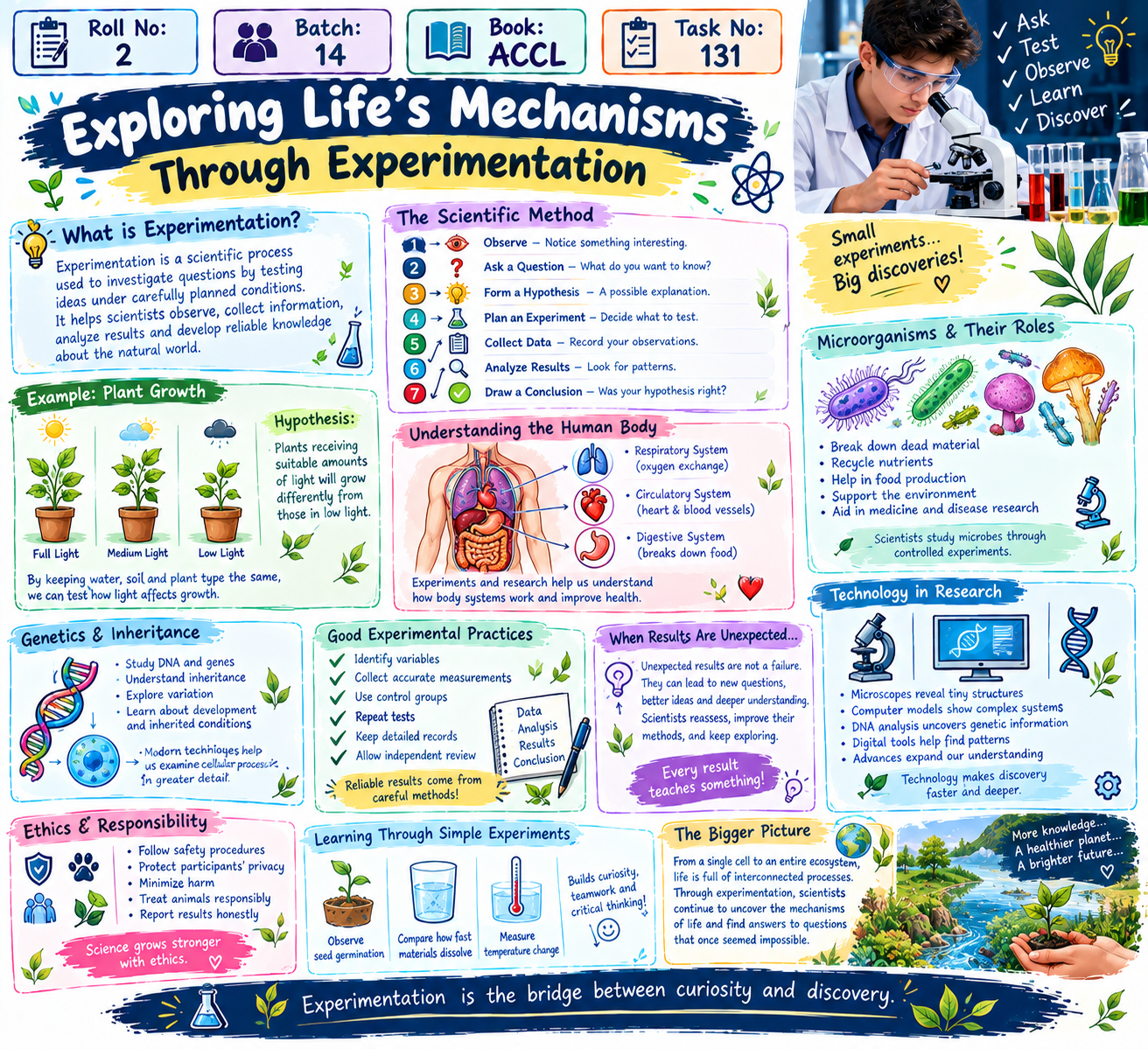
    Have you ever wondered how scientists discover the secrets of life? From understanding how plants grow to investigating how the human heart works, science helps us explore the processes that make living organisms function. Behind many important discoveries lies a powerful method called **experimentation**, which allows scientists to test ideas, observe results, and develop a deeper understanding of the natural world.

    **Experimentation is a scientific process used to investigate questions by testing ideas under carefully planned conditions.** Scientists begin by observing something interesting, asking a question, and developing a hypothesis—a possible explanation that can be tested. They then design an experiment, collect information, and analyze the results to determine whether the evidence supports their original idea. This process helps turn curiosity into reliable scientific knowledge.

    One fascinating example is the study of plant growth. Imagine a student who wants to discover whether the amount of light affects how quickly a plant grows. The student forms a hypothesis that plants receiving suitable amounts of light will grow differently from plants kept in low-light conditions. By keeping factors such as water, soil, and plant type consistent, the student can compare the results and investigate the role of light in plant development.

    Experimentation is also essential for understanding the human body. Scientists investigate how the heart circulates blood, how the lungs exchange gases, and how the digestive system processes food. Through carefully designed studies, medical imaging, laboratory tests, and other research methods, scientists learn how body systems work together to maintain health. Their findings can contribute to improved medical treatments and a better understanding of human biology.

    Another important field is microbiology, the study of microscopic organisms. Many bacteria and fungi play beneficial roles in nature, including breaking down dead material and recycling nutrients. Scientists use controlled experiments to investigate how these organisms respond to different environmental conditions. Such research can help improve food production, develop medicines, understand infectious diseases, and protect ecosystems.

    Experiments also help researchers understand genetics and the mechanisms of inheritance. By studying DNA, genes, and the characteristics of organisms across generations, scientists investigate how biological information is passed on and how variations arise. Modern techniques allow researchers to explore cellular processes in greater detail, helping them understand development, inherited conditions, and the relationships among different forms of life.

    A successful experiment requires more than simply observing what happens. Scientists must identify the variables they are studying, collect accurate measurements, and repeat tests when appropriate. They often use control groups for comparison and record their observations carefully. Repeating experiments helps determine whether a result is consistent, while independent review allows other researchers to examine the methods and evaluate the conclusions. These practices make scientific findings more trustworthy.

    Sometimes experiments produce unexpected results. Instead of treating an unexpected outcome as a failure, scientists use it as an opportunity to ask new questions. They may reconsider their hypothesis, improve their experimental design, or investigate another possible explanation. Scientific progress often happens through this cycle of questioning, testing, learning, and refining ideas. Every result can contribute something valuable when it is interpreted carefully.

    Technology has made biological experimentation more advanced than ever before. Microscopes reveal structures too small to see with the naked eye, computer models help researchers understand complicated systems, and DNA analysis allows scientists to investigate genetic information. Digital tools can also help organize large amounts of data and identify patterns that might otherwise be difficult to notice. These innovations continue to expand our understanding of living organisms.

    However, scientific experimentation must always be guided by responsibility and ethics. Researchers should follow safety procedures, protect participants' privacy, minimize harm, and treat animals responsibly. Experiments involving people or animals require appropriate ethical review and safeguards. Scientists must also report results honestly, even when the findings do not match their expectations. Reliable science depends on both accurate evidence and responsible behavior.

    Experimentation connects classroom learning with real-world discoveries. Students can explore scientific ideas through safe activities, such as observing seed germination, comparing how quickly different materials dissolve in water, or measuring changes in temperature. These activities encourage curiosity, careful observation, teamwork, and critical thinking. They also show that science is not just a collection of facts to memorize; it is an ongoing process of discovery.

    As we explore life's mechanisms, we begin to understand how countless processes work together to support living organisms. From the activity inside a single cell to the interactions among species in an ecosystem, each discovery reveals another part of nature's complexity. Through experimentation, scientists continue to investigate these connections and search for answers to questions that once seemed impossible to solve.

    **Experimentation is the bridge between curiosity and discovery. By asking thoughtful questions, testing ideas fairly, and learning from evidence, we can uncover the mechanisms of life and use scientific knowledge to improve human health, protect the environment, and build a brighter future. **

    \#Experimentation #Biology #ScientificMethod #LifeSciences #ScientificDiscovery #Research #ACCL #Batch14 #Task131
    **Roll No: 2** **Batch: 14** **Book: ACCL** **Task No: 138** # 🔬🧪 Exploring Life’s Mechanisms Through Experimentation 🌱🧬 Have you ever wondered how scientists discover the secrets of life? 🌍 From understanding how plants grow to investigating how the human heart works, science helps us explore the processes that make living organisms function. Behind many important discoveries lies a powerful method called **experimentation**, which allows scientists to test ideas, observe results, and develop a deeper understanding of the natural world. 🔍✨ **Experimentation is a scientific process used to investigate questions by testing ideas under carefully planned conditions.** 🧪 Scientists begin by observing something interesting, asking a question, and developing a hypothesis—a possible explanation that can be tested. They then design an experiment, collect information, and analyze the results to determine whether the evidence supports their original idea. This process helps turn curiosity into reliable scientific knowledge. 📚💡 One fascinating example is the study of plant growth. 🌱 Imagine a student who wants to discover whether the amount of light affects how quickly a plant grows. The student forms a hypothesis that plants receiving suitable amounts of light will grow differently from plants kept in low-light conditions. By keeping factors such as water, soil, and plant type consistent, the student can compare the results and investigate the role of light in plant development. ☀️🌿 Experimentation is also essential for understanding the human body. ❤️ Scientists investigate how the heart circulates blood, how the lungs exchange gases, and how the digestive system processes food. Through carefully designed studies, medical imaging, laboratory tests, and other research methods, scientists learn how body systems work together to maintain health. Their findings can contribute to improved medical treatments and a better understanding of human biology. 🫁🧠 Another important field is microbiology, the study of microscopic organisms. 🦠 Many bacteria and fungi play beneficial roles in nature, including breaking down dead material and recycling nutrients. Scientists use controlled experiments to investigate how these organisms respond to different environmental conditions. Such research can help improve food production, develop medicines, understand infectious diseases, and protect ecosystems. 🔬🌍 Experiments also help researchers understand genetics and the mechanisms of inheritance. 🧬 By studying DNA, genes, and the characteristics of organisms across generations, scientists investigate how biological information is passed on and how variations arise. Modern techniques allow researchers to explore cellular processes in greater detail, helping them understand development, inherited conditions, and the relationships among different forms of life. 🌱🔍 A successful experiment requires more than simply observing what happens. Scientists must identify the variables they are studying, collect accurate measurements, and repeat tests when appropriate. 📏 They often use control groups for comparison and record their observations carefully. Repeating experiments helps determine whether a result is consistent, while independent review allows other researchers to examine the methods and evaluate the conclusions. These practices make scientific findings more trustworthy. 📊📝 Sometimes experiments produce unexpected results. 🤔 Instead of treating an unexpected outcome as a failure, scientists use it as an opportunity to ask new questions. They may reconsider their hypothesis, improve their experimental design, or investigate another possible explanation. Scientific progress often happens through this cycle of questioning, testing, learning, and refining ideas. Every result can contribute something valuable when it is interpreted carefully. 💡🔄 Technology has made biological experimentation more advanced than ever before. 🤖🔬 Microscopes reveal structures too small to see with the naked eye, computer models help researchers understand complicated systems, and DNA analysis allows scientists to investigate genetic information. Digital tools can also help organize large amounts of data and identify patterns that might otherwise be difficult to notice. These innovations continue to expand our understanding of living organisms. 💻🧬 However, scientific experimentation must always be guided by responsibility and ethics. 💚 Researchers should follow safety procedures, protect participants' privacy, minimize harm, and treat animals responsibly. Experiments involving people or animals require appropriate ethical review and safeguards. Scientists must also report results honestly, even when the findings do not match their expectations. Reliable science depends on both accurate evidence and responsible behavior. ⚖️🌿 Experimentation connects classroom learning with real-world discoveries. 🏫 Students can explore scientific ideas through safe activities, such as observing seed germination, comparing how quickly different materials dissolve in water, or measuring changes in temperature. These activities encourage curiosity, careful observation, teamwork, and critical thinking. They also show that science is not just a collection of facts to memorize; it is an ongoing process of discovery. 🌈🧪 As we explore life's mechanisms, we begin to understand how countless processes work together to support living organisms. From the activity inside a single cell to the interactions among species in an ecosystem, each discovery reveals another part of nature's complexity. Through experimentation, scientists continue to investigate these connections and search for answers to questions that once seemed impossible to solve. 🌎🦋🔬 **Experimentation is the bridge between curiosity and discovery. By asking thoughtful questions, testing ideas fairly, and learning from evidence, we can uncover the mechanisms of life and use scientific knowledge to improve human health, protect the environment, and build a brighter future. 🔬🧬🌍💚** \#Experimentation #Biology #ScientificMethod #LifeSciences #ScientificDiscovery #Research #ACCL #Batch14 #Task131 🧪🔬🌱

    0 Yorumlar 0 hisse senetleri 1276 Views
  • #rsisb
    Roll no. 247
    Story post . 24
    Foundation level

    **The Secret Lives of Plants: Communication and Interaction **

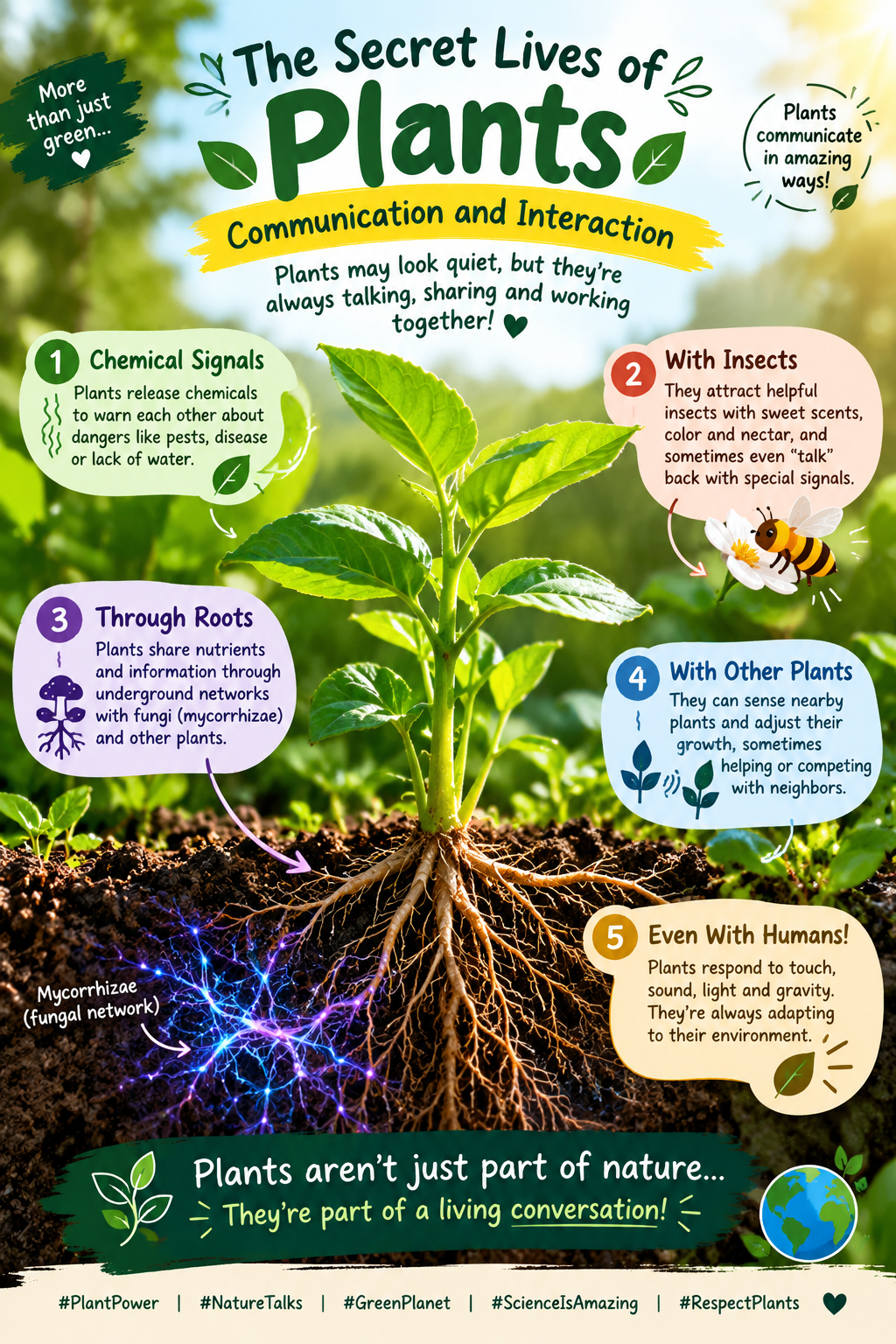
    Have you ever wondered if plants can communicate with each other? The world of plants is full of amazing secrets, hidden connections, and fascinating interactions! Although plants cannot speak like humans, they have incredible ways of responding to their surroundings and interacting with other living things.

    **How Do Plants Communicate?**

    Plants use different methods to exchange information with their environment. Some plants release chemical signals into the air when they are damaged by insects, which can help nearby plants prepare their own defenses. Plants can also send chemical signals through their roots and interact with helpful fungi living in the soil. These underground relationships help plants access nutrients and water, showing us how connected nature really is!

    **Plants and Their Amazing Partners**

    Plants have special relationships with insects, birds, animals, and microorganisms. Bees and butterflies visit flowers to collect nectar and pollen while helping plants reproduce through pollination. Birds and animals spread seeds to new places, allowing more plants to grow. Beneath the ground, roots, fungi, and tiny soil organisms work together to support healthy ecosystems. Every living thing has an important role in maintaining the balance of nature!

    **How Plants Respond to Their Environment**

    Plants may not walk from one place to another, but they can respond to sunlight, gravity, touch, temperature, and water. Sunflowers and many other plants show movements related to light, while roots generally grow toward sources of water and respond to gravity. Some plants even close their leaves when touched! These wonderful abilities help plants survive, grow, and adapt to changing conditions.

    **Why Should We Protect Plants?**

    Plants provide oxygen, food, shelter, and habitats for countless living organisms. They help maintain healthy soil, absorb carbon dioxide, and support biodiversity. By planting trees, growing flowers, protecting forests, saving water, and avoiding unnecessary damage to plants, we can help protect our beautiful planet. Even small actions can make a positive difference!

    **Let's Explore the Wonders of Nature!**

    Through *“The Secret Lives of Plants: Communication and Interaction,”* we discover that nature is much more connected than we might imagine. Plants are not simply decorations in our surroundings; they are living organisms that respond to their environment and participate in complex relationships with other species.

    Let’s keep asking questions, exploring science, observing nature, and learning something new every day! The more we understand plants, the more we appreciate the incredible world around us.

    **Question for Everyone:** Did you know that plants can respond to chemical signals and interact with fungi underground? Share your thoughts in the comments!

    Like, share, and comment to spread awareness about the amazing secret lives of plants!

    **Protect Nature. Respect Life. Keep Exploring!**

    #TheSecretLivesOfPlants #PlantCommunication #PlantScience #NatureLovers #AmazingPlants #ScienceEducation #PlantInteractions #NatureIsAmazing #EnvironmentalAwareness #Biodiversity #Ecosystems #PlantLife #GreenPlanet #SaveNature #ProtectOurPlanet #Biology #LearnSomethingNew #ScienceForEveryone #EducationalPost #StoryPost #PlantsAndNature #SustainableLiving #ExploreNature #RehanSchool #LearningWithAI
    #rsisb Roll no. 247 Story post . 24 Foundation level 🌿🌱 **The Secret Lives of Plants: Communication and Interaction 🌻🌳** 🌍✨ Have you ever wondered if plants can communicate with each other? 🤔🌿 The world of plants is full of amazing secrets, hidden connections, and fascinating interactions! 🌱💚 Although plants cannot speak like humans, they have incredible ways of responding to their surroundings and interacting with other living things. 🌻🦋 🌳💬 **How Do Plants Communicate?** Plants use different methods to exchange information with their environment. 🌿🌬️ Some plants release chemical signals into the air when they are damaged by insects, which can help nearby plants prepare their own defenses. 🐛🍃 Plants can also send chemical signals through their roots and interact with helpful fungi living in the soil. 🍄🌱 These underground relationships help plants access nutrients and water, showing us how connected nature really is! 🌍🤝 🌻🐝 **Plants and Their Amazing Partners** Plants have special relationships with insects, birds, animals, and microorganisms. 🦋🐝 Bees and butterflies visit flowers to collect nectar and pollen while helping plants reproduce through pollination. 🌺🐝 Birds and animals spread seeds to new places, allowing more plants to grow. 🐦🌳 Beneath the ground, roots, fungi, and tiny soil organisms work together to support healthy ecosystems. 🍄🌿 Every living thing has an important role in maintaining the balance of nature! 💚🌎 🌞💧 **How Plants Respond to Their Environment** Plants may not walk from one place to another, but they can respond to sunlight, gravity, touch, temperature, and water. ☀️🌱 Sunflowers and many other plants show movements related to light, while roots generally grow toward sources of water and respond to gravity. 🌻💦 Some plants even close their leaves when touched! 🌿👏 These wonderful abilities help plants survive, grow, and adapt to changing conditions. 🌎💚 **Why Should We Protect Plants?** Plants provide oxygen, food, shelter, and habitats for countless living organisms. 🌳🌍 They help maintain healthy soil, absorb carbon dioxide, and support biodiversity. 🐝🌼 By planting trees, growing flowers, protecting forests, saving water, and avoiding unnecessary damage to plants, we can help protect our beautiful planet. 🌱♻️ Even small actions can make a positive difference! 🔬📚 **Let's Explore the Wonders of Nature!** Through *“The Secret Lives of Plants: Communication and Interaction,”* we discover that nature is much more connected than we might imagine. 🌿✨ Plants are not simply decorations in our surroundings; they are living organisms that respond to their environment and participate in complex relationships with other species. 🌳💚 Let’s keep asking questions, exploring science, observing nature, and learning something new every day! 🔍🌱 The more we understand plants, the more we appreciate the incredible world around us. 🌍💫 💬 **Question for Everyone:** Did you know that plants can respond to chemical signals and interact with fungi underground? 🍄🌱 Share your thoughts in the comments! 👇😊 ❤️ Like, 🔄 share, and 💬 comment to spread awareness about the amazing secret lives of plants! 🌿 **Protect Nature. Respect Life. Keep Exploring!** 🌎💚 #TheSecretLivesOfPlants #PlantCommunication #PlantScience #NatureLovers #AmazingPlants #ScienceEducation #PlantInteractions #NatureIsAmazing #EnvironmentalAwareness #Biodiversity #Ecosystems #PlantLife #GreenPlanet #SaveNature #ProtectOurPlanet #Biology #LearnSomethingNew #ScienceForEveryone #EducationalPost #StoryPost #PlantsAndNature #SustainableLiving #ExploreNature #RehanSchool #LearningWithAI 🌿🌻🌎✨💚
    0 Yorumlar 0 hisse senetleri 987 Views
  • #rsisb
    Roll no. 247
    Story post . 23
    Foundation level

    **DNA Detectives: Unraveling the Double Helix Mystery **

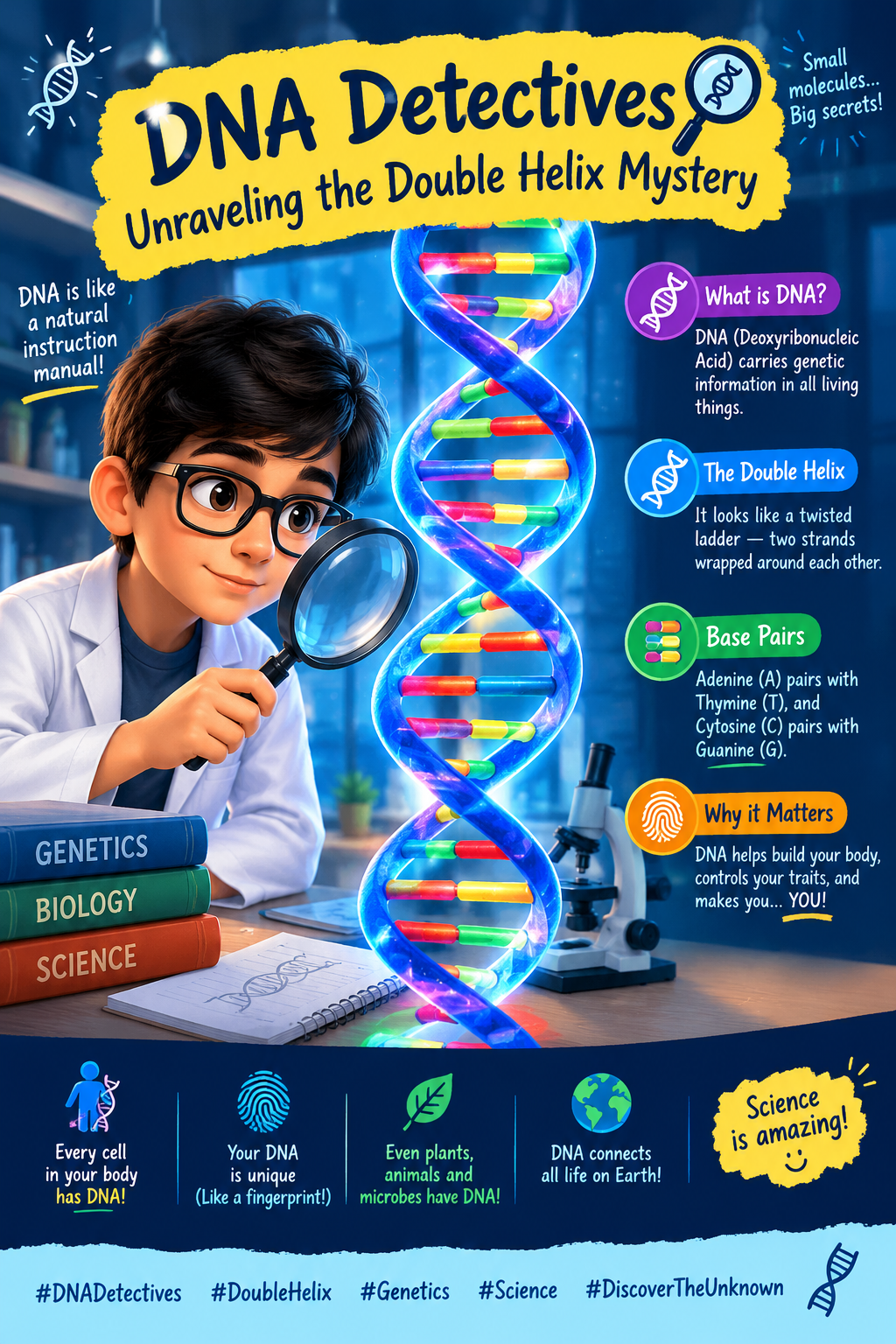
    Welcome to the fascinating world of DNA, where every tiny molecule holds amazing secrets about life! Get ready to become a DNA detective and explore one of the greatest mysteries in biology — the incredible structure of the double helix! ‍

    Have you ever wondered how your body knows how to grow, develop, and function? The answer lies in DNA, which stands for **Deoxyribonucleic Acid**. DNA contains the genetic instructions that help living organisms grow, survive, and pass characteristics from one generation to the next. ‍‍‍

    **What Is the Double Helix?**

    DNA has a special shape called a *double helix*, which looks like a twisted ladder! Its two strands twist around each other, while pairs of chemical bases form the steps of the ladder. These bases are adenine (A), thymine (T), cytosine (C), and guanine (G). The base-pairing rules are simple: A pairs with T, and C pairs with G. These tiny building blocks help store the instructions that make life possible!

    ‍ **Become a DNA Detective!**

    Imagine putting on your detective hat , picking up your scientific magnifying glass , and investigating the hidden clues inside every living cell! What can DNA tell us about living things? How does it copy its information? Why do family members sometimes share similar characteristics? These exciting questions lead us into the world of genetics, heredity, and molecular biology.

    ‍ Scientists James Watson, Francis Crick, Rosalind Franklin, and Maurice Wilkins played important roles in the scientific work that led to our understanding of DNA's structure. Rosalind Franklin's X-ray diffraction research provided crucial evidence about DNA's shape. Her contribution is an important part of this scientific story!

    **Why Is DNA Important?**

    DNA research helps scientists understand inherited conditions, study the diversity of life, investigate biological relationships, and develop new approaches in medicine and biotechnology. It also helps researchers learn how living organisms are connected and how life continues from one generation to another.

    **Amazing Science Fact:** Every cell in your body that contains a complete set of nuclear DNA carries an extraordinary amount of biological information! Your DNA is like a tiny instruction library that helps your cells perform their jobs.

    **The Mission:** Explore the double helix, discover the secrets of genetic information, ask questions, and keep your curiosity alive! Remember, every great scientific discovery begins with a question and the courage to investigate.

    Science makes the invisible visible, and DNA reminds us that some of life's greatest mysteries are hidden in the tiniest places. Keep learning, keep exploring, and become a young scientist who is ready to uncover the wonders of our world!

    **Share your thoughts!** What do you find most fascinating about DNA — its double-helix structure, its genetic code, or its role in living organisms? Tell us in the comments below!

    Like, share, and spread the excitement of science with friends, family, teachers, and fellow learners!

    **DNA Detectives: Every molecule has a story, and every discovery brings us closer to understanding life!**

    #DNADetectives #DNA #DoubleHelix #ScienceExploration #Biology #Genetics #MolecularBiology #RosalindFranklin #JamesWatson #FrancisCrick #ScienceEducation #LearnScience #YoungScientists #ScienceFacts #BiologyLovers #GeneticCode #ExploreScience #STEMEducation #Curiosity #DiscoverTheUnknown #EducationalContent #ScienceStory #KnowledgeIsPower #KeepLearning #FutureScientists
    #rsisb Roll no. 247 Story post . 23 Foundation level 🧬🔍 **DNA Detectives: Unraveling the Double Helix Mystery 🧬✨** Welcome to the fascinating world of DNA, where every tiny molecule holds amazing secrets about life! 🌍🔬 Get ready to become a DNA detective and explore one of the greatest mysteries in biology — the incredible structure of the double helix! 🕵️‍♂️🧬 Have you ever wondered how your body knows how to grow, develop, and function? 🤔💡 The answer lies in DNA, which stands for **Deoxyribonucleic Acid**. DNA contains the genetic instructions that help living organisms grow, survive, and pass characteristics from one generation to the next. 🌱👨‍👩‍👧‍👦 🔬 **What Is the Double Helix?** DNA has a special shape called a *double helix*, which looks like a twisted ladder! 🪜🌀 Its two strands twist around each other, while pairs of chemical bases form the steps of the ladder. These bases are adenine (A), thymine (T), cytosine (C), and guanine (G). 🧪 The base-pairing rules are simple: A pairs with T, and C pairs with G. These tiny building blocks help store the instructions that make life possible! 🌟 🕵️‍♀️ **Become a DNA Detective!** Imagine putting on your detective hat 🕵️, picking up your scientific magnifying glass 🔎, and investigating the hidden clues inside every living cell! What can DNA tell us about living things? How does it copy its information? Why do family members sometimes share similar characteristics? These exciting questions lead us into the world of genetics, heredity, and molecular biology. 🧬📚 👩‍🔬 Scientists James Watson, Francis Crick, Rosalind Franklin, and Maurice Wilkins played important roles in the scientific work that led to our understanding of DNA's structure. Rosalind Franklin's X-ray diffraction research provided crucial evidence about DNA's shape. Her contribution is an important part of this scientific story! 👏🔬 🌍 **Why Is DNA Important?** DNA research helps scientists understand inherited conditions, study the diversity of life, investigate biological relationships, and develop new approaches in medicine and biotechnology. 🏥🧫 It also helps researchers learn how living organisms are connected and how life continues from one generation to another. 💡 **Amazing Science Fact:** Every cell in your body that contains a complete set of nuclear DNA carries an extraordinary amount of biological information! Your DNA is like a tiny instruction library that helps your cells perform their jobs. 📖🧬 🎯 **The Mission:** Explore the double helix, discover the secrets of genetic information, ask questions, and keep your curiosity alive! Remember, every great scientific discovery begins with a question and the courage to investigate. 🚀🔍 ✨ Science makes the invisible visible, and DNA reminds us that some of life's greatest mysteries are hidden in the tiniest places. Keep learning, keep exploring, and become a young scientist who is ready to uncover the wonders of our world! 🌎💚 📢 **Share your thoughts!** What do you find most fascinating about DNA — its double-helix structure, its genetic code, or its role in living organisms? Tell us in the comments below! 💬👇 ❤️ Like, share, and spread the excitement of science with friends, family, teachers, and fellow learners! 🧬🔬 **DNA Detectives: Every molecule has a story, and every discovery brings us closer to understanding life!** 🌟🎓 #DNADetectives #DNA #DoubleHelix #ScienceExploration #Biology #Genetics #MolecularBiology #RosalindFranklin #JamesWatson #FrancisCrick #ScienceEducation #LearnScience #YoungScientists #ScienceFacts #BiologyLovers #GeneticCode #ExploreScience #STEMEducation #Curiosity #DiscoverTheUnknown #EducationalContent #ScienceStory #KnowledgeIsPower #KeepLearning #FutureScientists 🧬🔬🌍✨🚀📚
    0 Yorumlar 0 hisse senetleri 908 Views
  • RSIF8
    Roll no 94
    Call annie no 12
    Call annie topic
    Went Live with Annie!

    Today, I had an interesting 10-minute conversation with Annie on the topic "What's the Matter? - The Roots of Concern."

    We discussed why people care about others, how concern develops in our lives, and how kindness, empathy, and understanding can make a positive difference in the world.

    This conversation reminded me that showing concern for others is one of the simplest ways to build stronger relationships and create a more caring community.

    Watch the live session and share your thoughts! What does concern mean to you?

    #WhatsTheMatter #RootsOfConcern #AnnieAI #LiveSession #LearningTogether #Empathy #Kindness #CareForOthers #PersonalGrowth #CommunicationSkills #SocialMediaLearning #RehanSchool #PakistanZindabad
    RSIF8 Roll no 94 Call annie no 12 Call annie topic 🎙️📱 Went Live with Annie! Today, I had an interesting 10-minute conversation with Annie on the topic "What's the Matter? - The Roots of Concern." 🤔💭 We discussed why people care about others, how concern develops in our lives, and how kindness, empathy, and understanding can make a positive difference in the world. 🌍❤️ This conversation reminded me that showing concern for others is one of the simplest ways to build stronger relationships and create a more caring community. 🤝✨ Watch the live session and share your thoughts! What does concern mean to you? 💬😊 #WhatsTheMatter #RootsOfConcern #AnnieAI #LiveSession #LearningTogether #Empathy #Kindness #CareForOthers #PersonalGrowth #CommunicationSkills #SocialMediaLearning #RehanSchool #PakistanZindabad 🇵🇰✨
    0 Yorumlar 0 hisse senetleri 492 Views 0
  • RSIF8
    Rool no :14
    story no:15
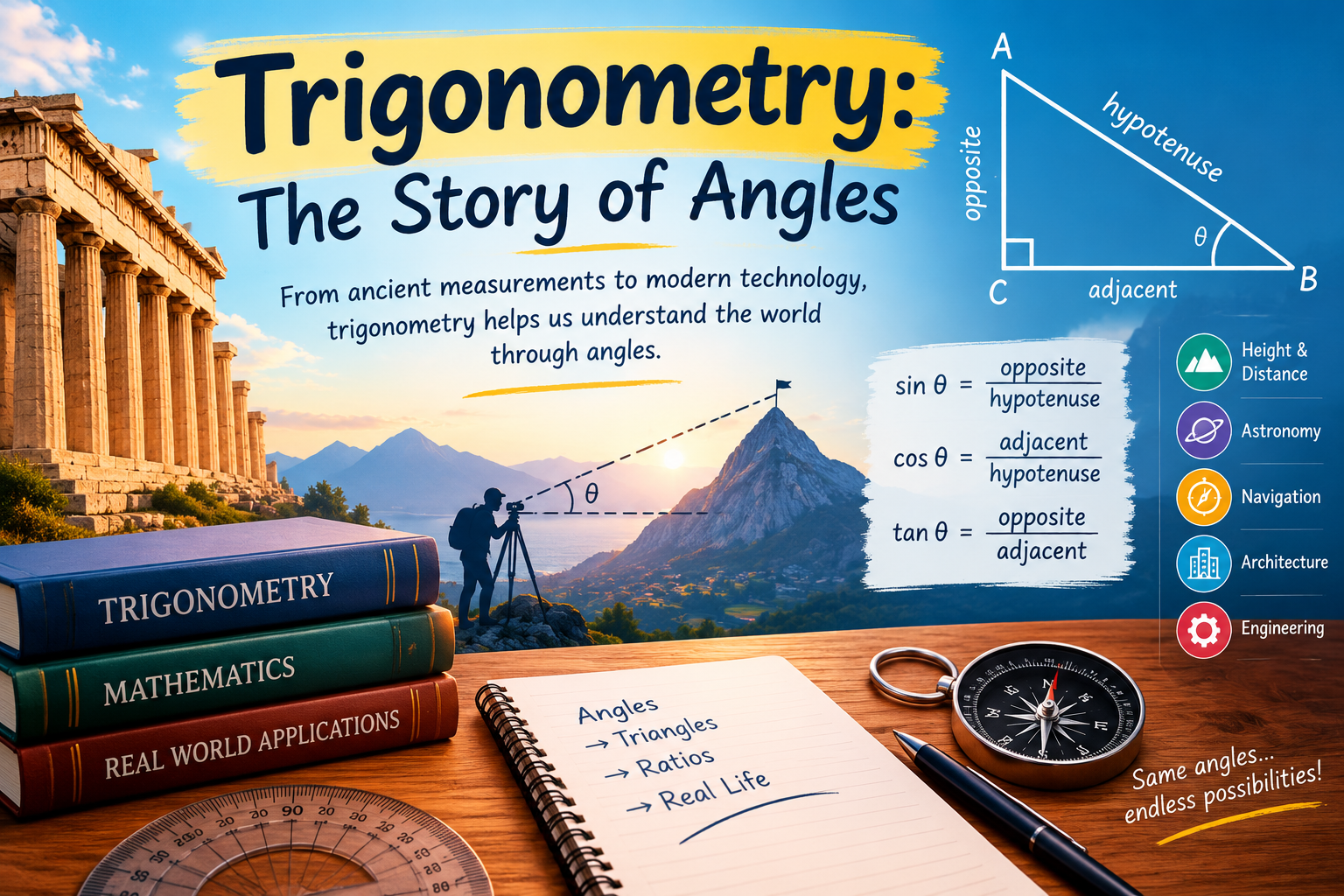
    story topic:Trigonometry: The Story of Angles

    # Trigonometry: The Story of Angles

    Trigonometry is a fascinating branch of mathematics that helps us understand the relationship between angles and sides of triangles. From ancient civilizations to modern technology, trigonometry has played an important role in exploring the world, solving complex problems, and making scientific discoveries.

    In this educational project, **“Trigonometry: The Story of Angles,”** we explore the basic concepts of angles, triangles, and trigonometric ratios, including sine (sin), cosine (cos), and tangent (tan). These mathematical principles help us calculate heights, distances, and unknown measurements with accuracy and confidence.

    We also discover how trigonometry is used in our everyday lives and in various professional fields. Architects use it to design buildings, engineers apply it to construct safe structures, astronomers use it to study celestial objects, and navigators rely on it to determine directions and positions. Even measuring the height of a mountain without climbing it can be possible with the help of trigonometry!

    This project demonstrates that mathematics is not just about formulas and calculations; it is a powerful tool for understanding the world around us. By learning trigonometry, students can improve their logical thinking, problem-solving abilities, and understanding of real-world measurements.

    **Key Message:** Every angle tells a story, and every triangle opens the door to new discoveries. Trigonometry connects mathematical theory with practical applications, showing us how simple relationships can help solve extraordinary problems.

    **Remember:** Learn the angles, understand the ratios, and discover the endless possibilities of mathematics!

    #Trigonometry #TheStoryOfAngles #Mathematics #SineCosineTangent #EducationalProject #Geometry #MathsLearning #ScienceAndTechnology #RealWorldApplications #StudentLearning #LearnMathematics #STEMEducation
    RSIF8 Rool no :14 story no:15 story topic:Trigonometry: The Story of Angles # 📐 Trigonometry: The Story of Angles 🔺✨ Trigonometry is a fascinating branch of mathematics that helps us understand the relationship between angles and sides of triangles. From ancient civilizations to modern technology, trigonometry has played an important role in exploring the world, solving complex problems, and making scientific discoveries. 🌍📚 In this educational project, **“Trigonometry: The Story of Angles,”** we explore the basic concepts of angles, triangles, and trigonometric ratios, including sine (sin), cosine (cos), and tangent (tan). These mathematical principles help us calculate heights, distances, and unknown measurements with accuracy and confidence. 📏🧮 We also discover how trigonometry is used in our everyday lives and in various professional fields. Architects use it to design buildings, engineers apply it to construct safe structures, astronomers use it to study celestial objects, and navigators rely on it to determine directions and positions. Even measuring the height of a mountain without climbing it can be possible with the help of trigonometry! 🏔️🏗️🚀 This project demonstrates that mathematics is not just about formulas and calculations; it is a powerful tool for understanding the world around us. By learning trigonometry, students can improve their logical thinking, problem-solving abilities, and understanding of real-world measurements. 💡🎯 ✨ **Key Message:** Every angle tells a story, and every triangle opens the door to new discoveries. Trigonometry connects mathematical theory with practical applications, showing us how simple relationships can help solve extraordinary problems. 🌟 **Remember:** Learn the angles, understand the ratios, and discover the endless possibilities of mathematics! #Trigonometry #TheStoryOfAngles #Mathematics #SineCosineTangent #EducationalProject #Geometry #MathsLearning #ScienceAndTechnology #RealWorldApplications #StudentLearning #LearnMathematics #STEMEducation
    0 Yorumlar 0 hisse senetleri 1127 Views
  • RSIF8
    Roll no.49
    Class;Foundation
    Interview no.28
    Topic:Interview with a Classmate, Facilitator, or Family Member
    Meaningful conversations help us learn from the experiences, perspectives, and stories of others. In this interview, I had the opportunity to talk with a classmate, facilitator, or family member about their journey, insights, and valuable life lessons.
    **What this interview covers:**
    Learning from real-life experiences
    Improving communication and listening skills
    Understanding different perspectives
    Building confidence through meaningful conversations
    Gaining inspiration from personal stories
    Every conversation is an opportunity to grow, learn, and connect. By asking thoughtful questions and actively listening, we can discover new ideas, strengthen relationships, and develop valuable communication skills.
    **What's the best advice you've ever received from someone close to you?** Share it in the comments!
    Like | Comment | Share | Follow for more educational content, communication activities, and personal development insights.
    #Interview #CommunicationSkills #Learning #Education #PersonalGrowth #PublicSpeaking #LifeLessons #StudentLife #Confidence #ActiveListening #MeaningfulConversations #EducationJourney #SoftSkills #SelfDevelopment #ContentCreator #EducationalContent #InterviewPractice #LearningTogether #AyeshAhmed #SkillDevelopment
    RSIF8 Roll no.49 Class;Foundation Interview no.28 Topic:Interview with a Classmate, Facilitator, or Family Member Meaningful conversations help us learn from the experiences, perspectives, and stories of others. In this interview, I had the opportunity to talk with a classmate, facilitator, or family member about their journey, insights, and valuable life lessons. ✨ **What this interview covers:** ✅ Learning from real-life experiences ✅ Improving communication and listening skills ✅ Understanding different perspectives ✅ Building confidence through meaningful conversations ✅ Gaining inspiration from personal stories 🌟 Every conversation is an opportunity to grow, learn, and connect. By asking thoughtful questions and actively listening, we can discover new ideas, strengthen relationships, and develop valuable communication skills. 💬 **What's the best advice you've ever received from someone close to you?** Share it in the comments! 👍 Like | 💭 Comment | 🔄 Share | 🔔 Follow for more educational content, communication activities, and personal development insights. #Interview #CommunicationSkills #Learning #Education #PersonalGrowth #PublicSpeaking #LifeLessons #StudentLife #Confidence #ActiveListening #MeaningfulConversations #EducationJourney #SoftSkills #SelfDevelopment #ContentCreator #EducationalContent #InterviewPractice #LearningTogether #AyeshAhmed #SkillDevelopment
    0 Yorumlar 0 hisse senetleri 776 Views 3
Arama Sonuçları