• #riab
    RollNo.247
    Foundional Level

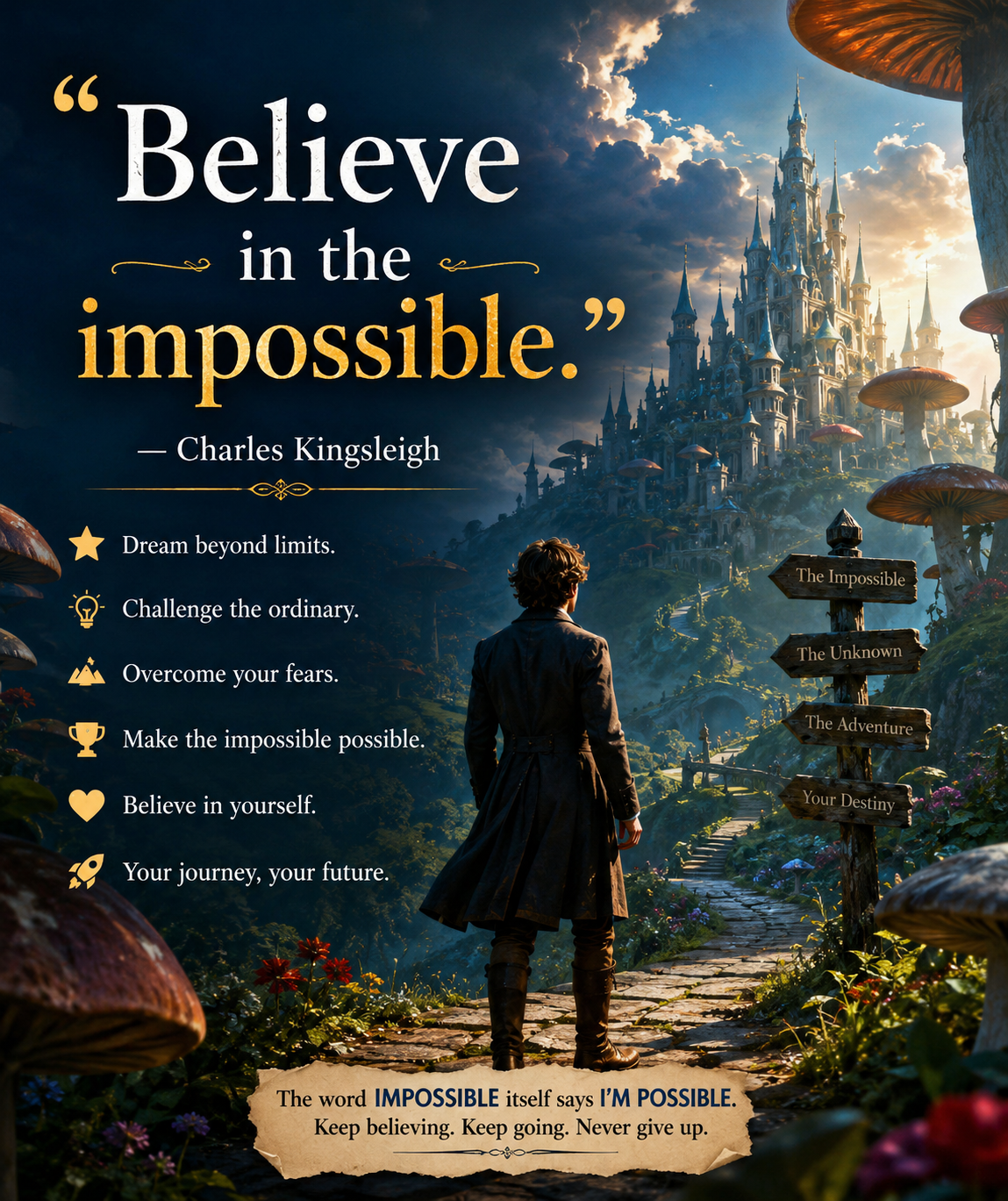
    **"Believe in the impossible." — Charles Kingsleigh**

    What does it truly mean to **believe in the impossible**? It means having the courage to dream beyond limits, to keep moving forward even when the world says you can't, and to trust that today's impossible can become tomorrow's reality.

    Every great invention, every successful entrepreneur, every inspiring leader, and every life-changing achievement began as someone's "impossible" dream. People laughed at ideas that later changed the world. They doubted dreams that eventually became history. The only difference between those who succeeded and those who gave up was **belief**.

    Life will test your patience. You may face failures, rejection, criticism, and moments when giving up seems easier than trying again. But remember, every challenge is preparing you for something greater. Your struggles are not signs to quit—they are stepping stones toward success.

    Never let fear stop you from chasing your dreams. Believe in your abilities, trust your journey, and keep learning every day. Every small step you take brings you closer to your goals. Even when you cannot see the entire path, keep walking with faith.

    Success doesn't come overnight. It comes through persistence, determination, hard work, and an unwavering belief that anything is possible. When you believe in yourself, you unlock the power to overcome obstacles, inspire others, and create opportunities where none seemed to exist.

    Today, choose to believe in your dreams. Dream bigger than your fears. Work harder than your excuses. Stay positive despite setbacks. Your future is created by the decisions you make today. Never underestimate what you can achieve with faith, consistency, and determination.

    **Remember:** The word **"Impossible"** itself says **"I'm Possible."** Believe in yourself, stay focused, and never stop chasing your dreams. The impossible is only impossible until someone proves it can be done.

    **Do you believe that nothing is impossible? Share your thoughts in the comments!**

    #BelieveInTheImpossible #CharlesKingsleigh #DreamBig #NeverGiveUp #SuccessMindset #StayPositive #BelieveInYourself #Motivation #Inspiration #GrowthMindset #HardWork #Determination #PositiveThinking #SelfConfidence #Goals #SuccessJourney #MindsetMatters #KeepGoing #AchieveYourDreams #FaithOverFear #InspireOthers #DailyMotivation #LimitlessPossibilities #DreamBelieveAchieve
    #riab RollNo.247 Foundional Level ✨🌟 **"Believe in the impossible." — Charles Kingsleigh** 🌟✨ What does it truly mean to **believe in the impossible**? 💭 It means having the courage to dream beyond limits, to keep moving forward even when the world says you can't, and to trust that today's impossible can become tomorrow's reality. 🚀 Every great invention, every successful entrepreneur, every inspiring leader, and every life-changing achievement began as someone's "impossible" dream. 💡 People laughed at ideas that later changed the world. They doubted dreams that eventually became history. The only difference between those who succeeded and those who gave up was **belief**. 💪 Life will test your patience. 🌧️ You may face failures, rejection, criticism, and moments when giving up seems easier than trying again. But remember, every challenge is preparing you for something greater. Your struggles are not signs to quit—they are stepping stones toward success. 🌈 Never let fear stop you from chasing your dreams. Believe in your abilities, trust your journey, and keep learning every day. 📚 Every small step you take brings you closer to your goals. Even when you cannot see the entire path, keep walking with faith. 🌟 Success doesn't come overnight. It comes through persistence, determination, hard work, and an unwavering belief that anything is possible. 💯 When you believe in yourself, you unlock the power to overcome obstacles, inspire others, and create opportunities where none seemed to exist. 🔥 Today, choose to believe in your dreams. 🌍 Dream bigger than your fears. Work harder than your excuses. Stay positive despite setbacks. Your future is created by the decisions you make today. Never underestimate what you can achieve with faith, consistency, and determination. ❤️ ✨ **Remember:** The word **"Impossible"** itself says **"I'm Possible."** Believe in yourself, stay focused, and never stop chasing your dreams. The impossible is only impossible until someone proves it can be done. 🚀🌟 💬 **Do you believe that nothing is impossible? Share your thoughts in the comments!** 👇 #BelieveInTheImpossible #CharlesKingsleigh #DreamBig 🌟 #NeverGiveUp 💪 #SuccessMindset 🚀 #StayPositive ✨ #BelieveInYourself ❤️ #Motivation 💯 #Inspiration 🌈 #GrowthMindset 📚 #HardWork 🔥 #Determination 🌍 #PositiveThinking 💡 #SelfConfidence 🌟 #Goals 🎯 #SuccessJourney 🚀 #MindsetMatters 💖 #KeepGoing 💪 #AchieveYourDreams ✨ #FaithOverFear 🙌 #InspireOthers 🌟 #DailyMotivation 📈 #LimitlessPossibilities 🚀 #DreamBelieveAchieve 💫
    0 Commentarii 0 Distribuiri 3952 Views
  • ?? Project Completed: AI Time Travel Data Simulator ?
    Excited to share another AI-powered project ? Time Travel Data Simulator!
    This intelligent agent allows users to simulate and visualize data across different time periods by predicting future trends, analyzing historical patterns, and exploring "what-if" scenarios. It helps users understand how decisions and variables can influence outcomes over time, making data analysis more interactive, insightful, and engaging.
    Every project I build strengthens my expertise in Artificial Intelligence, data simulation, and real-world software development. Im excited to continue creating innovative AI solutions that transform ideas into intelligent applications. ??
    Exploring the past, understanding the present, and simulating the future with AI.
    #AI #TimeTravelDataSimulator #DataSimulation #PredictiveAnalytics #ArtificialIntelligence #DataScience #Automation #Python #WebDevelopment #SoftwareDevelopment #DeveloperLife #BuildInPublic #Innovation #RehanSchool #SadeemFreelancingwala
    ?? Project Completed: AI Time Travel Data Simulator ? Excited to share another AI-powered project ? Time Travel Data Simulator! This intelligent agent allows users to simulate and visualize data across different time periods by predicting future trends, analyzing historical patterns, and exploring "what-if" scenarios. It helps users understand how decisions and variables can influence outcomes over time, making data analysis more interactive, insightful, and engaging. Every project I build strengthens my expertise in Artificial Intelligence, data simulation, and real-world software development. I'm excited to continue creating innovative AI solutions that transform ideas into intelligent applications. ?? Exploring the past, understanding the present, and simulating the future with AI. #AI #TimeTravelDataSimulator #DataSimulation #PredictiveAnalytics #ArtificialIntelligence #DataScience #Automation #Python #WebDevelopment #SoftwareDevelopment #DeveloperLife #BuildInPublic #Innovation #RehanSchool #SadeemFreelancingwala
    0 Commentarii 0 Distribuiri 1716 Views
  • ??? Project Completed: AI Weather Manipulation Simulator Agent ?
    Excited to share another AI-powered project ? Weather Manipulation Simulator Agent!
    This intelligent agent allows users to simulate how different weather conditions could affect environments, activities, agriculture, transportation, and daily life. By adjusting variables such as temperature, rainfall, wind, and humidity, users can explore interactive "what-if" scenarios, making it a powerful educational and analytical tool for understanding weather patterns and their potential impacts.
    Every project I build strengthens my expertise in Artificial Intelligence, simulation technology, and real-world software development. Im excited to continue creating innovative AI solutions that inspire learning and exploration. ??
    Simulating tomorrows possibilities with the power of AI.
    #AI #WeatherSimulator #WeatherManipulation #ClimateTech #ArtificialIntelligence #Simulation #DataScience #Automation #Python #WebDevelopment #SoftwareDevelopment #DeveloperLife #BuildInPublic #Innovation #RehanSchool #SadeemFreelancingwala
    ??? Project Completed: AI Weather Manipulation Simulator Agent ? Excited to share another AI-powered project ? Weather Manipulation Simulator Agent! This intelligent agent allows users to simulate how different weather conditions could affect environments, activities, agriculture, transportation, and daily life. By adjusting variables such as temperature, rainfall, wind, and humidity, users can explore interactive "what-if" scenarios, making it a powerful educational and analytical tool for understanding weather patterns and their potential impacts. Every project I build strengthens my expertise in Artificial Intelligence, simulation technology, and real-world software development. I'm excited to continue creating innovative AI solutions that inspire learning and exploration. ?? Simulating tomorrow's possibilities with the power of AI. #AI #WeatherSimulator #WeatherManipulation #ClimateTech #ArtificialIntelligence #Simulation #DataScience #Automation #Python #WebDevelopment #SoftwareDevelopment #DeveloperLife #BuildInPublic #Innovation #RehanSchool #SadeemFreelancingwala
    0 Commentarii 0 Distribuiri 2534 Views
  • History of Interest

    The story of bank interest is tied closely to the history of money, finance, and lending, dating back thousands of years. Here’s a brief overview:

    1. Ancient Origins

    • Early Lending Practices: The concept of interest has roots in ancient Mesopotamia around 3000 BCE, where agricultural communities would borrow seeds or livestock, and lenders expected repayment with a surplus. This surplus was the earliest form of interest.
    • Code of Hammurabi: In Babylon around 1750 BCE, the Code of Hammurabi formalized rules around loans and interest rates. Interest was usually paid in the form of crops or goods, and the rates were capped by law.
    • Ancient Greece & Rome: The Greeks and Romans had well-developed banking systems, including moneylenders. Interest was accepted, though there were often debates about fairness, with rates regulated by law.

    2. Religious Views on Interest

    • Judaism: In the Hebrew Bible (Old Testament), charging interest to fellow Jews was prohibited, but it was allowed with foreigners.
    • Christianity: Early Christian teachings considered interest (usury) immoral. The Catholic Church banned usury in the Middle Ages, leading to Jewish communities often filling the role of moneylenders in Europe.
    • Islam: In Islamic finance, charging or paying interest (riba) is strictly forbidden. Islamic banking follows Sharia law, using profit-sharing models instead.

    3. Medieval Europe

    • Rise of Moneylenders: In the Middle Ages, Italian city-states like Venice and Florence developed banking systems, despite religious prohibitions. Moneylenders often charged interest, but the rates were capped, and excessive interest was frowned upon.
    • Medici Bank: In the 15th century, the Medici family of Florence established one of the first major banks, using creative methods to collect “fees” instead of direct interest to comply with religious restrictions.

    4. Modern Banking (17th - 19th Century)

    • Bank of England: Established in 1694, the Bank of England was one of the first central banks, using interest as a tool to manage national debt and support economic growth.
    • Fractional Reserve Banking: This system, where banks lend out more money than they have in deposits, became widespread. It increased the use of interest as a means to generate profits for banks and incentivize savings for depositors.
    • Industrial Revolution: Interest became a fundamental tool in financing factories, railroads, and other major industrial projects. It helped foster the growth of modern capitalism.

    5. 20th Century to Present

    • Global Central Banks: The 20th century saw the rise of central banks globally, using interest rates to control inflation, unemployment, and economic stability. The U.S. Federal Reserve, for example, adjusts interest rates to influence the economy.
    • Interest on Savings & Loans: Modern banks offer interest on savings accounts as a way to attract deposits. On the flip side, they charge interest on loans to make a profit, pay depositors, and cover operating costs.
    • Subprime Crisis (2008): A significant example of interest-related issues was the 2008 financial crisis, partially caused by risky subprime mortgages with adjustable interest rates. This led to a massive global economic downturn.

    Types of Interest Today

    • Simple Interest: Calculated only on the principal amount of a loan or investment.
    • Compound Interest: Calculated on the principal and on any interest already earned or charged, leading to exponential growth or debt.
    • Fixed vs. Variable Interest Rates: Loans can have a fixed rate (unchanging) or a variable rate (fluctuates with the market).

    Why Do Banks Charge Interest?

    • Profit for Operations: Banks charge interest to make profits, cover operational costs, and pay interest to depositors.
    • Compensation for Risk: Lending involves risk; interest compensates lenders for the potential of borrowers defaulting.
    • Inflation Hedge: Interest helps protect lenders from inflation, which reduces the value of money over time.
    • Encourages Savings: Offering interest on deposits encourages people to save money, providing funds that banks can use for loans.

    The concept of interest has evolved from simple lending practices to a complex financial tool, affecting economies, religions, and societies throughout history. Today, it remains a crucial part of modern financial systems, shaping everything from individual savings to global monetary policy.
    History of Interest The story of bank interest is tied closely to the history of money, finance, and lending, dating back thousands of years. Here’s a brief overview: 1. Ancient Origins • Early Lending Practices: The concept of interest has roots in ancient Mesopotamia around 3000 BCE, where agricultural communities would borrow seeds or livestock, and lenders expected repayment with a surplus. This surplus was the earliest form of interest. • Code of Hammurabi: In Babylon around 1750 BCE, the Code of Hammurabi formalized rules around loans and interest rates. Interest was usually paid in the form of crops or goods, and the rates were capped by law. • Ancient Greece & Rome: The Greeks and Romans had well-developed banking systems, including moneylenders. Interest was accepted, though there were often debates about fairness, with rates regulated by law. 2. Religious Views on Interest • Judaism: In the Hebrew Bible (Old Testament), charging interest to fellow Jews was prohibited, but it was allowed with foreigners. • Christianity: Early Christian teachings considered interest (usury) immoral. The Catholic Church banned usury in the Middle Ages, leading to Jewish communities often filling the role of moneylenders in Europe. • Islam: In Islamic finance, charging or paying interest (riba) is strictly forbidden. Islamic banking follows Sharia law, using profit-sharing models instead. 3. Medieval Europe • Rise of Moneylenders: In the Middle Ages, Italian city-states like Venice and Florence developed banking systems, despite religious prohibitions. Moneylenders often charged interest, but the rates were capped, and excessive interest was frowned upon. • Medici Bank: In the 15th century, the Medici family of Florence established one of the first major banks, using creative methods to collect “fees” instead of direct interest to comply with religious restrictions. 4. Modern Banking (17th - 19th Century) • Bank of England: Established in 1694, the Bank of England was one of the first central banks, using interest as a tool to manage national debt and support economic growth. • Fractional Reserve Banking: This system, where banks lend out more money than they have in deposits, became widespread. It increased the use of interest as a means to generate profits for banks and incentivize savings for depositors. • Industrial Revolution: Interest became a fundamental tool in financing factories, railroads, and other major industrial projects. It helped foster the growth of modern capitalism. 5. 20th Century to Present • Global Central Banks: The 20th century saw the rise of central banks globally, using interest rates to control inflation, unemployment, and economic stability. The U.S. Federal Reserve, for example, adjusts interest rates to influence the economy. • Interest on Savings & Loans: Modern banks offer interest on savings accounts as a way to attract deposits. On the flip side, they charge interest on loans to make a profit, pay depositors, and cover operating costs. • Subprime Crisis (2008): A significant example of interest-related issues was the 2008 financial crisis, partially caused by risky subprime mortgages with adjustable interest rates. This led to a massive global economic downturn. Types of Interest Today • Simple Interest: Calculated only on the principal amount of a loan or investment. • Compound Interest: Calculated on the principal and on any interest already earned or charged, leading to exponential growth or debt. • Fixed vs. Variable Interest Rates: Loans can have a fixed rate (unchanging) or a variable rate (fluctuates with the market). Why Do Banks Charge Interest? • Profit for Operations: Banks charge interest to make profits, cover operational costs, and pay interest to depositors. • Compensation for Risk: Lending involves risk; interest compensates lenders for the potential of borrowers defaulting. • Inflation Hedge: Interest helps protect lenders from inflation, which reduces the value of money over time. • Encourages Savings: Offering interest on deposits encourages people to save money, providing funds that banks can use for loans. The concept of interest has evolved from simple lending practices to a complex financial tool, affecting economies, religions, and societies throughout history. Today, it remains a crucial part of modern financial systems, shaping everything from individual savings to global monetary policy.
    0 Commentarii 0 Distribuiri 421 Views
  • Invention: Ultra-Efficient Motorcycle – “Eco700”

    Key Specifications:
    1. Fuel Efficiency: 700 km per liter of gasoline.
    2. Engine Type: Advanced Hyper-Efficient Combustion Engine (HECE).
    3. Weight: 50 kg (ultra-lightweight design).
    4. Top Speed: 90 km/h (optimized for fuel efficiency).
    5. Range: 7000 km on a 10-liter tank.

    Design Elements:
    1. Engine:
    • Homogeneous Charge Compression Ignition (HCCI) technology for near-perfect fuel combustion.
    • Nano-coated cylinder walls to reduce friction and heat loss.
    • Micro-turbocharging for efficient air-fuel mixing at low speeds.
    2. Chassis:
    • Constructed from carbon fiber-reinforced polymer for lightweight and durability.
    • Aerodynamic design to minimize drag.
    3. Fuel System:
    • Vapor injection system: Converts gasoline into a fine mist for better combustion.
    • Ultra-precise fuel injection controlled by AI algorithms.
    4. Transmission:
    • Continuously Variable Transmission (CVT) optimized for low energy loss.
    5. Wheels & Tires:
    • Low-resistance tires with self-sealing features to prevent punctures.
    6. Energy Recovery:
    • Regenerative braking to recover kinetic energy and reduce fuel usage.

    Prototype Assembly:
    1. Engine Development: Build the HCCI engine using advanced manufacturing techniques.
    2. Chassis Construction: Assemble the carbon-fiber body and integrate engine mounts.
    3. System Integration: Install the vapor injection and regenerative braking systems.
    4. Testing and Optimization: Conduct efficiency tests and fine-tune for maximum mileage.

    This motorcycle, the “Eco700,” achieves unparalleled fuel efficiency through cutting-edge engine technology, lightweight materials, and innovative design features.
    Invention: Ultra-Efficient Motorcycle – “Eco700” Key Specifications: 1. Fuel Efficiency: 700 km per liter of gasoline. 2. Engine Type: Advanced Hyper-Efficient Combustion Engine (HECE). 3. Weight: 50 kg (ultra-lightweight design). 4. Top Speed: 90 km/h (optimized for fuel efficiency). 5. Range: 7000 km on a 10-liter tank. Design Elements: 1. Engine: • Homogeneous Charge Compression Ignition (HCCI) technology for near-perfect fuel combustion. • Nano-coated cylinder walls to reduce friction and heat loss. • Micro-turbocharging for efficient air-fuel mixing at low speeds. 2. Chassis: • Constructed from carbon fiber-reinforced polymer for lightweight and durability. • Aerodynamic design to minimize drag. 3. Fuel System: • Vapor injection system: Converts gasoline into a fine mist for better combustion. • Ultra-precise fuel injection controlled by AI algorithms. 4. Transmission: • Continuously Variable Transmission (CVT) optimized for low energy loss. 5. Wheels & Tires: • Low-resistance tires with self-sealing features to prevent punctures. 6. Energy Recovery: • Regenerative braking to recover kinetic energy and reduce fuel usage. Prototype Assembly: 1. Engine Development: Build the HCCI engine using advanced manufacturing techniques. 2. Chassis Construction: Assemble the carbon-fiber body and integrate engine mounts. 3. System Integration: Install the vapor injection and regenerative braking systems. 4. Testing and Optimization: Conduct efficiency tests and fine-tune for maximum mileage. This motorcycle, the “Eco700,” achieves unparalleled fuel efficiency through cutting-edge engine technology, lightweight materials, and innovative design features.
    0 Commentarii 0 Distribuiri 291 Views
  • Why Do We Feel Up or Down After Meeting People?

    Understanding the Science of Human Vibes

    Have you ever walked away from a conversation feeling like you just drank three cups of espresso without touching a drop—or like someone unplugged your soul and drained your battery? You’re not alone. The energy we feel when meeting others isn’t just “in our head” or emotional poetry—it’s deeply rooted in biology, chemistry, and even subtle electromagnetic signals in our bodies. Let’s explore why meeting some people lifts us up, while others leave us feeling down.


    Chemical & Hormonal Reactions in the Body

    When you interact with someone, your body doesn’t wait for your opinion—it automatically reacts by releasing different chemicals and hormones based on how it perceives the person.
    • Oxytocin is often released when we feel connected or safe. It’s nicknamed the “love hormone” and is key to feelings of trust and bonding. A kind smile or warm voice can trigger a burst of oxytocin, making us feel uplifted.
    • Dopamine kicks in when something feels rewarding. If someone is interesting, funny, or aligns with your values, dopamine brings a feeling of pleasure and motivation.
    • On the flip side, cortisol, the stress hormone, spikes when we feel uncomfortable, judged, or unsafe. This can instantly make your mood drop, heart race, and stomach turn.
    • Adrenaline may also be triggered—if the person feels intense or confrontational, your body gears up to deal with them, even if it’s just emotionally.
    • And when things don’t go well socially, serotonin—the mood stabilizer—can dip, leaving you with a vague sense of deflation or sadness.

    So yes, meeting people is a bit like a hormone cocktail shaker. The mix depends on the person—and how your nervous system interprets them.


    Your Brain is Always Scanning for Safety

    This process is called neuroception—your nervous system scans every person you meet to assess: “Am I safe? Can I relax? Can I trust this person?” And it does this without asking you first.

    If someone feels authentic, open, or kind, your nervous system gives a green light. Energy flows. You feel expansive. But if someone’s body language is tense, fake, or threatening, your system hits the brakes—emotionally and physically.

    It’s a primal survival mechanism. Your ancestors didn’t have time to analyze intentions—they had to sense danger instantly. You still do.


    The Mirror Effect

    We humans are natural mimics. Known as mirror neurons, our brain reflects the emotions and body language of others. If someone’s excited, your energy may rise to match theirs. If they’re anxious, sad, or negative—you might suddenly feel drained without knowing why.

    It’s emotional Wi-Fi. And you’re always connected.


    The Frequency of People

    There’s another layer too: personal resonance. Some people just “vibe” with you. Their beliefs, values, humor, or goals match yours. The interaction flows effortlessly—and both parties leave the conversation feeling lighter, brighter, and more alive.

    Other people may be completely fine—but not “tuned” to your frequency. That mismatch can feel flat, awkward, or draining, even if nothing negative is said.


    The Science of Real Energy

    Beyond chemistry, your body actually emits electromagnetic fields—especially the heart and brain. Research has shown that:
    • Our heart rate variability (HRV) changes when we feel emotionally connected.
    • Our brainwaves can synchronize with others during deep conversations.

    While this isn’t the kind of energy you measure with a plug or battery, it is a form of energetic exchange. Human-to-human Bluetooth, if you will.


    How to Notice the Shift

    Pay attention after interactions. Ask:
    • Do I feel more alive or more tired?
    • Did I feel seen, heard, respected?
    • Did I feel tense, guarded, or free?

    Your body knows. Listen.


    In Summary

    We feel up or down after meeting people because:
    • Our hormones and chemicals respond instantly to perceived emotions and safety.
    • Our nervous system scans people for trust and threat.
    • We mirror others’ energy—consciously or not.
    • We resonate (or don’t) based on values, beliefs, and emotional tone.
    • And, possibly, our hearts and minds physically sync when real connection occurs.

    So next time you meet someone and feel like you just caught a second wind—or like your battery hit 1%—remember: It’s not magic. It’s science.
    Your vibes don’t lie. Your body is simply trying to tell you the truth.
    Why Do We Feel Up or Down After Meeting People? Understanding the Science of Human Vibes Have you ever walked away from a conversation feeling like you just drank three cups of espresso without touching a drop—or like someone unplugged your soul and drained your battery? You’re not alone. The energy we feel when meeting others isn’t just “in our head” or emotional poetry—it’s deeply rooted in biology, chemistry, and even subtle electromagnetic signals in our bodies. Let’s explore why meeting some people lifts us up, while others leave us feeling down. ⸻ ⚗️ Chemical & Hormonal Reactions in the Body When you interact with someone, your body doesn’t wait for your opinion—it automatically reacts by releasing different chemicals and hormones based on how it perceives the person. • Oxytocin is often released when we feel connected or safe. It’s nicknamed the “love hormone” and is key to feelings of trust and bonding. A kind smile or warm voice can trigger a burst of oxytocin, making us feel uplifted. • Dopamine kicks in when something feels rewarding. If someone is interesting, funny, or aligns with your values, dopamine brings a feeling of pleasure and motivation. • On the flip side, cortisol, the stress hormone, spikes when we feel uncomfortable, judged, or unsafe. This can instantly make your mood drop, heart race, and stomach turn. • Adrenaline may also be triggered—if the person feels intense or confrontational, your body gears up to deal with them, even if it’s just emotionally. • And when things don’t go well socially, serotonin—the mood stabilizer—can dip, leaving you with a vague sense of deflation or sadness. So yes, meeting people is a bit like a hormone cocktail shaker. The mix depends on the person—and how your nervous system interprets them. ⸻ 🧠 Your Brain is Always Scanning for Safety This process is called neuroception—your nervous system scans every person you meet to assess: “Am I safe? Can I relax? Can I trust this person?” And it does this without asking you first. If someone feels authentic, open, or kind, your nervous system gives a green light. Energy flows. You feel expansive. But if someone’s body language is tense, fake, or threatening, your system hits the brakes—emotionally and physically. It’s a primal survival mechanism. Your ancestors didn’t have time to analyze intentions—they had to sense danger instantly. You still do. ⸻ 🪞 The Mirror Effect We humans are natural mimics. Known as mirror neurons, our brain reflects the emotions and body language of others. If someone’s excited, your energy may rise to match theirs. If they’re anxious, sad, or negative—you might suddenly feel drained without knowing why. It’s emotional Wi-Fi. And you’re always connected. ⸻ 🧲 The Frequency of People There’s another layer too: personal resonance. Some people just “vibe” with you. Their beliefs, values, humor, or goals match yours. The interaction flows effortlessly—and both parties leave the conversation feeling lighter, brighter, and more alive. Other people may be completely fine—but not “tuned” to your frequency. That mismatch can feel flat, awkward, or draining, even if nothing negative is said. ⸻ 💓 The Science of Real Energy Beyond chemistry, your body actually emits electromagnetic fields—especially the heart and brain. Research has shown that: • Our heart rate variability (HRV) changes when we feel emotionally connected. • Our brainwaves can synchronize with others during deep conversations. While this isn’t the kind of energy you measure with a plug or battery, it is a form of energetic exchange. Human-to-human Bluetooth, if you will. ⸻ 🚦 How to Notice the Shift Pay attention after interactions. Ask: • Do I feel more alive or more tired? • Did I feel seen, heard, respected? • Did I feel tense, guarded, or free? Your body knows. Listen. ⸻ ✅ In Summary We feel up or down after meeting people because: • Our hormones and chemicals respond instantly to perceived emotions and safety. • Our nervous system scans people for trust and threat. • We mirror others’ energy—consciously or not. • We resonate (or don’t) based on values, beliefs, and emotional tone. • And, possibly, our hearts and minds physically sync when real connection occurs. So next time you meet someone and feel like you just caught a second wind—or like your battery hit 1%—remember: It’s not magic. It’s science. Your vibes don’t lie. Your body is simply trying to tell you the truth.
    0 Commentarii 0 Distribuiri 629 Views
  • Why Do We Feel Up or Down After Meeting People?

    Understanding the Science of Human Vibes

    Have you ever walked away from a conversation feeling like you just drank three cups of espresso without touching a drop—or like someone unplugged your soul and drained your battery? You’re not alone. The energy we feel when meeting others isn’t just “in our head” or emotional poetry—it’s deeply rooted in biology, chemistry, and even subtle electromagnetic signals in our bodies. Let’s explore why meeting some people lifts us up, while others leave us feeling down.


    Chemical & Hormonal Reactions in the Body

    When you interact with someone, your body doesn’t wait for your opinion—it automatically reacts by releasing different chemicals and hormones based on how it perceives the person.
    • Oxytocin is often released when we feel connected or safe. It’s nicknamed the “love hormone” and is key to feelings of trust and bonding. A kind smile or warm voice can trigger a burst of oxytocin, making us feel uplifted.
    • Dopamine kicks in when something feels rewarding. If someone is interesting, funny, or aligns with your values, dopamine brings a feeling of pleasure and motivation.
    • On the flip side, cortisol, the stress hormone, spikes when we feel uncomfortable, judged, or unsafe. This can instantly make your mood drop, heart race, and stomach turn.
    • Adrenaline may also be triggered—if the person feels intense or confrontational, your body gears up to deal with them, even if it’s just emotionally.
    • And when things don’t go well socially, serotonin—the mood stabilizer—can dip, leaving you with a vague sense of deflation or sadness.

    So yes, meeting people is a bit like a hormone cocktail shaker. The mix depends on the person—and how your nervous system interprets them.


    Your Brain is Always Scanning for Safety

    This process is called neuroception—your nervous system scans every person you meet to assess: “Am I safe? Can I relax? Can I trust this person?” And it does this without asking you first.

    If someone feels authentic, open, or kind, your nervous system gives a green light. Energy flows. You feel expansive. But if someone’s body language is tense, fake, or threatening, your system hits the brakes—emotionally and physically.

    It’s a primal survival mechanism. Your ancestors didn’t have time to analyze intentions—they had to sense danger instantly. You still do.


    The Mirror Effect

    We humans are natural mimics. Known as mirror neurons, our brain reflects the emotions and body language of others. If someone’s excited, your energy may rise to match theirs. If they’re anxious, sad, or negative—you might suddenly feel drained without knowing why.

    It’s emotional Wi-Fi. And you’re always connected.


    The Frequency of People

    There’s another layer too: personal resonance. Some people just “vibe” with you. Their beliefs, values, humor, or goals match yours. The interaction flows effortlessly—and both parties leave the conversation feeling lighter, brighter, and more alive.

    Other people may be completely fine—but not “tuned” to your frequency. That mismatch can feel flat, awkward, or draining, even if nothing negative is said.


    The Science of Real Energy

    Beyond chemistry, your body actually emits electromagnetic fields—especially the heart and brain. Research has shown that:
    • Our heart rate variability (HRV) changes when we feel emotionally connected.
    • Our brainwaves can synchronize with others during deep conversations.

    While this isn’t the kind of energy you measure with a plug or battery, it is a form of energetic exchange. Human-to-human Bluetooth, if you will.


    How to Notice the Shift

    Pay attention after interactions. Ask:
    • Do I feel more alive or more tired?
    • Did I feel seen, heard, respected?
    • Did I feel tense, guarded, or free?

    Your body knows. Listen.


    In Summary

    We feel up or down after meeting people because:
    • Our hormones and chemicals respond instantly to perceived emotions and safety.
    • Our nervous system scans people for trust and threat.
    • We mirror others’ energy—consciously or not.
    • We resonate (or don’t) based on values, beliefs, and emotional tone.
    • And, possibly, our hearts and minds physically sync when real connection occurs.

    So next time you meet someone and feel like you just caught a second wind—or like your battery hit 1%—remember: It’s not magic. It’s science.
    Your vibes don’t lie. Your body is simply trying to tell you the truth.
    Why Do We Feel Up or Down After Meeting People? Understanding the Science of Human Vibes Have you ever walked away from a conversation feeling like you just drank three cups of espresso without touching a drop—or like someone unplugged your soul and drained your battery? You’re not alone. The energy we feel when meeting others isn’t just “in our head” or emotional poetry—it’s deeply rooted in biology, chemistry, and even subtle electromagnetic signals in our bodies. Let’s explore why meeting some people lifts us up, while others leave us feeling down. ⸻ ⚗️ Chemical & Hormonal Reactions in the Body When you interact with someone, your body doesn’t wait for your opinion—it automatically reacts by releasing different chemicals and hormones based on how it perceives the person. • Oxytocin is often released when we feel connected or safe. It’s nicknamed the “love hormone” and is key to feelings of trust and bonding. A kind smile or warm voice can trigger a burst of oxytocin, making us feel uplifted. • Dopamine kicks in when something feels rewarding. If someone is interesting, funny, or aligns with your values, dopamine brings a feeling of pleasure and motivation. • On the flip side, cortisol, the stress hormone, spikes when we feel uncomfortable, judged, or unsafe. This can instantly make your mood drop, heart race, and stomach turn. • Adrenaline may also be triggered—if the person feels intense or confrontational, your body gears up to deal with them, even if it’s just emotionally. • And when things don’t go well socially, serotonin—the mood stabilizer—can dip, leaving you with a vague sense of deflation or sadness. So yes, meeting people is a bit like a hormone cocktail shaker. The mix depends on the person—and how your nervous system interprets them. ⸻ 🧠 Your Brain is Always Scanning for Safety This process is called neuroception—your nervous system scans every person you meet to assess: “Am I safe? Can I relax? Can I trust this person?” And it does this without asking you first. If someone feels authentic, open, or kind, your nervous system gives a green light. Energy flows. You feel expansive. But if someone’s body language is tense, fake, or threatening, your system hits the brakes—emotionally and physically. It’s a primal survival mechanism. Your ancestors didn’t have time to analyze intentions—they had to sense danger instantly. You still do. ⸻ 🪞 The Mirror Effect We humans are natural mimics. Known as mirror neurons, our brain reflects the emotions and body language of others. If someone’s excited, your energy may rise to match theirs. If they’re anxious, sad, or negative—you might suddenly feel drained without knowing why. It’s emotional Wi-Fi. And you’re always connected. ⸻ 🧲 The Frequency of People There’s another layer too: personal resonance. Some people just “vibe” with you. Their beliefs, values, humor, or goals match yours. The interaction flows effortlessly—and both parties leave the conversation feeling lighter, brighter, and more alive. Other people may be completely fine—but not “tuned” to your frequency. That mismatch can feel flat, awkward, or draining, even if nothing negative is said. ⸻ 💓 The Science of Real Energy Beyond chemistry, your body actually emits electromagnetic fields—especially the heart and brain. Research has shown that: • Our heart rate variability (HRV) changes when we feel emotionally connected. • Our brainwaves can synchronize with others during deep conversations. While this isn’t the kind of energy you measure with a plug or battery, it is a form of energetic exchange. Human-to-human Bluetooth, if you will. ⸻ 🚦 How to Notice the Shift Pay attention after interactions. Ask: • Do I feel more alive or more tired? • Did I feel seen, heard, respected? • Did I feel tense, guarded, or free? Your body knows. Listen. ⸻ ✅ In Summary We feel up or down after meeting people because: • Our hormones and chemicals respond instantly to perceived emotions and safety. • Our nervous system scans people for trust and threat. • We mirror others’ energy—consciously or not. • We resonate (or don’t) based on values, beliefs, and emotional tone. • And, possibly, our hearts and minds physically sync when real connection occurs. So next time you meet someone and feel like you just caught a second wind—or like your battery hit 1%—remember: It’s not magic. It’s science. Your vibes don’t lie. Your body is simply trying to tell you the truth.
    0 Commentarii 0 Distribuiri 612 Views
  • A letter of Albert Einstein to his daughter about the power of love:

    A letter from Albert Einstein to his daughter about the power of Love

    …”When I proposed the theory of relativity, very few understood me, and what I will reveal now to transmit to mankind will also collide with the misunderstanding and prejudice in the world.
    I ask you to guard the letters as long as necessary, years, decades, until society is advanced enough to accept what I will explain below.
    There is an extremely powerful force that, so far, science has not found a formal explanation to. It is a force that includes and governs all others, and is even behind any phenomenon operating in the universe and has not yet been identified by us.

    This universal force is LOVE.
    When scientists looked for a unified theory of the universe they forgot the most powerful unseen force.

    Love is Light, that enlightens those who give and receive it.
    Love is gravity, because it makes some people feel attracted to others.

    Love is power, because it multiplies the best we have, and allows humanity not to be extinguished in their blind selfishness. Love unfolds and reveals.

    For love we live and die.
    Love is God and God is Love.

    This force explains everything and gives meaning to life. This is the variable that we have ignored for too long, maybe because we are afraid of love because it is the only energy in the universe that man has not learned to drive at will.

    To give visibility to love, I made a simple substitution in my most famous equation.

    If instead of E = mc2, we accept that the energy to heal the world can be obtained through love multiplied by the speed of light squared, we arrive at the conclusion that love is the most powerful force there is, because it has no limits.
    After the failure of humanity in the use and control of the other forces of the universe that have turned against us, it is urgent that we nourish ourselves with another kind of energy…

    If we want our species to survive, if we are to find meaning in life, if we want to save the world and every sentient being that inhabits it, love is the one and only answer.
    Perhaps we are not yet ready to make a bomb of love, a device powerful enough to entirely destroy the hate, selfishness and greed that devastate the planet.

    However, each individual carries within them a small but powerful generator of love whose energy is waiting to be released.
    When we learn to give and receive this universal energy, dear Lieserl, we will have affirmed that love conquers all, is able to transcend everything and anything, because love is the quintessence of life.

    I deeply regret not having been able to express what is in my heart, which has quietly beaten for you all my life. Maybe it’s too late to apologize, but as time is relative, I need to tell you that I love you and thanks to you I have reached the ultimate answer! “.

    https://wearelightbeings.wordpress.com/2015/04/15/a-letter-from-albert-einstein-to-his-daughter-about-the-universal-force-which-is-love/
    A letter of Albert Einstein to his daughter about the power of love: A letter from Albert Einstein to his daughter about the power of Love …”When I proposed the theory of relativity, very few understood me, and what I will reveal now to transmit to mankind will also collide with the misunderstanding and prejudice in the world. I ask you to guard the letters as long as necessary, years, decades, until society is advanced enough to accept what I will explain below. There is an extremely powerful force that, so far, science has not found a formal explanation to. It is a force that includes and governs all others, and is even behind any phenomenon operating in the universe and has not yet been identified by us. This universal force is LOVE. When scientists looked for a unified theory of the universe they forgot the most powerful unseen force. Love is Light, that enlightens those who give and receive it. Love is gravity, because it makes some people feel attracted to others. Love is power, because it multiplies the best we have, and allows humanity not to be extinguished in their blind selfishness. Love unfolds and reveals. For love we live and die. Love is God and God is Love. This force explains everything and gives meaning to life. This is the variable that we have ignored for too long, maybe because we are afraid of love because it is the only energy in the universe that man has not learned to drive at will. To give visibility to love, I made a simple substitution in my most famous equation. If instead of E = mc2, we accept that the energy to heal the world can be obtained through love multiplied by the speed of light squared, we arrive at the conclusion that love is the most powerful force there is, because it has no limits. After the failure of humanity in the use and control of the other forces of the universe that have turned against us, it is urgent that we nourish ourselves with another kind of energy… If we want our species to survive, if we are to find meaning in life, if we want to save the world and every sentient being that inhabits it, love is the one and only answer. Perhaps we are not yet ready to make a bomb of love, a device powerful enough to entirely destroy the hate, selfishness and greed that devastate the planet. However, each individual carries within them a small but powerful generator of love whose energy is waiting to be released. When we learn to give and receive this universal energy, dear Lieserl, we will have affirmed that love conquers all, is able to transcend everything and anything, because love is the quintessence of life. I deeply regret not having been able to express what is in my heart, which has quietly beaten for you all my life. Maybe it’s too late to apologize, but as time is relative, I need to tell you that I love you and thanks to you I have reached the ultimate answer! “. https://wearelightbeings.wordpress.com/2015/04/15/a-letter-from-albert-einstein-to-his-daughter-about-the-universal-force-which-is-love/
    0 Commentarii 0 Distribuiri 312 Views
  • Rehan Allahwala
    Advanced ChatGPT Prompt Engineering Course in Urdu

    What we will cover
    Why should you learn Python today?
    Step-1 Install Visual Studio Code
    Steo-2 Install Python
    We Will Learn Fast With chatGPT
    Variables & Lists
    Conditions
    Loops
    Functions
    Modules
    Very Important
    Part-2
    What we will build
    Let’s Start
    Connect Python With ChatGPT API
    Get Live Bitcoin Prices
    Combine With Advanced Prompt
    Create the UI

    Join Zoom Meeting

    https://us05web.zoom.us/j/88405692275?pwd=b0ovZWNFZThUbHZadWlkY0E2TEJ5Zz09
    Meeting ID: 884 0569 2275
    Passcode: 4W7Q5W

    WhatsApp Group
    https://chat.whatsapp.com/Lo6LHdFe1NgK0VrSbqvmpQ
    Rehan Allahwala Advanced ChatGPT Prompt Engineering Course in Urdu What we will cover Why should you learn Python today? Step-1 Install Visual Studio Code Steo-2 Install Python We Will Learn Fast With chatGPT Variables & Lists Conditions Loops Functions Modules Very Important Part-2 What we will build Let’s Start Connect Python With ChatGPT API Get Live Bitcoin Prices Combine With Advanced Prompt Create the UI Join Zoom Meeting https://us05web.zoom.us/j/88405692275?pwd=b0ovZWNFZThUbHZadWlkY0E2TEJ5Zz09 Meeting ID: 884 0569 2275 Passcode: 4W7Q5W WhatsApp Group https://chat.whatsapp.com/Lo6LHdFe1NgK0VrSbqvmpQ
    0 Commentarii 0 Distribuiri 176 Views
  • In the late 1980s, Lieserl, the daughter of the famous genius, donated 1,400 letters, written by Einstein, to the Hebrew University, with orders not to publish their contents until two decades after his death. This is one of them, for Lieserl Einstein.

    …”When I proposed the theory of relativity, very few understood me, and what I will reveal now to transmit to mankind will also collide with the misunderstanding and prejudice in the world.

    I ask you to guard the letters as long as necessary, years, decades, until society is advanced enough to accept what I will explain below.

    There is an extremely powerful force that, so far, science has not found a formal explanation to. It is a force that includes and governs all others, and is even behind any phenomenon operating in the universe and has not yet been identified by us; This universal force is LOVE.

    When scientists looked for a unified theory of the universe they forgot the most powerful unseen force.
    Love is Light, that enlightens those who give and receive it.

    Love is gravity, because it makes some people feel attracted to others.
    Love is power, because it multiplies the best we have, and allows humanity not to be extinguished in their blind selfishness. Love unfolds and reveals.

    For love we live and die.
    Love is God and God is Love.
    This force explains everything and gives meaning to life. This is the variable that we have ignored for too long, maybe because we are afraid of love because it is the only energy in the universe that man has not learned to drive at will.

    To give visibility to love, I made a simple substitution in my most famous equation. If instead of E = mc2, we accept that the energy to heal the world can be obtained through love multiplied by the speed of light squared, we arrive at the conclusion that love is the most powerful force there is, because it has no limits.

    After the failure of humanity in the use and control of the other forces of the universe that have turned against us, it is urgent that we nourish ourselves with another kind of energy…

    If we want our species to survive, if we are to find meaning in life, if we want to save the world and every sentient being that inhabits it, love is the one and only answer.

    Perhaps we are not yet ready to make a bomb of love, a device powerful enough to entirely destroy the hate, selfishness and greed that devastate the planet.

    However, each individual carries within them a small but powerful generator of love whose energy is waiting to be released.

    When we learn to give and receive this universal energy, dear Lieserl, we will have affirmed that love conquers all, is able to transcend everything and anything, because love is the quintessence of life.

    I deeply regret not having been able to express what is in my heart, which has quietly beaten for you all my life. Maybe it’s too late to apologize, but as time is relative, I need to tell you that I love you and thanks to you I have reached the ultimate answer! “.

    ~Your father Albert Einstein
    In the late 1980s, Lieserl, the daughter of the famous genius, donated 1,400 letters, written by Einstein, to the Hebrew University, with orders not to publish their contents until two decades after his death. This is one of them, for Lieserl Einstein. …”When I proposed the theory of relativity, very few understood me, and what I will reveal now to transmit to mankind will also collide with the misunderstanding and prejudice in the world. I ask you to guard the letters as long as necessary, years, decades, until society is advanced enough to accept what I will explain below. There is an extremely powerful force that, so far, science has not found a formal explanation to. It is a force that includes and governs all others, and is even behind any phenomenon operating in the universe and has not yet been identified by us; This universal force is LOVE. When scientists looked for a unified theory of the universe they forgot the most powerful unseen force. Love is Light, that enlightens those who give and receive it. Love is gravity, because it makes some people feel attracted to others. Love is power, because it multiplies the best we have, and allows humanity not to be extinguished in their blind selfishness. Love unfolds and reveals. For love we live and die. Love is God and God is Love. This force explains everything and gives meaning to life. This is the variable that we have ignored for too long, maybe because we are afraid of love because it is the only energy in the universe that man has not learned to drive at will. To give visibility to love, I made a simple substitution in my most famous equation. If instead of E = mc2, we accept that the energy to heal the world can be obtained through love multiplied by the speed of light squared, we arrive at the conclusion that love is the most powerful force there is, because it has no limits. After the failure of humanity in the use and control of the other forces of the universe that have turned against us, it is urgent that we nourish ourselves with another kind of energy… If we want our species to survive, if we are to find meaning in life, if we want to save the world and every sentient being that inhabits it, love is the one and only answer. Perhaps we are not yet ready to make a bomb of love, a device powerful enough to entirely destroy the hate, selfishness and greed that devastate the planet. However, each individual carries within them a small but powerful generator of love whose energy is waiting to be released. When we learn to give and receive this universal energy, dear Lieserl, we will have affirmed that love conquers all, is able to transcend everything and anything, because love is the quintessence of life. I deeply regret not having been able to express what is in my heart, which has quietly beaten for you all my life. Maybe it’s too late to apologize, but as time is relative, I need to tell you that I love you and thanks to you I have reached the ultimate answer! “. ~Your father Albert Einstein
    0 Commentarii 0 Distribuiri 181 Views
Sponsorizeaza Paginile