Foundation level
Roll no 13
Day 62
story post
Rehan school urdu bazar campas
Periodic Table: The Language of Science
Paragraph 1: The World of Elements
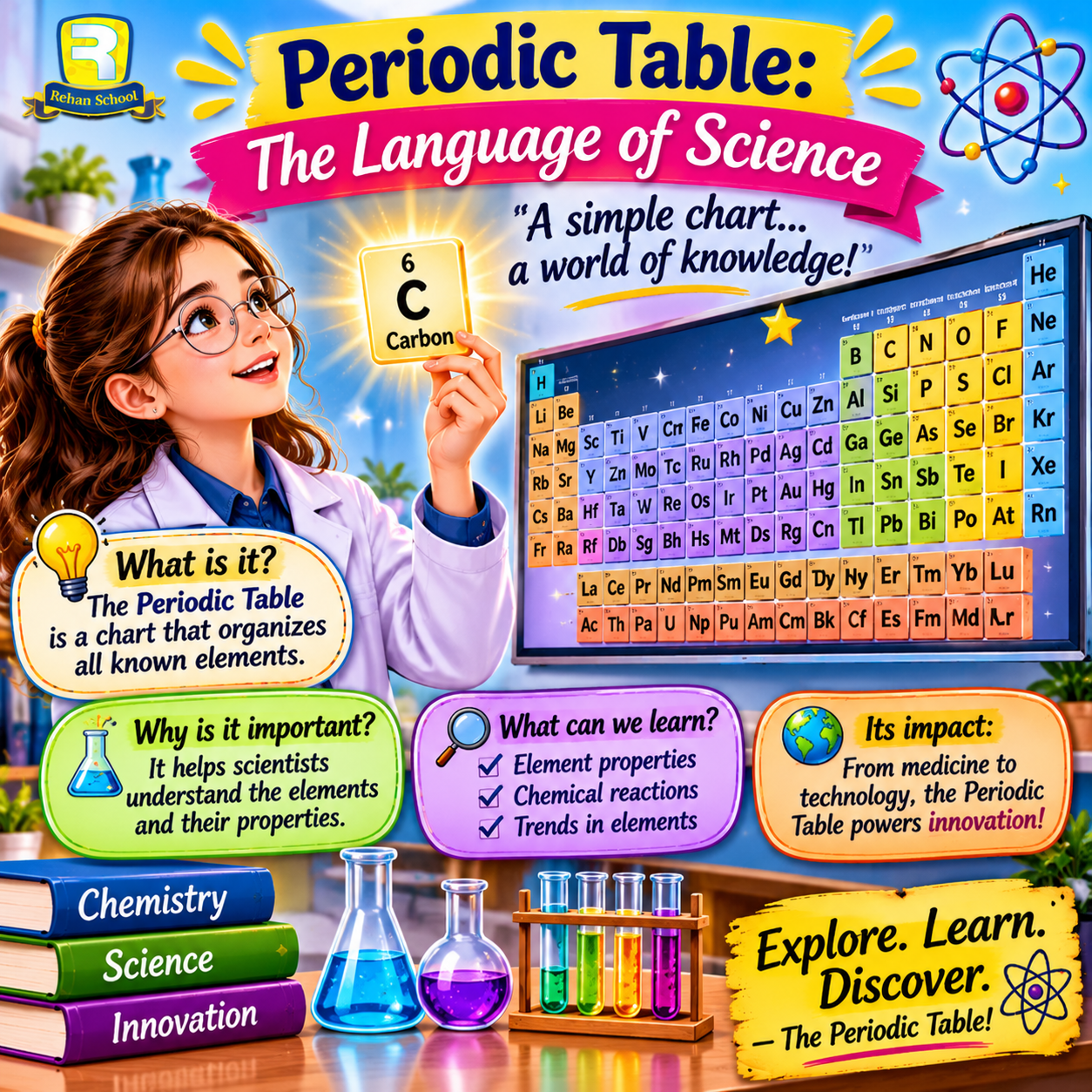
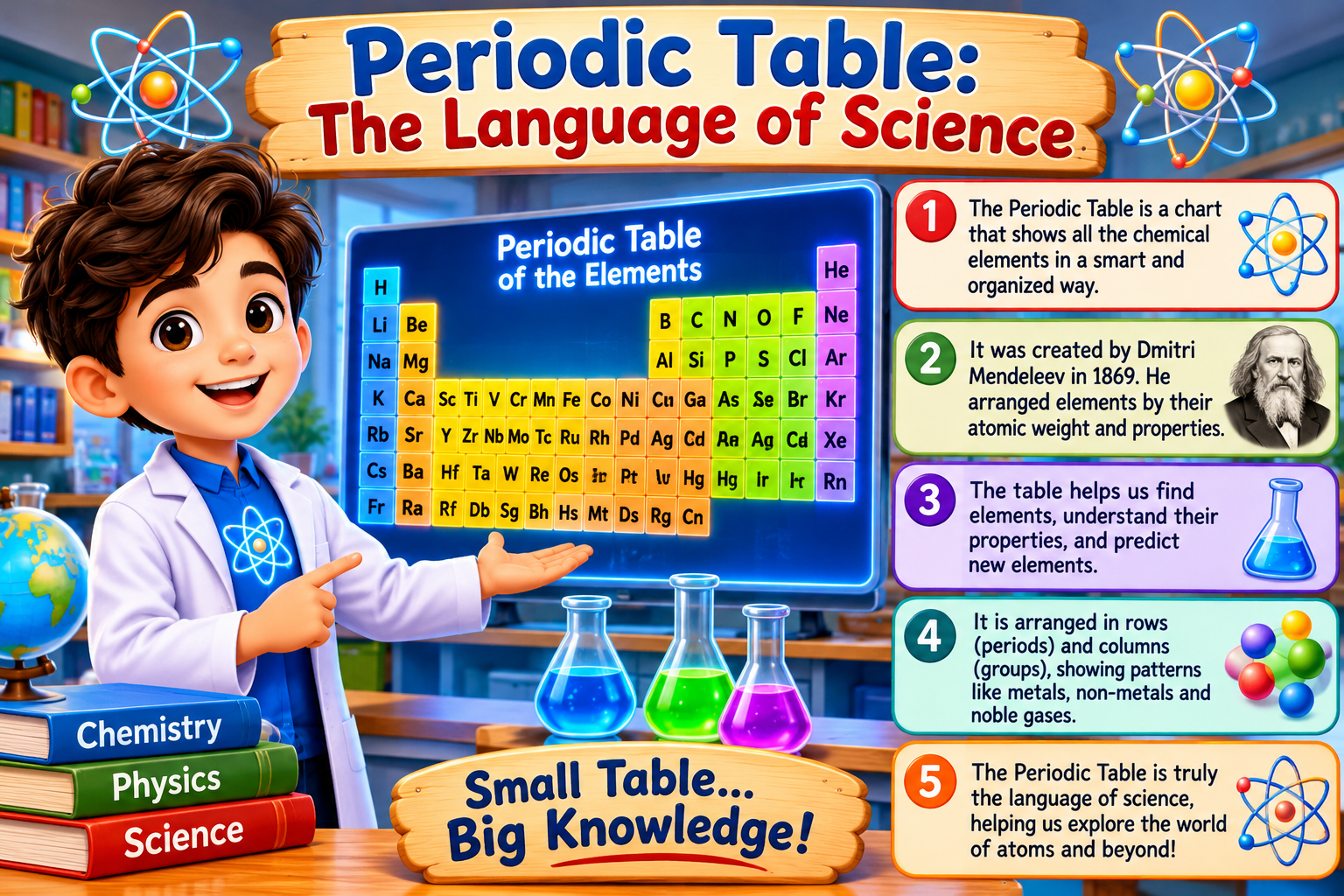
The Periodic Table is one of the most important discoveries in science. It is a chart that contains all the chemical elements found in the universe. Everything around us, including air, water, plants, animals, and even our bodies, is made of elements. Each element has its own name, symbol, and atomic number.
Paragraph 2: The Discovery
The Periodic Table was created by a Russian scientist named Dmitri Mendeleev in 1869. He arranged the elements according to their properties and atomic masses. His amazing idea helped scientists understand how different elements are connected.
Paragraph 3: Understanding the Table
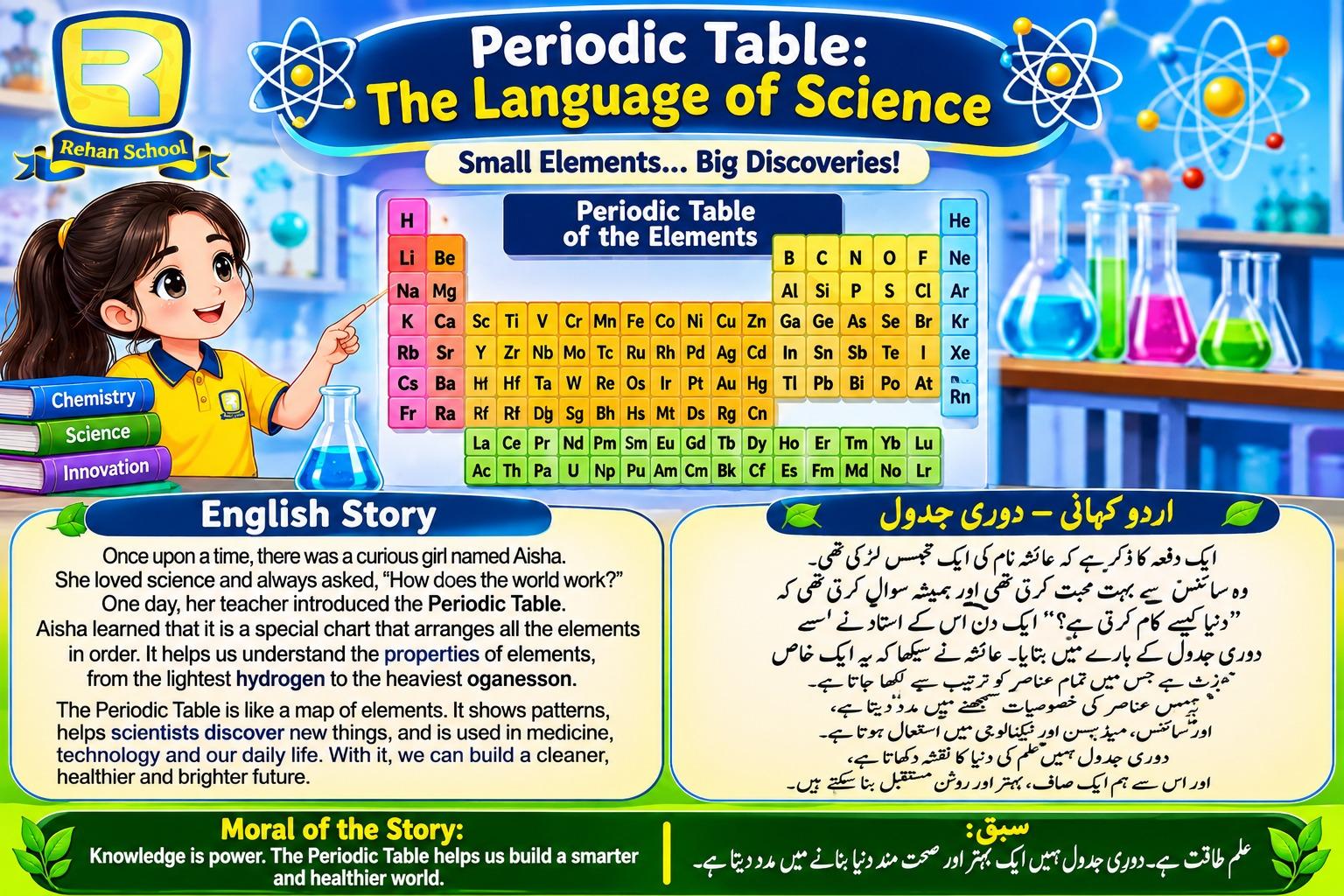
Every box in the Periodic Table represents one element. For example, H stands for Hydrogen, O stands for Oxygen, and Au stands for Gold. The atomic number tells us how many protons an element has. Elements are arranged in rows and columns according to their properties.
Paragraph 4: Why Is It Important?
The Periodic Table helps scientists discover new materials, understand chemical reactions, and learn how matter works. It is used in schools, laboratories, medicine, technology, and many other fields. Without it, understanding chemistry would be much more difficult.
Paragraph 5: The Language of Science
The Periodic Table is like a special language that helps us understand the building blocks of our world. It teaches us that even the smallest elements play a big role in our lives. Learning the Periodic Table is an exciting step toward discovering the mysteries of science and the universe.
Foundation level
Roll no 13
Day 62
story post
Rehan school urdu bazar campas
Periodic Table: The Language of Science
Paragraph 1: The World of Elements
The Periodic Table is one of the most important discoveries in science. It is a chart that contains all the chemical elements found in the universe. Everything around us, including air, water, plants, animals, and even our bodies, is made of elements. Each element has its own name, symbol, and atomic number.
Paragraph 2: The Discovery
The Periodic Table was created by a Russian scientist named Dmitri Mendeleev in 1869. He arranged the elements according to their properties and atomic masses. His amazing idea helped scientists understand how different elements are connected.
Paragraph 3: Understanding the Table
Every box in the Periodic Table represents one element. For example, H stands for Hydrogen, O stands for Oxygen, and Au stands for Gold. The atomic number tells us how many protons an element has. Elements are arranged in rows and columns according to their properties.
Paragraph 4: Why Is It Important?
The Periodic Table helps scientists discover new materials, understand chemical reactions, and learn how matter works. It is used in schools, laboratories, medicine, technology, and many other fields. Without it, understanding chemistry would be much more difficult.
Paragraph 5: The Language of Science
The Periodic Table is like a special language that helps us understand the building blocks of our world. It teaches us that even the smallest elements play a big role in our lives. Learning the Periodic Table is an exciting step toward discovering the mysteries of science and the universe.
0 Σχόλια
0 Μοιράστηκε
189 Views