


#rsisb
Roll no.239
Story post no.20
Foundation Level
In the 17th century, English scientist **Robert Hooke** examined thin slices of cork under a microscope. He noticed many tiny, box-like structures that reminded him of the small rooms, or **cells**, occupied by monks. He used the word **“cell”** to describe them.
Although Hooke observed the structures in dead cork tissue, his discovery helped introduce a word that would later become one of the most important terms in biology.
Centuries later, scientists discovered that living organisms are made up of cells and that cells carry out the essential processes needed for life. From a simple observation through an early microscope to today’s advanced biology laboratories, the journey of **“cell”** shows how language, observation, and scientific discovery can come together.
**One tiny word. One historic observation. A whole new way of understanding life.**
#Cell #RobertHooke #Biology #ScienceHistory #HistoryOfWords #Etymology #Microscope #CellBiology #Science #BiologyFacts #DidYouKnow #Education #Learning #ScientificDiscovery
Roll no.239
Story post no.20
Foundation Level
In the 17th century, English scientist **Robert Hooke** examined thin slices of cork under a microscope. He noticed many tiny, box-like structures that reminded him of the small rooms, or **cells**, occupied by monks. He used the word **“cell”** to describe them.
Although Hooke observed the structures in dead cork tissue, his discovery helped introduce a word that would later become one of the most important terms in biology.
Centuries later, scientists discovered that living organisms are made up of cells and that cells carry out the essential processes needed for life. From a simple observation through an early microscope to today’s advanced biology laboratories, the journey of **“cell”** shows how language, observation, and scientific discovery can come together.
**One tiny word. One historic observation. A whole new way of understanding life.**
#Cell #RobertHooke #Biology #ScienceHistory #HistoryOfWords #Etymology #Microscope #CellBiology #Science #BiologyFacts #DidYouKnow #Education #Learning #ScientificDiscovery
#rsisb
Roll no.239
Story post no.20
Foundation Level
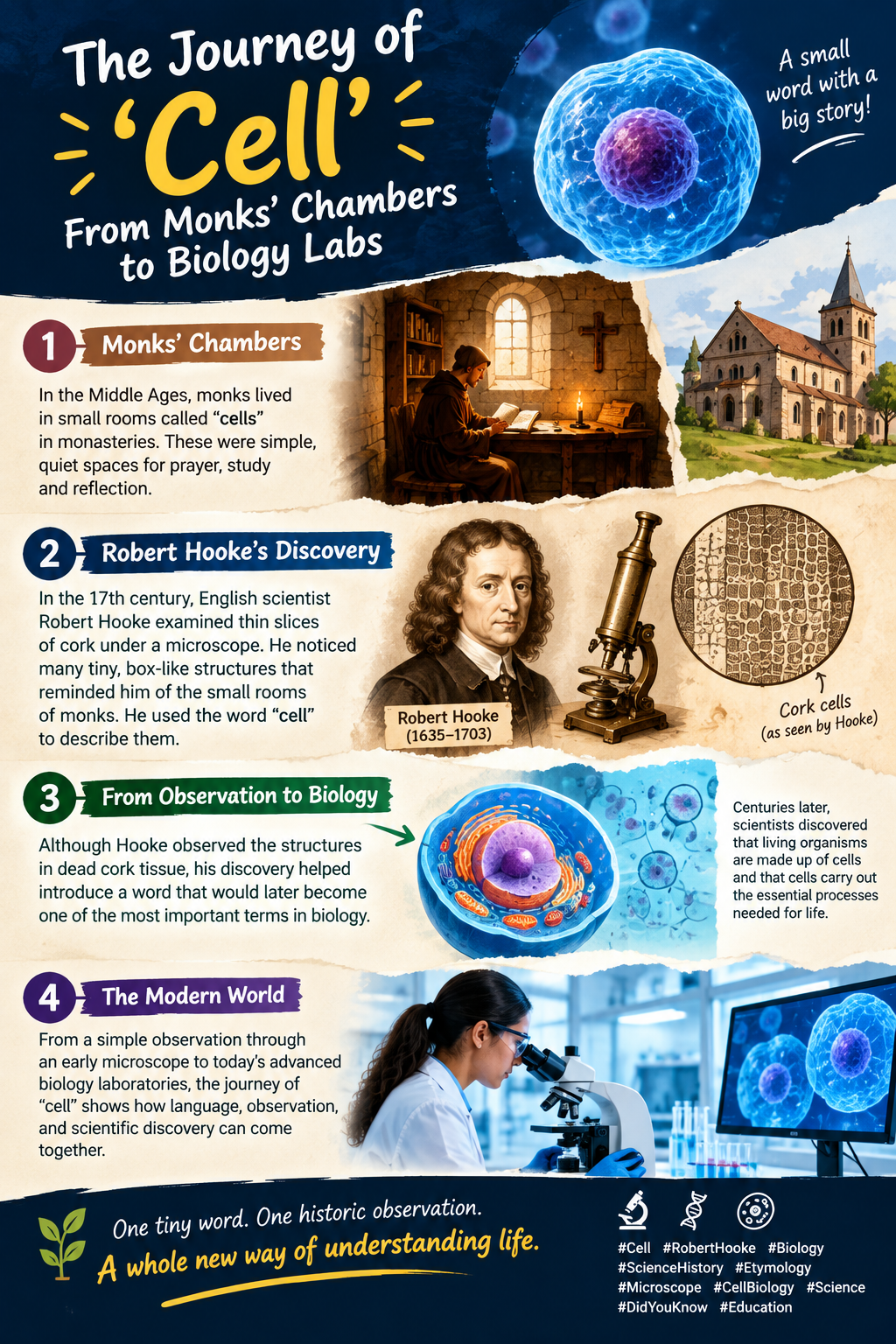
In the 17th century, English scientist **Robert Hooke** examined thin slices of cork under a microscope. He noticed many tiny, box-like structures that reminded him of the small rooms, or **cells**, occupied by monks. He used the word **“cell”** to describe them.
Although Hooke observed the structures in dead cork tissue, his discovery helped introduce a word that would later become one of the most important terms in biology. 🧬
Centuries later, scientists discovered that living organisms are made up of cells and that cells carry out the essential processes needed for life. From a simple observation through an early microscope to today’s advanced biology laboratories, the journey of **“cell”** shows how language, observation, and scientific discovery can come together.
🌱 **One tiny word. One historic observation. A whole new way of understanding life.**
#Cell #RobertHooke #Biology #ScienceHistory #HistoryOfWords #Etymology #Microscope #CellBiology #Science #BiologyFacts #DidYouKnow #Education #Learning #ScientificDiscovery
0 Comments
0 Shares
432 Views