• RSIF8
    Roll no:14
    story no:20
    story topic:Why Frogs? Understanding the Anatomy of Life

    # Why Frogs? Understanding the Anatomy of Life

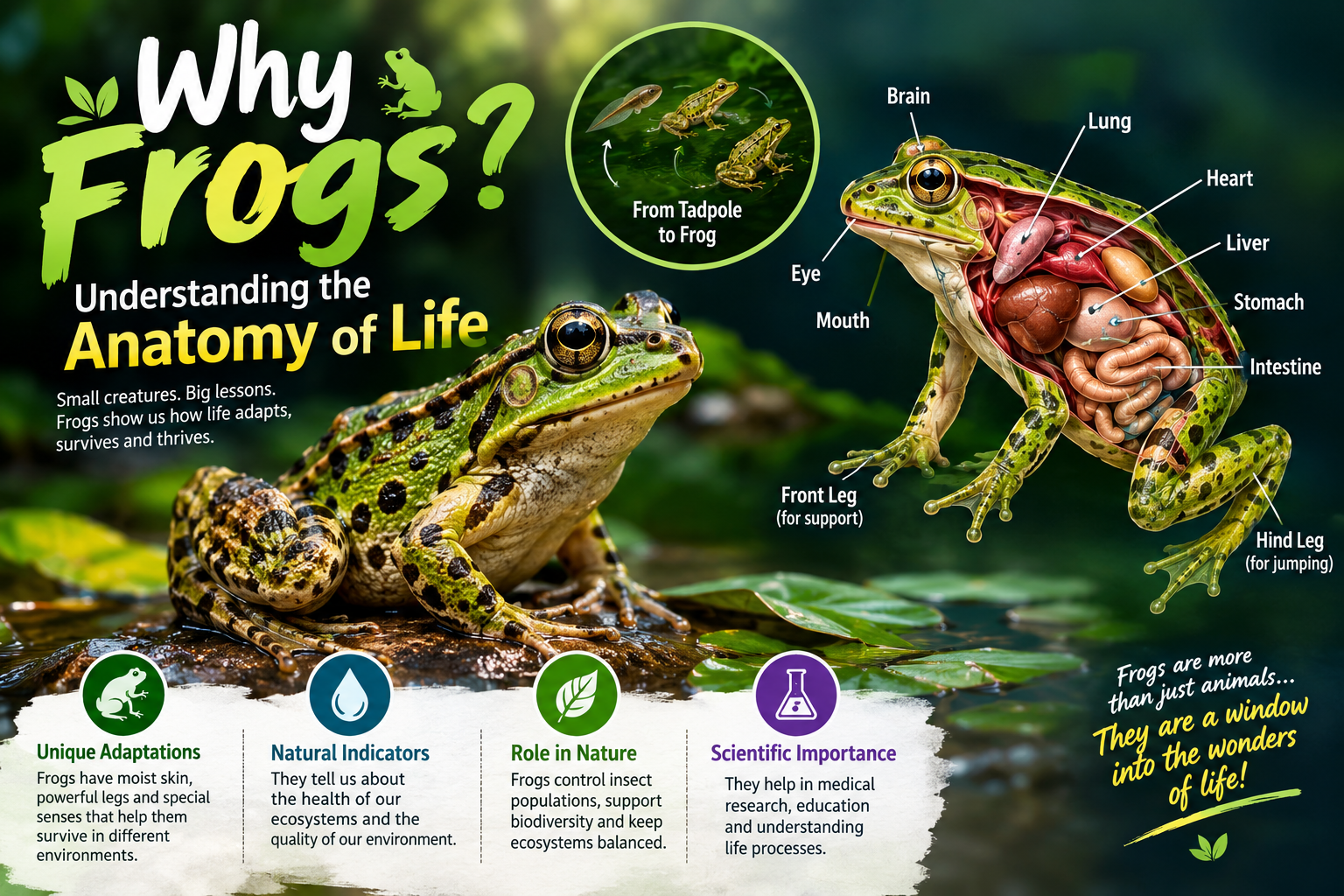
    Discover the fascinating world of frogs through **“Why Frogs? Understanding the Anatomy of Life.”** This educational topic explores the unique anatomy, amazing adaptations, and important role frogs play in maintaining the balance of nature. Although frogs may seem like small and simple creatures, their bodies reveal extraordinary examples of biological design, survival, and adaptation.

    From their powerful hind legs and moist skin to their sensitive eyes and specialized internal organs, frogs have developed remarkable features that help them survive in different environments. Their life cycle, from tiny tadpoles to adult frogs, demonstrates one of nature’s most interesting transformations.

    **What Will You Discover?**

    - **Frog Anatomy:** Learn about the brain, heart, lungs, stomach, intestines, and other important body parts.
    - **Unique Adaptations:** Discover how frogs jump, breathe, swim, and survive in their habitats.
    - **Life Cycle:** Explore the fascinating transformation from tadpole to adult frog.
    - **Environmental Indicators:** Understand how frogs can help scientists monitor ecosystem health.
    - **Role in Nature:** Learn how frogs help control insect populations and support biodiversity.
    - **Scientific Importance:** Discover how studying frogs helps us understand biology, anatomy, and life processes.

    Frogs are more than just pond-dwelling animals. They are an important part of food chains and ecosystems, and their sensitivity to environmental changes makes them valuable subjects for scientific research. Studying these amazing amphibians helps us appreciate the complexity of life and the importance of protecting nature.

    **Explore the hidden wonders of frog anatomy, uncover the secrets of their survival, and discover how these small creatures teach us big lessons about life!**

    #WhyFrogs #FrogAnatomy #UnderstandingLife #Biology #ScienceEducation #Amphibians #AnimalScience #Nature #Biodiversity #LifeCycle #EnvironmentalScience #EducationalContent #ExploreScience
    RSIF8 Roll no:14 story no:20 story topic:Why Frogs? Understanding the Anatomy of Life # 🐸 Why Frogs? Understanding the Anatomy of Life 🌿🔬 Discover the fascinating world of frogs through **“Why Frogs? Understanding the Anatomy of Life.”** This educational topic explores the unique anatomy, amazing adaptations, and important role frogs play in maintaining the balance of nature. 🌍✨ Although frogs may seem like small and simple creatures, their bodies reveal extraordinary examples of biological design, survival, and adaptation. From their powerful hind legs and moist skin to their sensitive eyes and specialized internal organs, frogs have developed remarkable features that help them survive in different environments. Their life cycle, from tiny tadpoles to adult frogs, demonstrates one of nature’s most interesting transformations. 💧🌱 🐸 **What Will You Discover?** - 🔬 **Frog Anatomy:** Learn about the brain, heart, lungs, stomach, intestines, and other important body parts. - 🌿 **Unique Adaptations:** Discover how frogs jump, breathe, swim, and survive in their habitats. - 💧 **Life Cycle:** Explore the fascinating transformation from tadpole to adult frog. - 🌎 **Environmental Indicators:** Understand how frogs can help scientists monitor ecosystem health. - 🦟 **Role in Nature:** Learn how frogs help control insect populations and support biodiversity. - 🧪 **Scientific Importance:** Discover how studying frogs helps us understand biology, anatomy, and life processes. Frogs are more than just pond-dwelling animals. They are an important part of food chains and ecosystems, and their sensitivity to environmental changes makes them valuable subjects for scientific research. Studying these amazing amphibians helps us appreciate the complexity of life and the importance of protecting nature. 💚🌏 ✨ **Explore the hidden wonders of frog anatomy, uncover the secrets of their survival, and discover how these small creatures teach us big lessons about life!** #WhyFrogs #FrogAnatomy #UnderstandingLife #Biology #ScienceEducation #Amphibians #AnimalScience #Nature #Biodiversity #LifeCycle #EnvironmentalScience #EducationalContent #ExploreScience 🐸🔬🌿
    0 Комментарии 0 Поделились 3234 Просмотры
  • **Roll No: 2**
    **Batch: 14**
    **Book: ACCL**
    **Task No: 130**

    # Peering Inside: The Role of Dissections in Understanding Life

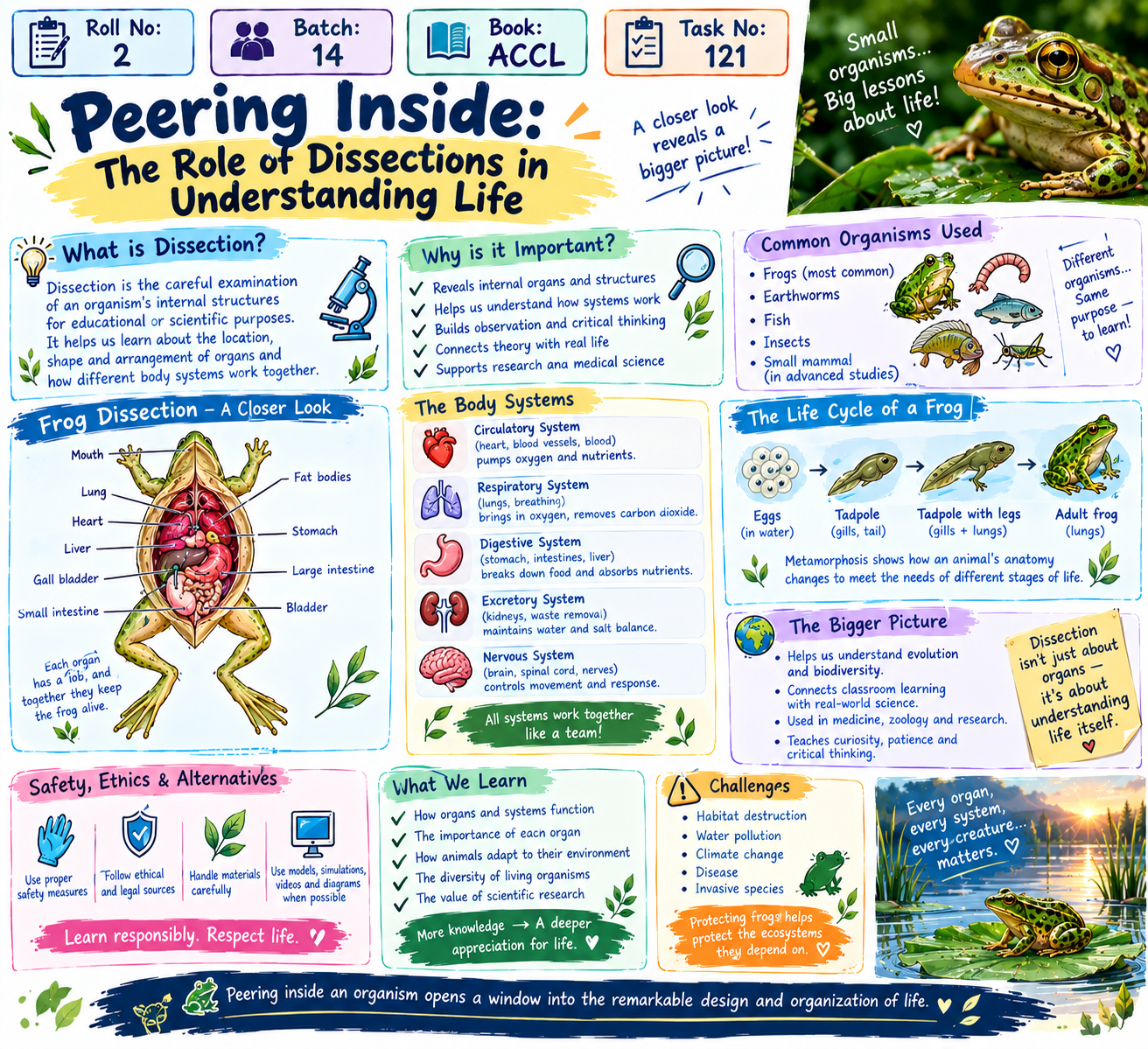
    Have you ever wondered how scientists discover what lies inside a living organism and how its different organs work together? The human body and the bodies of other animals contain many complex structures that cannot be fully understood by looking only at their outer appearance. Dissection is one scientific method that helps students and researchers explore internal anatomy and understand the remarkable organization of life.

    **Dissection is the careful examination of an organism's internal structures for educational or scientific purposes.** It helps us learn about the location, shape, and arrangement of organs and how different body systems work together. By studying anatomy, we can better understand how living organisms obtain energy, breathe, circulate blood, digest food, and respond to their surroundings.

    One commonly discussed example in biology education is frog dissection. Frogs are interesting study organisms because they have many organ systems that can be compared with those of other vertebrates. Their bodies are adapted for movement on land and in water, and their anatomy provides useful opportunities to study how organs perform different functions. Observing frog anatomy can help students understand the relationship between body structure and survival.

    The circulatory system is an important area of anatomical study. The heart pumps blood through blood vessels, helping transport oxygen, nutrients, and other substances around the body. The respiratory system supports gas exchange, while the digestive system breaks down food so that the body can absorb useful nutrients. These systems work together to supply cells with the materials and energy they need.

    The nervous system is equally fascinating. It includes the brain, spinal cord, and nerves, which coordinate movement, process information, and help organisms respond to changes in their environments. The excretory system also plays an essential role by removing waste products and maintaining the balance of water and salts. Studying these systems reveals that every organ has a specific role, yet no organ works entirely alone.

    Dissection can also connect classroom learning with real-world science. Medical professionals study anatomy to understand the human body, while zoologists investigate the structures of different animal species. Researchers use many methods, including imaging, microscopy, computer models, and carefully conducted anatomical studies, to investigate how organisms function. These approaches have helped expand our knowledge of health, development, and biodiversity.

    Although dissection can be a valuable learning method, science education must also emphasize responsibility and respect for life. Schools and laboratories should follow appropriate safety procedures, use legally and ethically sourced specimens, and handle materials carefully. Whenever possible, students may also learn through digital simulations, anatomical models, videos, and diagrams. These alternatives can explain many internal structures without requiring the use of preserved specimens.

    The study of anatomy helps us appreciate the diversity of living organisms. Different species have different body structures because they have adapted to different environments and ways of life. Comparing these structures allows scientists to investigate evolution, understand biological similarities, and discover how organisms meet the challenges of survival.

    Dissection teaches more than the names of organs. It encourages observation, patience, careful reasoning, and the ability to connect scientific evidence with biological explanations. It also reminds us that scientific knowledge grows through asking questions, examining evidence, and learning from reliable methods rather than making assumptions.

    **Peering inside an organism opens a window into the remarkable design and organization of life. By studying anatomy responsibly, we deepen our understanding of biology, appreciate the connections between body systems, and learn why every discovery should be guided by curiosity, care, and respect for the natural world. **

    \#Dissection #Anatomy #Biology #ScienceEducation #AnimalScience #LearningThroughScience #ACCL #Batch14 #Task121
    **Roll No: 2** **Batch: 14** **Book: ACCL** **Task No: 130** # 🔬🧬 Peering Inside: The Role of Dissections in Understanding Life 🐸🌿 Have you ever wondered how scientists discover what lies inside a living organism and how its different organs work together? 🔍🫀 The human body and the bodies of other animals contain many complex structures that cannot be fully understood by looking only at their outer appearance. Dissection is one scientific method that helps students and researchers explore internal anatomy and understand the remarkable organization of life. 🌍✨ **Dissection is the careful examination of an organism's internal structures for educational or scientific purposes.** 🔬 It helps us learn about the location, shape, and arrangement of organs and how different body systems work together. By studying anatomy, we can better understand how living organisms obtain energy, breathe, circulate blood, digest food, and respond to their surroundings. 📚🧠 One commonly discussed example in biology education is frog dissection. 🐸 Frogs are interesting study organisms because they have many organ systems that can be compared with those of other vertebrates. Their bodies are adapted for movement on land and in water, and their anatomy provides useful opportunities to study how organs perform different functions. Observing frog anatomy can help students understand the relationship between body structure and survival. The circulatory system is an important area of anatomical study. ❤️ The heart pumps blood through blood vessels, helping transport oxygen, nutrients, and other substances around the body. The respiratory system supports gas exchange, while the digestive system breaks down food so that the body can absorb useful nutrients. These systems work together to supply cells with the materials and energy they need. ⚡🫁 The nervous system is equally fascinating. 🧠 It includes the brain, spinal cord, and nerves, which coordinate movement, process information, and help organisms respond to changes in their environments. The excretory system also plays an essential role by removing waste products and maintaining the balance of water and salts. Studying these systems reveals that every organ has a specific role, yet no organ works entirely alone. Dissection can also connect classroom learning with real-world science. 🏥 Medical professionals study anatomy to understand the human body, while zoologists investigate the structures of different animal species. Researchers use many methods, including imaging, microscopy, computer models, and carefully conducted anatomical studies, to investigate how organisms function. These approaches have helped expand our knowledge of health, development, and biodiversity. 🔬📖 Although dissection can be a valuable learning method, science education must also emphasize responsibility and respect for life. 💚 Schools and laboratories should follow appropriate safety procedures, use legally and ethically sourced specimens, and handle materials carefully. Whenever possible, students may also learn through digital simulations, anatomical models, videos, and diagrams. These alternatives can explain many internal structures without requiring the use of preserved specimens. The study of anatomy helps us appreciate the diversity of living organisms. 🐸🐟🐦 Different species have different body structures because they have adapted to different environments and ways of life. Comparing these structures allows scientists to investigate evolution, understand biological similarities, and discover how organisms meet the challenges of survival. Dissection teaches more than the names of organs. It encourages observation, patience, careful reasoning, and the ability to connect scientific evidence with biological explanations. 🧪💡 It also reminds us that scientific knowledge grows through asking questions, examining evidence, and learning from reliable methods rather than making assumptions. **Peering inside an organism opens a window into the remarkable design and organization of life. By studying anatomy responsibly, we deepen our understanding of biology, appreciate the connections between body systems, and learn why every discovery should be guided by curiosity, care, and respect for the natural world. 🔬🌿🌎** \#Dissection #Anatomy #Biology #ScienceEducation #AnimalScience #LearningThroughScience #ACCL #Batch14 #Task121 🧬🔬💚
    0 Комментарии 0 Поделились 3558 Просмотры
  • **Roll No: 2**
    **Batch: 14**
    **Book: ACCL**
    **Task No: 120**

    # Why Frogs? Understanding the Anatomy of Life

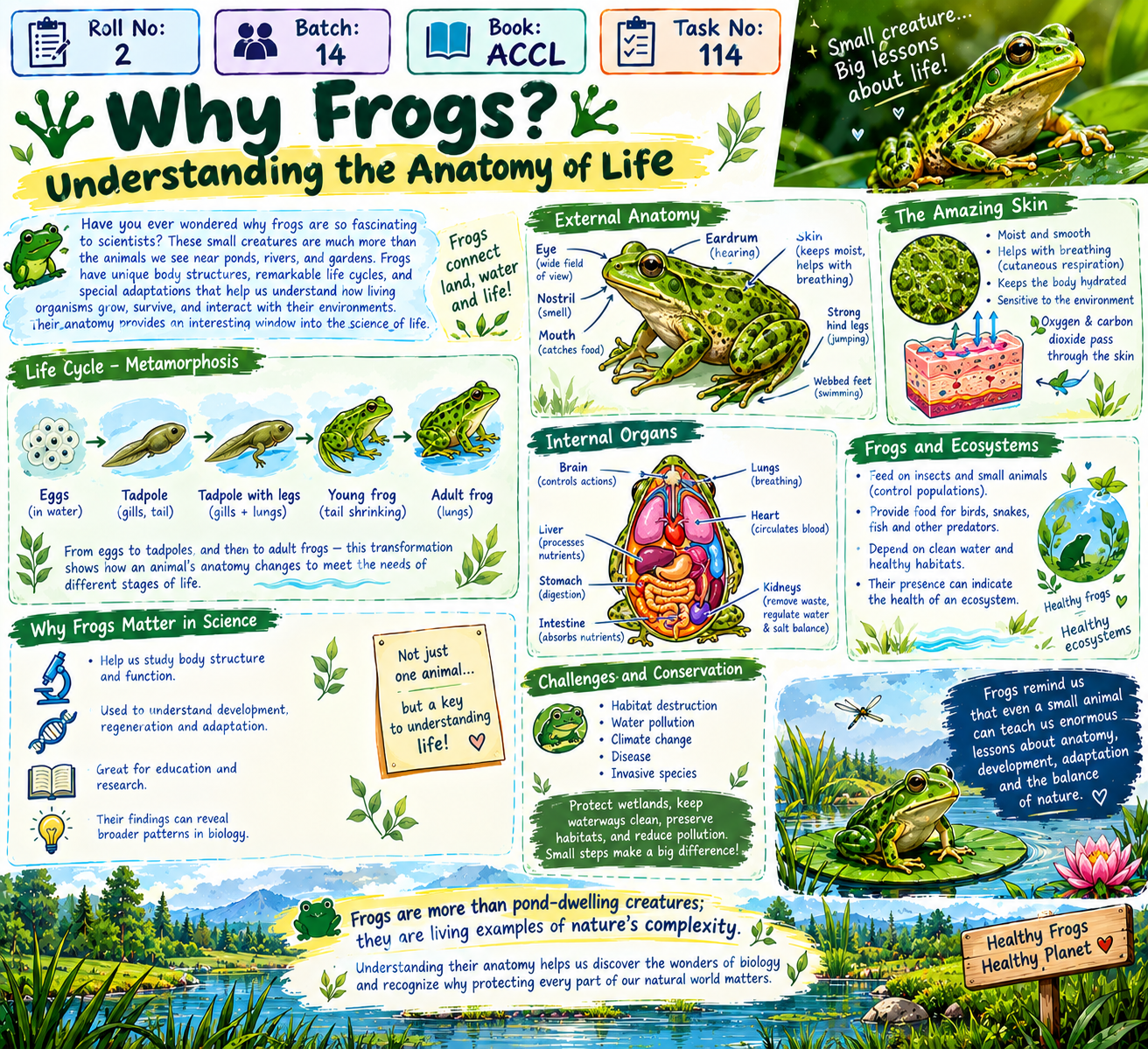
    Have you ever wondered why frogs are so fascinating to scientists? These small creatures are much more than the animals we see near ponds, rivers, and gardens. Frogs have unique body structures, remarkable life cycles, and special adaptations that help us understand how living organisms grow, survive, and interact with their environments. Their anatomy provides an interesting window into the science of life.

    A frog's body is designed for life both in water and on land. Its body generally has a broad head, a short trunk, strong hind legs, and webbed feet in many species. These features help frogs jump, swim, and move through their habitats. Their eyes are positioned to provide a wide field of view, while their sensitive hearing helps them detect sounds, including the calls of other frogs.

    One of the most interesting features of frogs is their skin. Unlike the dry, scaly skin of many reptiles, frog skin is usually moist and plays an important role in their survival. Many frogs can exchange gases through their skin as well as through their lungs. This process, called **cutaneous respiration**, allows oxygen and carbon dioxide to pass across the skin under suitable conditions. Their skin also helps maintain moisture, making a healthy habitat especially important for them.

    Frogs have a fascinating life cycle called **metamorphosis**. Many begin life as eggs in water. The eggs hatch into tadpoles, which usually have tails and breathe mainly through gills. As they develop, they grow legs, their lungs develop, and their bodies gradually change into those of adult frogs. The tail is usually absorbed during development. This transformation demonstrates how an animal's anatomy changes to meet the needs of different stages of life.

    The internal organs of a frog also reveal important biological principles. Its heart circulates blood through the body, carrying oxygen and nutrients to tissues. The digestive system breaks down food, while the kidneys help remove waste and regulate water and salt balance. The brain and nervous system coordinate movement, senses, and responses to the environment. Each organ works with other systems to keep the animal alive.

    Frogs are also valuable to ecosystems. Many feed on insects and other small animals, helping influence populations of these organisms. Frogs themselves provide food for birds, snakes, fish, and other predators. Because many frogs depend on suitable water and land habitats, changes in their populations can provide clues about environmental conditions. Scientists therefore study frogs to learn more about biodiversity, habitat quality, and ecosystem health.

    Another reason frogs are important is their role in scientific research and education. Their anatomy helps students explore the structure and function of organs, compare different vertebrates, and understand biological systems. Researchers also study frog development, regeneration in certain species, communication, and adaptation. Such research can reveal broader patterns in biology, although findings from frogs do not always apply directly to humans.

    Unfortunately, many frog species face challenges such as habitat destruction, water pollution, climate change, disease, and invasive species. Protecting wetlands, keeping waterways clean, preserving natural habitats, and reducing pollution can help support frog populations and the many other organisms that share their ecosystems. Caring for frogs is one way of caring for the wider web of life.

    Frogs remind us that even a small animal can teach us enormous lessons about anatomy, development, adaptation, and the balance of nature. By observing their bodies and studying their life cycles, we gain a deeper appreciation of how living systems work together.

    **Frogs are more than pond-dwelling creatures; they are living examples of nature's complexity. Understanding their anatomy helps us discover the wonders of biology and recognize why protecting every part of our natural world matters. **

    \#Frogs #AnatomyOfLife #Biology #LifeCycle #AnimalScience #Biodiversity #ACCL #Batch14 #Task114
    **Roll No: 2** **Batch: 14** **Book: ACCL** **Task No: 120** # 🐸🔬 Why Frogs? Understanding the Anatomy of Life 🌿💚 Have you ever wondered why frogs are so fascinating to scientists? 🐸🌎 These small creatures are much more than the animals we see near ponds, rivers, and gardens. Frogs have unique body structures, remarkable life cycles, and special adaptations that help us understand how living organisms grow, survive, and interact with their environments. Their anatomy provides an interesting window into the science of life. 🔬✨ A frog's body is designed for life both in water and on land. 💧🌱 Its body generally has a broad head, a short trunk, strong hind legs, and webbed feet in many species. These features help frogs jump, swim, and move through their habitats. Their eyes are positioned to provide a wide field of view, while their sensitive hearing helps them detect sounds, including the calls of other frogs. 🦵👀 One of the most interesting features of frogs is their skin. Unlike the dry, scaly skin of many reptiles, frog skin is usually moist and plays an important role in their survival. 🐸💦 Many frogs can exchange gases through their skin as well as through their lungs. This process, called **cutaneous respiration**, allows oxygen and carbon dioxide to pass across the skin under suitable conditions. Their skin also helps maintain moisture, making a healthy habitat especially important for them. Frogs have a fascinating life cycle called **metamorphosis**. 🥚➡️🐟➡️🐸 Many begin life as eggs in water. The eggs hatch into tadpoles, which usually have tails and breathe mainly through gills. As they develop, they grow legs, their lungs develop, and their bodies gradually change into those of adult frogs. The tail is usually absorbed during development. This transformation demonstrates how an animal's anatomy changes to meet the needs of different stages of life. 🌱🔄 The internal organs of a frog also reveal important biological principles. ❤️ Its heart circulates blood through the body, carrying oxygen and nutrients to tissues. The digestive system breaks down food, while the kidneys help remove waste and regulate water and salt balance. The brain and nervous system coordinate movement, senses, and responses to the environment. Each organ works with other systems to keep the animal alive. 🧠🫀 Frogs are also valuable to ecosystems. 🦟🌿 Many feed on insects and other small animals, helping influence populations of these organisms. Frogs themselves provide food for birds, snakes, fish, and other predators. Because many frogs depend on suitable water and land habitats, changes in their populations can provide clues about environmental conditions. Scientists therefore study frogs to learn more about biodiversity, habitat quality, and ecosystem health. 🌍🔎 Another reason frogs are important is their role in scientific research and education. 📚🔬 Their anatomy helps students explore the structure and function of organs, compare different vertebrates, and understand biological systems. Researchers also study frog development, regeneration in certain species, communication, and adaptation. Such research can reveal broader patterns in biology, although findings from frogs do not always apply directly to humans. Unfortunately, many frog species face challenges such as habitat destruction, water pollution, climate change, disease, and invasive species. 🌧️🏞️ Protecting wetlands, keeping waterways clean, preserving natural habitats, and reducing pollution can help support frog populations and the many other organisms that share their ecosystems. Caring for frogs is one way of caring for the wider web of life. 💚♻️ Frogs remind us that even a small animal can teach us enormous lessons about anatomy, development, adaptation, and the balance of nature. By observing their bodies and studying their life cycles, we gain a deeper appreciation of how living systems work together. 🐸🌎🔬 **Frogs are more than pond-dwelling creatures; they are living examples of nature's complexity. Understanding their anatomy helps us discover the wonders of biology and recognize why protecting every part of our natural world matters. 🐸🧬🌿✨** \#Frogs #AnatomyOfLife #Biology #LifeCycle #AnimalScience #Biodiversity #ACCL #Batch14 #Task114 🐸🔬🌍
    0 Комментарии 0 Поделились 4875 Просмотры
  • RSIF8
    Roll no: 99
    Song no: 17
    Song topic: Learning Through Layers: The Importance of Animal Anatomy Studies
    Animal anatomy is more than the study of bones, muscles, and organs—it is a journey into understanding how living organisms are built and how their bodies work together. By exploring anatomy through different layers, we can better understand the structure, function, and complexity of life. This song highlights the importance of animal anatomy studies in biology, helping us connect what we see on the outside with the fascinating systems working within.
    #AnimalAnatomy #AnatomyStudies #Biology #AnimalScience #LearningThroughLayers #Science #ScienceSong #Learning #Education
    RSIF8 Roll no: 99 Song no: 17 Song topic: Learning Through Layers: The Importance of Animal Anatomy Studies Animal anatomy is more than the study of bones, muscles, and organs—it is a journey into understanding how living organisms are built and how their bodies work together. By exploring anatomy through different layers, we can better understand the structure, function, and complexity of life. This song highlights the importance of animal anatomy studies in biology, helping us connect what we see on the outside with the fascinating systems working within. #AnimalAnatomy #AnatomyStudies #Biology #AnimalScience #LearningThroughLayers #Science #ScienceSong #Learning #Education
    0 Комментарии 0 Поделились 1830 Просмотры 2
  • Michael Sillion giving talk at UVAS-University of Veterinary and Animal Sciences, Lahore

    #Lahore #AnimalSciences
    Michael Sillion giving talk at UVAS-University of Veterinary and Animal Sciences, Lahore #Lahore #AnimalSciences
    0 Комментарии 0 Поделились 1475 Просмотры
  • Day: 125
    Roll No: 006
    Foundation Level
    Story Post

    Why Frogs? Understanding the Anatomy of Life
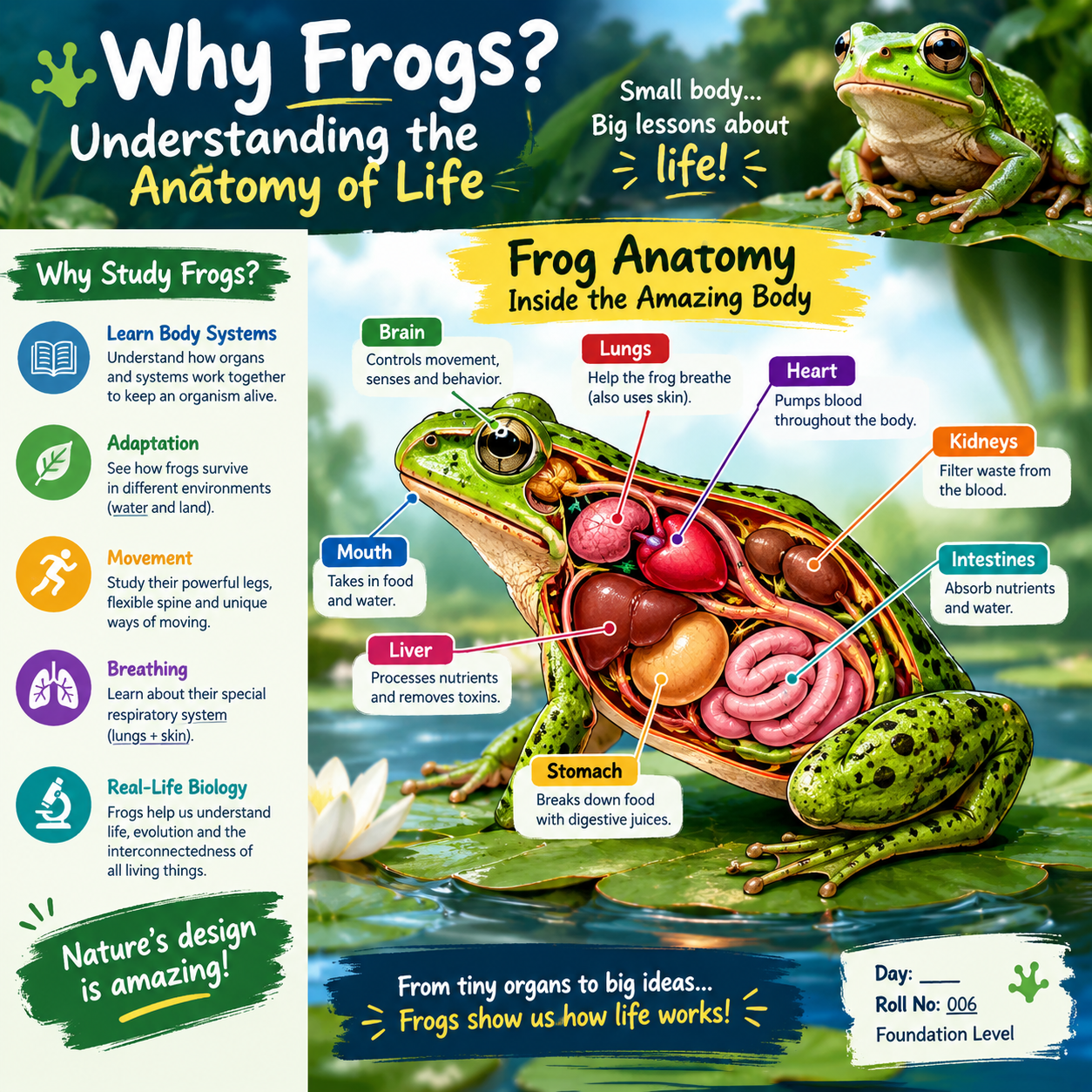
    Frogs are fascinating animals that help us understand how living bodies work. Their anatomy includes important organs such as the heart, lungs, stomach, intestines, and kidneys, each performing a special function. Studying frogs helps students learn about body systems, adaptation, movement, breathing, and how different organs work together to keep an organism alive.
    From their powerful legs to their unique respiratory system, frogs show us how beautifully different parts of the body are connected.
    #Frogs #AnatomyOfLife #Biology #Science #Learning #AnimalScience #Education #Nature #FoundationLevel #RehanSchool
    Day: 125 Roll No: 006 Foundation Level 📖 Story Post 🐸 Why Frogs? Understanding the Anatomy of Life Frogs are fascinating animals that help us understand how living bodies work. Their anatomy includes important organs such as the heart, lungs, stomach, intestines, and kidneys, each performing a special function. Studying frogs helps students learn about body systems, adaptation, movement, breathing, and how different organs work together to keep an organism alive. From their powerful legs to their unique respiratory system, frogs show us how beautifully different parts of the body are connected. 🧬🔬 #Frogs #AnatomyOfLife #Biology #Science #Learning #AnimalScience #Education #Nature #FoundationLevel #RehanSchool
    0 Комментарии 0 Поделились 1541 Просмотры
  • **Foundation Level** **Day 125** **story post** **Roll Number: 005**

    Why Frogs? Understanding the Anatomy of Life

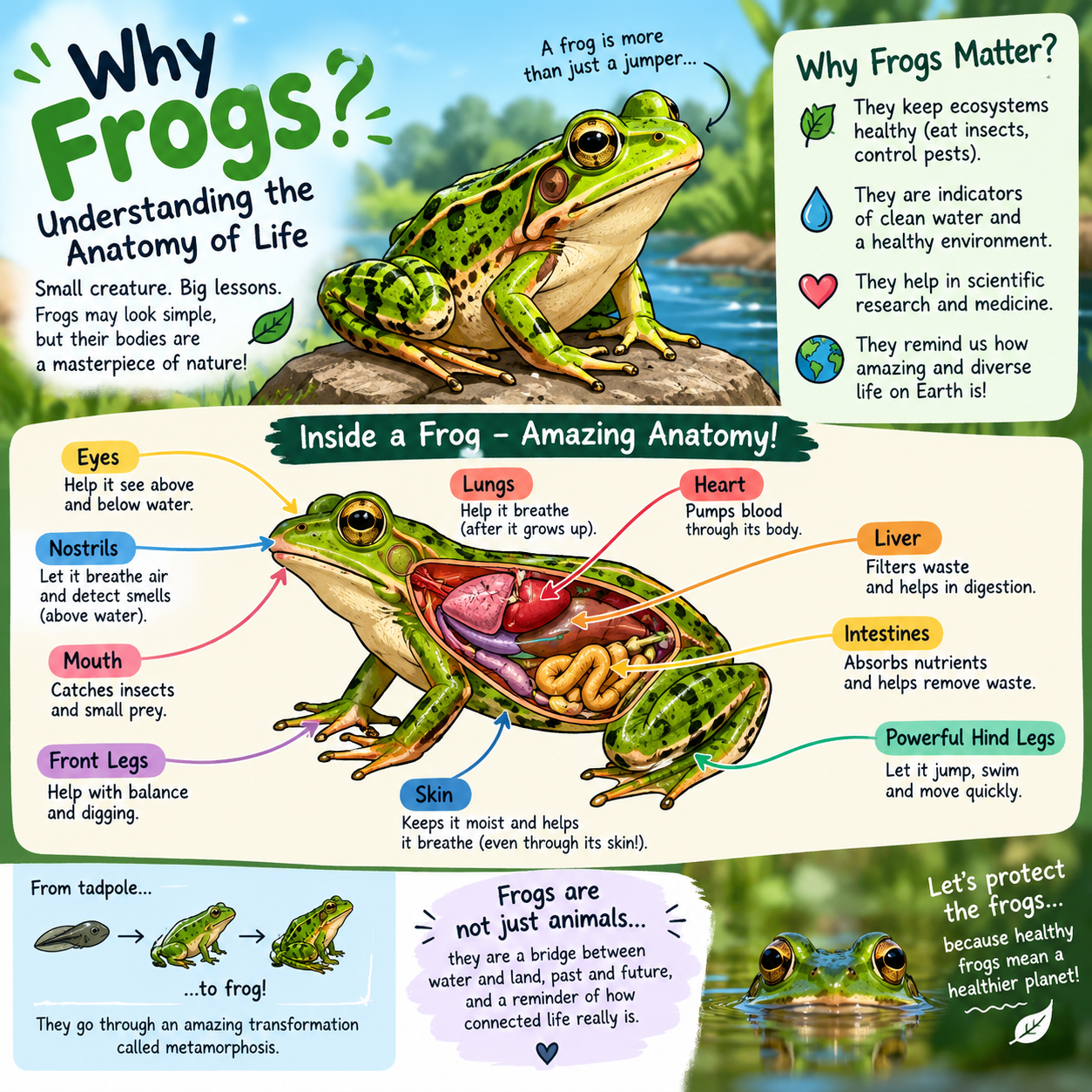
    Frogs may look like simple little creatures, but their bodies reveal amazing lessons about life and nature! This educational comic explores frog anatomy, including the eyes, lungs, heart, liver, intestines, skin, and powerful hind legs, while showing how each part helps the frog survive.

    From tadpole to frog, their incredible metamorphosis shows the beauty of nature’s transformations. Frogs also help keep ecosystems healthy and can indicate the condition of our environment.

    Learn about frogs. Understand life. Protect nature.

    #Frogs #Anatomy #Biology #ScienceEducation #Nature #AnimalScience #LifeScience #Metamorphosis #Environment #EducationalPost #ScienceComic #InstagramEducation
    **Foundation Level** **Day 125** **story post** **Roll Number: 005** 🐸 Why Frogs? Understanding the Anatomy of Life 🌿 Frogs may look like simple little creatures, but their bodies reveal amazing lessons about life and nature! 🔬✨ This educational comic explores frog anatomy, including the eyes, lungs, heart, liver, intestines, skin, and powerful hind legs, while showing how each part helps the frog survive. From tadpole to frog, their incredible metamorphosis shows the beauty of nature’s transformations. 🌱💧 Frogs also help keep ecosystems healthy and can indicate the condition of our environment. 💚 Learn about frogs. Understand life. Protect nature. #Frogs #Anatomy #Biology #ScienceEducation #Nature #AnimalScience #LifeScience #Metamorphosis #Environment #EducationalPost #ScienceComic #InstagramEducation
    0 Комментарии 0 Поделились 3394 Просмотры

  • #rsisb
    Roll no.239
    Song no .28
    Foundation Level

    **Learning Through Layers: The Importance of Animal Anatomy Studies** explores how studying animal anatomy helps us understand the structure and function of living organisms. By examining organs, tissues, bones, muscles, and body systems, students can discover how different parts work together to support life.

    Animal anatomy studies also help develop **observation, scientific thinking, and biological understanding**. Comparing different species can reveal both shared biological structures and fascinating adaptations to different environments.

    #AnimalAnatomy #Biology #Science #LifeScience #AnatomyStudies #AnimalScience #Education #Learning #ScientificDiscovery
    #rsisb Roll no.239 Song no .28 Foundation Level **Learning Through Layers: The Importance of Animal Anatomy Studies** explores how studying animal anatomy helps us understand the structure and function of living organisms. 🧬✨ By examining organs, tissues, bones, muscles, and body systems, students can discover how different parts work together to support life. Animal anatomy studies also help develop **observation, scientific thinking, and biological understanding**. Comparing different species can reveal both shared biological structures and fascinating adaptations to different environments. 🌍🐾 #AnimalAnatomy #Biology #Science #LifeScience #AnatomyStudies #AnimalScience #Education #Learning #ScientificDiscovery 🐾🔬📚✨
    0 Комментарии 0 Поделились 1920 Просмотры 4
  • #rsisb
    Roll no.247
    song .25
    Foundation level

    **Learning Through Layers: The Importance of Animal Anatomy Studies**

    Animal anatomy is a fascinating field that helps us understand how living organisms are built, how their body systems work, and how different parts work together to support life. From the smallest bones and muscles to complex organs and body systems, studying anatomy gives us a deeper appreciation of the incredible organization found in living creatures.

    **Learning Through Layers** means exploring the body step by step. By studying structures from the outside to the inside, students can understand how muscles, bones, organs, tissues, and other systems are connected. Each layer reveals something new and helps turn scientific ideas into a clearer picture.

    Animal anatomy studies are also important because they develop observation, critical thinking, and scientific reasoning. Students learn to identify structures, compare different animals, ask questions, and understand how body structures relate to their functions.

    Comparing the anatomy of different animals can also teach us about adaptation and diversity. Animals may have different body shapes and structures because they live in different environments and have different ways of surviving. This makes anatomy an exciting bridge between **biology, evolution, ecology, and the study of life itself.**

    Most importantly, anatomy encourages curiosity. Instead of simply memorizing names, learners can ask: **Why is this structure shaped this way? What does it do? How does it work with other parts of the body?** These questions transform learning into exploration.

    Studying animal anatomy reminds us that every living creature has a remarkable internal design. Through careful observation, scientific study, and responsible learning, we can better understand the diversity and complexity of life around us.

    **Explore. Observe. Question. Discover. Learn through every layer of life!**

    #AnimalAnatomy #AnatomyStudies #Biology #ScienceLearning #LearningThroughLayers #AnimalScience #LifeScience #BiologyStudents #ScienceEducation #EducationalJourney #ExploreScience #ScientificLearning #Curiosity #CriticalThinking #Observation #NatureAndScience #AnimalBiology #STEMEducation #LearningIsFun #DiscoverScience #KnowledgeIsPower #ScienceExploration
    #rsisb Roll no.247 song .25 Foundation level 🐾🔬 **Learning Through Layers: The Importance of Animal Anatomy Studies** 🧬📚 Animal anatomy is a fascinating field that helps us understand how living organisms are built, how their body systems work, and how different parts work together to support life. 🌍❤️ From the smallest bones and muscles to complex organs and body systems, studying anatomy gives us a deeper appreciation of the incredible organization found in living creatures. 🦴🫀🫁 🔍 **Learning Through Layers** means exploring the body step by step. By studying structures from the outside to the inside, students can understand how muscles, bones, organs, tissues, and other systems are connected. Each layer reveals something new and helps turn scientific ideas into a clearer picture. 🧠✨ 📖 Animal anatomy studies are also important because they develop observation, critical thinking, and scientific reasoning. Students learn to identify structures, compare different animals, ask questions, and understand how body structures relate to their functions. 🐕🐈🦅🐸 🌱 Comparing the anatomy of different animals can also teach us about adaptation and diversity. Animals may have different body shapes and structures because they live in different environments and have different ways of surviving. This makes anatomy an exciting bridge between **biology, evolution, ecology, and the study of life itself.** 🌎🔬 💡 Most importantly, anatomy encourages curiosity. Instead of simply memorizing names, learners can ask: **Why is this structure shaped this way? What does it do? How does it work with other parts of the body?** These questions transform learning into exploration. 🚀📚 🐾🔬 Studying animal anatomy reminds us that every living creature has a remarkable internal design. Through careful observation, scientific study, and responsible learning, we can better understand the diversity and complexity of life around us. 🌟🧬 ✨ **Explore. Observe. Question. Discover. Learn through every layer of life!** 📚🔍🐾 #AnimalAnatomy #AnatomyStudies #Biology #ScienceLearning #LearningThroughLayers #AnimalScience #LifeScience #BiologyStudents #ScienceEducation #EducationalJourney #ExploreScience #ScientificLearning #Curiosity #CriticalThinking #Observation #NatureAndScience #AnimalBiology #STEMEducation #LearningIsFun #DiscoverScience #KnowledgeIsPower #ScienceExploration 🐾🔬🧬📚🌍✨
    0 Комментарии 0 Поделились 5720 Просмотры 5
  • #rsisb
    Roll no.214
    Foundation level
    Storyn post no.18
    Discover the amazing world of frogs and learn how their unique body structure helps them survive in nature! From their powerful legs and sensitive eyes to their lungs, skin, heart, and digestive system, every part of a frog’s body has an important role. This topic helps us understand how living organisms are designed, how their organs work together, and how nature creates incredible systems of life.
    Learn • Explore • Discover • Understand
    #Frogs #FrogAnatomy #AnatomyOfLife #Biology #Science #AnimalScience #LifeScience #Nature #Learning #Education #BiologyStudents #ScienceExploration #AmazingNature #AnimalAnatomy
    #rsisb Roll no.214 Foundation level Storyn post no.18 Discover the amazing world of frogs and learn how their unique body structure helps them survive in nature! 🔬🫀 From their powerful legs and sensitive eyes to their lungs, skin, heart, and digestive system, every part of a frog’s body has an important role. 🌱✨ This topic helps us understand how living organisms are designed, how their organs work together, and how nature creates incredible systems of life. 🧬🌍 📚 Learn • 🔬 Explore • 🐸 Discover • 🌿 Understand #Frogs #FrogAnatomy #AnatomyOfLife #Biology #Science #AnimalScience #LifeScience #Nature #Learning #Education #BiologyStudents #ScienceExploration #AmazingNature #AnimalAnatomy 🐸🔬🌿📚✨
    0 Комментарии 0 Поделились 3337 Просмотры
Расширенные страницы