• #rsisb
    Roll No.240
    Story No.19
    Foundation Level

    # The Blueprint of Existence: Unraveling DNA and the Origins of Life

    DNA, or **Deoxyribonucleic Acid**, is often called the **blueprint of life** because it contains the genetic instructions that guide the growth, development, and functioning of every living organism. From the tiniest bacteria to the largest mammals, DNA carries the information that determines how living things are built, how they reproduce, and how traits are passed from one generation to the next. Understanding DNA has revolutionized biology, medicine, agriculture, and forensic science, helping scientists unlock the mysteries of life itself.

    The origins of life remain one of science's greatest questions. Researchers believe that billions of years ago, simple molecules on the early Earth gradually combined through natural chemical processes to form more complex compounds. Over immense periods of time, these molecules eventually developed the ability to replicate and evolve, leading to the first primitive forms of life. While many details are still being explored, scientific evidence suggests that DNA became the primary storage system for genetic information as life evolved.

    Every cell in the human body contains DNA organized into chromosomes, with thousands of genes carrying instructions for producing proteins. These proteins perform countless essential functions, from building tissues and organs to regulating metabolism and supporting the immune system. Even small changes in DNA can influence physical characteristics, health, and susceptibility to certain diseases, making genetics one of the most important fields in modern science.

    The study of DNA has transformed healthcare through genetic testing, personalized medicine, gene therapy, and disease prevention. It has also helped solve criminal investigations through DNA fingerprinting, improved crop production through genetic engineering, and deepened our understanding of evolution by revealing the shared ancestry of all living organisms.

    As scientists continue exploring genetics and the origins of life, new discoveries are reshaping our understanding of biology and opening exciting possibilities for the future. By unraveling the secrets hidden within DNA, humanity moves closer to understanding not only where life came from but also how we can improve health, protect biodiversity, and advance scientific knowledge for generations to come.

    **#DNA #Genetics #Biology #Science #OriginOfLife #MolecularBiology #Evolution #GeneticResearch #LifeSciences #STEM #Education #ScientificDiscovery #Innovation #Learning #FutureOfScience**

    Rehan School Islamabad Campus
    Asma Shaheen EducationWali
    Irum Asim
    Saima Happinesswali
    #rsisb Roll No.240 Story No.19 Foundation Level # 🧬 The Blueprint of Existence: Unraveling DNA and the Origins of Life DNA, or **Deoxyribonucleic Acid**, is often called the **blueprint of life** because it contains the genetic instructions that guide the growth, development, and functioning of every living organism. From the tiniest bacteria to the largest mammals, DNA carries the information that determines how living things are built, how they reproduce, and how traits are passed from one generation to the next. Understanding DNA has revolutionized biology, medicine, agriculture, and forensic science, helping scientists unlock the mysteries of life itself. The origins of life remain one of science's greatest questions. Researchers believe that billions of years ago, simple molecules on the early Earth gradually combined through natural chemical processes to form more complex compounds. Over immense periods of time, these molecules eventually developed the ability to replicate and evolve, leading to the first primitive forms of life. While many details are still being explored, scientific evidence suggests that DNA became the primary storage system for genetic information as life evolved. Every cell in the human body contains DNA organized into chromosomes, with thousands of genes carrying instructions for producing proteins. These proteins perform countless essential functions, from building tissues and organs to regulating metabolism and supporting the immune system. Even small changes in DNA can influence physical characteristics, health, and susceptibility to certain diseases, making genetics one of the most important fields in modern science. The study of DNA has transformed healthcare through genetic testing, personalized medicine, gene therapy, and disease prevention. It has also helped solve criminal investigations through DNA fingerprinting, improved crop production through genetic engineering, and deepened our understanding of evolution by revealing the shared ancestry of all living organisms. As scientists continue exploring genetics and the origins of life, new discoveries are reshaping our understanding of biology and opening exciting possibilities for the future. By unraveling the secrets hidden within DNA, humanity moves closer to understanding not only where life came from but also how we can improve health, protect biodiversity, and advance scientific knowledge for generations to come. **#DNA #Genetics #Biology #Science #OriginOfLife #MolecularBiology #Evolution #GeneticResearch #LifeSciences #STEM #Education #ScientificDiscovery #Innovation #Learning #FutureOfScience** 🧬🔬🌍📚✨ Rehan School Islamabad Campus Asma Shaheen EducationWali Irum Asim Saima Happinesswali
    0 تبصرے 0 شیئرز 605 ویوز
  • #rsisb
    Roll No.240
    Story No.13
    Foundation Level

    # The Earth's Chemistry: Connecting Biology and Chemistry

    The Earth is a remarkable system where biology and chemistry work together to sustain life. Every living organism depends on chemical elements and reactions to grow, reproduce, and survive. From the oxygen we breathe and the water we drink to the nutrients in the soil, Earth's natural cycles are driven by the close relationship between biological processes and chemical transformations. Photosynthesis, respiration, decomposition, and nutrient cycling all demonstrate how life and chemistry are deeply interconnected.

    Chemistry explains the composition of air, water, rocks, and living cells, while biology reveals how organisms use these substances to carry out life's essential functions. Carbon, hydrogen, oxygen, nitrogen, phosphorus, and sulfur are the building blocks of life, constantly moving through Earth's atmosphere, oceans, soil, and ecosystems. Understanding this connection helps us appreciate the delicate balance that supports biodiversity, regulates climate, and maintains healthy environments.

    Exploring Earth's chemistry allows us to understand environmental challenges such as pollution, climate change, soil degradation, and water quality. By combining the principles of biology and chemistry, scientists develop innovative solutions for conserving ecosystems, improving agriculture, protecting natural resources, and creating a more sustainable future. Discover how these two fascinating sciences unite to explain the incredible processes that make our planet a thriving home for life.

    Rehan School Islamabad Campus
    Asma Shaheen EducationWali
    Irum Asim
    Saima Happinesswali
    #rsisb Roll No.240 Story No.13 Foundation Level # The Earth's Chemistry: Connecting Biology and Chemistry The Earth is a remarkable system where biology and chemistry work together to sustain life. Every living organism depends on chemical elements and reactions to grow, reproduce, and survive. From the oxygen we breathe and the water we drink to the nutrients in the soil, Earth's natural cycles are driven by the close relationship between biological processes and chemical transformations. Photosynthesis, respiration, decomposition, and nutrient cycling all demonstrate how life and chemistry are deeply interconnected. Chemistry explains the composition of air, water, rocks, and living cells, while biology reveals how organisms use these substances to carry out life's essential functions. Carbon, hydrogen, oxygen, nitrogen, phosphorus, and sulfur are the building blocks of life, constantly moving through Earth's atmosphere, oceans, soil, and ecosystems. Understanding this connection helps us appreciate the delicate balance that supports biodiversity, regulates climate, and maintains healthy environments. Exploring Earth's chemistry allows us to understand environmental challenges such as pollution, climate change, soil degradation, and water quality. By combining the principles of biology and chemistry, scientists develop innovative solutions for conserving ecosystems, improving agriculture, protecting natural resources, and creating a more sustainable future. Discover how these two fascinating sciences unite to explain the incredible processes that make our planet a thriving home for life. Rehan School Islamabad Campus Asma Shaheen EducationWali Irum Asim Saima Happinesswali
    0 تبصرے 0 شیئرز 287 ویوز
  • #rsisb
    Roll No. 183
    Image With Chatgpt No. 22
    Foundation Level

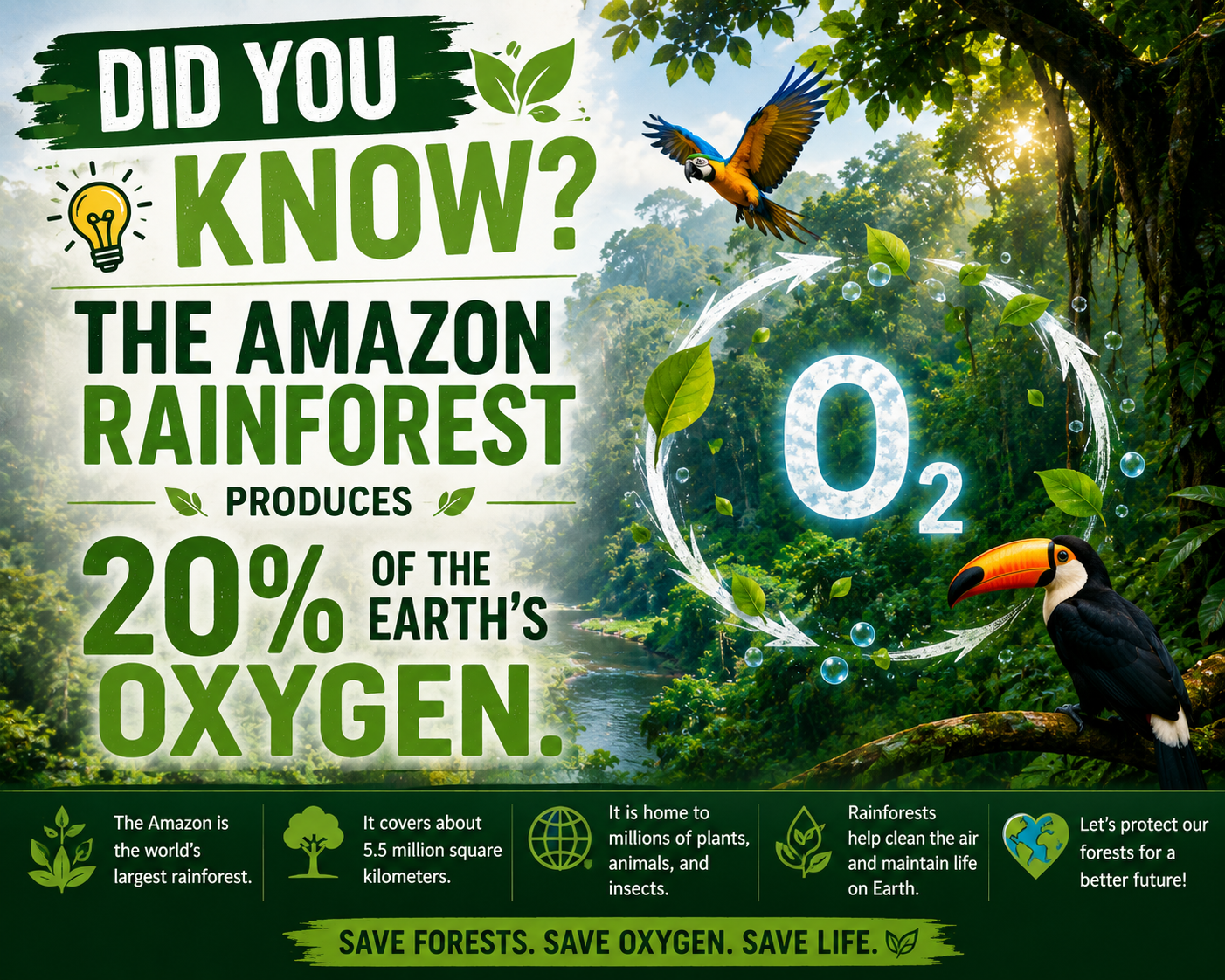
    **Did You Know?**

    The **Amazon Rainforest** is often called the **"Lungs of the Earth"** because it plays a vital role in our planet's ecosystem. While a popular claim says it produces **20% of the Earth's oxygen**, the reality is more nuanced—although the Amazon generates a great deal of oxygen through photosynthesis, it also uses much of that oxygen through the respiration of plants and other living organisms. Even so, it remains one of the world's most important ecosystems, helping regulate climate, store vast amounts of carbon, and provide a home for millions of plant and animal species.

    Protecting the Amazon means protecting biodiversity, supporting Indigenous communities, and helping maintain a healthier planet for future generations. Every small action we take to care for nature makes a difference. Let's spread awareness and inspire others to value and protect our forests!

    **Nature is our greatest treasure—let's protect it together!**

    #AmazonRainforest #DidYouKnow #NatureFacts #SaveTheAmazon #ProtectNature #ClimateAction #GoGreen #Earth #Environment #Rainforest #Wildlife #Biodiversity #Sustainability #EcoFriendly #NatureLovers #PlanetEarth #GreenFuture #Forest #Conservation #LearnSomethingNew

    Malik Lehrasib Awan
    Irum Asim

    #rsisb Roll No. 183 Image With Chatgpt No. 22 Foundation Level 🌿🌎 **Did You Know?** 🌎🌿 The **Amazon Rainforest** is often called the **"Lungs of the Earth"** because it plays a vital role in our planet's ecosystem. 🌳💚 While a popular claim says it produces **20% of the Earth's oxygen**, the reality is more nuanced—although the Amazon generates a great deal of oxygen through photosynthesis, it also uses much of that oxygen through the respiration of plants and other living organisms. 🌱🍃 Even so, it remains one of the world's most important ecosystems, helping regulate climate, store vast amounts of carbon, and provide a home for millions of plant and animal species. 🦜🐒🌺 Protecting the Amazon means protecting biodiversity, supporting Indigenous communities, and helping maintain a healthier planet for future generations. Every small action we take to care for nature makes a difference. 🌍💙 Let's spread awareness and inspire others to value and protect our forests! 🌿✨ 💚 **Nature is our greatest treasure—let's protect it together!** 🌎🌱 #AmazonRainforest #DidYouKnow #NatureFacts #SaveTheAmazon #ProtectNature #ClimateAction #GoGreen #Earth #Environment #Rainforest #Wildlife #Biodiversity #Sustainability #EcoFriendly #NatureLovers #PlanetEarth #GreenFuture #Forest #Conservation #LearnSomethingNew 🌿🌎🍃💚✨ Malik Lehrasib Awan Irum Asim
    0 تبصرے 0 شیئرز 6133 ویوز
  • **Title: Embracing a New Dawn: Israel-Palestine in a Post-Peace Era**

    Since the historic peace accord of 2023, the landscapes and hearts across Israel and Palestine have been meticulously woven into a tapestry of unity, hope, and shared futures. The regions have embraced a transformative journey, redefining their narratives and societies in profound ways.

    **Collaborative Governance:**
    Joint institutions and collaborative governance structures have fostered a political climate that prioritizes collective well-being and inclusive decision-making. Shared democratic values guide policies and initiatives, ensuring equitable opportunities for all citizens.

    **Thriving Economies:**
    An era of economic cooperation and integrated markets has propelled growth, innovation, and prosperity. Shared industries, technology collaborations, and mutual investments have cultivated a robust economic landscape where creativity flourishes.

    **Cultural Harmonization:**
    Cultural exchange and appreciation have become pillars of society, where festivals, languages, and traditions intermingle, fostering a rich and diverse social fabric. Educational systems promote multi-lingualism and intercultural understanding, nurturing generations rooted in empathy and mutual respect.

    **Social Bridges:**
    Communities have become intricately linked, forging relationships and networks that transcend old divisions. Cities and neighborhoods gleam with shared spaces, parks, and community centers that facilitate interaction, dialogue, and friendship.

    **Holistic Peace Education:**
    Curricula are imbued with lessons on peace, reconciliation, and shared histories, cultivating minds that are ambassadors of tolerance and understanding. Youth are equipped with the tools to navigate diversity, uphold peace, and contribute positively to their global community.

    **Environmental Custodianship:**
    Unified in their commitment to safeguard their cherished homelands, extensive joint efforts have been invested in sustainable practices, ecological innovation, and the preservation of biodiversity, ensuring a harmonious coexistence with nature’s wonders.

    Every street, story, and smile in Israel and Palestine today echoes with the resilience and hopes of societies that have chosen a path of peace and shared destinies. Their journey remains a beacon, illuminating the transformative power of peace and cooperation in shaping a harmonious and prosperous region. 🕊
    **Title: Embracing a New Dawn: Israel-Palestine in a Post-Peace Era** Since the historic peace accord of 2023, the landscapes and hearts across Israel and Palestine have been meticulously woven into a tapestry of unity, hope, and shared futures. The regions have embraced a transformative journey, redefining their narratives and societies in profound ways. **Collaborative Governance:** Joint institutions and collaborative governance structures have fostered a political climate that prioritizes collective well-being and inclusive decision-making. Shared democratic values guide policies and initiatives, ensuring equitable opportunities for all citizens. **Thriving Economies:** An era of economic cooperation and integrated markets has propelled growth, innovation, and prosperity. Shared industries, technology collaborations, and mutual investments have cultivated a robust economic landscape where creativity flourishes. **Cultural Harmonization:** Cultural exchange and appreciation have become pillars of society, where festivals, languages, and traditions intermingle, fostering a rich and diverse social fabric. Educational systems promote multi-lingualism and intercultural understanding, nurturing generations rooted in empathy and mutual respect. **Social Bridges:** Communities have become intricately linked, forging relationships and networks that transcend old divisions. Cities and neighborhoods gleam with shared spaces, parks, and community centers that facilitate interaction, dialogue, and friendship. **Holistic Peace Education:** Curricula are imbued with lessons on peace, reconciliation, and shared histories, cultivating minds that are ambassadors of tolerance and understanding. Youth are equipped with the tools to navigate diversity, uphold peace, and contribute positively to their global community. **Environmental Custodianship:** Unified in their commitment to safeguard their cherished homelands, extensive joint efforts have been invested in sustainable practices, ecological innovation, and the preservation of biodiversity, ensuring a harmonious coexistence with nature’s wonders. Every street, story, and smile in Israel and Palestine today echoes with the resilience and hopes of societies that have chosen a path of peace and shared destinies. Their journey remains a beacon, illuminating the transformative power of peace and cooperation in shaping a harmonious and prosperous region. 🕊🌿
    0 تبصرے 0 شیئرز 1004 ویوز
  • Karachi, with its varied ecosystems ranging from coastal areas to managed urban parks, hosts a diverse array of birds. Different types of trees in the city attract specific birds due to their food offerings, nesting opportunities, and shelter. Here are some common pairings of birds and trees you might find in Karachi:

    1. **Neem Trees (Azadirachta indica)** - These trees are quite common in Karachi and attract a variety of birds, including house sparrows, common mynas, and crows, which benefit from the trees dense foliage for nesting and its insects for food.

    2. **Peepal Trees (Ficus religiosa)** - Known for their large size and extensive shade, peepal trees are a favorite among many bird species, such as the Rose-ringed Parakeet, Asian Koels, and various types of pigeons and doves that feed on the trees fruits and find nesting spots among its branches.

    3. **Gulmohar Tree (Delonix regia)** - With its bright red flowers, the Gulmohar tree is attractive not just to humans but also to nectar-feeding birds like sunbirds and certain types of hummingbirds that might pass through the region.

    4. **Banyan Trees (Ficus benghalensis)** - These trees are similar to peepal in providing excellent shelter and food sources for birds. They are particularly favored by large birds such as kites and crows due to the sturdy support they offer for nesting.

    5. **Mango Trees (Mangifera indica)** - During the fruiting season, mango trees are a magnet for fruit-eating birds like parakeets, bulbuls, and mynas, which come to feast on the ripe mangoes.

    6. **Date Palm Trees (Phoenix dactylifera)** - Commonly found in the coastal and urban areas of Karachi, these trees attract birds like the Eurasian Collared-Dove and Palm Swift, which often nest in the tree’s crevices and feed on its dates.

    These bird-tree interactions contribute significantly to the biodiversity of urban Karachi, enhancing the ecological health and aesthetic value of the city.
    Karachi, with its varied ecosystems ranging from coastal areas to managed urban parks, hosts a diverse array of birds. Different types of trees in the city attract specific birds due to their food offerings, nesting opportunities, and shelter. Here are some common pairings of birds and trees you might find in Karachi: 1. **Neem Trees (Azadirachta indica)** - These trees are quite common in Karachi and attract a variety of birds, including house sparrows, common mynas, and crows, which benefit from the tree's dense foliage for nesting and its insects for food. 2. **Peepal Trees (Ficus religiosa)** - Known for their large size and extensive shade, peepal trees are a favorite among many bird species, such as the Rose-ringed Parakeet, Asian Koels, and various types of pigeons and doves that feed on the tree's fruits and find nesting spots among its branches. 3. **Gulmohar Tree (Delonix regia)** - With its bright red flowers, the Gulmohar tree is attractive not just to humans but also to nectar-feeding birds like sunbirds and certain types of hummingbirds that might pass through the region. 4. **Banyan Trees (Ficus benghalensis)** - These trees are similar to peepal in providing excellent shelter and food sources for birds. They are particularly favored by large birds such as kites and crows due to the sturdy support they offer for nesting. 5. **Mango Trees (Mangifera indica)** - During the fruiting season, mango trees are a magnet for fruit-eating birds like parakeets, bulbuls, and mynas, which come to feast on the ripe mangoes. 6. **Date Palm Trees (Phoenix dactylifera)** - Commonly found in the coastal and urban areas of Karachi, these trees attract birds like the Eurasian Collared-Dove and Palm Swift, which often nest in the tree’s crevices and feed on its dates. These bird-tree interactions contribute significantly to the biodiversity of urban Karachi, enhancing the ecological health and aesthetic value of the city.
    0 تبصرے 0 شیئرز 948 ویوز
  • Urgent Need for Tree Planting in Karachi!

    Karachi and Sindh are facing a serious environmental crisis due to deforestation, rising temperatures, and pollution. During the construction of the Red Line Bus Rapid Transit (BRT) project, around 3,802 trees were cut down, yet the promise to plant five new trees for each one felled has not been fulfilled.

    Why Trees Matter:

    Trees absorb harmful CO2, helping fight climate change.
    They cool down our environment, combating heatwaves.
    Trees act as natural filters, improving air quality.
    They preserve biodiversity, providing habitats for wildlife.
    They help prevent desertification by stabilizing soil and retaining moisture.

    The situation is dire—Karachi has seen deadly heatwaves and increased pollution. Without trees, we’re facing rising temperatures, poor air quality, and threats to public health.

    The Solution? Massive tree plantation efforts! We must green our urban spaces, restore forests, and involve our communities in tree-planting campaigns.

    The High Court has ordered that no more trees be cut in Sindh unless absolutely necessary, with proper approval and relocation.

    Let’s act NOW to protect our city and our planet for future generations! #PlantTrees #GreenKarachi #SaveThePlanet #BRTProject
    🚨 Urgent Need for Tree Planting in Karachi! 🌳 Karachi and Sindh are facing a serious environmental crisis due to deforestation, rising temperatures, and pollution. During the construction of the Red Line Bus Rapid Transit (BRT) project, around 3,802 trees were cut down, yet the promise to plant five new trees for each one felled has not been fulfilled. Why Trees Matter: • 🌍 Trees absorb harmful CO2, helping fight climate change. • 🌞 They cool down our environment, combating heatwaves. • 🌬️ Trees act as natural filters, improving air quality. • 🦜 They preserve biodiversity, providing habitats for wildlife. • 🌾 They help prevent desertification by stabilizing soil and retaining moisture. The situation is dire—Karachi has seen deadly heatwaves and increased pollution. Without trees, we’re facing rising temperatures, poor air quality, and threats to public health. 🌱 The Solution? Massive tree plantation efforts! We must green our urban spaces, restore forests, and involve our communities in tree-planting campaigns. The High Court has ordered that no more trees be cut in Sindh unless absolutely necessary, with proper approval and relocation. 🌿 Let’s act NOW to protect our city and our planet for future generations! #PlantTrees #GreenKarachi #SaveThePlanet #BRTProject
    0 تبصرے 0 شیئرز 2852 ویوز
  • The Story of Plastic-Eating Mushrooms

    Plastic pollution has become one of the most serious environmental challenges of our time. Every year, more than 400 million tons of plastic are produced, and only about 9% of it ever gets recycled. The rest ends up in landfills, rivers, and oceans, where it remains for hundreds of years, harming animals, entering our food chain, and choking our planet.

    But nature, as always, has a secret weapon — fungi. In the last decade, scientists have discovered that some species of mushrooms have the extraordinary ability to “eat” plastic, turning it into harmless materials. These organisms may hold one of the keys to cleaning up our plastic-filled world.


    What Are Plastic-Eating Mushrooms?

    Plastic-eating mushrooms are not a single species but a group of fungi capable of breaking down synthetic polymers — the long chemical chains that make up plastics. Instead of relying on sunlight or heat, these fungi use enzymes, powerful biological molecules, to digest plastic just as they would digest wood or dead leaves.

    The first major discovery came in 2011 when students from Yale University explored the Amazon rainforest and found a species called Pestalotiopsis microspora. This fungus could survive by feeding on polyurethane, a common type of plastic used in foams, shoes, and furniture — even in places without oxygen, such as deep landfills. This was revolutionary because it meant that fungi could potentially degrade plastic where most other life forms could not survive.

    A few years later, another breakthrough came from Pakistan. Scientists studying a waste dump near Islamabad discovered Aspergillus tubingensis, a fungus that could break down polyurethane in just a few weeks. This discovery gained international attention because it showed that plastic-eating fungi exist even in polluted urban environments, not only in exotic rainforests.

    Since then, researchers around the world — from China to Hawaii — have identified more than 200 species of fungi capable of degrading various plastics, including polyethylene (used in shopping bags), polystyrene (used in packaging), and PET (used in bottles).


    How Do They Eat Plastic?

    The process through which mushrooms “eat” plastic is both simple and amazing.

    When a piece of plastic comes in contact with fungal spores, the spores germinate and form a thin network called mycelium — a web of thread-like roots that cover the plastic’s surface. Once attached, the fungus secretes special enzymes that start attacking the strong chemical bonds inside the plastic.

    These enzymes act like molecular scissors, cutting the long plastic molecules into smaller pieces called monomers. The fungus then absorbs these small molecules as food, using them as a source of carbon and energy. Over time, the plastic begins to lose its shape, crack, and disappear. What remains is mostly water, carbon dioxide, and fungal biomass — all naturally occurring and harmless.

    Some fungi even do this in anaerobic conditions, where there is no oxygen. This is important because most landfill environments are oxygen-poor. That means fungi could, in theory, help reduce the billions of tons of plastic buried underground.


    Where Are They Found?

    Plastic-degrading fungi have been found in some of the most unexpected places.
    • Tropical rainforests like the Amazon, where humidity and biodiversity create perfect conditions for unique microbes to evolve.
    • Urban dumps and landfills, where human waste gives fungi new materials to adapt to.
    • Oceans and coastal areas, where marine fungi cling to floating plastic debris and slowly begin digesting it.

    In 2023, a team from the University of Hawaii discovered that over 60% of marine fungi isolated from ocean plastic waste could degrade plastic to some extent. This shows that nature is already evolving to respond to our pollution problem — we just need to understand and support it.


    What Are the Challenges?

    Although the idea of mushrooms eating plastic sounds like a miracle, it is not yet a large-scale solution. Scientists face several challenges.

    First, speed. Fungi work slowly. In laboratory experiments, small pieces of plastic may take weeks or months to break down, while the world produces millions of tons of plastic every month.

    Second, plastic variety. Not all plastics are the same. Some, like polyurethane, are easier to digest; others, like polyethylene, are extremely resistant. We still don’t have fungi that can handle every type.

    Third, environmental conditions. Fungi need the right temperature, humidity, and nutrients to survive. In dry or cold environments, they may not function effectively.

    Fourth, safety and by-products. When plastic is broken down, tiny microplastics or chemical residues might still remain. Scientists must ensure that these by-products do not cause new environmental or health problems.

    Lastly, scalability. What works in a small petri dish is not easy to repeat in a landfill or ocean. To make this technology useful, we need bioreactors — machines where fungi can grow under controlled conditions and process large quantities of waste.


    Why It Matters

    Even with its challenges, the discovery of plastic-eating mushrooms is a symbol of hope. It reminds us that nature is not our enemy but our greatest teacher. Fungi have been decomposing dead trees, leaves, and animals for millions of years. Now, they are adapting to a new material that humans have introduced: plastic.

    For countries like Pakistan, where waste management systems are weak, this presents a massive opportunity for innovation. Imagine young students or entrepreneurs developing small-scale units that use fungi to turn plastic waste into compost or clean soil. This could become a new form of green entrepreneurship, creating jobs while protecting the environment.

    Schools, like Rehan School, could include this topic in science and leadership curriculums — encouraging students to see waste not as a problem but as a business opportunity. Students could collect plastic waste, experiment with local fungi, measure results, and even develop small startup ideas based on bioremediation.


    The Future of Fungal Biodegradation

    Scientists are now exploring how to make fungi work faster using genetic engineering and biotechnology. By studying the enzymes that break down plastic, researchers hope to produce synthetic versions that are much more efficient.

    Some labs are also combining fungi with bacteria to create microbial teams — ecosystems that can digest different plastics together. Others are designing bioreactors that feed on plastic waste and produce valuable by-products like organic fertilizer or even edible mycelium (mushroom protein).

    In the long term, this technology could be integrated with recycling systems. For example, factories might send certain types of waste to “fungal recycling plants,” where mushrooms turn plastic into harmless matter instead of burning or burying it.


    Lessons from Nature

    The discovery of plastic-eating mushrooms teaches a deep lesson about life on Earth. Whenever humans create a problem, nature begins working on a solution. These fungi are proof that evolution never sleeps. They are small, silent recyclers, turning pollution into potential.

    It also challenges us to rethink how we live. Instead of fighting nature with chemicals and machines, we can partner with it — using living systems to heal what we have damaged.


    Conclusion

    Plastic-eating mushrooms are still in the early stages of research, but they represent one of the most exciting frontiers in environmental science. They show that solutions to global problems may come not from high technology, but from the humble soil beneath our feet.

    If supported by researchers, entrepreneurs, and educators, these fungi could one day help humanity close the loop on plastic waste. For visionary institutions like Rehan School, this is more than a science topic — it is an opportunity to inspire the next generation of green innovators who can turn today’s waste into tomorrow’s wealth.

    Nature has already shown us the way. Now it’s our turn to follow.
    🌱 The Story of Plastic-Eating Mushrooms Plastic pollution has become one of the most serious environmental challenges of our time. Every year, more than 400 million tons of plastic are produced, and only about 9% of it ever gets recycled. The rest ends up in landfills, rivers, and oceans, where it remains for hundreds of years, harming animals, entering our food chain, and choking our planet. But nature, as always, has a secret weapon — fungi. In the last decade, scientists have discovered that some species of mushrooms have the extraordinary ability to “eat” plastic, turning it into harmless materials. These organisms may hold one of the keys to cleaning up our plastic-filled world. ⸻ 🍄 What Are Plastic-Eating Mushrooms? Plastic-eating mushrooms are not a single species but a group of fungi capable of breaking down synthetic polymers — the long chemical chains that make up plastics. Instead of relying on sunlight or heat, these fungi use enzymes, powerful biological molecules, to digest plastic just as they would digest wood or dead leaves. The first major discovery came in 2011 when students from Yale University explored the Amazon rainforest and found a species called Pestalotiopsis microspora. This fungus could survive by feeding on polyurethane, a common type of plastic used in foams, shoes, and furniture — even in places without oxygen, such as deep landfills. This was revolutionary because it meant that fungi could potentially degrade plastic where most other life forms could not survive. A few years later, another breakthrough came from Pakistan. Scientists studying a waste dump near Islamabad discovered Aspergillus tubingensis, a fungus that could break down polyurethane in just a few weeks. This discovery gained international attention because it showed that plastic-eating fungi exist even in polluted urban environments, not only in exotic rainforests. Since then, researchers around the world — from China to Hawaii — have identified more than 200 species of fungi capable of degrading various plastics, including polyethylene (used in shopping bags), polystyrene (used in packaging), and PET (used in bottles). ⸻ 🔬 How Do They Eat Plastic? The process through which mushrooms “eat” plastic is both simple and amazing. When a piece of plastic comes in contact with fungal spores, the spores germinate and form a thin network called mycelium — a web of thread-like roots that cover the plastic’s surface. Once attached, the fungus secretes special enzymes that start attacking the strong chemical bonds inside the plastic. These enzymes act like molecular scissors, cutting the long plastic molecules into smaller pieces called monomers. The fungus then absorbs these small molecules as food, using them as a source of carbon and energy. Over time, the plastic begins to lose its shape, crack, and disappear. What remains is mostly water, carbon dioxide, and fungal biomass — all naturally occurring and harmless. Some fungi even do this in anaerobic conditions, where there is no oxygen. This is important because most landfill environments are oxygen-poor. That means fungi could, in theory, help reduce the billions of tons of plastic buried underground. ⸻ 🌍 Where Are They Found? Plastic-degrading fungi have been found in some of the most unexpected places. • Tropical rainforests like the Amazon, where humidity and biodiversity create perfect conditions for unique microbes to evolve. • Urban dumps and landfills, where human waste gives fungi new materials to adapt to. • Oceans and coastal areas, where marine fungi cling to floating plastic debris and slowly begin digesting it. In 2023, a team from the University of Hawaii discovered that over 60% of marine fungi isolated from ocean plastic waste could degrade plastic to some extent. This shows that nature is already evolving to respond to our pollution problem — we just need to understand and support it. ⸻ ⚙️ What Are the Challenges? Although the idea of mushrooms eating plastic sounds like a miracle, it is not yet a large-scale solution. Scientists face several challenges. First, speed. Fungi work slowly. In laboratory experiments, small pieces of plastic may take weeks or months to break down, while the world produces millions of tons of plastic every month. Second, plastic variety. Not all plastics are the same. Some, like polyurethane, are easier to digest; others, like polyethylene, are extremely resistant. We still don’t have fungi that can handle every type. Third, environmental conditions. Fungi need the right temperature, humidity, and nutrients to survive. In dry or cold environments, they may not function effectively. Fourth, safety and by-products. When plastic is broken down, tiny microplastics or chemical residues might still remain. Scientists must ensure that these by-products do not cause new environmental or health problems. Lastly, scalability. What works in a small petri dish is not easy to repeat in a landfill or ocean. To make this technology useful, we need bioreactors — machines where fungi can grow under controlled conditions and process large quantities of waste. ⸻ 🌿 Why It Matters Even with its challenges, the discovery of plastic-eating mushrooms is a symbol of hope. It reminds us that nature is not our enemy but our greatest teacher. Fungi have been decomposing dead trees, leaves, and animals for millions of years. Now, they are adapting to a new material that humans have introduced: plastic. For countries like Pakistan, where waste management systems are weak, this presents a massive opportunity for innovation. Imagine young students or entrepreneurs developing small-scale units that use fungi to turn plastic waste into compost or clean soil. This could become a new form of green entrepreneurship, creating jobs while protecting the environment. Schools, like Rehan School, could include this topic in science and leadership curriculums — encouraging students to see waste not as a problem but as a business opportunity. Students could collect plastic waste, experiment with local fungi, measure results, and even develop small startup ideas based on bioremediation. ⸻ 🚀 The Future of Fungal Biodegradation Scientists are now exploring how to make fungi work faster using genetic engineering and biotechnology. By studying the enzymes that break down plastic, researchers hope to produce synthetic versions that are much more efficient. Some labs are also combining fungi with bacteria to create microbial teams — ecosystems that can digest different plastics together. Others are designing bioreactors that feed on plastic waste and produce valuable by-products like organic fertilizer or even edible mycelium (mushroom protein). In the long term, this technology could be integrated with recycling systems. For example, factories might send certain types of waste to “fungal recycling plants,” where mushrooms turn plastic into harmless matter instead of burning or burying it. ⸻ 💡 Lessons from Nature The discovery of plastic-eating mushrooms teaches a deep lesson about life on Earth. Whenever humans create a problem, nature begins working on a solution. These fungi are proof that evolution never sleeps. They are small, silent recyclers, turning pollution into potential. It also challenges us to rethink how we live. Instead of fighting nature with chemicals and machines, we can partner with it — using living systems to heal what we have damaged. ⸻ 🧭 Conclusion Plastic-eating mushrooms are still in the early stages of research, but they represent one of the most exciting frontiers in environmental science. They show that solutions to global problems may come not from high technology, but from the humble soil beneath our feet. If supported by researchers, entrepreneurs, and educators, these fungi could one day help humanity close the loop on plastic waste. For visionary institutions like Rehan School, this is more than a science topic — it is an opportunity to inspire the next generation of green innovators who can turn today’s waste into tomorrow’s wealth. Nature has already shown us the way. Now it’s our turn to follow.
    0 تبصرے 0 شیئرز 1623 ویوز
  • My name is Aaron Justice Tsatsaku. i am from Adzokoe Peki in the Volta Region of Ghana. i am final year student of The University of Cape Coast College of Distance Education, (CoDE). I am studying Educational Psychology.
    I Started Heritage Permaculture Center in Peki Adzokoe after I took part in the 1st Ecovillage Design Education at Kumasi Institute of Tropical Agriculture (KITA) and Ghana Permaculture Institute (GPI). I also took part in other relevant Permaculture courses.
    Since then, I’m living and working in my community by creating school gardens and also set up a demonstration center to bring members in my community closer to nature through Permaculture Trainings.
    I am providing trainings to local farmers the principals of permaculture as a sustainable agricultural principle to improve the issues with poverty and undernourishment in local communities.
    Beside that, I am also providing biodiversity awareness programs for schools since I think education is the key. I have also organized training on Oyster Mushroom Cultivation to youths, women and children in my community a year ago. it was a month intensive training.
    Working together with the local communities is really so rewarding and I will never choose to stay idle. Permaculture stole my heart.
    I hope to find more nice and trustworthy friendships in order to share experiences about permaculture and sustainable living and get their supports through any kind.
    Heritage Permaculture Center needs strong financial supports to keep it projects moving.
    I have shared some post showing pictures about my farm and my work with the local communities of Peki Adzokoe.
    #Caring for Humanity and The Earth!#

    Connect with Aaron Justice Tsatsaku
    My name is Aaron Justice Tsatsaku. i am from Adzokoe Peki in the Volta Region of Ghana. i am final year student of The University of Cape Coast College of Distance Education, (CoDE). I am studying Educational Psychology. I Started Heritage Permaculture Center in Peki Adzokoe after I took part in the 1st Ecovillage Design Education at Kumasi Institute of Tropical Agriculture (KITA) and Ghana Permaculture Institute (GPI). I also took part in other relevant Permaculture courses. Since then, I’m living and working in my community by creating school gardens and also set up a demonstration center to bring members in my community closer to nature through Permaculture Trainings. I am providing trainings to local farmers the principals of permaculture as a sustainable agricultural principle to improve the issues with poverty and undernourishment in local communities. Beside that, I am also providing biodiversity awareness programs for schools since I think education is the key. I have also organized training on Oyster Mushroom Cultivation to youths, women and children in my community a year ago. it was a month intensive training. Working together with the local communities is really so rewarding and I will never choose to stay idle. Permaculture stole my heart. I hope to find more nice and trustworthy friendships in order to share experiences about permaculture and sustainable living and get their supports through any kind. Heritage Permaculture Center needs strong financial supports to keep it projects moving. I have shared some post showing pictures about my farm and my work with the local communities of Peki Adzokoe. #Caring for Humanity and The Earth!# Connect with Aaron Justice Tsatsaku
    0 تبصرے 0 شیئرز 324 ویوز
  • Mangroves are a group of trees and shrubs that live in coastal intertidal zones. They are known for their distinctive root systems, which are adapted to saline and brackish water conditions. Here are some key characteristics of mangroves:

    1. **Unique Root Systems**: Mangroves have complex root systems that allow them to survive in the fluctuating conditions of coastal environments. These roots often protrude above the water level, which helps in gas exchange and stabilizes the trees in loose, muddy substrates.

    2. **Salt Tolerance**: Mangroves are highly salt-tolerant. They can either exclude salt from their systems or secrete it through their leaves.

    3. **Biodiversity Hotspots**: Mangrove forests are rich in biodiversity, providing habitat for a wide range of marine and terrestrial species. They serve as nurseries for many fish species, and are also important for birds, mammals, and invertebrates.

    4. **Coastal Protection**: Mangroves protect coastlines from erosion, storm surge, and tsunamis. Their root systems help in stabilizing the shoreline and reducing the impact of waves.

    5. **Climate Change Mitigation**: Mangroves play a significant role in carbon sequestration, thus aiding in the fight against climate change.

    6. **Economic Importance**: They are valuable for fisheries, timber, and as tourist attractions. Local communities often depend on mangroves for their livelihoods.

    7. **Threats**: Despite their importance, mangrove forests are under threat due to factors like deforestation, pollution, and climate change-related sea-level rise.

    Mangrove ecosystems are found in tropical and subtropical regions around the world, including parts of Asia, Africa, North and South America, and Oceania. Their conservation is crucial for maintaining coastal ecology and supporting local communities.
    Mangroves are a group of trees and shrubs that live in coastal intertidal zones. They are known for their distinctive root systems, which are adapted to saline and brackish water conditions. Here are some key characteristics of mangroves: 1. **Unique Root Systems**: Mangroves have complex root systems that allow them to survive in the fluctuating conditions of coastal environments. These roots often protrude above the water level, which helps in gas exchange and stabilizes the trees in loose, muddy substrates. 2. **Salt Tolerance**: Mangroves are highly salt-tolerant. They can either exclude salt from their systems or secrete it through their leaves. 3. **Biodiversity Hotspots**: Mangrove forests are rich in biodiversity, providing habitat for a wide range of marine and terrestrial species. They serve as nurseries for many fish species, and are also important for birds, mammals, and invertebrates. 4. **Coastal Protection**: Mangroves protect coastlines from erosion, storm surge, and tsunamis. Their root systems help in stabilizing the shoreline and reducing the impact of waves. 5. **Climate Change Mitigation**: Mangroves play a significant role in carbon sequestration, thus aiding in the fight against climate change. 6. **Economic Importance**: They are valuable for fisheries, timber, and as tourist attractions. Local communities often depend on mangroves for their livelihoods. 7. **Threats**: Despite their importance, mangrove forests are under threat due to factors like deforestation, pollution, and climate change-related sea-level rise. Mangrove ecosystems are found in tropical and subtropical regions around the world, including parts of Asia, Africa, North and South America, and Oceania. Their conservation is crucial for maintaining coastal ecology and supporting local communities.
    0 تبصرے 0 شیئرز 686 ویوز
  • Subject: Mandatory Tree Plantation for University Students to Combat Climate Change

    Dear Mukhtar Ahmad, Chairman Higher Education Commission, Pakistan

    I am writing to request your urgent intervention to address the critical issue of climate change that Pakistan is currently facing. As you are aware, our country is one of the hardest hit by climate change, and immediate, collective action is imperative.

    I propose that it be made mandatory for all university students in Pakistan to plant one fruit tree every day for the next five years. With approximately 2 million university students in Pakistan, if each student plants one tree daily, this initiative will result in over 730 million trees being planted annually. This massive reforestation effort would significantly contribute to combating climate change, improving air quality, and supporting biodiversity.

    If passing in mathematics is considered crucial for students, this initiative is even more critical for the survival and prosperity of our nation.

    Your support and directive in making this a mandatory requirement will be a monumental step towards ensuring a greener, healthier, and more sustainable future for Pakistan.

    I urge you to reach out to the Prime Minister and the Minister of Climate Change to make this initiative a national priority.

    Thank you for your attention to this urgent matter.

    Sincerely,
    Rehan Allahwala
    Subject: Mandatory Tree Plantation for University Students to Combat Climate Change Dear Mukhtar Ahmad, Chairman Higher Education Commission, Pakistan I am writing to request your urgent intervention to address the critical issue of climate change that Pakistan is currently facing. As you are aware, our country is one of the hardest hit by climate change, and immediate, collective action is imperative. I propose that it be made mandatory for all university students in Pakistan to plant one fruit tree every day for the next five years. With approximately 2 million university students in Pakistan, if each student plants one tree daily, this initiative will result in over 730 million trees being planted annually. This massive reforestation effort would significantly contribute to combating climate change, improving air quality, and supporting biodiversity. If passing in mathematics is considered crucial for students, this initiative is even more critical for the survival and prosperity of our nation. Your support and directive in making this a mandatory requirement will be a monumental step towards ensuring a greener, healthier, and more sustainable future for Pakistan. I urge you to reach out to the Prime Minister and the Minister of Climate Change to make this initiative a national priority. Thank you for your attention to this urgent matter. Sincerely, Rehan Allahwala
    0 تبصرے 0 شیئرز 321 ویوز
More Results