• #rsisb
    Roll No.247
    foundation level
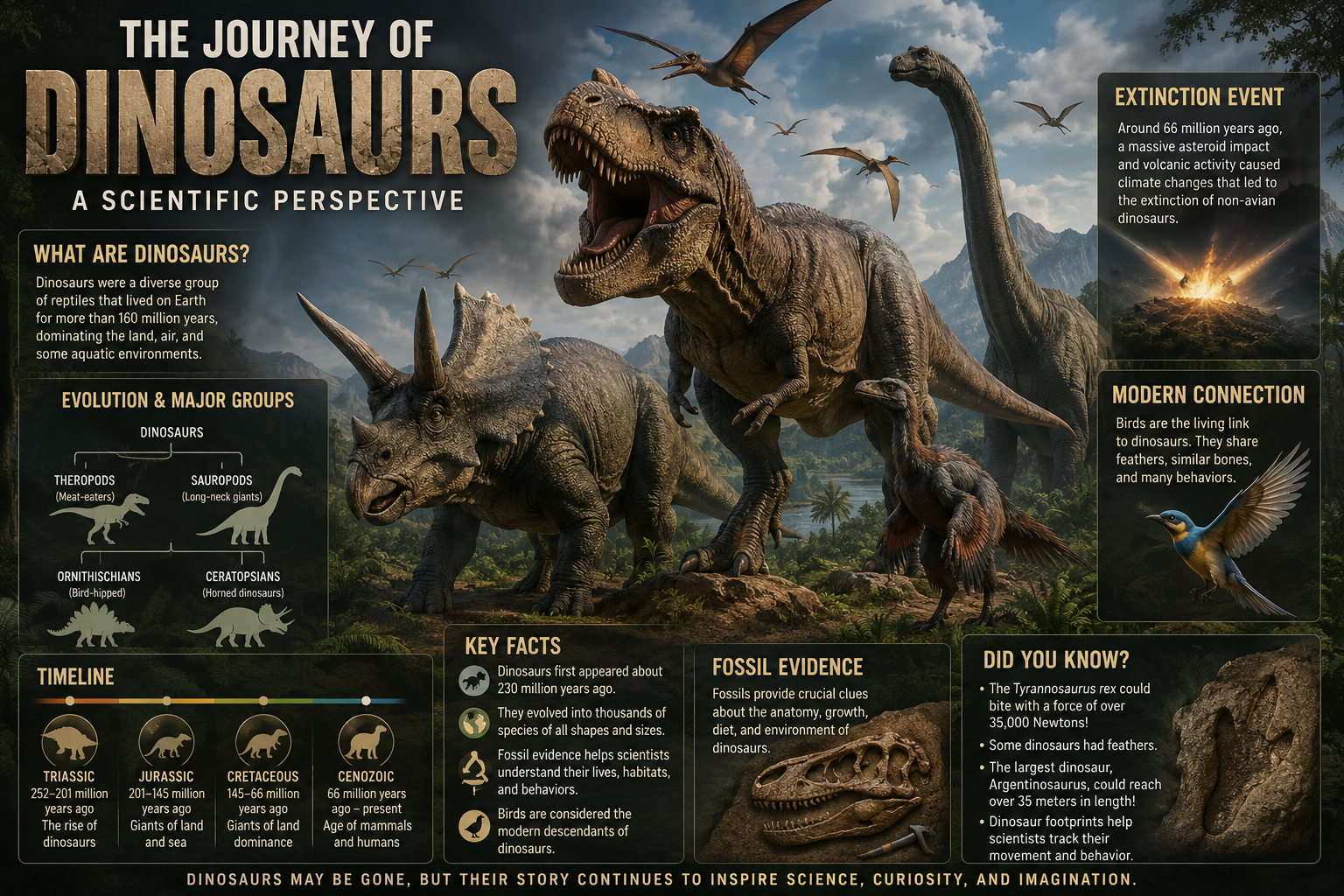
    # The Journey of Dinosaurs: A Scientific Perspective

    Step into the fascinating world of dinosaurs and explore one of the most remarkable chapters in the history of life on Earth! Dinosaurs ruled many of the planet’s ecosystems for more than 160 million years, appearing during the Triassic Period and continuing through the Jurassic and Cretaceous Periods. Their incredible diversity included enormous plant-eaters, powerful predators, swift hunters, armored species, and many other extraordinary creatures.

    From a scientific perspective, the story of dinosaurs is not simply a tale of giant creatures—it is a story of evolution, adaptation, survival, extinction, and discovery. Scientists learn about dinosaurs through fossils, including bones, teeth, footprints, eggs, nests, and even traces of skin and feathers. By carefully studying these clues, paleontologists can reconstruct how dinosaurs lived, what they ate, how they moved, and how different species changed over millions of years.

    Dinosaurs first appeared roughly 230 million years ago. Over time, they adapted to changing environments and became one of the most successful groups of land animals in Earth's history. Some developed long necks and enormous bodies to reach vegetation, while others evolved sharp teeth and strong jaws for hunting. Their fossils have been discovered on every continent, showing just how widely they were distributed.

    The Jurassic Period is often remembered as a time when giant dinosaurs became especially prominent. Huge sauropods walked across ancient landscapes, while theropods hunted or scavenged. During the Cretaceous Period, dinosaurs continued to diversify, and many familiar species appeared. At the same time, flowering plants became increasingly important parts of many ecosystems.

    One of the most important scientific discoveries is that birds are living dinosaurs. Evidence from fossils, anatomy, and evolutionary studies shows that modern birds descended from theropod dinosaurs. This means that although non-avian dinosaurs disappeared from the fossil record about 66 million years ago, the dinosaur lineage continues today in the form of birds.

    The end of the Cretaceous Period brought a dramatic change. A large asteroid struck what is now the Yucatán Peninsula, contributing to major environmental disruptions around the world. This event, together with other environmental changes, played a major role in the extinction of non-avian dinosaurs. However, many other organisms survived, including early mammals, reptiles, and birds.

    Today, dinosaur research continues to evolve. New fossils, improved imaging technologies, computer modeling, and advances in genetics and evolutionary biology are helping scientists understand these ancient animals more accurately. Every newly discovered fossil can provide another piece of the enormous puzzle of Earth's past.

    The journey of dinosaurs reminds us that Earth has changed dramatically over geological time. Their story teaches us about adaptation, biodiversity, environmental change, and extinction. Most importantly, it shows how scientific evidence can help us understand a world that existed millions of years before humans appeared.

    Whether you are fascinated by enormous herbivores, fearsome predators, ancient ecosystems, or the origins of modern birds, the scientific journey of dinosaurs offers endless opportunities for discovery. Their fossils connect us to a distant past and inspire scientists, students, and curious minds to keep asking questions about the incredible history of life on our planet.

    #Dinosaurs #DinosaurJourney #Paleontology #Science #Fossils #Evolution #EarthHistory #JurassicPeriod #CretaceousPeriod #TriassicPeriod #DinosaurScience #AncientEarth #NaturalHistory #PrehistoricLife #ScientificDiscovery #Paleontologist #Biodiversity #Extinction #BirdsAreDinosaurs #LearnScience #ScienceEducation
    #rsisb Roll No.247 foundation level # The Journey of Dinosaurs: A Scientific Perspective πŸ¦–πŸŒπŸ”¬ Step into the fascinating world of dinosaurs and explore one of the most remarkable chapters in the history of life on Earth! πŸŒŽπŸ¦• Dinosaurs ruled many of the planet’s ecosystems for more than 160 million years, appearing during the Triassic Period and continuing through the Jurassic and Cretaceous Periods. Their incredible diversity included enormous plant-eaters, powerful predators, swift hunters, armored species, and many other extraordinary creatures. 🦴✨ From a scientific perspective, the story of dinosaurs is not simply a tale of giant creatures—it is a story of evolution, adaptation, survival, extinction, and discovery. Scientists learn about dinosaurs through fossils, including bones, teeth, footprints, eggs, nests, and even traces of skin and feathers. πŸ”¬πŸ¦΄ By carefully studying these clues, paleontologists can reconstruct how dinosaurs lived, what they ate, how they moved, and how different species changed over millions of years. Dinosaurs first appeared roughly 230 million years ago. πŸŒ‹πŸŒΏ Over time, they adapted to changing environments and became one of the most successful groups of land animals in Earth's history. Some developed long necks and enormous bodies to reach vegetation, while others evolved sharp teeth and strong jaws for hunting. πŸ¦•πŸŒ±πŸ¦– Their fossils have been discovered on every continent, showing just how widely they were distributed. The Jurassic Period is often remembered as a time when giant dinosaurs became especially prominent. πŸŒ΄β˜€οΈ Huge sauropods walked across ancient landscapes, while theropods hunted or scavenged. During the Cretaceous Period, dinosaurs continued to diversify, and many familiar species appeared. At the same time, flowering plants became increasingly important parts of many ecosystems. πŸŒΈπŸ¦– One of the most important scientific discoveries is that birds are living dinosaurs. πŸ¦πŸ¦• Evidence from fossils, anatomy, and evolutionary studies shows that modern birds descended from theropod dinosaurs. This means that although non-avian dinosaurs disappeared from the fossil record about 66 million years ago, the dinosaur lineage continues today in the form of birds. πŸŒπŸ”¬ The end of the Cretaceous Period brought a dramatic change. A large asteroid struck what is now the Yucatán Peninsula, contributing to major environmental disruptions around the world. 🌠🌎 This event, together with other environmental changes, played a major role in the extinction of non-avian dinosaurs. However, many other organisms survived, including early mammals, reptiles, and birds. Today, dinosaur research continues to evolve. πŸ§‘‍πŸ”¬πŸ”Ž New fossils, improved imaging technologies, computer modeling, and advances in genetics and evolutionary biology are helping scientists understand these ancient animals more accurately. Every newly discovered fossil can provide another piece of the enormous puzzle of Earth's past. 🦴🧩 The journey of dinosaurs reminds us that Earth has changed dramatically over geological time. 🌎⏳ Their story teaches us about adaptation, biodiversity, environmental change, and extinction. Most importantly, it shows how scientific evidence can help us understand a world that existed millions of years before humans appeared. Whether you are fascinated by enormous herbivores, fearsome predators, ancient ecosystems, or the origins of modern birds, the scientific journey of dinosaurs offers endless opportunities for discovery. πŸ¦–πŸ”¬πŸŒΏ Their fossils connect us to a distant past and inspire scientists, students, and curious minds to keep asking questions about the incredible history of life on our planet. 🌍✨ #Dinosaurs πŸ¦– #DinosaurJourney πŸ¦• #Paleontology πŸ”¬ #Science πŸ§ͺ #Fossils 🦴 #Evolution 🧬 #EarthHistory 🌍 #JurassicPeriod 🌿 #CretaceousPeriod πŸŒ‹ #TriassicPeriod 🌎 #DinosaurScience πŸ”Ž #AncientEarth ⏳ #NaturalHistory 🏞️ #PrehistoricLife πŸ¦• #ScientificDiscovery πŸ’‘ #Paleontologist πŸ§‘‍πŸ”¬ #Biodiversity 🌱 #Extinction 🌠 #BirdsAreDinosaurs 🐦 #LearnScience πŸ“š #ScienceEducation πŸ”¬βœ¨
    0 Reacties 0 aandelen 5980 Views
  • The Companies who do not self disrupt themselves, Just stop growing.
    The Companies who do not self disrupt themselves, Just stop growing.
    0 Reacties 0 aandelen 203 Views
  • I am very excited with the idea of FREE Facebook in Pakistan being offered on mobile phones, I just met a guy Naveed Iqbal who is new to Facebook, and is from a remote Part of Pakistan, and I have given him a task to complete which if he does, I can give him a job to do, and send him a laptop also to work on, I am looking forward to finding more disrupters like him around the world soon.
    I am very excited with the idea of FREE Facebook in Pakistan being offered on mobile phones, I just met a guy Naveed Iqbal who is new to Facebook, and is from a remote Part of Pakistan, and I have given him a task to complete which if he does, I can give him a job to do, and send him a laptop also to work on, I am looking forward to finding more disrupters like him around the world soon.
    0 Reacties 0 aandelen 568 Views
  • Internet has Disrupted Knowledge, Music, Entertainment, Postal Service, Photo Service, Telecom Services, Now it is time to Disrupt Borders... Lets Begin...

    Rehan Allahwala
    Internet has Disrupted Knowledge, Music, Entertainment, Postal Service, Photo Service, Telecom Services, Now it is time to Disrupt Borders... Let's Begin... Rehan Allahwala
    0 Reacties 0 aandelen 585 Views
  • Have u heard about TV White Space, voted 2013 most disruptive tech? it can get the whole Pakistan connected at a much lower cost but can work with telco (which sees it as a threat) but can actually work with ISP if telco not receptive. My partner is the patent holder. If you are interested contact Mara Ang Chong Lai
    Have u heard about TV White Space, voted 2013 most disruptive tech? it can get the whole Pakistan connected at a much lower cost but can work with telco (which sees it as a threat) but can actually work with ISP if telco not receptive. My partner is the patent holder. If you are interested contact Mara Ang Chong Lai
    0 Reacties 0 aandelen 263 Views
  • Thought provoking crystal gaze for next generation........
    (Lengthy but Must Read Article).

    In 1998, Kodak had 170,000 employees and sold 85% of all photo paper worldwide.
    Within just a few years, their business model disappeared and they got bankrupt.
    What happened to Kodak will happen in a lot of industries in the next 10 year - and most people dont see it coming. Did you think in 1998 that 3 years later you would never take pictures on paper film again?
    Yet digital cameras were invented in 1975. The first ones only had 10,000 pixels, but followed Moores law. So as with all exponential technologies, it was a disappointment for a long time, before it became way superiour and got mainstream in only a few short years. It will now happen with Artificial Intelligence, health, autonomous and electric cars, education, 3D printing, agriculture and jobs. Welcome to the 4th Industrial Revolution.
    Welcome to the Exponential Age.

    Software will disrupt most traditional industries in the next 5-10 years.
    Uber is just a software tool, they dont own any cars, and are now the biggest taxi company in the world. Airbnb is now the biggest hotel company in the world, although they dont own any properties.

    Artificial Intelligence: Computers become exponentially better in understanding the world. This year, a computer beat the best Go player in the world, 10 years earlier than expected. In the US, young lawyers already dont get jobs. Because of IBM Watson, you can get legal advice (so far for more or less basic stuff) within seconds, with 90% accuracy compared with 70% accuracy when done by humans. So if you study law, stop immediately. There will be 90% less laywyers in the future, only specialists will remain.
    Watson already helps nurses diagnosing cancer, 4 time more accurate than human nurses. Facebook now has a pattern recognition software that can recognize faces better than humans. In 2030, computers will become more intelligent than humans.

    Autonomous cars: In 2018 the first self driving cars will appear for the public. Around 2020, the complete industry will start to be disrupted. You dont want to own a car anymore. You will call a car with your phone, it will show up at your location and drive you to your destination. You will not need to park it, you only pay for the driven distance and can be productive while driving. Our kids will never get a drivers licence and will never own a car. It will change the cities, because we will need 90-95% less cars for that. We can transform former parking space into parks. 1,2 million people die each year in car accidents worldwide. We now have one accident every 100,000km, with autonomous driving that will drop to one accident in 10 million km. That will save a million lifes each year.

    Most car companies might become bankrupt. Traditional car companies try the evolutionary approach and just build a better car, while tech companies (Tesla, Apple, Google) will do the revolutionary approach and build a computer on wheels. I spoke to a lot of engineers from Volkswagen and Audi; they are completely terrified of Tesla.

    Insurance companies will have massive trouble because without accidents, the insurance will become 100x cheaper. Their car insurance business model will disappear.
    Real estate will change. Because if you can work while you commute, people will move further away to live in a more beautiful neighborhood.
    Electric cars will become mainstream until 2020. Cities will be less noisy because all cars will run on electric. Electricity will become incredibly cheap and clean: Solar production has been on an exponential curve for 30 years, but you can only now see the impact. Last year, more solar energy was installed worldwide than fossil. The price for solar will drop so much that all coal companies will be out of business by 2025.
    With cheap electricity comes cheap and abundant water. Desalination now only needs 2kWh per cubic meter. We dont have scarce water in most places, we only have scarce drinking water. Imagine what will be possible if anyone can have as much clean water as he wants, for nearly no cost.

    Health: The Tricorder X price will be announced this year. There will be companies who will build a medical device (called the "Tricorder" from Star Trek) that works with you phone, which takes your retina scan, you blood sample and you breath into it. It then analyses 54 biomarkers that will identify nearly any disease. It will be cheap, so in a few years everyone on this planet will have access to world class medicine, nearly for free.

    3D printing: The price of the cheapest 3D printer came down from 18,000$ to 400$ within 10 years. In the same time, it became 100 times faster. All major shoe companies started 3D printing shoes. Spare airplane parts are already 3D printed in remote airports. The space station now has a printer that eliminates the need for the large amout of spare parts they used to have in the past.
    At the end of this year, new smartphones will have 3D scanning possibilities. You can then 3D scan your feet and print your perfect shoe at home. In China, they already 3D printed a complete 6-storey office building. By 2027, 10% of everything thats being produced will be 3D printed.

    Business opportunities: If you think of a niche you want to go in, ask yourself: "in the future, do you think we will have that?" and if the answer is yes, how can you make that happen sooner? If it doesnt work with your phone, forget the idea. And any idea designed for success in the 20th century is doomed in to failure in the 21st century.

    Work: 70-80% of jobs will disappear in the next 20 years. There will be a lot of new jobs, but it is not clear if there will be enough new jobs in such a small time.

    Agriculture: There will be a 100$ agricultural robot in the future. Farmers in 3rd world countried can then become managers of their field instead of working all days on their fields. Aeroponics will need much less water. The first petri dish produced veal is now available and will be cheaper than cow produced veal in 2018. Right now, 30% of all agricultural surfaces is used for cows. Imagine if we dont need that space anymore. There are several startups who will bring insect protein to the market shortly. It contains more protein than meat. It will be labeled as "alternative protein source" (because most people still reject the idea of eating insects).

    There is an app called "moodies" which can already tell in which mood you are. Until 2020 there will be apps that can tell by your facial expressions if you are lying. Imagine a political debate where its being displayed when they are telling the truth and when not.

    Bitcoin will become mainstream this year and might even become the default reserve currency.

    Longevity: Right now, the average life span increases by 3 months per year. Four years ago, the life span used to be 79 years, now its 80 years. The increase itself is increasing and by 2036, there will be more that one year increase per year. So we all might live for a long long time, probably way more than 100.

    Education: The cheapest smartphones are already at 10$ in Africa and Asia. Until 2020, 70% of all humans will own a smartphone. That means, everyone has the same access to world class education. Every child can use Khan academy for everything a child learns at school in First World countries. We have already released our software in Indonesia and will release it in Arabic, Suaheli and Chinese this Summer, because I see an enormous potential. We will give the English app for free, so that children in Africa can become fluent in English within half a year.
    🏼

    SaSarfaraz Ahmed Rehman
    Thought provoking crystal gaze for next generation........ (Lengthy but Must Read Article). In 1998, Kodak had 170,000 employees and sold 85% of all photo paper worldwide. Within just a few years, their business model disappeared and they got bankrupt. What happened to Kodak will happen in a lot of industries in the next 10 year - and most people don't see it coming. Did you think in 1998 that 3 years later you would never take pictures on paper film again? Yet digital cameras were invented in 1975. The first ones only had 10,000 pixels, but followed Moore's law. So as with all exponential technologies, it was a disappointment for a long time, before it became way superiour and got mainstream in only a few short years. It will now happen with Artificial Intelligence, health, autonomous and electric cars, education, 3D printing, agriculture and jobs. Welcome to the 4th Industrial Revolution. Welcome to the Exponential Age. Software will disrupt most traditional industries in the next 5-10 years. Uber is just a software tool, they don't own any cars, and are now the biggest taxi company in the world. Airbnb is now the biggest hotel company in the world, although they don't own any properties. Artificial Intelligence: Computers become exponentially better in understanding the world. This year, a computer beat the best Go player in the world, 10 years earlier than expected. In the US, young lawyers already don't get jobs. Because of IBM Watson, you can get legal advice (so far for more or less basic stuff) within seconds, with 90% accuracy compared with 70% accuracy when done by humans. So if you study law, stop immediately. There will be 90% less laywyers in the future, only specialists will remain. Watson already helps nurses diagnosing cancer, 4 time more accurate than human nurses. Facebook now has a pattern recognition software that can recognize faces better than humans. In 2030, computers will become more intelligent than humans. Autonomous cars: In 2018 the first self driving cars will appear for the public. Around 2020, the complete industry will start to be disrupted. You don't want to own a car anymore. You will call a car with your phone, it will show up at your location and drive you to your destination. You will not need to park it, you only pay for the driven distance and can be productive while driving. Our kids will never get a driver's licence and will never own a car. It will change the cities, because we will need 90-95% less cars for that. We can transform former parking space into parks. 1,2 million people die each year in car accidents worldwide. We now have one accident every 100,000km, with autonomous driving that will drop to one accident in 10 million km. That will save a million lifes each year. Most car companies might become bankrupt. Traditional car companies try the evolutionary approach and just build a better car, while tech companies (Tesla, Apple, Google) will do the revolutionary approach and build a computer on wheels. I spoke to a lot of engineers from Volkswagen and Audi; they are completely terrified of Tesla. Insurance companies will have massive trouble because without accidents, the insurance will become 100x cheaper. Their car insurance business model will disappear. Real estate will change. Because if you can work while you commute, people will move further away to live in a more beautiful neighborhood. Electric cars will become mainstream until 2020. Cities will be less noisy because all cars will run on electric. Electricity will become incredibly cheap and clean: Solar production has been on an exponential curve for 30 years, but you can only now see the impact. Last year, more solar energy was installed worldwide than fossil. The price for solar will drop so much that all coal companies will be out of business by 2025. With cheap electricity comes cheap and abundant water. Desalination now only needs 2kWh per cubic meter. We don't have scarce water in most places, we only have scarce drinking water. Imagine what will be possible if anyone can have as much clean water as he wants, for nearly no cost. Health: The Tricorder X price will be announced this year. There will be companies who will build a medical device (called the "Tricorder" from Star Trek) that works with you phone, which takes your retina scan, you blood sample and you breath into it. It then analyses 54 biomarkers that will identify nearly any disease. It will be cheap, so in a few years everyone on this planet will have access to world class medicine, nearly for free. 3D printing: The price of the cheapest 3D printer came down from 18,000$ to 400$ within 10 years. In the same time, it became 100 times faster. All major shoe companies started 3D printing shoes. Spare airplane parts are already 3D printed in remote airports. The space station now has a printer that eliminates the need for the large amout of spare parts they used to have in the past. At the end of this year, new smartphones will have 3D scanning possibilities. You can then 3D scan your feet and print your perfect shoe at home. In China, they already 3D printed a complete 6-storey office building. By 2027, 10% of everything that's being produced will be 3D printed. Business opportunities: If you think of a niche you want to go in, ask yourself: "in the future, do you think we will have that?" and if the answer is yes, how can you make that happen sooner? If it doesn't work with your phone, forget the idea. And any idea designed for success in the 20th century is doomed in to failure in the 21st century. Work: 70-80% of jobs will disappear in the next 20 years. There will be a lot of new jobs, but it is not clear if there will be enough new jobs in such a small time. Agriculture: There will be a 100$ agricultural robot in the future. Farmers in 3rd world countried can then become managers of their field instead of working all days on their fields. Aeroponics will need much less water. The first petri dish produced veal is now available and will be cheaper than cow produced veal in 2018. Right now, 30% of all agricultural surfaces is used for cows. Imagine if we don't need that space anymore. There are several startups who will bring insect protein to the market shortly. It contains more protein than meat. It will be labeled as "alternative protein source" (because most people still reject the idea of eating insects). There is an app called "moodies" which can already tell in which mood you are. Until 2020 there will be apps that can tell by your facial expressions if you are lying. Imagine a political debate where it's being displayed when they are telling the truth and when not. Bitcoin will become mainstream this year and might even become the default reserve currency. Longevity: Right now, the average life span increases by 3 months per year. Four years ago, the life span used to be 79 years, now it's 80 years. The increase itself is increasing and by 2036, there will be more that one year increase per year. So we all might live for a long long time, probably way more than 100. Education: The cheapest smartphones are already at 10$ in Africa and Asia. Until 2020, 70% of all humans will own a smartphone. That means, everyone has the same access to world class education. Every child can use Khan academy for everything a child learns at school in First World countries. We have already released our software in Indonesia and will release it in Arabic, Suaheli and Chinese this Summer, because I see an enormous potential. We will give the English app for free, so that children in Africa can become fluent in English within half a year. πŸ™πŸΌ SaSarfaraz Ahmed Rehman
    0 Reacties 0 aandelen 4590 Views
  • The world needs UBER of Politics and Governance.

    The younger generation globally is rising above from being left wing, right wing, pro-democracy, or dictatorship, kingship etc neither supporting judicial system that protects elite and punishes the poor alone. Any New IDEA that disrupts this current system, produces pro-humanity based outcomes, automates procedures, will surely be revolutionizing how we live today massively.

    Via Inciting Insights with Mohsin M. Siddique
    The world needs UBER of Politics and Governance. The younger generation globally is rising above from being left wing, right wing, pro-democracy, or dictatorship, kingship etc neither supporting judicial system that protects elite and punishes the poor alone. Any New IDEA that disrupts this current system, produces pro-humanity based outcomes, automates procedures, will surely be revolutionizing how we live today massively. Via Inciting Insights with Mohsin M. Siddique
    0 Reacties 0 aandelen 254 Views
  • Who will disrupt Automobile industry more ?
    Who will disrupt Automobile industry more ?
    0 Reacties 0 aandelen 173 Views
  • @sandra is a positive disruptor ! Add her and learn more ! Do inbox her and let her know how u likes the show

    She cant be followed for now :(
    @sandra is a positive disruptor ! Add her and learn more ! Do inbox her and let her know how u likes the show She can't be followed for now :(
    0 Reacties 0 aandelen 167 Views
  • Disruption of #education - Live from Hong Kong with Gal Orian -

    #edushifts
    Disruption of #education - Live from Hong Kong with Gal Orian - #edushifts
    0 Reacties 0 aandelen 204 Views
Zoekresultaten