• RSISB
    Roll No:#209
    Story Post No.27


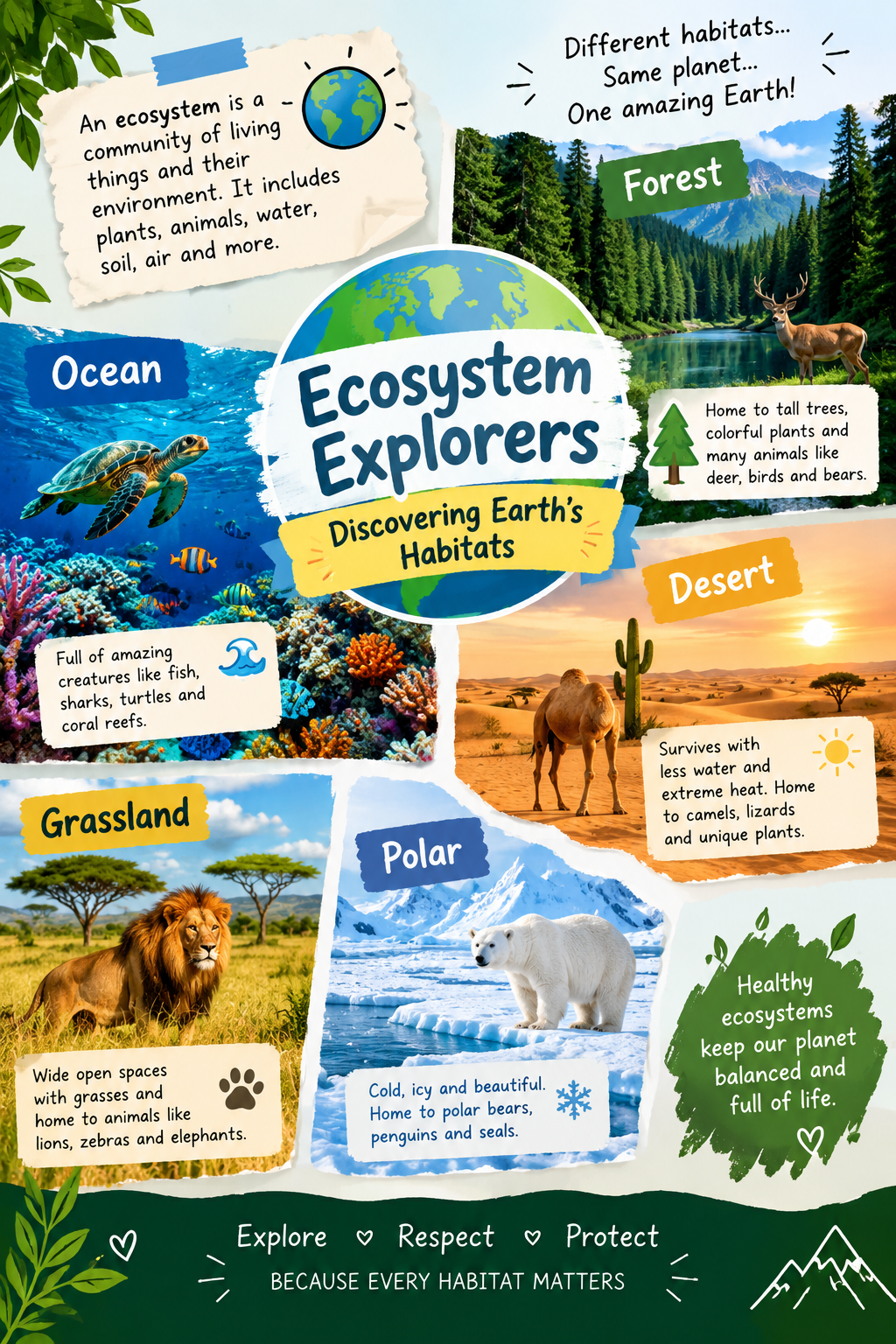
    Ecosystem Explorers: Discovering Earth's Habitats

    Step into the amazing world of Earth's ecosystems and discover the incredible habitats that support life on our planet! From lush forests and vast oceans to deserts , grasslands , and icy polar regions , every habitat has its own unique environment and fascinating wildlife.

    In this exciting journey, we explore how plants, animals, climate, and natural resources work together to create balanced ecosystems. Understanding these connections helps us appreciate the incredible diversity of life and reminds us why protecting our planet is so important.

    Explore. Discover. Learn. Protect. Let's uncover the wonders of Earth's habitats and become true Ecosystem Explorers!

    #EcosystemExplorers #Ecosystems #EarthHabitats #Nature #Wildlife #Biodiversity #Environment #Science #EarthScience #AnimalWorld #PlantLife #NatureLovers #EnvironmentalAwareness #SaveOurPlanet #Sustainability #Education #Learning #DiscoverNature #Climate #Knowledge
    RSISB Roll No:#209 Story Post No.27 🌍🌿 Ecosystem Explorers: Discovering Earth's Habitats 🐾🔍 Step into the amazing world of Earth's ecosystems and discover the incredible habitats that support life on our planet! 🌎✨ From lush forests 🌳 and vast oceans 🌊 to deserts 🏜️, grasslands 🌾, and icy polar regions ❄️, every habitat has its own unique environment and fascinating wildlife. 🦁🐧🐠 In this exciting journey, we explore how plants, animals, climate, and natural resources work together to create balanced ecosystems. 🌱🦋 Understanding these connections helps us appreciate the incredible diversity of life and reminds us why protecting our planet is so important. 💚♻️ 🔎🌟 Explore. Discover. Learn. Protect. Let's uncover the wonders of Earth's habitats and become true Ecosystem Explorers! 🚀🌍 #EcosystemExplorers #Ecosystems #EarthHabitats #Nature #Wildlife #Biodiversity #Environment #Science #EarthScience #AnimalWorld #PlantLife #NatureLovers #EnvironmentalAwareness #SaveOurPlanet #Sustainability #Education #Learning #DiscoverNature #Climate #Knowledge 🌍🌿🐾🔍🌳🌊🏜️🌾❄️🦁🐧🐠🦋💚♻️✨📚🚀
    0 تبصرے 0 شیئرز 726 ویوز
  • #rsisb
    Roll No.247
    foundation level
    # The Journey of Dinosaurs: A Scientific Perspective

    Step into the fascinating world of dinosaurs and explore one of the most remarkable chapters in the history of life on Earth! Dinosaurs ruled many of the planet’s ecosystems for more than 160 million years, appearing during the Triassic Period and continuing through the Jurassic and Cretaceous Periods. Their incredible diversity included enormous plant-eaters, powerful predators, swift hunters, armored species, and many other extraordinary creatures.

    From a scientific perspective, the story of dinosaurs is not simply a tale of giant creatures—it is a story of evolution, adaptation, survival, extinction, and discovery. Scientists learn about dinosaurs through fossils, including bones, teeth, footprints, eggs, nests, and even traces of skin and feathers. By carefully studying these clues, paleontologists can reconstruct how dinosaurs lived, what they ate, how they moved, and how different species changed over millions of years.

    Dinosaurs first appeared roughly 230 million years ago. Over time, they adapted to changing environments and became one of the most successful groups of land animals in Earth's history. Some developed long necks and enormous bodies to reach vegetation, while others evolved sharp teeth and strong jaws for hunting. Their fossils have been discovered on every continent, showing just how widely they were distributed.

    The Jurassic Period is often remembered as a time when giant dinosaurs became especially prominent. Huge sauropods walked across ancient landscapes, while theropods hunted or scavenged. During the Cretaceous Period, dinosaurs continued to diversify, and many familiar species appeared. At the same time, flowering plants became increasingly important parts of many ecosystems.

    One of the most important scientific discoveries is that birds are living dinosaurs. Evidence from fossils, anatomy, and evolutionary studies shows that modern birds descended from theropod dinosaurs. This means that although non-avian dinosaurs disappeared from the fossil record about 66 million years ago, the dinosaur lineage continues today in the form of birds.

    The end of the Cretaceous Period brought a dramatic change. A large asteroid struck what is now the Yucatán Peninsula, contributing to major environmental disruptions around the world. This event, together with other environmental changes, played a major role in the extinction of non-avian dinosaurs. However, many other organisms survived, including early mammals, reptiles, and birds.

    Today, dinosaur research continues to evolve. New fossils, improved imaging technologies, computer modeling, and advances in genetics and evolutionary biology are helping scientists understand these ancient animals more accurately. Every newly discovered fossil can provide another piece of the enormous puzzle of Earth's past.

    The journey of dinosaurs reminds us that Earth has changed dramatically over geological time. Their story teaches us about adaptation, biodiversity, environmental change, and extinction. Most importantly, it shows how scientific evidence can help us understand a world that existed millions of years before humans appeared.

    Whether you are fascinated by enormous herbivores, fearsome predators, ancient ecosystems, or the origins of modern birds, the scientific journey of dinosaurs offers endless opportunities for discovery. Their fossils connect us to a distant past and inspire scientists, students, and curious minds to keep asking questions about the incredible history of life on our planet.

    #Dinosaurs #DinosaurJourney #Paleontology #Science #Fossils #Evolution #EarthHistory #JurassicPeriod #CretaceousPeriod #TriassicPeriod #DinosaurScience #AncientEarth #NaturalHistory #PrehistoricLife #ScientificDiscovery #Paleontologist #Biodiversity #Extinction #BirdsAreDinosaurs #LearnScience #ScienceEducation
    #rsisb Roll No.247 foundation level # The Journey of Dinosaurs: A Scientific Perspective 🦖🌍🔬 Step into the fascinating world of dinosaurs and explore one of the most remarkable chapters in the history of life on Earth! 🌎🦕 Dinosaurs ruled many of the planet’s ecosystems for more than 160 million years, appearing during the Triassic Period and continuing through the Jurassic and Cretaceous Periods. Their incredible diversity included enormous plant-eaters, powerful predators, swift hunters, armored species, and many other extraordinary creatures. 🦴✨ From a scientific perspective, the story of dinosaurs is not simply a tale of giant creatures—it is a story of evolution, adaptation, survival, extinction, and discovery. Scientists learn about dinosaurs through fossils, including bones, teeth, footprints, eggs, nests, and even traces of skin and feathers. 🔬🦴 By carefully studying these clues, paleontologists can reconstruct how dinosaurs lived, what they ate, how they moved, and how different species changed over millions of years. Dinosaurs first appeared roughly 230 million years ago. 🌋🌿 Over time, they adapted to changing environments and became one of the most successful groups of land animals in Earth's history. Some developed long necks and enormous bodies to reach vegetation, while others evolved sharp teeth and strong jaws for hunting. 🦕🌱🦖 Their fossils have been discovered on every continent, showing just how widely they were distributed. The Jurassic Period is often remembered as a time when giant dinosaurs became especially prominent. 🌴☀️ Huge sauropods walked across ancient landscapes, while theropods hunted or scavenged. During the Cretaceous Period, dinosaurs continued to diversify, and many familiar species appeared. At the same time, flowering plants became increasingly important parts of many ecosystems. 🌸🦖 One of the most important scientific discoveries is that birds are living dinosaurs. 🐦🦕 Evidence from fossils, anatomy, and evolutionary studies shows that modern birds descended from theropod dinosaurs. This means that although non-avian dinosaurs disappeared from the fossil record about 66 million years ago, the dinosaur lineage continues today in the form of birds. 🌍🔬 The end of the Cretaceous Period brought a dramatic change. A large asteroid struck what is now the Yucatán Peninsula, contributing to major environmental disruptions around the world. 🌠🌎 This event, together with other environmental changes, played a major role in the extinction of non-avian dinosaurs. However, many other organisms survived, including early mammals, reptiles, and birds. Today, dinosaur research continues to evolve. 🧑‍🔬🔎 New fossils, improved imaging technologies, computer modeling, and advances in genetics and evolutionary biology are helping scientists understand these ancient animals more accurately. Every newly discovered fossil can provide another piece of the enormous puzzle of Earth's past. 🦴🧩 The journey of dinosaurs reminds us that Earth has changed dramatically over geological time. 🌎⏳ Their story teaches us about adaptation, biodiversity, environmental change, and extinction. Most importantly, it shows how scientific evidence can help us understand a world that existed millions of years before humans appeared. Whether you are fascinated by enormous herbivores, fearsome predators, ancient ecosystems, or the origins of modern birds, the scientific journey of dinosaurs offers endless opportunities for discovery. 🦖🔬🌿 Their fossils connect us to a distant past and inspire scientists, students, and curious minds to keep asking questions about the incredible history of life on our planet. 🌍✨ #Dinosaurs 🦖 #DinosaurJourney 🦕 #Paleontology 🔬 #Science 🧪 #Fossils 🦴 #Evolution 🧬 #EarthHistory 🌍 #JurassicPeriod 🌿 #CretaceousPeriod 🌋 #TriassicPeriod 🌎 #DinosaurScience 🔎 #AncientEarth ⏳ #NaturalHistory 🏞️ #PrehistoricLife 🦕 #ScientificDiscovery 💡 #Paleontologist 🧑‍🔬 #Biodiversity 🌱 #Extinction 🌠 #BirdsAreDinosaurs 🐦 #LearnScience 📚 #ScienceEducation 🔬✨
    0 تبصرے 0 شیئرز 3851 ویوز
  • #rsisb Roll No.240 Call Annie No.19 Foundation Level “Water” – The Origin of Life and Language (25 min) is an engaging educational session that explores the importance of water as the foundation of life on Earth. The lesson explains how water supports living organisms, ecosystems, human civilization, and the development of language and communication. Students will discover the unique properties of water, its role in sustaining life, and how humans have developed different words, expressions, and cultural meanings around this essential resource. The session combines science, history, language, and everyday examples to help learners understand why water is often considered the source and symbol of life. Rehan School Islamabad Campus Asma Shaheen EducationWali Irum Asim Saima Happinesswali https://www.facebook.com/share/v/17dYuppSQH/
    WWW.FACEBOOK.COM
    Facebook
    #rsisb Roll No.240 Call Annie No.19 Foundation Level “Water” – The Origin of Life and Language (25 min) is an engaging educational session that explores the importance of water as the foundation of...
    0 تبصرے 0 شیئرز 1258 ویوز
  • #rsisb
    Roll No.240
    Story No.18
    Foundation Level

    ### **Exploring Life’s Mechanisms Through Experimentation**

    Scientific experimentation is one of the most powerful ways to understand the complex processes that sustain life. From the smallest microscopic cells to entire ecosystems, experiments allow scientists to observe, test, and explain how living organisms grow, reproduce, respond to their environment, and maintain balance. Through careful observation, data collection, and analysis, researchers uncover the biological mechanisms that drive life and contribute to advances in medicine, agriculture, biotechnology, and environmental conservation.

    Biological experiments help students and scientists explore essential topics such as genetics, cell biology, microbiology, physiology, ecology, and evolution. By forming hypotheses, conducting controlled experiments, and interpreting results, learners develop critical thinking, problem-solving, and analytical skills. Laboratory investigations also demonstrate the importance of accuracy, ethical responsibility, and evidence-based conclusions in scientific research.

    Modern technology has transformed biological experimentation through advanced microscopes, DNA sequencing, computer simulations, molecular biology techniques, and artificial intelligence. These innovations enable researchers to study diseases, develop life-saving medicines, improve crop production, protect endangered species, and better understand the incredible complexity of living organisms. Every experiment, whether simple or advanced, contributes valuable knowledge that helps improve human health and our understanding of the natural world.

    Exploring life's mechanisms through experimentation inspires curiosity, encourages innovation, and highlights the importance of scientific discovery. By combining observation, creativity, and rigorous testing, scientists continue to unlock the mysteries of life and create solutions to global challenges, paving the way for a healthier, more sustainable future.

    **#Biology #LifeScience #ScientificExperiment #Laboratory #STEM #ScienceEducation #Research #Biotechnology #CellBiology #Genetics #Microbiology #Innovation #ScientificDiscovery #Education #ExploreScience **

    Rehan School Islamabad Campus
    Asma Shaheen EducationWali
    Irum Asim
    Saima Happinesswali
    #rsisb Roll No.240 Story No.18 Foundation Level ### **Exploring Life’s Mechanisms Through Experimentation** Scientific experimentation is one of the most powerful ways to understand the complex processes that sustain life. From the smallest microscopic cells to entire ecosystems, experiments allow scientists to observe, test, and explain how living organisms grow, reproduce, respond to their environment, and maintain balance. Through careful observation, data collection, and analysis, researchers uncover the biological mechanisms that drive life and contribute to advances in medicine, agriculture, biotechnology, and environmental conservation. Biological experiments help students and scientists explore essential topics such as genetics, cell biology, microbiology, physiology, ecology, and evolution. By forming hypotheses, conducting controlled experiments, and interpreting results, learners develop critical thinking, problem-solving, and analytical skills. Laboratory investigations also demonstrate the importance of accuracy, ethical responsibility, and evidence-based conclusions in scientific research. Modern technology has transformed biological experimentation through advanced microscopes, DNA sequencing, computer simulations, molecular biology techniques, and artificial intelligence. These innovations enable researchers to study diseases, develop life-saving medicines, improve crop production, protect endangered species, and better understand the incredible complexity of living organisms. Every experiment, whether simple or advanced, contributes valuable knowledge that helps improve human health and our understanding of the natural world. Exploring life's mechanisms through experimentation inspires curiosity, encourages innovation, and highlights the importance of scientific discovery. By combining observation, creativity, and rigorous testing, scientists continue to unlock the mysteries of life and create solutions to global challenges, paving the way for a healthier, more sustainable future. **#Biology #LifeScience #ScientificExperiment #Laboratory #STEM #ScienceEducation #Research #Biotechnology #CellBiology #Genetics #Microbiology #Innovation #ScientificDiscovery #Education #ExploreScience 🔬🧬🧫🌱📚** Rehan School Islamabad Campus Asma Shaheen EducationWali Irum Asim Saima Happinesswali
    0 تبصرے 0 شیئرز 4624 ویوز
  • #rsisb
    Roll No.240
    Story No.13
    Foundation Level

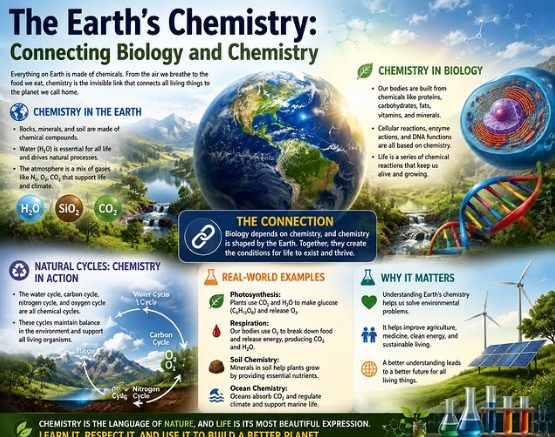
    # The Earth's Chemistry: Connecting Biology and Chemistry

    The Earth is a remarkable system where biology and chemistry work together to sustain life. Every living organism depends on chemical elements and reactions to grow, reproduce, and survive. From the oxygen we breathe and the water we drink to the nutrients in the soil, Earth's natural cycles are driven by the close relationship between biological processes and chemical transformations. Photosynthesis, respiration, decomposition, and nutrient cycling all demonstrate how life and chemistry are deeply interconnected.

    Chemistry explains the composition of air, water, rocks, and living cells, while biology reveals how organisms use these substances to carry out life's essential functions. Carbon, hydrogen, oxygen, nitrogen, phosphorus, and sulfur are the building blocks of life, constantly moving through Earth's atmosphere, oceans, soil, and ecosystems. Understanding this connection helps us appreciate the delicate balance that supports biodiversity, regulates climate, and maintains healthy environments.

    Exploring Earth's chemistry allows us to understand environmental challenges such as pollution, climate change, soil degradation, and water quality. By combining the principles of biology and chemistry, scientists develop innovative solutions for conserving ecosystems, improving agriculture, protecting natural resources, and creating a more sustainable future. Discover how these two fascinating sciences unite to explain the incredible processes that make our planet a thriving home for life.

    Rehan School Islamabad Campus
    Asma Shaheen EducationWali
    Irum Asim
    Saima Happinesswali
    #rsisb Roll No.240 Story No.13 Foundation Level # The Earth's Chemistry: Connecting Biology and Chemistry The Earth is a remarkable system where biology and chemistry work together to sustain life. Every living organism depends on chemical elements and reactions to grow, reproduce, and survive. From the oxygen we breathe and the water we drink to the nutrients in the soil, Earth's natural cycles are driven by the close relationship between biological processes and chemical transformations. Photosynthesis, respiration, decomposition, and nutrient cycling all demonstrate how life and chemistry are deeply interconnected. Chemistry explains the composition of air, water, rocks, and living cells, while biology reveals how organisms use these substances to carry out life's essential functions. Carbon, hydrogen, oxygen, nitrogen, phosphorus, and sulfur are the building blocks of life, constantly moving through Earth's atmosphere, oceans, soil, and ecosystems. Understanding this connection helps us appreciate the delicate balance that supports biodiversity, regulates climate, and maintains healthy environments. Exploring Earth's chemistry allows us to understand environmental challenges such as pollution, climate change, soil degradation, and water quality. By combining the principles of biology and chemistry, scientists develop innovative solutions for conserving ecosystems, improving agriculture, protecting natural resources, and creating a more sustainable future. Discover how these two fascinating sciences unite to explain the incredible processes that make our planet a thriving home for life. Rehan School Islamabad Campus Asma Shaheen EducationWali Irum Asim Saima Happinesswali
    0 تبصرے 0 شیئرز 2204 ویوز
  • #rsisb
    Roll no.239
    Foundation Level

    Earth is a remarkable system where **chemistry and biology work together** to support life. From the air we breathe and the water we drink to the food we eat, chemical substances and reactions are constantly shaping the living world.

    genui{"chemistry_atoms_molecules_matter":{"type_id":"ATOMIC_COMPOSITION"}}

    Chemistry helps us understand the elements and molecules that make up living organisms, while biology explains how these substances interact within cells and ecosystems. **Carbon, oxygen, hydrogen, nitrogen, phosphorus, and sulfur** are especially important because they form many of the molecules essential for life.

    Processes such as **photosynthesis, respiration, decomposition, and nutrient cycling** demonstrate the close relationship between chemistry and biology. Understanding this connection helps us explore Earth's ecosystems, environmental changes, and the chemistry that makes life possible.

    **Chemistry explains the substances; biology shows how life uses them. Together, they reveal the amazing science of our planet.**
    #rsisb Roll no.239 Foundation Level Earth is a remarkable system where **chemistry and biology work together** to support life. From the air we breathe and the water we drink to the food we eat, chemical substances and reactions are constantly shaping the living world. genui{"chemistry_atoms_molecules_matter":{"type_id":"ATOMIC_COMPOSITION"}} Chemistry helps us understand the elements and molecules that make up living organisms, while biology explains how these substances interact within cells and ecosystems. **Carbon, oxygen, hydrogen, nitrogen, phosphorus, and sulfur** are especially important because they form many of the molecules essential for life. Processes such as **photosynthesis, respiration, decomposition, and nutrient cycling** demonstrate the close relationship between chemistry and biology. Understanding this connection helps us explore Earth's ecosystems, environmental changes, and the chemistry that makes life possible. **Chemistry explains the substances; biology shows how life uses them. Together, they reveal the amazing science of our planet.** 🌍🧪🌱
    0 تبصرے 0 شیئرز 1439 ویوز
  • #rsisb
    Roll No.240
    Story No.9
    Foundation Level

    # **Acids and Bases: The Balance of Nature | Description**

    Discover the fascinating world of **acids and bases** and learn how these essential substances help maintain the balance of nature. From the food we eat and the water we drink to the soil that grows our crops and the human body itself, acids and bases play a vital role in everyday life. This topic explores their unique properties, the pH scale, and how chemical reactions between acids and bases create neutral substances that are important for both living organisms and the environment.

    Learn how acids and bases are used in industries, agriculture, medicine, and household products. Understand why maintaining the right pH is essential for healthy ecosystems, clean water, and proper body functions. Through simple explanations and real-life examples, this lesson makes chemistry engaging, practical, and easy to understand for learners of all ages.

    Whether you're a student, science enthusiast, or simply curious about the chemistry behind the world around you, **Acids and Bases: The Balance of Nature** offers an exciting journey into one of the most important concepts in science.

    **#AcidsAndBases #Chemistry #ScienceEducation #Learning #PHScale #ChemicalReactions #Nature #STEM #Education #ScienceFacts**

    Rehan School Islamabad Campus
    Asma Shaheen EducationWali
    Irum Asim
    Saima Happinesswali
    #rsisb Roll No.240 Story No.9 Foundation Level # **Acids and Bases: The Balance of Nature | Description** Discover the fascinating world of **acids and bases** and learn how these essential substances help maintain the balance of nature. From the food we eat and the water we drink to the soil that grows our crops and the human body itself, acids and bases play a vital role in everyday life. This topic explores their unique properties, the pH scale, and how chemical reactions between acids and bases create neutral substances that are important for both living organisms and the environment. Learn how acids and bases are used in industries, agriculture, medicine, and household products. Understand why maintaining the right pH is essential for healthy ecosystems, clean water, and proper body functions. Through simple explanations and real-life examples, this lesson makes chemistry engaging, practical, and easy to understand for learners of all ages. Whether you're a student, science enthusiast, or simply curious about the chemistry behind the world around you, **Acids and Bases: The Balance of Nature** offers an exciting journey into one of the most important concepts in science. **#AcidsAndBases #Chemistry #ScienceEducation #Learning #PHScale #ChemicalReactions #Nature #STEM #Education #ScienceFacts** 🧪⚗️🌍📚 Rehan School Islamabad Campus Asma Shaheen EducationWali Irum Asim Saima Happinesswali
    0 تبصرے 0 شیئرز 1251 ویوز
  • #rsisb
    Roll no.239
    Foundation Level

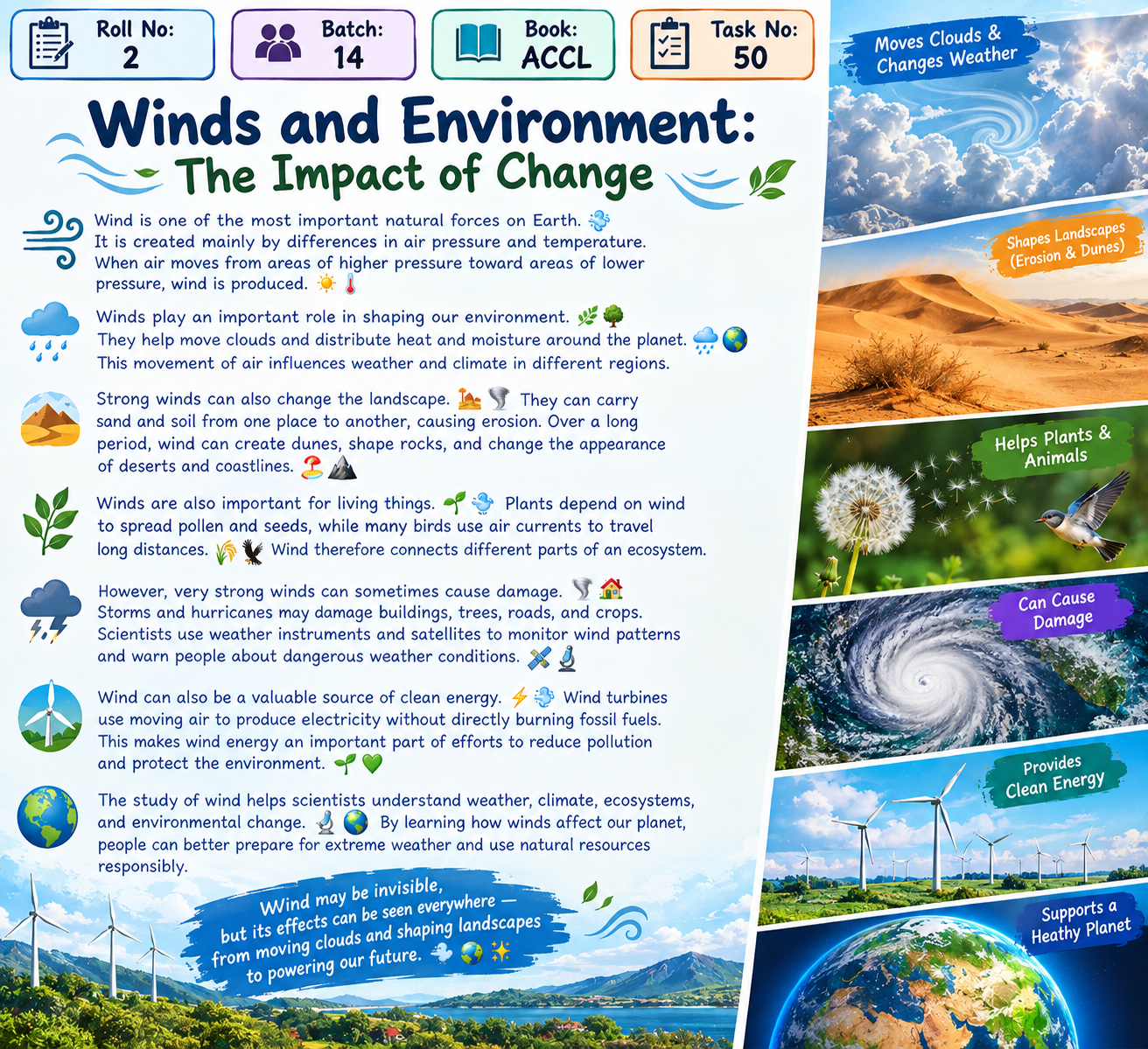
    **Winds and Environment: The Impact of Change** explores how wind influences our planet and how environmental changes can affect wind patterns. Wind is an important part of Earth’s climate system. It moves heat and moisture around the world, influences weather, and helps shape landscapes.

    Changes in temperature, oceans, vegetation, and atmospheric conditions can alter wind patterns. Strong winds can cause soil erosion, damage crops, spread wildfires, and affect communities. At the same time, wind can also provide benefits through pollination, natural cooling, and renewable energy production.

    Understanding the relationship between wind and the environment helps us recognize the importance of protecting natural ecosystems and preparing for changing weather conditions.

    **Conclusion:**
    Wind is more than moving air—it is an important force that connects the atmosphere, land, oceans, and living things. By understanding environmental change, we can make better decisions for a safer and healthier planet.
    #rsisb Roll no.239 Foundation Level **Winds and Environment: The Impact of Change** explores how wind influences our planet and how environmental changes can affect wind patterns. Wind is an important part of Earth’s climate system. It moves heat and moisture around the world, influences weather, and helps shape landscapes. Changes in temperature, oceans, vegetation, and atmospheric conditions can alter wind patterns. Strong winds can cause soil erosion, damage crops, spread wildfires, and affect communities. At the same time, wind can also provide benefits through pollination, natural cooling, and renewable energy production. Understanding the relationship between wind and the environment helps us recognize the importance of protecting natural ecosystems and preparing for changing weather conditions. **Conclusion:** Wind is more than moving air—it is an important force that connects the atmosphere, land, oceans, and living things. By understanding environmental change, we can make better decisions for a safer and healthier planet. 🌍💨
    0 تبصرے 0 شیئرز 1214 ویوز
  • #rsisb
    RollNo.247
    TEDX No.8
    Foundation Level
    # Winds and Environment: The Impact of Change

    Welcome to an insightful journey into the fascinating relationship between **winds and our environment**! In this video, we explore how winds influence Earth's climate, weather patterns, ecosystems, agriculture, and daily life. From gentle breezes that bring comfort to powerful storms that reshape landscapes, wind is one of nature’s most influential forces.

    Discover how changing environmental conditions, pollution, deforestation, and climate change are affecting global wind patterns and why these changes matter for the future of our planet. Learn about the science behind air movement, the role of winds in distributing heat and moisture, and how they impact oceans, forests, wildlife, and human communities.

    **In this video, you'll learn about:**
    What causes wind and how it forms
    Different types of winds around the world
    The role of winds in weather and climate
    How climate change is altering wind patterns
    The environmental impacts of pollution and deforestation
    The importance of renewable wind energy
    Ways we can protect our environment for future generations

    Understanding the connection between winds and the environment helps us appreciate the delicate balance of nature. Every small action we take—reducing pollution, planting trees, conserving energy, and supporting clean energy—can contribute to a healthier and more sustainable world.

    Whether you're a student, teacher, environmental enthusiast, or simply curious about the natural world, this video offers valuable knowledge in an easy-to-understand and engaging way.

    We'd love to hear from you!
    What do you think is the biggest environmental challenge facing our planet today? Share your thoughts in the comments below!

    If you enjoyed this video, don't forget to:
    Like
    Share
    Subscribe
    Turn on notifications so you never miss our latest educational content!

    Together, let's spread awareness, inspire action, and work toward a cleaner, greener, and healthier future for everyone.

    #WindsAndEnvironment #ClimateChange #Environment #GlobalWarming #Wind #Nature #Earth #Weather #RenewableEnergy #Sustainability #GoGreen #EcoFriendly #SaveEarth #CleanEnergy #GreenFuture #EnvironmentalAwareness #ScienceEducation #Geography #ClimateAction #Pollution #Deforestation #ProtectNature #WeatherScience #EducationalVideo #Learning #EarthScience #WindEnergy #NatureLovers #SaveThePlanet #KnowledgeIsPower
    #rsisb RollNo.247 TEDX No.8 Foundation Level # 🌍💨 Winds and Environment: The Impact of Change 🌿🌎 Welcome to an insightful journey into the fascinating relationship between **winds and our environment**! 🌬️🌍 In this video, we explore how winds influence Earth's climate, weather patterns, ecosystems, agriculture, and daily life. From gentle breezes that bring comfort to powerful storms that reshape landscapes, wind is one of nature’s most influential forces. 🌤️🌪️ Discover how changing environmental conditions, pollution, deforestation, and climate change are affecting global wind patterns and why these changes matter for the future of our planet. 🌱⚠️ Learn about the science behind air movement, the role of winds in distributing heat and moisture, and how they impact oceans, forests, wildlife, and human communities. 🌎 **In this video, you'll learn about:** ✅ What causes wind and how it forms 🌬️ ✅ Different types of winds around the world 🌍 ✅ The role of winds in weather and climate 🌦️ ✅ How climate change is altering wind patterns 🌡️ ✅ The environmental impacts of pollution and deforestation 🌳 ✅ The importance of renewable wind energy ⚡🌿 ✅ Ways we can protect our environment for future generations 🌎💚 Understanding the connection between winds and the environment helps us appreciate the delicate balance of nature. Every small action we take—reducing pollution, planting trees, conserving energy, and supporting clean energy—can contribute to a healthier and more sustainable world. 🌱🤝 Whether you're a student, teacher, environmental enthusiast, or simply curious about the natural world, this video offers valuable knowledge in an easy-to-understand and engaging way. 📚✨ 💬 We'd love to hear from you! What do you think is the biggest environmental challenge facing our planet today? Share your thoughts in the comments below! 👇 👍 If you enjoyed this video, don't forget to: 🔹 Like ❤️ 🔹 Share 📤 🔹 Subscribe 🔔 🔹 Turn on notifications so you never miss our latest educational content! Together, let's spread awareness, inspire action, and work toward a cleaner, greener, and healthier future for everyone. 🌍💚🌿 #WindsAndEnvironment #ClimateChange #Environment #GlobalWarming #Wind #Nature #Earth #Weather #RenewableEnergy #Sustainability #GoGreen #EcoFriendly #SaveEarth #CleanEnergy #GreenFuture #EnvironmentalAwareness #ScienceEducation #Geography #ClimateAction #Pollution #Deforestation #ProtectNature #WeatherScience #EducationalVideo #Learning #EarthScience #WindEnergy #NatureLovers #SaveThePlanet #KnowledgeIsPower 🌍💨
    0 تبصرے 0 شیئرز 3892 ویوز
  • #rsisb
    Roll no. 253
    Story Post no.08
    Foundation level
    ## Winds and Environment: The Impact of Change
    Wind is one of Earth's most powerful natural forces, playing a vital role in shaping weather, climate, and ecosystems. It helps distribute heat around the planet, carries seeds and pollen that support plant life, and provides a clean, renewable source of energy through wind power. However, changes in global wind patterns caused by climate change and human activities can lead to stronger storms, prolonged droughts, soil erosion, and the spread of air pollution. By understanding how winds influence our environment, we can make informed decisions to protect natural resources, reduce pollution, and promote sustainable development for future generations.
    ** Key Lesson:** *Winds are essential for maintaining Earth's natural balance, but protecting the environment is crucial to preserving healthy wind patterns and a stable climate.*
    ** Tags:**
    #Winds #Environment #ClimateChange #Weather #RenewableEnergy #WindPower #Science #STEM #EarthScience #Sustainability #Nature #EnvironmentalAwareness #Education #Learning #RehanSchool
    Asma Shaheen EducationWali
    Irum Asim
    Saima Happinesswali
    #rsisb Roll no. 253 Story Post no.08 Foundation level ## 🌬️🌍 Winds and Environment: The Impact of Change Wind is one of Earth's most powerful natural forces, playing a vital role in shaping weather, climate, and ecosystems. It helps distribute heat around the planet, carries seeds and pollen that support plant life, and provides a clean, renewable source of energy through wind power. However, changes in global wind patterns caused by climate change and human activities can lead to stronger storms, prolonged droughts, soil erosion, and the spread of air pollution. By understanding how winds influence our environment, we can make informed decisions to protect natural resources, reduce pollution, and promote sustainable development for future generations. 🌱💨🌎 **📚 Key Lesson:** *Winds are essential for maintaining Earth's natural balance, but protecting the environment is crucial to preserving healthy wind patterns and a stable climate.* **🏷️ Tags:** #Winds #Environment #ClimateChange #Weather #RenewableEnergy #WindPower #Science #STEM #EarthScience #Sustainability #Nature #EnvironmentalAwareness #Education #Learning #RehanSchool 🌬️🌍🍃 Asma Shaheen EducationWali Irum Asim Saima Happinesswali
    0 تبصرے 0 شیئرز 5782 ویوز
More Results