• RSIF8
    Roll no: 99
    Song no: 15
    Song topic: Microbial Universe: The Power of the Invisible World

    A fascinating journey into the invisible universe of microbes, revealing the tiny organisms that shape ecosystems, sustain life, and transform our world.

    #MicrobialUniverse #Microbiology #InvisibleWorld #ScienceAndMusic #RSIF8
    RSIF8 Roll no: 99 Song no: 15 Song topic: Microbial Universe: The Power of the Invisible World A fascinating journey into the invisible universe of microbes, revealing the tiny organisms that shape ecosystems, sustain life, and transform our world. 🦠🌍🎶 #MicrobialUniverse #Microbiology #InvisibleWorld #ScienceAndMusic #RSIF8
    0 Kommentare 0 Anteile 1299 Ansichten 9
  • RSIF8
    Roll no 94
    Song no 16
    Song topic
    Microbial Universe: The Power of the Invisible World

    Step into the fascinating world of microbes—the tiny organisms that shape life in ways we can hardly imagine! From helping plants grow to supporting human health , these invisible heroes play a powerful role in our everyday lives.

    This song celebrates the beauty, mystery, and importance of the microbial universe, reminding us that even the smallest forms of life can have the greatest impact.

    Let the rhythm of science inspire curiosity, wonder, and appreciation for the hidden world around us!

    Every drop of water, every breath of air, and every handful of soil is filled with a universe of microscopic life working tirelessly behind the scenes.

    #MicrobialUniverse #InvisibleWorld #ScienceMusic #Microbiology #STEM #ScienceEducation #Biology #Nature #Innovation #Learning #Knowledge #TinyButMighty #ExploreScience #LifeOnEarth #ScientificWonder
    RSIF8 Roll no 94 Song no 16 Song topic 🌍🦠 Microbial Universe: The Power of the Invisible World 🎶✨ Step into the fascinating world of microbes—the tiny organisms that shape life in ways we can hardly imagine! From helping plants grow 🌱 to supporting human health 💚, these invisible heroes play a powerful role in our everyday lives. This song celebrates the beauty, mystery, and importance of the microbial universe, reminding us that even the smallest forms of life can have the greatest impact. 🌟🔬 🎵 Let the rhythm of science inspire curiosity, wonder, and appreciation for the hidden world around us! 💫 Every drop of water, every breath of air, and every handful of soil is filled with a universe of microscopic life working tirelessly behind the scenes. #MicrobialUniverse #InvisibleWorld #ScienceMusic #Microbiology #STEM #ScienceEducation #Biology #Nature #Innovation #Learning #Knowledge #TinyButMighty #ExploreScience #LifeOnEarth #ScientificWonder 🦠🔬🌎✨🎶💚
    0 Kommentare 0 Anteile 2570 Ansichten 9
  • **Roll No: 2**
    **Batch: 14**
    **Book: ACCL**
    **Task No: 138**

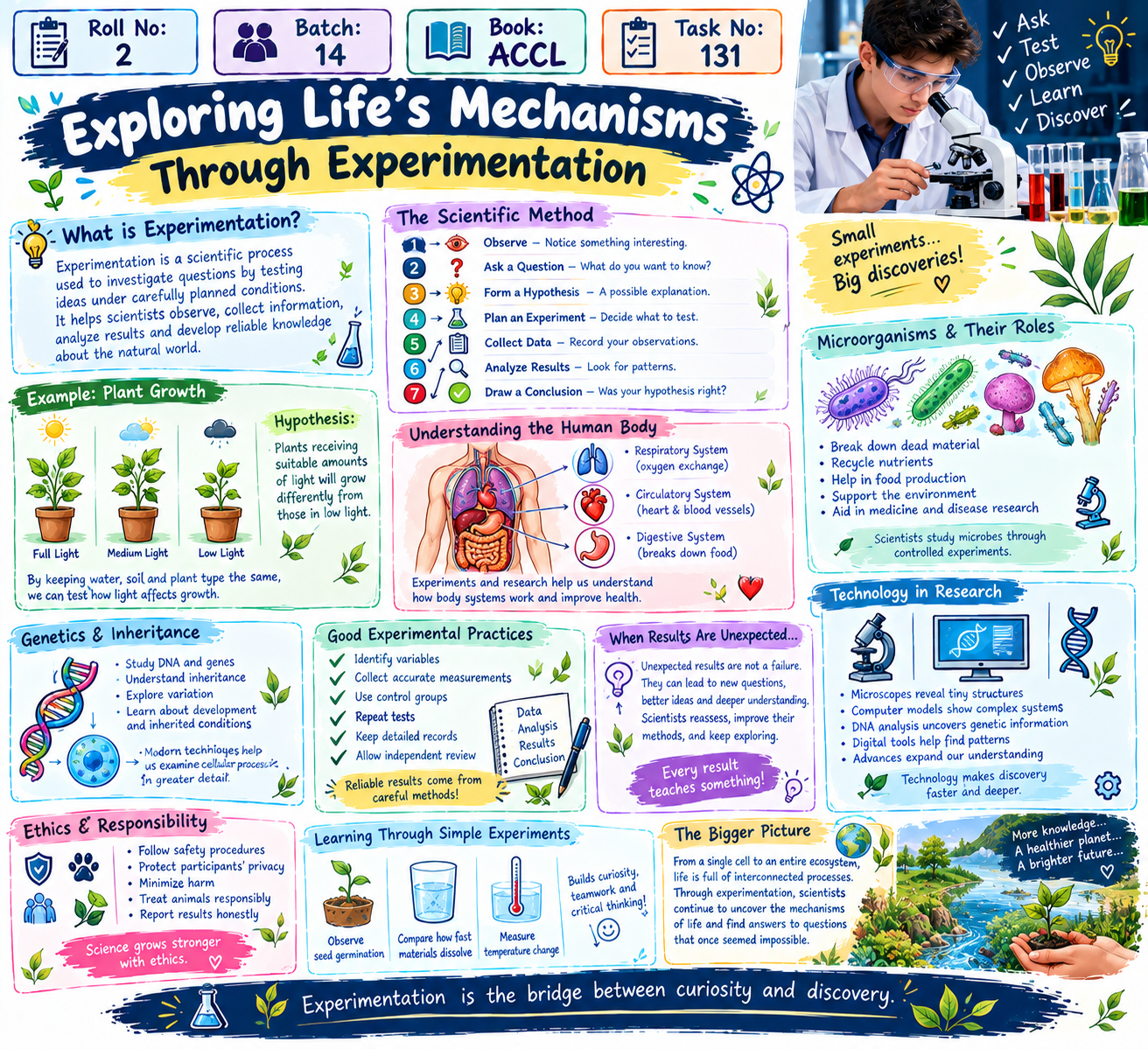
    # Exploring Life’s Mechanisms Through Experimentation

    Have you ever wondered how scientists discover the secrets of life? From understanding how plants grow to investigating how the human heart works, science helps us explore the processes that make living organisms function. Behind many important discoveries lies a powerful method called **experimentation**, which allows scientists to test ideas, observe results, and develop a deeper understanding of the natural world.

    **Experimentation is a scientific process used to investigate questions by testing ideas under carefully planned conditions.** Scientists begin by observing something interesting, asking a question, and developing a hypothesis—a possible explanation that can be tested. They then design an experiment, collect information, and analyze the results to determine whether the evidence supports their original idea. This process helps turn curiosity into reliable scientific knowledge.

    One fascinating example is the study of plant growth. Imagine a student who wants to discover whether the amount of light affects how quickly a plant grows. The student forms a hypothesis that plants receiving suitable amounts of light will grow differently from plants kept in low-light conditions. By keeping factors such as water, soil, and plant type consistent, the student can compare the results and investigate the role of light in plant development.

    Experimentation is also essential for understanding the human body. Scientists investigate how the heart circulates blood, how the lungs exchange gases, and how the digestive system processes food. Through carefully designed studies, medical imaging, laboratory tests, and other research methods, scientists learn how body systems work together to maintain health. Their findings can contribute to improved medical treatments and a better understanding of human biology.

    Another important field is microbiology, the study of microscopic organisms. Many bacteria and fungi play beneficial roles in nature, including breaking down dead material and recycling nutrients. Scientists use controlled experiments to investigate how these organisms respond to different environmental conditions. Such research can help improve food production, develop medicines, understand infectious diseases, and protect ecosystems.

    Experiments also help researchers understand genetics and the mechanisms of inheritance. By studying DNA, genes, and the characteristics of organisms across generations, scientists investigate how biological information is passed on and how variations arise. Modern techniques allow researchers to explore cellular processes in greater detail, helping them understand development, inherited conditions, and the relationships among different forms of life.

    A successful experiment requires more than simply observing what happens. Scientists must identify the variables they are studying, collect accurate measurements, and repeat tests when appropriate. They often use control groups for comparison and record their observations carefully. Repeating experiments helps determine whether a result is consistent, while independent review allows other researchers to examine the methods and evaluate the conclusions. These practices make scientific findings more trustworthy.

    Sometimes experiments produce unexpected results. Instead of treating an unexpected outcome as a failure, scientists use it as an opportunity to ask new questions. They may reconsider their hypothesis, improve their experimental design, or investigate another possible explanation. Scientific progress often happens through this cycle of questioning, testing, learning, and refining ideas. Every result can contribute something valuable when it is interpreted carefully.

    Technology has made biological experimentation more advanced than ever before. Microscopes reveal structures too small to see with the naked eye, computer models help researchers understand complicated systems, and DNA analysis allows scientists to investigate genetic information. Digital tools can also help organize large amounts of data and identify patterns that might otherwise be difficult to notice. These innovations continue to expand our understanding of living organisms.

    However, scientific experimentation must always be guided by responsibility and ethics. Researchers should follow safety procedures, protect participants' privacy, minimize harm, and treat animals responsibly. Experiments involving people or animals require appropriate ethical review and safeguards. Scientists must also report results honestly, even when the findings do not match their expectations. Reliable science depends on both accurate evidence and responsible behavior.

    Experimentation connects classroom learning with real-world discoveries. Students can explore scientific ideas through safe activities, such as observing seed germination, comparing how quickly different materials dissolve in water, or measuring changes in temperature. These activities encourage curiosity, careful observation, teamwork, and critical thinking. They also show that science is not just a collection of facts to memorize; it is an ongoing process of discovery.

    As we explore life's mechanisms, we begin to understand how countless processes work together to support living organisms. From the activity inside a single cell to the interactions among species in an ecosystem, each discovery reveals another part of nature's complexity. Through experimentation, scientists continue to investigate these connections and search for answers to questions that once seemed impossible to solve.

    **Experimentation is the bridge between curiosity and discovery. By asking thoughtful questions, testing ideas fairly, and learning from evidence, we can uncover the mechanisms of life and use scientific knowledge to improve human health, protect the environment, and build a brighter future. **

    \#Experimentation #Biology #ScientificMethod #LifeSciences #ScientificDiscovery #Research #ACCL #Batch14 #Task131
    **Roll No: 2** **Batch: 14** **Book: ACCL** **Task No: 138** # 🔬🧪 Exploring Life’s Mechanisms Through Experimentation 🌱🧬 Have you ever wondered how scientists discover the secrets of life? 🌍 From understanding how plants grow to investigating how the human heart works, science helps us explore the processes that make living organisms function. Behind many important discoveries lies a powerful method called **experimentation**, which allows scientists to test ideas, observe results, and develop a deeper understanding of the natural world. 🔍✨ **Experimentation is a scientific process used to investigate questions by testing ideas under carefully planned conditions.** 🧪 Scientists begin by observing something interesting, asking a question, and developing a hypothesis—a possible explanation that can be tested. They then design an experiment, collect information, and analyze the results to determine whether the evidence supports their original idea. This process helps turn curiosity into reliable scientific knowledge. 📚💡 One fascinating example is the study of plant growth. 🌱 Imagine a student who wants to discover whether the amount of light affects how quickly a plant grows. The student forms a hypothesis that plants receiving suitable amounts of light will grow differently from plants kept in low-light conditions. By keeping factors such as water, soil, and plant type consistent, the student can compare the results and investigate the role of light in plant development. ☀️🌿 Experimentation is also essential for understanding the human body. ❤️ Scientists investigate how the heart circulates blood, how the lungs exchange gases, and how the digestive system processes food. Through carefully designed studies, medical imaging, laboratory tests, and other research methods, scientists learn how body systems work together to maintain health. Their findings can contribute to improved medical treatments and a better understanding of human biology. 🫁🧠 Another important field is microbiology, the study of microscopic organisms. 🦠 Many bacteria and fungi play beneficial roles in nature, including breaking down dead material and recycling nutrients. Scientists use controlled experiments to investigate how these organisms respond to different environmental conditions. Such research can help improve food production, develop medicines, understand infectious diseases, and protect ecosystems. 🔬🌍 Experiments also help researchers understand genetics and the mechanisms of inheritance. 🧬 By studying DNA, genes, and the characteristics of organisms across generations, scientists investigate how biological information is passed on and how variations arise. Modern techniques allow researchers to explore cellular processes in greater detail, helping them understand development, inherited conditions, and the relationships among different forms of life. 🌱🔍 A successful experiment requires more than simply observing what happens. Scientists must identify the variables they are studying, collect accurate measurements, and repeat tests when appropriate. 📏 They often use control groups for comparison and record their observations carefully. Repeating experiments helps determine whether a result is consistent, while independent review allows other researchers to examine the methods and evaluate the conclusions. These practices make scientific findings more trustworthy. 📊📝 Sometimes experiments produce unexpected results. 🤔 Instead of treating an unexpected outcome as a failure, scientists use it as an opportunity to ask new questions. They may reconsider their hypothesis, improve their experimental design, or investigate another possible explanation. Scientific progress often happens through this cycle of questioning, testing, learning, and refining ideas. Every result can contribute something valuable when it is interpreted carefully. 💡🔄 Technology has made biological experimentation more advanced than ever before. 🤖🔬 Microscopes reveal structures too small to see with the naked eye, computer models help researchers understand complicated systems, and DNA analysis allows scientists to investigate genetic information. Digital tools can also help organize large amounts of data and identify patterns that might otherwise be difficult to notice. These innovations continue to expand our understanding of living organisms. 💻🧬 However, scientific experimentation must always be guided by responsibility and ethics. 💚 Researchers should follow safety procedures, protect participants' privacy, minimize harm, and treat animals responsibly. Experiments involving people or animals require appropriate ethical review and safeguards. Scientists must also report results honestly, even when the findings do not match their expectations. Reliable science depends on both accurate evidence and responsible behavior. ⚖️🌿 Experimentation connects classroom learning with real-world discoveries. 🏫 Students can explore scientific ideas through safe activities, such as observing seed germination, comparing how quickly different materials dissolve in water, or measuring changes in temperature. These activities encourage curiosity, careful observation, teamwork, and critical thinking. They also show that science is not just a collection of facts to memorize; it is an ongoing process of discovery. 🌈🧪 As we explore life's mechanisms, we begin to understand how countless processes work together to support living organisms. From the activity inside a single cell to the interactions among species in an ecosystem, each discovery reveals another part of nature's complexity. Through experimentation, scientists continue to investigate these connections and search for answers to questions that once seemed impossible to solve. 🌎🦋🔬 **Experimentation is the bridge between curiosity and discovery. By asking thoughtful questions, testing ideas fairly, and learning from evidence, we can uncover the mechanisms of life and use scientific knowledge to improve human health, protect the environment, and build a brighter future. 🔬🧬🌍💚** \#Experimentation #Biology #ScientificMethod #LifeSciences #ScientificDiscovery #Research #ACCL #Batch14 #Task131 🧪🔬🌱

    0 Kommentare 0 Anteile 6664 Ansichten
  • RSIF8
    Roll no 94
    Song no 15
    Song topic
    Cellular Symphony: The Intricate Dance of Life's Building Blocks

    Every living thing begins with a tiny cell, a microscopic masterpiece that carries the instructions for life itself. From the beating of a human heart to the blooming of a flower , cells work together in perfect harmony, creating a magnificent symphony that has been playing for billions of years.

    This song celebrates the incredible world hidden within us—a world of DNA spirals , energy-producing mitochondria , and countless cellular processes that keep life moving forward every second of every day. It reminds us that even the smallest building blocks can create something extraordinary when they work together.

    Just like musicians in an orchestra , cells communicate, cooperate, and perform their unique roles to create the masterpiece we call life. Their intricate dance is a testament to the beauty, complexity, and wonder of nature.

    Join me on this fascinating journey into the microscopic universe where science meets music, and where every cell contributes its own note to the grand symphony of existence.

    Listen, learn, and be inspired by the hidden rhythm that connects all living things!

    #CellularSymphony #ScienceMusic #Biology #Cells #DNA #LifeScience #STEM #ScientificWonder #Microbiology #Biotechnology #Education #Learning #Nature #Innovation #Life #ScienceFacts #CellBiology #FutureScientists #Inspiration #Knowledge #ExploreScience #MusicAndScience #AmazingNature #Discovery #StudentLife
    RSIF8 Roll no 94 Song no 15 Song topic 🎵 Cellular Symphony: The Intricate Dance of Life's Building Blocks 🧬✨ Every living thing begins with a tiny cell, a microscopic masterpiece that carries the instructions for life itself. 🌱🔬 From the beating of a human heart ❤️ to the blooming of a flower 🌸, cells work together in perfect harmony, creating a magnificent symphony that has been playing for billions of years. 🎶🌍 This song celebrates the incredible world hidden within us—a world of DNA spirals 🧬, energy-producing mitochondria ⚡, and countless cellular processes that keep life moving forward every second of every day. ⏳✨ It reminds us that even the smallest building blocks can create something extraordinary when they work together. 🌟 Just like musicians in an orchestra 🎻🎺, cells communicate, cooperate, and perform their unique roles to create the masterpiece we call life. 🌎💫 Their intricate dance is a testament to the beauty, complexity, and wonder of nature. 🌿🔍 Join me on this fascinating journey into the microscopic universe where science meets music, and where every cell contributes its own note to the grand symphony of existence. 🎵🧬💙 ✨ Listen, learn, and be inspired by the hidden rhythm that connects all living things! 🌍🎶 #CellularSymphony #ScienceMusic #Biology #Cells #DNA #LifeScience #STEM #ScientificWonder #Microbiology #Biotechnology #Education #Learning #Nature #Innovation #Life #ScienceFacts #CellBiology #FutureScientists #Inspiration #Knowledge #ExploreScience #MusicAndScience #AmazingNature #Discovery #StudentLife 🧬🎵🔬🌱✨💙
    0 Kommentare 0 Anteile 3494 Ansichten 9
  • Mohsin RS
    song title no:10
    Rool no:13
    Class: Foundation level

    Microbial Universe: The Power of the Invisible World

    Microbial Universe: The Power of the Invisible World takes us into an extraordinary world that cannot be seen with the naked eye, yet plays an essential role in life on Earth. Microorganisms such as bacteria, fungi, and other microscopic forms of life exist almost everywhere around us—in soil, water, air, plants, animals, and the human body. Although they are incredibly small, their impact on our planet is enormous.

    Microorganisms are an important part of nature’s systems. In soil, many microbes help break down organic matter and return nutrients to the environment. This process supports plant growth and contributes to healthy and productive soil. In oceans, rivers, and other aquatic environments, microorganisms are also important members of food webs and natural cycles. They help maintain the balance of ecosystems and support other forms of life.

    The microbial world is also closely connected to human life. Our bodies naturally interact with many microorganisms, and scientists continue to study these relationships to better understand health and biology. Research into microorganisms has helped expand our knowledge of how living systems work and how different organisms interact with one another.

    Microorganisms are also valuable in food production and biotechnology. Certain microbes are involved in producing foods such as yogurt and cheese through fermentation. In modern biotechnology, microorganisms can be used to produce useful substances and support a variety of scientific and industrial processes. Some microorganisms can also contribute to environmental processes by breaking down organic materials and helping with natural decomposition.

    One of the most fascinating lessons of the microbial universe is that being invisible does not mean being unimportant. A tiny microorganism can have a major influence on an ecosystem. Microbiology teaches us that nature depends on countless connections between organisms, even when those connections are impossible to see without scientific tools.
    Mohsin RS song title no:10 Rool no:13 Class: Foundation level Microbial Universe: The Power of the Invisible World Microbial Universe: The Power of the Invisible World takes us into an extraordinary world that cannot be seen with the naked eye, yet plays an essential role in life on Earth. Microorganisms such as bacteria, fungi, and other microscopic forms of life exist almost everywhere around us—in soil, water, air, plants, animals, and the human body. Although they are incredibly small, their impact on our planet is enormous. Microorganisms are an important part of nature’s systems. In soil, many microbes help break down organic matter and return nutrients to the environment. This process supports plant growth and contributes to healthy and productive soil. In oceans, rivers, and other aquatic environments, microorganisms are also important members of food webs and natural cycles. They help maintain the balance of ecosystems and support other forms of life. The microbial world is also closely connected to human life. Our bodies naturally interact with many microorganisms, and scientists continue to study these relationships to better understand health and biology. Research into microorganisms has helped expand our knowledge of how living systems work and how different organisms interact with one another. Microorganisms are also valuable in food production and biotechnology. Certain microbes are involved in producing foods such as yogurt and cheese through fermentation. In modern biotechnology, microorganisms can be used to produce useful substances and support a variety of scientific and industrial processes. Some microorganisms can also contribute to environmental processes by breaking down organic materials and helping with natural decomposition. One of the most fascinating lessons of the microbial universe is that being invisible does not mean being unimportant. A tiny microorganism can have a major influence on an ecosystem. Microbiology teaches us that nature depends on countless connections between organisms, even when those connections are impossible to see without scientific tools.
    0 Kommentare 0 Anteile 2837 Ansichten 93
  • RSIF8
    Roll no: 99
    Song no: 15
    Song topic: Microbial Universe: The Power of the Invisible World
    The microbial world is filled with tiny organisms that have a huge impact on life. From bacteria and fungi to microscopic organisms in soil, water, and our bodies, microbes play important roles in ecosystems, nutrition, decomposition, and human health. This song takes us into the fascinating invisible world of microbes and explores the incredible power hidden within the smallest forms of life.
    #MicrobialUniverse #Microbiology #InvisibleWorld #Microbes #Bacteria #Biology #Science #LifeScience #ScienceSong #Learning #Education
    RSIF8 Roll no: 99 Song no: 15 Song topic: Microbial Universe: The Power of the Invisible World The microbial world is filled with tiny organisms that have a huge impact on life. From bacteria and fungi to microscopic organisms in soil, water, and our bodies, microbes play important roles in ecosystems, nutrition, decomposition, and human health. This song takes us into the fascinating invisible world of microbes and explores the incredible power hidden within the smallest forms of life. #MicrobialUniverse #Microbiology #InvisibleWorld #Microbes #Bacteria #Biology #Science #LifeScience #ScienceSong #Learning #Education
    0 Kommentare 0 Anteile 1968 Ansichten 2
  • #rsisb
    Roll NO:232
    Foundation level student.
    Story post:25

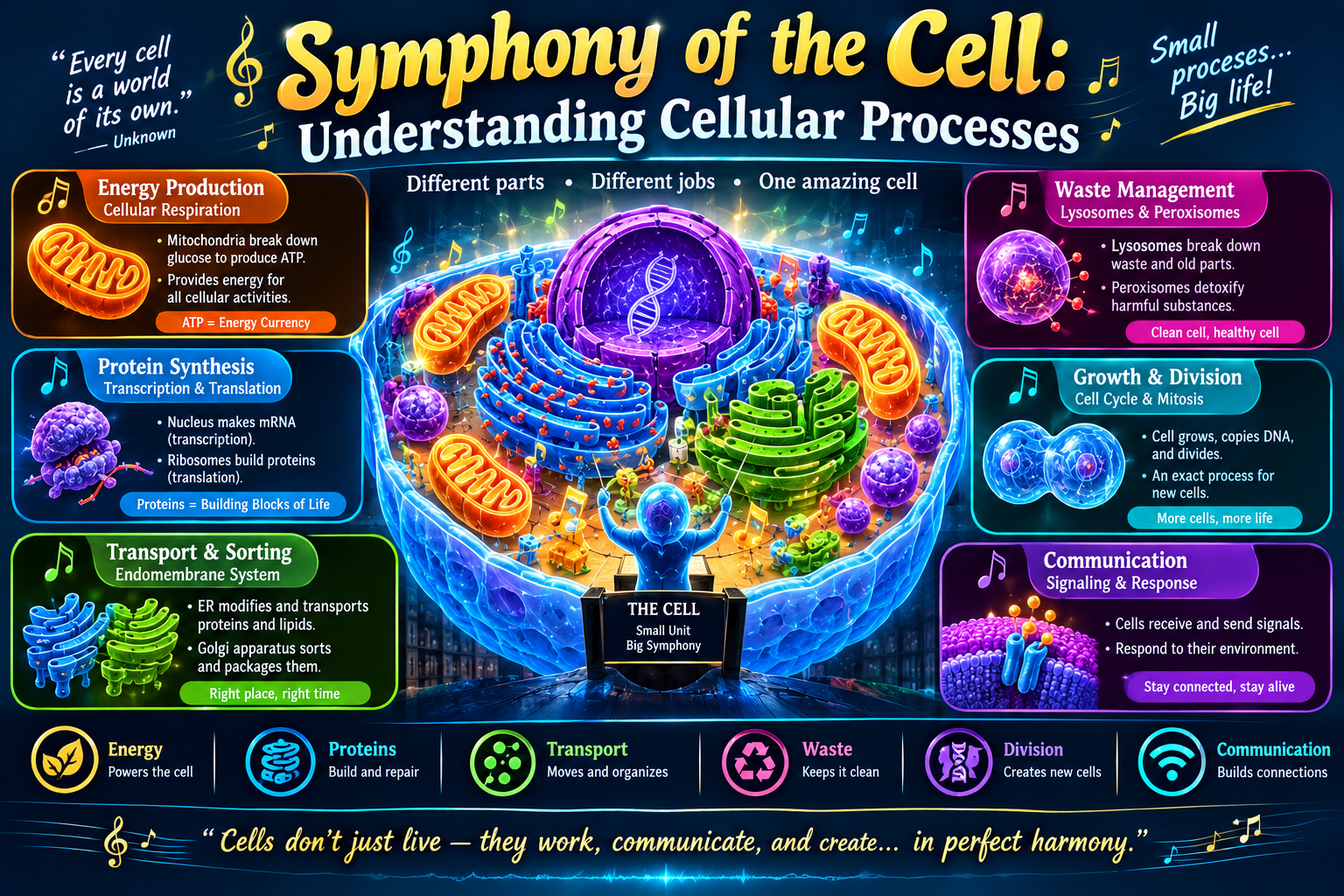
    ### Symphony of the Cell: Understanding Cellular Processes

    **Description:**
    Welcome to the **Symphony of the Cell**! Explore the incredible processes happening inside every living cell and discover how different cellular parts work together like instruments in a perfectly coordinated orchestra.

    From **energy production and protein synthesis to DNA replication, cell division, and waste removal**, every process plays an important role in keeping cells alive and functioning. Learn how these tiny biological systems work together to support life itself!

    **Hashtags:**
    #SymphonyOfTheCell #CellBiology #CellularProcesses #Biology #Science #DNA #ProteinSynthesis #CellDivision #Mitochondria #Organelles #Microbiology #ScienceEducation #LearnBiology #EducationalVideo #ScienceLovers

    **Emojis:**

    #rsisb Roll NO:232 Foundation level student. Story post:25 ### 🧬 Symphony of the Cell: Understanding Cellular Processes 🎶🔬 **Description:** Welcome to the **Symphony of the Cell**! 🧬🎶 Explore the incredible processes happening inside every living cell and discover how different cellular parts work together like instruments in a perfectly coordinated orchestra. 🔬✨ From **energy production and protein synthesis to DNA replication, cell division, and waste removal**, every process plays an important role in keeping cells alive and functioning. ⚡🧪 Learn how these tiny biological systems work together to support life itself! 🌱🌍 **Hashtags:** #SymphonyOfTheCell #CellBiology #CellularProcesses #Biology #Science #DNA #ProteinSynthesis #CellDivision #Mitochondria #Organelles #Microbiology #ScienceEducation #LearnBiology #EducationalVideo #ScienceLovers 🧬🔬 **Emojis:** 🧬 🔬 🧫 🎶 🧪 ⚡ 🧠 🌱 🌍 📚 ✨ 🔍 🚀
    0 Kommentare 0 Anteile 3943 Ansichten
  • #rsisb
    Roll NO:232
    Foundation level student.
    Story post:24

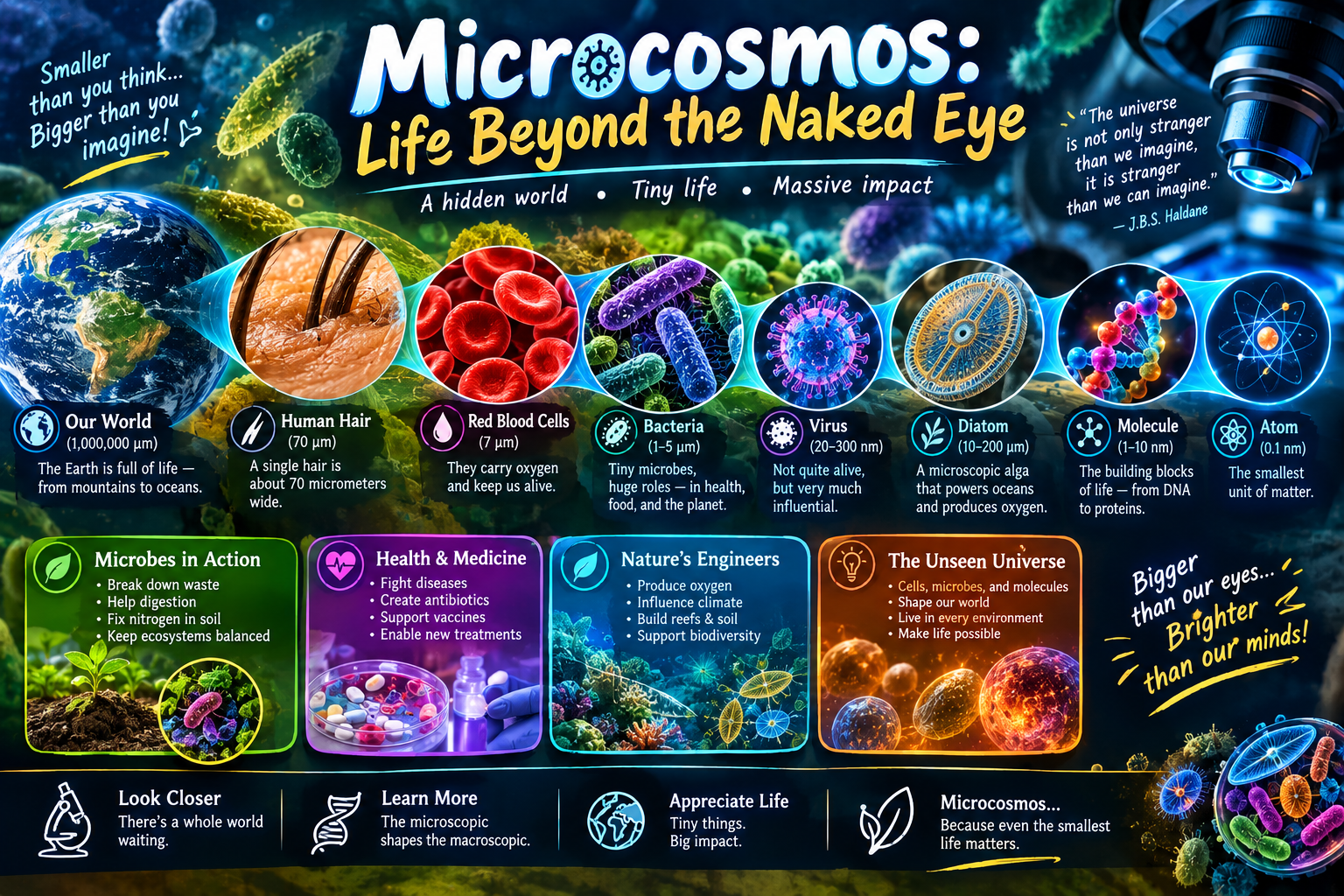
    ### Microcosmos: Life Beyond the Naked Eye

    **Description:**
    Step into the fascinating world of the **Microcosmos**—a hidden universe filled with tiny organisms and structures that are invisible to the naked eye! From microscopic bacteria and fascinating cells to tiny life forms living all around us, this journey reveals how much life exists beyond what we can see.

    Discover how microscopes allow us to explore this incredible miniature world and understand the important role microscopic life plays in nature, science, and our everyday lives.

    **Hashtags:**
    #Microcosmos #MicroscopicWorld #Microscope #Microbiology #Biology #Science #TinyWorld #Microorganisms #Cells #Bacteria #Nature #ScienceEducation #ExploreScience #LearnBiology #EducationalVideo #ScienceLovers

    **Emojis:**

    #rsisb Roll NO:232 Foundation level student. Story post:24 ### 🔬 Microcosmos: Life Beyond the Naked Eye 🌎🦠 **Description:** Step into the fascinating world of the **Microcosmos**—a hidden universe filled with tiny organisms and structures that are invisible to the naked eye! 🔬🦠✨ From microscopic bacteria and fascinating cells to tiny life forms living all around us, this journey reveals how much life exists beyond what we can see. 🌱💧 Discover how microscopes allow us to explore this incredible miniature world and understand the important role microscopic life plays in nature, science, and our everyday lives. 🧫🌍📚 **Hashtags:** #Microcosmos #MicroscopicWorld #Microscope #Microbiology #Biology #Science #TinyWorld #Microorganisms #Cells #Bacteria #Nature #ScienceEducation #ExploreScience #LearnBiology #EducationalVideo #ScienceLovers 🔬🦠🌎 **Emojis:** 🔬 🦠 🧫 🌱 🌎 🧬 🧪 👀 📚 ✨ 🔍 🚀
    0 Kommentare 0 Anteile 2301 Ansichten
  • #rsisb
    Roll no.239
    Story post no.23
    Foundation Level


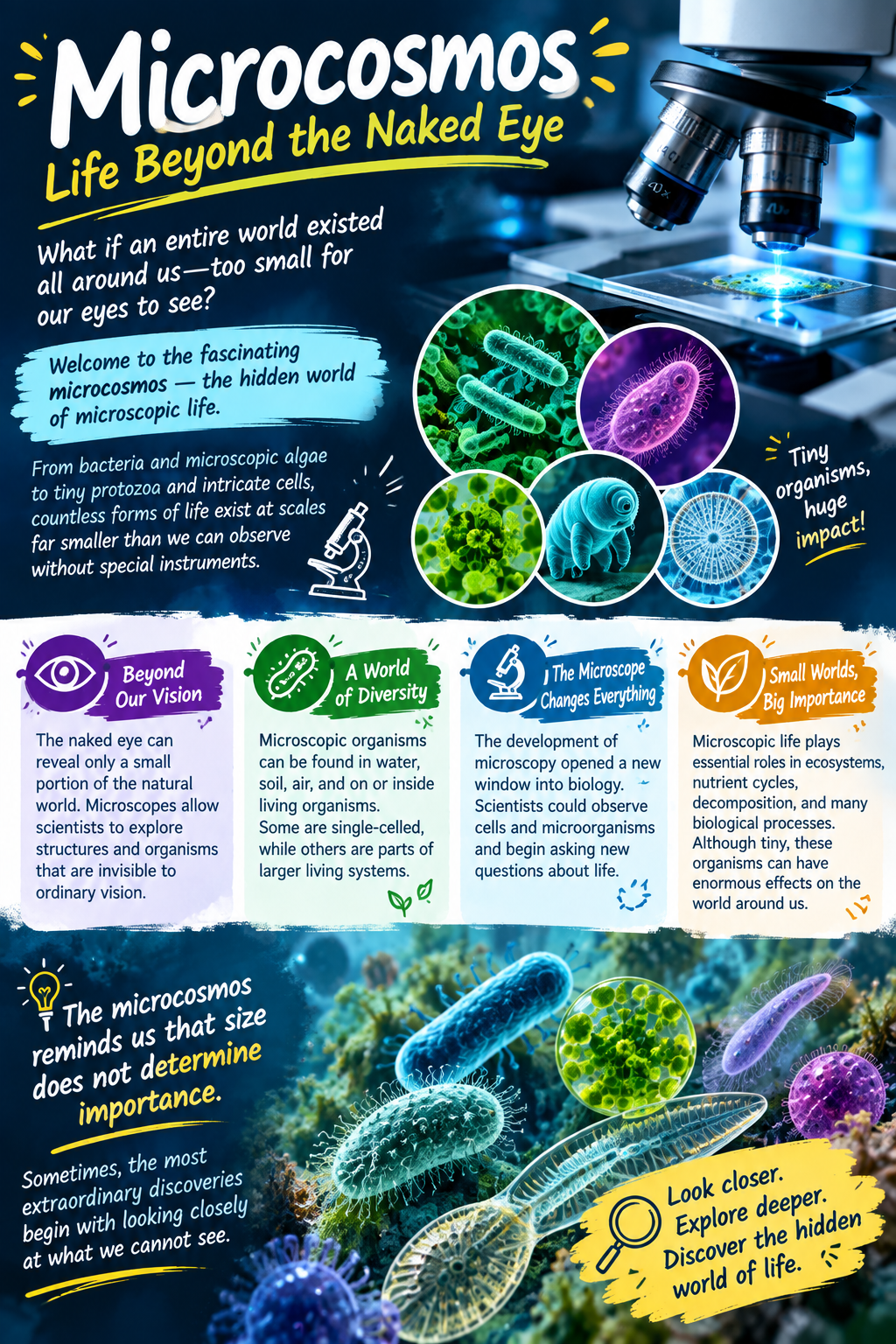
    Welcome to the fascinating **microcosmos**, the hidden world of microscopic life. From bacteria and microscopic algae to tiny protozoa and intricate cells, countless forms of life exist at scales far smaller than we can observe without special instruments.

    **Beyond Our Vision**
    The naked eye can reveal only a small portion of the natural world. Microscopes allow scientists to explore structures and organisms that are invisible to ordinary vision.

    **A World of Diversity**
    Microscopic organisms can be found in water, soil, air, and on or inside living organisms. Some are single-celled, while others are parts of larger living systems.

    **The Microscope Changes Everything**
    The development of microscopy opened a new window into biology. Scientists could observe cells and microorganisms and begin asking new questions about life.

    **Small Worlds, Big Importance**
    Microscopic life plays essential roles in ecosystems, nutrient cycles, decomposition, and many biological processes. Although tiny, these organisms can have enormous effects on the world around us.

    **The microcosmos reminds us that size does not determine importance. Sometimes, the most extraordinary discoveries begin with looking closely at what we cannot see.**

    **Look closer. Explore deeper. Discover the hidden world of life.**

    #Microcosmos #MicroscopicWorld #Microscopy #Biology #Microbiology #Science #Cells #Microorganisms #NaturalWorld #ScienceEducation #BiologyFacts #DidYouKnow #ExploreScience #Learning #ScientificDiscovery
    #rsisb Roll no.239 Story post no.23 Foundation Level Welcome to the fascinating **microcosmos**, the hidden world of microscopic life. From bacteria and microscopic algae to tiny protozoa and intricate cells, countless forms of life exist at scales far smaller than we can observe without special instruments. 🔬 👁️ **Beyond Our Vision** The naked eye can reveal only a small portion of the natural world. Microscopes allow scientists to explore structures and organisms that are invisible to ordinary vision. 🧫 **A World of Diversity** Microscopic organisms can be found in water, soil, air, and on or inside living organisms. Some are single-celled, while others are parts of larger living systems. 🔬 **The Microscope Changes Everything** The development of microscopy opened a new window into biology. Scientists could observe cells and microorganisms and begin asking new questions about life. 🌱 **Small Worlds, Big Importance** Microscopic life plays essential roles in ecosystems, nutrient cycles, decomposition, and many biological processes. Although tiny, these organisms can have enormous effects on the world around us. ✨ **The microcosmos reminds us that size does not determine importance. Sometimes, the most extraordinary discoveries begin with looking closely at what we cannot see.** 🔍 **Look closer. Explore deeper. Discover the hidden world of life.** #Microcosmos #MicroscopicWorld #Microscopy #Biology #Microbiology #Science #Cells #Microorganisms #NaturalWorld #ScienceEducation #BiologyFacts #DidYouKnow #ExploreScience #Learning #ScientificDiscovery
    0 Kommentare 0 Anteile 2731 Ansichten
  • #rsisb
    Roll no.239
    Song no .25
    Foundation Level

    **Microbial Universe: The Power of the Invisible World** explores the fascinating world of microorganisms—tiny forms of life that are often invisible to the naked eye. From bacteria and fungi to microscopic algae and other microbes, these organisms play important roles in nature and in our daily lives.

    Microorganisms help **decompose organic matter, recycle nutrients, support ecosystems, produce useful foods and medicines, and influence human health**. This topic reveals how an invisible world can have a remarkable impact on life on Earth.

    #MicrobialUniverse #Microbiology #Microorganisms #Bacteria #Science #Biology #InvisibleWorld #Education #Learning
    #rsisb Roll no.239 Song no .25 Foundation Level **Microbial Universe: The Power of the Invisible World** explores the fascinating world of microorganisms—tiny forms of life that are often invisible to the naked eye. 🔬✨ From bacteria and fungi to microscopic algae and other microbes, these organisms play important roles in nature and in our daily lives. Microorganisms help **decompose organic matter, recycle nutrients, support ecosystems, produce useful foods and medicines, and influence human health**. This topic reveals how an invisible world can have a remarkable impact on life on Earth. 🌱🧬🔬 #MicrobialUniverse #Microbiology #Microorganisms #Bacteria #Science #Biology #InvisibleWorld #Education #Learning 🦠🔬🌍✨
    0 Kommentare 0 Anteile 2666 Ansichten 9
Suchergebnis