


• **Roll No: 2**
    **Batch: 14**
    **Book: ACCL**
    **Task No: 130**

    # Peering Inside: The Role of Dissections in Understanding Life

    Have you ever wondered how scientists discover what lies inside a living organism and how its different organs work together? The human body and the bodies of other animals contain many complex structures that cannot be fully understood by looking only at their outer appearance. Dissection is one scientific method that helps students and researchers explore internal anatomy and understand the remarkable organization of life.

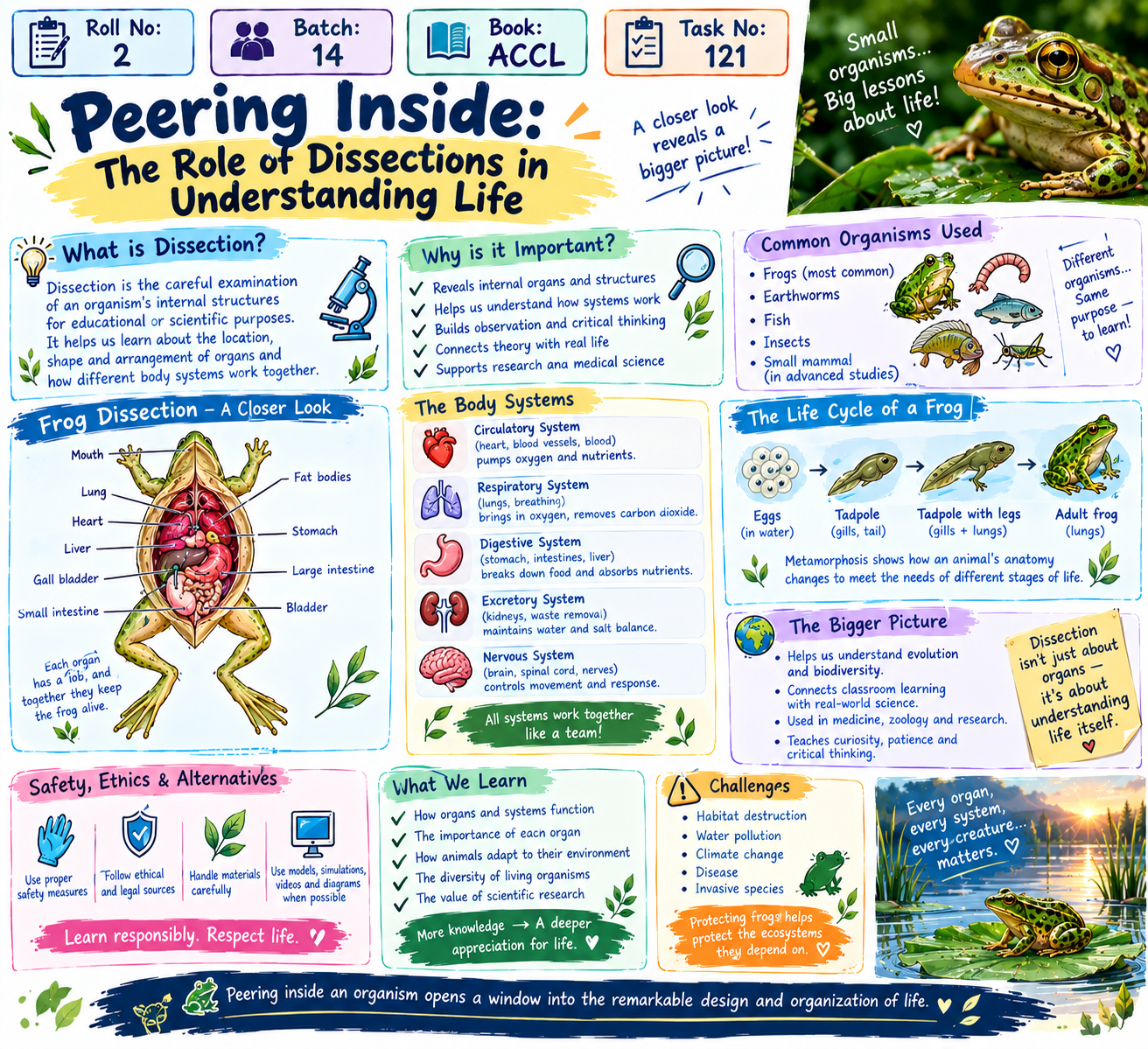
    **Dissection is the careful examination of an organism's internal structures for educational or scientific purposes.** It helps us learn about the location, shape, and arrangement of organs and how different body systems work together. By studying anatomy, we can better understand how living organisms obtain energy, breathe, circulate blood, digest food, and respond to their surroundings.

    One commonly discussed example in biology education is frog dissection. Frogs are interesting study organisms because they have many organ systems that can be compared with those of other vertebrates. Their bodies are adapted for movement on land and in water, and their anatomy provides useful opportunities to study how organs perform different functions. Observing frog anatomy can help students understand the relationship between body structure and survival.

    The circulatory system is an important area of anatomical study. The heart pumps blood through blood vessels, helping transport oxygen, nutrients, and other substances around the body. The respiratory system supports gas exchange, while the digestive system breaks down food so that the body can absorb useful nutrients. These systems work together to supply cells with the materials and energy they need.

    The nervous system is equally fascinating. It includes the brain, spinal cord, and nerves, which coordinate movement, process information, and help organisms respond to changes in their environments. The excretory system also plays an essential role by removing waste products and maintaining the balance of water and salts. Studying these systems reveals that every organ has a specific role, yet no organ works entirely alone.

    Dissection can also connect classroom learning with real-world science. Medical professionals study anatomy to understand the human body, while zoologists investigate the structures of different animal species. Researchers use many methods, including imaging, microscopy, computer models, and carefully conducted anatomical studies, to investigate how organisms function. These approaches have helped expand our knowledge of health, development, and biodiversity.

    Although dissection can be a valuable learning method, science education must also emphasize responsibility and respect for life. Schools and laboratories should follow appropriate safety procedures, use legally and ethically sourced specimens, and handle materials carefully. Whenever possible, students may also learn through digital simulations, anatomical models, videos, and diagrams. These alternatives can explain many internal structures without requiring the use of preserved specimens.

    The study of anatomy helps us appreciate the diversity of living organisms. Different species have different body structures because they have adapted to different environments and ways of life. Comparing these structures allows scientists to investigate evolution, understand biological similarities, and discover how organisms meet the challenges of survival.

    Dissection teaches more than the names of organs. It encourages observation, patience, careful reasoning, and the ability to connect scientific evidence with biological explanations. It also reminds us that scientific knowledge grows through asking questions, examining evidence, and learning from reliable methods rather than making assumptions.

    **Peering inside an organism opens a window into the remarkable design and organization of life. By studying anatomy responsibly, we deepen our understanding of biology, appreciate the connections between body systems, and learn why every discovery should be guided by curiosity, care, and respect for the natural world. **

    \#Dissection #Anatomy #Biology #ScienceEducation #AnimalScience #LearningThroughScience #ACCL #Batch14 #Task121
    **Roll No: 2** **Batch: 14** **Book: ACCL** **Task No: 130** # 🔬🧬 Peering Inside: The Role of Dissections in Understanding Life 🐸🌿 Have you ever wondered how scientists discover what lies inside a living organism and how its different organs work together? 🔍🫀 The human body and the bodies of other animals contain many complex structures that cannot be fully understood by looking only at their outer appearance. Dissection is one scientific method that helps students and researchers explore internal anatomy and understand the remarkable organization of life. 🌍✨ **Dissection is the careful examination of an organism's internal structures for educational or scientific purposes.** 🔬 It helps us learn about the location, shape, and arrangement of organs and how different body systems work together. By studying anatomy, we can better understand how living organisms obtain energy, breathe, circulate blood, digest food, and respond to their surroundings. 📚🧠 One commonly discussed example in biology education is frog dissection. 🐸 Frogs are interesting study organisms because they have many organ systems that can be compared with those of other vertebrates. Their bodies are adapted for movement on land and in water, and their anatomy provides useful opportunities to study how organs perform different functions. Observing frog anatomy can help students understand the relationship between body structure and survival. The circulatory system is an important area of anatomical study. ❤️ The heart pumps blood through blood vessels, helping transport oxygen, nutrients, and other substances around the body. The respiratory system supports gas exchange, while the digestive system breaks down food so that the body can absorb useful nutrients. These systems work together to supply cells with the materials and energy they need. ⚡🫁 The nervous system is equally fascinating. 🧠 It includes the brain, spinal cord, and nerves, which coordinate movement, process information, and help organisms respond to changes in their environments. The excretory system also plays an essential role by removing waste products and maintaining the balance of water and salts. Studying these systems reveals that every organ has a specific role, yet no organ works entirely alone. Dissection can also connect classroom learning with real-world science. 🏥 Medical professionals study anatomy to understand the human body, while zoologists investigate the structures of different animal species. Researchers use many methods, including imaging, microscopy, computer models, and carefully conducted anatomical studies, to investigate how organisms function. These approaches have helped expand our knowledge of health, development, and biodiversity. 🔬📖 Although dissection can be a valuable learning method, science education must also emphasize responsibility and respect for life. 💚 Schools and laboratories should follow appropriate safety procedures, use legally and ethically sourced specimens, and handle materials carefully. Whenever possible, students may also learn through digital simulations, anatomical models, videos, and diagrams. These alternatives can explain many internal structures without requiring the use of preserved specimens. The study of anatomy helps us appreciate the diversity of living organisms. 🐸🐟🐦 Different species have different body structures because they have adapted to different environments and ways of life. Comparing these structures allows scientists to investigate evolution, understand biological similarities, and discover how organisms meet the challenges of survival. Dissection teaches more than the names of organs. It encourages observation, patience, careful reasoning, and the ability to connect scientific evidence with biological explanations. 🧪💡 It also reminds us that scientific knowledge grows through asking questions, examining evidence, and learning from reliable methods rather than making assumptions. **Peering inside an organism opens a window into the remarkable design and organization of life. By studying anatomy responsibly, we deepen our understanding of biology, appreciate the connections between body systems, and learn why every discovery should be guided by curiosity, care, and respect for the natural world. 🔬🌿🌎** \#Dissection #Anatomy #Biology #ScienceEducation #AnimalScience #LearningThroughScience #ACCL #Batch14 #Task121 🧬🔬💚
    0 Commentarios 0 Acciones 4874 Views
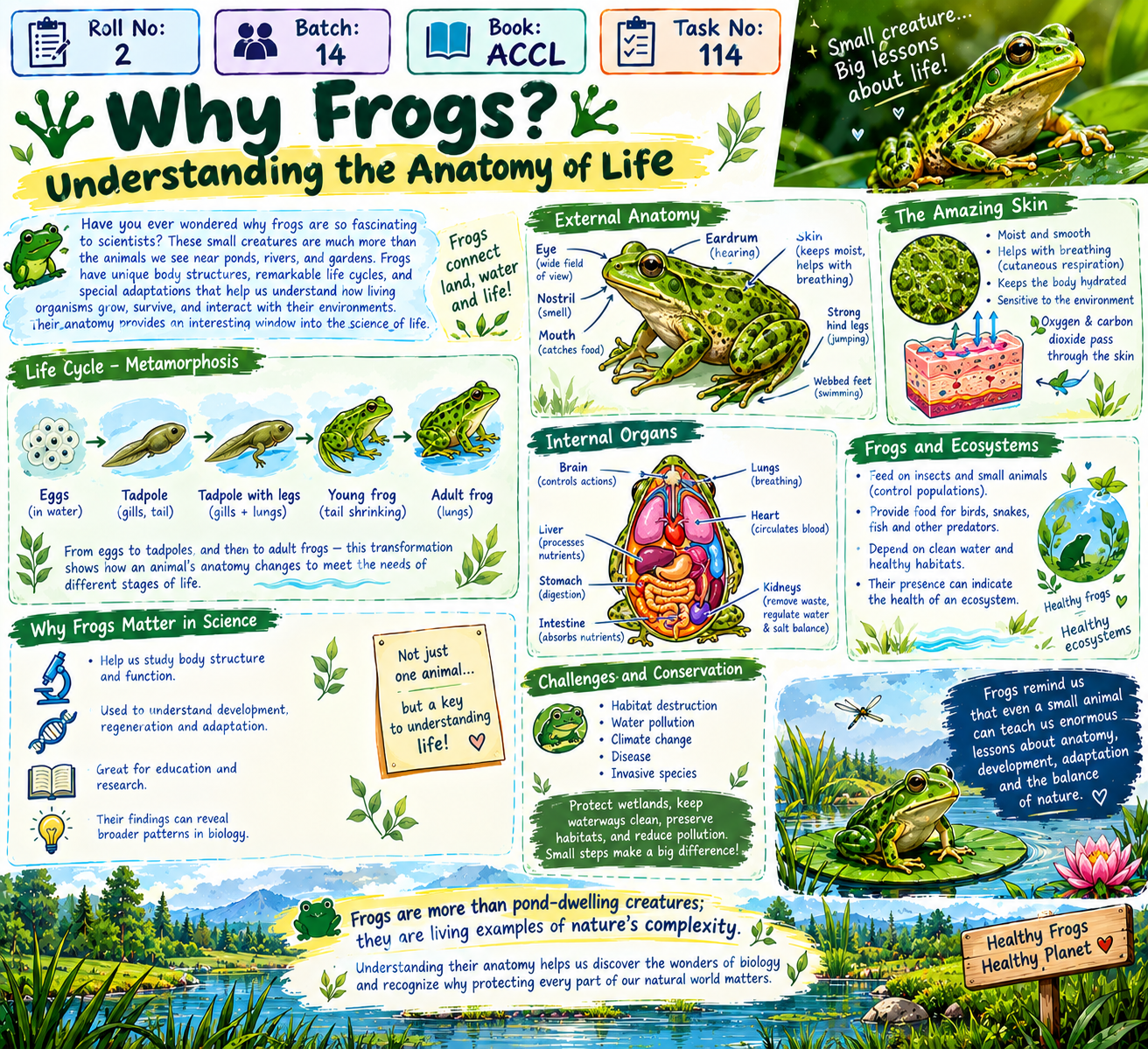
  • **Roll No: 2**
    **Batch: 14**
    **Book: ACCL**
    **Task No: 120**

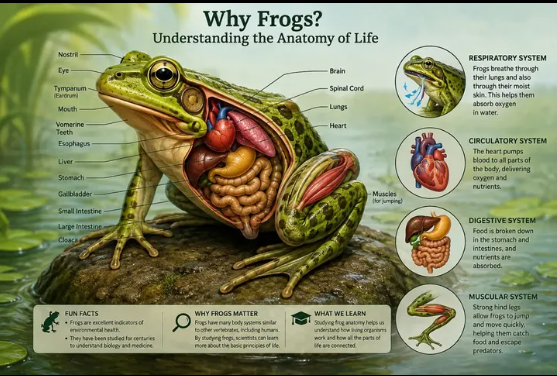
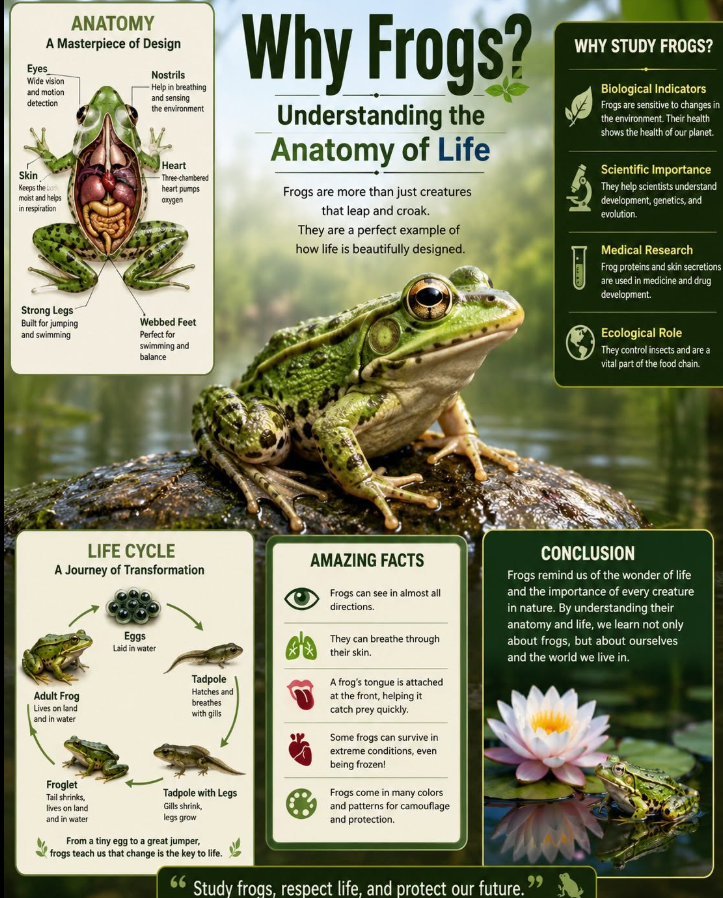
    # Why Frogs? Understanding the Anatomy of Life

    Have you ever wondered why frogs are so fascinating to scientists? These small creatures are much more than the animals we see near ponds, rivers, and gardens. Frogs have unique body structures, remarkable life cycles, and special adaptations that help us understand how living organisms grow, survive, and interact with their environments. Their anatomy provides an interesting window into the science of life.

    A frog's body is designed for life both in water and on land. Its body generally has a broad head, a short trunk, strong hind legs, and webbed feet in many species. These features help frogs jump, swim, and move through their habitats. Their eyes are positioned to provide a wide field of view, while their sensitive hearing helps them detect sounds, including the calls of other frogs.

    One of the most interesting features of frogs is their skin. Unlike the dry, scaly skin of many reptiles, frog skin is usually moist and plays an important role in their survival. Many frogs can exchange gases through their skin as well as through their lungs. This process, called **cutaneous respiration**, allows oxygen and carbon dioxide to pass across the skin under suitable conditions. Their skin also helps maintain moisture, making a healthy habitat especially important for them.

    Frogs have a fascinating life cycle called **metamorphosis**. Many begin life as eggs in water. The eggs hatch into tadpoles, which usually have tails and breathe mainly through gills. As they develop, they grow legs, their lungs develop, and their bodies gradually change into those of adult frogs. The tail is usually absorbed during development. This transformation demonstrates how an animal's anatomy changes to meet the needs of different stages of life.

    The internal organs of a frog also reveal important biological principles. Its heart circulates blood through the body, carrying oxygen and nutrients to tissues. The digestive system breaks down food, while the kidneys help remove waste and regulate water and salt balance. The brain and nervous system coordinate movement, senses, and responses to the environment. Each organ works with other systems to keep the animal alive.

    Frogs are also valuable to ecosystems. Many feed on insects and other small animals, helping influence populations of these organisms. Frogs themselves provide food for birds, snakes, fish, and other predators. Because many frogs depend on suitable water and land habitats, changes in their populations can provide clues about environmental conditions. Scientists therefore study frogs to learn more about biodiversity, habitat quality, and ecosystem health.

    Another reason frogs are important is their role in scientific research and education. Their anatomy helps students explore the structure and function of organs, compare different vertebrates, and understand biological systems. Researchers also study frog development, regeneration in certain species, communication, and adaptation. Such research can reveal broader patterns in biology, although findings from frogs do not always apply directly to humans.

    Unfortunately, many frog species face challenges such as habitat destruction, water pollution, climate change, disease, and invasive species. Protecting wetlands, keeping waterways clean, preserving natural habitats, and reducing pollution can help support frog populations and the many other organisms that share their ecosystems. Caring for frogs is one way of caring for the wider web of life.

    Frogs remind us that even a small animal can teach us enormous lessons about anatomy, development, adaptation, and the balance of nature. By observing their bodies and studying their life cycles, we gain a deeper appreciation of how living systems work together.

    **Frogs are more than pond-dwelling creatures; they are living examples of nature's complexity. Understanding their anatomy helps us discover the wonders of biology and recognize why protecting every part of our natural world matters. **

    \#Frogs #AnatomyOfLife #Biology #LifeCycle #AnimalScience #Biodiversity #ACCL #Batch14 #Task114
    **Roll No: 2** **Batch: 14** **Book: ACCL** **Task No: 120** # 🐸🔬 Why Frogs? Understanding the Anatomy of Life 🌿💚 Have you ever wondered why frogs are so fascinating to scientists? 🐸🌎 These small creatures are much more than the animals we see near ponds, rivers, and gardens. Frogs have unique body structures, remarkable life cycles, and special adaptations that help us understand how living organisms grow, survive, and interact with their environments. Their anatomy provides an interesting window into the science of life. 🔬✨ A frog's body is designed for life both in water and on land. 💧🌱 Its body generally has a broad head, a short trunk, strong hind legs, and webbed feet in many species. These features help frogs jump, swim, and move through their habitats. Their eyes are positioned to provide a wide field of view, while their sensitive hearing helps them detect sounds, including the calls of other frogs. 🦵👀 One of the most interesting features of frogs is their skin. Unlike the dry, scaly skin of many reptiles, frog skin is usually moist and plays an important role in their survival. 🐸💦 Many frogs can exchange gases through their skin as well as through their lungs. This process, called **cutaneous respiration**, allows oxygen and carbon dioxide to pass across the skin under suitable conditions. Their skin also helps maintain moisture, making a healthy habitat especially important for them. Frogs have a fascinating life cycle called **metamorphosis**. 🥚➡️🐟➡️🐸 Many begin life as eggs in water. The eggs hatch into tadpoles, which usually have tails and breathe mainly through gills. As they develop, they grow legs, their lungs develop, and their bodies gradually change into those of adult frogs. The tail is usually absorbed during development. This transformation demonstrates how an animal's anatomy changes to meet the needs of different stages of life. 🌱🔄 The internal organs of a frog also reveal important biological principles. ❤️ Its heart circulates blood through the body, carrying oxygen and nutrients to tissues. The digestive system breaks down food, while the kidneys help remove waste and regulate water and salt balance. The brain and nervous system coordinate movement, senses, and responses to the environment. Each organ works with other systems to keep the animal alive. 🧠🫀 Frogs are also valuable to ecosystems. 🦟🌿 Many feed on insects and other small animals, helping influence populations of these organisms. Frogs themselves provide food for birds, snakes, fish, and other predators. Because many frogs depend on suitable water and land habitats, changes in their populations can provide clues about environmental conditions. Scientists therefore study frogs to learn more about biodiversity, habitat quality, and ecosystem health. 🌍🔎 Another reason frogs are important is their role in scientific research and education. 📚🔬 Their anatomy helps students explore the structure and function of organs, compare different vertebrates, and understand biological systems. Researchers also study frog development, regeneration in certain species, communication, and adaptation. Such research can reveal broader patterns in biology, although findings from frogs do not always apply directly to humans. Unfortunately, many frog species face challenges such as habitat destruction, water pollution, climate change, disease, and invasive species. 🌧️🏞️ Protecting wetlands, keeping waterways clean, preserving natural habitats, and reducing pollution can help support frog populations and the many other organisms that share their ecosystems. Caring for frogs is one way of caring for the wider web of life. 💚♻️ Frogs remind us that even a small animal can teach us enormous lessons about anatomy, development, adaptation, and the balance of nature. By observing their bodies and studying their life cycles, we gain a deeper appreciation of how living systems work together. 🐸🌎🔬 **Frogs are more than pond-dwelling creatures; they are living examples of nature's complexity. Understanding their anatomy helps us discover the wonders of biology and recognize why protecting every part of our natural world matters. 🐸🧬🌿✨** \#Frogs #AnatomyOfLife #Biology #LifeCycle #AnimalScience #Biodiversity #ACCL #Batch14 #Task114 🐸🔬🌍
    0 Commentarios 0 Acciones 5961 Views
  • Mohsin RS F8
    Story post NO:15
    roll NO:13
    Class: Foundation Level
    Made by Me

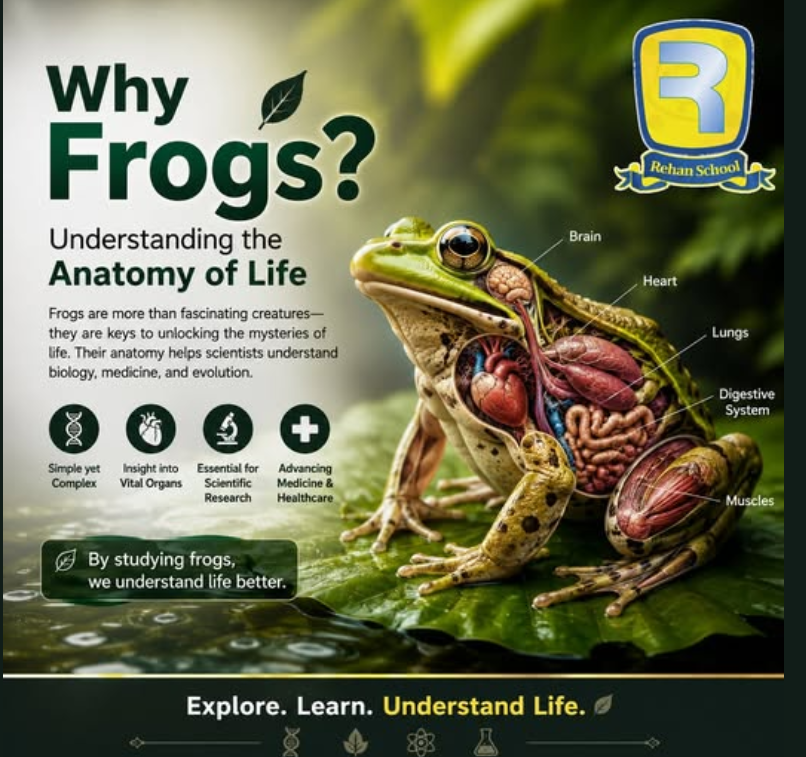
    Frogs may be small animals, but their bodies contain an amazing combination of organs, systems, and adaptations that make them excellent subjects for understanding the basic principles of life. Studying frog anatomy gives us an opportunity to see how different parts of a living organism work together to support movement, breathing, digestion, communication, growth, and survival. Their anatomy also shares important features with many other vertebrates, making frogs useful for learning fundamental concepts in biology.
    One of the most interesting features of frogs is their respiratory system. Unlike humans, frogs can exchange gases not only through their lungs but also through their moist skin. This special adaptation allows them to survive in aquatic and terrestrial environments. Their circulatory system also plays an important role in maintaining life by transporting oxygen and nutrients throughout the body.
    Frogs have powerful hind legs that are specially adapted for jumping and swimming. Their large eyes provide a wide field of vision and help them detect movement, while their ears allow them to hear sounds and communicate. Inside the body, organs such as the heart, lungs, liver, stomach, and intestines each perform important functions. These organs do not work independently; instead, they form interconnected systems that keep the frog alive and functioning.
    The frog's life cycle is another fascinating example of biological development. It begins with eggs laid in water, followed by the tadpole stage. Tadpoles gradually develop legs and lungs as their bodies change, eventually becoming froglets and then adult frogs. This transformation demonstrates how living organisms can undergo remarkable changes as they grow and mature.
    Frogs are also important indicators of environmental health. Because they are sensitive to changes in their surroundings, changes in frog populations can provide clues about the condition of an ecosystem. They also play an important role in controlling insect populations and maintaining food chains.
    Overall, “Why Frogs? Understanding the Anat
    Mohsin RS F8 🎓✨ Story post NO:15 roll NO:13 Class: Foundation Level 📚 Made by Me 💻🚀 Frogs may be small animals, but their bodies contain an amazing combination of organs, systems, and adaptations that make them excellent subjects for understanding the basic principles of life. Studying frog anatomy gives us an opportunity to see how different parts of a living organism work together to support movement, breathing, digestion, communication, growth, and survival. Their anatomy also shares important features with many other vertebrates, making frogs useful for learning fundamental concepts in biology. One of the most interesting features of frogs is their respiratory system. Unlike humans, frogs can exchange gases not only through their lungs but also through their moist skin. This special adaptation allows them to survive in aquatic and terrestrial environments. Their circulatory system also plays an important role in maintaining life by transporting oxygen and nutrients throughout the body. Frogs have powerful hind legs that are specially adapted for jumping and swimming. Their large eyes provide a wide field of vision and help them detect movement, while their ears allow them to hear sounds and communicate. Inside the body, organs such as the heart, lungs, liver, stomach, and intestines each perform important functions. These organs do not work independently; instead, they form interconnected systems that keep the frog alive and functioning. The frog's life cycle is another fascinating example of biological development. It begins with eggs laid in water, followed by the tadpole stage. Tadpoles gradually develop legs and lungs as their bodies change, eventually becoming froglets and then adult frogs. This transformation demonstrates how living organisms can undergo remarkable changes as they grow and mature. Frogs are also important indicators of environmental health. Because they are sensitive to changes in their surroundings, changes in frog populations can provide clues about the condition of an ecosystem. They also play an important role in controlling insect populations and maintaining food chains. Overall, “Why Frogs? Understanding the Anat
    0 Commentarios 0 Acciones 2189 Views
  • 📖 **Day 125 | Story Post** 🐸 **Why Frogs? Understanding the Anatomy of Life** Frogs may look like simple animals, but their bodies provide an amazing way to understand how life works. Their anatomy shows how different organs and body systems work together to help them survive. A frog has a **heart, lungs, digestive system, nervous system, muscles, and bones**, just like many other vertebrates. 🫀🫁 One fascinating feature is that frogs can breathe through both their **lungs and their skin**. Their powerful hind legs help them jump, while their eyes and ears help them detect what is happening around them. Studying frogs helps scientists and students understand important concepts in **biology, anatomy, adaptation, and evolution**. 🔬🌿 🐸 **A small frog can teach us a big lesson: every living organism has a remarkable design and a complex system that helps it survive.** 🎓 **Rehan School | Foundation Level** 🔢 **Roll No: 01** ✅ **Day 125 — Task Completed!** http://youtube.com/post/Ugkx8XKleK_2aVCTBhDkbmEeJzY2p9MGPqMb?si=2A-Mzzu9NR4WqiXF
    YOUTUBE.COM
    📖 **Day 125 | Story Post** 🐸 **Why Frogs? Understanding the Anatomy of Life** Frogs may look like simple animals, but their bodies provide an amazing way to ...
    📖 **Day 125 | Story Post** 🐸 **Why Frogs? Understanding the Anatomy of Life** Frogs may look like simple animals, but their bodies provide an amazing way to ...
    0 Commentarios 0 Acciones 1847 Views
  • #rsisb
    Roll no.247
    song .26
    Foundation level

    **Dissecting Frogs: A Gateway to Human Anatomy**

    Studying frog anatomy can provide students with a fascinating introduction to the structure and organization of living organisms. Through careful anatomical study, students can learn how different organs are arranged, how body systems work together, and how scientists use observation to understand life.

    Frogs are commonly studied in biology because their basic body organization shares important similarities with other vertebrates. Exploring their anatomy can help learners recognize major structures such as the heart, lungs, digestive organs, and reproductive organs, while also developing an understanding of how these systems perform different functions.

    **From Frog Anatomy to Human Anatomy**

    Learning about a frog's internal organization can help students build foundational knowledge that makes human anatomy easier to understand. By comparing different vertebrate body plans, learners can discover both similarities and differences in organs, tissues, and body systems. This comparison encourages curiosity and strengthens scientific thinking.

    **Learning Through Observation**

    Anatomical studies teach more than just the names of organs. They encourage students to observe carefully, record information, ask questions, and connect physical structures with biological functions. These skills are valuable in biology, medicine, veterinary science, and many other scientific fields. ‍‍

    **Science, Respect, and Responsibility**

    Biology education should always be approached with respect for living organisms and with appropriate safety, ethical, and educational guidelines. Modern classrooms may also use models, diagrams, videos, simulations, and digital anatomy tools to provide meaningful learning experiences.

    **Conclusion**

    “Dissecting Frogs: A Gateway to Human Anatomy” represents more than an anatomy lesson—it is an opportunity to explore the fascinating organization of life. By studying structures, comparing body systems, and asking scientific questions, students can develop a deeper appreciation for biology and the remarkable complexity of living organisms.

    #DissectingFrogs #FrogAnatomy #HumanAnatomy #Biology #ScienceEducation #AnatomyStudy #BiologyLearning #ScienceExperiment #LearningThroughScience #VertebrateAnatomy #LifeScience #ScienceStudents #EducationalJourney #ExploreBiology #ScientificThinking #AnatomyAndPhysiology #STEMEducation #ScienceExploration #BiologyProject #LearningIsFun
    #rsisb Roll no.247 song .26 Foundation level 🐸🔬 **Dissecting Frogs: A Gateway to Human Anatomy** 🧬🫀 Studying frog anatomy can provide students with a fascinating introduction to the structure and organization of living organisms. Through careful anatomical study, students can learn how different organs are arranged, how body systems work together, and how scientists use observation to understand life. 🔍📚 🐸 Frogs are commonly studied in biology because their basic body organization shares important similarities with other vertebrates. Exploring their anatomy can help learners recognize major structures such as the heart, lungs, digestive organs, and reproductive organs, while also developing an understanding of how these systems perform different functions. 🫀🫁 🧠 **From Frog Anatomy to Human Anatomy** Learning about a frog's internal organization can help students build foundational knowledge that makes human anatomy easier to understand. By comparing different vertebrate body plans, learners can discover both similarities and differences in organs, tissues, and body systems. This comparison encourages curiosity and strengthens scientific thinking. 🔬✨ 📖 **Learning Through Observation** Anatomical studies teach more than just the names of organs. They encourage students to observe carefully, record information, ask questions, and connect physical structures with biological functions. These skills are valuable in biology, medicine, veterinary science, and many other scientific fields. 🧪👩‍🔬👨‍🔬 🌱 **Science, Respect, and Responsibility** Biology education should always be approached with respect for living organisms and with appropriate safety, ethical, and educational guidelines. Modern classrooms may also use models, diagrams, videos, simulations, and digital anatomy tools to provide meaningful learning experiences. 🌍💚 ✨ **Conclusion** “Dissecting Frogs: A Gateway to Human Anatomy” represents more than an anatomy lesson—it is an opportunity to explore the fascinating organization of life. By studying structures, comparing body systems, and asking scientific questions, students can develop a deeper appreciation for biology and the remarkable complexity of living organisms. 🐸🔬🧬🌟 #DissectingFrogs #FrogAnatomy #HumanAnatomy #Biology #ScienceEducation #AnatomyStudy #BiologyLearning #ScienceExperiment #LearningThroughScience #VertebrateAnatomy #LifeScience #ScienceStudents #EducationalJourney #ExploreBiology #ScientificThinking #AnatomyAndPhysiology #STEMEducation #ScienceExploration #BiologyProject #LearningIsFun 🐸🔬📚🧬🫀🫁✨
    0 Commentarios 0 Acciones 9609 Views 6
  • #rsisb
    Roll no.239
    Story Post no.3
    Foundation Level
    **Why Frogs? Understanding the Anatomy of Life**

    Frogs are much more than fascinating creatures found near ponds and wetlands. They provide scientists and students with a simple yet powerful way to understand the **anatomy, biology, and complexity of life**.

    From their powerful hind legs to their unique respiratory system , sensitive eyes , strong hearts , and specialized skin, frogs have body structures that demonstrate how different organs work together to keep an organism alive.

    Studying frog anatomy can help us understand important biological concepts such as **organs, muscles, bones, digestion, circulation, respiration, and nervous systems**. It also gives us a deeper appreciation for how living organisms adapt to their environments.

    Frogs are often studied in biology because their anatomy provides an accessible example of the basic principles shared by many vertebrates. By exploring their bodies, we can discover how structure and function are connected—and how every part of a living organism has an important role.

    **Explore the frog. Discover anatomy. Understand life.**

    #WhyFrogs #FrogAnatomy #UnderstandingLife #Anatomy #Biology #Science #LifeScience #BiologyEducation #ScienceEducation #Frogs #Amphibians #AnimalAnatomy #HumanBiology #Vertebrates #Organs #Muscles #Bones #Heart #RespiratorySystem #DigestiveSystem #NervousSystem #BiologicalScience #Nature #Wildlife #Ecology #Learning #Education #STEM #ScienceForStudents #BiologyStudents #StudyScience #ScienceIsAmazing #ExploreScience #DiscoverBiology #Knowledge #LearningJourney #EducationalContent #ScienceLovers #NatureLovers
    #rsisb Roll no.239 Story Post no.3 Foundation Level 🐸🔬 **Why Frogs? Understanding the Anatomy of Life** 🌿🧬 Frogs are much more than fascinating creatures found near ponds and wetlands. 🐸🌊 They provide scientists and students with a simple yet powerful way to understand the **anatomy, biology, and complexity of life**. 🔬📚 From their powerful hind legs 🦵 to their unique respiratory system 🫁, sensitive eyes 👀, strong hearts ❤️, and specialized skin, frogs have body structures that demonstrate how different organs work together to keep an organism alive. 🌱✨ Studying frog anatomy can help us understand important biological concepts such as **organs, muscles, bones, digestion, circulation, respiration, and nervous systems**. 🧠🦴❤️ It also gives us a deeper appreciation for how living organisms adapt to their environments. 🌍🌿 Frogs are often studied in biology because their anatomy provides an accessible example of the basic principles shared by many vertebrates. 🧪🔍 By exploring their bodies, we can discover how structure and function are connected—and how every part of a living organism has an important role. 🐸 **Explore the frog. Discover anatomy. Understand life.** 🔬🌍✨ #WhyFrogs #FrogAnatomy #UnderstandingLife #Anatomy #Biology #Science #LifeScience #BiologyEducation #ScienceEducation #Frogs #Amphibians #AnimalAnatomy #HumanBiology #Vertebrates #Organs #Muscles #Bones #Heart #RespiratorySystem #DigestiveSystem #NervousSystem #BiologicalScience #Nature #Wildlife #Ecology #Learning #Education #STEM #ScienceForStudents #BiologyStudents #StudyScience #ScienceIsAmazing #ExploreScience #DiscoverBiology #Knowledge #LearningJourney #EducationalContent #ScienceLovers #NatureLovers 🐸🔬🧬🌿📚✨
    0 Commentarios 0 Acciones 11637 Views
  • #rsisb
    Roll no.239
    Foundation Level


    Frogs are often studied in biology because their bodies provide a clear way to understand **basic animal anatomy and physiology**. Their organs and organ systems are relatively easy to observe, while still showing many of the same fundamental structures found in other vertebrates.

    ### What Can Frogs Teach Us?

    * **Heart:** A frog’s three-chambered heart demonstrates how blood circulates through the body.
    * **Lungs and skin:** Frogs breathe through both their lungs and moist skin, showing different methods of gas exchange.
    * **Digestive system:** Their digestive organs demonstrate how food is broken down and nutrients are absorbed.
    * **Muscles and skeleton:** Powerful hind-leg muscles and a specialized skeleton explain how frogs jump and move.
    * **Nervous system:** The brain, spinal cord, and nerves coordinate movement and responses.
    * **Kidneys:** These organs help remove waste and maintain the body's internal balance.

    genui{"biology_anatomy_physiology":{"type_id":"BLOOD_CIRCULATION","locale_override":"en-US"}}

    ### **Why Are Frogs Important in Biology?**

    Frogs are useful study organisms because their anatomy helps students connect **structure with function**. By examining how different organs work together, we can better understand a central idea of biology: **life depends on coordinated systems working as one whole organism.**

    In short, studying a frog is not simply about studying one animal—it is a way to explore the **anatomy, physiology, adaptation, and organization of life itself**.
    #rsisb Roll no.239 Foundation Level Frogs are often studied in biology because their bodies provide a clear way to understand **basic animal anatomy and physiology**. Their organs and organ systems are relatively easy to observe, while still showing many of the same fundamental structures found in other vertebrates. ### 🐸 What Can Frogs Teach Us? * **Heart:** A frog’s three-chambered heart demonstrates how blood circulates through the body. * **Lungs and skin:** Frogs breathe through both their lungs and moist skin, showing different methods of gas exchange. * **Digestive system:** Their digestive organs demonstrate how food is broken down and nutrients are absorbed. * **Muscles and skeleton:** Powerful hind-leg muscles and a specialized skeleton explain how frogs jump and move. * **Nervous system:** The brain, spinal cord, and nerves coordinate movement and responses. * **Kidneys:** These organs help remove waste and maintain the body's internal balance. genui{"biology_anatomy_physiology":{"type_id":"BLOOD_CIRCULATION","locale_override":"en-US"}} ### **Why Are Frogs Important in Biology?** Frogs are useful study organisms because their anatomy helps students connect **structure with function**. By examining how different organs work together, we can better understand a central idea of biology: **life depends on coordinated systems working as one whole organism.** In short, studying a frog is not simply about studying one animal—it is a way to explore the **anatomy, physiology, adaptation, and organization of life itself**.
    0 Commentarios 0 Acciones 4202 Views
  • In Pakistan, there are numerous species of non-venomous snakes that are harmless to humans. These snakes play a crucial role in the ecosystem, primarily by controlling pest populations. Below is a list of some of the non-poisonous (non-venomous) snakes found in Pakistan:

    ### Non-Poisonous Snakes in Pakistan:

    1. **Indian Rock Python (Python molurus)**
    - One of the largest snake species, these pythons are non-venomous and kill their prey by constriction.

    2. **Red Sand Boa (Eryx johnii)**
    - A burrowing snake commonly found in sandy areas. It is harmless and often mistaken for a venomous species due to its robust appearance.

    3. **Common Wolf Snake (Lycodon aulicus)**
    - A small, nocturnal snake that feeds mainly on lizards. It is commonly found in urban areas.

    4. **Rat Snake (Ptyas mucosa)**
    - Also known as the Indian rat snake, it is a large, fast-moving snake that preys on rodents and is often found near human habitations.

    5. **Checkered Keelback (Xenochrophis piscator)**
    - A semi-aquatic snake often found near water bodies. It primarily feeds on fish and amphibians.

    6. **Oriental Garden Snake (Ptyas mucosa)**
    - A common snake found in gardens and agricultural areas, feeding on frogs and small rodents.

    7. **Bronzeback Tree Snake (Dendrelaphis tristis)**
    - A slender, arboreal snake that is commonly found in trees and bushes, feeding on small vertebrates.

    8. **Common Trinket Snake (Coelognathus helena)**
    - Known for its striking pattern, this snake is non-venomous and feeds on rodents and birds.

    9. **Dhaman (Ptyas mucosa)**
    - Also known as the Oriental ratsnake, it is non-venomous and found in a variety of habitats, including urban areas.

    10. **Common Vine Snake (Ahaetulla nasuta)**
    - A slender, green snake that lives in trees and shrubs, feeding on lizards and frogs. It has a mildly toxic venom, but it is not harmful to humans.

    ### Summary:
    Pakistan is home to approximately 72 snake species, of which about **14-18** are venomous. The remaining **54-58** species are non-venomous and pose no significant threat to humans. The percentage of venomous snakes in Pakistan is roughly **19.4% to 25%**, meaning that the majority, **75% to 80.6%**, of snake species in Pakistan are non-venomous.

    Non-venomous snakes, such as the Indian Rock Python, Red Sand Boa, and Common Wolf Snake, play an essential role in the ecosystem by controlling rodent and pest populations, and they should be protected rather than feared.
    In Pakistan, there are numerous species of non-venomous snakes that are harmless to humans. These snakes play a crucial role in the ecosystem, primarily by controlling pest populations. Below is a list of some of the non-poisonous (non-venomous) snakes found in Pakistan: ### Non-Poisonous Snakes in Pakistan: 1. **Indian Rock Python (Python molurus)** - One of the largest snake species, these pythons are non-venomous and kill their prey by constriction. 2. **Red Sand Boa (Eryx johnii)** - A burrowing snake commonly found in sandy areas. It is harmless and often mistaken for a venomous species due to its robust appearance. 3. **Common Wolf Snake (Lycodon aulicus)** - A small, nocturnal snake that feeds mainly on lizards. It is commonly found in urban areas. 4. **Rat Snake (Ptyas mucosa)** - Also known as the Indian rat snake, it is a large, fast-moving snake that preys on rodents and is often found near human habitations. 5. **Checkered Keelback (Xenochrophis piscator)** - A semi-aquatic snake often found near water bodies. It primarily feeds on fish and amphibians. 6. **Oriental Garden Snake (Ptyas mucosa)** - A common snake found in gardens and agricultural areas, feeding on frogs and small rodents. 7. **Bronzeback Tree Snake (Dendrelaphis tristis)** - A slender, arboreal snake that is commonly found in trees and bushes, feeding on small vertebrates. 8. **Common Trinket Snake (Coelognathus helena)** - Known for its striking pattern, this snake is non-venomous and feeds on rodents and birds. 9. **Dhaman (Ptyas mucosa)** - Also known as the Oriental ratsnake, it is non-venomous and found in a variety of habitats, including urban areas. 10. **Common Vine Snake (Ahaetulla nasuta)** - A slender, green snake that lives in trees and shrubs, feeding on lizards and frogs. It has a mildly toxic venom, but it is not harmful to humans. ### Summary: Pakistan is home to approximately 72 snake species, of which about **14-18** are venomous. The remaining **54-58** species are non-venomous and pose no significant threat to humans. The percentage of venomous snakes in Pakistan is roughly **19.4% to 25%**, meaning that the majority, **75% to 80.6%**, of snake species in Pakistan are non-venomous. Non-venomous snakes, such as the Indian Rock Python, Red Sand Boa, and Common Wolf Snake, play an essential role in the ecosystem by controlling rodent and pest populations, and they should be protected rather than feared.
    0 Commentarios 0 Acciones 2191 Views
  • Mangroves are a group of trees and shrubs that live in coastal intertidal zones. They are known for their distinctive root systems, which are adapted to saline and brackish water conditions. Here are some key characteristics of mangroves:

    1. **Unique Root Systems**: Mangroves have complex root systems that allow them to survive in the fluctuating conditions of coastal environments. These roots often protrude above the water level, which helps in gas exchange and stabilizes the trees in loose, muddy substrates.

    2. **Salt Tolerance**: Mangroves are highly salt-tolerant. They can either exclude salt from their systems or secrete it through their leaves.

    3. **Biodiversity Hotspots**: Mangrove forests are rich in biodiversity, providing habitat for a wide range of marine and terrestrial species. They serve as nurseries for many fish species, and are also important for birds, mammals, and invertebrates.

    4. **Coastal Protection**: Mangroves protect coastlines from erosion, storm surge, and tsunamis. Their root systems help in stabilizing the shoreline and reducing the impact of waves.

    5. **Climate Change Mitigation**: Mangroves play a significant role in carbon sequestration, thus aiding in the fight against climate change.

    6. **Economic Importance**: They are valuable for fisheries, timber, and as tourist attractions. Local communities often depend on mangroves for their livelihoods.

    7. **Threats**: Despite their importance, mangrove forests are under threat due to factors like deforestation, pollution, and climate change-related sea-level rise.

    Mangrove ecosystems are found in tropical and subtropical regions around the world, including parts of Asia, Africa, North and South America, and Oceania. Their conservation is crucial for maintaining coastal ecology and supporting local communities.
    Mangroves are a group of trees and shrubs that live in coastal intertidal zones. They are known for their distinctive root systems, which are adapted to saline and brackish water conditions. Here are some key characteristics of mangroves: 1. **Unique Root Systems**: Mangroves have complex root systems that allow them to survive in the fluctuating conditions of coastal environments. These roots often protrude above the water level, which helps in gas exchange and stabilizes the trees in loose, muddy substrates. 2. **Salt Tolerance**: Mangroves are highly salt-tolerant. They can either exclude salt from their systems or secrete it through their leaves. 3. **Biodiversity Hotspots**: Mangrove forests are rich in biodiversity, providing habitat for a wide range of marine and terrestrial species. They serve as nurseries for many fish species, and are also important for birds, mammals, and invertebrates. 4. **Coastal Protection**: Mangroves protect coastlines from erosion, storm surge, and tsunamis. Their root systems help in stabilizing the shoreline and reducing the impact of waves. 5. **Climate Change Mitigation**: Mangroves play a significant role in carbon sequestration, thus aiding in the fight against climate change. 6. **Economic Importance**: They are valuable for fisheries, timber, and as tourist attractions. Local communities often depend on mangroves for their livelihoods. 7. **Threats**: Despite their importance, mangrove forests are under threat due to factors like deforestation, pollution, and climate change-related sea-level rise. Mangrove ecosystems are found in tropical and subtropical regions around the world, including parts of Asia, Africa, North and South America, and Oceania. Their conservation is crucial for maintaining coastal ecology and supporting local communities.
    0 Commentarios 0 Acciones 2024 Views