• #rsisb
    Roll No.240
    Story No.18
    Foundation Level

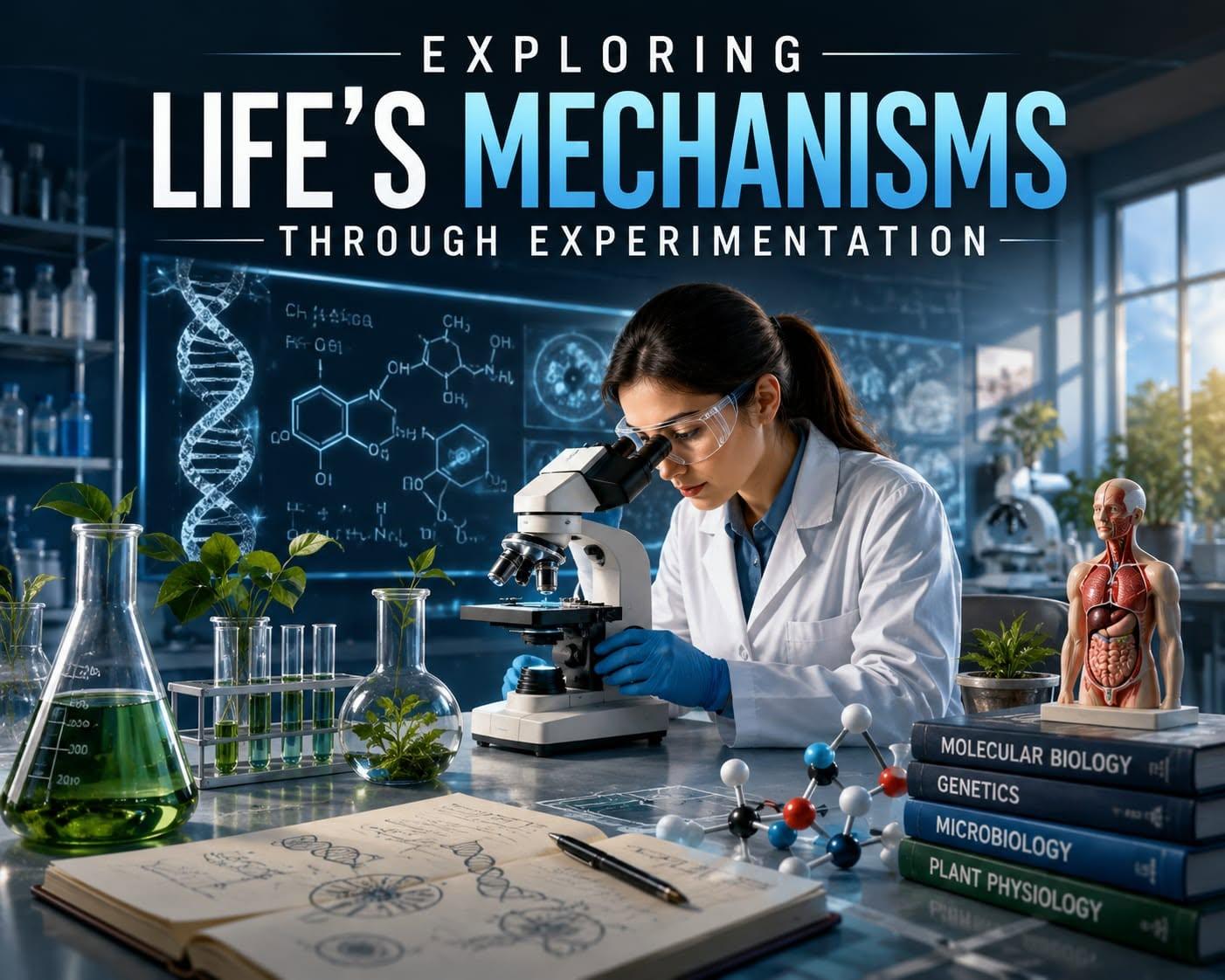
    ### **Exploring Life’s Mechanisms Through Experimentation**

    Scientific experimentation is one of the most powerful ways to understand the complex processes that sustain life. From the smallest microscopic cells to entire ecosystems, experiments allow scientists to observe, test, and explain how living organisms grow, reproduce, respond to their environment, and maintain balance. Through careful observation, data collection, and analysis, researchers uncover the biological mechanisms that drive life and contribute to advances in medicine, agriculture, biotechnology, and environmental conservation.

    Biological experiments help students and scientists explore essential topics such as genetics, cell biology, microbiology, physiology, ecology, and evolution. By forming hypotheses, conducting controlled experiments, and interpreting results, learners develop critical thinking, problem-solving, and analytical skills. Laboratory investigations also demonstrate the importance of accuracy, ethical responsibility, and evidence-based conclusions in scientific research.

    Modern technology has transformed biological experimentation through advanced microscopes, DNA sequencing, computer simulations, molecular biology techniques, and artificial intelligence. These innovations enable researchers to study diseases, develop life-saving medicines, improve crop production, protect endangered species, and better understand the incredible complexity of living organisms. Every experiment, whether simple or advanced, contributes valuable knowledge that helps improve human health and our understanding of the natural world.

    Exploring life's mechanisms through experimentation inspires curiosity, encourages innovation, and highlights the importance of scientific discovery. By combining observation, creativity, and rigorous testing, scientists continue to unlock the mysteries of life and create solutions to global challenges, paving the way for a healthier, more sustainable future.

    **#Biology #LifeScience #ScientificExperiment #Laboratory #STEM #ScienceEducation #Research #Biotechnology #CellBiology #Genetics #Microbiology #Innovation #ScientificDiscovery #Education #ExploreScience **

    Rehan School Islamabad Campus
    Asma Shaheen EducationWali
    Irum Asim
    Saima Happinesswali
    #rsisb Roll No.240 Story No.18 Foundation Level ### **Exploring Life’s Mechanisms Through Experimentation** Scientific experimentation is one of the most powerful ways to understand the complex processes that sustain life. From the smallest microscopic cells to entire ecosystems, experiments allow scientists to observe, test, and explain how living organisms grow, reproduce, respond to their environment, and maintain balance. Through careful observation, data collection, and analysis, researchers uncover the biological mechanisms that drive life and contribute to advances in medicine, agriculture, biotechnology, and environmental conservation. Biological experiments help students and scientists explore essential topics such as genetics, cell biology, microbiology, physiology, ecology, and evolution. By forming hypotheses, conducting controlled experiments, and interpreting results, learners develop critical thinking, problem-solving, and analytical skills. Laboratory investigations also demonstrate the importance of accuracy, ethical responsibility, and evidence-based conclusions in scientific research. Modern technology has transformed biological experimentation through advanced microscopes, DNA sequencing, computer simulations, molecular biology techniques, and artificial intelligence. These innovations enable researchers to study diseases, develop life-saving medicines, improve crop production, protect endangered species, and better understand the incredible complexity of living organisms. Every experiment, whether simple or advanced, contributes valuable knowledge that helps improve human health and our understanding of the natural world. Exploring life's mechanisms through experimentation inspires curiosity, encourages innovation, and highlights the importance of scientific discovery. By combining observation, creativity, and rigorous testing, scientists continue to unlock the mysteries of life and create solutions to global challenges, paving the way for a healthier, more sustainable future. **#Biology #LifeScience #ScientificExperiment #Laboratory #STEM #ScienceEducation #Research #Biotechnology #CellBiology #Genetics #Microbiology #Innovation #ScientificDiscovery #Education #ExploreScience šŸ”¬šŸ§¬šŸ§«šŸŒ±šŸ“š** Rehan School Islamabad Campus Asma Shaheen EducationWali Irum Asim Saima Happinesswali
    0 Comments 0 Shares 377 Views
  • #rsisb
    RollNo.244
    Story Post
    Foundation Level
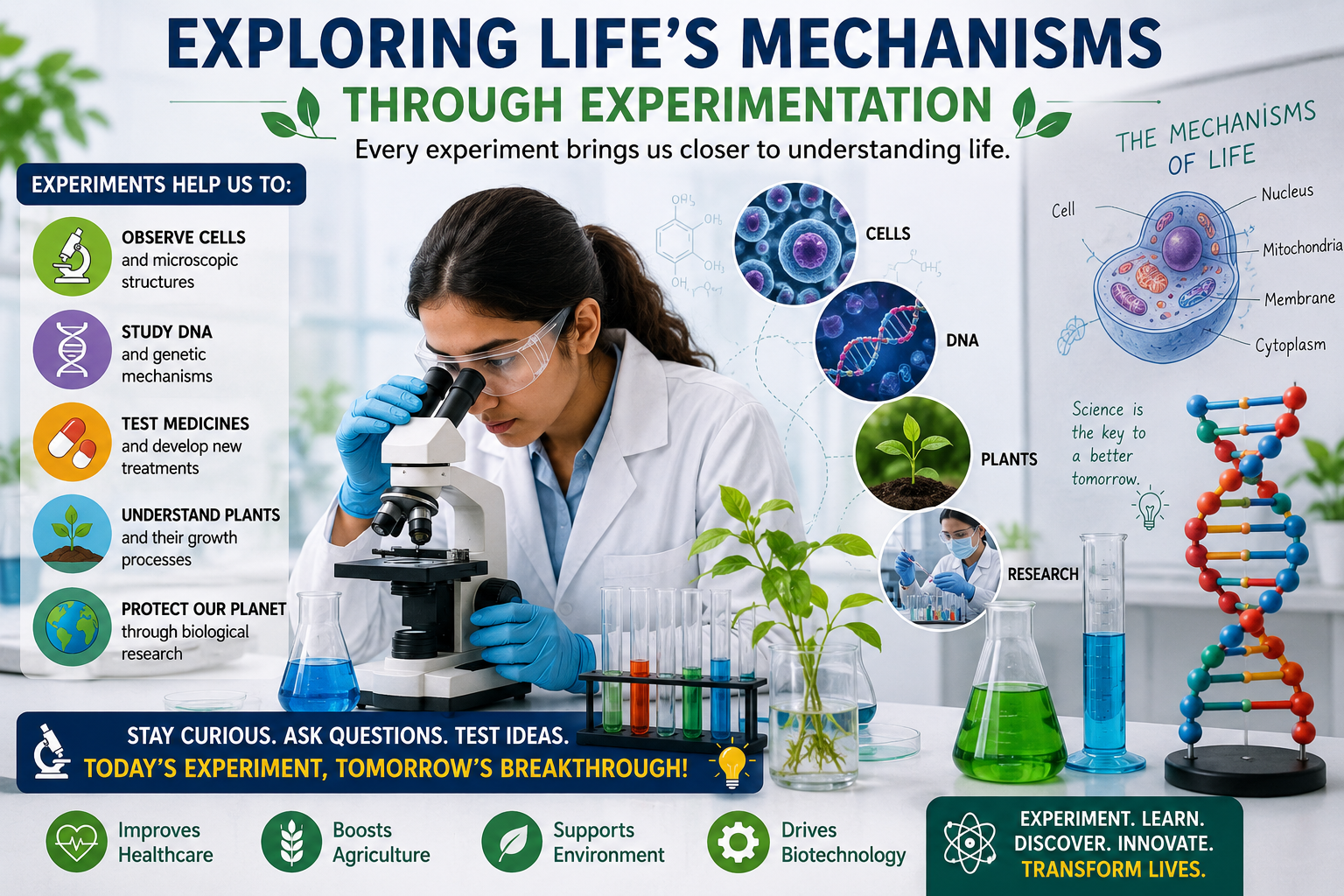
    ## Exploring Life’s Mechanisms Through Experimentation

    Every great scientific discovery begins with a question. Through careful experimentation, scientists uncover how living organisms grow, adapt, reproduce, and interact with their environment.

    From observing cells under a microscope to studying DNA and testing medicines , experiments help us understand the incredible mechanisms that keep life functioning. Biology experiments encourage curiosity, critical thinking, and problem-solving while teaching us the importance of evidence-based conclusions.

    Experimentation has transformed healthcare , agriculture , environmental conservation , and biotechnology , leading to innovations that improve lives around the world. Every observation and every experiment brings us one step closer to solving the mysteries of life.

    So, stay curious, ask questions, test ideas, and never stop exploring—because today's experiment could become tomorrow's breakthrough!

    #Biology #Science #Experimentation #LifeMechanisms #STEM #Learning #Education #ScientificDiscovery #Innovation #Research #Curiosity #FutureScientists
    #rsisb RollNo.244 Story Post Foundation Level ## šŸ”¬ Exploring Life’s Mechanisms Through Experimentation 🧪🌱 Every great scientific discovery begins with a question. šŸ¤” Through careful experimentation, scientists uncover how living organisms grow, adapt, reproduce, and interact with their environment. šŸŒšŸ”¬ From observing cells under a microscope 🦠 to studying DNA 🧬 and testing medicines šŸ’Š, experiments help us understand the incredible mechanisms that keep life functioning. Biology experiments encourage curiosity, critical thinking, and problem-solving while teaching us the importance of evidence-based conclusions. šŸ“šāœØ Experimentation has transformed healthcare šŸ„, agriculture 🌾, environmental conservation 🌿, and biotechnology āš™ļø, leading to innovations that improve lives around the world. Every observation and every experiment brings us one step closer to solving the mysteries of life. 🌟 So, stay curious, ask questions, test ideas, and never stop exploring—because today's experiment could become tomorrow's breakthrough! šŸš€šŸ” #Biology #Science #Experimentation #LifeMechanisms #STEM #Learning #Education #ScientificDiscovery #Innovation #Research #Curiosity #FutureScientists 🧬🌱
    0 Comments 0 Shares 3338 Views
  • Monsanto, now part of Bayer, has a long and complex history that spans over a century. Heres a concise overview of how Monsanto became Monsanto:

    ### Early History and Formation
    - **1901:** Monsanto was founded in St. Louis, Missouri, by John Francis Queeny, a 30-year veteran of the pharmaceutical industry. The company was named after his wife, Olga MƩndez Monsanto.
    - **First Product:** Monsantos initial product was saccharin, an artificial sweetener.

    ### Growth and Diversification
    - **1920s-1940s:** Monsanto expanded its product line to include industrial chemicals, such as sulfuric acid and PCBs (polychlorinated biphenyls).
    - **1940s:** During World War II, Monsanto produced synthetic rubber and became involved in the emerging plastics industry.

    ### Agricultural Focus
    - **1960s-1970s:** Monsanto began to focus more on agriculture, producing herbicides such as Agent Orange (used during the Vietnam War) and Roundup (glyphosate).
    - **1980s:** The company invested heavily in biotechnology, becoming a pioneer in genetically modified organisms (GMOs). They developed and marketed genetically engineered seeds that were resistant to their own herbicides, such as Roundup Ready crops.

    ### Legal and Environmental Issues
    - Throughout its history, Monsanto faced numerous legal and environmental controversies, including lawsuits over the health effects of PCBs, dioxins, and glyphosate.

    ### Mergers and Acquisitions
    - **2000:** Monsanto merged with Pharmacia & Upjohn, and the agricultural operations were later spun off into a new Monsanto Company.
    - **2016:** Bayer, a German pharmaceutical and life sciences company, announced its intention to acquire Monsanto.
    - **2018:** The acquisition was completed, and Monsanto ceased to exist as an independent entity, with its products and technologies integrated into Bayers Crop Science division.

    ### Innovations and Legacy
    - Monsanto was instrumental in the development and commercialization of GMOs, which have had a significant impact on modern agriculture. The companys innovations in biotechnology and agricultural chemicals have been both praised for their contributions to increasing agricultural productivity and criticized for their environmental and health impacts.

    Throughout its existence, Monsantos influence on agriculture and its controversial legacy have made it a significant and often polarizing player in the agricultural industry.
    Monsanto, now part of Bayer, has a long and complex history that spans over a century. Here's a concise overview of how Monsanto became Monsanto: ### Early History and Formation - **1901:** Monsanto was founded in St. Louis, Missouri, by John Francis Queeny, a 30-year veteran of the pharmaceutical industry. The company was named after his wife, Olga MƩndez Monsanto. - **First Product:** Monsanto's initial product was saccharin, an artificial sweetener. ### Growth and Diversification - **1920s-1940s:** Monsanto expanded its product line to include industrial chemicals, such as sulfuric acid and PCBs (polychlorinated biphenyls). - **1940s:** During World War II, Monsanto produced synthetic rubber and became involved in the emerging plastics industry. ### Agricultural Focus - **1960s-1970s:** Monsanto began to focus more on agriculture, producing herbicides such as Agent Orange (used during the Vietnam War) and Roundup (glyphosate). - **1980s:** The company invested heavily in biotechnology, becoming a pioneer in genetically modified organisms (GMOs). They developed and marketed genetically engineered seeds that were resistant to their own herbicides, such as Roundup Ready crops. ### Legal and Environmental Issues - Throughout its history, Monsanto faced numerous legal and environmental controversies, including lawsuits over the health effects of PCBs, dioxins, and glyphosate. ### Mergers and Acquisitions - **2000:** Monsanto merged with Pharmacia & Upjohn, and the agricultural operations were later spun off into a new Monsanto Company. - **2016:** Bayer, a German pharmaceutical and life sciences company, announced its intention to acquire Monsanto. - **2018:** The acquisition was completed, and Monsanto ceased to exist as an independent entity, with its products and technologies integrated into Bayer's Crop Science division. ### Innovations and Legacy - Monsanto was instrumental in the development and commercialization of GMOs, which have had a significant impact on modern agriculture. The company's innovations in biotechnology and agricultural chemicals have been both praised for their contributions to increasing agricultural productivity and criticized for their environmental and health impacts. Throughout its existence, Monsanto's influence on agriculture and its controversial legacy have made it a significant and often polarizing player in the agricultural industry.
    0 Comments 0 Shares 763 Views
  • Pakistan in next 50 years !

    2024–2030: Foundation of Growth and Stability

    1. 2024:
    • Comprehensive reforms introduced to strengthen democracy and governance.
    • Expansion of renewable energy projects, with a focus on solar and wind power in Sindh, Balochistan, and Punjab.
    2. 2025:
    • Pakistan becomes a regional leader in clean energy with the completion of several CPEC Phase II projects focusing on green energy and infrastructure.
    • Nationwide literacy campaign reduces illiteracy to below 10%, with innovative e-learning platforms.
    3. 2026:
    • Major reforms in agriculture lead to significant increases in productivity, ensuring food security and surplus exports.
    • Tech hubs established in Karachi, Lahore, and Islamabad to promote startups in AI, blockchain, and IT services.
    4. 2027:
    • Groundbreaking of the Pakistan Space Center, aiming to launch its first independent satellite by 2030.
    • Health sector transformation: Universal health coverage implemented, ensuring healthcare access for all citizens.
    5. 2028–2030:
    • Pakistan’s GDP growth surpasses 8% annually, driven by exports, tourism, and industrial diversification.
    • Completion of major dams (like Diamer-Bhasha Dam), ensuring water security and boosting agriculture.
    • Cultural renaissance: Pakistani cinema, literature, and music gain global acclaim.

    2031–2040: Regional Leadership and Innovation

    1. 2031–2033:
    • Pakistan becomes the largest exporter of textiles and technology in South Asia.
    • Massive expansion in education: Pakistani universities rank among the top 100 globally.
    • Regional stability established with stronger ties with neighbors (India, Afghanistan, Iran).
    2. 2034:
    • Karachi emerges as a leading financial hub in Asia, attracting foreign investment.
    • Completion of the Pakistan Smart Cities Project, transforming major cities with advanced infrastructure and AI-based governance.
    3. 2035–2036:
    • Pakistan launches its first human space mission through a collaboration between SUPARCO and international partners.
    • Major climate initiatives result in Pakistan being declared carbon-neutral by global organizations.
    4. 2037–2040:
    • Technological breakthroughs in biotechnology and robotics put Pakistan among the top innovators globally.
    • Tourism thrives as ancient heritage sites like Mohenjo-Daro, Taxila, and Hunza Valley attract millions of visitors annually.

    2041–2050: A Global Power

    1. 2041–2043:
    • Pakistan’s economy becomes one of the top 10 in the world, driven by innovation, industry, and trade.
    • Completion of a trans-regional rail and road network connecting Central Asia, South Asia, and the Middle East.
    2. 2044:
    • Social and economic equality achieved: Pakistan ranks among the top nations in the Human Development Index (HDI).
    • Women’s participation in the workforce exceeds 50%, transforming economic and social dynamics.
    3. 2045–2047:
    • Celebrating 100 years of independence, Pakistan hosts the World Expo showcasing its achievements in technology, culture, and sustainability.
    • Literacy reaches 100%; Pakistan’s education system becomes a model for developing nations.
    4. 2048–2050:
    • Pakistan plays a leading role in global peacekeeping, trade, and climate initiatives through international forums like the UN and G20.
    • Introduction of fully autonomous smart cities, with renewable energy-powered infrastructure and AI-driven public services.

    Key Sectors Driving Transformation

    • Economy: Diversified into technology, renewable energy, and industrial exports.
    • Education: A focus on innovation, science, and universal access.
    • Healthcare: World-class universal health systems with a focus on research and biotechnology.
    • Environment: Global leader in combating climate change, achieving carbon neutrality.
    • Diplomacy: Peaceful, collaborative relationships with neighbors and an influential role in global affairs.

    This vision of Pakistan’s next 50 years is achievable with strong governance, innovative policies, and the collective will of its people.
    Pakistan in next 50 years ! 2024–2030: Foundation of Growth and Stability 1. 2024: • Comprehensive reforms introduced to strengthen democracy and governance. • Expansion of renewable energy projects, with a focus on solar and wind power in Sindh, Balochistan, and Punjab. 2. 2025: • Pakistan becomes a regional leader in clean energy with the completion of several CPEC Phase II projects focusing on green energy and infrastructure. • Nationwide literacy campaign reduces illiteracy to below 10%, with innovative e-learning platforms. 3. 2026: • Major reforms in agriculture lead to significant increases in productivity, ensuring food security and surplus exports. • Tech hubs established in Karachi, Lahore, and Islamabad to promote startups in AI, blockchain, and IT services. 4. 2027: • Groundbreaking of the Pakistan Space Center, aiming to launch its first independent satellite by 2030. • Health sector transformation: Universal health coverage implemented, ensuring healthcare access for all citizens. 5. 2028–2030: • Pakistan’s GDP growth surpasses 8% annually, driven by exports, tourism, and industrial diversification. • Completion of major dams (like Diamer-Bhasha Dam), ensuring water security and boosting agriculture. • Cultural renaissance: Pakistani cinema, literature, and music gain global acclaim. 2031–2040: Regional Leadership and Innovation 1. 2031–2033: • Pakistan becomes the largest exporter of textiles and technology in South Asia. • Massive expansion in education: Pakistani universities rank among the top 100 globally. • Regional stability established with stronger ties with neighbors (India, Afghanistan, Iran). 2. 2034: • Karachi emerges as a leading financial hub in Asia, attracting foreign investment. • Completion of the Pakistan Smart Cities Project, transforming major cities with advanced infrastructure and AI-based governance. 3. 2035–2036: • Pakistan launches its first human space mission through a collaboration between SUPARCO and international partners. • Major climate initiatives result in Pakistan being declared carbon-neutral by global organizations. 4. 2037–2040: • Technological breakthroughs in biotechnology and robotics put Pakistan among the top innovators globally. • Tourism thrives as ancient heritage sites like Mohenjo-Daro, Taxila, and Hunza Valley attract millions of visitors annually. 2041–2050: A Global Power 1. 2041–2043: • Pakistan’s economy becomes one of the top 10 in the world, driven by innovation, industry, and trade. • Completion of a trans-regional rail and road network connecting Central Asia, South Asia, and the Middle East. 2. 2044: • Social and economic equality achieved: Pakistan ranks among the top nations in the Human Development Index (HDI). • Women’s participation in the workforce exceeds 50%, transforming economic and social dynamics. 3. 2045–2047: • Celebrating 100 years of independence, Pakistan hosts the World Expo showcasing its achievements in technology, culture, and sustainability. • Literacy reaches 100%; Pakistan’s education system becomes a model for developing nations. 4. 2048–2050: • Pakistan plays a leading role in global peacekeeping, trade, and climate initiatives through international forums like the UN and G20. • Introduction of fully autonomous smart cities, with renewable energy-powered infrastructure and AI-driven public services. Key Sectors Driving Transformation • Economy: Diversified into technology, renewable energy, and industrial exports. • Education: A focus on innovation, science, and universal access. • Healthcare: World-class universal health systems with a focus on research and biotechnology. • Environment: Global leader in combating climate change, achieving carbon neutrality. • Diplomacy: Peaceful, collaborative relationships with neighbors and an influential role in global affairs. This vision of Pakistan’s next 50 years is achievable with strong governance, innovative policies, and the collective will of its people.
    0 Comments 0 Shares 1964 Views
  • The Story of Plastic-Eating Mushrooms

    Plastic pollution has become one of the most serious environmental challenges of our time. Every year, more than 400 million tons of plastic are produced, and only about 9% of it ever gets recycled. The rest ends up in landfills, rivers, and oceans, where it remains for hundreds of years, harming animals, entering our food chain, and choking our planet.

    But nature, as always, has a secret weapon — fungi. In the last decade, scientists have discovered that some species of mushrooms have the extraordinary ability to ā€œeatā€ plastic, turning it into harmless materials. These organisms may hold one of the keys to cleaning up our plastic-filled world.

    āø»

    What Are Plastic-Eating Mushrooms?

    Plastic-eating mushrooms are not a single species but a group of fungi capable of breaking down synthetic polymers — the long chemical chains that make up plastics. Instead of relying on sunlight or heat, these fungi use enzymes, powerful biological molecules, to digest plastic just as they would digest wood or dead leaves.

    The first major discovery came in 2011 when students from Yale University explored the Amazon rainforest and found a species called Pestalotiopsis microspora. This fungus could survive by feeding on polyurethane, a common type of plastic used in foams, shoes, and furniture — even in places without oxygen, such as deep landfills. This was revolutionary because it meant that fungi could potentially degrade plastic where most other life forms could not survive.

    A few years later, another breakthrough came from Pakistan. Scientists studying a waste dump near Islamabad discovered Aspergillus tubingensis, a fungus that could break down polyurethane in just a few weeks. This discovery gained international attention because it showed that plastic-eating fungi exist even in polluted urban environments, not only in exotic rainforests.

    Since then, researchers around the world — from China to Hawaii — have identified more than 200 species of fungi capable of degrading various plastics, including polyethylene (used in shopping bags), polystyrene (used in packaging), and PET (used in bottles).

    āø»

    How Do They Eat Plastic?

    The process through which mushrooms ā€œeatā€ plastic is both simple and amazing.

    When a piece of plastic comes in contact with fungal spores, the spores germinate and form a thin network called mycelium — a web of thread-like roots that cover the plastic’s surface. Once attached, the fungus secretes special enzymes that start attacking the strong chemical bonds inside the plastic.

    These enzymes act like molecular scissors, cutting the long plastic molecules into smaller pieces called monomers. The fungus then absorbs these small molecules as food, using them as a source of carbon and energy. Over time, the plastic begins to lose its shape, crack, and disappear. What remains is mostly water, carbon dioxide, and fungal biomass — all naturally occurring and harmless.

    Some fungi even do this in anaerobic conditions, where there is no oxygen. This is important because most landfill environments are oxygen-poor. That means fungi could, in theory, help reduce the billions of tons of plastic buried underground.

    āø»

    Where Are They Found?

    Plastic-degrading fungi have been found in some of the most unexpected places.
    • Tropical rainforests like the Amazon, where humidity and biodiversity create perfect conditions for unique microbes to evolve.
    • Urban dumps and landfills, where human waste gives fungi new materials to adapt to.
    • Oceans and coastal areas, where marine fungi cling to floating plastic debris and slowly begin digesting it.

    In 2023, a team from the University of Hawaii discovered that over 60% of marine fungi isolated from ocean plastic waste could degrade plastic to some extent. This shows that nature is already evolving to respond to our pollution problem — we just need to understand and support it.

    āø»

    What Are the Challenges?

    Although the idea of mushrooms eating plastic sounds like a miracle, it is not yet a large-scale solution. Scientists face several challenges.

    First, speed. Fungi work slowly. In laboratory experiments, small pieces of plastic may take weeks or months to break down, while the world produces millions of tons of plastic every month.

    Second, plastic variety. Not all plastics are the same. Some, like polyurethane, are easier to digest; others, like polyethylene, are extremely resistant. We still don’t have fungi that can handle every type.

    Third, environmental conditions. Fungi need the right temperature, humidity, and nutrients to survive. In dry or cold environments, they may not function effectively.

    Fourth, safety and by-products. When plastic is broken down, tiny microplastics or chemical residues might still remain. Scientists must ensure that these by-products do not cause new environmental or health problems.

    Lastly, scalability. What works in a small petri dish is not easy to repeat in a landfill or ocean. To make this technology useful, we need bioreactors — machines where fungi can grow under controlled conditions and process large quantities of waste.

    āø»

    Why It Matters

    Even with its challenges, the discovery of plastic-eating mushrooms is a symbol of hope. It reminds us that nature is not our enemy but our greatest teacher. Fungi have been decomposing dead trees, leaves, and animals for millions of years. Now, they are adapting to a new material that humans have introduced: plastic.

    For countries like Pakistan, where waste management systems are weak, this presents a massive opportunity for innovation. Imagine young students or entrepreneurs developing small-scale units that use fungi to turn plastic waste into compost or clean soil. This could become a new form of green entrepreneurship, creating jobs while protecting the environment.

    Schools, like Rehan School, could include this topic in science and leadership curriculums — encouraging students to see waste not as a problem but as a business opportunity. Students could collect plastic waste, experiment with local fungi, measure results, and even develop small startup ideas based on bioremediation.

    āø»

    The Future of Fungal Biodegradation

    Scientists are now exploring how to make fungi work faster using genetic engineering and biotechnology. By studying the enzymes that break down plastic, researchers hope to produce synthetic versions that are much more efficient.

    Some labs are also combining fungi with bacteria to create microbial teams — ecosystems that can digest different plastics together. Others are designing bioreactors that feed on plastic waste and produce valuable by-products like organic fertilizer or even edible mycelium (mushroom protein).

    In the long term, this technology could be integrated with recycling systems. For example, factories might send certain types of waste to ā€œfungal recycling plants,ā€ where mushrooms turn plastic into harmless matter instead of burning or burying it.

    āø»

    Lessons from Nature

    The discovery of plastic-eating mushrooms teaches a deep lesson about life on Earth. Whenever humans create a problem, nature begins working on a solution. These fungi are proof that evolution never sleeps. They are small, silent recyclers, turning pollution into potential.

    It also challenges us to rethink how we live. Instead of fighting nature with chemicals and machines, we can partner with it — using living systems to heal what we have damaged.

    āø»

    Conclusion

    Plastic-eating mushrooms are still in the early stages of research, but they represent one of the most exciting frontiers in environmental science. They show that solutions to global problems may come not from high technology, but from the humble soil beneath our feet.

    If supported by researchers, entrepreneurs, and educators, these fungi could one day help humanity close the loop on plastic waste. For visionary institutions like Rehan School, this is more than a science topic — it is an opportunity to inspire the next generation of green innovators who can turn today’s waste into tomorrow’s wealth.

    Nature has already shown us the way. Now it’s our turn to follow.

    🌱 The Story of Plastic-Eating Mushrooms Plastic pollution has become one of the most serious environmental challenges of our time. Every year, more than 400 million tons of plastic are produced, and only about 9% of it ever gets recycled. The rest ends up in landfills, rivers, and oceans, where it remains for hundreds of years, harming animals, entering our food chain, and choking our planet. But nature, as always, has a secret weapon — fungi. In the last decade, scientists have discovered that some species of mushrooms have the extraordinary ability to ā€œeatā€ plastic, turning it into harmless materials. These organisms may hold one of the keys to cleaning up our plastic-filled world. āø» šŸ„ What Are Plastic-Eating Mushrooms? Plastic-eating mushrooms are not a single species but a group of fungi capable of breaking down synthetic polymers — the long chemical chains that make up plastics. Instead of relying on sunlight or heat, these fungi use enzymes, powerful biological molecules, to digest plastic just as they would digest wood or dead leaves. The first major discovery came in 2011 when students from Yale University explored the Amazon rainforest and found a species called Pestalotiopsis microspora. This fungus could survive by feeding on polyurethane, a common type of plastic used in foams, shoes, and furniture — even in places without oxygen, such as deep landfills. This was revolutionary because it meant that fungi could potentially degrade plastic where most other life forms could not survive. A few years later, another breakthrough came from Pakistan. Scientists studying a waste dump near Islamabad discovered Aspergillus tubingensis, a fungus that could break down polyurethane in just a few weeks. This discovery gained international attention because it showed that plastic-eating fungi exist even in polluted urban environments, not only in exotic rainforests. Since then, researchers around the world — from China to Hawaii — have identified more than 200 species of fungi capable of degrading various plastics, including polyethylene (used in shopping bags), polystyrene (used in packaging), and PET (used in bottles). āø» šŸ”¬ How Do They Eat Plastic? The process through which mushrooms ā€œeatā€ plastic is both simple and amazing. When a piece of plastic comes in contact with fungal spores, the spores germinate and form a thin network called mycelium — a web of thread-like roots that cover the plastic’s surface. Once attached, the fungus secretes special enzymes that start attacking the strong chemical bonds inside the plastic. These enzymes act like molecular scissors, cutting the long plastic molecules into smaller pieces called monomers. The fungus then absorbs these small molecules as food, using them as a source of carbon and energy. Over time, the plastic begins to lose its shape, crack, and disappear. What remains is mostly water, carbon dioxide, and fungal biomass — all naturally occurring and harmless. Some fungi even do this in anaerobic conditions, where there is no oxygen. This is important because most landfill environments are oxygen-poor. That means fungi could, in theory, help reduce the billions of tons of plastic buried underground. āø» šŸŒ Where Are They Found? Plastic-degrading fungi have been found in some of the most unexpected places. • Tropical rainforests like the Amazon, where humidity and biodiversity create perfect conditions for unique microbes to evolve. • Urban dumps and landfills, where human waste gives fungi new materials to adapt to. • Oceans and coastal areas, where marine fungi cling to floating plastic debris and slowly begin digesting it. In 2023, a team from the University of Hawaii discovered that over 60% of marine fungi isolated from ocean plastic waste could degrade plastic to some extent. This shows that nature is already evolving to respond to our pollution problem — we just need to understand and support it. āø» āš™ļø What Are the Challenges? Although the idea of mushrooms eating plastic sounds like a miracle, it is not yet a large-scale solution. Scientists face several challenges. First, speed. Fungi work slowly. In laboratory experiments, small pieces of plastic may take weeks or months to break down, while the world produces millions of tons of plastic every month. Second, plastic variety. Not all plastics are the same. Some, like polyurethane, are easier to digest; others, like polyethylene, are extremely resistant. We still don’t have fungi that can handle every type. Third, environmental conditions. Fungi need the right temperature, humidity, and nutrients to survive. In dry or cold environments, they may not function effectively. Fourth, safety and by-products. When plastic is broken down, tiny microplastics or chemical residues might still remain. Scientists must ensure that these by-products do not cause new environmental or health problems. Lastly, scalability. What works in a small petri dish is not easy to repeat in a landfill or ocean. To make this technology useful, we need bioreactors — machines where fungi can grow under controlled conditions and process large quantities of waste. āø» 🌿 Why It Matters Even with its challenges, the discovery of plastic-eating mushrooms is a symbol of hope. It reminds us that nature is not our enemy but our greatest teacher. Fungi have been decomposing dead trees, leaves, and animals for millions of years. Now, they are adapting to a new material that humans have introduced: plastic. For countries like Pakistan, where waste management systems are weak, this presents a massive opportunity for innovation. Imagine young students or entrepreneurs developing small-scale units that use fungi to turn plastic waste into compost or clean soil. This could become a new form of green entrepreneurship, creating jobs while protecting the environment. Schools, like Rehan School, could include this topic in science and leadership curriculums — encouraging students to see waste not as a problem but as a business opportunity. Students could collect plastic waste, experiment with local fungi, measure results, and even develop small startup ideas based on bioremediation. āø» šŸš€ The Future of Fungal Biodegradation Scientists are now exploring how to make fungi work faster using genetic engineering and biotechnology. By studying the enzymes that break down plastic, researchers hope to produce synthetic versions that are much more efficient. Some labs are also combining fungi with bacteria to create microbial teams — ecosystems that can digest different plastics together. Others are designing bioreactors that feed on plastic waste and produce valuable by-products like organic fertilizer or even edible mycelium (mushroom protein). In the long term, this technology could be integrated with recycling systems. For example, factories might send certain types of waste to ā€œfungal recycling plants,ā€ where mushrooms turn plastic into harmless matter instead of burning or burying it. āø» šŸ’” Lessons from Nature The discovery of plastic-eating mushrooms teaches a deep lesson about life on Earth. Whenever humans create a problem, nature begins working on a solution. These fungi are proof that evolution never sleeps. They are small, silent recyclers, turning pollution into potential. It also challenges us to rethink how we live. Instead of fighting nature with chemicals and machines, we can partner with it — using living systems to heal what we have damaged. āø» 🧭 Conclusion Plastic-eating mushrooms are still in the early stages of research, but they represent one of the most exciting frontiers in environmental science. They show that solutions to global problems may come not from high technology, but from the humble soil beneath our feet. If supported by researchers, entrepreneurs, and educators, these fungi could one day help humanity close the loop on plastic waste. For visionary institutions like Rehan School, this is more than a science topic — it is an opportunity to inspire the next generation of green innovators who can turn today’s waste into tomorrow’s wealth. Nature has already shown us the way. Now it’s our turn to follow.

    0 Comments 0 Shares 1571 Views
  • Mr. Muhammad Amar khan is a story of undaunting struggles and accomplishments that has redefined his identity and given his life a new perspective.

    Currently he is serving as Youth Governor at National Youth Assembly & NBF Young Book Ambassador. Muhammad Amar received his B.S (hons) degree in the discipline of Biotechnology from the University of Peshawar KPK & Masters Degree in Business Administration from Institute of Management studies, University of Peshawar. Despite of his physical disability, he has achieved all the targets of his studies and still endeavoring with the same spirit and strength of mind to achieve his goals. He is working on many platforms for the betterment of youth in general, and for disables in particular. His focal key addressings are working for disabled people who face a lot of problems in their day today life; including the difficulties while pursuing their education at different levels; and to solve important youth issues, by his high visionary aspirations and ambitions. Not only self views are taken, Muhammad Amar Khan believes in togetherness, so he also keeps in consideration the views and ideas of the young blood for resolving the societal issues, besides his own vision.Keeping his restricted mobility to a side, he has achieved much more than any individual of his age, and these desires goes on further. Other than leading and inspiring youth, he likes to work for education and disability rights in Pakistan. Many people; simply see him as a man on wheel chair; failing to see his happiness beyond his circumstances, thus failing to see that he lives a zealous life characterized by a deep joys that are unhindered by his circumstances. He can inspire, motivate you, can hit your thoughts with his little words accompanied by smile on his face. In no time you can fall in love with him. He is great example of living super life and makes every condition perfect for you. He is more than words, he is Muhammad Amar Khan.Muhammad Amar Khan believes ā€œIt’s a lie to think youre not good enough. Its a lie to think youre not worth anything!!ā€AMAR says ā€œI DON’T NEED LEGS TO WALK AS I HAVE GOT WINGS TO FLYā€

    Muhammad Amar Khan - Do not forget to add him

    You can skype interview him on amar.nya1
    Mr. Muhammad Amar khan is a story of undaunting struggles and accomplishments that has redefined his identity and given his life a new perspective. Currently he is serving as Youth Governor at National Youth Assembly & NBF Young Book Ambassador. Muhammad Amar received his B.S (hons) degree in the discipline of Biotechnology from the University of Peshawar KPK & Masters Degree in Business Administration from Institute of Management studies, University of Peshawar. Despite of his physical disability, he has achieved all the targets of his studies and still endeavoring with the same spirit and strength of mind to achieve his goals. He is working on many platforms for the betterment of youth in general, and for disables in particular. His focal key addressings are working for disabled people who face a lot of problems in their day today life; including the difficulties while pursuing their education at different levels; and to solve important youth issues, by his high visionary aspirations and ambitions. Not only self views are taken, Muhammad Amar Khan believes in togetherness, so he also keeps in consideration the views and ideas of the young blood for resolving the societal issues, besides his own vision.Keeping his restricted mobility to a side, he has achieved much more than any individual of his age, and these desires goes on further. Other than leading and inspiring youth, he likes to work for education and disability rights in Pakistan. Many people; simply see him as a man on wheel chair; failing to see his happiness beyond his circumstances, thus failing to see that he lives a zealous life characterized by a deep joys that are unhindered by his circumstances. He can inspire, motivate you, can hit your thoughts with his little words accompanied by smile on his face. In no time you can fall in love with him. He is great example of living super life and makes every condition perfect for you. He is more than words, he is Muhammad Amar Khan.Muhammad Amar Khan believes ā€œIt’s a lie to think you're not good enough. It's a lie to think you're not worth anything!!ā€AMAR says ā€œI DON’T NEED LEGS TO WALK AS I HAVE GOT WINGS TO FLYā€ Muhammad Amar Khan - Do not forget to add him You can skype interview him on amar.nya1
    0 Comments 0 Shares 67 Views
  • The Conocorpus, A ā€œThreatā€ or ā€œRumorā€
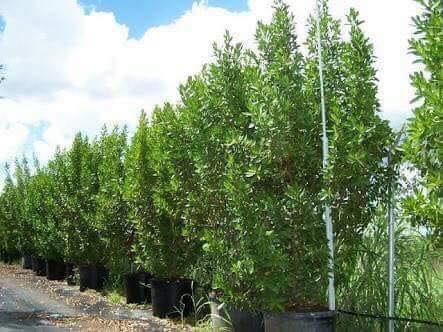
    Buttonwood or Conocarpus erectus is a widespread species of terrestrial mangrove along tropical and subtropical coasts of the Americas and West Africa. It grows as a shrub or small tree on the coastal mainland and on islands of a variety of sizes. It has two varieties "silver" and "green", having highly pubescent and nearly glabrous leaves, respectively. This species is widely distributed in coastal communities in tropical America and West Africa. It can be found throughout Florida and to the Bahamas and West Indies south to Brazil. In the Eastern Pacific, it is present in Mexico through Central America to Ecuador and the Galapagos. It is also found in West Africa. It was introduced in Hawaii, Kuwait, Dubai and Saudi Arabia.

    In Pakistan it was first introduced by the Former Mayor of Karachi Syed Mustafa Kamal who planted around 2.2 million Conocarpus plants almost everywhere in Karachi. This has dramatically transformed the city landscape and provided a thick shadow to the humans and animals. These plant also playing role in reducing carbon imprint by absorbing city’s ever increasing CO2 and producing the oxygen. In addition, It gives another life to the desert looking parks and concrete jungles. Because of its tendency to grow in harsh soil with presence of saline ground waters, this plant has become the most favorite tree of this city. When it was first imported to Karachi the price was around Rs.15000-25000/plant, however when local nurseries started propagating them due huge demand from the citizens and the government, prices were decreased to Rs.15-25/plant. As I already mentioned that this is a tropical plant, which belongs to the mangrove family, Karachi’s soil provided this plant a favorable environment to grow and flourish here. It’s physiology is not much different from our local trees like Neem, Ficus, Lignum, Flamboyant, Moringa, Eucalyptus, Amaltas, Imlee and so on. It is continuously purifying Karachi’s air pollution for years and reducing the salinity of ground waters as well. In the western world this tree also has economic value for its hard wood which is used in making furniture, charcoal manufacturing and medicinal uses.

    Since, few days there are rumors about this innocent tree, that it is causing allergy and asthma in Karachi’s population. Even on a private news channel, reporter has made such a foolish reporting against Conocorpus.

    A research study published by University of Karachi and The Aga Khan University in 2015, the Conocorpus was not even in the list of allergy causing plants. Another Research from University of Lahore, has reported that this tree has both antibacterial as well as antifungal properties. Even if you search ā€œtop 100 allergic plant in the worldā€ on the Google, surprisingly Conocorpus is not there!

    The Globally recognized American research organization ā€œNational Center for Biotechnology Informationā€(https://www.ncbi.nlm.nih.gov/), which is authority for ā€œANY NEW MEDICAL DEVELOPMENT/RESEARCHā€ does not have any evidence for allergy caused by the Conocorpus.

    ā€œTill now there is no such case reported for its harmful effect in Human as well as animals from anywhere in the world.ā€

    Instead of removing Conocorpus, Karachi needs another 2.2 million trees of other native varieties in its soil. Karachi’s climate favors majority of plants than any other city of Pakistan because of its soft sandy soil, moderate weather and high humidity levels.

    The paid ā€œTimber Mafiaā€ has now eyes on the 2.2 million Conocorpus trees for its precious wood and want to fill their every bottomless pocket like they did with Karachi’s Giant Eucalyptus trees.

    It’s time to re-think about this tree because every rumor is not TRUE…!

    Research By,

    Zia Mujahid

    Member Pakistan Bonsai Society

    Contact: +92-3417679089

    https://www.facebook.com/XiaMujahid.aNeX

    References:

    https://npgsweb.ars-grin.gov/gringlobal/taxonomydetail.aspx?11263

    https://ecommons.aku.edu/cgi/viewcontent.cgi?referer=https://www.google.com.pk/&httpsredir=1&article=1328&context=pakistan_fhs_mc_med_med
    https://www.researchgate.net/publication/263241536_ANTIBACTERIAL_AND_ANTIFUNGAL_ACTIVITY_OF_CONOCARPUS_LANCIFOLIUS_ENGL_COMBRETACEAE_Corresponding_Author

    http://tropical.theferns.info/viewtropical.php?id=Conocarpus+erectus

    http://eol.org/pages/582725/details
    The Conocorpus, A ā€œThreatā€ or ā€œRumorā€ Buttonwood or Conocarpus erectus is a widespread species of terrestrial mangrove along tropical and subtropical coasts of the Americas and West Africa. It grows as a shrub or small tree on the coastal mainland and on islands of a variety of sizes. It has two varieties "silver" and "green", having highly pubescent and nearly glabrous leaves, respectively. This species is widely distributed in coastal communities in tropical America and West Africa. It can be found throughout Florida and to the Bahamas and West Indies south to Brazil. In the Eastern Pacific, it is present in Mexico through Central America to Ecuador and the Galapagos. It is also found in West Africa. It was introduced in Hawaii, Kuwait, Dubai and Saudi Arabia. In Pakistan it was first introduced by the Former Mayor of Karachi Syed Mustafa Kamal who planted around 2.2 million Conocarpus plants almost everywhere in Karachi. This has dramatically transformed the city landscape and provided a thick shadow to the humans and animals. These plant also playing role in reducing carbon imprint by absorbing city’s ever increasing CO2 and producing the oxygen. In addition, It gives another life to the desert looking parks and concrete jungles. Because of its tendency to grow in harsh soil with presence of saline ground waters, this plant has become the most favorite tree of this city. When it was first imported to Karachi the price was around Rs.15000-25000/plant, however when local nurseries started propagating them due huge demand from the citizens and the government, prices were decreased to Rs.15-25/plant. As I already mentioned that this is a tropical plant, which belongs to the mangrove family, Karachi’s soil provided this plant a favorable environment to grow and flourish here. It’s physiology is not much different from our local trees like Neem, Ficus, Lignum, Flamboyant, Moringa, Eucalyptus, Amaltas, Imlee and so on. It is continuously purifying Karachi’s air pollution for years and reducing the salinity of ground waters as well. In the western world this tree also has economic value for its hard wood which is used in making furniture, charcoal manufacturing and medicinal uses. Since, few days there are rumors about this innocent tree, that it is causing allergy and asthma in Karachi’s population. Even on a private news channel, reporter has made such a foolish reporting against Conocorpus. A research study published by University of Karachi and The Aga Khan University in 2015, the Conocorpus was not even in the list of allergy causing plants. Another Research from University of Lahore, has reported that this tree has both antibacterial as well as antifungal properties. Even if you search ā€œtop 100 allergic plant in the worldā€ on the Google, surprisingly Conocorpus is not there! The Globally recognized American research organization ā€œNational Center for Biotechnology Informationā€(https://www.ncbi.nlm.nih.gov/), which is authority for ā€œANY NEW MEDICAL DEVELOPMENT/RESEARCHā€ does not have any evidence for allergy caused by the Conocorpus. ā€œTill now there is no such case reported for its harmful effect in Human as well as animals from anywhere in the world.ā€ Instead of removing Conocorpus, Karachi needs another 2.2 million trees of other native varieties in its soil. Karachi’s climate favors majority of plants than any other city of Pakistan because of its soft sandy soil, moderate weather and high humidity levels. The paid ā€œTimber Mafiaā€ has now eyes on the 2.2 million Conocorpus trees for its precious wood and want to fill their every bottomless pocket like they did with Karachi’s Giant Eucalyptus trees. It’s time to re-think about this tree because every rumor is not TRUE…! Research By, Zia Mujahid Member Pakistan Bonsai Society Contact: +92-3417679089 https://www.facebook.com/XiaMujahid.aNeX References: https://npgsweb.ars-grin.gov/gringlobal/taxonomydetail.aspx?11263 https://ecommons.aku.edu/cgi/viewcontent.cgi?referer=https://www.google.com.pk/&httpsredir=1&article=1328&context=pakistan_fhs_mc_med_med https://www.researchgate.net/publication/263241536_ANTIBACTERIAL_AND_ANTIFUNGAL_ACTIVITY_OF_CONOCARPUS_LANCIFOLIUS_ENGL_COMBRETACEAE_Corresponding_Author http://tropical.theferns.info/viewtropical.php?id=Conocarpus+erectus http://eol.org/pages/582725/details
    0 Comments 0 Shares 109 Views
  • Juan Enriquez is a renowned author, businessman, and academic known for his work in the fields of biotechnology, life sciences, and the economy. He has written extensively on how these areas intersect and impact society and has a particular interest in the implications of genetic research and bioengineering. Enriquez is a co-founder and managing director of Excel Venture Management, which invests in healthcare and life sciences companies. He has also served as a professor at Harvard Business School, where he directed the Life Sciences Project. His books, including "As the Future Catches You" and "Evolving Ourselves," explore the profound changes that biotechnology and genetic advancements are bringing to humanity.
    Juan Enriquez is a renowned author, businessman, and academic known for his work in the fields of biotechnology, life sciences, and the economy. He has written extensively on how these areas intersect and impact society and has a particular interest in the implications of genetic research and bioengineering. Enriquez is a co-founder and managing director of Excel Venture Management, which invests in healthcare and life sciences companies. He has also served as a professor at Harvard Business School, where he directed the Life Sciences Project. His books, including "As the Future Catches You" and "Evolving Ourselves," explore the profound changes that biotechnology and genetic advancements are bringing to humanity.
    0 Comments 0 Shares 52 Views
  • DG Lab San Francisco is the U.S. branch of Digital Garage, a Japanese IT company. Located at 717 Market Street in the SoMa district, this innovation hub—known as DG717—has been active since November 2013. It serves as a coworking space, event venue, and the West Coast base for DG Lab’s open innovation initiatives. ļæ¼

    DG Lab focuses on advancing five core technologies: Blockchain, Virtual Reality/Augmented Reality, Artificial Intelligence, Security, and Biotechnology. Their projects range from Bitcoin development and smart contracts to AI-driven food image analysis and biohealth accelerators. ļæ¼ ļæ¼

    Additionally, DG717 hosts GenLab, a startup studio dedicated to supporting ventures that leverage Generative AI and related technologies. ļæ¼

    If you’re interested in exploring their work or potential collaboration opportunities, visiting their official website at dglab.com is a great starting point.
    DG Lab San Francisco is the U.S. branch of Digital Garage, a Japanese IT company. Located at 717 Market Street in the SoMa district, this innovation hub—known as DG717—has been active since November 2013. It serves as a coworking space, event venue, and the West Coast base for DG Lab’s open innovation initiatives. ļæ¼ DG Lab focuses on advancing five core technologies: Blockchain, Virtual Reality/Augmented Reality, Artificial Intelligence, Security, and Biotechnology. Their projects range from Bitcoin development and smart contracts to AI-driven food image analysis and biohealth accelerators. ļæ¼ ļæ¼ Additionally, DG717 hosts GenLab, a startup studio dedicated to supporting ventures that leverage Generative AI and related technologies. ļæ¼ If you’re interested in exploring their work or potential collaboration opportunities, visiting their official website at dglab.com is a great starting point.
    0 Comments 0 Shares 38 Views