• Untitled recording - 2026-10-05T215055.600RSIF 8 Roll no 93 Short documentary no 7 Short documentary topic:"The Secret Lives of Plants: Communication and Interaction". **Documentary Review — The Secret Lives of Plants: Communication and Interaction** Plants may look silent and still, but the natural world around them is full of fascinating interactions. In this documentary, **“The Secret Lives of Plants: Communication and Interaction,”** we explore how plants respond to their surroundings and interact with other living organisms. Plants can sense changes in their environment and use chemical signals to respond to threats. They can also interact with soil, fungi, microorganisms, insects, and other plants. These relationships show us that nature is much more connected and complex than we often realize. One of the most interesting lessons is that plants are not simply passive organisms. They continuously respond to their environment and play an important role in maintaining ecosystems. They provide food and shelter, support biodiversity, protect soil, and contribute oxygen to our atmosphere. This documentary reminds us that every part of nature has a role to play. By learning about plants and their hidden interactions, we can develop a greater appreciation for our environment and understand why protecting nature is so important. **My key takeaway:** Plants may not communicate like humans, but their world is full of signals, interactions, cooperation, and survival strategies. Watch my documentary review and discover the fascinating secret world of plants! #TheSecretLivesOfPlants #Plants #PlantCommunication #Nature #Environment #Biodiversity #Ecosystem #PlantScience #ScienceDocumentary #DocumentaryReview #NatureLovers #EnvironmentalAwareness #Learning #Education #Science #PlantLife #NatureIsAmazing #StudentProject #RehanSchool #Knowledge #Inspiration
    Untitled recording - 2026-10-05T215055.600RSIF 8 Roll no 93 Short documentary no 7 Short documentary topic:"The Secret Lives of Plants: Communication and Interaction".🌿🌱 **Documentary Review — The Secret Lives of Plants: Communication and Interaction** 🌱🌿 Plants may look silent and still, but the natural world around them is full of fascinating interactions. 🌍✨ In this documentary, **“The Secret Lives of Plants: Communication and Interaction,”** we explore how plants respond to their surroundings and interact with other living organisms. 🌱 Plants can sense changes in their environment and use chemical signals to respond to threats. They can also interact with soil, fungi, microorganisms, insects, and other plants. These relationships show us that nature is much more connected and complex than we often realize. 🌿 One of the most interesting lessons is that plants are not simply passive organisms. They continuously respond to their environment and play an important role in maintaining ecosystems. They provide food and shelter, support biodiversity, protect soil, and contribute oxygen to our atmosphere. 🌍 This documentary reminds us that every part of nature has a role to play. By learning about plants and their hidden interactions, we can develop a greater appreciation for our environment and understand why protecting nature is so important. ✨ **My key takeaway:** Plants may not communicate like humans, but their world is full of signals, interactions, cooperation, and survival strategies. πŸŽ₯ Watch my documentary review and discover the fascinating secret world of plants! #TheSecretLivesOfPlants #Plants #PlantCommunication #Nature #Environment #Biodiversity #Ecosystem #PlantScience #ScienceDocumentary #DocumentaryReview #NatureLovers #EnvironmentalAwareness #Learning #Education #Science #PlantLife #NatureIsAmazing #StudentProject #RehanSchool #Knowledge #Inspiration
    0 Reacties 1 aandelen 418 Views
  • RSIF8
    ROLL NO 77
    SONG NO 27
    SONG TOPIC "Exploring Earth's Diverse Ecosystems"

    **Exploring Earth's Diverse Ecosystems!**

    From lush rainforests and vast oceans to deserts, grasslands, and icy polar regions, Earth is home to an incredible variety of ecosystems. Each ecosystem has unique plants, animals, climates, and food chains that work together to keep our planet balanced.

    Join us as we explore the amazing diversity of life on Earth and discover why protecting these ecosystems is essential for our future!

    #EarthEcosystems #Biodiversity #Nature #Environment #Wildlife #Climate #Earth #Science #Education #SaveOurPlanet #ExploreNature
    RSIF8 ROLL NO 77 SONG NO 27 SONG TOPIC "Exploring Earth's Diverse Ecosystems" 🌍🌿 **Exploring Earth's Diverse Ecosystems!** 🌊🐘🌳 From lush rainforests and vast oceans to deserts, grasslands, and icy polar regions, Earth is home to an incredible variety of ecosystems. 🌎✨ Each ecosystem has unique plants, animals, climates, and food chains that work together to keep our planet balanced. 🐝🌱🦁 Join us as we explore the amazing diversity of life on Earth and discover why protecting these ecosystems is essential for our future! πŸ’šπŸŒ #EarthEcosystems #Biodiversity #Nature #Environment #Wildlife #Climate #Earth #Science #Education #SaveOurPlanet #ExploreNature πŸŒΏπŸ”¬πŸŒŽ
    0 Reacties 0 aandelen 674 Views 3
  • Mohsin RS F8
    Story post NO:12
    Class: Foundation Level
    Made by Me

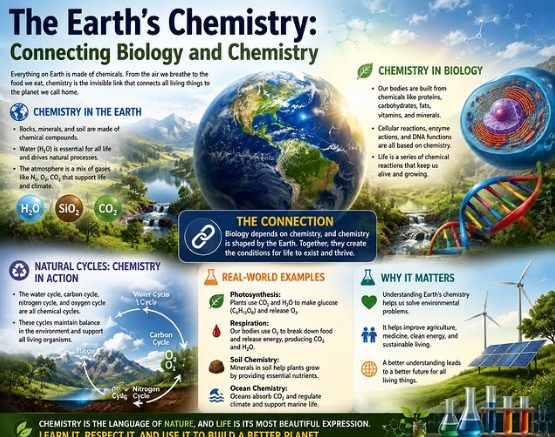
    The Earth’s Chemistry: Connecting Biology and Chemistry

    The Earth is a remarkable system where chemistry and biology are deeply connected. Everything around us—from the air we breathe and the water we drink to the soil, plants, animals, and even our own bodies—is made of chemical substances. Chemistry helps us understand what Earth is made of, while biology shows us how living organisms use these substances to survive, grow, reproduce, and interact with their environment.

    Water, carbon dioxide, oxygen, minerals, and many other chemical compounds play essential roles in life. Plants use water and carbon dioxide during photosynthesis to produce food and release oxygen. Animals and humans depend on oxygen and nutrients to obtain energy and maintain their bodies. At the cellular level, countless chemical reactions happen every moment, allowing cells to function and living organisms to remain healthy.

    Earth’s natural cycles also demonstrate the powerful connection between chemistry and biology. The water cycle, carbon cycle, nitrogen cycle, and oxygen cycle continuously move important substances through the atmosphere, oceans, soil, plants, animals, and microorganisms. These cycles help maintain balance in ecosystems and provide the materials that living things need.

    Soil chemistry is another important example. Plants require minerals and nutrients from the soil to grow, while microorganisms help break down organic matter and return nutrients to the environment. In the oceans, chemical processes influence water quality, carbon storage, climate, and marine ecosystems. Even the rocks and minerals beneath our feet are part of Earth’s ongoing chemical processes.

    Understanding the connection between chemistry and biology is also important for solving real-world problems. Scientists use this knowledge to improve agriculture, protect ecosystems, develop medicines, understand climate change, create cleaner technologies, and find sustainable ways to use Earth’s resources.

    In conclusion, chemistry is more than a subject studied in a laboratory—it is one of the fundamental languages of nature.
    Mohsin RS F8 πŸŽ“βœ¨ Story post NO:12 Class: Foundation Level πŸ“š Made by Me πŸ’»πŸš€ The Earth’s Chemistry: Connecting Biology and Chemistry The Earth is a remarkable system where chemistry and biology are deeply connected. Everything around us—from the air we breathe and the water we drink to the soil, plants, animals, and even our own bodies—is made of chemical substances. Chemistry helps us understand what Earth is made of, while biology shows us how living organisms use these substances to survive, grow, reproduce, and interact with their environment. Water, carbon dioxide, oxygen, minerals, and many other chemical compounds play essential roles in life. Plants use water and carbon dioxide during photosynthesis to produce food and release oxygen. Animals and humans depend on oxygen and nutrients to obtain energy and maintain their bodies. At the cellular level, countless chemical reactions happen every moment, allowing cells to function and living organisms to remain healthy. Earth’s natural cycles also demonstrate the powerful connection between chemistry and biology. The water cycle, carbon cycle, nitrogen cycle, and oxygen cycle continuously move important substances through the atmosphere, oceans, soil, plants, animals, and microorganisms. These cycles help maintain balance in ecosystems and provide the materials that living things need. Soil chemistry is another important example. Plants require minerals and nutrients from the soil to grow, while microorganisms help break down organic matter and return nutrients to the environment. In the oceans, chemical processes influence water quality, carbon storage, climate, and marine ecosystems. Even the rocks and minerals beneath our feet are part of Earth’s ongoing chemical processes. Understanding the connection between chemistry and biology is also important for solving real-world problems. Scientists use this knowledge to improve agriculture, protect ecosystems, develop medicines, understand climate change, create cleaner technologies, and find sustainable ways to use Earth’s resources. In conclusion, chemistry is more than a subject studied in a laboratory—it is one of the fundamental languages of nature.
    0 Reacties 0 aandelen 629 Views
  • #rsisb
    Roll no.231
    song no.16
    Foundation Level


    ## Biology Beats — Long Description

    **Welcome to Biology Beats!**

    Get ready to explore the incredible world of **biology** through an exciting mix of science, discovery, and rhythm! From tiny cells to massive ecosystems , biology reveals the amazing story of life and everything living around us.

    Discover how **cells work**, how our bodies function, how plants grow , how animals survive , and how living organisms interact with their environment. Explore DNA , genetics , evolution , the human body , microorganisms , ecosystems , oceans , and the incredible diversity of life on Earth!

    **Biology Beats** turns fascinating biological ideas into an engaging journey that makes learning science more memorable and fun. Whether you're curious about the human brain , fascinated by microscopic life , amazed by animal behavior , or interested in the secrets hidden inside DNA , there's always something exciting to discover!

    Biology isn't just a school subject—it is the story of **life itself**. From a single cell to an entire rainforest , every organism has a remarkable story.

    Join us as we explore the wonders of life, uncover scientific mysteries, and discover how biology connects **humans, animals, plants, cells, and the entire natural world**.

    ### Emojis

    ‍


    Asma Shaheen EducationWali
    Saima Empowerment Wali
    Irum Asim Leadershipwali
    #rsisb Roll no.231 song no.16 Foundation Level ## 🧬🎡 Biology Beats — Long Description 🌟 **Welcome to Biology Beats!** 🧬🎢 Get ready to explore the incredible world of **biology** through an exciting mix of science, discovery, and rhythm! πŸ”¬πŸŽ΅ From tiny cells πŸ”¬ to massive ecosystems 🌳🌍, biology reveals the amazing story of life and everything living around us. πŸ§ πŸ«€πŸ¦ πŸŒ± 🧬 Discover how **cells work**, how our bodies function, how plants grow 🌿, how animals survive πŸ˜πŸ¦…, and how living organisms interact with their environment. 🌎✨ Explore DNA 🧬, genetics πŸ”¬, evolution πŸ¦–, the human body πŸ«€, microorganisms 🦠, ecosystems 🌳, oceans 🌊, and the incredible diversity of life on Earth! 🌍🐾 🎢 **Biology Beats** turns fascinating biological ideas into an engaging journey that makes learning science more memorable and fun. Whether you're curious about the human brain 🧠, fascinated by microscopic life 🦠, amazed by animal behavior 🐬, or interested in the secrets hidden inside DNA 🧬, there's always something exciting to discover! πŸ’‘ Biology isn't just a school subject—it is the story of **life itself**. From a single cell πŸ”¬ to an entire rainforest 🌴, every organism has a remarkable story. 🌟 πŸš€ Join us as we explore the wonders of life, uncover scientific mysteries, and discover how biology connects **humans, animals, plants, cells, and the entire natural world**. πŸŒπŸ§¬πŸ”¬ ### πŸ”₯ Emojis 🧬 πŸ”¬ 🦠 🧠 πŸ«€ 🫁 🌱 🌿 🌳 🐾 🐘 πŸ¦‹ 🐬 πŸ¦– 🌍 🌎 🌊 β˜€οΈ πŸ§ͺ πŸ“š 🎡 🎢 πŸ’‘ ✨ 🀯 πŸš€ ❀️‍🩹 Asma Shaheen EducationWali Saima Empowerment Wali Irum Asim Leadershipwali
    0 Reacties 0 aandelen 1146 Views 7
  • #rsisb
    Roll no.231
    song no.17
    Foundation Level


    ### Environmental Science and Nature

    **“Environmental Science and Nature”** explores the fascinating relationship between humans and the natural world. It helps us understand **ecosystems, plants, animals, water, air, soil, climate, and biodiversity**.

    Nature provides essential resources for life, so learning about environmental science can help us understand problems such as **pollution, deforestation, waste, and climate change**. It also teaches us ways to protect our surroundings through conservation, recycling, saving water, and planting trees.

    This topic reminds us that **our everyday choices can affect the environment**. By learning more about nature and caring for our planet, we can help create a cleaner and healthier future.

    **My Takeaway:** *“Protecting nature today helps preserve a beautiful and healthy planet for tomorrow.”*

    #EnvironmentalScience #Nature #Environment #Biodiversity #SaveOurPlanet #Climate #Conservation #PlantTrees #Sustainability #Learning #Education


    Asma Shaheen EducationWali\
    Irum Asim Leadershipwali
    @
    #rsisb Roll no.231 song no.17 Foundation Level ### 🌿 Environmental Science and Nature 🌍 **“Environmental Science and Nature”** explores the fascinating relationship between humans and the natural world. It helps us understand **ecosystems, plants, animals, water, air, soil, climate, and biodiversity**. πŸŒ±πŸ¦‹πŸ’§ Nature provides essential resources for life, so learning about environmental science can help us understand problems such as **pollution, deforestation, waste, and climate change**. It also teaches us ways to protect our surroundings through conservation, recycling, saving water, and planting trees. πŸŒ³β™»οΈ This topic reminds us that **our everyday choices can affect the environment**. By learning more about nature and caring for our planet, we can help create a cleaner and healthier future. πŸŒŽπŸ’š ✨ **My Takeaway:** *“Protecting nature today helps preserve a beautiful and healthy planet for tomorrow.”* #EnvironmentalScience #Nature #Environment #Biodiversity #SaveOurPlanet #Climate #Conservation #PlantTrees #Sustainability #Learning #Education πŸŒΏπŸŒπŸ’š Asma Shaheen EducationWali\ Irum Asim Leadershipwali @
    0 Reacties 0 aandelen 1243 Views 2
  • RSIF8
    Roll no: 99
    Song no: 15
    Song topic: Microbial Universe: The Power of the Invisible World
    The microbial world is filled with tiny organisms that have a huge impact on life. From bacteria and fungi to microscopic organisms in soil, water, and our bodies, microbes play important roles in ecosystems, nutrition, decomposition, and human health. This song takes us into the fascinating invisible world of microbes and explores the incredible power hidden within the smallest forms of life.
    #MicrobialUniverse #Microbiology #InvisibleWorld #Microbes #Bacteria #Biology #Science #LifeScience #ScienceSong #Learning #Education
    RSIF8 Roll no: 99 Song no: 15 Song topic: Microbial Universe: The Power of the Invisible World The microbial world is filled with tiny organisms that have a huge impact on life. From bacteria and fungi to microscopic organisms in soil, water, and our bodies, microbes play important roles in ecosystems, nutrition, decomposition, and human health. This song takes us into the fascinating invisible world of microbes and explores the incredible power hidden within the smallest forms of life. #MicrobialUniverse #Microbiology #InvisibleWorld #Microbes #Bacteria #Biology #Science #LifeScience #ScienceSong #Learning #Education
    0 Reacties 0 aandelen 620 Views 1
  • #rsisb
    Roll no.231
    song no.15
    Foundation Level


    ## Environmental Science and Nature

    **“Environmental Science and Nature”** is an educational topic that helps us understand the amazing world around us. It explores **plants, animals, water, air, soil, ecosystems, climate, and biodiversity**.

    Nature provides us with the resources we need to live, so protecting our environment is an important responsibility. Learning about pollution, conservation, recycling, and sustainable living can help us make better choices for our planet.

    This topic reminds us that **every small action matters**. Planting trees, saving water, reducing waste, and keeping our surroundings clean can all contribute to a healthier environment.

    **My Takeaway:** *“When we understand nature, we learn why it is important to protect it.”*

    #EnvironmentalScience #Nature #Environment #SaveOurPlanet #Biodiversity #Climate #CleanWater #PlantTrees #Sustainability #Learning #Education


    Asma Shaheen EducationWali
    Saima Empowerment Wali
    Irum Asim Leadershipwali
    #rsisb Roll no.231 song no.15 Foundation Level ## 🌿 Environmental Science and Nature 🌍 **“Environmental Science and Nature”** is an educational topic that helps us understand the amazing world around us. It explores **plants, animals, water, air, soil, ecosystems, climate, and biodiversity**. πŸŒ±πŸ¦‹πŸ’§ Nature provides us with the resources we need to live, so protecting our environment is an important responsibility. Learning about pollution, conservation, recycling, and sustainable living can help us make better choices for our planet. This topic reminds us that **every small action matters**. Planting trees, saving water, reducing waste, and keeping our surroundings clean can all contribute to a healthier environment. πŸŒ³β™»οΈ 🌟 **My Takeaway:** *“When we understand nature, we learn why it is important to protect it.”* #EnvironmentalScience #Nature #Environment #SaveOurPlanet #Biodiversity #Climate #CleanWater #PlantTrees #Sustainability #Learning #Education πŸŒπŸŒΏπŸ’šβœ¨ Asma Shaheen EducationWali Saima Empowerment Wali Irum Asim Leadershipwali
    0 Reacties 0 aandelen 1156 Views 1
  • **Roll No: 2**
    **Batch: 14**
    **Book: ACCL**
    **Task No: 50**

    # Winds and Environment: The Impact of Change

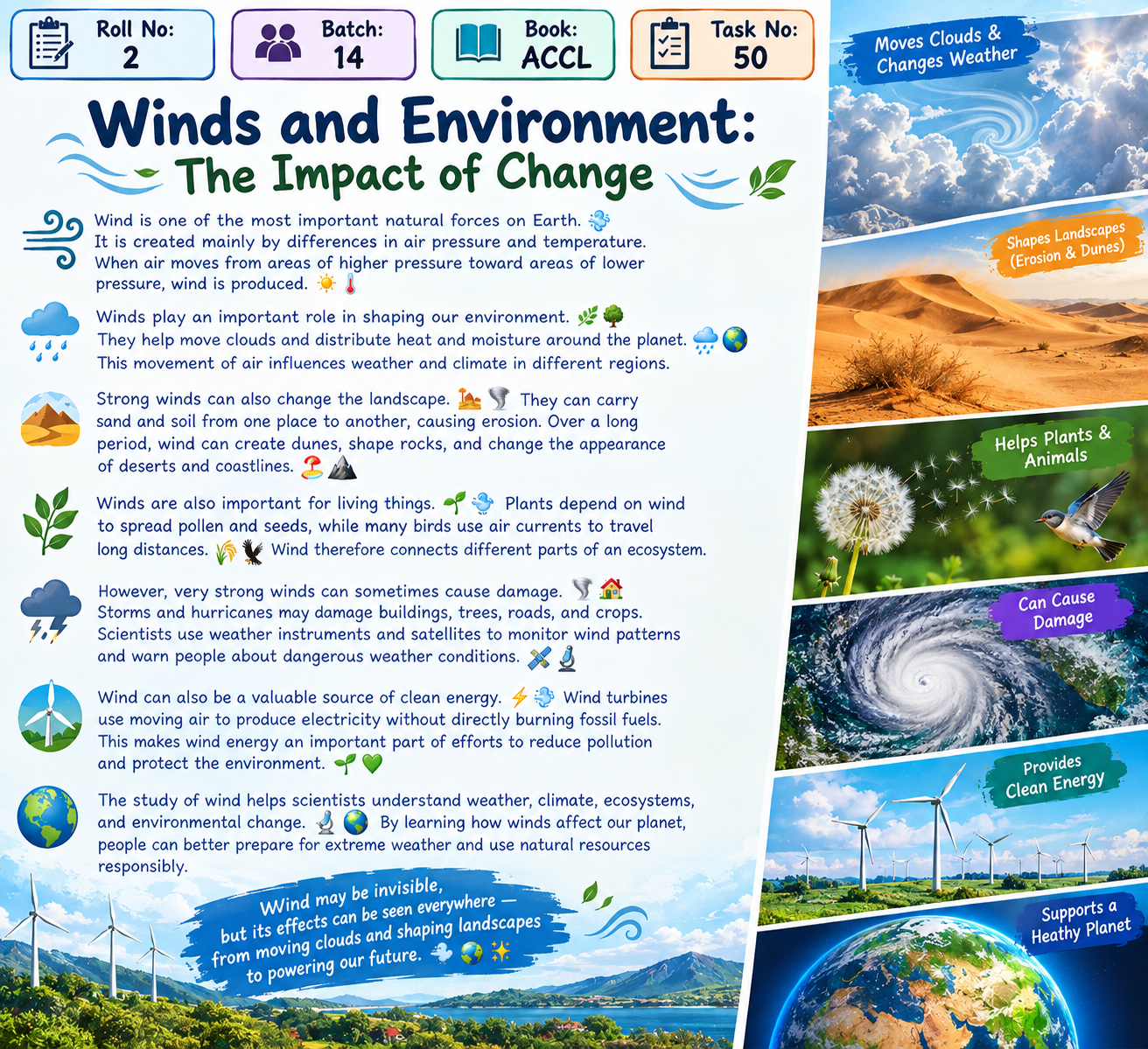
    Wind is one of the most important natural forces on Earth. It is created mainly by differences in air pressure and temperature. When air moves from areas of higher pressure toward areas of lower pressure, wind is produced.

    Winds play an important role in shaping our environment. They help move clouds and distribute heat and moisture around the planet. This movement of air influences weather and climate in different regions.

    Strong winds can also change the landscape. They can carry sand and soil from one place to another, causing erosion. Over a long period, wind can create dunes, shape rocks, and change the appearance of deserts and coastlines.

    Winds are also important for living things. Plants depend on wind to spread pollen and seeds, while many birds use air currents to travel long distances. Wind therefore connects different parts of an ecosystem.

    However, very strong winds can sometimes cause damage. Storms and hurricanes may damage buildings, trees, roads, and crops. Scientists use weather instruments and satellites to monitor wind patterns and warn people about dangerous weather conditions.

    Wind can also be a valuable source of clean energy. Wind turbines use moving air to produce electricity without directly burning fossil fuels. This makes wind energy an important part of efforts to reduce pollution and protect the environment.

    The study of wind helps scientists understand weather, climate, ecosystems, and environmental change. By learning how winds affect our planet, people can better prepare for extreme weather and use natural resources responsibly.

    **Wind may be invisible, but its effects can be seen everywhere—from moving clouds and shaping landscapes to powering our future. **
    **Roll No: 2** **Batch: 14** **Book: ACCL** **Task No: 50** # 🌬️ Winds and Environment: The Impact of Change 🌍 Wind is one of the most important natural forces on Earth. 🌬️ It is created mainly by differences in air pressure and temperature. When air moves from areas of higher pressure toward areas of lower pressure, wind is produced. β˜€οΈπŸŒ‘οΈ Winds play an important role in shaping our environment. 🌿🌳 They help move clouds and distribute heat and moisture around the planet. 🌧️🌎 This movement of air influences weather and climate in different regions. Strong winds can also change the landscape. 🏜️πŸŒͺ️ They can carry sand and soil from one place to another, causing erosion. Over a long period, wind can create dunes, shape rocks, and change the appearance of deserts and coastlines. πŸ–οΈβ›°οΈ Winds are also important for living things. 🌱🐦 Plants depend on wind to spread pollen and seeds, while many birds use air currents to travel long distances. πŸŒΎπŸ¦… Wind therefore connects different parts of an ecosystem. However, very strong winds can sometimes cause damage. πŸŒͺ️🏠 Storms and hurricanes may damage buildings, trees, roads, and crops. Scientists use weather instruments and satellites to monitor wind patterns and warn people about dangerous weather conditions. πŸ›°οΈπŸ”¬ Wind can also be a valuable source of clean energy. ⚑🌬️ Wind turbines use moving air to produce electricity without directly burning fossil fuels. This makes wind energy an important part of efforts to reduce pollution and protect the environment. πŸŒ±πŸ’š The study of wind helps scientists understand weather, climate, ecosystems, and environmental change. πŸ”¬πŸŒ By learning how winds affect our planet, people can better prepare for extreme weather and use natural resources responsibly. **Wind may be invisible, but its effects can be seen everywhere—from moving clouds and shaping landscapes to powering our future. 🌬️🌎✨**
    0 Reacties 0 aandelen 1236 Views
  • #RSTA
    #Task : Story Post
    #Class: Foundation Level Book 2
    #Day No: 1
    #Made By Me

    Total Post:25

    **Description:**
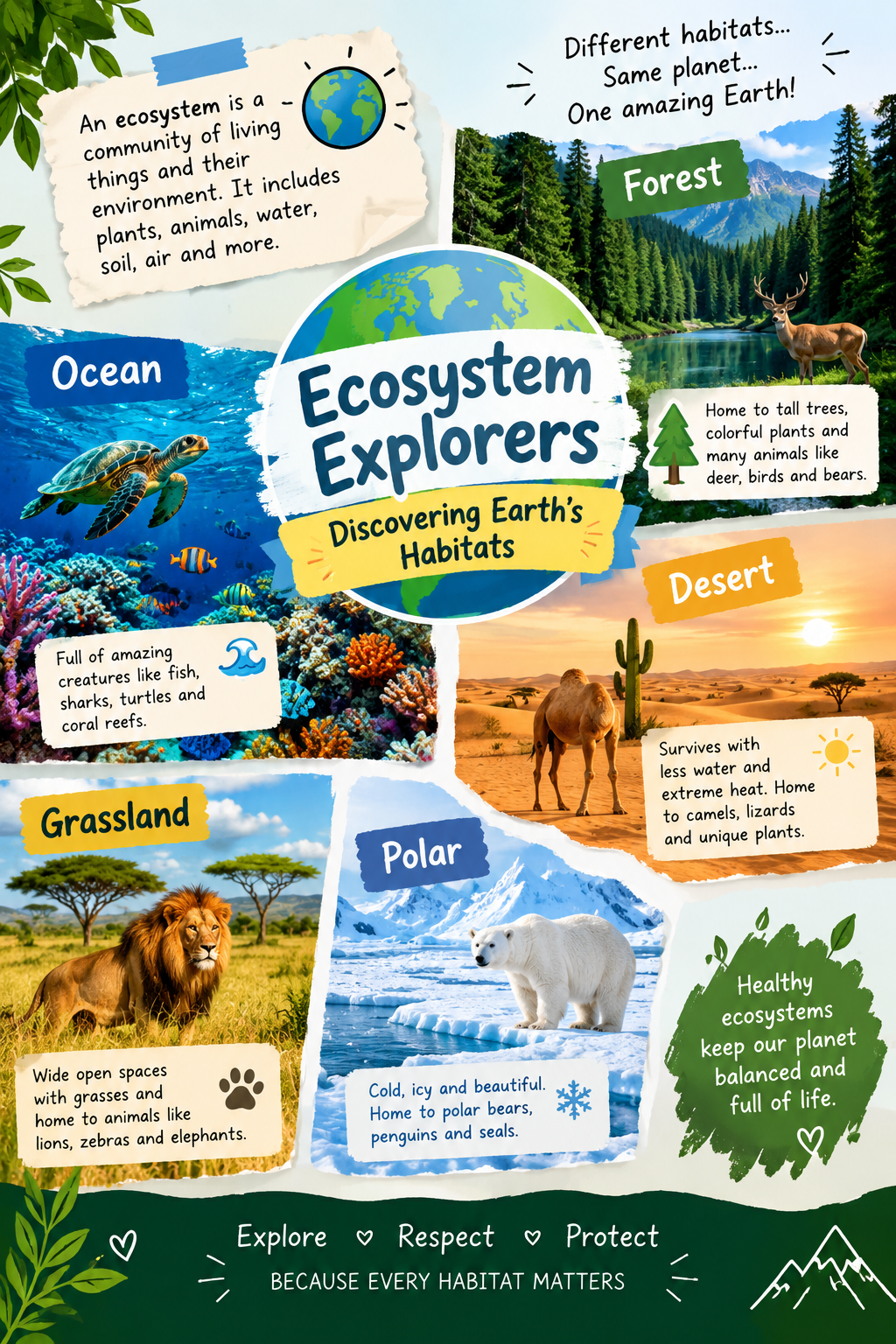
    Completed the task **“Ecosystem Explorers: Discovering Earth’s Habitats.”** I wrote a story post and created an educational image about different habitats, including forests, oceans, deserts, grasslands, and polar regions. This activity helped me learn about ecosystems, animals, plants, and the importance of protecting our planet. I also shared the post on Facebook, YouTube, LinkedIn, Instagram, and TikTok.

    RSTA StoryPost EcosystemExplorers EarthHabitats Environment Learning SocialMedia MadeByMe
    #RSTA #Task : Story Post #Class: Foundation Level Book 2 #Day No: 1 #Made By Me Total Post:25 **Description:** Completed the task **“Ecosystem Explorers: Discovering Earth’s Habitats.”** 🌍🌿 I wrote a story post and created an educational image about different habitats, including forests, oceans, deserts, grasslands, and polar regions. This activity helped me learn about ecosystems, animals, plants, and the importance of protecting our planet. 🌱✨ I also shared the post on Facebook, YouTube, LinkedIn, Instagram, and TikTok. RSTA StoryPost EcosystemExplorers EarthHabitats Environment Learning SocialMedia MadeByMe
    0 Reacties 0 aandelen 1477 Views
  • #rsisb
    Roll No 253
    Foundation Level
    Story Post 25


    # Climate and Culture: How Geography Shapes Our Way of Life

    Imagine placing a person in a frozen mountain valley , then moving them to a scorching desert , a tropical rainforest , or a coastline .

    The landscape changes.

    The weather changes.

    And gradually, **the way people live changes too.** ‍‍

    Where we live influences what we eat , what we grow , how we build our homes , what we wear , how we earn a living , and even how communities develop traditions and identities.

    ---

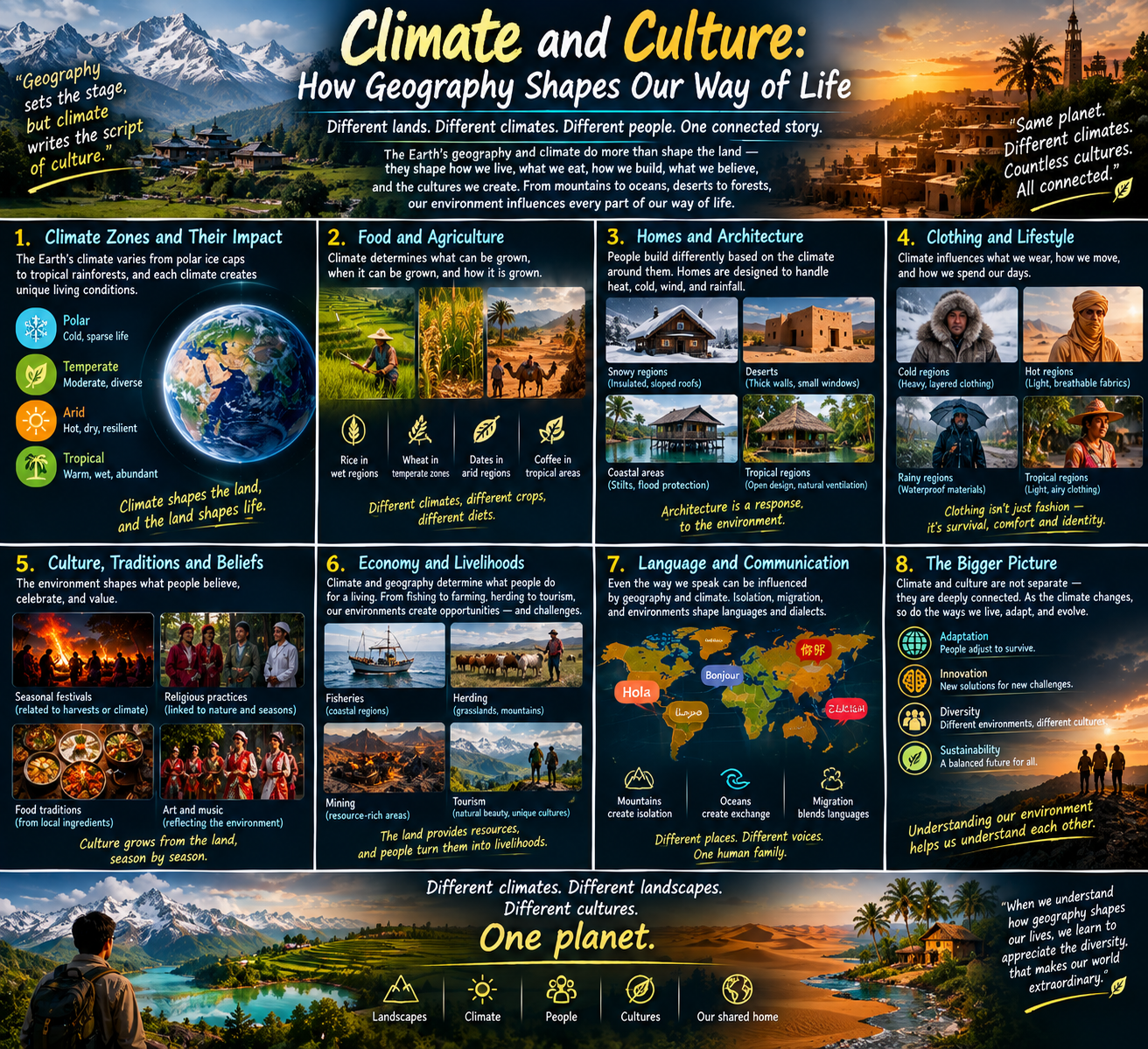
    # 1. Climate Zones and Their Impact

    Earth contains an incredible variety of climates.

    **Polar regions** — extremely cold and often sparsely populated
    **Temperate regions** — moderate temperatures and diverse ecosystems
    **Arid regions** — hot or dry conditions with limited rainfall
    **Tropical regions** — warm temperatures and often abundant rainfall

    These environments create different opportunities and challenges for human societies.

    ### **The climate shapes the environment—and people adapt to it.**

    ---

    # 2. Food and Agriculture

    Climate has a major influence on what can be grown and how agriculture is practiced.

    Rice thrives in many warm, water-rich environments.
    Wheat grows widely across temperate regions.
    Dates are well adapted to hot, dry climates.
    Coffee grows particularly well in suitable tropical highland environments.

    These crops don't just provide food.

    They can become part of a community's:

    Cuisine
    Economy
    Festivals
    ‍‍‍ Traditions
    History

    ### **Different environments create different relationships with food.**

    ---

    # 3. Homes and Architecture

    Look at houses around the world and you'll often find clues about their environment.

    **Cold regions** may use insulation and steep roofs to handle snow and retain heat.

    **Desert regions** may use thick walls, shaded spaces, and smaller openings to reduce heat.

    **Coastal regions** may use raised structures to reduce exposure to flooding.

    **Tropical regions** often benefit from designs that encourage ventilation and manage heavy rainfall.

    Architecture is therefore more than appearance.

    ### **Buildings are often human responses to climate.**

    ---

    # 4. Clothing and Lifestyle

    What people wear is also influenced by their environment.

    Cold climates → layered and insulating clothing
    Hot climates → lightweight, breathable fabrics
    Rainy climates → water-resistant materials

    But clothing isn't only about weather.

    It can also express:

    Identity
    Tradition
    Culture
    ‍‍ Community
    History

    ### **Clothing can be both practical and cultural.**

    ---

    # 5. Culture, Traditions, and Beliefs

    The environment can influence cultural practices in subtle and powerful ways.

    Seasonal changes may shape festivals.

    Harvest periods can become important community celebrations.

    Local ingredients can influence traditional cuisine.

    Natural landscapes may become part of stories, art, music, and cultural traditions.

    Over generations, people develop ways of understanding and responding to the environments around them.

    ### **Culture grows through the interaction between people, place, and history.**

    ---

    # 6. Economy and Livelihoods

    Geography also influences how people make a living.

    Coastal communities may depend on fishing.
    Mountain regions may support tourism or livestock herding.
    Fertile areas can support agriculture.
    Resource-rich regions may develop mining industries.
    Beautiful landscapes can attract tourism.

    Climate doesn't determine a person's occupation by itself—technology, markets, history, politics, and many other factors matter too.

    But geography can create **opportunities and constraints** that shape economic life.

    ---

    # 7. Language and Communication

    Human geography can even influence how languages develop and spread.

    Mountains and difficult terrain can sometimes separate communities, allowing linguistic differences to develop over time.

    Rivers, oceans, migration, trade, and cities can connect people and encourage languages to interact.

    Languages carry traces of human movement and cultural exchange.

    ### **Different places can create different voices—while connection brings them together.**

    ---

    # 8. The Bigger Picture

    Climate and culture aren't isolated subjects.

    They are part of a much larger system.

    Climate influences environments.
    Environments provide resources and constraints.
    ‍‍ People adapt and innovate.
    Communities develop ways of living.
    Traditions and identities evolve.
    Migration and technology create new connections.

    And these relationships are constantly changing.

    Climate patterns shift.
    Technology advances.
    Cities grow.
    People migrate. ‍
    Cultures interact.

    ### **Human societies are always adapting to a changing world.**

    ---

    # The Bigger Lesson

    There is no single way to live.

    Across our planet, humans have created extraordinary diversity in response to different landscapes, climates, histories, and social conditions.

    From mountain villages to desert communities …

    From tropical islands to northern settlements …

    People have found creative ways to build homes, grow food, form communities, and create cultures.

    Yet beneath all that diversity is something we share:

    ### **One planet. One interconnected human story.**

    When we understand how geography and climate influence human life, we gain a deeper appreciation for why cultures can be so different—and why they are all part of the same extraordinary world.

    # **Different climates. Different landscapes. Different cultures. One planet.**


    Asma Shaheen EducationWali
    Saima Empowerment Wali
    Mishaal TrainingWali
    #rsisb Roll No 253 Foundation Level Story Post 25 # 🌍🌦️ Climate and Culture: How Geography Shapes Our Way of Life Imagine placing a person in a frozen mountain valley πŸ”οΈβ„οΈ, then moving them to a scorching desert πŸœοΈβ˜€οΈ, a tropical rainforest 🌴🌧️, or a coastline 🌊🐚. The landscape changes. The weather changes. And gradually, **the way people live changes too.** πŸ§‘‍🀝‍πŸ§‘πŸŒŽ Where we live influences what we eat 🍚, what we grow 🌾, how we build our homes 🏠, what we wear πŸ‘•, how we earn a living πŸ’Ό, and even how communities develop traditions and identities. 🎭🎢 --- # 🌑️🌍 1. Climate Zones and Their Impact Earth contains an incredible variety of climates. ❄️ **Polar regions** — extremely cold and often sparsely populated 🌿 **Temperate regions** — moderate temperatures and diverse ecosystems 🏜️ **Arid regions** — hot or dry conditions with limited rainfall 🌴 **Tropical regions** — warm temperatures and often abundant rainfall These environments create different opportunities and challenges for human societies. ### **The climate shapes the environment—and people adapt to it.** 🌱🧠 --- # 🌾🍎 2. Food and Agriculture Climate has a major influence on what can be grown and how agriculture is practiced. πŸŒ±β˜€οΈπŸ’§ Rice thrives in many warm, water-rich environments. 🍚 Wheat grows widely across temperate regions. 🌾 Dates are well adapted to hot, dry climates. 🌴 Coffee grows particularly well in suitable tropical highland environments. β˜• These crops don't just provide food. They can become part of a community's: 🍽️ Cuisine πŸ’Ό Economy πŸŽ‰ Festivals πŸ‘¨‍πŸ‘©‍πŸ‘§‍πŸ‘¦ Traditions πŸ›οΈ History ### **Different environments create different relationships with food.** 🌍🍴 --- # πŸ πŸ”οΈ 3. Homes and Architecture Look at houses around the world and you'll often find clues about their environment. πŸ”πŸŒŽ πŸ”οΈ **Cold regions** may use insulation and steep roofs to handle snow and retain heat. 🏜️ **Desert regions** may use thick walls, shaded spaces, and smaller openings to reduce heat. 🌊 **Coastal regions** may use raised structures to reduce exposure to flooding. 🌴 **Tropical regions** often benefit from designs that encourage ventilation and manage heavy rainfall. Architecture is therefore more than appearance. ### **Buildings are often human responses to climate.** 🏠🌦️ --- # πŸ‘•πŸŒ¬οΈ 4. Clothing and Lifestyle What people wear is also influenced by their environment. πŸ§₯β˜€οΈ ❄️ Cold climates → layered and insulating clothing β˜€οΈ Hot climates → lightweight, breathable fabrics 🌧️ Rainy climates → water-resistant materials But clothing isn't only about weather. It can also express: 🎨 Identity πŸ•Œ Tradition 🎭 Culture πŸ‘¨‍πŸ‘©‍πŸ‘§ Community πŸ“œ History ### **Clothing can be both practical and cultural.** πŸ‘•πŸŒ --- # 🎭🌿 5. Culture, Traditions, and Beliefs The environment can influence cultural practices in subtle and powerful ways. Seasonal changes may shape festivals. πŸŒ±πŸŒΎπŸŽ‰ Harvest periods can become important community celebrations. 🌾πŸ₯ Local ingredients can influence traditional cuisine. 🍲🌢️ Natural landscapes may become part of stories, art, music, and cultural traditions. πŸ”οΈπŸŽΆπŸŽ¨ Over generations, people develop ways of understanding and responding to the environments around them. ### **Culture grows through the interaction between people, place, and history.** 🌍❀️ --- # πŸ’ΌπŸŒΎ 6. Economy and Livelihoods Geography also influences how people make a living. 🌊 Coastal communities may depend on fishing. 🐟 πŸ”οΈ Mountain regions may support tourism or livestock herding. 🐐 🌾 Fertile areas can support agriculture. ⛏️ Resource-rich regions may develop mining industries. 🏝️ Beautiful landscapes can attract tourism. Climate doesn't determine a person's occupation by itself—technology, markets, history, politics, and many other factors matter too. But geography can create **opportunities and constraints** that shape economic life. πŸŒŽπŸ’Ό --- # πŸ—£οΈπŸŒ 7. Language and Communication Human geography can even influence how languages develop and spread. πŸ—£οΈβœ¨ Mountains and difficult terrain can sometimes separate communities, allowing linguistic differences to develop over time. πŸ”οΈ Rivers, oceans, migration, trade, and cities can connect people and encourage languages to interact. πŸŒŠπŸš’πŸ™οΈ Languages carry traces of human movement and cultural exchange. ### **Different places can create different voices—while connection brings them together.** πŸ—ΊοΈπŸ—£οΈ --- # πŸ”„πŸŒ± 8. The Bigger Picture Climate and culture aren't isolated subjects. They are part of a much larger system. πŸ”—πŸŒ 🌦️ Climate influences environments. 🌱 Environments provide resources and constraints. πŸ‘¨‍πŸ‘©‍πŸ‘§ People adapt and innovate. 🏠 Communities develop ways of living. 🎭 Traditions and identities evolve. 🌍 Migration and technology create new connections. And these relationships are constantly changing. Climate patterns shift. 🌑️ Technology advances. πŸ’» Cities grow. πŸ™οΈ People migrate. 🚢‍♂️ Cultures interact. 🀝 ### **Human societies are always adapting to a changing world.** --- # 🌍✨ The Bigger Lesson There is no single way to live. Across our planet, humans have created extraordinary diversity in response to different landscapes, climates, histories, and social conditions. πŸ”οΈπŸœοΈπŸŒ΄πŸŒŠ From mountain villages πŸ”οΈ to desert communities 🏜️… From tropical islands 🌴 to northern settlements ❄️… People have found creative ways to build homes, grow food, form communities, and create cultures. Yet beneath all that diversity is something we share: ### 🌎 **One planet. One interconnected human story.** When we understand how geography and climate influence human life, we gain a deeper appreciation for why cultures can be so different—and why they are all part of the same extraordinary world. 🌍🀝❀️ # πŸŒ¦οΈπŸ”οΈπŸœοΈπŸŒ΄ **Different climates. Different landscapes. Different cultures. One planet.** 🌎✨ Asma Shaheen EducationWali Saima Empowerment Wali Mishaal TrainingWali

    0 Reacties 0 aandelen 2583 Views
Zoekresultaten