• RSIf8
    Roll Number: 49
    Story post no.43
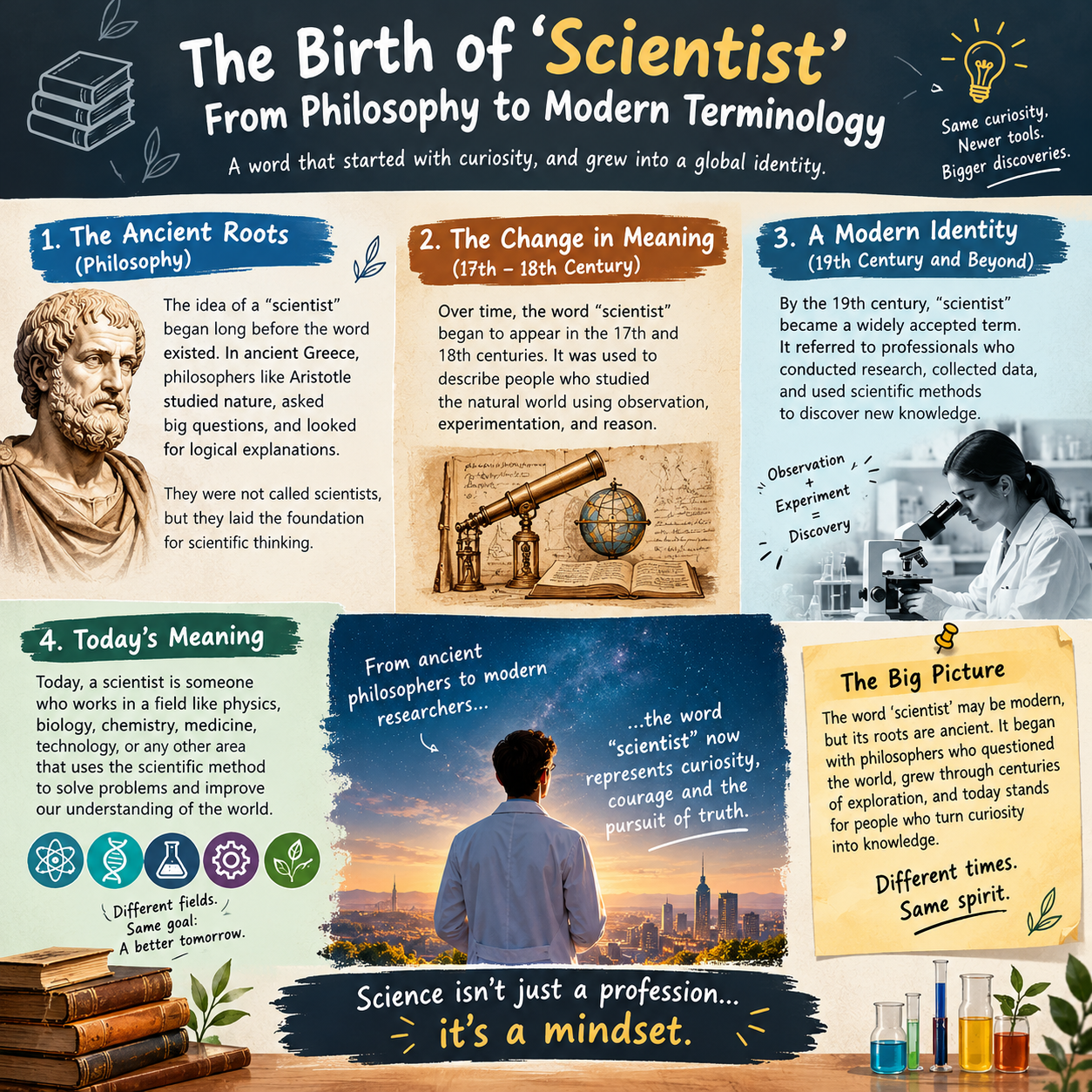
    Story post topic:The Birth of “Scientist” – From Philosophy to Modern Terminology

    Have you ever wondered how the word “scientist” came into existence? This story explores the fascinating journey of the word, from ancient philosophers who questioned the mysteries of nature to modern scientists who use observation, experimentation, and technology to discover new knowledge.

    From the early ideas of philosophers like Aristotle to today's researchers working in physics, biology, chemistry, and medicine, science has continuously evolved. This journey shows how human curiosity has helped us understand the world and make incredible discoveries.

    The key message: Science is more than a profession; it is a mindset built on curiosity, critical thinking, and the courage to ask questions. Different times, same spirit of discovery!

    #HistoryOfScience #Scientist #ScientificDiscoveries #Philosophy #ScienceAndTechnology #Curiosity #Knowledge #LearningJourney #ClassFoundation #RSf8
    RSIf8 Roll Number: 49 Story post no.43 Story post topic:The Birth of “Scientist” – From Philosophy to Modern Terminology Have you ever wondered how the word “scientist” came into existence? 🌍✨ This story explores the fascinating journey of the word, from ancient philosophers who questioned the mysteries of nature to modern scientists who use observation, experimentation, and technology to discover new knowledge. From the early ideas of philosophers like Aristotle to today's researchers working in physics, biology, chemistry, and medicine, science has continuously evolved. 🧪🔭 This journey shows how human curiosity has helped us understand the world and make incredible discoveries. 💡 The key message: Science is more than a profession; it is a mindset built on curiosity, critical thinking, and the courage to ask questions. Different times, same spirit of discovery! #HistoryOfScience #Scientist #ScientificDiscoveries #Philosophy #ScienceAndTechnology #Curiosity #Knowledge #LearningJourney #ClassFoundation #RSf8
    0 Comentários 0 Compartilhamentos 1428 Visualizações
  • RSIF8
    Roll no:14
    song no:18
    song topic:Science and Faith: A Harmonious Comparison

    # Science and Faith: A Harmonious Comparison

    Welcome to **Science and Faith: A Harmonious Comparison**, an inspiring exploration of two important ways people seek to understand the world, discover meaning, and explore the mysteries of existence. Science and faith have influenced human thought, culture, and civilization for centuries, encouraging people to ask questions about life, nature, the universe, and our place within it.

    **The World of Science**

    Science helps us understand the natural world through observation, experimentation, evidence, and logical reasoning. From the smallest particles inside atoms to the vast galaxies across the universe, scientific discoveries continue to expand our knowledge. Science encourages curiosity, critical thinking, and the willingness to revise our understanding when new evidence becomes available.

    **The World of Faith**

    Faith provides many people with spiritual guidance, hope, purpose, and moral values. It encourages reflection on questions about meaning, responsibility, compassion, and our relationship with the world. Religious traditions have also inspired communities to explore knowledge, support education, and contribute to society.

    **Finding Common Ground**

    Science and faith do not always answer the same questions, and sometimes their interpretations differ. Science primarily investigates how the natural world works, while faith often addresses spiritual beliefs, values, and questions of meaning. Exploring both with an open mind can encourage thoughtful conversations, mutual respect, and a deeper appreciation of different perspectives.

    **What Will You Discover?**
    - How science investigates the universe through evidence.
    - How faith influences values, beliefs, and human purpose.
    - The differences between scientific explanations and spiritual interpretations.
    - Why respectful dialogue matters when discussing complex ideas.
    - How curiosity, humility, and understanding can bring people together.

    **The Message:** We can approach important questions with curiosity, respect, and a willingness to learn. By understanding different perspectives, we can encourage meaningful discussions and appreciate the many ways people search for truth and purpose.

    Join us on this fascinating journey where knowledge meets reflection and curiosity opens the door to understanding!

    Like, share, and subscribe for more educational content exploring science, philosophy, faith, history, and the wonders of the universe.

    #ScienceAndFaith #Science #Faith #Philosophy #Knowledge #Education #Universe #CriticalThinking #Spirituality #LearningTogether
    RSIF8 Roll no:14 song no:18 song topic:Science and Faith: A Harmonious Comparison # 🌍 Science and Faith: A Harmonious Comparison 🔬✨ Welcome to **Science and Faith: A Harmonious Comparison**, an inspiring exploration of two important ways people seek to understand the world, discover meaning, and explore the mysteries of existence. Science and faith have influenced human thought, culture, and civilization for centuries, encouraging people to ask questions about life, nature, the universe, and our place within it. 🔬 **The World of Science** Science helps us understand the natural world through observation, experimentation, evidence, and logical reasoning. From the smallest particles inside atoms to the vast galaxies across the universe, scientific discoveries continue to expand our knowledge. Science encourages curiosity, critical thinking, and the willingness to revise our understanding when new evidence becomes available. 🤲 **The World of Faith** Faith provides many people with spiritual guidance, hope, purpose, and moral values. It encourages reflection on questions about meaning, responsibility, compassion, and our relationship with the world. Religious traditions have also inspired communities to explore knowledge, support education, and contribute to society. 🌟 **Finding Common Ground** Science and faith do not always answer the same questions, and sometimes their interpretations differ. Science primarily investigates how the natural world works, while faith often addresses spiritual beliefs, values, and questions of meaning. Exploring both with an open mind can encourage thoughtful conversations, mutual respect, and a deeper appreciation of different perspectives. 🎯 **What Will You Discover?** - How science investigates the universe through evidence. - How faith influences values, beliefs, and human purpose. - The differences between scientific explanations and spiritual interpretations. - Why respectful dialogue matters when discussing complex ideas. - How curiosity, humility, and understanding can bring people together. 💡 **The Message:** We can approach important questions with curiosity, respect, and a willingness to learn. By understanding different perspectives, we can encourage meaningful discussions and appreciate the many ways people search for truth and purpose. Join us on this fascinating journey where knowledge meets reflection and curiosity opens the door to understanding! 🌌📚 👍 Like, share, and subscribe for more educational content exploring science, philosophy, faith, history, and the wonders of the universe. #ScienceAndFaith #Science #Faith #Philosophy #Knowledge #Education #Universe #CriticalThinking #Spirituality #LearningTogether
    0 Comentários 0 Compartilhamentos 2108 Visualizações 7
  • RSIF8
    Roll no: 86
    Short Documentary no: 3
    Short Documentary Topic: **The Birth of "Scientist": From Philosophy to Modern Terminology**

    In this task, I created and shared a short documentary titled **"The Birth of 'Scientist': From Philosophy to Modern Terminology"** on **Facebook, YouTube, LinkedIn, Instagram, and TikTok**.

    This documentary explores the history of the word **"scientist"** and explains how people who were once known as **natural philosophers** gradually became recognized as scientists. It highlights how the growth of scientific knowledge and discoveries led to the need for a new term that represented professionals dedicated to scientific research and innovation.

    Through this documentary, I learned that science has evolved over centuries through curiosity, observation, experimentation, and evidence. The contributions of great thinkers and researchers have transformed our understanding of the world and continue to improve our daily lives through medicine, technology, engineering, and environmental research.

    Creating this documentary improved my research, communication, and presentation skills. It also helped me appreciate the importance of scientific history and the role scientists play in solving global challenges and advancing human knowledge.

    Overall, this project was educational, informative, and inspiring. It encouraged me to value scientific thinking, continue learning, and understand how knowledge evolves over time to shape a better future for humanity.

    #Scientist #ScienceHistory #Innovation #Education #Learning #StudentLearning #Research #ScientificDiscovery #Technology #Knowledge #RSIF8
    RSIF8 Roll no: 86 Short Documentary no: 3 Short Documentary Topic: **The Birth of "Scientist": From Philosophy to Modern Terminology** 🎥🔬📚 In this task, I created and shared a short documentary titled **"The Birth of 'Scientist': From Philosophy to Modern Terminology"** on **Facebook, YouTube, LinkedIn, Instagram, and TikTok**. 📱🌍✨ This documentary explores the history of the word **"scientist"** and explains how people who were once known as **natural philosophers** gradually became recognized as scientists. It highlights how the growth of scientific knowledge and discoveries led to the need for a new term that represented professionals dedicated to scientific research and innovation. 🔬💡 Through this documentary, I learned that science has evolved over centuries through curiosity, observation, experimentation, and evidence. The contributions of great thinkers and researchers have transformed our understanding of the world and continue to improve our daily lives through medicine, technology, engineering, and environmental research. 🌱🚀 Creating this documentary improved my research, communication, and presentation skills. It also helped me appreciate the importance of scientific history and the role scientists play in solving global challenges and advancing human knowledge. 🎤📖 Overall, this project was educational, informative, and inspiring. It encouraged me to value scientific thinking, continue learning, and understand how knowledge evolves over time to shape a better future for humanity. 🌟✨ #Scientist #ScienceHistory #Innovation #Education #Learning #StudentLearning #Research #ScientificDiscovery #Technology #Knowledge #RSIF8 🔬📚🌍🚀✨
    0 Comentários 0 Compartilhamentos 1480 Visualizações 11
  • #rsisb Roll No:232 Foundation level student. Documentary No:5 🔬 **Description:** Discover the fascinating history of the word **“Scientist”** and explore how it evolved from ancient philosophy to modern scientific terminology! 🌍📖 In this documentary, we will explore how people in the past studied nature, the universe, and human life through philosophy and observation. We will learn how the word “scientist” became popular in the 19th century and how science developed into a major field of modern knowledge. From curious philosophers to groundbreaking researchers, this journey highlights the importance of curiosity, creativity, experimentation, and discovery in shaping our world. 🧪💡 Join us to discover the origins of scientific thinking and understand how the language of science has changed over time. 🚀 ✨ **Keep learning, stay curious, and explore the world of science!** #️⃣ **Hashtags:** #Scientist #HistoryOfScience #ScienceDocumentary #WordOrigins #Etymology #ScientificDiscovery #Philosophy #ModernScience #ScienceHistory #Education #Knowledge #LearningJourney #Curiosity #Innovation #Technology #Research #Documentary #KeepLearning #ExploreScience #EducationalContent 🎥🔬📚🌍🧪💡🚀✨ Irum Asim Leadershipwali Asma Shaheen EducationWali Rehan School Islamabad Campus https://www.facebook.com/share/v/1E1ykR5mCZ/
    WWW.FACEBOOK.COM
    Facebook
    #rsisb Roll No:232 Foundation level student. Documentary No:5 🔬 **Description:** Discover the fascinating history of the word **“Scientist”** and explore how it evolved from ancient philosophy to...
    0 Comentários 0 Compartilhamentos 1485 Visualizações
  • RSIF8
    Roll no:14
    story no:24
    story topic:The Nature of Light: Exploring Waves and Particles

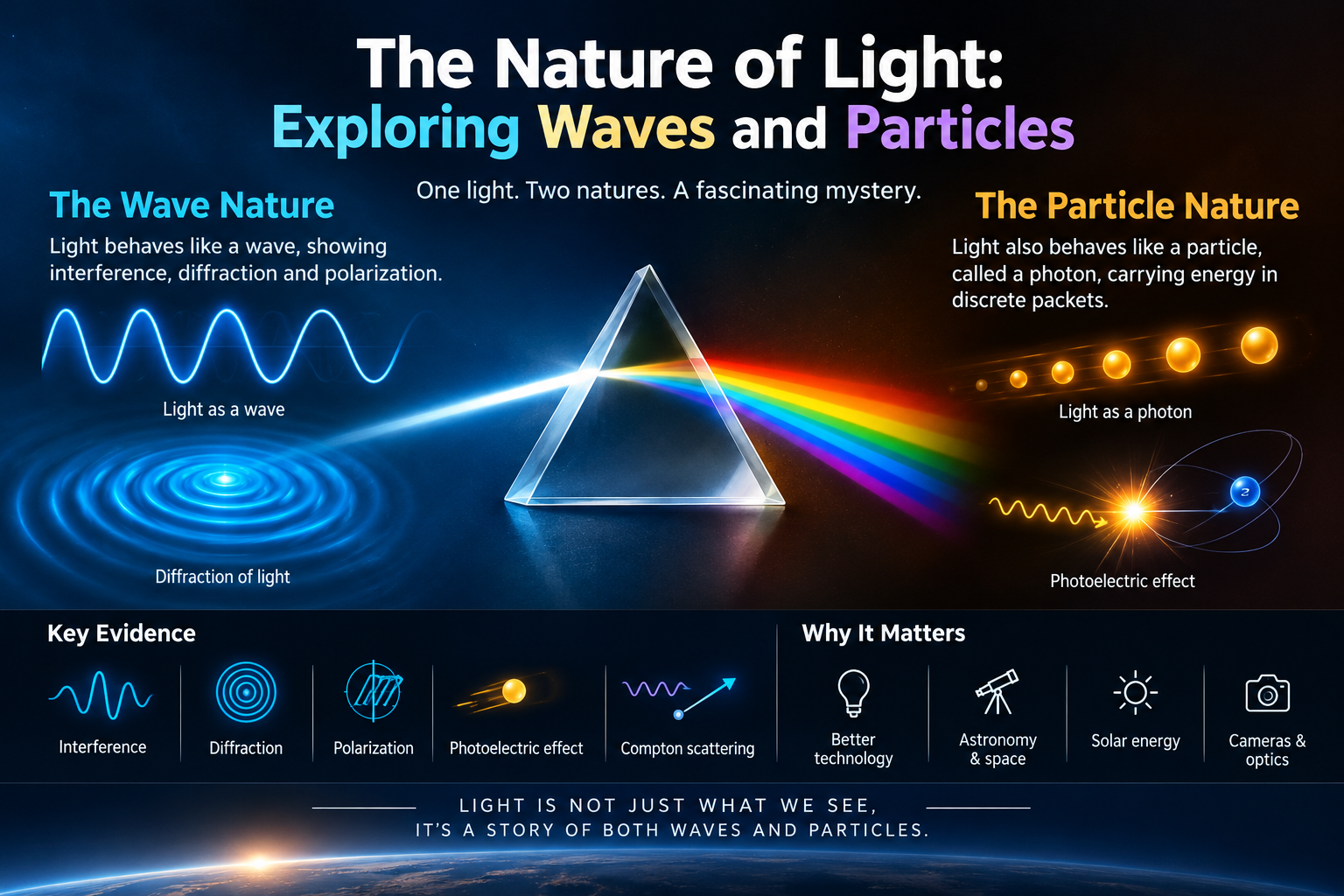
    **The Nature of Light: Exploring Waves and Particles**

    Have you ever wondered what light really is? How does sunlight travel across millions of kilometers through space, how do rainbows form, and how can light behave like both a wave and a particle? The nature of light is one of the most fascinating topics in physics, revealing the extraordinary connection between the visible world and the mysterious laws of quantum mechanics. From the light that illuminates our homes to the distant stars shining in the universe, light plays an essential role in understanding the world around us.

    **1. The Wave Nature of Light **

    For many years, scientists have studied light as a wave because it demonstrates important wave-like properties. Light can undergo interference, diffraction, and polarization. Interference occurs when light waves overlap and combine, producing patterns of brightness and darkness. Diffraction happens when light spreads around an obstacle or passes through a narrow opening. Polarization describes the orientation of light's oscillations and helps us understand how light interacts with different materials.

    These properties demonstrate that the wave model is essential for explaining many optical phenomena. From colorful patterns created by thin films to the operation of polarized sunglasses, the wave nature of light has many applications in everyday life and modern technology.

    **2. The Particle Nature of Light **

    Light also behaves in ways that reveal its particle nature. In quantum physics, light energy is exchanged in discrete packets called **photons**. Each photon carries energy determined by its frequency, described by the equation **E = hf**, where E represents energy, h is Planck's constant, and f is frequency.

    The photoelectric effect provides important evidence for this particle nature. When light of a suitable frequency strikes certain materials, it can release electrons from their surfaces. This phenomenon helped scientists understand that light energy is transferred in individual quanta rather than always behaving like a continuous wave.

    Another important example is Compton scattering, in which photons exchange energy and momentum with electrons. These discoveries transformed our understanding of light and helped establish the foundations of quantum physics.

    **3. Wave-Particle Duality: Two Sides of Light**

    One of the most remarkable discoveries in science is that light cannot be fully explained by treating it only as a classical wave or only as a classical particle. Its behavior depends on the physical process being investigated and how it is measured. This concept is known as **wave-particle duality**.

    Experiments involving interference reveal wave-like patterns, while experiments involving photon detection show that light energy is detected in discrete units. Quantum mechanics brings these observations together into a more complete description of nature. Rather than being an ordinary wave or a tiny classical object, light is a quantum phenomenon with properties that challenge our everyday intuition.

    **4. How Do We Discover the Secrets of Light?**

    Scientists use carefully designed experiments to explore the behavior of light. Prisms separate white light into different colors, optical instruments measure its properties, and advanced detectors record individual photons. Interference experiments reveal patterns that cannot be explained by simple particle models, while photoelectric experiments demonstrate the importance of quantized energy.

    The work of scientists such as Isaac Newton, Thomas Young, Max Planck, Albert Einstein, and Arthur Compton helped build our modern understanding of light. Their discoveries show how scientific knowledge develops through observation, experimentation, mathematical reasoning, and new ideas.

    **5. Why Is the Nature of Light Important?**

    Understanding light is essential to many technologies that shape modern life. Lasers are used in medicine, manufacturing, and scientific research. Fiber-optic cables transmit information across the world using pulses of light. Solar panels convert light energy into electrical energy, while cameras and telescopes help us capture images and explore distant objects in space.

    The principles of light are also important in astronomy, microscopy, optical communication, quantum technologies, and the study of the universe. By investigating how light behaves, scientists can examine distant galaxies, study the structure of matter, and develop new tools that improve our understanding of nature.

    **6. Light: Connecting Science and the Universe**

    Light is much more than what allows us to see. It carries information about distant stars, reveals the composition of celestial objects, and provides clues about the physical processes occurring throughout the cosmos. By analyzing the light received from distant galaxies, astronomers can learn about their temperatures, chemical compositions, and motion.

    At the smallest scales, the study of photons helps scientists investigate the quantum world and understand how energy interacts with matter. From the smallest laboratory experiments to the largest astronomical observations, light connects different areas of science in extraordinary ways.

    **Conclusion: The Extraordinary Mystery of Light**

    The study of light demonstrates how nature can be far more complex than it first appears. Its wave-like properties explain interference, diffraction, and polarization, while its particle-like properties help explain the photoelectric effect and Compton scattering. Together, these discoveries form an important part of our modern understanding of physics.

    Learning about wave-particle duality encourages us to question assumptions, explore scientific evidence, and appreciate the discoveries that continue to expand human knowledge. Every beam of sunlight, every shining star, and every photon detected by a scientific instrument reminds us that there is still much to discover about the universe.

    **Light Is More Than What We See—It Is a Window into the Fundamental Nature of Reality!**

    If you enjoyed this science topic, share it with others and continue exploring the fascinating world of physics. Stay curious, keep asking questions, and never stop learning!

    #NatureOfLight #WaveParticleDuality #Physics #QuantumPhysics #ScienceEducation #Photons #LightWaves #PhotoelectricEffect #ComptonScattering #Optics #Astronomy #ScientificDiscoveries #STEMEducation #LearnPhysics #ScienceExplained #EducationalContent #WavesAndParticles
    RSIF8 Roll no:14 story no:24 story topic:The Nature of Light: Exploring Waves and Particles 🌟 **The Nature of Light: Exploring Waves and Particles** 🌈🔬 Have you ever wondered what light really is? How does sunlight travel across millions of kilometers through space, how do rainbows form, and how can light behave like both a wave and a particle? The nature of light is one of the most fascinating topics in physics, revealing the extraordinary connection between the visible world and the mysterious laws of quantum mechanics. From the light that illuminates our homes to the distant stars shining in the universe, light plays an essential role in understanding the world around us. 🌍✨ 💡 **1. The Wave Nature of Light 🌊** For many years, scientists have studied light as a wave because it demonstrates important wave-like properties. Light can undergo interference, diffraction, and polarization. Interference occurs when light waves overlap and combine, producing patterns of brightness and darkness. Diffraction happens when light spreads around an obstacle or passes through a narrow opening. Polarization describes the orientation of light's oscillations and helps us understand how light interacts with different materials. These properties demonstrate that the wave model is essential for explaining many optical phenomena. From colorful patterns created by thin films to the operation of polarized sunglasses, the wave nature of light has many applications in everyday life and modern technology. ⚛️ **2. The Particle Nature of Light ✨** Light also behaves in ways that reveal its particle nature. In quantum physics, light energy is exchanged in discrete packets called **photons**. Each photon carries energy determined by its frequency, described by the equation **E = hf**, where E represents energy, h is Planck's constant, and f is frequency. The photoelectric effect provides important evidence for this particle nature. When light of a suitable frequency strikes certain materials, it can release electrons from their surfaces. This phenomenon helped scientists understand that light energy is transferred in individual quanta rather than always behaving like a continuous wave. Another important example is Compton scattering, in which photons exchange energy and momentum with electrons. These discoveries transformed our understanding of light and helped establish the foundations of quantum physics. 🔬 **3. Wave-Particle Duality: Two Sides of Light** One of the most remarkable discoveries in science is that light cannot be fully explained by treating it only as a classical wave or only as a classical particle. Its behavior depends on the physical process being investigated and how it is measured. This concept is known as **wave-particle duality**. Experiments involving interference reveal wave-like patterns, while experiments involving photon detection show that light energy is detected in discrete units. Quantum mechanics brings these observations together into a more complete description of nature. Rather than being an ordinary wave or a tiny classical object, light is a quantum phenomenon with properties that challenge our everyday intuition. 🌈 **4. How Do We Discover the Secrets of Light?** Scientists use carefully designed experiments to explore the behavior of light. Prisms separate white light into different colors, optical instruments measure its properties, and advanced detectors record individual photons. Interference experiments reveal patterns that cannot be explained by simple particle models, while photoelectric experiments demonstrate the importance of quantized energy. The work of scientists such as Isaac Newton, Thomas Young, Max Planck, Albert Einstein, and Arthur Compton helped build our modern understanding of light. Their discoveries show how scientific knowledge develops through observation, experimentation, mathematical reasoning, and new ideas. 🚀 **5. Why Is the Nature of Light Important?** Understanding light is essential to many technologies that shape modern life. Lasers are used in medicine, manufacturing, and scientific research. Fiber-optic cables transmit information across the world using pulses of light. Solar panels convert light energy into electrical energy, while cameras and telescopes help us capture images and explore distant objects in space. The principles of light are also important in astronomy, microscopy, optical communication, quantum technologies, and the study of the universe. By investigating how light behaves, scientists can examine distant galaxies, study the structure of matter, and develop new tools that improve our understanding of nature. 🌍 **6. Light: Connecting Science and the Universe** Light is much more than what allows us to see. It carries information about distant stars, reveals the composition of celestial objects, and provides clues about the physical processes occurring throughout the cosmos. By analyzing the light received from distant galaxies, astronomers can learn about their temperatures, chemical compositions, and motion. At the smallest scales, the study of photons helps scientists investigate the quantum world and understand how energy interacts with matter. From the smallest laboratory experiments to the largest astronomical observations, light connects different areas of science in extraordinary ways. 💫 **Conclusion: The Extraordinary Mystery of Light** The study of light demonstrates how nature can be far more complex than it first appears. Its wave-like properties explain interference, diffraction, and polarization, while its particle-like properties help explain the photoelectric effect and Compton scattering. Together, these discoveries form an important part of our modern understanding of physics. Learning about wave-particle duality encourages us to question assumptions, explore scientific evidence, and appreciate the discoveries that continue to expand human knowledge. Every beam of sunlight, every shining star, and every photon detected by a scientific instrument reminds us that there is still much to discover about the universe. ✨ **Light Is More Than What We See—It Is a Window into the Fundamental Nature of Reality!** 🔭🌌 👍 If you enjoyed this science topic, share it with others and continue exploring the fascinating world of physics. Stay curious, keep asking questions, and never stop learning! #NatureOfLight #WaveParticleDuality #Physics #QuantumPhysics #ScienceEducation #Photons #LightWaves #PhotoelectricEffect #ComptonScattering #Optics #Astronomy #ScientificDiscoveries #STEMEducation #LearnPhysics #ScienceExplained #EducationalContent #WavesAndParticles 🌈🔬🚀

    0 Comentários 0 Compartilhamentos 8015 Visualizações
  • RSIF8
    Roll no:14
    story no:22
    story post topic:Exploring Life’s Mechanisms Through Experimentation
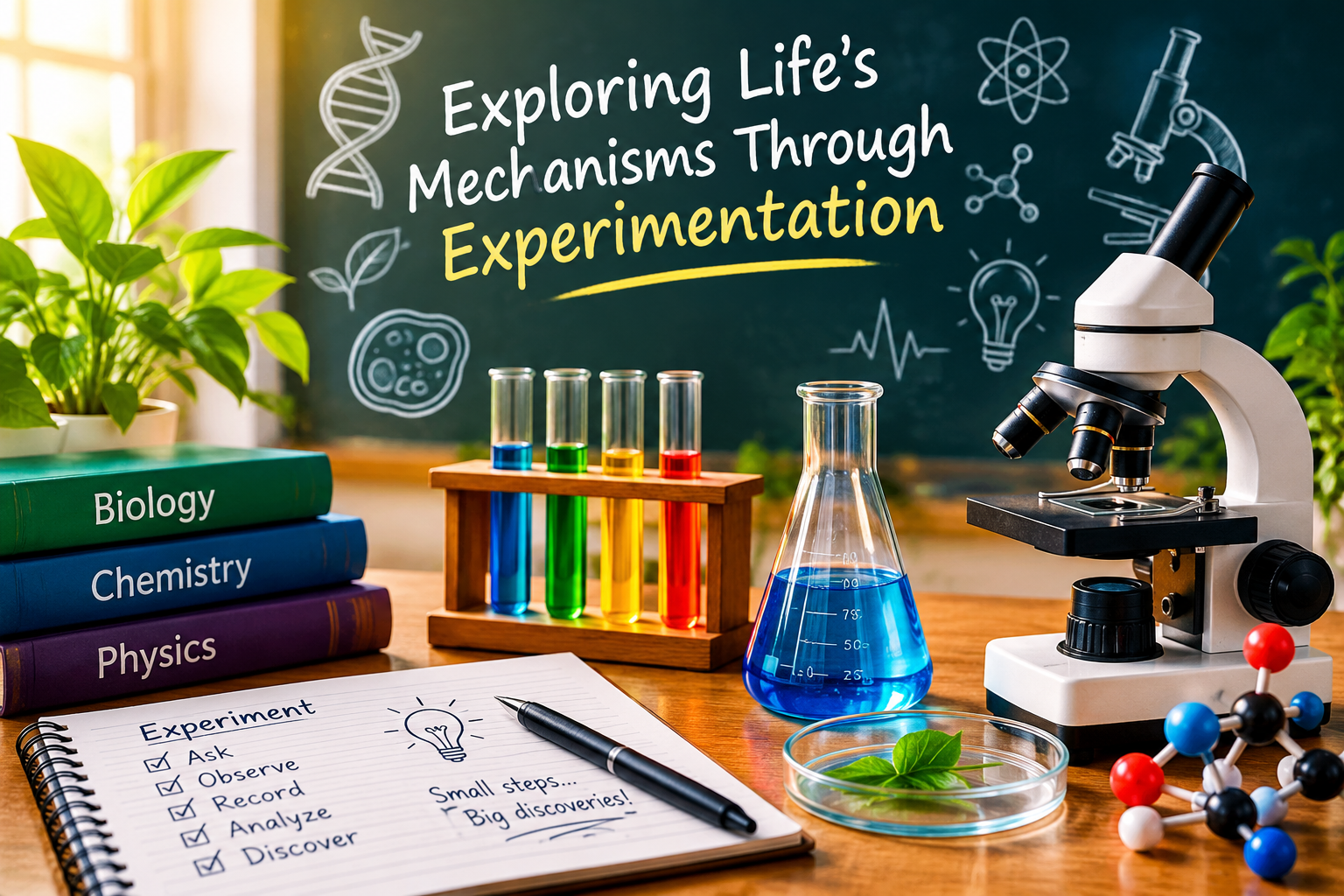
    # Exploring Life’s Mechanisms Through Experimentation

    Welcome to the fascinating world of scientific discovery, where curiosity meets experimentation and every observation brings us closer to understanding the mysteries of life! **“Exploring Life’s Mechanisms Through Experimentation”** highlights the importance of practical experiments in understanding how living organisms function, grow, and interact with their environments.

    Through hands-on activities, laboratory experiments, microscopes, and scientific observations, students can explore the amazing processes that take place inside living things. From examining plant growth and studying cells to understanding biological systems, experimentation helps transform scientific theories into meaningful discoveries.

    **Key Topics Covered:**
    - Understanding the structure and functions of living organisms
    - Exploring cells, DNA, and biological processes
    - Investigating plant growth and environmental factors
    - Learning through experiments and scientific observations
    - Developing critical thinking and problem-solving skills
    - Discovering how living organisms interact with their surroundings

    **Why Is Experimentation Important?**

    Scientific experimentation allows learners to ask questions, test ideas, analyze results, and develop evidence-based conclusions. It encourages creativity, patience, and curiosity while helping students understand the principles of biology and life sciences.

    Whether you are a student, science enthusiast, or aspiring researcher, exploring life's mechanisms through experimentation opens the door to new knowledge and exciting discoveries. Every experiment is an opportunity to learn something new about the incredible world around us!

    **Observe, experiment, discover, and explore the science of life—because every great discovery begins with a question!**

    #Biology #ScienceExperiments #LifeSciences #ScientificDiscovery #BiologyLab #LearningThroughExperimentation #STEMEducation #ScienceLearning #CellBiology #NatureAndScience #EducationalContent #ExploreScience
    RSIF8 Roll no:14 story no:22 story post topic:Exploring Life’s Mechanisms Through Experimentation # 🔬 Exploring Life’s Mechanisms Through Experimentation 🧬 Welcome to the fascinating world of scientific discovery, where curiosity meets experimentation and every observation brings us closer to understanding the mysteries of life! 🌱🔍 **“Exploring Life’s Mechanisms Through Experimentation”** highlights the importance of practical experiments in understanding how living organisms function, grow, and interact with their environments. Through hands-on activities, laboratory experiments, microscopes, and scientific observations, students can explore the amazing processes that take place inside living things. From examining plant growth and studying cells to understanding biological systems, experimentation helps transform scientific theories into meaningful discoveries. 🧪🌿 💡 **Key Topics Covered:** - 🔬 Understanding the structure and functions of living organisms - 🧬 Exploring cells, DNA, and biological processes - 🌱 Investigating plant growth and environmental factors - 🧪 Learning through experiments and scientific observations - 📚 Developing critical thinking and problem-solving skills - 🌍 Discovering how living organisms interact with their surroundings 🎯 **Why Is Experimentation Important?** Scientific experimentation allows learners to ask questions, test ideas, analyze results, and develop evidence-based conclusions. It encourages creativity, patience, and curiosity while helping students understand the principles of biology and life sciences. 🌟 Whether you are a student, science enthusiast, or aspiring researcher, exploring life's mechanisms through experimentation opens the door to new knowledge and exciting discoveries. Every experiment is an opportunity to learn something new about the incredible world around us! ✨ **Observe, experiment, discover, and explore the science of life—because every great discovery begins with a question!** #Biology #ScienceExperiments #LifeSciences #ScientificDiscovery #BiologyLab #LearningThroughExperimentation #STEMEducation #ScienceLearning #CellBiology #NatureAndScience #EducationalContent #ExploreScience
    0 Comentários 0 Compartilhamentos 3811 Visualizações
  • RSIF8
    Roll no: 99
    Song no: 20
    Song topic: From Specimens to Knowledge: The Purpose of Science Experiments

    A captivating melody celebrating how observation, experimentation, and curiosity transform tiny specimens into powerful scientific discoveries.

    #ScienceExperiments #FromSpecimensToKnowledge #ScientificDiscovery #LearningThroughScience #RSIF8
    RSIF8 Roll no: 99 Song no: 20 Song topic: From Specimens to Knowledge: The Purpose of Science Experiments A captivating melody celebrating how observation, experimentation, and curiosity transform tiny specimens into powerful scientific discoveries. 🔬🧪🎶 #ScienceExperiments #FromSpecimensToKnowledge #ScientificDiscovery #LearningThroughScience #RSIF8
    0 Comentários 0 Compartilhamentos 1838 Visualizações 4
  • RSIF8
    TASK NO:139
    ROLLNO:13
    # Exploring Life’s Mechanisms Through Experimentation

    Life is full of mysteries, discoveries, and amazing processes that help us understand how living organisms work. **“Exploring Life’s Mechanisms Through Experimentation”** is an exciting topic that highlights the importance of scientific experiments in understanding life, nature, and the world around us. Through observation, investigation, and practical activities, we can explore how living things function and discover the scientific principles behind everyday phenomena.

    Experimentation is one of the most important parts of science. It allows us to ask questions, develop ideas, test hypotheses, observe results, and learn from our findings. Instead of simply memorizing facts from books, we can use experiments to understand scientific concepts through practical experience. Every experiment gives us an opportunity to explore something new, improve our knowledge, and develop critical-thinking skills.

    Biology helps us understand living organisms, including plants, animals, humans, and microorganisms. By studying cells, we can discover how the basic units of life work together to support living systems. We can investigate how plants grow, how seeds germinate, how leaves respond to sunlight, and how environmental conditions affect living things. These investigations help us appreciate the complexity of life and understand the relationships between organisms and their surroundings.

    Chemistry also plays an important role in understanding life. Living organisms depend on chemical reactions to obtain energy, grow, repair cells, and maintain essential functions. Through safe and supervised experiments, students can explore how different substances interact, observe changes in color, and learn about solutions, acids, bases, and chemical reactions. These activities demonstrate that chemistry is not just a subject in a textbook; it is connected to many processes that happen inside our bodies and throughout the natural world.

    Microscopes and laboratory equipment make scientific exploration even more interesting. A microscope allows us to observe structures that are too small to see
    RSIF8 TASK NO:139 ROLLNO:13 # Exploring Life’s Mechanisms Through Experimentation 🧬🔬🧪 Life is full of mysteries, discoveries, and amazing processes that help us understand how living organisms work. **“Exploring Life’s Mechanisms Through Experimentation”** is an exciting topic that highlights the importance of scientific experiments in understanding life, nature, and the world around us. Through observation, investigation, and practical activities, we can explore how living things function and discover the scientific principles behind everyday phenomena. Experimentation is one of the most important parts of science. It allows us to ask questions, develop ideas, test hypotheses, observe results, and learn from our findings. Instead of simply memorizing facts from books, we can use experiments to understand scientific concepts through practical experience. Every experiment gives us an opportunity to explore something new, improve our knowledge, and develop critical-thinking skills. Biology helps us understand living organisms, including plants, animals, humans, and microorganisms. By studying cells, we can discover how the basic units of life work together to support living systems. We can investigate how plants grow, how seeds germinate, how leaves respond to sunlight, and how environmental conditions affect living things. These investigations help us appreciate the complexity of life and understand the relationships between organisms and their surroundings. Chemistry also plays an important role in understanding life. Living organisms depend on chemical reactions to obtain energy, grow, repair cells, and maintain essential functions. Through safe and supervised experiments, students can explore how different substances interact, observe changes in color, and learn about solutions, acids, bases, and chemical reactions. These activities demonstrate that chemistry is not just a subject in a textbook; it is connected to many processes that happen inside our bodies and throughout the natural world. Microscopes and laboratory equipment make scientific exploration even more interesting. A microscope allows us to observe structures that are too small to see
    0 Comentários 0 Compartilhamentos 2814 Visualizações
  • RSIF8
    Roll no 94
    Song no 19
    Song topic
    Why Do We Experiment? The Search for Truth in Biology

    Every discovery in biology begins with a question and grows through experimentation. From understanding cells to unlocking the secrets of life, experiments help us uncover the truth hidden within nature.

    Join me on this journey of curiosity, learning, and scientific exploration!

    #Biology #Science #Experimentation #SearchForTruth #LearningJourney #STEMEducation #ScientificDiscovery #BiologyLovers #Education #Curiosity #Innovation #LifeSciences
    RSIF8 Roll no 94 Song no 19 Song topic 🌿🔬 Why Do We Experiment? The Search for Truth in Biology 🎶 Every discovery in biology begins with a question and grows through experimentation. 🧬✨ From understanding cells to unlocking the secrets of life, experiments help us uncover the truth hidden within nature. 🌱🔍 Join me on this journey of curiosity, learning, and scientific exploration! 🚀📚 #Biology #Science #Experimentation #SearchForTruth #LearningJourney #STEMEducation #ScientificDiscovery #BiologyLovers #Education #Curiosity #Innovation #LifeSciences 🧬🔬🌿✨🚀
    0 Comentários 0 Compartilhamentos 1791 Visualizações 7
  • RSIF8
    Roll no 94
    Storypost no 20
    Storypost topic
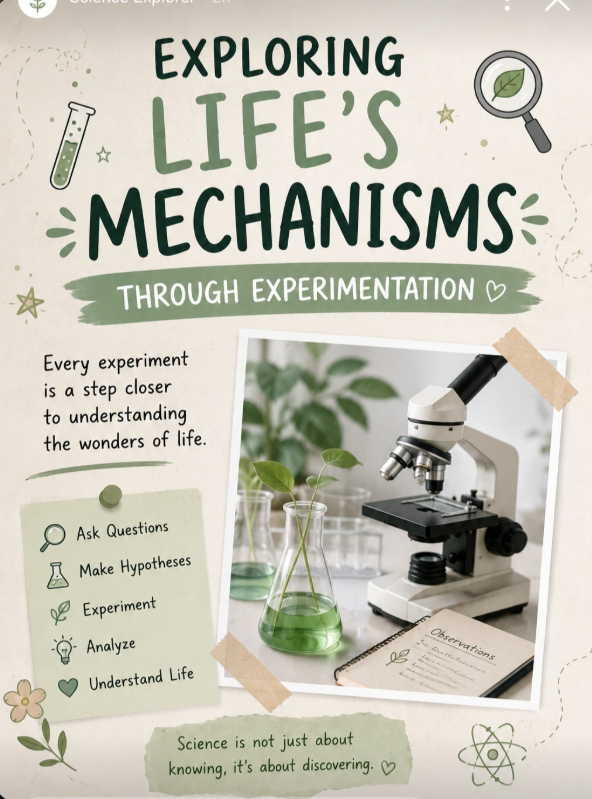
    Exploring Life's Mechanisms Through Experimentation
    Science begins with curiosity and grows through discovery. Every experiment helps us understand how living organisms function, adapt, and interact with the world around them.
    From observing tiny cells under a microscope to testing hypotheses in the lab, experimentation allows us to uncover the fascinating mechanisms that make life possible.
    Keep asking questions, exploring new ideas, and embracing the journey of learning. Every discovery starts with a single experiment!
    #Science #Biology #Experimentation #STEM #LifeSciences #ScientificDiscovery #Learning #Innovation #Curiosity #FutureScientists #Education #Research
    RSIF8 Roll no 94 Storypost no 20 Storypost topic 🔬🌱 Exploring Life's Mechanisms Through Experimentation 🧪✨ Science begins with curiosity and grows through discovery. Every experiment helps us understand how living organisms function, adapt, and interact with the world around them. 🌍💡 From observing tiny cells under a microscope to testing hypotheses in the lab, experimentation allows us to uncover the fascinating mechanisms that make life possible. 🔍🧬 Keep asking questions, exploring new ideas, and embracing the journey of learning. Every discovery starts with a single experiment! 🚀📚💚 #Science #Biology #Experimentation #STEM #LifeSciences #ScientificDiscovery #Learning #Innovation #Curiosity #FutureScientists #Education #Research 🔬🧪🌱📖✨
    0 Comentários 0 Compartilhamentos 1945 Visualizações
Páginas impulsionada