• RSIF8
    Roll no.49
    Image chatgpt no.12
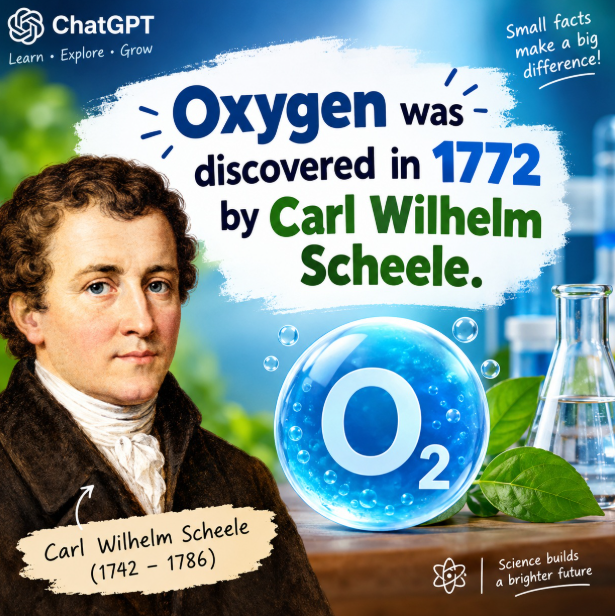
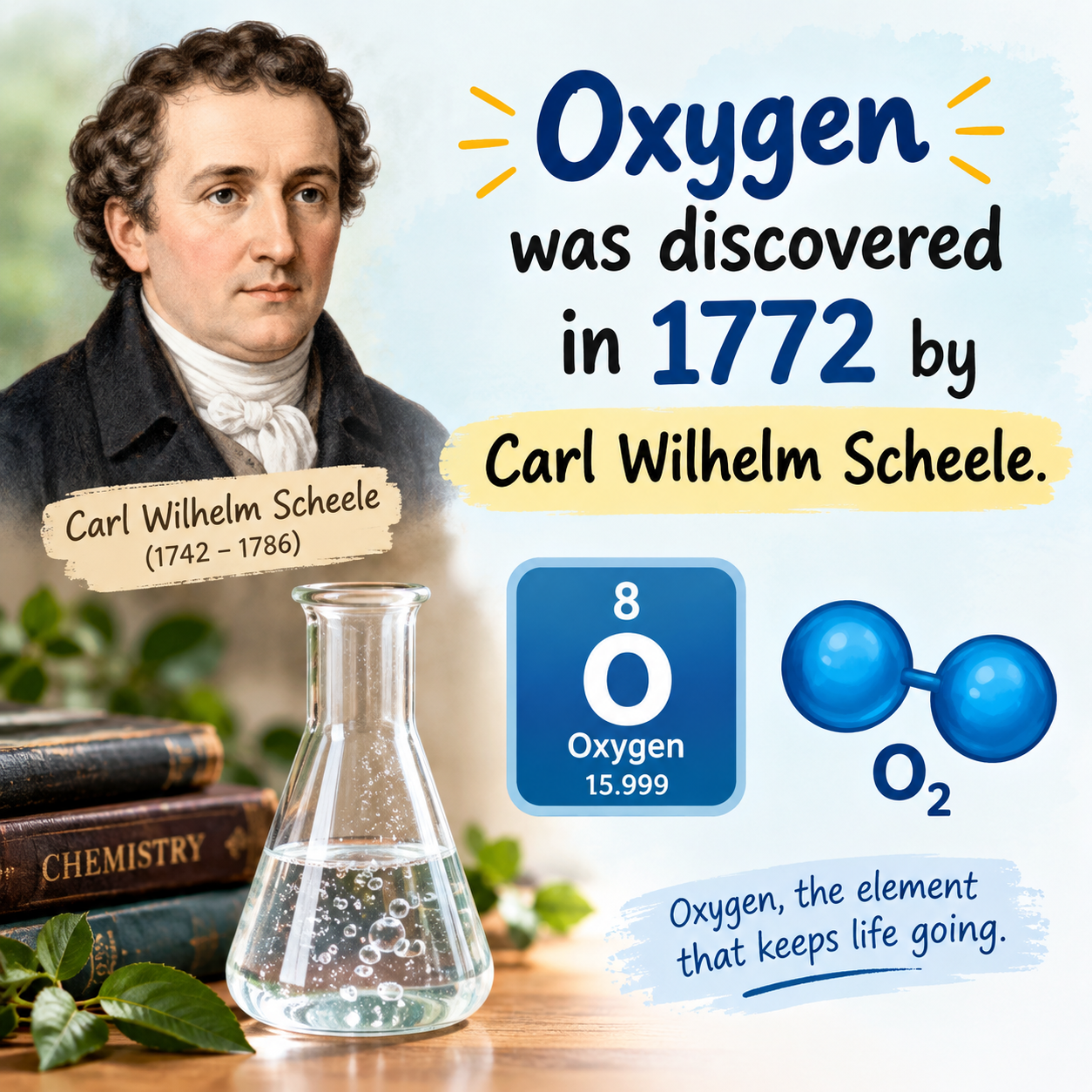
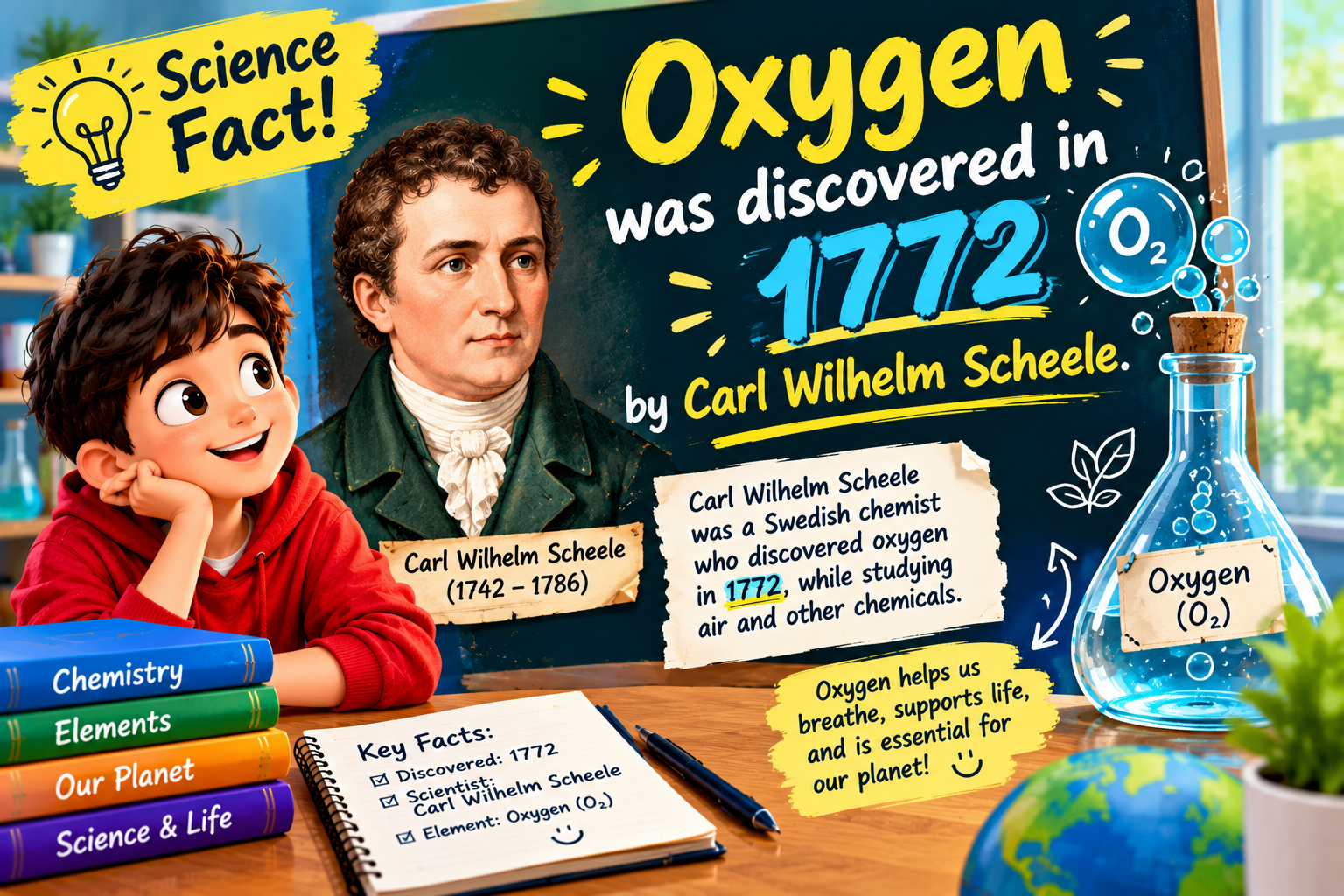
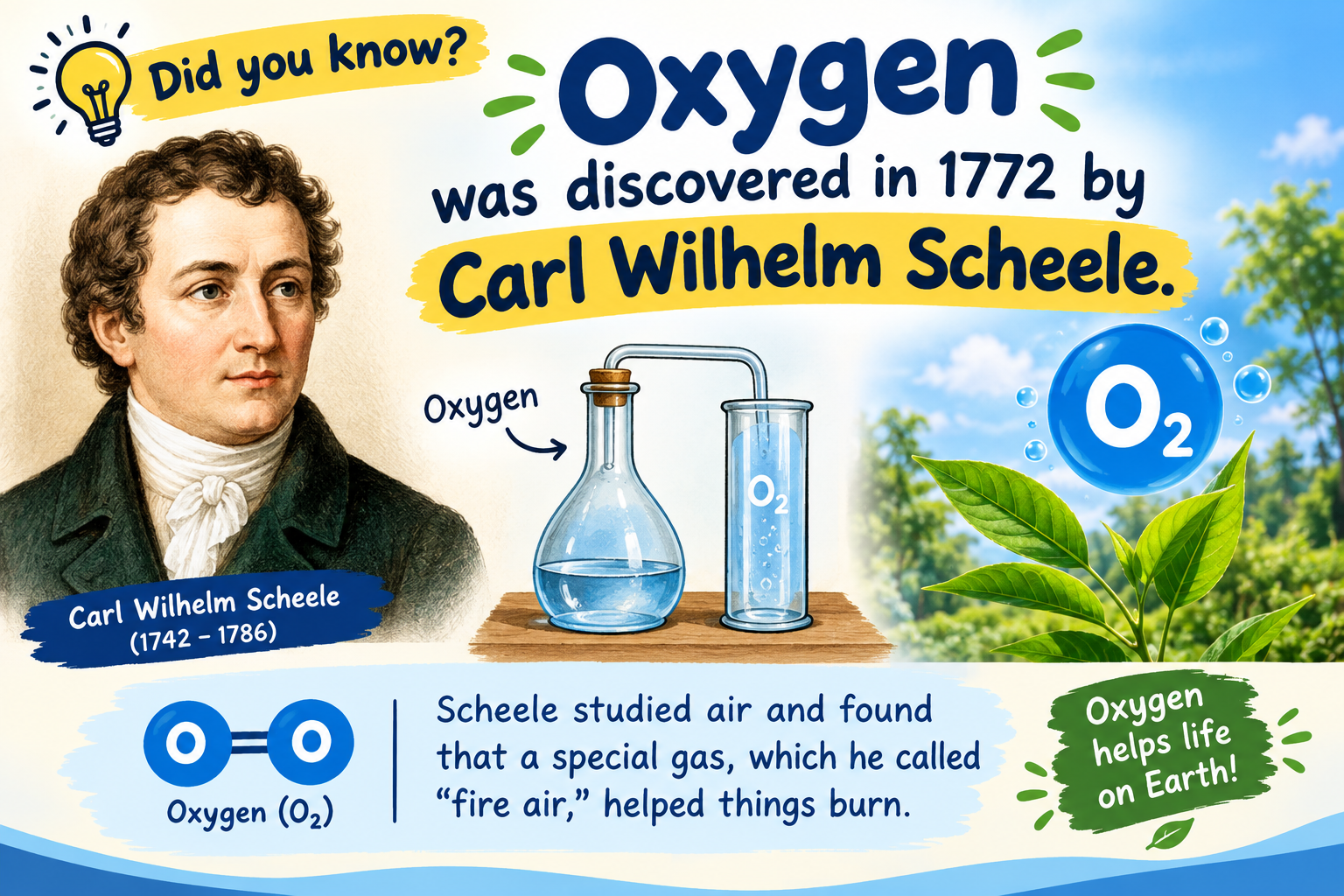
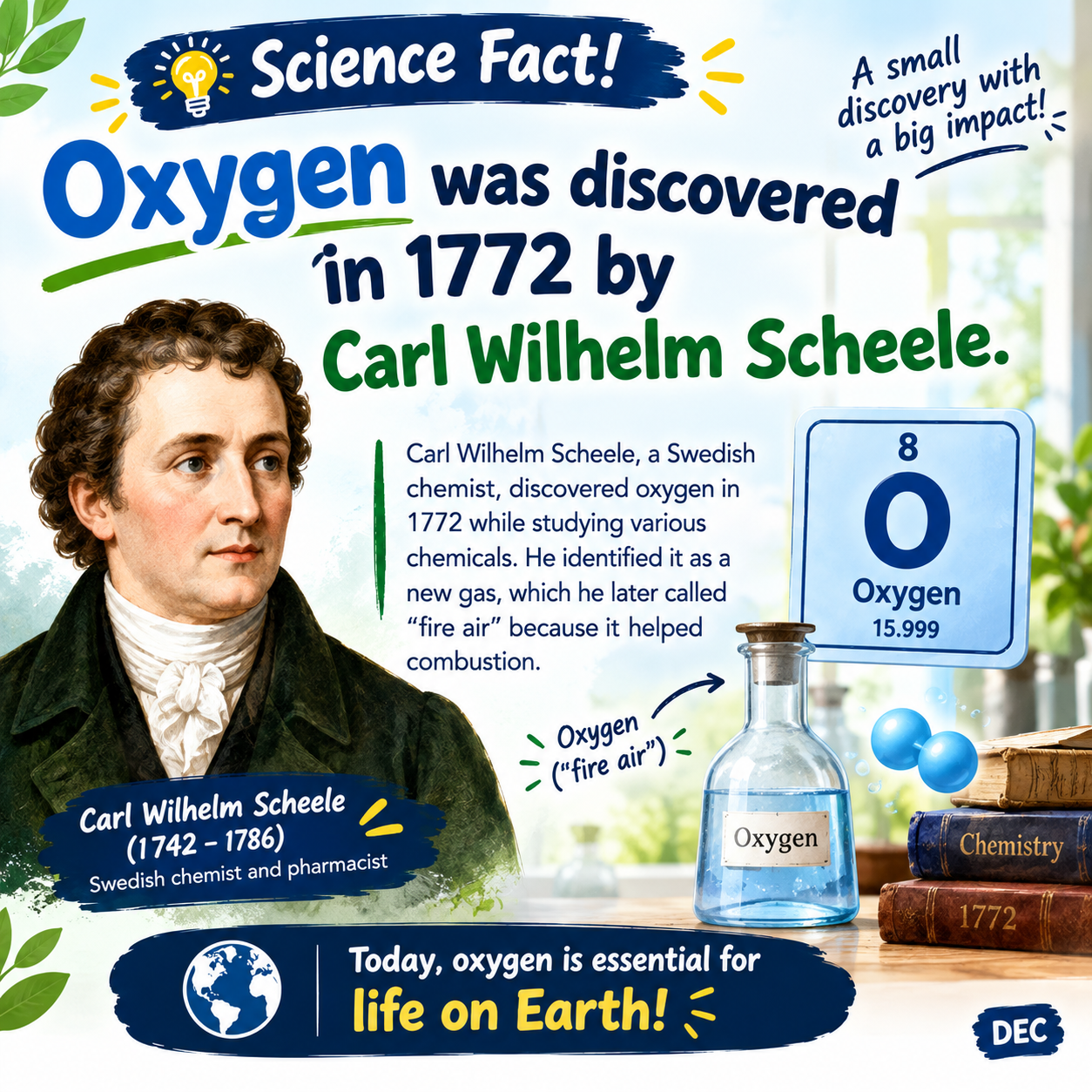
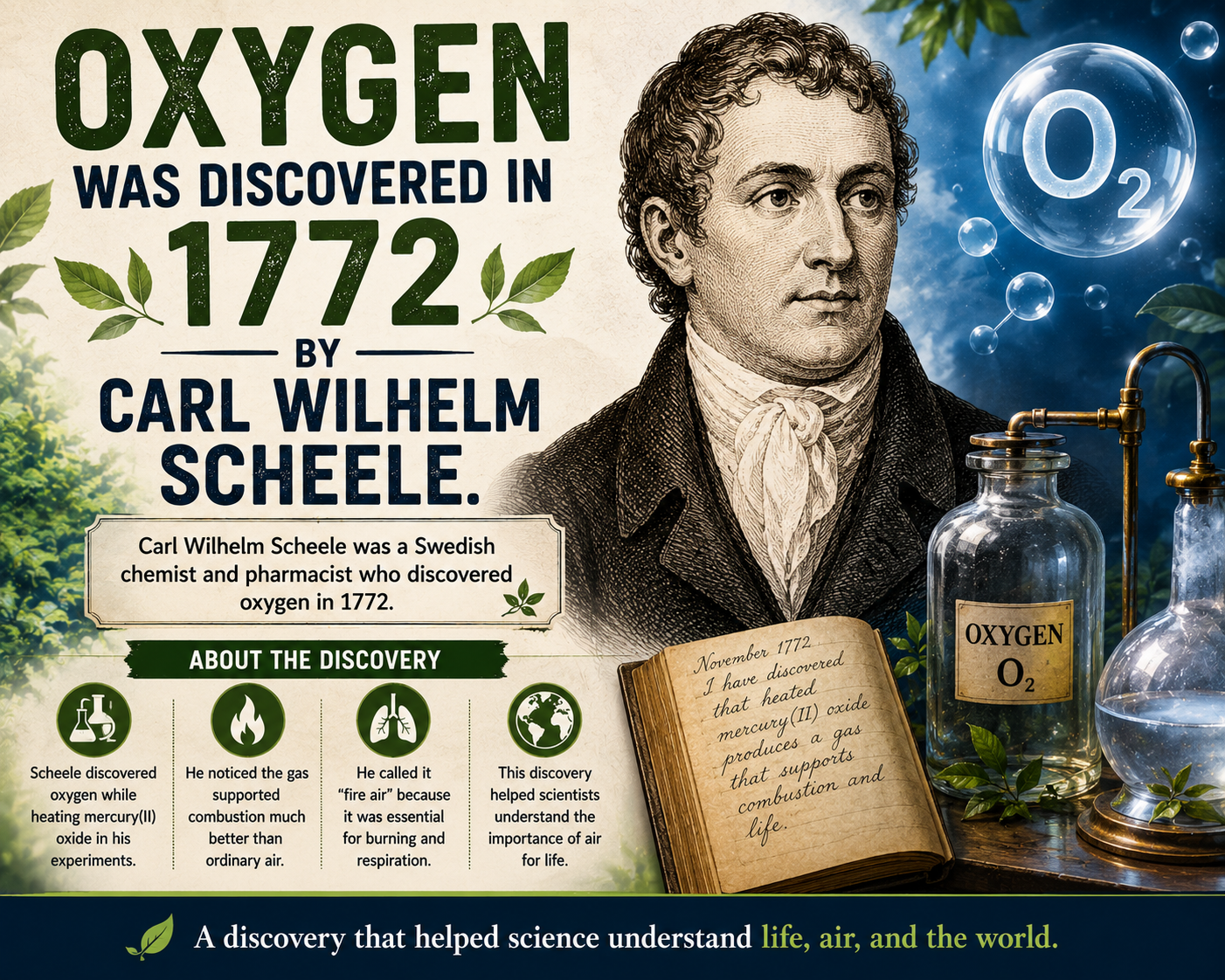
    Image Chatgpt topic:"Oxygen was discovered in 1772 by Carl Wilhelm Scheele." **Oxygen Discovery — A Remarkable Scientific Milestone!**

    Did you know that **oxygen was discovered in 1772 by Carl Wilhelm Scheele**? His work helped scientists understand one of the most important elements needed for life and combustion.

    Oxygen plays a vital role in breathing, energy production, medicine, and many natural processes. This discovery became an important milestone in the history of chemistry and continues to influence science today.

    **Learn • Explore • Discover • Grow!**

    #Oxygen #CarlWilhelmScheele #Science #Chemistry #ScienceFacts #HistoryOfScience #Education #DidYouKnow #Learning #ChatGPT
    RSIF8 Roll no.49 Image chatgpt no.12 Image Chatgpt topic:"Oxygen was discovered in 1772 by Carl Wilhelm Scheele." πŸ§ͺ **Oxygen Discovery — A Remarkable Scientific Milestone!** 🌍✨ Did you know that **oxygen was discovered in 1772 by Carl Wilhelm Scheele**? πŸ”¬πŸ’¨ His work helped scientists understand one of the most important elements needed for life and combustion. Oxygen plays a vital role in breathing, energy production, medicine, and many natural processes. 🌱🫁 This discovery became an important milestone in the history of chemistry and continues to influence science today. πŸ“š **Learn • Explore • Discover • Grow!** πŸš€ #Oxygen #CarlWilhelmScheele #Science #Chemistry #ScienceFacts #HistoryOfScience #Education #DidYouKnow #Learning #ChatGPT
    0 Commenti 0 condivisioni 1376 Views
  • RSIF8
    Roll no:14
    story no:24
    story topic:The Nature of Light: Exploring Waves and Particles

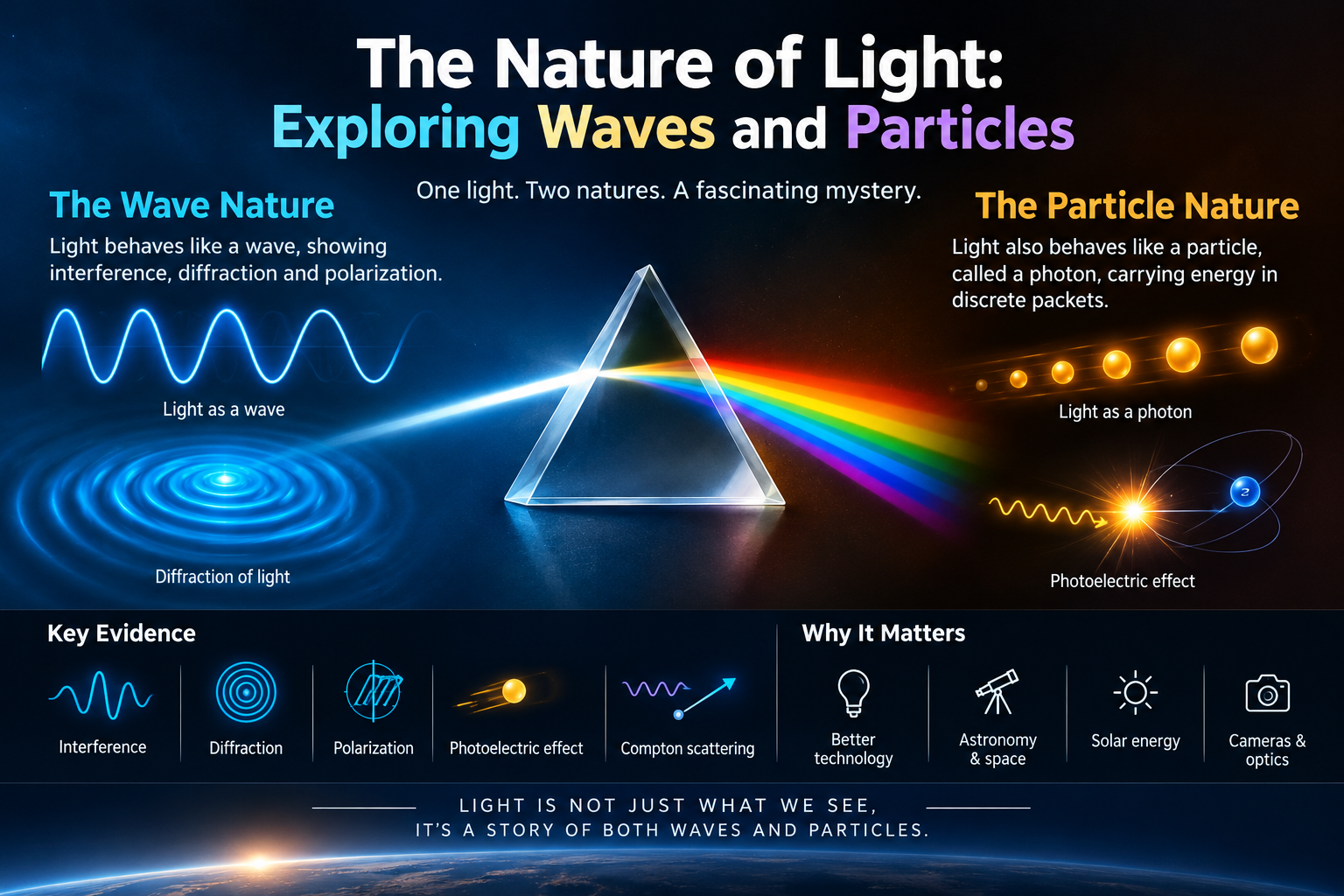
    **The Nature of Light: Exploring Waves and Particles**

    Have you ever wondered what light really is? How does sunlight travel across millions of kilometers through space, how do rainbows form, and how can light behave like both a wave and a particle? The nature of light is one of the most fascinating topics in physics, revealing the extraordinary connection between the visible world and the mysterious laws of quantum mechanics. From the light that illuminates our homes to the distant stars shining in the universe, light plays an essential role in understanding the world around us.

    **1. The Wave Nature of Light **

    For many years, scientists have studied light as a wave because it demonstrates important wave-like properties. Light can undergo interference, diffraction, and polarization. Interference occurs when light waves overlap and combine, producing patterns of brightness and darkness. Diffraction happens when light spreads around an obstacle or passes through a narrow opening. Polarization describes the orientation of light's oscillations and helps us understand how light interacts with different materials.

    These properties demonstrate that the wave model is essential for explaining many optical phenomena. From colorful patterns created by thin films to the operation of polarized sunglasses, the wave nature of light has many applications in everyday life and modern technology.

    **2. The Particle Nature of Light **

    Light also behaves in ways that reveal its particle nature. In quantum physics, light energy is exchanged in discrete packets called **photons**. Each photon carries energy determined by its frequency, described by the equation **E = hf**, where E represents energy, h is Planck's constant, and f is frequency.

    The photoelectric effect provides important evidence for this particle nature. When light of a suitable frequency strikes certain materials, it can release electrons from their surfaces. This phenomenon helped scientists understand that light energy is transferred in individual quanta rather than always behaving like a continuous wave.

    Another important example is Compton scattering, in which photons exchange energy and momentum with electrons. These discoveries transformed our understanding of light and helped establish the foundations of quantum physics.

    **3. Wave-Particle Duality: Two Sides of Light**

    One of the most remarkable discoveries in science is that light cannot be fully explained by treating it only as a classical wave or only as a classical particle. Its behavior depends on the physical process being investigated and how it is measured. This concept is known as **wave-particle duality**.

    Experiments involving interference reveal wave-like patterns, while experiments involving photon detection show that light energy is detected in discrete units. Quantum mechanics brings these observations together into a more complete description of nature. Rather than being an ordinary wave or a tiny classical object, light is a quantum phenomenon with properties that challenge our everyday intuition.

    **4. How Do We Discover the Secrets of Light?**

    Scientists use carefully designed experiments to explore the behavior of light. Prisms separate white light into different colors, optical instruments measure its properties, and advanced detectors record individual photons. Interference experiments reveal patterns that cannot be explained by simple particle models, while photoelectric experiments demonstrate the importance of quantized energy.

    The work of scientists such as Isaac Newton, Thomas Young, Max Planck, Albert Einstein, and Arthur Compton helped build our modern understanding of light. Their discoveries show how scientific knowledge develops through observation, experimentation, mathematical reasoning, and new ideas.

    **5. Why Is the Nature of Light Important?**

    Understanding light is essential to many technologies that shape modern life. Lasers are used in medicine, manufacturing, and scientific research. Fiber-optic cables transmit information across the world using pulses of light. Solar panels convert light energy into electrical energy, while cameras and telescopes help us capture images and explore distant objects in space.

    The principles of light are also important in astronomy, microscopy, optical communication, quantum technologies, and the study of the universe. By investigating how light behaves, scientists can examine distant galaxies, study the structure of matter, and develop new tools that improve our understanding of nature.

    **6. Light: Connecting Science and the Universe**

    Light is much more than what allows us to see. It carries information about distant stars, reveals the composition of celestial objects, and provides clues about the physical processes occurring throughout the cosmos. By analyzing the light received from distant galaxies, astronomers can learn about their temperatures, chemical compositions, and motion.

    At the smallest scales, the study of photons helps scientists investigate the quantum world and understand how energy interacts with matter. From the smallest laboratory experiments to the largest astronomical observations, light connects different areas of science in extraordinary ways.

    **Conclusion: The Extraordinary Mystery of Light**

    The study of light demonstrates how nature can be far more complex than it first appears. Its wave-like properties explain interference, diffraction, and polarization, while its particle-like properties help explain the photoelectric effect and Compton scattering. Together, these discoveries form an important part of our modern understanding of physics.

    Learning about wave-particle duality encourages us to question assumptions, explore scientific evidence, and appreciate the discoveries that continue to expand human knowledge. Every beam of sunlight, every shining star, and every photon detected by a scientific instrument reminds us that there is still much to discover about the universe.

    **Light Is More Than What We See—It Is a Window into the Fundamental Nature of Reality!**

    If you enjoyed this science topic, share it with others and continue exploring the fascinating world of physics. Stay curious, keep asking questions, and never stop learning!

    #NatureOfLight #WaveParticleDuality #Physics #QuantumPhysics #ScienceEducation #Photons #LightWaves #PhotoelectricEffect #ComptonScattering #Optics #Astronomy #ScientificDiscoveries #STEMEducation #LearnPhysics #ScienceExplained #EducationalContent #WavesAndParticles
    RSIF8 Roll no:14 story no:24 story topic:The Nature of Light: Exploring Waves and Particles 🌟 **The Nature of Light: Exploring Waves and Particles** πŸŒˆπŸ”¬ Have you ever wondered what light really is? How does sunlight travel across millions of kilometers through space, how do rainbows form, and how can light behave like both a wave and a particle? The nature of light is one of the most fascinating topics in physics, revealing the extraordinary connection between the visible world and the mysterious laws of quantum mechanics. From the light that illuminates our homes to the distant stars shining in the universe, light plays an essential role in understanding the world around us. 🌍✨ πŸ’‘ **1. The Wave Nature of Light 🌊** For many years, scientists have studied light as a wave because it demonstrates important wave-like properties. Light can undergo interference, diffraction, and polarization. Interference occurs when light waves overlap and combine, producing patterns of brightness and darkness. Diffraction happens when light spreads around an obstacle or passes through a narrow opening. Polarization describes the orientation of light's oscillations and helps us understand how light interacts with different materials. These properties demonstrate that the wave model is essential for explaining many optical phenomena. From colorful patterns created by thin films to the operation of polarized sunglasses, the wave nature of light has many applications in everyday life and modern technology. βš›οΈ **2. The Particle Nature of Light ✨** Light also behaves in ways that reveal its particle nature. In quantum physics, light energy is exchanged in discrete packets called **photons**. Each photon carries energy determined by its frequency, described by the equation **E = hf**, where E represents energy, h is Planck's constant, and f is frequency. The photoelectric effect provides important evidence for this particle nature. When light of a suitable frequency strikes certain materials, it can release electrons from their surfaces. This phenomenon helped scientists understand that light energy is transferred in individual quanta rather than always behaving like a continuous wave. Another important example is Compton scattering, in which photons exchange energy and momentum with electrons. These discoveries transformed our understanding of light and helped establish the foundations of quantum physics. πŸ”¬ **3. Wave-Particle Duality: Two Sides of Light** One of the most remarkable discoveries in science is that light cannot be fully explained by treating it only as a classical wave or only as a classical particle. Its behavior depends on the physical process being investigated and how it is measured. This concept is known as **wave-particle duality**. Experiments involving interference reveal wave-like patterns, while experiments involving photon detection show that light energy is detected in discrete units. Quantum mechanics brings these observations together into a more complete description of nature. Rather than being an ordinary wave or a tiny classical object, light is a quantum phenomenon with properties that challenge our everyday intuition. 🌈 **4. How Do We Discover the Secrets of Light?** Scientists use carefully designed experiments to explore the behavior of light. Prisms separate white light into different colors, optical instruments measure its properties, and advanced detectors record individual photons. Interference experiments reveal patterns that cannot be explained by simple particle models, while photoelectric experiments demonstrate the importance of quantized energy. The work of scientists such as Isaac Newton, Thomas Young, Max Planck, Albert Einstein, and Arthur Compton helped build our modern understanding of light. Their discoveries show how scientific knowledge develops through observation, experimentation, mathematical reasoning, and new ideas. πŸš€ **5. Why Is the Nature of Light Important?** Understanding light is essential to many technologies that shape modern life. Lasers are used in medicine, manufacturing, and scientific research. Fiber-optic cables transmit information across the world using pulses of light. Solar panels convert light energy into electrical energy, while cameras and telescopes help us capture images and explore distant objects in space. The principles of light are also important in astronomy, microscopy, optical communication, quantum technologies, and the study of the universe. By investigating how light behaves, scientists can examine distant galaxies, study the structure of matter, and develop new tools that improve our understanding of nature. 🌍 **6. Light: Connecting Science and the Universe** Light is much more than what allows us to see. It carries information about distant stars, reveals the composition of celestial objects, and provides clues about the physical processes occurring throughout the cosmos. By analyzing the light received from distant galaxies, astronomers can learn about their temperatures, chemical compositions, and motion. At the smallest scales, the study of photons helps scientists investigate the quantum world and understand how energy interacts with matter. From the smallest laboratory experiments to the largest astronomical observations, light connects different areas of science in extraordinary ways. πŸ’« **Conclusion: The Extraordinary Mystery of Light** The study of light demonstrates how nature can be far more complex than it first appears. Its wave-like properties explain interference, diffraction, and polarization, while its particle-like properties help explain the photoelectric effect and Compton scattering. Together, these discoveries form an important part of our modern understanding of physics. Learning about wave-particle duality encourages us to question assumptions, explore scientific evidence, and appreciate the discoveries that continue to expand human knowledge. Every beam of sunlight, every shining star, and every photon detected by a scientific instrument reminds us that there is still much to discover about the universe. ✨ **Light Is More Than What We See—It Is a Window into the Fundamental Nature of Reality!** πŸ”­πŸŒŒ πŸ‘ If you enjoyed this science topic, share it with others and continue exploring the fascinating world of physics. Stay curious, keep asking questions, and never stop learning! #NatureOfLight #WaveParticleDuality #Physics #QuantumPhysics #ScienceEducation #Photons #LightWaves #PhotoelectricEffect #ComptonScattering #Optics #Astronomy #ScientificDiscoveries #STEMEducation #LearnPhysics #ScienceExplained #EducationalContent #WavesAndParticles πŸŒˆπŸ”¬πŸš€
    0 Commenti 0 condivisioni 6070 Views
  • RSIF8
    Roll NO:92
    CHAT GPT TASK NO:14
    Topic: **Did You Know? Oxygen Was Discovered in 1772! **

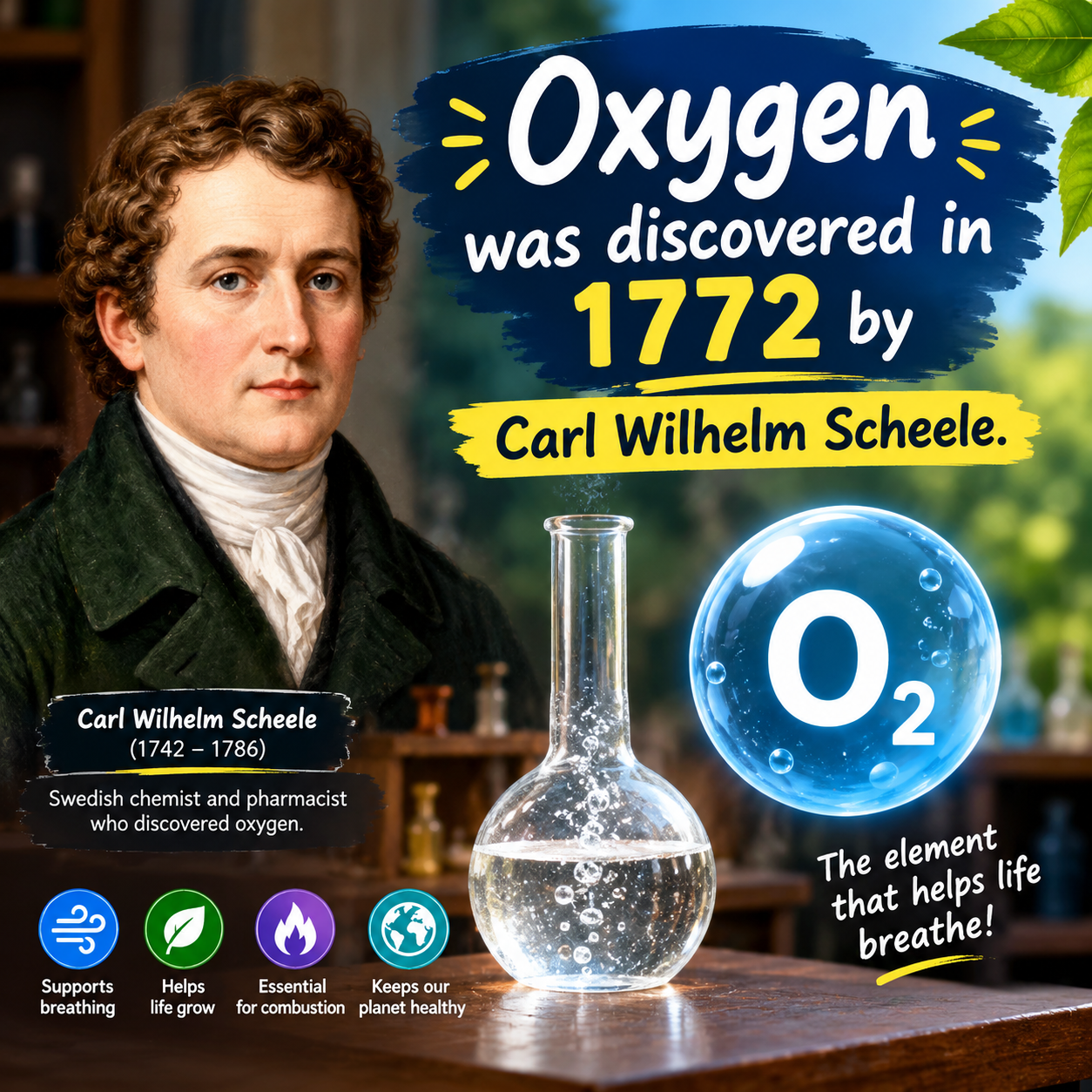
    Oxygen is one of the most important elements for life on Earth! Swedish chemist and pharmacist **Carl Wilhelm Scheele** discovered oxygen around 1772. This amazing discovery helped scientists understand the chemistry of air, breathing, and combustion.

    **Interesting Facts About Oxygen:**
    Symbol: O
    Chemical formula: Oβ‚‚
    Essential for life and respiration
    Supports combustion
    Makes up about 21% of Earth's atmosphere

    Science is full of amazing discoveries that help us understand our world!

    **Keep learning, stay curious, and explore the wonders of science!**

    #DidYouKnow #Oxygen #CarlWilhelmScheele #ScienceFacts #Chemistry #ScienceEducation #AmazingFacts #KnowledgeIsPower #EducationalPost #LearnSomethingNew
    RSIF8 Roll NO:92 CHAT GPT TASK NO:14 Topic:🌬️ **Did You Know? Oxygen Was Discovered in 1772! πŸ§ͺ** Oxygen is one of the most important elements for life on Earth! 🌍 Swedish chemist and pharmacist **Carl Wilhelm Scheele** discovered oxygen around 1772. This amazing discovery helped scientists understand the chemistry of air, breathing, and combustion. πŸ’‘ **Interesting Facts About Oxygen:** πŸ”¬ Symbol: O πŸ§ͺ Chemical formula: Oβ‚‚ 🌱 Essential for life and respiration πŸ”₯ Supports combustion 🌍 Makes up about 21% of Earth's atmosphere ✨ Science is full of amazing discoveries that help us understand our world! πŸ“š **Keep learning, stay curious, and explore the wonders of science!** #DidYouKnow #Oxygen #CarlWilhelmScheele #ScienceFacts #Chemistry #ScienceEducation #AmazingFacts #KnowledgeIsPower #EducationalPost #LearnSomethingNew
    0 Commenti 0 condivisioni 1867 Views
  • #rsisb
    Roll no. 247
    Story post 14
    Foundation level

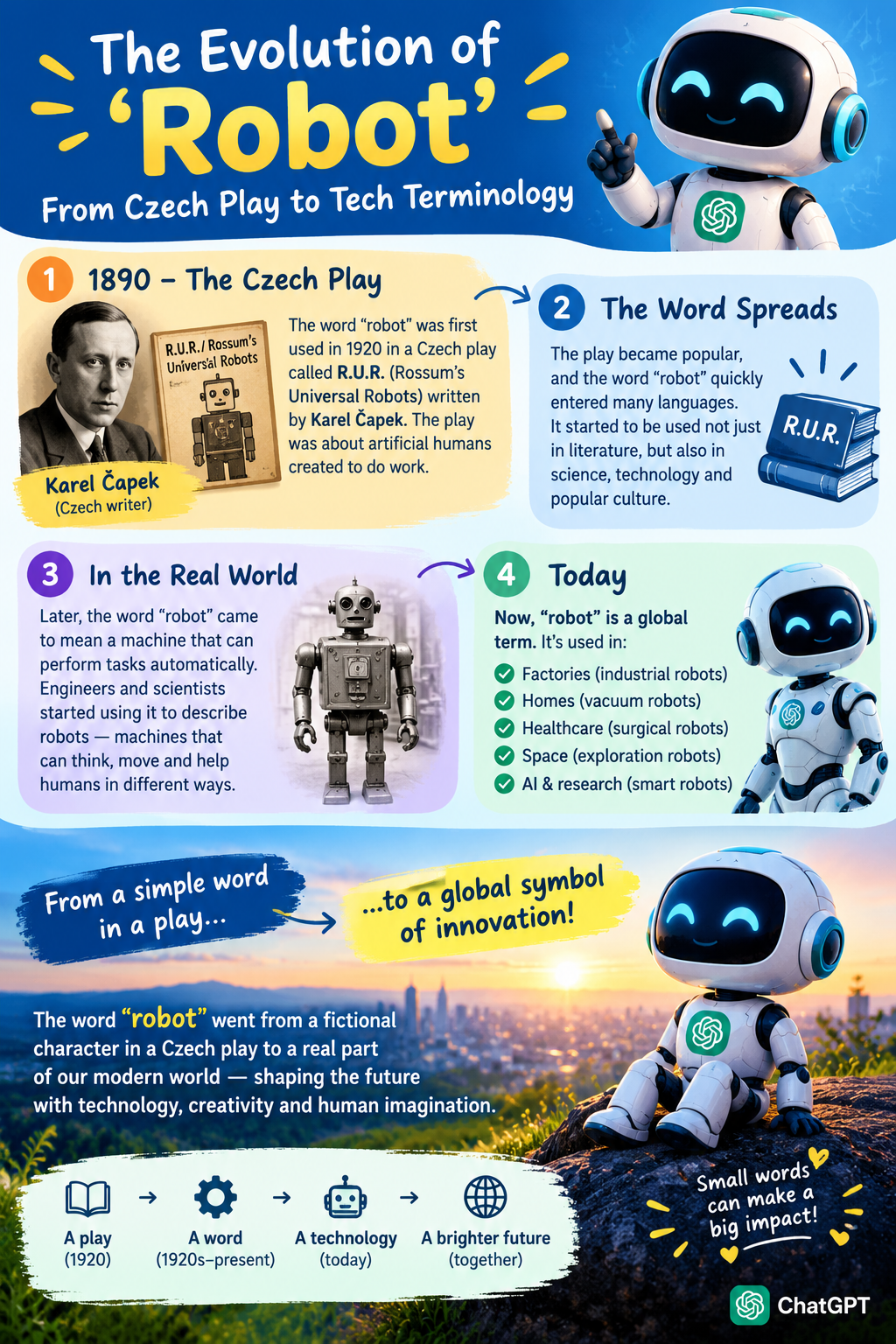
    **The Evolution of “Robot”: From Czech Play to Tech Terminology **

    Have you ever wondered where the word **“robot”** came from? Today, we use this word when talking about smart machines, artificial intelligence, factories, space exploration, and modern technology. But did you know that the word “robot” became popular through a Czech play written more than a century ago? Let's explore the fascinating journey of this little word that became a big part of our technological world!

    **1. The Beginning: A Czech Play **

    The story of the word “robot” begins with Czech writer and playwright **Karel Čapek** and his science-fiction play *R.U.R. (Rossum’s Universal Robots)*, first performed in 1921 and published in 1920. The play imagined artificial workers created to perform tasks for humans. It introduced audiences to ideas about artificial beings, technology, work, and the relationship between humans and machines.

    The word “robot” comes from the Czech word *robota*, associated with forced labor or compulsory work. Interestingly, Karel Čapek credited his brother, **Josef Čapek**, with suggesting the word for the play.

    **2. How the Word Spread Around the World **

    As the play gained attention, the word “robot” spread beyond literature and entered everyday language. People began using it to discuss machines that could perform tasks automatically. Over time, robots became a popular subject in science-fiction stories, films, books, and discussions about the future.

    Writers and scientists explored exciting questions: Could machines help humans? Could robots perform difficult tasks? How might technology change our lives? These questions helped inspire generations of inventors and researchers.

    **3. From Fiction to Real Machines **

    Robots eventually became an important part of real-world engineering and science. Modern robots can perform repetitive tasks, assist with manufacturing, explore places that are difficult for humans to reach, and help researchers carry out complex work.

    Today, we can find robots in many areas:

    **Factories:** Industrial robots help assemble products and perform precise tasks.

    **Homes:** Robotic vacuum cleaners help people with household cleaning.

    **Healthcare:** Specialised robotic systems assist medical professionals with certain procedures.

    **Space Exploration:** Robotic rovers and spacecraft help scientists explore distant worlds.

    **Agriculture:** Some robots help monitor crops and perform farming tasks.

    **Research:** Scientists use robots to test ideas, collect information, and explore new possibilities.

    **4. Robots and Artificial Intelligence **

    Modern technology has introduced new possibilities through artificial intelligence (AI). Some robots use AI to interpret information from sensors, recognise objects, plan actions, or respond to changing conditions. However, not every robot uses AI, and not every AI system is a robot.

    This difference is important! A robot is generally a physical machine that can carry out tasks, while AI refers to computer systems designed to perform tasks that may require abilities such as recognising patterns or understanding language. Together, robotics and AI are helping researchers develop new tools and technologies.

    **5. What Can We Learn from the Evolution of “Robot”?**

    The journey of the word “robot” teaches us that ideas can travel from books and plays into real life. A word introduced through a fictional story became an important term in science, engineering, and technology.

    It also reminds us that technology is created by people using imagination, creativity, teamwork, and scientific knowledge. As we learn more about robots, we should think about how to use technology responsibly and how it can benefit people and communities.

    **Conclusion: From a Czech Play to a Technological Future**

    The evolution of “robot” is a remarkable example of how language, literature, and science connect. What began as a word associated with artificial workers in a Czech play is now used around the world to describe machines that help us in factories, homes, hospitals, laboratories, and space exploration.

    The future of robotics will continue to bring new discoveries, challenges, and opportunities. By learning about the past, understanding the present, and thinking creatively about the future, we can become more informed and responsible users of technology.

    **Let's keep learning, exploring, and innovating!** Every great invention begins with an idea, and every curious mind has the potential to discover something new.

    **Question for everyone:** If you could invent a helpful robot, what would you want it to do? Share your ideas in the comments!

    Like, share, and spread the excitement of science and technology!

    ━━━━━━━━━━━━━━━━━━

    **HASHTAGS**

    #EvolutionOfRobots #RobotHistory #TheWordRobot #KarelCapek #JosefCapek #RUR #CzechLiterature #HistoryOfTechnology #Robotics #ArtificialIntelligence #AI #ScienceAndTechnology #EducationalPost #StoryPost #TechnologyEducation #FutureTechnology #Innovation #Engineering #STEMEducation #ScienceForEveryone #LearningIsFun #DigitalLearning #TechHistory #SmartMachines #SpaceExploration #IndustrialRobots #CreativeThinking #KnowledgeIsPower #ChatGPT #PostOnAllPlatforms
    #rsisb Roll no. 247 Story post 14 Foundation level πŸ€–πŸŒ **The Evolution of “Robot”: From Czech Play to Tech Terminology πŸ“šβœ¨** πŸš€πŸ€– Have you ever wondered where the word **“robot”** came from? Today, we use this word when talking about smart machines, artificial intelligence, factories, space exploration, and modern technology. But did you know that the word “robot” became popular through a Czech play written more than a century ago? πŸ“–πŸŒŸ Let's explore the fascinating journey of this little word that became a big part of our technological world! πŸ’‘πŸŒ πŸ“š **1. The Beginning: A Czech Play πŸ‡¨πŸ‡Ώ** The story of the word “robot” begins with Czech writer and playwright **Karel Čapek** and his science-fiction play *R.U.R. (Rossum’s Universal Robots)*, first performed in 1921 and published in 1920. πŸŽ­πŸ€– The play imagined artificial workers created to perform tasks for humans. It introduced audiences to ideas about artificial beings, technology, work, and the relationship between humans and machines. The word “robot” comes from the Czech word *robota*, associated with forced labor or compulsory work. Interestingly, Karel Čapek credited his brother, **Josef Čapek**, with suggesting the word for the play. βœοΈπŸ’­ 🌎 **2. How the Word Spread Around the World 🌐** As the play gained attention, the word “robot” spread beyond literature and entered everyday language. People began using it to discuss machines that could perform tasks automatically. πŸ“–βš™οΈ Over time, robots became a popular subject in science-fiction stories, films, books, and discussions about the future. Writers and scientists explored exciting questions: Could machines help humans? Could robots perform difficult tasks? How might technology change our lives? These questions helped inspire generations of inventors and researchers. πŸš€πŸ§  βš™οΈ **3. From Fiction to Real Machines 🏭** Robots eventually became an important part of real-world engineering and science. Modern robots can perform repetitive tasks, assist with manufacturing, explore places that are difficult for humans to reach, and help researchers carry out complex work. πŸ”§πŸ€– Today, we can find robots in many areas: 🏭 **Factories:** Industrial robots help assemble products and perform precise tasks. 🏠 **Homes:** Robotic vacuum cleaners help people with household cleaning. πŸ₯ **Healthcare:** Specialised robotic systems assist medical professionals with certain procedures. πŸš€ **Space Exploration:** Robotic rovers and spacecraft help scientists explore distant worlds. 🌾 **Agriculture:** Some robots help monitor crops and perform farming tasks. πŸ§ͺ **Research:** Scientists use robots to test ideas, collect information, and explore new possibilities. πŸ’» **4. Robots and Artificial Intelligence 🧠** Modern technology has introduced new possibilities through artificial intelligence (AI). Some robots use AI to interpret information from sensors, recognise objects, plan actions, or respond to changing conditions. πŸ€–πŸ’‘ However, not every robot uses AI, and not every AI system is a robot. This difference is important! A robot is generally a physical machine that can carry out tasks, while AI refers to computer systems designed to perform tasks that may require abilities such as recognising patterns or understanding language. Together, robotics and AI are helping researchers develop new tools and technologies. 🌐✨ 🌟 **5. What Can We Learn from the Evolution of “Robot”?** The journey of the word “robot” teaches us that ideas can travel from books and plays into real life. A word introduced through a fictional story became an important term in science, engineering, and technology. πŸ“šβž‘οΈβš™οΈ It also reminds us that technology is created by people using imagination, creativity, teamwork, and scientific knowledge. As we learn more about robots, we should think about how to use technology responsibly and how it can benefit people and communities. ❀️🌍 🎯 **Conclusion: From a Czech Play to a Technological Future** The evolution of “robot” is a remarkable example of how language, literature, and science connect. What began as a word associated with artificial workers in a Czech play is now used around the world to describe machines that help us in factories, homes, hospitals, laboratories, and space exploration. πŸ€–πŸš€ The future of robotics will continue to bring new discoveries, challenges, and opportunities. By learning about the past, understanding the present, and thinking creatively about the future, we can become more informed and responsible users of technology. πŸŒŸπŸ’š πŸ“’ **Let's keep learning, exploring, and innovating!** Every great invention begins with an idea, and every curious mind has the potential to discover something new. πŸ’‘πŸ“š πŸ’¬ **Question for everyone:** If you could invent a helpful robot, what would you want it to do? Share your ideas in the comments! πŸ‘‡πŸ€– ❀️ Like, share, and spread the excitement of science and technology! ━━━━━━━━━━━━━━━━━━ 🏷️ **HASHTAGS** #EvolutionOfRobots #RobotHistory #TheWordRobot #KarelCapek #JosefCapek #RUR #CzechLiterature #HistoryOfTechnology #Robotics #ArtificialIntelligence #AI #ScienceAndTechnology #EducationalPost #StoryPost #TechnologyEducation #FutureTechnology #Innovation #Engineering #STEMEducation #ScienceForEveryone #LearningIsFun #DigitalLearning #TechHistory #SmartMachines #SpaceExploration #IndustrialRobots #CreativeThinking #KnowledgeIsPower #ChatGPT #PostOnAllPlatforms πŸ€–πŸŒπŸ“šπŸš€βœ¨
    0 Commenti 0 condivisioni 6553 Views
  • RSIF 8
    Roll no 93
    Image chatgpt no 12
    Image chatgpt topic:— Text: "Oxygen was discovered in 1772 by Carl Wilhelm Scheele." **Oxygen Discovery — A Remarkable Scientific Milestone!**
    Did you know that **oxygen was discovered in 1772 by Carl Wilhelm Scheele**? His work helped scientists understand one of the most important elements needed for life and combustion.
    Oxygen plays a vital role in breathing, energy production, medicine, and many natural processes. This discovery became an important milestone in the history of chemistry and continues to influence science today.
    **Learn • Explore • Discover • Grow!**
    #Oxygen #CarlWilhelmScheele #Science #Chemistry #ScienceFacts #HistoryOfScience #Education #DidYouKnow #Learning #ChatGPT
    RSIF 8 Roll no 93 Image chatgpt no 12 Image chatgpt topic:— Text: "Oxygen was discovered in 1772 by Carl Wilhelm Scheele." πŸ§ͺ **Oxygen Discovery — A Remarkable Scientific Milestone!** 🌍✨ Did you know that **oxygen was discovered in 1772 by Carl Wilhelm Scheele**? πŸ”¬πŸ’¨ His work helped scientists understand one of the most important elements needed for life and combustion. Oxygen plays a vital role in breathing, energy production, medicine, and many natural processes. 🌱🫁 This discovery became an important milestone in the history of chemistry and continues to influence science today. πŸ“š **Learn • Explore • Discover • Grow!** πŸš€ #Oxygen #CarlWilhelmScheele #Science #Chemistry #ScienceFacts #HistoryOfScience #Education #DidYouKnow #Learning #ChatGPT
    0 Commenti 0 condivisioni 1170 Views
  • #RSTA
    #Task : Image with Chatgpt Post
    #Class: Foundation Level Book 2
    #Day No: 7
    #Made By Me

    Total Post:7


    Today, I created a science post on ChatGPT with the interesting fact: **“Oxygen was discovered in 1772 by Carl Wilhelm Scheele.”**

    This post helped me learn an important fact about the history of oxygen and science. I shared this educational post on **Facebook, YouTube, LinkedIn, Instagram, and TikTok**.

    RSTA Science Oxygen CarlWilhelmScheele ScienceFacts Learning ChatGPT MadeByMe Facebook YouTube LinkedIn Instagram TikTok
    #RSTA #Task : Image with Chatgpt Post #Class: Foundation Level Book 2 #Day No: 7 #Made By Me Total Post:7 Today, I created a science post on ChatGPT with the interesting fact: **“Oxygen was discovered in 1772 by Carl Wilhelm Scheele.”** πŸ”¬βœ¨ This post helped me learn an important fact about the history of oxygen and science. I shared this educational post on **Facebook, YouTube, LinkedIn, Instagram, and TikTok**. πŸŒπŸ“š RSTA Science Oxygen CarlWilhelmScheele ScienceFacts Learning ChatGPT MadeByMe Facebook YouTube LinkedIn Instagram TikTok
    0 Commenti 0 condivisioni 1072 Views
  • #rsisb
    Roll NO:232
    Foundation level student.
    Story post:52

    ### Description

    **“Oxygen Was Discovered in 1772 by Carl Wilhelm Scheele.”**

    Did you know that oxygen has a fascinating history? Swedish chemist **Carl Wilhelm Scheele** produced oxygen in experiments around **1772** and called it “fire air” because it supported combustion.

    Although Scheele’s work was important, the history of oxygen’s discovery is shared with other scientists. **Joseph Priestley independently produced and studied oxygen in 1774**, and **Antoine Lavoisier later helped establish oxygen’s role in combustion and respiration and gave the element its modern name.**

    This story shows how scientific discoveries often develop through the work of several scientists over time.

    **Keep exploring science—every discovery begins with curiosity and a question!**

    ### Hashtags

    #Oxygen #CarlWilhelmScheele #ScienceFacts #Chemistry #HistoryOfScience #DidYouKnow #AmazingFacts #ScienceHistory #ChemistryFacts #LearnSomethingNew #ScienceIsFun #Education #Knowledge #Curiosity #STEM #KeepLearning

    ### Emojis


    #rsisb Roll NO:232 Foundation level student. Story post:52 ### πŸ”¬ Description **“Oxygen Was Discovered in 1772 by Carl Wilhelm Scheele.”** πŸ§ͺ🌍✨ Did you know that oxygen has a fascinating history? πŸ€―πŸ”¬ Swedish chemist **Carl Wilhelm Scheele** produced oxygen in experiments around **1772** and called it “fire air” because it supported combustion. πŸ”₯πŸ§ͺ Although Scheele’s work was important, the history of oxygen’s discovery is shared with other scientists. **Joseph Priestley independently produced and studied oxygen in 1774**, and **Antoine Lavoisier later helped establish oxygen’s role in combustion and respiration and gave the element its modern name.** πŸ§ πŸ“š This story shows how scientific discoveries often develop through the work of several scientists over time. πŸŒŸπŸ”¬ **Keep exploring science—every discovery begins with curiosity and a question!** πŸš€πŸ’‘πŸŒ± ### πŸ”– Hashtags #Oxygen #CarlWilhelmScheele #ScienceFacts #Chemistry #HistoryOfScience #DidYouKnow #AmazingFacts #ScienceHistory #ChemistryFacts #LearnSomethingNew #ScienceIsFun #Education #Knowledge #Curiosity #STEM #KeepLearning ### 😊 Emojis πŸ§ͺπŸ”¬πŸ’¨πŸ”₯πŸŒπŸ“šπŸ§ πŸ’‘βœ¨πŸŒŸπŸš€βš—οΈπŸ˜ŠπŸ”ŽπŸŒ±πŸ“–
    0 Commenti 0 condivisioni 2648 Views
  • #rsisb
    ROll
    Story post no.63
    Foundation Level

    ### Oxygen: A Fascinating Discovery!

    **Oxygen was independently discovered by several scientists, including Carl Wilhelm Scheele, who produced it around 1772.** Scheele called it “fire air” because it supported combustion.

    Later, **Joseph Priestley independently produced oxygen in 1774**, and **Antoine Lavoisier** helped establish its role in combustion and respiration and gave it the name *oxygen*.

    This discovery transformed our understanding of **chemistry, breathing, combustion, and life itself**.

    #Oxygen #ScienceHistory #CarlWilhelmScheele #Chemistry #ScienceFacts #Discoveries #LearningIsFun #AmazingScience


    Asma Shaheen EducationWali
    Saima Empowerment Wali
    Irum Asim Leadershipwali
    #rsisb ROll Story post no.63 Foundation Level ### πŸ§ͺ Oxygen: A Fascinating Discovery! 🌬️ **Oxygen was independently discovered by several scientists, including Carl Wilhelm Scheele, who produced it around 1772.** Scheele called it “fire air” because it supported combustion. πŸ”₯ Later, **Joseph Priestley independently produced oxygen in 1774**, and **Antoine Lavoisier** helped establish its role in combustion and respiration and gave it the name *oxygen*. βš—οΈπŸŒ This discovery transformed our understanding of **chemistry, breathing, combustion, and life itself**. 🫁✨ #Oxygen #ScienceHistory #CarlWilhelmScheele #Chemistry #ScienceFacts #Discoveries #LearningIsFun #AmazingScience πŸ§ͺπŸ”¬πŸŒŽ Asma Shaheen EducationWali Saima Empowerment Wali Irum Asim Leadershipwali
    0 Commenti 0 condivisioni 1812 Views
  • #rsisb
    Roll no.239
    Image with Chat gpt no.11
    Foundation Level


    In around **1772**, Swedish chemist and pharmacist **Carl Wilhelm Scheele** produced and studied a gas that we now know as **oxygen**. He called it **“fire air”** because he observed that it strongly supported combustion.

    Scheele’s experiments helped reveal that the air around us was not simply one single substance. Instead, it contained different gases with different properties. His work became an important part of the development of modern chemistry.

    **Who was Carl Wilhelm Scheele?**
    Carl Wilhelm Scheele (1742–1786) was a Swedish chemist and pharmacist known for his experimental work with many substances. He investigated gases, minerals, acids, and other chemicals and made several important observations during his scientific career.

    **Why is oxygen so important?**
    Oxygen is essential for most forms of life on Earth. Humans and many other organisms use oxygen during **cellular respiration**, a process that helps cells release energy from food. Oxygen also plays an important role in combustion and many chemical reactions.

    **A fascinating part of the story:**
    The history of oxygen’s discovery involved more than one scientist. Scheele investigated oxygen around **1772**, while **Joseph Priestley** independently produced and studied the gas in **1774**. Later, **Antoine Lavoisier** helped establish oxygen’s role in combustion and respiration and gave the element its name.

    **Quick facts:**
    Element: **Oxygen**
    Chemical symbol: **O**
    Atomic number: **8**
    Scheele’s work: **around 1772**
    Scheele’s name for it: **“Fire air”**
    Oxygen is essential for life and many natural and chemical processes.

    From a laboratory experiment centuries ago to our understanding of the atmosphere today, the discovery of oxygen shows how scientific knowledge develops through **careful observation, experimentation, and the work of multiple scientists**.

    **Science is full of discoveries that changed the way we understand our world!**

    **Learn. Explore. Question. Discover.**

    #ScienceFact #Oxygen #CarlWilhelmScheele #Chemistry #ScienceHistory #ChemistryFacts #DidYouKnow #ScienceEducation #LearnScience #PhysicsAndChemistry #Biology #STEM #ScientificDiscovery #HistoryOfScience #ChemicalElements #OxygenDiscovery #Education #Knowledge #FunScience #DEC
    #rsisb Roll no.239 Image with Chat gpt no.11 Foundation Level In around **1772**, Swedish chemist and pharmacist **Carl Wilhelm Scheele** produced and studied a gas that we now know as **oxygen**. He called it **“fire air”** because he observed that it strongly supported combustion. πŸ”₯ Scheele’s experiments helped reveal that the air around us was not simply one single substance. Instead, it contained different gases with different properties. His work became an important part of the development of modern chemistry. πŸ§ͺπŸ“š πŸ”Ž **Who was Carl Wilhelm Scheele?** Carl Wilhelm Scheele (1742–1786) was a Swedish chemist and pharmacist known for his experimental work with many substances. He investigated gases, minerals, acids, and other chemicals and made several important observations during his scientific career. 🌬️ **Why is oxygen so important?** Oxygen is essential for most forms of life on Earth. Humans and many other organisms use oxygen during **cellular respiration**, a process that helps cells release energy from food. Oxygen also plays an important role in combustion and many chemical reactions. πŸ“– **A fascinating part of the story:** The history of oxygen’s discovery involved more than one scientist. Scheele investigated oxygen around **1772**, while **Joseph Priestley** independently produced and studied the gas in **1774**. Later, **Antoine Lavoisier** helped establish oxygen’s role in combustion and respiration and gave the element its name. 🌟 **Quick facts:** πŸ”Ή Element: **Oxygen** πŸ”Ή Chemical symbol: **O** πŸ”Ή Atomic number: **8** πŸ”Ή Scheele’s work: **around 1772** πŸ”Ή Scheele’s name for it: **“Fire air”** πŸ”Ή Oxygen is essential for life and many natural and chemical processes. From a laboratory experiment centuries ago to our understanding of the atmosphere today, the discovery of oxygen shows how scientific knowledge develops through **careful observation, experimentation, and the work of multiple scientists**. 🌍🧠 πŸ’‘ **Science is full of discoveries that changed the way we understand our world!** πŸ“š **Learn. Explore. Question. Discover.** πŸ”¬βœ¨ #ScienceFact #Oxygen #CarlWilhelmScheele #Chemistry #ScienceHistory #ChemistryFacts #DidYouKnow #ScienceEducation #LearnScience #PhysicsAndChemistry #Biology #STEM #ScientificDiscovery #HistoryOfScience #ChemicalElements #OxygenDiscovery #Education #Knowledge #FunScience #DEC
    0 Commenti 0 condivisioni 3151 Views
  • #rsisb
    Roll No.240
    Image With Chatgpt No.6
    Foundation Level

    Oxygen is one of the most important elements for life on Earth, but its discovery was the result of careful experiments, curiosity, and scientific investigation.

    In 1772, Swedish chemist and pharmacist Carl Wilhelm Scheele identified a gas that behaved differently from ordinary air. He found that this gas strongly supported combustion and played an important role in the processes we now understand as respiration and burning.

    Scheele referred to the gas as “fire air” because of its ability to support combustion. His experiments helped reveal that air was not simply one single substance, but a mixture containing different gases.

    The story of oxygen’s discovery is a fascinating example of how science develops through observation and experimentation. Scientists investigate materials, record their observations, test ideas, and gradually build a better understanding of the natural world.

    Although Scheele discovered oxygen independently, the recognition and naming of oxygen as an element also involved other scientists, including Joseph Priestley and Antoine Lavoisier. Their work helped establish oxygen’s role in combustion and contributed to the development of modern chemistry.

    Oxygen is represented by the chemical symbol O and has the atomic number 8. It is essential for aerobic respiration in humans and many other organisms. Without oxygen, most familiar forms of complex life could not survive.

    The discovery of oxygen changed the way scientists understood air, combustion, chemistry, and life. It became an important part of the scientific revolution in chemistry and helped researchers develop a much clearer understanding of chemical reactions.

    This story also reminds us that major scientific discoveries often happen through patience, careful observation, and a willingness to ask questions. Every experiment can reveal something new, and every discovery can open the door to further knowledge.

    From “fire air” to oxygen, the journey of discovery changed chemistry forever.

    Science teaches us that the world around us is full of mysteries waiting to be explored. Whether studying gases, atoms, cells, planets, or living organisms, curiosity is often the first step toward discovery.

    Question. Observe. Experiment. Discover. Learn.

    #Oxygen #DiscoveryOfOxygen #CarlWilhelmScheele #ScienceHistory #HistoryOfScience #Chemistry #ChemicalElements #OxygenDiscovery #1772 #ScientificDiscovery #ScienceEducation #ChemistryFacts #ScienceFacts #LearnScience #ScientificRevolution #Combustion #Air #Respiration #ChemistryHistory #STEM #Education #LearningJourney #ScienceExperiment #ScientificThinking #Research #Discovery #Knowledge #Innovation #Curiosity #ExploreScience #ScienceLovers #EducationalContent #Scientists #ChemicalScience #ModernChemistry #ScienceJourney #HistoryOfChemistry

    Rehan School Islamabad Campus
    Asma Shaheen EducationWali
    Irum Asim
    Saima Happinesswali

    #rsisb Roll No.240 Image With Chatgpt No.6 Foundation Level Oxygen is one of the most important elements for life on Earth, but its discovery was the result of careful experiments, curiosity, and scientific investigation. 🌱🫁πŸ”₯ In 1772, Swedish chemist and pharmacist Carl Wilhelm Scheele identified a gas that behaved differently from ordinary air. He found that this gas strongly supported combustion and played an important role in the processes we now understand as respiration and burning. πŸ”₯πŸ§ͺ Scheele referred to the gas as “fire air” because of its ability to support combustion. His experiments helped reveal that air was not simply one single substance, but a mixture containing different gases. πŸŒ¬οΈπŸ”¬ The story of oxygen’s discovery is a fascinating example of how science develops through observation and experimentation. Scientists investigate materials, record their observations, test ideas, and gradually build a better understanding of the natural world. πŸ“šπŸ”ŽπŸ’‘ Although Scheele discovered oxygen independently, the recognition and naming of oxygen as an element also involved other scientists, including Joseph Priestley and Antoine Lavoisier. Their work helped establish oxygen’s role in combustion and contributed to the development of modern chemistry. βš—οΈπŸ§ πŸŒ Oxygen is represented by the chemical symbol O and has the atomic number 8. It is essential for aerobic respiration in humans and many other organisms. 🫁🌿🐾 Without oxygen, most familiar forms of complex life could not survive. The discovery of oxygen changed the way scientists understood air, combustion, chemistry, and life. 🌎πŸ”₯πŸ”¬ It became an important part of the scientific revolution in chemistry and helped researchers develop a much clearer understanding of chemical reactions. This story also reminds us that major scientific discoveries often happen through patience, careful observation, and a willingness to ask questions. πŸ’­βž‘οΈπŸ”¬βž‘οΈπŸ’‘ Every experiment can reveal something new, and every discovery can open the door to further knowledge. ✨ From “fire air” to oxygen, the journey of discovery changed chemistry forever. ✨ Science teaches us that the world around us is full of mysteries waiting to be explored. πŸŒπŸ”Ž Whether studying gases, atoms, cells, planets, or living organisms, curiosity is often the first step toward discovery. πŸš€πŸ“š 🌟 Question. Observe. Experiment. Discover. Learn. 🌟 #Oxygen #DiscoveryOfOxygen #CarlWilhelmScheele #ScienceHistory #HistoryOfScience #Chemistry #ChemicalElements #OxygenDiscovery #1772 #ScientificDiscovery #ScienceEducation #ChemistryFacts #ScienceFacts #LearnScience #ScientificRevolution #Combustion #Air #Respiration #ChemistryHistory #STEM #Education #LearningJourney #ScienceExperiment #ScientificThinking #Research #Discovery #Knowledge #Innovation #Curiosity #ExploreScience #ScienceLovers #EducationalContent #Scientists #ChemicalScience #ModernChemistry #ScienceJourney #HistoryOfChemistry πŸ”¬πŸ§ͺ🌍πŸ”₯πŸ«πŸ“šπŸ’‘βœ¨πŸš€πŸŒ± Rehan School Islamabad Campus Asma Shaheen EducationWali Irum Asim Saima Happinesswali
    0 Commenti 0 condivisioni 10173 Views
Pagine in Evidenza