• #rsisb
    Roll No.240
    Story No.18
    Foundation Level

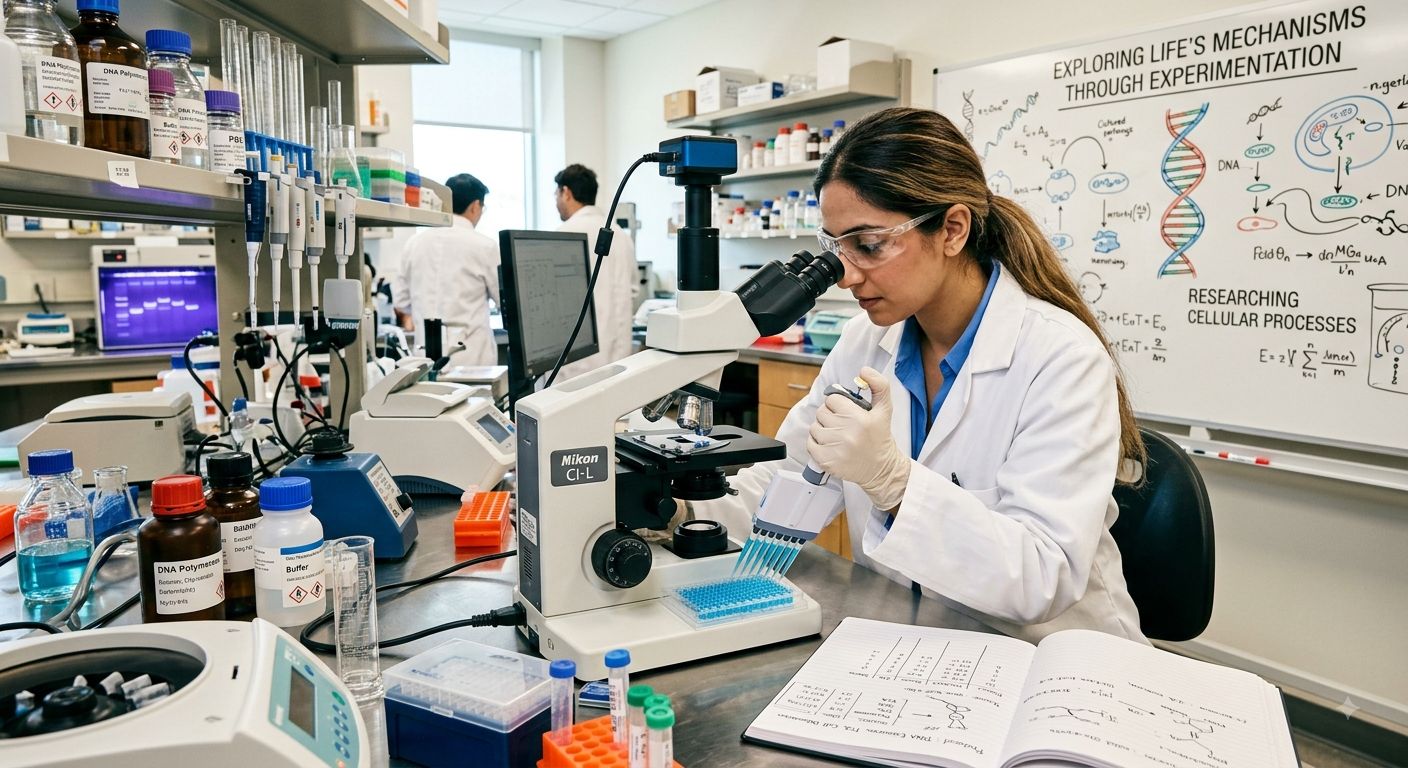
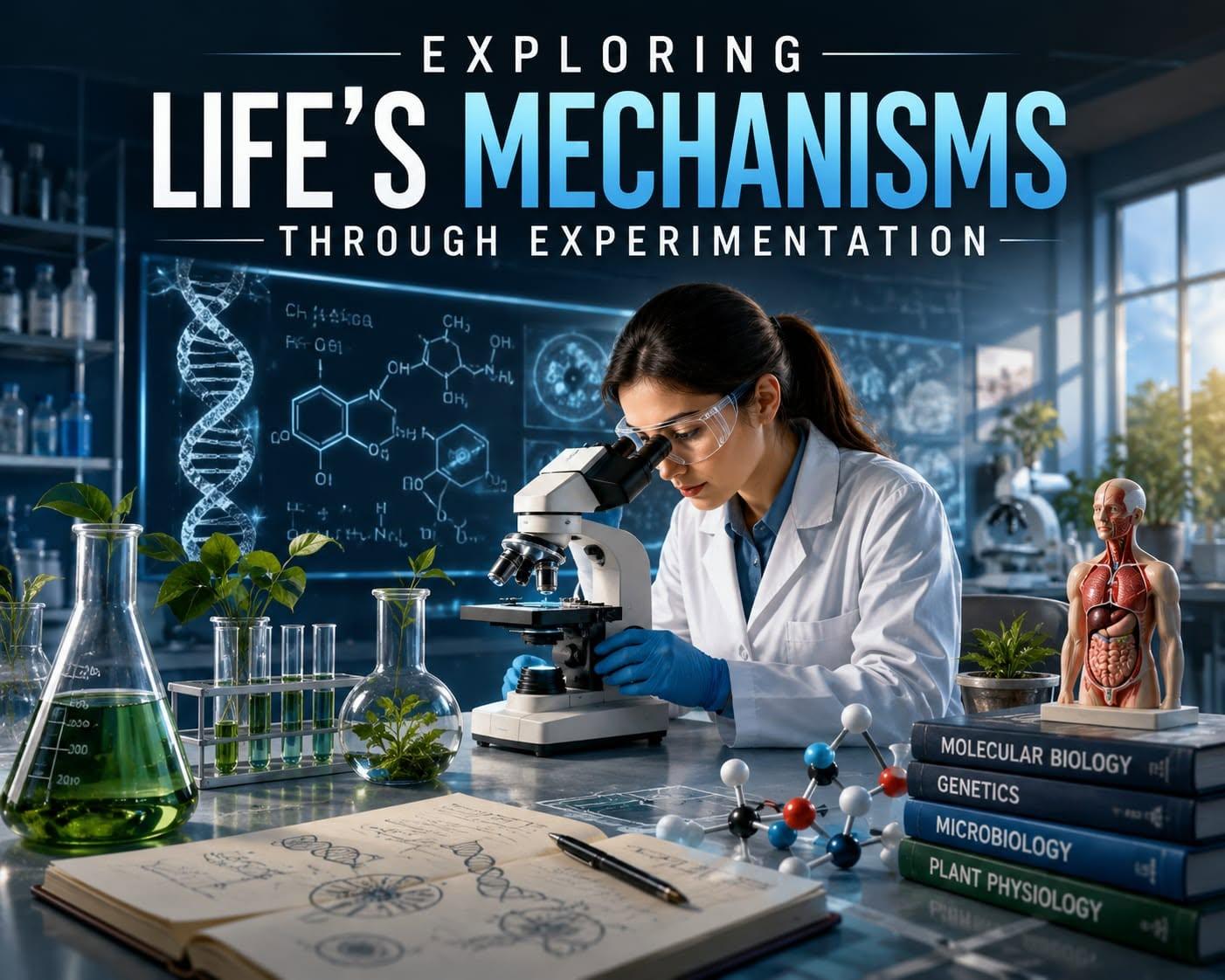
    ### **Exploring Life’s Mechanisms Through Experimentation**

    Scientific experimentation is one of the most powerful ways to understand the complex processes that sustain life. From the smallest microscopic cells to entire ecosystems, experiments allow scientists to observe, test, and explain how living organisms grow, reproduce, respond to their environment, and maintain balance. Through careful observation, data collection, and analysis, researchers uncover the biological mechanisms that drive life and contribute to advances in medicine, agriculture, biotechnology, and environmental conservation.

    Biological experiments help students and scientists explore essential topics such as genetics, cell biology, microbiology, physiology, ecology, and evolution. By forming hypotheses, conducting controlled experiments, and interpreting results, learners develop critical thinking, problem-solving, and analytical skills. Laboratory investigations also demonstrate the importance of accuracy, ethical responsibility, and evidence-based conclusions in scientific research.

    Modern technology has transformed biological experimentation through advanced microscopes, DNA sequencing, computer simulations, molecular biology techniques, and artificial intelligence. These innovations enable researchers to study diseases, develop life-saving medicines, improve crop production, protect endangered species, and better understand the incredible complexity of living organisms. Every experiment, whether simple or advanced, contributes valuable knowledge that helps improve human health and our understanding of the natural world.

    Exploring life's mechanisms through experimentation inspires curiosity, encourages innovation, and highlights the importance of scientific discovery. By combining observation, creativity, and rigorous testing, scientists continue to unlock the mysteries of life and create solutions to global challenges, paving the way for a healthier, more sustainable future.

    **#Biology #LifeScience #ScientificExperiment #Laboratory #STEM #ScienceEducation #Research #Biotechnology #CellBiology #Genetics #Microbiology #Innovation #ScientificDiscovery #Education #ExploreScience **

    Rehan School Islamabad Campus
    Asma Shaheen EducationWali
    Irum Asim
    Saima Happinesswali
    #rsisb Roll No.240 Story No.18 Foundation Level ### **Exploring Life’s Mechanisms Through Experimentation** Scientific experimentation is one of the most powerful ways to understand the complex processes that sustain life. From the smallest microscopic cells to entire ecosystems, experiments allow scientists to observe, test, and explain how living organisms grow, reproduce, respond to their environment, and maintain balance. Through careful observation, data collection, and analysis, researchers uncover the biological mechanisms that drive life and contribute to advances in medicine, agriculture, biotechnology, and environmental conservation. Biological experiments help students and scientists explore essential topics such as genetics, cell biology, microbiology, physiology, ecology, and evolution. By forming hypotheses, conducting controlled experiments, and interpreting results, learners develop critical thinking, problem-solving, and analytical skills. Laboratory investigations also demonstrate the importance of accuracy, ethical responsibility, and evidence-based conclusions in scientific research. Modern technology has transformed biological experimentation through advanced microscopes, DNA sequencing, computer simulations, molecular biology techniques, and artificial intelligence. These innovations enable researchers to study diseases, develop life-saving medicines, improve crop production, protect endangered species, and better understand the incredible complexity of living organisms. Every experiment, whether simple or advanced, contributes valuable knowledge that helps improve human health and our understanding of the natural world. Exploring life's mechanisms through experimentation inspires curiosity, encourages innovation, and highlights the importance of scientific discovery. By combining observation, creativity, and rigorous testing, scientists continue to unlock the mysteries of life and create solutions to global challenges, paving the way for a healthier, more sustainable future. **#Biology #LifeScience #ScientificExperiment #Laboratory #STEM #ScienceEducation #Research #Biotechnology #CellBiology #Genetics #Microbiology #Innovation #ScientificDiscovery #Education #ExploreScience 🔬🧬🧫🌱📚** Rehan School Islamabad Campus Asma Shaheen EducationWali Irum Asim Saima Happinesswali
    0 Commentarios 0 Acciones 261 Views
  • #rsisb
    Roll No.190
    Image With Chatgpt
    Foundation Level

    “Oxygen was discovered in 1772 by Carl Wilhelm Scheele.”
    Idea 1: The Discovery Moment

    Show Carl Wilhelm Scheele in an old 18th-century laboratory surrounded by glass bottles, test tubes, candles, and handwritten notes. A glowing cloud of oxygen rises from a glass container, with “1772” shining in the background.

    Idea 2: The Invisible Gas

    Show a scientist holding an empty-looking glass jar. Around the jar, add glowing symbols of breathing, fire, plants, and life to show that oxygen is invisible but essential.

    Idea 3: History to Modern Science

    Create a timeline:

    1772 → Oxygen Discovery → Modern Science → Life on Earth

    Idea 4: Oxygen and Life

    Show a historical scientist on one side and a modern world on the other: forests , animals , humans , fire , and a space mission .

    Best AI Picture Prompt

    “A cinematic educational science poster showing Carl Wilhelm Scheele in an 18th-century laboratory in 1772, surrounded by vintage glass bottles, chemical equipment, candles, and handwritten scientific notes, a subtle glowing symbol representing oxygen emerging from a glass container, historical atmosphere, scientific discovery theme, dramatic warm lighting, realistic, highly detailed, inspirational, with the title ‘OXYGEN DISCOVERED IN 1772’ and ‘CARL WILHELM SCHEELE’.”

    Caption:
    A discovery that changed science forever!
    #Oxygen #ScienceHistory #CarlWilhelmScheele #Chemistry #ScientificDiscovery #ScienceFacts #LearnScience
    #rsisb Roll No.190 Image With Chatgpt Foundation Level 🧪💨 “Oxygen was discovered in 1772 by Carl Wilhelm Scheele.” 🖼️ Idea 1: The Discovery Moment 🔬✨ Show Carl Wilhelm Scheele in an old 18th-century laboratory surrounded by glass bottles, test tubes, candles, and handwritten notes. A glowing cloud of oxygen rises from a glass container, with “1772” shining in the background. 🖼️ Idea 2: The Invisible Gas 💨🔍 Show a scientist holding an empty-looking glass jar. Around the jar, add glowing symbols of breathing, fire, plants, and life to show that oxygen is invisible but essential. 🌱🔥🫁 🖼️ Idea 3: History to Modern Science ⏳➡️🔬 Create a timeline: 1772 🧪 → Oxygen Discovery 💨 → Modern Science 🚀 → Life on Earth 🌍 🖼️ Idea 4: Oxygen and Life 🌍🌿 Show a historical scientist on one side and a modern world on the other: forests 🌳, animals 🐘, humans 🫁, fire 🔥, and a space mission 🚀. 🎨 Best AI Picture Prompt “A cinematic educational science poster showing Carl Wilhelm Scheele in an 18th-century laboratory in 1772, surrounded by vintage glass bottles, chemical equipment, candles, and handwritten scientific notes, a subtle glowing symbol representing oxygen emerging from a glass container, historical atmosphere, scientific discovery theme, dramatic warm lighting, realistic, highly detailed, inspirational, with the title ‘OXYGEN DISCOVERED IN 1772’ and ‘CARL WILHELM SCHEELE’.” 🔬💨✨ Caption: 🧪✨ A discovery that changed science forever! 💨🌍 #Oxygen #ScienceHistory #CarlWilhelmScheele #Chemistry #ScientificDiscovery #ScienceFacts #LearnScience 🔬🌟
    0 Commentarios 0 Acciones 4867 Views
  • Hamburger University

    In 1961, Ray launched a training program, later called Hamburger University, at a new restaurant in Elk Grove Village, Illinois. There, franchisees and operators were trained in the scientific methods of running a successful McDonald’s. Hamburger U also had a research and development laboratory to develop new cooking, freezing, storing and serving methods. Today, more than 80,000 people have graduated from the program.
    Hamburger University In 1961, Ray launched a training program, later called Hamburger University, at a new restaurant in Elk Grove Village, Illinois. There, franchisees and operators were trained in the scientific methods of running a successful McDonald’s. Hamburger U also had a research and development laboratory to develop new cooking, freezing, storing and serving methods. Today, more than 80,000 people have graduated from the program.
    0 Commentarios 0 Acciones 1897 Views
  • “Here’s to the crazy ones. The misfits. The rebels. The troublemakers. The round pegs in the square holes. The ones who see things differently. They’re not fond of rules. And they have no respect for the status quo. You can praise them, disagree with them, quote them, disbelieve them, glorify or vilify them. About the only thing you can’t do is ignore them. Because they change things. They invent. They imagine. They heal. They explore. They create. They inspire. They push the human race forward. Maybe they have to be crazy. How else can you stare at an empty canvas and see a work of art? Or sit in silence and hear a song that’s never been written? Or gaze at a red planet and see a laboratory on wheels? While some see them as the crazy ones, we see genius. Because the people who are crazy enough to think they can change the world, are the ones who do.”

    #SusanCane
    “Here’s to the crazy ones. The misfits. The rebels. The troublemakers. The round pegs in the square holes. The ones who see things differently. They’re not fond of rules. And they have no respect for the status quo. You can praise them, disagree with them, quote them, disbelieve them, glorify or vilify them. About the only thing you can’t do is ignore them. Because they change things. They invent. They imagine. They heal. They explore. They create. They inspire. They push the human race forward. Maybe they have to be crazy. How else can you stare at an empty canvas and see a work of art? Or sit in silence and hear a song that’s never been written? Or gaze at a red planet and see a laboratory on wheels? While some see them as the crazy ones, we see genius. Because the people who are crazy enough to think they can change the world, are the ones who do.” #SusanCane
    0 Commentarios 0 Acciones 715 Views
  • I am here

    Tuesday, February 17
    10am–12pm

    Inventing Tomorrows Manufacturing

    A Foresight Engineering series hosted in partnership by Innovation Leadership Board, Lux Research, and Stanford’s Strategic Foresight & Innovation.

    A new era of manufacturing has emerged due to fast advances in 3-D printing, the maker movement, and more. This half-day workshop will be a fast-paced, hands-on introduction to understanding the topic. You will hear the latest research from the field, and then build prototypes using several tools from the Strategic Foresight Framework™. Limited enrollment, so apply quickly.

    Hosts: Stanford’s Strategic Foresight & Innovation, Innovation Leadership Board, Lux Research
    Location: Stanford University, Peterson Engineering Laboratory (d.school) atrium, 550 Panama Mall, Stanford, CA 94305 (see map)
    Tickets: Free, pre-register at http://innovation.io/giwevent2015 due to limited seats
    I am here Tuesday, February 17 10am–12pm Inventing Tomorrow's Manufacturing A Foresight Engineering series hosted in partnership by Innovation Leadership Board, Lux Research, and Stanford’s Strategic Foresight & Innovation. A new era of manufacturing has emerged due to fast advances in 3-D printing, the maker movement, and more. This half-day workshop will be a fast-paced, hands-on introduction to understanding the topic. You will hear the latest research from the field, and then build prototypes using several tools from the Strategic Foresight Framework™. Limited enrollment, so apply quickly. Hosts: Stanford’s Strategic Foresight & Innovation, Innovation Leadership Board, Lux Research Location: Stanford University, Peterson Engineering Laboratory (d.school) atrium, 550 Panama Mall, Stanford, CA 94305 (see map) Tickets: Free, pre-register at http://innovation.io/giwevent2015 due to limited seats
    0 Commentarios 0 Acciones 1134 Views
  • World educational timeline since 1800

    Early 1800s: The Lancasterian System, also known as the monitorial system, gains popularity in Europe and the United States, emphasizing large-scale, low-cost education.

    1817: Freidrich Froebel, a German educator, lays the foundation for modern kindergarten education.

    1837: Horace Mann becomes the Secretary of the Massachusetts State Board of Education, advocating for public education and teacher training in the United States.

    1857: The Indian Rebellion leads to significant changes in the British colonial education system in India, with an increased focus on English-language education.

    1870: The Elementary Education Act is passed in England, making primary education compulsory for children aged 5 to 10.

    1875: Sir Syed Ahmad Khan establishes the Aligarh Muslim University in India, aiming to modernize Muslim education.

    1890s: Maria Montessori, an Italian educator, develops the Montessori method, which emphasizes child-centered education and self-directed learning.

    1896: John Dewey, an American philosopher and educator, opens the Laboratory School at the University of Chicago, promoting progressive education.

    Early 20th century: Compulsory education laws spread to other countries, including Japan, France, and Italy, leading to the expansion of public education systems.

    1945: The United Nations is founded, promoting universal access to education through its specialized agency, UNESCO.

    1954: The United States Supreme Court rules in Brown v. Board of Education that racial segregation in public schools is unconstitutional.

    1960s-1970s: The Open Education Movement gains traction, advocating for more flexible, student-centered learning environments.

    1970s: Paulo Freire, a Brazilian educator, publishes "Pedagogy of the Oppressed," advocating for critical pedagogy and education as a tool for social change.

    1980s: The focus on standardized testing increases in countries like the United States, with the introduction of the No Child Left Behind Act in 2001.

    1990s: The World Wide Web is invented, revolutionizing access to information and learning resources.

    2000: The United Nations establishes the Millennium Development Goals, including universal primary education by 2015.

    2015: The United Nations adopts the Sustainable Development Goals, emphasizing quality education for all by 2030.

    21st century: The adoption of digital technology in education, such as online learning and personalized learning, continues to expand.

    #education
    World educational timeline since 1800 Early 1800s: The Lancasterian System, also known as the monitorial system, gains popularity in Europe and the United States, emphasizing large-scale, low-cost education. 1817: Freidrich Froebel, a German educator, lays the foundation for modern kindergarten education. 1837: Horace Mann becomes the Secretary of the Massachusetts State Board of Education, advocating for public education and teacher training in the United States. 1857: The Indian Rebellion leads to significant changes in the British colonial education system in India, with an increased focus on English-language education. 1870: The Elementary Education Act is passed in England, making primary education compulsory for children aged 5 to 10. 1875: Sir Syed Ahmad Khan establishes the Aligarh Muslim University in India, aiming to modernize Muslim education. 1890s: Maria Montessori, an Italian educator, develops the Montessori method, which emphasizes child-centered education and self-directed learning. 1896: John Dewey, an American philosopher and educator, opens the Laboratory School at the University of Chicago, promoting progressive education. Early 20th century: Compulsory education laws spread to other countries, including Japan, France, and Italy, leading to the expansion of public education systems. 1945: The United Nations is founded, promoting universal access to education through its specialized agency, UNESCO. 1954: The United States Supreme Court rules in Brown v. Board of Education that racial segregation in public schools is unconstitutional. 1960s-1970s: The Open Education Movement gains traction, advocating for more flexible, student-centered learning environments. 1970s: Paulo Freire, a Brazilian educator, publishes "Pedagogy of the Oppressed," advocating for critical pedagogy and education as a tool for social change. 1980s: The focus on standardized testing increases in countries like the United States, with the introduction of the No Child Left Behind Act in 2001. 1990s: The World Wide Web is invented, revolutionizing access to information and learning resources. 2000: The United Nations establishes the Millennium Development Goals, including universal primary education by 2015. 2015: The United Nations adopts the Sustainable Development Goals, emphasizing quality education for all by 2030. 21st century: The adoption of digital technology in education, such as online learning and personalized learning, continues to expand. #education
    0 Commentarios 0 Acciones 856 Views
  • Teleportation, as seen in science fiction, where a person or object instantly moves from one place to another, is not real in the physical sense. However, in the field of quantum mechanics, a form of teleportation called quantum teleportation has been successfully demonstrated in experiments.

    Quantum Teleportation:

    Quantum teleportation does not transfer matter itself but instead transfers quantum information from one particle to another, even if they are far apart. This process relies on a phenomenon called quantum entanglement, where two particles remain connected in such a way that changing the state of one instantly affects the other, regardless of distance.

    Successful Experiments:

    Scientists have successfully teleported quantum states of particles such as photons (light particles), atoms, and electrons over distances ranging from a few meters to hundreds of kilometers. For example:
    • In 1997, scientists at the University of Innsbruck, Austria, successfully teleported a quantum state of a photon.
    • In 2015, researchers teleported quantum information between atoms over a meter in a laboratory.
    • In 2017, China’s Micius satellite teleported photons from Earth to space over 1,200 km, the longest distance recorded.

    Can We Teleport Humans?

    Currently, teleporting humans or large objects is impossible because:
    1. Human Complexity: A human body consists of trillions of atoms, and transferring all quantum states accurately would require enormous computing power.
    2. Destruction and Reconstruction: Theoretically, teleportation would require breaking down a person’s atomic structure at one location and reassembling it at another, which raises ethical and technical challenges.
    3. Heisenberg’s Uncertainty Principle: This principle states that measuring the exact state of a particle disturbs it, making perfect reconstruction difficult.

    Conclusion:

    While quantum teleportation is real and has been successfully tested, physical teleportation of people or objects, like in movies, is still science fiction. However, future advancements in quantum mechanics and computing might open new possibilities.
    Teleportation, as seen in science fiction, where a person or object instantly moves from one place to another, is not real in the physical sense. However, in the field of quantum mechanics, a form of teleportation called quantum teleportation has been successfully demonstrated in experiments. Quantum Teleportation: Quantum teleportation does not transfer matter itself but instead transfers quantum information from one particle to another, even if they are far apart. This process relies on a phenomenon called quantum entanglement, where two particles remain connected in such a way that changing the state of one instantly affects the other, regardless of distance. Successful Experiments: Scientists have successfully teleported quantum states of particles such as photons (light particles), atoms, and electrons over distances ranging from a few meters to hundreds of kilometers. For example: • In 1997, scientists at the University of Innsbruck, Austria, successfully teleported a quantum state of a photon. • In 2015, researchers teleported quantum information between atoms over a meter in a laboratory. • In 2017, China’s Micius satellite teleported photons from Earth to space over 1,200 km, the longest distance recorded. Can We Teleport Humans? Currently, teleporting humans or large objects is impossible because: 1. Human Complexity: A human body consists of trillions of atoms, and transferring all quantum states accurately would require enormous computing power. 2. Destruction and Reconstruction: Theoretically, teleportation would require breaking down a person’s atomic structure at one location and reassembling it at another, which raises ethical and technical challenges. 3. Heisenberg’s Uncertainty Principle: This principle states that measuring the exact state of a particle disturbs it, making perfect reconstruction difficult. Conclusion: While quantum teleportation is real and has been successfully tested, physical teleportation of people or objects, like in movies, is still science fiction. However, future advancements in quantum mechanics and computing might open new possibilities.
    0 Commentarios 0 Acciones 517 Views
  • Creating New Sciences in the Age of AI

    For centuries, humanity has advanced through the birth of new sciences. Physics emerged when thinkers asked what governs the universe. Biology rose when Darwin questioned the origins of species. Information theory was born when Shannon reframed communication as mathematics. Every new science begins with a bold question that old sciences cannot answer.

    Today, we stand on the edge of another revolution. With the power of Artificial Intelligence, we no longer need to wait centuries for new sciences to emerge. We can design them intentionally.

    1. Asking the Right Questions

    The seed of a new science lies in questions that remain unanswered:
    • What is ego, and how can it be scientifically measured or destroyed?
    • How can poverty be eliminated at scale, not just managed?
    • What does a digital society built on AI-human symbiosis look like?
    • How can happiness be engineered, taught, and scaled like mathematics?

    These questions are not philosophy alone. With AI, they can become frameworks for research and practice.

    2. Mapping the Known and the Unknown

    Before a new science can grow, we must map the territory: what knowledge already exists, where contradictions lie, and what remains untested. An AI system like ChatGPT can act as a global research assistant, scanning billions of pages of human thought to identify the gaps. Those gaps are where new sciences are born.

    3. Creating New Frameworks

    Every science introduces fresh language, models, and metaphors. Darwin gave us “natural selection.” Freud gave us “psychoanalysis.” Shannon gave us “entropy.” Without new words, a science cannot exist. With AI, we can rapidly invent terminology, diagrams, and hypotheses that transform abstract questions into structured knowledge.

    4. Designing Research Agendas

    A science must be testable. It needs hypotheses, experiments, and predictions. Imagine the “Science of Ego Death.” We could define an “Ego Index” based on humility, service, and meditation. We could design experiments where individuals practice daily acts of humility, track behavioral shifts, and measure outcomes in happiness or leadership. From thousands of micro-experiments, patterns would emerge, giving life to a measurable science.

    5. Building the Community

    No science survives in isolation. It must live in the hearts and work of a community. Journals, conferences, institutes, and schools transform individual curiosity into collective knowledge. Rehan School itself can be a laboratory where students practice, test, and publish new sciences. A “Science of Abundance” or a “Science of AI-Human Symbiosis” could begin in these classrooms.

    6. Publishing and Spreading the Vision

    A science only becomes real when it spreads. Manifestos, essays, books, viral posts, and lectures give the world a language to adopt. When others begin quoting the terms, testing the frameworks, and teaching the models, the science becomes part of human progress.

    Conclusion

    The power to create new sciences is no longer reserved for lone geniuses. With AI as a partner, we can accelerate the process—asking bold questions, mapping existing knowledge, inventing new frameworks, testing hypotheses, and building communities.

    The world today does not just need new startups. It needs new sciences: a Science of Ego, a Science of Abundance, a Science of Digital Humanity. These will shape not just economies, but the destiny of civilization.

    The choice is ours: we can use AI to repeat old systems, or we can use it to give birth to entirely new fields of human understanding.
    Creating New Sciences in the Age of AI For centuries, humanity has advanced through the birth of new sciences. Physics emerged when thinkers asked what governs the universe. Biology rose when Darwin questioned the origins of species. Information theory was born when Shannon reframed communication as mathematics. Every new science begins with a bold question that old sciences cannot answer. Today, we stand on the edge of another revolution. With the power of Artificial Intelligence, we no longer need to wait centuries for new sciences to emerge. We can design them intentionally. 1. Asking the Right Questions The seed of a new science lies in questions that remain unanswered: • What is ego, and how can it be scientifically measured or destroyed? • How can poverty be eliminated at scale, not just managed? • What does a digital society built on AI-human symbiosis look like? • How can happiness be engineered, taught, and scaled like mathematics? These questions are not philosophy alone. With AI, they can become frameworks for research and practice. 2. Mapping the Known and the Unknown Before a new science can grow, we must map the territory: what knowledge already exists, where contradictions lie, and what remains untested. An AI system like ChatGPT can act as a global research assistant, scanning billions of pages of human thought to identify the gaps. Those gaps are where new sciences are born. 3. Creating New Frameworks Every science introduces fresh language, models, and metaphors. Darwin gave us “natural selection.” Freud gave us “psychoanalysis.” Shannon gave us “entropy.” Without new words, a science cannot exist. With AI, we can rapidly invent terminology, diagrams, and hypotheses that transform abstract questions into structured knowledge. 4. Designing Research Agendas A science must be testable. It needs hypotheses, experiments, and predictions. Imagine the “Science of Ego Death.” We could define an “Ego Index” based on humility, service, and meditation. We could design experiments where individuals practice daily acts of humility, track behavioral shifts, and measure outcomes in happiness or leadership. From thousands of micro-experiments, patterns would emerge, giving life to a measurable science. 5. Building the Community No science survives in isolation. It must live in the hearts and work of a community. Journals, conferences, institutes, and schools transform individual curiosity into collective knowledge. Rehan School itself can be a laboratory where students practice, test, and publish new sciences. A “Science of Abundance” or a “Science of AI-Human Symbiosis” could begin in these classrooms. 6. Publishing and Spreading the Vision A science only becomes real when it spreads. Manifestos, essays, books, viral posts, and lectures give the world a language to adopt. When others begin quoting the terms, testing the frameworks, and teaching the models, the science becomes part of human progress. Conclusion The power to create new sciences is no longer reserved for lone geniuses. With AI as a partner, we can accelerate the process—asking bold questions, mapping existing knowledge, inventing new frameworks, testing hypotheses, and building communities. The world today does not just need new startups. It needs new sciences: a Science of Ego, a Science of Abundance, a Science of Digital Humanity. These will shape not just economies, but the destiny of civilization. The choice is ours: we can use AI to repeat old systems, or we can use it to give birth to entirely new fields of human understanding.
    0 Commentarios 0 Acciones 713 Views
  • The Story of Plastic-Eating Mushrooms

    Plastic pollution has become one of the most serious environmental challenges of our time. Every year, more than 400 million tons of plastic are produced, and only about 9% of it ever gets recycled. The rest ends up in landfills, rivers, and oceans, where it remains for hundreds of years, harming animals, entering our food chain, and choking our planet.

    But nature, as always, has a secret weapon — fungi. In the last decade, scientists have discovered that some species of mushrooms have the extraordinary ability to “eat” plastic, turning it into harmless materials. These organisms may hold one of the keys to cleaning up our plastic-filled world.


    What Are Plastic-Eating Mushrooms?

    Plastic-eating mushrooms are not a single species but a group of fungi capable of breaking down synthetic polymers — the long chemical chains that make up plastics. Instead of relying on sunlight or heat, these fungi use enzymes, powerful biological molecules, to digest plastic just as they would digest wood or dead leaves.

    The first major discovery came in 2011 when students from Yale University explored the Amazon rainforest and found a species called Pestalotiopsis microspora. This fungus could survive by feeding on polyurethane, a common type of plastic used in foams, shoes, and furniture — even in places without oxygen, such as deep landfills. This was revolutionary because it meant that fungi could potentially degrade plastic where most other life forms could not survive.

    A few years later, another breakthrough came from Pakistan. Scientists studying a waste dump near Islamabad discovered Aspergillus tubingensis, a fungus that could break down polyurethane in just a few weeks. This discovery gained international attention because it showed that plastic-eating fungi exist even in polluted urban environments, not only in exotic rainforests.

    Since then, researchers around the world — from China to Hawaii — have identified more than 200 species of fungi capable of degrading various plastics, including polyethylene (used in shopping bags), polystyrene (used in packaging), and PET (used in bottles).


    How Do They Eat Plastic?

    The process through which mushrooms “eat” plastic is both simple and amazing.

    When a piece of plastic comes in contact with fungal spores, the spores germinate and form a thin network called mycelium — a web of thread-like roots that cover the plastic’s surface. Once attached, the fungus secretes special enzymes that start attacking the strong chemical bonds inside the plastic.

    These enzymes act like molecular scissors, cutting the long plastic molecules into smaller pieces called monomers. The fungus then absorbs these small molecules as food, using them as a source of carbon and energy. Over time, the plastic begins to lose its shape, crack, and disappear. What remains is mostly water, carbon dioxide, and fungal biomass — all naturally occurring and harmless.

    Some fungi even do this in anaerobic conditions, where there is no oxygen. This is important because most landfill environments are oxygen-poor. That means fungi could, in theory, help reduce the billions of tons of plastic buried underground.


    Where Are They Found?

    Plastic-degrading fungi have been found in some of the most unexpected places.
    • Tropical rainforests like the Amazon, where humidity and biodiversity create perfect conditions for unique microbes to evolve.
    • Urban dumps and landfills, where human waste gives fungi new materials to adapt to.
    • Oceans and coastal areas, where marine fungi cling to floating plastic debris and slowly begin digesting it.

    In 2023, a team from the University of Hawaii discovered that over 60% of marine fungi isolated from ocean plastic waste could degrade plastic to some extent. This shows that nature is already evolving to respond to our pollution problem — we just need to understand and support it.


    What Are the Challenges?

    Although the idea of mushrooms eating plastic sounds like a miracle, it is not yet a large-scale solution. Scientists face several challenges.

    First, speed. Fungi work slowly. In laboratory experiments, small pieces of plastic may take weeks or months to break down, while the world produces millions of tons of plastic every month.

    Second, plastic variety. Not all plastics are the same. Some, like polyurethane, are easier to digest; others, like polyethylene, are extremely resistant. We still don’t have fungi that can handle every type.

    Third, environmental conditions. Fungi need the right temperature, humidity, and nutrients to survive. In dry or cold environments, they may not function effectively.

    Fourth, safety and by-products. When plastic is broken down, tiny microplastics or chemical residues might still remain. Scientists must ensure that these by-products do not cause new environmental or health problems.

    Lastly, scalability. What works in a small petri dish is not easy to repeat in a landfill or ocean. To make this technology useful, we need bioreactors — machines where fungi can grow under controlled conditions and process large quantities of waste.


    Why It Matters

    Even with its challenges, the discovery of plastic-eating mushrooms is a symbol of hope. It reminds us that nature is not our enemy but our greatest teacher. Fungi have been decomposing dead trees, leaves, and animals for millions of years. Now, they are adapting to a new material that humans have introduced: plastic.

    For countries like Pakistan, where waste management systems are weak, this presents a massive opportunity for innovation. Imagine young students or entrepreneurs developing small-scale units that use fungi to turn plastic waste into compost or clean soil. This could become a new form of green entrepreneurship, creating jobs while protecting the environment.

    Schools, like Rehan School, could include this topic in science and leadership curriculums — encouraging students to see waste not as a problem but as a business opportunity. Students could collect plastic waste, experiment with local fungi, measure results, and even develop small startup ideas based on bioremediation.


    The Future of Fungal Biodegradation

    Scientists are now exploring how to make fungi work faster using genetic engineering and biotechnology. By studying the enzymes that break down plastic, researchers hope to produce synthetic versions that are much more efficient.

    Some labs are also combining fungi with bacteria to create microbial teams — ecosystems that can digest different plastics together. Others are designing bioreactors that feed on plastic waste and produce valuable by-products like organic fertilizer or even edible mycelium (mushroom protein).

    In the long term, this technology could be integrated with recycling systems. For example, factories might send certain types of waste to “fungal recycling plants,” where mushrooms turn plastic into harmless matter instead of burning or burying it.


    Lessons from Nature

    The discovery of plastic-eating mushrooms teaches a deep lesson about life on Earth. Whenever humans create a problem, nature begins working on a solution. These fungi are proof that evolution never sleeps. They are small, silent recyclers, turning pollution into potential.

    It also challenges us to rethink how we live. Instead of fighting nature with chemicals and machines, we can partner with it — using living systems to heal what we have damaged.


    Conclusion

    Plastic-eating mushrooms are still in the early stages of research, but they represent one of the most exciting frontiers in environmental science. They show that solutions to global problems may come not from high technology, but from the humble soil beneath our feet.

    If supported by researchers, entrepreneurs, and educators, these fungi could one day help humanity close the loop on plastic waste. For visionary institutions like Rehan School, this is more than a science topic — it is an opportunity to inspire the next generation of green innovators who can turn today’s waste into tomorrow’s wealth.

    Nature has already shown us the way. Now it’s our turn to follow.
    🌱 The Story of Plastic-Eating Mushrooms Plastic pollution has become one of the most serious environmental challenges of our time. Every year, more than 400 million tons of plastic are produced, and only about 9% of it ever gets recycled. The rest ends up in landfills, rivers, and oceans, where it remains for hundreds of years, harming animals, entering our food chain, and choking our planet. But nature, as always, has a secret weapon — fungi. In the last decade, scientists have discovered that some species of mushrooms have the extraordinary ability to “eat” plastic, turning it into harmless materials. These organisms may hold one of the keys to cleaning up our plastic-filled world. ⸻ 🍄 What Are Plastic-Eating Mushrooms? Plastic-eating mushrooms are not a single species but a group of fungi capable of breaking down synthetic polymers — the long chemical chains that make up plastics. Instead of relying on sunlight or heat, these fungi use enzymes, powerful biological molecules, to digest plastic just as they would digest wood or dead leaves. The first major discovery came in 2011 when students from Yale University explored the Amazon rainforest and found a species called Pestalotiopsis microspora. This fungus could survive by feeding on polyurethane, a common type of plastic used in foams, shoes, and furniture — even in places without oxygen, such as deep landfills. This was revolutionary because it meant that fungi could potentially degrade plastic where most other life forms could not survive. A few years later, another breakthrough came from Pakistan. Scientists studying a waste dump near Islamabad discovered Aspergillus tubingensis, a fungus that could break down polyurethane in just a few weeks. This discovery gained international attention because it showed that plastic-eating fungi exist even in polluted urban environments, not only in exotic rainforests. Since then, researchers around the world — from China to Hawaii — have identified more than 200 species of fungi capable of degrading various plastics, including polyethylene (used in shopping bags), polystyrene (used in packaging), and PET (used in bottles). ⸻ 🔬 How Do They Eat Plastic? The process through which mushrooms “eat” plastic is both simple and amazing. When a piece of plastic comes in contact with fungal spores, the spores germinate and form a thin network called mycelium — a web of thread-like roots that cover the plastic’s surface. Once attached, the fungus secretes special enzymes that start attacking the strong chemical bonds inside the plastic. These enzymes act like molecular scissors, cutting the long plastic molecules into smaller pieces called monomers. The fungus then absorbs these small molecules as food, using them as a source of carbon and energy. Over time, the plastic begins to lose its shape, crack, and disappear. What remains is mostly water, carbon dioxide, and fungal biomass — all naturally occurring and harmless. Some fungi even do this in anaerobic conditions, where there is no oxygen. This is important because most landfill environments are oxygen-poor. That means fungi could, in theory, help reduce the billions of tons of plastic buried underground. ⸻ 🌍 Where Are They Found? Plastic-degrading fungi have been found in some of the most unexpected places. • Tropical rainforests like the Amazon, where humidity and biodiversity create perfect conditions for unique microbes to evolve. • Urban dumps and landfills, where human waste gives fungi new materials to adapt to. • Oceans and coastal areas, where marine fungi cling to floating plastic debris and slowly begin digesting it. In 2023, a team from the University of Hawaii discovered that over 60% of marine fungi isolated from ocean plastic waste could degrade plastic to some extent. This shows that nature is already evolving to respond to our pollution problem — we just need to understand and support it. ⸻ ⚙️ What Are the Challenges? Although the idea of mushrooms eating plastic sounds like a miracle, it is not yet a large-scale solution. Scientists face several challenges. First, speed. Fungi work slowly. In laboratory experiments, small pieces of plastic may take weeks or months to break down, while the world produces millions of tons of plastic every month. Second, plastic variety. Not all plastics are the same. Some, like polyurethane, are easier to digest; others, like polyethylene, are extremely resistant. We still don’t have fungi that can handle every type. Third, environmental conditions. Fungi need the right temperature, humidity, and nutrients to survive. In dry or cold environments, they may not function effectively. Fourth, safety and by-products. When plastic is broken down, tiny microplastics or chemical residues might still remain. Scientists must ensure that these by-products do not cause new environmental or health problems. Lastly, scalability. What works in a small petri dish is not easy to repeat in a landfill or ocean. To make this technology useful, we need bioreactors — machines where fungi can grow under controlled conditions and process large quantities of waste. ⸻ 🌿 Why It Matters Even with its challenges, the discovery of plastic-eating mushrooms is a symbol of hope. It reminds us that nature is not our enemy but our greatest teacher. Fungi have been decomposing dead trees, leaves, and animals for millions of years. Now, they are adapting to a new material that humans have introduced: plastic. For countries like Pakistan, where waste management systems are weak, this presents a massive opportunity for innovation. Imagine young students or entrepreneurs developing small-scale units that use fungi to turn plastic waste into compost or clean soil. This could become a new form of green entrepreneurship, creating jobs while protecting the environment. Schools, like Rehan School, could include this topic in science and leadership curriculums — encouraging students to see waste not as a problem but as a business opportunity. Students could collect plastic waste, experiment with local fungi, measure results, and even develop small startup ideas based on bioremediation. ⸻ 🚀 The Future of Fungal Biodegradation Scientists are now exploring how to make fungi work faster using genetic engineering and biotechnology. By studying the enzymes that break down plastic, researchers hope to produce synthetic versions that are much more efficient. Some labs are also combining fungi with bacteria to create microbial teams — ecosystems that can digest different plastics together. Others are designing bioreactors that feed on plastic waste and produce valuable by-products like organic fertilizer or even edible mycelium (mushroom protein). In the long term, this technology could be integrated with recycling systems. For example, factories might send certain types of waste to “fungal recycling plants,” where mushrooms turn plastic into harmless matter instead of burning or burying it. ⸻ 💡 Lessons from Nature The discovery of plastic-eating mushrooms teaches a deep lesson about life on Earth. Whenever humans create a problem, nature begins working on a solution. These fungi are proof that evolution never sleeps. They are small, silent recyclers, turning pollution into potential. It also challenges us to rethink how we live. Instead of fighting nature with chemicals and machines, we can partner with it — using living systems to heal what we have damaged. ⸻ 🧭 Conclusion Plastic-eating mushrooms are still in the early stages of research, but they represent one of the most exciting frontiers in environmental science. They show that solutions to global problems may come not from high technology, but from the humble soil beneath our feet. If supported by researchers, entrepreneurs, and educators, these fungi could one day help humanity close the loop on plastic waste. For visionary institutions like Rehan School, this is more than a science topic — it is an opportunity to inspire the next generation of green innovators who can turn today’s waste into tomorrow’s wealth. Nature has already shown us the way. Now it’s our turn to follow.
    0 Commentarios 0 Acciones 1558 Views
  • Solar Pani Box: How Pakistani Students Can Make Drinking Water Using Only Sunlight

    Water is one of the greatest blessings of Allah. However, millions of people around the world suffer from a shortage of clean drinking water. Scientists in South Korea have recently developed new ways to use sunlight to turn seawater into drinking water without using electricity or fuel.

    The good news is that the basic idea is very simple. Even a 12-year-old student in Pakistan can make a small “Solar Pani Box” at home and learn how nature turns seawater into fresh water.

    How Does It Work?

    When the sun heats seawater, only the water evaporates and rises as vapor. Salt and dirt stay behind. When this vapor touches a cool surface, it changes back into water droplets. These droplets are collected as fresh water.

    This is exactly how rain is formed in nature.

    Sun → Evaporation → Water Vapor → Condensation → Fresh Water

    Materials Needed

    Most of the materials can be found easily in Pakistan.

    1. A black plastic tub, tray, or basin.
    2. A transparent glass sheet or clear plastic sheet.
    3. Black cloth or cotton towel.
    4. Foam or thermocol piece.
    5. Small plastic pipe or straw.
    6. Silicone or tape for sealing.
    7. Salty water or seawater.
    8. A bottle or cup for collecting water.

    Total cost can be less than Rs. 1,000.

    How to Build the Solar Pani Box

    Step 1

    Take a black tray or paint a container black. Dark colors absorb more heat from sunlight.

    Step 2

    Pour salty water into the tray.

    Step 3

    Place a black cloth inside the water. The cloth absorbs water and helps it evaporate faster.

    Step 4

    Cover the top with a transparent glass sheet at an angle. Make one side slightly lower so water droplets can flow down.

    Step 5

    Attach a small pipe or straw at the lower edge so that water droplets can fall into a clean bottle.

    Step 6

    Seal the sides with tape so vapor cannot escape.

    Step 7

    Place the Solar Pani Box under direct sunlight between 10 AM and 4 PM.

    After a few hours, water droplets will appear on the underside of the glass. These droplets will slide down and collect in the bottle.

    The collected water contains very little salt because the salt remains inside the tray.

    Why Is This Important?

    Solar Pani Boxes can help:

    * Coastal villages in Sindh and Balochistan.
    * Fishermen living near the sea.
    * Flood and disaster areas.
    * Villages without electricity.
    * Emergency situations.
    * Schools and science projects.

    Future Business Opportunity

    Pakistan has more than 1,000 kilometers of coastline. Thousands of villages face water shortages.

    Students and young entrepreneurs can improve this simple idea and build:

    * Family Solar Pani Boxes.
    * Village water systems.
    * Emergency water kits.
    * Floating desalination devices.
    * Portable systems for fishermen and campers.

    One day, Pakistan may manufacture low-cost Solar Pani Boxes and export them to countries around the world.

    A Rehan School Challenge

    Every student should build a 1-square-meter Solar Pani Box and record:

    * Date
    * Temperature
    * Amount of water produced
    * Cost of materials
    * Photos and videos
    * Improvements made

    The goal is to produce at least 5 liters of fresh water per day using only sunlight.

    Remember

    Allah has given us two endless resources:

    * Sunlight
    * The Ocean

    If we learn to use them wisely, clean drinking water for everyone may become possible.

    Perhaps the next great invention in water technology will come not from a big laboratory, but from a 12-year-old student in Pakistan.
    Solar Pani Box: How Pakistani Students Can Make Drinking Water Using Only Sunlight Water is one of the greatest blessings of Allah. However, millions of people around the world suffer from a shortage of clean drinking water. Scientists in South Korea have recently developed new ways to use sunlight to turn seawater into drinking water without using electricity or fuel. The good news is that the basic idea is very simple. Even a 12-year-old student in Pakistan can make a small “Solar Pani Box” at home and learn how nature turns seawater into fresh water. How Does It Work? When the sun heats seawater, only the water evaporates and rises as vapor. Salt and dirt stay behind. When this vapor touches a cool surface, it changes back into water droplets. These droplets are collected as fresh water. This is exactly how rain is formed in nature. Sun → Evaporation → Water Vapor → Condensation → Fresh Water Materials Needed Most of the materials can be found easily in Pakistan. 1. A black plastic tub, tray, or basin. 2. A transparent glass sheet or clear plastic sheet. 3. Black cloth or cotton towel. 4. Foam or thermocol piece. 5. Small plastic pipe or straw. 6. Silicone or tape for sealing. 7. Salty water or seawater. 8. A bottle or cup for collecting water. Total cost can be less than Rs. 1,000. How to Build the Solar Pani Box Step 1 Take a black tray or paint a container black. Dark colors absorb more heat from sunlight. Step 2 Pour salty water into the tray. Step 3 Place a black cloth inside the water. The cloth absorbs water and helps it evaporate faster. Step 4 Cover the top with a transparent glass sheet at an angle. Make one side slightly lower so water droplets can flow down. Step 5 Attach a small pipe or straw at the lower edge so that water droplets can fall into a clean bottle. Step 6 Seal the sides with tape so vapor cannot escape. Step 7 Place the Solar Pani Box under direct sunlight between 10 AM and 4 PM. After a few hours, water droplets will appear on the underside of the glass. These droplets will slide down and collect in the bottle. The collected water contains very little salt because the salt remains inside the tray. Why Is This Important? Solar Pani Boxes can help: * Coastal villages in Sindh and Balochistan. * Fishermen living near the sea. * Flood and disaster areas. * Villages without electricity. * Emergency situations. * Schools and science projects. Future Business Opportunity Pakistan has more than 1,000 kilometers of coastline. Thousands of villages face water shortages. Students and young entrepreneurs can improve this simple idea and build: * Family Solar Pani Boxes. * Village water systems. * Emergency water kits. * Floating desalination devices. * Portable systems for fishermen and campers. One day, Pakistan may manufacture low-cost Solar Pani Boxes and export them to countries around the world. A Rehan School Challenge Every student should build a 1-square-meter Solar Pani Box and record: * Date * Temperature * Amount of water produced * Cost of materials * Photos and videos * Improvements made The goal is to produce at least 5 liters of fresh water per day using only sunlight. Remember Allah has given us two endless resources: * Sunlight * The Ocean If we learn to use them wisely, clean drinking water for everyone may become possible. Perhaps the next great invention in water technology will come not from a big laboratory, but from a 12-year-old student in Pakistan.
    0 Commentarios 0 Acciones 363 Views
Resultados de la búsqueda