• RSIF8
    Roll no:14
    story no:24
    story topic:The Nature of Light: Exploring Waves and Particles

    **The Nature of Light: Exploring Waves and Particles**

    Have you ever wondered what light really is? How does sunlight travel across millions of kilometers through space, how do rainbows form, and how can light behave like both a wave and a particle? The nature of light is one of the most fascinating topics in physics, revealing the extraordinary connection between the visible world and the mysterious laws of quantum mechanics. From the light that illuminates our homes to the distant stars shining in the universe, light plays an essential role in understanding the world around us.

    **1. The Wave Nature of Light **

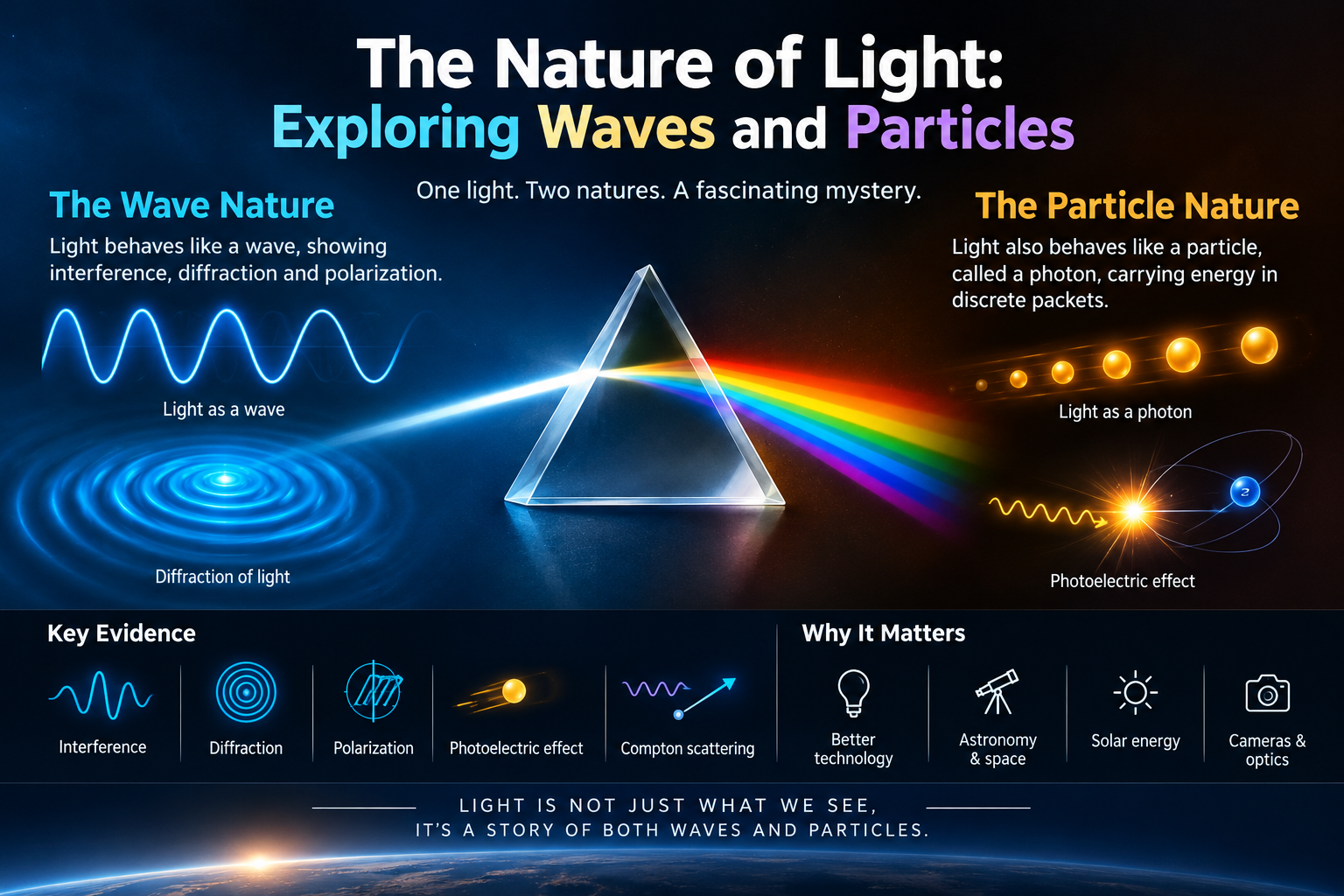
    For many years, scientists have studied light as a wave because it demonstrates important wave-like properties. Light can undergo interference, diffraction, and polarization. Interference occurs when light waves overlap and combine, producing patterns of brightness and darkness. Diffraction happens when light spreads around an obstacle or passes through a narrow opening. Polarization describes the orientation of light's oscillations and helps us understand how light interacts with different materials.

    These properties demonstrate that the wave model is essential for explaining many optical phenomena. From colorful patterns created by thin films to the operation of polarized sunglasses, the wave nature of light has many applications in everyday life and modern technology.

    **2. The Particle Nature of Light **

    Light also behaves in ways that reveal its particle nature. In quantum physics, light energy is exchanged in discrete packets called **photons**. Each photon carries energy determined by its frequency, described by the equation **E = hf**, where E represents energy, h is Planck's constant, and f is frequency.

    The photoelectric effect provides important evidence for this particle nature. When light of a suitable frequency strikes certain materials, it can release electrons from their surfaces. This phenomenon helped scientists understand that light energy is transferred in individual quanta rather than always behaving like a continuous wave.

    Another important example is Compton scattering, in which photons exchange energy and momentum with electrons. These discoveries transformed our understanding of light and helped establish the foundations of quantum physics.

    **3. Wave-Particle Duality: Two Sides of Light**

    One of the most remarkable discoveries in science is that light cannot be fully explained by treating it only as a classical wave or only as a classical particle. Its behavior depends on the physical process being investigated and how it is measured. This concept is known as **wave-particle duality**.

    Experiments involving interference reveal wave-like patterns, while experiments involving photon detection show that light energy is detected in discrete units. Quantum mechanics brings these observations together into a more complete description of nature. Rather than being an ordinary wave or a tiny classical object, light is a quantum phenomenon with properties that challenge our everyday intuition.

    **4. How Do We Discover the Secrets of Light?**

    Scientists use carefully designed experiments to explore the behavior of light. Prisms separate white light into different colors, optical instruments measure its properties, and advanced detectors record individual photons. Interference experiments reveal patterns that cannot be explained by simple particle models, while photoelectric experiments demonstrate the importance of quantized energy.

    The work of scientists such as Isaac Newton, Thomas Young, Max Planck, Albert Einstein, and Arthur Compton helped build our modern understanding of light. Their discoveries show how scientific knowledge develops through observation, experimentation, mathematical reasoning, and new ideas.

    **5. Why Is the Nature of Light Important?**

    Understanding light is essential to many technologies that shape modern life. Lasers are used in medicine, manufacturing, and scientific research. Fiber-optic cables transmit information across the world using pulses of light. Solar panels convert light energy into electrical energy, while cameras and telescopes help us capture images and explore distant objects in space.

    The principles of light are also important in astronomy, microscopy, optical communication, quantum technologies, and the study of the universe. By investigating how light behaves, scientists can examine distant galaxies, study the structure of matter, and develop new tools that improve our understanding of nature.

    **6. Light: Connecting Science and the Universe**

    Light is much more than what allows us to see. It carries information about distant stars, reveals the composition of celestial objects, and provides clues about the physical processes occurring throughout the cosmos. By analyzing the light received from distant galaxies, astronomers can learn about their temperatures, chemical compositions, and motion.

    At the smallest scales, the study of photons helps scientists investigate the quantum world and understand how energy interacts with matter. From the smallest laboratory experiments to the largest astronomical observations, light connects different areas of science in extraordinary ways.

    **Conclusion: The Extraordinary Mystery of Light**

    The study of light demonstrates how nature can be far more complex than it first appears. Its wave-like properties explain interference, diffraction, and polarization, while its particle-like properties help explain the photoelectric effect and Compton scattering. Together, these discoveries form an important part of our modern understanding of physics.

    Learning about wave-particle duality encourages us to question assumptions, explore scientific evidence, and appreciate the discoveries that continue to expand human knowledge. Every beam of sunlight, every shining star, and every photon detected by a scientific instrument reminds us that there is still much to discover about the universe.

    **Light Is More Than What We See—It Is a Window into the Fundamental Nature of Reality!**

    If you enjoyed this science topic, share it with others and continue exploring the fascinating world of physics. Stay curious, keep asking questions, and never stop learning!

    #NatureOfLight #WaveParticleDuality #Physics #QuantumPhysics #ScienceEducation #Photons #LightWaves #PhotoelectricEffect #ComptonScattering #Optics #Astronomy #ScientificDiscoveries #STEMEducation #LearnPhysics #ScienceExplained #EducationalContent #WavesAndParticles
    RSIF8 Roll no:14 story no:24 story topic:The Nature of Light: Exploring Waves and Particles 🌟 **The Nature of Light: Exploring Waves and Particles** 🌈🔬 Have you ever wondered what light really is? How does sunlight travel across millions of kilometers through space, how do rainbows form, and how can light behave like both a wave and a particle? The nature of light is one of the most fascinating topics in physics, revealing the extraordinary connection between the visible world and the mysterious laws of quantum mechanics. From the light that illuminates our homes to the distant stars shining in the universe, light plays an essential role in understanding the world around us. 🌍✨ 💡 **1. The Wave Nature of Light 🌊** For many years, scientists have studied light as a wave because it demonstrates important wave-like properties. Light can undergo interference, diffraction, and polarization. Interference occurs when light waves overlap and combine, producing patterns of brightness and darkness. Diffraction happens when light spreads around an obstacle or passes through a narrow opening. Polarization describes the orientation of light's oscillations and helps us understand how light interacts with different materials. These properties demonstrate that the wave model is essential for explaining many optical phenomena. From colorful patterns created by thin films to the operation of polarized sunglasses, the wave nature of light has many applications in everyday life and modern technology. ⚛️ **2. The Particle Nature of Light ✨** Light also behaves in ways that reveal its particle nature. In quantum physics, light energy is exchanged in discrete packets called **photons**. Each photon carries energy determined by its frequency, described by the equation **E = hf**, where E represents energy, h is Planck's constant, and f is frequency. The photoelectric effect provides important evidence for this particle nature. When light of a suitable frequency strikes certain materials, it can release electrons from their surfaces. This phenomenon helped scientists understand that light energy is transferred in individual quanta rather than always behaving like a continuous wave. Another important example is Compton scattering, in which photons exchange energy and momentum with electrons. These discoveries transformed our understanding of light and helped establish the foundations of quantum physics. 🔬 **3. Wave-Particle Duality: Two Sides of Light** One of the most remarkable discoveries in science is that light cannot be fully explained by treating it only as a classical wave or only as a classical particle. Its behavior depends on the physical process being investigated and how it is measured. This concept is known as **wave-particle duality**. Experiments involving interference reveal wave-like patterns, while experiments involving photon detection show that light energy is detected in discrete units. Quantum mechanics brings these observations together into a more complete description of nature. Rather than being an ordinary wave or a tiny classical object, light is a quantum phenomenon with properties that challenge our everyday intuition. 🌈 **4. How Do We Discover the Secrets of Light?** Scientists use carefully designed experiments to explore the behavior of light. Prisms separate white light into different colors, optical instruments measure its properties, and advanced detectors record individual photons. Interference experiments reveal patterns that cannot be explained by simple particle models, while photoelectric experiments demonstrate the importance of quantized energy. The work of scientists such as Isaac Newton, Thomas Young, Max Planck, Albert Einstein, and Arthur Compton helped build our modern understanding of light. Their discoveries show how scientific knowledge develops through observation, experimentation, mathematical reasoning, and new ideas. 🚀 **5. Why Is the Nature of Light Important?** Understanding light is essential to many technologies that shape modern life. Lasers are used in medicine, manufacturing, and scientific research. Fiber-optic cables transmit information across the world using pulses of light. Solar panels convert light energy into electrical energy, while cameras and telescopes help us capture images and explore distant objects in space. The principles of light are also important in astronomy, microscopy, optical communication, quantum technologies, and the study of the universe. By investigating how light behaves, scientists can examine distant galaxies, study the structure of matter, and develop new tools that improve our understanding of nature. 🌍 **6. Light: Connecting Science and the Universe** Light is much more than what allows us to see. It carries information about distant stars, reveals the composition of celestial objects, and provides clues about the physical processes occurring throughout the cosmos. By analyzing the light received from distant galaxies, astronomers can learn about their temperatures, chemical compositions, and motion. At the smallest scales, the study of photons helps scientists investigate the quantum world and understand how energy interacts with matter. From the smallest laboratory experiments to the largest astronomical observations, light connects different areas of science in extraordinary ways. 💫 **Conclusion: The Extraordinary Mystery of Light** The study of light demonstrates how nature can be far more complex than it first appears. Its wave-like properties explain interference, diffraction, and polarization, while its particle-like properties help explain the photoelectric effect and Compton scattering. Together, these discoveries form an important part of our modern understanding of physics. Learning about wave-particle duality encourages us to question assumptions, explore scientific evidence, and appreciate the discoveries that continue to expand human knowledge. Every beam of sunlight, every shining star, and every photon detected by a scientific instrument reminds us that there is still much to discover about the universe. ✨ **Light Is More Than What We See—It Is a Window into the Fundamental Nature of Reality!** 🔭🌌 👍 If you enjoyed this science topic, share it with others and continue exploring the fascinating world of physics. Stay curious, keep asking questions, and never stop learning! #NatureOfLight #WaveParticleDuality #Physics #QuantumPhysics #ScienceEducation #Photons #LightWaves #PhotoelectricEffect #ComptonScattering #Optics #Astronomy #ScientificDiscoveries #STEMEducation #LearnPhysics #ScienceExplained #EducationalContent #WavesAndParticles 🌈🔬🚀
    0 Commentarios 0 Acciones 10768 Views
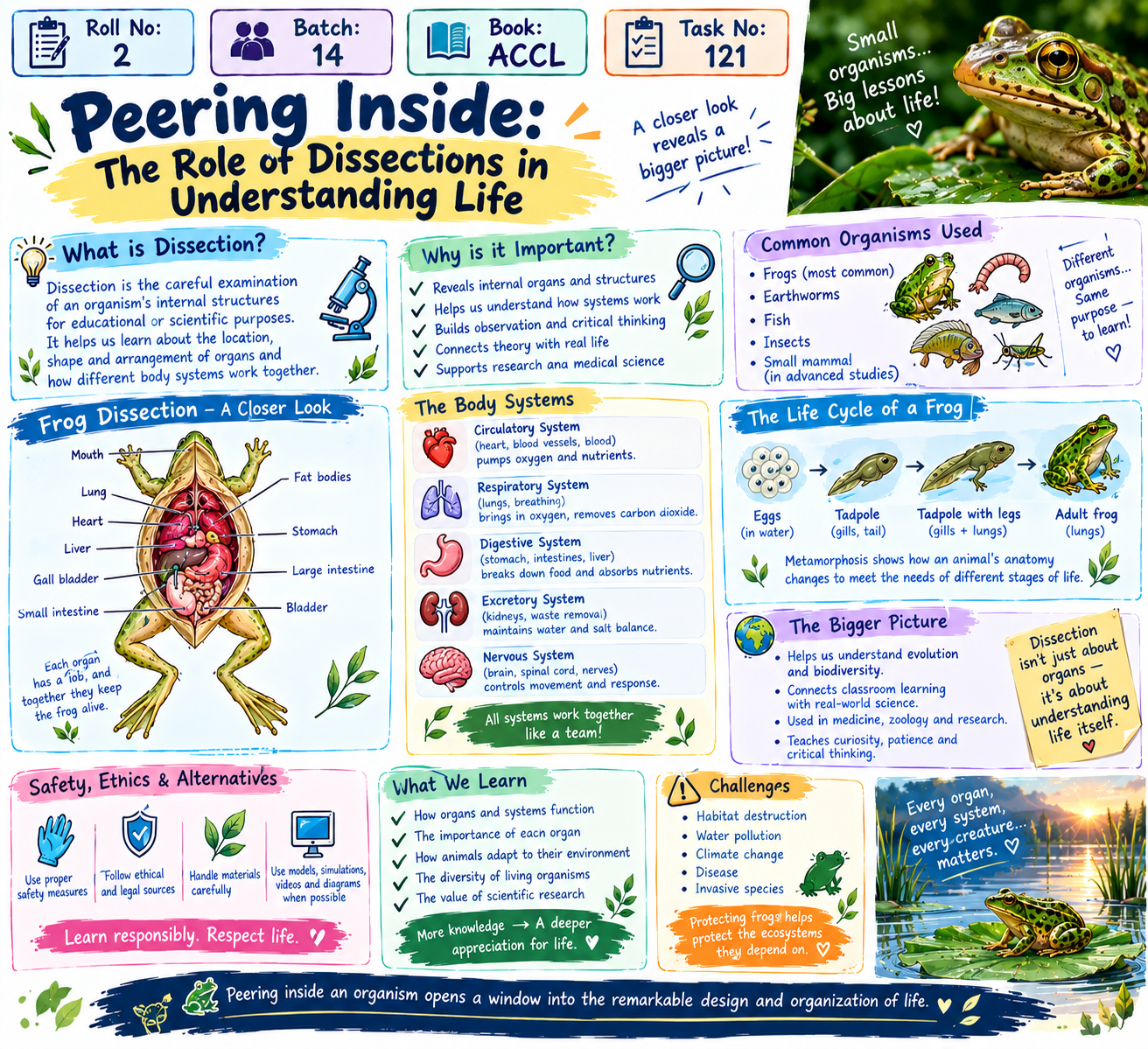
  • **Roll No: 2**
    **Batch: 14**
    **Book: ACCL**
    **Task No: 130**

    # Peering Inside: The Role of Dissections in Understanding Life

    Have you ever wondered how scientists discover what lies inside a living organism and how its different organs work together? The human body and the bodies of other animals contain many complex structures that cannot be fully understood by looking only at their outer appearance. Dissection is one scientific method that helps students and researchers explore internal anatomy and understand the remarkable organization of life.

    **Dissection is the careful examination of an organism's internal structures for educational or scientific purposes.** It helps us learn about the location, shape, and arrangement of organs and how different body systems work together. By studying anatomy, we can better understand how living organisms obtain energy, breathe, circulate blood, digest food, and respond to their surroundings.

    One commonly discussed example in biology education is frog dissection. Frogs are interesting study organisms because they have many organ systems that can be compared with those of other vertebrates. Their bodies are adapted for movement on land and in water, and their anatomy provides useful opportunities to study how organs perform different functions. Observing frog anatomy can help students understand the relationship between body structure and survival.

    The circulatory system is an important area of anatomical study. The heart pumps blood through blood vessels, helping transport oxygen, nutrients, and other substances around the body. The respiratory system supports gas exchange, while the digestive system breaks down food so that the body can absorb useful nutrients. These systems work together to supply cells with the materials and energy they need.

    The nervous system is equally fascinating. It includes the brain, spinal cord, and nerves, which coordinate movement, process information, and help organisms respond to changes in their environments. The excretory system also plays an essential role by removing waste products and maintaining the balance of water and salts. Studying these systems reveals that every organ has a specific role, yet no organ works entirely alone.

    Dissection can also connect classroom learning with real-world science. Medical professionals study anatomy to understand the human body, while zoologists investigate the structures of different animal species. Researchers use many methods, including imaging, microscopy, computer models, and carefully conducted anatomical studies, to investigate how organisms function. These approaches have helped expand our knowledge of health, development, and biodiversity.

    Although dissection can be a valuable learning method, science education must also emphasize responsibility and respect for life. Schools and laboratories should follow appropriate safety procedures, use legally and ethically sourced specimens, and handle materials carefully. Whenever possible, students may also learn through digital simulations, anatomical models, videos, and diagrams. These alternatives can explain many internal structures without requiring the use of preserved specimens.

    The study of anatomy helps us appreciate the diversity of living organisms. Different species have different body structures because they have adapted to different environments and ways of life. Comparing these structures allows scientists to investigate evolution, understand biological similarities, and discover how organisms meet the challenges of survival.

    Dissection teaches more than the names of organs. It encourages observation, patience, careful reasoning, and the ability to connect scientific evidence with biological explanations. It also reminds us that scientific knowledge grows through asking questions, examining evidence, and learning from reliable methods rather than making assumptions.

    **Peering inside an organism opens a window into the remarkable design and organization of life. By studying anatomy responsibly, we deepen our understanding of biology, appreciate the connections between body systems, and learn why every discovery should be guided by curiosity, care, and respect for the natural world. **

    \#Dissection #Anatomy #Biology #ScienceEducation #AnimalScience #LearningThroughScience #ACCL #Batch14 #Task121
    **Roll No: 2** **Batch: 14** **Book: ACCL** **Task No: 130** # 🔬🧬 Peering Inside: The Role of Dissections in Understanding Life 🐸🌿 Have you ever wondered how scientists discover what lies inside a living organism and how its different organs work together? 🔍🫀 The human body and the bodies of other animals contain many complex structures that cannot be fully understood by looking only at their outer appearance. Dissection is one scientific method that helps students and researchers explore internal anatomy and understand the remarkable organization of life. 🌍✨ **Dissection is the careful examination of an organism's internal structures for educational or scientific purposes.** 🔬 It helps us learn about the location, shape, and arrangement of organs and how different body systems work together. By studying anatomy, we can better understand how living organisms obtain energy, breathe, circulate blood, digest food, and respond to their surroundings. 📚🧠 One commonly discussed example in biology education is frog dissection. 🐸 Frogs are interesting study organisms because they have many organ systems that can be compared with those of other vertebrates. Their bodies are adapted for movement on land and in water, and their anatomy provides useful opportunities to study how organs perform different functions. Observing frog anatomy can help students understand the relationship between body structure and survival. The circulatory system is an important area of anatomical study. ❤️ The heart pumps blood through blood vessels, helping transport oxygen, nutrients, and other substances around the body. The respiratory system supports gas exchange, while the digestive system breaks down food so that the body can absorb useful nutrients. These systems work together to supply cells with the materials and energy they need. ⚡🫁 The nervous system is equally fascinating. 🧠 It includes the brain, spinal cord, and nerves, which coordinate movement, process information, and help organisms respond to changes in their environments. The excretory system also plays an essential role by removing waste products and maintaining the balance of water and salts. Studying these systems reveals that every organ has a specific role, yet no organ works entirely alone. Dissection can also connect classroom learning with real-world science. 🏥 Medical professionals study anatomy to understand the human body, while zoologists investigate the structures of different animal species. Researchers use many methods, including imaging, microscopy, computer models, and carefully conducted anatomical studies, to investigate how organisms function. These approaches have helped expand our knowledge of health, development, and biodiversity. 🔬📖 Although dissection can be a valuable learning method, science education must also emphasize responsibility and respect for life. 💚 Schools and laboratories should follow appropriate safety procedures, use legally and ethically sourced specimens, and handle materials carefully. Whenever possible, students may also learn through digital simulations, anatomical models, videos, and diagrams. These alternatives can explain many internal structures without requiring the use of preserved specimens. The study of anatomy helps us appreciate the diversity of living organisms. 🐸🐟🐦 Different species have different body structures because they have adapted to different environments and ways of life. Comparing these structures allows scientists to investigate evolution, understand biological similarities, and discover how organisms meet the challenges of survival. Dissection teaches more than the names of organs. It encourages observation, patience, careful reasoning, and the ability to connect scientific evidence with biological explanations. 🧪💡 It also reminds us that scientific knowledge grows through asking questions, examining evidence, and learning from reliable methods rather than making assumptions. **Peering inside an organism opens a window into the remarkable design and organization of life. By studying anatomy responsibly, we deepen our understanding of biology, appreciate the connections between body systems, and learn why every discovery should be guided by curiosity, care, and respect for the natural world. 🔬🌿🌎** \#Dissection #Anatomy #Biology #ScienceEducation #AnimalScience #LearningThroughScience #ACCL #Batch14 #Task121 🧬🔬💚
    0 Commentarios 0 Acciones 4079 Views
  • #rsisb
    Roll No 253
    Foundation Level
    Story Post 24

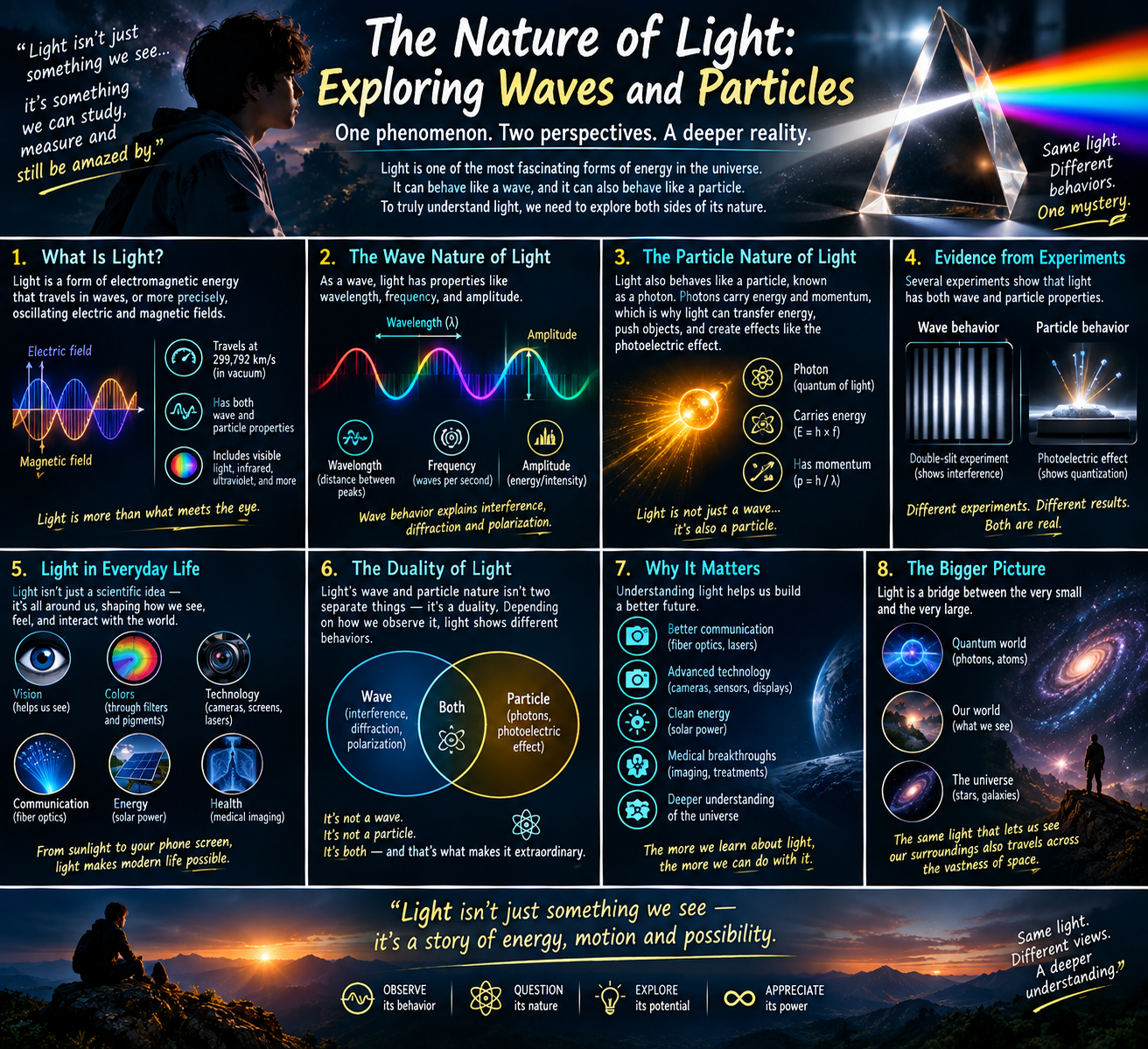
    # The Nature of Light: Exploring Waves and Particles

    Imagine standing beneath a night sky filled with stars.

    Every photon reaching your eyes has traveled across space carrying information from distant worlds. Light allows us to see, measure, communicate, explore, and understand the universe itself.

    But light is far stranger than it first appears.

    Sometimes it behaves like a **wave** .

    Sometimes it behaves like a **particle** .

    And understanding this strange dual nature changed our picture of reality forever.

    ---

    # 1. What Is Light?

    Light is a form of **electromagnetic radiation**—energy carried through oscillating electric and magnetic fields.

    In empty space, electromagnetic waves travel at approximately:

    ### **299,792 kilometers per second**

    That's the speed of light in vacuum.

    Visible light is only a small part of the electromagnetic spectrum.

    Beyond what our eyes can see are:

    Radio waves
    Microwaves
    Infrared
    Visible light
    Ultraviolet
    🩻 X-rays
    Gamma rays

    So light isn't simply what we see.

    ### **It's an enormous family of electromagnetic phenomena.**

    ---

    # 2. The Wave Nature of Light

    When light behaves as a wave, we can describe it using several important properties:

    **Wavelength** — the distance between successive wave peaks
    **Frequency** — how many oscillations occur each second
    **Amplitude** — related to the wave's intensity

    These properties help explain many familiar phenomena.

    **Interference** occurs when waves combine.
    **Diffraction** occurs when waves spread around openings or obstacles.
    **Polarization** describes the orientation of electromagnetic oscillations.

    The wave model explains behaviors that are difficult to understand if we imagine light only as tiny particles.

    ---

    # 3. The Particle Nature of Light

    But the story doesn't end there.

    Light can also behave as if it arrives in discrete packets of energy called **photons**.

    A photon is a quantum of electromagnetic radiation.

    Its energy is related to frequency:

    ### **E = h × f**

    And its momentum is related to its wavelength:

    ### **p = h / λ**

    This particle-like behavior helps explain phenomena such as the **photoelectric effect**, where light can transfer energy to electrons.

    So light isn't simply a smooth continuous wave.

    At the quantum level, energy can be exchanged in discrete amounts.

    ### **Light has another side—and it's quantum.**

    ---

    # 4. Evidence From Experiments

    The strange nature of light isn't merely philosophical.

    Experiments demonstrate it.

    ### Double-Slit Experiment

    When light passes through two narrow openings, an **interference pattern** can appear—strong evidence of wave-like behavior.

    ### Photoelectric Effect

    When light strikes certain materials, it can eject electrons. This behavior is explained using photons and quantized energy.

    Different experiments reveal different aspects of light.

    And that's one of the most fascinating things about physics:

    ### **The same phenomenon can reveal different behaviors depending on how we investigate it.**

    ---

    # 5. Light in Everyday Life

    Light isn't something that exists only inside physics laboratories.

    It's everywhere.

    **Vision** — allows us to see the world
    **Colors** — arise from how different wavelengths interact with matter
    **Cameras** — convert light into images
    **Screens** — produce controlled patterns of light
    **Fiber optics** — carry information using light
    **Solar panels** — convert light energy into electrical energy
    🩻 **Medical imaging** — uses electromagnetic radiation to see inside the body

    From sunrise to smartphone screens…

    ### **Modern civilization depends heavily on our ability to control light.**

    ---

    # 6. The Duality of Light

    Here lies the great mystery.

    Light can display **wave-like behavior**

    and

    **particle-like behavior** .

    This is known as **wave-particle duality**.

    It's important to understand that this doesn't mean light is literally switching between being a classical wave and a classical particle like two separate objects.

    Instead, quantum physics gives us a deeper framework in which classical wave and particle descriptions each capture different aspects of light's behavior.

    ### **Two perspectives. One quantum reality.**

    ---

    # 7. Why Understanding Light Matters

    Learning how light behaves has transformed technology.

    **Communication** — fiber-optic networks
    **Science** — spectroscopy and microscopy
    **Imaging** — cameras and sensors
    **Energy** — solar technology
    **Medicine** — lasers and diagnostic imaging
    **Astronomy** — studying distant stars and galaxies

    When astronomers observe light from a distant star, they aren't simply seeing brightness.

    They can analyze the light's wavelengths and learn about the star's:

    Temperature
    Chemical composition
    Motion
    Environment

    ### **Light carries information across space.**

    ---

    # 8. The Bigger Picture

    Light connects the microscopic and the cosmic.

    At the quantum scale, photons interact with atoms and electrons.

    At human scales, light allows us to see and communicate.

    Across astronomical distances, light travels from stars and galaxies to our telescopes.

    In many ways, light is our messenger from the universe.

    When we look at a distant galaxy, we are receiving photons that may have traveled for millions or billions of years before reaching Earth.

    ### **Looking at the universe means looking at ancient light.**

    ---

    # The Final Thought

    Light is more than something that illuminates a room.

    It is energy.
    It is information.
    It is electromagnetic radiation.
    It has quantum behavior.
    And it is one of the most important tools we have for exploring reality.

    From a photon interacting with an electron…

    to sunlight crossing space…

    to the glow of a distant galaxy…

    ### **Light connects the smallest scales of nature with the largest.**

    So the next time you see sunlight streaming through a window , a rainbow , or stars shining overhead , remember:

    **You aren't simply seeing light.**

    You're witnessing one of the universe's most fascinating mysteries—a phenomenon that behaves in ways far stranger and more beautiful than our everyday experience suggests.

    # **Light isn't just something we see—it's a story of energy, motion, information, and possibility.** ∞


    Asma Shaheen EducationWali
    Saima Empowerment Wali
    Mishaal TrainingWali
    #rsisb Roll No 253 Foundation Level Story Post 24 # 🌈⚡ The Nature of Light: Exploring Waves and Particles Imagine standing beneath a night sky filled with stars. 🌌✨ Every photon reaching your eyes has traveled across space carrying information from distant worlds. Light allows us to see, measure, communicate, explore, and understand the universe itself. 🔭👁️📡 But light is far stranger than it first appears. Sometimes it behaves like a **wave** 🌊. Sometimes it behaves like a **particle** ⚛️. And understanding this strange dual nature changed our picture of reality forever. 🧠🌌 --- # 💡🌌 1. What Is Light? Light is a form of **electromagnetic radiation**—energy carried through oscillating electric and magnetic fields. ⚡🧲 In empty space, electromagnetic waves travel at approximately: ### 🚀 **299,792 kilometers per second** That's the speed of light in vacuum. Visible light 👁️🌈 is only a small part of the electromagnetic spectrum. Beyond what our eyes can see are: 📻 Radio waves 📡 Microwaves 🔥 Infrared 🌈 Visible light ☀️ Ultraviolet 🩻 X-rays ☢️ Gamma rays So light isn't simply what we see. ### **It's an enormous family of electromagnetic phenomena.** 🌌⚡ --- # 🌊🔬 2. The Wave Nature of Light When light behaves as a wave, we can describe it using several important properties: 〰️ **Wavelength** — the distance between successive wave peaks ⚡ **Frequency** — how many oscillations occur each second 📈 **Amplitude** — related to the wave's intensity These properties help explain many familiar phenomena. 🌈 **Interference** occurs when waves combine. 🔍 **Diffraction** occurs when waves spread around openings or obstacles. 🕶️ **Polarization** describes the orientation of electromagnetic oscillations. The wave model explains behaviors that are difficult to understand if we imagine light only as tiny particles. --- # ⚛️✨ 3. The Particle Nature of Light But the story doesn't end there. Light can also behave as if it arrives in discrete packets of energy called **photons**. ⚛️💡 A photon is a quantum of electromagnetic radiation. Its energy is related to frequency: ### **E = h × f** ⚡ And its momentum is related to its wavelength: ### **p = h / λ** 🌊⚛️ This particle-like behavior helps explain phenomena such as the **photoelectric effect**, where light can transfer energy to electrons. So light isn't simply a smooth continuous wave. At the quantum level, energy can be exchanged in discrete amounts. ### **Light has another side—and it's quantum.** 🌌⚛️ --- # 🧪🔍 4. Evidence From Experiments The strange nature of light isn't merely philosophical. Experiments demonstrate it. ### 🌊 Double-Slit Experiment When light passes through two narrow openings, an **interference pattern** can appear—strong evidence of wave-like behavior. 🌊〰️ ### ⚡ Photoelectric Effect When light strikes certain materials, it can eject electrons. This behavior is explained using photons and quantized energy. ⚛️🔋 Different experiments reveal different aspects of light. And that's one of the most fascinating things about physics: ### **The same phenomenon can reveal different behaviors depending on how we investigate it.** 🔬✨ --- # 👁️🌈 5. Light in Everyday Life Light isn't something that exists only inside physics laboratories. It's everywhere. 🌍☀️ 👁️ **Vision** — allows us to see the world 🌈 **Colors** — arise from how different wavelengths interact with matter 📷 **Cameras** — convert light into images 📱 **Screens** — produce controlled patterns of light 🌐 **Fiber optics** — carry information using light ☀️ **Solar panels** — convert light energy into electrical energy 🩻 **Medical imaging** — uses electromagnetic radiation to see inside the body From sunrise to smartphone screens… ### **Modern civilization depends heavily on our ability to control light.** 💡🌍 --- # 🌊⚛️ 6. The Duality of Light Here lies the great mystery. Light can display **wave-like behavior** 🌊 and **particle-like behavior** ⚛️. This is known as **wave-particle duality**. It's important to understand that this doesn't mean light is literally switching between being a classical wave and a classical particle like two separate objects. Instead, quantum physics gives us a deeper framework in which classical wave and particle descriptions each capture different aspects of light's behavior. ### **Two perspectives. One quantum reality.** 🌌✨ --- # 🚀🔬 7. Why Understanding Light Matters Learning how light behaves has transformed technology. 📡 **Communication** — fiber-optic networks 🔬 **Science** — spectroscopy and microscopy 📷 **Imaging** — cameras and sensors ☀️ **Energy** — solar technology 🩺 **Medicine** — lasers and diagnostic imaging 🚀 **Astronomy** — studying distant stars and galaxies When astronomers observe light from a distant star, they aren't simply seeing brightness. They can analyze the light's wavelengths and learn about the star's: 🌡️ Temperature 🧪 Chemical composition 💨 Motion 🌌 Environment ### **Light carries information across space.** --- # 🌌🔭 8. The Bigger Picture Light connects the microscopic and the cosmic. At the quantum scale, photons interact with atoms and electrons. ⚛️🔬 At human scales, light allows us to see and communicate. 👁️📱 Across astronomical distances, light travels from stars and galaxies to our telescopes. 🌟🔭 In many ways, light is our messenger from the universe. When we look at a distant galaxy, we are receiving photons that may have traveled for millions or billions of years before reaching Earth. 🌌⏳ ### **Looking at the universe means looking at ancient light.** ✨ --- # 🌅💡 The Final Thought Light is more than something that illuminates a room. It is energy. ⚡ It is information. 📡 It is electromagnetic radiation. 🌊 It has quantum behavior. ⚛️ And it is one of the most important tools we have for exploring reality. 🔭 From a photon interacting with an electron… to sunlight crossing space… to the glow of a distant galaxy… ### **Light connects the smallest scales of nature with the largest.** 🌌⚛️ So the next time you see sunlight streaming through a window ☀️, a rainbow 🌈, or stars shining overhead ⭐, remember: **You aren't simply seeing light.** You're witnessing one of the universe's most fascinating mysteries—a phenomenon that behaves in ways far stranger and more beautiful than our everyday experience suggests. 🌊⚛️✨ # 🌈🌌 **Light isn't just something we see—it's a story of energy, motion, information, and possibility.** ⚡🔬∞ Asma Shaheen EducationWali Saima Empowerment Wali Mishaal TrainingWali
    0 Commentarios 0 Acciones 7721 Views
  • #rsisb
    Roll no.239
    Story post no.24
    Foundation Level
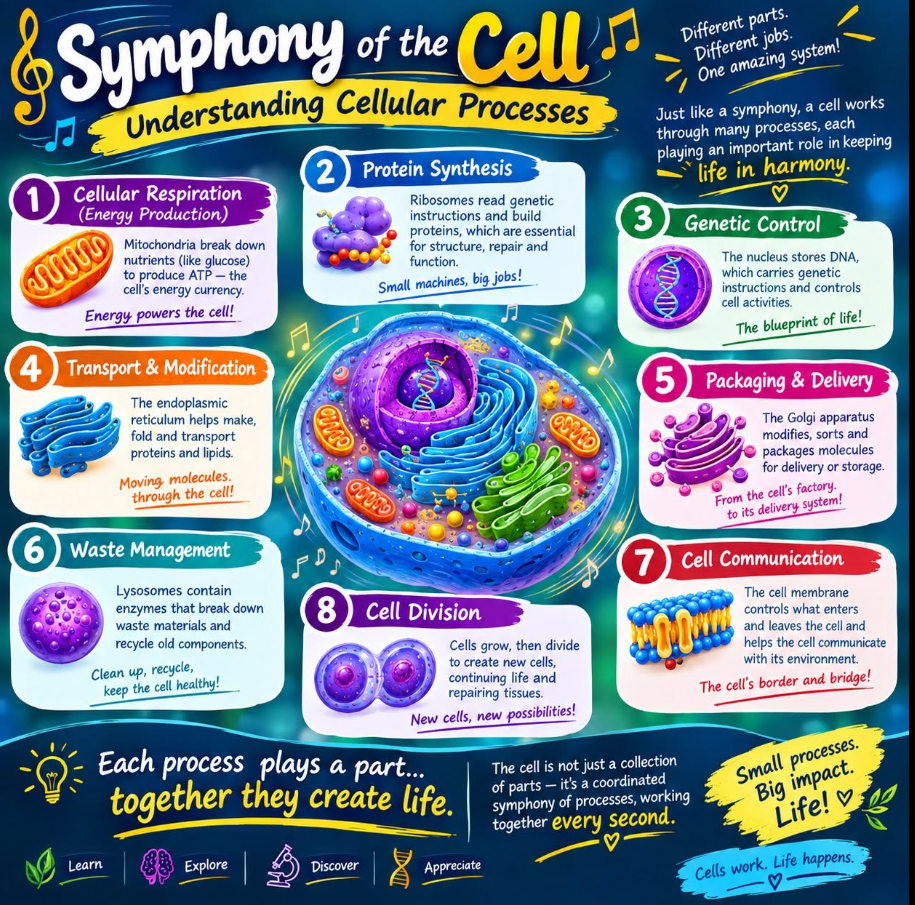
    Imagine a cell as a magnificent orchestra, where every organelle has its own instrument and every cellular process plays an important part. Together, they create the incredible **symphony of life**.
    Just as an orchestra depends on different musicians working together, a cell depends on many specialized structures and processes to stay organized and function properly.
    **Cellular Respiration — The Energy Makers**
    Mitochondria help produce ATP, the usable energy that powers many cellular activities.
    **Genetic Control — The Instructions**
    The nucleus stores DNA, which contains genetic information that helps guide cell activities.
    **Protein Synthesis — The Builders**
    Ribosomes use genetic instructions to build proteins needed for growth, repair, and everyday cellular functions.
    **Transport & Modification — The Delivery Network**
    The endoplasmic reticulum helps produce and transport proteins and lipids within the cell.
    **Packaging & Delivery — The Shipping Center**
    The Golgi apparatus modifies, sorts, and packages molecules so they can reach their proper destinations.
    **Waste Management — The Recycling Team**
    Lysosomes help break down unwanted materials and recycle components within the cell.
    **Cell Communication — The Gatekeeper**
    The cell membrane controls what enters and leaves the cell while helping the cell interact with its surroundings.
    **Cell Division — Creating New Cells**
    Cells can grow and divide, allowing organisms to develop, replace cells, and repair tissues.
    Every process has a role. Every organelle contributes to the performance. And together, they demonstrate one of biology’s most fascinating ideas:
    **A cell is not simply a collection of parts—it is a coordinated system where countless processes work together to support life.**
    **Learn. Explore. Discover. Appreciate the amazing symphony happening inside every living cell.**
    #SymphonyOfTheCell #CellBiology #Biology #CellularProcesses #Organelles #Science #ScienceEducation #BiologyFacts #CellStructure #Mitochondria #DNA #ProteinSynthesis #CellDivision #Microscopy #Learning #DidYouKnow #ScientificDiscovery
    #rsisb Roll no.239 Story post no.24 Foundation Level Imagine a cell as a magnificent orchestra, where every organelle has its own instrument and every cellular process plays an important part. Together, they create the incredible **symphony of life**. 🎼🌱 Just as an orchestra depends on different musicians working together, a cell depends on many specialized structures and processes to stay organized and function properly. ⚡ **Cellular Respiration — The Energy Makers** Mitochondria help produce ATP, the usable energy that powers many cellular activities. 🧬 **Genetic Control — The Instructions** The nucleus stores DNA, which contains genetic information that helps guide cell activities. 🏭 **Protein Synthesis — The Builders** Ribosomes use genetic instructions to build proteins needed for growth, repair, and everyday cellular functions. 🚚 **Transport & Modification — The Delivery Network** The endoplasmic reticulum helps produce and transport proteins and lipids within the cell. 📦 **Packaging & Delivery — The Shipping Center** The Golgi apparatus modifies, sorts, and packages molecules so they can reach their proper destinations. ♻️ **Waste Management — The Recycling Team** Lysosomes help break down unwanted materials and recycle components within the cell. 🚪 **Cell Communication — The Gatekeeper** The cell membrane controls what enters and leaves the cell while helping the cell interact with its surroundings. 🌱 **Cell Division — Creating New Cells** Cells can grow and divide, allowing organisms to develop, replace cells, and repair tissues. Every process has a role. Every organelle contributes to the performance. And together, they demonstrate one of biology’s most fascinating ideas: ✨ **A cell is not simply a collection of parts—it is a coordinated system where countless processes work together to support life.** 🔬 **Learn. Explore. Discover. Appreciate the amazing symphony happening inside every living cell.** #SymphonyOfTheCell #CellBiology #Biology #CellularProcesses #Organelles #Science #ScienceEducation #BiologyFacts #CellStructure #Mitochondria #DNA #ProteinSynthesis #CellDivision #Microscopy #Learning #DidYouKnow #ScientificDiscovery
    0 Commentarios 0 Acciones 7289 Views
  • #rsisb
    Roll no.239
    Story post no.23
    Foundation Level


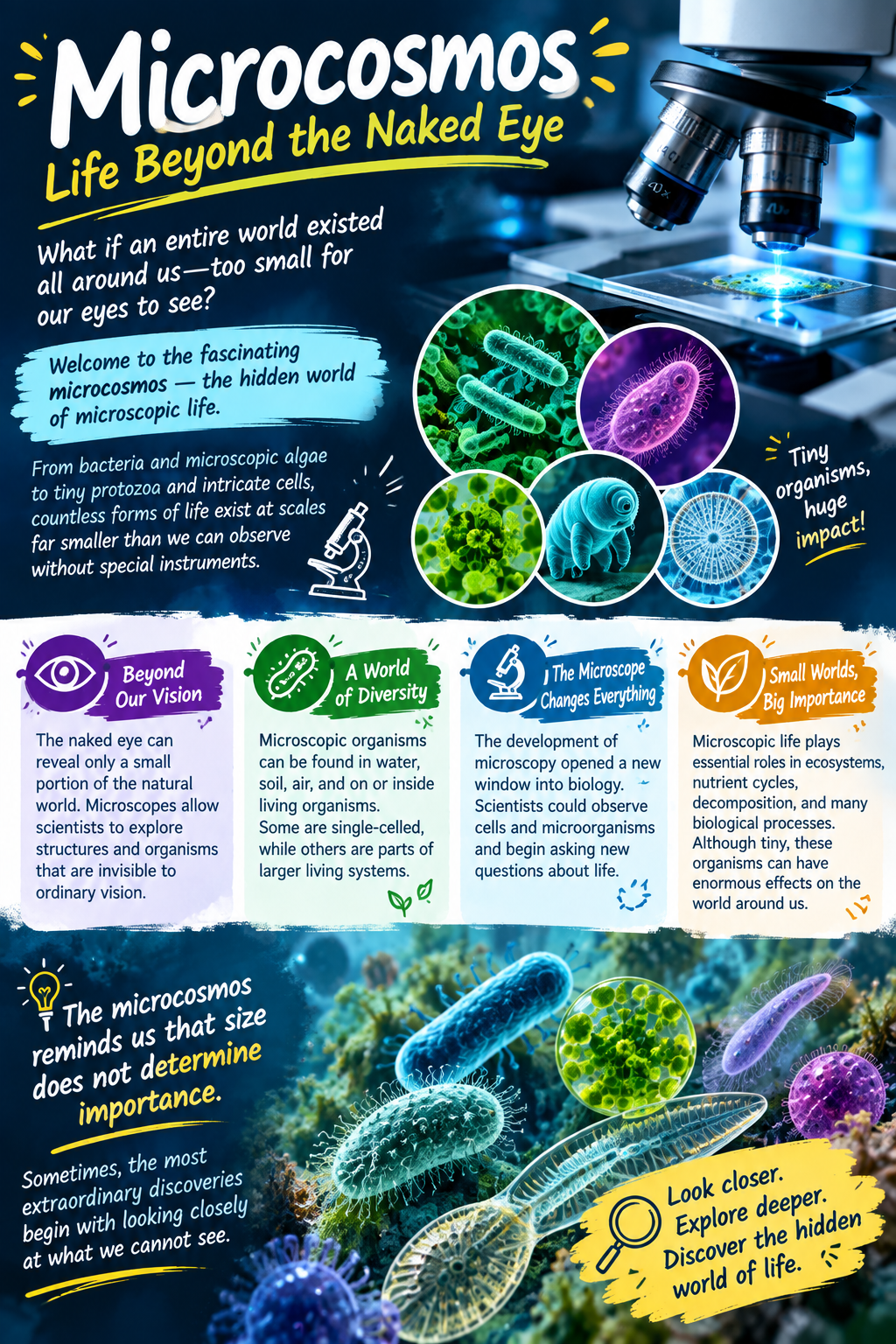
    Welcome to the fascinating **microcosmos**, the hidden world of microscopic life. From bacteria and microscopic algae to tiny protozoa and intricate cells, countless forms of life exist at scales far smaller than we can observe without special instruments.

    **Beyond Our Vision**
    The naked eye can reveal only a small portion of the natural world. Microscopes allow scientists to explore structures and organisms that are invisible to ordinary vision.

    **A World of Diversity**
    Microscopic organisms can be found in water, soil, air, and on or inside living organisms. Some are single-celled, while others are parts of larger living systems.

    **The Microscope Changes Everything**
    The development of microscopy opened a new window into biology. Scientists could observe cells and microorganisms and begin asking new questions about life.

    **Small Worlds, Big Importance**
    Microscopic life plays essential roles in ecosystems, nutrient cycles, decomposition, and many biological processes. Although tiny, these organisms can have enormous effects on the world around us.

    **The microcosmos reminds us that size does not determine importance. Sometimes, the most extraordinary discoveries begin with looking closely at what we cannot see.**

    **Look closer. Explore deeper. Discover the hidden world of life.**

    #Microcosmos #MicroscopicWorld #Microscopy #Biology #Microbiology #Science #Cells #Microorganisms #NaturalWorld #ScienceEducation #BiologyFacts #DidYouKnow #ExploreScience #Learning #ScientificDiscovery
    #rsisb Roll no.239 Story post no.23 Foundation Level Welcome to the fascinating **microcosmos**, the hidden world of microscopic life. From bacteria and microscopic algae to tiny protozoa and intricate cells, countless forms of life exist at scales far smaller than we can observe without special instruments. 🔬 👁️ **Beyond Our Vision** The naked eye can reveal only a small portion of the natural world. Microscopes allow scientists to explore structures and organisms that are invisible to ordinary vision. 🧫 **A World of Diversity** Microscopic organisms can be found in water, soil, air, and on or inside living organisms. Some are single-celled, while others are parts of larger living systems. 🔬 **The Microscope Changes Everything** The development of microscopy opened a new window into biology. Scientists could observe cells and microorganisms and begin asking new questions about life. 🌱 **Small Worlds, Big Importance** Microscopic life plays essential roles in ecosystems, nutrient cycles, decomposition, and many biological processes. Although tiny, these organisms can have enormous effects on the world around us. ✨ **The microcosmos reminds us that size does not determine importance. Sometimes, the most extraordinary discoveries begin with looking closely at what we cannot see.** 🔍 **Look closer. Explore deeper. Discover the hidden world of life.** #Microcosmos #MicroscopicWorld #Microscopy #Biology #Microbiology #Science #Cells #Microorganisms #NaturalWorld #ScienceEducation #BiologyFacts #DidYouKnow #ExploreScience #Learning #ScientificDiscovery
    0 Commentarios 0 Acciones 2982 Views