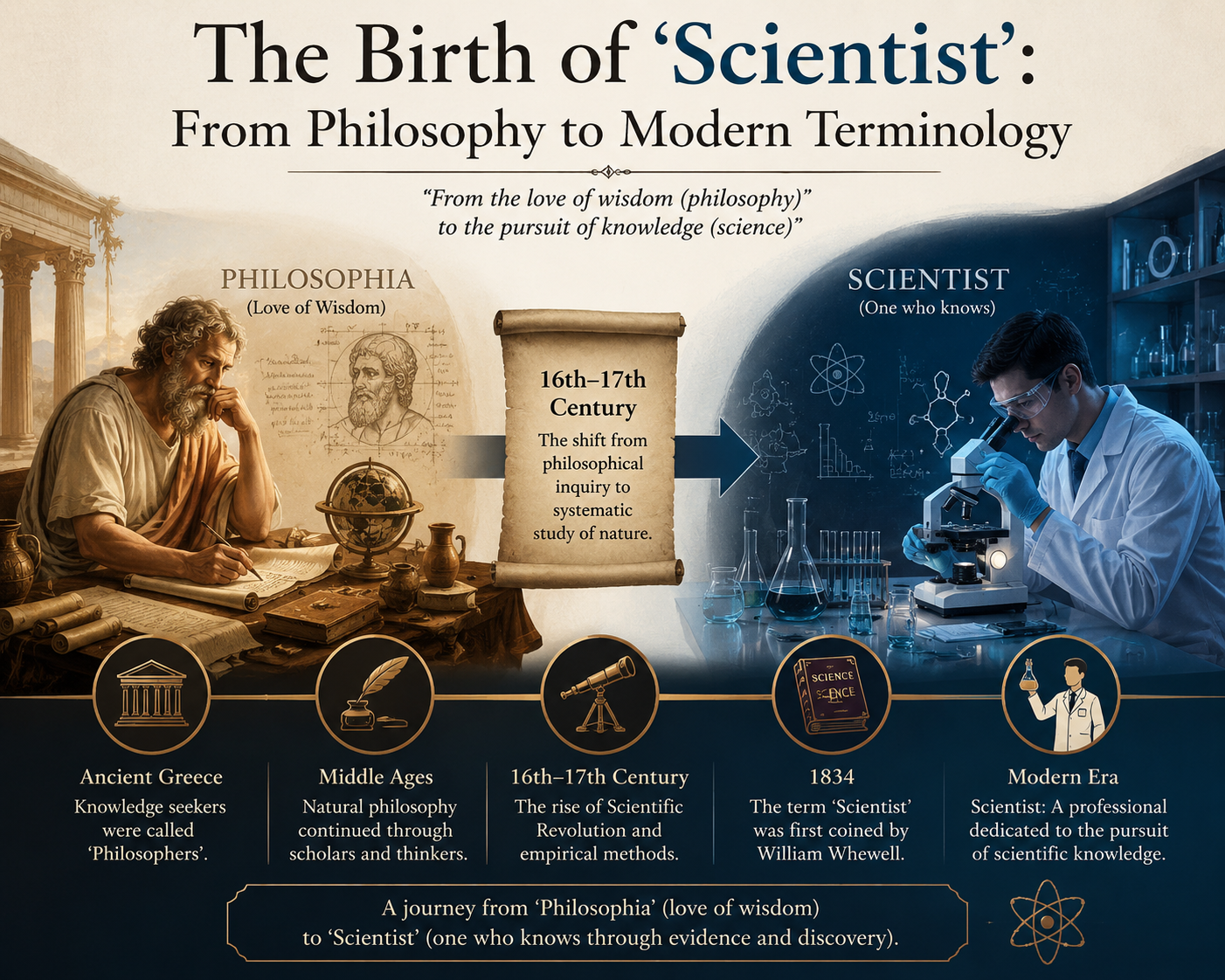
• #rsisb Roll No:232 Foundation level student. Documentary No:5 🔬 **Description:** Discover the fascinating history of the word **“Scientist”** and explore how it evolved from ancient philosophy to modern scientific terminology! 🌍📖 In this documentary, we will explore how people in the past studied nature, the universe, and human life through philosophy and observation. We will learn how the word “scientist” became popular in the 19th century and how science developed into a major field of modern knowledge. From curious philosophers to groundbreaking researchers, this journey highlights the importance of curiosity, creativity, experimentation, and discovery in shaping our world. 🧪💡 Join us to discover the origins of scientific thinking and understand how the language of science has changed over time. 🚀 ✨ **Keep learning, stay curious, and explore the world of science!** #️⃣ **Hashtags:** #Scientist #HistoryOfScience #ScienceDocumentary #WordOrigins #Etymology #ScientificDiscovery #Philosophy #ModernScience #ScienceHistory #Education #Knowledge #LearningJourney #Curiosity #Innovation #Technology #Research #Documentary #KeepLearning #ExploreScience #EducationalContent 🎥🔬📚🌍🧪💡🚀✨ Irum Asim Leadershipwali Asma Shaheen EducationWali Rehan School Islamabad Campus https://www.facebook.com/share/v/1E1ykR5mCZ/
    WWW.FACEBOOK.COM
    Facebook
    #rsisb Roll No:232 Foundation level student. Documentary No:5 🔬 **Description:** Discover the fascinating history of the word **“Scientist”** and explore how it evolved from ancient philosophy to...
    0 Комментарии 0 Поделились 2373 Просмотры
  • Rsif8
    Roll No 30
    Post No 212
    ## Description — “The Birth of ‘Scientist’: From Philosophy to Modern Terminology”

    In this video, I explore the fascinating history of the word **“scientist”** and how it became part of modern terminology.

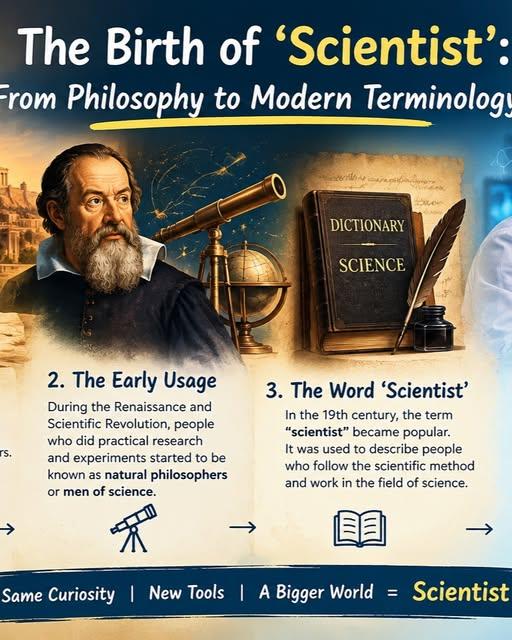
    In the past, people who studied nature and the world around us were often called **natural philosophers**. As scientific knowledge grew and different fields became more specialized, there was a need for a new word to describe people who worked in science.

    In **1833, William Whewell introduced the term “scientist.”** Over time, the word became widely used and is now a common part of our everyday language.

    This project helped me learn how **science, history, philosophy, and language** are connected. It also showed me how scientific work has developed from the past to the modern world.

    Thank you for watching and learning with me!

    #Scientist #HistoryOfScience #Science #Philosophy #WilliamWhewell #ScientificHistory #Education #Learning #ModernScience #RehanSchool
    Rsif8 Roll No 30 Post No 212 ## 🔬 Description — “The Birth of ‘Scientist’: From Philosophy to Modern Terminology” In this video, I explore the fascinating history of the word **“scientist”** and how it became part of modern terminology. In the past, people who studied nature and the world around us were often called **natural philosophers**. As scientific knowledge grew and different fields became more specialized, there was a need for a new word to describe people who worked in science. In **1833, William Whewell introduced the term “scientist.”** Over time, the word became widely used and is now a common part of our everyday language. This project helped me learn how **science, history, philosophy, and language** are connected. It also showed me how scientific work has developed from the past to the modern world. Thank you for watching and learning with me! 🔬📚 #Scientist #HistoryOfScience #Science #Philosophy #WilliamWhewell #ScientificHistory #Education #Learning #ModernScience #RehanSchool
    0 Комментарии 1 Поделились 1862 Просмотры 7
  • #RSTA
    #Task : Story Post
    #Class: Foundation Level Book 2
    #Day No: 4
    #Made By Me

    Total Post:2


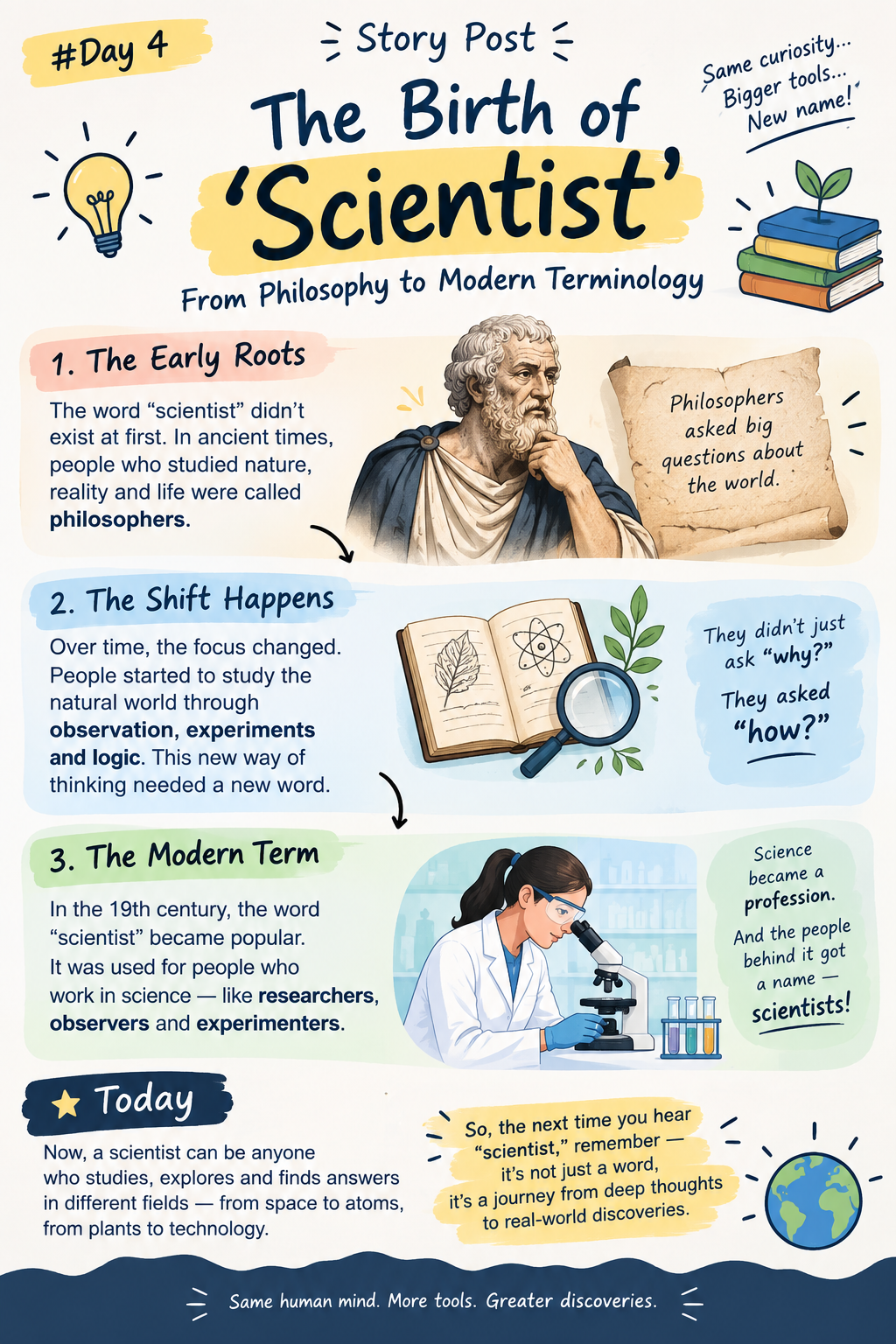
    This story explores how the word **“Scientist”** came into use and how the study of nature changed from ancient philosophy to modern science. It takes us through the journey from philosophers asking “why?” to scientists using observation, experiments, and logic to discover “how.”

    I also created a creative image based on this story and shared the post on **Facebook, YouTube, LinkedIn, Instagram, and TikTok.**

    RSTA StoryPost Scientist ScienceHistory Learning Education ModernScience MadeByMe
    #RSTA #Task : Story Post #Class: Foundation Level Book 2 #Day No: 4 #Made By Me Total Post:2 This story explores how the word **“Scientist”** came into use and how the study of nature changed from ancient philosophy to modern science. 🔬✨ It takes us through the journey from philosophers asking “why?” to scientists using observation, experiments, and logic to discover “how.” 🎨 I also created a creative image based on this story and shared the post on **Facebook, YouTube, LinkedIn, Instagram, and TikTok.** RSTA StoryPost Scientist ScienceHistory Learning Education ModernScience MadeByMe
    0 Комментарии 0 Поделились 1447 Просмотры
  • RSIF8
    ROLL NO 77
    STORY POST NO 43
    STORY TOPIC : The Birth of 'Scientist': From Philosophy to Modern Terminology.

    **The Birth of “Scientist”: From Philosophy to Modern Terminology**

    کیا آپ جانتے ہیں کہ **“Scientist”** کا لفظ ہمیشہ سے موجود نہیں تھا؟
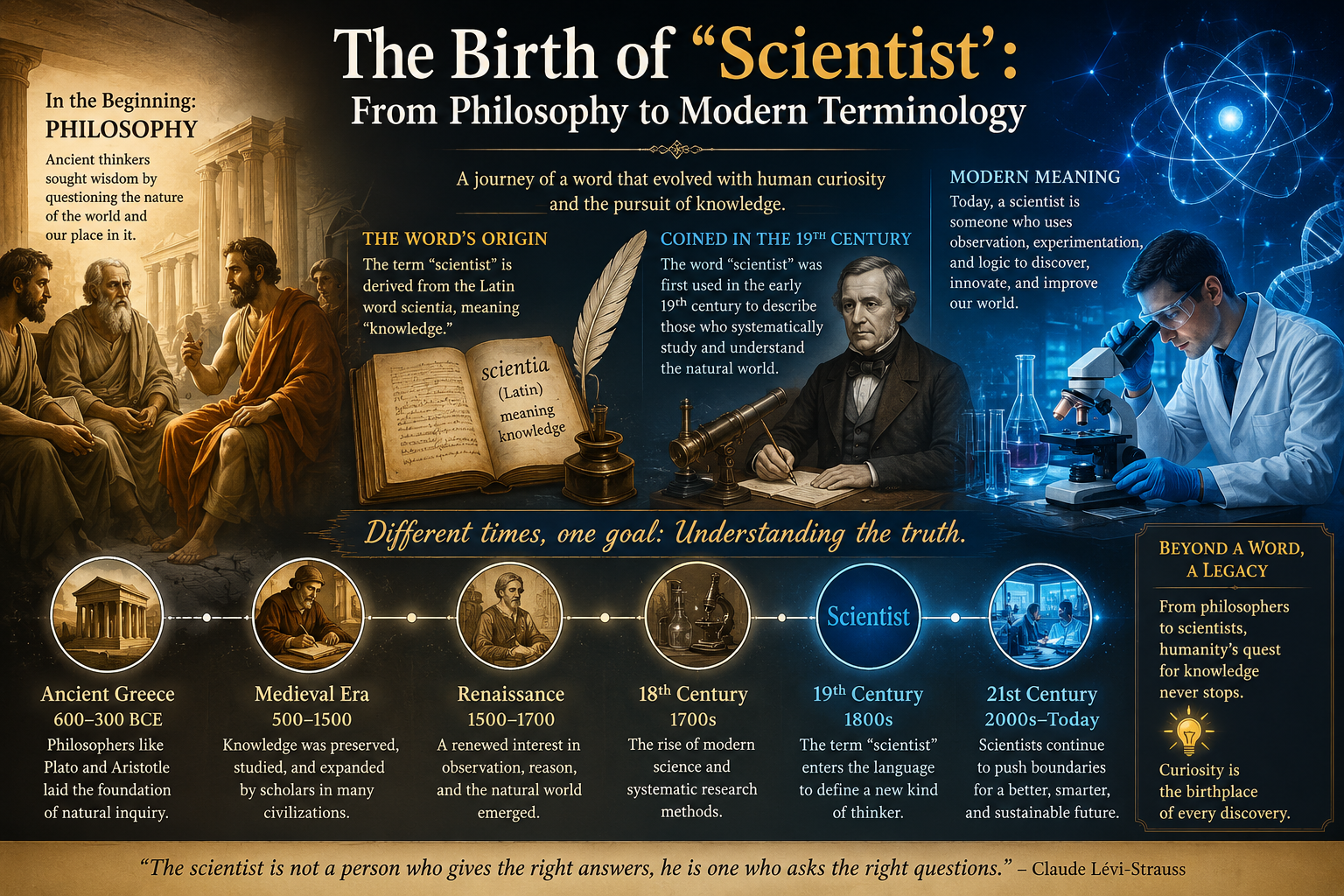
    قدیم زمانے میں فطرت، کائنات اور علم کا مطالعہ کرنے والے لوگوں کو عموماً **Philosophers** کہا جاتا تھا۔ وقت کے ساتھ علم کی مختلف شاخیں الگ ہوتی گئیں اور آخرکار **“Scientist”** ایک باقاعدہ اصطلاح کے طور پر سامنے آیا۔

    اس دلچسپ سفر میں جانیں کہ فلسفے سے جدید سائنس تک کا راستہ کیسے بنا، اور کس طرح ایک لفظ نے علم کی دنیا کو نئی شناخت دی!

    **Learn from the past. Understand the present. Create the future!**

    #Scientist #HistoryOfScience #ScienceHistory #Science #Philosophy #Knowledge #Learning #Education #InterestingFacts #ScienceFacts #DidYouKnow #EducationalContent #LearnEveryDay #ExploreScience #ModernScience
    RSIF8 ROLL NO 77 STORY POST NO 43 STORY TOPIC : The Birth of 'Scientist': From Philosophy to Modern Terminology. 🔬✨ **The Birth of “Scientist”: From Philosophy to Modern Terminology** 🧠🌍 کیا آپ جانتے ہیں کہ **“Scientist”** کا لفظ ہمیشہ سے موجود نہیں تھا؟ 🤔📚 قدیم زمانے میں فطرت، کائنات اور علم کا مطالعہ کرنے والے لوگوں کو عموماً **Philosophers** کہا جاتا تھا۔ وقت کے ساتھ علم کی مختلف شاخیں الگ ہوتی گئیں اور آخرکار **“Scientist”** ایک باقاعدہ اصطلاح کے طور پر سامنے آیا۔ 🔬⚙️ اس دلچسپ سفر میں جانیں کہ فلسفے سے جدید سائنس تک کا راستہ کیسے بنا، اور کس طرح ایک لفظ نے علم کی دنیا کو نئی شناخت دی! 🚀🌌 📖 **Learn from the past. Understand the present. Create the future!** 🌟 #Scientist #HistoryOfScience #ScienceHistory #Science #Philosophy #Knowledge #Learning #Education #InterestingFacts #ScienceFacts #DidYouKnow #EducationalContent #LearnEveryDay #ExploreScience #ModernScience 🔬🧠📚🌍✨
    0 Комментарии 0 Поделились 1915 Просмотры
  • #rsisb
    Roll No.240
    Story Post No.24
    Foundation Level

    The word “scientist” may sound like a modern term, but the journey behind it is connected to centuries of human curiosity, philosophy, observation, experimentation, and the search for knowledge.

    Long before the word “scientist” became common, people who studied the natural world were often known as philosophers, scholars, natural philosophers, mathematicians, and thinkers. They asked important questions about nature, the universe, life, matter, motion, and the world around them.

    From the thinkers of the ancient world to the scholars of the Renaissance and the Scientific Revolution, humans continued developing new ways to understand nature. Observation became more important, experiments became more systematic, and evidence gradually became a central part of scientific inquiry.

    During the 18th and 19th centuries, many different branches of knowledge began becoming more specialized. Physics, chemistry, biology, astronomy, geology, and other fields developed their own methods, discoveries, and communities of researchers.

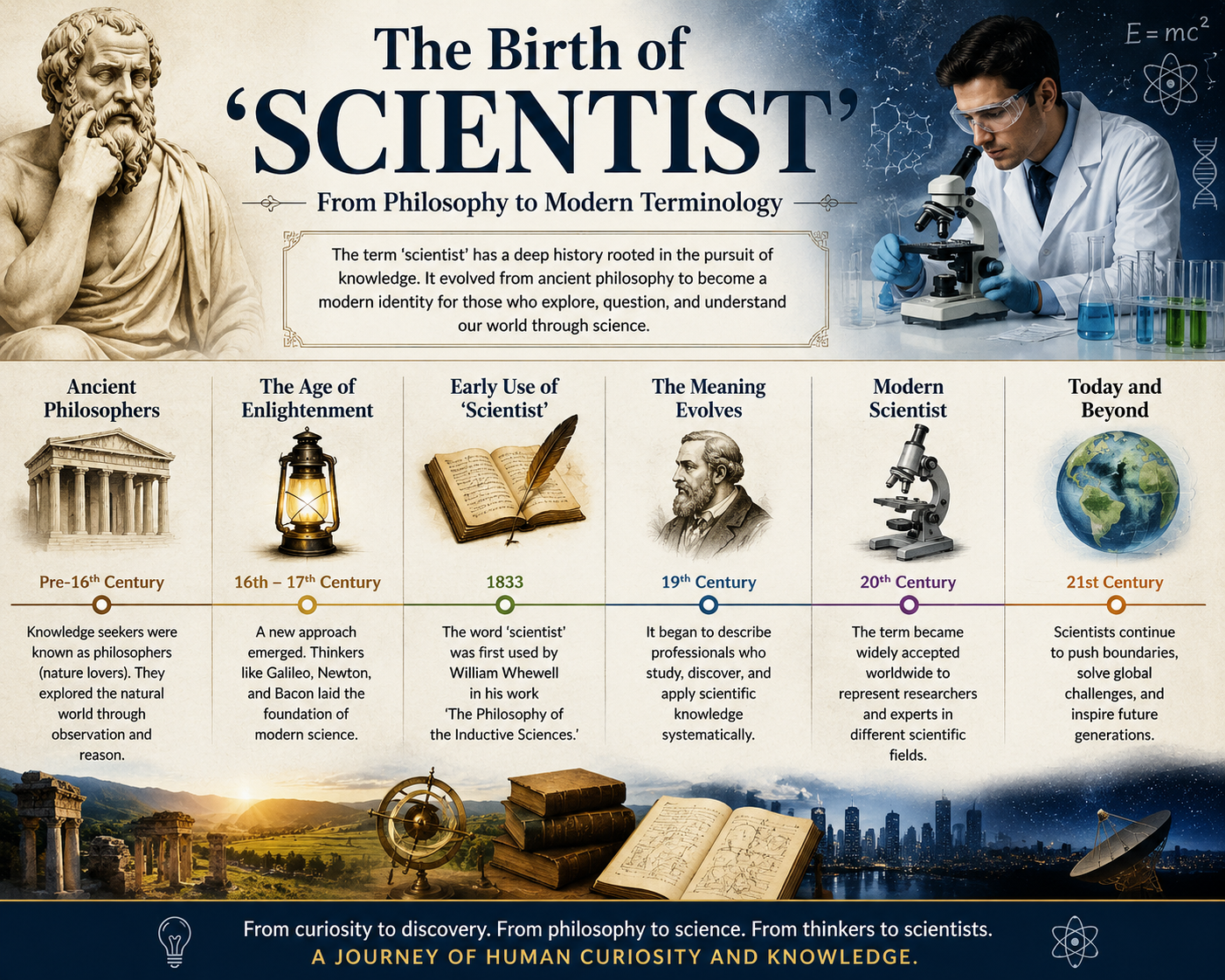
    A major moment in terminology came in the 19th century, when the word “scientist” was introduced as a useful name for people engaged in scientific study. The term is widely associated with William Whewell, who used it in 1833. This helped provide a new, unified word for researchers working across different areas of science.

    The evolution of this word reflects something bigger than language. It represents the changing way humanity organized knowledge and recognized scientific work. The transition from “natural philosopher” to “scientist” shows how science gradually became a distinct and organized field of study.

    Today, scientists work in laboratories, universities, hospitals, observatories, research centers, engineering facilities, and many other places around the world. They investigate everything from tiny cells and molecules to distant galaxies and the origins of the universe.

    Modern science continues to grow through curiosity, evidence, teamwork, technology, and a willingness to ask difficult questions. Every discovery begins with someone wondering, “Why?”, “How?”, or “What if?”

    The story of the word “scientist” reminds us that human knowledge is always evolving. What began with simple curiosity and philosophical questioning gradually developed into the powerful and diverse scientific world we know today.

    From thinkers to researchers. From philosophy to science. From questions to discoveries.

    Science is not only about finding answers—it is also about continuing to ask better questions.

    A journey from curiosity to discovery, and from philosophy to modern science.

    #TheBirthOfScientist #Scientist #HistoryOfScience #ScienceHistory #ScientificRevolution #Philosophy #NaturalPhilosophy #WilliamWhewell #1833 #ModernScience #ScienceEducation #ScientificTerminology #Science #Scientists #Research #Discovery #Curiosity #Knowledge #Learning #Education #STEM #Physics #Chemistry #Biology #Astronomy #Geology #Innovation #Experimentation #ScientificThinking #CriticalThinking #HumanKnowledge #HistoryOfKnowledge #ScienceJourney #FromPhilosophyToScience #ScienceFacts #EducationalContent #LearningJourney #ExploreScience #DiscoverScience

    Rehan School Islamabad Campus
    Asma Shaheen EducationWali
    Irum Asim
    Saima Happinesswali

    #rsisb Roll No.240 Story Post No.24 Foundation Level The word “scientist” may sound like a modern term, but the journey behind it is connected to centuries of human curiosity, philosophy, observation, experimentation, and the search for knowledge. 🧠🔎 Long before the word “scientist” became common, people who studied the natural world were often known as philosophers, scholars, natural philosophers, mathematicians, and thinkers. 🏛️📜 They asked important questions about nature, the universe, life, matter, motion, and the world around them. From the thinkers of the ancient world to the scholars of the Renaissance and the Scientific Revolution, humans continued developing new ways to understand nature. 🌌🌍📖 Observation became more important, experiments became more systematic, and evidence gradually became a central part of scientific inquiry. 🔬🧪✨ During the 18th and 19th centuries, many different branches of knowledge began becoming more specialized. Physics, chemistry, biology, astronomy, geology, and other fields developed their own methods, discoveries, and communities of researchers. 🧬⚗️🌠 A major moment in terminology came in the 19th century, when the word “scientist” was introduced as a useful name for people engaged in scientific study. The term is widely associated with William Whewell, who used it in 1833. 📜🔬 This helped provide a new, unified word for researchers working across different areas of science. The evolution of this word reflects something bigger than language. It represents the changing way humanity organized knowledge and recognized scientific work. 🌟📚 The transition from “natural philosopher” to “scientist” shows how science gradually became a distinct and organized field of study. Today, scientists work in laboratories, universities, hospitals, observatories, research centers, engineering facilities, and many other places around the world. 🌍🧪🔭 They investigate everything from tiny cells and molecules to distant galaxies and the origins of the universe. 🧬🦠🌌 Modern science continues to grow through curiosity, evidence, teamwork, technology, and a willingness to ask difficult questions. 💡🤝🚀 Every discovery begins with someone wondering, “Why?”, “How?”, or “What if?” The story of the word “scientist” reminds us that human knowledge is always evolving. What began with simple curiosity and philosophical questioning gradually developed into the powerful and diverse scientific world we know today. 🌱➡️🔬➡️🌍 ✨ From thinkers to researchers. From philosophy to science. From questions to discoveries. ✨ Science is not only about finding answers—it is also about continuing to ask better questions. 🔎💡 🌟 A journey from curiosity to discovery, and from philosophy to modern science. 🌟 #TheBirthOfScientist #Scientist #HistoryOfScience #ScienceHistory #ScientificRevolution #Philosophy #NaturalPhilosophy #WilliamWhewell #1833 #ModernScience #ScienceEducation #ScientificTerminology #Science #Scientists #Research #Discovery #Curiosity #Knowledge #Learning #Education #STEM #Physics #Chemistry #Biology #Astronomy #Geology #Innovation #Experimentation #ScientificThinking #CriticalThinking #HumanKnowledge #HistoryOfKnowledge #ScienceJourney #FromPhilosophyToScience #ScienceFacts #EducationalContent #LearningJourney #ExploreScience #DiscoverScience 🔬📚🧠🌍✨🔭🧪🚀💡🌟 Rehan School Islamabad Campus Asma Shaheen EducationWali Irum Asim Saima Happinesswali

    0 Комментарии 0 Поделились 11648 Просмотры
  • RSISB
    Roll No: 209
    Story Post No. 27

    The Birth of “Scientist”: From Philosophy to Modern Terminology

    Have you ever wondered where the word “Scientist” came from? This fascinating journey takes us from the ancient world of philosophy and natural inquiry to the modern age of laboratories, experiments, and scientific discovery.

    For centuries, thinkers explored the mysteries of nature through observation, reasoning, and philosophy. As knowledge and research evolved, a new term was needed to describe people who systematically studied the natural world—and the word “scientist” emerged in the 19th century.

    Today, scientists continue this timeless journey by asking questions, testing ideas, discovering new knowledge, and helping us understand our universe.

    From philosophers seeking wisdom to scientists seeking evidence, the quest for knowledge has never stopped!

    #Scientist #HistoryOfScience #ScienceHistory #Philosophy #ScientificDiscovery #Knowledge #ScienceAndTechnology #NaturalScience #Learning #Education #Curiosity #Innovation #Research #ModernScience #ScienceJourney
    RSISB Roll No: 209 Story Post No. 27 🔬📚 The Birth of “Scientist”: From Philosophy to Modern Terminology 🌍✨ Have you ever wondered where the word “Scientist” came from? 🤔🔎 This fascinating journey takes us from the ancient world of philosophy and natural inquiry to the modern age of laboratories, experiments, and scientific discovery. 🏛️➡️🧪 For centuries, thinkers explored the mysteries of nature through observation, reasoning, and philosophy. As knowledge and research evolved, a new term was needed to describe people who systematically studied the natural world—and the word “scientist” emerged in the 19th century. 💡📖 Today, scientists continue this timeless journey by asking questions, testing ideas, discovering new knowledge, and helping us understand our universe. 🌌🧬🚀 ✨ From philosophers seeking wisdom to scientists seeking evidence, the quest for knowledge has never stopped! 🔬🌟 #Scientist #HistoryOfScience #ScienceHistory #Philosophy #ScientificDiscovery #Knowledge #ScienceAndTechnology #NaturalScience #Learning #Education #Curiosity #Innovation #Research #ModernScience #ScienceJourney 🔬📚🌍✨
    0 Комментарии 0 Поделились 3415 Просмотры
  • The Birth of "Scientist": From Philosophy to Modern Terminology

    The word "Scientist" has a fascinating history that reflects the evolution of human knowledge and discovery. Before the modern scientific world existed, people who studied nature were often known as philosophers, natural philosophers, scholars, or thinkers. Over time, the search for knowledge became more specialized, leading to the birth of the term "scientist."

    In this fascinating topic, we explore how the word "scientist" emerged and how its meaning developed alongside the growth of modern science. Discover how curiosity, observation, experimentation, and critical thinking transformed the way humanity understands the world around us.

    From ancient thinkers to today's researchers and innovators , the journey of the word "scientist" tells a powerful story about our endless desire to question, discover, and understand.

    Join us on this exciting journey through the history of science and language, and discover how one word came to represent the people who continue to expand the boundaries of human knowledge!

    #Scientist #HistoryOfScience #WordHistory #Etymology #Science #Philosophy #ScientificRevolution #ModernScience #Scientists #Knowledge #Discovery #Curiosity #CriticalThinking #Education #Learning #Innovation #Research #Language #Linguistics #HumanKnowledge


    RSISB
    Roll No:#209
    Story Post No.26
    🔬📚 The Birth of "Scientist": From Philosophy to Modern Terminology 🌍✨ The word "Scientist" has a fascinating history that reflects the evolution of human knowledge and discovery. 🧠💡 Before the modern scientific world existed, people who studied nature were often known as philosophers, natural philosophers, scholars, or thinkers. Over time, the search for knowledge became more specialized, leading to the birth of the term "scientist." 🔬🌟 In this fascinating topic, we explore how the word "scientist" emerged and how its meaning developed alongside the growth of modern science. 📖🕰️ Discover how curiosity, observation, experimentation, and critical thinking transformed the way humanity understands the world around us. 🌎🔍 From ancient thinkers to today's researchers and innovators 🚀, the journey of the word "scientist" tells a powerful story about our endless desire to question, discover, and understand. 💭✨ 💬 Join us on this exciting journey through the history of science and language, and discover how one word came to represent the people who continue to expand the boundaries of human knowledge! 🌟🔬 #Scientist #HistoryOfScience #WordHistory #Etymology #Science #Philosophy #ScientificRevolution #ModernScience #Scientists #Knowledge #Discovery #Curiosity #CriticalThinking #Education #Learning #Innovation #Research #Language #Linguistics #HumanKnowledge 🔬📚🧠💡🌍✨🕰️🔍🚀🌟📖💭🌎🧪👏 RSISB Roll No:#209 Story Post No.26
    0 Комментарии 0 Поделились 5153 Просмотры