• #rsisb
    Roll no.247
    call Annie .15
    Foundation level

    **“Earth” – The History of Our Home in a Word (25 min)**

    Welcome to an exciting journey through the incredible history of **Earth — our beautiful home in the universe!** From its formation billions of years ago to the amazing diversity of life we see today, Earth has experienced an extraordinary story filled with change, discovery, survival, and transformation.

    In this **25-minute exploration**, we will travel back through deep time and discover how our planet formed from the early material of the solar system. We’ll explore the development of oceans , mountains , continents , atmosphere , and the conditions that eventually made life possible.

    We’ll take a fascinating look at ancient Earth, when the planet was very different from the world we know today. We’ll discover how simple forms of life appeared and gradually evolved into increasingly complex organisms.

    The story of Earth also includes dramatic events such as massive volcanic activity, changing climates, shifting continents, ice ages, and the disappearance of many ancient species. These events helped shape the planet and created opportunities for new forms of life to develop.

    As we move closer to the present, we’ll explore the rise of humans and how our species became an important part of Earth’s story. From early communities and agriculture to modern cities, technology, science, and exploration, humanity has changed the planet in remarkable ways.

    But Earth’s history is not just a story about the past. It also encourages us to think about the future. What will happen to our planet in the years ahead? How can we protect nature, conserve resources, reduce pollution, and take better care of the world we call home?

    **Earth is more than just a planet — it is a living story.** Every mountain, ocean, fossil, forest, river, and living creature is part of that incredible story. By learning about Earth’s past, we can better understand the present and make wiser choices for the future.

    Join us for this fascinating **25-minute journey through Earth’s history** and discover how our planet became the remarkable world we know today!

    **Learn about the past. Understand the present. Protect the future.**

    #Earth #EarthHistory #OurPlanet #PlanetEarth #HistoryOfEarth #Science #Geology #Evolution #Dinosaurs #AncientEarth #Oceans #Nature #Environment #Climate #Space #Universe #HumanHistory #ScienceEducation #Learning #EducationalVideo #EarthScience #ExploreEarth #SaveOurPlanet #ProtectNature #FutureOfEarth #Knowledge #DiscoverScience #AmazingEarth #WorldHistory
    #rsisb Roll no.247 call Annie .15 Foundation level ๐ŸŒ **“Earth” – The History of Our Home in a Word (25 min)** ๐ŸŒŽโœจ Welcome to an exciting journey through the incredible history of **Earth — our beautiful home in the universe!** ๐ŸŒŒ๐ŸŒ From its formation billions of years ago to the amazing diversity of life we see today, Earth has experienced an extraordinary story filled with change, discovery, survival, and transformation. ๐Ÿฆ•๐ŸŒ‹๐ŸŒŠ๐ŸŒณ In this **25-minute exploration**, we will travel back through deep time and discover how our planet formed from the early material of the solar system. โ˜€๏ธ๐Ÿช We’ll explore the development of oceans ๐ŸŒŠ, mountains โ›ฐ๏ธ, continents ๐ŸŒŽ, atmosphere ๐ŸŒค๏ธ, and the conditions that eventually made life possible. ๐Ÿงฌ๐ŸŒฑ We’ll take a fascinating look at ancient Earth, when the planet was very different from the world we know today. ๐ŸŒ‹๐Ÿ”ฅ We’ll discover how simple forms of life appeared and gradually evolved into increasingly complex organisms. ๐Ÿฆ โžก๏ธ๐Ÿ โžก๏ธ๐Ÿฆ–โžก๏ธ๐Ÿฆ…โžก๏ธ๐Ÿ˜ The story of Earth also includes dramatic events such as massive volcanic activity, changing climates, shifting continents, ice ages, and the disappearance of many ancient species. ๐ŸŒ‹โ„๏ธ๐ŸŒ These events helped shape the planet and created opportunities for new forms of life to develop. ๐ŸŒฑ๐Ÿฆ–๐Ÿ”ฌ As we move closer to the present, we’ll explore the rise of humans and how our species became an important part of Earth’s story. ๐Ÿ‘จ‍๐Ÿ‘ฉ‍๐Ÿ‘ง‍๐Ÿ‘ฆ๐Ÿ•๏ธ๐ŸŒพ๐Ÿ™๏ธ From early communities and agriculture to modern cities, technology, science, and exploration, humanity has changed the planet in remarkable ways. ๐Ÿšœ๐Ÿ—๏ธ๐Ÿ’ก๐Ÿš€ But Earth’s history is not just a story about the past. It also encourages us to think about the future. ๐ŸŒฑ๐Ÿ’š What will happen to our planet in the years ahead? How can we protect nature, conserve resources, reduce pollution, and take better care of the world we call home? ๐ŸŒณ๐Ÿ’งโ™ป๏ธ ๐ŸŒ **Earth is more than just a planet — it is a living story.** Every mountain, ocean, fossil, forest, river, and living creature is part of that incredible story. By learning about Earth’s past, we can better understand the present and make wiser choices for the future. ๐Ÿ”ฌ๐Ÿ“š๐ŸŒŽ Join us for this fascinating **25-minute journey through Earth’s history** and discover how our planet became the remarkable world we know today! ๐ŸŒโœจ๐Ÿš€ ๐Ÿ’š **Learn about the past. Understand the present. Protect the future.** ๐ŸŒฑ๐ŸŒŽ #Earth ๐ŸŒ #EarthHistory ๐Ÿ“š #OurPlanet ๐ŸŒŽ #PlanetEarth ๐Ÿช #HistoryOfEarth โณ #Science ๐Ÿ”ฌ #Geology ๐Ÿชจ #Evolution ๐Ÿงฌ #Dinosaurs ๐Ÿฆ– #AncientEarth ๐ŸŒ‹ #Oceans ๐ŸŒŠ #Nature ๐ŸŒณ #Environment ๐ŸŒฑ #Climate ๐ŸŒค๏ธ #Space ๐ŸŒŒ #Universe โœจ #HumanHistory ๐Ÿ‘จ‍๐Ÿ‘ฉ‍๐Ÿ‘ง‍๐Ÿ‘ฆ #ScienceEducation ๐Ÿ“– #Learning ๐Ÿ“š #EducationalVideo ๐ŸŽ“ #EarthScience ๐Ÿ”ฌ #ExploreEarth ๐ŸŒ #SaveOurPlanet ๐Ÿ’š #ProtectNature ๐ŸŒณ #FutureOfEarth ๐ŸŒŽ #Knowledge ๐Ÿ’ก #DiscoverScience ๐Ÿš€ #AmazingEarth โœจ #WorldHistory ๐ŸŒ
    0 Comments 0 Shares 359 Views 5
  • #rsisb
    Roll No.190
    Call Anni.No.46
    Foundation Level


    1. *My First Conversation With AI! *

    Start a video by introducing AI and asking simple questions like: “What are you?”*, *“How do you answer questions?”*, and *“What can you help me with?” Then move into more interesting questions about school, technology, hobbies, and the future. Finish by asking AI what advice it would give to someone who wants to learn new things.

    2. *Can AI Answer 20 Questions? *

    Create a fun challenge where you ask AI 20 completely different questions. Start with easy questions and slowly make them more difficult. Ask about science, space, computers, animals, history, and everyday life. The goal is to see how interesting and useful AI's answers can be.

    3. *AI and the Future of Technology *

    Talk with AI about how technology might change in the future. Ask about smart homes, robots, self-driving cars, virtual reality, and future computers. You can also ask, “What might technology look like 20 years from now?” This can make an exciting educational conversation.

    4. *AI Becomes My Teacher! *

    Pretend that AI is your personal teacher for one day. Ask it to explain mathematics, science, English, and computer topics in very simple language. You can then ask follow-up questions whenever something is difficult.

    5. *Ask AI About Our Amazing Planet *

    Have a conversation about Earth and nature. Ask AI about oceans, mountains, forests, weather, animals, and interesting natural phenomena. You can make each question more surprising than the previous one.

    6. *Talking to AI About Space! *

    Take your audience on a virtual journey through space. Ask AI about planets, stars, galaxies, black holes, astronauts, and space exploration. End with an imaginative question such as, “What could humans discover in space in the future?”

    7. *AI and Video Games *

    Discuss how AI is used in modern games. Ask about computer-controlled characters, game worlds, racing games, and how AI can make games more challenging. You can also ask AI to invent an idea for a brand-new game.

    8. *My Dream Smart Home With AI *

    Ask AI to imagine a futuristic smart home. Talk about automatic lights, smart security, helpful robots, voice commands, smart appliances, and energy-saving technology. Then ask AI to design your perfect futuristic room.

    9. *AI Helps Me Learn Coding! *

    Make a beginner-friendly coding conversation. Ask AI what coding is, why people learn it, and how simple programs work. You can ask it to explain concepts like variables, loops, and functions using easy examples.

    10. *Can AI Solve My Brain Challenges? *

    Give AI fun puzzles, riddles, logic questions, and math challenges. Don't reveal the answers immediately—let your audience think first! Then compare your answer with AI's explanation.

    11. *Improve My English With AI! *

    Have a daily English conversation with AI. Talk about school, hobbies, food, sports, technology, and your daily routine. Ask AI to correct your grammar and teach you new vocabulary in a simple way.

    12. *AI Predicts the Future! *

    Ask AI questions about the future of computers, phones, robots, transportation, education, and space exploration. Make it clear that these are **ideas or predictions, not guaranteed facts**.

    13. *Can AI Help Save the Planet? *

    Talk about pollution, recycling, renewable energy, forests, oceans, and wildlife. Ask AI how technology could help people protect the environment. This gives your video an educational and positive message.

    14. *Funny Questions for AI! *

    Ask AI unusual but harmless questions such as “If you could have a favorite hobby, what would it be?” or “What would a robot's perfect vacation look like?” Turn the answers into a fun conversation with reactions and jokes.

    15. *A Full Day With My AI Assistant! *

    Create a story where AI helps you throughout an imaginary day. Start with planning your morning, then studying, learning something new, organizing tasks, solving a puzzle, and finishing the day with a fun conversation. It can become a complete *“Day With AI”* episode.
    #rsisb Roll No.190 Call Anni.No.46 Foundation Level ๐Ÿค– 1. *My First Conversation With AI! ๐ŸŒŸ* Start a video by introducing AI and asking simple questions like: “What are you?”*, *“How do you answer questions?”*, and *“What can you help me with?” Then move into more interesting questions about school, technology, hobbies, and the future. Finish by asking AI what advice it would give to someone who wants to learn new things. ๐Ÿ“šโœจ ๐Ÿง  2. *Can AI Answer 20 Questions? ๐ŸŽฏ* Create a fun challenge where you ask AI 20 completely different questions. Start with easy questions and slowly make them more difficult. Ask about science, space, computers, animals, history, and everyday life. The goal is to see how interesting and useful AI's answers can be. ๐Ÿš€๐ŸŒ ๐Ÿ’ป 3. *AI and the Future of Technology ๐Ÿš€* Talk with AI about how technology might change in the future. Ask about smart homes, robots, self-driving cars, virtual reality, and future computers. You can also ask, “What might technology look like 20 years from now?” This can make an exciting educational conversation. ๐Ÿค–๐Ÿ ๐Ÿš— ๐Ÿ“š 4. *AI Becomes My Teacher! ๐Ÿ‘จ‍๐Ÿซ๐Ÿค–* Pretend that AI is your personal teacher for one day. Ask it to explain mathematics, science, English, and computer topics in very simple language. You can then ask follow-up questions whenever something is difficult. ๐Ÿ“–โœ๏ธ ๐ŸŒŽ 5. *Ask AI About Our Amazing Planet ๐ŸŒ* Have a conversation about Earth and nature. Ask AI about oceans, mountains, forests, weather, animals, and interesting natural phenomena. You can make each question more surprising than the previous one. ๐ŸŒŠ๐Ÿ”๏ธ๐Ÿฆ ๐Ÿ‘จ‍๐Ÿš€ 6. *Talking to AI About Space! ๐ŸŒŒ๐Ÿš€* Take your audience on a virtual journey through space. Ask AI about planets, stars, galaxies, black holes, astronauts, and space exploration. End with an imaginative question such as, “What could humans discover in space in the future?” ๐ŸŒ™โญ ๐ŸŽฎ 7. *AI and Video Games ๐ŸŽฎ๐Ÿค–* Discuss how AI is used in modern games. Ask about computer-controlled characters, game worlds, racing games, and how AI can make games more challenging. You can also ask AI to invent an idea for a brand-new game. ๐ŸŽ๏ธ๐ŸŽฏ ๐Ÿ  8. *My Dream Smart Home With AI ๐Ÿกโœจ* Ask AI to imagine a futuristic smart home. Talk about automatic lights, smart security, helpful robots, voice commands, smart appliances, and energy-saving technology. Then ask AI to design your perfect futuristic room. ๐Ÿ’ก๐Ÿค–๐Ÿ  ๐Ÿง‘‍๐Ÿ’ป 9. *AI Helps Me Learn Coding! ๐Ÿ’ป๐Ÿ”ฅ* Make a beginner-friendly coding conversation. Ask AI what coding is, why people learn it, and how simple programs work. You can ask it to explain concepts like variables, loops, and functions using easy examples. ๐Ÿ–ฅ๏ธโŒจ๏ธ ๐Ÿงฉ 10. *Can AI Solve My Brain Challenges? ๐Ÿง ๐Ÿ†* Give AI fun puzzles, riddles, logic questions, and math challenges. Don't reveal the answers immediately—let your audience think first! Then compare your answer with AI's explanation. ๐Ÿค”๐Ÿ’ก ๐Ÿ—ฃ๏ธ 11. *Improve My English With AI! ๐Ÿ‡ฌ๐Ÿ‡ง๐Ÿค–* Have a daily English conversation with AI. Talk about school, hobbies, food, sports, technology, and your daily routine. Ask AI to correct your grammar and teach you new vocabulary in a simple way. ๐Ÿ“š๐Ÿ—ฃ๏ธโœจ ๐Ÿ”ฎ 12. *AI Predicts the Future! ๐Ÿš€๐Ÿ”ฎ* Ask AI questions about the future of computers, phones, robots, transportation, education, and space exploration. Make it clear that these are **ideas or predictions, not guaranteed facts**. ๐ŸŒ๐Ÿค– ๐ŸŒฑ 13. *Can AI Help Save the Planet? ๐ŸŒณ๐ŸŒŽ* Talk about pollution, recycling, renewable energy, forests, oceans, and wildlife. Ask AI how technology could help people protect the environment. This gives your video an educational and positive message. โ™ป๏ธ๐ŸŒณ๐Ÿผ ๐Ÿ˜‚ 14. *Funny Questions for AI! ๐Ÿคฃ๐Ÿค–* Ask AI unusual but harmless questions such as “If you could have a favorite hobby, what would it be?” or “What would a robot's perfect vacation look like?” Turn the answers into a fun conversation with reactions and jokes. ๐Ÿ˜„๐ŸŽ‰ ๐ŸŒŸ 15. *A Full Day With My AI Assistant! ๐Ÿค–โ˜€๏ธ๐ŸŒ™* Create a story where AI helps you throughout an imaginary day. Start with planning your morning, then studying, learning something new, organizing tasks, solving a puzzle, and finishing the day with a fun conversation. It can become a complete *“Day With AI”* episode. ๐Ÿš€๐Ÿ“š๐ŸŽฎ๐ŸŒ™
    0 Comments 0 Shares 653 Views 8
  • #rsisb
    Roll no.239
    maya no.18
    Foundation Level

    The word **“Earth”** is one of the oldest and most meaningful words in the English language. It represents much more than the planet beneath our feet. Earth is our **home, the source of life, the ground we walk on, and a symbol of nature and human existence**. But where did this simple word come from, and how did its meaning develop over time?

    The history of the word **“Earth”** takes us back thousands of years. In ancient forms of English and related Germanic languages, words similar to *earth* were used to describe the **ground, soil, land, and the physical world**. Over time, the word developed into the name we now use for our entire planet. Unlike many planets in our Solar System, whose names are connected to ancient gods and mythology, **Earth's English name is closely connected to the ordinary ground beneath our feet**.

    This connection tells us something important about human history. Long before people understood that they lived on a planet moving through space, they experienced Earth simply as the land around them—the soil that grew their food, the ground that supported their homes, and the world they could see and touch.

    As human knowledge grew, our understanding of Earth changed dramatically. Ancient thinkers observed the sky and began asking important questions about the shape and nature of the world. Over centuries, explorers, scientists, astronomers, and travelers expanded humanity's understanding of the planet. Eventually, space exploration allowed humans to see Earth from beyond its atmosphere. Those images showed something extraordinary: **our vast world is a beautiful, fragile-looking sphere surrounded by the darkness of space**.

    From a scientific perspective, Earth is the **third planet from the Sun** and the only world currently known to support life. It has liquid water on its surface, a protective atmosphere, and a wide variety of environments that support countless living organisms. Its oceans, forests, mountains, deserts, rivers, and grasslands form an incredibly diverse and interconnected system.

    Earth's structure is also fascinating. Beneath the surface are different layers, including the **crust, mantle, and core**. These layers influence many natural processes, including the movement of tectonic plates, earthquakes, volcanic activity, and the formation of mountains. Although we live on the surface, the planet beneath us is constantly changing.

    Life on Earth depends on a delicate balance. **Air, water, sunlight, soil, and biodiversity** all play essential roles in supporting life. Plants produce oxygen and form the foundation of many ecosystems. Oceans help regulate climate and support an enormous variety of life. Forests provide habitats and influence the movement of water and carbon through the environment.

    However, Earth also faces serious environmental challenges. **Pollution, deforestation, habitat destruction, and climate change** affect ecosystems and communities around the world. These challenges remind us that Earth is not an unlimited resource. The choices humans make today can influence the quality of life for future generations.

    Protecting Earth does not always require extraordinary actions. Small changes can make a difference, such as **reducing waste, conserving water and energy, planting and protecting trees, avoiding unnecessary pollution, and learning more about the environment**. Governments, scientists, businesses, communities, and individuals all have important roles to play.

    The word **“Earth”** also has a powerful emotional and cultural meaning. People may come from different countries, speak different languages, and follow different traditions, but we all share the same planet. From this perspective, Earth can be seen as a symbol of our **shared home and shared responsibility**.

    **“Earth” – The History of Our Home in a Word** is therefore a journey through **language, history, science, nature, and human imagination**. The story of this word shows how language grows alongside human knowledge. What once described the soil beneath people's feet eventually became the name of an entire world traveling through space.

    The next time you hear or say the word **“Earth,”** remember that it carries a remarkable story. It connects us to the ancient past, the natural world around us, and the future we are helping to create.

    **Earth is not just where we live—it is the only home we all share. Protecting it is a responsibility that belongs to everyone.**

    ### **Hashtags**

    #Earth #OurPlanet #PlanetEarth #WordHistory #HistoryOfEarth #EnglishLanguage #LanguageHistory #Science #Nature #Environment #ClimateAwareness #ProtectOurPlanet #Sustainability #EarthScience #Space #Astronomy #LifeOnEarth #MotherEarth #SaveEarth #GoGreen #CleanEnvironment #Biodiversity #ClimateChange #Education #Knowledge #LearnAndExplore #OnePlanet #FutureGenerations #EarthLovers #OurHome
    #rsisb Roll no.239 maya no.18 Foundation Level The word **“Earth”** is one of the oldest and most meaningful words in the English language. It represents much more than the planet beneath our feet. Earth is our **home, the source of life, the ground we walk on, and a symbol of nature and human existence**. But where did this simple word come from, and how did its meaning develop over time? The history of the word **“Earth”** takes us back thousands of years. In ancient forms of English and related Germanic languages, words similar to *earth* were used to describe the **ground, soil, land, and the physical world**. Over time, the word developed into the name we now use for our entire planet. Unlike many planets in our Solar System, whose names are connected to ancient gods and mythology, **Earth's English name is closely connected to the ordinary ground beneath our feet**. ๐Ÿ“–๐ŸŒฑ This connection tells us something important about human history. Long before people understood that they lived on a planet moving through space, they experienced Earth simply as the land around them—the soil that grew their food, the ground that supported their homes, and the world they could see and touch. As human knowledge grew, our understanding of Earth changed dramatically. Ancient thinkers observed the sky and began asking important questions about the shape and nature of the world. Over centuries, explorers, scientists, astronomers, and travelers expanded humanity's understanding of the planet. Eventually, space exploration allowed humans to see Earth from beyond its atmosphere. Those images showed something extraordinary: **our vast world is a beautiful, fragile-looking sphere surrounded by the darkness of space**. ๐Ÿš€๐ŸŒŒ From a scientific perspective, Earth is the **third planet from the Sun** and the only world currently known to support life. It has liquid water on its surface, a protective atmosphere, and a wide variety of environments that support countless living organisms. Its oceans, forests, mountains, deserts, rivers, and grasslands form an incredibly diverse and interconnected system. ๐ŸŒŠ๐Ÿ”๏ธ๐ŸŒณ Earth's structure is also fascinating. Beneath the surface are different layers, including the **crust, mantle, and core**. These layers influence many natural processes, including the movement of tectonic plates, earthquakes, volcanic activity, and the formation of mountains. Although we live on the surface, the planet beneath us is constantly changing. Life on Earth depends on a delicate balance. **Air, water, sunlight, soil, and biodiversity** all play essential roles in supporting life. Plants produce oxygen and form the foundation of many ecosystems. Oceans help regulate climate and support an enormous variety of life. Forests provide habitats and influence the movement of water and carbon through the environment. However, Earth also faces serious environmental challenges. **Pollution, deforestation, habitat destruction, and climate change** affect ecosystems and communities around the world. These challenges remind us that Earth is not an unlimited resource. The choices humans make today can influence the quality of life for future generations. ๐ŸŒฟโ™ป๏ธ Protecting Earth does not always require extraordinary actions. Small changes can make a difference, such as **reducing waste, conserving water and energy, planting and protecting trees, avoiding unnecessary pollution, and learning more about the environment**. Governments, scientists, businesses, communities, and individuals all have important roles to play. The word **“Earth”** also has a powerful emotional and cultural meaning. People may come from different countries, speak different languages, and follow different traditions, but we all share the same planet. From this perspective, Earth can be seen as a symbol of our **shared home and shared responsibility**. ๐Ÿค๐ŸŒ **“Earth” – The History of Our Home in a Word** is therefore a journey through **language, history, science, nature, and human imagination**. The story of this word shows how language grows alongside human knowledge. What once described the soil beneath people's feet eventually became the name of an entire world traveling through space. The next time you hear or say the word **“Earth,”** remember that it carries a remarkable story. It connects us to the ancient past, the natural world around us, and the future we are helping to create. **Earth is not just where we live—it is the only home we all share. Protecting it is a responsibility that belongs to everyone.** ๐ŸŒ๐Ÿ’šโœจ ### ๐Ÿ”– **Hashtags** #Earth #OurPlanet #PlanetEarth #WordHistory #HistoryOfEarth #EnglishLanguage #LanguageHistory #Science #Nature #Environment #ClimateAwareness #ProtectOurPlanet #Sustainability #EarthScience #Space #Astronomy #LifeOnEarth #MotherEarth #SaveEarth #GoGreen #CleanEnvironment #Biodiversity #ClimateChange #Education #Knowledge #LearnAndExplore #OnePlanet #FutureGenerations #EarthLovers #OurHome ๐ŸŒ๐ŸŒฟ๐Ÿ’šโœจ
    0 Comments 0 Shares 1216 Views 17
  • #rsisb
    Roll no 248
    Foundation level
    Call Annie no 15
    **“Water” – The Origin of Life and Language **

    Water is one of the most amazing and essential substances on Earth. From supporting the first forms of life to shaping civilizations, cultures, and even the words we use, water has played a powerful role in human history.

    In this **25-minute exploration**, we’ll discover why water is called the **source of life**, how it helped life develop on Earth, and how rivers, oceans, and rain have influenced human communication, stories, and language.

    Let’s dive deep into the fascinating connection between **water, life, humans, and language!**

    #Water #OriginOfLife #Language #Science #Nature #Learning #Knowledge #Biology #Earth #Curiosity #Education #WaterIsLife #ExploreAndLearn #StudentLife
    #rsisb Roll no 248 Foundation level Call Annie no 15 ๐Ÿ’ง **“Water” – The Origin of Life and Language ๐ŸŒ๐Ÿงฌ๐Ÿ—ฃ๏ธ** Water is one of the most amazing and essential substances on Earth. ๐ŸŒŠ From supporting the first forms of life to shaping civilizations, cultures, and even the words we use, water has played a powerful role in human history. ๐ŸŒฑ๐Ÿ’™ In this **25-minute exploration**, we’ll discover why water is called the **source of life**, how it helped life develop on Earth, and how rivers, oceans, and rain have influenced human communication, stories, and language. ๐ŸŒง๏ธ๐ŸŒŠ๐Ÿ“š Let’s dive deep into the fascinating connection between **water, life, humans, and language!** ๐Ÿš€๐Ÿ’ก #Water ๐Ÿ’ง #OriginOfLife ๐Ÿงฌ #Language ๐Ÿ—ฃ๏ธ #Science ๐Ÿ”ฌ #Nature ๐ŸŒ #Learning ๐Ÿ“š #Knowledge ๐Ÿ’ก #Biology ๐Ÿงฌ #Earth ๐ŸŒŽ #Curiosity ๐Ÿ” #Education ๐ŸŽ“ #WaterIsLife ๐Ÿ’™ #ExploreAndLearn ๐Ÿš€ #StudentLife ๐Ÿ“–
    0 Comments 0 Shares 1866 Views 7
  • #rsisb
    Roll No.269
    Foundation Level
    Story Post No.10


    **Acids and Bases: The Balance of Nature **

    Have you ever wondered why lemons taste sour , why soap feels slippery , or how scientists measure the strength of different substances? The answer lies in the fascinating world of **acids and bases!**

    In this video, we explore **“Acids and Bases: The Balance of Nature”** and discover how these two important groups of substances interact with each other. Acids and bases are found everywhere around us—from the foods we eat and the drinks we enjoy to our environment, soil, water, and many everyday products.

    We’ll learn about the **pH scale**, the difference between acids and bases, neutral substances, indicators, and the process of **neutralization**. Understanding these concepts helps us see how chemistry plays an important role in everyday life.

    **In This Video, You’ll Learn:**
    What acids and bases are
    The meaning of the pH scale
    Examples of acids and bases in daily life
    What neutral substances are
    How indicators help identify acids and bases
    What happens during neutralization
    Why the balance between acids and bases is important in nature

    From the chemistry of our oceans and soil to the food in our kitchens, acids and bases help maintain balance in the natural world.

    Whether you're a student, science lover, or simply curious about how the world works, this video will help make chemistry interesting and easy to understand!

    **Like, Share & Subscribe** for more educational videos and fascinating science topics!

    **Question:** Can you name one acidic substance and one basic substance you use in everyday life?

    #AcidsAndBases #Chemistry #Science #PHScale #ScienceEducation #LearnChemistry #ChemicalReactions #Neutralization #Nature #ScienceFacts #STEM #Education #LearningIsFun #ChemistryForStudents
    #rsisb Roll No.269 Foundation Level Story Post No.10 ๐Ÿงช **Acids and Bases: The Balance of Nature ๐ŸŒฟโš–๏ธ** Have you ever wondered why lemons taste sour ๐Ÿ‹, why soap feels slippery ๐Ÿงผ, or how scientists measure the strength of different substances? ๐Ÿค” The answer lies in the fascinating world of **acids and bases!** ๐Ÿ”ฌโœจ In this video, we explore **“Acids and Bases: The Balance of Nature”** and discover how these two important groups of substances interact with each other. Acids and bases are found everywhere around us—from the foods we eat ๐ŸŠ and the drinks we enjoy ๐Ÿฅค to our environment, soil, water, and many everyday products. ๐ŸŒ๐Ÿ’ง We’ll learn about the **pH scale**, the difference between acids and bases, neutral substances, indicators, and the process of **neutralization**. ๐Ÿงช๐Ÿ“š Understanding these concepts helps us see how chemistry plays an important role in everyday life. ๐ŸŒฑ **In This Video, You’ll Learn:** ๐Ÿ”น What acids and bases are ๐Ÿ”น The meaning of the pH scale ๐Ÿ”น Examples of acids and bases in daily life ๐Ÿ”น What neutral substances are ๐Ÿ”น How indicators help identify acids and bases ๐Ÿ”น What happens during neutralization ๐Ÿ”น Why the balance between acids and bases is important in nature ๐ŸŒ From the chemistry of our oceans and soil to the food in our kitchens, acids and bases help maintain balance in the natural world. โš–๏ธ๐ŸŒฟ ๐ŸŽ“ Whether you're a student, science lover, or simply curious about how the world works, this video will help make chemistry interesting and easy to understand! ๐Ÿง ๐Ÿ”ฌ ๐Ÿ‘ **Like, Share & Subscribe** for more educational videos and fascinating science topics! ๐Ÿ””๐Ÿ“– ๐Ÿ’ฌ **Question:** Can you name one acidic substance and one basic substance you use in everyday life? ๐Ÿค”๐Ÿงช #AcidsAndBases ๐Ÿงช #Chemistry ๐Ÿ”ฌ #Science ๐ŸŒ #PHScale โš–๏ธ #ScienceEducation ๐Ÿ“š #LearnChemistry ๐Ÿง  #ChemicalReactions โš—๏ธ #Neutralization ๐Ÿงช #Nature ๐ŸŒฟ #ScienceFacts ๐Ÿ’ก #STEM ๐Ÿš€ #Education ๐ŸŽ“ #LearningIsFun ๐Ÿ˜Š #ChemistryForStudents ๐Ÿ“–
    0 Comments 0 Shares 2103 Views
  • RSISB
    Roll No: 209
    Song No.26

    Task topic: "The Journey of the Water Cycle" *The Journey of the Water Cycle*


    Water is one of the most important parts of life, and the *Water Cycle* shows us how water continuously travels through nature. From evaporation caused by the Sun’s heat, to cloud formation, rainfall, and the return of water to rivers, lakes, and oceans, this amazing journey never stops.


    This educational song, *“The Journey of the Water Cycle,”* explains the water cycle in a fun, simple, and creative way. It is especially helpful for children and students to understand important stages such as **Evaporation, Condensation, and Precipitation**.


    *Save Water, Save Life!*

    Let’s protect our water, care for our environment, and build a cleaner and healthier future together.


    #WaterCycle #JourneyOfTheWaterCycle #SaveWater #ScienceForKids #Education #Learning #Environment #Nature #EducationalSong #SunoAI #Canva #WaterCycleSong #Science
    RSISB Roll No: 209 Song No.26 Task topic: "The Journey of the Water Cycle" ๐Ÿ’ง *The Journey of the Water Cycle* ๐ŸŒง๏ธโ˜€๏ธ๐ŸŒˆ Water is one of the most important parts of life, and the *Water Cycle* shows us how water continuously travels through nature. From evaporation caused by the Sun’s heat, to cloud formation, rainfall, and the return of water to rivers, lakes, and oceans, this amazing journey never stops. ๐ŸŒ๐Ÿ’ฆ This educational song, *“The Journey of the Water Cycle,”* explains the water cycle in a fun, simple, and creative way. ๐ŸŽถโœจ It is especially helpful for children and students to understand important stages such as **Evaporation, Condensation, and Precipitation**. ๐Ÿ’ง *Save Water, Save Life!* ๐ŸŒฑ Let’s protect our water, care for our environment, and build a cleaner and healthier future together. #WaterCycle #JourneyOfTheWaterCycle #SaveWater #ScienceForKids #Education #Learning #Environment #Nature #EducationalSong #SunoAI #Canva #WaterCycleSong #Science ๐ŸŒง๏ธ๐Ÿ’ง๐ŸŒ
    0 Comments 0 Shares 2649 Views 14
  • RSISB
    Roll No: 209
    Song No.26

    The Journey of the Water Cycle

    From the warm oceans to the high skies, and back to the Earth again, the water cycle is a beautiful journey that never ends.
    Through evaporation, water rises into the air, forms clouds by condensation, falls back as precipitation, and collects in rivers, lakes, and oceans to begin the journey once more.

    This natural cycle supports life on Earth, nourishes plants , fills our rivers, and reminds us how perfectly nature works in harmony.
    Understanding the water cycle helps us appreciate the value of every single drop of water.
    RSISB Roll No: 209 Song No.26 ๐ŸŒ๐Ÿ’ง The Journey of the Water Cycle ๐Ÿ’ง๐ŸŒ From the warm oceans to the high skies, and back to the Earth again, the water cycle is a beautiful journey that never ends. โ˜€๏ธโ˜๏ธ๐ŸŒง๏ธ Through evaporation, water rises into the air, forms clouds by condensation, falls back as precipitation, and collects in rivers, lakes, and oceans to begin the journey once more. ๐ŸŒŠ This natural cycle supports life on Earth, nourishes plants ๐ŸŒฑ, fills our rivers, and reminds us how perfectly nature works in harmony. ๐Ÿ’™๐ŸŒŽ Understanding the water cycle helps us appreciate the value of every single drop of water. ๐Ÿ’ฆโœจ
    0 Comments 0 Shares 773 Views 6
  • #rsisb
    Roll no.239
    Story Post no.32
    Foundation Level


    Discover the amazing world of **angles, triangles, and mathematical relationships!** Trigonometry is more than just formulas—it helps us understand the world around us.

    From measuring the height of buildings to navigating across oceans , studying planets and stars , designing bridges , and creating computer graphics , trigonometry plays an important role in science, technology, engineering, and everyday life.

    At the heart of this fascinating subject are **Sine, Cosine, and Tangent** . These powerful concepts help us explore the connection between angles and sides of triangles.

    Let’s turn every angle into a story, every triangle into a discovery, and every formula into a new way of understanding mathematics!

    **Learn. Explore. Calculate. Discover.**

    #Trigonometry #TheStoryOfAngles #Mathematics #Math #Maths #Angles #Triangles #Geometry #Sine #Cosine #Tangent #MathLearning #LearnMath #MathEducation #Education #STEM #Science #Technology #Engineering #Physics #Astronomy #Architecture #Navigation #MathematicalThinking #ProblemSolving #Students #StudentLife #StudyMotivation #Learning #Knowledge #EducationForAll #MathIsFun #MathematicsLovers #MathSkills #StudyHard #KeepLearning #LearningJourney #FutureEngineers #FutureScientists #EducationalContent #AmazingMath #MathWorld #ExploreMath #SchoolLife #Teacher #StudentsLearning #SmartLearning #Inspiration #Success #DreamBig #NeverStopLearning
    #rsisb Roll no.239 Story Post no.32 Foundation Level Discover the amazing world of **angles, triangles, and mathematical relationships!** ๐Ÿงฎ๐Ÿ“š Trigonometry is more than just formulas—it helps us understand the world around us. ๐ŸŒ๐Ÿ” From measuring the height of buildings ๐Ÿข๐Ÿ“ to navigating across oceans ๐Ÿงญ๐ŸŒŠ, studying planets and stars ๐ŸŒŒ๐Ÿ”ญ, designing bridges ๐ŸŒ‰๐Ÿ—๏ธ, and creating computer graphics ๐Ÿ’ป๐ŸŽจ, trigonometry plays an important role in science, technology, engineering, and everyday life. ๐Ÿš€โš™๏ธ At the heart of this fascinating subject are **Sine, Cosine, and Tangent** ๐Ÿ“โž—. These powerful concepts help us explore the connection between angles and sides of triangles. ๐Ÿ”บโœจ Let’s turn every angle into a story, every triangle into a discovery, and every formula into a new way of understanding mathematics! ๐Ÿ’ก๐Ÿง ๐Ÿ“– โค๏ธ **Learn. Explore. Calculate. Discover.** ๐Ÿš€๐Ÿ“š #Trigonometry #TheStoryOfAngles #Mathematics #Math #Maths #Angles #Triangles #Geometry #Sine #Cosine #Tangent #MathLearning #LearnMath #MathEducation #Education #STEM #Science #Technology #Engineering #Physics #Astronomy #Architecture #Navigation #MathematicalThinking #ProblemSolving #Students #StudentLife #StudyMotivation #Learning #Knowledge #EducationForAll #MathIsFun #MathematicsLovers #MathSkills #StudyHard #KeepLearning #LearningJourney #FutureEngineers #FutureScientists #EducationalContent #AmazingMath #MathWorld #ExploreMath #SchoolLife #Teacher #StudentsLearning #SmartLearning #Inspiration #Success #DreamBig #NeverStopLearning ๐Ÿ“๐Ÿ”บ๐Ÿงฎโœจ๐Ÿš€๐Ÿ“š๐ŸŒŸ
    0 Comments 0 Shares 5149 Views
  • #rsisb
    roll no.247
    Foundation level

    **The Earth's Chemistry: Connecting Biology and Chemistry**

    Our Earth is a remarkable laboratory where chemistry and biology work together every moment! From the air we breathe to the water we drink, from the soil that supports plants to the cells that make up living organisms, chemistry is at the heart of life.

    **Chemistry makes life possible.** Plants use chemical reactions during photosynthesis to transform sunlight, water, and carbon dioxide into energy-rich food while releasing oxygen. This amazing process supports ecosystems and provides the oxygen needed by countless living organisms.

    **Biology and chemistry are deeply connected.** Every living cell depends on chemical substances such as proteins, carbohydrates, fats, DNA, water, minerals, and gases. These molecules interact through countless chemical reactions that allow organisms to grow, repair themselves, reproduce, and respond to their environment.

    Water is another perfect example of this connection. It helps transport nutrients, regulate temperature, support chemical reactions, and maintain ecosystems. Oceans, rivers, lakes, and groundwater are all part of Earth's interconnected chemical and biological systems.

    The **carbon cycle, nitrogen cycle, and oxygen cycle** demonstrate how matter continuously moves between the atmosphere, soil, water, and living organisms. Plants absorb carbon dioxide, animals obtain nutrients by consuming plants or other organisms, and decomposers return important elements to the environment.

    Even the soil beneath our feet is full of chemistry and biology. Minerals, microorganisms, organic matter, water, and air interact to create an environment where plants can grow. Healthy ecosystems depend on these delicate chemical relationships.

    Understanding Earth's chemistry helps us better understand climate, pollution, agriculture, ecosystems, human health, and the future of our planet. By studying how chemical substances interact with living systems, scientists can discover better ways to protect nature and use Earth's resources responsibly.

    **The big lesson:** Chemistry explains many of the processes that make biology possible, while biology shows us how those chemical processes come together to create living systems. Together, they tell an incredible story about our planet and life itself.

    Keep exploring, keep questioning, and keep discovering the fascinating science hidden all around us!

    #EarthsChemistry #Chemistry #Biology #EarthScience #Science #ScienceEducation #ChemistryAndBiology #LifeOnEarth #EnvironmentalScience #Photosynthesis #CarbonCycle #NitrogenCycle #OxygenCycle #Ecosystems #Nature #ScienceLovers #LearningScience #STEM #STEMEducation #ScienceExploration #OurPlanet #AmazingScience #Biochemistry #PlanetEarth #Education
    #rsisb roll no.247 Foundation level ๐ŸŒ๐Ÿงช **The Earth's Chemistry: Connecting Biology and Chemistry** ๐Ÿงฌ๐ŸŒฑ Our Earth is a remarkable laboratory where chemistry and biology work together every moment! ๐ŸŒŽโœจ From the air we breathe to the water we drink, from the soil that supports plants to the cells that make up living organisms, chemistry is at the heart of life. ๐Ÿ”ฌ๐Ÿ’š ๐ŸŒฟ **Chemistry makes life possible.** Plants use chemical reactions during photosynthesis to transform sunlight, water, and carbon dioxide into energy-rich food while releasing oxygen. โ˜€๏ธ๐ŸŒฑ This amazing process supports ecosystems and provides the oxygen needed by countless living organisms. ๐Ÿงฌ **Biology and chemistry are deeply connected.** Every living cell depends on chemical substances such as proteins, carbohydrates, fats, DNA, water, minerals, and gases. These molecules interact through countless chemical reactions that allow organisms to grow, repair themselves, reproduce, and respond to their environment. ๐Ÿ”ฌ๐Ÿงซ ๐Ÿ’ง Water is another perfect example of this connection. It helps transport nutrients, regulate temperature, support chemical reactions, and maintain ecosystems. Oceans, rivers, lakes, and groundwater are all part of Earth's interconnected chemical and biological systems. ๐ŸŒŠ๐ŸŸ ๐ŸŒŽ The **carbon cycle, nitrogen cycle, and oxygen cycle** demonstrate how matter continuously moves between the atmosphere, soil, water, and living organisms. Plants absorb carbon dioxide, animals obtain nutrients by consuming plants or other organisms, and decomposers return important elements to the environment. ๐Ÿ”„๐ŸŒฟ๐Ÿฆ  ๐ŸŒฑ Even the soil beneath our feet is full of chemistry and biology. Minerals, microorganisms, organic matter, water, and air interact to create an environment where plants can grow. Healthy ecosystems depend on these delicate chemical relationships. ๐ŸŒพ๐ŸŒ ๐Ÿ”ฌ Understanding Earth's chemistry helps us better understand climate, pollution, agriculture, ecosystems, human health, and the future of our planet. By studying how chemical substances interact with living systems, scientists can discover better ways to protect nature and use Earth's resources responsibly. ๐Ÿ’ก๐ŸŒณ โœจ **The big lesson:** Chemistry explains many of the processes that make biology possible, while biology shows us how those chemical processes come together to create living systems. Together, they tell an incredible story about our planet and life itself. ๐ŸŒโค๏ธ๐Ÿงช๐Ÿงฌ ๐Ÿ“š Keep exploring, keep questioning, and keep discovering the fascinating science hidden all around us! ๐Ÿ”Žโœจ #EarthsChemistry #Chemistry #Biology #EarthScience #Science #ScienceEducation #ChemistryAndBiology #LifeOnEarth #EnvironmentalScience #Photosynthesis #CarbonCycle #NitrogenCycle #OxygenCycle #Ecosystems #Nature #ScienceLovers #LearningScience #STEM #STEMEducation #ScienceExploration #OurPlanet #AmazingScience #Biochemistry #PlanetEarth #Education
    0 Comments 0 Shares 4165 Views
  • RSISB
    Roll No:#209
    Story Post No.27


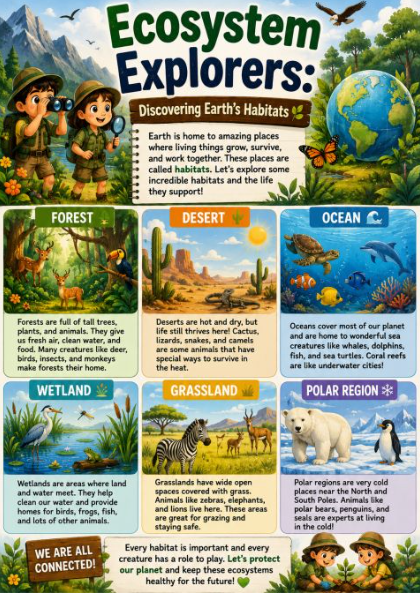
    Ecosystem Explorers: Discovering Earth's Habitats

    Step into the amazing world of Earth's ecosystems and discover the incredible habitats that support life on our planet! From lush forests and vast oceans to deserts , grasslands , and icy polar regions , every habitat has its own unique environment and fascinating wildlife.

    In this exciting journey, we explore how plants, animals, climate, and natural resources work together to create balanced ecosystems. Understanding these connections helps us appreciate the incredible diversity of life and reminds us why protecting our planet is so important.

    Explore. Discover. Learn. Protect. Let's uncover the wonders of Earth's habitats and become true Ecosystem Explorers!

    #EcosystemExplorers #Ecosystems #EarthHabitats #Nature #Wildlife #Biodiversity #Environment #Science #EarthScience #AnimalWorld #PlantLife #NatureLovers #EnvironmentalAwareness #SaveOurPlanet #Sustainability #Education #Learning #DiscoverNature #Climate #Knowledge
    RSISB Roll No:#209 Story Post No.27 ๐ŸŒ๐ŸŒฟ Ecosystem Explorers: Discovering Earth's Habitats ๐Ÿพ๐Ÿ” Step into the amazing world of Earth's ecosystems and discover the incredible habitats that support life on our planet! ๐ŸŒŽโœจ From lush forests ๐ŸŒณ and vast oceans ๐ŸŒŠ to deserts ๐Ÿœ๏ธ, grasslands ๐ŸŒพ, and icy polar regions โ„๏ธ, every habitat has its own unique environment and fascinating wildlife. ๐Ÿฆ๐Ÿง๐Ÿ  In this exciting journey, we explore how plants, animals, climate, and natural resources work together to create balanced ecosystems. ๐ŸŒฑ๐Ÿฆ‹ Understanding these connections helps us appreciate the incredible diversity of life and reminds us why protecting our planet is so important. ๐Ÿ’šโ™ป๏ธ ๐Ÿ”Ž๐ŸŒŸ Explore. Discover. Learn. Protect. Let's uncover the wonders of Earth's habitats and become true Ecosystem Explorers! ๐Ÿš€๐ŸŒ #EcosystemExplorers #Ecosystems #EarthHabitats #Nature #Wildlife #Biodiversity #Environment #Science #EarthScience #AnimalWorld #PlantLife #NatureLovers #EnvironmentalAwareness #SaveOurPlanet #Sustainability #Education #Learning #DiscoverNature #Climate #Knowledge ๐ŸŒ๐ŸŒฟ๐Ÿพ๐Ÿ”๐ŸŒณ๐ŸŒŠ๐Ÿœ๏ธ๐ŸŒพโ„๏ธ๐Ÿฆ๐Ÿง๐Ÿ ๐Ÿฆ‹๐Ÿ’šโ™ป๏ธโœจ๐Ÿ“š๐Ÿš€
    0 Comments 0 Shares 3031 Views
More Results