


#rsisb
Roll no 248
Fondation level
Stroy post no 22
**The Journey of "Cell": From Monks' Chambers to Biology Labs**
Have you ever wondered where the word **"Cell"** came from?
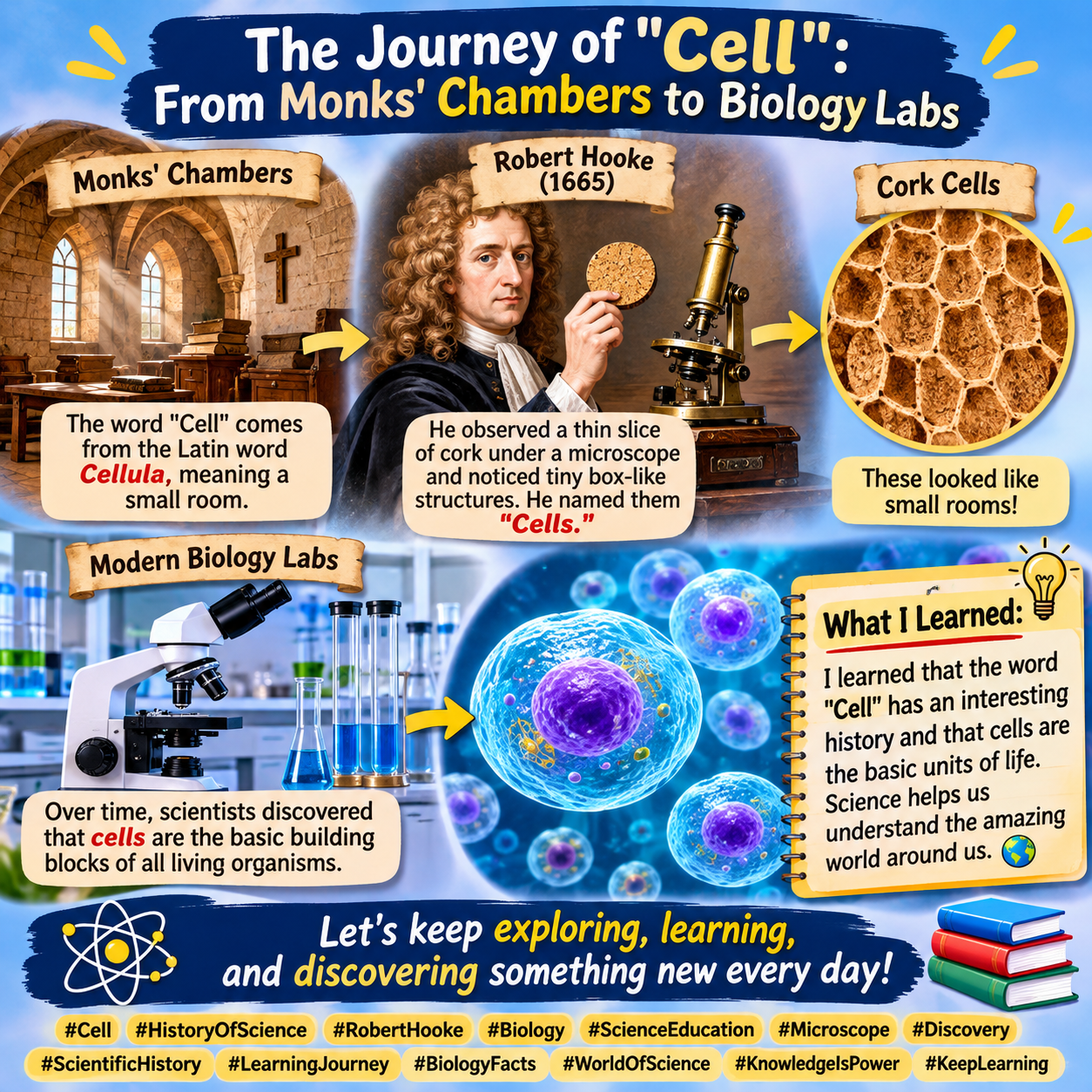
The story of the word "Cell" is fascinating! It comes from the Latin word *Cellula*, meaning a small room. In 1665, an English scientist named Robert Hooke observed a thin slice of cork under a microscope. He noticed tiny box-like structures that reminded him of small rooms in a monastery. He named these structures "Cells."
Over time, scientists discovered that cells are the basic building blocks of all living organisms. Today, modern laboratories use advanced microscopes and technology to study cells and understand how life works.
This journey teaches us that even a simple observation can lead to a great scientific discovery! Every small discovery can open the door to a world of knowledge.
**What I Learned:**
I learned that the word "Cell" has an interesting history and that cells are the basic units of life. Science helps us understand the amazing world around us.
Let's keep exploring, learning, and discovering something new every day!
#Cell #HistoryOfScience #RobertHooke #Biology #ScienceEducation #Microscope #Discovery #ScientificHistory #LearningJourney #BiologyFacts #WorldOfScience #KnowledgeIsPower #KeepLearning #Education #RehanSchool #AI Learner
#rsisb
Roll no 248
Fondation level
Stroy post no 22
🔬📖 **The Journey of "Cell": From Monks' Chambers to Biology Labs** 🧬✨
Have you ever wondered where the word **"Cell"** came from? 🤔
The story of the word "Cell" is fascinating! It comes from the Latin word *Cellula*, meaning a small room. In 1665, an English scientist named Robert Hooke observed a thin slice of cork under a microscope. He noticed tiny box-like structures that reminded him of small rooms in a monastery. He named these structures "Cells." 🔬
Over time, scientists discovered that cells are the basic building blocks of all living organisms. Today, modern laboratories use advanced microscopes and technology to study cells and understand how life works. 🌱🧫
This journey teaches us that even a simple observation can lead to a great scientific discovery! Every small discovery can open the door to a world of knowledge. 🚀
**What I Learned:**
I learned that the word "Cell" has an interesting history and that cells are the basic units of life. Science helps us understand the amazing world around us. 🌍💡
Let's keep exploring, learning, and discovering something new every day! 📚🌟
#Cell #HistoryOfScience #RobertHooke #Biology #ScienceEducation #Microscope #Discovery #ScientificHistory #LearningJourney #BiologyFacts #WorldOfScience #KnowledgeIsPower #KeepLearning #Education #RehanSchool #AI Learner 🔬🧬🚀
0 Commenti
0 condivisioni
1264 Views