Fondation Level Batch No 4
Roll RSLC #42
Task No #139
Day #139
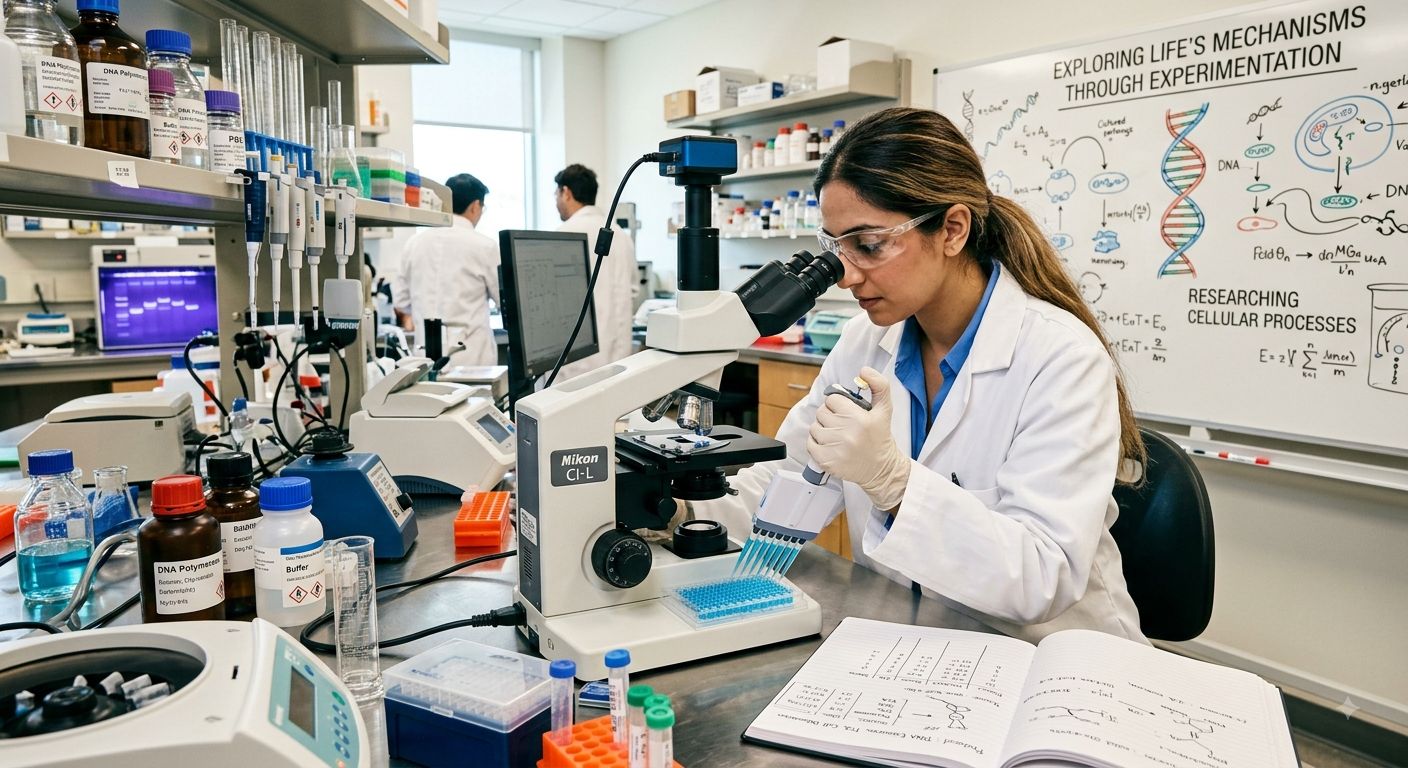
# Exploring Life?s Mechanisms Through Experimentation
Sara was a curious young student who loved discovering how life worked. One day, while studying in her school laboratory, she looked through a microscope and became fascinated by the tiny cells she saw moving beneath the lens. She wondered how something so small could perform such important tasks and keep living organisms alive. Instead of simply memorizing facts from her textbook, Sara decided to investigate through experiments. She carefully planned her work, recorded her observations, and began searching for answers to the mysteries hidden inside living cells.
At first, Sara?s experiments did not go as planned. Some results were confusing, while others were completely different from what she expected. She became disappointed and thought about giving up, but her teacher encouraged her to look at every mistake as an opportunity to learn. Sara repeated her experiments, checked her measurements, and carefully studied her observations. Gradually, she discovered that cells respond to changes in their environment and that many different processes work together to keep life functioning. Each experiment, even the unsuccessful ones, taught her something valuable.
As Sara continued her research, she realized that life is a complex system filled with countless interactions. Cells communicate, produce energy, transport materials, grow, repair damage, and respond to their surroundings. She understood that scientific discovery requires more than intelligence; it requires patience, curiosity, careful observation, and the courage to learn from failure. The more she experimented, the more questions she developed, and each question encouraged her to explore even deeper into the fascinating mechanisms of life.
When Sara finally completed her project, she presented her findings to her classmates. She explained that her greatest discovery was not a single scientific fact, but the understanding that every experiment has something to teach us. Success can give us answers, while failure can show us a better path toward them. Sara left the laboratory with a new appreciation for science and a stronger belief in herself.
**Moral: Never be afraid of failure, because every mistake can become a lesson, and every lesson can bring you one step closer to discovery.**
#LifeScience #ScientificResearch #Experimentation #Biology #ScienceExploration #LifeMechanisms #ScientificDiscovery
Roll RSLC #42
Task No #139
Day #139
# Exploring Life?s Mechanisms Through Experimentation
Sara was a curious young student who loved discovering how life worked. One day, while studying in her school laboratory, she looked through a microscope and became fascinated by the tiny cells she saw moving beneath the lens. She wondered how something so small could perform such important tasks and keep living organisms alive. Instead of simply memorizing facts from her textbook, Sara decided to investigate through experiments. She carefully planned her work, recorded her observations, and began searching for answers to the mysteries hidden inside living cells.
At first, Sara?s experiments did not go as planned. Some results were confusing, while others were completely different from what she expected. She became disappointed and thought about giving up, but her teacher encouraged her to look at every mistake as an opportunity to learn. Sara repeated her experiments, checked her measurements, and carefully studied her observations. Gradually, she discovered that cells respond to changes in their environment and that many different processes work together to keep life functioning. Each experiment, even the unsuccessful ones, taught her something valuable.
As Sara continued her research, she realized that life is a complex system filled with countless interactions. Cells communicate, produce energy, transport materials, grow, repair damage, and respond to their surroundings. She understood that scientific discovery requires more than intelligence; it requires patience, curiosity, careful observation, and the courage to learn from failure. The more she experimented, the more questions she developed, and each question encouraged her to explore even deeper into the fascinating mechanisms of life.
When Sara finally completed her project, she presented her findings to her classmates. She explained that her greatest discovery was not a single scientific fact, but the understanding that every experiment has something to teach us. Success can give us answers, while failure can show us a better path toward them. Sara left the laboratory with a new appreciation for science and a stronger belief in herself.
**Moral: Never be afraid of failure, because every mistake can become a lesson, and every lesson can bring you one step closer to discovery.**
#LifeScience #ScientificResearch #Experimentation #Biology #ScienceExploration #LifeMechanisms #ScientificDiscovery
Fondation Level Batch No 4
Roll RSLC #42
Task No #139
Day #139
# Exploring Life?s Mechanisms Through Experimentation
Sara was a curious young student who loved discovering how life worked. One day, while studying in her school laboratory, she looked through a microscope and became fascinated by the tiny cells she saw moving beneath the lens. She wondered how something so small could perform such important tasks and keep living organisms alive. Instead of simply memorizing facts from her textbook, Sara decided to investigate through experiments. She carefully planned her work, recorded her observations, and began searching for answers to the mysteries hidden inside living cells.
At first, Sara?s experiments did not go as planned. Some results were confusing, while others were completely different from what she expected. She became disappointed and thought about giving up, but her teacher encouraged her to look at every mistake as an opportunity to learn. Sara repeated her experiments, checked her measurements, and carefully studied her observations. Gradually, she discovered that cells respond to changes in their environment and that many different processes work together to keep life functioning. Each experiment, even the unsuccessful ones, taught her something valuable.
As Sara continued her research, she realized that life is a complex system filled with countless interactions. Cells communicate, produce energy, transport materials, grow, repair damage, and respond to their surroundings. She understood that scientific discovery requires more than intelligence; it requires patience, curiosity, careful observation, and the courage to learn from failure. The more she experimented, the more questions she developed, and each question encouraged her to explore even deeper into the fascinating mechanisms of life.
When Sara finally completed her project, she presented her findings to her classmates. She explained that her greatest discovery was not a single scientific fact, but the understanding that every experiment has something to teach us. Success can give us answers, while failure can show us a better path toward them. Sara left the laboratory with a new appreciation for science and a stronger belief in herself.
**Moral: Never be afraid of failure, because every mistake can become a lesson, and every lesson can bring you one step closer to discovery.**
#LifeScience #ScientificResearch #Experimentation #Biology #ScienceExploration #LifeMechanisms #ScientificDiscovery
0 Reacties
0 aandelen
1791 Views