• #rsisb
    Roll no.239
    Song no .30
    Foundation Level

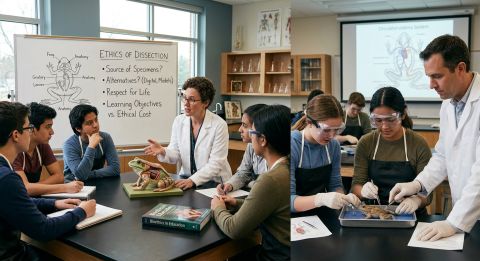
    **From Specimens to Knowledge: The Purpose of Science Experiments** explores how scientists use specimens, observations, and experiments to understand the living world. By carefully examining biological materials and testing scientific ideas, researchers can gather evidence and develop reliable explanations.

    Experiments help transform **curiosity into knowledge** by allowing scientists to ask questions, test hypotheses, analyze results, and discover how biological systems work. From cells and microorganisms to plants and animals, scientific investigation helps us better understand the complexity of life.

    #ScienceExperiments #Biology #ScientificMethod #Specimens #Research #Science #Education #Learning #ScientificDiscovery
    #rsisb Roll no.239 Song no .30 Foundation Level **From Specimens to Knowledge: The Purpose of Science Experiments** explores how scientists use specimens, observations, and experiments to understand the living world. 🌱✨ By carefully examining biological materials and testing scientific ideas, researchers can gather evidence and develop reliable explanations. Experiments help transform **curiosity into knowledge** by allowing scientists to ask questions, test hypotheses, analyze results, and discover how biological systems work. From cells and microorganisms to plants and animals, scientific investigation helps us better understand the complexity of life. 🧬🌍 #ScienceExperiments #Biology #ScientificMethod #Specimens #Research #Science #Education #Learning #ScientificDiscovery 🔬🧪✨
    0 Комментарии 0 Поделились 786 Просмотры 5
  • Foundation Level
    Day 146

    **Roll Number:** 005

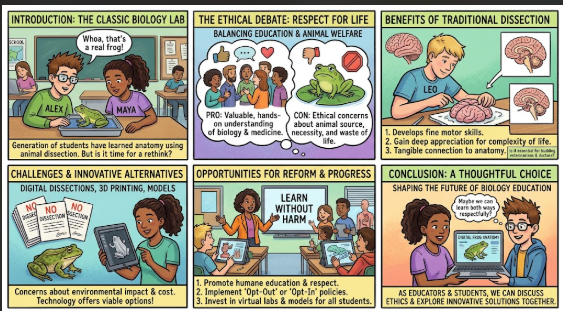
    This comic-strip illustration explores the ongoing debate surrounding animal dissection in science education, balancing traditional hands-on learning with modern, humane alternatives.

    * **Panel 1 (The Classic Biology Lab):** Alex and Maya examine a preserved frog in a traditional classroom setup, introducing the long-standing educational practice.
    * **Panel 2 (The Ethical Debate):** A visual breakdown comparing the benefits of hands-on educational value against the ethical concerns regarding animal welfare, sourcing, and respect for life.
    * **Panel 3 (Benefits of Traditional Dissection):** Highlighting how physical dissection aids fine motor skills, offers a tactile understanding of organ structures, and builds foundational experience for future medical or veterinary paths.
    * **Panel 4 (Innovative Alternatives):** Showcasing high-tech solutions like digital software, interactive tablets, and 3D-printed anatomical models that eliminate the need for real specimens.
    * **Panel 5 (Progress & Reform):** Demonstrating a modern, inclusive classroom environment that respects student ethics through opt-out policies and virtual learning tools.
    * **Panel 6 (A Thoughtful Future):** Alex and Maya reflect on finding a balance, concluding that technology and ethics can work together to advance science education without harm.
    Foundation Level Day 146 **Roll Number:** 005 This comic-strip illustration explores the ongoing debate surrounding animal dissection in science education, balancing traditional hands-on learning with modern, humane alternatives. * **Panel 1 (The Classic Biology Lab):** Alex and Maya examine a preserved frog in a traditional classroom setup, introducing the long-standing educational practice. * **Panel 2 (The Ethical Debate):** A visual breakdown comparing the benefits of hands-on educational value against the ethical concerns regarding animal welfare, sourcing, and respect for life. * **Panel 3 (Benefits of Traditional Dissection):** Highlighting how physical dissection aids fine motor skills, offers a tactile understanding of organ structures, and builds foundational experience for future medical or veterinary paths. * **Panel 4 (Innovative Alternatives):** Showcasing high-tech solutions like digital software, interactive tablets, and 3D-printed anatomical models that eliminate the need for real specimens. * **Panel 5 (Progress & Reform):** Demonstrating a modern, inclusive classroom environment that respects student ethics through opt-out policies and virtual learning tools. * **Panel 6 (A Thoughtful Future):** Alex and Maya reflect on finding a balance, concluding that technology and ethics can work together to advance science education without harm.
    1
    0 Комментарии 0 Поделились 790 Просмотры
  • Fondation Level Batch No 4
    Roll RSLC #42
    Task No #146
    Day #146

    # The Ethics and Education of Animal Dissections

    On a bright Monday morning, Sara entered her biology classroom with excitement and curiosity. Her teacher, Ms. Helen, announced that the students would be learning about animal anatomy through a dissection lesson. Sara had always wanted to understand how living bodies worked, but she also wondered whether using animals for education was the right choice. Before beginning, Ms. Helen reminded the class that science was not only about discovering facts?it was also about making responsible and ethical decisions.

    During the lesson, Sara carefully observed the specimen and began to understand how different organs worked together. However, Ms. Helen explained that animals should never be treated as ordinary objects. They were living beings and deserved respect. She told the students that every use of an animal in education should have a clear purpose and that unnecessary harm should always be avoided.

    One student asked, ?Can we learn anatomy without using real animals?? Ms. Helen explained that modern technology now offers alternatives such as virtual dissections, 3D models, computer simulations, and artificial specimens. These methods can help students understand anatomy while reducing the need for animal use. Sara realized that scientific progress was not only about learning more, but also about finding kinder and more responsible ways to learn.

    At the end of the lesson, Sara wrote in her notebook, ?True science seeks knowledge without forgetting kindness.? She understood that education should develop knowledge, compassion, responsibility, and respect. From that day forward, she looked at science differently and realized that the best discoveries are those that help us understand life while also teaching us to value it.

    ## Moral Lesson

    **True education combines knowledge with compassion. Science should seek understanding while respecting life and choosing ethical ways to learn whenever possible.**

    #AnimalDissection #EthicsInScience #BiologyEducation #AnimalWelfare #ScienceEducation #EthicalLearning
    Fondation Level Batch No 4 Roll RSLC #42 Task No #146 Day #146 # The Ethics and Education of Animal Dissections On a bright Monday morning, Sara entered her biology classroom with excitement and curiosity. Her teacher, Ms. Helen, announced that the students would be learning about animal anatomy through a dissection lesson. Sara had always wanted to understand how living bodies worked, but she also wondered whether using animals for education was the right choice. Before beginning, Ms. Helen reminded the class that science was not only about discovering facts?it was also about making responsible and ethical decisions. During the lesson, Sara carefully observed the specimen and began to understand how different organs worked together. However, Ms. Helen explained that animals should never be treated as ordinary objects. They were living beings and deserved respect. She told the students that every use of an animal in education should have a clear purpose and that unnecessary harm should always be avoided. One student asked, ?Can we learn anatomy without using real animals?? Ms. Helen explained that modern technology now offers alternatives such as virtual dissections, 3D models, computer simulations, and artificial specimens. These methods can help students understand anatomy while reducing the need for animal use. Sara realized that scientific progress was not only about learning more, but also about finding kinder and more responsible ways to learn. At the end of the lesson, Sara wrote in her notebook, ?True science seeks knowledge without forgetting kindness.? She understood that education should develop knowledge, compassion, responsibility, and respect. From that day forward, she looked at science differently and realized that the best discoveries are those that help us understand life while also teaching us to value it. ## Moral Lesson **True education combines knowledge with compassion. Science should seek understanding while respecting life and choosing ethical ways to learn whenever possible.** #AnimalDissection #EthicsInScience #BiologyEducation #AnimalWelfare #ScienceEducation #EthicalLearning
    0 Комментарии 0 Поделились 1962 Просмотры
  • #rsisb Roll No.240 Song No.25 Foundation level Dissecting Frogs: A Gateway to Human Anatomy explores the role of frog anatomy in biology education and shows how studying animal structures can help students develop a better understanding of anatomy. Frog anatomy provides a useful learning model for exploring the organization of a living body. Through careful observation, students can learn about different organs, body parts, and biological systems, while connecting classroom concepts with practical scientific learning. One of the important goals of anatomy studies is understanding how different body parts work together. By learning about body structures and their functions, students can build a stronger foundation for understanding more complex biological systems, including those found in humans. This topic also introduces the importance of observation, comparison, and scientific thinking. Students can examine similarities and differences between frog and human anatomy and understand that different organisms may have different structures while still sharing some basic biological principles. Practical anatomy work can also teach students important values such as responsibility, careful observation, accurate recording of information, and respect for biological specimens. Such activities should always be conducted with appropriate supervision, ethical consideration, and laboratory safety procedures. The study of frog anatomy can be especially valuable for students interested in biology, medicine, veterinary science, zoology, and health-related subjects. It helps turn scientific ideas into meaningful learning experiences and encourages students to ask questions about how living bodies are organized. 🔬 Learn about animal anatomy 🐸 Explore body structures and biological systems 🧠 Develop observation and scientific thinking skills 📚 Connect practical study with biology lessons 🫀 Build a foundation for understanding human anatomy 🌍 Appreciate the complexity of living organisms Dissecting Frogs: A Gateway to Human Anatomy reminds us that studying biology is more than memorizing names and diagrams. It is about observing, questioning, comparing, and understanding how life is organized. Through responsible scientific study, students can gain knowledge that supports deeper learning in anatomy and the life sciences. #FrogDissection #FrogAnatomy #HumanAnatomy #Biology #Anatomy #ScienceEducation #BiologyLab #LifeScience #AnimalAnatomy #ScientificLearning #StudentLearning #Zoology #HumanBody Rehan School Islamabad Campus Asma Shaheen EducationWali Irum Asim Saima Happinesswali https://www.facebook.com/share/v/1BrWG6PyH1/
    WWW.FACEBOOK.COM
    Facebook
    #rsisb Roll No.240 Song No.25 Foundation level Dissecting Frogs: A Gateway to Human Anatomy explores the role of frog anatomy in biology education and shows how studying animal structures can help...
    0 Комментарии 0 Поделились 2634 Просмотры
  • #rsisb Roll No.240 Song No.16 Foundation Level Science experiments help us understand the world by turning observations into knowledge. In this topic, we explore how scientists use specimens, samples, tools, and careful experiments to discover facts and answer important questions. From observing plants and animals to studying chemicals, cells, and materials, every experiment teaches us something new. Experiments also develop important skills such as observation, questioning, problem-solving, critical thinking, and analysis. By testing ideas and comparing results, students learn that science is not just about memorizing facts—it is about discovering, testing, learning, and improving our understanding of the world. This topic shows how a simple specimen can become the starting point for a valuable scientific discovery. 🔬🧪📚 #ScienceExperiments #Science #Education #ScientificDiscovery #Learning #Experiments #Students #knowledgeispower Rehan School Islamabad Campus Asma Shaheen EducationWali Irum Asim Saima Happinesswali https://www.facebook.com/share/v/1Ef1Dr8vt6/
    WWW.FACEBOOK.COM
    Facebook
    #rsisb Roll No.240 Song No.16 Foundation Level Science experiments help us understand the world by turning observations into knowledge. In this topic, we explore how scientists use specimens,...
    0 Комментарии 0 Поделились 1939 Просмотры
  • #rsisb Roll No.240 Song No.15 Foundation Level Science experiments help us understand the world around us. By studying specimens, observing changes, asking questions, and testing ideas, we can discover how things work. Experiments turn simple observations into useful knowledge. Students can collect specimens, examine them carefully, record what they see, and learn from the results. Sometimes an experiment gives an expected result, and sometimes it teaches us something completely new. The main purpose of science experiments is to observe, investigate, test, and learn. They make science more interesting and help students develop curiosity, critical thinking, and problem-solving skills. Observe carefully, ask questions, perform experiments, and discover new knowledge! 🔬📚 #ScienceExperiments #Science #Learning #Education #Experiments #Knowledge #Students #ScienceLearning Rehan School Islamabad Campus Asma Shaheen EducationWali Irum Asim Saima Happinesswali https://www.facebook.com/share/v/1CRQa63cJK/
    WWW.FACEBOOK.COM
    Facebook
    #rsisb Roll No.240 Song No.15 Foundation Level Science experiments help us understand the world around us. By studying specimens, observing changes, asking questions, and testing ideas, we can...
    0 Комментарии 0 Поделились 1510 Просмотры
  • #rsisb
    Roll no.239
    Foundation Level

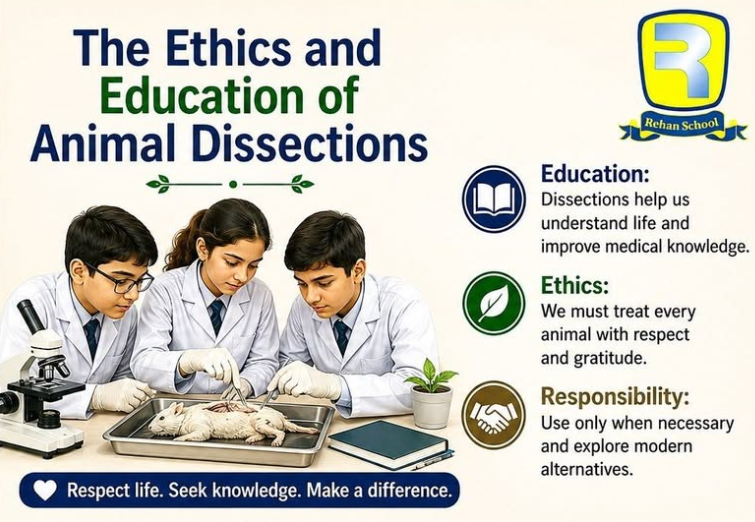
    Animal dissections have been used in biology education to help students understand **anatomy, organs, tissues, and body systems**. By examining specimens directly, students can connect what they learn from textbooks and diagrams with real biological structures.

    However, dissections also raise important **ethical questions**. Students and educators should consider animal welfare, the purpose of the dissection, and whether suitable alternatives are available. Dissections should be conducted with respect, following appropriate ethical and safety standards.

    Modern education can also use **3D models, digital simulations, videos, and virtual dissections**. These tools can provide valuable anatomical learning while reducing or eliminating the need to use animal specimens.

    The goal of education should be to develop scientific knowledge while also encouraging **responsibility, compassion, and respect for life**.

    **In simple words: Animal dissections can provide valuable biological knowledge, but responsible education should balance scientific learning with ethical considerations and appropriate alternatives.**
    #rsisb Roll no.239 Foundation Level Animal dissections have been used in biology education to help students understand **anatomy, organs, tissues, and body systems**. By examining specimens directly, students can connect what they learn from textbooks and diagrams with real biological structures. However, dissections also raise important **ethical questions**. Students and educators should consider animal welfare, the purpose of the dissection, and whether suitable alternatives are available. Dissections should be conducted with respect, following appropriate ethical and safety standards. Modern education can also use **3D models, digital simulations, videos, and virtual dissections**. These tools can provide valuable anatomical learning while reducing or eliminating the need to use animal specimens. The goal of education should be to develop scientific knowledge while also encouraging **responsibility, compassion, and respect for life**. **In simple words: Animal dissections can provide valuable biological knowledge, but responsible education should balance scientific learning with ethical considerations and appropriate alternatives.**
    0 Комментарии 0 Поделились 2498 Просмотры
  • #rsisb
    Roll No.240
    Story No.17
    Foundation level

    ### **The Ethics and Education of Animal Dissections**

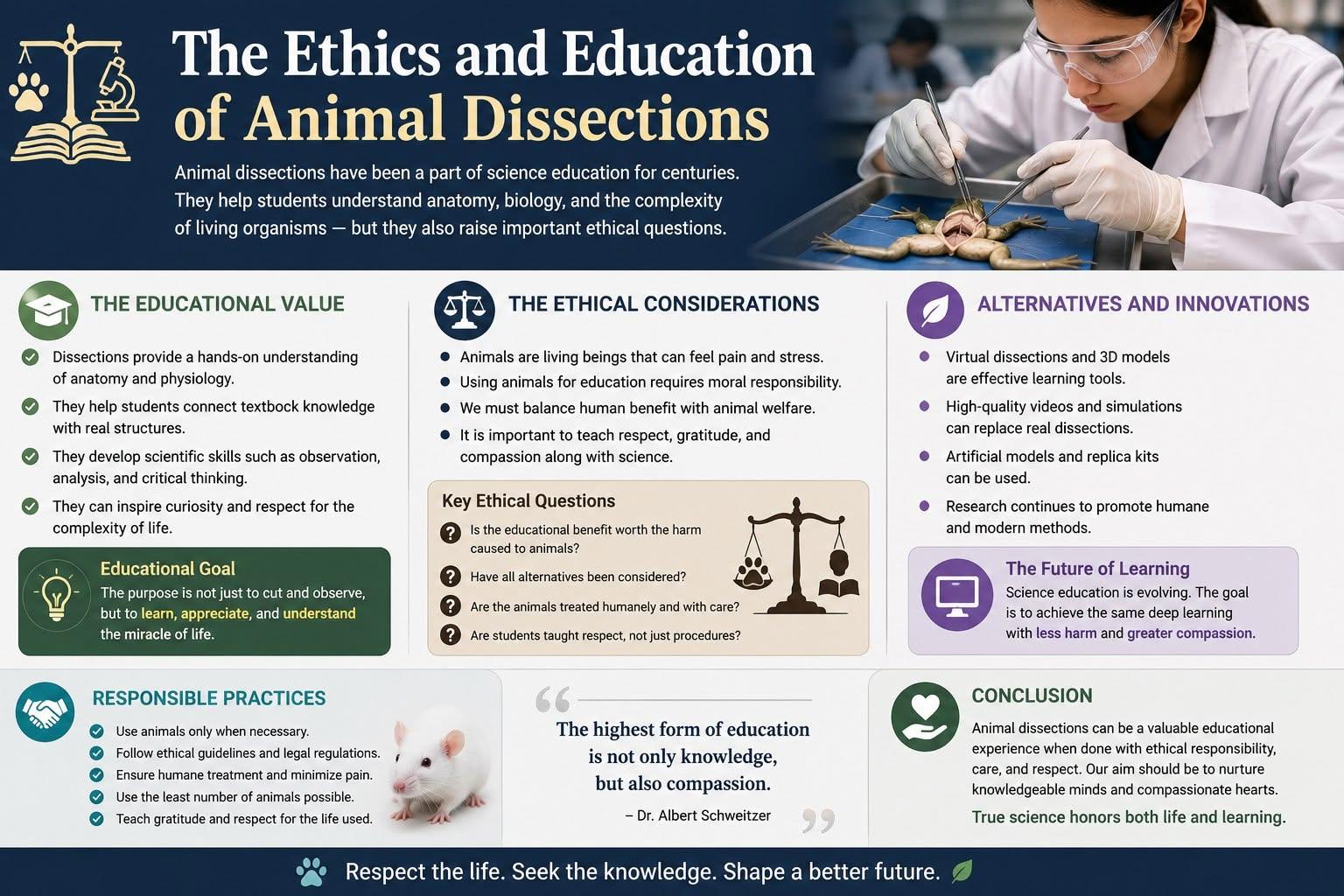
    Animal dissection has long been an important part of biology and medical education, helping students understand anatomy, physiology, and the complex structures of living organisms. By examining real biological specimens, learners gain hands-on experience that strengthens their observation, critical thinking, and scientific investigation skills. For many years, dissections have played a significant role in preparing future doctors, veterinarians, scientists, and researchers by providing practical knowledge that complements classroom learning.

    At the same time, animal dissections raise important ethical questions about animal welfare, responsible scientific practice, and the balance between educational benefits and respect for living creatures. Modern education encourages students to consider these ethical perspectives while learning about science. Many schools and universities now offer alternatives such as virtual dissections, 3D anatomical models, computer simulations, and interactive digital laboratories. These innovative tools provide effective learning experiences while reducing the need for animal specimens in many educational settings.

    Understanding the ethics of animal dissection helps students develop not only scientific knowledge but also compassion, responsibility, and respect for life. By combining ethical awareness with scientific inquiry, educators can inspire future generations to pursue discovery in ways that are both innovative and humane. This balanced approach promotes critical thinking, responsible decision-making, and a deeper appreciation for the relationship between science, education, and the living world.

    **#AnimalDissection #Biology #ScienceEducation #Ethics #STEM #BiologyLab #Anatomy #LifeSciences #ScientificLearning #AnimalWelfare #Education #MedicalScience #CriticalThinking #Research #Science **

    Rehan School Islamabad Campus
    Asma Shaheen EducationWali
    Irum Asim
    Saima Happinesswali
    #rsisb Roll No.240 Story No.17 Foundation level ### **The Ethics and Education of Animal Dissections** Animal dissection has long been an important part of biology and medical education, helping students understand anatomy, physiology, and the complex structures of living organisms. By examining real biological specimens, learners gain hands-on experience that strengthens their observation, critical thinking, and scientific investigation skills. For many years, dissections have played a significant role in preparing future doctors, veterinarians, scientists, and researchers by providing practical knowledge that complements classroom learning. At the same time, animal dissections raise important ethical questions about animal welfare, responsible scientific practice, and the balance between educational benefits and respect for living creatures. Modern education encourages students to consider these ethical perspectives while learning about science. Many schools and universities now offer alternatives such as virtual dissections, 3D anatomical models, computer simulations, and interactive digital laboratories. These innovative tools provide effective learning experiences while reducing the need for animal specimens in many educational settings. Understanding the ethics of animal dissection helps students develop not only scientific knowledge but also compassion, responsibility, and respect for life. By combining ethical awareness with scientific inquiry, educators can inspire future generations to pursue discovery in ways that are both innovative and humane. This balanced approach promotes critical thinking, responsible decision-making, and a deeper appreciation for the relationship between science, education, and the living world. **#AnimalDissection #Biology #ScienceEducation #Ethics #STEM #BiologyLab #Anatomy #LifeSciences #ScientificLearning #AnimalWelfare #Education #MedicalScience #CriticalThinking #Research #Science 🌿🔬🧬🐸📚** Rehan School Islamabad Campus Asma Shaheen EducationWali Irum Asim Saima Happinesswali
    0 Комментарии 0 Поделились 7124 Просмотры
  • Day 147: From Specimens to Knowledge: The Purpose of Science Experiments
    Day 147: From Specimens to Knowledge: The Purpose of Science Experiments
    0 Комментарии 0 Поделились 515 Просмотры 0
  • "From Specimens to Knowledge:

    The Purpose of Science Experiments"

    From specimens to knowledge…

    Science is more than just experiments—it's a path to truth.

    This song explores why we experiment, how we turn curiosity into understanding, and how every trial brings us closer to the answers we seek.

    "From Specimens to Knowledge: The Purpose of Science Experiments"

    Celebrate science with rhythm, reason, and a little bit of wonder.

    Listen now.

    Think deeply.

    Learn joyfully.

    #ScienceSong #STEMEducation #WhyWeExperiment #SpecimensToKnowledge #ScienceIsBeautiful #ScienceMusic #Biology #Physics #ScienceStudents #CuriosityDriven #ScientificMethod #LearnWithMusic

    Song no 21

    Roll no 51

    Follow Us:

    Instagram: [ / muhammadmujeebasif ]

    LinkedIn: [ / muhammad-mujeeb-asif-a9b3b6363 ]

    Facebook: [ / mujeeb.asif.822421 ]

    YouTube: [ / @mujeeb3810 ]

    FOR any type of song,youtube thumnail,editing,and canva post needed then contect me on whatapps number : 03001040381

    Don’t forget to LIKE, SHARE, and SUBSCRIBE for more inspiring content!
    "From Specimens to Knowledge: The Purpose of Science Experiments" 🧪✨ From specimens to knowledge… Science is more than just experiments—it's a path to truth. This song explores why we experiment, how we turn curiosity into understanding, and how every trial brings us closer to the answers we seek. 🎶 "From Specimens to Knowledge: The Purpose of Science Experiments" Celebrate science with rhythm, reason, and a little bit of wonder. 🌍🔬 🎧 Listen now. 🧠 Think deeply. 🎓 Learn joyfully. #ScienceSong #STEMEducation #WhyWeExperiment #SpecimensToKnowledge #ScienceIsBeautiful #ScienceMusic #Biology #Physics #ScienceStudents #CuriosityDriven #ScientificMethod #LearnWithMusic Song no 21 Roll no 51 👉 Follow Us: 📸 Instagram: [ / muhammadmujeebasif ] 💼 LinkedIn: [ / muhammad-mujeeb-asif-a9b3b6363 ] 📘 Facebook: [ / mujeeb.asif.822421 ] 🎥 YouTube: [ / @mujeeb3810 ] FOR any type of song,youtube thumnail,editing,and canva post needed then contect me on whatapps number : 03001040381 Don’t forget to LIKE, SHARE, and SUBSCRIBE for more inspiring content!
    0 Комментарии 0 Поделились 4888 Просмотры 0
Расширенные страницы