• #rsisb
    Roll no.247
    song . 9
    Foundation level

    **Cellular Symphony: The Intricate Dance of Life’s Building Blocks**

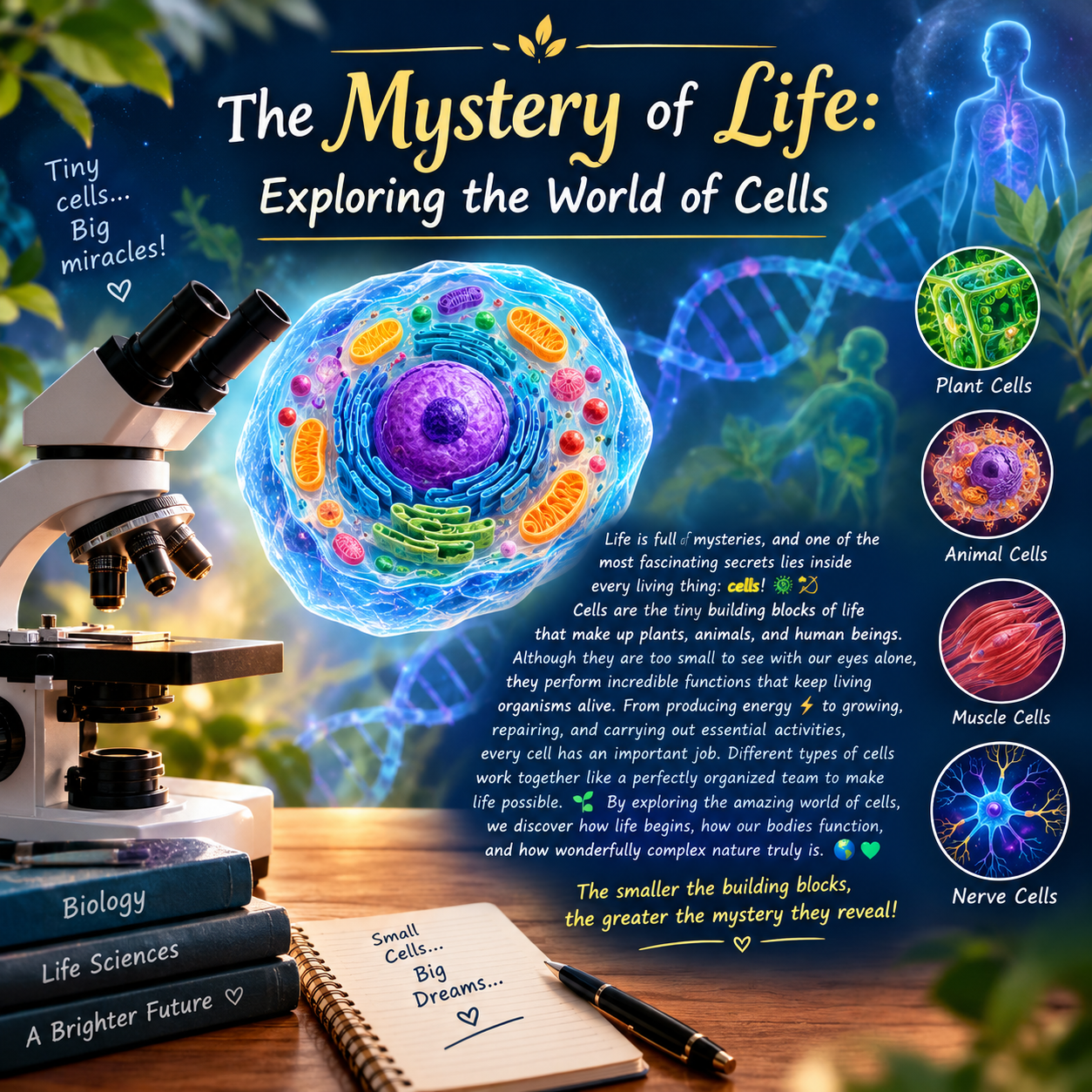
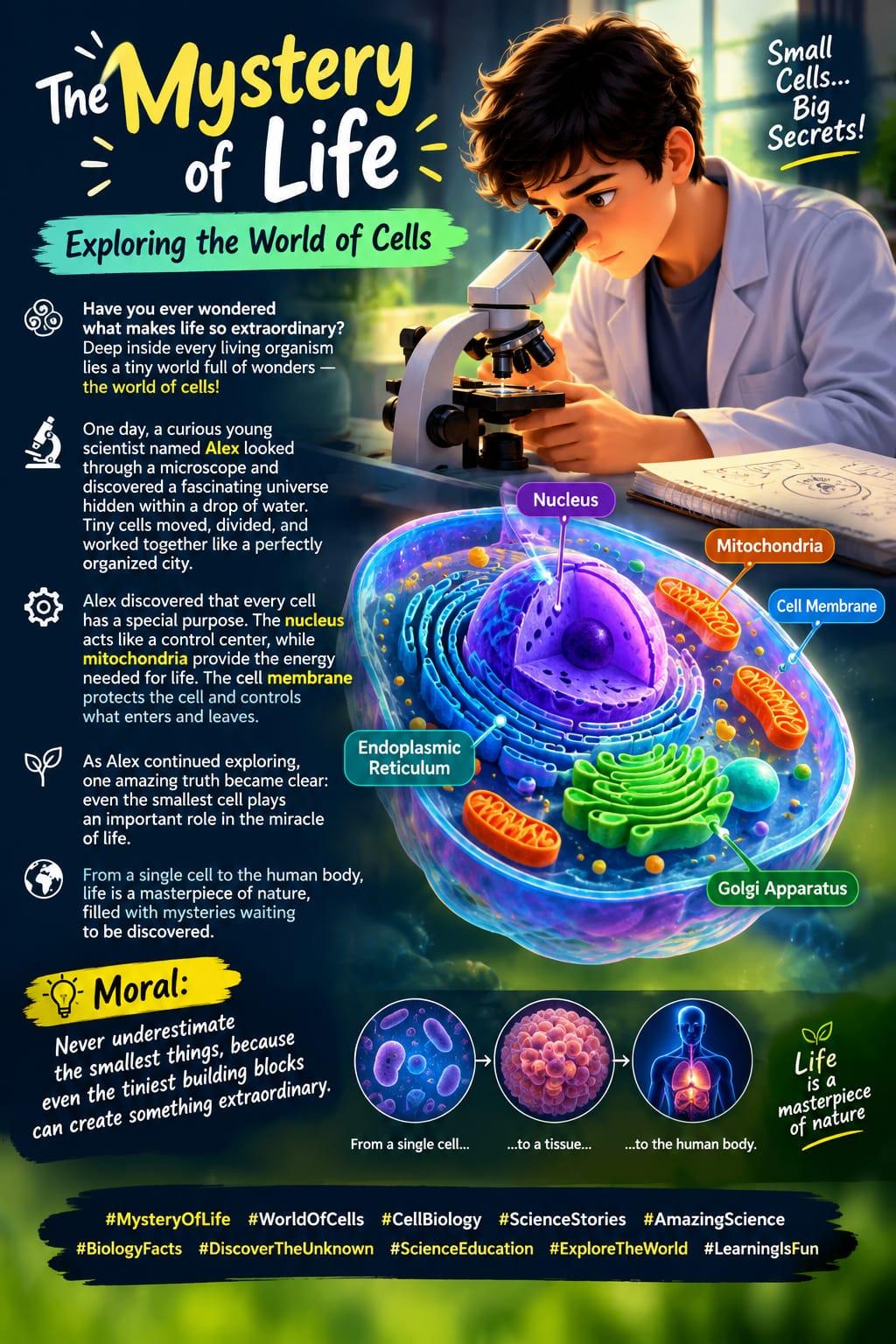
    Life is an extraordinary masterpiece, and at its heart lies the incredible world of the **cell**—the fundamental building block of every living organism. From the tiniest microorganisms to the complex human body, cells work together in a beautifully coordinated system that makes life possible.

    In **“Cellular Symphony: The Intricate Dance of Life’s Building Blocks,”** we explore the fascinating universe hidden within cells. Discover how the cell membrane protects and communicates, how the nucleus stores genetic information, how mitochondria help provide energy, and how proteins and other molecular components perform countless essential tasks.

    Just like musicians in a symphony orchestra, each cellular component has a unique role. No single part works completely alone. Instead, organelles, molecules, and genetic instructions interact continuously, creating an amazing biological harmony. From energy production and cellular communication to growth, repair, and reproduction, every process contributes to the larger story of life.

    We’ll also take a closer look at **DNA**, the remarkable molecule that carries the instructions needed for life. How does DNA store information? How do cells use those instructions to create proteins? And how do cells coordinate their activities with such incredible precision? These questions reveal just how sophisticated even the smallest living systems can be.

    This journey into cellular biology is an opportunity to appreciate the complexity and beauty of life from a completely new perspective. Whether you are a student, science enthusiast, educator, or simply curious about how living things work, this exploration can help make the microscopic world easier to understand and appreciate.

    **Every cell tells a story.**
    **Every molecule has a purpose.**
    **Every process contributes to life.**
    **Together, they create the symphony of existence.**

    Join us as we zoom into the microscopic world and uncover the remarkable cooperation that takes place inside living cells. From the structure of cellular organelles to the flow of genetic information, this is a fascinating journey through one of nature’s greatest achievements—the living cell.

    **Educational • Scientific • Inspiring • Fascinating**
    Explore. Discover. Learn. Be Inspired.

    #CellularSymphony #CellBiology #Cells #Biology #Science #ScienceEducation #MolecularBiology #DNA #Genetics #LifeScience #HumanBody #MicroscopicWorld #BiologyLovers #ScienceLovers #STEM #STEMEducation #LearnScience #ScientificDiscovery #Nature #Life #Education #Knowledge #ScienceExplained #AmazingScience #CellularLife #Organelle #GeneticInformation #BiologicalScience #ExploreScience #ScienceJourney
    #rsisb Roll no.247 song . 9 Foundation level 🧬✨ **Cellular Symphony: The Intricate Dance of Life’s Building Blocks** 🔬🌱 Life is an extraordinary masterpiece, and at its heart lies the incredible world of the **cell**—the fundamental building block of every living organism. 🧫🌍 From the tiniest microorganisms to the complex human body, cells work together in a beautifully coordinated system that makes life possible. In **“Cellular Symphony: The Intricate Dance of Life’s Building Blocks,”** we explore the fascinating universe hidden within cells. 🔬✨ Discover how the cell membrane protects and communicates, how the nucleus stores genetic information, how mitochondria help provide energy, and how proteins and other molecular components perform countless essential tasks. ⚡🧬 Just like musicians in a symphony orchestra, each cellular component has a unique role. 🎻🎶 No single part works completely alone. Instead, organelles, molecules, and genetic instructions interact continuously, creating an amazing biological harmony. From energy production and cellular communication to growth, repair, and reproduction, every process contributes to the larger story of life. 🌱❤️ We’ll also take a closer look at **DNA**, the remarkable molecule that carries the instructions needed for life. 🧬📖 How does DNA store information? How do cells use those instructions to create proteins? And how do cells coordinate their activities with such incredible precision? These questions reveal just how sophisticated even the smallest living systems can be. This journey into cellular biology is an opportunity to appreciate the complexity and beauty of life from a completely new perspective. 🌎🔍 Whether you are a student, science enthusiast, educator, or simply curious about how living things work, this exploration can help make the microscopic world easier to understand and appreciate. 🔬 **Every cell tells a story.** 🧬 **Every molecule has a purpose.** ⚡ **Every process contributes to life.** 🌱 **Together, they create the symphony of existence.** Join us as we zoom into the microscopic world and uncover the remarkable cooperation that takes place inside living cells. From the structure of cellular organelles to the flow of genetic information, this is a fascinating journey through one of nature’s greatest achievements—the living cell. 🌟🧫 🎓 **Educational • Scientific • Inspiring • Fascinating** 🔬 Explore. 🧬 Discover. 🌱 Learn. ✨ Be Inspired. #CellularSymphony #CellBiology #Cells #Biology #Science #ScienceEducation #MolecularBiology #DNA #Genetics #LifeScience #HumanBody #MicroscopicWorld #BiologyLovers #ScienceLovers #STEM #STEMEducation #LearnScience #ScientificDiscovery #Nature #Life #Education #Knowledge #ScienceExplained #AmazingScience #CellularLife #Organelle #GeneticInformation #BiologicalScience #ExploreScience #ScienceJourney 🔬🧬🌱✨
    0 Commentarios 0 Acciones 1420 Views 7
  • #rsisb
    Roll no 248
    Foundation level
    Song no 24
    **Black Holes and Beyond: Exploring the Limits of Physics**

    Step into the mysterious universe of black holes, where gravity becomes incredibly powerful and the laws of physics are pushed to their limits! This song takes you on an exciting journey through space, exploring cosmic mysteries, spacetime, gravity, and the unanswered questions that continue to inspire scientists.

    Let the music carry you beyond the stars and into the deepest mysteries of the cosmos! Learn, wonder, and imagine what lies beyond our understanding.

    #BlackHoles #BeyondTheStars #Physics #Space #Astronomy #Cosmos #Science #Universe #Spacetime #Gravity #ScienceSong #CosmicMysteries #ExploreTheUniverse #LearningThroughMusic
    #rsisb Roll no 248 Foundation level Song no 24 🌌🕳️ **Black Holes and Beyond: Exploring the Limits of Physics** 🚀✨ Step into the mysterious universe of black holes, where gravity becomes incredibly powerful and the laws of physics are pushed to their limits! 🌠🔭 This song takes you on an exciting journey through space, exploring cosmic mysteries, spacetime, gravity, and the unanswered questions that continue to inspire scientists. 🪐⚡ 🎶 Let the music carry you beyond the stars and into the deepest mysteries of the cosmos! 🌌✨ Learn, wonder, and imagine what lies beyond our understanding. 🚀🔬 #BlackHoles 🕳️ #BeyondTheStars 🌟 #Physics 🔬 #Space 🌌 #Astronomy 🔭 #Cosmos 🪐 #Science 🎓 #Universe 🌠 #Spacetime ⏳ #Gravity ⚡ #ScienceSong 🎶 #CosmicMysteries 🚀 #ExploreTheUniverse 🔭 #LearningThroughMusic 🎵
    0 Commentarios 0 Acciones 969 Views 5
  • Fondation Level Batch No 4
    Roll RSLC #42
    Task No #118
    Day #118

    Atoms and Eternity: How Chemistry Shapes the Cosmos

    One night, Ali looked up at the sky and wondered what all those countless stars were made of. His teacher explained that everything in the universe is made of atoms, and these tiny building blocks combine in different ways to create stars, planets, water, air, and even the ingredients of life. Ali was amazed that something so small could play such a huge role in shaping the universe.

    The next day, his teacher explained that powerful processes inside stars create new elements. Over enormous periods of time, these elements become part of planets and eventually contribute to the building blocks of life. Ali realized that every person, plant, and animal on Earth is connected to a much older cosmic story.

    Ali looked at the sky again and understood that nothing in the universe is truly insignificant. Even a tiny atom can be an important part of something much greater. He realized that, just as different atoms come together to create beautiful forms of matter, people can also work together to create a better world.

    Moral Lesson:
    Never consider something unimportant simply because it is small. Every part of the universe has a purpose, and our small efforts can also come together to create something truly meaningful.

    #AtomsAndEternity #Chemistry #Cosmos #Atoms #Science #Universe #SpaceScience #CosmicChemistry
    Fondation Level Batch No 4 Roll RSLC #42 Task No #118 Day #118 Atoms and Eternity: How Chemistry Shapes the Cosmos One night, Ali looked up at the sky and wondered what all those countless stars were made of. His teacher explained that everything in the universe is made of atoms, and these tiny building blocks combine in different ways to create stars, planets, water, air, and even the ingredients of life. Ali was amazed that something so small could play such a huge role in shaping the universe. The next day, his teacher explained that powerful processes inside stars create new elements. Over enormous periods of time, these elements become part of planets and eventually contribute to the building blocks of life. Ali realized that every person, plant, and animal on Earth is connected to a much older cosmic story. Ali looked at the sky again and understood that nothing in the universe is truly insignificant. Even a tiny atom can be an important part of something much greater. He realized that, just as different atoms come together to create beautiful forms of matter, people can also work together to create a better world. Moral Lesson: Never consider something unimportant simply because it is small. Every part of the universe has a purpose, and our small efforts can also come together to create something truly meaningful. #AtomsAndEternity #Chemistry #Cosmos #Atoms #Science #Universe #SpaceScience #CosmicChemistry
    0 Commentarios 0 Acciones 642 Views
  • Fondation Level Batch No 4
    Roll RSLC #42
    Task No #160
    Day #160

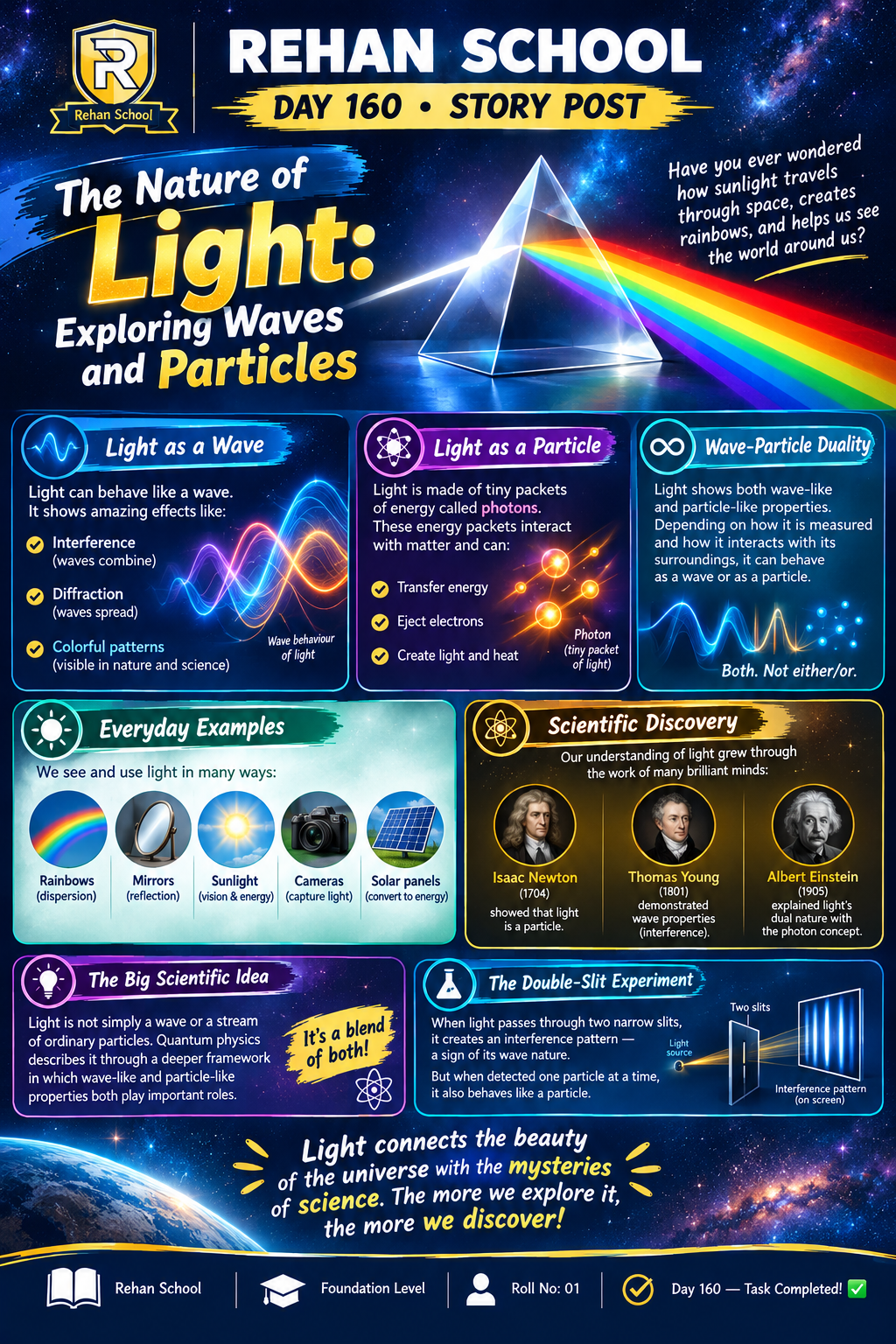
    One evening, Ayan sat by his window watching the golden sunlight fill his room.
    He wondered how light traveled from the Sun across the vastness of space.
    The next day, he asked his science teacher about the true nature of light.
    His teacher explained that light is much more mysterious than it appears.
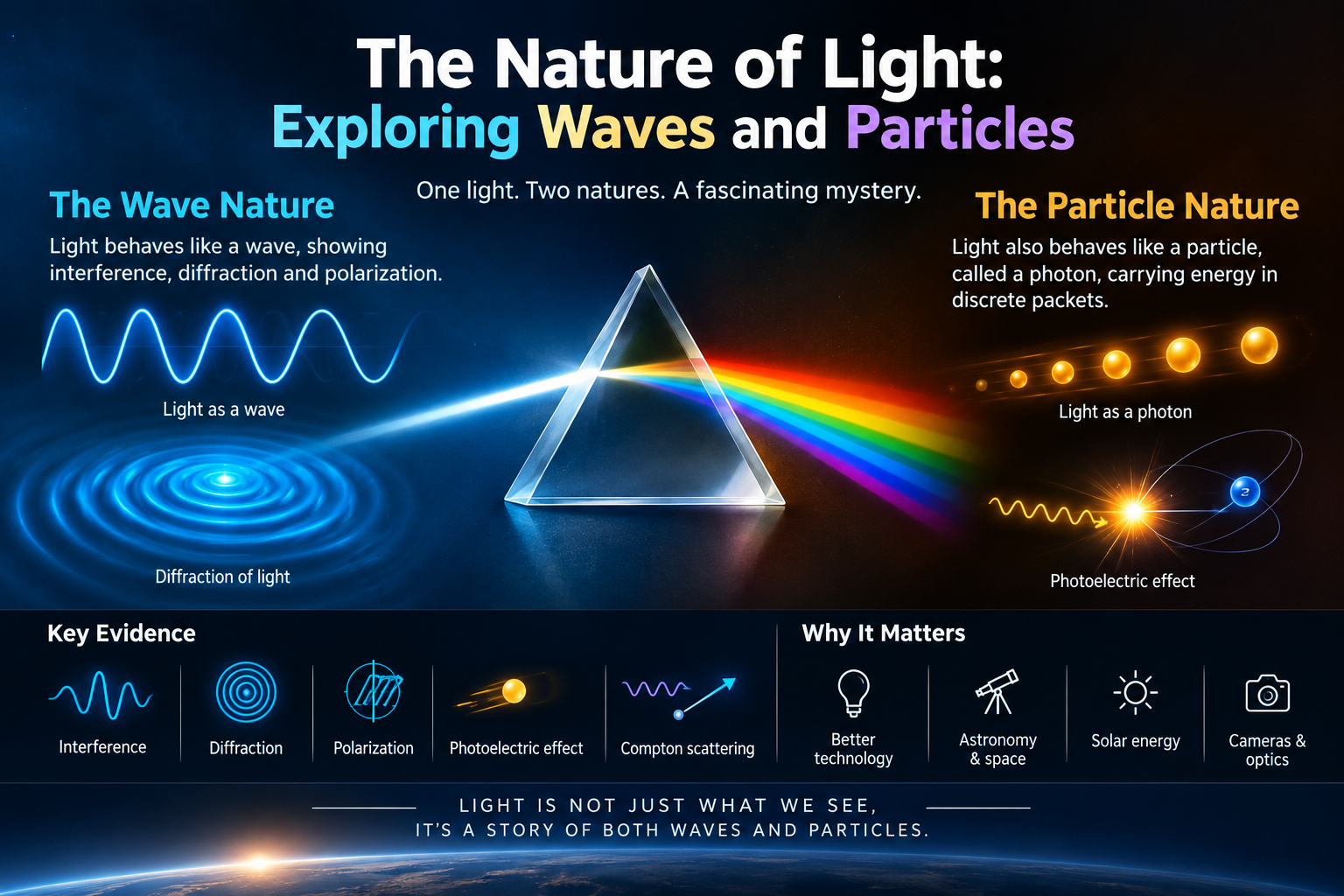
    Scientists discovered that light can behave both like waves and tiny particles.
    This fascinating property is called the wave-particle duality of light.
    Ayan became curious and wanted to discover how this was possible.
    He began an exciting journey into the hidden world of light.
    His teacher explained that light can behave like waves moving through space.
    Light shows reflection, refraction, diffraction, and interference in different situations.
    Reflection allows light to bounce from surfaces such as mirrors and shiny objects.
    Refraction causes light to change direction when it passes through different materials.
    Interference happens when light waves meet and interact with one another.
    These properties help explain rainbows, colors, reflections, and many other phenomena.
    Ayan realized that everyday sights could reveal important scientific secrets.
    He became even more fascinated by the mysterious behavior of light.
    Then Ayan learned that light can also behave like tiny particles called photons.
    Each photon carries energy and can interact with matter in different ways.
    This particle-like behavior helps scientists understand the photoelectric effect.
    Ayan found it amazing that light could appear as both a wave and a particle.
    His teacher explained that this strange behavior is a key idea in quantum physics.
    The quantum world does not always follow the rules we experience every day.
    Light became a perfect example of nature?s surprising complexity.
    Ayan realized that science often reveals things we cannot understand at first.
    That evening, Ayan looked at the sunlight outside with completely new eyes.
    He imagined photons traveling through space and waves carrying energy across the universe.
    He understood that something as ordinary as sunlight could hold incredible mysteries.
    The experience taught him that science is not only about learning known facts.
    It is also about asking questions and searching for answers beyond what we can see.
    Ayan felt inspired to explore more mysteries hidden throughout the universe.
    From that day forward, every beam of light reminded him of his discovery.
    He learned that even the simplest things can contain the greatest scientific wonders.


    #NatureOfLight #LightWaves #LightParticles #Photon #QuantumPhysics #ScienceExploration #PhysicsFacts
    Fondation Level Batch No 4 Roll RSLC #42 Task No #160 Day #160 One evening, Ayan sat by his window watching the golden sunlight fill his room. He wondered how light traveled from the Sun across the vastness of space. The next day, he asked his science teacher about the true nature of light. His teacher explained that light is much more mysterious than it appears. Scientists discovered that light can behave both like waves and tiny particles. This fascinating property is called the wave-particle duality of light. Ayan became curious and wanted to discover how this was possible. He began an exciting journey into the hidden world of light. His teacher explained that light can behave like waves moving through space. Light shows reflection, refraction, diffraction, and interference in different situations. Reflection allows light to bounce from surfaces such as mirrors and shiny objects. Refraction causes light to change direction when it passes through different materials. Interference happens when light waves meet and interact with one another. These properties help explain rainbows, colors, reflections, and many other phenomena. Ayan realized that everyday sights could reveal important scientific secrets. He became even more fascinated by the mysterious behavior of light. Then Ayan learned that light can also behave like tiny particles called photons. Each photon carries energy and can interact with matter in different ways. This particle-like behavior helps scientists understand the photoelectric effect. Ayan found it amazing that light could appear as both a wave and a particle. His teacher explained that this strange behavior is a key idea in quantum physics. The quantum world does not always follow the rules we experience every day. Light became a perfect example of nature?s surprising complexity. Ayan realized that science often reveals things we cannot understand at first. That evening, Ayan looked at the sunlight outside with completely new eyes. He imagined photons traveling through space and waves carrying energy across the universe. He understood that something as ordinary as sunlight could hold incredible mysteries. The experience taught him that science is not only about learning known facts. It is also about asking questions and searching for answers beyond what we can see. Ayan felt inspired to explore more mysteries hidden throughout the universe. From that day forward, every beam of light reminded him of his discovery. He learned that even the simplest things can contain the greatest scientific wonders. #NatureOfLight #LightWaves #LightParticles #Photon #QuantumPhysics #ScienceExploration #PhysicsFacts
    0 Commentarios 0 Acciones 1124 Views
  • #rsisb
    Roll No.240
    Image With Chatgpt No.7
    Foundation Level

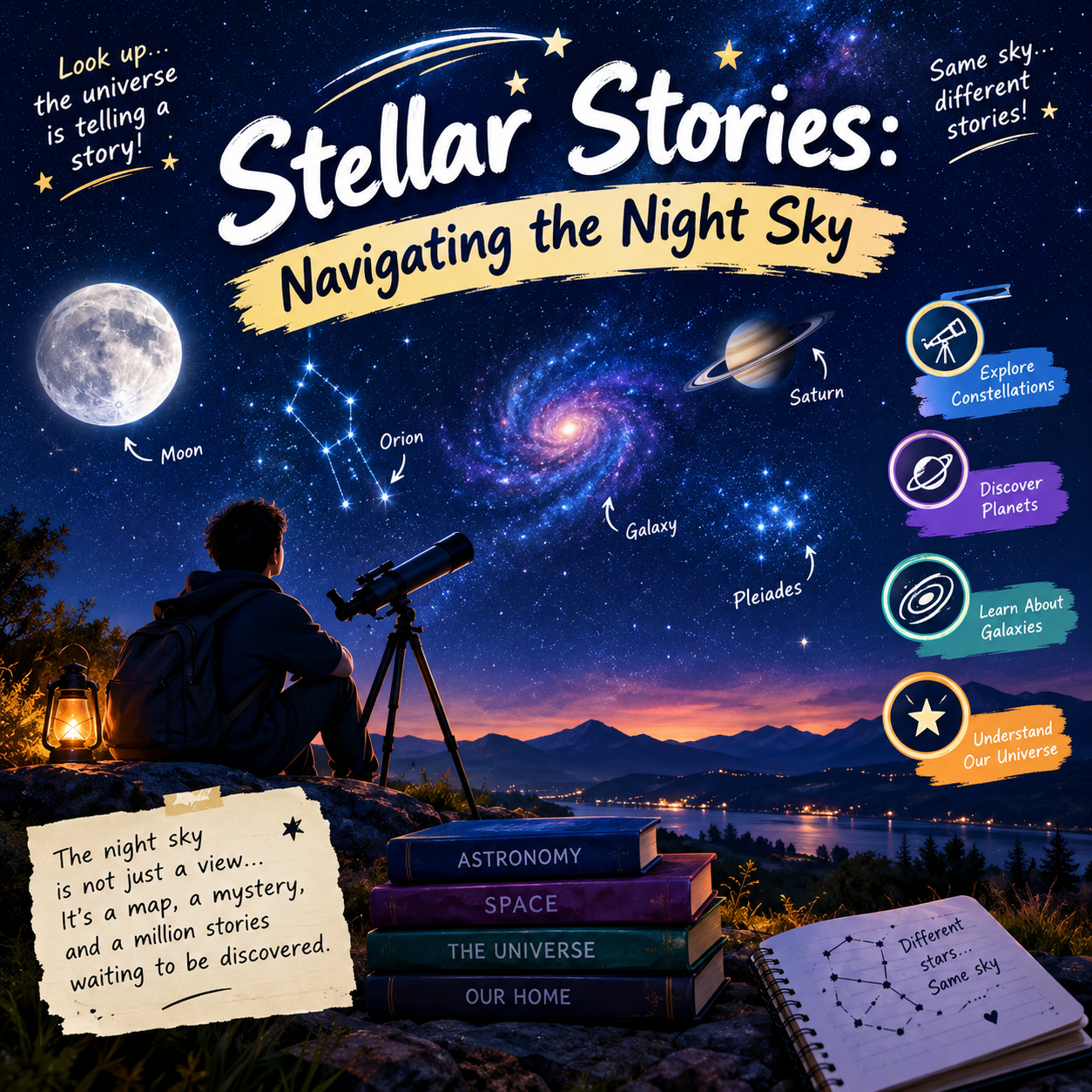
    Step into the magical world of the night sky! Discover beautiful stars , fascinating constellations , ancient legends , and the mysteries of space . Every star has a story, and every night gives us a chance to look up, wonder, and explore.

    Let the stars guide your imagination and inspire you to discover something new!

    Hashtags

    #StellarStories #NightSky #Stars #Constellations #Space #Astronomy #Stargazing #Universe #Cosmos #NightSkyPhotography #ExploreTheStars #SpaceLovers #StarGazing #CosmicJourney #SkyWatchers

    Rehan School Islamabad Campus
    Asma Shaheen EducationWali
    Irum Asim
    Saima Happinesswali

    #rsisb Roll No.240 Image With Chatgpt No.7 Foundation Level Step into the magical world of the night sky! 🌌✨ Discover beautiful stars ⭐, fascinating constellations 🔭, ancient legends 📖, and the mysteries of space 🚀. Every star has a story, and every night gives us a chance to look up, wonder, and explore. 🌠💫 Let the stars guide your imagination and inspire you to discover something new! 🌟🔭 🏷️ Hashtags #StellarStories #NightSky #Stars #Constellations #Space #Astronomy #Stargazing #Universe #Cosmos #NightSkyPhotography #ExploreTheStars #SpaceLovers #StarGazing #CosmicJourney #SkyWatchers 🌌✨⭐🔭🚀🌙🌠💫 Rehan School Islamabad Campus Asma Shaheen EducationWali Irum Asim Saima Happinesswali
    0 Commentarios 0 Acciones 1613 Views
  • #rsisb
    Roll No.240
    Story Post No.24
    Foundation Level

    The word “scientist” may sound like a modern term, but the journey behind it is connected to centuries of human curiosity, philosophy, observation, experimentation, and the search for knowledge.

    Long before the word “scientist” became common, people who studied the natural world were often known as philosophers, scholars, natural philosophers, mathematicians, and thinkers. They asked important questions about nature, the universe, life, matter, motion, and the world around them.

    From the thinkers of the ancient world to the scholars of the Renaissance and the Scientific Revolution, humans continued developing new ways to understand nature. Observation became more important, experiments became more systematic, and evidence gradually became a central part of scientific inquiry.

    During the 18th and 19th centuries, many different branches of knowledge began becoming more specialized. Physics, chemistry, biology, astronomy, geology, and other fields developed their own methods, discoveries, and communities of researchers.

    A major moment in terminology came in the 19th century, when the word “scientist” was introduced as a useful name for people engaged in scientific study. The term is widely associated with William Whewell, who used it in 1833. This helped provide a new, unified word for researchers working across different areas of science.

    The evolution of this word reflects something bigger than language. It represents the changing way humanity organized knowledge and recognized scientific work. The transition from “natural philosopher” to “scientist” shows how science gradually became a distinct and organized field of study.

    Today, scientists work in laboratories, universities, hospitals, observatories, research centers, engineering facilities, and many other places around the world. They investigate everything from tiny cells and molecules to distant galaxies and the origins of the universe.

    Modern science continues to grow through curiosity, evidence, teamwork, technology, and a willingness to ask difficult questions. Every discovery begins with someone wondering, “Why?”, “How?”, or “What if?”

    The story of the word “scientist” reminds us that human knowledge is always evolving. What began with simple curiosity and philosophical questioning gradually developed into the powerful and diverse scientific world we know today.

    From thinkers to researchers. From philosophy to science. From questions to discoveries.

    Science is not only about finding answers—it is also about continuing to ask better questions.

    A journey from curiosity to discovery, and from philosophy to modern science.

    #TheBirthOfScientist #Scientist #HistoryOfScience #ScienceHistory #ScientificRevolution #Philosophy #NaturalPhilosophy #WilliamWhewell #1833 #ModernScience #ScienceEducation #ScientificTerminology #Science #Scientists #Research #Discovery #Curiosity #Knowledge #Learning #Education #STEM #Physics #Chemistry #Biology #Astronomy #Geology #Innovation #Experimentation #ScientificThinking #CriticalThinking #HumanKnowledge #HistoryOfKnowledge #ScienceJourney #FromPhilosophyToScience #ScienceFacts #EducationalContent #LearningJourney #ExploreScience #DiscoverScience

    Rehan School Islamabad Campus
    Asma Shaheen EducationWali
    Irum Asim
    Saima Happinesswali

    #rsisb Roll No.240 Story Post No.24 Foundation Level The word “scientist” may sound like a modern term, but the journey behind it is connected to centuries of human curiosity, philosophy, observation, experimentation, and the search for knowledge. 🧠🔎 Long before the word “scientist” became common, people who studied the natural world were often known as philosophers, scholars, natural philosophers, mathematicians, and thinkers. 🏛️📜 They asked important questions about nature, the universe, life, matter, motion, and the world around them. From the thinkers of the ancient world to the scholars of the Renaissance and the Scientific Revolution, humans continued developing new ways to understand nature. 🌌🌍📖 Observation became more important, experiments became more systematic, and evidence gradually became a central part of scientific inquiry. 🔬🧪✨ During the 18th and 19th centuries, many different branches of knowledge began becoming more specialized. Physics, chemistry, biology, astronomy, geology, and other fields developed their own methods, discoveries, and communities of researchers. 🧬⚗️🌠 A major moment in terminology came in the 19th century, when the word “scientist” was introduced as a useful name for people engaged in scientific study. The term is widely associated with William Whewell, who used it in 1833. 📜🔬 This helped provide a new, unified word for researchers working across different areas of science. The evolution of this word reflects something bigger than language. It represents the changing way humanity organized knowledge and recognized scientific work. 🌟📚 The transition from “natural philosopher” to “scientist” shows how science gradually became a distinct and organized field of study. Today, scientists work in laboratories, universities, hospitals, observatories, research centers, engineering facilities, and many other places around the world. 🌍🧪🔭 They investigate everything from tiny cells and molecules to distant galaxies and the origins of the universe. 🧬🦠🌌 Modern science continues to grow through curiosity, evidence, teamwork, technology, and a willingness to ask difficult questions. 💡🤝🚀 Every discovery begins with someone wondering, “Why?”, “How?”, or “What if?” The story of the word “scientist” reminds us that human knowledge is always evolving. What began with simple curiosity and philosophical questioning gradually developed into the powerful and diverse scientific world we know today. 🌱➡️🔬➡️🌍 ✨ From thinkers to researchers. From philosophy to science. From questions to discoveries. ✨ Science is not only about finding answers—it is also about continuing to ask better questions. 🔎💡 🌟 A journey from curiosity to discovery, and from philosophy to modern science. 🌟 #TheBirthOfScientist #Scientist #HistoryOfScience #ScienceHistory #ScientificRevolution #Philosophy #NaturalPhilosophy #WilliamWhewell #1833 #ModernScience #ScienceEducation #ScientificTerminology #Science #Scientists #Research #Discovery #Curiosity #Knowledge #Learning #Education #STEM #Physics #Chemistry #Biology #Astronomy #Geology #Innovation #Experimentation #ScientificThinking #CriticalThinking #HumanKnowledge #HistoryOfKnowledge #ScienceJourney #FromPhilosophyToScience #ScienceFacts #EducationalContent #LearningJourney #ExploreScience #DiscoverScience 🔬📚🧠🌍✨🔭🧪🚀💡🌟 Rehan School Islamabad Campus Asma Shaheen EducationWali Irum Asim Saima Happinesswali
    0 Commentarios 0 Acciones 3006 Views

  • #rsisb
    Roll no.239
    Maya no.19
    Foundation Level

    **“Conscious – Tracing the Evolution of Awareness”** explores one of the greatest mysteries of science and philosophy: **how awareness and conscious experience developed in living beings**. Consciousness allows us to experience the world, think, remember, feel emotions, make decisions, and recognize ourselves.

    The topic takes us back to the earliest forms of life and asks how simple organisms developed increasingly complex ways of sensing and responding to their surroundings. As nervous systems and brains became more sophisticated, organisms gained greater abilities to process information, learn from experiences, remember events, and respond flexibly to their environments.

    One of the most fascinating questions is whether consciousness appeared suddenly or **evolved gradually over millions of years**. Scientists study the brains and behaviors of humans and other animals to understand possible forms of awareness. However, consciousness remains difficult to explain because subjective experiences—such as seeing colors, feeling pain, or experiencing emotions—are personal and cannot be directly observed by others.

    The discussion also introduces **self-awareness**, which is the ability to recognize oneself and reflect on one's own thoughts and experiences. Human consciousness is closely connected with language, memory, attention, imagination, creativity, and decision-making.

    Another important part of the topic is the relationship between **conscious and unconscious processes**. Many things our brains do happen automatically, without our full awareness. This shows that the human mind is far more complex than conscious thought alone.

    Overall, this 25-minute exploration encourages us to think deeply about **who we are, how awareness developed, and what it means to be conscious**. It connects biology, neuroscience, psychology, evolution, and philosophy while reminding us that many questions about consciousness are still unanswered.

    **Key Message:** Understanding consciousness may help us better understand not only the human brain, but also the evolution of life, intelligence, identity, and our place in the universe.
    ### **Hashtags**

    #Consciousness #Awareness #Evolution #HumanMind #BrainScience #Neuroscience #SelfAwareness #Psychology #Science #Philosophy #HumanEvolution #Learning #Curiosity #Knowledge #MindAndBrain
    #rsisb Roll no.239 Maya no.19 Foundation Level **“Conscious – Tracing the Evolution of Awareness”** explores one of the greatest mysteries of science and philosophy: **how awareness and conscious experience developed in living beings**. Consciousness allows us to experience the world, think, remember, feel emotions, make decisions, and recognize ourselves. The topic takes us back to the earliest forms of life and asks how simple organisms developed increasingly complex ways of sensing and responding to their surroundings. As nervous systems and brains became more sophisticated, organisms gained greater abilities to process information, learn from experiences, remember events, and respond flexibly to their environments. One of the most fascinating questions is whether consciousness appeared suddenly or **evolved gradually over millions of years**. Scientists study the brains and behaviors of humans and other animals to understand possible forms of awareness. However, consciousness remains difficult to explain because subjective experiences—such as seeing colors, feeling pain, or experiencing emotions—are personal and cannot be directly observed by others. The discussion also introduces **self-awareness**, which is the ability to recognize oneself and reflect on one's own thoughts and experiences. Human consciousness is closely connected with language, memory, attention, imagination, creativity, and decision-making. Another important part of the topic is the relationship between **conscious and unconscious processes**. Many things our brains do happen automatically, without our full awareness. This shows that the human mind is far more complex than conscious thought alone. Overall, this 25-minute exploration encourages us to think deeply about **who we are, how awareness developed, and what it means to be conscious**. It connects biology, neuroscience, psychology, evolution, and philosophy while reminding us that many questions about consciousness are still unanswered. 🌟 **Key Message:** Understanding consciousness may help us better understand not only the human brain, but also the evolution of life, intelligence, identity, and our place in the universe. ### **Hashtags** #Consciousness #Awareness #Evolution #HumanMind #BrainScience #Neuroscience #SelfAwareness #Psychology #Science #Philosophy #HumanEvolution #Learning #Curiosity #Knowledge #MindAndBrain 🧠🔬✨
    0 Commentarios 0 Acciones 2232 Views 3

  • #rsisb
    Roll no.239
    Maya no.19
    Foundation Level

    **“Conscious – Tracing the Evolution of Awareness”** explores one of the greatest mysteries of science and philosophy: **how awareness and conscious experience developed in living beings**. Consciousness allows us to experience the world, think, remember, feel emotions, make decisions, and recognize ourselves.

    The topic takes us back to the earliest forms of life and asks how simple organisms developed increasingly complex ways of sensing and responding to their surroundings. As nervous systems and brains became more sophisticated, organisms gained greater abilities to process information, learn from experiences, remember events, and respond flexibly to their environments.

    One of the most fascinating questions is whether consciousness appeared suddenly or **evolved gradually over millions of years**. Scientists study the brains and behaviors of humans and other animals to understand possible forms of awareness. However, consciousness remains difficult to explain because subjective experiences—such as seeing colors, feeling pain, or experiencing emotions—are personal and cannot be directly observed by others.

    The discussion also introduces **self-awareness**, which is the ability to recognize oneself and reflect on one's own thoughts and experiences. Human consciousness is closely connected with language, memory, attention, imagination, creativity, and decision-making.

    Another important part of the topic is the relationship between **conscious and unconscious processes**. Many things our brains do happen automatically, without our full awareness. This shows that the human mind is far more complex than conscious thought alone.

    Overall, this 25-minute exploration encourages us to think deeply about **who we are, how awareness developed, and what it means to be conscious**. It connects biology, neuroscience, psychology, evolution, and philosophy while reminding us that many questions about consciousness are still unanswered.

    **Key Message:** Understanding consciousness may help us better understand not only the human brain, but also the evolution of life, intelligence, identity, and our place in the universe.

    ### **Hashtags**

    #Consciousness #Awareness #Evolution #HumanMind #BrainScience #Neuroscience #SelfAwareness #Psychology #Science #Philosophy #HumanEvolution #Learning #Curiosity #Knowledge #MindAndBrain


    **“Conscious – Tracing the Evolution of Awareness”** explores one of the greatest mysteries of science and philosophy: **how awareness and conscious experience developed in living beings**. Consciousness allows us to experience the world, think, remember, feel emotions, make decisions, and recognize ourselves.

    The topic takes us back to the earliest forms of life and asks how simple organisms developed increasingly complex ways of sensing and responding to their surroundings. As nervous systems and brains became more sophisticated, organisms gained greater abilities to process information, learn from experiences, remember events, and respond flexibly to their environments.

    One of the most fascinating questions is whether consciousness appeared suddenly or **evolved gradually over millions of years**. Scientists study the brains and behaviors of humans and other animals to understand possible forms of awareness. However, consciousness remains difficult to explain because subjective experiences—such as seeing colors, feeling pain, or experiencing emotions—are personal and cannot be directly observed by others.

    The discussion also introduces **self-awareness**, which is the ability to recognize oneself and reflect on one's own thoughts and experiences. Human consciousness is closely connected with language, memory, attention, imagination, creativity, and decision-making.

    Another important part of the topic is the relationship between **conscious and unconscious processes**. Many things our brains do happen automatically, without our full awareness. This shows that the human mind is far more complex than conscious thought alone.

    Overall, this 25-minute exploration encourages us to think deeply about **who we are, how awareness developed, and what it means to be conscious**. It connects biology, neuroscience, psychology, evolution, and philosophy while reminding us that many questions about consciousness are still unanswered.

    **Key Message:** Understanding consciousness may help us better understand not only the human brain, but also the evolution of life, intelligence, identity, and our place in the universe.

    ### **Hashtags**

    #Consciousness #Awareness #Evolution #HumanMind #BrainScience #Neuroscience #SelfAwareness #Psychology #Science #Philosophy #HumanEvolution #Learning #Curiosity #Knowledge #MindAndBrain
    #rsisb Roll no.239 Maya no.19 Foundation Level **“Conscious – Tracing the Evolution of Awareness”** explores one of the greatest mysteries of science and philosophy: **how awareness and conscious experience developed in living beings**. Consciousness allows us to experience the world, think, remember, feel emotions, make decisions, and recognize ourselves. The topic takes us back to the earliest forms of life and asks how simple organisms developed increasingly complex ways of sensing and responding to their surroundings. As nervous systems and brains became more sophisticated, organisms gained greater abilities to process information, learn from experiences, remember events, and respond flexibly to their environments. One of the most fascinating questions is whether consciousness appeared suddenly or **evolved gradually over millions of years**. Scientists study the brains and behaviors of humans and other animals to understand possible forms of awareness. However, consciousness remains difficult to explain because subjective experiences—such as seeing colors, feeling pain, or experiencing emotions—are personal and cannot be directly observed by others. The discussion also introduces **self-awareness**, which is the ability to recognize oneself and reflect on one's own thoughts and experiences. Human consciousness is closely connected with language, memory, attention, imagination, creativity, and decision-making. Another important part of the topic is the relationship between **conscious and unconscious processes**. Many things our brains do happen automatically, without our full awareness. This shows that the human mind is far more complex than conscious thought alone. Overall, this 25-minute exploration encourages us to think deeply about **who we are, how awareness developed, and what it means to be conscious**. It connects biology, neuroscience, psychology, evolution, and philosophy while reminding us that many questions about consciousness are still unanswered. 🌟 **Key Message:** Understanding consciousness may help us better understand not only the human brain, but also the evolution of life, intelligence, identity, and our place in the universe. ### **Hashtags** #Consciousness #Awareness #Evolution #HumanMind #BrainScience #Neuroscience #SelfAwareness #Psychology #Science #Philosophy #HumanEvolution #Learning #Curiosity #Knowledge #MindAndBrain 🧠🔬✨ **“Conscious – Tracing the Evolution of Awareness”** explores one of the greatest mysteries of science and philosophy: **how awareness and conscious experience developed in living beings**. Consciousness allows us to experience the world, think, remember, feel emotions, make decisions, and recognize ourselves. The topic takes us back to the earliest forms of life and asks how simple organisms developed increasingly complex ways of sensing and responding to their surroundings. As nervous systems and brains became more sophisticated, organisms gained greater abilities to process information, learn from experiences, remember events, and respond flexibly to their environments. One of the most fascinating questions is whether consciousness appeared suddenly or **evolved gradually over millions of years**. Scientists study the brains and behaviors of humans and other animals to understand possible forms of awareness. However, consciousness remains difficult to explain because subjective experiences—such as seeing colors, feeling pain, or experiencing emotions—are personal and cannot be directly observed by others. The discussion also introduces **self-awareness**, which is the ability to recognize oneself and reflect on one's own thoughts and experiences. Human consciousness is closely connected with language, memory, attention, imagination, creativity, and decision-making. Another important part of the topic is the relationship between **conscious and unconscious processes**. Many things our brains do happen automatically, without our full awareness. This shows that the human mind is far more complex than conscious thought alone. Overall, this 25-minute exploration encourages us to think deeply about **who we are, how awareness developed, and what it means to be conscious**. It connects biology, neuroscience, psychology, evolution, and philosophy while reminding us that many questions about consciousness are still unanswered. 🌟 **Key Message:** Understanding consciousness may help us better understand not only the human brain, but also the evolution of life, intelligence, identity, and our place in the universe. ### **Hashtags** #Consciousness #Awareness #Evolution #HumanMind #BrainScience #Neuroscience #SelfAwareness #Psychology #Science #Philosophy #HumanEvolution #Learning #Curiosity #Knowledge #MindAndBrain 🧠🔬✨
    0 Commentarios 0 Acciones 2136 Views 2

  • #rsisb
    Roll no.239
    Maya no.19
    Foundation Level

    **“Conscious – Tracing the Evolution of Awareness”** explores one of the greatest mysteries of science and philosophy: **how awareness and conscious experience developed in living beings**. Consciousness allows us to experience the world, think, remember, feel emotions, make decisions, and recognize ourselves.

    The topic takes us back to the earliest forms of life and asks how simple organisms developed increasingly complex ways of sensing and responding to their surroundings. As nervous systems and brains became more sophisticated, organisms gained greater abilities to process information, learn from experiences, remember events, and respond flexibly to their environments.

    One of the most fascinating questions is whether consciousness appeared suddenly or **evolved gradually over millions of years**. Scientists study the brains and behaviors of humans and other animals to understand possible forms of awareness. However, consciousness remains difficult to explain because subjective experiences—such as seeing colors, feeling pain, or experiencing emotions—are personal and cannot be directly observed by others.

    The discussion also introduces **self-awareness**, which is the ability to recognize oneself and reflect on one's own thoughts and experiences. Human consciousness is closely connected with language, memory, attention, imagination, creativity, and decision-making.

    Another important part of the topic is the relationship between **conscious and unconscious processes**. Many things our brains do happen automatically, without our full awareness. This shows that the human mind is far more complex than conscious thought alone.

    Overall, this 25-minute exploration encourages us to think deeply about **who we are, how awareness developed, and what it means to be conscious**. It connects biology, neuroscience, psychology, evolution, and philosophy while reminding us that many questions about consciousness are still unanswered.

    **Key Message:** Understanding consciousness may help us better understand not only the human brain, but also the evolution of life, intelligence, identity, and our place in the universe.


    #Consciousness #Awareness #Evolution #HumanMind #BrainScience #Neuroscience #SelfAwareness #Psychology #Science #Philosophy #HumanEvolution #Learning #Curiosity #Knowledge #MindAndBrain


    **“Conscious – Tracing the Evolution of Awareness”** explores one of the greatest mysteries of science and philosophy: **how awareness and conscious experience developed in living beings**. Consciousness allows us to experience the world, think, remember, feel emotions, make decisions, and recognize ourselves.

    The topic takes us back to the earliest forms of life and asks how simple organisms developed increasingly complex ways of sensing and responding to their surroundings. As nervous systems and brains became more sophisticated, organisms gained greater abilities to process information, learn from experiences, remember events, and respond flexibly to their environments.
    One of the most fascinating questions is whether consciousness appeared suddenly or **evolved gradually over millions of years**. Scientists study the brains and behaviors of humans and other animals to understand possible forms of awareness. However, consciousness remains difficult to explain because subjective experiences—such as seeing colors, feeling pain, or experiencing emotions—are personal and cannot be directly observed by others.


    #Consciousness #Awareness #Evolution #HumanMind #BrainScience #Neuroscience #SelfAwareness #Psychology #Science #Philosophy #HumanEvolution #Learning #Curiosity #Knowledge #MindAndBrain
    #rsisb Roll no.239 Maya no.19 Foundation Level **“Conscious – Tracing the Evolution of Awareness”** explores one of the greatest mysteries of science and philosophy: **how awareness and conscious experience developed in living beings**. Consciousness allows us to experience the world, think, remember, feel emotions, make decisions, and recognize ourselves. The topic takes us back to the earliest forms of life and asks how simple organisms developed increasingly complex ways of sensing and responding to their surroundings. As nervous systems and brains became more sophisticated, organisms gained greater abilities to process information, learn from experiences, remember events, and respond flexibly to their environments. One of the most fascinating questions is whether consciousness appeared suddenly or **evolved gradually over millions of years**. Scientists study the brains and behaviors of humans and other animals to understand possible forms of awareness. However, consciousness remains difficult to explain because subjective experiences—such as seeing colors, feeling pain, or experiencing emotions—are personal and cannot be directly observed by others. The discussion also introduces **self-awareness**, which is the ability to recognize oneself and reflect on one's own thoughts and experiences. Human consciousness is closely connected with language, memory, attention, imagination, creativity, and decision-making. Another important part of the topic is the relationship between **conscious and unconscious processes**. Many things our brains do happen automatically, without our full awareness. This shows that the human mind is far more complex than conscious thought alone. Overall, this 25-minute exploration encourages us to think deeply about **who we are, how awareness developed, and what it means to be conscious**. It connects biology, neuroscience, psychology, evolution, and philosophy while reminding us that many questions about consciousness are still unanswered. 🌟 **Key Message:** Understanding consciousness may help us better understand not only the human brain, but also the evolution of life, intelligence, identity, and our place in the universe. #Consciousness #Awareness #Evolution #HumanMind #BrainScience #Neuroscience #SelfAwareness #Psychology #Science #Philosophy #HumanEvolution #Learning #Curiosity #Knowledge #MindAndBrain 🧠🔬✨ **“Conscious – Tracing the Evolution of Awareness”** explores one of the greatest mysteries of science and philosophy: **how awareness and conscious experience developed in living beings**. Consciousness allows us to experience the world, think, remember, feel emotions, make decisions, and recognize ourselves. The topic takes us back to the earliest forms of life and asks how simple organisms developed increasingly complex ways of sensing and responding to their surroundings. As nervous systems and brains became more sophisticated, organisms gained greater abilities to process information, learn from experiences, remember events, and respond flexibly to their environments. One of the most fascinating questions is whether consciousness appeared suddenly or **evolved gradually over millions of years**. Scientists study the brains and behaviors of humans and other animals to understand possible forms of awareness. However, consciousness remains difficult to explain because subjective experiences—such as seeing colors, feeling pain, or experiencing emotions—are personal and cannot be directly observed by others. #Consciousness #Awareness #Evolution #HumanMind #BrainScience #Neuroscience #SelfAwareness #Psychology #Science #Philosophy #HumanEvolution #Learning #Curiosity #Knowledge #MindAndBrain 🧠🔬✨
    0 Commentarios 0 Acciones 2101 Views 1

  • #rsisb
    Roll no.239
    Maya no.19
    Foundation Level

    **“Conscious – Tracing the Evolution of Awareness”** explores one of the greatest mysteries of science and philosophy: **how awareness and conscious experience developed in living beings**. Consciousness allows us to experience the world, think, remember, feel emotions, make decisions, and recognize ourselves.

    The topic takes us back to the earliest forms of life and asks how simple organisms developed increasingly complex ways of sensing and responding to their surroundings. As nervous systems and brains became more sophisticated, organisms gained greater abilities to process information, learn from experiences, remember events, and respond flexibly to their environments.

    One of the most fascinating questions is whether consciousness appeared suddenly or **evolved gradually over millions of years**. Scientists study the brains and behaviors of humans and other animals to understand possible forms of awareness. However, consciousness remains difficult to explain because subjective experiences—such as seeing colors, feeling pain, or experiencing emotions—are personal and cannot be directly observed by others.

    The discussion also introduces **self-awareness**, which is the ability to recognize oneself and reflect on one's own thoughts and experiences. Human consciousness is closely connected with language, memory, attention, imagination, creativity, and decision-making.

    Another important part of the topic is the relationship between **conscious and unconscious processes**. Many things our brains do happen automatically, without our full awareness. This shows that the human mind is far more complex than conscious thought alone.

    Overall, this 25-minute exploration encourages us to think deeply about **who we are, how awareness developed, and what it means to be conscious**. It connects biology, neuroscience, psychology, evolution, and philosophy while reminding us that many questions about consciousness are still unanswered.

    **Key Message:** Understanding consciousness may help us better understand not only the human brain, but also the evolution of life, intelligence, identity, and our place in the universe.

    ### **Hashtags**

    #Consciousness #Awareness #Evolution #HumanMind #BrainScience #Neuroscience #SelfAwareness #Psychology #Science #Philosophy #HumanEvolution #Learning #Curiosity #Knowledge #MindAndBrain


    **“Conscious – Tracing the Evolution of Awareness”** explores one of the greatest mysteries of science and philosophy: **how awareness and conscious experience developed in living beings**. Consciousness allows us to experience the world, think, remember, feel emotions, make decisions, and recognize ourselves.

    The topic takes us back to the earliest forms of life and asks how simple organisms developed increasingly complex ways of sensing and responding to their surroundings. As nervous systems and brains became more sophisticated, organisms gained greater abilities to process information, learn from experiences, remember events, and respond flexibly to their environments.

    One of the most fascinating questions is whether consciousness appeared suddenly or **evolved gradually over millions of years**. Scientists study the brains and behaviors of humans and other animals to understand possible forms of awareness. However, consciousness remains difficult to explain because subjective experiences—such as seeing colors, feeling pain, or experiencing emotions—are personal and cannot be directly observed by others.
    ### **Hashtags**

    #Consciousness #Awareness #Evolution #HumanMind #BrainScience #Neuroscience #SelfAwareness #Psychology #Science #Philosophy #HumanEvolution #Learning #Curiosity #Knowledge #MindAndBrain
    #rsisb Roll no.239 Maya no.19 Foundation Level **“Conscious – Tracing the Evolution of Awareness”** explores one of the greatest mysteries of science and philosophy: **how awareness and conscious experience developed in living beings**. Consciousness allows us to experience the world, think, remember, feel emotions, make decisions, and recognize ourselves. The topic takes us back to the earliest forms of life and asks how simple organisms developed increasingly complex ways of sensing and responding to their surroundings. As nervous systems and brains became more sophisticated, organisms gained greater abilities to process information, learn from experiences, remember events, and respond flexibly to their environments. One of the most fascinating questions is whether consciousness appeared suddenly or **evolved gradually over millions of years**. Scientists study the brains and behaviors of humans and other animals to understand possible forms of awareness. However, consciousness remains difficult to explain because subjective experiences—such as seeing colors, feeling pain, or experiencing emotions—are personal and cannot be directly observed by others. The discussion also introduces **self-awareness**, which is the ability to recognize oneself and reflect on one's own thoughts and experiences. Human consciousness is closely connected with language, memory, attention, imagination, creativity, and decision-making. Another important part of the topic is the relationship between **conscious and unconscious processes**. Many things our brains do happen automatically, without our full awareness. This shows that the human mind is far more complex than conscious thought alone. Overall, this 25-minute exploration encourages us to think deeply about **who we are, how awareness developed, and what it means to be conscious**. It connects biology, neuroscience, psychology, evolution, and philosophy while reminding us that many questions about consciousness are still unanswered. 🌟 **Key Message:** Understanding consciousness may help us better understand not only the human brain, but also the evolution of life, intelligence, identity, and our place in the universe. ### **Hashtags** #Consciousness #Awareness #Evolution #HumanMind #BrainScience #Neuroscience #SelfAwareness #Psychology #Science #Philosophy #HumanEvolution #Learning #Curiosity #Knowledge #MindAndBrain 🧠🔬✨ **“Conscious – Tracing the Evolution of Awareness”** explores one of the greatest mysteries of science and philosophy: **how awareness and conscious experience developed in living beings**. Consciousness allows us to experience the world, think, remember, feel emotions, make decisions, and recognize ourselves. The topic takes us back to the earliest forms of life and asks how simple organisms developed increasingly complex ways of sensing and responding to their surroundings. As nervous systems and brains became more sophisticated, organisms gained greater abilities to process information, learn from experiences, remember events, and respond flexibly to their environments. One of the most fascinating questions is whether consciousness appeared suddenly or **evolved gradually over millions of years**. Scientists study the brains and behaviors of humans and other animals to understand possible forms of awareness. However, consciousness remains difficult to explain because subjective experiences—such as seeing colors, feeling pain, or experiencing emotions—are personal and cannot be directly observed by others. ### **Hashtags** #Consciousness #Awareness #Evolution #HumanMind #BrainScience #Neuroscience #SelfAwareness #Psychology #Science #Philosophy #HumanEvolution #Learning #Curiosity #Knowledge #MindAndBrain 🧠🔬✨
    0 Commentarios 0 Acciones 2058 Views 2
Resultados de la búsqueda