• Accl Foundation level (Rehan School Urdu Bazar Campus)
    Day :62 Story post no : 9
    Roll no : 16
    Accl task
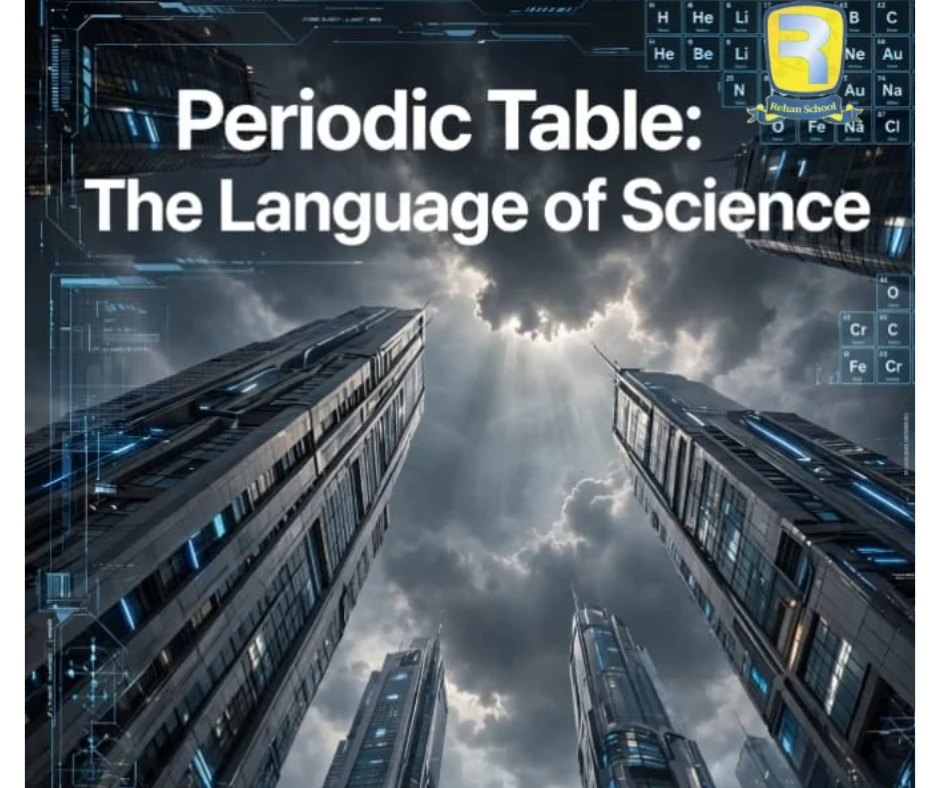
    > Periodic Table: The Language of Science
    > The Periodic Table is not just a chart on a wall, it is the alphabet of the universe! Just like we use 26 letters to make millions of words, nature uses 118 elements to make everything around us!
    > From the oxygen you breathe (O) to the gold in a ring (Au), from the iron in your blood (Fe) to the silicon in your phone — everything has a story written in this language!
    > Dmitri Mendeleev didn't just arrange elements, he gave science a dictionary to understand the world. Every box is a discovery, every symbol is a power!
    > Moral: If you learn this language, you can read the secrets of the whole universe!
    > Learn Elements, Understand Life!
    ### 2. Story / Description in Urdu (الف والی اردو):
    > پیریڈک ٹیبل: سائنس کی زبان
    > پیریڈک ٹیبل صرف دیوار پر لگا ایک چارٹ نہیں ہے، یہ کائنات کے حروفِ تہجی ہیں! جس طرح ہم 26 حروف سے لاکھوں الفاظ بناتے ہیں، اسی طرح قدرت 118 عناصر سے اس دنیا کی ہر چیز بناتی ہے!
    > آپ جو آکسیجن سانس لیتے ہیں (O) سے لے کر انگوٹھی میں موجود سونے (Au) تک، آپ کے خون میں موجود آئرن (Fe) سے لے کر آپ کے موبائل میں موجود سلیکون تک — ہر چیز کی کہانی اسی زبان میں لکھی ہوئی ہے!
    > دمتری مینڈلیف نے صرف عناصر کو ترتیب نہیں دیا، بلکہ اس نے سائنس کو دنیا کو سمجھنے کے لیے ایک لغت دی۔ ہر ڈبہ ایک دریافت ہے، ہر علامت ایک طاقت ہے!
    > سبق: اگر آپ یہ زبان سیکھ لیں، تو آپ پوری کائنات کے راز پڑھ سکتے ہیں!
    > عناصر سیکھو، زندگی کو سمجھو! See less
    Accl Foundation level (Rehan School Urdu Bazar Campus) Day :62 Story post no : 9 Roll no : 16 Accl task > 🧪 Periodic Table: The Language of Science 🔬 > The Periodic Table is not just a chart on a wall, it is the alphabet of the universe! 🌌 Just like we use 26 letters to make millions of words, nature uses 118 elements to make everything around us! ✨ > From the oxygen you breathe (O) to the gold in a ring (Au), from the iron in your blood (Fe) to the silicon in your phone — everything has a story written in this language! 💍📱🩸 > Dmitri Mendeleev didn't just arrange elements, he gave science a dictionary to understand the world. Every box is a discovery, every symbol is a power! 💪 > Moral: If you learn this language, you can read the secrets of the whole universe! 🚀 > 🔬 Learn Elements, Understand Life! 🔬 ### 2. Story / Description in Urdu (الف والی اردو): > 🧪 پیریڈک ٹیبل: سائنس کی زبان 🔬 > پیریڈک ٹیبل صرف دیوار پر لگا ایک چارٹ نہیں ہے، یہ کائنات کے حروفِ تہجی ہیں! 🌌 جس طرح ہم 26 حروف سے لاکھوں الفاظ بناتے ہیں، اسی طرح قدرت 118 عناصر سے اس دنیا کی ہر چیز بناتی ہے! ✨ > آپ جو آکسیجن سانس لیتے ہیں (O) سے لے کر انگوٹھی میں موجود سونے (Au) تک، آپ کے خون میں موجود آئرن (Fe) سے لے کر آپ کے موبائل میں موجود سلیکون تک — ہر چیز کی کہانی اسی زبان میں لکھی ہوئی ہے! 💍📱🩸 > دمتری مینڈلیف نے صرف عناصر کو ترتیب نہیں دیا، بلکہ اس نے سائنس کو دنیا کو سمجھنے کے لیے ایک لغت دی۔ ہر ڈبہ ایک دریافت ہے، ہر علامت ایک طاقت ہے! 💪 > سبق: اگر آپ یہ زبان سیکھ لیں، تو آپ پوری کائنات کے راز پڑھ سکتے ہیں! 🚀 > 🔬 عناصر سیکھو، زندگی کو سمجھو! 🔬 See less
    0 Comentários 0 Compartilhamentos 178 Visualizações
  • ACCL BOOK
    DAY 41
    Story Post
    Zainab Siddiqui AI Wali
    Foundation Level
    Roll No: 002
    Student at Rehan School Urdu Bazar Campus
    @Saba Ibrahim Educationwali

    Leo pressed his eye against the lens of the old microscope, adjusting the focus knob until a vibrant green world snapped into sharp relief . Inside a single leaf cell, an entire bustling universe unfolded .

    Thousands of tiny emerald spheres—chloroplasts —danced in a swirling current of cytoplasm, diligently capturing sunlight and transforming it into life . At the center, the nucleus stood like a grand, quiet library , holding the ancient, coiled blueprints of existence .

    Leo watched in silent wonder as microscopic channels pumped nutrients across the cell membrane , and mitochondria worked tirelessly like miniature power plants keeping the rhythm going . In that quiet room, illuminated by a single bulb , he realized that the greatest mystery of the universe wasn't hidden among distant stars, but quietly pulsing in every living thing around him . As he looked deeper, he understood that these tiny cells are the foundation of the entire cosmos, writing a new story every single moment without making a sound .
    Activate to view larger image,
    ACCL BOOK DAY 41 Story Post Zainab Siddiqui AI Wali Foundation Level Roll No: 002 Student at Rehan School Urdu Bazar Campus @Saba Ibrahim Educationwali Leo pressed his eye against the lens of the old microscope, adjusting the focus knob until a vibrant green world snapped into sharp relief 🌿🔍. Inside a single leaf cell, an entire bustling universe unfolded 🌍✨. Thousands of tiny emerald spheres—chloroplasts 🍃—danced in a swirling current of cytoplasm, diligently capturing sunlight and transforming it into life ☀️🌱. At the center, the nucleus 🧬 stood like a grand, quiet library 📚, holding the ancient, coiled blueprints of existence 📜. Leo watched in silent wonder as microscopic channels pumped nutrients across the cell membrane 💧, and mitochondria ⚡ worked tirelessly like miniature power plants keeping the rhythm going 🔋. In that quiet room, illuminated by a single bulb 💡, he realized that the greatest mystery of the universe wasn't hidden among distant stars, but quietly pulsing in every living thing around him 🌸🌟. As he looked deeper, he understood that these tiny cells are the foundation of the entire cosmos, writing a new story every single moment without making a sound 📖💫. Activate to view larger image,
    1
    0 Comentários 0 Compartilhamentos 371 Visualizações
  • RSIF8
    Roll no:14
    song no:14
    song topic:"You are never too old to set another goal or dream a new dream." — C.S. Lewis

    # The Physics of Everyday Life: How Science Affects Our World

    Discover the amazing connection between science and our everyday lives with **“The Physics of Everyday Life: How Science Affects Our World”** — an educational and inspiring song that explores how physics shapes the world around us!

    From the light that brightens our homes to the electricity that powers our devices, physics is everywhere. It explains gravity, motion, sound, heat, energy, and the fascinating forces that make our universe work.

    This song takes listeners on an exciting journey through the wonders of science, showing how physics helps us understand everyday activities, modern technology, transportation, and the natural world.

    Perfect for students, teachers, science enthusiasts, and curious minds, this song makes learning physics enjoyable, memorable, and fun. Let the rhythm of music inspire you to explore scientific discoveries, ask questions, and uncover the secrets of nature!

    **Learn through music, explore through science, and discover the physics behind every moment of life!**

    Listen, learn, and enjoy the incredible world of physics!

    **#Physics #EverydayPhysics #ScienceSong #EducationalMusic #LearnThroughMusic #ScienceEducation #PhysicsInDailyLife #STEMEducation #ScienceAndTechnology #LearningIsFun #EducationalSong #ExploreScience**
    RSIF8 Roll no:14 song no:14 song topic:"You are never too old to set another goal or dream a new dream." — C.S. Lewis # 🎵 The Physics of Everyday Life: How Science Affects Our World 🌍🔬 Discover the amazing connection between science and our everyday lives with **“The Physics of Everyday Life: How Science Affects Our World”** — an educational and inspiring song that explores how physics shapes the world around us! ⚡🎶 From the light that brightens our homes to the electricity that powers our devices, physics is everywhere. It explains gravity, motion, sound, heat, energy, and the fascinating forces that make our universe work. 🌞💡 This song takes listeners on an exciting journey through the wonders of science, showing how physics helps us understand everyday activities, modern technology, transportation, and the natural world. 🚗✈️🌊 Perfect for students, teachers, science enthusiasts, and curious minds, this song makes learning physics enjoyable, memorable, and fun. Let the rhythm of music inspire you to explore scientific discoveries, ask questions, and uncover the secrets of nature! 🧪📚 ✨ **Learn through music, explore through science, and discover the physics behind every moment of life!** 🎧 Listen, learn, and enjoy the incredible world of physics! **#Physics #EverydayPhysics #ScienceSong #EducationalMusic #LearnThroughMusic #ScienceEducation #PhysicsInDailyLife #STEMEducation #ScienceAndTechnology #LearningIsFun #EducationalSong #ExploreScience**
    0 Comentários 0 Compartilhamentos 967 Visualizações 5
  • RSIF8
    Roll no: 86
    Maya no: 21
    Maya Topic: **Talk with Maya for 15 Minutes on the Topic "Sky – The Word That Stretches Beyond Horizons"**
    In this task, I had an engaging **15-minute discussion with Maya** on the topic **"Sky – The Word That Stretches Beyond Horizons."** During our conversation, we explored the beauty of the sky, its importance in nature, and how it has inspired people throughout history.
    We discussed why the sky appears blue, how clouds, rain, wind, and sunlight are formed, and how the sky connects us to space, the stars, the Moon, and the universe. We also talked about how the sky influences weather, climate, and life on Earth.
    This activity helped me improve my communication, listening, and public speaking skills. It also increased my understanding of science, geography, and the wonders of the natural world.
    Through this discussion, I learned that the sky is more than just what we see above us—it represents curiosity, discovery, and endless possibilities. It inspired me to appreciate nature, continue learning, and explore the amazing universe around us.
    Overall, this was an educational and enjoyable experience that expanded my knowledge and strengthened my confidence in speaking and sharing ideas with others.
    #Sky #Nature #Science #Space #Geography #Learning #Education #PublicSpeaking #StudentLearning #Knowledge #RSIF8 See less
    RSIF8 Roll no: 86 Maya no: 21 Maya Topic: **Talk with Maya for 15 Minutes on the Topic "Sky – The Word That Stretches Beyond Horizons"** ☁️🌤️🌍 In this task, I had an engaging **15-minute discussion with Maya** on the topic **"Sky – The Word That Stretches Beyond Horizons."** 📚💬 During our conversation, we explored the beauty of the sky, its importance in nature, and how it has inspired people throughout history. We discussed why the sky appears blue, how clouds, rain, wind, and sunlight are formed, and how the sky connects us to space, the stars, the Moon, and the universe. 🌤️🌙⭐ We also talked about how the sky influences weather, climate, and life on Earth. This activity helped me improve my communication, listening, and public speaking skills. 🎙️💡 It also increased my understanding of science, geography, and the wonders of the natural world. Through this discussion, I learned that the sky is more than just what we see above us—it represents curiosity, discovery, and endless possibilities. 🌍🚀 It inspired me to appreciate nature, continue learning, and explore the amazing universe around us. Overall, this was an educational and enjoyable experience that expanded my knowledge and strengthened my confidence in speaking and sharing ideas with others. 🌟✨ #Sky #Nature #Science #Space #Geography #Learning #Education #PublicSpeaking #StudentLearning #Knowledge #RSIF8 ☁️🌤️🌙⭐🌍🚀📚✨ See less
    0 Comentários 0 Compartilhamentos 907 Visualizações 16
  • **Story Post | Day 160**
    **Foundation Level**
    **Roll No: 01**
    **Rehan School | Urdu Bazar Campus**

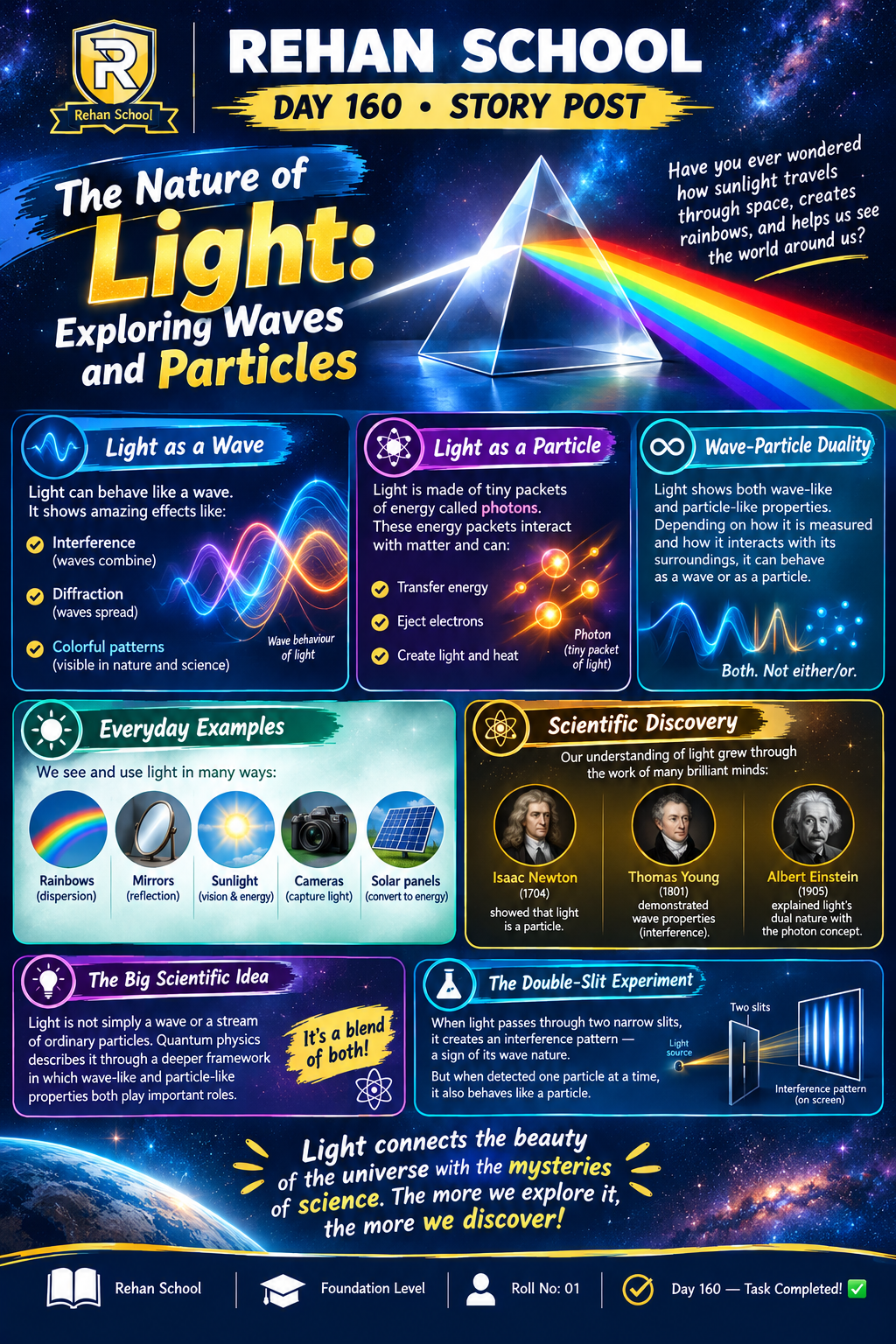
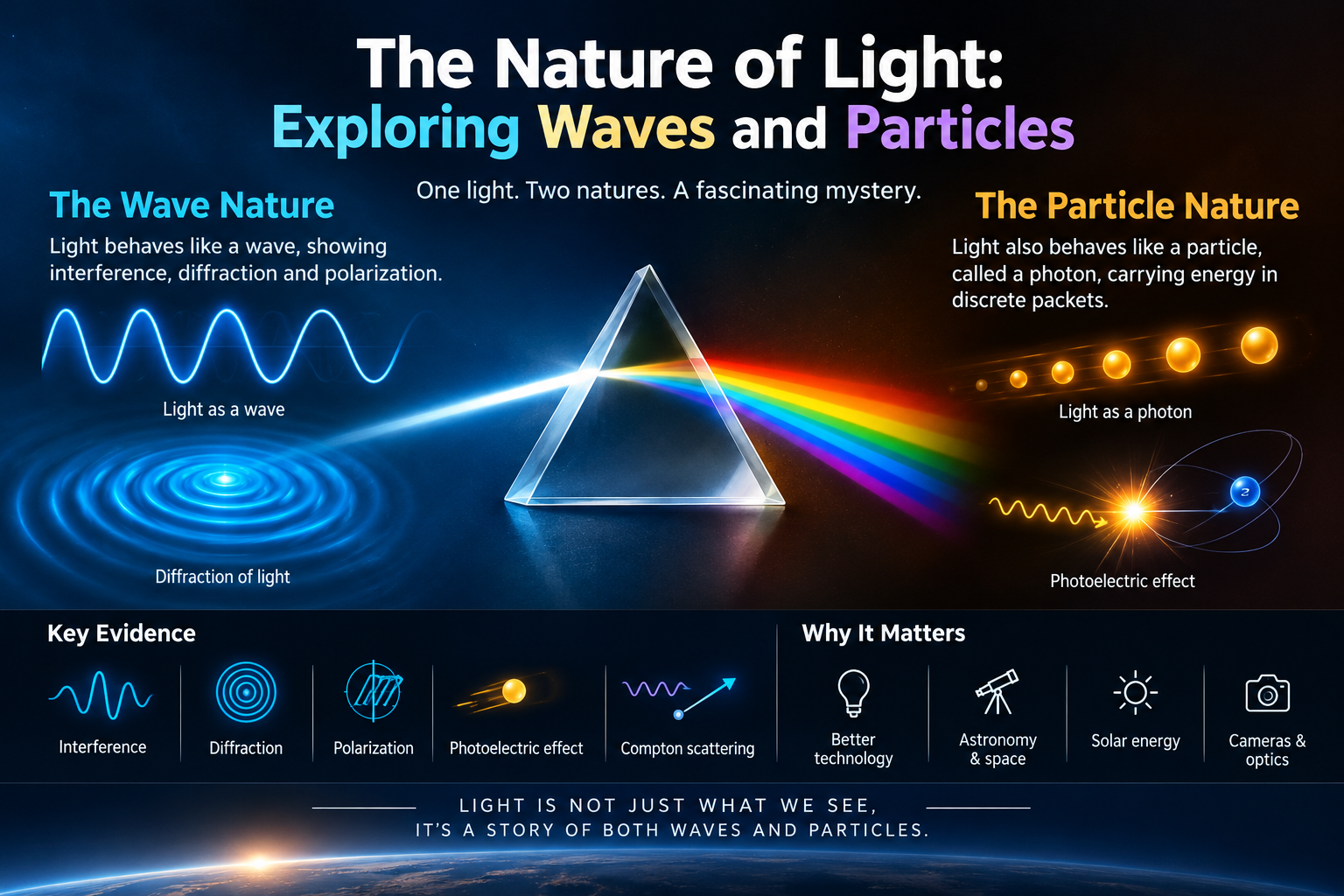
    **The Nature of Light: Exploring Waves and Particles**

    Light is one of the most fascinating wonders of science! Through this task, I learned how light behaves like both a wave and a particle, and how photons help us understand its amazing properties.

    From colorful rainbows and reflections to cameras and solar panels, light plays an important role in our everyday lives. The discoveries of Isaac Newton, Thomas Young, and Albert Einstein helped us understand light in new and exciting ways.

    **Learning about light reminds us that curiosity and scientific exploration can reveal the hidden wonders of our universe!**

    **Rehan School | Day 160 — Task Completed! **

    #RehanSchool #UrduBazarCampus #Day160 #StoryPost #FoundationLevel #RollNo01 #Physics #NatureOfLight #ScienceEducation #KeepLearning
    📖 **Story Post | Day 160** 📚 **Foundation Level** 🔢 **Roll No: 01** 🏫 **Rehan School | Urdu Bazar Campus** 🌈 **The Nature of Light: Exploring Waves and Particles** Light is one of the most fascinating wonders of science! ✨ Through this task, I learned how light behaves like both a wave and a particle, and how photons help us understand its amazing properties. 🔬 From colorful rainbows and reflections to cameras and solar panels, light plays an important role in our everyday lives. The discoveries of Isaac Newton, Thomas Young, and Albert Einstein helped us understand light in new and exciting ways. 🌌 💡 **Learning about light reminds us that curiosity and scientific exploration can reveal the hidden wonders of our universe!** 🎓 **Rehan School | Day 160 — Task Completed! ✅** #RehanSchool #UrduBazarCampus #Day160 #StoryPost #FoundationLevel #RollNo01 #Physics #NatureOfLight #ScienceEducation #KeepLearning
    0 Comentários 0 Compartilhamentos 1019 Visualizações
  • RSIf8
    Roll Number: 49
    Story post no.36
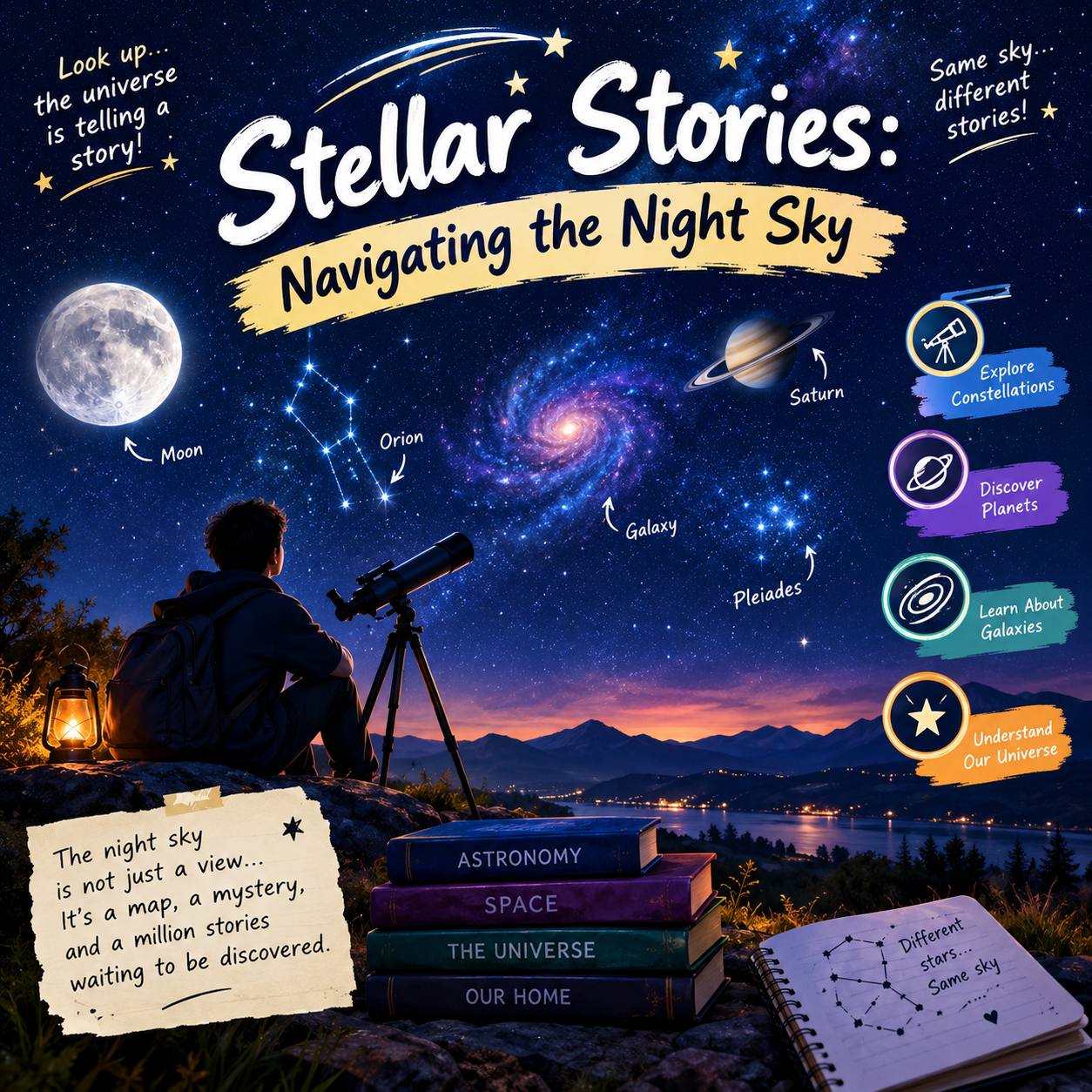
    Story post topic:Stellar Stories – Navigating the Night Sky

    Explore the wonders of the universe with my story post, “Stellar Stories: Navigating the Night Sky!” This post takes us on an exciting journey through the night sky, where we discover beautiful constellations, shining stars, fascinating planets, and amazing galaxies.

    From the glowing Moon and the rings of Saturn to the famous Orion constellation, the universe is full of mysteries waiting to be explored. This activity helped me understand how astronomy allows us to learn more about space and our place in the universe.

    The night sky is not just a beautiful view; it is a window into the wonders of science and discovery. Keep looking up, stay curious, and never stop exploring!

    #StellarStories #NightSky #Astronomy #SpaceExploration #Stars #Constellations #Planets #Galaxies #ScienceAndDiscovery #ClassFoundation #RSf8
    RSIf8 Roll Number: 49 Story post no.36 Story post topic:Stellar Stories – Navigating the Night Sky Explore the wonders of the universe with my story post, “Stellar Stories: Navigating the Night Sky!” ✨🌙 This post takes us on an exciting journey through the night sky, where we discover beautiful constellations, shining stars, fascinating planets, and amazing galaxies. 🔭 From the glowing Moon and the rings of Saturn to the famous Orion constellation, the universe is full of mysteries waiting to be explored. This activity helped me understand how astronomy allows us to learn more about space and our place in the universe. 🚀🪐 The night sky is not just a beautiful view; it is a window into the wonders of science and discovery. Keep looking up, stay curious, and never stop exploring! ⭐💫 #StellarStories #NightSky #Astronomy #SpaceExploration #Stars #Constellations #Planets #Galaxies #ScienceAndDiscovery #ClassFoundation #RSf8
    0 Comentários 0 Compartilhamentos 1068 Visualizações
  • RSIF8
    Roll no:14
    story no:24
    story topic:The Nature of Light: Exploring Waves and Particles

    **The Nature of Light: Exploring Waves and Particles**

    Have you ever wondered what light really is? How does sunlight travel across millions of kilometers through space, how do rainbows form, and how can light behave like both a wave and a particle? The nature of light is one of the most fascinating topics in physics, revealing the extraordinary connection between the visible world and the mysterious laws of quantum mechanics. From the light that illuminates our homes to the distant stars shining in the universe, light plays an essential role in understanding the world around us.

    **1. The Wave Nature of Light **

    For many years, scientists have studied light as a wave because it demonstrates important wave-like properties. Light can undergo interference, diffraction, and polarization. Interference occurs when light waves overlap and combine, producing patterns of brightness and darkness. Diffraction happens when light spreads around an obstacle or passes through a narrow opening. Polarization describes the orientation of light's oscillations and helps us understand how light interacts with different materials.

    These properties demonstrate that the wave model is essential for explaining many optical phenomena. From colorful patterns created by thin films to the operation of polarized sunglasses, the wave nature of light has many applications in everyday life and modern technology.

    **2. The Particle Nature of Light **

    Light also behaves in ways that reveal its particle nature. In quantum physics, light energy is exchanged in discrete packets called **photons**. Each photon carries energy determined by its frequency, described by the equation **E = hf**, where E represents energy, h is Planck's constant, and f is frequency.

    The photoelectric effect provides important evidence for this particle nature. When light of a suitable frequency strikes certain materials, it can release electrons from their surfaces. This phenomenon helped scientists understand that light energy is transferred in individual quanta rather than always behaving like a continuous wave.

    Another important example is Compton scattering, in which photons exchange energy and momentum with electrons. These discoveries transformed our understanding of light and helped establish the foundations of quantum physics.

    **3. Wave-Particle Duality: Two Sides of Light**

    One of the most remarkable discoveries in science is that light cannot be fully explained by treating it only as a classical wave or only as a classical particle. Its behavior depends on the physical process being investigated and how it is measured. This concept is known as **wave-particle duality**.

    Experiments involving interference reveal wave-like patterns, while experiments involving photon detection show that light energy is detected in discrete units. Quantum mechanics brings these observations together into a more complete description of nature. Rather than being an ordinary wave or a tiny classical object, light is a quantum phenomenon with properties that challenge our everyday intuition.

    **4. How Do We Discover the Secrets of Light?**

    Scientists use carefully designed experiments to explore the behavior of light. Prisms separate white light into different colors, optical instruments measure its properties, and advanced detectors record individual photons. Interference experiments reveal patterns that cannot be explained by simple particle models, while photoelectric experiments demonstrate the importance of quantized energy.

    The work of scientists such as Isaac Newton, Thomas Young, Max Planck, Albert Einstein, and Arthur Compton helped build our modern understanding of light. Their discoveries show how scientific knowledge develops through observation, experimentation, mathematical reasoning, and new ideas.

    **5. Why Is the Nature of Light Important?**

    Understanding light is essential to many technologies that shape modern life. Lasers are used in medicine, manufacturing, and scientific research. Fiber-optic cables transmit information across the world using pulses of light. Solar panels convert light energy into electrical energy, while cameras and telescopes help us capture images and explore distant objects in space.

    The principles of light are also important in astronomy, microscopy, optical communication, quantum technologies, and the study of the universe. By investigating how light behaves, scientists can examine distant galaxies, study the structure of matter, and develop new tools that improve our understanding of nature.

    **6. Light: Connecting Science and the Universe**

    Light is much more than what allows us to see. It carries information about distant stars, reveals the composition of celestial objects, and provides clues about the physical processes occurring throughout the cosmos. By analyzing the light received from distant galaxies, astronomers can learn about their temperatures, chemical compositions, and motion.

    At the smallest scales, the study of photons helps scientists investigate the quantum world and understand how energy interacts with matter. From the smallest laboratory experiments to the largest astronomical observations, light connects different areas of science in extraordinary ways.

    **Conclusion: The Extraordinary Mystery of Light**

    The study of light demonstrates how nature can be far more complex than it first appears. Its wave-like properties explain interference, diffraction, and polarization, while its particle-like properties help explain the photoelectric effect and Compton scattering. Together, these discoveries form an important part of our modern understanding of physics.

    Learning about wave-particle duality encourages us to question assumptions, explore scientific evidence, and appreciate the discoveries that continue to expand human knowledge. Every beam of sunlight, every shining star, and every photon detected by a scientific instrument reminds us that there is still much to discover about the universe.

    **Light Is More Than What We See—It Is a Window into the Fundamental Nature of Reality!**

    If you enjoyed this science topic, share it with others and continue exploring the fascinating world of physics. Stay curious, keep asking questions, and never stop learning!

    #NatureOfLight #WaveParticleDuality #Physics #QuantumPhysics #ScienceEducation #Photons #LightWaves #PhotoelectricEffect #ComptonScattering #Optics #Astronomy #ScientificDiscoveries #STEMEducation #LearnPhysics #ScienceExplained #EducationalContent #WavesAndParticles
    RSIF8 Roll no:14 story no:24 story topic:The Nature of Light: Exploring Waves and Particles 🌟 **The Nature of Light: Exploring Waves and Particles** 🌈🔬 Have you ever wondered what light really is? How does sunlight travel across millions of kilometers through space, how do rainbows form, and how can light behave like both a wave and a particle? The nature of light is one of the most fascinating topics in physics, revealing the extraordinary connection between the visible world and the mysterious laws of quantum mechanics. From the light that illuminates our homes to the distant stars shining in the universe, light plays an essential role in understanding the world around us. 🌍✨ 💡 **1. The Wave Nature of Light 🌊** For many years, scientists have studied light as a wave because it demonstrates important wave-like properties. Light can undergo interference, diffraction, and polarization. Interference occurs when light waves overlap and combine, producing patterns of brightness and darkness. Diffraction happens when light spreads around an obstacle or passes through a narrow opening. Polarization describes the orientation of light's oscillations and helps us understand how light interacts with different materials. These properties demonstrate that the wave model is essential for explaining many optical phenomena. From colorful patterns created by thin films to the operation of polarized sunglasses, the wave nature of light has many applications in everyday life and modern technology. ⚛️ **2. The Particle Nature of Light ✨** Light also behaves in ways that reveal its particle nature. In quantum physics, light energy is exchanged in discrete packets called **photons**. Each photon carries energy determined by its frequency, described by the equation **E = hf**, where E represents energy, h is Planck's constant, and f is frequency. The photoelectric effect provides important evidence for this particle nature. When light of a suitable frequency strikes certain materials, it can release electrons from their surfaces. This phenomenon helped scientists understand that light energy is transferred in individual quanta rather than always behaving like a continuous wave. Another important example is Compton scattering, in which photons exchange energy and momentum with electrons. These discoveries transformed our understanding of light and helped establish the foundations of quantum physics. 🔬 **3. Wave-Particle Duality: Two Sides of Light** One of the most remarkable discoveries in science is that light cannot be fully explained by treating it only as a classical wave or only as a classical particle. Its behavior depends on the physical process being investigated and how it is measured. This concept is known as **wave-particle duality**. Experiments involving interference reveal wave-like patterns, while experiments involving photon detection show that light energy is detected in discrete units. Quantum mechanics brings these observations together into a more complete description of nature. Rather than being an ordinary wave or a tiny classical object, light is a quantum phenomenon with properties that challenge our everyday intuition. 🌈 **4. How Do We Discover the Secrets of Light?** Scientists use carefully designed experiments to explore the behavior of light. Prisms separate white light into different colors, optical instruments measure its properties, and advanced detectors record individual photons. Interference experiments reveal patterns that cannot be explained by simple particle models, while photoelectric experiments demonstrate the importance of quantized energy. The work of scientists such as Isaac Newton, Thomas Young, Max Planck, Albert Einstein, and Arthur Compton helped build our modern understanding of light. Their discoveries show how scientific knowledge develops through observation, experimentation, mathematical reasoning, and new ideas. 🚀 **5. Why Is the Nature of Light Important?** Understanding light is essential to many technologies that shape modern life. Lasers are used in medicine, manufacturing, and scientific research. Fiber-optic cables transmit information across the world using pulses of light. Solar panels convert light energy into electrical energy, while cameras and telescopes help us capture images and explore distant objects in space. The principles of light are also important in astronomy, microscopy, optical communication, quantum technologies, and the study of the universe. By investigating how light behaves, scientists can examine distant galaxies, study the structure of matter, and develop new tools that improve our understanding of nature. 🌍 **6. Light: Connecting Science and the Universe** Light is much more than what allows us to see. It carries information about distant stars, reveals the composition of celestial objects, and provides clues about the physical processes occurring throughout the cosmos. By analyzing the light received from distant galaxies, astronomers can learn about their temperatures, chemical compositions, and motion. At the smallest scales, the study of photons helps scientists investigate the quantum world and understand how energy interacts with matter. From the smallest laboratory experiments to the largest astronomical observations, light connects different areas of science in extraordinary ways. 💫 **Conclusion: The Extraordinary Mystery of Light** The study of light demonstrates how nature can be far more complex than it first appears. Its wave-like properties explain interference, diffraction, and polarization, while its particle-like properties help explain the photoelectric effect and Compton scattering. Together, these discoveries form an important part of our modern understanding of physics. Learning about wave-particle duality encourages us to question assumptions, explore scientific evidence, and appreciate the discoveries that continue to expand human knowledge. Every beam of sunlight, every shining star, and every photon detected by a scientific instrument reminds us that there is still much to discover about the universe. ✨ **Light Is More Than What We See—It Is a Window into the Fundamental Nature of Reality!** 🔭🌌 👍 If you enjoyed this science topic, share it with others and continue exploring the fascinating world of physics. Stay curious, keep asking questions, and never stop learning! #NatureOfLight #WaveParticleDuality #Physics #QuantumPhysics #ScienceEducation #Photons #LightWaves #PhotoelectricEffect #ComptonScattering #Optics #Astronomy #ScientificDiscoveries #STEMEducation #LearnPhysics #ScienceExplained #EducationalContent #WavesAndParticles 🌈🔬🚀

    0 Comentários 0 Compartilhamentos 5184 Visualizações
  • RSIF8
    Roll no:14
    story no:24
    story topic:The Force Behind Motion: Understanding Newton’s Laws

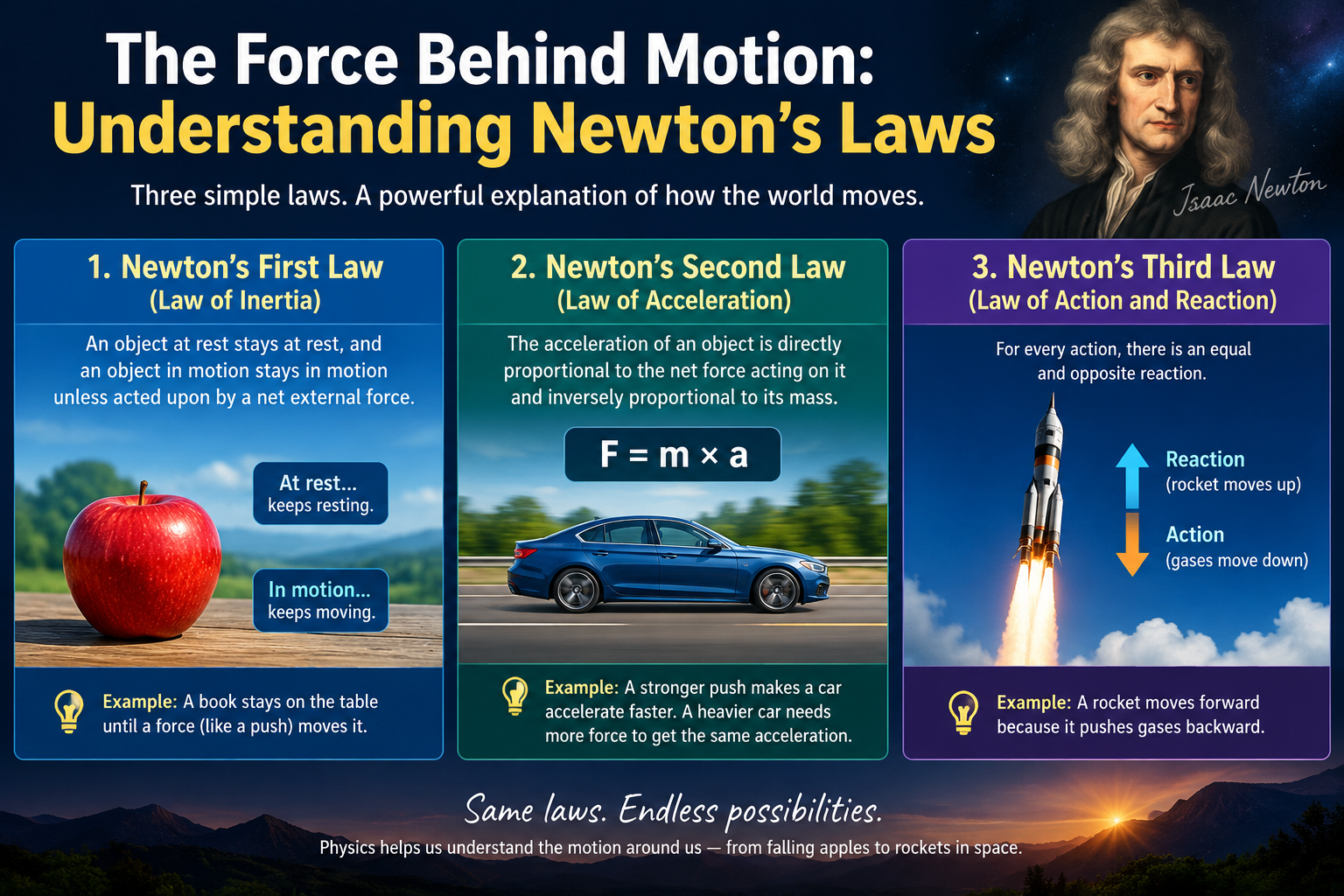
    **The Force Behind Motion: Understanding Newton’s Laws**

    Welcome to the fascinating world of physics, where forces, motion, and energy work together to explain how our universe operates! In this educational journey, we explore **Newton’s Three Laws of Motion**, some of the most important principles in science that help us understand why objects move, how they change speed, and how forces affect everything around us. From a simple falling apple to a speeding car and a powerful rocket launching into space, Newton’s laws are everywhere in our daily lives!

    **1. Newton’s First Law — The Law of Inertia**

    Newton’s First Law states that an object at rest remains at rest, and an object in motion continues moving at a constant speed in a straight line unless acted upon by an unbalanced external force. This principle explains why a book stays on a table until someone moves it and why passengers tend to move forward when a moving car suddenly stops. Inertia is the natural tendency of objects to resist changes in their state of motion.

    **2. Newton’s Second Law — The Law of Acceleration**

    Newton’s Second Law explains how force, mass, and acceleration are connected. The greater the net force applied to an object, the greater its acceleration. However, a heavier object requires more force than a lighter object to achieve the same acceleration. This relationship is expressed through the famous formula **F = m × a**, where F represents force, m represents mass, and a represents acceleration. This law helps engineers design vehicles, machines, and countless other technologies.

    **3. Newton’s Third Law — The Law of Action and Reaction**

    Newton’s Third Law states that for every action, there is an equal and opposite reaction. Whenever one object exerts a force on another, the second object exerts an equal force in the opposite direction. This principle explains how rockets move forward by pushing exhaust gases backward, how swimmers move through water, and how we walk by pushing against the ground. It reveals the incredible relationship between forces acting on interacting objects.

    **Why Are Newton’s Laws Important?**

    Newton’s laws are essential for understanding the physical world. They help scientists explain motion, engineers develop safer vehicles, athletes improve their performance, and space agencies calculate the movements of spacecraft. These principles are used in transportation, construction, robotics, aviation, sports science, and space exploration. By understanding these laws, students can develop stronger scientific thinking and see how classroom physics connects to real-life experiences.

    **Explore the Science Behind Everyday Motion!**

    Physics is more than formulas and equations; it is a way to understand the world around us. Every moving bicycle, bouncing ball, accelerating car, and launching rocket demonstrates the fascinating principles of force and motion. Learning Newton’s laws opens the door to deeper discoveries in science, technology, engineering, and mathematics.

    Join us on this exciting journey to discover how simple scientific principles explain some of the most extraordinary movements in our universe. Keep asking questions, stay curious, and never stop exploring the wonders of science!

    **Learn the Laws. Understand the Forces. Discover the Science of Motion!**

    Like, share, and follow for more educational content, fascinating science topics, and easy-to-understand explanations that make learning enjoyable!

    #NewtonsLaws #ForceAndMotion #Physics #ScienceEducation #IsaacNewton #LawOfInertia #Acceleration #ActionAndReaction #PhysicsExplained #ScienceFacts #STEMEducation #EducationalVideos #LearnScience #ScientificDiscoveries #SpaceExploration #KnowledgeIsPower
    RSIF8 Roll no:14 story no:24 story topic:The Force Behind Motion: Understanding Newton’s Laws 🚀 **The Force Behind Motion: Understanding Newton’s Laws** 🌍🔬 Welcome to the fascinating world of physics, where forces, motion, and energy work together to explain how our universe operates! 🌌 In this educational journey, we explore **Newton’s Three Laws of Motion**, some of the most important principles in science that help us understand why objects move, how they change speed, and how forces affect everything around us. From a simple falling apple to a speeding car and a powerful rocket launching into space, Newton’s laws are everywhere in our daily lives! 🍎🚗🚀 📘 **1. Newton’s First Law — The Law of Inertia** Newton’s First Law states that an object at rest remains at rest, and an object in motion continues moving at a constant speed in a straight line unless acted upon by an unbalanced external force. This principle explains why a book stays on a table until someone moves it and why passengers tend to move forward when a moving car suddenly stops. Inertia is the natural tendency of objects to resist changes in their state of motion. ⚡ **2. Newton’s Second Law — The Law of Acceleration** Newton’s Second Law explains how force, mass, and acceleration are connected. The greater the net force applied to an object, the greater its acceleration. However, a heavier object requires more force than a lighter object to achieve the same acceleration. This relationship is expressed through the famous formula **F = m × a**, where F represents force, m represents mass, and a represents acceleration. This law helps engineers design vehicles, machines, and countless other technologies. 🌟 **3. Newton’s Third Law — The Law of Action and Reaction** Newton’s Third Law states that for every action, there is an equal and opposite reaction. Whenever one object exerts a force on another, the second object exerts an equal force in the opposite direction. This principle explains how rockets move forward by pushing exhaust gases backward, how swimmers move through water, and how we walk by pushing against the ground. It reveals the incredible relationship between forces acting on interacting objects. 🔍 **Why Are Newton’s Laws Important?** Newton’s laws are essential for understanding the physical world. They help scientists explain motion, engineers develop safer vehicles, athletes improve their performance, and space agencies calculate the movements of spacecraft. These principles are used in transportation, construction, robotics, aviation, sports science, and space exploration. By understanding these laws, students can develop stronger scientific thinking and see how classroom physics connects to real-life experiences. 💡 **Explore the Science Behind Everyday Motion!** Physics is more than formulas and equations; it is a way to understand the world around us. Every moving bicycle, bouncing ball, accelerating car, and launching rocket demonstrates the fascinating principles of force and motion. Learning Newton’s laws opens the door to deeper discoveries in science, technology, engineering, and mathematics. Join us on this exciting journey to discover how simple scientific principles explain some of the most extraordinary movements in our universe. Keep asking questions, stay curious, and never stop exploring the wonders of science! 🌍✨ 🎯 **Learn the Laws. Understand the Forces. Discover the Science of Motion!** 👍 Like, share, and follow for more educational content, fascinating science topics, and easy-to-understand explanations that make learning enjoyable! #NewtonsLaws #ForceAndMotion #Physics #ScienceEducation #IsaacNewton #LawOfInertia #Acceleration #ActionAndReaction #PhysicsExplained #ScienceFacts #STEMEducation #EducationalVideos #LearnScience #ScientificDiscoveries #SpaceExploration #KnowledgeIsPower 🚀📚
    0 Comentários 0 Compartilhamentos 3854 Visualizações
  • #RSFI8
    Roll No: 64
    Class: Foundation Level
    Muhammad ibrahim Acctounting wala
    Documentary task no 12
    Documentary task topic "The Birth of 'Scientist': From Philosophy to Modern Terminology". Share on all platforms.
    Post on the platforms you have and paste those links (at least one required):
    The Birth of “Scientist”: From Philosophy to Modern Terminology**
    Have you ever wondered where the word *scientist* came from? Science has a fascinating history that connects ancient philosophy, human curiosity, and modern discoveries!

    In the past, people who explored nature and knowledge were often called philosophers or natural philosophers. The word **“scientist”** was proposed by William Whewell in 1833 and became more widely used during the 19th century.

    **What I Learned:**
    - Philosophy helped shape early scientific thinking.
    - Scientific knowledge developed through observation, experiments, and reasoning.
    - The word “scientist” gave a shared name to people working in different scientific fields.
    - Modern science continues to help us understand the universe and improve our lives.

    **My Key Takeaway:** Every great discovery begins with curiosity, questions, and a desire to learn! Never stop asking questions or exploring the world around you.

    **Share, Learn & Inspire!**
    I’m sharing this educational post on my social media platforms to spread knowledge and encourage everyone to explore the amazing history of science.

    Like | Comment | Share | Keep Learning!
    #HistoryOfScience #Scientist #ScienceHistory #Philosophy #ScientificDiscovery #Education #Knowledge #Curiosity #ScienceAndTechnology #LearningEveryDay #STEM #RehanSchool #Facebook #Instagram #YouTube #TikTok #LinkedIn
    #RSFI8 Roll No: 64📝 Class: Foundation Level Muhammad ibrahim Acctounting wala Documentary task no 12 Documentary task topic "The Birth of 'Scientist': From Philosophy to Modern Terminology". Share on all platforms. Post on the platforms you have and paste those links (at least one required): The Birth of “Scientist”: From Philosophy to Modern Terminology** Have you ever wondered where the word *scientist* came from? 🤔📚 Science has a fascinating history that connects ancient philosophy, human curiosity, and modern discoveries! 🚀💡 In the past, people who explored nature and knowledge were often called philosophers or natural philosophers. The word **“scientist”** was proposed by William Whewell in 1833 and became more widely used during the 19th century. 📖🔍 🌟 **What I Learned:** - 🧠 Philosophy helped shape early scientific thinking. - 🔬 Scientific knowledge developed through observation, experiments, and reasoning. - 💡 The word “scientist” gave a shared name to people working in different scientific fields. - 🌍 Modern science continues to help us understand the universe and improve our lives. 🎯 **My Key Takeaway:** Every great discovery begins with curiosity, questions, and a desire to learn! Never stop asking questions or exploring the world around you. 🌈🔭 📱 **Share, Learn & Inspire!** ❤️✨ I’m sharing this educational post on my social media platforms to spread knowledge and encourage everyone to explore the amazing history of science. 🌍📚 👍 Like | 💬 Comment | 🔄 Share | ⭐ Keep Learning! #HistoryOfScience #Scientist #ScienceHistory #Philosophy #ScientificDiscovery #Education #Knowledge #Curiosity #ScienceAndTechnology #LearningEveryDay #STEM #RehanSchool #Facebook #Instagram #YouTube #TikTok #LinkedIn 🔬🧪✨
    0 Comentários 0 Compartilhamentos 1748 Visualizações 6
  • ACCL foun da tion level
    rehan school
    roll no . 27
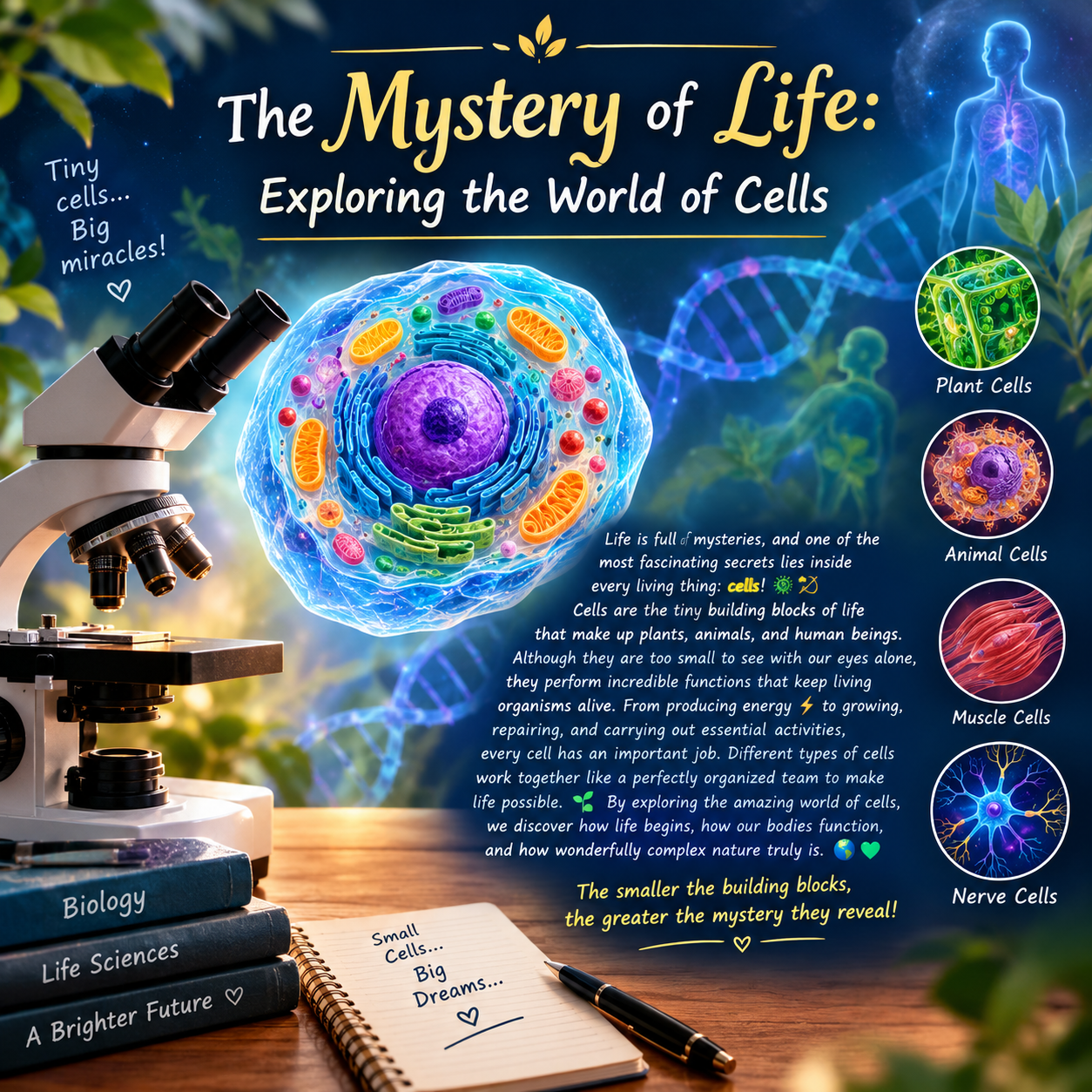
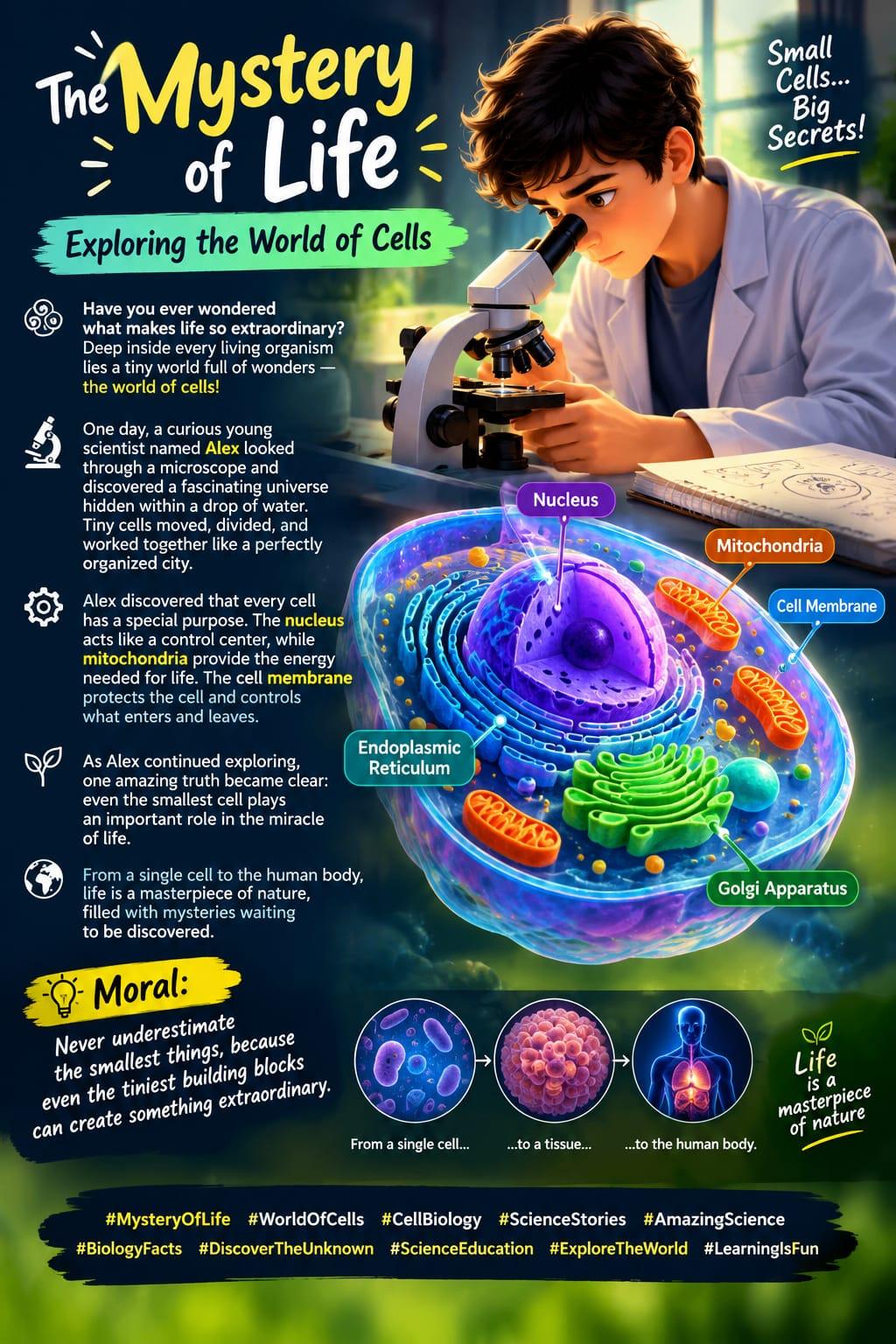
    The Mystery of Life: Exploring the World of Cells

    Have you ever wondered what makes life so extraordinary? Deep inside every living organism lies a tiny world full of wonders — the world of cells!

    One day, a curious young scientist named Alex looked through a microscope and discovered a fascinating universe hidden within a drop of water. Tiny cells moved, divided, and worked together like a perfectly organized city. Some produced energy, others carried important materials, and many worked together to keep living things alive.

    Alex discovered that every cell has a special purpose. The nucleus acts like a control center, while mitochondria provide the energy needed for life. The cell membrane protects the cell and controls what enters and leaves.

    As Alex continued exploring, one amazing truth became clear: even the smallest cell plays an important role in the miracle of life.

    From a single cell to the human body, life is a masterpiece of nature, filled with mysteries waiting to be
    #MysteryOfLife #WorldOfCells #CellBiology #ScienceStories #AmazingScience #BiologyFacts #DiscoverTheUnknown #ScienceEducation #ExploreTheWorld #LearningIsFun
    ACCL foun da tion level rehan school roll no . 27 The Mystery of Life: Exploring the World of Cells Have you ever wondered what makes life so extraordinary? Deep inside every living organism lies a tiny world full of wonders — the world of cells! One day, a curious young scientist named Alex looked through a microscope and discovered a fascinating universe hidden within a drop of water. Tiny cells moved, divided, and worked together like a perfectly organized city. Some produced energy, others carried important materials, and many worked together to keep living things alive. Alex discovered that every cell has a special purpose. The nucleus acts like a control center, while mitochondria provide the energy needed for life. The cell membrane protects the cell and controls what enters and leaves. As Alex continued exploring, one amazing truth became clear: even the smallest cell plays an important role in the miracle of life. From a single cell to the human body, life is a masterpiece of nature, filled with mysteries waiting to be #MysteryOfLife #WorldOfCells #CellBiology #ScienceStories #AmazingScience #BiologyFacts #DiscoverTheUnknown #ScienceEducation #ExploreTheWorld #LearningIsFun
    0 Comentários 0 Compartilhamentos 2071 Visualizações
Páginas impulsionada