• Mohsin RS F8
    Story post NO:15
    roll NO:13
    Class: Foundation Level
    Made by Me

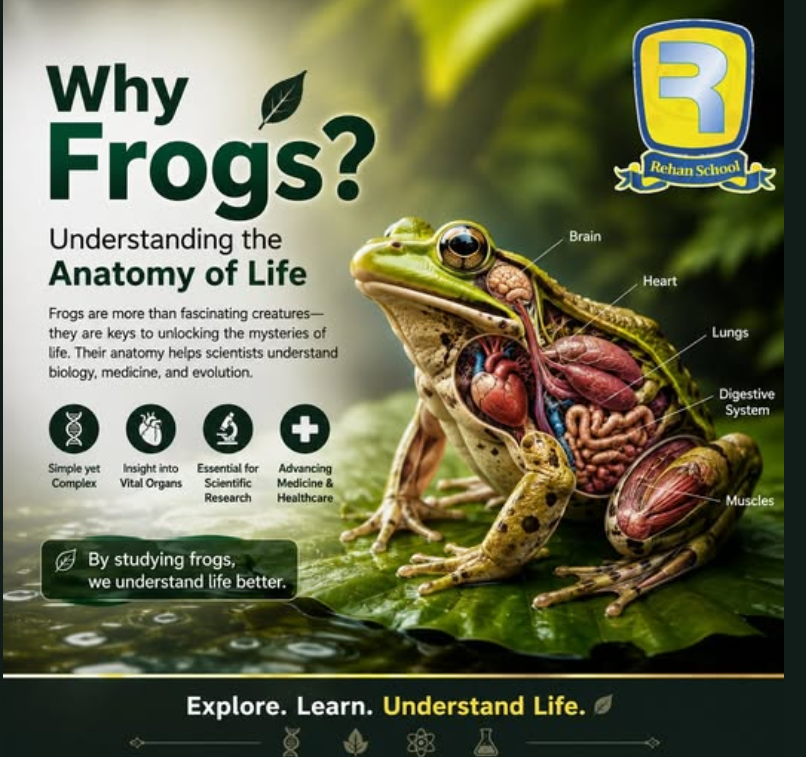
    Frogs may be small animals, but their bodies contain an amazing combination of organs, systems, and adaptations that make them excellent subjects for understanding the basic principles of life. Studying frog anatomy gives us an opportunity to see how different parts of a living organism work together to support movement, breathing, digestion, communication, growth, and survival. Their anatomy also shares important features with many other vertebrates, making frogs useful for learning fundamental concepts in biology.
    One of the most interesting features of frogs is their respiratory system. Unlike humans, frogs can exchange gases not only through their lungs but also through their moist skin. This special adaptation allows them to survive in aquatic and terrestrial environments. Their circulatory system also plays an important role in maintaining life by transporting oxygen and nutrients throughout the body.
    Frogs have powerful hind legs that are specially adapted for jumping and swimming. Their large eyes provide a wide field of vision and help them detect movement, while their ears allow them to hear sounds and communicate. Inside the body, organs such as the heart, lungs, liver, stomach, and intestines each perform important functions. These organs do not work independently; instead, they form interconnected systems that keep the frog alive and functioning.
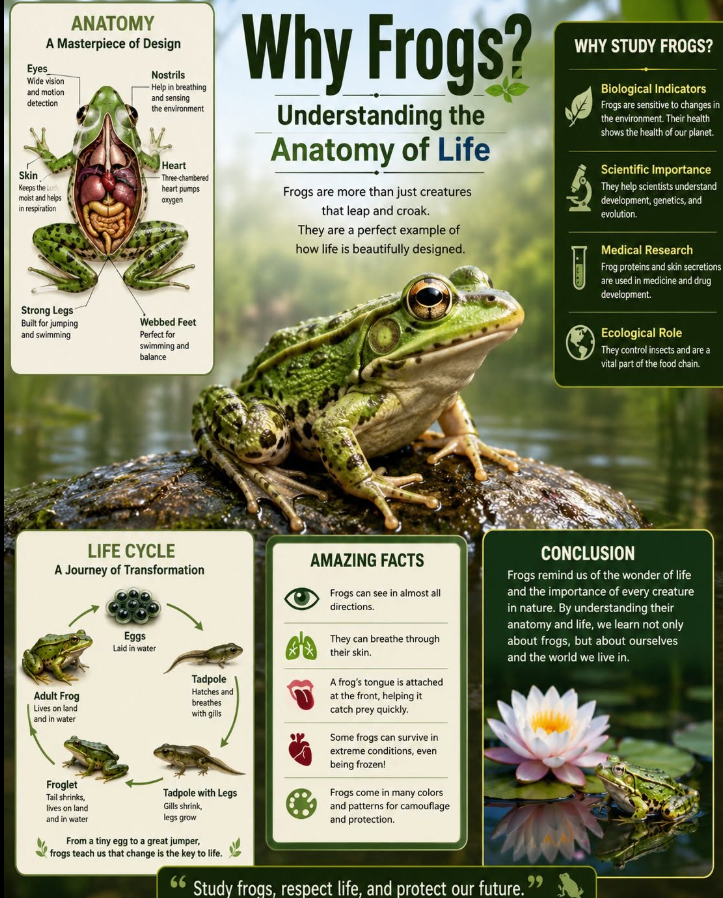
    The frog's life cycle is another fascinating example of biological development. It begins with eggs laid in water, followed by the tadpole stage. Tadpoles gradually develop legs and lungs as their bodies change, eventually becoming froglets and then adult frogs. This transformation demonstrates how living organisms can undergo remarkable changes as they grow and mature.
    Frogs are also important indicators of environmental health. Because they are sensitive to changes in their surroundings, changes in frog populations can provide clues about the condition of an ecosystem. They also play an important role in controlling insect populations and maintaining food chains.
    Overall, “Why Frogs? Understanding the Anat
    Mohsin RS F8 πŸŽ“βœ¨ Story post NO:15 roll NO:13 Class: Foundation Level πŸ“š Made by Me πŸ’»πŸš€ Frogs may be small animals, but their bodies contain an amazing combination of organs, systems, and adaptations that make them excellent subjects for understanding the basic principles of life. Studying frog anatomy gives us an opportunity to see how different parts of a living organism work together to support movement, breathing, digestion, communication, growth, and survival. Their anatomy also shares important features with many other vertebrates, making frogs useful for learning fundamental concepts in biology. One of the most interesting features of frogs is their respiratory system. Unlike humans, frogs can exchange gases not only through their lungs but also through their moist skin. This special adaptation allows them to survive in aquatic and terrestrial environments. Their circulatory system also plays an important role in maintaining life by transporting oxygen and nutrients throughout the body. Frogs have powerful hind legs that are specially adapted for jumping and swimming. Their large eyes provide a wide field of vision and help them detect movement, while their ears allow them to hear sounds and communicate. Inside the body, organs such as the heart, lungs, liver, stomach, and intestines each perform important functions. These organs do not work independently; instead, they form interconnected systems that keep the frog alive and functioning. The frog's life cycle is another fascinating example of biological development. It begins with eggs laid in water, followed by the tadpole stage. Tadpoles gradually develop legs and lungs as their bodies change, eventually becoming froglets and then adult frogs. This transformation demonstrates how living organisms can undergo remarkable changes as they grow and mature. Frogs are also important indicators of environmental health. Because they are sensitive to changes in their surroundings, changes in frog populations can provide clues about the condition of an ecosystem. They also play an important role in controlling insect populations and maintaining food chains. Overall, “Why Frogs? Understanding the Anat
    0 Commenti 0 condivisioni 268 Views
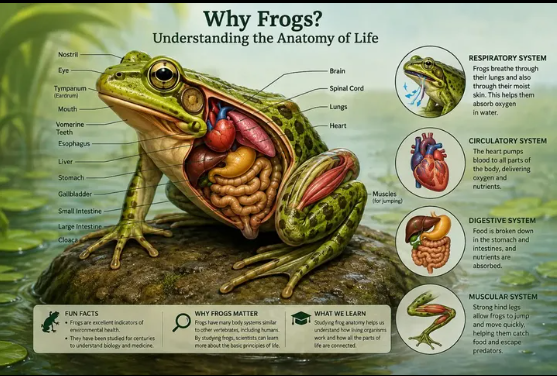
  • πŸ“– **Day 125 | Story Post** 🐸 **Why Frogs? Understanding the Anatomy of Life** Frogs may look like simple animals, but their bodies provide an amazing way to understand how life works. Their anatomy shows how different organs and body systems work together to help them survive. A frog has a **heart, lungs, digestive system, nervous system, muscles, and bones**, just like many other vertebrates. πŸ«€πŸ« One fascinating feature is that frogs can breathe through both their **lungs and their skin**. Their powerful hind legs help them jump, while their eyes and ears help them detect what is happening around them. Studying frogs helps scientists and students understand important concepts in **biology, anatomy, adaptation, and evolution**. πŸ”¬πŸŒΏ 🐸 **A small frog can teach us a big lesson: every living organism has a remarkable design and a complex system that helps it survive.** πŸŽ“ **Rehan School | Foundation Level** πŸ”’ **Roll No: 01** βœ… **Day 125 — Task Completed!** http://youtube.com/post/Ugkx8XKleK_2aVCTBhDkbmEeJzY2p9MGPqMb?si=2A-Mzzu9NR4WqiXF
    YOUTUBE.COM
    πŸ“– **Day 125 | Story Post** 🐸 **Why Frogs? Understanding the Anatomy of Life** Frogs may look like simple animals, but their bodies provide an amazing way to ...
    πŸ“– **Day 125 | Story Post** 🐸 **Why Frogs? Understanding the Anatomy of Life** Frogs may look like simple animals, but their bodies provide an amazing way to ...
    0 Commenti 0 condivisioni 887 Views
  • #rsisb
    Roll no.247
    song .26
    Foundation level

    **Dissecting Frogs: A Gateway to Human Anatomy**

    Studying frog anatomy can provide students with a fascinating introduction to the structure and organization of living organisms. Through careful anatomical study, students can learn how different organs are arranged, how body systems work together, and how scientists use observation to understand life.

    Frogs are commonly studied in biology because their basic body organization shares important similarities with other vertebrates. Exploring their anatomy can help learners recognize major structures such as the heart, lungs, digestive organs, and reproductive organs, while also developing an understanding of how these systems perform different functions.

    **From Frog Anatomy to Human Anatomy**

    Learning about a frog's internal organization can help students build foundational knowledge that makes human anatomy easier to understand. By comparing different vertebrate body plans, learners can discover both similarities and differences in organs, tissues, and body systems. This comparison encourages curiosity and strengthens scientific thinking.

    **Learning Through Observation**

    Anatomical studies teach more than just the names of organs. They encourage students to observe carefully, record information, ask questions, and connect physical structures with biological functions. These skills are valuable in biology, medicine, veterinary science, and many other scientific fields. ‍‍

    **Science, Respect, and Responsibility**

    Biology education should always be approached with respect for living organisms and with appropriate safety, ethical, and educational guidelines. Modern classrooms may also use models, diagrams, videos, simulations, and digital anatomy tools to provide meaningful learning experiences.

    **Conclusion**

    “Dissecting Frogs: A Gateway to Human Anatomy” represents more than an anatomy lesson—it is an opportunity to explore the fascinating organization of life. By studying structures, comparing body systems, and asking scientific questions, students can develop a deeper appreciation for biology and the remarkable complexity of living organisms.

    #DissectingFrogs #FrogAnatomy #HumanAnatomy #Biology #ScienceEducation #AnatomyStudy #BiologyLearning #ScienceExperiment #LearningThroughScience #VertebrateAnatomy #LifeScience #ScienceStudents #EducationalJourney #ExploreBiology #ScientificThinking #AnatomyAndPhysiology #STEMEducation #ScienceExploration #BiologyProject #LearningIsFun
    #rsisb Roll no.247 song .26 Foundation level πŸΈπŸ”¬ **Dissecting Frogs: A Gateway to Human Anatomy** πŸ§¬πŸ«€ Studying frog anatomy can provide students with a fascinating introduction to the structure and organization of living organisms. Through careful anatomical study, students can learn how different organs are arranged, how body systems work together, and how scientists use observation to understand life. πŸ”πŸ“š 🐸 Frogs are commonly studied in biology because their basic body organization shares important similarities with other vertebrates. Exploring their anatomy can help learners recognize major structures such as the heart, lungs, digestive organs, and reproductive organs, while also developing an understanding of how these systems perform different functions. πŸ«€πŸ« 🧠 **From Frog Anatomy to Human Anatomy** Learning about a frog's internal organization can help students build foundational knowledge that makes human anatomy easier to understand. By comparing different vertebrate body plans, learners can discover both similarities and differences in organs, tissues, and body systems. This comparison encourages curiosity and strengthens scientific thinking. πŸ”¬βœ¨ πŸ“– **Learning Through Observation** Anatomical studies teach more than just the names of organs. They encourage students to observe carefully, record information, ask questions, and connect physical structures with biological functions. These skills are valuable in biology, medicine, veterinary science, and many other scientific fields. πŸ§ͺπŸ‘©‍πŸ”¬πŸ‘¨‍πŸ”¬ 🌱 **Science, Respect, and Responsibility** Biology education should always be approached with respect for living organisms and with appropriate safety, ethical, and educational guidelines. Modern classrooms may also use models, diagrams, videos, simulations, and digital anatomy tools to provide meaningful learning experiences. πŸŒπŸ’š ✨ **Conclusion** “Dissecting Frogs: A Gateway to Human Anatomy” represents more than an anatomy lesson—it is an opportunity to explore the fascinating organization of life. By studying structures, comparing body systems, and asking scientific questions, students can develop a deeper appreciation for biology and the remarkable complexity of living organisms. πŸΈπŸ”¬πŸ§¬πŸŒŸ #DissectingFrogs #FrogAnatomy #HumanAnatomy #Biology #ScienceEducation #AnatomyStudy #BiologyLearning #ScienceExperiment #LearningThroughScience #VertebrateAnatomy #LifeScience #ScienceStudents #EducationalJourney #ExploreBiology #ScientificThinking #AnatomyAndPhysiology #STEMEducation #ScienceExploration #BiologyProject #LearningIsFun πŸΈπŸ”¬πŸ“šπŸ§¬πŸ«€πŸ«βœ¨
    0 Commenti 0 condivisioni 5162 Views 6
  • #rsisb
    Roll no.239
    Story Post no.3
    Foundation Level
    **Why Frogs? Understanding the Anatomy of Life**

    Frogs are much more than fascinating creatures found near ponds and wetlands. They provide scientists and students with a simple yet powerful way to understand the **anatomy, biology, and complexity of life**.

    From their powerful hind legs to their unique respiratory system , sensitive eyes , strong hearts , and specialized skin, frogs have body structures that demonstrate how different organs work together to keep an organism alive.

    Studying frog anatomy can help us understand important biological concepts such as **organs, muscles, bones, digestion, circulation, respiration, and nervous systems**. It also gives us a deeper appreciation for how living organisms adapt to their environments.

    Frogs are often studied in biology because their anatomy provides an accessible example of the basic principles shared by many vertebrates. By exploring their bodies, we can discover how structure and function are connected—and how every part of a living organism has an important role.

    **Explore the frog. Discover anatomy. Understand life.**

    #WhyFrogs #FrogAnatomy #UnderstandingLife #Anatomy #Biology #Science #LifeScience #BiologyEducation #ScienceEducation #Frogs #Amphibians #AnimalAnatomy #HumanBiology #Vertebrates #Organs #Muscles #Bones #Heart #RespiratorySystem #DigestiveSystem #NervousSystem #BiologicalScience #Nature #Wildlife #Ecology #Learning #Education #STEM #ScienceForStudents #BiologyStudents #StudyScience #ScienceIsAmazing #ExploreScience #DiscoverBiology #Knowledge #LearningJourney #EducationalContent #ScienceLovers #NatureLovers
    #rsisb Roll no.239 Story Post no.3 Foundation Level πŸΈπŸ”¬ **Why Frogs? Understanding the Anatomy of Life** 🌿🧬 Frogs are much more than fascinating creatures found near ponds and wetlands. 🐸🌊 They provide scientists and students with a simple yet powerful way to understand the **anatomy, biology, and complexity of life**. πŸ”¬πŸ“š From their powerful hind legs 🦡 to their unique respiratory system 🫁, sensitive eyes πŸ‘€, strong hearts ❀️, and specialized skin, frogs have body structures that demonstrate how different organs work together to keep an organism alive. 🌱✨ Studying frog anatomy can help us understand important biological concepts such as **organs, muscles, bones, digestion, circulation, respiration, and nervous systems**. 🧠🦴❀️ It also gives us a deeper appreciation for how living organisms adapt to their environments. 🌍🌿 Frogs are often studied in biology because their anatomy provides an accessible example of the basic principles shared by many vertebrates. πŸ§ͺπŸ” By exploring their bodies, we can discover how structure and function are connected—and how every part of a living organism has an important role. 🐸 **Explore the frog. Discover anatomy. Understand life.** πŸ”¬πŸŒβœ¨ #WhyFrogs #FrogAnatomy #UnderstandingLife #Anatomy #Biology #Science #LifeScience #BiologyEducation #ScienceEducation #Frogs #Amphibians #AnimalAnatomy #HumanBiology #Vertebrates #Organs #Muscles #Bones #Heart #RespiratorySystem #DigestiveSystem #NervousSystem #BiologicalScience #Nature #Wildlife #Ecology #Learning #Education #STEM #ScienceForStudents #BiologyStudents #StudyScience #ScienceIsAmazing #ExploreScience #DiscoverBiology #Knowledge #LearningJourney #EducationalContent #ScienceLovers #NatureLovers πŸΈπŸ”¬πŸ§¬πŸŒΏπŸ“šβœ¨
    0 Commenti 0 condivisioni 8538 Views
  • #rsisb
    Roll no.239
    Foundation Level


    Frogs are often studied in biology because their bodies provide a clear way to understand **basic animal anatomy and physiology**. Their organs and organ systems are relatively easy to observe, while still showing many of the same fundamental structures found in other vertebrates.

    ### What Can Frogs Teach Us?

    * **Heart:** A frog’s three-chambered heart demonstrates how blood circulates through the body.
    * **Lungs and skin:** Frogs breathe through both their lungs and moist skin, showing different methods of gas exchange.
    * **Digestive system:** Their digestive organs demonstrate how food is broken down and nutrients are absorbed.
    * **Muscles and skeleton:** Powerful hind-leg muscles and a specialized skeleton explain how frogs jump and move.
    * **Nervous system:** The brain, spinal cord, and nerves coordinate movement and responses.
    * **Kidneys:** These organs help remove waste and maintain the body's internal balance.

    ξˆ€genuiξˆ‚{"biology_anatomy_physiology":{"type_id":"BLOOD_CIRCULATION","locale_override":"en-US"}}

    ### **Why Are Frogs Important in Biology?**

    Frogs are useful study organisms because their anatomy helps students connect **structure with function**. By examining how different organs work together, we can better understand a central idea of biology: **life depends on coordinated systems working as one whole organism.**

    In short, studying a frog is not simply about studying one animal—it is a way to explore the **anatomy, physiology, adaptation, and organization of life itself**.
    #rsisb Roll no.239 Foundation Level Frogs are often studied in biology because their bodies provide a clear way to understand **basic animal anatomy and physiology**. Their organs and organ systems are relatively easy to observe, while still showing many of the same fundamental structures found in other vertebrates. ### 🐸 What Can Frogs Teach Us? * **Heart:** A frog’s three-chambered heart demonstrates how blood circulates through the body. * **Lungs and skin:** Frogs breathe through both their lungs and moist skin, showing different methods of gas exchange. * **Digestive system:** Their digestive organs demonstrate how food is broken down and nutrients are absorbed. * **Muscles and skeleton:** Powerful hind-leg muscles and a specialized skeleton explain how frogs jump and move. * **Nervous system:** The brain, spinal cord, and nerves coordinate movement and responses. * **Kidneys:** These organs help remove waste and maintain the body's internal balance. ξˆ€genuiξˆ‚{"biology_anatomy_physiology":{"type_id":"BLOOD_CIRCULATION","locale_override":"en-US"}} ### **Why Are Frogs Important in Biology?** Frogs are useful study organisms because their anatomy helps students connect **structure with function**. By examining how different organs work together, we can better understand a central idea of biology: **life depends on coordinated systems working as one whole organism.** In short, studying a frog is not simply about studying one animal—it is a way to explore the **anatomy, physiology, adaptation, and organization of life itself**.
    0 Commenti 0 condivisioni 3557 Views
  • In Pakistan, there are numerous species of non-venomous snakes that are harmless to humans. These snakes play a crucial role in the ecosystem, primarily by controlling pest populations. Below is a list of some of the non-poisonous (non-venomous) snakes found in Pakistan:

    ### Non-Poisonous Snakes in Pakistan:

    1. **Indian Rock Python (Python molurus)**
    - One of the largest snake species, these pythons are non-venomous and kill their prey by constriction.

    2. **Red Sand Boa (Eryx johnii)**
    - A burrowing snake commonly found in sandy areas. It is harmless and often mistaken for a venomous species due to its robust appearance.

    3. **Common Wolf Snake (Lycodon aulicus)**
    - A small, nocturnal snake that feeds mainly on lizards. It is commonly found in urban areas.

    4. **Rat Snake (Ptyas mucosa)**
    - Also known as the Indian rat snake, it is a large, fast-moving snake that preys on rodents and is often found near human habitations.

    5. **Checkered Keelback (Xenochrophis piscator)**
    - A semi-aquatic snake often found near water bodies. It primarily feeds on fish and amphibians.

    6. **Oriental Garden Snake (Ptyas mucosa)**
    - A common snake found in gardens and agricultural areas, feeding on frogs and small rodents.

    7. **Bronzeback Tree Snake (Dendrelaphis tristis)**
    - A slender, arboreal snake that is commonly found in trees and bushes, feeding on small vertebrates.

    8. **Common Trinket Snake (Coelognathus helena)**
    - Known for its striking pattern, this snake is non-venomous and feeds on rodents and birds.

    9. **Dhaman (Ptyas mucosa)**
    - Also known as the Oriental ratsnake, it is non-venomous and found in a variety of habitats, including urban areas.

    10. **Common Vine Snake (Ahaetulla nasuta)**
    - A slender, green snake that lives in trees and shrubs, feeding on lizards and frogs. It has a mildly toxic venom, but it is not harmful to humans.

    ### Summary:
    Pakistan is home to approximately 72 snake species, of which about **14-18** are venomous. The remaining **54-58** species are non-venomous and pose no significant threat to humans. The percentage of venomous snakes in Pakistan is roughly **19.4% to 25%**, meaning that the majority, **75% to 80.6%**, of snake species in Pakistan are non-venomous.

    Non-venomous snakes, such as the Indian Rock Python, Red Sand Boa, and Common Wolf Snake, play an essential role in the ecosystem by controlling rodent and pest populations, and they should be protected rather than feared.
    In Pakistan, there are numerous species of non-venomous snakes that are harmless to humans. These snakes play a crucial role in the ecosystem, primarily by controlling pest populations. Below is a list of some of the non-poisonous (non-venomous) snakes found in Pakistan: ### Non-Poisonous Snakes in Pakistan: 1. **Indian Rock Python (Python molurus)** - One of the largest snake species, these pythons are non-venomous and kill their prey by constriction. 2. **Red Sand Boa (Eryx johnii)** - A burrowing snake commonly found in sandy areas. It is harmless and often mistaken for a venomous species due to its robust appearance. 3. **Common Wolf Snake (Lycodon aulicus)** - A small, nocturnal snake that feeds mainly on lizards. It is commonly found in urban areas. 4. **Rat Snake (Ptyas mucosa)** - Also known as the Indian rat snake, it is a large, fast-moving snake that preys on rodents and is often found near human habitations. 5. **Checkered Keelback (Xenochrophis piscator)** - A semi-aquatic snake often found near water bodies. It primarily feeds on fish and amphibians. 6. **Oriental Garden Snake (Ptyas mucosa)** - A common snake found in gardens and agricultural areas, feeding on frogs and small rodents. 7. **Bronzeback Tree Snake (Dendrelaphis tristis)** - A slender, arboreal snake that is commonly found in trees and bushes, feeding on small vertebrates. 8. **Common Trinket Snake (Coelognathus helena)** - Known for its striking pattern, this snake is non-venomous and feeds on rodents and birds. 9. **Dhaman (Ptyas mucosa)** - Also known as the Oriental ratsnake, it is non-venomous and found in a variety of habitats, including urban areas. 10. **Common Vine Snake (Ahaetulla nasuta)** - A slender, green snake that lives in trees and shrubs, feeding on lizards and frogs. It has a mildly toxic venom, but it is not harmful to humans. ### Summary: Pakistan is home to approximately 72 snake species, of which about **14-18** are venomous. The remaining **54-58** species are non-venomous and pose no significant threat to humans. The percentage of venomous snakes in Pakistan is roughly **19.4% to 25%**, meaning that the majority, **75% to 80.6%**, of snake species in Pakistan are non-venomous. Non-venomous snakes, such as the Indian Rock Python, Red Sand Boa, and Common Wolf Snake, play an essential role in the ecosystem by controlling rodent and pest populations, and they should be protected rather than feared.
    0 Commenti 0 condivisioni 1689 Views
  • Mangroves are a group of trees and shrubs that live in coastal intertidal zones. They are known for their distinctive root systems, which are adapted to saline and brackish water conditions. Here are some key characteristics of mangroves:

    1. **Unique Root Systems**: Mangroves have complex root systems that allow them to survive in the fluctuating conditions of coastal environments. These roots often protrude above the water level, which helps in gas exchange and stabilizes the trees in loose, muddy substrates.

    2. **Salt Tolerance**: Mangroves are highly salt-tolerant. They can either exclude salt from their systems or secrete it through their leaves.

    3. **Biodiversity Hotspots**: Mangrove forests are rich in biodiversity, providing habitat for a wide range of marine and terrestrial species. They serve as nurseries for many fish species, and are also important for birds, mammals, and invertebrates.

    4. **Coastal Protection**: Mangroves protect coastlines from erosion, storm surge, and tsunamis. Their root systems help in stabilizing the shoreline and reducing the impact of waves.

    5. **Climate Change Mitigation**: Mangroves play a significant role in carbon sequestration, thus aiding in the fight against climate change.

    6. **Economic Importance**: They are valuable for fisheries, timber, and as tourist attractions. Local communities often depend on mangroves for their livelihoods.

    7. **Threats**: Despite their importance, mangrove forests are under threat due to factors like deforestation, pollution, and climate change-related sea-level rise.

    Mangrove ecosystems are found in tropical and subtropical regions around the world, including parts of Asia, Africa, North and South America, and Oceania. Their conservation is crucial for maintaining coastal ecology and supporting local communities.
    Mangroves are a group of trees and shrubs that live in coastal intertidal zones. They are known for their distinctive root systems, which are adapted to saline and brackish water conditions. Here are some key characteristics of mangroves: 1. **Unique Root Systems**: Mangroves have complex root systems that allow them to survive in the fluctuating conditions of coastal environments. These roots often protrude above the water level, which helps in gas exchange and stabilizes the trees in loose, muddy substrates. 2. **Salt Tolerance**: Mangroves are highly salt-tolerant. They can either exclude salt from their systems or secrete it through their leaves. 3. **Biodiversity Hotspots**: Mangrove forests are rich in biodiversity, providing habitat for a wide range of marine and terrestrial species. They serve as nurseries for many fish species, and are also important for birds, mammals, and invertebrates. 4. **Coastal Protection**: Mangroves protect coastlines from erosion, storm surge, and tsunamis. Their root systems help in stabilizing the shoreline and reducing the impact of waves. 5. **Climate Change Mitigation**: Mangroves play a significant role in carbon sequestration, thus aiding in the fight against climate change. 6. **Economic Importance**: They are valuable for fisheries, timber, and as tourist attractions. Local communities often depend on mangroves for their livelihoods. 7. **Threats**: Despite their importance, mangrove forests are under threat due to factors like deforestation, pollution, and climate change-related sea-level rise. Mangrove ecosystems are found in tropical and subtropical regions around the world, including parts of Asia, Africa, North and South America, and Oceania. Their conservation is crucial for maintaining coastal ecology and supporting local communities.
    0 Commenti 0 condivisioni 1737 Views