• RSIF8
    Roll No: 112
    Call Annie No: 4
    Call Annie Topic: “Bye-Bye – Where Did Our Goodbye Come From?”
    ### Description
    **Bye-Bye!** Today I’m going live with Annie for an interesting 5-minute conversation about **“Bye-Bye – Where Did Our Goodbye Come From?”**
    We’ll explore where the word **“goodbye”** came from, why people use it when leaving, and how different cultures say goodbye. We’ll also talk about how simple words can have fascinating stories behind them!
    Join my live stream, listen to our conversation, and learn something new with me!
    ### #️⃣ Hashtags
    #ByeBye #Goodbye #Annie #EnglishPractice #EnglishSpeaking #LearnEnglish #CommunicationSkills #LiveStream #SocialMediaLive #WordHistory #FunLearning #LearningEnglish #ConversationPractice #RSIF8 #LearningJourney
    RSIF8 Roll No: 112 Call Annie No: 4 Call Annie Topic: “Bye-Bye – Where Did Our Goodbye Come From?” ### 📝 Description 👋✨ **Bye-Bye!** Today I’m going live with Annie for an interesting 5-minute conversation about **“Bye-Bye – Where Did Our Goodbye Come From?”** 🌍🗣️ We’ll explore where the word **“goodbye”** came from, why people use it when leaving, and how different cultures say goodbye. 👋🌎 We’ll also talk about how simple words can have fascinating stories behind them! 📚💡 Join my live stream, listen to our conversation, and learn something new with me! 🎤📱😊 ### #️⃣ Hashtags #ByeBye #Goodbye #Annie #EnglishPractice #EnglishSpeaking #LearnEnglish #CommunicationSkills #LiveStream #SocialMediaLive #WordHistory #FunLearning #LearningEnglish #ConversationPractice #RSIF8 #LearningJourney 👋🌍📚✨🎤😊
    0 التعليقات 0 المشاركات 394 مشاهدة 13
  • RSIF8
    Roll no:112
    Call Annie no:2
    Call Annie topic: "Okay" - The Story Behind the World's Favorite Word
    "Okay" – The Story Behind the World's Favorite Word
    Description:
    Have you ever wondered where the word “Okay” came from? It is one of the most commonly used words in everyday conversations, but its history is surprisingly interesting!
    In this 5-minute live conversation with Annie, I’ll explore the fascinating story behind the word “Okay.” We’ll talk about its origins, how it became popular, and why people around the world use it so often today.
    From a simple word to a global part of everyday communication, “Okay” has an amazing journey! Join me as we discover how this small and simple word became such a big part of the English language.
    Tune in, listen, learn, and enjoy this fun conversation!
    Let’s talk about “Okay”!
    Hashtags:
    #Okay #WordHistory #EnglishLearning #LearnEnglish #LanguageLearning #EnglishLanguage #InterestingFacts #WordOfTheDay #Communication #FunLearning #Annie #LiveConversation #SocialMediaLive #LearnSomethingNew #WorldsFavoriteWord #LanguageHistory #EnglishPractice #Education #Knowledge #ExploreLanguage
    Emojis:
    RSIF8 Roll no:112 Call Annie no:2 Call Annie topic: "Okay" - The Story Behind the World's Favorite Word 💬🌍 "Okay" – The Story Behind the World's Favorite Word Description: Have you ever wondered where the word “Okay” came from? 🤔💬 It is one of the most commonly used words in everyday conversations, but its history is surprisingly interesting! 🌍✨ In this 5-minute live conversation with Annie, I’ll explore the fascinating story behind the word “Okay.” 🎙️📚 We’ll talk about its origins, how it became popular, and why people around the world use it so often today. 🗣️🌎 From a simple word to a global part of everyday communication, “Okay” has an amazing journey! 🚀💡 Join me as we discover how this small and simple word became such a big part of the English language. 😊📖 Tune in, listen, learn, and enjoy this fun conversation! 🎤✨ Let’s talk about “Okay”! 💬❤️ Hashtags: #Okay #WordHistory #EnglishLearning #LearnEnglish #LanguageLearning #EnglishLanguage #InterestingFacts #WordOfTheDay #Communication #FunLearning #Annie #LiveConversation #SocialMediaLive #LearnSomethingNew #WorldsFavoriteWord #LanguageHistory #EnglishPractice #Education #Knowledge #ExploreLanguage Emojis: 💬 🌍 🎙️ 📚 ✨ 🤔 😊 🗣️ 🎤 💡 🚀 ❤️ 🌎 📖 🔤 🎯 🙌 🌟 📱 🔥
    0 التعليقات 0 المشاركات 942 مشاهدة 24
  • #rsisb
    Roll no.239
    maya no.18
    Foundation Level

    The word **“Earth”** is one of the oldest and most meaningful words in the English language. It represents much more than the planet beneath our feet. Earth is our **home, the source of life, the ground we walk on, and a symbol of nature and human existence**. But where did this simple word come from, and how did its meaning develop over time?

    The history of the word **“Earth”** takes us back thousands of years. In ancient forms of English and related Germanic languages, words similar to *earth* were used to describe the **ground, soil, land, and the physical world**. Over time, the word developed into the name we now use for our entire planet. Unlike many planets in our Solar System, whose names are connected to ancient gods and mythology, **Earth's English name is closely connected to the ordinary ground beneath our feet**.

    This connection tells us something important about human history. Long before people understood that they lived on a planet moving through space, they experienced Earth simply as the land around them—the soil that grew their food, the ground that supported their homes, and the world they could see and touch.

    As human knowledge grew, our understanding of Earth changed dramatically. Ancient thinkers observed the sky and began asking important questions about the shape and nature of the world. Over centuries, explorers, scientists, astronomers, and travelers expanded humanity's understanding of the planet. Eventually, space exploration allowed humans to see Earth from beyond its atmosphere. Those images showed something extraordinary: **our vast world is a beautiful, fragile-looking sphere surrounded by the darkness of space**.

    From a scientific perspective, Earth is the **third planet from the Sun** and the only world currently known to support life. It has liquid water on its surface, a protective atmosphere, and a wide variety of environments that support countless living organisms. Its oceans, forests, mountains, deserts, rivers, and grasslands form an incredibly diverse and interconnected system.

    Earth's structure is also fascinating. Beneath the surface are different layers, including the **crust, mantle, and core**. These layers influence many natural processes, including the movement of tectonic plates, earthquakes, volcanic activity, and the formation of mountains. Although we live on the surface, the planet beneath us is constantly changing.

    Life on Earth depends on a delicate balance. **Air, water, sunlight, soil, and biodiversity** all play essential roles in supporting life. Plants produce oxygen and form the foundation of many ecosystems. Oceans help regulate climate and support an enormous variety of life. Forests provide habitats and influence the movement of water and carbon through the environment.

    However, Earth also faces serious environmental challenges. **Pollution, deforestation, habitat destruction, and climate change** affect ecosystems and communities around the world. These challenges remind us that Earth is not an unlimited resource. The choices humans make today can influence the quality of life for future generations.

    Protecting Earth does not always require extraordinary actions. Small changes can make a difference, such as **reducing waste, conserving water and energy, planting and protecting trees, avoiding unnecessary pollution, and learning more about the environment**. Governments, scientists, businesses, communities, and individuals all have important roles to play.

    The word **“Earth”** also has a powerful emotional and cultural meaning. People may come from different countries, speak different languages, and follow different traditions, but we all share the same planet. From this perspective, Earth can be seen as a symbol of our **shared home and shared responsibility**.

    **“Earth” – The History of Our Home in a Word** is therefore a journey through **language, history, science, nature, and human imagination**. The story of this word shows how language grows alongside human knowledge. What once described the soil beneath people's feet eventually became the name of an entire world traveling through space.

    The next time you hear or say the word **“Earth,”** remember that it carries a remarkable story. It connects us to the ancient past, the natural world around us, and the future we are helping to create.

    **Earth is not just where we live—it is the only home we all share. Protecting it is a responsibility that belongs to everyone.**

    ### **Hashtags**

    #Earth #OurPlanet #PlanetEarth #WordHistory #HistoryOfEarth #EnglishLanguage #LanguageHistory #Science #Nature #Environment #ClimateAwareness #ProtectOurPlanet #Sustainability #EarthScience #Space #Astronomy #LifeOnEarth #MotherEarth #SaveEarth #GoGreen #CleanEnvironment #Biodiversity #ClimateChange #Education #Knowledge #LearnAndExplore #OnePlanet #FutureGenerations #EarthLovers #OurHome
    #rsisb Roll no.239 maya no.18 Foundation Level The word **“Earth”** is one of the oldest and most meaningful words in the English language. It represents much more than the planet beneath our feet. Earth is our **home, the source of life, the ground we walk on, and a symbol of nature and human existence**. But where did this simple word come from, and how did its meaning develop over time? The history of the word **“Earth”** takes us back thousands of years. In ancient forms of English and related Germanic languages, words similar to *earth* were used to describe the **ground, soil, land, and the physical world**. Over time, the word developed into the name we now use for our entire planet. Unlike many planets in our Solar System, whose names are connected to ancient gods and mythology, **Earth's English name is closely connected to the ordinary ground beneath our feet**. 📖🌱 This connection tells us something important about human history. Long before people understood that they lived on a planet moving through space, they experienced Earth simply as the land around them—the soil that grew their food, the ground that supported their homes, and the world they could see and touch. As human knowledge grew, our understanding of Earth changed dramatically. Ancient thinkers observed the sky and began asking important questions about the shape and nature of the world. Over centuries, explorers, scientists, astronomers, and travelers expanded humanity's understanding of the planet. Eventually, space exploration allowed humans to see Earth from beyond its atmosphere. Those images showed something extraordinary: **our vast world is a beautiful, fragile-looking sphere surrounded by the darkness of space**. 🚀🌌 From a scientific perspective, Earth is the **third planet from the Sun** and the only world currently known to support life. It has liquid water on its surface, a protective atmosphere, and a wide variety of environments that support countless living organisms. Its oceans, forests, mountains, deserts, rivers, and grasslands form an incredibly diverse and interconnected system. 🌊🏔️🌳 Earth's structure is also fascinating. Beneath the surface are different layers, including the **crust, mantle, and core**. These layers influence many natural processes, including the movement of tectonic plates, earthquakes, volcanic activity, and the formation of mountains. Although we live on the surface, the planet beneath us is constantly changing. Life on Earth depends on a delicate balance. **Air, water, sunlight, soil, and biodiversity** all play essential roles in supporting life. Plants produce oxygen and form the foundation of many ecosystems. Oceans help regulate climate and support an enormous variety of life. Forests provide habitats and influence the movement of water and carbon through the environment. However, Earth also faces serious environmental challenges. **Pollution, deforestation, habitat destruction, and climate change** affect ecosystems and communities around the world. These challenges remind us that Earth is not an unlimited resource. The choices humans make today can influence the quality of life for future generations. 🌿♻️ Protecting Earth does not always require extraordinary actions. Small changes can make a difference, such as **reducing waste, conserving water and energy, planting and protecting trees, avoiding unnecessary pollution, and learning more about the environment**. Governments, scientists, businesses, communities, and individuals all have important roles to play. The word **“Earth”** also has a powerful emotional and cultural meaning. People may come from different countries, speak different languages, and follow different traditions, but we all share the same planet. From this perspective, Earth can be seen as a symbol of our **shared home and shared responsibility**. 🤝🌍 **“Earth” – The History of Our Home in a Word** is therefore a journey through **language, history, science, nature, and human imagination**. The story of this word shows how language grows alongside human knowledge. What once described the soil beneath people's feet eventually became the name of an entire world traveling through space. The next time you hear or say the word **“Earth,”** remember that it carries a remarkable story. It connects us to the ancient past, the natural world around us, and the future we are helping to create. **Earth is not just where we live—it is the only home we all share. Protecting it is a responsibility that belongs to everyone.** 🌍💚✨ ### 🔖 **Hashtags** #Earth #OurPlanet #PlanetEarth #WordHistory #HistoryOfEarth #EnglishLanguage #LanguageHistory #Science #Nature #Environment #ClimateAwareness #ProtectOurPlanet #Sustainability #EarthScience #Space #Astronomy #LifeOnEarth #MotherEarth #SaveEarth #GoGreen #CleanEnvironment #Biodiversity #ClimateChange #Education #Knowledge #LearnAndExplore #OnePlanet #FutureGenerations #EarthLovers #OurHome 🌍🌿💚✨

    0 التعليقات 0 المشاركات 5229 مشاهدة 17
  • #rsisb
    Roll no.239
    maya no.17
    Foundation Level
    The **sky** is one of the most familiar yet mysterious parts of our world. Every day, we look upward and see a constantly changing canvas of **blue, white, gray, orange, red, and black**. It gives us clouds, sunlight, rainbows, stars, the Moon, and endless inspiration. But have you ever stopped to think about the simple word **“sky”** itself? Where did it come from, and how did it become the word we use for the vast space above our heads?
    The story of the word **“sky”** is as fascinating as the sky itself. The English word has ancient roots and changed its meaning over time. Interestingly, its earlier connections were related to **clouds and the atmosphere**, before it developed into the broader meaning we use today—the seemingly endless expanse above the Earth.
    Scientifically, the sky is closely connected to Earth's **atmosphere**. The atmosphere scatters sunlight, making the daytime sky usually appear blue. During sunrise and sunset, the sky can transform into beautiful shades of **red, orange, pink, and purple**. At night, when sunlight no longer brightens our side of the Earth, we can observe the Moon, stars, and sometimes distant planets.
    The sky also plays an important role in helping us understand **weather and climate**. Dark clouds may warn us of approaching rain or storms, while clear skies often suggest calmer weather. By observing the sky, humans have learned about changing seasons, wind patterns, rainfall, and other natural events for thousands of years.
    Beyond science, the sky has always held a special place in **human imagination and culture**. Ancient civilizations watched the stars to understand the passing of time and to navigate across land and sea. Poets and writers have used the sky as a symbol of **freedom, hope, mystery, dreams, and limitless possibilities**.
    Many popular expressions also use the word “sky.” For example, **“The sky is the limit”** encourages us to believe that there are no limits to what we can achieve. **“Reach for the sky”** inspires people to dream big and aim high. These expressions show how deeply the sky is connected with human ambition and imagination.
    Today, technology has brought us even closer to understanding the sky. Airplanes allow us to travel through it, satellites observe Earth from above, and telescopes help scientists explore objects far beyond our atmosphere. Yet, despite all our scientific knowledge, looking at a clear night sky can still fill us with wonder.
    However, the beauty of the sky is also affected by environmental challenges. **Air pollution and light pollution** can make the sky appear hazy and reduce our ability to see stars. Protecting our environment and keeping the air clean helps preserve not only our health but also the natural beauty above us.
    **“Sky” – The Word That Stretches Beyond Horizons** is more than a topic about a simple English word. It is a journey through **language, history, science, nature, culture, imagination, and human curiosity**. The sky reminds us that while we may stand on the ground, our thoughts, dreams, and questions can travel far beyond the horizon.
    So, the next time you look upward, take a moment to appreciate the changing world above you. The sky is not just something we see—it is a source of **wonder, inspiration, knowledge, and endless possibilities**.
    ### **Hashtags**
    #Sky #BeyondHorizons #WordHistory #EnglishLanguage #LanguageLearning #Nature #Science #Atmosphere #BlueSky #NightSky #Stars #Clouds #Sunset #Sunrise #HumanCuriosity #Explore #LearnEnglish #Vocabulary #LanguageHistory #SkyIsTheLimit #DreamBig #Inspiration #Education #Knowledge #NatureLovers #Environment #Astronomy #Weather #BeautifulSky #EndlessPossibilities
    #rsisb Roll no.239 maya no.17 Foundation Level The **sky** is one of the most familiar yet mysterious parts of our world. Every day, we look upward and see a constantly changing canvas of **blue, white, gray, orange, red, and black**. It gives us clouds, sunlight, rainbows, stars, the Moon, and endless inspiration. But have you ever stopped to think about the simple word **“sky”** itself? Where did it come from, and how did it become the word we use for the vast space above our heads? The story of the word **“sky”** is as fascinating as the sky itself. The English word has ancient roots and changed its meaning over time. Interestingly, its earlier connections were related to **clouds and the atmosphere**, before it developed into the broader meaning we use today—the seemingly endless expanse above the Earth. Scientifically, the sky is closely connected to Earth's **atmosphere**. The atmosphere scatters sunlight, making the daytime sky usually appear blue. During sunrise and sunset, the sky can transform into beautiful shades of **red, orange, pink, and purple**. At night, when sunlight no longer brightens our side of the Earth, we can observe the Moon, stars, and sometimes distant planets. 🌅🌙⭐ The sky also plays an important role in helping us understand **weather and climate**. Dark clouds may warn us of approaching rain or storms, while clear skies often suggest calmer weather. By observing the sky, humans have learned about changing seasons, wind patterns, rainfall, and other natural events for thousands of years. Beyond science, the sky has always held a special place in **human imagination and culture**. Ancient civilizations watched the stars to understand the passing of time and to navigate across land and sea. Poets and writers have used the sky as a symbol of **freedom, hope, mystery, dreams, and limitless possibilities**. Many popular expressions also use the word “sky.” For example, **“The sky is the limit”** encourages us to believe that there are no limits to what we can achieve. **“Reach for the sky”** inspires people to dream big and aim high. These expressions show how deeply the sky is connected with human ambition and imagination. 🚀✨ Today, technology has brought us even closer to understanding the sky. Airplanes allow us to travel through it, satellites observe Earth from above, and telescopes help scientists explore objects far beyond our atmosphere. Yet, despite all our scientific knowledge, looking at a clear night sky can still fill us with wonder. However, the beauty of the sky is also affected by environmental challenges. **Air pollution and light pollution** can make the sky appear hazy and reduce our ability to see stars. Protecting our environment and keeping the air clean helps preserve not only our health but also the natural beauty above us. 🌱🌎 **“Sky” – The Word That Stretches Beyond Horizons** is more than a topic about a simple English word. It is a journey through **language, history, science, nature, culture, imagination, and human curiosity**. The sky reminds us that while we may stand on the ground, our thoughts, dreams, and questions can travel far beyond the horizon. So, the next time you look upward, take a moment to appreciate the changing world above you. The sky is not just something we see—it is a source of **wonder, inspiration, knowledge, and endless possibilities**. ☁️🌅🌌 ### 🔖 **Hashtags** #Sky #BeyondHorizons #WordHistory #EnglishLanguage #LanguageLearning #Nature #Science #Atmosphere #BlueSky #NightSky #Stars #Clouds #Sunset #Sunrise #HumanCuriosity #Explore #LearnEnglish #Vocabulary #LanguageHistory #SkyIsTheLimit #DreamBig #Inspiration #Education #Knowledge #NatureLovers #Environment #Astronomy #Weather #BeautifulSky #EndlessPossibilities ☁️🌍✨
    0 التعليقات 0 المشاركات 4153 مشاهدة 2
  • #rsisb
    Roll no.239
    maya no.16
    Foundation Level


    Have you ever wondered where the word **“Sorry”** comes from and why it is such an important part of human communication?

    The word **sorry** is more than just a simple response after making a mistake. It expresses regret, sympathy, responsibility, and sometimes a sincere desire to repair a relationship. Throughout history, apologies have played an important role in maintaining peace and understanding between people.

    Saying **“I’m sorry”** can be difficult because it requires honesty and courage. A meaningful apology shows that we recognize our mistakes and care about the feelings of others. However, a true apology is not only about saying the word—it is also about understanding what went wrong and trying to do better.

    The journey of the word **“Sorry”** also reminds us how language changes over time. Words develop new meanings as societies and cultures change. Today, “sorry” is used in many different situations: when we make a mistake, express sympathy, politely interrupt someone, or show concern.

    A sincere apology can heal misunderstandings, rebuild trust, and strengthen relationships. Sometimes, one small word can make a big difference.

    **Say sorry when you are wrong. Learn from your mistakes. Grow into a better person.**

    #Sorry #Apology #Language #WordHistory #Communication #Kindness #Respect #Forgiveness #Relationships #LearnAndGrow #EnglishLearning #Vocabulary #SelfImprovement #PositiveChange
    #rsisb Roll no.239 maya no.16 Foundation Level Have you ever wondered where the word **“Sorry”** comes from and why it is such an important part of human communication? 🤔💭 The word **sorry** is more than just a simple response after making a mistake. It expresses regret, sympathy, responsibility, and sometimes a sincere desire to repair a relationship. ❤️🤝 Throughout history, apologies have played an important role in maintaining peace and understanding between people. Saying **“I’m sorry”** can be difficult because it requires honesty and courage. 💪 A meaningful apology shows that we recognize our mistakes and care about the feelings of others. However, a true apology is not only about saying the word—it is also about understanding what went wrong and trying to do better. 🌱✨ The journey of the word **“Sorry”** also reminds us how language changes over time. Words develop new meanings as societies and cultures change. Today, “sorry” is used in many different situations: when we make a mistake, express sympathy, politely interrupt someone, or show concern. 🗣️🌍 A sincere apology can heal misunderstandings, rebuild trust, and strengthen relationships. ❤️‍🩹 Sometimes, one small word can make a big difference. ✨ **Say sorry when you are wrong. Learn from your mistakes. Grow into a better person.** ✨ #Sorry #Apology #Language #WordHistory #Communication #Kindness #Respect #Forgiveness #Relationships #LearnAndGrow #EnglishLearning #Vocabulary #SelfImprovement #PositiveChange 🌍💬❤️
    0 التعليقات 0 المشاركات 1493 مشاهدة 1
  • #rsisb
    Roll no.247
    Foundation level

    # **“Alright” – How This Simple Affirmation Came to Be **

    The word **“Alright”** may seem like one of the simplest words in everyday conversation, but behind this small expression lies a fascinating story of language, communication, reassurance, and human connection. We often say “alright” without thinking about it—when we agree with someone, accept a situation, reassure a friend, or simply indicate that everything is okay. But how did this ordinary word become such an important part of our daily communication?

    In this 10-minute exploration, **“Alright” – How This Simple Affirmation Came to Be**, we take a closer look at the meaning and development of this familiar expression. The word combines the idea of being “all” or completely in a particular condition with “right,” suggesting that things are satisfactory, acceptable, or in order. Over time, its use became increasingly common in spoken and written English.

    One of the most interesting things about “alright” is its versatility. It can communicate agreement: *“Alright, let’s begin.”* It can offer reassurance: *“Are you alright?”* It can show acceptance: *“Alright, I understand.”* It can even express a decision to move forward: *“Alright, let’s try again.”* In just one word, we can communicate different emotions and intentions depending on our tone and the situation.

    The story of “alright” also shows us that languages are constantly changing. Words and expressions develop as people use them in new ways. Some forms become accepted in informal conversation before becoming more widely recognized in writing. “Alright” is a great example of how everyday speech can influence the evolution of language.

    Another fascinating aspect is the difference between **“all right”** and **“alright.”** Both forms are widely encountered, but their usage and acceptance have been debated by writers, editors, and language experts. “All right” has traditionally been preferred in formal writing, while “alright” is extremely common in informal communication and has become increasingly familiar in modern English. This difference reminds us that language is not always fixed—it grows and changes with society.

    The word also has an important social function. When someone asks, **“Are you alright?”**, they may not simply be asking about a situation. They could be showing concern, kindness, or friendship. A simple word can therefore become a bridge between people.

    “Alright” can also represent optimism and resilience. Sometimes life does not go exactly as planned, yet saying “alright” can mean that we are ready to continue. It can carry the feeling of **acceptance, patience, and hope**. Even when something is difficult, saying “alright, let’s keep going” can help create a positive attitude.

    This topic encourages us to think about how much meaning can exist inside ordinary words. Words that we use every day can have histories that stretch across generations. Studying them helps us understand not only language, but also the people and cultures that shaped it.

    So the next time you hear or say **“Alright,”** take a moment to notice what it means in that particular situation. Is it agreement? Is it reassurance? Is it acceptance? Is it encouragement to move forward? The answer may depend entirely on the context and the speaker’s tone.

    Ultimately, **“Alright”** is more than just a simple affirmation. It is a small example of the incredible flexibility of human language. It demonstrates how words evolve, how meanings change, and how everyday expressions can connect people.

    **Let’s celebrate the fascinating stories hidden inside ordinary words!** Every simple expression has a journey, and sometimes the smallest words can tell us the biggest stories.

    #Alright #LanguageHistory #EnglishLanguage #WordOrigins #Linguistics #LanguageLearning #EnglishWords #WordsMatter #Communication #EverydayLanguage #Affirmation #LanguageEvolution #WordHistory #LearnEnglish #EnglishLearning #Vocabulary #InterestingFacts #LanguageAndCulture #CommunicationSkills #EducationalContent #DidYouKnow #LearningIsFun #HistoryOfLanguage #WordsAndMeaning #ExploreLanguage
    #rsisb Roll no.247 Foundation level # **“Alright” – How This Simple Affirmation Came to Be 🌟** The word **“Alright”** may seem like one of the simplest words in everyday conversation, but behind this small expression lies a fascinating story of language, communication, reassurance, and human connection. 😊💬 We often say “alright” without thinking about it—when we agree with someone, accept a situation, reassure a friend, or simply indicate that everything is okay. But how did this ordinary word become such an important part of our daily communication? 🤔✨ In this 10-minute exploration, **“Alright” – How This Simple Affirmation Came to Be**, we take a closer look at the meaning and development of this familiar expression. 📚🌍 The word combines the idea of being “all” or completely in a particular condition with “right,” suggesting that things are satisfactory, acceptable, or in order. Over time, its use became increasingly common in spoken and written English. One of the most interesting things about “alright” is its versatility. 🌈 It can communicate agreement: *“Alright, let’s begin.”* It can offer reassurance: *“Are you alright?”* It can show acceptance: *“Alright, I understand.”* It can even express a decision to move forward: *“Alright, let’s try again.”* In just one word, we can communicate different emotions and intentions depending on our tone and the situation. 🗣️💡 The story of “alright” also shows us that languages are constantly changing. 🔄📖 Words and expressions develop as people use them in new ways. Some forms become accepted in informal conversation before becoming more widely recognized in writing. “Alright” is a great example of how everyday speech can influence the evolution of language. Another fascinating aspect is the difference between **“all right”** and **“alright.”** ✍️ Both forms are widely encountered, but their usage and acceptance have been debated by writers, editors, and language experts. “All right” has traditionally been preferred in formal writing, while “alright” is extremely common in informal communication and has become increasingly familiar in modern English. This difference reminds us that language is not always fixed—it grows and changes with society. 🌱📚 The word also has an important social function. ❤️ When someone asks, **“Are you alright?”**, they may not simply be asking about a situation. They could be showing concern, kindness, or friendship. A simple word can therefore become a bridge between people. 🤝😊 “Alright” can also represent optimism and resilience. 🌟 Sometimes life does not go exactly as planned, yet saying “alright” can mean that we are ready to continue. It can carry the feeling of **acceptance, patience, and hope**. Even when something is difficult, saying “alright, let’s keep going” can help create a positive attitude. 💪🌅 This topic encourages us to think about how much meaning can exist inside ordinary words. Words that we use every day can have histories that stretch across generations. 🕰️📖 Studying them helps us understand not only language, but also the people and cultures that shaped it. So the next time you hear or say **“Alright,”** take a moment to notice what it means in that particular situation. Is it agreement? 👍 Is it reassurance? 💙 Is it acceptance? 🌿 Is it encouragement to move forward? 🚀 The answer may depend entirely on the context and the speaker’s tone. Ultimately, **“Alright”** is more than just a simple affirmation. It is a small example of the incredible flexibility of human language. 🌍🗣️ It demonstrates how words evolve, how meanings change, and how everyday expressions can connect people. ✨ **Let’s celebrate the fascinating stories hidden inside ordinary words!** Every simple expression has a journey, and sometimes the smallest words can tell us the biggest stories. 📚💫 #Alright #LanguageHistory #EnglishLanguage #WordOrigins #Linguistics #LanguageLearning #EnglishWords #WordsMatter #Communication #EverydayLanguage #Affirmation #LanguageEvolution #WordHistory #LearnEnglish #EnglishLearning #Vocabulary #InterestingFacts #LanguageAndCulture #CommunicationSkills #EducationalContent #DidYouKnow #LearningIsFun #HistoryOfLanguage #WordsAndMeaning #ExploreLanguage 📚🌍✨🗣️💡❤️
    0 التعليقات 0 المشاركات 4281 مشاهدة 8
  • #rsisb
    Roll no.239
    Tedex talk no.12
    Foundation Level

    Just watched an incredible Ted Talk that completely blew my mind! �
    The speaker’s insights were so thought-provoking and inspiring that I couldn’t resist making this video to share the highlights with you all.
    � Prepare to expand your horizons and challenge your perspectives as we delve into the fascinating ideas discussed in this talk.
    � Let’s embrace knowledge and ignite our curiosity together!
    Check out the video now and join the conversation in the comments below. �
    � Connect with the brilliant speaker on social media

    #ByeBye #Goodbye #HistoryOfWords #EnglishLanguage #WordHistory #Language #Etymology #InterestingFacts #Communication #LearnEnglish #DidYouKnow #Education #LanguageHistory #EnglishWords #FunFacts**

    https://www.ted.com/.../may_el_khalil_making_peace_is_a
    #rsisb Roll no.239 Tedex talk no.12 Foundation Level Just watched an incredible Ted Talk that completely blew my mind! � The speaker’s insights were so thought-provoking and inspiring that I couldn’t resist making this video to share the highlights with you all. � Prepare to expand your horizons and challenge your perspectives as we delve into the fascinating ideas discussed in this talk. � Let’s embrace knowledge and ignite our curiosity together! Check out the video now and join the conversation in the comments below. � � Connect with the brilliant speaker on social media #ByeBye #Goodbye #HistoryOfWords #EnglishLanguage #WordHistory #Language #Etymology #InterestingFacts #Communication #LearnEnglish #DidYouKnow #Education #LanguageHistory #EnglishWords #FunFacts** https://www.ted.com/.../may_el_khalil_making_peace_is_a
    0 التعليقات 0 المشاركات 1453 مشاهدة 10
  • #rsisb
    Roll no.239
    Maya no.8
    Foundation Level


    Have you ever wondered where the simple word **“goodbye”** came from? Every day, we say “bye,” “bye-bye,” or “goodbye” when we leave someone, but behind these ordinary words is a fascinating story about the evolution of language.

    The word **“goodbye”** developed from an older expression meaning **“God be with you.”** Over time, this longer phrase changed through everyday speech and eventually became the familiar word we use today. **“Bye”** later became a shorter and more casual form of “goodbye,” while **“bye-bye”** developed as a friendly, repeated form that is especially common when speaking to children.

    In this interesting topic, we explore how farewell expressions have changed through history, why people say “bye-bye,” and how different cultures express the idea of leaving.

    From ancient expressions to modern text messages and emojis, the story of **“goodbye”** shows us how language constantly changes with society and everyday life.

    **#ByeBye #Goodbye #HistoryOfWords #EnglishLanguage #WordHistory #Language #Etymology #InterestingFacts #Communication #LearnEnglish #DidYouKnow #Education #LanguageHistory #EnglishWords #FunFacts**
    #rsisb Roll no.239 Maya no.8 Foundation Level Have you ever wondered where the simple word **“goodbye”** came from? 👋 Every day, we say “bye,” “bye-bye,” or “goodbye” when we leave someone, but behind these ordinary words is a fascinating story about the evolution of language. The word **“goodbye”** developed from an older expression meaning **“God be with you.”** Over time, this longer phrase changed through everyday speech and eventually became the familiar word we use today. **“Bye”** later became a shorter and more casual form of “goodbye,” while **“bye-bye”** developed as a friendly, repeated form that is especially common when speaking to children. In this interesting topic, we explore how farewell expressions have changed through history, why people say “bye-bye,” and how different cultures express the idea of leaving. 🌍🗣️ From ancient expressions to modern text messages and emojis, the story of **“goodbye”** shows us how language constantly changes with society and everyday life. **#ByeBye #Goodbye #HistoryOfWords #EnglishLanguage #WordHistory #Language #Etymology #InterestingFacts #Communication #LearnEnglish #DidYouKnow #Education #LanguageHistory #EnglishWords #FunFacts**
    0 التعليقات 0 المشاركات 1993 مشاهدة 14
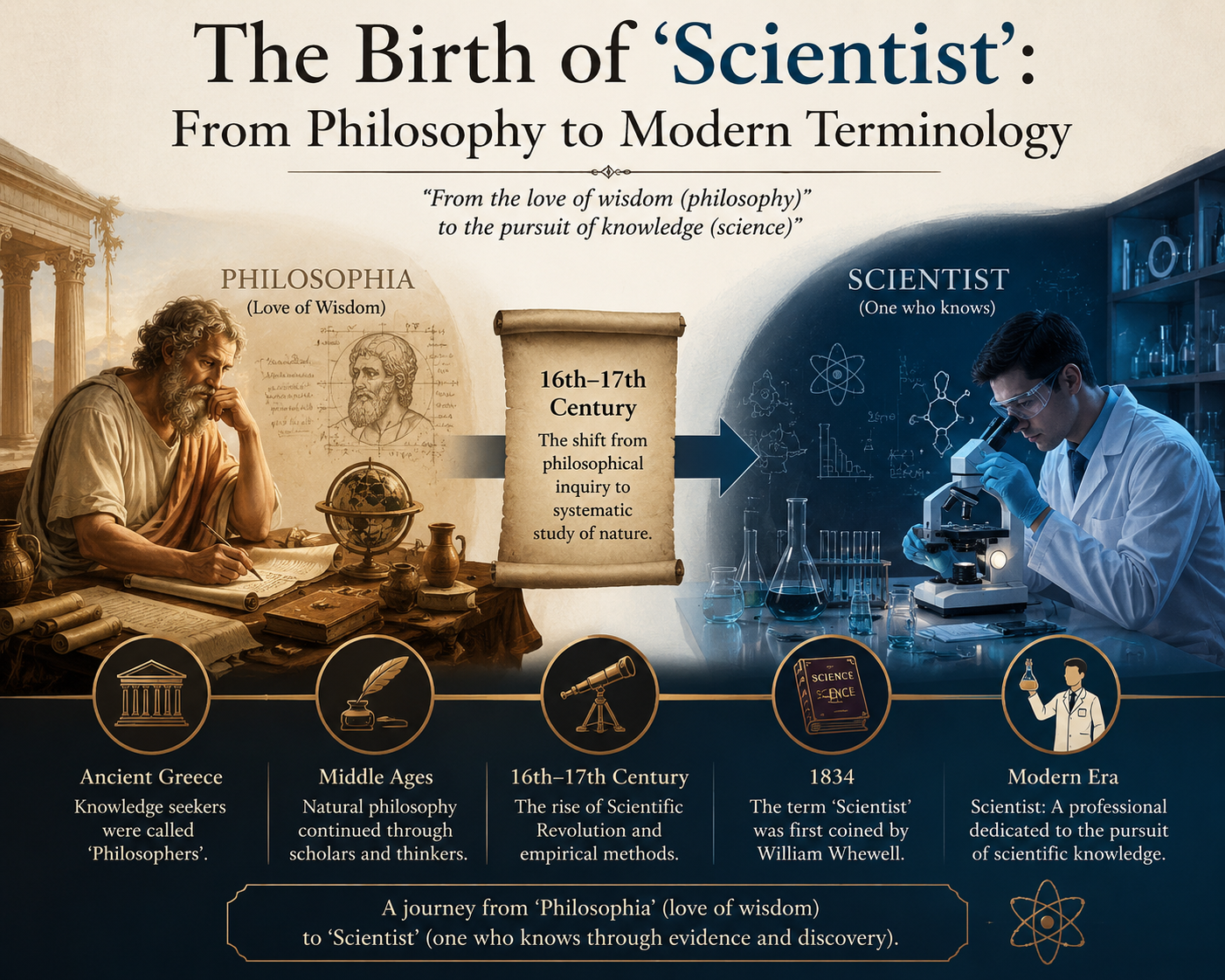
  • The Birth of "Scientist": From Philosophy to Modern Terminology

    The word "Scientist" has a fascinating history that reflects the evolution of human knowledge and discovery. Before the modern scientific world existed, people who studied nature were often known as philosophers, natural philosophers, scholars, or thinkers. Over time, the search for knowledge became more specialized, leading to the birth of the term "scientist."

    In this fascinating topic, we explore how the word "scientist" emerged and how its meaning developed alongside the growth of modern science. Discover how curiosity, observation, experimentation, and critical thinking transformed the way humanity understands the world around us.

    From ancient thinkers to today's researchers and innovators , the journey of the word "scientist" tells a powerful story about our endless desire to question, discover, and understand.

    Join us on this exciting journey through the history of science and language, and discover how one word came to represent the people who continue to expand the boundaries of human knowledge!

    #Scientist #HistoryOfScience #WordHistory #Etymology #Science #Philosophy #ScientificRevolution #ModernScience #Scientists #Knowledge #Discovery #Curiosity #CriticalThinking #Education #Learning #Innovation #Research #Language #Linguistics #HumanKnowledge


    RSISB
    Roll No:#209
    Story Post No.26
    🔬📚 The Birth of "Scientist": From Philosophy to Modern Terminology 🌍✨ The word "Scientist" has a fascinating history that reflects the evolution of human knowledge and discovery. 🧠💡 Before the modern scientific world existed, people who studied nature were often known as philosophers, natural philosophers, scholars, or thinkers. Over time, the search for knowledge became more specialized, leading to the birth of the term "scientist." 🔬🌟 In this fascinating topic, we explore how the word "scientist" emerged and how its meaning developed alongside the growth of modern science. 📖🕰️ Discover how curiosity, observation, experimentation, and critical thinking transformed the way humanity understands the world around us. 🌎🔍 From ancient thinkers to today's researchers and innovators 🚀, the journey of the word "scientist" tells a powerful story about our endless desire to question, discover, and understand. 💭✨ 💬 Join us on this exciting journey through the history of science and language, and discover how one word came to represent the people who continue to expand the boundaries of human knowledge! 🌟🔬 #Scientist #HistoryOfScience #WordHistory #Etymology #Science #Philosophy #ScientificRevolution #ModernScience #Scientists #Knowledge #Discovery #Curiosity #CriticalThinking #Education #Learning #Innovation #Research #Language #Linguistics #HumanKnowledge 🔬📚🧠💡🌍✨🕰️🔍🚀🌟📖💭🌎🧪👏 RSISB Roll No:#209 Story Post No.26
    0 التعليقات 0 المشاركات 3345 مشاهدة
  • #rsisb Roll No.240 Call Annie No.7 Foundation Level # **"Please" – The Evolution of Politeness (5 min)** Have you ever wondered why we say **"please"**? This simple word has a long and fascinating history that reflects the evolution of human kindness, respect, and good manners. In this 5-minute video, you'll discover where the word **"please"** came from, how it developed over centuries, and why it remains one of the most powerful words in everyday communication. From ancient expressions of courtesy to modern conversations, "please" has become a universal symbol of politeness. Whether you're asking for help, making a request, or showing respect, this small word can make a big difference in how people respond to you. Watch this short journey through language and history to learn how one simple word has shaped cultures, strengthened relationships, and made communication more thoughtful around the world. 💬 **If you enjoyed this video, don't forget to Like 👍, Share 📤, and Subscribe 🔔 for more interesting stories about language, history, and everyday words!** #Please #Politeness #GoodManners #EnglishLanguage #WordHistory #LanguageLearning #CommunicationSkills #Kindness #Respect #Learning #Education #History #Vocabulary #English #Courtesy 🌍📚✨ Rehan School Islamabad Campus Asma Shaheen EducationWali Irum Asim Saima Happinesswali https://www.facebook.com/share/v/1ENEXhLxAg/
    WWW.FACEBOOK.COM
    Facebook
    #rsisb Roll No.240 Call Annie No.7 Foundation Level # **"Please" – The Evolution of Politeness (5 min)** ✨ **Description** Have you ever wondered why we say **"please"**? This simple word has a...
    0 التعليقات 0 المشاركات 1110 مشاهدة
الصفحات المعززة