• RSIF8
    ROLL NO:13
    CLASS: FOUNDATION LEVEL
    CODING TASK NO:12

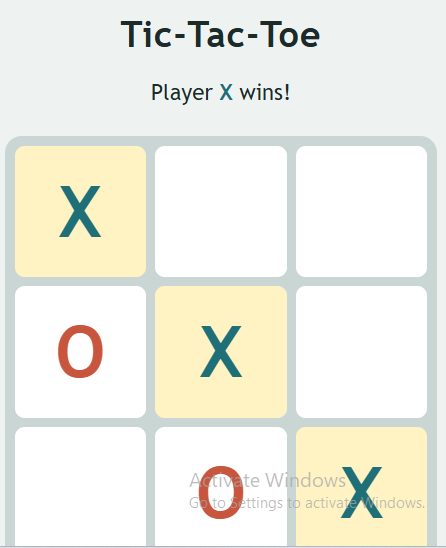
    This is a two-player Tic-Tac-Toe game in one HTML file. Two people share the same screen and take turns clicking squares on a 3×3 grid. Player X always goes first in the first round. The game announces whose turn it is, ends as soon as someone wins or the board fills up, and keeps a running score across rounds.

    HTML structure

    The page has five parts:

    A title (<h1>).
    A status line that shows whose turn it is or who won. It is marked aria-live="polite", so screen readers announce each change.
    An empty <div id="board">, which JavaScript fills with nine buttons.
    A score area with three counters: X wins, draws and O wins.
    A “New game” button.

    The cells are real <button> elements rather than plain divs, so they work with the keyboard (Tab to move, Enter or Space to play) and with screen readers.

    CSS styling
    Board layout: CSS Grid with three equal columns builds the board. The board is min(90vw, 360px) wide and square, so it fits small phone screens and doesn’t grow too large on desktop.
    Colors: All colors are CSS variables on :root. X is teal and O is a warm orange-red, so the two players are easy to tell apart. The page also has a dark theme that follows the device’s light or dark setting.
    Cell states: Cells change background on hover. The winning three cells turn pale yellow. Cells are disabled once filled, and a visible focus outline helps keyboard users.
    Sizing: The X and O symbols scale with the screen using clamp(), so they stay readable on any device.
    JavaScript logic

    1. Winning lines. The LINES array lists the eight ways to win. The cells are numbered 0 to 8 from the top-left, row by row:

    Rows: 0-1-2, 3-4-5, 6-7-8
    Columns: 0-3-6, 1-4-7, 2-5-8
    Diagonals: 0-4-8 and 2-4-6

    2. Setup. A loop creates the nine buttons, gives each an accessible label (“Cell 1” to “Cell 9”) and attaches a click handler that calls play(i).

    3. newGame(). It resets the board array to nine empty slots, clears the cells, re-enables them and shows whose turn it is. It also alternates who starts, so X starts the first round, O the second, and so on. This keeps the game fair over many rounds.
    RSIF8 ROLL NO:13 CLASS: FOUNDATION LEVEL CODING TASK NO:12 This is a two-player Tic-Tac-Toe game in one HTML file. Two people share the same screen and take turns clicking squares on a 3×3 grid. Player X always goes first in the first round. The game announces whose turn it is, ends as soon as someone wins or the board fills up, and keeps a running score across rounds. HTML structure The page has five parts: A title (<h1>). A status line that shows whose turn it is or who won. It is marked aria-live="polite", so screen readers announce each change. An empty <div id="board">, which JavaScript fills with nine buttons. A score area with three counters: X wins, draws and O wins. A “New game” button. The cells are real <button> elements rather than plain divs, so they work with the keyboard (Tab to move, Enter or Space to play) and with screen readers. CSS styling Board layout: CSS Grid with three equal columns builds the board. The board is min(90vw, 360px) wide and square, so it fits small phone screens and doesn’t grow too large on desktop. Colors: All colors are CSS variables on :root. X is teal and O is a warm orange-red, so the two players are easy to tell apart. The page also has a dark theme that follows the device’s light or dark setting. Cell states: Cells change background on hover. The winning three cells turn pale yellow. Cells are disabled once filled, and a visible focus outline helps keyboard users. Sizing: The X and O symbols scale with the screen using clamp(), so they stay readable on any device. JavaScript logic 1. Winning lines. The LINES array lists the eight ways to win. The cells are numbered 0 to 8 from the top-left, row by row: Rows: 0-1-2, 3-4-5, 6-7-8 Columns: 0-3-6, 1-4-7, 2-5-8 Diagonals: 0-4-8 and 2-4-6 2. Setup. A loop creates the nine buttons, gives each an accessible label (“Cell 1” to “Cell 9”) and attaches a click handler that calls play(i). 3. newGame(). It resets the board array to nine empty slots, clears the cells, re-enables them and shows whose turn it is. It also alternates who starts, so X starts the first round, O the second, and so on. This keeps the game fair over many rounds.
    0 Comentários 0 Compartilhamentos 453 Visualizações
  • RSIF8
    Roll no:81
    Task no:71
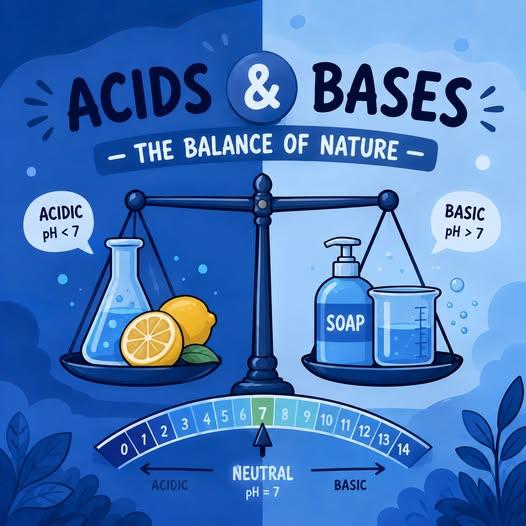
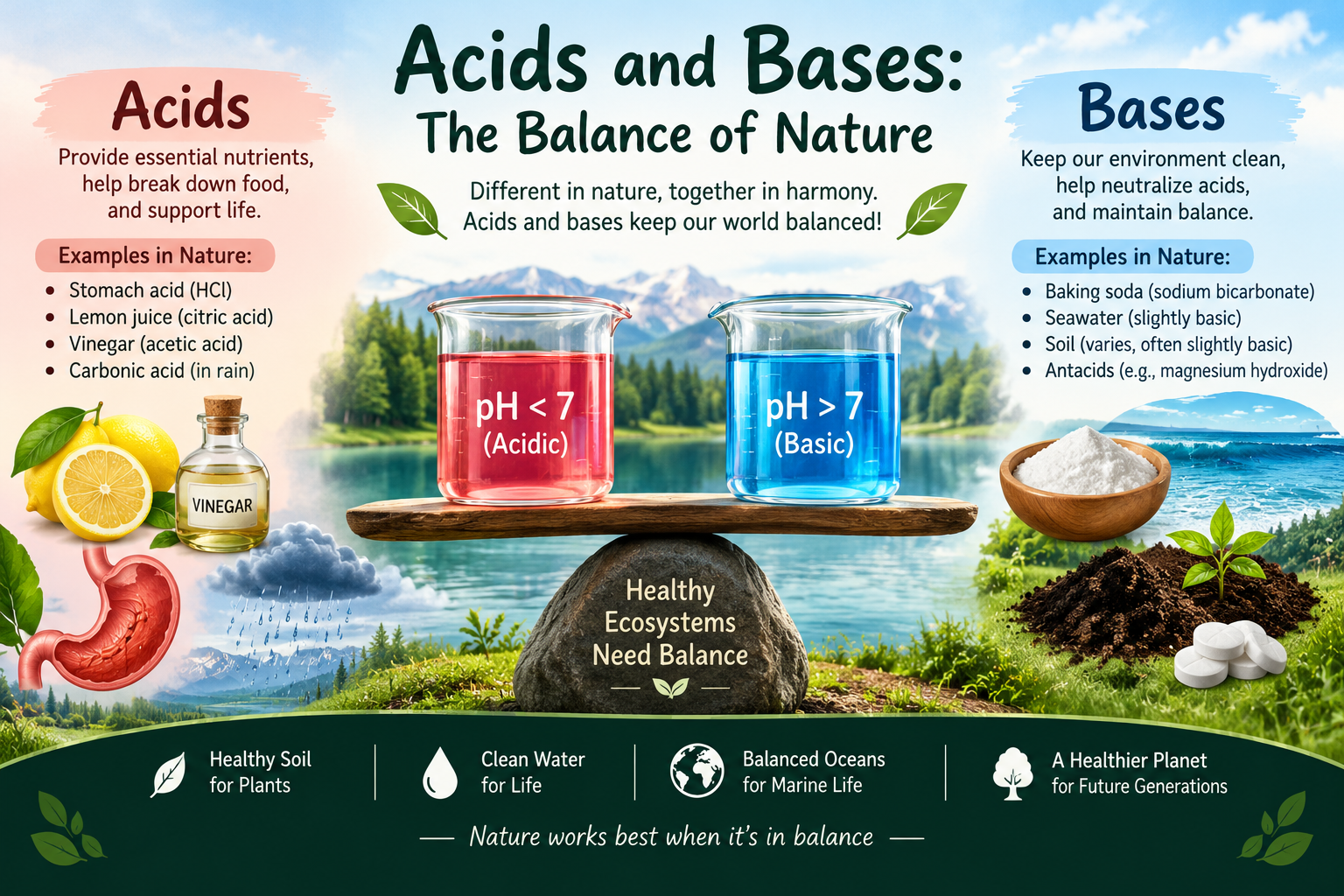
    Task topic Acids are found in lemon juice, vinegar, and our stomachs. They play important roles in food and digestion.
    Bases are found in products like soap and baking soda. They are useful for cleaning and many everyday activities.
    The balance between acids and bases is also important for healthy soil, clean water, and living organisms. Scientists use the pH scale to measure how acidic or basic a substance is.
    Remember: Understanding acids and bases helps us protect nature, explore science, and learn how our world works!
    Like, Share, and Follow for more interesting science topics and educational content!
    #AcidsAndBases #BalanceOfNature #Chemistry #ScienceEducation #PHScale #LearnScience #Nature #EnvironmentalScience #StudentProjects #ScienceIsFun
    RSIF8 Roll no:81 Task no:71 Task topic🍋 Acids are found in lemon juice, vinegar, and our stomachs. They play important roles in food and digestion. 🧼 Bases are found in products like soap and baking soda. They are useful for cleaning and many everyday activities. 🌱 The balance between acids and bases is also important for healthy soil, clean water, and living organisms. Scientists use the pH scale to measure how acidic or basic a substance is. 💡 Remember: Understanding acids and bases helps us protect nature, explore science, and learn how our world works! ❤️ Like, Share, and Follow for more interesting science topics and educational content! #AcidsAndBases #BalanceOfNature #Chemistry #ScienceEducation #PHScale #LearnScience #Nature #EnvironmentalScience #StudentProjects #ScienceIsFun 🧪🌍
    0 Comentários 0 Compartilhamentos 730 Visualizações
  • rehan school urdu bazar
    roll no11
    foundation level### Paragraph 1: Understanding Acids and Bases
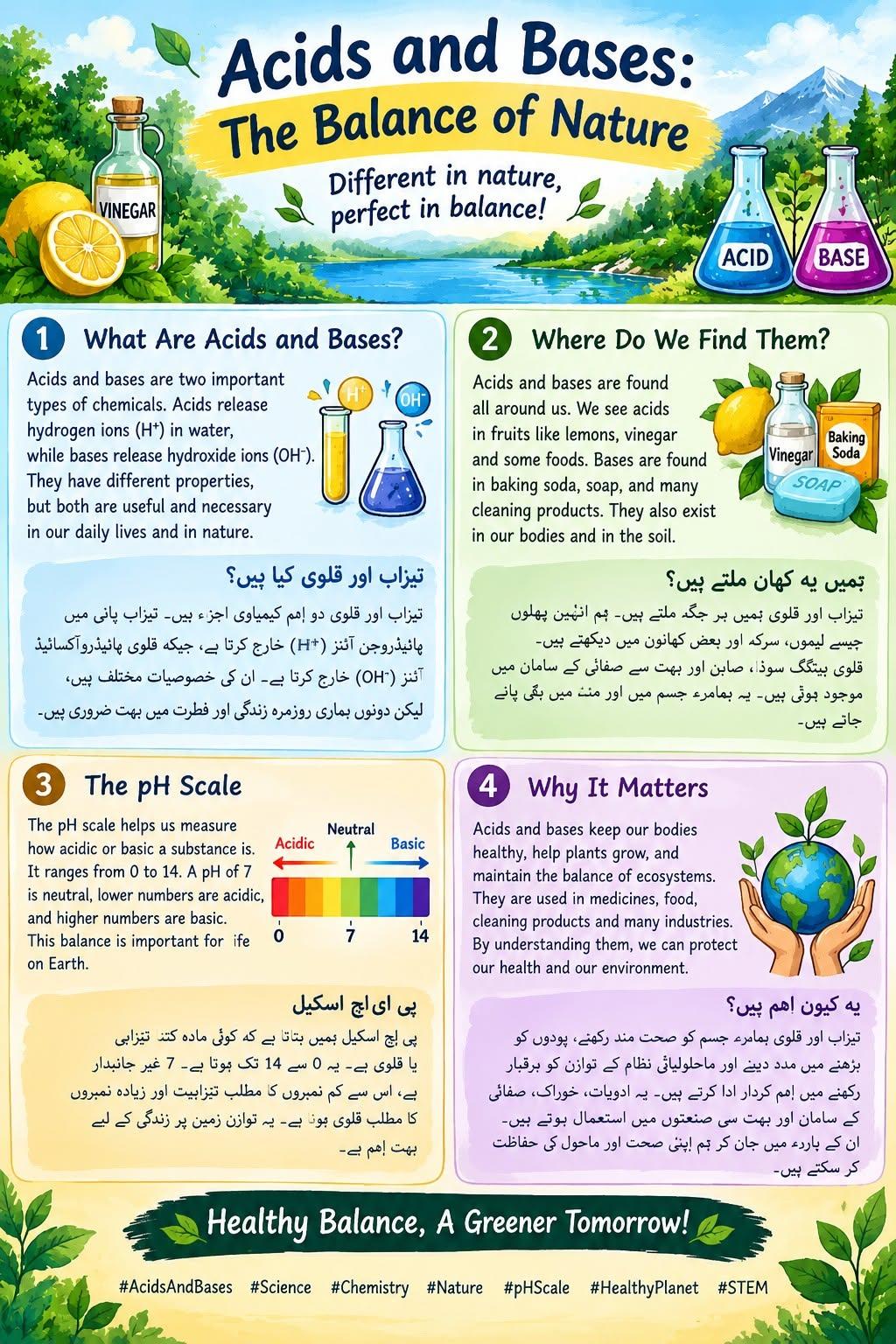
    Acids and bases are important parts of chemistry. They have different properties and play many roles in our daily lives. Acids release hydrogen ions in water, while bases can accept hydrogen ions or produce hydroxide ions in water. Both are essential to understanding the world around us.
    ### Paragraph 2: Acids and Bases Around Us
    We can find acids and bases in many everyday things. Lemons and oranges contain citric acid, while vinegar contains acetic acid. Baking soda is a common base, and many soaps are basic too. These substances are useful in cooking, cleaning, and many other activities.
    ### Paragraph 3: The Amazing pH Scale
    The pH scale measures how acidic or basic a water-based solution is. It usually ranges from 0 to 14. A pH below 7 is acidic, a pH of 7 is neutral, and a pH above 7 is basic. This scale helps scientists understand soil, water, food, and many chemical reactions.
    ### Paragraph 4: The Balance of Nature
    Acids and bases are important for living things and the environment. Soil pH affects plant growth, and the acidity of water can influence aquatic life. By understanding acids and bases, scientists can help protect our health, improve agriculture, and care for nature. A healthy balance helps create a better future for our planet.
    **A Healthy Balance Means a Healthier Planet!** See less
    rehan school urdu bazar roll no11 foundation level### Paragraph 1: Understanding Acids and Bases Acids and bases are important parts of chemistry. They have different properties and play many roles in our daily lives. Acids release hydrogen ions in water, while bases can accept hydrogen ions or produce hydroxide ions in water. Both are essential to understanding the world around us. ### Paragraph 2: Acids and Bases Around Us We can find acids and bases in many everyday things. Lemons and oranges contain citric acid, while vinegar contains acetic acid. Baking soda is a common base, and many soaps are basic too. These substances are useful in cooking, cleaning, and many other activities. ### Paragraph 3: The Amazing pH Scale The pH scale measures how acidic or basic a water-based solution is. It usually ranges from 0 to 14. A pH below 7 is acidic, a pH of 7 is neutral, and a pH above 7 is basic. This scale helps scientists understand soil, water, food, and many chemical reactions. ### Paragraph 4: The Balance of Nature Acids and bases are important for living things and the environment. Soil pH affects plant growth, and the acidity of water can influence aquatic life. By understanding acids and bases, scientists can help protect our health, improve agriculture, and care for nature. A healthy balance helps create a better future for our planet. **A Healthy Balance Means a Healthier Planet!** See less
    0 Comentários 0 Compartilhamentos 418 Visualizações
  • RSLC ROLL NO 80#
    FOUNDATION LEVEL Batch 06#
    DAY 69 — TASK 69

    Story Post: Acids and Bases: The Balance of Nature

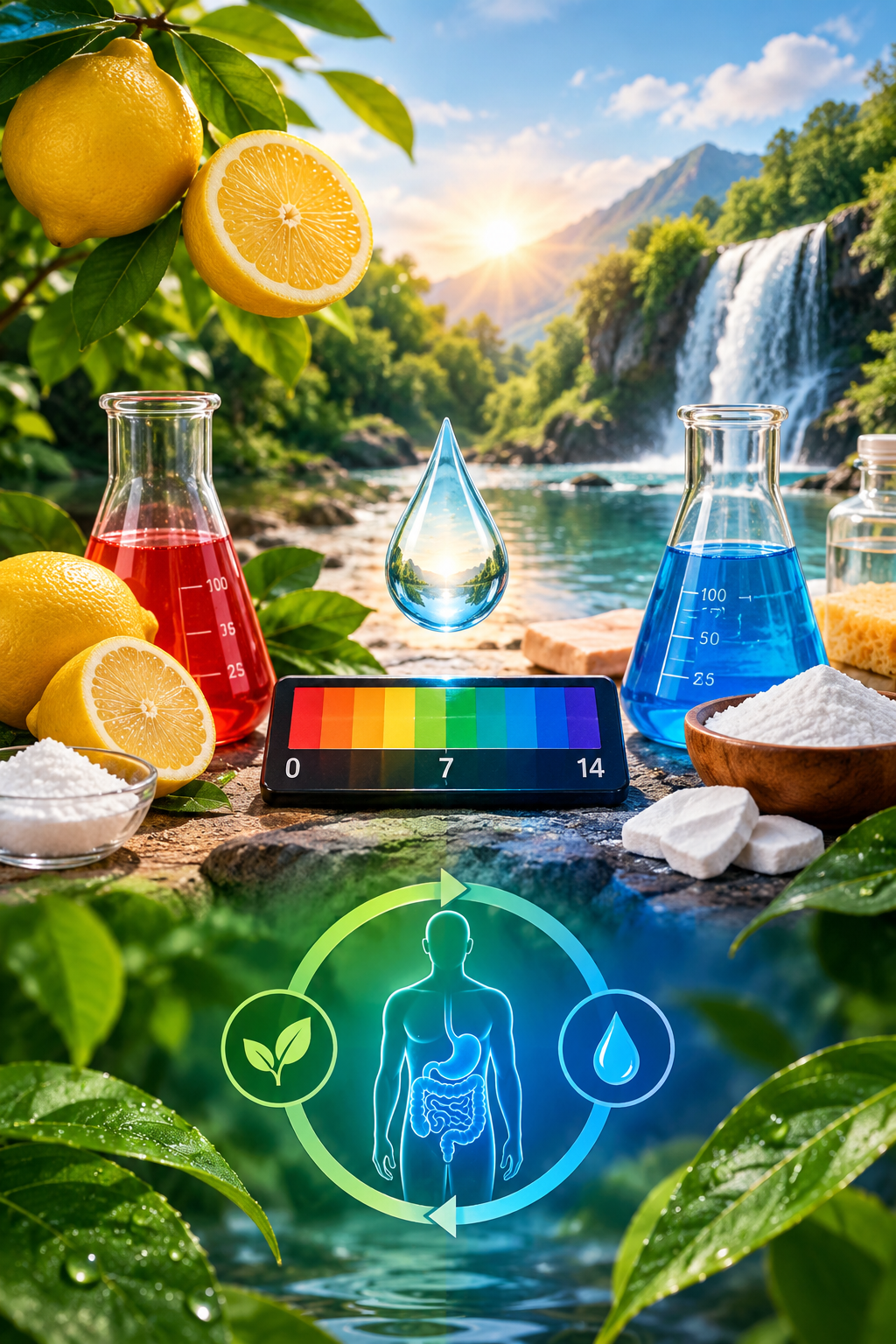
    Acids and bases are important parts of our everyday lives! From the sour taste of lemons to the cleaning power of baking soda , they play a major role in nature and science. Acids and bases interact through chemical reactions, and the pH scale helps us understand whether a substance is acidic, neutral, or basic. Even our bodies depend on the right balance of acids and bases to function properly!

    Nature teaches us that balance is essential for life. By learning about acids and bases, we can better understand the chemistry happening all around us.

    Keep exploring science, because every discovery opens a new door to knowledge!

    #RSLC #AcidsAndBases #Chemistry #ScienceLearning #Nature
    RSLC ROLL NO 80# FOUNDATION LEVEL Batch 06# DAY 69 — TASK 69 📖 Story Post: Acids and Bases: The Balance of Nature 🧪🌿 Acids and bases are important parts of our everyday lives! 🌍 From the sour taste of lemons 🍋 to the cleaning power of baking soda 🧂, they play a major role in nature and science. Acids and bases interact through chemical reactions, and the pH scale helps us understand whether a substance is acidic, neutral, or basic. Even our bodies depend on the right balance of acids and bases to function properly! 🧬⚗️ Nature teaches us that balance is essential for life. By learning about acids and bases, we can better understand the chemistry happening all around us. 🌱🔬 Keep exploring science, because every discovery opens a new door to knowledge! 🚀📚 #RSLC #AcidsAndBases #Chemistry #ScienceLearning #Nature
    0 Comentários 0 Compartilhamentos 1150 Visualizações
  • RSIF8
    Roll no:14
    story no:24
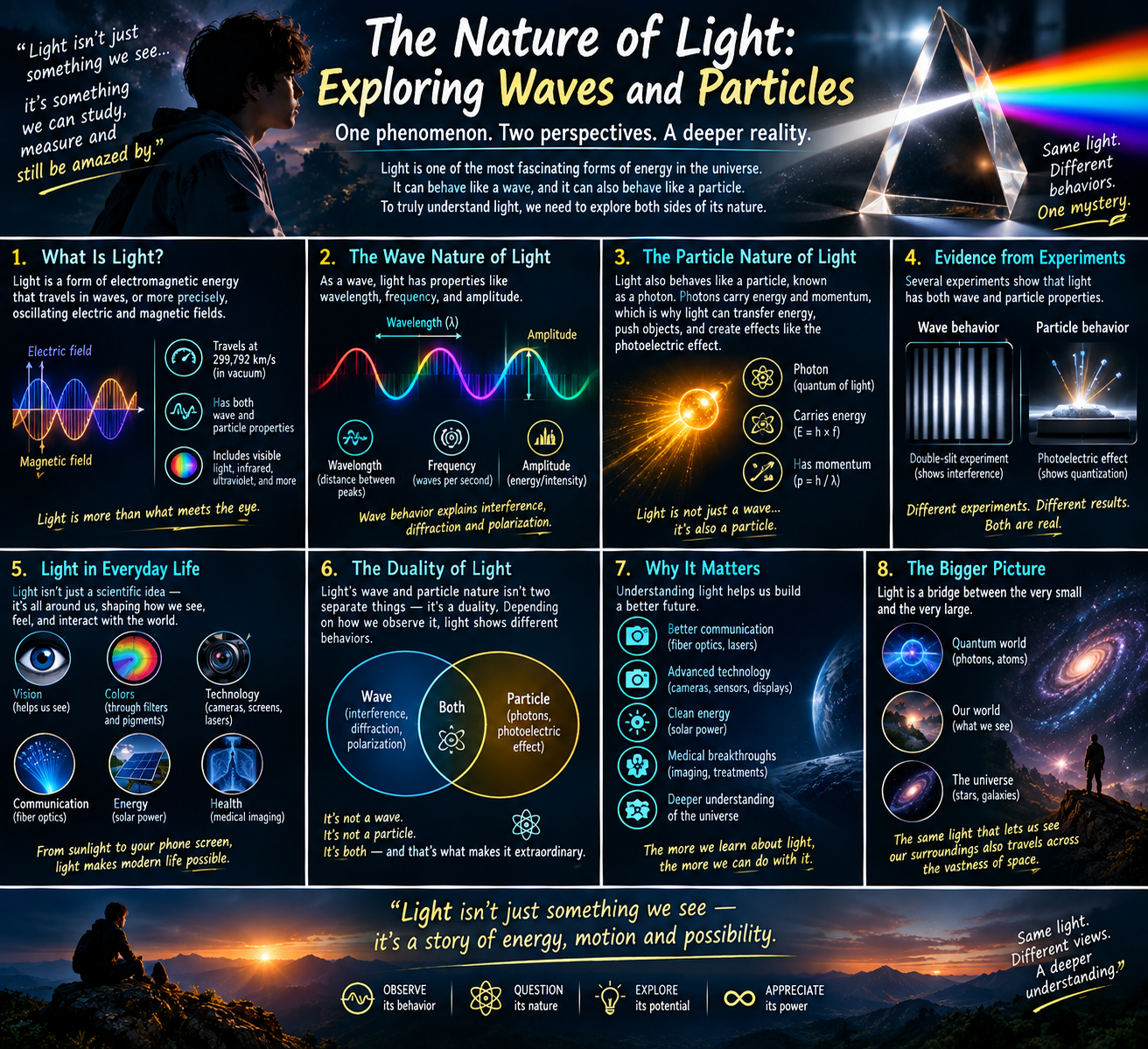
    story topic:The Nature of Light: Exploring Waves and Particles

    **The Nature of Light: Exploring Waves and Particles**

    Have you ever wondered what light really is? How does sunlight travel across millions of kilometers through space, how do rainbows form, and how can light behave like both a wave and a particle? The nature of light is one of the most fascinating topics in physics, revealing the extraordinary connection between the visible world and the mysterious laws of quantum mechanics. From the light that illuminates our homes to the distant stars shining in the universe, light plays an essential role in understanding the world around us.

    **1. The Wave Nature of Light **

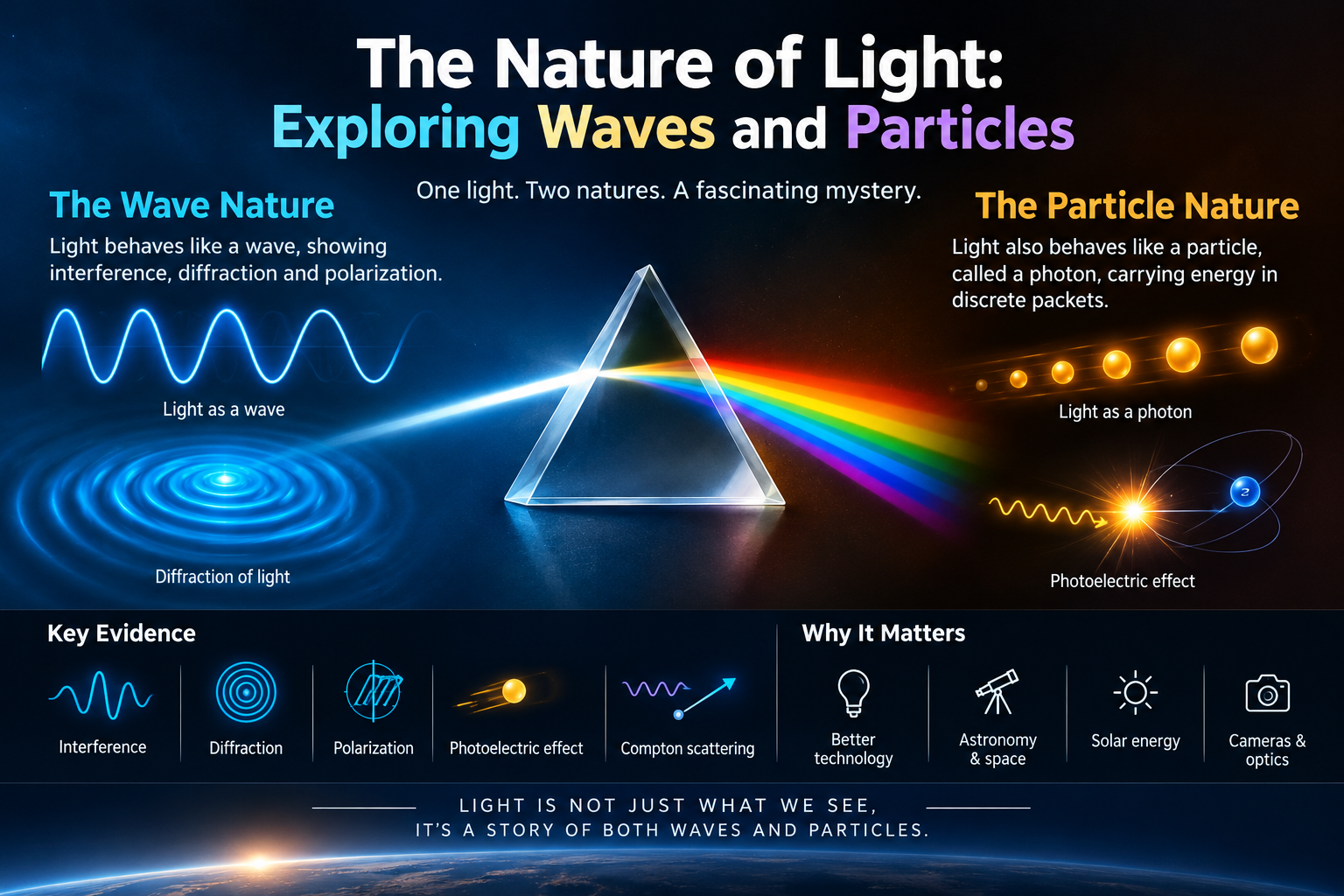
    For many years, scientists have studied light as a wave because it demonstrates important wave-like properties. Light can undergo interference, diffraction, and polarization. Interference occurs when light waves overlap and combine, producing patterns of brightness and darkness. Diffraction happens when light spreads around an obstacle or passes through a narrow opening. Polarization describes the orientation of light's oscillations and helps us understand how light interacts with different materials.

    These properties demonstrate that the wave model is essential for explaining many optical phenomena. From colorful patterns created by thin films to the operation of polarized sunglasses, the wave nature of light has many applications in everyday life and modern technology.

    **2. The Particle Nature of Light **

    Light also behaves in ways that reveal its particle nature. In quantum physics, light energy is exchanged in discrete packets called **photons**. Each photon carries energy determined by its frequency, described by the equation **E = hf**, where E represents energy, h is Planck's constant, and f is frequency.

    The photoelectric effect provides important evidence for this particle nature. When light of a suitable frequency strikes certain materials, it can release electrons from their surfaces. This phenomenon helped scientists understand that light energy is transferred in individual quanta rather than always behaving like a continuous wave.

    Another important example is Compton scattering, in which photons exchange energy and momentum with electrons. These discoveries transformed our understanding of light and helped establish the foundations of quantum physics.

    **3. Wave-Particle Duality: Two Sides of Light**

    One of the most remarkable discoveries in science is that light cannot be fully explained by treating it only as a classical wave or only as a classical particle. Its behavior depends on the physical process being investigated and how it is measured. This concept is known as **wave-particle duality**.

    Experiments involving interference reveal wave-like patterns, while experiments involving photon detection show that light energy is detected in discrete units. Quantum mechanics brings these observations together into a more complete description of nature. Rather than being an ordinary wave or a tiny classical object, light is a quantum phenomenon with properties that challenge our everyday intuition.

    **4. How Do We Discover the Secrets of Light?**

    Scientists use carefully designed experiments to explore the behavior of light. Prisms separate white light into different colors, optical instruments measure its properties, and advanced detectors record individual photons. Interference experiments reveal patterns that cannot be explained by simple particle models, while photoelectric experiments demonstrate the importance of quantized energy.

    The work of scientists such as Isaac Newton, Thomas Young, Max Planck, Albert Einstein, and Arthur Compton helped build our modern understanding of light. Their discoveries show how scientific knowledge develops through observation, experimentation, mathematical reasoning, and new ideas.

    **5. Why Is the Nature of Light Important?**

    Understanding light is essential to many technologies that shape modern life. Lasers are used in medicine, manufacturing, and scientific research. Fiber-optic cables transmit information across the world using pulses of light. Solar panels convert light energy into electrical energy, while cameras and telescopes help us capture images and explore distant objects in space.

    The principles of light are also important in astronomy, microscopy, optical communication, quantum technologies, and the study of the universe. By investigating how light behaves, scientists can examine distant galaxies, study the structure of matter, and develop new tools that improve our understanding of nature.

    **6. Light: Connecting Science and the Universe**

    Light is much more than what allows us to see. It carries information about distant stars, reveals the composition of celestial objects, and provides clues about the physical processes occurring throughout the cosmos. By analyzing the light received from distant galaxies, astronomers can learn about their temperatures, chemical compositions, and motion.

    At the smallest scales, the study of photons helps scientists investigate the quantum world and understand how energy interacts with matter. From the smallest laboratory experiments to the largest astronomical observations, light connects different areas of science in extraordinary ways.

    **Conclusion: The Extraordinary Mystery of Light**

    The study of light demonstrates how nature can be far more complex than it first appears. Its wave-like properties explain interference, diffraction, and polarization, while its particle-like properties help explain the photoelectric effect and Compton scattering. Together, these discoveries form an important part of our modern understanding of physics.

    Learning about wave-particle duality encourages us to question assumptions, explore scientific evidence, and appreciate the discoveries that continue to expand human knowledge. Every beam of sunlight, every shining star, and every photon detected by a scientific instrument reminds us that there is still much to discover about the universe.

    **Light Is More Than What We See—It Is a Window into the Fundamental Nature of Reality!**

    If you enjoyed this science topic, share it with others and continue exploring the fascinating world of physics. Stay curious, keep asking questions, and never stop learning!

    #NatureOfLight #WaveParticleDuality #Physics #QuantumPhysics #ScienceEducation #Photons #LightWaves #PhotoelectricEffect #ComptonScattering #Optics #Astronomy #ScientificDiscoveries #STEMEducation #LearnPhysics #ScienceExplained #EducationalContent #WavesAndParticles
    RSIF8 Roll no:14 story no:24 story topic:The Nature of Light: Exploring Waves and Particles 🌟 **The Nature of Light: Exploring Waves and Particles** 🌈🔬 Have you ever wondered what light really is? How does sunlight travel across millions of kilometers through space, how do rainbows form, and how can light behave like both a wave and a particle? The nature of light is one of the most fascinating topics in physics, revealing the extraordinary connection between the visible world and the mysterious laws of quantum mechanics. From the light that illuminates our homes to the distant stars shining in the universe, light plays an essential role in understanding the world around us. 🌍✨ 💡 **1. The Wave Nature of Light 🌊** For many years, scientists have studied light as a wave because it demonstrates important wave-like properties. Light can undergo interference, diffraction, and polarization. Interference occurs when light waves overlap and combine, producing patterns of brightness and darkness. Diffraction happens when light spreads around an obstacle or passes through a narrow opening. Polarization describes the orientation of light's oscillations and helps us understand how light interacts with different materials. These properties demonstrate that the wave model is essential for explaining many optical phenomena. From colorful patterns created by thin films to the operation of polarized sunglasses, the wave nature of light has many applications in everyday life and modern technology. ⚛️ **2. The Particle Nature of Light ✨** Light also behaves in ways that reveal its particle nature. In quantum physics, light energy is exchanged in discrete packets called **photons**. Each photon carries energy determined by its frequency, described by the equation **E = hf**, where E represents energy, h is Planck's constant, and f is frequency. The photoelectric effect provides important evidence for this particle nature. When light of a suitable frequency strikes certain materials, it can release electrons from their surfaces. This phenomenon helped scientists understand that light energy is transferred in individual quanta rather than always behaving like a continuous wave. Another important example is Compton scattering, in which photons exchange energy and momentum with electrons. These discoveries transformed our understanding of light and helped establish the foundations of quantum physics. 🔬 **3. Wave-Particle Duality: Two Sides of Light** One of the most remarkable discoveries in science is that light cannot be fully explained by treating it only as a classical wave or only as a classical particle. Its behavior depends on the physical process being investigated and how it is measured. This concept is known as **wave-particle duality**. Experiments involving interference reveal wave-like patterns, while experiments involving photon detection show that light energy is detected in discrete units. Quantum mechanics brings these observations together into a more complete description of nature. Rather than being an ordinary wave or a tiny classical object, light is a quantum phenomenon with properties that challenge our everyday intuition. 🌈 **4. How Do We Discover the Secrets of Light?** Scientists use carefully designed experiments to explore the behavior of light. Prisms separate white light into different colors, optical instruments measure its properties, and advanced detectors record individual photons. Interference experiments reveal patterns that cannot be explained by simple particle models, while photoelectric experiments demonstrate the importance of quantized energy. The work of scientists such as Isaac Newton, Thomas Young, Max Planck, Albert Einstein, and Arthur Compton helped build our modern understanding of light. Their discoveries show how scientific knowledge develops through observation, experimentation, mathematical reasoning, and new ideas. 🚀 **5. Why Is the Nature of Light Important?** Understanding light is essential to many technologies that shape modern life. Lasers are used in medicine, manufacturing, and scientific research. Fiber-optic cables transmit information across the world using pulses of light. Solar panels convert light energy into electrical energy, while cameras and telescopes help us capture images and explore distant objects in space. The principles of light are also important in astronomy, microscopy, optical communication, quantum technologies, and the study of the universe. By investigating how light behaves, scientists can examine distant galaxies, study the structure of matter, and develop new tools that improve our understanding of nature. 🌍 **6. Light: Connecting Science and the Universe** Light is much more than what allows us to see. It carries information about distant stars, reveals the composition of celestial objects, and provides clues about the physical processes occurring throughout the cosmos. By analyzing the light received from distant galaxies, astronomers can learn about their temperatures, chemical compositions, and motion. At the smallest scales, the study of photons helps scientists investigate the quantum world and understand how energy interacts with matter. From the smallest laboratory experiments to the largest astronomical observations, light connects different areas of science in extraordinary ways. 💫 **Conclusion: The Extraordinary Mystery of Light** The study of light demonstrates how nature can be far more complex than it first appears. Its wave-like properties explain interference, diffraction, and polarization, while its particle-like properties help explain the photoelectric effect and Compton scattering. Together, these discoveries form an important part of our modern understanding of physics. Learning about wave-particle duality encourages us to question assumptions, explore scientific evidence, and appreciate the discoveries that continue to expand human knowledge. Every beam of sunlight, every shining star, and every photon detected by a scientific instrument reminds us that there is still much to discover about the universe. ✨ **Light Is More Than What We See—It Is a Window into the Fundamental Nature of Reality!** 🔭🌌 👍 If you enjoyed this science topic, share it with others and continue exploring the fascinating world of physics. Stay curious, keep asking questions, and never stop learning! #NatureOfLight #WaveParticleDuality #Physics #QuantumPhysics #ScienceEducation #Photons #LightWaves #PhotoelectricEffect #ComptonScattering #Optics #Astronomy #ScientificDiscoveries #STEMEducation #LearnPhysics #ScienceExplained #EducationalContent #WavesAndParticles 🌈🔬🚀
    0 Comentários 0 Compartilhamentos 7123 Visualizações
  • **Roll No: 2**
    **Batch: 14**
    **Book: ACCL**
    **Task No: 69**

    # Acids and Bases: The Balance of Nature

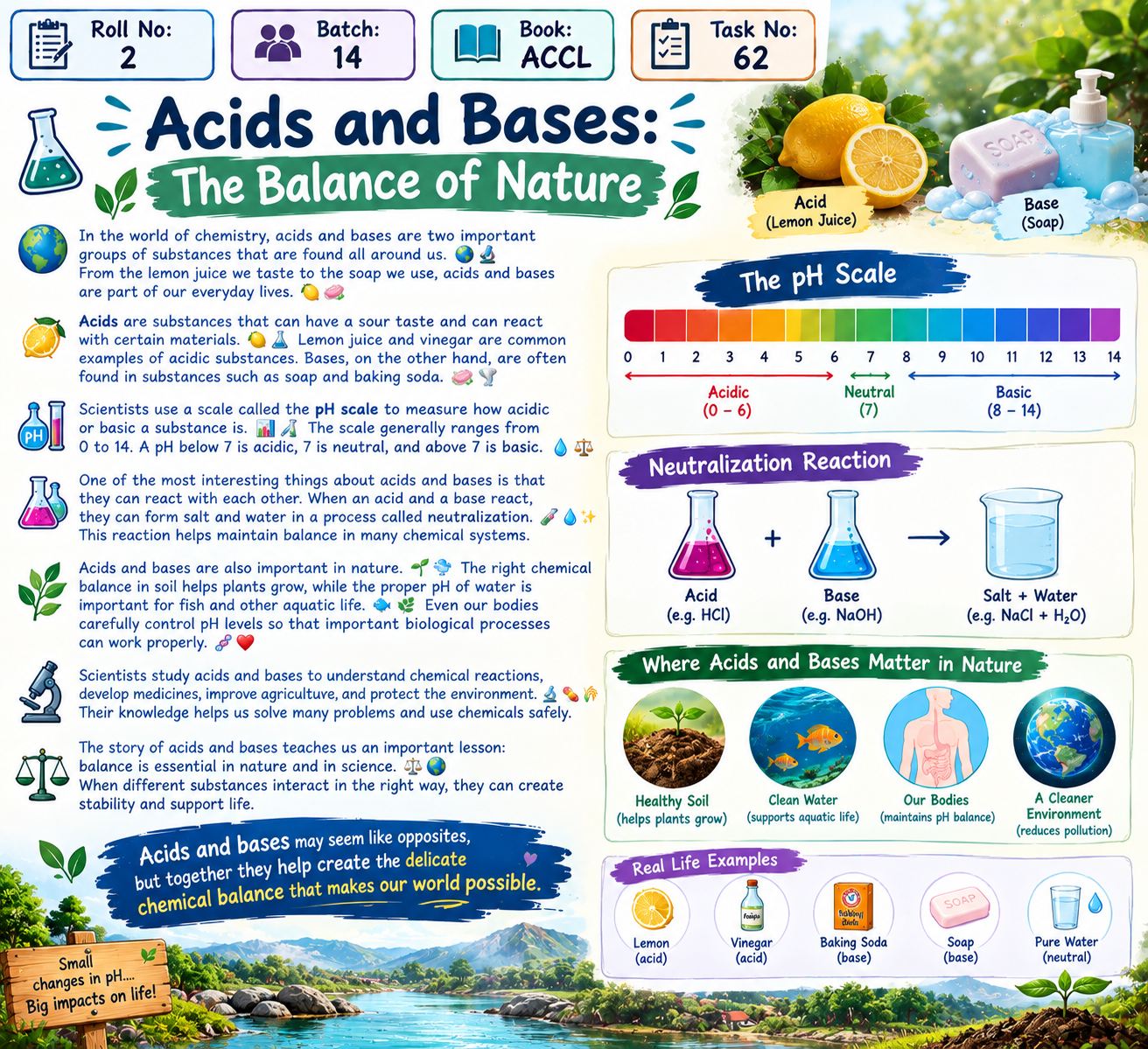
    In the world of chemistry, acids and bases are two important groups of substances that are found all around us. From the lemon juice we taste to the soap we use, acids and bases are part of our everyday lives.

    Acids are substances that can have a sour taste and can react with certain materials. Lemon juice and vinegar are common examples of acidic substances. Bases, on the other hand, are often found in substances such as soap and baking soda.

    Scientists use a scale called the **pH scale** to measure how acidic or basic a substance is. The scale generally ranges from **0 to 14**. A pH below 7 is acidic, 7 is neutral, and above 7 is basic.

    One of the most interesting things about acids and bases is that they can react with each other. When an acid and a base react, they can form **salt and water** in a process called neutralization. This reaction helps maintain balance in many chemical systems.

    Acids and bases are also important in nature. The right chemical balance in soil helps plants grow, while the proper pH of water is important for fish and other aquatic life. Even our bodies carefully control pH levels so that important biological processes can work properly.

    Scientists study acids and bases to understand chemical reactions, develop medicines, improve agriculture, and protect the environment. Their knowledge helps us solve many problems and use chemicals safely.

    The story of acids and bases teaches us an important lesson: **balance is essential in nature and in science.** When different substances interact in the right way, they can create stability and support life.

    **Acids and bases may seem like opposites, but together they help create the delicate chemical balance that makes our world possible. **
    **Roll No: 2** **Batch: 14** **Book: ACCL** **Task No: 69** # 🧪 Acids and Bases: The Balance of Nature 🌿⚖️ In the world of chemistry, acids and bases are two important groups of substances that are found all around us. 🌍🔬 From the lemon juice we taste to the soap we use, acids and bases are part of our everyday lives. 🍋🧼 Acids are substances that can have a sour taste and can react with certain materials. 🍋⚗️ Lemon juice and vinegar are common examples of acidic substances. Bases, on the other hand, are often found in substances such as soap and baking soda. 🧼🥄 Scientists use a scale called the **pH scale** to measure how acidic or basic a substance is. 📊🧪 The scale generally ranges from **0 to 14**. A pH below 7 is acidic, 7 is neutral, and above 7 is basic. 💧⚖️ One of the most interesting things about acids and bases is that they can react with each other. When an acid and a base react, they can form **salt and water** in a process called neutralization. 🧪💧✨ This reaction helps maintain balance in many chemical systems. Acids and bases are also important in nature. 🌱🌧️ The right chemical balance in soil helps plants grow, while the proper pH of water is important for fish and other aquatic life. 🐟🌿 Even our bodies carefully control pH levels so that important biological processes can work properly. 🧬❤️ Scientists study acids and bases to understand chemical reactions, develop medicines, improve agriculture, and protect the environment. 🔬💊🌾 Their knowledge helps us solve many problems and use chemicals safely. The story of acids and bases teaches us an important lesson: **balance is essential in nature and in science.** ⚖️🌍 When different substances interact in the right way, they can create stability and support life. **Acids and bases may seem like opposites, but together they help create the delicate chemical balance that makes our world possible. 🧪🌎✨**
    0 Comentários 0 Compartilhamentos 1763 Visualizações
  • **RSLC ROLL NO 80#**
    **FOUNDATION LEVEL Batch 06#**
    **DAY 69 — TASK 69**
    https://paki.com/content/uploads/photos/2026/09/educator_3c8c776746553cde41b0a5614ee8f9a2_cropped.png
    # Acids and Bases: The Balance of Nature

    Have you ever wondered why lemons taste sour or why soap feels slippery? The answer lies in **acids and bases**!

    Acids are substances that often taste sour. For example, **lemon juice and vinegar** contain acids. Bases are different. They can feel slippery and are found in things like **soap and baking soda**.

    Acids and bases are important in nature and in our daily lives. Our stomach uses acid to help digest food, while plants and soil depend on the right balance of chemicals to grow properly. Scientists use the **pH scale** to measure how acidic or basic something is.

    The amazing thing is that acids and bases can balance each other. When an acid and a base react, they can form **salt and water**. This process is called **neutralization**.

    ### Moral:

    **Balance is important in nature and in life. Too much or too little of something can cause problems, but the right balance helps everything work properly.**

    ### Hashtags:

    #AcidsAndBases #Chemistry #Science #PHScale #SciencePost
    **RSLC ROLL NO 80#** **FOUNDATION LEVEL Batch 06#** **DAY 69 — TASK 69** https://paki.com/content/uploads/photos/2026/09/educator_3c8c776746553cde41b0a5614ee8f9a2_cropped.png # 🧪 Acids and Bases: The Balance of Nature Have you ever wondered why lemons taste sour or why soap feels slippery? 🤔 The answer lies in **acids and bases**! Acids are substances that often taste sour. For example, **lemon juice and vinegar** contain acids. Bases are different. They can feel slippery and are found in things like **soap and baking soda**. Acids and bases are important in nature and in our daily lives. Our stomach uses acid to help digest food, while plants and soil depend on the right balance of chemicals to grow properly. Scientists use the **pH scale** to measure how acidic or basic something is. The amazing thing is that acids and bases can balance each other. When an acid and a base react, they can form **salt and water**. This process is called **neutralization**. 🌱⚗️ ### 🌟 Moral: **Balance is important in nature and in life. Too much or too little of something can cause problems, but the right balance helps everything work properly.** ### 🏷️ Hashtags: #AcidsAndBases #Chemistry #Science #PHScale #SciencePost
    0 Comentários 0 Compartilhamentos 2287 Visualizações
  • RSIF8
    Roll no: 99
    Story post no: 11
    Story topic: Acids and Bases: The Balance of Nature
    Acids and bases are an important part of chemistry and are found all around us. From the sour taste of lemons and the acid in our stomach to soaps and cleaning products, they play a role in many everyday processes.
    The pH scale helps us understand how acidic or basic a substance is. The balance between acids and bases is essential for nature, living organisms, and many chemical reactions that happen every day.
    #AcidsAndBases #Chemistry #Science #PHScale #ChemicalReactions #ScienceEducation #ChemistryLovers #STEM #LearnScience #Education
    RSIF8 Roll no: 99 Story post no: 11 Story topic: Acids and Bases: The Balance of Nature Acids and bases are an important part of chemistry and are found all around us. From the sour taste of lemons and the acid in our stomach to soaps and cleaning products, they play a role in many everyday processes. The pH scale helps us understand how acidic or basic a substance is. The balance between acids and bases is essential for nature, living organisms, and many chemical reactions that happen every day. #AcidsAndBases #Chemistry #Science #PHScale #ChemicalReactions #ScienceEducation #ChemistryLovers #STEM #LearnScience #Education
    0 Comentários 0 Compartilhamentos 1539 Visualizações
  • #rsisb
    Roll No 253
    Foundation Level
    Story Post 24

    # The Nature of Light: Exploring Waves and Particles

    Imagine standing beneath a night sky filled with stars.

    Every photon reaching your eyes has traveled across space carrying information from distant worlds. Light allows us to see, measure, communicate, explore, and understand the universe itself.

    But light is far stranger than it first appears.

    Sometimes it behaves like a **wave** .

    Sometimes it behaves like a **particle** .

    And understanding this strange dual nature changed our picture of reality forever.

    ---

    # 1. What Is Light?

    Light is a form of **electromagnetic radiation**—energy carried through oscillating electric and magnetic fields.

    In empty space, electromagnetic waves travel at approximately:

    ### **299,792 kilometers per second**

    That's the speed of light in vacuum.

    Visible light is only a small part of the electromagnetic spectrum.

    Beyond what our eyes can see are:

    Radio waves
    Microwaves
    Infrared
    Visible light
    Ultraviolet
    🩻 X-rays
    Gamma rays

    So light isn't simply what we see.

    ### **It's an enormous family of electromagnetic phenomena.**

    ---

    # 2. The Wave Nature of Light

    When light behaves as a wave, we can describe it using several important properties:

    **Wavelength** — the distance between successive wave peaks
    **Frequency** — how many oscillations occur each second
    **Amplitude** — related to the wave's intensity

    These properties help explain many familiar phenomena.

    **Interference** occurs when waves combine.
    **Diffraction** occurs when waves spread around openings or obstacles.
    **Polarization** describes the orientation of electromagnetic oscillations.

    The wave model explains behaviors that are difficult to understand if we imagine light only as tiny particles.

    ---

    # 3. The Particle Nature of Light

    But the story doesn't end there.

    Light can also behave as if it arrives in discrete packets of energy called **photons**.

    A photon is a quantum of electromagnetic radiation.

    Its energy is related to frequency:

    ### **E = h × f**

    And its momentum is related to its wavelength:

    ### **p = h / λ**

    This particle-like behavior helps explain phenomena such as the **photoelectric effect**, where light can transfer energy to electrons.

    So light isn't simply a smooth continuous wave.

    At the quantum level, energy can be exchanged in discrete amounts.

    ### **Light has another side—and it's quantum.**

    ---

    # 4. Evidence From Experiments

    The strange nature of light isn't merely philosophical.

    Experiments demonstrate it.

    ### Double-Slit Experiment

    When light passes through two narrow openings, an **interference pattern** can appear—strong evidence of wave-like behavior.

    ### Photoelectric Effect

    When light strikes certain materials, it can eject electrons. This behavior is explained using photons and quantized energy.

    Different experiments reveal different aspects of light.

    And that's one of the most fascinating things about physics:

    ### **The same phenomenon can reveal different behaviors depending on how we investigate it.**

    ---

    # 5. Light in Everyday Life

    Light isn't something that exists only inside physics laboratories.

    It's everywhere.

    **Vision** — allows us to see the world
    **Colors** — arise from how different wavelengths interact with matter
    **Cameras** — convert light into images
    **Screens** — produce controlled patterns of light
    **Fiber optics** — carry information using light
    **Solar panels** — convert light energy into electrical energy
    🩻 **Medical imaging** — uses electromagnetic radiation to see inside the body

    From sunrise to smartphone screens…

    ### **Modern civilization depends heavily on our ability to control light.**

    ---

    # 6. The Duality of Light

    Here lies the great mystery.

    Light can display **wave-like behavior**

    and

    **particle-like behavior** .

    This is known as **wave-particle duality**.

    It's important to understand that this doesn't mean light is literally switching between being a classical wave and a classical particle like two separate objects.

    Instead, quantum physics gives us a deeper framework in which classical wave and particle descriptions each capture different aspects of light's behavior.

    ### **Two perspectives. One quantum reality.**

    ---

    # 7. Why Understanding Light Matters

    Learning how light behaves has transformed technology.

    **Communication** — fiber-optic networks
    **Science** — spectroscopy and microscopy
    **Imaging** — cameras and sensors
    **Energy** — solar technology
    **Medicine** — lasers and diagnostic imaging
    **Astronomy** — studying distant stars and galaxies

    When astronomers observe light from a distant star, they aren't simply seeing brightness.

    They can analyze the light's wavelengths and learn about the star's:

    Temperature
    Chemical composition
    Motion
    Environment

    ### **Light carries information across space.**

    ---

    # 8. The Bigger Picture

    Light connects the microscopic and the cosmic.

    At the quantum scale, photons interact with atoms and electrons.

    At human scales, light allows us to see and communicate.

    Across astronomical distances, light travels from stars and galaxies to our telescopes.

    In many ways, light is our messenger from the universe.

    When we look at a distant galaxy, we are receiving photons that may have traveled for millions or billions of years before reaching Earth.

    ### **Looking at the universe means looking at ancient light.**

    ---

    # The Final Thought

    Light is more than something that illuminates a room.

    It is energy.
    It is information.
    It is electromagnetic radiation.
    It has quantum behavior.
    And it is one of the most important tools we have for exploring reality.

    From a photon interacting with an electron…

    to sunlight crossing space…

    to the glow of a distant galaxy…

    ### **Light connects the smallest scales of nature with the largest.**

    So the next time you see sunlight streaming through a window , a rainbow , or stars shining overhead , remember:

    **You aren't simply seeing light.**

    You're witnessing one of the universe's most fascinating mysteries—a phenomenon that behaves in ways far stranger and more beautiful than our everyday experience suggests.

    # **Light isn't just something we see—it's a story of energy, motion, information, and possibility.** ∞


    Asma Shaheen EducationWali
    Saima Empowerment Wali
    Mishaal TrainingWali
    #rsisb Roll No 253 Foundation Level Story Post 24 # 🌈⚡ The Nature of Light: Exploring Waves and Particles Imagine standing beneath a night sky filled with stars. 🌌✨ Every photon reaching your eyes has traveled across space carrying information from distant worlds. Light allows us to see, measure, communicate, explore, and understand the universe itself. 🔭👁️📡 But light is far stranger than it first appears. Sometimes it behaves like a **wave** 🌊. Sometimes it behaves like a **particle** ⚛️. And understanding this strange dual nature changed our picture of reality forever. 🧠🌌 --- # 💡🌌 1. What Is Light? Light is a form of **electromagnetic radiation**—energy carried through oscillating electric and magnetic fields. ⚡🧲 In empty space, electromagnetic waves travel at approximately: ### 🚀 **299,792 kilometers per second** That's the speed of light in vacuum. Visible light 👁️🌈 is only a small part of the electromagnetic spectrum. Beyond what our eyes can see are: 📻 Radio waves 📡 Microwaves 🔥 Infrared 🌈 Visible light ☀️ Ultraviolet 🩻 X-rays ☢️ Gamma rays So light isn't simply what we see. ### **It's an enormous family of electromagnetic phenomena.** 🌌⚡ --- # 🌊🔬 2. The Wave Nature of Light When light behaves as a wave, we can describe it using several important properties: 〰️ **Wavelength** — the distance between successive wave peaks ⚡ **Frequency** — how many oscillations occur each second 📈 **Amplitude** — related to the wave's intensity These properties help explain many familiar phenomena. 🌈 **Interference** occurs when waves combine. 🔍 **Diffraction** occurs when waves spread around openings or obstacles. 🕶️ **Polarization** describes the orientation of electromagnetic oscillations. The wave model explains behaviors that are difficult to understand if we imagine light only as tiny particles. --- # ⚛️✨ 3. The Particle Nature of Light But the story doesn't end there. Light can also behave as if it arrives in discrete packets of energy called **photons**. ⚛️💡 A photon is a quantum of electromagnetic radiation. Its energy is related to frequency: ### **E = h × f** ⚡ And its momentum is related to its wavelength: ### **p = h / λ** 🌊⚛️ This particle-like behavior helps explain phenomena such as the **photoelectric effect**, where light can transfer energy to electrons. So light isn't simply a smooth continuous wave. At the quantum level, energy can be exchanged in discrete amounts. ### **Light has another side—and it's quantum.** 🌌⚛️ --- # 🧪🔍 4. Evidence From Experiments The strange nature of light isn't merely philosophical. Experiments demonstrate it. ### 🌊 Double-Slit Experiment When light passes through two narrow openings, an **interference pattern** can appear—strong evidence of wave-like behavior. 🌊〰️ ### ⚡ Photoelectric Effect When light strikes certain materials, it can eject electrons. This behavior is explained using photons and quantized energy. ⚛️🔋 Different experiments reveal different aspects of light. And that's one of the most fascinating things about physics: ### **The same phenomenon can reveal different behaviors depending on how we investigate it.** 🔬✨ --- # 👁️🌈 5. Light in Everyday Life Light isn't something that exists only inside physics laboratories. It's everywhere. 🌍☀️ 👁️ **Vision** — allows us to see the world 🌈 **Colors** — arise from how different wavelengths interact with matter 📷 **Cameras** — convert light into images 📱 **Screens** — produce controlled patterns of light 🌐 **Fiber optics** — carry information using light ☀️ **Solar panels** — convert light energy into electrical energy 🩻 **Medical imaging** — uses electromagnetic radiation to see inside the body From sunrise to smartphone screens… ### **Modern civilization depends heavily on our ability to control light.** 💡🌍 --- # 🌊⚛️ 6. The Duality of Light Here lies the great mystery. Light can display **wave-like behavior** 🌊 and **particle-like behavior** ⚛️. This is known as **wave-particle duality**. It's important to understand that this doesn't mean light is literally switching between being a classical wave and a classical particle like two separate objects. Instead, quantum physics gives us a deeper framework in which classical wave and particle descriptions each capture different aspects of light's behavior. ### **Two perspectives. One quantum reality.** 🌌✨ --- # 🚀🔬 7. Why Understanding Light Matters Learning how light behaves has transformed technology. 📡 **Communication** — fiber-optic networks 🔬 **Science** — spectroscopy and microscopy 📷 **Imaging** — cameras and sensors ☀️ **Energy** — solar technology 🩺 **Medicine** — lasers and diagnostic imaging 🚀 **Astronomy** — studying distant stars and galaxies When astronomers observe light from a distant star, they aren't simply seeing brightness. They can analyze the light's wavelengths and learn about the star's: 🌡️ Temperature 🧪 Chemical composition 💨 Motion 🌌 Environment ### **Light carries information across space.** --- # 🌌🔭 8. The Bigger Picture Light connects the microscopic and the cosmic. At the quantum scale, photons interact with atoms and electrons. ⚛️🔬 At human scales, light allows us to see and communicate. 👁️📱 Across astronomical distances, light travels from stars and galaxies to our telescopes. 🌟🔭 In many ways, light is our messenger from the universe. When we look at a distant galaxy, we are receiving photons that may have traveled for millions or billions of years before reaching Earth. 🌌⏳ ### **Looking at the universe means looking at ancient light.** ✨ --- # 🌅💡 The Final Thought Light is more than something that illuminates a room. It is energy. ⚡ It is information. 📡 It is electromagnetic radiation. 🌊 It has quantum behavior. ⚛️ And it is one of the most important tools we have for exploring reality. 🔭 From a photon interacting with an electron… to sunlight crossing space… to the glow of a distant galaxy… ### **Light connects the smallest scales of nature with the largest.** 🌌⚛️ So the next time you see sunlight streaming through a window ☀️, a rainbow 🌈, or stars shining overhead ⭐, remember: **You aren't simply seeing light.** You're witnessing one of the universe's most fascinating mysteries—a phenomenon that behaves in ways far stranger and more beautiful than our everyday experience suggests. 🌊⚛️✨ # 🌈🌌 **Light isn't just something we see—it's a story of energy, motion, information, and possibility.** ⚡🔬∞ Asma Shaheen EducationWali Saima Empowerment Wali Mishaal TrainingWali
    0 Comentários 0 Compartilhamentos 6219 Visualizações
  • #rsisb
    Roll No 253
    Foundation Level
    Story Post 23

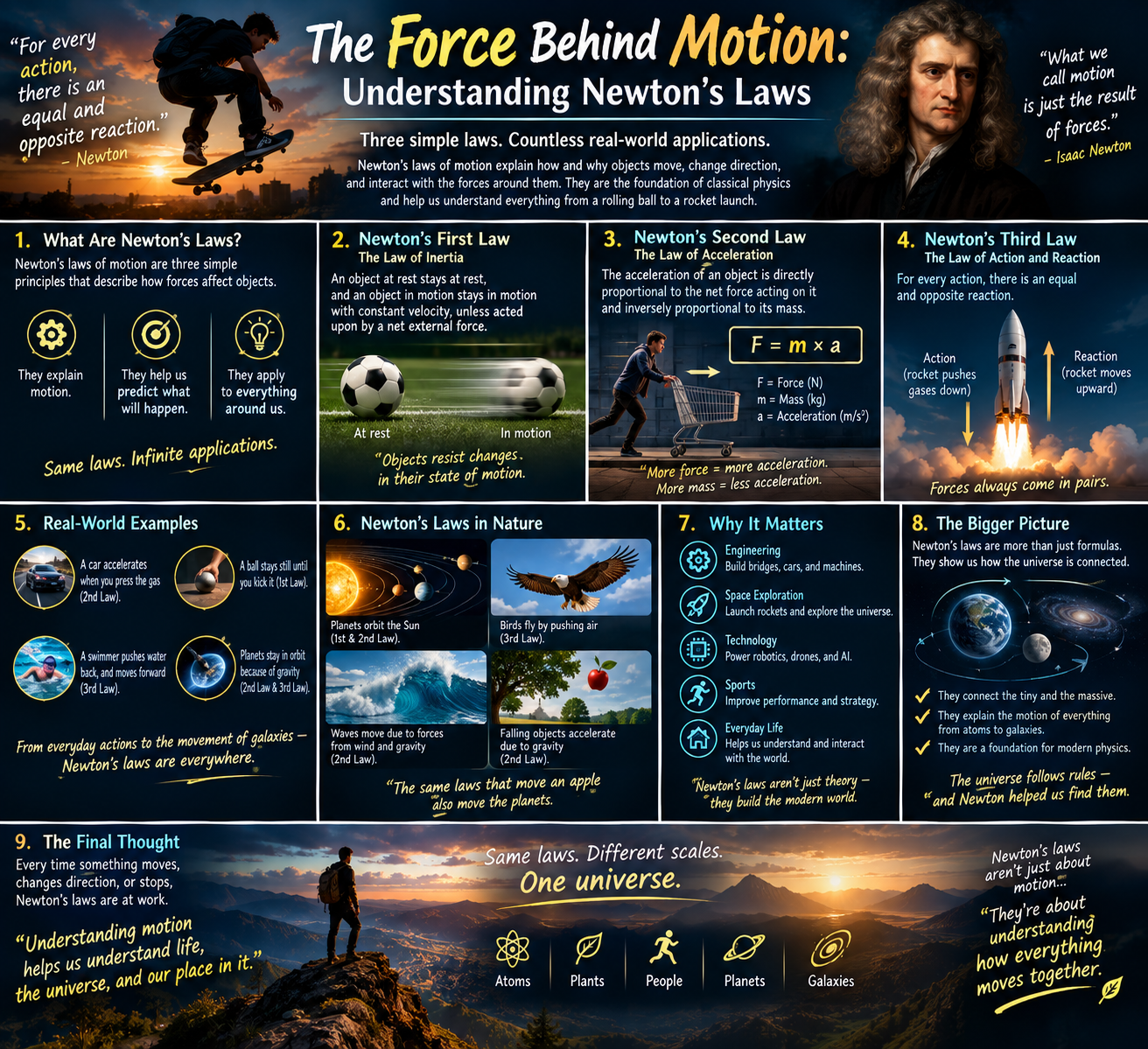
    # The Force Behind Motion: Understanding Newton’s Laws

    Imagine watching a football fly through the air , a car accelerate down a road , a rocket launch into space , or planets orbiting a star .

    These events may appear completely different—but beneath them is the same fundamental idea:

    ## **Forces control motion.**

    More than three centuries ago, **Isaac Newton** developed three laws that transformed our understanding of how objects move and interact. These laws became the foundation of classical mechanics and remain essential to physics, engineering, astronomy, and countless technologies today.

    ---

    # 1. What Are Newton's Laws?

    Newton's three laws describe the relationship between:

    **Force**
    **Mass**
    **Acceleration**
    **Motion**

    Together, they help us explain why objects remain still, why they accelerate, and how forces interact.

    From a rolling ball to a spacecraft , the same fundamental principles apply.

    ### **Three simple laws. Infinite applications.**

    ---

    # 2. Newton's First Law — The Law of Inertia

    Newton's First Law states that an object at rest remains at rest, while an object in motion continues moving at constant velocity unless acted upon by a net external force.

    This property is called **inertia**.

    Imagine a football sitting on the ground.

    It stays there until you kick it.

    Once moving, it won't naturally change its motion unless another force acts on it—such as friction, air resistance, or another object.

    A car requires braking to stop.
    A ball slows because of friction.
    Objects in space can continue moving with very little resistance.

    ### **Objects resist changes in their state of motion.**

    ---

    # 3. Newton's Second Law — The Law of Acceleration

    The second law explains how force changes motion.

    Its famous equation is:

    # **F = m × a**

    Where:

    **F** = Force
    **m** = Mass
    **a** = Acceleration

    This means that increasing the net force on an object generally increases its acceleration, while increasing the object's mass makes the same force produce less acceleration.

    Imagine pushing an empty shopping cart .

    It accelerates easily.

    Now fill it with heavy objects.

    The same push produces less acceleration.

    ### **More net force → more acceleration.**

    ### **More mass → less acceleration for the same force.**

    This simple relationship powers everything from vehicle design to rocket engineering .

    ---

    # 4. Newton's Third Law — Action and Reaction

    Newton's Third Law states:

    ### **For every action, there is an equal and opposite reaction.**

    Forces always occur through interactions between objects.

    Consider a rocket.

    The engine pushes hot gases downward and backward.

    The gases exert an equal and opposite force on the rocket, pushing it upward.

    The same principle appears everywhere:

    A swimmer pushes water backward → the water pushes the swimmer forward.
    A bird pushes air downward → the air helps push the bird upward.
    You push the ground backward → the ground pushes you forward.

    ### **Forces come in pairs.**

    ---

    # 5. Newton's Laws in Everyday Life

    You don't need a laboratory to see Newton's laws.

    They are happening around you constantly.

    **Cars:** Engine force changes speed and direction.
    **Sports:** Kicking a ball changes its motion.
    **Swimming:** Pushing water creates forward motion.
    **Cycling:** Pedaling produces forces that accelerate the bicycle.
    **Falling objects:** Gravity changes their motion.
    **Skateboards:** Pushing against the ground creates movement.

    Everyday motion is essentially a continuous interaction between forces.

    ---

    # 6. Newton's Laws in Nature

    Newton's laws don't stop at Earth.

    They also help describe motion throughout the universe.

    Planets orbit stars.
    Moons orbit planets.
    Comets travel through space.
    Waves respond to forces.
    Birds generate lift through interactions with air.
    Objects accelerate under gravity.

    The same physics that explains a falling apple can help describe the motion of enormous celestial bodies.

    ### **From apples to planets, the same laws operate across nature.**

    ---

    # 7. Why Newton's Laws Matter

    Newton's laws are more than equations in a textbook.

    They are essential tools for understanding and designing the physical world.

    **Engineering** — bridges, buildings, vehicles, and machines
    **Space exploration** — rockets, spacecraft, and orbital motion
    **Technology** — robots, drones, and automated systems
    **Sports science** — movement, speed, and performance
    **Transportation** — cars, aircraft, and trains

    Modern technology depends heavily on our ability to predict how forces produce motion.

    ---

    # 8. The Bigger Picture

    Newton's laws reveal something remarkable:

    The universe is not simply a collection of random movements.

    Objects interact through measurable forces.

    From microscopic particles to massive planets and galaxies , physics provides mathematical relationships that help us understand motion.

    The scale may change.

    The objects may change.

    But the underlying principles remain incredibly powerful.

    ### **Tiny or massive. Fast or slow. Earth or space. Motion follows physical laws.**

    ---

    # 9. The Final Thought

    Every time something moves…

    Every time something accelerates…

    Every time something changes direction…

    **Newton's laws are there.**

    A skateboard rolling down a street
    A bird taking flight
    A rocket leaving Earth
    A planet orbiting the Sun

    Different events.

    Different scales.

    One underlying framework.

    ## **Same laws. Different scales. One universe.**

    Understanding motion isn't just about solving equations.

    It's about understanding **how the physical world moves, interacts, and holds together.**

    ### **Once you understand the forces behind motion, the world around you begins to move in a whole new way.**


    Asma Shaheen EducationWali
    Saima Empowerment Wali
    Mishaal TrainingWali
    #rsisb Roll No 253 Foundation Level Story Post 23 # ⚡🌌 The Force Behind Motion: Understanding Newton’s Laws Imagine watching a football fly through the air ⚽, a car accelerate down a road 🚗💨, a rocket launch into space 🚀, or planets orbiting a star 🪐✨. These events may appear completely different—but beneath them is the same fundamental idea: ## **Forces control motion.** ⚡🧲 More than three centuries ago, **Isaac Newton** developed three laws that transformed our understanding of how objects move and interact. These laws became the foundation of classical mechanics and remain essential to physics, engineering, astronomy, and countless technologies today. 🔬⚙️🌍 --- # 🧠⚡ 1. What Are Newton's Laws? Newton's three laws describe the relationship between: ⚡ **Force** 🧱 **Mass** 💨 **Acceleration** 🏃 **Motion** Together, they help us explain why objects remain still, why they accelerate, and how forces interact. From a rolling ball 🎾 to a spacecraft 🚀, the same fundamental principles apply. ### **Three simple laws. Infinite applications.** 🌌 --- # 🛑➡️ 2. Newton's First Law — The Law of Inertia Newton's First Law states that an object at rest remains at rest, while an object in motion continues moving at constant velocity unless acted upon by a net external force. This property is called **inertia**. 🧱⚡ Imagine a football sitting on the ground. ⚽ It stays there until you kick it. Once moving, it won't naturally change its motion unless another force acts on it—such as friction, air resistance, or another object. 🚗 A car requires braking to stop. ⚽ A ball slows because of friction. 🛰️ Objects in space can continue moving with very little resistance. ### **Objects resist changes in their state of motion.** --- # 💨⚙️ 3. Newton's Second Law — The Law of Acceleration The second law explains how force changes motion. Its famous equation is: # **F = m × a** ⚡ Where: **F** = Force 🧲 **m** = Mass ⚖️ **a** = Acceleration 💨 This means that increasing the net force on an object generally increases its acceleration, while increasing the object's mass makes the same force produce less acceleration. Imagine pushing an empty shopping cart 🛒. It accelerates easily. Now fill it with heavy objects. The same push produces less acceleration. ### **More net force → more acceleration.** ### **More mass → less acceleration for the same force.** This simple relationship powers everything from vehicle design 🚗 to rocket engineering 🚀. --- # 🚀🔥 4. Newton's Third Law — Action and Reaction Newton's Third Law states: ### **For every action, there is an equal and opposite reaction.** ⚡ Forces always occur through interactions between objects. Consider a rocket. 🚀 The engine pushes hot gases downward and backward. The gases exert an equal and opposite force on the rocket, pushing it upward. ⬆️🔥 The same principle appears everywhere: 🏊 A swimmer pushes water backward → the water pushes the swimmer forward. 🦅 A bird pushes air downward → the air helps push the bird upward. 🚶 You push the ground backward → the ground pushes you forward. ### **Forces come in pairs.** 🔗⚡ --- # 🌍⚽ 5. Newton's Laws in Everyday Life You don't need a laboratory to see Newton's laws. They are happening around you constantly. 🚗 **Cars:** Engine force changes speed and direction. ⚽ **Sports:** Kicking a ball changes its motion. 🏊 **Swimming:** Pushing water creates forward motion. 🚲 **Cycling:** Pedaling produces forces that accelerate the bicycle. 🍎 **Falling objects:** Gravity changes their motion. 🛹 **Skateboards:** Pushing against the ground creates movement. Everyday motion is essentially a continuous interaction between forces. --- # 🌌🪐 6. Newton's Laws in Nature Newton's laws don't stop at Earth. They also help describe motion throughout the universe. 🌌 🪐 Planets orbit stars. 🌙 Moons orbit planets. ☄️ Comets travel through space. 🌊 Waves respond to forces. 🦅 Birds generate lift through interactions with air. 🍎 Objects accelerate under gravity. The same physics that explains a falling apple can help describe the motion of enormous celestial bodies. ### **From apples to planets, the same laws operate across nature.** 🍎➡️🪐 --- # ⚙️🚀 7. Why Newton's Laws Matter Newton's laws are more than equations in a textbook. They are essential tools for understanding and designing the physical world. 🏗️ **Engineering** — bridges, buildings, vehicles, and machines 🚀 **Space exploration** — rockets, spacecraft, and orbital motion 🤖 **Technology** — robots, drones, and automated systems 🏃 **Sports science** — movement, speed, and performance 🚗 **Transportation** — cars, aircraft, and trains Modern technology depends heavily on our ability to predict how forces produce motion. --- # 🌌🔭 8. The Bigger Picture Newton's laws reveal something remarkable: The universe is not simply a collection of random movements. Objects interact through measurable forces. ⚛️🧲 From microscopic particles 🔬 to massive planets 🪐 and galaxies 🌌, physics provides mathematical relationships that help us understand motion. The scale may change. The objects may change. But the underlying principles remain incredibly powerful. ### **Tiny or massive. Fast or slow. Earth or space. Motion follows physical laws.** ⚡🌍🌌 --- # 🌅⚡ 9. The Final Thought Every time something moves… Every time something accelerates… Every time something changes direction… **Newton's laws are there.** 🧠⚡ A skateboard rolling down a street 🛹 A bird taking flight 🦅 A rocket leaving Earth 🚀 A planet orbiting the Sun ☀️🪐 Different events. Different scales. One underlying framework. ## 🌌 **Same laws. Different scales. One universe.** Understanding motion isn't just about solving equations. It's about understanding **how the physical world moves, interacts, and holds together.** ⚛️🌍✨ ### **Once you understand the forces behind motion, the world around you begins to move in a whole new way.** ⚡🔬🌌 Asma Shaheen EducationWali Saima Empowerment Wali Mishaal TrainingWali
    0 Comentários 0 Compartilhamentos 4525 Visualizações
Páginas impulsionada