• **Story Post | Day 160**
    **Foundation Level**
    **Roll No: 01**
    **Rehan School | Urdu Bazar Campus**

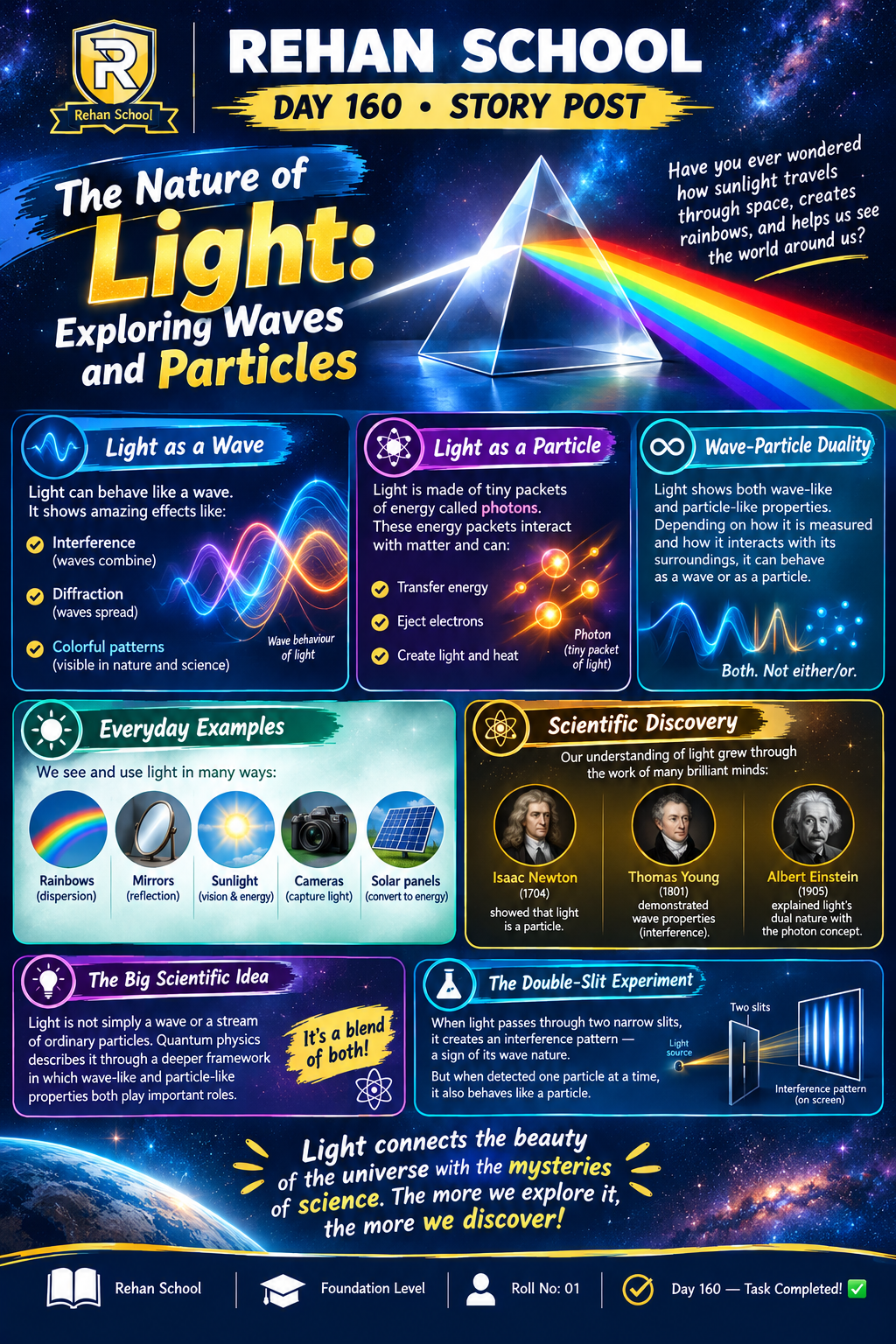
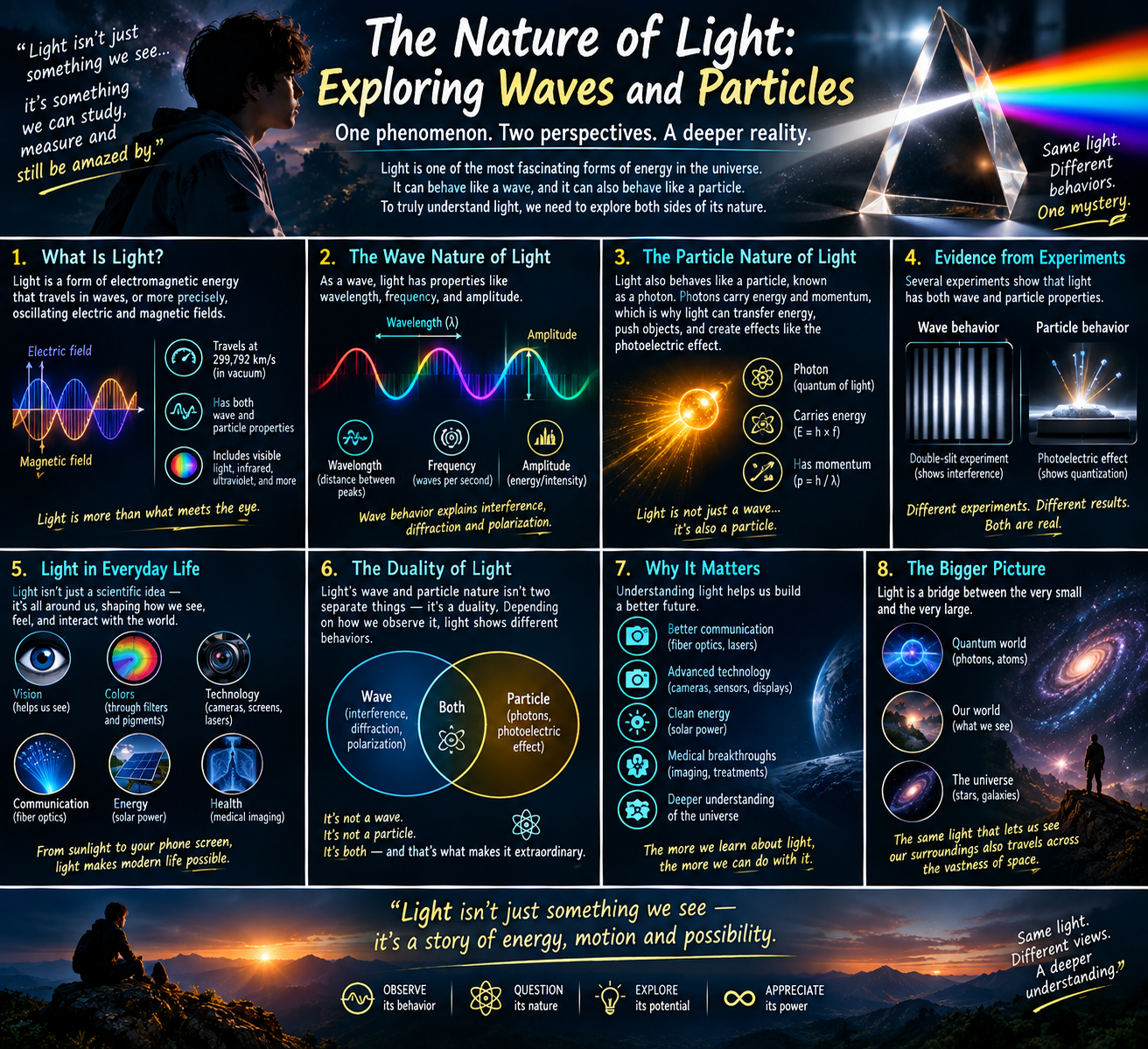
    **The Nature of Light: Exploring Waves and Particles**

    Light is one of the most fascinating wonders of science! Through this task, I learned how light behaves like both a wave and a particle, and how photons help us understand its amazing properties.

    From colorful rainbows and reflections to cameras and solar panels, light plays an important role in our everyday lives. The discoveries of Isaac Newton, Thomas Young, and Albert Einstein helped us understand light in new and exciting ways.

    **Learning about light reminds us that curiosity and scientific exploration can reveal the hidden wonders of our universe!**

    **Rehan School | Day 160 — Task Completed! **

    #RehanSchool #UrduBazarCampus #Day160 #StoryPost #FoundationLevel #RollNo01 #Physics #NatureOfLight #ScienceEducation #KeepLearning
    📖 **Story Post | Day 160** 📚 **Foundation Level** 🔢 **Roll No: 01** 🏫 **Rehan School | Urdu Bazar Campus** 🌈 **The Nature of Light: Exploring Waves and Particles** Light is one of the most fascinating wonders of science! ✨ Through this task, I learned how light behaves like both a wave and a particle, and how photons help us understand its amazing properties. 🔬 From colorful rainbows and reflections to cameras and solar panels, light plays an important role in our everyday lives. The discoveries of Isaac Newton, Thomas Young, and Albert Einstein helped us understand light in new and exciting ways. 🌌 💡 **Learning about light reminds us that curiosity and scientific exploration can reveal the hidden wonders of our universe!** 🎓 **Rehan School | Day 160 — Task Completed! ✅** #RehanSchool #UrduBazarCampus #Day160 #StoryPost #FoundationLevel #RollNo01 #Physics #NatureOfLight #ScienceEducation #KeepLearning
    0 Comentários 0 Compartilhamentos 587 Visualizações
  • RSIF8
    Roll no:14
    story no:24
    story topic:The Nature of Light: Exploring Waves and Particles

    **The Nature of Light: Exploring Waves and Particles**

    Have you ever wondered what light really is? How does sunlight travel across millions of kilometers through space, how do rainbows form, and how can light behave like both a wave and a particle? The nature of light is one of the most fascinating topics in physics, revealing the extraordinary connection between the visible world and the mysterious laws of quantum mechanics. From the light that illuminates our homes to the distant stars shining in the universe, light plays an essential role in understanding the world around us.

    **1. The Wave Nature of Light **

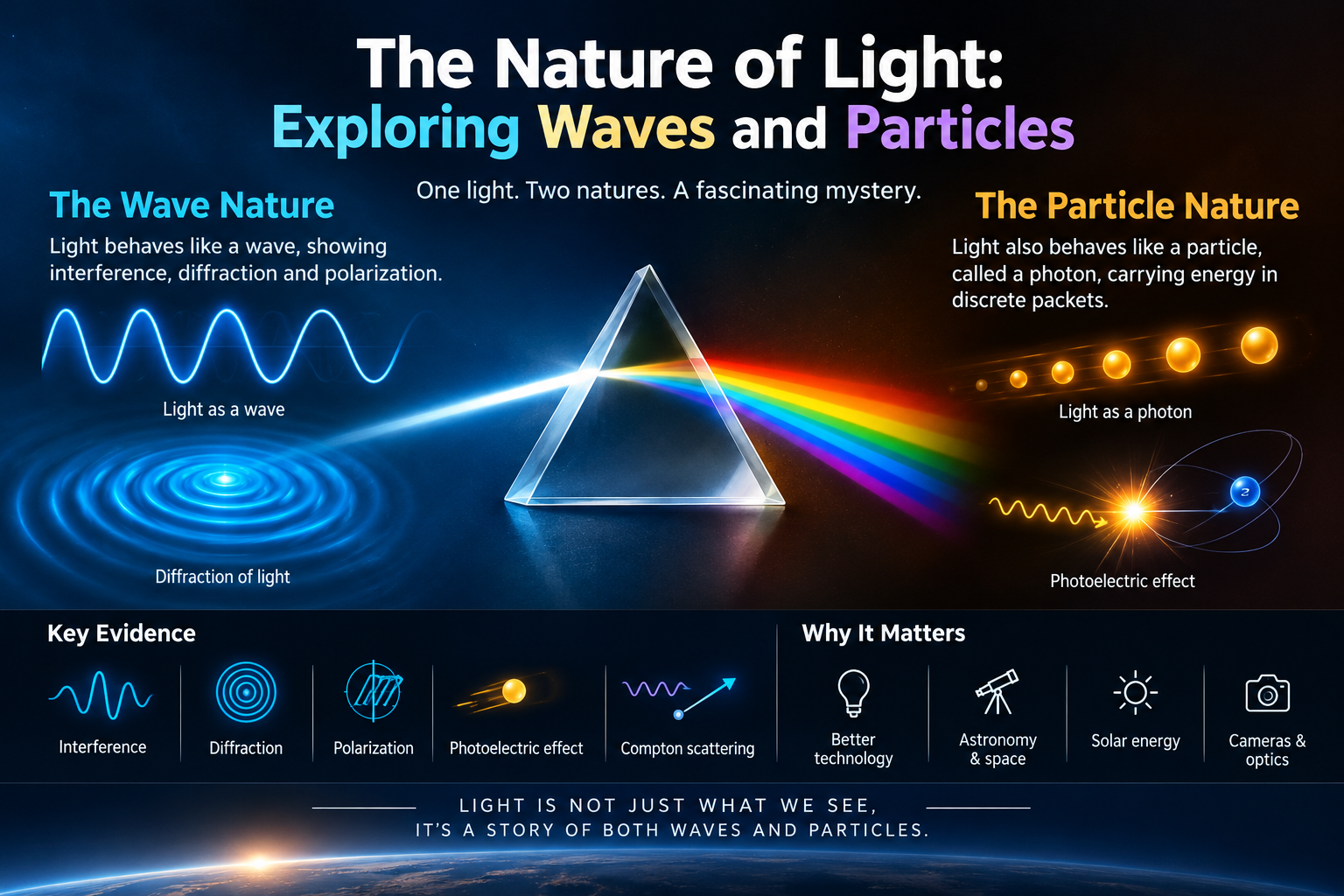
    For many years, scientists have studied light as a wave because it demonstrates important wave-like properties. Light can undergo interference, diffraction, and polarization. Interference occurs when light waves overlap and combine, producing patterns of brightness and darkness. Diffraction happens when light spreads around an obstacle or passes through a narrow opening. Polarization describes the orientation of light's oscillations and helps us understand how light interacts with different materials.

    These properties demonstrate that the wave model is essential for explaining many optical phenomena. From colorful patterns created by thin films to the operation of polarized sunglasses, the wave nature of light has many applications in everyday life and modern technology.

    **2. The Particle Nature of Light **

    Light also behaves in ways that reveal its particle nature. In quantum physics, light energy is exchanged in discrete packets called **photons**. Each photon carries energy determined by its frequency, described by the equation **E = hf**, where E represents energy, h is Planck's constant, and f is frequency.

    The photoelectric effect provides important evidence for this particle nature. When light of a suitable frequency strikes certain materials, it can release electrons from their surfaces. This phenomenon helped scientists understand that light energy is transferred in individual quanta rather than always behaving like a continuous wave.

    Another important example is Compton scattering, in which photons exchange energy and momentum with electrons. These discoveries transformed our understanding of light and helped establish the foundations of quantum physics.

    **3. Wave-Particle Duality: Two Sides of Light**

    One of the most remarkable discoveries in science is that light cannot be fully explained by treating it only as a classical wave or only as a classical particle. Its behavior depends on the physical process being investigated and how it is measured. This concept is known as **wave-particle duality**.

    Experiments involving interference reveal wave-like patterns, while experiments involving photon detection show that light energy is detected in discrete units. Quantum mechanics brings these observations together into a more complete description of nature. Rather than being an ordinary wave or a tiny classical object, light is a quantum phenomenon with properties that challenge our everyday intuition.

    **4. How Do We Discover the Secrets of Light?**

    Scientists use carefully designed experiments to explore the behavior of light. Prisms separate white light into different colors, optical instruments measure its properties, and advanced detectors record individual photons. Interference experiments reveal patterns that cannot be explained by simple particle models, while photoelectric experiments demonstrate the importance of quantized energy.

    The work of scientists such as Isaac Newton, Thomas Young, Max Planck, Albert Einstein, and Arthur Compton helped build our modern understanding of light. Their discoveries show how scientific knowledge develops through observation, experimentation, mathematical reasoning, and new ideas.

    **5. Why Is the Nature of Light Important?**

    Understanding light is essential to many technologies that shape modern life. Lasers are used in medicine, manufacturing, and scientific research. Fiber-optic cables transmit information across the world using pulses of light. Solar panels convert light energy into electrical energy, while cameras and telescopes help us capture images and explore distant objects in space.

    The principles of light are also important in astronomy, microscopy, optical communication, quantum technologies, and the study of the universe. By investigating how light behaves, scientists can examine distant galaxies, study the structure of matter, and develop new tools that improve our understanding of nature.

    **6. Light: Connecting Science and the Universe**

    Light is much more than what allows us to see. It carries information about distant stars, reveals the composition of celestial objects, and provides clues about the physical processes occurring throughout the cosmos. By analyzing the light received from distant galaxies, astronomers can learn about their temperatures, chemical compositions, and motion.

    At the smallest scales, the study of photons helps scientists investigate the quantum world and understand how energy interacts with matter. From the smallest laboratory experiments to the largest astronomical observations, light connects different areas of science in extraordinary ways.

    **Conclusion: The Extraordinary Mystery of Light**

    The study of light demonstrates how nature can be far more complex than it first appears. Its wave-like properties explain interference, diffraction, and polarization, while its particle-like properties help explain the photoelectric effect and Compton scattering. Together, these discoveries form an important part of our modern understanding of physics.

    Learning about wave-particle duality encourages us to question assumptions, explore scientific evidence, and appreciate the discoveries that continue to expand human knowledge. Every beam of sunlight, every shining star, and every photon detected by a scientific instrument reminds us that there is still much to discover about the universe.

    **Light Is More Than What We See—It Is a Window into the Fundamental Nature of Reality!**

    If you enjoyed this science topic, share it with others and continue exploring the fascinating world of physics. Stay curious, keep asking questions, and never stop learning!

    #NatureOfLight #WaveParticleDuality #Physics #QuantumPhysics #ScienceEducation #Photons #LightWaves #PhotoelectricEffect #ComptonScattering #Optics #Astronomy #ScientificDiscoveries #STEMEducation #LearnPhysics #ScienceExplained #EducationalContent #WavesAndParticles
    RSIF8 Roll no:14 story no:24 story topic:The Nature of Light: Exploring Waves and Particles 🌟 **The Nature of Light: Exploring Waves and Particles** 🌈🔬 Have you ever wondered what light really is? How does sunlight travel across millions of kilometers through space, how do rainbows form, and how can light behave like both a wave and a particle? The nature of light is one of the most fascinating topics in physics, revealing the extraordinary connection between the visible world and the mysterious laws of quantum mechanics. From the light that illuminates our homes to the distant stars shining in the universe, light plays an essential role in understanding the world around us. 🌍✨ 💡 **1. The Wave Nature of Light 🌊** For many years, scientists have studied light as a wave because it demonstrates important wave-like properties. Light can undergo interference, diffraction, and polarization. Interference occurs when light waves overlap and combine, producing patterns of brightness and darkness. Diffraction happens when light spreads around an obstacle or passes through a narrow opening. Polarization describes the orientation of light's oscillations and helps us understand how light interacts with different materials. These properties demonstrate that the wave model is essential for explaining many optical phenomena. From colorful patterns created by thin films to the operation of polarized sunglasses, the wave nature of light has many applications in everyday life and modern technology. ⚛️ **2. The Particle Nature of Light ✨** Light also behaves in ways that reveal its particle nature. In quantum physics, light energy is exchanged in discrete packets called **photons**. Each photon carries energy determined by its frequency, described by the equation **E = hf**, where E represents energy, h is Planck's constant, and f is frequency. The photoelectric effect provides important evidence for this particle nature. When light of a suitable frequency strikes certain materials, it can release electrons from their surfaces. This phenomenon helped scientists understand that light energy is transferred in individual quanta rather than always behaving like a continuous wave. Another important example is Compton scattering, in which photons exchange energy and momentum with electrons. These discoveries transformed our understanding of light and helped establish the foundations of quantum physics. 🔬 **3. Wave-Particle Duality: Two Sides of Light** One of the most remarkable discoveries in science is that light cannot be fully explained by treating it only as a classical wave or only as a classical particle. Its behavior depends on the physical process being investigated and how it is measured. This concept is known as **wave-particle duality**. Experiments involving interference reveal wave-like patterns, while experiments involving photon detection show that light energy is detected in discrete units. Quantum mechanics brings these observations together into a more complete description of nature. Rather than being an ordinary wave or a tiny classical object, light is a quantum phenomenon with properties that challenge our everyday intuition. 🌈 **4. How Do We Discover the Secrets of Light?** Scientists use carefully designed experiments to explore the behavior of light. Prisms separate white light into different colors, optical instruments measure its properties, and advanced detectors record individual photons. Interference experiments reveal patterns that cannot be explained by simple particle models, while photoelectric experiments demonstrate the importance of quantized energy. The work of scientists such as Isaac Newton, Thomas Young, Max Planck, Albert Einstein, and Arthur Compton helped build our modern understanding of light. Their discoveries show how scientific knowledge develops through observation, experimentation, mathematical reasoning, and new ideas. 🚀 **5. Why Is the Nature of Light Important?** Understanding light is essential to many technologies that shape modern life. Lasers are used in medicine, manufacturing, and scientific research. Fiber-optic cables transmit information across the world using pulses of light. Solar panels convert light energy into electrical energy, while cameras and telescopes help us capture images and explore distant objects in space. The principles of light are also important in astronomy, microscopy, optical communication, quantum technologies, and the study of the universe. By investigating how light behaves, scientists can examine distant galaxies, study the structure of matter, and develop new tools that improve our understanding of nature. 🌍 **6. Light: Connecting Science and the Universe** Light is much more than what allows us to see. It carries information about distant stars, reveals the composition of celestial objects, and provides clues about the physical processes occurring throughout the cosmos. By analyzing the light received from distant galaxies, astronomers can learn about their temperatures, chemical compositions, and motion. At the smallest scales, the study of photons helps scientists investigate the quantum world and understand how energy interacts with matter. From the smallest laboratory experiments to the largest astronomical observations, light connects different areas of science in extraordinary ways. 💫 **Conclusion: The Extraordinary Mystery of Light** The study of light demonstrates how nature can be far more complex than it first appears. Its wave-like properties explain interference, diffraction, and polarization, while its particle-like properties help explain the photoelectric effect and Compton scattering. Together, these discoveries form an important part of our modern understanding of physics. Learning about wave-particle duality encourages us to question assumptions, explore scientific evidence, and appreciate the discoveries that continue to expand human knowledge. Every beam of sunlight, every shining star, and every photon detected by a scientific instrument reminds us that there is still much to discover about the universe. ✨ **Light Is More Than What We See—It Is a Window into the Fundamental Nature of Reality!** 🔭🌌 👍 If you enjoyed this science topic, share it with others and continue exploring the fascinating world of physics. Stay curious, keep asking questions, and never stop learning! #NatureOfLight #WaveParticleDuality #Physics #QuantumPhysics #ScienceEducation #Photons #LightWaves #PhotoelectricEffect #ComptonScattering #Optics #Astronomy #ScientificDiscoveries #STEMEducation #LearnPhysics #ScienceExplained #EducationalContent #WavesAndParticles 🌈🔬🚀
    0 Comentários 0 Compartilhamentos 4506 Visualizações
  • Untitled recording - 2026-10-19T225537.151RSIF 8Roll no 93Short documentary no 11Task topic: Journey Through the Solar System. **Journey Through the Solar System | Documentary**Join me on an exciting journey through our Solar System! Discover the Sun, explore all eight planets, and learn about the wonders of space, including moons, asteroids, comets, and dwarf planets. From Mercury to Neptune, every planet has its own unique features and mysteries. This documentary will help you explore our cosmic neighborhood and discover how amazing our universe is! **Keep exploring, keep learning, and never stop discovering!** Watch, like, share, and comment on my documentary!#JourneyThroughTheSolarSystem #SolarSystem #SpaceExploration #Planets #Astronomy #Science #EducationalDocumentary #Universe #SpaceLovers #Learning
    Untitled recording - 2026-10-19T225537.151RSIF 8Roll no 93Short documentary no 11Task topic: Journey Through the Solar System.🌌🚀 **Journey Through the Solar System | Documentary**Join me on an exciting journey through our Solar System! Discover the Sun, explore all eight planets, and learn about the wonders of space, including moons, asteroids, comets, and dwarf planets. 🌍🪐✨ From Mercury to Neptune, every planet has its own unique features and mysteries. This documentary will help you explore our cosmic neighborhood and discover how amazing our universe is!🔭 **Keep exploring, keep learning, and never stop discovering!**📢 Watch, like, share, and comment on my documentary!#JourneyThroughTheSolarSystem #SolarSystem #SpaceExploration #Planets #Astronomy #Science #EducationalDocumentary #Universe #SpaceLovers #Learning 🚀🌎
    0 Comentários 0 Compartilhamentos 1326 Visualizações
  • RSIF8
    ROLL NO 77
    SHOURT DOCUMENTARY NO 11
    SHOURT DOCUMENTARY TOPIC "Journey Through the Solar System".

    **Journey Through the Solar System**

    Get ready for an amazing adventure through space! Explore the eight incredible planets, discover the mysteries of the Sun, travel past Saturn’s beautiful rings, and learn fascinating facts about our cosmic neighborhood.

    From the scorching surface of Mercury to the icy world of Neptune, every planet has a unique story to tell!

    **The universe is full of wonders waiting to be discovered!** Keep exploring, keep learning, and always reach for the stars!

    Don't forget to like, share, and follow for more exciting educational content!

    \#SolarSystem #JourneyThroughTheSolarSystem #SpaceExploration #Planets #Astronomy #ScienceEducation #SpaceFacts #Universe #LearnWithFun #EducationalContent #ExploreSpace #KnowledgeIsPower
    RSIF8 ROLL NO 77 SHOURT DOCUMENTARY NO 11 SHOURT DOCUMENTARY TOPIC "Journey Through the Solar System". 🚀🌌 **Journey Through the Solar System** 🪐✨ Get ready for an amazing adventure through space! 🌍☀️ Explore the eight incredible planets, discover the mysteries of the Sun, travel past Saturn’s beautiful rings, and learn fascinating facts about our cosmic neighborhood. 🌠🔭 From the scorching surface of Mercury to the icy world of Neptune, every planet has a unique story to tell! 🪐💫 🌟 **The universe is full of wonders waiting to be discovered!** Keep exploring, keep learning, and always reach for the stars! 🚀🌌 💙 Don't forget to like, share, and follow for more exciting educational content! 📚✨ \#SolarSystem #JourneyThroughTheSolarSystem #SpaceExploration #Planets #Astronomy #ScienceEducation #SpaceFacts #Universe #LearnWithFun #EducationalContent #ExploreSpace #KnowledgeIsPower 🚀🌍🪐🌟
    0 Comentários 0 Compartilhamentos 1603 Visualizações 23
  • #rsisb
    Roll no. 247
    Story post . 25
    Foundation level

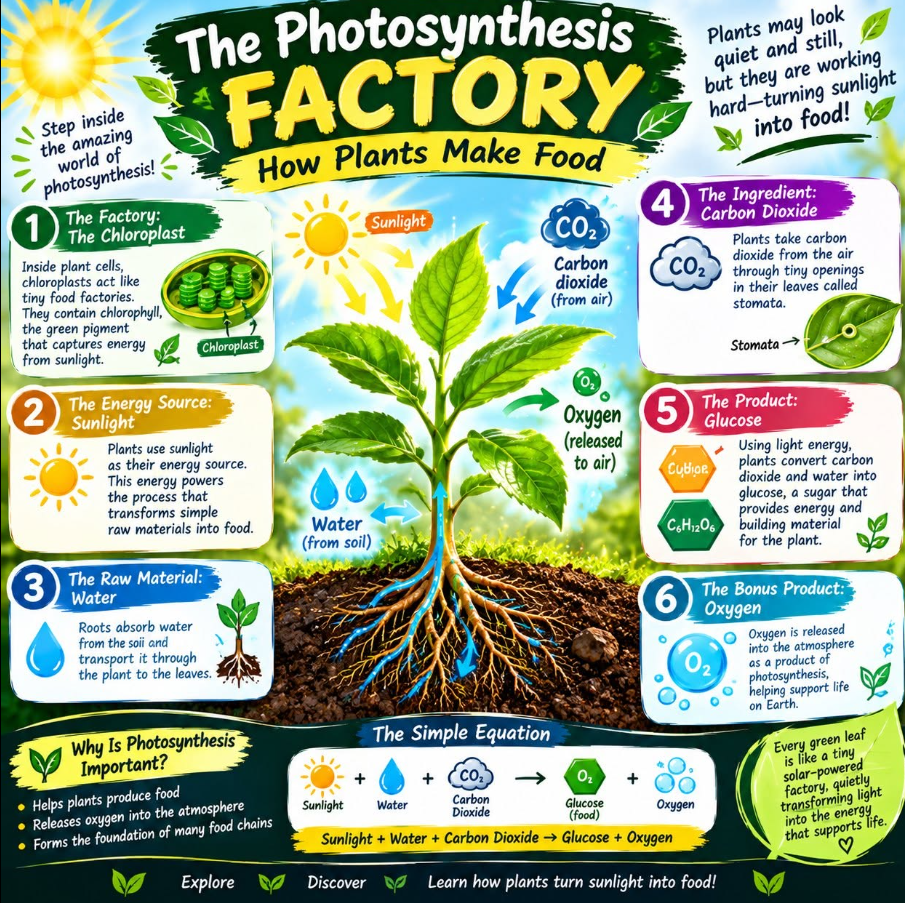
    **The Photosynthesis Factory: How Plants Make Food **

    Welcome to the amazing world of plants! Have you ever wondered how plants make their own food without going to a kitchen or a grocery store? The answer is **PHOTOSYNTHESIS!**

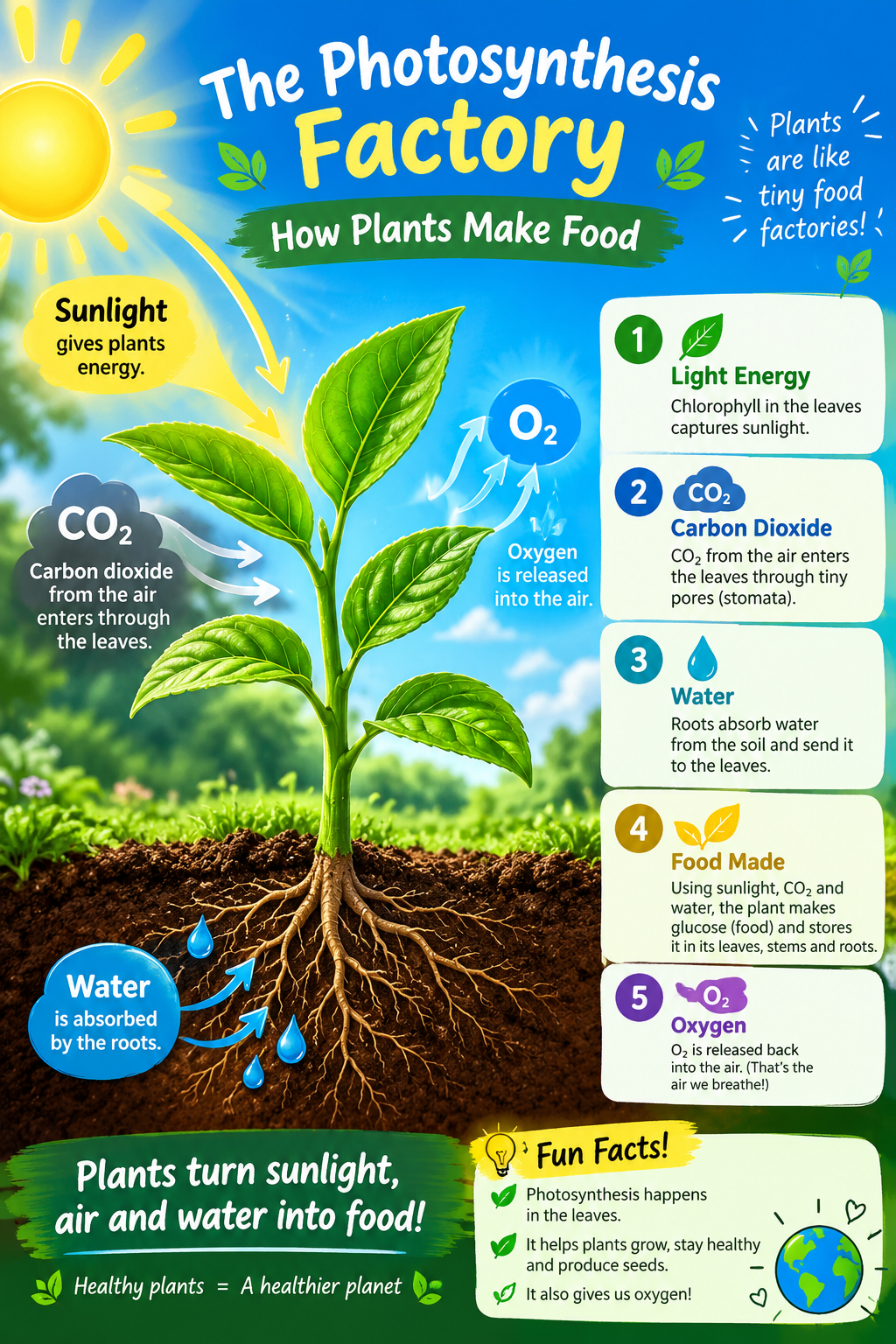
    Imagine every green plant as a tiny natural food factory! The leaves work like solar-powered machines, using sunlight , water , and carbon dioxide (CO₂) from the air to produce glucose, a type of sugar that provides energy for the plant. During this amazing process, plants also release oxygen (O₂) into the air, which humans and many other living things need to breathe!

    **How Does the Photosynthesis Factory Work?**

    **Step 1: Sunlight — The Power Source!**
    Sunlight provides the energy plants need to make their food.

    **Step 2: Water — The Essential Ingredient!**
    Plants absorb water from the soil through their roots.

    **Step 3: Carbon Dioxide — From the Air!**
    Plants take in carbon dioxide through tiny openings in their leaves called stomata.

    **Step 4: Chlorophyll — The Green Magic!**
    Chlorophyll is the green pigment in leaves that absorbs light energy.

    **Step 5: Making Food!**
    Using light energy, plants turn water and carbon dioxide into glucose, which they use for energy and growth. They also release oxygen!

    **Why Is Photosynthesis Important?**

    Plants provide food for people and animals.
    They release oxygen that supports life on Earth.
    They help remove carbon dioxide from the atmosphere.
    They support food chains and healthy ecosystems.
    They help keep our planet green, beautiful, and full of life!

    Isn't nature incredible? Every green leaf is part of a wonderful living factory that helps support life on Earth. The next time you see a tree, a flower, or a little green plant, remember the amazing science happening inside its leaves!

    **Today's Science Fact:** Photosynthesis shows us how plants use sunlight to make their own food and help sustain life on our planet!

    **Protect plants, grow more trees, save nature, and keep our planet green!** Every plant matters!

    Like , Share , and Comment : What is your favorite plant, and why do you love it?

    #Photosynthesis #PhotosynthesisFactory #HowPlantsMakeFood #PlantScience #ScienceForKids #LearnScience #Biology #NatureLovers #GreenPlanet #PlantLife #ScienceEducation #AmazingNature #SaveTrees #ProtectNature #EnvironmentalAwareness #STEMEducation #EducationalPost #DiscoverScience #GreenEarth #KeepLearning
    #rsisb Roll no. 247 Story post . 25 Foundation level 🌿🏭 **The Photosynthesis Factory: How Plants Make Food 🌱☀️** 🌍💚 Welcome to the amazing world of plants! Have you ever wondered how plants make their own food without going to a kitchen or a grocery store? 🤔🌿 The answer is **PHOTOSYNTHESIS!** 🌞🍃 🏭🌱 Imagine every green plant as a tiny natural food factory! The leaves work like solar-powered machines, using sunlight ☀️, water 💧, and carbon dioxide (CO₂) from the air 🌬️ to produce glucose, a type of sugar that provides energy for the plant. During this amazing process, plants also release oxygen (O₂) into the air, which humans and many other living things need to breathe! 🌎💚 🔬🍃 **How Does the Photosynthesis Factory Work?** ☀️ **Step 1: Sunlight — The Power Source!** Sunlight provides the energy plants need to make their food. 🌞⚡ 💧 **Step 2: Water — The Essential Ingredient!** Plants absorb water from the soil through their roots. 🌱💦 🌬️ **Step 3: Carbon Dioxide — From the Air!** Plants take in carbon dioxide through tiny openings in their leaves called stomata. 🍃🔬 💚 **Step 4: Chlorophyll — The Green Magic!** Chlorophyll is the green pigment in leaves that absorbs light energy. 🌿✨ 🍬 **Step 5: Making Food!** Using light energy, plants turn water and carbon dioxide into glucose, which they use for energy and growth. They also release oxygen! 🌱🍬💨 🌎💚 **Why Is Photosynthesis Important?** 🌳 Plants provide food for people and animals. 💨 They release oxygen that supports life on Earth. 🌍 They help remove carbon dioxide from the atmosphere. 🍎 They support food chains and healthy ecosystems. 🌿 They help keep our planet green, beautiful, and full of life! 🤩🌱 Isn't nature incredible? Every green leaf is part of a wonderful living factory that helps support life on Earth. The next time you see a tree, a flower, or a little green plant, remember the amazing science happening inside its leaves! 🌳🔬☀️ 💡 **Today's Science Fact:** Photosynthesis shows us how plants use sunlight to make their own food and help sustain life on our planet! 🌱💚 **Protect plants, grow more trees, save nature, and keep our planet green!** 🌍🌳 Every plant matters! 📢 Like 👍, Share 🔄, and Comment 💬: What is your favorite plant, and why do you love it? 🌻🌵🌹 #Photosynthesis #PhotosynthesisFactory #HowPlantsMakeFood #PlantScience #ScienceForKids #LearnScience #Biology #NatureLovers #GreenPlanet #PlantLife #ScienceEducation #AmazingNature #SaveTrees #ProtectNature #EnvironmentalAwareness #STEMEducation #EducationalPost #DiscoverScience #GreenEarth #KeepLearning 🌿🌍🔬☀️💚
    0 Comentários 0 Compartilhamentos 3036 Visualizações
  • #rsisb
    Roll no.247
    Story post .9
    Foundation level


    **Stellar Stories: Navigating the Night Sky**

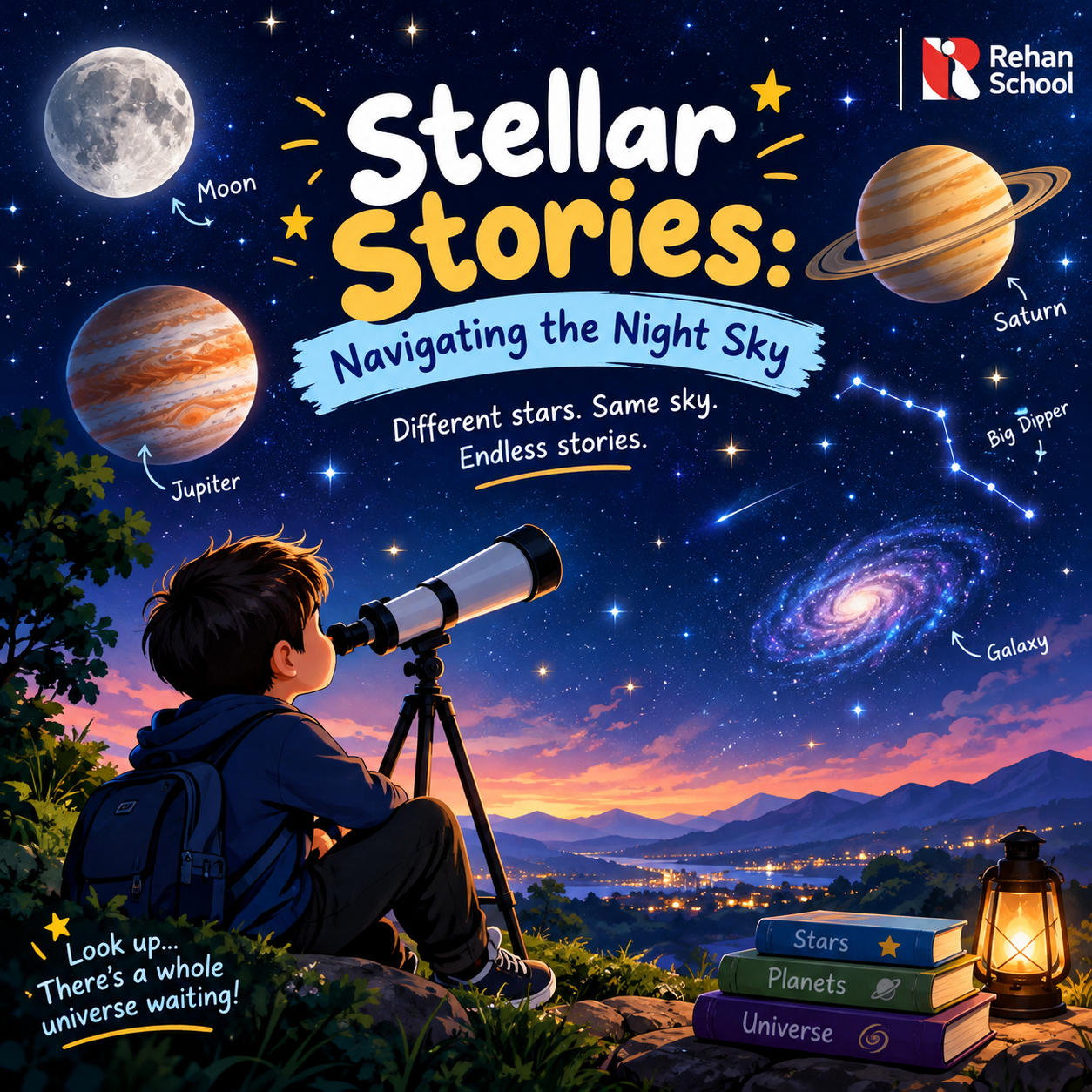
    **Welcome to Stellar Stories, where the magic of the universe comes alive!** Have you ever looked up at the night sky and wondered how many stars are shining above you? Have you ever imagined traveling through space, discovering distant planets, exploring beautiful galaxies, and learning the secrets hidden among the stars? If yes, then get ready for an amazing journey through the wonders of the cosmos!

    The night sky is like a giant storybook filled with countless stars, fascinating constellations, mysterious planets, and breathtaking galaxies. Every tiny point of light tells us something about our incredible universe. From the bright North Star to the beautiful patterns of Orion's Belt , the sky has inspired explorers, scientists, dreamers, and storytellers for thousands of years.

    **Discover the Wonders of the Night Sky!**

    **Stars:** Learn about the glowing balls of hot gas that light up the universe. Some stars are much larger than our Sun, while others are smaller and cooler. Every star has its own fascinating story!

    **Planets:** Explore the amazing worlds of our solar system, from Mercury's scorching surface to Neptune's distant, deep-blue atmosphere. Discover how planets move around the Sun and why Earth is such a special place for life.

    **Galaxies:** Imagine billions of stars gathered together in enormous cosmic cities! Our home galaxy, the Milky Way, contains stars, planets, gas, and dust, all connected by gravity. Just think about how enormous the universe really is!

    **Constellations:** Discover how people connect stars into recognizable patterns in the sky. These patterns have helped people tell stories, recognize seasons, and navigate throughout history.

    **The Moon:** Observe our closest celestial neighbor and discover why it changes appearance throughout the month. Learn about its phases, its craters, and its important role in Earth's natural systems.

    **Meteors and Comets:** Discover the spectacular streaks of light called meteors and learn about icy comets that travel through space, sometimes developing beautiful glowing tails near the Sun.

    ‍ **Become a Young Space Explorer!**

    You don't need a giant telescope or a spaceship to begin exploring the universe! You can start by looking at the night sky, learning the names of bright stars, identifying visible constellations, and observing the Moon. A simple sky map or astronomy app can help you understand what you're seeing.

    **Why Is Astronomy Important?**

    Astronomy teaches us to ask questions, observe carefully, think scientifically, and search for answers. It helps us understand Earth's place in the universe and reminds us that learning never has to stop. Every discovery begins with curiosity!

    Imagine standing beneath a sky filled with sparkling stars, wondering what exists beyond the worlds we already know. Somewhere out there, new mysteries are waiting to be explored, new discoveries are waiting to be made, and new questions are waiting for curious minds like yours!

    **Remember:** The universe is vast, beautiful, and full of wonders. Keep looking up, keep asking questions, and never stop exploring! Your next great discovery might begin with one simple question: *What's out there?*

    Let's make learning about space exciting, inspiring, and fun! Share this post with your friends and family, encourage young explorers to discover astronomy, and spread the wonder of the night sky across the world.

    **Tell us in the comments!**
    Which would you love to explore first: the Moon, Mars, Saturn's rings, or a distant galaxy?

    Like | Comment | Share | Follow for more amazing stories, educational adventures, science facts, and discoveries!

    **Stellar Stories: Every Star Has a Story, and Every Explorer Has a Question!**

    ━━━━━━━━━━━━━━━━━━━━

    **HASHTAGS**

    #StellarStories #NavigatingTheNightSky #NightSky #Astronomy #SpaceExploration #ExploreTheUniverse #Stars #Planets #Galaxies #MilkyWay #Constellations #Moon #SolarSystem #SpaceScience #ScienceForKids #YoungScientists #YoungExplorers #SpaceLovers #AstronomyForBeginners #LearnAboutSpace #EducationalContent #ScienceEducation #DiscoverTheUniverse #CosmicWonders #Universe #SpaceFacts #Stargazing #Telescope #Astrophysics #ScienceIsFun #Curiosity #KeepLearning #DreamBig #ExploreAndDiscover #KnowledgeIsPower #InspiringMinds #StoryPost #EducationalPost #CreativeLearning #SpaceAdventure #FutureAstronomers #WonderOfTheUniverse #KeepLookingUp
    #rsisb Roll no.247 Story post .9 Foundation level 🌌✨ **Stellar Stories: Navigating the Night Sky** 🌟🔭 🌠🌌 **Welcome to Stellar Stories, where the magic of the universe comes alive!** 🚀✨ Have you ever looked up at the night sky and wondered how many stars are shining above you? 🌟 Have you ever imagined traveling through space, discovering distant planets, exploring beautiful galaxies, and learning the secrets hidden among the stars? 🌍🪐🌌 If yes, then get ready for an amazing journey through the wonders of the cosmos! 🚀💫 🌙✨ The night sky is like a giant storybook filled with countless stars, fascinating constellations, mysterious planets, and breathtaking galaxies. Every tiny point of light tells us something about our incredible universe. 🌟📖 From the bright North Star ⭐ to the beautiful patterns of Orion's Belt 🌠, the sky has inspired explorers, scientists, dreamers, and storytellers for thousands of years. 🔭🌌 **Discover the Wonders of the Night Sky!** 🌟 **Stars:** Learn about the glowing balls of hot gas that light up the universe. Some stars are much larger than our Sun, while others are smaller and cooler. Every star has its own fascinating story! ☀️✨ 🪐 **Planets:** Explore the amazing worlds of our solar system, from Mercury's scorching surface to Neptune's distant, deep-blue atmosphere. Discover how planets move around the Sun and why Earth is such a special place for life. 🌍🚀 🌌 **Galaxies:** Imagine billions of stars gathered together in enormous cosmic cities! Our home galaxy, the Milky Way, contains stars, planets, gas, and dust, all connected by gravity. Just think about how enormous the universe really is! 🌠💫 ⭐ **Constellations:** Discover how people connect stars into recognizable patterns in the sky. These patterns have helped people tell stories, recognize seasons, and navigate throughout history. 🧭🌟 🌙 **The Moon:** Observe our closest celestial neighbor and discover why it changes appearance throughout the month. Learn about its phases, its craters, and its important role in Earth's natural systems. 🌕🔭 ☄️ **Meteors and Comets:** Discover the spectacular streaks of light called meteors and learn about icy comets that travel through space, sometimes developing beautiful glowing tails near the Sun. ☄️✨ 🧑‍🚀🚀 **Become a Young Space Explorer!** You don't need a giant telescope or a spaceship to begin exploring the universe! 🌌🔭 You can start by looking at the night sky, learning the names of bright stars, identifying visible constellations, and observing the Moon. A simple sky map or astronomy app can help you understand what you're seeing. 📱⭐ 🌍💡 **Why Is Astronomy Important?** Astronomy teaches us to ask questions, observe carefully, think scientifically, and search for answers. It helps us understand Earth's place in the universe and reminds us that learning never has to stop. Every discovery begins with curiosity! 🧠🔬✨ 🌠 Imagine standing beneath a sky filled with sparkling stars, wondering what exists beyond the worlds we already know. Somewhere out there, new mysteries are waiting to be explored, new discoveries are waiting to be made, and new questions are waiting for curious minds like yours! 🚀🌌 💫 **Remember:** The universe is vast, beautiful, and full of wonders. Keep looking up, keep asking questions, and never stop exploring! Your next great discovery might begin with one simple question: *What's out there?* 🌟🔭🌍 ❤️🌌 Let's make learning about space exciting, inspiring, and fun! Share this post with your friends and family, encourage young explorers to discover astronomy, and spread the wonder of the night sky across the world. 🌎🚀✨ 👇 **Tell us in the comments!** 💬 🌟 Which would you love to explore first: the Moon, Mars, Saturn's rings, or a distant galaxy? 🪐🌙🔴🌌 👍 Like | 💬 Comment | 🔄 Share | ⭐ Follow for more amazing stories, educational adventures, science facts, and discoveries! 🌌✨ **Stellar Stories: Every Star Has a Story, and Every Explorer Has a Question!** 🚀🌟 ━━━━━━━━━━━━━━━━━━━━ 🏷️ **HASHTAGS** 🌠 #StellarStories #NavigatingTheNightSky #NightSky #Astronomy #SpaceExploration #ExploreTheUniverse #Stars #Planets #Galaxies #MilkyWay #Constellations #Moon #SolarSystem #SpaceScience #ScienceForKids #YoungScientists #YoungExplorers #SpaceLovers #AstronomyForBeginners #LearnAboutSpace #EducationalContent #ScienceEducation #DiscoverTheUniverse #CosmicWonders #Universe #SpaceFacts #Stargazing #Telescope #Astrophysics #ScienceIsFun #Curiosity #KeepLearning #DreamBig #ExploreAndDiscover #KnowledgeIsPower #InspiringMinds #StoryPost #EducationalPost #CreativeLearning #SpaceAdventure #FutureAstronomers #WonderOfTheUniverse #KeepLookingUp 🌌🔭🚀✨🌟🪐🌙💫
    0 Comentários 0 Compartilhamentos 8434 Visualizações
  • Untitled design (20)RSIF 8 Roll no 93 Song no 30 Song topic: "Conservation Laws: Matter and Energy in Balance" **Song/Poem — Conservation Laws: Matter and Energy in Balance** I created this educational song/poem on **Suno.ai** with a Canva video to explore the fascinating concepts of the **Conservation of Matter and Conservation of Energy**. The song explains how matter does not simply disappear—it changes from one form to another. Water can change into ice or steam, but the matter remains part of the system. Energy also changes from one form to another. Solar energy can become heat, chemical energy, or other forms of energy, but it is not simply lost. These ideas help us understand the balance and order found in nature. Through music and creativity, this project makes science easier, more interesting, and enjoyable to learn. It shows that even complex scientific concepts can be explained through simple words, rhythm, and imagination. **Project:** Conservation Laws: Matter and Energy in Balance **Created with:** Suno.ai **Video created on:** Canva **Topic:** Science — Matter & Energy I’m excited to share this creative learning project and hope it inspires others to explore the amazing world of science! #ConservationLaws #MatterAndEnergy #ScienceSong #SunoAI #Canva #Science #Physics #Chemistry #Energy #Matter #ScienceEducation #EducationalSong #LearningThroughMusic #CreativeLearning #StudentProject #RehanSchool #RehanCodingWithAI #Education #ScienceProject #Learning #Knowledge #Technology
    Untitled design (20)RSIF 8 Roll no 93 Song no 30 Song topic: "Conservation Laws: Matter and Energy in Balance" 🎵⚡ **Song/Poem — Conservation Laws: Matter and Energy in Balance** 🌍🔬 I created this educational song/poem on **Suno.ai** with a Canva video to explore the fascinating concepts of the **Conservation of Matter and Conservation of Energy**. 🌱 The song explains how matter does not simply disappear—it changes from one form to another. Water can change into ice or steam, but the matter remains part of the system. ⚡ Energy also changes from one form to another. Solar energy can become heat, chemical energy, or other forms of energy, but it is not simply lost. These ideas help us understand the balance and order found in nature. 🎶 Through music and creativity, this project makes science easier, more interesting, and enjoyable to learn. It shows that even complex scientific concepts can be explained through simple words, rhythm, and imagination. 📚 **Project:** Conservation Laws: Matter and Energy in Balance 🎵 **Created with:** Suno.ai 🎬 **Video created on:** Canva 🌍 **Topic:** Science — Matter & Energy I’m excited to share this creative learning project and hope it inspires others to explore the amazing world of science! 🚀🔬 #ConservationLaws #MatterAndEnergy #ScienceSong #SunoAI #Canva #Science #Physics #Chemistry #Energy #Matter #ScienceEducation #EducationalSong #LearningThroughMusic #CreativeLearning #StudentProject #RehanSchool #RehanCodingWithAI #Education #ScienceProject #Learning #Knowledge #Technology
    0 Comentários 0 Compartilhamentos 2344 Visualizações
  • #rsisb
    Roll No 253
    Foundation Level
    Story Post 24

    # The Nature of Light: Exploring Waves and Particles

    Imagine standing beneath a night sky filled with stars.

    Every photon reaching your eyes has traveled across space carrying information from distant worlds. Light allows us to see, measure, communicate, explore, and understand the universe itself.

    But light is far stranger than it first appears.

    Sometimes it behaves like a **wave** .

    Sometimes it behaves like a **particle** .

    And understanding this strange dual nature changed our picture of reality forever.

    ---

    # 1. What Is Light?

    Light is a form of **electromagnetic radiation**—energy carried through oscillating electric and magnetic fields.

    In empty space, electromagnetic waves travel at approximately:

    ### **299,792 kilometers per second**

    That's the speed of light in vacuum.

    Visible light is only a small part of the electromagnetic spectrum.

    Beyond what our eyes can see are:

    Radio waves
    Microwaves
    Infrared
    Visible light
    Ultraviolet
    🩻 X-rays
    Gamma rays

    So light isn't simply what we see.

    ### **It's an enormous family of electromagnetic phenomena.**

    ---

    # 2. The Wave Nature of Light

    When light behaves as a wave, we can describe it using several important properties:

    **Wavelength** — the distance between successive wave peaks
    **Frequency** — how many oscillations occur each second
    **Amplitude** — related to the wave's intensity

    These properties help explain many familiar phenomena.

    **Interference** occurs when waves combine.
    **Diffraction** occurs when waves spread around openings or obstacles.
    **Polarization** describes the orientation of electromagnetic oscillations.

    The wave model explains behaviors that are difficult to understand if we imagine light only as tiny particles.

    ---

    # 3. The Particle Nature of Light

    But the story doesn't end there.

    Light can also behave as if it arrives in discrete packets of energy called **photons**.

    A photon is a quantum of electromagnetic radiation.

    Its energy is related to frequency:

    ### **E = h × f**

    And its momentum is related to its wavelength:

    ### **p = h / λ**

    This particle-like behavior helps explain phenomena such as the **photoelectric effect**, where light can transfer energy to electrons.

    So light isn't simply a smooth continuous wave.

    At the quantum level, energy can be exchanged in discrete amounts.

    ### **Light has another side—and it's quantum.**

    ---

    # 4. Evidence From Experiments

    The strange nature of light isn't merely philosophical.

    Experiments demonstrate it.

    ### Double-Slit Experiment

    When light passes through two narrow openings, an **interference pattern** can appear—strong evidence of wave-like behavior.

    ### Photoelectric Effect

    When light strikes certain materials, it can eject electrons. This behavior is explained using photons and quantized energy.

    Different experiments reveal different aspects of light.

    And that's one of the most fascinating things about physics:

    ### **The same phenomenon can reveal different behaviors depending on how we investigate it.**

    ---

    # 5. Light in Everyday Life

    Light isn't something that exists only inside physics laboratories.

    It's everywhere.

    **Vision** — allows us to see the world
    **Colors** — arise from how different wavelengths interact with matter
    **Cameras** — convert light into images
    **Screens** — produce controlled patterns of light
    **Fiber optics** — carry information using light
    **Solar panels** — convert light energy into electrical energy
    🩻 **Medical imaging** — uses electromagnetic radiation to see inside the body

    From sunrise to smartphone screens…

    ### **Modern civilization depends heavily on our ability to control light.**

    ---

    # 6. The Duality of Light

    Here lies the great mystery.

    Light can display **wave-like behavior**

    and

    **particle-like behavior** .

    This is known as **wave-particle duality**.

    It's important to understand that this doesn't mean light is literally switching between being a classical wave and a classical particle like two separate objects.

    Instead, quantum physics gives us a deeper framework in which classical wave and particle descriptions each capture different aspects of light's behavior.

    ### **Two perspectives. One quantum reality.**

    ---

    # 7. Why Understanding Light Matters

    Learning how light behaves has transformed technology.

    **Communication** — fiber-optic networks
    **Science** — spectroscopy and microscopy
    **Imaging** — cameras and sensors
    **Energy** — solar technology
    **Medicine** — lasers and diagnostic imaging
    **Astronomy** — studying distant stars and galaxies

    When astronomers observe light from a distant star, they aren't simply seeing brightness.

    They can analyze the light's wavelengths and learn about the star's:

    Temperature
    Chemical composition
    Motion
    Environment

    ### **Light carries information across space.**

    ---

    # 8. The Bigger Picture

    Light connects the microscopic and the cosmic.

    At the quantum scale, photons interact with atoms and electrons.

    At human scales, light allows us to see and communicate.

    Across astronomical distances, light travels from stars and galaxies to our telescopes.

    In many ways, light is our messenger from the universe.

    When we look at a distant galaxy, we are receiving photons that may have traveled for millions or billions of years before reaching Earth.

    ### **Looking at the universe means looking at ancient light.**

    ---

    # The Final Thought

    Light is more than something that illuminates a room.

    It is energy.
    It is information.
    It is electromagnetic radiation.
    It has quantum behavior.
    And it is one of the most important tools we have for exploring reality.

    From a photon interacting with an electron…

    to sunlight crossing space…

    to the glow of a distant galaxy…

    ### **Light connects the smallest scales of nature with the largest.**

    So the next time you see sunlight streaming through a window , a rainbow , or stars shining overhead , remember:

    **You aren't simply seeing light.**

    You're witnessing one of the universe's most fascinating mysteries—a phenomenon that behaves in ways far stranger and more beautiful than our everyday experience suggests.

    # **Light isn't just something we see—it's a story of energy, motion, information, and possibility.** ∞


    Asma Shaheen EducationWali
    Saima Empowerment Wali
    Mishaal TrainingWali
    #rsisb Roll No 253 Foundation Level Story Post 24 # 🌈⚡ The Nature of Light: Exploring Waves and Particles Imagine standing beneath a night sky filled with stars. 🌌✨ Every photon reaching your eyes has traveled across space carrying information from distant worlds. Light allows us to see, measure, communicate, explore, and understand the universe itself. 🔭👁️📡 But light is far stranger than it first appears. Sometimes it behaves like a **wave** 🌊. Sometimes it behaves like a **particle** ⚛️. And understanding this strange dual nature changed our picture of reality forever. 🧠🌌 --- # 💡🌌 1. What Is Light? Light is a form of **electromagnetic radiation**—energy carried through oscillating electric and magnetic fields. ⚡🧲 In empty space, electromagnetic waves travel at approximately: ### 🚀 **299,792 kilometers per second** That's the speed of light in vacuum. Visible light 👁️🌈 is only a small part of the electromagnetic spectrum. Beyond what our eyes can see are: 📻 Radio waves 📡 Microwaves 🔥 Infrared 🌈 Visible light ☀️ Ultraviolet 🩻 X-rays ☢️ Gamma rays So light isn't simply what we see. ### **It's an enormous family of electromagnetic phenomena.** 🌌⚡ --- # 🌊🔬 2. The Wave Nature of Light When light behaves as a wave, we can describe it using several important properties: 〰️ **Wavelength** — the distance between successive wave peaks ⚡ **Frequency** — how many oscillations occur each second 📈 **Amplitude** — related to the wave's intensity These properties help explain many familiar phenomena. 🌈 **Interference** occurs when waves combine. 🔍 **Diffraction** occurs when waves spread around openings or obstacles. 🕶️ **Polarization** describes the orientation of electromagnetic oscillations. The wave model explains behaviors that are difficult to understand if we imagine light only as tiny particles. --- # ⚛️✨ 3. The Particle Nature of Light But the story doesn't end there. Light can also behave as if it arrives in discrete packets of energy called **photons**. ⚛️💡 A photon is a quantum of electromagnetic radiation. Its energy is related to frequency: ### **E = h × f** ⚡ And its momentum is related to its wavelength: ### **p = h / λ** 🌊⚛️ This particle-like behavior helps explain phenomena such as the **photoelectric effect**, where light can transfer energy to electrons. So light isn't simply a smooth continuous wave. At the quantum level, energy can be exchanged in discrete amounts. ### **Light has another side—and it's quantum.** 🌌⚛️ --- # 🧪🔍 4. Evidence From Experiments The strange nature of light isn't merely philosophical. Experiments demonstrate it. ### 🌊 Double-Slit Experiment When light passes through two narrow openings, an **interference pattern** can appear—strong evidence of wave-like behavior. 🌊〰️ ### ⚡ Photoelectric Effect When light strikes certain materials, it can eject electrons. This behavior is explained using photons and quantized energy. ⚛️🔋 Different experiments reveal different aspects of light. And that's one of the most fascinating things about physics: ### **The same phenomenon can reveal different behaviors depending on how we investigate it.** 🔬✨ --- # 👁️🌈 5. Light in Everyday Life Light isn't something that exists only inside physics laboratories. It's everywhere. 🌍☀️ 👁️ **Vision** — allows us to see the world 🌈 **Colors** — arise from how different wavelengths interact with matter 📷 **Cameras** — convert light into images 📱 **Screens** — produce controlled patterns of light 🌐 **Fiber optics** — carry information using light ☀️ **Solar panels** — convert light energy into electrical energy 🩻 **Medical imaging** — uses electromagnetic radiation to see inside the body From sunrise to smartphone screens… ### **Modern civilization depends heavily on our ability to control light.** 💡🌍 --- # 🌊⚛️ 6. The Duality of Light Here lies the great mystery. Light can display **wave-like behavior** 🌊 and **particle-like behavior** ⚛️. This is known as **wave-particle duality**. It's important to understand that this doesn't mean light is literally switching between being a classical wave and a classical particle like two separate objects. Instead, quantum physics gives us a deeper framework in which classical wave and particle descriptions each capture different aspects of light's behavior. ### **Two perspectives. One quantum reality.** 🌌✨ --- # 🚀🔬 7. Why Understanding Light Matters Learning how light behaves has transformed technology. 📡 **Communication** — fiber-optic networks 🔬 **Science** — spectroscopy and microscopy 📷 **Imaging** — cameras and sensors ☀️ **Energy** — solar technology 🩺 **Medicine** — lasers and diagnostic imaging 🚀 **Astronomy** — studying distant stars and galaxies When astronomers observe light from a distant star, they aren't simply seeing brightness. They can analyze the light's wavelengths and learn about the star's: 🌡️ Temperature 🧪 Chemical composition 💨 Motion 🌌 Environment ### **Light carries information across space.** --- # 🌌🔭 8. The Bigger Picture Light connects the microscopic and the cosmic. At the quantum scale, photons interact with atoms and electrons. ⚛️🔬 At human scales, light allows us to see and communicate. 👁️📱 Across astronomical distances, light travels from stars and galaxies to our telescopes. 🌟🔭 In many ways, light is our messenger from the universe. When we look at a distant galaxy, we are receiving photons that may have traveled for millions or billions of years before reaching Earth. 🌌⏳ ### **Looking at the universe means looking at ancient light.** ✨ --- # 🌅💡 The Final Thought Light is more than something that illuminates a room. It is energy. ⚡ It is information. 📡 It is electromagnetic radiation. 🌊 It has quantum behavior. ⚛️ And it is one of the most important tools we have for exploring reality. 🔭 From a photon interacting with an electron… to sunlight crossing space… to the glow of a distant galaxy… ### **Light connects the smallest scales of nature with the largest.** 🌌⚛️ So the next time you see sunlight streaming through a window ☀️, a rainbow 🌈, or stars shining overhead ⭐, remember: **You aren't simply seeing light.** You're witnessing one of the universe's most fascinating mysteries—a phenomenon that behaves in ways far stranger and more beautiful than our everyday experience suggests. 🌊⚛️✨ # 🌈🌌 **Light isn't just something we see—it's a story of energy, motion, information, and possibility.** ⚡🔬∞ Asma Shaheen EducationWali Saima Empowerment Wali Mishaal TrainingWali

    0 Comentários 0 Compartilhamentos 5744 Visualizações
  • #rsisb
    Roll no.239
    Story post no.27
    Foundation Level

    Have you ever wondered how plants make their own food? Step inside the amazing **Photosynthesis Factory** and discover one of nature’s most important processes!

    **The Factory: The Chloroplast**
    Inside plant cells, chloroplasts act like tiny food factories. They contain **chlorophyll**, the green pigment that captures energy from sunlight.

    **The Energy Source: Sunlight**
    Plants use sunlight as their energy source. This energy powers the process that transforms simple raw materials into food.

    **The Raw Material: Water**
    Roots absorb water from the soil and transport it through the plant to the leaves.

    **The Ingredient: Carbon Dioxide**
    Plants take carbon dioxide from the air through tiny openings in their leaves called **stomata**.

    **The Product: Glucose**
    Using light energy, plants convert carbon dioxide and water into **glucose**, a sugar that provides energy and building material for the plant.

    **The Bonus Product: Oxygen**
    Oxygen is released into the atmosphere as a product of photosynthesis, helping support life on Earth.

    **Why Is Photosynthesis Important?**
    Photosynthesis is fundamental to life because it helps plants produce food and contributes oxygen to Earth’s atmosphere. It also forms the foundation of many food chains.

    **The amazing process can be summarized simply:**
    Sunlight + Water + Carbon Dioxide → Glucose + Oxygen

    **Every green leaf is like a tiny solar-powered factory, quietly transforming light into the energy that supports life.**

    **Explore. Discover. Learn how plants turn sunlight into food!**

    #Photosynthesis #PlantBiology #Biology #Science #Plants #Chloroplasts #Chlorophyll #ScienceEducation #BiologyFacts #Nature #Botany #STEM #Learning #DidYouKnow #ScientificDiscovery
    #rsisb Roll no.239 Story post no.27 Foundation Level Have you ever wondered how plants make their own food? Step inside the amazing **Photosynthesis Factory** and discover one of nature’s most important processes! 🌿✨ 🏭 **The Factory: The Chloroplast** Inside plant cells, chloroplasts act like tiny food factories. They contain **chlorophyll**, the green pigment that captures energy from sunlight. ☀️ **The Energy Source: Sunlight** Plants use sunlight as their energy source. This energy powers the process that transforms simple raw materials into food. 💧 **The Raw Material: Water** Roots absorb water from the soil and transport it through the plant to the leaves. 🌬️ **The Ingredient: Carbon Dioxide** Plants take carbon dioxide from the air through tiny openings in their leaves called **stomata**. 🍬 **The Product: Glucose** Using light energy, plants convert carbon dioxide and water into **glucose**, a sugar that provides energy and building material for the plant. 💨 **The Bonus Product: Oxygen** Oxygen is released into the atmosphere as a product of photosynthesis, helping support life on Earth. 🌱 **Why Is Photosynthesis Important?** Photosynthesis is fundamental to life because it helps plants produce food and contributes oxygen to Earth’s atmosphere. It also forms the foundation of many food chains. 🔬 **The amazing process can be summarized simply:** ☀️ Sunlight + 💧 Water + 🌬️ Carbon Dioxide → 🍬 Glucose + 💨 Oxygen ✨ **Every green leaf is like a tiny solar-powered factory, quietly transforming light into the energy that supports life.** 🌿 **Explore. Discover. Learn how plants turn sunlight into food!** #Photosynthesis #PlantBiology #Biology #Science #Plants #Chloroplasts #Chlorophyll #ScienceEducation #BiologyFacts #Nature #Botany #STEM #Learning #DidYouKnow #ScientificDiscovery
    0 Comentários 0 Compartilhamentos 2307 Visualizações
  • #rsisb
    Roll no.239
    Story post no.22
    Foundation Level


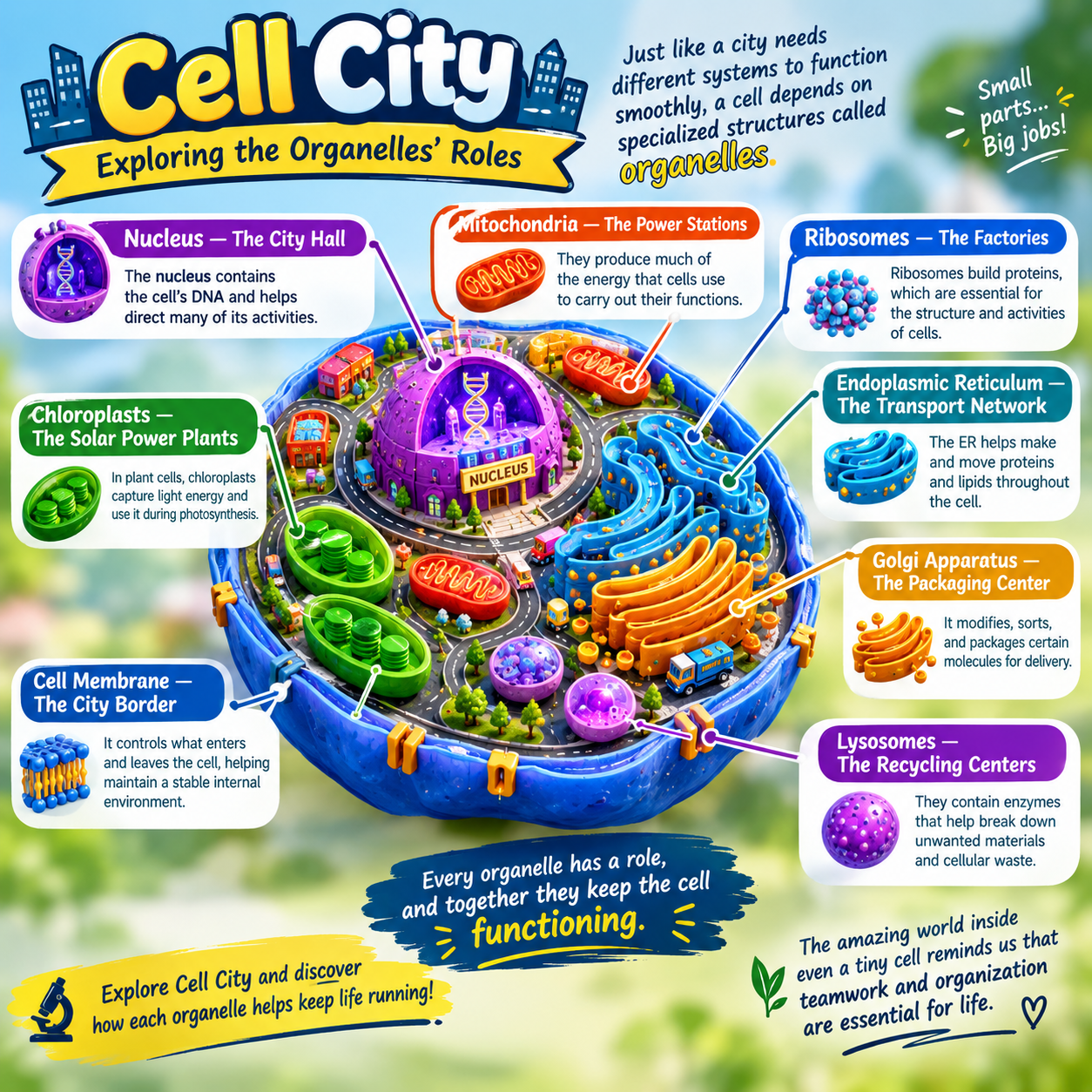
    Imagine a living cell as a busy, well-organized city where every building, worker, and department has an important job. Welcome to **Cell City**!

    Just like a city needs different systems to function smoothly, a cell depends on specialized structures called **organelles**.

    **Nucleus — The City Hall**
    The nucleus contains the cell’s DNA and helps direct many of its activities.

    **Mitochondria — The Power Stations**
    They produce much of the energy that cells use to carry out their functions.

    **Ribosomes — The Factories**
    Ribosomes build proteins, which are essential for the structure and activities of cells.

    **Endoplasmic Reticulum — The Transport Network**
    The ER helps make and move proteins and lipids throughout the cell.

    **Golgi Apparatus — The Packaging Center**
    It modifies, sorts, and packages certain molecules for delivery.

    **Lysosomes — The Recycling Centers**
    They contain enzymes that help break down unwanted materials and cellular waste.

    **Cell Membrane — The City Border**
    It controls what enters and leaves the cell, helping maintain a stable internal environment.

    **Chloroplasts — The Solar Power Plants**
    In plant cells, chloroplasts capture light energy and use it during photosynthesis.

    Every organelle has a role, and together they keep the cell functioning. The amazing world inside even a tiny cell reminds us that **teamwork and organization are essential for life.**

    **Explore Cell City and discover how each organelle helps keep life running!**

    #CellCity #CellBiology #Organelles #Biology #Science #ScienceEducation #BiologyFacts #CellStructure #Mitochondria #Nucleus #Ribosomes #GolgiApparatus #Chloroplasts #Learning #DidYouKnow #education
    #rsisb Roll no.239 Story post no.22 Foundation Level Imagine a living cell as a busy, well-organized city where every building, worker, and department has an important job. Welcome to **Cell City**! 🏙️ Just like a city needs different systems to function smoothly, a cell depends on specialized structures called **organelles**. 🏛️ **Nucleus — The City Hall** The nucleus contains the cell’s DNA and helps direct many of its activities. ⚡ **Mitochondria — The Power Stations** They produce much of the energy that cells use to carry out their functions. 🏭 **Ribosomes — The Factories** Ribosomes build proteins, which are essential for the structure and activities of cells. 🚚 **Endoplasmic Reticulum — The Transport Network** The ER helps make and move proteins and lipids throughout the cell. 📦 **Golgi Apparatus — The Packaging Center** It modifies, sorts, and packages certain molecules for delivery. ♻️ **Lysosomes — The Recycling Centers** They contain enzymes that help break down unwanted materials and cellular waste. 🚪 **Cell Membrane — The City Border** It controls what enters and leaves the cell, helping maintain a stable internal environment. 🌿 **Chloroplasts — The Solar Power Plants** In plant cells, chloroplasts capture light energy and use it during photosynthesis. Every organelle has a role, and together they keep the cell functioning. The amazing world inside even a tiny cell reminds us that **teamwork and organization are essential for life.** 🌱🔬 ✨ **Explore Cell City and discover how each organelle helps keep life running!** #CellCity #CellBiology #Organelles #Biology #Science #ScienceEducation #BiologyFacts #CellStructure #Mitochondria #Nucleus #Ribosomes #GolgiApparatus #Chloroplasts #Learning #DidYouKnow #education
    0 Comentários 0 Compartilhamentos 4547 Visualizações
Páginas Impulsionadas