• #rsisb
    Roll no 248
    Foundation level
    Story post no 40
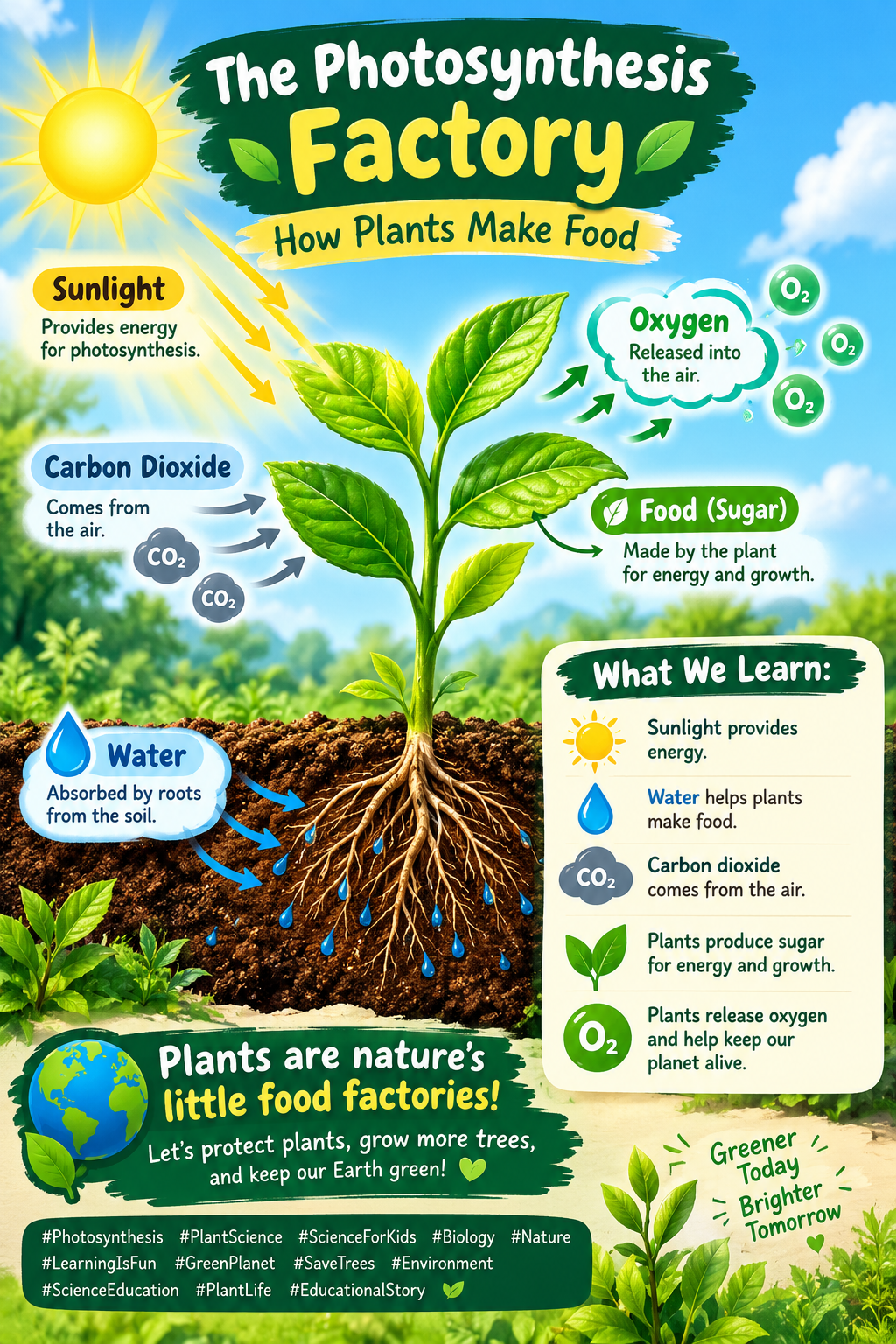
    **The Photosynthesis Factory: How Plants Make Food! **

    Have you ever wondered how plants make their own food? Welcome to the amazing Photosynthesis Factory!

    Plants use sunlight , water , and carbon dioxide to make their own food through a process called **photosynthesis**. During this amazing process, plants release oxygen 🫧, which humans and animals need to breathe!

    **What can we learn?**
    Sunlight provides energy.
    Water helps plants make food.
    Carbon dioxide comes from the air.
    Plants produce sugar for energy and growth.
    Plants release oxygen and help keep our planet alive.

    **Remember:** Plants are nature's little food factories! Let's protect plants, grow more trees, and keep our Earth green!

    #Photosynthesis #PlantScience #ScienceForKids #Biology #Nature #LearningIsFun #GreenPlanet #SaveTrees #Environment #ScienceEducation #PlantLife #EducationalStory
    #rsisb Roll no 248 Foundation level Story post no 40 🌿🏭 **The Photosynthesis Factory: How Plants Make Food! ☀️🌱** Have you ever wondered how plants make their own food? 🤔🌿 Welcome to the amazing Photosynthesis Factory! 🏭🌱 Plants use sunlight ☀️, water 💧, and carbon dioxide 🌬️ to make their own food through a process called **photosynthesis**. During this amazing process, plants release oxygen 🫧, which humans and animals need to breathe! 🌍💚 🍃 **What can we learn?** ✨ Sunlight provides energy. 💧 Water helps plants make food. 🌬️ Carbon dioxide comes from the air. 🍬 Plants produce sugar for energy and growth. 💚 Plants release oxygen and help keep our planet alive. 🌎 **Remember:** Plants are nature's little food factories! Let's protect plants, grow more trees, and keep our Earth green! 🌳💚 #Photosynthesis #PlantScience #ScienceForKids #Biology #Nature #LearningIsFun #GreenPlanet #SaveTrees #Environment #ScienceEducation #PlantLife #EducationalStory 🌿🌱☀️💚
    0 Комментарии 0 Поделились 333 Просмотры
  • RSIF8
    Roll no 94
    TEDx talk no 3
    TEDx talk topic
    Today I watched the TEDx Talk Iqra Khilji – "Living in Denial – Climate Change". This inspiring talk highlights how many people ignore the reality of climate change even though its effects are visible around us. Iqra Khilji explains that denial only worsens the problem and encourages us to take responsibility for protecting our planet.
    The talk reminded me that small actions—such as reducing waste, planting trees, conserving energy, and spreading awareness—can make a big difference. Climate change is not a future problem; it is happening now, and every individual has a role to play in creating a greener and safer world.
    #TEDxTalk #IqraKhilji #ClimateChange #ClimateAction #SaveThePlanet #GoGreen #Sustainability #Environment #ActNow #GreenFuture #EarthMatters
    RSIF8 Roll no 94 TEDx talk no 3 TEDx talk topic Today I watched the TEDx Talk Iqra Khilji – "Living in Denial – Climate Change". This inspiring talk highlights how many people ignore the reality of climate change even though its effects are visible around us. Iqra Khilji explains that denial only worsens the problem and encourages us to take responsibility for protecting our planet. 🌱🌎 The talk reminded me that small actions—such as reducing waste, planting trees, conserving energy, and spreading awareness—can make a big difference. Climate change is not a future problem; it is happening now, and every individual has a role to play in creating a greener and safer world. 🌿💚 #TEDxTalk #IqraKhilji #ClimateChange #ClimateAction #SaveThePlanet #GoGreen #Sustainability #Environment #ActNow #GreenFuture #EarthMatters 🌍🌱♻️💚✨
    0 Комментарии 0 Поделились 529 Просмотры 8
  • RSIF8
    Roll no.38
    Story post no.28
    Story post topic Ecosystem Explorers: Discovering Earth's Habitats

    Ecosystem Explorers: Discovering Earth's Habitats

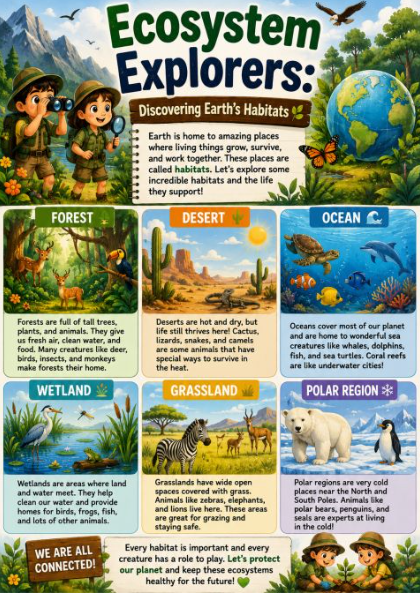
    Imagine becoming an **Ecosystem Explorer** and traveling across Earth to discover amazing places where plants and animals live!

    Our first stop is the **forest**, where tall trees provide homes for birds, deer, insects, and many other animals.

    Next, we travel to the **desert**, a hot and dry habitat where camels, snakes, lizards, and special plants have learned to survive.

    Then we dive into the **ocean**, where dolphins, whales, colorful fish, and sea turtles live among beautiful coral reefs.

    Our adventure continues through **wetlands**, **grasslands**, and the **polar regions**. Each habitat is different, but every one is important. They provide food, water, shelter, and space for living things.

    As Ecosystem Explorers, we learn that all living things are connected. Protecting forests, oceans, rivers, and wildlife helps keep our planet healthy.

    **Explore nature. Protect habitats. Make a difference!**

    #EcosystemExplorers

    #Habitats

    #Nature

    #Environment

    #Wildlife
    #Earth #Science #Learning #ProtectOurPlanet
    RSIF8 Roll no.38 Story post no.28 Story post topic Ecosystem Explorers: Discovering Earth's Habitats Ecosystem Explorers: Discovering Earth's Habitats Imagine becoming an **Ecosystem Explorer** and traveling across Earth to discover amazing places where plants and animals live! Our first stop is the **forest**, where tall trees provide homes for birds, deer, insects, and many other animals. Next, we travel to the **desert**, a hot and dry habitat where camels, snakes, lizards, and special plants have learned to survive. Then we dive into the **ocean**, where dolphins, whales, colorful fish, and sea turtles live among beautiful coral reefs. Our adventure continues through **wetlands**, **grasslands**, and the **polar regions**. Each habitat is different, but every one is important. They provide food, water, shelter, and space for living things. As Ecosystem Explorers, we learn that all living things are connected. Protecting forests, oceans, rivers, and wildlife helps keep our planet healthy. **Explore nature. Protect habitats. Make a difference!** #EcosystemExplorers #Habitats #Nature #Environment #Wildlife #Earth #Science #Learning #ProtectOurPlanet
    0 Комментарии 0 Поделились 636 Просмотры
  • **Roll No: 2**
    **Batch: 14**
    **Book: ACCL**
    **Task No: 104**

    # The Blueprint of Existence: Unraveling DNA and the Origins of Life

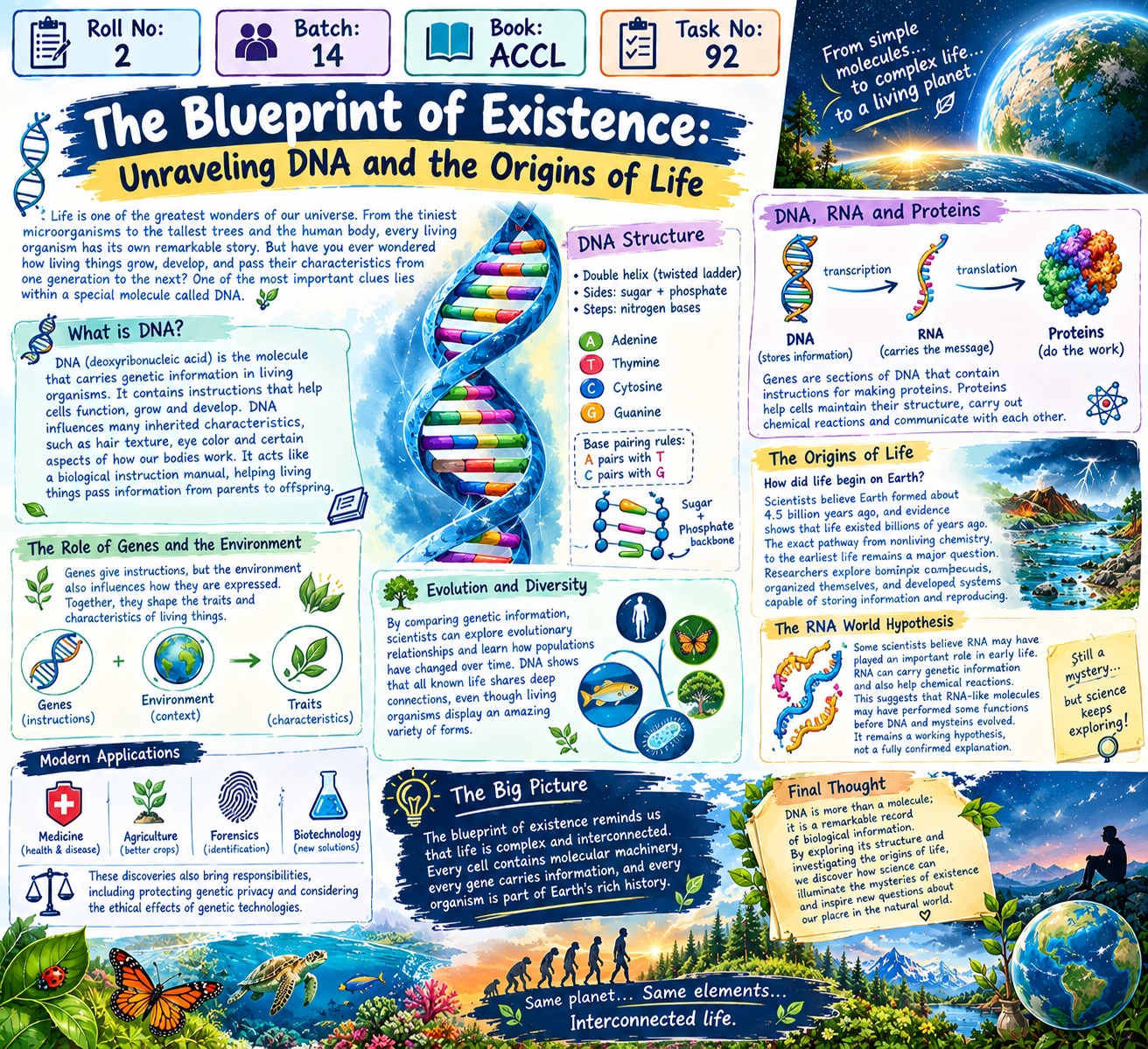
    Life is one of the greatest wonders of our universe. From the tiniest microorganisms to the tallest trees and the human body, every living organism has its own remarkable story. But have you ever wondered how living things grow, develop, and pass their characteristics from one generation to the next? One of the most important clues lies within a special molecule called **DNA**.

    **DNA, or deoxyribonucleic acid, is the molecule that carries genetic information in living organisms.** It contains instructions that help cells function, grow, and develop. DNA influences many inherited characteristics, such as natural hair texture, eye color, and certain aspects of how our bodies work. It acts like a biological instruction manual, helping living things pass information from parents to offspring.

    The structure of DNA is fascinating. It resembles a twisted ladder called a **double helix**. Its sides are made of sugar and phosphate molecules, while its steps contain pairs of chemical bases: adenine, thymine, cytosine, and guanine. These bases follow specific pairing rules: adenine pairs with thymine, while cytosine pairs with guanine. The order of these bases stores genetic information in a form that cells can use.

    DNA works closely with other molecules inside cells. Sections of DNA called **genes** contain instructions for making functional products, often proteins. Proteins perform countless important jobs, including helping cells maintain their structure, carry out chemical reactions, and communicate with one another. This relationship between DNA, RNA, and proteins is a central part of modern biology.

    But how did life begin on Earth? Scientists believe that Earth formed about 4.5 billion years ago, and evidence indicates that life existed billions of years ago. However, the exact pathway through which nonliving chemistry gave rise to the earliest life remains an important scientific question. Researchers investigate how simple molecules might have formed more complex compounds, how these compounds could have organized themselves, and how early systems capable of storing information and reproducing might have developed.

    One area of research explores the possibility that **RNA played an important role in early life**. RNA can carry genetic information, and certain RNA molecules can also help chemical reactions occur. This has led to the RNA-world hypothesis, which suggests that RNA-like molecules may have performed some functions before modern DNA-and-protein systems evolved. It remains an active scientific hypothesis, not a fully confirmed explanation of life's origin.

    The study of DNA also helps scientists understand the diversity of life. By comparing genetic information from different organisms, researchers can investigate evolutionary relationships and learn how populations have changed over generations. DNA evidence supports the scientific understanding that all known life shares deep connections through evolution, even though living organisms display an extraordinary variety of forms.

    Modern DNA research has transformed medicine, agriculture, forensics, and biotechnology. Scientists can study genetic variations, investigate inherited conditions, identify organisms, improve crops, and develop new research methods. These discoveries also bring important responsibilities, including protecting genetic privacy and considering the ethical effects of genetic technologies.

    The blueprint of existence reminds us that life is both complex and interconnected. Every cell contains molecular machinery, every gene carries information, and every organism is part of Earth's rich history. Although many questions about the earliest beginnings of life remain unanswered, careful experiments, observations, and discoveries continue to expand our understanding.

    **DNA is more than a molecule; it is a remarkable record of biological information. By exploring its structure and investigating the origins of life, we discover how science can illuminate the mysteries of existence and inspire new questions about our place in the natural world. **

    \#DNA #OriginsOfLife #Biology #Genetics #Science #Evolution #ACCL #Batch14 #Task92
    **Roll No: 2** **Batch: 14** **Book: ACCL** **Task No: 104** # 🧬🌍 The Blueprint of Existence: Unraveling DNA and the Origins of Life 🔬✨ Life is one of the greatest wonders of our universe. From the tiniest microorganisms to the tallest trees and the human body, every living organism has its own remarkable story. 🌱🦠🌳 But have you ever wondered how living things grow, develop, and pass their characteristics from one generation to the next? One of the most important clues lies within a special molecule called **DNA**. **DNA, or deoxyribonucleic acid, is the molecule that carries genetic information in living organisms.** 🧬 It contains instructions that help cells function, grow, and develop. DNA influences many inherited characteristics, such as natural hair texture, eye color, and certain aspects of how our bodies work. It acts like a biological instruction manual, helping living things pass information from parents to offspring. 📖🔬 The structure of DNA is fascinating. It resembles a twisted ladder called a **double helix**. 🌀 Its sides are made of sugar and phosphate molecules, while its steps contain pairs of chemical bases: adenine, thymine, cytosine, and guanine. These bases follow specific pairing rules: adenine pairs with thymine, while cytosine pairs with guanine. The order of these bases stores genetic information in a form that cells can use. DNA works closely with other molecules inside cells. 🧪 Sections of DNA called **genes** contain instructions for making functional products, often proteins. Proteins perform countless important jobs, including helping cells maintain their structure, carry out chemical reactions, and communicate with one another. This relationship between DNA, RNA, and proteins is a central part of modern biology. ⚙️🧫 But how did life begin on Earth? 🌎 Scientists believe that Earth formed about 4.5 billion years ago, and evidence indicates that life existed billions of years ago. However, the exact pathway through which nonliving chemistry gave rise to the earliest life remains an important scientific question. Researchers investigate how simple molecules might have formed more complex compounds, how these compounds could have organized themselves, and how early systems capable of storing information and reproducing might have developed. 🔭🧪 One area of research explores the possibility that **RNA played an important role in early life**. RNA can carry genetic information, and certain RNA molecules can also help chemical reactions occur. This has led to the RNA-world hypothesis, which suggests that RNA-like molecules may have performed some functions before modern DNA-and-protein systems evolved. It remains an active scientific hypothesis, not a fully confirmed explanation of life's origin. 🧬💡 The study of DNA also helps scientists understand the diversity of life. 🌿🐦🦋 By comparing genetic information from different organisms, researchers can investigate evolutionary relationships and learn how populations have changed over generations. DNA evidence supports the scientific understanding that all known life shares deep connections through evolution, even though living organisms display an extraordinary variety of forms. Modern DNA research has transformed medicine, agriculture, forensics, and biotechnology. 🏥🌾 Scientists can study genetic variations, investigate inherited conditions, identify organisms, improve crops, and develop new research methods. These discoveries also bring important responsibilities, including protecting genetic privacy and considering the ethical effects of genetic technologies. ⚖️🔬 The blueprint of existence reminds us that life is both complex and interconnected. Every cell contains molecular machinery, every gene carries information, and every organism is part of Earth's rich history. Although many questions about the earliest beginnings of life remain unanswered, careful experiments, observations, and discoveries continue to expand our understanding. 🌌📚 **DNA is more than a molecule; it is a remarkable record of biological information. By exploring its structure and investigating the origins of life, we discover how science can illuminate the mysteries of existence and inspire new questions about our place in the natural world. 🧬🌍💚** \#DNA #OriginsOfLife #Biology #Genetics #Science #Evolution #ACCL #Batch14 #Task92 🔬🧬✨
    0 Комментарии 0 Поделились 1172 Просмотры
  • RSIF8
    ROLL NO 100
    TED X TALK NO 3
    TED X TALK TOPIC Living in Denial – Climate Change – Iqra Khilji

    Climate change is not just a distant threat; it is a reality that affects our planet, our lives, and our future. From rising temperatures and melting glaciers to extreme weather events and environmental destruction, the signs are all around us. Yet, many people continue to ignore the facts and live in denial.

    In this thought-provoking message, Iqra Khilji highlights the importance of acknowledging climate change and taking responsibility for protecting our planet. The time to act is NOW! Every small step counts, whether it's reducing waste, saving energy, planting trees, or spreading awareness.

    **Stop denying. Start understanding. Take action.** Because there is no Planet B!

    #LivingInDenial #ClimateChange #IqraKhilji #ClimateAction #SaveOurPlanet #GlobalWarming #EnvironmentalAwareness #GoGreen #Sustainability #ProtectNature #EcoFriendly #ThereIsNoPlanetB #ActNow
    RSIF8 ROLL NO 100 TED X TALK NO 3 TED X TALK TOPIC Living in Denial – Climate Change – Iqra Khilji Climate change is not just a distant threat; it is a reality that affects our planet, our lives, and our future. 🌎🔥 From rising temperatures and melting glaciers to extreme weather events and environmental destruction, the signs are all around us. 🌊🏭 Yet, many people continue to ignore the facts and live in denial. In this thought-provoking message, Iqra Khilji highlights the importance of acknowledging climate change and taking responsibility for protecting our planet. 🌿💡 The time to act is NOW! ⏳🌳 Every small step counts, whether it's reducing waste, saving energy, planting trees, or spreading awareness. ♻️🌱 💚 **Stop denying. Start understanding. Take action.** Because there is no Planet B! 🌍✨ #LivingInDenial #ClimateChange #IqraKhilji #ClimateAction #SaveOurPlanet #GlobalWarming #EnvironmentalAwareness #GoGreen #Sustainability #ProtectNature #EcoFriendly #ThereIsNoPlanetB #ActNow 🌍🌱♻️💚🌎
    0 Комментарии 0 Поделились 850 Просмотры 1
  • #rsisb

    Roll No.177

    TEDxTalk No.81

    Level one


    The Future of Our Earth by Severn Cullis-Suzuki

    Our Earth is our beautiful home, and it is our responsibility to protect it for future generations. In this inspiring topic, “The Future of Our Earth” by Severn Cullis-Suzuki, we learn about the importance of protecting our planet, saving natural resources, and keeping our environment clean.

    Earth gives us fresh air, clean water, food, and a beautiful place to live. But pollution, deforestation, and climate change are serious problems that can harm our planet. We should take care of nature and make better choices to create a healthier and greener world.

    Every small action matters! We can plant trees , save water , reduce plastic waste , keep our surroundings clean , and encourage others to protect the environment. Together, we can make a positive difference and build a brighter future for the next generation.

    This topic teaches us that protecting the Earth is everyone's responsibility. We should not only think about today but also about the world we will leave for our children and grandchildren. ‍‍‍

    Let's work together to protect our planet, save nature, and make our Earth a cleaner, greener, and happier place to live!

    #TheFutureOfOurEarth

    #SevernCullisSuzuki

    #SaveOurEarth

    #ProtectOurPlanet

    #ClimateChange

    #SaveNature

    #PlantMoreTrees

    #GoGreen

    #EnvironmentalProtection

    #ReduceReuseRecycle

    #StopPollution

    #CleanEnvironment

    #GreenFuture

    #SustainableLiving

    #SaveWater

    #EarthDay

    #NatureLovers

    #YoungGeneration

    #EducationForEveryone

    #RehanSchool

    #HafizRehanMarketing
    #rsisb Roll No.177 TEDxTalk No.81 Level one 🌍🌱 The Future of Our Earth by Severn Cullis-Suzuki 🌱🌎 🌿✨ Our Earth is our beautiful home, and it is our responsibility to protect it for future generations. 🌍💚 In this inspiring topic, “The Future of Our Earth” by Severn Cullis-Suzuki, we learn about the importance of protecting our planet, saving natural resources, and keeping our environment clean. 🌳💧🌞 🌎💚 Earth gives us fresh air, clean water, food, and a beautiful place to live. 🌳🌸 But pollution, deforestation, and climate change are serious problems that can harm our planet. 🏭🚯🌡️ We should take care of nature and make better choices to create a healthier and greener world. 🌿♻️💚 🌱🌍 Every small action matters! We can plant trees 🌳, save water 💧, reduce plastic waste ♻️, keep our surroundings clean 🧹, and encourage others to protect the environment. 🌼🤝 Together, we can make a positive difference and build a brighter future for the next generation. 👧🧒🌈 💚✨ This topic teaches us that protecting the Earth is everyone's responsibility. We should not only think about today but also about the world we will leave for our children and grandchildren. 🌎👨‍👩‍👧‍👦🌿 🌍💫 Let's work together to protect our planet, save nature, and make our Earth a cleaner, greener, and happier place to live! 🌱🌳💚🌎 #TheFutureOfOurEarth 🌍 #SevernCullisSuzuki 🌱 #SaveOurEarth 💚 #ProtectOurPlanet 🌎 #ClimateChange 🌡️ #SaveNature 🌳 #PlantMoreTrees 🌲 #GoGreen 💚 #EnvironmentalProtection 🌿 #ReduceReuseRecycle ♻️ #StopPollution 🚯 #CleanEnvironment 🌸 #GreenFuture 🌱 #SustainableLiving 🌍 #SaveWater 💧 #EarthDay 🌎 #NatureLovers 🌻 #YoungGeneration 👧🧒 #EducationForEveryone 📚 #RehanSchool 🎓 #HafizRehanMarketing ✨
    0 Комментарии 0 Поделились 2445 Просмотры 4
  • RSIF8
    Roll no:86
    Task no:38
    Task topic: Living in Denial – Climate Change – Iqra Khilji
    Climate change is one of the greatest challenges facing our world today. Rising temperatures, melting glaciers, extreme weather events, and changing ecosystems are clear signs that our planet is under pressure. Despite the growing evidence, many people continue to deny or ignore the reality of climate change, delaying the actions needed to protect our environment.
    From devastating floods to prolonged droughts and heatwaves, the effects of climate change are becoming more visible every year. Communities around the world are experiencing the consequences, with impacts on agriculture, water resources, wildlife, and public health. These changes remind us that climate change is not a distant problem—it is happening right now.
    Human activities such as deforestation, pollution, and the excessive use of fossil fuels contribute significantly to global warming. However, every individual can play a role in creating positive change. Simple actions like saving energy, reducing waste, recycling, and planting trees can make a meaningful difference in protecting our planet for future generations.
    The first step toward solving any problem is accepting that it exists. By moving beyond denial and embracing responsibility, we can work together to build a cleaner, greener, and more sustainable future. Awareness, education, and action are the keys to combating climate change and ensuring a healthier world for everyone.
    #LivingInDenial #ClimateChange #IqraKhilji #ClimateAction #SaveThePlanet #GlobalWarming #EnvironmentalAwareness #GoGreen #Sustainability #ProtectEarth #EcoFriendly #GreenFuture #ActNow #ClimateCrisis #SaveOurFuture
    RSIF8 Roll no:86 Task no:38 Task topic: Living in Denial – Climate Change – Iqra Khilji Climate change is one of the greatest challenges facing our world today. Rising temperatures, melting glaciers, extreme weather events, and changing ecosystems are clear signs that our planet is under pressure. Despite the growing evidence, many people continue to deny or ignore the reality of climate change, delaying the actions needed to protect our environment. 🌱 🌦️ From devastating floods to prolonged droughts and heatwaves, the effects of climate change are becoming more visible every year. Communities around the world are experiencing the consequences, with impacts on agriculture, water resources, wildlife, and public health. These changes remind us that climate change is not a distant problem—it is happening right now. 🌳 Human activities such as deforestation, pollution, and the excessive use of fossil fuels contribute significantly to global warming. However, every individual can play a role in creating positive change. Simple actions like saving energy, reducing waste, recycling, and planting trees can make a meaningful difference in protecting our planet for future generations. 💚 The first step toward solving any problem is accepting that it exists. By moving beyond denial and embracing responsibility, we can work together to build a cleaner, greener, and more sustainable future. Awareness, education, and action are the keys to combating climate change and ensuring a healthier world for everyone. #LivingInDenial #ClimateChange #IqraKhilji #ClimateAction #SaveThePlanet #GlobalWarming #EnvironmentalAwareness #GoGreen #Sustainability #ProtectEarth #EcoFriendly #GreenFuture #ActNow #ClimateCrisis #SaveOurFuture 🌍🌿
    0 Комментарии 0 Поделились 1930 Просмотры 11
  • RSIF8
    Roll no:85
    Task no:55
    Task topic: Winds and Environment: The Impact of Change
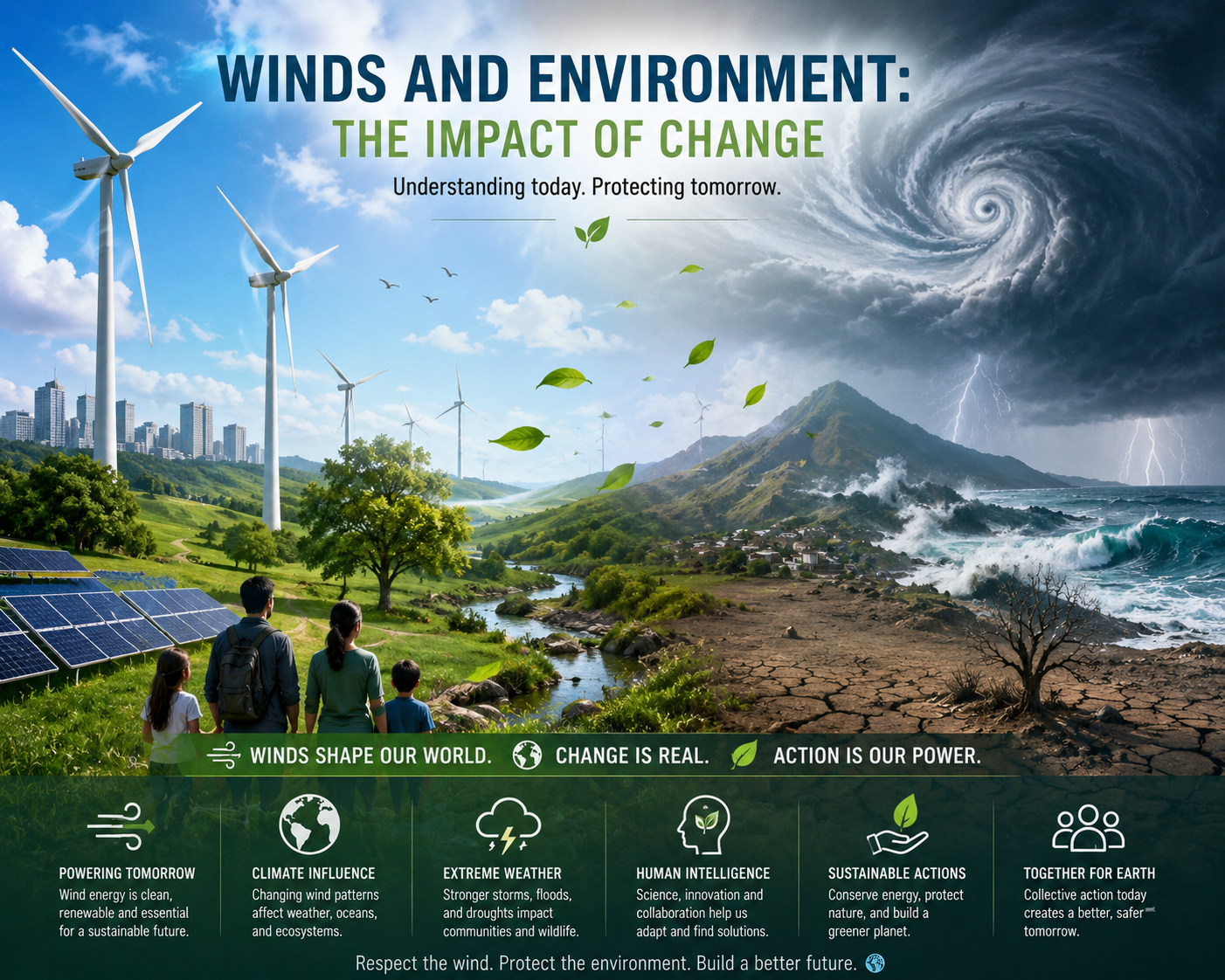
    The wind is one of nature's most powerful forces, shaping landscapes, influencing weather, and supporting life across the planet. It carries moisture that nourishes forests and farmland, spreads seeds that help plants grow, and drives ocean currents that regulate Earth's climate. For centuries, humans have relied on the wind for travel, agriculture, and renewable energy. Understanding how wind interacts with the environment helps us appreciate its essential role in maintaining the balance of nature.

    As the global climate changes, wind patterns are also shifting in many regions. Rising temperatures, changing air pressure, and altered weather systems can influence the strength, direction, and frequency of winds. These changes may contribute to more intense storms in some areas, prolonged droughts in others, and increased challenges for farming, transportation, and wildlife. Scientists continue to study these complex interactions to better predict future environmental conditions and help communities prepare for changing climates.

    Human intelligence plays a vital role in addressing environmental challenges. Through scientific research, technological innovation, and international cooperation, people are developing cleaner energy sources, improving weather forecasting, and creating sustainable practices that reduce environmental impact. Wind energy, in particular, has become one of the fastest-growing renewable energy sources, offering a cleaner alternative to fossil fuels while helping reduce greenhouse gas emissions.

    Protecting the environment requires both knowledge and action. Every individual can contribute by conserving energy, planting trees, reducing waste, and supporting sustainable solutions. By combining human intelligence with respect for nature, we can better understand the changing relationship between winds and the environment and work toward a healthier, more resilient future for generations to come.
    RSIF8 Roll no:85 Task no:55 Task topic: Winds and Environment: The Impact of Change The wind is one of nature's most powerful forces, shaping landscapes, influencing weather, and supporting life across the planet. It carries moisture that nourishes forests and farmland, spreads seeds that help plants grow, and drives ocean currents that regulate Earth's climate. For centuries, humans have relied on the wind for travel, agriculture, and renewable energy. Understanding how wind interacts with the environment helps us appreciate its essential role in maintaining the balance of nature. As the global climate changes, wind patterns are also shifting in many regions. Rising temperatures, changing air pressure, and altered weather systems can influence the strength, direction, and frequency of winds. These changes may contribute to more intense storms in some areas, prolonged droughts in others, and increased challenges for farming, transportation, and wildlife. Scientists continue to study these complex interactions to better predict future environmental conditions and help communities prepare for changing climates. Human intelligence plays a vital role in addressing environmental challenges. Through scientific research, technological innovation, and international cooperation, people are developing cleaner energy sources, improving weather forecasting, and creating sustainable practices that reduce environmental impact. Wind energy, in particular, has become one of the fastest-growing renewable energy sources, offering a cleaner alternative to fossil fuels while helping reduce greenhouse gas emissions. Protecting the environment requires both knowledge and action. Every individual can contribute by conserving energy, planting trees, reducing waste, and supporting sustainable solutions. By combining human intelligence with respect for nature, we can better understand the changing relationship between winds and the environment and work toward a healthier, more resilient future for generations to come.
    0 Комментарии 0 Поделились 1787 Просмотры
  • #rsisb
    Roll no.239
    Miss Zoya no.3
    Foundation Level

    **Human beings are one of the most remarkable parts of life on Earth.** Humans have the ability to think, learn, communicate, create, imagine, and solve problems. They can develop knowledge through education and experience and use that knowledge to improve their lives and the world around them.

    The **human body** is a complex system made up of many organs and body systems that work together. The brain helps humans think, remember, learn, and control the body. The heart pumps blood throughout the body, while the lungs help provide oxygen. Bones provide structure and support, muscles allow movement, and the nervous system helps control and coordinate many body functions.

    Humans also have **emotions and feelings**. People can experience happiness, sadness, fear, anger, love, excitement, and many other emotions. Understanding emotions is important because they influence how people communicate, make decisions, and interact with others.

    ### Learning and Intelligence

    Humans have a remarkable ability to learn. Children learn language, numbers, social skills, and many other things as they grow. Education helps people develop knowledge and skills, while experience teaches them how to deal with challenges and make better decisions.

    Humans can also use **creativity and imagination** to create art, music, literature, inventions, and new technologies. This ability to imagine new possibilities has played an important role in the development of human civilization.

    ### Health and Well-Being

    Good health is essential for a healthy and productive life. Humans need nutritious food, clean water, oxygen, enough sleep, physical activity, and a safe environment. Regular exercise can help keep the body strong, while healthy habits can support overall well-being.

    Mental and emotional well-being are also important. People need positive relationships, support, relaxation, and opportunities to express their feelings.

    ### ‍‍‍ Human Relationships

    Humans are social beings. Families, friends, classmates, teachers, colleagues, and communities all play important roles in people's lives. Communication and cooperation help people build strong relationships

    ### Humans and Technology

    Technology has become an important part of modern human life. Computers, smartphones, the internet, robotics, and artificial intelligence help people communicate, learn, work, and solve problems.

    Artificial intelligence can assist humans in many areas, but human judgment, responsibility, creativity, and ethical thinking remain extremely important. Technology should be used wisely and responsibly to benefit society.

    ### Humans and the Environment

    Humans depend on Earth for air, water, food, energy, and natural resources. Protecting the environment is therefore an important responsibility.

    Pollution, climate change, deforestation, and the loss of biodiversity can affect human life and other living organisms. People can help protect the planet by reducing waste, saving water and energy, recycling, planting trees, and using resources responsibly.

    ### The Future of Humanity

    The future of humanity will depend on the choices people make today. Education, science, technology, cooperation, peace, and responsible decision-making can help create a better future.

    Humans may continue to explore space, develop new medical treatments, create advanced technologies, and discover new ways to solve global problems. However, progress should always be balanced with ethics, safety, equality, and respect for life.

    ### **Conclusion**

    The study of humans is a broad and fascinating topic that includes the **human body, brain, emotions, health, learning, relationships, society, technology, and the future**.

    Understanding ourselves can help us become healthier, kinder, more responsible, and more thoughtful people. It can also teach us to respect others, appreciate differences, protect our planet, and work together to solve problems.

    **Key Message:**

    > **Human beings have the ability to learn, create, care, and make a difference. By using knowledge wisely and treating others with respect, humans can help build a healthier, kinder, and better world.**

    #rsisb Roll no.239 Miss Zoya no.3 Foundation Level **Human beings are one of the most remarkable parts of life on Earth.** Humans have the ability to think, learn, communicate, create, imagine, and solve problems. They can develop knowledge through education and experience and use that knowledge to improve their lives and the world around them. The **human body** is a complex system made up of many organs and body systems that work together. The brain helps humans think, remember, learn, and control the body. The heart pumps blood throughout the body, while the lungs help provide oxygen. Bones provide structure and support, muscles allow movement, and the nervous system helps control and coordinate many body functions. Humans also have **emotions and feelings**. People can experience happiness, sadness, fear, anger, love, excitement, and many other emotions. Understanding emotions is important because they influence how people communicate, make decisions, and interact with others. ### 🧠 Learning and Intelligence Humans have a remarkable ability to learn. Children learn language, numbers, social skills, and many other things as they grow. Education helps people develop knowledge and skills, while experience teaches them how to deal with challenges and make better decisions. Humans can also use **creativity and imagination** to create art, music, literature, inventions, and new technologies. This ability to imagine new possibilities has played an important role in the development of human civilization. ### ❤️ Health and Well-Being Good health is essential for a healthy and productive life. Humans need nutritious food, clean water, oxygen, enough sleep, physical activity, and a safe environment. Regular exercise can help keep the body strong, while healthy habits can support overall well-being. Mental and emotional well-being are also important. People need positive relationships, support, relaxation, and opportunities to express their feelings. ### 👨‍👩‍👧‍👦 Human Relationships Humans are social beings. Families, friends, classmates, teachers, colleagues, and communities all play important roles in people's lives. Communication and cooperation help people build strong relationships ### 💻 Humans and Technology Technology has become an important part of modern human life. Computers, smartphones, the internet, robotics, and artificial intelligence help people communicate, learn, work, and solve problems. Artificial intelligence can assist humans in many areas, but human judgment, responsibility, creativity, and ethical thinking remain extremely important. Technology should be used wisely and responsibly to benefit society. ### 🌱 Humans and the Environment Humans depend on Earth for air, water, food, energy, and natural resources. Protecting the environment is therefore an important responsibility. Pollution, climate change, deforestation, and the loss of biodiversity can affect human life and other living organisms. People can help protect the planet by reducing waste, saving water and energy, recycling, planting trees, and using resources responsibly. ### 🚀 The Future of Humanity The future of humanity will depend on the choices people make today. Education, science, technology, cooperation, peace, and responsible decision-making can help create a better future. Humans may continue to explore space, develop new medical treatments, create advanced technologies, and discover new ways to solve global problems. However, progress should always be balanced with ethics, safety, equality, and respect for life. ### **Conclusion** The study of humans is a broad and fascinating topic that includes the **human body, brain, emotions, health, learning, relationships, society, technology, and the future**. Understanding ourselves can help us become healthier, kinder, more responsible, and more thoughtful people. It can also teach us to respect others, appreciate differences, protect our planet, and work together to solve problems. **Key Message:** > **Human beings have the ability to learn, create, care, and make a difference. By using knowledge wisely and treating others with respect, humans can help build a healthier, kinder, and better world.**

    0 Комментарии 0 Поделились 2625 Просмотры 5
  • #rsisb
    Roll no.247
    song no.3
    Foundation level

    **Exploring Earth's Diverse Ecosystems — A Song of Nature and Life**

    Welcome to a musical journey through the amazing ecosystems of our beautiful planet! **“Exploring Earth's Diverse Ecosystems”** is an educational and inspiring song that takes us on an adventure through forests , oceans , deserts , mountains , rivers , grasslands , and many other incredible habitats.

    Every ecosystem is a special home for countless plants, animals, insects, birds, and microorganisms. Each living thing has an important role to play in maintaining the balance of nature. Through this song, we can discover how different forms of life depend on one another and why protecting our environment is so important.

    The song encourages children and learners to explore the natural world with curiosity, respect, and wonder. It reminds us that our Earth is not just a place where we live—it is a shared home for millions of species.

    From the colorful life beneath the ocean waves to the peaceful forests filled with trees and birds , from the hot and dry deserts to the cold and majestic mountains , every ecosystem tells its own story.

    Let the music inspire you to learn more about nature, appreciate biodiversity, and become a responsible guardian of our planet. Small actions can make a big difference, and together we can help keep our Earth beautiful for future generations.

    **Listen, learn, explore, and enjoy the wonderful diversity of life on Earth!**

    #ExploringEarth #EarthsEcosystems #Ecosystems #Nature #Biodiversity #Environment #Earth #Wildlife #Animals #Plants #Forests #Oceans #Deserts #Mountains #Grasslands #NatureLovers #EnvironmentalEducation #Science #Learning #Education #SaveOurPlanet #ProtectNature #LoveNature #EarthDay #GreenPlanet #SunoAI #EducationalSong #NatureSong #KidsLearning #ExploreNature
    #rsisb Roll no.247 song no.3 Foundation level 🌍🎶 **Exploring Earth's Diverse Ecosystems — A Song of Nature and Life** 🌿🐾 Welcome to a musical journey through the amazing ecosystems of our beautiful planet! 🌎✨ **“Exploring Earth's Diverse Ecosystems”** is an educational and inspiring song that takes us on an adventure through forests 🌳, oceans 🌊, deserts 🏜️, mountains ⛰️, rivers 🏞️, grasslands 🌾, and many other incredible habitats. Every ecosystem is a special home for countless plants, animals, insects, birds, and microorganisms. 🐘🦋🦅🐠🌱 Each living thing has an important role to play in maintaining the balance of nature. Through this song, we can discover how different forms of life depend on one another and why protecting our environment is so important. 💚🌿 The song encourages children and learners to explore the natural world with curiosity, respect, and wonder. 🔍🌎🎵 It reminds us that our Earth is not just a place where we live—it is a shared home for millions of species. 🏡🌍 From the colorful life beneath the ocean waves 🐋🐢🐟 to the peaceful forests filled with trees and birds 🌲🦜, from the hot and dry deserts 🏜️🐪 to the cold and majestic mountains ❄️🏔️, every ecosystem tells its own story. 📖✨ 🎵 Let the music inspire you to learn more about nature, appreciate biodiversity, and become a responsible guardian of our planet. 🌱💚 Small actions can make a big difference, and together we can help keep our Earth beautiful for future generations. 🌍🌳💫 🎧 **Listen, learn, explore, and enjoy the wonderful diversity of life on Earth!** 🌎🎶🌿 #ExploringEarth #EarthsEcosystems #Ecosystems #Nature #Biodiversity #Environment #Earth #Wildlife #Animals #Plants #Forests #Oceans #Deserts #Mountains #Grasslands #NatureLovers #EnvironmentalEducation #Science #Learning #Education #SaveOurPlanet #ProtectNature #LoveNature #EarthDay #GreenPlanet #SunoAI #EducationalSong #NatureSong #KidsLearning #ExploreNature 🌍🌿🐾🎶✨
    0 Комментарии 0 Поделились 2419 Просмотры 0
Расширенные страницы