• Story no.1
    ### Mulla Nasrudin & the Donkey's Price
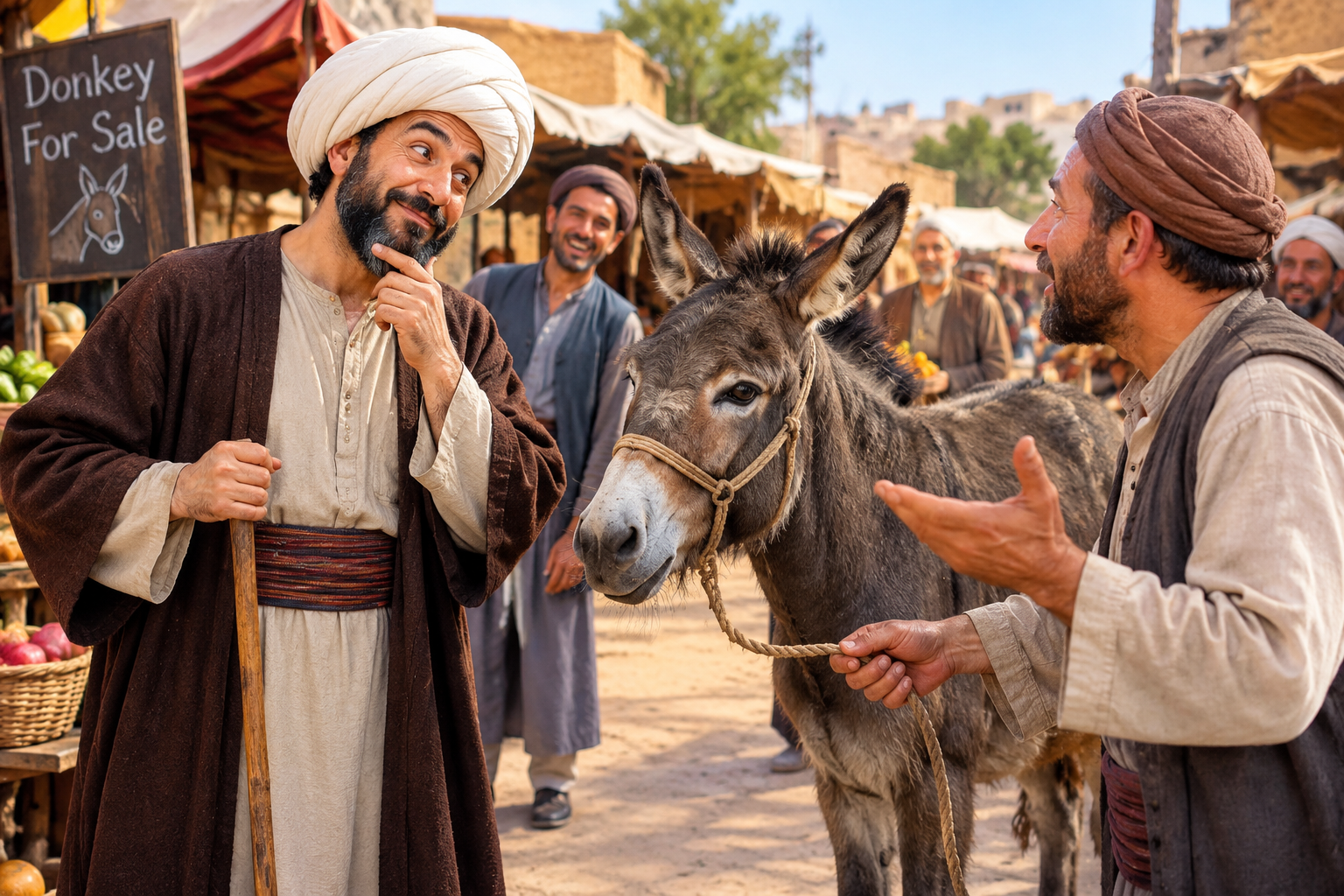
    Paragraph 1: Mulla Nasrudin was a clever and funny man who lived in a small village. One day, he decided to buy a donkey from the village market. He saw a man selling a donkey and asked him about its price. The seller said that the donkey was very strong and useful.
    Paragraph 2: The seller asked for a high price, but Mulla Nasrudin thought it was too expensive. He carefully looked at the donkey and said, “Your donkey looks good, but I think the price is too high.” The seller tried to convince him that the donkey was worth the money.
    Paragraph 3: Mulla Nasrudin smiled and said, “If this donkey is so valuable, why are you selling it?” The seller was surprised by this question and did not know what to say. Mulla Nasrudin then offered a lower price, explaining that he did not want to pay more than the donkey was worth.
    Paragraph 4: In the end, the seller agreed to a fair price, and Mulla Nasrudin bought the donkey happily. The people in the market laughed at his clever words. Mulla Nasrudin taught everyone an important lesson: we should think carefully before spending money and should always use our wisdom when making decisions.
    Story no.1 ### Mulla Nasrudin & the Donkey's Price Paragraph 1: Mulla Nasrudin was a clever and funny man who lived in a small village. One day, he decided to buy a donkey from the village market. He saw a man selling a donkey and asked him about its price. The seller said that the donkey was very strong and useful. Paragraph 2: The seller asked for a high price, but Mulla Nasrudin thought it was too expensive. He carefully looked at the donkey and said, “Your donkey looks good, but I think the price is too high.” The seller tried to convince him that the donkey was worth the money. Paragraph 3: Mulla Nasrudin smiled and said, “If this donkey is so valuable, why are you selling it?” The seller was surprised by this question and did not know what to say. Mulla Nasrudin then offered a lower price, explaining that he did not want to pay more than the donkey was worth. Paragraph 4: In the end, the seller agreed to a fair price, and Mulla Nasrudin bought the donkey happily. The people in the market laughed at his clever words. Mulla Nasrudin taught everyone an important lesson: we should think carefully before spending money and should always use our wisdom when making decisions.
    0 Σχόλια 0 Μοιράστηκε 135 Views
  • RSIF8
    Roll no:14
    story post no:16
    story topic:The Earth's Chemistry: Connecting Biology and Chemistry

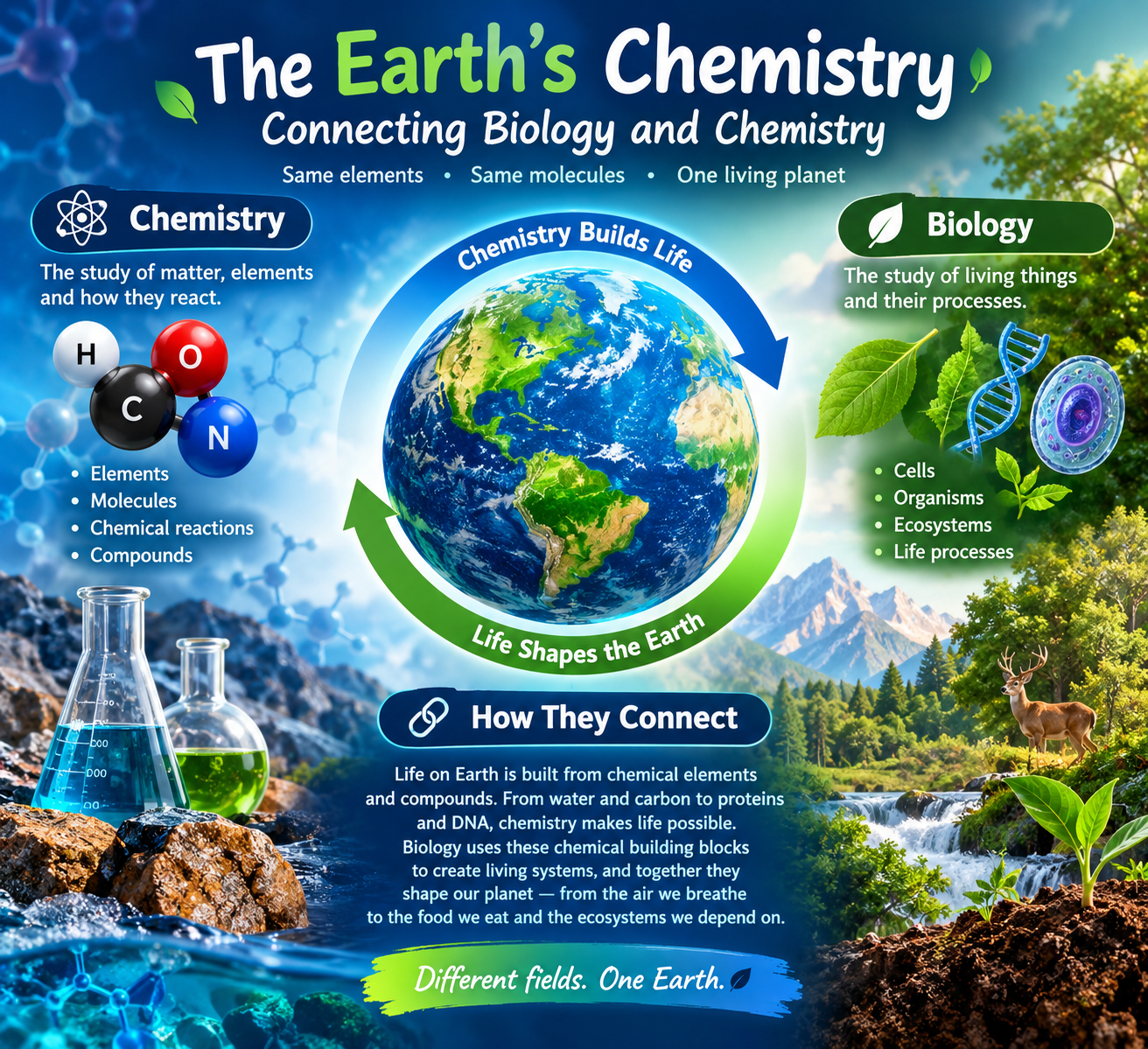
    **The Earth's Chemistry: Connecting Biology and Chemistry**

    **Description:**

    The Earth is a fascinating world where chemistry and biology work together to make life possible. The topic *“The Earth's Chemistry: Connecting Biology and Chemistry”* explores the amazing relationship between chemical elements, molecules, living organisms, and the natural environment.

    **Chemistry** helps us understand the elements, compounds, and chemical reactions that form the building blocks of life. From the water we drink to the oxygen we breathe, chemistry plays an essential role in our everyday lives.

    **Biology** explores living organisms and their life processes, including the growth of plants, the functioning of cells, and the interactions between animals and their environments. Every living organism depends on chemical processes to survive, grow, and reproduce.

    When biology and chemistry come together, we can understand how plants produce food through photosynthesis, how our bodies convert food into energy, how DNA carries genetic information, and how ecosystems maintain the balance of nature.

    Our planet is a connected system in which air, water, soil, plants, animals, and microorganisms interact continuously. Understanding these connections helps us protect biodiversity, reduce pollution, conserve natural resources, and create a healthier environment for future generations.

    **Conclusion:** Chemistry provides the building blocks of life, while biology explains how life uses those building blocks. Together, these two sciences help us understand the wonders of our planet and the importance of protecting it.

    **Different Fields. One Earth. One Connected System.**

    #EarthScience #Chemistry #Biology #EnvironmentalScience #ScienceEducation #ChemicalReactions #Ecosystems #Nature #Sustainability #ProtectOurPlanet #Learning #EducationalVideo
    RSIF8 Roll no:14 story post no:16 story topic:The Earth's Chemistry: Connecting Biology and Chemistry 🌍 **The Earth's Chemistry: Connecting Biology and Chemistry** 🧪🌿 **Description:** The Earth is a fascinating world where chemistry and biology work together to make life possible. 🌎✨ The topic *“The Earth's Chemistry: Connecting Biology and Chemistry”* explores the amazing relationship between chemical elements, molecules, living organisms, and the natural environment. 🧪 **Chemistry** helps us understand the elements, compounds, and chemical reactions that form the building blocks of life. From the water we drink to the oxygen we breathe, chemistry plays an essential role in our everyday lives. 🌱 **Biology** explores living organisms and their life processes, including the growth of plants, the functioning of cells, and the interactions between animals and their environments. Every living organism depends on chemical processes to survive, grow, and reproduce. 🔬 When biology and chemistry come together, we can understand how plants produce food through photosynthesis, how our bodies convert food into energy, how DNA carries genetic information, and how ecosystems maintain the balance of nature. 🌳 Our planet is a connected system in which air, water, soil, plants, animals, and microorganisms interact continuously. Understanding these connections helps us protect biodiversity, reduce pollution, conserve natural resources, and create a healthier environment for future generations. 🌿💧 🎯 **Conclusion:** Chemistry provides the building blocks of life, while biology explains how life uses those building blocks. Together, these two sciences help us understand the wonders of our planet and the importance of protecting it. 💚 **Different Fields. One Earth. One Connected System.** #EarthScience #Chemistry #Biology #EnvironmentalScience #ScienceEducation #ChemicalReactions #Ecosystems #Nature #Sustainability #ProtectOurPlanet #Learning #EducationalVideo 🌍🧪🌱
    0 Σχόλια 0 Μοιράστηκε 352 Views
  • MohsinRSF8
    song title no:11
    Rool no:13

    The Story of Elements: From Carbon to Gold

    The universe is full of incredible stories, and one of the most fascinating stories is the story of the elements. Everything around us—from the air we breathe and the water we drink to the rocks beneath our feet, the plants around us, and even our own bodies—is connected to chemical elements. This journey helps us understand how the building blocks of matter became part of the amazing world we see today.

    The story begins with the early universe, when the simplest elements such as hydrogen and helium appeared. As the universe expanded and changed, huge clouds of matter came together under gravity and eventually formed stars. These stars became enormous natural laboratories where nuclear reactions could create heavier elements.

    Inside stars, incredible temperatures and pressures allow atoms to take part in processes that produce new elements. One important element created through stellar processes is carbon. Carbon is especially fascinating because it can form a huge variety of compounds and plays a fundamental role in life. It can be found in living organisms, plants, fuels, minerals, and different forms of materials.

    But carbon is only one part of the story. Other elements such as oxygen and nitrogen are also essential to the natural world. Elements move through cycles in nature, becoming part of the atmosphere, oceans, soil, rocks, plants, animals, and countless other systems. This shows us that the elements are constantly participating in the processes that shape our planet.

    As massive stars evolve, they can create heavier elements through different nuclear processes. Eventually, some stars reach dramatic final stages and release material into space. That material can become part of future stars, planets, and other objects. In this way, the universe continuously recycles matter and gives elements new places to exist.

    The journey becomes even more fascinating when we reach elements heavier than iron. Powerful cosmic events can create many of these heavy elements. Gold is one of the most remarkable examples.
    MohsinRSF8 song title no:11 Rool no:13 🌌 The Story of Elements: From Carbon to Gold 🔬🥇 The universe is full of incredible stories, and one of the most fascinating stories is the story of the elements. Everything around us—from the air we breathe and the water we drink to the rocks beneath our feet, the plants around us, and even our own bodies—is connected to chemical elements. This journey helps us understand how the building blocks of matter became part of the amazing world we see today. The story begins with the early universe, when the simplest elements such as hydrogen and helium appeared. As the universe expanded and changed, huge clouds of matter came together under gravity and eventually formed stars. These stars became enormous natural laboratories where nuclear reactions could create heavier elements. Inside stars, incredible temperatures and pressures allow atoms to take part in processes that produce new elements. One important element created through stellar processes is carbon. Carbon is especially fascinating because it can form a huge variety of compounds and plays a fundamental role in life. It can be found in living organisms, plants, fuels, minerals, and different forms of materials. But carbon is only one part of the story. Other elements such as oxygen and nitrogen are also essential to the natural world. Elements move through cycles in nature, becoming part of the atmosphere, oceans, soil, rocks, plants, animals, and countless other systems. This shows us that the elements are constantly participating in the processes that shape our planet. As massive stars evolve, they can create heavier elements through different nuclear processes. Eventually, some stars reach dramatic final stages and release material into space. That material can become part of future stars, planets, and other objects. In this way, the universe continuously recycles matter and gives elements new places to exist. The journey becomes even more fascinating when we reach elements heavier than iron. Powerful cosmic events can create many of these heavy elements. Gold is one of the most remarkable examples.
    0 Σχόλια 0 Μοιράστηκε 241 Views 19
  • RSIF8
    Roll NO:92
    CHAT GPT TASK NO:14
    Topic: **Did You Know? Oxygen Was Discovered in 1772! **

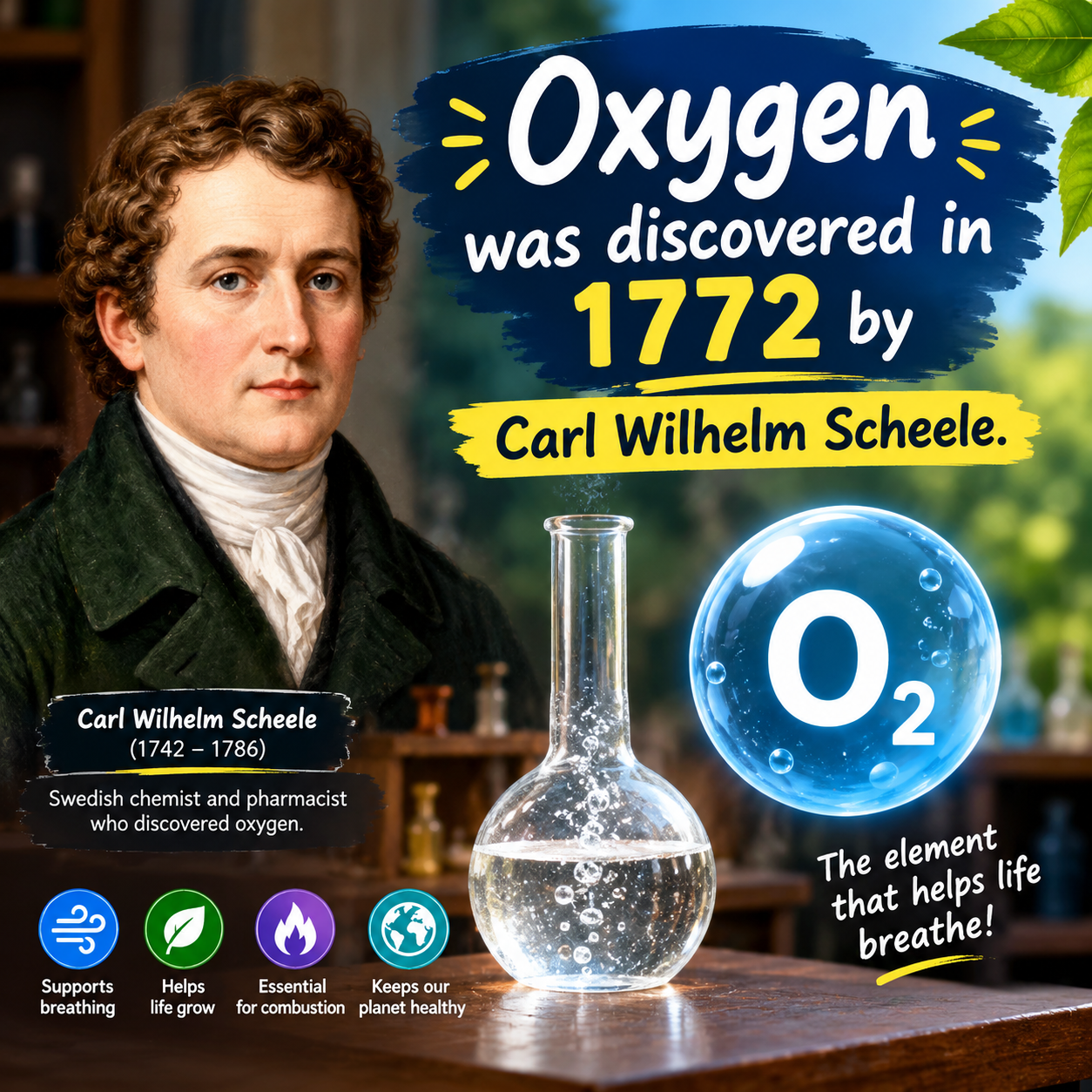
    Oxygen is one of the most important elements for life on Earth! Swedish chemist and pharmacist **Carl Wilhelm Scheele** discovered oxygen around 1772. This amazing discovery helped scientists understand the chemistry of air, breathing, and combustion.

    **Interesting Facts About Oxygen:**
    Symbol: O
    Chemical formula: O₂
    Essential for life and respiration
    Supports combustion
    Makes up about 21% of Earth's atmosphere

    Science is full of amazing discoveries that help us understand our world!

    **Keep learning, stay curious, and explore the wonders of science!**

    #DidYouKnow #Oxygen #CarlWilhelmScheele #ScienceFacts #Chemistry #ScienceEducation #AmazingFacts #KnowledgeIsPower #EducationalPost #LearnSomethingNew
    RSIF8 Roll NO:92 CHAT GPT TASK NO:14 Topic:🌬️ **Did You Know? Oxygen Was Discovered in 1772! 🧪** Oxygen is one of the most important elements for life on Earth! 🌍 Swedish chemist and pharmacist **Carl Wilhelm Scheele** discovered oxygen around 1772. This amazing discovery helped scientists understand the chemistry of air, breathing, and combustion. 💡 **Interesting Facts About Oxygen:** 🔬 Symbol: O 🧪 Chemical formula: O₂ 🌱 Essential for life and respiration 🔥 Supports combustion 🌍 Makes up about 21% of Earth's atmosphere ✨ Science is full of amazing discoveries that help us understand our world! 📚 **Keep learning, stay curious, and explore the wonders of science!** #DidYouKnow #Oxygen #CarlWilhelmScheele #ScienceFacts #Chemistry #ScienceEducation #AmazingFacts #KnowledgeIsPower #EducationalPost #LearnSomethingNew
    0 Σχόλια 0 Μοιράστηκε 200 Views
  • #rsisb Foundation level student. Roll no:232 Documentary NO:11 🤖🌍 **Documentary — The History and Future of Artificial Intelligence** 🚀💡 Welcome to an exciting journey through the world of Artificial Intelligence (AI)! 🎬✨ In this documentary, *The History and Future of Artificial Intelligence*, we explore how AI began, how it has evolved over time, and how it is shaping our modern world. Discover the early ideas behind artificial intelligence, the development of intelligent computer systems, and the incredible progress that has made AI a powerful part of our daily lives. 🧠💻 From virtual assistants and language models to robotics, healthcare, education, and self-driving technology, AI is transforming the way people live, learn, and work. We will also explore the future possibilities of AI, including smarter learning tools, scientific discoveries, creative technologies, and new ways to solve global challenges. 🌟🔬 At the same time, we will discuss important concerns such as privacy, fairness, safety, and responsible AI development. 🔐⚖️ What will artificial intelligence look like in the future? How will it change our jobs, education, and society? Join me as we explore these fascinating questions and discover the opportunities and challenges ahead. 🌐🚀 **Understand AI Today, Shape Tomorrow! 🤖🌍** #ArtificialIntelligence #HistoryOfAI #FutureOfAI #AIRevolution #MachineLearning #Technology #Innovation #Robotics #DigitalFuture #AIinEducation #ScienceAndTechnology #ResponsibleAI #TechDocumentary #EducationalVideo #LearnWithAI 🤖💻🧠🚀🌍✨ Irum Asim Leadershipwali Asma Shaheen EducationWali Rehan School Islamabad Campus https://www.facebook.com/share/v/1HmF7mwc6J/
    WWW.FACEBOOK.COM
    Facebook
    #rsisb Foundation level student. Roll no:232 Documentary NO:11 🤖🌍 **Documentary — The History and Future of Artificial Intelligence** 🚀💡 Welcome to an exciting journey through the world of...
    0 Σχόλια 0 Μοιράστηκε 449 Views
  • CCL Foundation Level (Rehan School Urdu Bazar Campus)
    Roll No: 25
    Day: 14 (Story Post# # Mulla Nasrudin & the Tightrope Walker
    ## English Story
    One sunny day, Mulla Nasrudin went to a village fair. There, he saw a man walking on a tightrope high above the ground. Everyone watched with excitement.
    The tightrope walker walked slowly and carefully from one side to the other without falling. The crowd clapped loudly.
    Mulla Nasrudin smiled and said, “This man has great balance and courage!”
    A young boy asked Mulla, “Can you walk on a tightrope too?”
    Mulla laughed and replied, “Of course! But first, I need to find a rope that is close to the ground!”
    Everyone laughed at Mulla’s clever answer.
    **Moral:** Courage is important, but wisdom teaches us to be careful.
    ---
    # ملا نصرالدین اور رسّی پر چلنے والا آدمی
    ## اردو کہانی
    ایک دھوپ والے دن ملا نصرالدین گاؤں کے میلے میں گئے۔ وہاں انہوں نے ایک آدمی کو زمین سے کافی اونچائی پر بندھی ہوئی رسّی پر چلتے دیکھا۔ سب لوگ بڑی دلچسپی سے اسے دیکھ رہے تھے۔
    رسّی پر چلنے والا آدمی آہستہ آہستہ اور احتیاط سے ایک طرف سے دوسری طرف پہنچ گیا اور گرا نہیں۔ لوگوں نے خوشی سے تالیاں بجائیں۔
    ملا نصرالدین مسکرائے اور بولے، ”اس آدمی میں بہت ہمت اور توازن ہے!“
    ایک چھوٹے لڑکے نے ملا سے پوچھا، ”کیا آپ بھی رسّی پر چل سکتے ہیں؟“
    ملا ہنس کر بولے، ”بالکل! لیکن پہلے مجھے ایسی رسّی ڈھونڈنی ہوگی جو زمین کے قریب بندھی ہو!“
    ملا کا دلچسپ جواب سن کر سب لوگ ہنسنے لگے۔
    **سبق:** ہمت ضروری ہے، لیکن عقل ہمیں احتیاط کرنا بھی سکھاتی ہے۔ See less


    CCL Foundation Level (Rehan School Urdu Bazar Campus) Roll No: 25 Day: 14 (Story Post# # 🎪 Mulla Nasrudin & the Tightrope Walker ## English Story One sunny day, Mulla Nasrudin went to a village fair. There, he saw a man walking on a tightrope high above the ground. Everyone watched with excitement. The tightrope walker walked slowly and carefully from one side to the other without falling. The crowd clapped loudly. Mulla Nasrudin smiled and said, “This man has great balance and courage!” A young boy asked Mulla, “Can you walk on a tightrope too?” Mulla laughed and replied, “Of course! But first, I need to find a rope that is close to the ground!” Everyone laughed at Mulla’s clever answer. **Moral:** Courage is important, but wisdom teaches us to be careful. --- # 🎪 ملا نصرالدین اور رسّی پر چلنے والا آدمی ## اردو کہانی ایک دھوپ والے دن ملا نصرالدین گاؤں کے میلے میں گئے۔ وہاں انہوں نے ایک آدمی کو زمین سے کافی اونچائی پر بندھی ہوئی رسّی پر چلتے دیکھا۔ سب لوگ بڑی دلچسپی سے اسے دیکھ رہے تھے۔ رسّی پر چلنے والا آدمی آہستہ آہستہ اور احتیاط سے ایک طرف سے دوسری طرف پہنچ گیا اور گرا نہیں۔ لوگوں نے خوشی سے تالیاں بجائیں۔ ملا نصرالدین مسکرائے اور بولے، ”اس آدمی میں بہت ہمت اور توازن ہے!“ ایک چھوٹے لڑکے نے ملا سے پوچھا، ”کیا آپ بھی رسّی پر چل سکتے ہیں؟“ ملا ہنس کر بولے، ”بالکل! لیکن پہلے مجھے ایسی رسّی ڈھونڈنی ہوگی جو زمین کے قریب بندھی ہو!“ ملا کا دلچسپ جواب سن کر سب لوگ ہنسنے لگے۔ **سبق:** ہمت ضروری ہے، لیکن عقل ہمیں احتیاط کرنا بھی سکھاتی ہے۔ See less
    0 Σχόλια 0 Μοιράστηκε 379 Views
  • RSIF8
    Roll no 94
    Song no 16
    Song topic
    Microbial Universe: The Power of the Invisible World

    Step into the fascinating world of microbes—the tiny organisms that shape life in ways we can hardly imagine! From helping plants grow to supporting human health , these invisible heroes play a powerful role in our everyday lives.

    This song celebrates the beauty, mystery, and importance of the microbial universe, reminding us that even the smallest forms of life can have the greatest impact.

    Let the rhythm of science inspire curiosity, wonder, and appreciation for the hidden world around us!

    Every drop of water, every breath of air, and every handful of soil is filled with a universe of microscopic life working tirelessly behind the scenes.

    #MicrobialUniverse #InvisibleWorld #ScienceMusic #Microbiology #STEM #ScienceEducation #Biology #Nature #Innovation #Learning #Knowledge #TinyButMighty #ExploreScience #LifeOnEarth #ScientificWonder
    RSIF8 Roll no 94 Song no 16 Song topic 🌍🦠 Microbial Universe: The Power of the Invisible World 🎶✨ Step into the fascinating world of microbes—the tiny organisms that shape life in ways we can hardly imagine! From helping plants grow 🌱 to supporting human health 💚, these invisible heroes play a powerful role in our everyday lives. This song celebrates the beauty, mystery, and importance of the microbial universe, reminding us that even the smallest forms of life can have the greatest impact. 🌟🔬 🎵 Let the rhythm of science inspire curiosity, wonder, and appreciation for the hidden world around us! 💫 Every drop of water, every breath of air, and every handful of soil is filled with a universe of microscopic life working tirelessly behind the scenes. #MicrobialUniverse #InvisibleWorld #ScienceMusic #Microbiology #STEM #ScienceEducation #Biology #Nature #Innovation #Learning #Knowledge #TinyButMighty #ExploreScience #LifeOnEarth #ScientificWonder 🦠🔬🌎✨🎶💚
    0 Σχόλια 0 Μοιράστηκε 700 Views 2

  • **Roll No: 2**

    **Batch: 14**

    **Book: ACCL**

    **Task No: 139**

    ## Why Do We Experiment? The Search for Truth in Biology

    Today’s task explores the importance of experimentation in biology and how scientists use evidence to understand the mysteries of life. Experiments help researchers investigate questions about living organisms, test scientific ideas, and discover how biological processes work. By observing nature, developing hypotheses, changing specific variables, and analyzing results, scientists can distinguish reliable evidence from assumptions. This topic will help me understand why fair testing, accurate observations, repeated experiments, and honest reporting are essential for trustworthy scientific discoveries. It will also highlight how biological experiments contribute to our knowledge of cells, genetics, ecosystems, and human health. Through this activity, I aim to strengthen my critical-thinking skills, develop scientific curiosity, and appreciate how the search for truth requires patience, careful investigation, and an open mind.

    #Batch14 #Task139 #ACCL #WhyDoWeExperiment #Biology #ScientificResearch #SearchForTruth #ScientificMethod #Experimentation #LifeScience #CriticalThinking #Discovery #ScienceEducation #DailyTask
    👤 **Roll No: 2** 📚 **Batch: 14** 📖 **Book: ACCL** 🎯 **Task No: 139** ## 🔬 Why Do We Experiment? The Search for Truth in Biology 🧬 Today’s task explores the importance of experimentation in biology and how scientists use evidence to understand the mysteries of life. 🌱 Experiments help researchers investigate questions about living organisms, test scientific ideas, and discover how biological processes work. By observing nature, developing hypotheses, changing specific variables, and analyzing results, scientists can distinguish reliable evidence from assumptions. 🧪 This topic will help me understand why fair testing, accurate observations, repeated experiments, and honest reporting are essential for trustworthy scientific discoveries. 📊 It will also highlight how biological experiments contribute to our knowledge of cells, genetics, ecosystems, and human health. Through this activity, I aim to strengthen my critical-thinking skills, develop scientific curiosity, and appreciate how the search for truth requires patience, careful investigation, and an open mind. 🌍✨ #Batch14 #Task139 #ACCL #WhyDoWeExperiment #Biology #ScientificResearch #SearchForTruth #ScientificMethod #Experimentation #LifeScience #CriticalThinking #Discovery #ScienceEducation #DailyTask
    0 Σχόλια 0 Μοιράστηκε 780 Views
  • **Roll No: 2**
    **Batch: 14**
    **Book: ACCL**
    **Task No: 138**

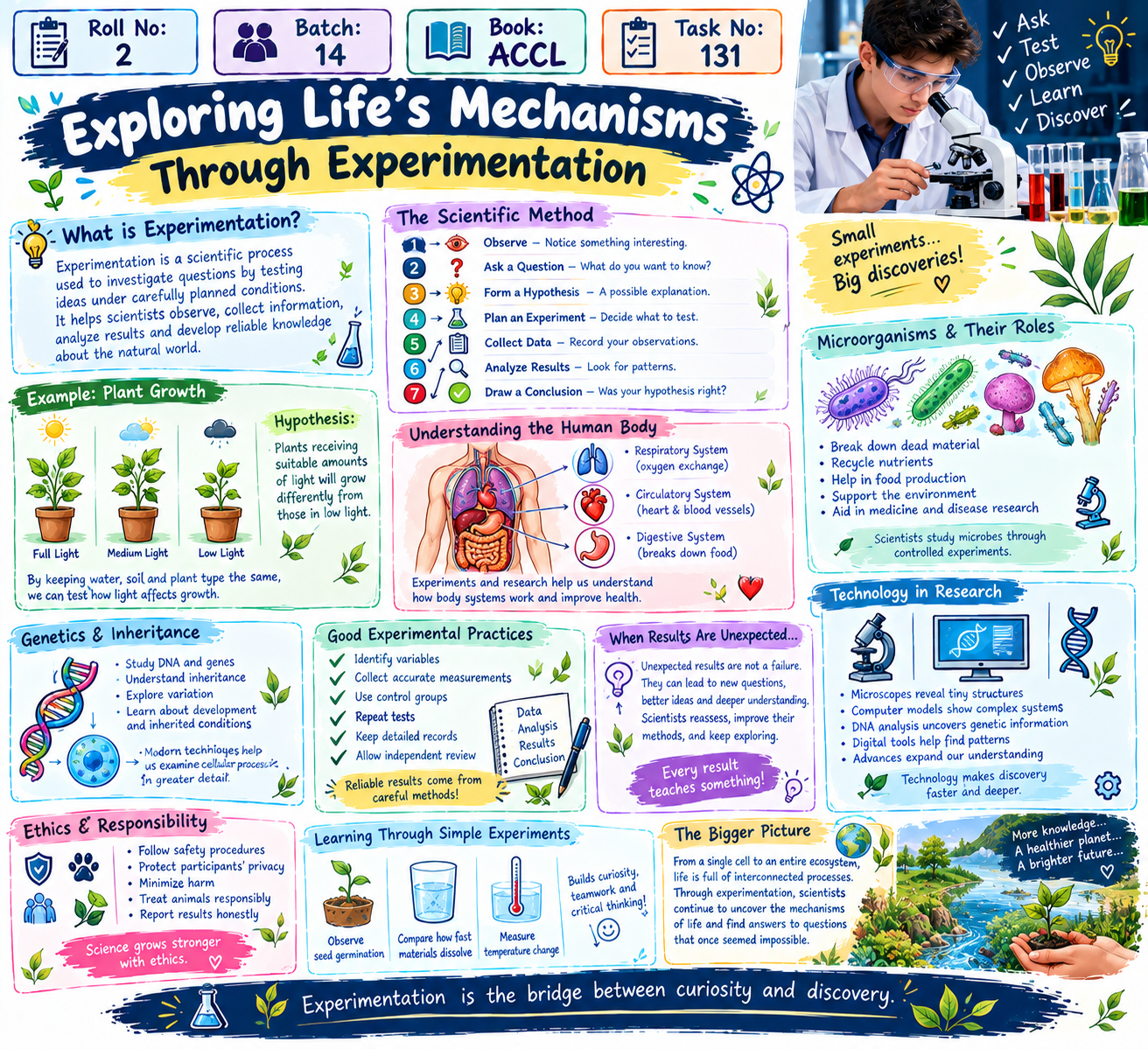
    # Exploring Life’s Mechanisms Through Experimentation

    Have you ever wondered how scientists discover the secrets of life? From understanding how plants grow to investigating how the human heart works, science helps us explore the processes that make living organisms function. Behind many important discoveries lies a powerful method called **experimentation**, which allows scientists to test ideas, observe results, and develop a deeper understanding of the natural world.

    **Experimentation is a scientific process used to investigate questions by testing ideas under carefully planned conditions.** Scientists begin by observing something interesting, asking a question, and developing a hypothesis—a possible explanation that can be tested. They then design an experiment, collect information, and analyze the results to determine whether the evidence supports their original idea. This process helps turn curiosity into reliable scientific knowledge.

    One fascinating example is the study of plant growth. Imagine a student who wants to discover whether the amount of light affects how quickly a plant grows. The student forms a hypothesis that plants receiving suitable amounts of light will grow differently from plants kept in low-light conditions. By keeping factors such as water, soil, and plant type consistent, the student can compare the results and investigate the role of light in plant development.

    Experimentation is also essential for understanding the human body. Scientists investigate how the heart circulates blood, how the lungs exchange gases, and how the digestive system processes food. Through carefully designed studies, medical imaging, laboratory tests, and other research methods, scientists learn how body systems work together to maintain health. Their findings can contribute to improved medical treatments and a better understanding of human biology.

    Another important field is microbiology, the study of microscopic organisms. Many bacteria and fungi play beneficial roles in nature, including breaking down dead material and recycling nutrients. Scientists use controlled experiments to investigate how these organisms respond to different environmental conditions. Such research can help improve food production, develop medicines, understand infectious diseases, and protect ecosystems.

    Experiments also help researchers understand genetics and the mechanisms of inheritance. By studying DNA, genes, and the characteristics of organisms across generations, scientists investigate how biological information is passed on and how variations arise. Modern techniques allow researchers to explore cellular processes in greater detail, helping them understand development, inherited conditions, and the relationships among different forms of life.

    A successful experiment requires more than simply observing what happens. Scientists must identify the variables they are studying, collect accurate measurements, and repeat tests when appropriate. They often use control groups for comparison and record their observations carefully. Repeating experiments helps determine whether a result is consistent, while independent review allows other researchers to examine the methods and evaluate the conclusions. These practices make scientific findings more trustworthy.

    Sometimes experiments produce unexpected results. Instead of treating an unexpected outcome as a failure, scientists use it as an opportunity to ask new questions. They may reconsider their hypothesis, improve their experimental design, or investigate another possible explanation. Scientific progress often happens through this cycle of questioning, testing, learning, and refining ideas. Every result can contribute something valuable when it is interpreted carefully.

    Technology has made biological experimentation more advanced than ever before. Microscopes reveal structures too small to see with the naked eye, computer models help researchers understand complicated systems, and DNA analysis allows scientists to investigate genetic information. Digital tools can also help organize large amounts of data and identify patterns that might otherwise be difficult to notice. These innovations continue to expand our understanding of living organisms.

    However, scientific experimentation must always be guided by responsibility and ethics. Researchers should follow safety procedures, protect participants' privacy, minimize harm, and treat animals responsibly. Experiments involving people or animals require appropriate ethical review and safeguards. Scientists must also report results honestly, even when the findings do not match their expectations. Reliable science depends on both accurate evidence and responsible behavior.

    Experimentation connects classroom learning with real-world discoveries. Students can explore scientific ideas through safe activities, such as observing seed germination, comparing how quickly different materials dissolve in water, or measuring changes in temperature. These activities encourage curiosity, careful observation, teamwork, and critical thinking. They also show that science is not just a collection of facts to memorize; it is an ongoing process of discovery.

    As we explore life's mechanisms, we begin to understand how countless processes work together to support living organisms. From the activity inside a single cell to the interactions among species in an ecosystem, each discovery reveals another part of nature's complexity. Through experimentation, scientists continue to investigate these connections and search for answers to questions that once seemed impossible to solve.

    **Experimentation is the bridge between curiosity and discovery. By asking thoughtful questions, testing ideas fairly, and learning from evidence, we can uncover the mechanisms of life and use scientific knowledge to improve human health, protect the environment, and build a brighter future. **

    \#Experimentation #Biology #ScientificMethod #LifeSciences #ScientificDiscovery #Research #ACCL #Batch14 #Task131
    **Roll No: 2** **Batch: 14** **Book: ACCL** **Task No: 138** # 🔬🧪 Exploring Life’s Mechanisms Through Experimentation 🌱🧬 Have you ever wondered how scientists discover the secrets of life? 🌍 From understanding how plants grow to investigating how the human heart works, science helps us explore the processes that make living organisms function. Behind many important discoveries lies a powerful method called **experimentation**, which allows scientists to test ideas, observe results, and develop a deeper understanding of the natural world. 🔍✨ **Experimentation is a scientific process used to investigate questions by testing ideas under carefully planned conditions.** 🧪 Scientists begin by observing something interesting, asking a question, and developing a hypothesis—a possible explanation that can be tested. They then design an experiment, collect information, and analyze the results to determine whether the evidence supports their original idea. This process helps turn curiosity into reliable scientific knowledge. 📚💡 One fascinating example is the study of plant growth. 🌱 Imagine a student who wants to discover whether the amount of light affects how quickly a plant grows. The student forms a hypothesis that plants receiving suitable amounts of light will grow differently from plants kept in low-light conditions. By keeping factors such as water, soil, and plant type consistent, the student can compare the results and investigate the role of light in plant development. ☀️🌿 Experimentation is also essential for understanding the human body. ❤️ Scientists investigate how the heart circulates blood, how the lungs exchange gases, and how the digestive system processes food. Through carefully designed studies, medical imaging, laboratory tests, and other research methods, scientists learn how body systems work together to maintain health. Their findings can contribute to improved medical treatments and a better understanding of human biology. 🫁🧠 Another important field is microbiology, the study of microscopic organisms. 🦠 Many bacteria and fungi play beneficial roles in nature, including breaking down dead material and recycling nutrients. Scientists use controlled experiments to investigate how these organisms respond to different environmental conditions. Such research can help improve food production, develop medicines, understand infectious diseases, and protect ecosystems. 🔬🌍 Experiments also help researchers understand genetics and the mechanisms of inheritance. 🧬 By studying DNA, genes, and the characteristics of organisms across generations, scientists investigate how biological information is passed on and how variations arise. Modern techniques allow researchers to explore cellular processes in greater detail, helping them understand development, inherited conditions, and the relationships among different forms of life. 🌱🔍 A successful experiment requires more than simply observing what happens. Scientists must identify the variables they are studying, collect accurate measurements, and repeat tests when appropriate. 📏 They often use control groups for comparison and record their observations carefully. Repeating experiments helps determine whether a result is consistent, while independent review allows other researchers to examine the methods and evaluate the conclusions. These practices make scientific findings more trustworthy. 📊📝 Sometimes experiments produce unexpected results. 🤔 Instead of treating an unexpected outcome as a failure, scientists use it as an opportunity to ask new questions. They may reconsider their hypothesis, improve their experimental design, or investigate another possible explanation. Scientific progress often happens through this cycle of questioning, testing, learning, and refining ideas. Every result can contribute something valuable when it is interpreted carefully. 💡🔄 Technology has made biological experimentation more advanced than ever before. 🤖🔬 Microscopes reveal structures too small to see with the naked eye, computer models help researchers understand complicated systems, and DNA analysis allows scientists to investigate genetic information. Digital tools can also help organize large amounts of data and identify patterns that might otherwise be difficult to notice. These innovations continue to expand our understanding of living organisms. 💻🧬 However, scientific experimentation must always be guided by responsibility and ethics. 💚 Researchers should follow safety procedures, protect participants' privacy, minimize harm, and treat animals responsibly. Experiments involving people or animals require appropriate ethical review and safeguards. Scientists must also report results honestly, even when the findings do not match their expectations. Reliable science depends on both accurate evidence and responsible behavior. ⚖️🌿 Experimentation connects classroom learning with real-world discoveries. 🏫 Students can explore scientific ideas through safe activities, such as observing seed germination, comparing how quickly different materials dissolve in water, or measuring changes in temperature. These activities encourage curiosity, careful observation, teamwork, and critical thinking. They also show that science is not just a collection of facts to memorize; it is an ongoing process of discovery. 🌈🧪 As we explore life's mechanisms, we begin to understand how countless processes work together to support living organisms. From the activity inside a single cell to the interactions among species in an ecosystem, each discovery reveals another part of nature's complexity. Through experimentation, scientists continue to investigate these connections and search for answers to questions that once seemed impossible to solve. 🌎🦋🔬 **Experimentation is the bridge between curiosity and discovery. By asking thoughtful questions, testing ideas fairly, and learning from evidence, we can uncover the mechanisms of life and use scientific knowledge to improve human health, protect the environment, and build a brighter future. 🔬🧬🌍💚** \#Experimentation #Biology #ScientificMethod #LifeSciences #ScientificDiscovery #Research #ACCL #Batch14 #Task131 🧪🔬🌱

    0 Σχόλια 0 Μοιράστηκε 1447 Views
  • RSIF8
    ROLL NO:92
    STORY POST NO:35
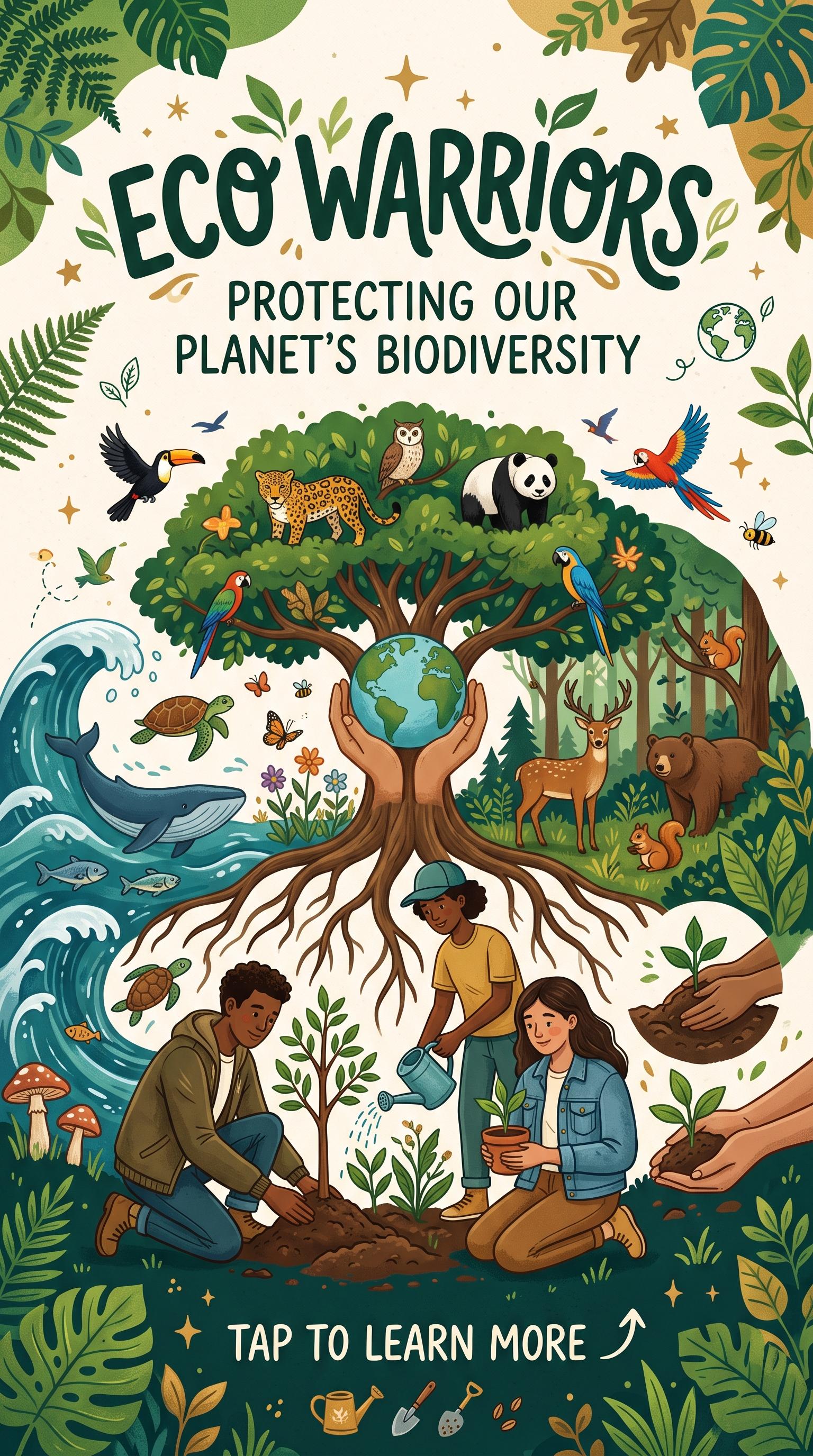
    Topic:Eco Warriors: Protecting Our Planet's Biodiversity
    Every plant, animal, and microscopic organism plays a vital role in keeping our ecosystems balanced and resilient. When one species disappears, the ripple effect impacts fresh water, clean air, soil health, and our collective future.

    Becoming an Eco Warrior isn't about grand gestures—it starts with consistent daily choices:

    Plant Native Species: Support local pollinators like bees, birds, and butterflies by adding indigenous flora to gardens and balconies.

    Reduce & Reuse: Minimize single-use plastics to keep toxic waste out of riverways and oceans.

    Support Sustainable Practices: Choose products with ethical, eco-friendly certifications that avoid deforestation and habitat destruction.

    Raise Awareness: Share knowledge, volunteer for community clean-ups, and champion conservation initiatives.

    Every small action protects the intricate web of life. Together, we can restore balance to the Earth.

    Hashtags:

    #EcoWarriors #ProtectOurPlanet #Biodiversity #ClimateAction #Conservation #SaveTheEarth #SustainableLiving
    RSIF8 ROLL NO:92 STORY POST NO:35 Topic:Eco Warriors: Protecting Our Planet's Biodiversity 🌍🌿 Every plant, animal, and microscopic organism plays a vital role in keeping our ecosystems balanced and resilient. When one species disappears, the ripple effect impacts fresh water, clean air, soil health, and our collective future. Becoming an Eco Warrior isn't about grand gestures—it starts with consistent daily choices: Plant Native Species: Support local pollinators like bees, birds, and butterflies by adding indigenous flora to gardens and balconies. Reduce & Reuse: Minimize single-use plastics to keep toxic waste out of riverways and oceans. Support Sustainable Practices: Choose products with ethical, eco-friendly certifications that avoid deforestation and habitat destruction. Raise Awareness: Share knowledge, volunteer for community clean-ups, and champion conservation initiatives. Every small action protects the intricate web of life. Together, we can restore balance to the Earth. Hashtags: #EcoWarriors #ProtectOurPlanet #Biodiversity #ClimateAction #Conservation #SaveTheEarth #SustainableLiving
    0 Σχόλια 0 Μοιράστηκε 666 Views
Αναζήτηση αποτελεσμάτων