



• #rsisb Roll No.240 Song No.25 Foundation level Dissecting Frogs: A Gateway to Human Anatomy explores the role of frog anatomy in biology education and shows how studying animal structures can help students develop a better understanding of anatomy. Frog anatomy provides a useful learning model for exploring the organization of a living body. Through careful observation, students can learn about different organs, body parts, and biological systems, while connecting classroom concepts with practical scientific learning. One of the important goals of anatomy studies is understanding how different body parts work together. By learning about body structures and their functions, students can build a stronger foundation for understanding more complex biological systems, including those found in humans. This topic also introduces the importance of observation, comparison, and scientific thinking. Students can examine similarities and differences between frog and human anatomy and understand that different organisms may have different structures while still sharing some basic biological principles. Practical anatomy work can also teach students important values such as responsibility, careful observation, accurate recording of information, and respect for biological specimens. Such activities should always be conducted with appropriate supervision, ethical consideration, and laboratory safety procedures. The study of frog anatomy can be especially valuable for students interested in biology, medicine, veterinary science, zoology, and health-related subjects. It helps turn scientific ideas into meaningful learning experiences and encourages students to ask questions about how living bodies are organized. 🔬 Learn about animal anatomy 🐸 Explore body structures and biological systems 🧠 Develop observation and scientific thinking skills 📚 Connect practical study with biology lessons 🫀 Build a foundation for understanding human anatomy 🌍 Appreciate the complexity of living organisms Dissecting Frogs: A Gateway to Human Anatomy reminds us that studying biology is more than memorizing names and diagrams. It is about observing, questioning, comparing, and understanding how life is organized. Through responsible scientific study, students can gain knowledge that supports deeper learning in anatomy and the life sciences. #FrogDissection #FrogAnatomy #HumanAnatomy #Biology #Anatomy #ScienceEducation #BiologyLab #LifeScience #AnimalAnatomy #ScientificLearning #StudentLearning #Zoology #HumanBody Rehan School Islamabad Campus Asma Shaheen EducationWali Irum Asim Saima Happinesswali https://www.facebook.com/share/v/1BrWG6PyH1/
    WWW.FACEBOOK.COM
    Facebook
    #rsisb Roll No.240 Song No.25 Foundation level Dissecting Frogs: A Gateway to Human Anatomy explores the role of frog anatomy in biology education and shows how studying animal structures can help...
    0 Comentários 0 Compartilhamentos 2789 Visualizações
  • #rsisb Roll No.240 Song No.23 Foundation Level **Dissecting Frogs: A Gateway to Human Anatomy** explores how studying frog anatomy can help students understand important ideas about the structure and functions of living organisms. Through careful observation and scientific study, students can learn how different body systems work together and how anatomy helps us understand life. Frogs are often used in biology education because their body structures provide useful examples for learning about organs, body systems, and biological functions. Studying anatomy can help students connect what they learn from textbooks and diagrams with real biological structures. This topic introduces students to important concepts such as the organization of the body, organs, tissues, and different body systems. It also encourages students to observe carefully, record information, ask questions, and think scientifically. The study of frog anatomy can also provide a broader understanding of **human anatomy**. Although frogs and humans are different animals, studying similarities and differences between organisms can help students understand how bodies are organized and how living systems perform essential functions. Most importantly, biological practical work should be carried out with **proper supervision, ethical consideration, safety procedures, and respect for living organisms**. Students can gain valuable scientific knowledge while developing responsible attitudes toward biological research. This topic encourages curiosity and helps students appreciate the complexity of life. It shows that science is not only about memorizing facts; it is also about observing, questioning, investigating, and building a deeper understanding of the natural world. 🔬 **Learn through scientific observation** 🐸 **Explore frog anatomy as a biology model** 🧠 **Understand organs and body systems** 📚 **Connect practical learning with classroom knowledge** 👩‍🔬 **Develop scientific thinking and observation skills** 🌍 **Appreciate the complexity and diversity of life** **Dissecting Frogs: A Gateway to Human Anatomy** provides students with an opportunity to explore anatomy in an educational setting and understand how biological structures are connected to their functions. Through responsible scientific learning, students can build knowledge that supports their future studies in biology, medicine, health sciences, and other scientific fields. #FrogDissection #HumanAnatomy #Anatomy #Biology #ScienceEducation #BiologyLab #FrogAnatomy #HumanBody #LifeScience #ScientificLearning #Education #Science #BiologyStudents #LearningThroughScience Rehan School Islamabad Campus Asma Shaheen EducationWali Irum Asim Saima Happinesswali https://www.facebook.com/share/v/1DrPuWFK8D/
    WWW.FACEBOOK.COM
    Facebook
    #rsisb Roll No.240 Song No.23 Foundation Level **Dissecting Frogs: A Gateway to Human Anatomy** explores how studying frog anatomy can help students understand important ideas about the structure...
    0 Comentários 0 Compartilhamentos 2258 Visualizações
  • #rsisb
    Roll No.240
    Story No.17
    Foundation level

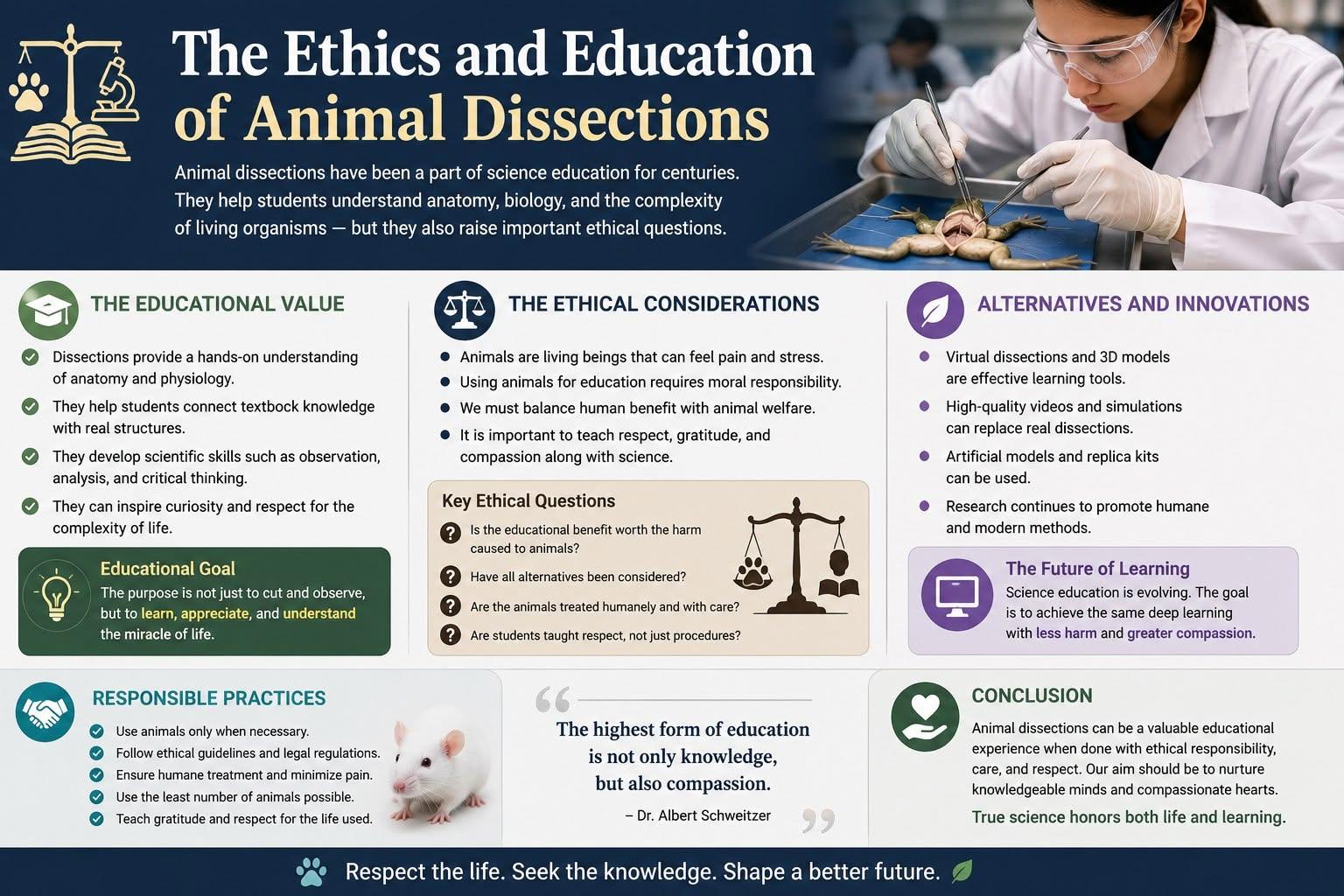
    ### **The Ethics and Education of Animal Dissections**

    Animal dissection has long been an important part of biology and medical education, helping students understand anatomy, physiology, and the complex structures of living organisms. By examining real biological specimens, learners gain hands-on experience that strengthens their observation, critical thinking, and scientific investigation skills. For many years, dissections have played a significant role in preparing future doctors, veterinarians, scientists, and researchers by providing practical knowledge that complements classroom learning.

    At the same time, animal dissections raise important ethical questions about animal welfare, responsible scientific practice, and the balance between educational benefits and respect for living creatures. Modern education encourages students to consider these ethical perspectives while learning about science. Many schools and universities now offer alternatives such as virtual dissections, 3D anatomical models, computer simulations, and interactive digital laboratories. These innovative tools provide effective learning experiences while reducing the need for animal specimens in many educational settings.

    Understanding the ethics of animal dissection helps students develop not only scientific knowledge but also compassion, responsibility, and respect for life. By combining ethical awareness with scientific inquiry, educators can inspire future generations to pursue discovery in ways that are both innovative and humane. This balanced approach promotes critical thinking, responsible decision-making, and a deeper appreciation for the relationship between science, education, and the living world.

    **#AnimalDissection #Biology #ScienceEducation #Ethics #STEM #BiologyLab #Anatomy #LifeSciences #ScientificLearning #AnimalWelfare #Education #MedicalScience #CriticalThinking #Research #Science **

    Rehan School Islamabad Campus
    Asma Shaheen EducationWali
    Irum Asim
    Saima Happinesswali
    #rsisb Roll No.240 Story No.17 Foundation level ### **The Ethics and Education of Animal Dissections** Animal dissection has long been an important part of biology and medical education, helping students understand anatomy, physiology, and the complex structures of living organisms. By examining real biological specimens, learners gain hands-on experience that strengthens their observation, critical thinking, and scientific investigation skills. For many years, dissections have played a significant role in preparing future doctors, veterinarians, scientists, and researchers by providing practical knowledge that complements classroom learning. At the same time, animal dissections raise important ethical questions about animal welfare, responsible scientific practice, and the balance between educational benefits and respect for living creatures. Modern education encourages students to consider these ethical perspectives while learning about science. Many schools and universities now offer alternatives such as virtual dissections, 3D anatomical models, computer simulations, and interactive digital laboratories. These innovative tools provide effective learning experiences while reducing the need for animal specimens in many educational settings. Understanding the ethics of animal dissection helps students develop not only scientific knowledge but also compassion, responsibility, and respect for life. By combining ethical awareness with scientific inquiry, educators can inspire future generations to pursue discovery in ways that are both innovative and humane. This balanced approach promotes critical thinking, responsible decision-making, and a deeper appreciation for the relationship between science, education, and the living world. **#AnimalDissection #Biology #ScienceEducation #Ethics #STEM #BiologyLab #Anatomy #LifeSciences #ScientificLearning #AnimalWelfare #Education #MedicalScience #CriticalThinking #Research #Science 🌿🔬🧬🐸📚** Rehan School Islamabad Campus Asma Shaheen EducationWali Irum Asim Saima Happinesswali
    0 Comentários 0 Compartilhamentos 7297 Visualizações