• ACCL BOOK
    DAY : 125
    CANVA POST
    ROLL NO : 17
    SYEDA UMAIMA EDITING WALI
    FOUNDATION LEVEL
    > The Anatomy of a Frog
    >
    > A frog has two main parts in its body - External Anatomy and Internal Anatomy.
    >
    > External Anatomy (Outside Body):
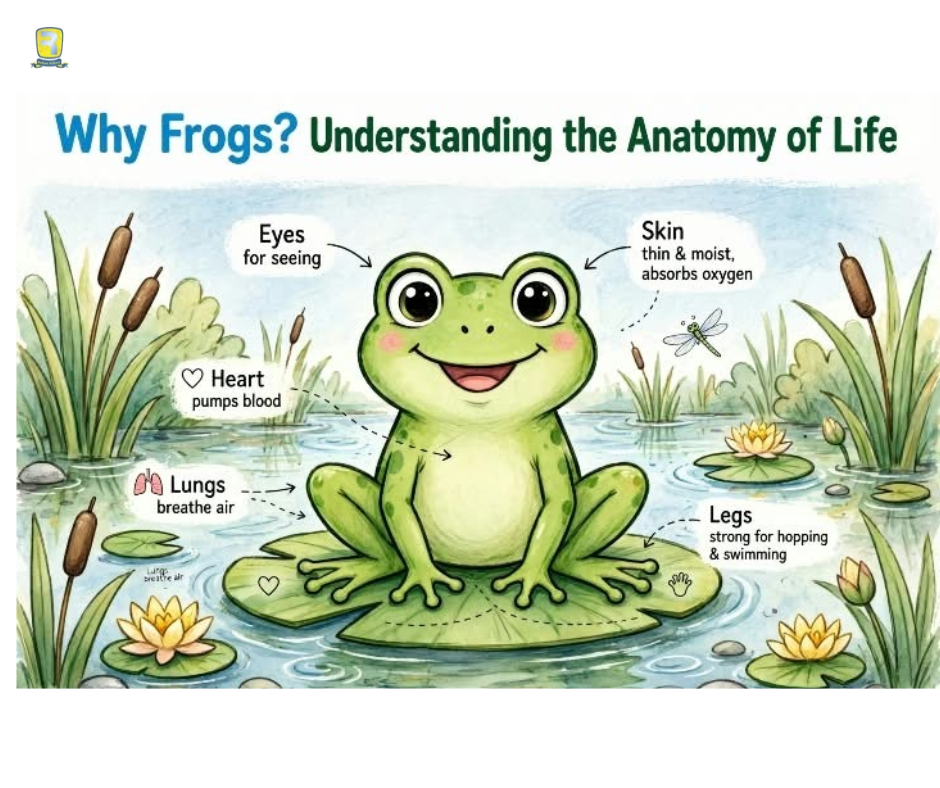
    > The frog has big eyes , nostrils , tympanum for hearing, and a long sticky tongue to catch insects. It has four legs - two front legs and two long back legs which help it to jump and swim. Its moist skin helps it to breathe!
    >
    > Internal Anatomy (Inside Body):
    > Inside the frog, there is a heart , lungs for breathing, liver, stomach, and intestines for digestion. It also has kidneys for cleaning the blood.
    >
    > Frogs are amazing animals! They can live both on land and in water. They help us by eating insects and keeping nature balanced.
    >
    > #Frog #Anatomy #Science #Biology #Day127 #SchoolProject See less
    ACCL BOOK DAY : 125 CANVA POST ROLL NO : 17 SYEDA UMAIMA EDITING WALI FOUNDATION LEVEL > 🐸 The Anatomy of a Frog 🐸 > > A frog has two main parts in its body - External Anatomy and Internal Anatomy. > > 👀 External Anatomy (Outside Body): > The frog has big eyes 👀, nostrils 👃, tympanum 👂 for hearing, and a long sticky tongue 👅 to catch insects. It has four legs - two front legs and two long back legs 🦵 which help it to jump and swim. Its moist skin 💧 helps it to breathe! > > ❤️ Internal Anatomy (Inside Body): > Inside the frog, there is a heart ❤️, lungs 🫁 for breathing, liver, stomach, and intestines for digestion. It also has kidneys for cleaning the blood. > > 🌿 Frogs are amazing animals! They can live both on land and in water. They help us by eating insects and keeping nature balanced. 🍃✨ > > #Frog 🐸 #Anatomy #Science 🔬 #Biology 📚 #Day127 ✨ #SchoolProject See less
    0 Comentários 0 Compartilhamentos 127 Visualizações
  • #rsisb
    Roll no 279
    song no 14
    foundation level
    # ** Dissecting Frogs: A Gateway to Human Anatomy **
    **Discover the fascinating world of biology and anatomy!** Frogs are amazing living organisms that help us understand how different body systems work. By studying frog anatomy, students can explore the structure and functions of important organs and discover how living things survive.
    Learn about the heart, lungs, stomach, liver, digestive system, respiratory system, and other important organs. Explore how these organs work together to keep the body functioning. Frog anatomy also provides valuable insights into similarities and differences between amphibians and humans.
    This educational topic opens the door to scientific discovery, encouraging curiosity, observation, and a deeper understanding of life sciences.
    **Every organism has a unique design, and every discovery brings us closer to understanding the wonders of life!**
    Let's explore biology, learn about anatomy, and discover the incredible science of living organisms!
    **#FrogAnatomy #HumanAnatomy #Biology #Science #Education #LifeScience #AnimalBiology #Learning #ScientificDiscovery**
    #rsisb Roll no 279 song no 14 foundation level # **🐸 Dissecting Frogs: A Gateway to Human Anatomy 🔬** 🌍 **Discover the fascinating world of biology and anatomy!** Frogs are amazing living organisms that help us understand how different body systems work. By studying frog anatomy, students can explore the structure and functions of important organs and discover how living things survive. 🧬 Learn about the heart, lungs, stomach, liver, digestive system, respiratory system, and other important organs. Explore how these organs work together to keep the body functioning. Frog anatomy also provides valuable insights into similarities and differences between amphibians and humans. 🔍 This educational topic opens the door to scientific discovery, encouraging curiosity, observation, and a deeper understanding of life sciences. 💡 **Every organism has a unique design, and every discovery brings us closer to understanding the wonders of life!** 🚀 Let's explore biology, learn about anatomy, and discover the incredible science of living organisms! **#FrogAnatomy #HumanAnatomy #Biology #Science #Education #LifeScience #AnimalBiology #Learning #ScientificDiscovery** 🐸🧬🔬🌿📚
    0 Comentários 0 Compartilhamentos 208 Visualizações 1
  • ACCL TASK :125
    Day :125
    foundation level
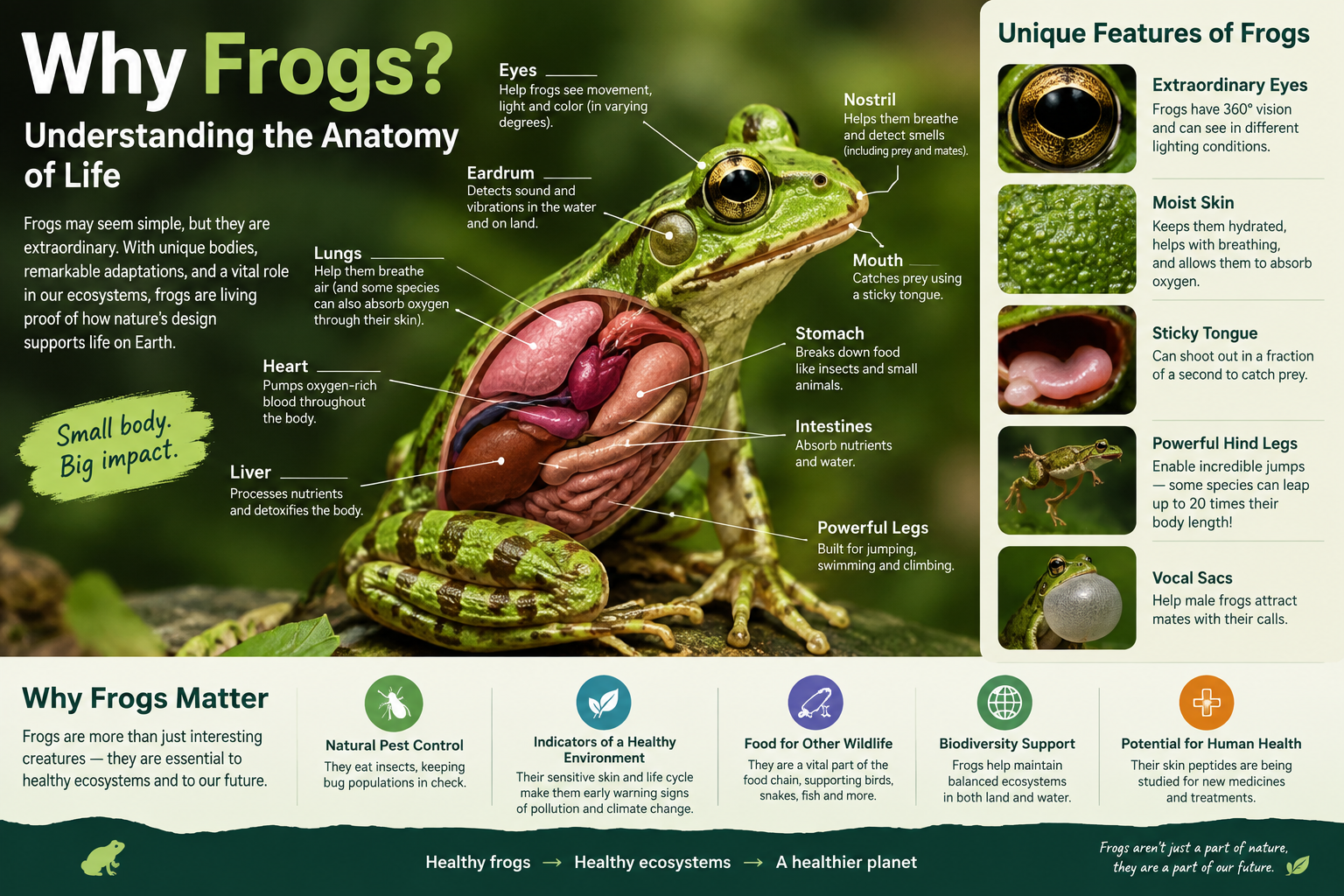
    **Why Frogs? Understanding the Anatomy of Life**
    Frogs are fascinating creatures with unique body structures and remarkable adaptations. From their powerful legs and specialized eyes to their moist skin and efficient organs, every part of a frog’s body plays an important role in survival.
    This educational poster explores frog anatomy and explains why frogs are important indicators of healthy ecosystems.
    **Small body. Big impact.**
    #FrogAnatomy #Biology #ScienceEducation #AnimalAnatomy #LearningThroughScience #Frogs #Nature
    ACCL TASK :125 Day :125 foundation level 🐸 **Why Frogs? Understanding the Anatomy of Life** Frogs are fascinating creatures with unique body structures and remarkable adaptations. From their powerful legs and specialized eyes to their moist skin and efficient organs, every part of a frog’s body plays an important role in survival. This educational poster explores frog anatomy and explains why frogs are important indicators of healthy ecosystems. 🌿🔬 **Small body. Big impact.** #FrogAnatomy #Biology #ScienceEducation #AnimalAnatomy #LearningThroughScience #Frogs #Nature
    0 Comentários 0 Compartilhamentos 2030 Visualizações
  • RSIF8
    Roll no:14
    story no:20
    story topic:Why Frogs? Understanding the Anatomy of Life

    # Why Frogs? Understanding the Anatomy of Life

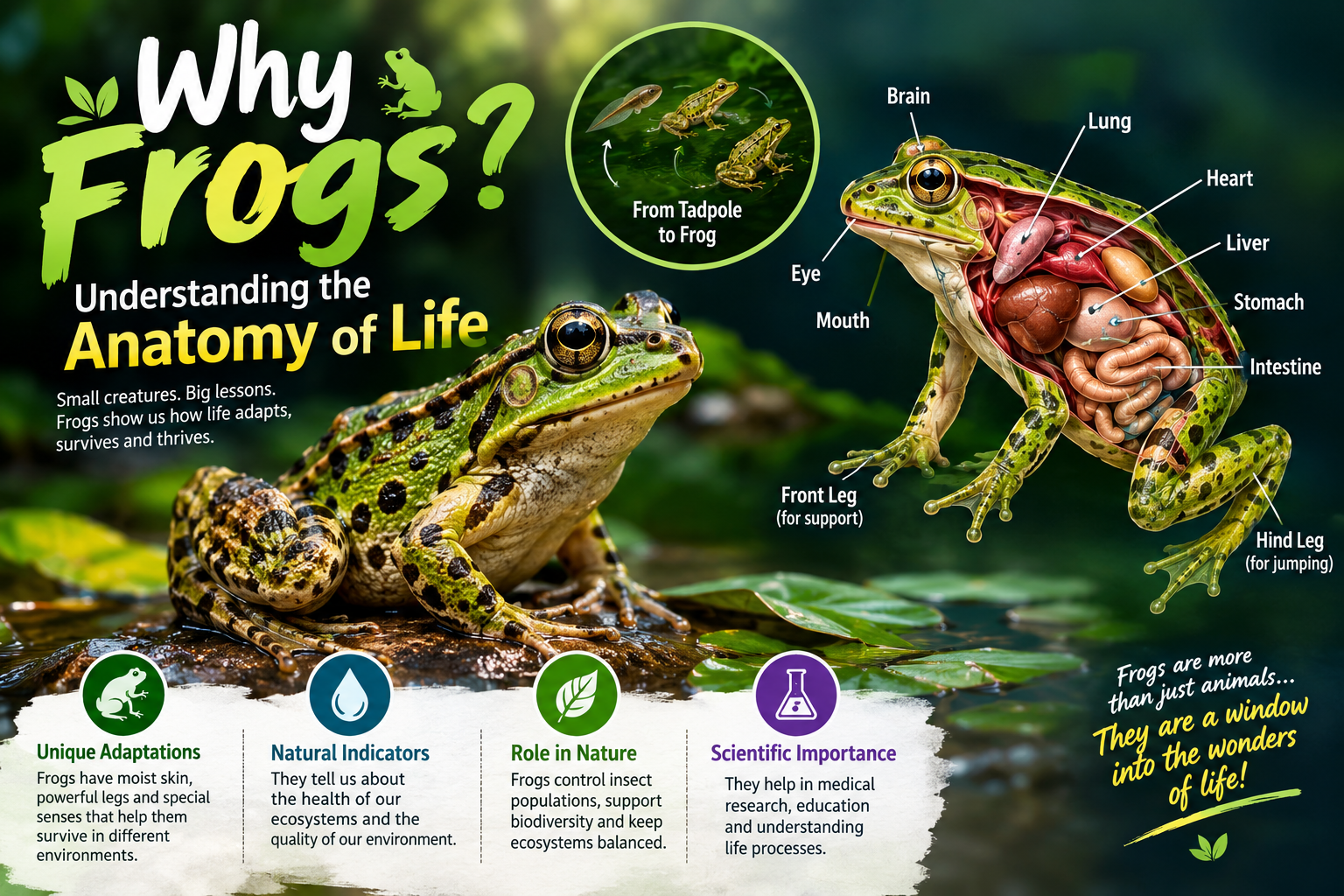
    Discover the fascinating world of frogs through **“Why Frogs? Understanding the Anatomy of Life.”** This educational topic explores the unique anatomy, amazing adaptations, and important role frogs play in maintaining the balance of nature. Although frogs may seem like small and simple creatures, their bodies reveal extraordinary examples of biological design, survival, and adaptation.

    From their powerful hind legs and moist skin to their sensitive eyes and specialized internal organs, frogs have developed remarkable features that help them survive in different environments. Their life cycle, from tiny tadpoles to adult frogs, demonstrates one of nature’s most interesting transformations.

    **What Will You Discover?**

    - **Frog Anatomy:** Learn about the brain, heart, lungs, stomach, intestines, and other important body parts.
    - **Unique Adaptations:** Discover how frogs jump, breathe, swim, and survive in their habitats.
    - **Life Cycle:** Explore the fascinating transformation from tadpole to adult frog.
    - **Environmental Indicators:** Understand how frogs can help scientists monitor ecosystem health.
    - **Role in Nature:** Learn how frogs help control insect populations and support biodiversity.
    - **Scientific Importance:** Discover how studying frogs helps us understand biology, anatomy, and life processes.

    Frogs are more than just pond-dwelling animals. They are an important part of food chains and ecosystems, and their sensitivity to environmental changes makes them valuable subjects for scientific research. Studying these amazing amphibians helps us appreciate the complexity of life and the importance of protecting nature.

    **Explore the hidden wonders of frog anatomy, uncover the secrets of their survival, and discover how these small creatures teach us big lessons about life!**

    #WhyFrogs #FrogAnatomy #UnderstandingLife #Biology #ScienceEducation #Amphibians #AnimalScience #Nature #Biodiversity #LifeCycle #EnvironmentalScience #EducationalContent #ExploreScience
    RSIF8 Roll no:14 story no:20 story topic:Why Frogs? Understanding the Anatomy of Life # 🐸 Why Frogs? Understanding the Anatomy of Life 🌿🔬 Discover the fascinating world of frogs through **“Why Frogs? Understanding the Anatomy of Life.”** This educational topic explores the unique anatomy, amazing adaptations, and important role frogs play in maintaining the balance of nature. 🌍✨ Although frogs may seem like small and simple creatures, their bodies reveal extraordinary examples of biological design, survival, and adaptation. From their powerful hind legs and moist skin to their sensitive eyes and specialized internal organs, frogs have developed remarkable features that help them survive in different environments. Their life cycle, from tiny tadpoles to adult frogs, demonstrates one of nature’s most interesting transformations. 💧🌱 🐸 **What Will You Discover?** - 🔬 **Frog Anatomy:** Learn about the brain, heart, lungs, stomach, intestines, and other important body parts. - 🌿 **Unique Adaptations:** Discover how frogs jump, breathe, swim, and survive in their habitats. - 💧 **Life Cycle:** Explore the fascinating transformation from tadpole to adult frog. - 🌎 **Environmental Indicators:** Understand how frogs can help scientists monitor ecosystem health. - 🦟 **Role in Nature:** Learn how frogs help control insect populations and support biodiversity. - 🧪 **Scientific Importance:** Discover how studying frogs helps us understand biology, anatomy, and life processes. Frogs are more than just pond-dwelling animals. They are an important part of food chains and ecosystems, and their sensitivity to environmental changes makes them valuable subjects for scientific research. Studying these amazing amphibians helps us appreciate the complexity of life and the importance of protecting nature. 💚🌏 ✨ **Explore the hidden wonders of frog anatomy, uncover the secrets of their survival, and discover how these small creatures teach us big lessons about life!** #WhyFrogs #FrogAnatomy #UnderstandingLife #Biology #ScienceEducation #Amphibians #AnimalScience #Nature #Biodiversity #LifeCycle #EnvironmentalScience #EducationalContent #ExploreScience 🐸🔬🌿
    0 Comentários 0 Compartilhamentos 4056 Visualizações
  • RSIF8
    Roll no 94
    Song no 17
    Song topic
    Dissecting Frogs: A Gateway to Human Anatomy
    Exploring frog anatomy helps us understand the amazing structure and functions of the human body! From organs to body systems, every discovery brings us closer to understanding life and science.
    Join me on this fascinating journey into biology and uncover the connections between frogs and humans! ‍
    #DissectingFrogs #HumanAnatomy #BiologyEducation #ScienceLearning #STEM #MedicalScience #AnatomyStudy #LifeSciences #LearningJourney #ScienceExplorer
    RSIF8 Roll no 94 Song no 17 Song topic 🐸🔬 Dissecting Frogs: A Gateway to Human Anatomy 🫀🧠 Exploring frog anatomy helps us understand the amazing structure and functions of the human body! 🌟 From organs to body systems, every discovery brings us closer to understanding life and science. 📚🔍 Join me on this fascinating journey into biology and uncover the connections between frogs and humans! 🐸➡️👨‍⚕️ #DissectingFrogs #HumanAnatomy #BiologyEducation #ScienceLearning #STEM #MedicalScience #AnatomyStudy #LifeSciences #LearningJourney #ScienceExplorer 🧪🔬📖
    0 Comentários 0 Compartilhamentos 2621 Visualizações 15
  • RSIF8
    Roll no 94
    Story post no 18
    Story post topic
    Why Frogs? Understanding the Anatomy of Life

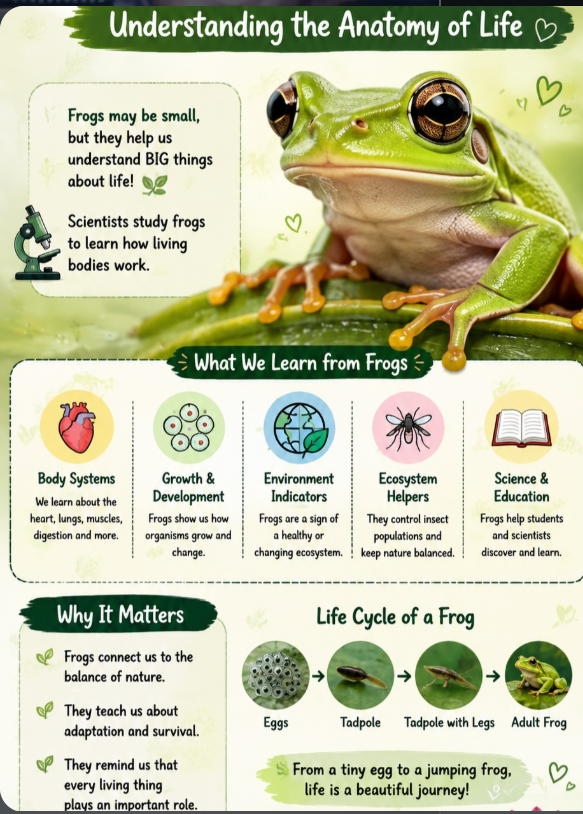
    Frogs are more than just fascinating creatures—they help us understand how living organisms function! By studying frog anatomy, we learn about body systems, adaptation, and the amazing complexity of life. Every frog is a small reminder of the wonders of nature and science.

    Explore, learn, and discover how these incredible amphibians contribute to our understanding of the natural world!


    #WhyFrogs #AnatomyOfLife #Biology #Science #LifeScience #STEM #Education #Nature #Wildlife #FrogLife #Learning #ScienceFacts #EnvironmentalScience #StudentLife #ExploreNature #Knowledge #AmazingNature #ScienceEducation #GreenWorld #Inspiration
    RSIF8 Roll no 94 Story post no 18 Story post topic 🐸✨ Why Frogs? Understanding the Anatomy of Life ✨🐸 Frogs are more than just fascinating creatures—they help us understand how living organisms function! 🌿🔬 By studying frog anatomy, we learn about body systems, adaptation, and the amazing complexity of life. Every frog is a small reminder of the wonders of nature and science. 🌎💚 📚 Explore, learn, and discover how these incredible amphibians contribute to our understanding of the natural world! 🐸🌱🔍✨ #WhyFrogs #AnatomyOfLife #Biology #Science #LifeScience #STEM #Education #Nature #Wildlife #FrogLife #Learning #ScienceFacts #EnvironmentalScience #StudentLife #ExploreNature #Knowledge #AmazingNature #ScienceEducation #GreenWorld #Inspiration
    0 Comentários 0 Compartilhamentos 3123 Visualizações
  • **Roll No: 2**
    **Batch: 14**
    **Book: ACCL**
    **Task No: 145**

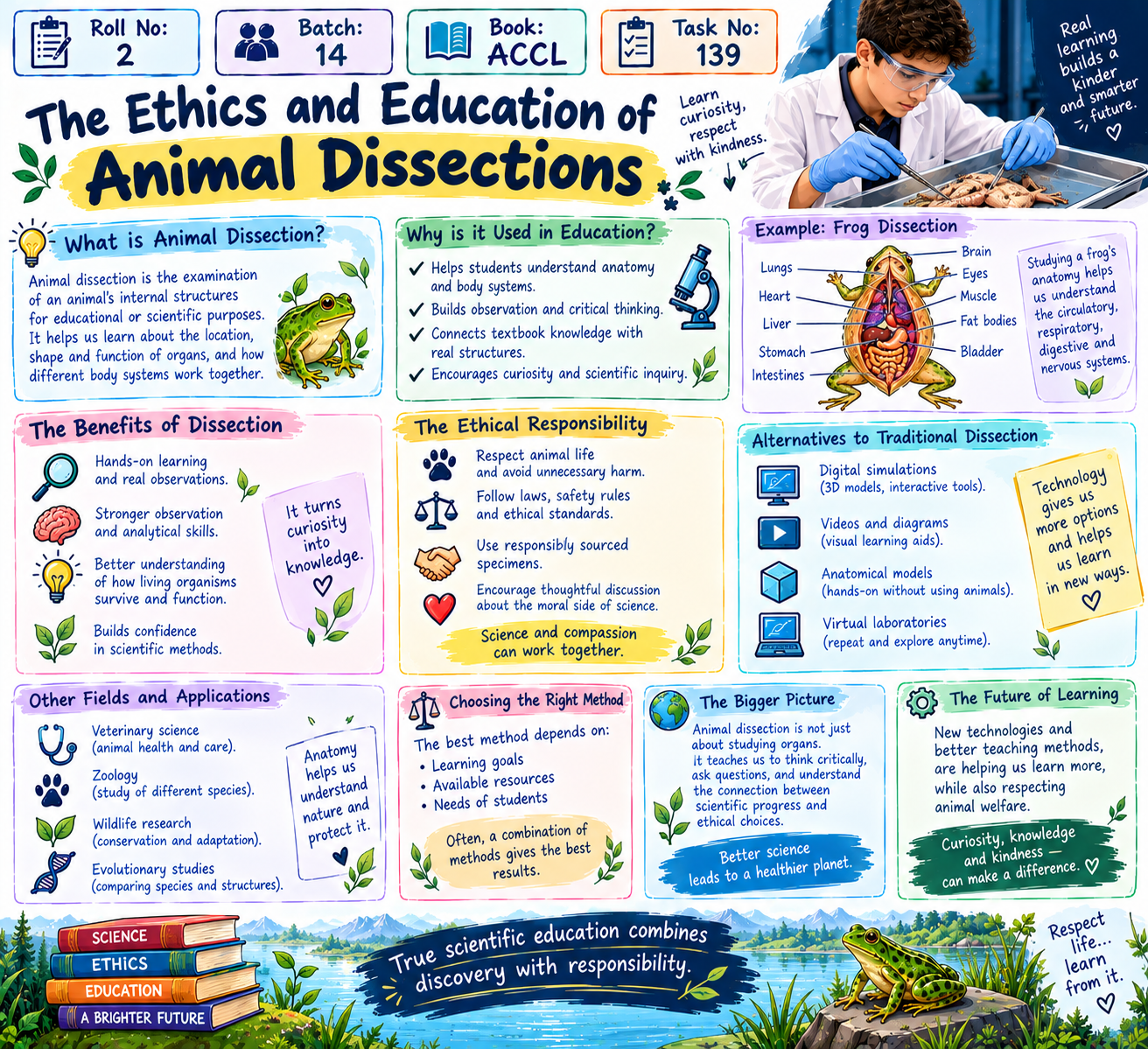
    # The Ethics and Education of Animal Dissections

    Have you ever wondered how students learn about the internal structures of animals and why science education places importance on understanding life responsibly? Animal dissection has been used in biology classrooms and scientific research to help learners explore anatomy, examine organs, and understand how different body systems function. However, it also raises important questions about animal welfare, ethical responsibility, and the best ways to teach scientific concepts.

    **Animal dissection is the examination of an animal's internal structures for educational or scientific purposes.** By studying anatomy, students can learn how organs are arranged and how body systems work together. For example, examining the anatomy of a frog can help learners understand the circulatory, respiratory, digestive, and nervous systems. These observations connect information from textbooks with the physical structures found in living organisms.

    One major benefit of dissection is that it encourages active learning. Instead of only memorizing the names of organs, students can observe anatomical structures, compare their shapes and positions, and ask questions about their functions. This process can strengthen observation skills, critical thinking, and scientific understanding. It also helps learners recognize that every organ has a role in supporting the survival of an organism.

    Nevertheless, **education must balance scientific learning with respect for animal life.** Animals are living organisms with their own biological needs, and their use in education should be considered carefully. Teachers and institutions should follow applicable laws, safety rules, and ethical standards. Specimens should be obtained responsibly, and unnecessary harm should be avoided. Students should also be encouraged to discuss the moral responsibilities that accompany scientific discovery.

    Fortunately, modern technology provides several alternatives to traditional dissection. Digital simulations allow students to explore three-dimensional anatomical models, examine virtual organs, and study body systems through interactive activities. Videos, diagrams, anatomical models, and virtual laboratories can also make complex concepts easier to understand. These approaches may reduce the need for physical specimens while offering flexible opportunities for repeated learning.

    The best educational method can depend on the learning objective, available resources, and the needs of students. A physical specimen may provide certain observations that a diagram cannot fully reproduce, while a digital model may allow students to rotate structures, zoom in on details, and repeat an activity without using another specimen. Combining different teaching methods can provide a richer understanding of anatomy and biology.

    Animal dissection also connects classroom education with wider scientific fields. Knowledge of anatomy contributes to veterinary science, zoology, wildlife research, and the study of animal health. Comparing anatomical structures across species can help scientists investigate adaptation and evolutionary relationships. Such knowledge can also support conservation efforts by improving our understanding of animals and the environments in which they live.

    Ethics should remain an important part of every scientific learning experience. Students should be able to ask questions, understand why a particular method is being used, and learn about alternatives where appropriate. Teachers can create respectful classrooms by explaining the educational purpose of activities, ensuring proper supervision, and encouraging thoughtful discussion. Scientific progress is strongest when curiosity is combined with compassion and responsibility.

    Another important lesson is that science continues to develop. New technologies and educational methods provide opportunities to improve the way anatomy is taught. By evaluating the effectiveness of different approaches, educators can choose methods that support learning while taking animal welfare seriously. This ongoing evaluation reflects the scientific habit of questioning, testing, and improving established practices.

    Ultimately, the ethics and education of animal dissections are about more than studying organs. They encourage students to think critically about scientific methods, recognize the value of responsible research, and understand the relationship between knowledge and moral choices. Learning biology should deepen both our understanding of nature and our respect for living organisms.

    **True scientific education combines discovery with responsibility. By studying anatomy thoughtfully, considering ethical alternatives, and respecting animal welfare, we can develop knowledgeable learners who value both scientific progress and the natural world. **

    #AnimalDissection #AnimalEthics #Biology #ScienceEducation #AnimalWelfare #Anatomy #ACCL #Batch14 #Task139
    **Roll No: 2** **Batch: 14** **Book: ACCL** **Task No: 145** # 🐸🔬 The Ethics and Education of Animal Dissections 🌿📚 Have you ever wondered how students learn about the internal structures of animals and why science education places importance on understanding life responsibly? 🧬🔍 Animal dissection has been used in biology classrooms and scientific research to help learners explore anatomy, examine organs, and understand how different body systems function. However, it also raises important questions about animal welfare, ethical responsibility, and the best ways to teach scientific concepts. **Animal dissection is the examination of an animal's internal structures for educational or scientific purposes.** 🔬 By studying anatomy, students can learn how organs are arranged and how body systems work together. For example, examining the anatomy of a frog can help learners understand the circulatory, respiratory, digestive, and nervous systems. These observations connect information from textbooks with the physical structures found in living organisms. 🐸🫀 One major benefit of dissection is that it encourages active learning. 📖 Instead of only memorizing the names of organs, students can observe anatomical structures, compare their shapes and positions, and ask questions about their functions. This process can strengthen observation skills, critical thinking, and scientific understanding. It also helps learners recognize that every organ has a role in supporting the survival of an organism. Nevertheless, **education must balance scientific learning with respect for animal life.** 💚 Animals are living organisms with their own biological needs, and their use in education should be considered carefully. Teachers and institutions should follow applicable laws, safety rules, and ethical standards. Specimens should be obtained responsibly, and unnecessary harm should be avoided. Students should also be encouraged to discuss the moral responsibilities that accompany scientific discovery. ⚖️🌱 Fortunately, modern technology provides several alternatives to traditional dissection. 💻🧬 Digital simulations allow students to explore three-dimensional anatomical models, examine virtual organs, and study body systems through interactive activities. Videos, diagrams, anatomical models, and virtual laboratories can also make complex concepts easier to understand. These approaches may reduce the need for physical specimens while offering flexible opportunities for repeated learning. The best educational method can depend on the learning objective, available resources, and the needs of students. 🏫 A physical specimen may provide certain observations that a diagram cannot fully reproduce, while a digital model may allow students to rotate structures, zoom in on details, and repeat an activity without using another specimen. Combining different teaching methods can provide a richer understanding of anatomy and biology. Animal dissection also connects classroom education with wider scientific fields. 🏥 Knowledge of anatomy contributes to veterinary science, zoology, wildlife research, and the study of animal health. Comparing anatomical structures across species can help scientists investigate adaptation and evolutionary relationships. Such knowledge can also support conservation efforts by improving our understanding of animals and the environments in which they live. 🌍🐦 Ethics should remain an important part of every scientific learning experience. Students should be able to ask questions, understand why a particular method is being used, and learn about alternatives where appropriate. Teachers can create respectful classrooms by explaining the educational purpose of activities, ensuring proper supervision, and encouraging thoughtful discussion. Scientific progress is strongest when curiosity is combined with compassion and responsibility. 🤝💚 Another important lesson is that science continues to develop. 🔬 New technologies and educational methods provide opportunities to improve the way anatomy is taught. By evaluating the effectiveness of different approaches, educators can choose methods that support learning while taking animal welfare seriously. This ongoing evaluation reflects the scientific habit of questioning, testing, and improving established practices. Ultimately, the ethics and education of animal dissections are about more than studying organs. They encourage students to think critically about scientific methods, recognize the value of responsible research, and understand the relationship between knowledge and moral choices. 🌿📚 Learning biology should deepen both our understanding of nature and our respect for living organisms. **True scientific education combines discovery with responsibility. By studying anatomy thoughtfully, considering ethical alternatives, and respecting animal welfare, we can develop knowledgeable learners who value both scientific progress and the natural world. 🐸🔬🌎💚** #AnimalDissection #AnimalEthics #Biology #ScienceEducation #AnimalWelfare #Anatomy #ACCL #Batch14 #Task139 🐸🧬📚

    0 Comentários 0 Compartilhamentos 5411 Visualizações
  • **Roll No: 2**
    **Batch: 14**
    **Book: ACCL**
    **Task No: 130**

    # Peering Inside: The Role of Dissections in Understanding Life

    Have you ever wondered how scientists discover what lies inside a living organism and how its different organs work together? The human body and the bodies of other animals contain many complex structures that cannot be fully understood by looking only at their outer appearance. Dissection is one scientific method that helps students and researchers explore internal anatomy and understand the remarkable organization of life.

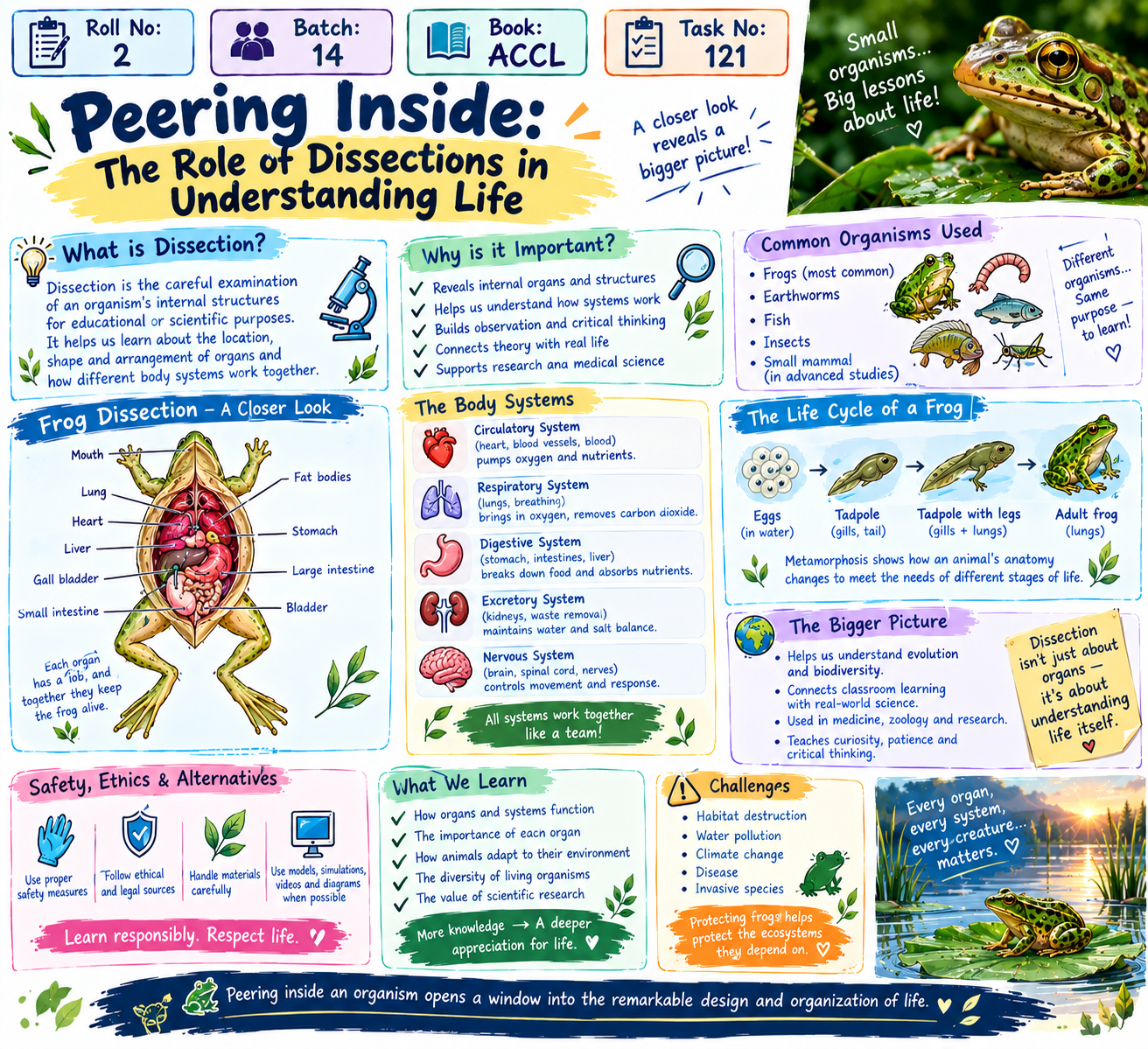
    **Dissection is the careful examination of an organism's internal structures for educational or scientific purposes.** It helps us learn about the location, shape, and arrangement of organs and how different body systems work together. By studying anatomy, we can better understand how living organisms obtain energy, breathe, circulate blood, digest food, and respond to their surroundings.

    One commonly discussed example in biology education is frog dissection. Frogs are interesting study organisms because they have many organ systems that can be compared with those of other vertebrates. Their bodies are adapted for movement on land and in water, and their anatomy provides useful opportunities to study how organs perform different functions. Observing frog anatomy can help students understand the relationship between body structure and survival.

    The circulatory system is an important area of anatomical study. The heart pumps blood through blood vessels, helping transport oxygen, nutrients, and other substances around the body. The respiratory system supports gas exchange, while the digestive system breaks down food so that the body can absorb useful nutrients. These systems work together to supply cells with the materials and energy they need.

    The nervous system is equally fascinating. It includes the brain, spinal cord, and nerves, which coordinate movement, process information, and help organisms respond to changes in their environments. The excretory system also plays an essential role by removing waste products and maintaining the balance of water and salts. Studying these systems reveals that every organ has a specific role, yet no organ works entirely alone.

    Dissection can also connect classroom learning with real-world science. Medical professionals study anatomy to understand the human body, while zoologists investigate the structures of different animal species. Researchers use many methods, including imaging, microscopy, computer models, and carefully conducted anatomical studies, to investigate how organisms function. These approaches have helped expand our knowledge of health, development, and biodiversity.

    Although dissection can be a valuable learning method, science education must also emphasize responsibility and respect for life. Schools and laboratories should follow appropriate safety procedures, use legally and ethically sourced specimens, and handle materials carefully. Whenever possible, students may also learn through digital simulations, anatomical models, videos, and diagrams. These alternatives can explain many internal structures without requiring the use of preserved specimens.

    The study of anatomy helps us appreciate the diversity of living organisms. Different species have different body structures because they have adapted to different environments and ways of life. Comparing these structures allows scientists to investigate evolution, understand biological similarities, and discover how organisms meet the challenges of survival.

    Dissection teaches more than the names of organs. It encourages observation, patience, careful reasoning, and the ability to connect scientific evidence with biological explanations. It also reminds us that scientific knowledge grows through asking questions, examining evidence, and learning from reliable methods rather than making assumptions.

    **Peering inside an organism opens a window into the remarkable design and organization of life. By studying anatomy responsibly, we deepen our understanding of biology, appreciate the connections between body systems, and learn why every discovery should be guided by curiosity, care, and respect for the natural world. **

    \#Dissection #Anatomy #Biology #ScienceEducation #AnimalScience #LearningThroughScience #ACCL #Batch14 #Task121
    **Roll No: 2** **Batch: 14** **Book: ACCL** **Task No: 130** # 🔬🧬 Peering Inside: The Role of Dissections in Understanding Life 🐸🌿 Have you ever wondered how scientists discover what lies inside a living organism and how its different organs work together? 🔍🫀 The human body and the bodies of other animals contain many complex structures that cannot be fully understood by looking only at their outer appearance. Dissection is one scientific method that helps students and researchers explore internal anatomy and understand the remarkable organization of life. 🌍✨ **Dissection is the careful examination of an organism's internal structures for educational or scientific purposes.** 🔬 It helps us learn about the location, shape, and arrangement of organs and how different body systems work together. By studying anatomy, we can better understand how living organisms obtain energy, breathe, circulate blood, digest food, and respond to their surroundings. 📚🧠 One commonly discussed example in biology education is frog dissection. 🐸 Frogs are interesting study organisms because they have many organ systems that can be compared with those of other vertebrates. Their bodies are adapted for movement on land and in water, and their anatomy provides useful opportunities to study how organs perform different functions. Observing frog anatomy can help students understand the relationship between body structure and survival. The circulatory system is an important area of anatomical study. ❤️ The heart pumps blood through blood vessels, helping transport oxygen, nutrients, and other substances around the body. The respiratory system supports gas exchange, while the digestive system breaks down food so that the body can absorb useful nutrients. These systems work together to supply cells with the materials and energy they need. ⚡🫁 The nervous system is equally fascinating. 🧠 It includes the brain, spinal cord, and nerves, which coordinate movement, process information, and help organisms respond to changes in their environments. The excretory system also plays an essential role by removing waste products and maintaining the balance of water and salts. Studying these systems reveals that every organ has a specific role, yet no organ works entirely alone. Dissection can also connect classroom learning with real-world science. 🏥 Medical professionals study anatomy to understand the human body, while zoologists investigate the structures of different animal species. Researchers use many methods, including imaging, microscopy, computer models, and carefully conducted anatomical studies, to investigate how organisms function. These approaches have helped expand our knowledge of health, development, and biodiversity. 🔬📖 Although dissection can be a valuable learning method, science education must also emphasize responsibility and respect for life. 💚 Schools and laboratories should follow appropriate safety procedures, use legally and ethically sourced specimens, and handle materials carefully. Whenever possible, students may also learn through digital simulations, anatomical models, videos, and diagrams. These alternatives can explain many internal structures without requiring the use of preserved specimens. The study of anatomy helps us appreciate the diversity of living organisms. 🐸🐟🐦 Different species have different body structures because they have adapted to different environments and ways of life. Comparing these structures allows scientists to investigate evolution, understand biological similarities, and discover how organisms meet the challenges of survival. Dissection teaches more than the names of organs. It encourages observation, patience, careful reasoning, and the ability to connect scientific evidence with biological explanations. 🧪💡 It also reminds us that scientific knowledge grows through asking questions, examining evidence, and learning from reliable methods rather than making assumptions. **Peering inside an organism opens a window into the remarkable design and organization of life. By studying anatomy responsibly, we deepen our understanding of biology, appreciate the connections between body systems, and learn why every discovery should be guided by curiosity, care, and respect for the natural world. 🔬🌿🌎** \#Dissection #Anatomy #Biology #ScienceEducation #AnimalScience #LearningThroughScience #ACCL #Batch14 #Task121 🧬🔬💚
    0 Comentários 0 Compartilhamentos 4370 Visualizações
  • **Roll No: 2**
    **Batch: 14**
    **Book: ACCL**
    **Task No: 120**

    # Why Frogs? Understanding the Anatomy of Life

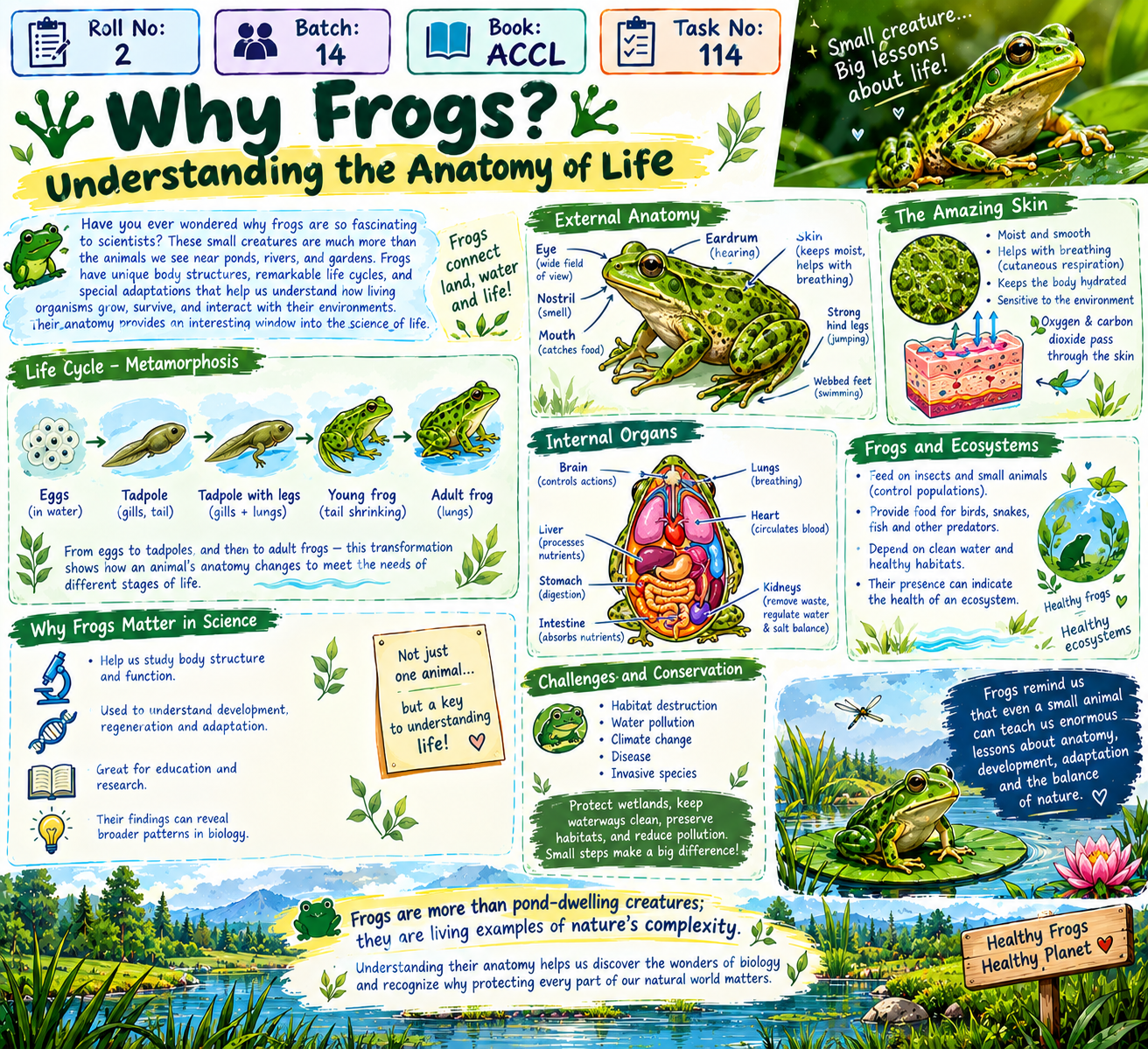
    Have you ever wondered why frogs are so fascinating to scientists? These small creatures are much more than the animals we see near ponds, rivers, and gardens. Frogs have unique body structures, remarkable life cycles, and special adaptations that help us understand how living organisms grow, survive, and interact with their environments. Their anatomy provides an interesting window into the science of life.

    A frog's body is designed for life both in water and on land. Its body generally has a broad head, a short trunk, strong hind legs, and webbed feet in many species. These features help frogs jump, swim, and move through their habitats. Their eyes are positioned to provide a wide field of view, while their sensitive hearing helps them detect sounds, including the calls of other frogs.

    One of the most interesting features of frogs is their skin. Unlike the dry, scaly skin of many reptiles, frog skin is usually moist and plays an important role in their survival. Many frogs can exchange gases through their skin as well as through their lungs. This process, called **cutaneous respiration**, allows oxygen and carbon dioxide to pass across the skin under suitable conditions. Their skin also helps maintain moisture, making a healthy habitat especially important for them.

    Frogs have a fascinating life cycle called **metamorphosis**. Many begin life as eggs in water. The eggs hatch into tadpoles, which usually have tails and breathe mainly through gills. As they develop, they grow legs, their lungs develop, and their bodies gradually change into those of adult frogs. The tail is usually absorbed during development. This transformation demonstrates how an animal's anatomy changes to meet the needs of different stages of life.

    The internal organs of a frog also reveal important biological principles. Its heart circulates blood through the body, carrying oxygen and nutrients to tissues. The digestive system breaks down food, while the kidneys help remove waste and regulate water and salt balance. The brain and nervous system coordinate movement, senses, and responses to the environment. Each organ works with other systems to keep the animal alive.

    Frogs are also valuable to ecosystems. Many feed on insects and other small animals, helping influence populations of these organisms. Frogs themselves provide food for birds, snakes, fish, and other predators. Because many frogs depend on suitable water and land habitats, changes in their populations can provide clues about environmental conditions. Scientists therefore study frogs to learn more about biodiversity, habitat quality, and ecosystem health.

    Another reason frogs are important is their role in scientific research and education. Their anatomy helps students explore the structure and function of organs, compare different vertebrates, and understand biological systems. Researchers also study frog development, regeneration in certain species, communication, and adaptation. Such research can reveal broader patterns in biology, although findings from frogs do not always apply directly to humans.

    Unfortunately, many frog species face challenges such as habitat destruction, water pollution, climate change, disease, and invasive species. Protecting wetlands, keeping waterways clean, preserving natural habitats, and reducing pollution can help support frog populations and the many other organisms that share their ecosystems. Caring for frogs is one way of caring for the wider web of life.

    Frogs remind us that even a small animal can teach us enormous lessons about anatomy, development, adaptation, and the balance of nature. By observing their bodies and studying their life cycles, we gain a deeper appreciation of how living systems work together.

    **Frogs are more than pond-dwelling creatures; they are living examples of nature's complexity. Understanding their anatomy helps us discover the wonders of biology and recognize why protecting every part of our natural world matters. **

    \#Frogs #AnatomyOfLife #Biology #LifeCycle #AnimalScience #Biodiversity #ACCL #Batch14 #Task114
    **Roll No: 2** **Batch: 14** **Book: ACCL** **Task No: 120** # 🐸🔬 Why Frogs? Understanding the Anatomy of Life 🌿💚 Have you ever wondered why frogs are so fascinating to scientists? 🐸🌎 These small creatures are much more than the animals we see near ponds, rivers, and gardens. Frogs have unique body structures, remarkable life cycles, and special adaptations that help us understand how living organisms grow, survive, and interact with their environments. Their anatomy provides an interesting window into the science of life. 🔬✨ A frog's body is designed for life both in water and on land. 💧🌱 Its body generally has a broad head, a short trunk, strong hind legs, and webbed feet in many species. These features help frogs jump, swim, and move through their habitats. Their eyes are positioned to provide a wide field of view, while their sensitive hearing helps them detect sounds, including the calls of other frogs. 🦵👀 One of the most interesting features of frogs is their skin. Unlike the dry, scaly skin of many reptiles, frog skin is usually moist and plays an important role in their survival. 🐸💦 Many frogs can exchange gases through their skin as well as through their lungs. This process, called **cutaneous respiration**, allows oxygen and carbon dioxide to pass across the skin under suitable conditions. Their skin also helps maintain moisture, making a healthy habitat especially important for them. Frogs have a fascinating life cycle called **metamorphosis**. 🥚➡️🐟➡️🐸 Many begin life as eggs in water. The eggs hatch into tadpoles, which usually have tails and breathe mainly through gills. As they develop, they grow legs, their lungs develop, and their bodies gradually change into those of adult frogs. The tail is usually absorbed during development. This transformation demonstrates how an animal's anatomy changes to meet the needs of different stages of life. 🌱🔄 The internal organs of a frog also reveal important biological principles. ❤️ Its heart circulates blood through the body, carrying oxygen and nutrients to tissues. The digestive system breaks down food, while the kidneys help remove waste and regulate water and salt balance. The brain and nervous system coordinate movement, senses, and responses to the environment. Each organ works with other systems to keep the animal alive. 🧠🫀 Frogs are also valuable to ecosystems. 🦟🌿 Many feed on insects and other small animals, helping influence populations of these organisms. Frogs themselves provide food for birds, snakes, fish, and other predators. Because many frogs depend on suitable water and land habitats, changes in their populations can provide clues about environmental conditions. Scientists therefore study frogs to learn more about biodiversity, habitat quality, and ecosystem health. 🌍🔎 Another reason frogs are important is their role in scientific research and education. 📚🔬 Their anatomy helps students explore the structure and function of organs, compare different vertebrates, and understand biological systems. Researchers also study frog development, regeneration in certain species, communication, and adaptation. Such research can reveal broader patterns in biology, although findings from frogs do not always apply directly to humans. Unfortunately, many frog species face challenges such as habitat destruction, water pollution, climate change, disease, and invasive species. 🌧️🏞️ Protecting wetlands, keeping waterways clean, preserving natural habitats, and reducing pollution can help support frog populations and the many other organisms that share their ecosystems. Caring for frogs is one way of caring for the wider web of life. 💚♻️ Frogs remind us that even a small animal can teach us enormous lessons about anatomy, development, adaptation, and the balance of nature. By observing their bodies and studying their life cycles, we gain a deeper appreciation of how living systems work together. 🐸🌎🔬 **Frogs are more than pond-dwelling creatures; they are living examples of nature's complexity. Understanding their anatomy helps us discover the wonders of biology and recognize why protecting every part of our natural world matters. 🐸🧬🌿✨** \#Frogs #AnatomyOfLife #Biology #LifeCycle #AnimalScience #Biodiversity #ACCL #Batch14 #Task114 🐸🔬🌍
    0 Comentários 0 Compartilhamentos 5523 Visualizações
  • Why Frogs? Understanding the Anatomy of Life
    #ACCL Day 125
    In classrooms and laboratories, countless students begin their journey into biology with a single question — “Why frogs?”
    Frogs are more than just amphibians; they’re living bridges between water and land, evolution and adaptation, simplicity and complexity.
    Inside a frog’s tiny body lies the blueprint of life itself — beating hearts, flowing blood, expanding lungs — a reflection of how all living creatures share a common thread of design and function.
    By studying frogs, we don’t just explore anatomy — we uncover the rhythm of life, the story of survival, and the miracle of biological balance.
    Every organ, every muscle, every leap reminds us that understanding one small creature helps us understand the entire web of existence.
    #WhyFrogs #AnatomyOfLife #ACCLDay125 #ScienceOfLife #natureandknowledge
    🐸🔬 Why Frogs? Understanding the Anatomy of Life #ACCL Day 125 In classrooms and laboratories, countless students begin their journey into biology with a single question — “Why frogs?” Frogs are more than just amphibians; they’re living bridges between water and land, evolution and adaptation, simplicity and complexity. 🌿💧 Inside a frog’s tiny body lies the blueprint of life itself — beating hearts, flowing blood, expanding lungs — a reflection of how all living creatures share a common thread of design and function. By studying frogs, we don’t just explore anatomy — we uncover the rhythm of life, the story of survival, and the miracle of biological balance. 🌎✨ Every organ, every muscle, every leap reminds us that understanding one small creature helps us understand the entire web of existence. #WhyFrogs #AnatomyOfLife #ACCLDay125 #ScienceOfLife #natureandknowledge
    0 Comentários 0 Compartilhamentos 3009 Visualizações
Páginas Impulsionadas