• RSIF8
    Roll no.49
    Image chatgpt no.11
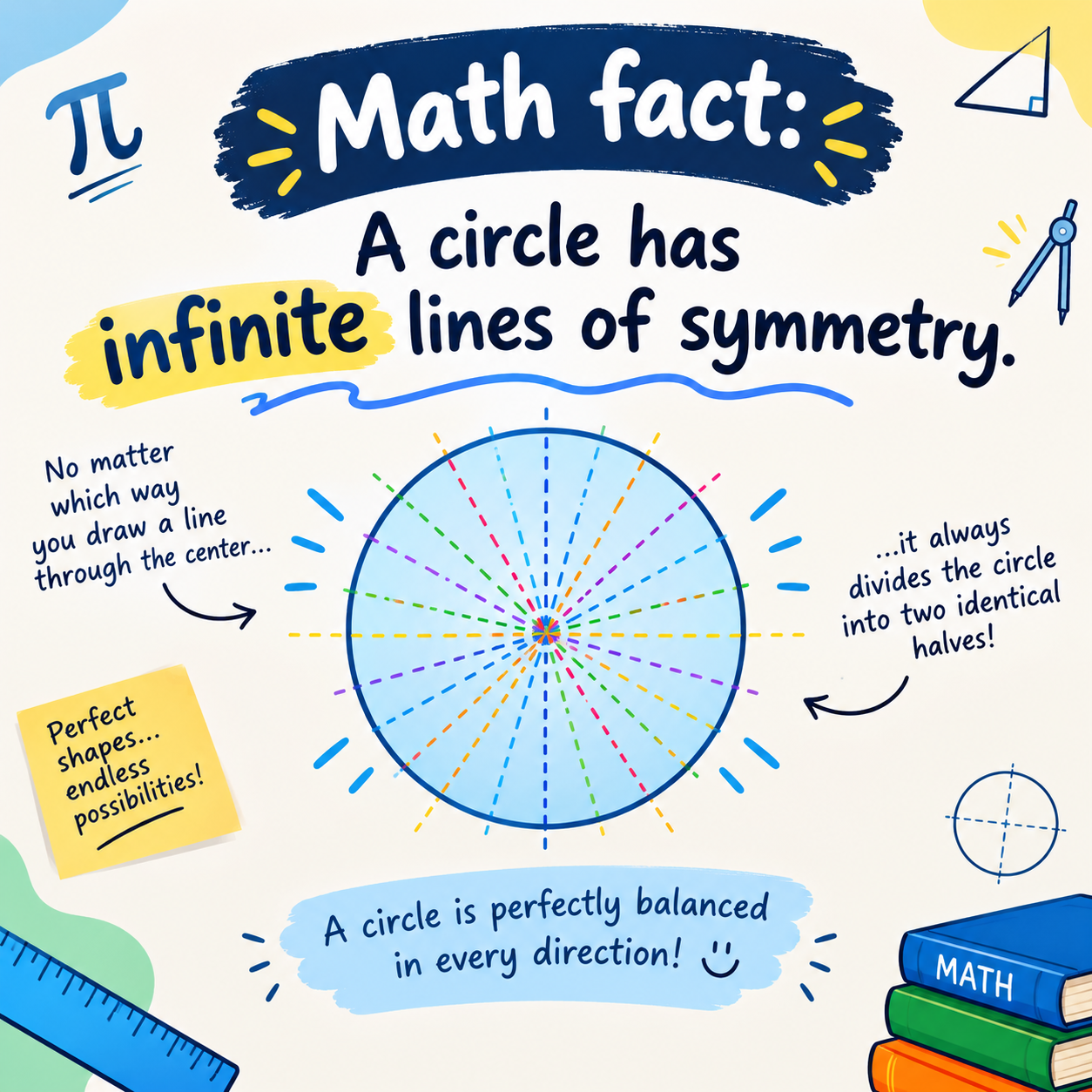
    Image Chatgpt topic:Math Fact: A Circle Has Infinite Lines of Symmetry!

    Did you know that a circle has infinitely many lines of symmetry? In this educational post, I explored an interesting mathematical fact about circles and their amazing properties.

    A line of symmetry divides a shape into two identical halves. In a circle, every straight line passing through its center creates two equal halves. Since we can draw infinitely many lines through the center at different angles, a circle has infinite lines of symmetry!

    This fun math fact shows how mathematics helps us understand shapes, patterns, and the beauty of geometry in our everyday lives. Keep exploring, keep learning, and discover the wonders of mathematics!

    #MathFacts #Circle #LinesOfSymmetry #Geometry #Mathematics #FunLearning #EducationalPost #LearningIsFun #ClassFoundation #RSf8
    RSIF8 Roll no.49 Image chatgpt no.11 Image Chatgpt topic:Math Fact: A Circle Has Infinite Lines of Symmetry! Did you know that a circle has infinitely many lines of symmetry? 🔵➗ In this educational post, I explored an interesting mathematical fact about circles and their amazing properties. A line of symmetry divides a shape into two identical halves. In a circle, every straight line passing through its center creates two equal halves. Since we can draw infinitely many lines through the center at different angles, a circle has infinite lines of symmetry! 💡📏 This fun math fact shows how mathematics helps us understand shapes, patterns, and the beauty of geometry in our everyday lives. Keep exploring, keep learning, and discover the wonders of mathematics! 🧠🌟 #MathFacts #Circle #LinesOfSymmetry #Geometry #Mathematics #FunLearning #EducationalPost #LearningIsFun #ClassFoundation #RSf8
    0 Comments 0 Shares 681 Views
  • RSIF8
    Roll no.49
    Documentary no.04
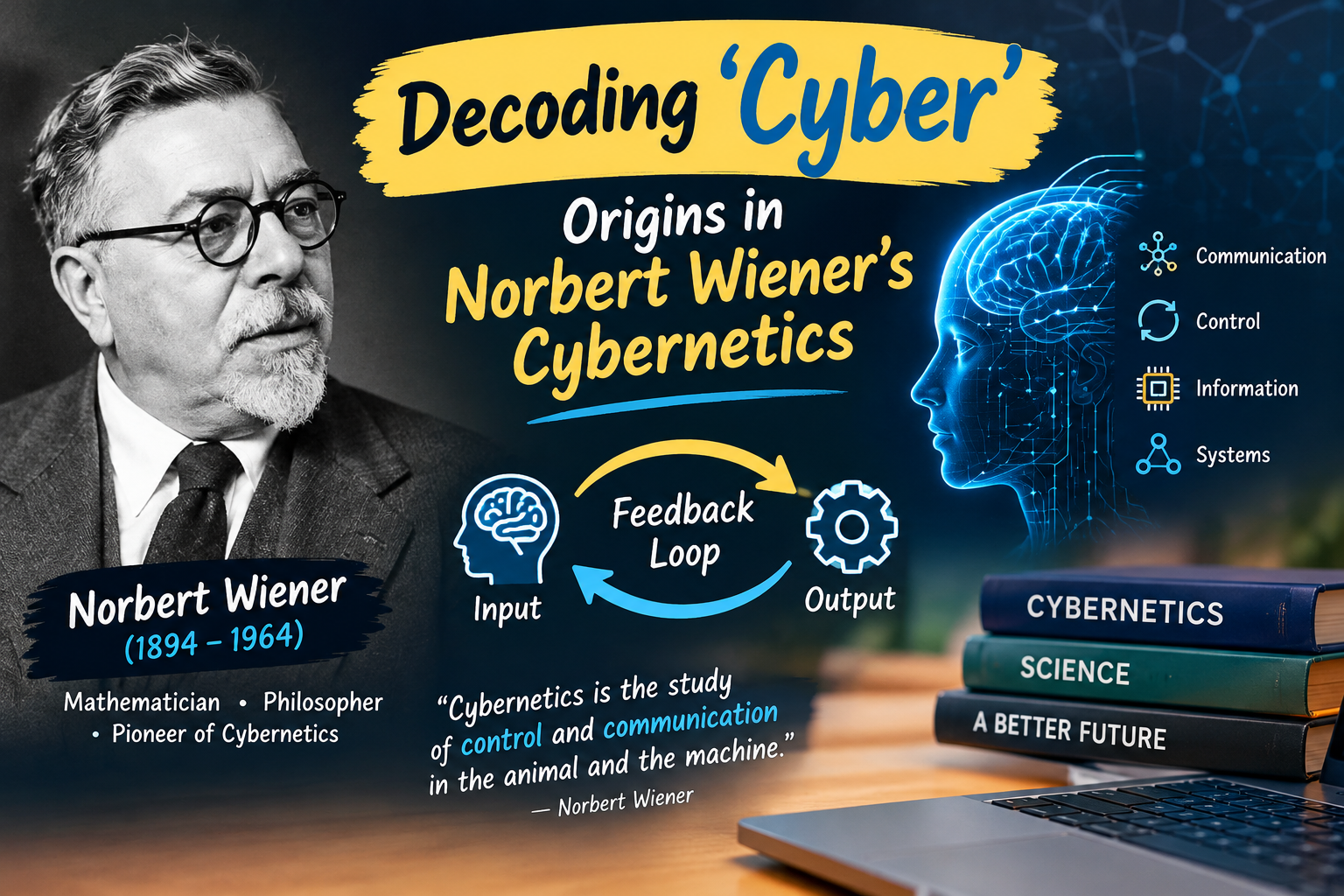
    Documentary Topic:Decoding “Cyber” – Origins in Norbert Wiener’s Cybernetics

    In this documentary, I explored the fascinating origins of the word “Cyber” and its connection to Norbert Wiener, the famous mathematician known as the father of cybernetics. I learned how cybernetics studies communication, control, and feedback in living things and machines, and how these ideas have influenced modern technology.

    From cybersecurity and cyberspace to robotics and artificial intelligence, cyber technology plays an important role in our daily lives. This documentary also highlights the importance of protecting personal information, using the internet responsibly, and understanding the benefits and challenges of the digital world.

    #Cyber #NorbertWiener #Cybernetics #Technology #CyberSecurity #ArtificialIntelligence #DigitalWorld #EducationalDocumentary #ClassFoundation #RSf8
    RSIF8 Roll no.49 Documentary no.04 Documentary Topic:Decoding “Cyber” – Origins in Norbert Wiener’s Cybernetics In this documentary, I explored the fascinating origins of the word “Cyber” and its connection to Norbert Wiener, the famous mathematician known as the father of cybernetics. 🧠✨ I learned how cybernetics studies communication, control, and feedback in living things and machines, and how these ideas have influenced modern technology. 🌐 From cybersecurity and cyberspace to robotics and artificial intelligence, cyber technology plays an important role in our daily lives. This documentary also highlights the importance of protecting personal information, using the internet responsibly, and understanding the benefits and challenges of the digital world. 🔐🚀 #Cyber #NorbertWiener #Cybernetics #Technology #CyberSecurity #ArtificialIntelligence #DigitalWorld #EducationalDocumentary #ClassFoundation #RSf8
    0 Comments 0 Shares 723 Views 2
  • RSIf8
    Roll Number: 49
    Story post no.34
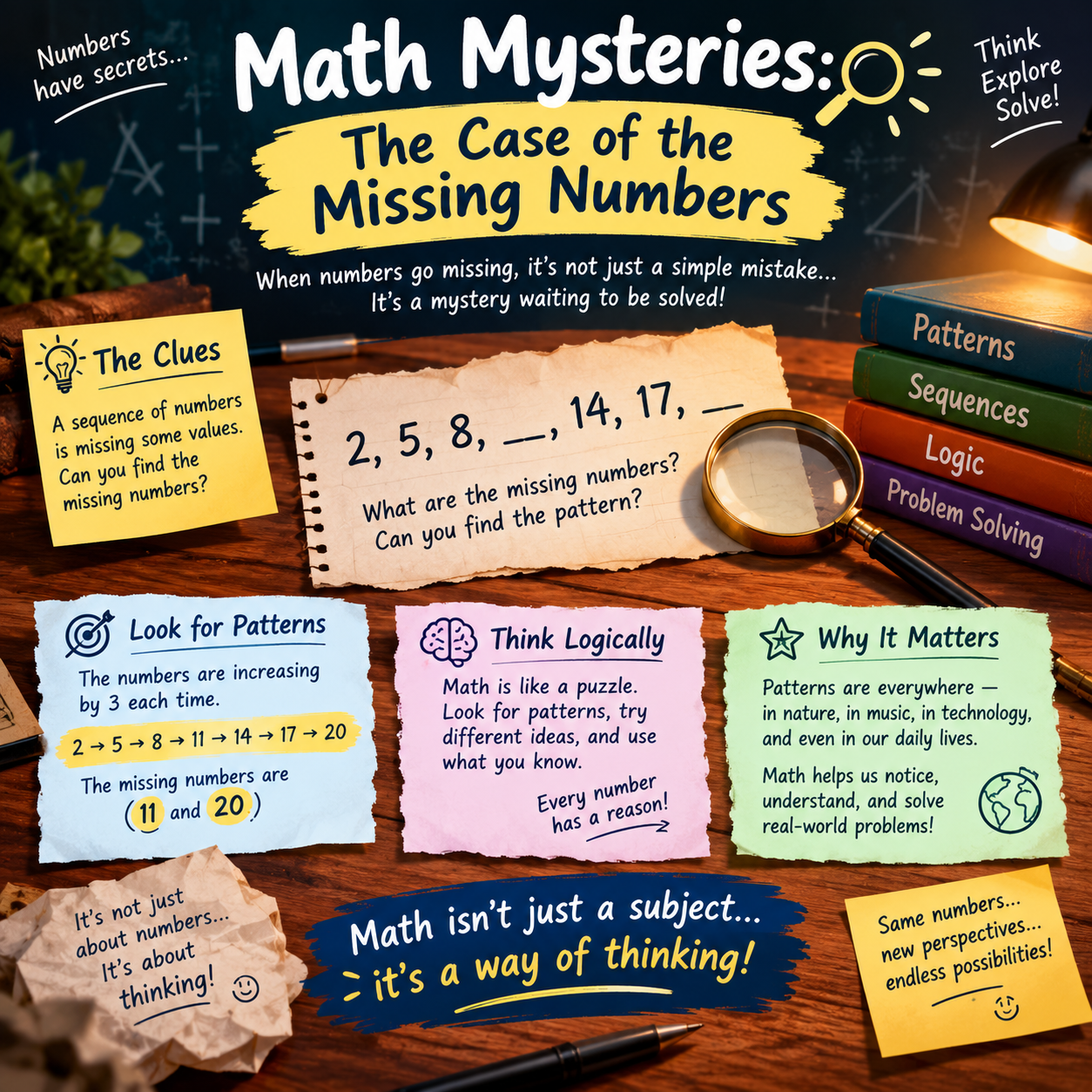
    Story post topic:Math Mysteries — The Case of the Missing Numbers

    Have you ever wondered how numbers can hide exciting mysteries waiting to be solved? ‍ In this creative story post, I explore the fascinating world of mathematics through a mystery filled with number patterns, logical thinking, and problem-solving challenges.

    The adventure begins with a sequence of numbers: 2, 5, 8, __, 14, 17, __. By carefully observing the pattern and adding 3 each time, we can discover the missing numbers: 11 and 20!

    Through this activity, I learned that mathematics is not just about calculations; it is also about observing patterns, thinking logically, and finding solutions. Numbers and patterns are everywhere—in nature, music, technology, and our everyday lives.

    This story makes learning mathematics fun, interactive, and exciting while encouraging curiosity and creative thinking. Every mystery has clues, and every problem has a solution waiting to be discovered!

    #MathMysteries #MissingNumbers #Mathematics #NumberPatterns #LogicalThinking #ProblemSolving #CreativeLearning #MathIsFun #Education #ClassFoundation #RSf8
    RSIf8 Roll Number: 49 Story post no.34 Story post topic:Math Mysteries — The Case of the Missing Numbers 🧩✨ Have you ever wondered how numbers can hide exciting mysteries waiting to be solved? 🕵️‍♂️📚 In this creative story post, I explore the fascinating world of mathematics through a mystery filled with number patterns, logical thinking, and problem-solving challenges. The adventure begins with a sequence of numbers: 2, 5, 8, __, 14, 17, __. By carefully observing the pattern and adding 3 each time, we can discover the missing numbers: 11 and 20! 🎯💡 Through this activity, I learned that mathematics is not just about calculations; it is also about observing patterns, thinking logically, and finding solutions. Numbers and patterns are everywhere—in nature, music, technology, and our everyday lives. 🌍🧠 This story makes learning mathematics fun, interactive, and exciting while encouraging curiosity and creative thinking. Every mystery has clues, and every problem has a solution waiting to be discovered! 🚀📖 #MathMysteries #MissingNumbers #Mathematics #NumberPatterns #LogicalThinking #ProblemSolving #CreativeLearning #MathIsFun #Education #ClassFoundation #RSf8
    0 Comments 0 Shares 1260 Views
  • RSIF8
    Roll no:14
    story no:24
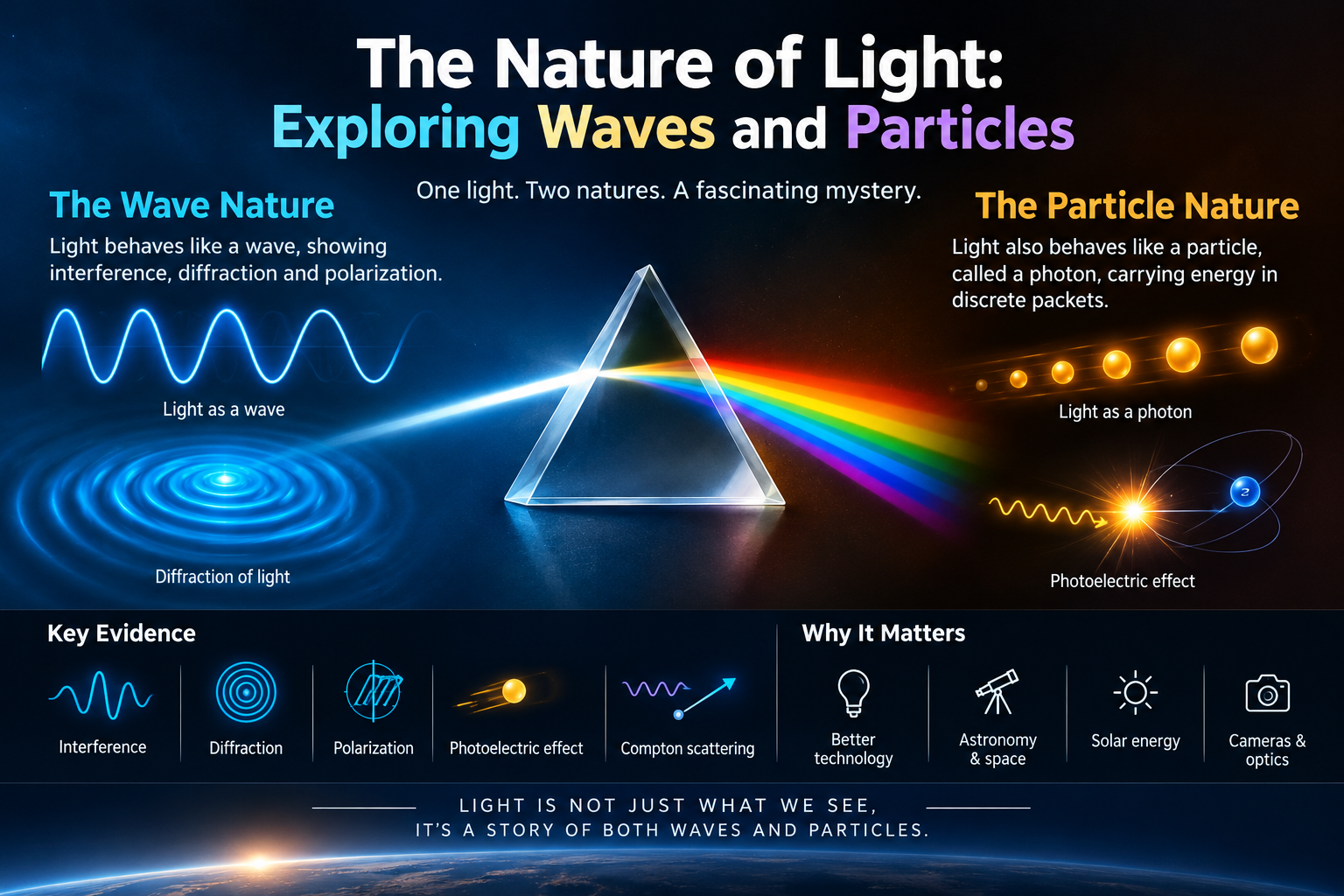
    story topic:The Nature of Light: Exploring Waves and Particles

    **The Nature of Light: Exploring Waves and Particles**

    Have you ever wondered what light really is? How does sunlight travel across millions of kilometers through space, how do rainbows form, and how can light behave like both a wave and a particle? The nature of light is one of the most fascinating topics in physics, revealing the extraordinary connection between the visible world and the mysterious laws of quantum mechanics. From the light that illuminates our homes to the distant stars shining in the universe, light plays an essential role in understanding the world around us.

    **1. The Wave Nature of Light **

    For many years, scientists have studied light as a wave because it demonstrates important wave-like properties. Light can undergo interference, diffraction, and polarization. Interference occurs when light waves overlap and combine, producing patterns of brightness and darkness. Diffraction happens when light spreads around an obstacle or passes through a narrow opening. Polarization describes the orientation of light's oscillations and helps us understand how light interacts with different materials.

    These properties demonstrate that the wave model is essential for explaining many optical phenomena. From colorful patterns created by thin films to the operation of polarized sunglasses, the wave nature of light has many applications in everyday life and modern technology.

    **2. The Particle Nature of Light **

    Light also behaves in ways that reveal its particle nature. In quantum physics, light energy is exchanged in discrete packets called **photons**. Each photon carries energy determined by its frequency, described by the equation **E = hf**, where E represents energy, h is Planck's constant, and f is frequency.

    The photoelectric effect provides important evidence for this particle nature. When light of a suitable frequency strikes certain materials, it can release electrons from their surfaces. This phenomenon helped scientists understand that light energy is transferred in individual quanta rather than always behaving like a continuous wave.

    Another important example is Compton scattering, in which photons exchange energy and momentum with electrons. These discoveries transformed our understanding of light and helped establish the foundations of quantum physics.

    **3. Wave-Particle Duality: Two Sides of Light**

    One of the most remarkable discoveries in science is that light cannot be fully explained by treating it only as a classical wave or only as a classical particle. Its behavior depends on the physical process being investigated and how it is measured. This concept is known as **wave-particle duality**.

    Experiments involving interference reveal wave-like patterns, while experiments involving photon detection show that light energy is detected in discrete units. Quantum mechanics brings these observations together into a more complete description of nature. Rather than being an ordinary wave or a tiny classical object, light is a quantum phenomenon with properties that challenge our everyday intuition.

    **4. How Do We Discover the Secrets of Light?**

    Scientists use carefully designed experiments to explore the behavior of light. Prisms separate white light into different colors, optical instruments measure its properties, and advanced detectors record individual photons. Interference experiments reveal patterns that cannot be explained by simple particle models, while photoelectric experiments demonstrate the importance of quantized energy.

    The work of scientists such as Isaac Newton, Thomas Young, Max Planck, Albert Einstein, and Arthur Compton helped build our modern understanding of light. Their discoveries show how scientific knowledge develops through observation, experimentation, mathematical reasoning, and new ideas.

    **5. Why Is the Nature of Light Important?**

    Understanding light is essential to many technologies that shape modern life. Lasers are used in medicine, manufacturing, and scientific research. Fiber-optic cables transmit information across the world using pulses of light. Solar panels convert light energy into electrical energy, while cameras and telescopes help us capture images and explore distant objects in space.

    The principles of light are also important in astronomy, microscopy, optical communication, quantum technologies, and the study of the universe. By investigating how light behaves, scientists can examine distant galaxies, study the structure of matter, and develop new tools that improve our understanding of nature.

    **6. Light: Connecting Science and the Universe**

    Light is much more than what allows us to see. It carries information about distant stars, reveals the composition of celestial objects, and provides clues about the physical processes occurring throughout the cosmos. By analyzing the light received from distant galaxies, astronomers can learn about their temperatures, chemical compositions, and motion.

    At the smallest scales, the study of photons helps scientists investigate the quantum world and understand how energy interacts with matter. From the smallest laboratory experiments to the largest astronomical observations, light connects different areas of science in extraordinary ways.

    **Conclusion: The Extraordinary Mystery of Light**

    The study of light demonstrates how nature can be far more complex than it first appears. Its wave-like properties explain interference, diffraction, and polarization, while its particle-like properties help explain the photoelectric effect and Compton scattering. Together, these discoveries form an important part of our modern understanding of physics.

    Learning about wave-particle duality encourages us to question assumptions, explore scientific evidence, and appreciate the discoveries that continue to expand human knowledge. Every beam of sunlight, every shining star, and every photon detected by a scientific instrument reminds us that there is still much to discover about the universe.

    **Light Is More Than What We See—It Is a Window into the Fundamental Nature of Reality!**

    If you enjoyed this science topic, share it with others and continue exploring the fascinating world of physics. Stay curious, keep asking questions, and never stop learning!

    #NatureOfLight #WaveParticleDuality #Physics #QuantumPhysics #ScienceEducation #Photons #LightWaves #PhotoelectricEffect #ComptonScattering #Optics #Astronomy #ScientificDiscoveries #STEMEducation #LearnPhysics #ScienceExplained #EducationalContent #WavesAndParticles
    RSIF8 Roll no:14 story no:24 story topic:The Nature of Light: Exploring Waves and Particles 🌟 **The Nature of Light: Exploring Waves and Particles** 🌈🔬 Have you ever wondered what light really is? How does sunlight travel across millions of kilometers through space, how do rainbows form, and how can light behave like both a wave and a particle? The nature of light is one of the most fascinating topics in physics, revealing the extraordinary connection between the visible world and the mysterious laws of quantum mechanics. From the light that illuminates our homes to the distant stars shining in the universe, light plays an essential role in understanding the world around us. 🌍✨ 💡 **1. The Wave Nature of Light 🌊** For many years, scientists have studied light as a wave because it demonstrates important wave-like properties. Light can undergo interference, diffraction, and polarization. Interference occurs when light waves overlap and combine, producing patterns of brightness and darkness. Diffraction happens when light spreads around an obstacle or passes through a narrow opening. Polarization describes the orientation of light's oscillations and helps us understand how light interacts with different materials. These properties demonstrate that the wave model is essential for explaining many optical phenomena. From colorful patterns created by thin films to the operation of polarized sunglasses, the wave nature of light has many applications in everyday life and modern technology. ⚛️ **2. The Particle Nature of Light ✨** Light also behaves in ways that reveal its particle nature. In quantum physics, light energy is exchanged in discrete packets called **photons**. Each photon carries energy determined by its frequency, described by the equation **E = hf**, where E represents energy, h is Planck's constant, and f is frequency. The photoelectric effect provides important evidence for this particle nature. When light of a suitable frequency strikes certain materials, it can release electrons from their surfaces. This phenomenon helped scientists understand that light energy is transferred in individual quanta rather than always behaving like a continuous wave. Another important example is Compton scattering, in which photons exchange energy and momentum with electrons. These discoveries transformed our understanding of light and helped establish the foundations of quantum physics. 🔬 **3. Wave-Particle Duality: Two Sides of Light** One of the most remarkable discoveries in science is that light cannot be fully explained by treating it only as a classical wave or only as a classical particle. Its behavior depends on the physical process being investigated and how it is measured. This concept is known as **wave-particle duality**. Experiments involving interference reveal wave-like patterns, while experiments involving photon detection show that light energy is detected in discrete units. Quantum mechanics brings these observations together into a more complete description of nature. Rather than being an ordinary wave or a tiny classical object, light is a quantum phenomenon with properties that challenge our everyday intuition. 🌈 **4. How Do We Discover the Secrets of Light?** Scientists use carefully designed experiments to explore the behavior of light. Prisms separate white light into different colors, optical instruments measure its properties, and advanced detectors record individual photons. Interference experiments reveal patterns that cannot be explained by simple particle models, while photoelectric experiments demonstrate the importance of quantized energy. The work of scientists such as Isaac Newton, Thomas Young, Max Planck, Albert Einstein, and Arthur Compton helped build our modern understanding of light. Their discoveries show how scientific knowledge develops through observation, experimentation, mathematical reasoning, and new ideas. 🚀 **5. Why Is the Nature of Light Important?** Understanding light is essential to many technologies that shape modern life. Lasers are used in medicine, manufacturing, and scientific research. Fiber-optic cables transmit information across the world using pulses of light. Solar panels convert light energy into electrical energy, while cameras and telescopes help us capture images and explore distant objects in space. The principles of light are also important in astronomy, microscopy, optical communication, quantum technologies, and the study of the universe. By investigating how light behaves, scientists can examine distant galaxies, study the structure of matter, and develop new tools that improve our understanding of nature. 🌍 **6. Light: Connecting Science and the Universe** Light is much more than what allows us to see. It carries information about distant stars, reveals the composition of celestial objects, and provides clues about the physical processes occurring throughout the cosmos. By analyzing the light received from distant galaxies, astronomers can learn about their temperatures, chemical compositions, and motion. At the smallest scales, the study of photons helps scientists investigate the quantum world and understand how energy interacts with matter. From the smallest laboratory experiments to the largest astronomical observations, light connects different areas of science in extraordinary ways. 💫 **Conclusion: The Extraordinary Mystery of Light** The study of light demonstrates how nature can be far more complex than it first appears. Its wave-like properties explain interference, diffraction, and polarization, while its particle-like properties help explain the photoelectric effect and Compton scattering. Together, these discoveries form an important part of our modern understanding of physics. Learning about wave-particle duality encourages us to question assumptions, explore scientific evidence, and appreciate the discoveries that continue to expand human knowledge. Every beam of sunlight, every shining star, and every photon detected by a scientific instrument reminds us that there is still much to discover about the universe. ✨ **Light Is More Than What We See—It Is a Window into the Fundamental Nature of Reality!** 🔭🌌 👍 If you enjoyed this science topic, share it with others and continue exploring the fascinating world of physics. Stay curious, keep asking questions, and never stop learning! #NatureOfLight #WaveParticleDuality #Physics #QuantumPhysics #ScienceEducation #Photons #LightWaves #PhotoelectricEffect #ComptonScattering #Optics #Astronomy #ScientificDiscoveries #STEMEducation #LearnPhysics #ScienceExplained #EducationalContent #WavesAndParticles 🌈🔬🚀

    0 Comments 0 Shares 4117 Views
  • RSIF8
    Roll no:14
    story no:24
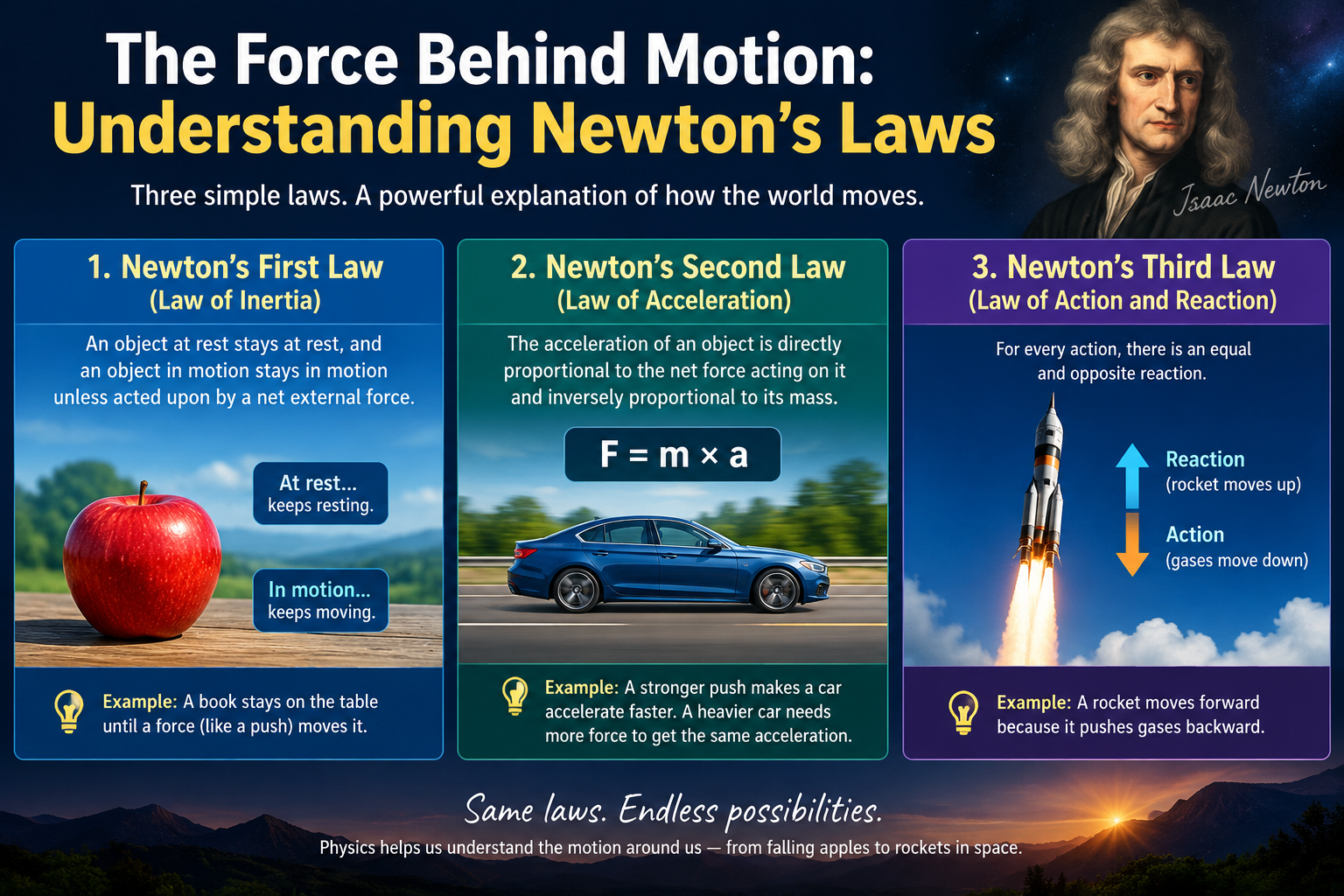
    story topic:The Force Behind Motion: Understanding Newton’s Laws

    **The Force Behind Motion: Understanding Newton’s Laws**

    Welcome to the fascinating world of physics, where forces, motion, and energy work together to explain how our universe operates! In this educational journey, we explore **Newton’s Three Laws of Motion**, some of the most important principles in science that help us understand why objects move, how they change speed, and how forces affect everything around us. From a simple falling apple to a speeding car and a powerful rocket launching into space, Newton’s laws are everywhere in our daily lives!

    **1. Newton’s First Law — The Law of Inertia**

    Newton’s First Law states that an object at rest remains at rest, and an object in motion continues moving at a constant speed in a straight line unless acted upon by an unbalanced external force. This principle explains why a book stays on a table until someone moves it and why passengers tend to move forward when a moving car suddenly stops. Inertia is the natural tendency of objects to resist changes in their state of motion.

    **2. Newton’s Second Law — The Law of Acceleration**

    Newton’s Second Law explains how force, mass, and acceleration are connected. The greater the net force applied to an object, the greater its acceleration. However, a heavier object requires more force than a lighter object to achieve the same acceleration. This relationship is expressed through the famous formula **F = m × a**, where F represents force, m represents mass, and a represents acceleration. This law helps engineers design vehicles, machines, and countless other technologies.

    **3. Newton’s Third Law — The Law of Action and Reaction**

    Newton’s Third Law states that for every action, there is an equal and opposite reaction. Whenever one object exerts a force on another, the second object exerts an equal force in the opposite direction. This principle explains how rockets move forward by pushing exhaust gases backward, how swimmers move through water, and how we walk by pushing against the ground. It reveals the incredible relationship between forces acting on interacting objects.

    **Why Are Newton’s Laws Important?**

    Newton’s laws are essential for understanding the physical world. They help scientists explain motion, engineers develop safer vehicles, athletes improve their performance, and space agencies calculate the movements of spacecraft. These principles are used in transportation, construction, robotics, aviation, sports science, and space exploration. By understanding these laws, students can develop stronger scientific thinking and see how classroom physics connects to real-life experiences.

    **Explore the Science Behind Everyday Motion!**

    Physics is more than formulas and equations; it is a way to understand the world around us. Every moving bicycle, bouncing ball, accelerating car, and launching rocket demonstrates the fascinating principles of force and motion. Learning Newton’s laws opens the door to deeper discoveries in science, technology, engineering, and mathematics.

    Join us on this exciting journey to discover how simple scientific principles explain some of the most extraordinary movements in our universe. Keep asking questions, stay curious, and never stop exploring the wonders of science!

    **Learn the Laws. Understand the Forces. Discover the Science of Motion!**

    Like, share, and follow for more educational content, fascinating science topics, and easy-to-understand explanations that make learning enjoyable!

    #NewtonsLaws #ForceAndMotion #Physics #ScienceEducation #IsaacNewton #LawOfInertia #Acceleration #ActionAndReaction #PhysicsExplained #ScienceFacts #STEMEducation #EducationalVideos #LearnScience #ScientificDiscoveries #SpaceExploration #KnowledgeIsPower
    RSIF8 Roll no:14 story no:24 story topic:The Force Behind Motion: Understanding Newton’s Laws 🚀 **The Force Behind Motion: Understanding Newton’s Laws** 🌍🔬 Welcome to the fascinating world of physics, where forces, motion, and energy work together to explain how our universe operates! 🌌 In this educational journey, we explore **Newton’s Three Laws of Motion**, some of the most important principles in science that help us understand why objects move, how they change speed, and how forces affect everything around us. From a simple falling apple to a speeding car and a powerful rocket launching into space, Newton’s laws are everywhere in our daily lives! 🍎🚗🚀 📘 **1. Newton’s First Law — The Law of Inertia** Newton’s First Law states that an object at rest remains at rest, and an object in motion continues moving at a constant speed in a straight line unless acted upon by an unbalanced external force. This principle explains why a book stays on a table until someone moves it and why passengers tend to move forward when a moving car suddenly stops. Inertia is the natural tendency of objects to resist changes in their state of motion. ⚡ **2. Newton’s Second Law — The Law of Acceleration** Newton’s Second Law explains how force, mass, and acceleration are connected. The greater the net force applied to an object, the greater its acceleration. However, a heavier object requires more force than a lighter object to achieve the same acceleration. This relationship is expressed through the famous formula **F = m × a**, where F represents force, m represents mass, and a represents acceleration. This law helps engineers design vehicles, machines, and countless other technologies. 🌟 **3. Newton’s Third Law — The Law of Action and Reaction** Newton’s Third Law states that for every action, there is an equal and opposite reaction. Whenever one object exerts a force on another, the second object exerts an equal force in the opposite direction. This principle explains how rockets move forward by pushing exhaust gases backward, how swimmers move through water, and how we walk by pushing against the ground. It reveals the incredible relationship between forces acting on interacting objects. 🔍 **Why Are Newton’s Laws Important?** Newton’s laws are essential for understanding the physical world. They help scientists explain motion, engineers develop safer vehicles, athletes improve their performance, and space agencies calculate the movements of spacecraft. These principles are used in transportation, construction, robotics, aviation, sports science, and space exploration. By understanding these laws, students can develop stronger scientific thinking and see how classroom physics connects to real-life experiences. 💡 **Explore the Science Behind Everyday Motion!** Physics is more than formulas and equations; it is a way to understand the world around us. Every moving bicycle, bouncing ball, accelerating car, and launching rocket demonstrates the fascinating principles of force and motion. Learning Newton’s laws opens the door to deeper discoveries in science, technology, engineering, and mathematics. Join us on this exciting journey to discover how simple scientific principles explain some of the most extraordinary movements in our universe. Keep asking questions, stay curious, and never stop exploring the wonders of science! 🌍✨ 🎯 **Learn the Laws. Understand the Forces. Discover the Science of Motion!** 👍 Like, share, and follow for more educational content, fascinating science topics, and easy-to-understand explanations that make learning enjoyable! #NewtonsLaws #ForceAndMotion #Physics #ScienceEducation #IsaacNewton #LawOfInertia #Acceleration #ActionAndReaction #PhysicsExplained #ScienceFacts #STEMEducation #EducationalVideos #LearnScience #ScientificDiscoveries #SpaceExploration #KnowledgeIsPower 🚀📚
    0 Comments 0 Shares 2988 Views
  • RSIF8
    ROLL NO 77
    STORY POST NO 44
    STORY TOPIC **Decoding “Cyber”: Origins in Norbert Wiener’s Cybernetics**

    Have you ever wondered where the word “Cyber” comes from?

    Discover the fascinating world of **Cybernetics**, a field pioneered by mathematician Norbert Wiener. His groundbreaking work explored how communication, control, and feedback operate in both living organisms and machines.

    **Communication:** How information is shared.
    **Control:** How systems manage their actions.
    **Feedback:** How systems learn and improve.
    **Technology:** How these ideas help us understand computers, automation, and artificial intelligence.

    From intelligent machines to modern AI, cybernetics has helped shape the way we understand the connection between humans and technology.

    **Knowledge is the key to innovation!** Keep exploring, keep learning, and discover the science behind our digital world.

    #Cyber #Cybernetics #NorbertWiener #ArtificialIntelligence #AI #Technology #ComputerScience #DigitalWorld #Innovation #ScienceAndTechnology #EducationalContent #LearnAndGrow #RehanCodingWithAI
    RSIF8 ROLL NO 77 STORY POST NO 44 STORY TOPIC 🤖🌐 **Decoding “Cyber”: Origins in Norbert Wiener’s Cybernetics** 💻✨ Have you ever wondered where the word “Cyber” comes from? 🤔🔍 Discover the fascinating world of **Cybernetics**, a field pioneered by mathematician Norbert Wiener. 🧠⚙️ His groundbreaking work explored how communication, control, and feedback operate in both living organisms and machines. 🔹 🧠 **Communication:** How information is shared. 🔹 ⚙️ **Control:** How systems manage their actions. 🔹 🔄 **Feedback:** How systems learn and improve. 🔹 🤖 **Technology:** How these ideas help us understand computers, automation, and artificial intelligence. From intelligent machines to modern AI, cybernetics has helped shape the way we understand the connection between humans and technology. 🚀🌍 💡 **Knowledge is the key to innovation!** Keep exploring, keep learning, and discover the science behind our digital world. #Cyber #Cybernetics #NorbertWiener #ArtificialIntelligence #AI #Technology #ComputerScience #DigitalWorld #Innovation #ScienceAndTechnology #EducationalContent #LearnAndGrow #RehanCodingWithAI 🤖💙
    0 Comments 0 Shares 1342 Views
  • Rsif8
    Roll No 30
    Post No 234
    **Math Fact: A Circle Has Infinite Lines of Symmetry!**

    Did you know that a circle has infinitely many lines of symmetry?

    A line of symmetry divides a shape into two equal halves that match perfectly. In a circle, any straight line passing through its center creates two identical halves. You can draw these lines in countless directions!

    This amazing math fact shows how beautiful and interesting geometry can be.

    **Keep learning, keep exploring, and make mathematics fun!**

    #MathFacts #Mathematics #Circle #LinesOfSymmetry #Geometry #FunLearning #Education #DidYouKnow
    Rsif8 Roll No 30 Post No 234 🔵 **Math Fact: A Circle Has Infinite Lines of Symmetry!** ➗ Did you know that a circle has infinitely many lines of symmetry? 🤔✨ A line of symmetry divides a shape into two equal halves that match perfectly. In a circle, any straight line passing through its center creates two identical halves. You can draw these lines in countless directions! This amazing math fact shows how beautiful and interesting geometry can be. 📐📚 💡 **Keep learning, keep exploring, and make mathematics fun!** #MathFacts #Mathematics #Circle #LinesOfSymmetry #Geometry #FunLearning #Education #DidYouKnow
    0 Comments 0 Shares 764 Views 8
  • RSIF8
    Roll no:14
    coding task no:22
    coding task topic:BMI Calculator

    # BMI Calculator – A Simple Health Calculation Tool

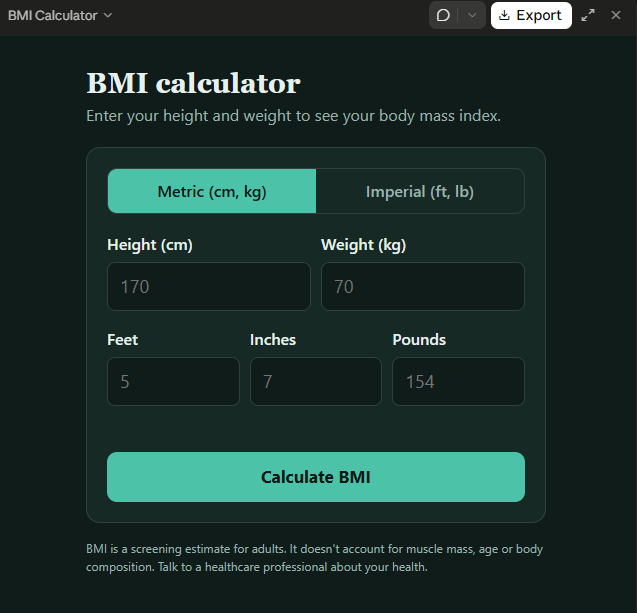
    The **BMI Calculator (Body Mass Index Calculator)** is a simple and useful application designed to calculate Body Mass Index (BMI) using a person's height and weight. It demonstrates how basic mathematical formulas can be used in a practical application to provide quick and easy results.

    This project allows users to enter their height and weight, calculate their BMI, and view the resulting value within seconds. The calculator uses the standard BMI formula:

    **BMI = Weight (kg) ÷ Height (m)²**

    **Key Features:**
    - Simple and user-friendly interface
    - Height input for accurate calculations
    - Weight input in kilograms
    - Automatic BMI calculation
    - Clear display of the calculated result
    - Useful for learning programming, mathematics, and basic application development

    **Project Purpose:**

    The main purpose of this project is to demonstrate how user input, mathematical calculations, and result display can be combined to create a functional application. It is suitable for students, beginners, and anyone interested in learning how to develop simple calculator programs.

    **Conclusion:**

    The BMI Calculator is an educational project that combines technology and mathematics in a practical way. It helps learners understand basic programming concepts while exploring a commonly used health-related calculation.

    **Note:** BMI is a general screening measure, not a complete assessment of health. For children and teenagers, BMI is interpreted using age- and sex-specific growth charts rather than adult categories.

    #BMICalculator #ProgrammingProject #CalculatorApp #HealthEducation #CodingForBeginners #Mathematics #SoftwareDevelopment #StudentProject #Technology #LearningByDoing
    RSIF8 Roll no:14 coding task no:22 coding task topic:BMI Calculator # 🧮 BMI Calculator – A Simple Health Calculation Tool The **BMI Calculator (Body Mass Index Calculator)** is a simple and useful application designed to calculate Body Mass Index (BMI) using a person's height and weight. It demonstrates how basic mathematical formulas can be used in a practical application to provide quick and easy results. 📊 This project allows users to enter their height and weight, calculate their BMI, and view the resulting value within seconds. The calculator uses the standard BMI formula: **BMI = Weight (kg) ÷ Height (m)²** 💡 **Key Features:** - ✅ Simple and user-friendly interface - 📏 Height input for accurate calculations - ⚖️ Weight input in kilograms - 🧮 Automatic BMI calculation - 📊 Clear display of the calculated result - 💻 Useful for learning programming, mathematics, and basic application development 🎯 **Project Purpose:** The main purpose of this project is to demonstrate how user input, mathematical calculations, and result display can be combined to create a functional application. It is suitable for students, beginners, and anyone interested in learning how to develop simple calculator programs. 🌟 **Conclusion:** The BMI Calculator is an educational project that combines technology and mathematics in a practical way. It helps learners understand basic programming concepts while exploring a commonly used health-related calculation. **Note:** BMI is a general screening measure, not a complete assessment of health. For children and teenagers, BMI is interpreted using age- and sex-specific growth charts rather than adult categories. #BMICalculator #ProgrammingProject #CalculatorApp #HealthEducation #CodingForBeginners #Mathematics #SoftwareDevelopment #StudentProject #Technology #LearningByDoing
    0 Comments 0 Shares 1405 Views
  • RSIF8
    ROLL NO 77
    SONG
    SONG TOPIC "Mathematical Marvels: Patterns in Nature"

    **Mathematical Marvels: Patterns in Nature**

    Have you ever wondered how mathematics shapes the natural world? From the beautiful spirals of seashells and sunflowers to the amazing patterns of snowflakes and honeycombs , mathematics is everywhere around us!

    Nature is full of fascinating shapes, patterns, numbers, and sequences that reveal the hidden beauty of our universe.

    **Explore the magic of mathematics in nature and discover how science and beauty come together!**

    *Look closely at nature, and you will find mathematics in every corner!*

    Like, share, and follow for more amazing educational content!

    \#MathematicalMarvels #PatternsInNature #Mathematics #NatureLovers #MathIsEverywhere #ScienceAndNature #EducationalContent #LearnWithFun #DiscoverNature #STEMEducation #KnowledgeIsPower #RehanCodingWithAI
    RSIF8 ROLL NO 77 SONG SONG TOPIC "Mathematical Marvels: Patterns in Nature" 🌿🔢 **Mathematical Marvels: Patterns in Nature** 🌸✨ Have you ever wondered how mathematics shapes the natural world? 🌍 From the beautiful spirals of seashells 🐚 and sunflowers 🌻 to the amazing patterns of snowflakes ❄️ and honeycombs 🐝, mathematics is everywhere around us! Nature is full of fascinating shapes, patterns, numbers, and sequences that reveal the hidden beauty of our universe. 🌌💚 🔍 **Explore the magic of mathematics in nature and discover how science and beauty come together!** 💡 *Look closely at nature, and you will find mathematics in every corner!* ❤️ Like, share, and follow for more amazing educational content! 🚀📚 \#MathematicalMarvels #PatternsInNature #Mathematics #NatureLovers #MathIsEverywhere #ScienceAndNature #EducationalContent #LearnWithFun #DiscoverNature #STEMEducation #KnowledgeIsPower #RehanCodingWithAI 🌿🔢✨
    0 Comments 0 Shares 1818 Views 14
  • RSIF8
    Roll no: 99
    Song no: 11
    Song topic: Calculus: The Journey of Numbers and Sacred Spaces

    A fascinating melody exploring the beauty of calculus, where numbers, infinity, and sacred patterns reveal the hidden harmony of the universe. ∞

    #Calculus #SacredGeometry #Mathematics #BeautyOfNumbers #RSIF8
    RSIF8 Roll no: 99 Song no: 11 Song topic: Calculus: The Journey of Numbers and Sacred Spaces A fascinating melody exploring the beauty of calculus, where numbers, infinity, and sacred patterns reveal the hidden harmony of the universe. ∞📐🎶 #Calculus #SacredGeometry #Mathematics #BeautyOfNumbers #RSIF8
    0 Comments 0 Shares 937 Views 10
More Results