• RSIF8
    Roll no.49
    Movie review no.03
    Movie review topic: Patch Adams (1998)

    Patch Adams is an inspiring and heartwarming movie based on the life of Dr. Hunter “Patch” Adams. Starring Robin Williams, the film highlights the importance of kindness, humor, compassion, and emotional support in healthcare.

    The story follows Patch Adams, a medical student who believes that treating patients means more than simply curing their illnesses. He uses laughter, friendship, and creative approaches to bring happiness to patients and help them feel valued and understood. Despite facing challenges and criticism, he remains committed to his belief that compassion should be an essential part of medicine.

    Through this movie, I learned that a simple smile, a kind word, or a little attention can make a big difference in someone's life. It also taught me to follow my dreams, respect others, and treat everyone with empathy and dignity.

    The biggest lesson is that medicine may treat the body, but kindness and compassion can bring comfort to the heart!

    #PatchAdams #MovieReview #RobinWilliams #KindnessMatters #PowerOfLaughter #Compassion #Healthcare #Empathy #InspirationalMovie #LifeLessons #ClassFoundation #RSf8
    RSIF8 Roll no.49 Movie review no.03 Movie review topic: Patch Adams (1998) 🩺❤️ Patch Adams is an inspiring and heartwarming movie based on the life of Dr. Hunter “Patch” Adams. Starring Robin Williams, the film highlights the importance of kindness, humor, compassion, and emotional support in healthcare. 🌟💖 The story follows Patch Adams, a medical student who believes that treating patients means more than simply curing their illnesses. He uses laughter, friendship, and creative approaches to bring happiness to patients and help them feel valued and understood. Despite facing challenges and criticism, he remains committed to his belief that compassion should be an essential part of medicine. 🏥✨ Through this movie, I learned that a simple smile, a kind word, or a little attention can make a big difference in someone's life. It also taught me to follow my dreams, respect others, and treat everyone with empathy and dignity. 🌈🤝 The biggest lesson is that medicine may treat the body, but kindness and compassion can bring comfort to the heart! ❤️🌍 #PatchAdams #MovieReview #RobinWilliams #KindnessMatters #PowerOfLaughter #Compassion #Healthcare #Empathy #InspirationalMovie #LifeLessons #ClassFoundation #RSf8
    0 Kommentare 0 Anteile 409 Ansichten 1
  • RSIF8
    Roll no:14
    story no:24
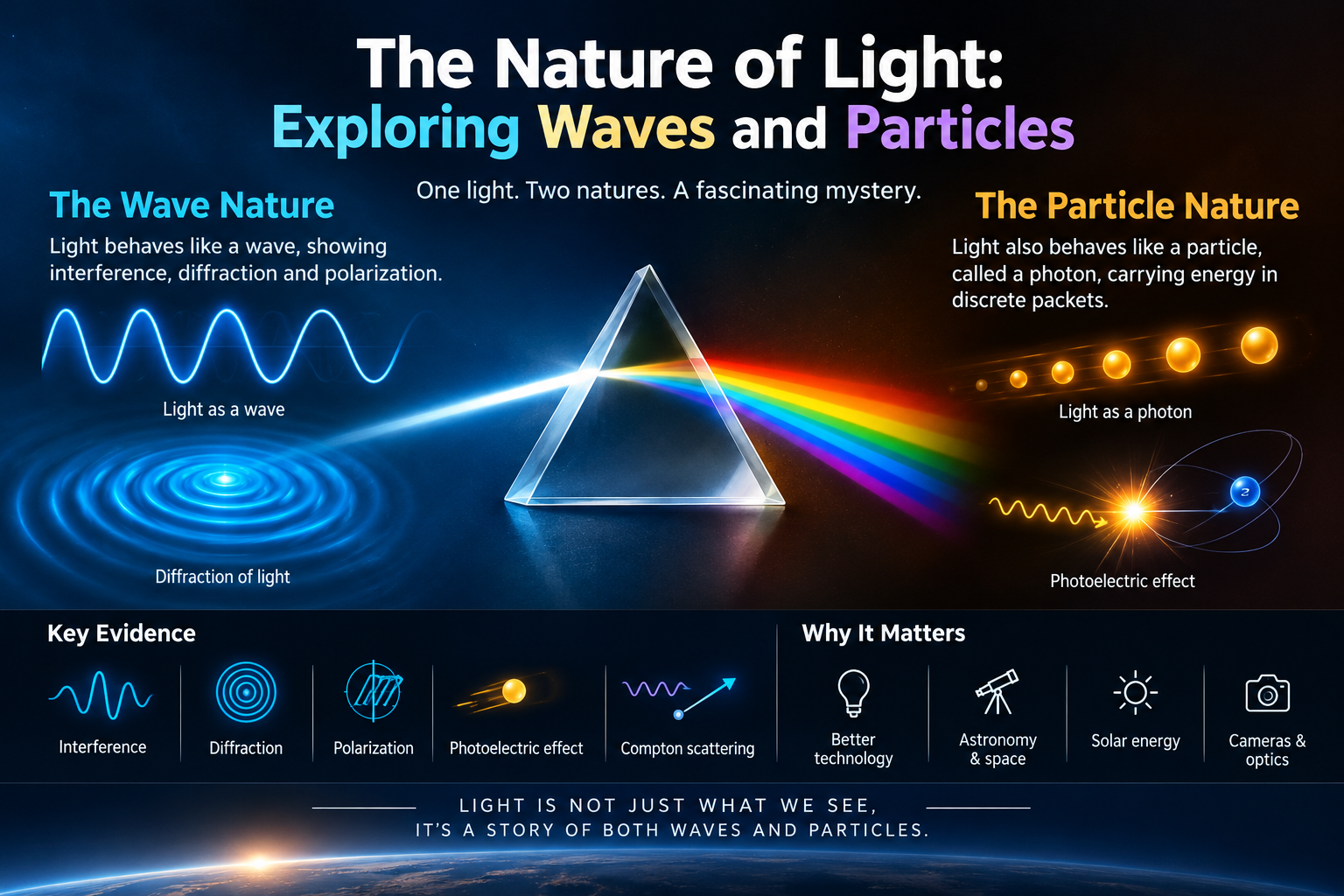
    story topic:The Nature of Light: Exploring Waves and Particles

    **The Nature of Light: Exploring Waves and Particles**

    Have you ever wondered what light really is? How does sunlight travel across millions of kilometers through space, how do rainbows form, and how can light behave like both a wave and a particle? The nature of light is one of the most fascinating topics in physics, revealing the extraordinary connection between the visible world and the mysterious laws of quantum mechanics. From the light that illuminates our homes to the distant stars shining in the universe, light plays an essential role in understanding the world around us.

    **1. The Wave Nature of Light **

    For many years, scientists have studied light as a wave because it demonstrates important wave-like properties. Light can undergo interference, diffraction, and polarization. Interference occurs when light waves overlap and combine, producing patterns of brightness and darkness. Diffraction happens when light spreads around an obstacle or passes through a narrow opening. Polarization describes the orientation of light's oscillations and helps us understand how light interacts with different materials.

    These properties demonstrate that the wave model is essential for explaining many optical phenomena. From colorful patterns created by thin films to the operation of polarized sunglasses, the wave nature of light has many applications in everyday life and modern technology.

    **2. The Particle Nature of Light **

    Light also behaves in ways that reveal its particle nature. In quantum physics, light energy is exchanged in discrete packets called **photons**. Each photon carries energy determined by its frequency, described by the equation **E = hf**, where E represents energy, h is Planck's constant, and f is frequency.

    The photoelectric effect provides important evidence for this particle nature. When light of a suitable frequency strikes certain materials, it can release electrons from their surfaces. This phenomenon helped scientists understand that light energy is transferred in individual quanta rather than always behaving like a continuous wave.

    Another important example is Compton scattering, in which photons exchange energy and momentum with electrons. These discoveries transformed our understanding of light and helped establish the foundations of quantum physics.

    **3. Wave-Particle Duality: Two Sides of Light**

    One of the most remarkable discoveries in science is that light cannot be fully explained by treating it only as a classical wave or only as a classical particle. Its behavior depends on the physical process being investigated and how it is measured. This concept is known as **wave-particle duality**.

    Experiments involving interference reveal wave-like patterns, while experiments involving photon detection show that light energy is detected in discrete units. Quantum mechanics brings these observations together into a more complete description of nature. Rather than being an ordinary wave or a tiny classical object, light is a quantum phenomenon with properties that challenge our everyday intuition.

    **4. How Do We Discover the Secrets of Light?**

    Scientists use carefully designed experiments to explore the behavior of light. Prisms separate white light into different colors, optical instruments measure its properties, and advanced detectors record individual photons. Interference experiments reveal patterns that cannot be explained by simple particle models, while photoelectric experiments demonstrate the importance of quantized energy.

    The work of scientists such as Isaac Newton, Thomas Young, Max Planck, Albert Einstein, and Arthur Compton helped build our modern understanding of light. Their discoveries show how scientific knowledge develops through observation, experimentation, mathematical reasoning, and new ideas.

    **5. Why Is the Nature of Light Important?**

    Understanding light is essential to many technologies that shape modern life. Lasers are used in medicine, manufacturing, and scientific research. Fiber-optic cables transmit information across the world using pulses of light. Solar panels convert light energy into electrical energy, while cameras and telescopes help us capture images and explore distant objects in space.

    The principles of light are also important in astronomy, microscopy, optical communication, quantum technologies, and the study of the universe. By investigating how light behaves, scientists can examine distant galaxies, study the structure of matter, and develop new tools that improve our understanding of nature.

    **6. Light: Connecting Science and the Universe**

    Light is much more than what allows us to see. It carries information about distant stars, reveals the composition of celestial objects, and provides clues about the physical processes occurring throughout the cosmos. By analyzing the light received from distant galaxies, astronomers can learn about their temperatures, chemical compositions, and motion.

    At the smallest scales, the study of photons helps scientists investigate the quantum world and understand how energy interacts with matter. From the smallest laboratory experiments to the largest astronomical observations, light connects different areas of science in extraordinary ways.

    **Conclusion: The Extraordinary Mystery of Light**

    The study of light demonstrates how nature can be far more complex than it first appears. Its wave-like properties explain interference, diffraction, and polarization, while its particle-like properties help explain the photoelectric effect and Compton scattering. Together, these discoveries form an important part of our modern understanding of physics.

    Learning about wave-particle duality encourages us to question assumptions, explore scientific evidence, and appreciate the discoveries that continue to expand human knowledge. Every beam of sunlight, every shining star, and every photon detected by a scientific instrument reminds us that there is still much to discover about the universe.

    **Light Is More Than What We See—It Is a Window into the Fundamental Nature of Reality!**

    If you enjoyed this science topic, share it with others and continue exploring the fascinating world of physics. Stay curious, keep asking questions, and never stop learning!

    #NatureOfLight #WaveParticleDuality #Physics #QuantumPhysics #ScienceEducation #Photons #LightWaves #PhotoelectricEffect #ComptonScattering #Optics #Astronomy #ScientificDiscoveries #STEMEducation #LearnPhysics #ScienceExplained #EducationalContent #WavesAndParticles
    RSIF8 Roll no:14 story no:24 story topic:The Nature of Light: Exploring Waves and Particles 🌟 **The Nature of Light: Exploring Waves and Particles** 🌈🔬 Have you ever wondered what light really is? How does sunlight travel across millions of kilometers through space, how do rainbows form, and how can light behave like both a wave and a particle? The nature of light is one of the most fascinating topics in physics, revealing the extraordinary connection between the visible world and the mysterious laws of quantum mechanics. From the light that illuminates our homes to the distant stars shining in the universe, light plays an essential role in understanding the world around us. 🌍✨ 💡 **1. The Wave Nature of Light 🌊** For many years, scientists have studied light as a wave because it demonstrates important wave-like properties. Light can undergo interference, diffraction, and polarization. Interference occurs when light waves overlap and combine, producing patterns of brightness and darkness. Diffraction happens when light spreads around an obstacle or passes through a narrow opening. Polarization describes the orientation of light's oscillations and helps us understand how light interacts with different materials. These properties demonstrate that the wave model is essential for explaining many optical phenomena. From colorful patterns created by thin films to the operation of polarized sunglasses, the wave nature of light has many applications in everyday life and modern technology. ⚛️ **2. The Particle Nature of Light ✨** Light also behaves in ways that reveal its particle nature. In quantum physics, light energy is exchanged in discrete packets called **photons**. Each photon carries energy determined by its frequency, described by the equation **E = hf**, where E represents energy, h is Planck's constant, and f is frequency. The photoelectric effect provides important evidence for this particle nature. When light of a suitable frequency strikes certain materials, it can release electrons from their surfaces. This phenomenon helped scientists understand that light energy is transferred in individual quanta rather than always behaving like a continuous wave. Another important example is Compton scattering, in which photons exchange energy and momentum with electrons. These discoveries transformed our understanding of light and helped establish the foundations of quantum physics. 🔬 **3. Wave-Particle Duality: Two Sides of Light** One of the most remarkable discoveries in science is that light cannot be fully explained by treating it only as a classical wave or only as a classical particle. Its behavior depends on the physical process being investigated and how it is measured. This concept is known as **wave-particle duality**. Experiments involving interference reveal wave-like patterns, while experiments involving photon detection show that light energy is detected in discrete units. Quantum mechanics brings these observations together into a more complete description of nature. Rather than being an ordinary wave or a tiny classical object, light is a quantum phenomenon with properties that challenge our everyday intuition. 🌈 **4. How Do We Discover the Secrets of Light?** Scientists use carefully designed experiments to explore the behavior of light. Prisms separate white light into different colors, optical instruments measure its properties, and advanced detectors record individual photons. Interference experiments reveal patterns that cannot be explained by simple particle models, while photoelectric experiments demonstrate the importance of quantized energy. The work of scientists such as Isaac Newton, Thomas Young, Max Planck, Albert Einstein, and Arthur Compton helped build our modern understanding of light. Their discoveries show how scientific knowledge develops through observation, experimentation, mathematical reasoning, and new ideas. 🚀 **5. Why Is the Nature of Light Important?** Understanding light is essential to many technologies that shape modern life. Lasers are used in medicine, manufacturing, and scientific research. Fiber-optic cables transmit information across the world using pulses of light. Solar panels convert light energy into electrical energy, while cameras and telescopes help us capture images and explore distant objects in space. The principles of light are also important in astronomy, microscopy, optical communication, quantum technologies, and the study of the universe. By investigating how light behaves, scientists can examine distant galaxies, study the structure of matter, and develop new tools that improve our understanding of nature. 🌍 **6. Light: Connecting Science and the Universe** Light is much more than what allows us to see. It carries information about distant stars, reveals the composition of celestial objects, and provides clues about the physical processes occurring throughout the cosmos. By analyzing the light received from distant galaxies, astronomers can learn about their temperatures, chemical compositions, and motion. At the smallest scales, the study of photons helps scientists investigate the quantum world and understand how energy interacts with matter. From the smallest laboratory experiments to the largest astronomical observations, light connects different areas of science in extraordinary ways. 💫 **Conclusion: The Extraordinary Mystery of Light** The study of light demonstrates how nature can be far more complex than it first appears. Its wave-like properties explain interference, diffraction, and polarization, while its particle-like properties help explain the photoelectric effect and Compton scattering. Together, these discoveries form an important part of our modern understanding of physics. Learning about wave-particle duality encourages us to question assumptions, explore scientific evidence, and appreciate the discoveries that continue to expand human knowledge. Every beam of sunlight, every shining star, and every photon detected by a scientific instrument reminds us that there is still much to discover about the universe. ✨ **Light Is More Than What We See—It Is a Window into the Fundamental Nature of Reality!** 🔭🌌 👍 If you enjoyed this science topic, share it with others and continue exploring the fascinating world of physics. Stay curious, keep asking questions, and never stop learning! #NatureOfLight #WaveParticleDuality #Physics #QuantumPhysics #ScienceEducation #Photons #LightWaves #PhotoelectricEffect #ComptonScattering #Optics #Astronomy #ScientificDiscoveries #STEMEducation #LearnPhysics #ScienceExplained #EducationalContent #WavesAndParticles 🌈🔬🚀

    0 Kommentare 0 Anteile 1505 Ansichten
  • RSIF8
    Roll no:14
    story no:21
    story topic:Peering Inside: The Role of Dissections in Understanding Life
    # Peering Inside: The Role of Dissections in Understanding Life

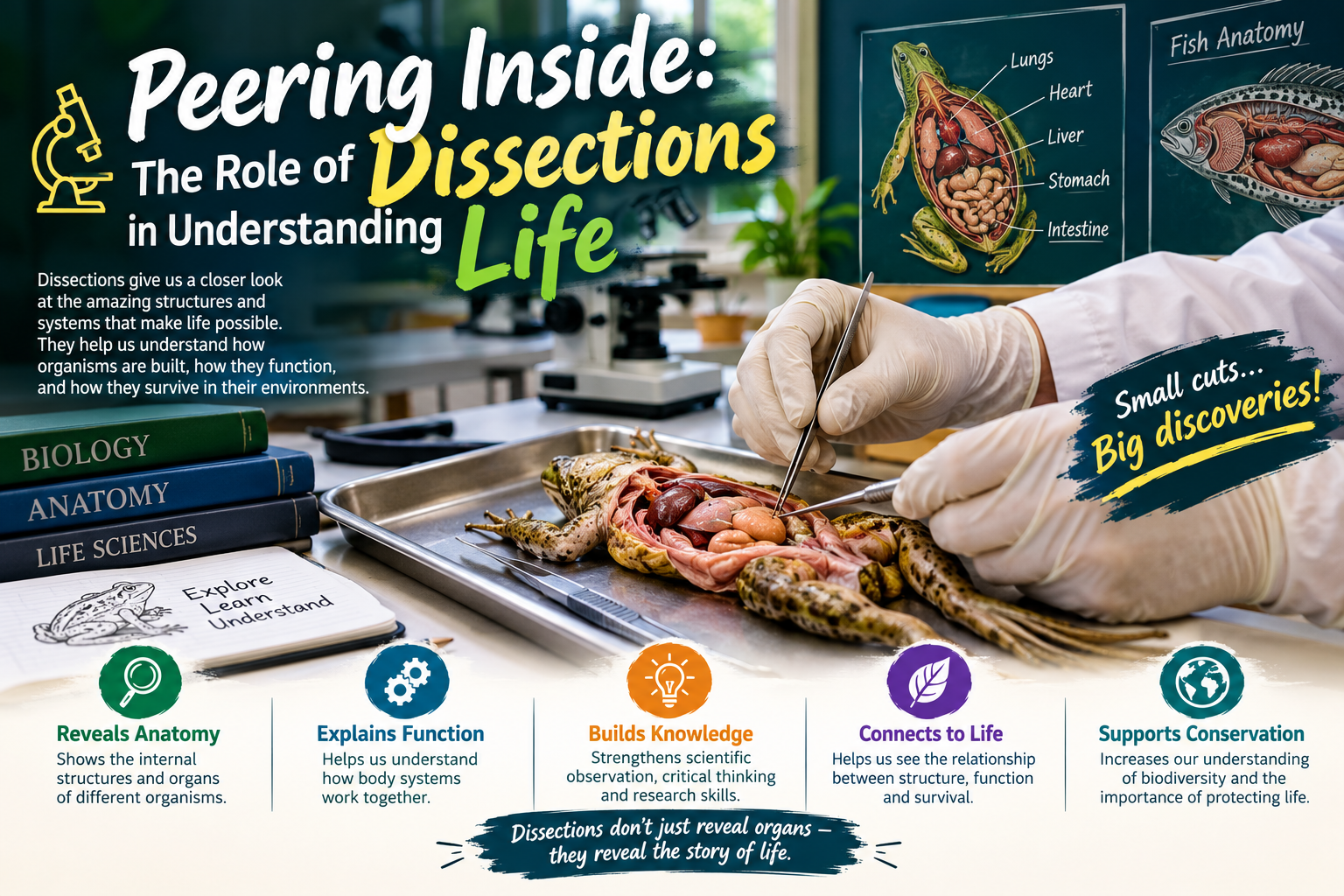
    Discover the fascinating world of biology through **“Peering Inside: The Role of Dissections in Understanding Life.”** This educational topic explores how dissection helps scientists and students understand the internal structures of living organisms and uncover the amazing systems that make life possible.

    Dissection is an important scientific method that allows researchers to examine organs, tissues, and body structures to learn how different parts of an organism work together. By studying anatomy, we can better understand the relationship between structure and function, how body systems support survival, and how different species are adapted to their environments.

    **What Will You Learn?**

    - **Understanding Anatomy:** Discover the internal structures and organs of living organisms.
    - **Structure and Function:** Learn how different organs work together to support life.
    - **Exploring Organisms:** Understand the similarities and differences between various species.
    - **Scientific Investigation:** Develop observation, analytical thinking, and research skills.
    - **Biodiversity and Conservation:** Explore how anatomical knowledge contributes to understanding and protecting living things.
    - **Educational Importance:** Discover how dissection supports biology, medicine, and scientific learning.

    Dissection has contributed greatly to our understanding of the human body and other organisms. Today, scientists and educators can also use anatomical models, digital simulations, and virtual dissection tools to explore biological structures. Responsible scientific study emphasizes ethical practices, safety, and respect for living things.

    **Conclusion:** Dissection is more than the study of internal organs; it is a window into the complexity, organization, and wonder of life. By exploring anatomy, we gain valuable knowledge about how organisms function, survive, and interact with the world around them.

    **“Dissections don't just reveal organs — they reveal the story of life!”**

    #PeeringInside #Dissection #Anatomy #Biology #LifeSciences #ScienceEducation #ScientificDiscovery #HumanAnatomy #AnimalBiology #Biodiversity #LearningThroughScience #EducationalContent #ExploreLife
    RSIF8 Roll no:14 story no:21 story topic:Peering Inside: The Role of Dissections in Understanding Life # 🔬 Peering Inside: The Role of Dissections in Understanding Life 🧬 Discover the fascinating world of biology through **“Peering Inside: The Role of Dissections in Understanding Life.”** This educational topic explores how dissection helps scientists and students understand the internal structures of living organisms and uncover the amazing systems that make life possible. 🌿✨ Dissection is an important scientific method that allows researchers to examine organs, tissues, and body structures to learn how different parts of an organism work together. By studying anatomy, we can better understand the relationship between structure and function, how body systems support survival, and how different species are adapted to their environments. 🔍 **What Will You Learn?** - 🫀 **Understanding Anatomy:** Discover the internal structures and organs of living organisms. - 🧠 **Structure and Function:** Learn how different organs work together to support life. - 🐸 **Exploring Organisms:** Understand the similarities and differences between various species. - 🔬 **Scientific Investigation:** Develop observation, analytical thinking, and research skills. - 🌍 **Biodiversity and Conservation:** Explore how anatomical knowledge contributes to understanding and protecting living things. - 📚 **Educational Importance:** Discover how dissection supports biology, medicine, and scientific learning. Dissection has contributed greatly to our understanding of the human body and other organisms. Today, scientists and educators can also use anatomical models, digital simulations, and virtual dissection tools to explore biological structures. Responsible scientific study emphasizes ethical practices, safety, and respect for living things. 💚 ✨ **Conclusion:** Dissection is more than the study of internal organs; it is a window into the complexity, organization, and wonder of life. By exploring anatomy, we gain valuable knowledge about how organisms function, survive, and interact with the world around them. **“Dissections don't just reveal organs — they reveal the story of life!”** 🌱🔬 #PeeringInside #Dissection #Anatomy #Biology #LifeSciences #ScienceEducation #ScientificDiscovery #HumanAnatomy #AnimalBiology #Biodiversity #LearningThroughScience #EducationalContent #ExploreLife
    0 Kommentare 0 Anteile 1576 Ansichten
  • **Roll No: 2**
    **Batch: 14**
    **Book: ACCL**
    **Task No: 138**

    # Exploring Life’s Mechanisms Through Experimentation

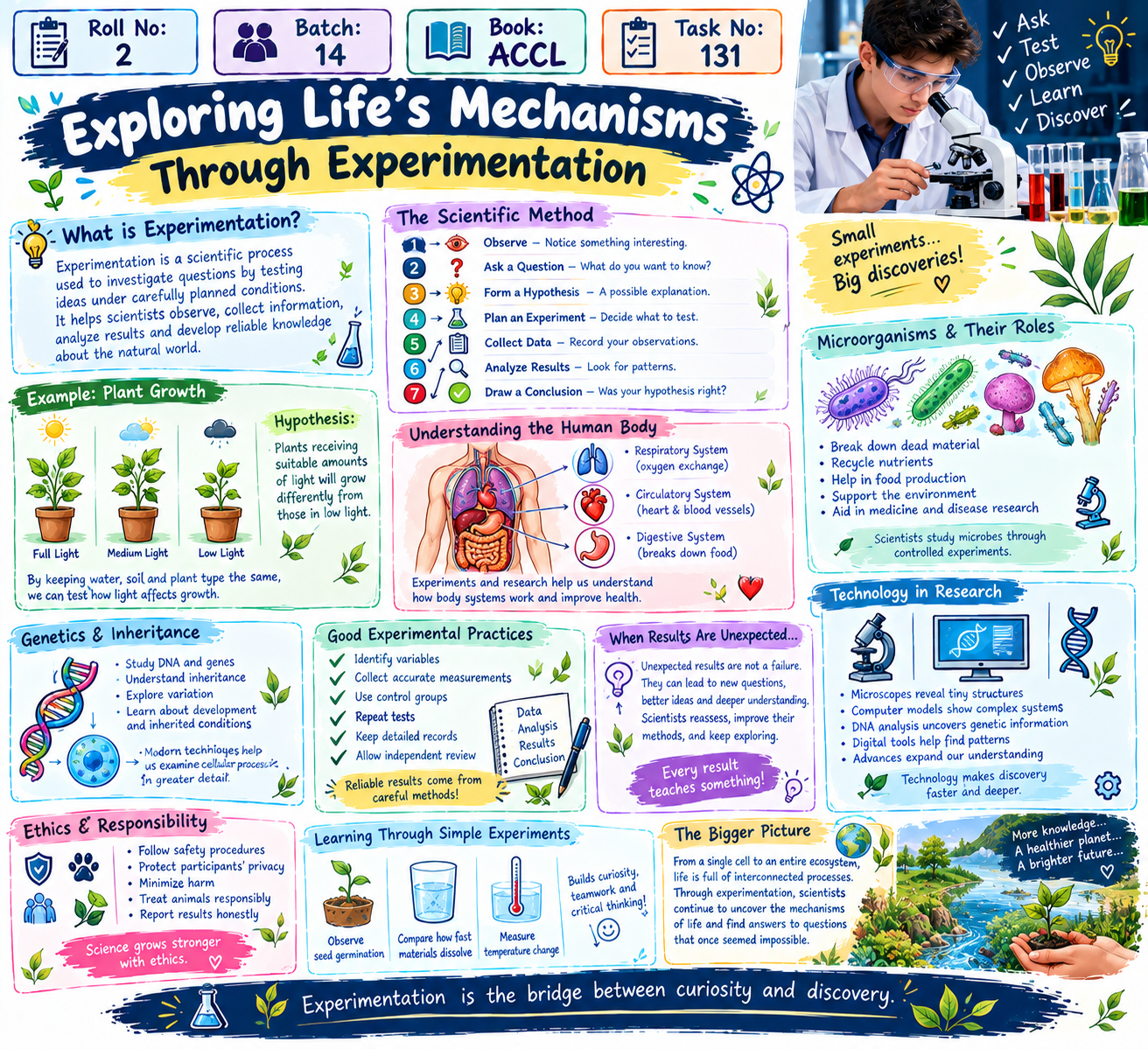
    Have you ever wondered how scientists discover the secrets of life? From understanding how plants grow to investigating how the human heart works, science helps us explore the processes that make living organisms function. Behind many important discoveries lies a powerful method called **experimentation**, which allows scientists to test ideas, observe results, and develop a deeper understanding of the natural world.

    **Experimentation is a scientific process used to investigate questions by testing ideas under carefully planned conditions.** Scientists begin by observing something interesting, asking a question, and developing a hypothesis—a possible explanation that can be tested. They then design an experiment, collect information, and analyze the results to determine whether the evidence supports their original idea. This process helps turn curiosity into reliable scientific knowledge.

    One fascinating example is the study of plant growth. Imagine a student who wants to discover whether the amount of light affects how quickly a plant grows. The student forms a hypothesis that plants receiving suitable amounts of light will grow differently from plants kept in low-light conditions. By keeping factors such as water, soil, and plant type consistent, the student can compare the results and investigate the role of light in plant development.

    Experimentation is also essential for understanding the human body. Scientists investigate how the heart circulates blood, how the lungs exchange gases, and how the digestive system processes food. Through carefully designed studies, medical imaging, laboratory tests, and other research methods, scientists learn how body systems work together to maintain health. Their findings can contribute to improved medical treatments and a better understanding of human biology.

    Another important field is microbiology, the study of microscopic organisms. Many bacteria and fungi play beneficial roles in nature, including breaking down dead material and recycling nutrients. Scientists use controlled experiments to investigate how these organisms respond to different environmental conditions. Such research can help improve food production, develop medicines, understand infectious diseases, and protect ecosystems.

    Experiments also help researchers understand genetics and the mechanisms of inheritance. By studying DNA, genes, and the characteristics of organisms across generations, scientists investigate how biological information is passed on and how variations arise. Modern techniques allow researchers to explore cellular processes in greater detail, helping them understand development, inherited conditions, and the relationships among different forms of life.

    A successful experiment requires more than simply observing what happens. Scientists must identify the variables they are studying, collect accurate measurements, and repeat tests when appropriate. They often use control groups for comparison and record their observations carefully. Repeating experiments helps determine whether a result is consistent, while independent review allows other researchers to examine the methods and evaluate the conclusions. These practices make scientific findings more trustworthy.

    Sometimes experiments produce unexpected results. Instead of treating an unexpected outcome as a failure, scientists use it as an opportunity to ask new questions. They may reconsider their hypothesis, improve their experimental design, or investigate another possible explanation. Scientific progress often happens through this cycle of questioning, testing, learning, and refining ideas. Every result can contribute something valuable when it is interpreted carefully.

    Technology has made biological experimentation more advanced than ever before. Microscopes reveal structures too small to see with the naked eye, computer models help researchers understand complicated systems, and DNA analysis allows scientists to investigate genetic information. Digital tools can also help organize large amounts of data and identify patterns that might otherwise be difficult to notice. These innovations continue to expand our understanding of living organisms.

    However, scientific experimentation must always be guided by responsibility and ethics. Researchers should follow safety procedures, protect participants' privacy, minimize harm, and treat animals responsibly. Experiments involving people or animals require appropriate ethical review and safeguards. Scientists must also report results honestly, even when the findings do not match their expectations. Reliable science depends on both accurate evidence and responsible behavior.

    Experimentation connects classroom learning with real-world discoveries. Students can explore scientific ideas through safe activities, such as observing seed germination, comparing how quickly different materials dissolve in water, or measuring changes in temperature. These activities encourage curiosity, careful observation, teamwork, and critical thinking. They also show that science is not just a collection of facts to memorize; it is an ongoing process of discovery.

    As we explore life's mechanisms, we begin to understand how countless processes work together to support living organisms. From the activity inside a single cell to the interactions among species in an ecosystem, each discovery reveals another part of nature's complexity. Through experimentation, scientists continue to investigate these connections and search for answers to questions that once seemed impossible to solve.

    **Experimentation is the bridge between curiosity and discovery. By asking thoughtful questions, testing ideas fairly, and learning from evidence, we can uncover the mechanisms of life and use scientific knowledge to improve human health, protect the environment, and build a brighter future. **

    \#Experimentation #Biology #ScientificMethod #LifeSciences #ScientificDiscovery #Research #ACCL #Batch14 #Task131
    **Roll No: 2** **Batch: 14** **Book: ACCL** **Task No: 138** # 🔬🧪 Exploring Life’s Mechanisms Through Experimentation 🌱🧬 Have you ever wondered how scientists discover the secrets of life? 🌍 From understanding how plants grow to investigating how the human heart works, science helps us explore the processes that make living organisms function. Behind many important discoveries lies a powerful method called **experimentation**, which allows scientists to test ideas, observe results, and develop a deeper understanding of the natural world. 🔍✨ **Experimentation is a scientific process used to investigate questions by testing ideas under carefully planned conditions.** 🧪 Scientists begin by observing something interesting, asking a question, and developing a hypothesis—a possible explanation that can be tested. They then design an experiment, collect information, and analyze the results to determine whether the evidence supports their original idea. This process helps turn curiosity into reliable scientific knowledge. 📚💡 One fascinating example is the study of plant growth. 🌱 Imagine a student who wants to discover whether the amount of light affects how quickly a plant grows. The student forms a hypothesis that plants receiving suitable amounts of light will grow differently from plants kept in low-light conditions. By keeping factors such as water, soil, and plant type consistent, the student can compare the results and investigate the role of light in plant development. ☀️🌿 Experimentation is also essential for understanding the human body. ❤️ Scientists investigate how the heart circulates blood, how the lungs exchange gases, and how the digestive system processes food. Through carefully designed studies, medical imaging, laboratory tests, and other research methods, scientists learn how body systems work together to maintain health. Their findings can contribute to improved medical treatments and a better understanding of human biology. 🫁🧠 Another important field is microbiology, the study of microscopic organisms. 🦠 Many bacteria and fungi play beneficial roles in nature, including breaking down dead material and recycling nutrients. Scientists use controlled experiments to investigate how these organisms respond to different environmental conditions. Such research can help improve food production, develop medicines, understand infectious diseases, and protect ecosystems. 🔬🌍 Experiments also help researchers understand genetics and the mechanisms of inheritance. 🧬 By studying DNA, genes, and the characteristics of organisms across generations, scientists investigate how biological information is passed on and how variations arise. Modern techniques allow researchers to explore cellular processes in greater detail, helping them understand development, inherited conditions, and the relationships among different forms of life. 🌱🔍 A successful experiment requires more than simply observing what happens. Scientists must identify the variables they are studying, collect accurate measurements, and repeat tests when appropriate. 📏 They often use control groups for comparison and record their observations carefully. Repeating experiments helps determine whether a result is consistent, while independent review allows other researchers to examine the methods and evaluate the conclusions. These practices make scientific findings more trustworthy. 📊📝 Sometimes experiments produce unexpected results. 🤔 Instead of treating an unexpected outcome as a failure, scientists use it as an opportunity to ask new questions. They may reconsider their hypothesis, improve their experimental design, or investigate another possible explanation. Scientific progress often happens through this cycle of questioning, testing, learning, and refining ideas. Every result can contribute something valuable when it is interpreted carefully. 💡🔄 Technology has made biological experimentation more advanced than ever before. 🤖🔬 Microscopes reveal structures too small to see with the naked eye, computer models help researchers understand complicated systems, and DNA analysis allows scientists to investigate genetic information. Digital tools can also help organize large amounts of data and identify patterns that might otherwise be difficult to notice. These innovations continue to expand our understanding of living organisms. 💻🧬 However, scientific experimentation must always be guided by responsibility and ethics. 💚 Researchers should follow safety procedures, protect participants' privacy, minimize harm, and treat animals responsibly. Experiments involving people or animals require appropriate ethical review and safeguards. Scientists must also report results honestly, even when the findings do not match their expectations. Reliable science depends on both accurate evidence and responsible behavior. ⚖️🌿 Experimentation connects classroom learning with real-world discoveries. 🏫 Students can explore scientific ideas through safe activities, such as observing seed germination, comparing how quickly different materials dissolve in water, or measuring changes in temperature. These activities encourage curiosity, careful observation, teamwork, and critical thinking. They also show that science is not just a collection of facts to memorize; it is an ongoing process of discovery. 🌈🧪 As we explore life's mechanisms, we begin to understand how countless processes work together to support living organisms. From the activity inside a single cell to the interactions among species in an ecosystem, each discovery reveals another part of nature's complexity. Through experimentation, scientists continue to investigate these connections and search for answers to questions that once seemed impossible to solve. 🌎🦋🔬 **Experimentation is the bridge between curiosity and discovery. By asking thoughtful questions, testing ideas fairly, and learning from evidence, we can uncover the mechanisms of life and use scientific knowledge to improve human health, protect the environment, and build a brighter future. 🔬🧬🌍💚** \#Experimentation #Biology #ScientificMethod #LifeSciences #ScientificDiscovery #Research #ACCL #Batch14 #Task131 🧪🔬🌱
    0 Kommentare 0 Anteile 3648 Ansichten
  • #rsisb
    Roll no. 247
    Story post . 23
    Foundation level

    **DNA Detectives: Unraveling the Double Helix Mystery **

    Welcome to the fascinating world of DNA, where every tiny molecule holds amazing secrets about life! Get ready to become a DNA detective and explore one of the greatest mysteries in biology — the incredible structure of the double helix! ‍

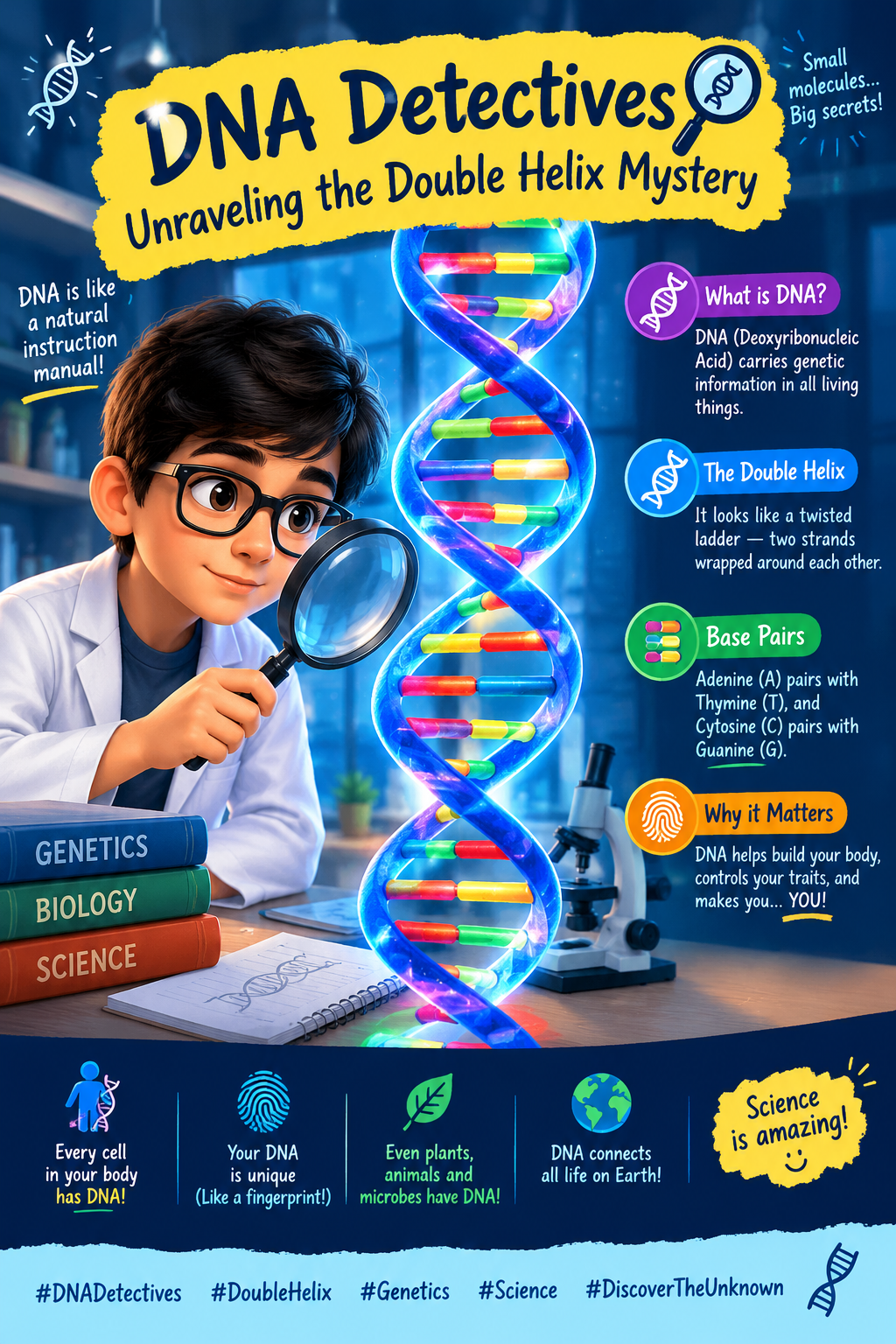
    Have you ever wondered how your body knows how to grow, develop, and function? The answer lies in DNA, which stands for **Deoxyribonucleic Acid**. DNA contains the genetic instructions that help living organisms grow, survive, and pass characteristics from one generation to the next. ‍‍‍

    **What Is the Double Helix?**

    DNA has a special shape called a *double helix*, which looks like a twisted ladder! Its two strands twist around each other, while pairs of chemical bases form the steps of the ladder. These bases are adenine (A), thymine (T), cytosine (C), and guanine (G). The base-pairing rules are simple: A pairs with T, and C pairs with G. These tiny building blocks help store the instructions that make life possible!

    ‍ **Become a DNA Detective!**

    Imagine putting on your detective hat , picking up your scientific magnifying glass , and investigating the hidden clues inside every living cell! What can DNA tell us about living things? How does it copy its information? Why do family members sometimes share similar characteristics? These exciting questions lead us into the world of genetics, heredity, and molecular biology.

    ‍ Scientists James Watson, Francis Crick, Rosalind Franklin, and Maurice Wilkins played important roles in the scientific work that led to our understanding of DNA's structure. Rosalind Franklin's X-ray diffraction research provided crucial evidence about DNA's shape. Her contribution is an important part of this scientific story!

    **Why Is DNA Important?**

    DNA research helps scientists understand inherited conditions, study the diversity of life, investigate biological relationships, and develop new approaches in medicine and biotechnology. It also helps researchers learn how living organisms are connected and how life continues from one generation to another.

    **Amazing Science Fact:** Every cell in your body that contains a complete set of nuclear DNA carries an extraordinary amount of biological information! Your DNA is like a tiny instruction library that helps your cells perform their jobs.

    **The Mission:** Explore the double helix, discover the secrets of genetic information, ask questions, and keep your curiosity alive! Remember, every great scientific discovery begins with a question and the courage to investigate.

    Science makes the invisible visible, and DNA reminds us that some of life's greatest mysteries are hidden in the tiniest places. Keep learning, keep exploring, and become a young scientist who is ready to uncover the wonders of our world!

    **Share your thoughts!** What do you find most fascinating about DNA — its double-helix structure, its genetic code, or its role in living organisms? Tell us in the comments below!

    Like, share, and spread the excitement of science with friends, family, teachers, and fellow learners!

    **DNA Detectives: Every molecule has a story, and every discovery brings us closer to understanding life!**

    #DNADetectives #DNA #DoubleHelix #ScienceExploration #Biology #Genetics #MolecularBiology #RosalindFranklin #JamesWatson #FrancisCrick #ScienceEducation #LearnScience #YoungScientists #ScienceFacts #BiologyLovers #GeneticCode #ExploreScience #STEMEducation #Curiosity #DiscoverTheUnknown #EducationalContent #ScienceStory #KnowledgeIsPower #KeepLearning #FutureScientists
    #rsisb Roll no. 247 Story post . 23 Foundation level 🧬🔍 **DNA Detectives: Unraveling the Double Helix Mystery 🧬✨** Welcome to the fascinating world of DNA, where every tiny molecule holds amazing secrets about life! 🌍🔬 Get ready to become a DNA detective and explore one of the greatest mysteries in biology — the incredible structure of the double helix! 🕵️‍♂️🧬 Have you ever wondered how your body knows how to grow, develop, and function? 🤔💡 The answer lies in DNA, which stands for **Deoxyribonucleic Acid**. DNA contains the genetic instructions that help living organisms grow, survive, and pass characteristics from one generation to the next. 🌱👨‍👩‍👧‍👦 🔬 **What Is the Double Helix?** DNA has a special shape called a *double helix*, which looks like a twisted ladder! 🪜🌀 Its two strands twist around each other, while pairs of chemical bases form the steps of the ladder. These bases are adenine (A), thymine (T), cytosine (C), and guanine (G). 🧪 The base-pairing rules are simple: A pairs with T, and C pairs with G. These tiny building blocks help store the instructions that make life possible! 🌟 🕵️‍♀️ **Become a DNA Detective!** Imagine putting on your detective hat 🕵️, picking up your scientific magnifying glass 🔎, and investigating the hidden clues inside every living cell! What can DNA tell us about living things? How does it copy its information? Why do family members sometimes share similar characteristics? These exciting questions lead us into the world of genetics, heredity, and molecular biology. 🧬📚 👩‍🔬 Scientists James Watson, Francis Crick, Rosalind Franklin, and Maurice Wilkins played important roles in the scientific work that led to our understanding of DNA's structure. Rosalind Franklin's X-ray diffraction research provided crucial evidence about DNA's shape. Her contribution is an important part of this scientific story! 👏🔬 🌍 **Why Is DNA Important?** DNA research helps scientists understand inherited conditions, study the diversity of life, investigate biological relationships, and develop new approaches in medicine and biotechnology. 🏥🧫 It also helps researchers learn how living organisms are connected and how life continues from one generation to another. 💡 **Amazing Science Fact:** Every cell in your body that contains a complete set of nuclear DNA carries an extraordinary amount of biological information! Your DNA is like a tiny instruction library that helps your cells perform their jobs. 📖🧬 🎯 **The Mission:** Explore the double helix, discover the secrets of genetic information, ask questions, and keep your curiosity alive! Remember, every great scientific discovery begins with a question and the courage to investigate. 🚀🔍 ✨ Science makes the invisible visible, and DNA reminds us that some of life's greatest mysteries are hidden in the tiniest places. Keep learning, keep exploring, and become a young scientist who is ready to uncover the wonders of our world! 🌎💚 📢 **Share your thoughts!** What do you find most fascinating about DNA — its double-helix structure, its genetic code, or its role in living organisms? Tell us in the comments below! 💬👇 ❤️ Like, share, and spread the excitement of science with friends, family, teachers, and fellow learners! 🧬🔬 **DNA Detectives: Every molecule has a story, and every discovery brings us closer to understanding life!** 🌟🎓 #DNADetectives #DNA #DoubleHelix #ScienceExploration #Biology #Genetics #MolecularBiology #RosalindFranklin #JamesWatson #FrancisCrick #ScienceEducation #LearnScience #YoungScientists #ScienceFacts #BiologyLovers #GeneticCode #ExploreScience #STEMEducation #Curiosity #DiscoverTheUnknown #EducationalContent #ScienceStory #KnowledgeIsPower #KeepLearning #FutureScientists 🧬🔬🌍✨🚀📚
    0 Kommentare 0 Anteile 3002 Ansichten
  • RSIF8
    Roll NO:92
    Movie Review NO:3
    Topic:# Movie Review — Munna Bhai M.B.B.S.

    In this movie review, I will talk about *Munna Bhai M.B.B.S.*, a popular Indian comedy-drama movie. The film is about Munna, a kind-hearted man who wants to become a doctor to make his father proud. He joins a medical college and learns that being a good doctor is not only about medicines but also about caring for patients.

    The movie is full of comedy, emotions, friendship, and important life lessons. It teaches us that love, kindness, and humanity are just as important as education and professional skills.

    I really like the message of this movie because it shows that a little kindness can make a big difference in someone's life.

    **My Rating:** 5/5

    **Moral:** Always treat people with kindness, respect, and humanity. A good heart is just as important as knowledge.

    #MunnaBhaiMBBS #MovieReview #BollywoodMovies #ComedyDrama #LifeLessons #Kindness #Humanity
    RSIF8 Roll NO:92 Movie Review NO:3 Topic:# 🎬 Movie Review — Munna Bhai M.B.B.S. In this movie review, I will talk about *Munna Bhai M.B.B.S.*, a popular Indian comedy-drama movie. The film is about Munna, a kind-hearted man who wants to become a doctor to make his father proud. He joins a medical college and learns that being a good doctor is not only about medicines but also about caring for patients. The movie is full of comedy, emotions, friendship, and important life lessons. It teaches us that love, kindness, and humanity are just as important as education and professional skills. I really like the message of this movie because it shows that a little kindness can make a big difference in someone's life. **My Rating:** ⭐⭐⭐⭐⭐ 5/5 **Moral:** Always treat people with kindness, respect, and humanity. A good heart is just as important as knowledge. #MunnaBhaiMBBS #MovieReview #BollywoodMovies #ComedyDrama #LifeLessons #Kindness #Humanity
    0 Kommentare 0 Anteile 1554 Ansichten 2
  • RSIF8
    Roll no 94
    Story post no 15
    Story post topic
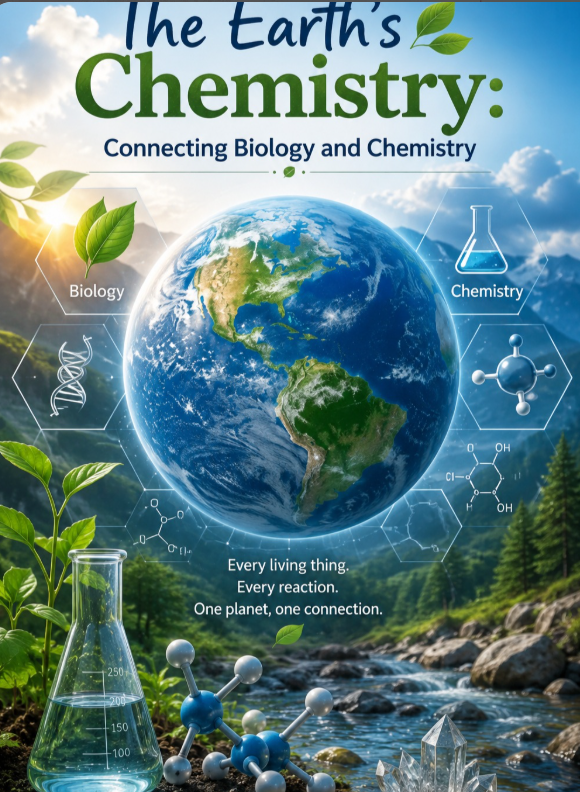
    The Earth's Chemistry: Connecting Biology and Chemistry
    Today I explored the amazing connection between Biology and Chemistry and discovered how these two sciences work together to explain life on Earth. Every living organism, from the smallest cell to the largest tree, depends on chemical reactions to survive and grow.
    Chemistry helps us understand how nutrients are absorbed, how plants perform photosynthesis, and how our bodies produce energy. Biology shows us how these chemical processes create and sustain life. Together, they reveal the incredible systems that keep our planet healthy and balanced.
    Learning about Earth's chemistry reminds us that everything in nature is connected. The air we breathe, the water we drink, the food we eat, and the ecosystems around us all depend on important chemical and biological interactions.
    By studying these connections, scientists can develop new medicines, protect the environment, improve agriculture, and find solutions to global challenges. The more we learn about science, the more we appreciate the beauty and complexity of our world.
    Let's continue exploring, learning, and protecting our planet for future generations!
    #EarthsChemistry #BiologyAndChemistry #ScienceEducation #STEM #EnvironmentalScience #LifeScience #Chemistry #Biology #ScienceLovers #LearningJourney #NatureAndScience #ScientificDiscovery #EarthScience #FutureScientists #Innovation #Education #ExploreScience #KnowledgeIsPower #PlanetEarth #ScienceForEveryone
    RSIF8 Roll no 94 Story post no 15 Story post topic 🌍🧪 The Earth's Chemistry: Connecting Biology and Chemistry 🌱🔬 Today I explored the amazing connection between Biology and Chemistry and discovered how these two sciences work together to explain life on Earth. 🌎✨ Every living organism, from the smallest cell to the largest tree, depends on chemical reactions to survive and grow. 🌿🧬 Chemistry helps us understand how nutrients are absorbed, how plants perform photosynthesis, and how our bodies produce energy. ⚡🌱 Biology shows us how these chemical processes create and sustain life. Together, they reveal the incredible systems that keep our planet healthy and balanced. 🌍💚 Learning about Earth's chemistry reminds us that everything in nature is connected. The air we breathe, the water we drink, the food we eat, and the ecosystems around us all depend on important chemical and biological interactions. 💧🌳☀️ By studying these connections, scientists can develop new medicines, protect the environment, improve agriculture, and find solutions to global challenges. 🔬🌾💊 The more we learn about science, the more we appreciate the beauty and complexity of our world. 🌎✨ Let's continue exploring, learning, and protecting our planet for future generations! 🌍💙🌱 #EarthsChemistry #BiologyAndChemistry #ScienceEducation #STEM #EnvironmentalScience #LifeScience #Chemistry #Biology #ScienceLovers #LearningJourney #NatureAndScience #ScientificDiscovery #EarthScience #FutureScientists #Innovation #Education #ExploreScience #KnowledgeIsPower #PlanetEarth #ScienceForEveryone 🌍🧪🌿🔬💚
    0 Kommentare 0 Anteile 1637 Ansichten
  • RSIF8
    Task NO:41

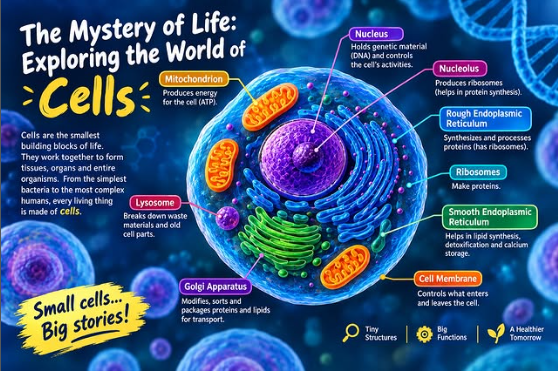
    The Mystery of Life: Exploring the World of Cells

    Cells are the fundamental building blocks of life, and understanding them helps us understand how living organisms grow, function, develop, and survive. From tiny microorganisms to plants, animals, and humans, every living organism is made up of cells. Although cells are incredibly small, they contain many fascinating structures that work together like a well-organized system.

    In this learning task, I explored the amazing world of cells and learned about different cell organelles and their important functions. The nucleus contains genetic material and helps control the activities of the cell, while the nucleolus plays an important role in producing ribosomes. The mitochondria are responsible for producing energy that the cell needs to perform its activities. I also learned about the rough and smooth endoplasmic reticulum, which are involved in processes such as protein production, lipid synthesis, and other cellular functions.

    Another interesting part of the cell is the Golgi apparatus, which modifies, sorts, and packages proteins and other materials for transport. Ribosomes help make proteins, while lysosomes help break down waste materials and unwanted cell components. The cell membrane surrounds the cell and controls what enters and leaves it. Learning about these structures made me realize that even the smallest parts of life have specific jobs and work together to keep the cell functioning properly.

    This topic also helped me understand how complex life can exist at a microscopic level. A cell may look tiny and simple from the outside, but inside it is a busy world filled with structures, chemical reactions, energy production, information, and continuous activity. Studying cells gives us a foundation for learning more advanced topics such as genetics, DNA, human biology, diseases, medicine, and biotechnology.

    Through this task, I improved my knowledge of biology and developed a greater appreciation for the incredible organization found in living things. It also reminded me that science is all about asking questions, exploring mysteries, observing carefully, and discovering
    RSIF8 Task NO:41 🔬🧬 The Mystery of Life: Exploring the World of Cells 🧬🔬 Cells are the fundamental building blocks of life, and understanding them helps us understand how living organisms grow, function, develop, and survive. From tiny microorganisms to plants, animals, and humans, every living organism is made up of cells. Although cells are incredibly small, they contain many fascinating structures that work together like a well-organized system. In this learning task, I explored the amazing world of cells and learned about different cell organelles and their important functions. The nucleus contains genetic material and helps control the activities of the cell, while the nucleolus plays an important role in producing ribosomes. The mitochondria are responsible for producing energy that the cell needs to perform its activities. I also learned about the rough and smooth endoplasmic reticulum, which are involved in processes such as protein production, lipid synthesis, and other cellular functions. Another interesting part of the cell is the Golgi apparatus, which modifies, sorts, and packages proteins and other materials for transport. Ribosomes help make proteins, while lysosomes help break down waste materials and unwanted cell components. The cell membrane surrounds the cell and controls what enters and leaves it. Learning about these structures made me realize that even the smallest parts of life have specific jobs and work together to keep the cell functioning properly. This topic also helped me understand how complex life can exist at a microscopic level. A cell may look tiny and simple from the outside, but inside it is a busy world filled with structures, chemical reactions, energy production, information, and continuous activity. Studying cells gives us a foundation for learning more advanced topics such as genetics, DNA, human biology, diseases, medicine, and biotechnology. Through this task, I improved my knowledge of biology and developed a greater appreciation for the incredible organization found in living things. It also reminded me that science is all about asking questions, exploring mysteries, observing carefully, and discovering
    0 Kommentare 0 Anteile 1623 Ansichten
  • #rsisb
    Roll no . 257
    Story post . 16
    Foundation level
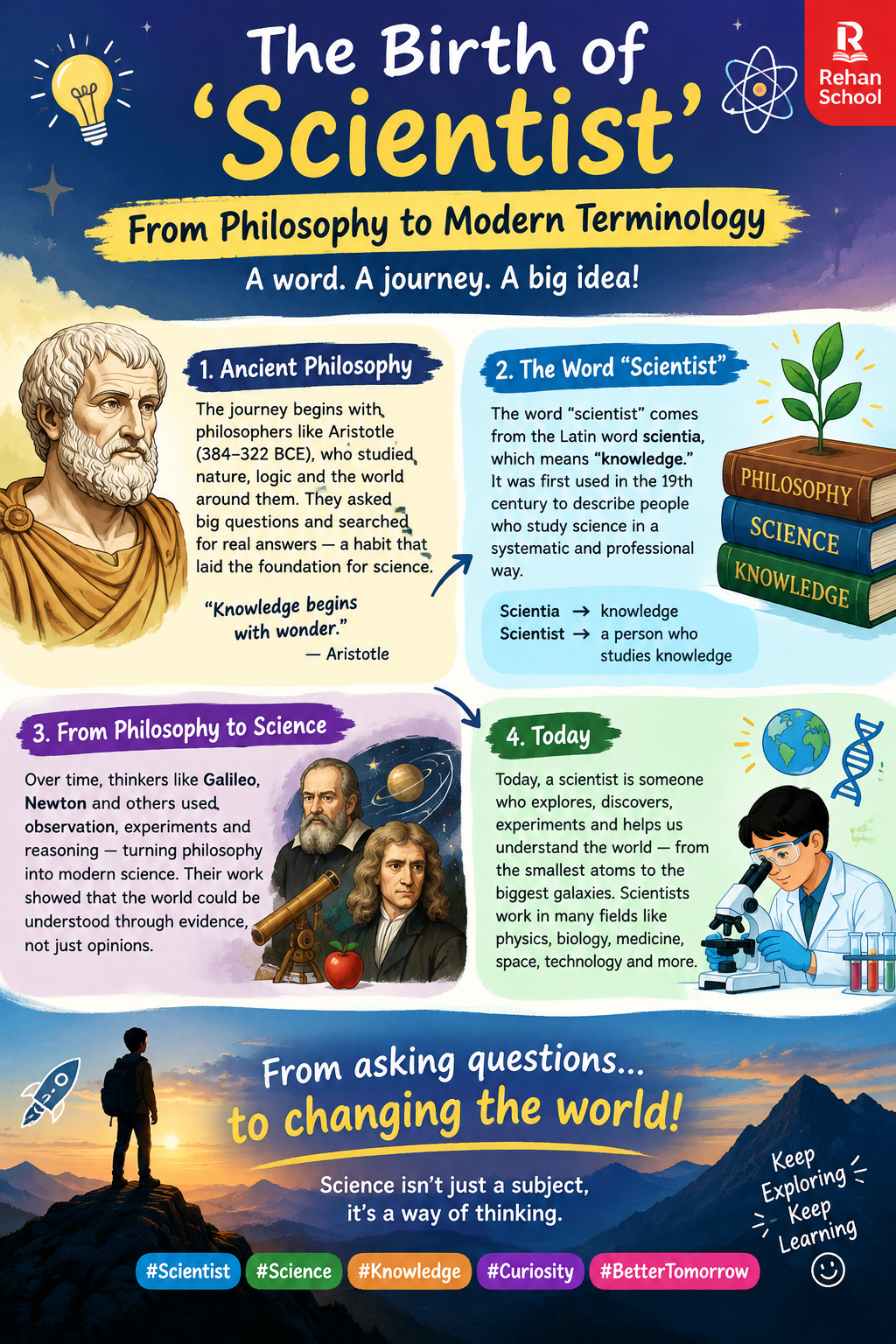
    **The Birth of “Scientist”: From Philosophy to Modern Terminology **
    **Have you ever wondered where the word “scientist” came from?** The word we use today to describe people who explore the mysteries of the universe, discover new things, and develop amazing inventions has an interesting history!
    In ancient times, people who studied nature, the stars, mathematics, medicine, and the world around them were often called **natural philosophers**. They asked important questions about how the world worked and tried to find answers through observation, reasoning, and experiments. Their curiosity helped build the foundations of modern science!
    Over time, the study of nature developed into different scientific fields, including physics , chemistry , biology , astronomy , and many others. As scientific research became more specialized, people needed a new word to describe those who dedicated their lives to scientific investigation.
    The word **“scientist” was coined by William Whewell in 1833 and publicly introduced in 1834** during discussions about how to describe people who studied science. Before that, terms such as natural philosopher were commonly used. The new word gradually became popular as science developed into a recognized profession.
    Today, scientists work in laboratories, universities, hospitals, observatories, research centers, and even in space exploration! ‍‍ They study everything from tiny cells to distant galaxies . Their discoveries help us understand diseases, protect our planet , develop new technologies , and improve our daily lives.
    **The biggest lesson from this story is that curiosity can change the world!** Every great discovery begins with a question. Every invention begins with an idea. And every scientist begins with a desire to learn something new!
    **Think and Discuss:**
    Who were natural philosophers?
    Who introduced the word “scientist”?
    Why do we need scientists in today's world?
    If you could become a scientist, what would you like to discover?
    **Share your thoughts in the comments!** What scientific mystery would you love to solve?
    Keep asking questions, keep exploring, and never stop learning! Because the journey from curiosity to discovery is what makes science truly amazing!
    ━━━━━━━━━━━━━━━━━━━━
    **HASHTAGS**
    #BirthOfScientist #HistoryOfScience #Scientist #ScienceHistory #NaturalPhilosophy #WilliamWhewell #ScienceEducation #LearnSomethingNew #AmazingFacts #DidYouKnow #ScientificDiscoveries #Curiosity #KnowledgeIsPower #Education #ScienceLovers #STEMEducation #Physics #Chemistry #Biology #Astronomy #Innovation #Technology #ExploreTheWorld #LearningJourney #StoryPost #EducationalContent #StudentLife #NeverStopLearning #ScienceForEveryone #KnowledgeSharing
    #rsisb Roll no . 257 Story post . 16 Foundation level 🔬📚 **The Birth of “Scientist”: From Philosophy to Modern Terminology 🧠✨** 🌍💡 **Have you ever wondered where the word “scientist” came from?** 🤔🔍 The word we use today to describe people who explore the mysteries of the universe, discover new things, and develop amazing inventions has an interesting history! 🚀🌟 📖✨ In ancient times, people who studied nature, the stars, mathematics, medicine, and the world around them were often called **natural philosophers**. 🏛️🌌 They asked important questions about how the world worked and tried to find answers through observation, reasoning, and experiments. 🧪🔭 Their curiosity helped build the foundations of modern science! 🌱🧠 Over time, the study of nature developed into different scientific fields, including physics ⚡, chemistry 🧫, biology 🧬, astronomy 🌠, and many others. As scientific research became more specialized, people needed a new word to describe those who dedicated their lives to scientific investigation. ✨📚 The word **“scientist” was coined by William Whewell in 1833 and publicly introduced in 1834** during discussions about how to describe people who studied science. Before that, terms such as natural philosopher were commonly used. The new word gradually became popular as science developed into a recognized profession. 🔬🌍 💡🚀 Today, scientists work in laboratories, universities, hospitals, observatories, research centers, and even in space exploration! 🧑‍🔬👩‍🔬 They study everything from tiny cells 🔬 to distant galaxies 🌌. Their discoveries help us understand diseases, protect our planet 🌳, develop new technologies 🤖, and improve our daily lives. 🌟📖 **The biggest lesson from this story is that curiosity can change the world!** Every great discovery begins with a question. 🤔 Every invention begins with an idea. 💡 And every scientist begins with a desire to learn something new! 🌱✨ 🎯 **Think and Discuss:** 🔹 Who were natural philosophers? 🔹 Who introduced the word “scientist”? 🔹 Why do we need scientists in today's world? 🔹 If you could become a scientist, what would you like to discover? 🚀🧬 💬 **Share your thoughts in the comments!** What scientific mystery would you love to solve? 🌍🔭 ❤️ Keep asking questions, keep exploring, and never stop learning! Because the journey from curiosity to discovery is what makes science truly amazing! 🧠🔬✨ ━━━━━━━━━━━━━━━━━━━━ 🏷️ **HASHTAGS** #BirthOfScientist #HistoryOfScience #Scientist #ScienceHistory #NaturalPhilosophy #WilliamWhewell #ScienceEducation #LearnSomethingNew #AmazingFacts #DidYouKnow #ScientificDiscoveries #Curiosity #KnowledgeIsPower #Education #ScienceLovers #STEMEducation #Physics #Chemistry #Biology #Astronomy #Innovation #Technology #ExploreTheWorld #LearningJourney #StoryPost #EducationalContent #StudentLife #NeverStopLearning #ScienceForEveryone #KnowledgeSharing 🔬📚🌍🚀 🚀
    0 Kommentare 0 Anteile 2655 Ansichten
  • RSIF8
    Roll no:17
    Movie review no:04
    Topic:Movie Review — Watch "Munna Bhai M.B.B.S".

    **Movie Review: Munna Bhai M.B.B.S.**

    Today, I watched the Bollywood movie *Munna Bhai M.B.B.S.* It is a funny, emotional, and inspiring movie that teaches us the importance of kindness, humanity, and helping others.

    Munna Bhai shows us that love, care, and a smile can sometimes heal people better than medicine. The movie also teaches us to respect doctors, support patients, and treat everyone with kindness.

    I really enjoyed this movie because it combines comedy with a beautiful life lesson. It reminds us that being a good human being is just as important as being successful.

    **Watch, Learn, Laugh, and Spread Kindness!**

    #MunnaBhaiMBBS #MovieReview #BollywoodMovies #LifeLessons #KindnessMatters #Humanity #InspirationalMovie #LearningThroughMovies #ComedyAndEmotion #MovieLovers
    RSIF8 Roll no:17 Movie review no:04 Topic:Movie Review — Watch "Munna Bhai M.B.B.S". 🎥🍿 **Movie Review: Munna Bhai M.B.B.S.** 🩺❤️ Today, I watched the Bollywood movie *Munna Bhai M.B.B.S.* It is a funny, emotional, and inspiring movie that teaches us the importance of kindness, humanity, and helping others. 🥰🤝 Munna Bhai shows us that love, care, and a smile can sometimes heal people better than medicine. 😊💖 The movie also teaches us to respect doctors, support patients, and treat everyone with kindness. 🌟 I really enjoyed this movie because it combines comedy with a beautiful life lesson. 😂❤️ It reminds us that being a good human being is just as important as being successful. 🎬 **Watch, Learn, Laugh, and Spread Kindness!** 💕✨ #MunnaBhaiMBBS #MovieReview #BollywoodMovies #LifeLessons #KindnessMatters #Humanity #InspirationalMovie #LearningThroughMovies #ComedyAndEmotion #MovieLovers 🎥🍿❤️
    0 Kommentare 0 Anteile 2032 Ansichten 2
Suchergebnis