• RSIF8
    Roll no:14
    story no:20
    story topic:Why Frogs? Understanding the Anatomy of Life

    # Why Frogs? Understanding the Anatomy of Life

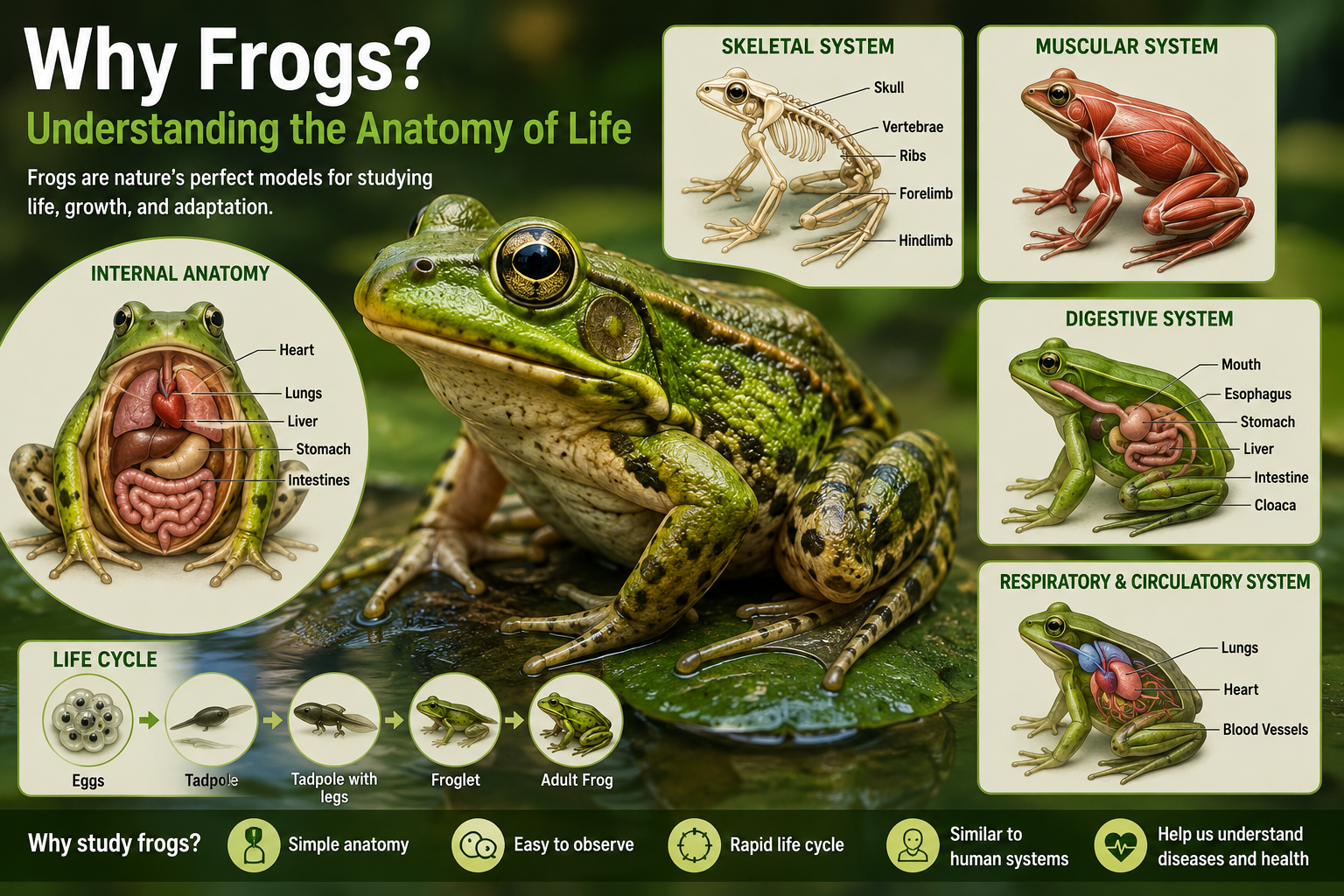
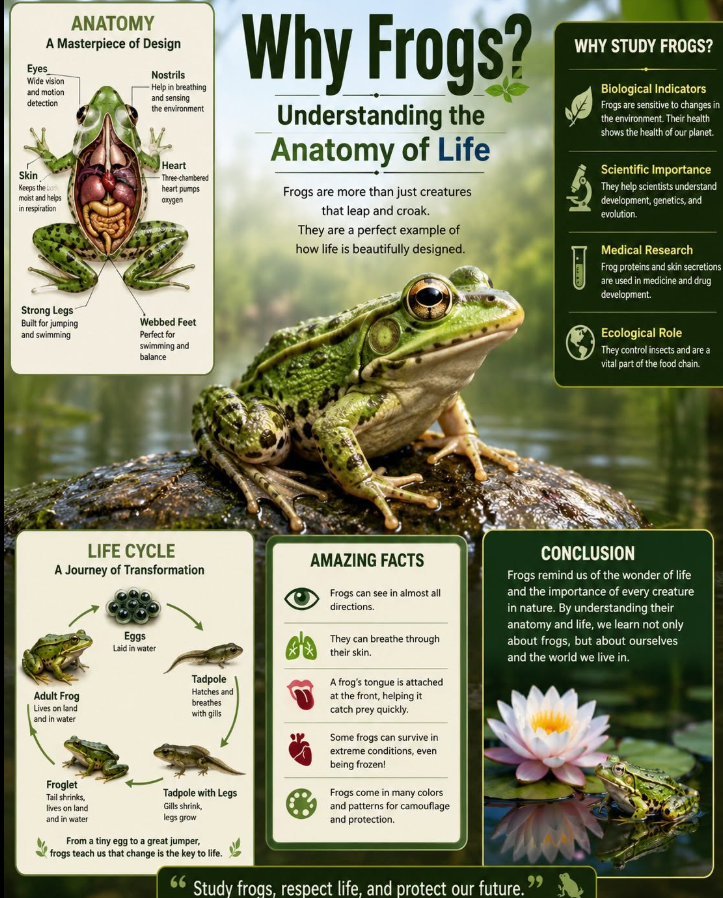
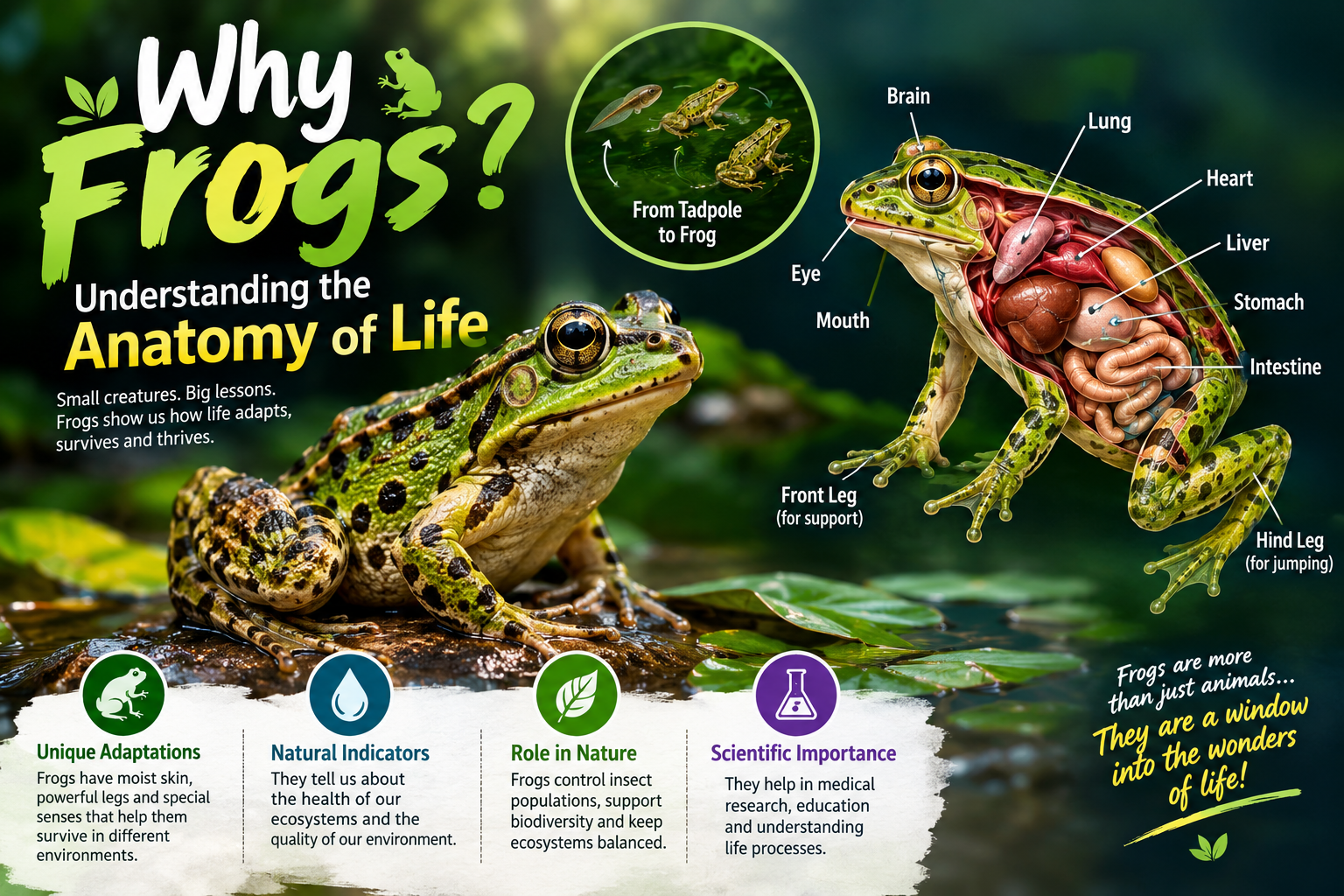
    Discover the fascinating world of frogs through **“Why Frogs? Understanding the Anatomy of Life.”** This educational topic explores the unique anatomy, amazing adaptations, and important role frogs play in maintaining the balance of nature. Although frogs may seem like small and simple creatures, their bodies reveal extraordinary examples of biological design, survival, and adaptation.

    From their powerful hind legs and moist skin to their sensitive eyes and specialized internal organs, frogs have developed remarkable features that help them survive in different environments. Their life cycle, from tiny tadpoles to adult frogs, demonstrates one of nature’s most interesting transformations.

    **What Will You Discover?**

    - **Frog Anatomy:** Learn about the brain, heart, lungs, stomach, intestines, and other important body parts.
    - **Unique Adaptations:** Discover how frogs jump, breathe, swim, and survive in their habitats.
    - **Life Cycle:** Explore the fascinating transformation from tadpole to adult frog.
    - **Environmental Indicators:** Understand how frogs can help scientists monitor ecosystem health.
    - **Role in Nature:** Learn how frogs help control insect populations and support biodiversity.
    - **Scientific Importance:** Discover how studying frogs helps us understand biology, anatomy, and life processes.

    Frogs are more than just pond-dwelling animals. They are an important part of food chains and ecosystems, and their sensitivity to environmental changes makes them valuable subjects for scientific research. Studying these amazing amphibians helps us appreciate the complexity of life and the importance of protecting nature.

    **Explore the hidden wonders of frog anatomy, uncover the secrets of their survival, and discover how these small creatures teach us big lessons about life!**

    #WhyFrogs #FrogAnatomy #UnderstandingLife #Biology #ScienceEducation #Amphibians #AnimalScience #Nature #Biodiversity #LifeCycle #EnvironmentalScience #EducationalContent #ExploreScience
    RSIF8 Roll no:14 story no:20 story topic:Why Frogs? Understanding the Anatomy of Life # 🐸 Why Frogs? Understanding the Anatomy of Life 🌿🔬 Discover the fascinating world of frogs through **“Why Frogs? Understanding the Anatomy of Life.”** This educational topic explores the unique anatomy, amazing adaptations, and important role frogs play in maintaining the balance of nature. 🌍✨ Although frogs may seem like small and simple creatures, their bodies reveal extraordinary examples of biological design, survival, and adaptation. From their powerful hind legs and moist skin to their sensitive eyes and specialized internal organs, frogs have developed remarkable features that help them survive in different environments. Their life cycle, from tiny tadpoles to adult frogs, demonstrates one of nature’s most interesting transformations. 💧🌱 🐸 **What Will You Discover?** - 🔬 **Frog Anatomy:** Learn about the brain, heart, lungs, stomach, intestines, and other important body parts. - 🌿 **Unique Adaptations:** Discover how frogs jump, breathe, swim, and survive in their habitats. - 💧 **Life Cycle:** Explore the fascinating transformation from tadpole to adult frog. - 🌎 **Environmental Indicators:** Understand how frogs can help scientists monitor ecosystem health. - 🦟 **Role in Nature:** Learn how frogs help control insect populations and support biodiversity. - 🧪 **Scientific Importance:** Discover how studying frogs helps us understand biology, anatomy, and life processes. Frogs are more than just pond-dwelling animals. They are an important part of food chains and ecosystems, and their sensitivity to environmental changes makes them valuable subjects for scientific research. Studying these amazing amphibians helps us appreciate the complexity of life and the importance of protecting nature. 💚🌏 ✨ **Explore the hidden wonders of frog anatomy, uncover the secrets of their survival, and discover how these small creatures teach us big lessons about life!** #WhyFrogs #FrogAnatomy #UnderstandingLife #Biology #ScienceEducation #Amphibians #AnimalScience #Nature #Biodiversity #LifeCycle #EnvironmentalScience #EducationalContent #ExploreScience 🐸🔬🌿
    0 Комментарии 0 Поделились 3221 Просмотры
  • #rsisb
    Roll no.214
    Foundation level
    Story post no.19

    Dissections help us explore the hidden structures of living organisms and understand how different organs work together. Through careful observation, students can learn about anatomy, body systems, and the amazing complexity of life. This topic shows how science helps us discover the secrets of living things and appreciate the beauty of nature.

    #Dissection #Biology #Anatomy #Science #Learning #LifeScience #Education #HumanBody #ExploreScience #UnderstandingLife
    #rsisb Roll no.214 Foundation level Story post no.19 Dissections help us explore the hidden structures of living organisms and understand how different organs work together. 🐸🫀🫁 Through careful observation, students can learn about anatomy, body systems, and the amazing complexity of life. 🌱🔬 This topic shows how science helps us discover the secrets of living things and appreciate the beauty of nature. ✨🧬 #Dissection 🔬 #Biology 🧬 #Anatomy 🫀 #Science 🔬 #Learning 📚 #LifeScience 🌱 #Education 🎓 #HumanBody 🫁 #ExploreScience 🔍 #UnderstandingLife 🌍
    1
    0 Комментарии 0 Поделились 1709 Просмотры
  • #rsisb
    Roll no.247
    Foundation level

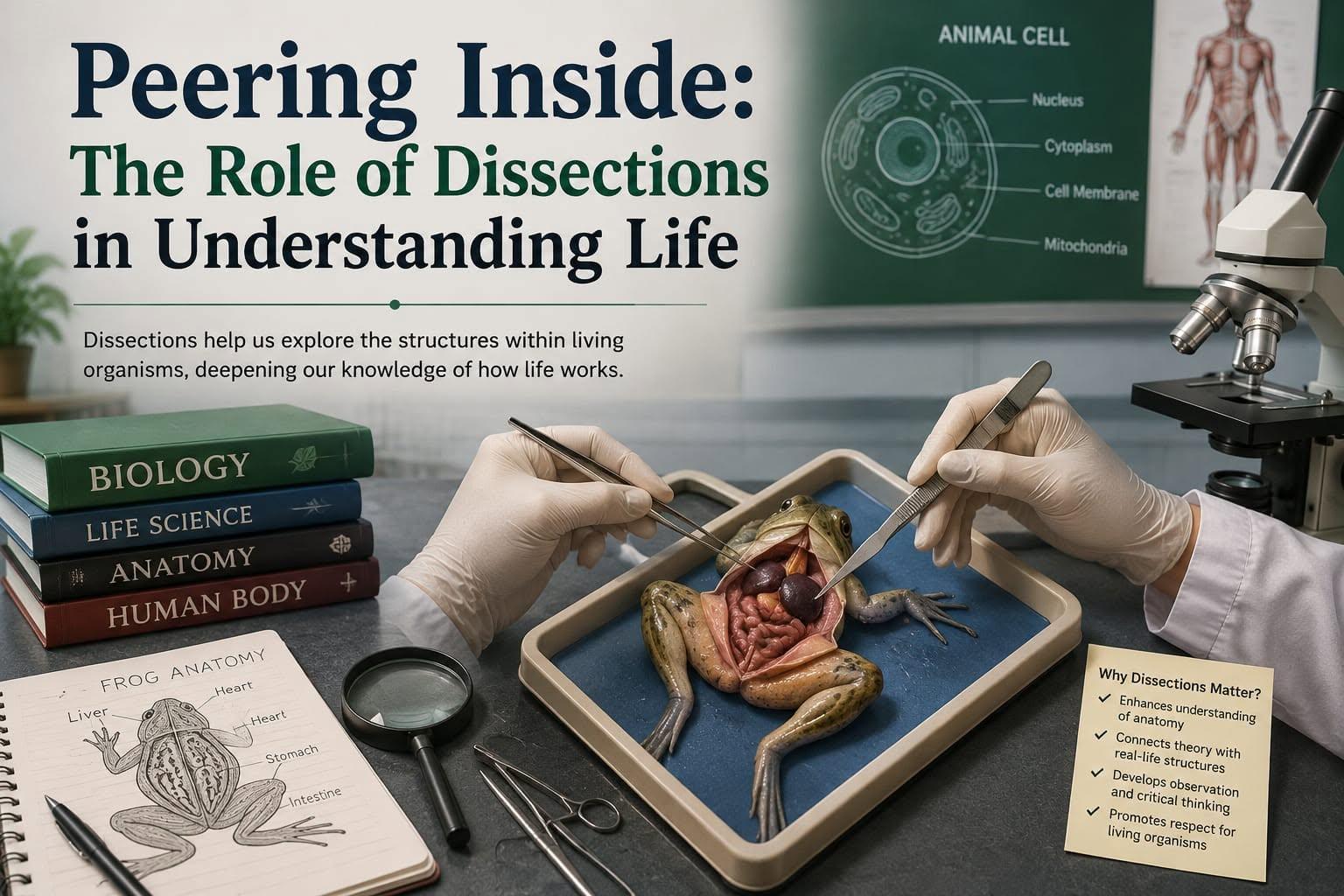
    **Peering Inside: The Role of Dissections in Understanding Life**

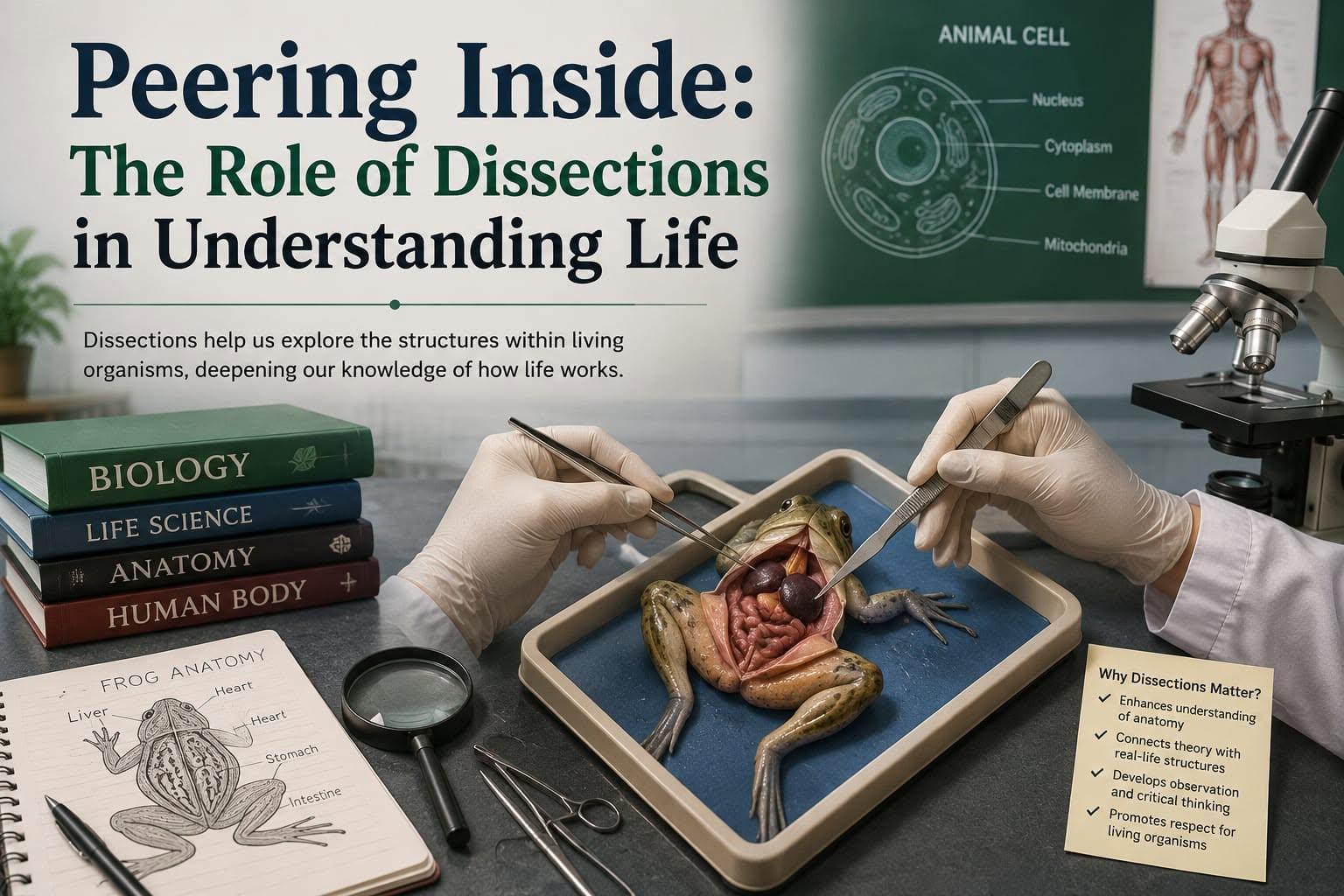
    Dissections have played an important role in helping students and scientists understand the incredible complexity of living organisms. By carefully examining biological structures, learners can move beyond diagrams and textbooks to develop a clearer understanding of how different organs, tissues, and body systems are connected.

    The study of anatomy through dissection can encourage curiosity, careful observation, scientific thinking, and respect for the complexity of life. It helps learners ask meaningful questions: How does an organ function? How are body systems connected? Why does each structure have a particular shape and position?

    From frogs and other organisms to modern anatomical models and digital simulations, the exploration of biological structures continues to support science education. Modern technology also provides alternatives such as 3D models, virtual dissections, and interactive simulations, making anatomy accessible in different ways.

    Most importantly, studying anatomy reminds us that life is a remarkable system of interconnected parts. Every structure has a role, and understanding those relationships helps us appreciate biology at a deeper level.

    Let’s explore, observe, question, and learn—because every discovery begins with curiosity!

    #Dissection #Biology #Anatomy #LifeScience #ScienceEducation #BiologyLearning #HumanAnatomy #AnimalAnatomy #ScientificDiscovery #ScienceExperiment #LearningBiology #STEMEducation #ScienceStudents #Curiosity #ExploreScience #AnatomyEducation #BiologicalSciences #ScienceJourney #LearnAndDiscover #UnderstandingLife
    #rsisb Roll no.247 Foundation level 🧬🔬 **Peering Inside: The Role of Dissections in Understanding Life** 🐸✨ Dissections have played an important role in helping students and scientists understand the incredible complexity of living organisms. By carefully examining biological structures, learners can move beyond diagrams and textbooks to develop a clearer understanding of how different organs, tissues, and body systems are connected. 🫀🫁🧠 The study of anatomy through dissection can encourage curiosity, careful observation, scientific thinking, and respect for the complexity of life. It helps learners ask meaningful questions: How does an organ function? How are body systems connected? Why does each structure have a particular shape and position? 🤔🔎 From frogs and other organisms to modern anatomical models and digital simulations, the exploration of biological structures continues to support science education. 🌱🐸💡 Modern technology also provides alternatives such as 3D models, virtual dissections, and interactive simulations, making anatomy accessible in different ways. Most importantly, studying anatomy reminds us that life is a remarkable system of interconnected parts. Every structure has a role, and understanding those relationships helps us appreciate biology at a deeper level. 🌍🧬❤️ Let’s explore, observe, question, and learn—because every discovery begins with curiosity! 🔬📚✨ #Dissection #Biology #Anatomy #LifeScience #ScienceEducation #BiologyLearning #HumanAnatomy #AnimalAnatomy #ScientificDiscovery #ScienceExperiment #LearningBiology #STEMEducation #ScienceStudents #Curiosity #ExploreScience #AnatomyEducation #BiologicalSciences #ScienceJourney #LearnAndDiscover #UnderstandingLife 🧬🔬🐸📚✨
    0 Комментарии 0 Поделились 7382 Просмотры
  • #rsisb
    Roll no.246
    Foundation level

    # Why Frogs? Understanding the Anatomy of Life

    Why study frogs? Because these fascinating amphibians provide an excellent way to explore the incredible organization and complexity of living organisms. From their powerful hind legs and unique skeletal structure to their remarkable organs, muscles, nervous system, and respiratory adaptations, frogs offer a wonderful window into the basic principles of anatomy and biology.

    In this educational exploration, **“Why Frogs? Understanding the Anatomy of Life,”** we discover how different body systems work together to keep an organism alive. We can learn how a frog moves, breathes, senses its environment, obtains nutrients, circulates blood, and responds to changes around it. Studying frog anatomy also helps us understand broader biological concepts that apply to many other animals, including humans.

    Frogs are especially interesting because they live both in water and on land, making them excellent examples of adaptation. Their life cycle—from egg to tadpole to adult frog—demonstrates how living organisms can undergo remarkable changes as they develop. Their anatomy reflects their lifestyle, showing how body structures are connected to survival and environmental challenges.

    Exploring anatomy encourages students to ask important scientific questions: How does each organ function? Why are certain body structures shaped the way they are? How do different systems cooperate? By investigating these questions, we develop observation skills, scientific curiosity, and a deeper appreciation for the complexity of life.

    Most importantly, studying frogs reminds us that biology is not simply about memorizing names of organs—it is about understanding **how life works as a connected system.** Every bone, muscle, organ, and tissue has a role, and together they create a living organism capable of movement, growth, reproduction, and interaction with its environment.

    Join us on this fascinating scientific journey and discover how the anatomy of a frog can open the door to understanding the amazing mechanisms of life!

    #WhyFrogs #FrogAnatomy #UnderstandingLife #Biology #ScienceEducation #Anatomy #Amphibians #FrogLifeCycle #AnimalBiology #HumanAnatomy #LifeScience #ScienceLearning #BiologyStudents #ScientificDiscovery #ExploreScience #Nature #Wildlife #Evolution #Adaptation #STEM #STEMEducation #ScienceIsAmazing #LearningIsFun #Curiosity #ExploreNature
    #rsisb Roll no.246 Foundation level # Why Frogs? Understanding the Anatomy of Life 🐸🔬 Why study frogs? 🐸 Because these fascinating amphibians provide an excellent way to explore the incredible organization and complexity of living organisms. From their powerful hind legs and unique skeletal structure to their remarkable organs, muscles, nervous system, and respiratory adaptations, frogs offer a wonderful window into the basic principles of anatomy and biology. 🌿🧬 In this educational exploration, **“Why Frogs? Understanding the Anatomy of Life,”** we discover how different body systems work together to keep an organism alive. 🫀🫁🧠 We can learn how a frog moves, breathes, senses its environment, obtains nutrients, circulates blood, and responds to changes around it. Studying frog anatomy also helps us understand broader biological concepts that apply to many other animals, including humans. 🌎✨ Frogs are especially interesting because they live both in water and on land, making them excellent examples of adaptation. 💧🌱 Their life cycle—from egg to tadpole to adult frog—demonstrates how living organisms can undergo remarkable changes as they develop. 🔄🐸 Their anatomy reflects their lifestyle, showing how body structures are connected to survival and environmental challenges. Exploring anatomy encourages students to ask important scientific questions: How does each organ function? Why are certain body structures shaped the way they are? How do different systems cooperate? 🤔🔬 By investigating these questions, we develop observation skills, scientific curiosity, and a deeper appreciation for the complexity of life. Most importantly, studying frogs reminds us that biology is not simply about memorizing names of organs—it is about understanding **how life works as a connected system.** ❤️🧬 Every bone, muscle, organ, and tissue has a role, and together they create a living organism capable of movement, growth, reproduction, and interaction with its environment. 🐸🌿 Join us on this fascinating scientific journey and discover how the anatomy of a frog can open the door to understanding the amazing mechanisms of life! #WhyFrogs #FrogAnatomy #UnderstandingLife #Biology #ScienceEducation #Anatomy #Amphibians #FrogLifeCycle #AnimalBiology #HumanAnatomy #LifeScience #ScienceLearning #BiologyStudents #ScientificDiscovery #ExploreScience #Nature #Wildlife #Evolution #Adaptation #STEM #STEMEducation #ScienceIsAmazing #LearningIsFun #Curiosity #ExploreNature 🐸🔬🌿🧬🫀🧠🌎✨
    0 Комментарии 0 Поделились 6363 Просмотры
  • #rsisb
    Roll no.239
    Story Post no.3
    Foundation Level
    **Why Frogs? Understanding the Anatomy of Life**

    Frogs are much more than fascinating creatures found near ponds and wetlands. They provide scientists and students with a simple yet powerful way to understand the **anatomy, biology, and complexity of life**.

    From their powerful hind legs to their unique respiratory system , sensitive eyes , strong hearts , and specialized skin, frogs have body structures that demonstrate how different organs work together to keep an organism alive.

    Studying frog anatomy can help us understand important biological concepts such as **organs, muscles, bones, digestion, circulation, respiration, and nervous systems**. It also gives us a deeper appreciation for how living organisms adapt to their environments.

    Frogs are often studied in biology because their anatomy provides an accessible example of the basic principles shared by many vertebrates. By exploring their bodies, we can discover how structure and function are connected—and how every part of a living organism has an important role.

    **Explore the frog. Discover anatomy. Understand life.**

    #WhyFrogs #FrogAnatomy #UnderstandingLife #Anatomy #Biology #Science #LifeScience #BiologyEducation #ScienceEducation #Frogs #Amphibians #AnimalAnatomy #HumanBiology #Vertebrates #Organs #Muscles #Bones #Heart #RespiratorySystem #DigestiveSystem #NervousSystem #BiologicalScience #Nature #Wildlife #Ecology #Learning #Education #STEM #ScienceForStudents #BiologyStudents #StudyScience #ScienceIsAmazing #ExploreScience #DiscoverBiology #Knowledge #LearningJourney #EducationalContent #ScienceLovers #NatureLovers
    #rsisb Roll no.239 Story Post no.3 Foundation Level 🐸🔬 **Why Frogs? Understanding the Anatomy of Life** 🌿🧬 Frogs are much more than fascinating creatures found near ponds and wetlands. 🐸🌊 They provide scientists and students with a simple yet powerful way to understand the **anatomy, biology, and complexity of life**. 🔬📚 From their powerful hind legs 🦵 to their unique respiratory system 🫁, sensitive eyes 👀, strong hearts ❤️, and specialized skin, frogs have body structures that demonstrate how different organs work together to keep an organism alive. 🌱✨ Studying frog anatomy can help us understand important biological concepts such as **organs, muscles, bones, digestion, circulation, respiration, and nervous systems**. 🧠🦴❤️ It also gives us a deeper appreciation for how living organisms adapt to their environments. 🌍🌿 Frogs are often studied in biology because their anatomy provides an accessible example of the basic principles shared by many vertebrates. 🧪🔍 By exploring their bodies, we can discover how structure and function are connected—and how every part of a living organism has an important role. 🐸 **Explore the frog. Discover anatomy. Understand life.** 🔬🌍✨ #WhyFrogs #FrogAnatomy #UnderstandingLife #Anatomy #Biology #Science #LifeScience #BiologyEducation #ScienceEducation #Frogs #Amphibians #AnimalAnatomy #HumanBiology #Vertebrates #Organs #Muscles #Bones #Heart #RespiratorySystem #DigestiveSystem #NervousSystem #BiologicalScience #Nature #Wildlife #Ecology #Learning #Education #STEM #ScienceForStudents #BiologyStudents #StudyScience #ScienceIsAmazing #ExploreScience #DiscoverBiology #Knowledge #LearningJourney #EducationalContent #ScienceLovers #NatureLovers 🐸🔬🧬🌿📚✨
    0 Комментарии 0 Поделились 10564 Просмотры
  • #rsisb
    Roll No.240
    Story No.22
    Foundation Level

    ### **Peering Inside: The Role of Dissections in Understanding Life – Description**

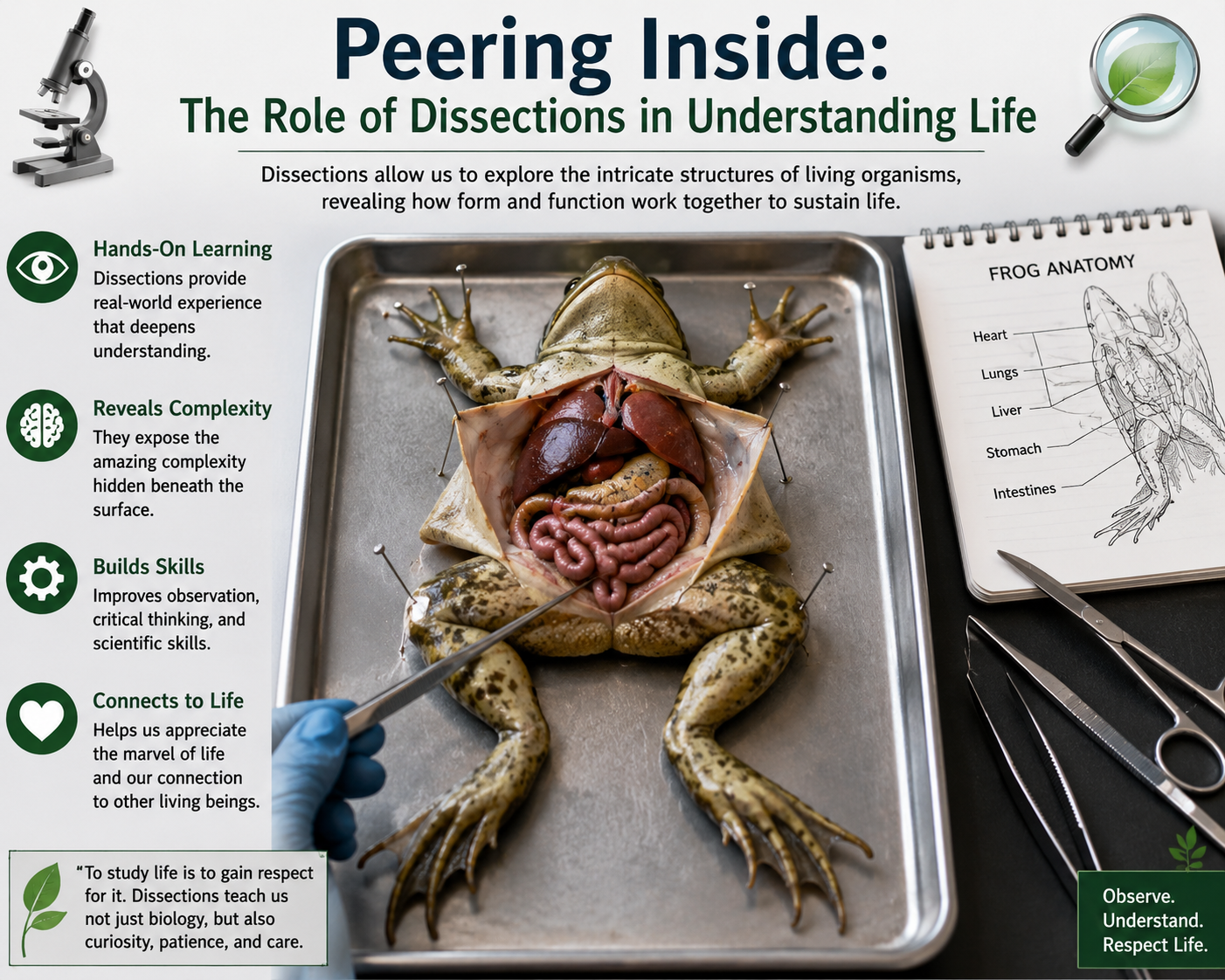
    **Peering Inside: The Role of Dissections in Understanding Life** explores how dissections help scientists, doctors, and students uncover the hidden structures of living organisms. By carefully studying internal anatomy, researchers gain a deeper understanding of how organs, tissues, and body systems work together.

    Through dissection, we can discover the complexity of life, improve medical knowledge, and develop better treatments for diseases. It connects observation with scientific discovery and allows learners to explore the amazing design and organization of living things.

    This journey highlights the importance of anatomy, research, and ethical scientific practices in understanding the mysteries of life.

    Discover how looking inside helps us understand the incredible story of life from within.

    #Dissection #Anatomy #Biology #ScienceEducation #UnderstandingLife #HumanBody #MedicalScience #BiologyLearning #ScientificDiscovery

    Rehan School Islamabad Campus
    Asma Shaheen EducationWali
    Irum Asim
    Saima Happinesswali
    #rsisb Roll No.240 Story No.22 Foundation Level ### 🔬 **Peering Inside: The Role of Dissections in Understanding Life – Description** ✨ 🧬 **Peering Inside: The Role of Dissections in Understanding Life** explores how dissections help scientists, doctors, and students uncover the hidden structures of living organisms. By carefully studying internal anatomy, researchers gain a deeper understanding of how organs, tissues, and body systems work together. 🔍 Through dissection, we can discover the complexity of life, improve medical knowledge, and develop better treatments for diseases. It connects observation with scientific discovery and allows learners to explore the amazing design and organization of living things. 🧪 This journey highlights the importance of anatomy, research, and ethical scientific practices in understanding the mysteries of life. 🌱 Discover how looking inside helps us understand the incredible story of life from within. #Dissection #Anatomy #Biology #ScienceEducation #UnderstandingLife #HumanBody #MedicalScience #BiologyLearning #ScientificDiscovery 🔬🧬✨ Rehan School Islamabad Campus Asma Shaheen EducationWali Irum Asim Saima Happinesswali
    0 Комментарии 0 Поделились 4527 Просмотры
  • #rsisb
    Roll No.240
    Story No.22
    Foundation Level

    ### **Peering Inside: The Role of Dissections in Understanding Life – Description**

    **Peering Inside: The Role of Dissections in Understanding Life** explores how dissections help scientists, doctors, and students uncover the hidden structures of living organisms. By carefully studying internal anatomy, researchers gain a deeper understanding of how organs, tissues, and body systems work together.

    Through dissection, we can discover the complexity of life, improve medical knowledge, and develop better treatments for diseases. It connects observation with scientific discovery and allows learners to explore the amazing design and organization of living things.

    This journey highlights the importance of anatomy, research, and ethical scientific practices in understanding the mysteries of life.

    Discover how looking inside helps us understand the incredible story of life from within.

    #Dissection #Anatomy #Biology #ScienceEducation #UnderstandingLife #HumanBody #MedicalScience #BiologyLearning #ScientificDiscovery

    Rehan School Islamabad Campus
    Asma Shaheen EducationWali
    Irum Asim
    Saima Happinesswali
    #rsisb Roll No.240 Story No.22 Foundation Level ### 🔬 **Peering Inside: The Role of Dissections in Understanding Life – Description** ✨ 🧬 **Peering Inside: The Role of Dissections in Understanding Life** explores how dissections help scientists, doctors, and students uncover the hidden structures of living organisms. By carefully studying internal anatomy, researchers gain a deeper understanding of how organs, tissues, and body systems work together. 🔍 Through dissection, we can discover the complexity of life, improve medical knowledge, and develop better treatments for diseases. It connects observation with scientific discovery and allows learners to explore the amazing design and organization of living things. 🧪 This journey highlights the importance of anatomy, research, and ethical scientific practices in understanding the mysteries of life. 🌱 Discover how looking inside helps us understand the incredible story of life from within. #Dissection #Anatomy #Biology #ScienceEducation #UnderstandingLife #HumanBody #MedicalScience #BiologyLearning #ScientificDiscovery 🔬🧬✨ Rehan School Islamabad Campus Asma Shaheen EducationWali Irum Asim Saima Happinesswali
    0 Комментарии 0 Поделились 4113 Просмотры