• In Pakistan, there are numerous species of non-venomous snakes that are harmless to humans. These snakes play a crucial role in the ecosystem, primarily by controlling pest populations. Below is a list of some of the non-poisonous (non-venomous) snakes found in Pakistan:

    ### Non-Poisonous Snakes in Pakistan:

    1. **Indian Rock Python (Python molurus)**
    - One of the largest snake species, these pythons are non-venomous and kill their prey by constriction.

    2. **Red Sand Boa (Eryx johnii)**
    - A burrowing snake commonly found in sandy areas. It is harmless and often mistaken for a venomous species due to its robust appearance.

    3. **Common Wolf Snake (Lycodon aulicus)**
    - A small, nocturnal snake that feeds mainly on lizards. It is commonly found in urban areas.

    4. **Rat Snake (Ptyas mucosa)**
    - Also known as the Indian rat snake, it is a large, fast-moving snake that preys on rodents and is often found near human habitations.

    5. **Checkered Keelback (Xenochrophis piscator)**
    - A semi-aquatic snake often found near water bodies. It primarily feeds on fish and amphibians.

    6. **Oriental Garden Snake (Ptyas mucosa)**
    - A common snake found in gardens and agricultural areas, feeding on frogs and small rodents.

    7. **Bronzeback Tree Snake (Dendrelaphis tristis)**
    - A slender, arboreal snake that is commonly found in trees and bushes, feeding on small vertebrates.

    8. **Common Trinket Snake (Coelognathus helena)**
    - Known for its striking pattern, this snake is non-venomous and feeds on rodents and birds.

    9. **Dhaman (Ptyas mucosa)**
    - Also known as the Oriental ratsnake, it is non-venomous and found in a variety of habitats, including urban areas.

    10. **Common Vine Snake (Ahaetulla nasuta)**
    - A slender, green snake that lives in trees and shrubs, feeding on lizards and frogs. It has a mildly toxic venom, but it is not harmful to humans.

    ### Summary:
    Pakistan is home to approximately 72 snake species, of which about **14-18** are venomous. The remaining **54-58** species are non-venomous and pose no significant threat to humans. The percentage of venomous snakes in Pakistan is roughly **19.4% to 25%**, meaning that the majority, **75% to 80.6%**, of snake species in Pakistan are non-venomous.

    Non-venomous snakes, such as the Indian Rock Python, Red Sand Boa, and Common Wolf Snake, play an essential role in the ecosystem by controlling rodent and pest populations, and they should be protected rather than feared.
    In Pakistan, there are numerous species of non-venomous snakes that are harmless to humans. These snakes play a crucial role in the ecosystem, primarily by controlling pest populations. Below is a list of some of the non-poisonous (non-venomous) snakes found in Pakistan: ### Non-Poisonous Snakes in Pakistan: 1. **Indian Rock Python (Python molurus)** - One of the largest snake species, these pythons are non-venomous and kill their prey by constriction. 2. **Red Sand Boa (Eryx johnii)** - A burrowing snake commonly found in sandy areas. It is harmless and often mistaken for a venomous species due to its robust appearance. 3. **Common Wolf Snake (Lycodon aulicus)** - A small, nocturnal snake that feeds mainly on lizards. It is commonly found in urban areas. 4. **Rat Snake (Ptyas mucosa)** - Also known as the Indian rat snake, it is a large, fast-moving snake that preys on rodents and is often found near human habitations. 5. **Checkered Keelback (Xenochrophis piscator)** - A semi-aquatic snake often found near water bodies. It primarily feeds on fish and amphibians. 6. **Oriental Garden Snake (Ptyas mucosa)** - A common snake found in gardens and agricultural areas, feeding on frogs and small rodents. 7. **Bronzeback Tree Snake (Dendrelaphis tristis)** - A slender, arboreal snake that is commonly found in trees and bushes, feeding on small vertebrates. 8. **Common Trinket Snake (Coelognathus helena)** - Known for its striking pattern, this snake is non-venomous and feeds on rodents and birds. 9. **Dhaman (Ptyas mucosa)** - Also known as the Oriental ratsnake, it is non-venomous and found in a variety of habitats, including urban areas. 10. **Common Vine Snake (Ahaetulla nasuta)** - A slender, green snake that lives in trees and shrubs, feeding on lizards and frogs. It has a mildly toxic venom, but it is not harmful to humans. ### Summary: Pakistan is home to approximately 72 snake species, of which about **14-18** are venomous. The remaining **54-58** species are non-venomous and pose no significant threat to humans. The percentage of venomous snakes in Pakistan is roughly **19.4% to 25%**, meaning that the majority, **75% to 80.6%**, of snake species in Pakistan are non-venomous. Non-venomous snakes, such as the Indian Rock Python, Red Sand Boa, and Common Wolf Snake, play an essential role in the ecosystem by controlling rodent and pest populations, and they should be protected rather than feared.
    0 Commentaires 0 Parts 453 Vue
  • Breathing with Skin

    Cutaneous Respiration in Frogs

    Introduction

    Frogs are remarkable amphibians that can live both in water and on land. To survive in these two environments, they have developed more than one way to breathe. They can use their lungs, mouth lining, and skin for respiration. Among these, cutaneous respiration, or skin breathing, is one of the most fascinating and vital processes that allow frogs to survive even when their lungs are inactive.


    Meaning of Cutaneous Respiration

    The word cutaneous comes from the Latin cutis, meaning skin. Thus, cutaneous respiration means the exchange of respiratory gases (oxygen and carbon dioxide) through the skin. This process allows frogs to take in oxygen directly from the surrounding environment and release carbon dioxide without using their lungs.


    Structure of Frog’s Skin

    The frog’s skin is perfectly designed for this type of respiration. It has three key features:
    1. Thin and permeable: The skin is very thin, which allows gases to diffuse easily.
    2. Moist surface: Mucus glands keep the skin moist at all times. Moisture helps dissolve oxygen, making it easier to pass through the skin.
    3. Rich blood supply: Beneath the skin lies a dense network of blood capillaries that carry oxygen to all parts of the body and remove carbon dioxide.

    If the frog’s skin becomes dry, this process stops. That is why frogs always stay close to moist areas such as ponds, lakes, or under wet leaves.


    The Process of Cutaneous Breathing

    The process of cutaneous respiration depends on diffusion, a natural movement of gases from higher concentration to lower concentration areas.
    1. Oxygen Intake:
    • In the surrounding air or water, oxygen is present in higher concentration than in the frog’s blood.
    • Oxygen dissolves in the moisture on the frog’s skin and diffuses through it into the tiny blood capillaries.
    • From there, it is carried by blood to all the cells of the body.
    2. Carbon Dioxide Release:
    • Inside the body, cells constantly produce carbon dioxide during energy release (cellular respiration).
    • The concentration of carbon dioxide in the blood becomes higher than in the environment.
    • This gas then diffuses out through the skin and escapes into the air or water.

    This exchange of gases continues silently and efficiently as long as the frog’s skin remains moist.


    When Frogs Use Cutaneous Respiration

    Frogs use different respiratory systems at different times:
    • On land (active): They mainly use lungs.
    • Underwater (resting or hibernating): They rely almost entirely on skin respiration.
    For example, during winter hibernation, frogs stay buried under mud or water, where they cannot use their lungs. Cutaneous breathing keeps them alive by providing oxygen and removing waste gases slowly and continuously.


    Relation to Energy Production

    Cutaneous respiration does not produce energy by itself. Instead, it provides oxygen, which is essential for cellular respiration — the process by which cells release energy from food.

    The basic equation for cellular respiration is:
    \text{Glucose (from food)} + \text{Oxygen (from breathing)} \rightarrow \text{Carbon dioxide} + \text{Water} + \text{Energy (ATP)}
    Thus, the oxygen absorbed through the skin helps the frog’s cells “burn” the food molecules (like glucose) and release energy needed for survival, movement, and growth.


    Importance of Cutaneous Respiration
    1. Survival under water: Enables frogs to live underwater for long periods.
    2. Backup system: Works when lungs cannot, such as during hibernation.
    3. Adaptation for dual life: Helps frogs thrive both in aquatic and terrestrial environments.


    Conclusion

    Cutaneous respiration in frogs is a wonderful example of biological adaptation. By developing the ability to breathe through their skin, frogs have mastered life both on land and in water. Although this method does not directly produce energy, it supplies the oxygen necessary for the internal energy-producing process — cellular respiration. Without it, frogs could not survive long underwater or during hibernation. Nature’s design of moist, thin, and richly vascular skin makes this process possible and highlights the delicate harmony between structure and function in living organisms.
    Breathing with Skin Cutaneous Respiration in Frogs Introduction Frogs are remarkable amphibians that can live both in water and on land. To survive in these two environments, they have developed more than one way to breathe. They can use their lungs, mouth lining, and skin for respiration. Among these, cutaneous respiration, or skin breathing, is one of the most fascinating and vital processes that allow frogs to survive even when their lungs are inactive. ⸻ Meaning of Cutaneous Respiration The word cutaneous comes from the Latin cutis, meaning skin. Thus, cutaneous respiration means the exchange of respiratory gases (oxygen and carbon dioxide) through the skin. This process allows frogs to take in oxygen directly from the surrounding environment and release carbon dioxide without using their lungs. ⸻ Structure of Frog’s Skin The frog’s skin is perfectly designed for this type of respiration. It has three key features: 1. Thin and permeable: The skin is very thin, which allows gases to diffuse easily. 2. Moist surface: Mucus glands keep the skin moist at all times. Moisture helps dissolve oxygen, making it easier to pass through the skin. 3. Rich blood supply: Beneath the skin lies a dense network of blood capillaries that carry oxygen to all parts of the body and remove carbon dioxide. If the frog’s skin becomes dry, this process stops. That is why frogs always stay close to moist areas such as ponds, lakes, or under wet leaves. ⸻ The Process of Cutaneous Breathing The process of cutaneous respiration depends on diffusion, a natural movement of gases from higher concentration to lower concentration areas. 1. Oxygen Intake: • In the surrounding air or water, oxygen is present in higher concentration than in the frog’s blood. • Oxygen dissolves in the moisture on the frog’s skin and diffuses through it into the tiny blood capillaries. • From there, it is carried by blood to all the cells of the body. 2. Carbon Dioxide Release: • Inside the body, cells constantly produce carbon dioxide during energy release (cellular respiration). • The concentration of carbon dioxide in the blood becomes higher than in the environment. • This gas then diffuses out through the skin and escapes into the air or water. This exchange of gases continues silently and efficiently as long as the frog’s skin remains moist. ⸻ When Frogs Use Cutaneous Respiration Frogs use different respiratory systems at different times: • On land (active): They mainly use lungs. • Underwater (resting or hibernating): They rely almost entirely on skin respiration. For example, during winter hibernation, frogs stay buried under mud or water, where they cannot use their lungs. Cutaneous breathing keeps them alive by providing oxygen and removing waste gases slowly and continuously. ⸻ Relation to Energy Production Cutaneous respiration does not produce energy by itself. Instead, it provides oxygen, which is essential for cellular respiration — the process by which cells release energy from food. The basic equation for cellular respiration is: \text{Glucose (from food)} + \text{Oxygen (from breathing)} \rightarrow \text{Carbon dioxide} + \text{Water} + \text{Energy (ATP)} Thus, the oxygen absorbed through the skin helps the frog’s cells “burn” the food molecules (like glucose) and release energy needed for survival, movement, and growth. ⸻ Importance of Cutaneous Respiration 1. Survival under water: Enables frogs to live underwater for long periods. 2. Backup system: Works when lungs cannot, such as during hibernation. 3. Adaptation for dual life: Helps frogs thrive both in aquatic and terrestrial environments. ⸻ Conclusion Cutaneous respiration in frogs is a wonderful example of biological adaptation. By developing the ability to breathe through their skin, frogs have mastered life both on land and in water. Although this method does not directly produce energy, it supplies the oxygen necessary for the internal energy-producing process — cellular respiration. Without it, frogs could not survive long underwater or during hibernation. Nature’s design of moist, thin, and richly vascular skin makes this process possible and highlights the delicate harmony between structure and function in living organisms.
    0 Commentaires 0 Parts 598 Vue
  • Why Frogs? Understanding the Anatomy of Life
    #ACCL Day 125
    In classrooms and laboratories, countless students begin their journey into biology with a single question — "Why frogs?"
    Frogs are more than just amphibians; theyre living bridges between water and land, evolution and adaptation, simplicity and complexity.
    Inside a frogs tiny body lies the blueprint of life itself — beating hearts, flowing blood, expanding lungs — a reflection of how all living creatures share a common thread of design and function.
    By studying frogs, we dont just explore anatomy — we uncover the rhythm of life, the story of survival, and the miracle of biological balance.
    Every organ, every muscle, every leap reminds us that understanding one small creature helps us understand the entire web of existence.
    #WhyFrogs #AnatomyOfLife #ACCLDay125 #ScienceOfLife #natureandknowledge
    🐸🔬 Why Frogs? Understanding the Anatomy of Life #ACCL Day 125 In classrooms and laboratories, countless students begin their journey into biology with a single question — "Why frogs?" Frogs are more than just amphibians; they're living bridges between water and land, evolution and adaptation, simplicity and complexity. 🌿💧 Inside a frog's tiny body lies the blueprint of life itself — beating hearts, flowing blood, expanding lungs — a reflection of how all living creatures share a common thread of design and function. By studying frogs, we don't just explore anatomy — we uncover the rhythm of life, the story of survival, and the miracle of biological balance. 🌎✨ Every organ, every muscle, every leap reminds us that understanding one small creature helps us understand the entire web of existence. #WhyFrogs #AnatomyOfLife #ACCLDay125 #ScienceOfLife #natureandknowledge
    0 Commentaires 0 Parts 1507 Vue
  • #rsib
    Roll No.190
    Story Post No.37
    Foundation Level

    :

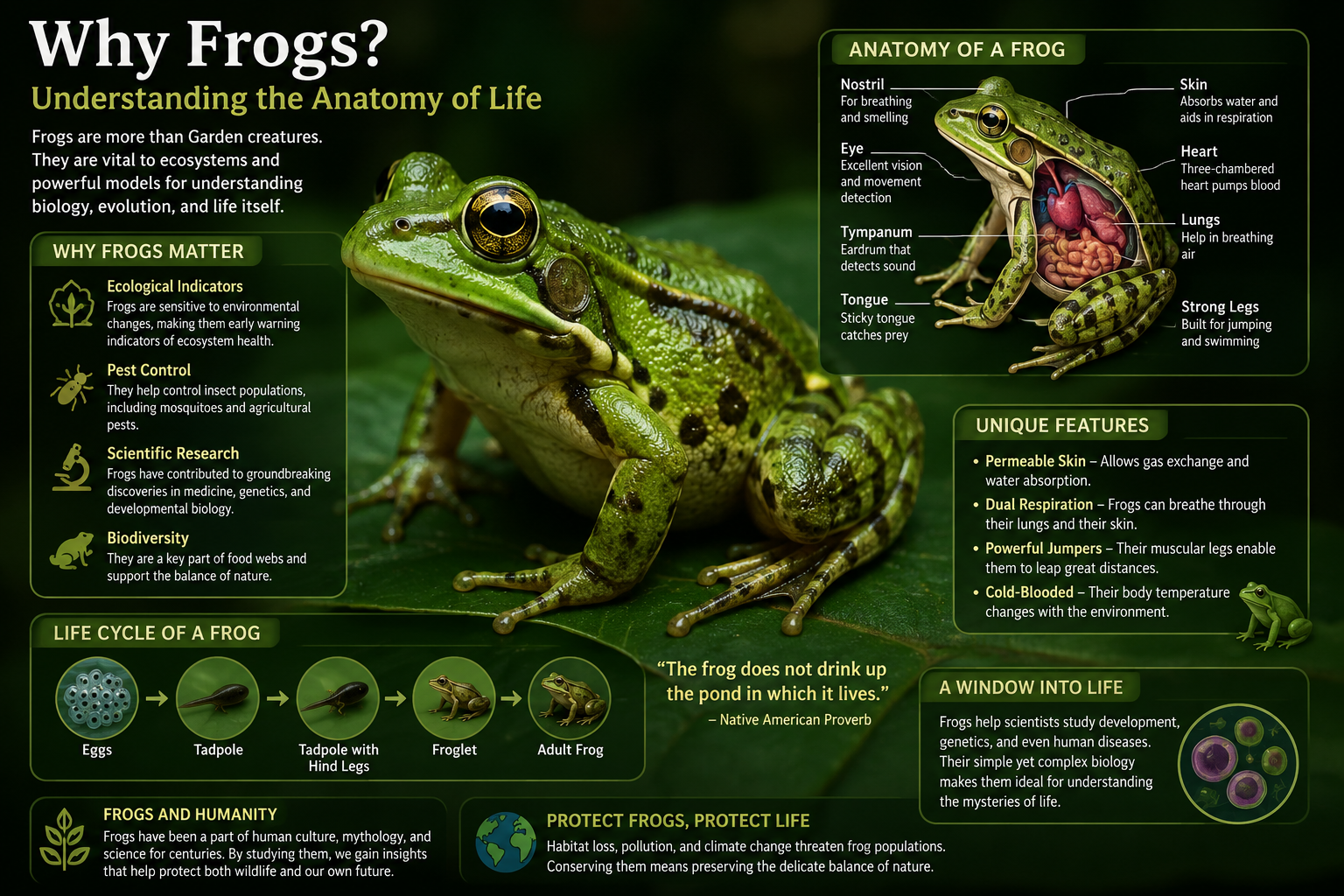
    Why Frogs? Understanding the Anatomy of Life

    Frogs are some of the most fascinating creatures on Earth. They are much more than simple amphibians hopping around ponds and forests. Frogs help scientists understand how living organisms grow, adapt, and survive. Their unique anatomy, incredible life cycle, and important role in ecosystems make them valuable subjects for biological research.

    From tiny eggs to swimming tadpoles and finally adult frogs, their transformation showcases one of nature's most amazing processes. Their sensitive skin, powerful legs, and specialized organs help them thrive both in water and on land. Because frogs react quickly to environmental changes, they are also important indicators of ecosystem health.

    Studying frogs helps researchers learn about genetics, development, medicine, evolution, and environmental conservation. By understanding frogs, we gain deeper insights into life itself and the delicate balance of nature that supports all living things.

    Let's appreciate these incredible amphibians and work together to protect their habitats for future generations.

    #WhyFrogs #FrogAnatomy #Biology #ScienceEducation #LifeScience #Amphibians #Nature #Wildlife #EnvironmentalScience #Ecosystem #FrogLifeCycle #ScientificResearch #STEM #Learning #Education #NatureLovers #AnimalScience #Conservation #Biodiversity #DiscoverScience #EarthScience #AmazingNature #StudyOfLife #Knowledge #ExploreNature
    #rsib Roll No.190 Story Post No.37 Foundation Level : 🐸🔬🌿 Why Frogs? Understanding the Anatomy of Life 🌿🔬🐸 Frogs are some of the most fascinating creatures on Earth. They are much more than simple amphibians hopping around ponds and forests. Frogs help scientists understand how living organisms grow, adapt, and survive. Their unique anatomy, incredible life cycle, and important role in ecosystems make them valuable subjects for biological research. From tiny eggs to swimming tadpoles and finally adult frogs, their transformation showcases one of nature's most amazing processes. Their sensitive skin, powerful legs, and specialized organs help them thrive both in water and on land. Because frogs react quickly to environmental changes, they are also important indicators of ecosystem health. 🌎💧 Studying frogs helps researchers learn about genetics, development, medicine, evolution, and environmental conservation. By understanding frogs, we gain deeper insights into life itself and the delicate balance of nature that supports all living things. 🌱✨ Let's appreciate these incredible amphibians and work together to protect their habitats for future generations. 🐸💚🌍 #WhyFrogs #FrogAnatomy #Biology #ScienceEducation #LifeScience #Amphibians #Nature #Wildlife #EnvironmentalScience #Ecosystem #FrogLifeCycle #ScientificResearch #STEM #Learning #Education #NatureLovers #AnimalScience #Conservation #Biodiversity #DiscoverScience #EarthScience #AmazingNature #StudyOfLife #Knowledge #ExploreNature 🐸🔬🌿💚🌎✨📚🧬🌱
    0 Commentaires 0 Parts 11144 Vue