• #rsisb
    Roll No.240
    Story No.18
    Foundation Level

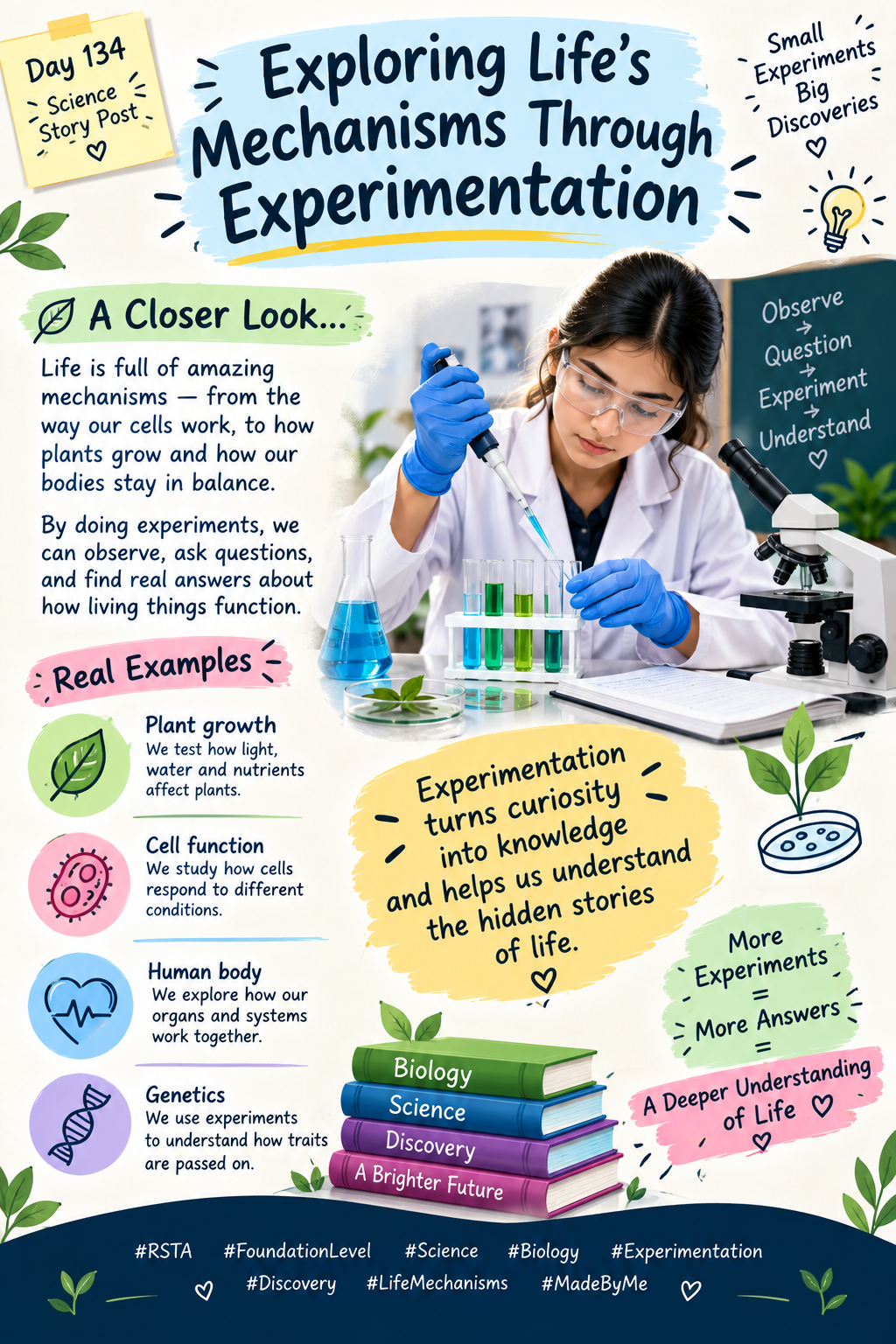
    ### **Exploring Life’s Mechanisms Through Experimentation**

    Scientific experimentation is one of the most powerful ways to understand the complex processes that sustain life. From the smallest microscopic cells to entire ecosystems, experiments allow scientists to observe, test, and explain how living organisms grow, reproduce, respond to their environment, and maintain balance. Through careful observation, data collection, and analysis, researchers uncover the biological mechanisms that drive life and contribute to advances in medicine, agriculture, biotechnology, and environmental conservation.

    Biological experiments help students and scientists explore essential topics such as genetics, cell biology, microbiology, physiology, ecology, and evolution. By forming hypotheses, conducting controlled experiments, and interpreting results, learners develop critical thinking, problem-solving, and analytical skills. Laboratory investigations also demonstrate the importance of accuracy, ethical responsibility, and evidence-based conclusions in scientific research.

    Modern technology has transformed biological experimentation through advanced microscopes, DNA sequencing, computer simulations, molecular biology techniques, and artificial intelligence. These innovations enable researchers to study diseases, develop life-saving medicines, improve crop production, protect endangered species, and better understand the incredible complexity of living organisms. Every experiment, whether simple or advanced, contributes valuable knowledge that helps improve human health and our understanding of the natural world.

    Exploring life's mechanisms through experimentation inspires curiosity, encourages innovation, and highlights the importance of scientific discovery. By combining observation, creativity, and rigorous testing, scientists continue to unlock the mysteries of life and create solutions to global challenges, paving the way for a healthier, more sustainable future.

    **#Biology #LifeScience #ScientificExperiment #Laboratory #STEM #ScienceEducation #Research #Biotechnology #CellBiology #Genetics #Microbiology #Innovation #ScientificDiscovery #Education #ExploreScience **

    Rehan School Islamabad Campus
    Asma Shaheen EducationWali
    Irum Asim
    Saima Happinesswali
    #rsisb Roll No.240 Story No.18 Foundation Level ### **Exploring Life’s Mechanisms Through Experimentation** Scientific experimentation is one of the most powerful ways to understand the complex processes that sustain life. From the smallest microscopic cells to entire ecosystems, experiments allow scientists to observe, test, and explain how living organisms grow, reproduce, respond to their environment, and maintain balance. Through careful observation, data collection, and analysis, researchers uncover the biological mechanisms that drive life and contribute to advances in medicine, agriculture, biotechnology, and environmental conservation. Biological experiments help students and scientists explore essential topics such as genetics, cell biology, microbiology, physiology, ecology, and evolution. By forming hypotheses, conducting controlled experiments, and interpreting results, learners develop critical thinking, problem-solving, and analytical skills. Laboratory investigations also demonstrate the importance of accuracy, ethical responsibility, and evidence-based conclusions in scientific research. Modern technology has transformed biological experimentation through advanced microscopes, DNA sequencing, computer simulations, molecular biology techniques, and artificial intelligence. These innovations enable researchers to study diseases, develop life-saving medicines, improve crop production, protect endangered species, and better understand the incredible complexity of living organisms. Every experiment, whether simple or advanced, contributes valuable knowledge that helps improve human health and our understanding of the natural world. Exploring life's mechanisms through experimentation inspires curiosity, encourages innovation, and highlights the importance of scientific discovery. By combining observation, creativity, and rigorous testing, scientists continue to unlock the mysteries of life and create solutions to global challenges, paving the way for a healthier, more sustainable future. **#Biology #LifeScience #ScientificExperiment #Laboratory #STEM #ScienceEducation #Research #Biotechnology #CellBiology #Genetics #Microbiology #Innovation #ScientificDiscovery #Education #ExploreScience 🔬🧬🧫🌱📚** Rehan School Islamabad Campus Asma Shaheen EducationWali Irum Asim Saima Happinesswali
    0 Σχόλια 0 Μοιράστηκε 490 Views
  • #rsisb
    Roll No.240
    Story No.20
    Foundation Level

    # The Evolution Paradox: Bridging Theories of Life with Divine Design

    The relationship between **evolution** and **divine design** has long been one of humanity's most fascinating and thought-provoking discussions. While evolutionary biology explains how living organisms have changed and diversified over billions of years through natural processes such as mutation, natural selection, and genetic variation, many religious traditions view life as the result of a purposeful and intelligent Creator. Rather than seeing these perspectives as necessarily incompatible, many scholars, scientists, and people of faith explore ways they can coexist.

    Evolution provides a scientific framework for understanding the development of life based on observable evidence from fossils, genetics, comparative anatomy, and ecology. It seeks to explain *how* biological diversity emerged and continues to change over time. Divine design, on the other hand, addresses questions of *purpose*, *meaning*, and *ultimate origin*—questions that science alone is not designed to answer.

    The "evolution paradox" arises because these perspectives often focus on different kinds of questions. Science investigates natural mechanisms through observation, experimentation, and evidence, while faith explores spiritual beliefs, morality, and humanity's relationship with the Creator. Many individuals embrace both scientific discoveries and religious faith, believing that natural laws themselves may reflect an intentional design behind the universe.

    Modern genetics has revealed remarkable complexity within DNA, strengthening our understanding of evolution while also inspiring philosophical and theological reflection about the origin of life and the fine-tuned nature of the universe. These discoveries encourage respectful dialogue between science and religion rather than unnecessary conflict.

    Ultimately, exploring the relationship between evolution and divine design reminds us that curiosity, critical thinking, and respectful discussion are essential in the pursuit of knowledge. Whether one approaches life's origins through scientific inquiry, religious belief, or a combination of both, the search for truth continues to inspire wonder, humility, and a deeper appreciation for the complexity and beauty of existence.

    **#Evolution #DivineDesign #Science #Faith #Biology #Genetics #OriginOfLife #CriticalThinking #Education #Philosophy #Theology #ScientificDiscovery #Knowledge #Learning #Wonder**

    Rehan School Islamabad Campus
    Asma Shaheen EducationWali
    Irum Asim
    Saima Happinesswali
    #rsisb Roll No.240 Story No.20 Foundation Level # 🌍🧬 The Evolution Paradox: Bridging Theories of Life with Divine Design The relationship between **evolution** and **divine design** has long been one of humanity's most fascinating and thought-provoking discussions. While evolutionary biology explains how living organisms have changed and diversified over billions of years through natural processes such as mutation, natural selection, and genetic variation, many religious traditions view life as the result of a purposeful and intelligent Creator. Rather than seeing these perspectives as necessarily incompatible, many scholars, scientists, and people of faith explore ways they can coexist. Evolution provides a scientific framework for understanding the development of life based on observable evidence from fossils, genetics, comparative anatomy, and ecology. It seeks to explain *how* biological diversity emerged and continues to change over time. Divine design, on the other hand, addresses questions of *purpose*, *meaning*, and *ultimate origin*—questions that science alone is not designed to answer. The "evolution paradox" arises because these perspectives often focus on different kinds of questions. Science investigates natural mechanisms through observation, experimentation, and evidence, while faith explores spiritual beliefs, morality, and humanity's relationship with the Creator. Many individuals embrace both scientific discoveries and religious faith, believing that natural laws themselves may reflect an intentional design behind the universe. Modern genetics has revealed remarkable complexity within DNA, strengthening our understanding of evolution while also inspiring philosophical and theological reflection about the origin of life and the fine-tuned nature of the universe. These discoveries encourage respectful dialogue between science and religion rather than unnecessary conflict. Ultimately, exploring the relationship between evolution and divine design reminds us that curiosity, critical thinking, and respectful discussion are essential in the pursuit of knowledge. Whether one approaches life's origins through scientific inquiry, religious belief, or a combination of both, the search for truth continues to inspire wonder, humility, and a deeper appreciation for the complexity and beauty of existence. **#Evolution #DivineDesign #Science #Faith #Biology #Genetics #OriginOfLife #CriticalThinking #Education #Philosophy #Theology #ScientificDiscovery #Knowledge #Learning #Wonder** 🌍🧬📖✨ Rehan School Islamabad Campus Asma Shaheen EducationWali Irum Asim Saima Happinesswali
    0 Σχόλια 0 Μοιράστηκε 336 Views
  • #rsisb
    Roll no.239
    Foundation Level

    The relationship between the **Quran and science** is a subject that encourages reflection on knowledge, nature, and the universe. The Quran repeatedly invites people to observe the world around them, think deeply, and seek understanding.

    Science explores the natural world through **observation, experimentation, and evidence**, while the Quran provides spiritual guidance and encourages reflection on creation. Some Quranic verses mention natural phenomena such as the heavens, the Earth, human development, and the water cycle. These passages have inspired many readers to think about the relationship between faith and scientific inquiry.

    It is important, however, to understand that the Quran is primarily a **book of guidance**, not a scientific textbook. Scientific theories and discoveries can change as new evidence emerges, so interpretations connecting specific verses with modern science should be approached thoughtfully.

    Ultimately, both the pursuit of knowledge and reflection on creation can encourage **curiosity, learning, humility, and a deeper appreciation of the world around us**.
    #rsisb Roll no.239 Foundation Level The relationship between the **Quran and science** is a subject that encourages reflection on knowledge, nature, and the universe. The Quran repeatedly invites people to observe the world around them, think deeply, and seek understanding. Science explores the natural world through **observation, experimentation, and evidence**, while the Quran provides spiritual guidance and encourages reflection on creation. Some Quranic verses mention natural phenomena such as the heavens, the Earth, human development, and the water cycle. These passages have inspired many readers to think about the relationship between faith and scientific inquiry. It is important, however, to understand that the Quran is primarily a **book of guidance**, not a scientific textbook. Scientific theories and discoveries can change as new evidence emerges, so interpretations connecting specific verses with modern science should be approached thoughtfully. Ultimately, both the pursuit of knowledge and reflection on creation can encourage **curiosity, learning, humility, and a deeper appreciation of the world around us**.
    0 Σχόλια 0 Μοιράστηκε 221 Views
  • Job Available:
    Looking for an Jr Assistant for Experimentation at my new Agriculture Farm at Gharo

    Requirement:
    Passionate about Agriculure
    English Listening Skills
    Not be camera shy to speak in English and Urdu for making videos of what he learns
    Own Bike / Can be provided to really good candidate.

    Job:
    To learn best practices in the Agri industry
    Then share the learning via video to be shared on Sabz.tv and other online platforms.
    Help us apply the learning on @rehanFarms Project


    Potential to grow:
    Become Project Manager for @rehanfarms
    Become Project Manager for @rehanAgriIncubator
    Job Available: Looking for an Jr Assistant for Experimentation at my new Agriculture Farm at Gharo Requirement: Passionate about Agriculure English Listening Skills Not be camera shy to speak in English and Urdu for making videos of what he learns Own Bike / Can be provided to really good candidate. Job: To learn best practices in the Agri industry Then share the learning via video to be shared on Sabz.tv and other online platforms. Help us apply the learning on @rehanFarms Project Potential to grow: Become Project Manager for @rehanfarms Become Project Manager for @rehanAgriIncubator
    0 Σχόλια 0 Μοιράστηκε 566 Views
  • #rsisb
    RollNo.244
    Story Post
    Foundation Level
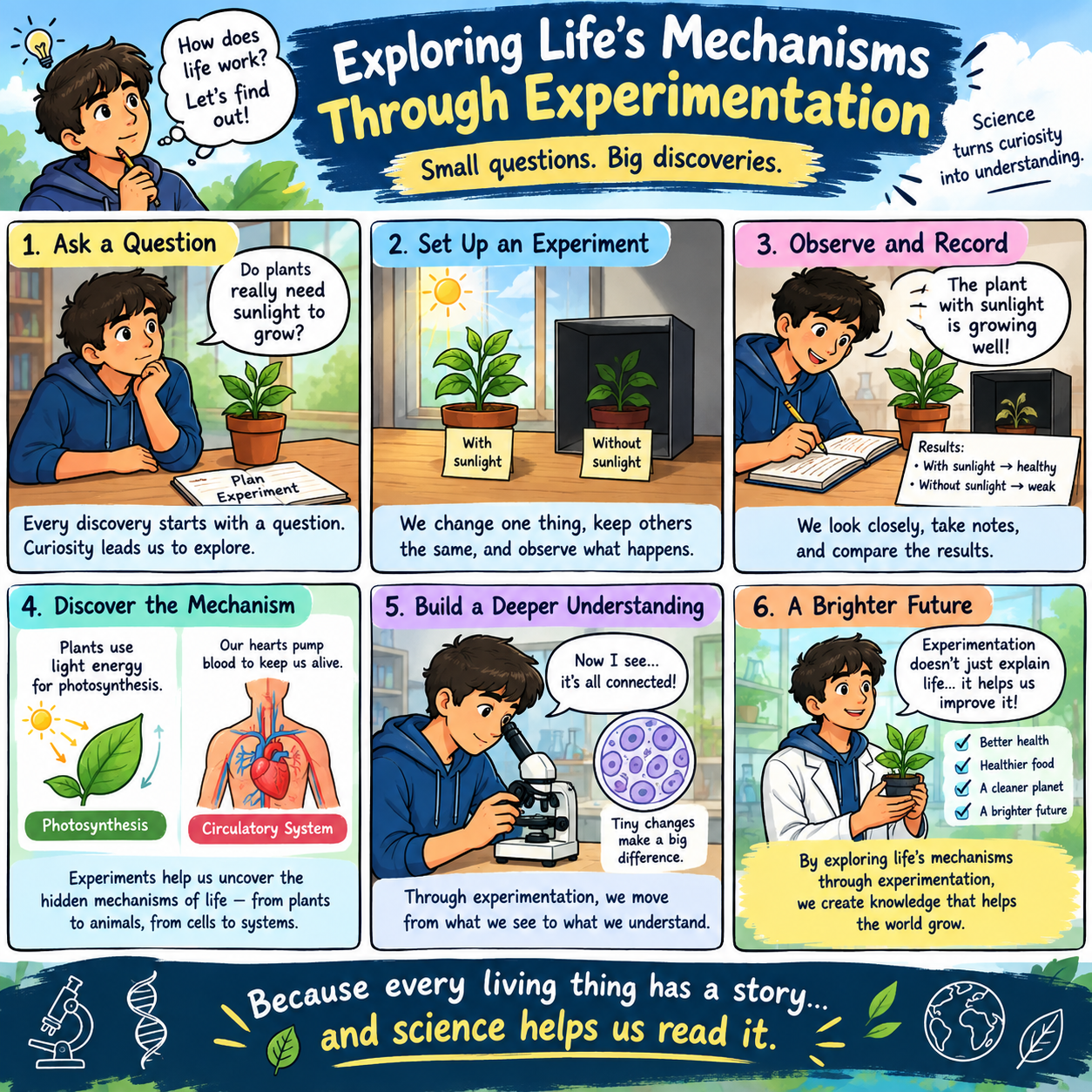
    ## Exploring Life’s Mechanisms Through Experimentation

    Every great scientific discovery begins with a question. Through careful experimentation, scientists uncover how living organisms grow, adapt, reproduce, and interact with their environment.

    From observing cells under a microscope to studying DNA and testing medicines , experiments help us understand the incredible mechanisms that keep life functioning. Biology experiments encourage curiosity, critical thinking, and problem-solving while teaching us the importance of evidence-based conclusions.

    Experimentation has transformed healthcare , agriculture , environmental conservation , and biotechnology , leading to innovations that improve lives around the world. Every observation and every experiment brings us one step closer to solving the mysteries of life.

    So, stay curious, ask questions, test ideas, and never stop exploring—because today's experiment could become tomorrow's breakthrough!

    #Biology #Science #Experimentation #LifeMechanisms #STEM #Learning #Education #ScientificDiscovery #Innovation #Research #Curiosity #FutureScientists
    #rsisb RollNo.244 Story Post Foundation Level ## 🔬 Exploring Life’s Mechanisms Through Experimentation 🧪🌱 Every great scientific discovery begins with a question. 🤔 Through careful experimentation, scientists uncover how living organisms grow, adapt, reproduce, and interact with their environment. 🌍🔬 From observing cells under a microscope 🦠 to studying DNA 🧬 and testing medicines 💊, experiments help us understand the incredible mechanisms that keep life functioning. Biology experiments encourage curiosity, critical thinking, and problem-solving while teaching us the importance of evidence-based conclusions. 📚✨ Experimentation has transformed healthcare 🏥, agriculture 🌾, environmental conservation 🌿, and biotechnology ⚙️, leading to innovations that improve lives around the world. Every observation and every experiment brings us one step closer to solving the mysteries of life. 🌟 So, stay curious, ask questions, test ideas, and never stop exploring—because today's experiment could become tomorrow's breakthrough! 🚀🔍 #Biology #Science #Experimentation #LifeMechanisms #STEM #Learning #Education #ScientificDiscovery #Innovation #Research #Curiosity #FutureScientists 🧬🌱
    0 Σχόλια 0 Μοιράστηκε 3365 Views
  • There are several books that explore the concept of “night owls”—individuals who naturally prefer staying awake late into the night—and discuss how this can be a normal variation in human circadian rhythms. Here are some notable titles:

    Go to Sleep Late: And Other Advice for Night Owls
    Authored by Sylvia Dziuba, this book challenges the conventional wisdom of early rising. It provides practical advice for night owls to achieve optimal health and productivity by aligning their schedules with their natural tendencies, rather than forcing themselves into early-bird routines. Night Owls and Early Birds: Rhythms of Life on a Rotating Planet
    Written by a leading chronobiologist, this book delves into the science of biological time, illuminating how our internal clocks dictate our sleep patterns. It offers insights into the natural variations among individuals, explaining why some people are predisposed to be night owls. Internal Time: Chronotypes, Social Jet Lag, and Why You’re So Tired
    In this book, chronobiologist Till Roenneberg explores the concept of “chronotypes,” explaining why some people are naturally inclined to stay up late. He discusses the societal challenges night owls face and introduces the idea of “social jet lag,” where there’s a mismatch between an individual’s internal clock and societal schedules.The Inner Clock: Living in Sync with Our Circadian Rhythms
    Science journalist Lynne Peeples examines how modern life disrupts our natural sleep patterns. Through extensive research and personal experimentation, she sheds light on the importance of aligning with one’s internal clock, offering insights particularly relevant to night owls striving to find balance in an early-riser world. The Body Clock Guide to Better Health
    Co-authored by Michael Smolensky and Lynne Lamberg, this guide delves into how our body’s natural rhythms affect health and behavior. It provides strategies for individuals, including night owls, to optimize their routines in harmony with their internal clocks.These books offer valuable insights into the science behind being a night owl and provide practical advice on how to navigate a society that often favors early risers.
    There are several books that explore the concept of “night owls”—individuals who naturally prefer staying awake late into the night—and discuss how this can be a normal variation in human circadian rhythms. Here are some notable titles: Go to Sleep Late: And Other Advice for Night Owls Authored by Sylvia Dziuba, this book challenges the conventional wisdom of early rising. It provides practical advice for night owls to achieve optimal health and productivity by aligning their schedules with their natural tendencies, rather than forcing themselves into early-bird routines. Night Owls and Early Birds: Rhythms of Life on a Rotating Planet Written by a leading chronobiologist, this book delves into the science of biological time, illuminating how our internal clocks dictate our sleep patterns. It offers insights into the natural variations among individuals, explaining why some people are predisposed to be night owls. Internal Time: Chronotypes, Social Jet Lag, and Why You’re So Tired In this book, chronobiologist Till Roenneberg explores the concept of “chronotypes,” explaining why some people are naturally inclined to stay up late. He discusses the societal challenges night owls face and introduces the idea of “social jet lag,” where there’s a mismatch between an individual’s internal clock and societal schedules.The Inner Clock: Living in Sync with Our Circadian Rhythms Science journalist Lynne Peeples examines how modern life disrupts our natural sleep patterns. Through extensive research and personal experimentation, she sheds light on the importance of aligning with one’s internal clock, offering insights particularly relevant to night owls striving to find balance in an early-riser world. The Body Clock Guide to Better Health Co-authored by Michael Smolensky and Lynne Lamberg, this guide delves into how our body’s natural rhythms affect health and behavior. It provides strategies for individuals, including night owls, to optimize their routines in harmony with their internal clocks.These books offer valuable insights into the science behind being a night owl and provide practical advice on how to navigate a society that often favors early risers.
    0 Σχόλια 0 Μοιράστηκε 329 Views
  • Why Perfection Sometimes Kills Progress

    Perfectionism often feels like a strength, but in reality, it can become our biggest enemy. When we push ourselves to make something flawless, it often becomes too complicated. We keep adding layers, details, and rules until the joy of creation disappears. What began as a simple, exciting idea suddenly feels heavy. Sometimes, we even abandon it. Other times, the people we are working with lose interest, because the project looks too strict, too polished, too intimidating.

    Think about it: have you ever joined a casual game with friends? Everyone laughs, makes mistakes, and enjoys the moment. But if suddenly the rules become too serious, the fun is gone, and people stop playing. Work and projects are the same. If you start casually, without burden or stress, others feel invited to join. More people get involved. More projects see the light of day.

    This doesn’t mean we shouldn’t aim for quality. But quality grows best from freedom and experimentation, not from fear of failure. Start light. Do it for fun. Share your idea even if it’s rough. The joy of creating will carry you forward, and as you move, you’ll polish what matters.

    In the long run, you’ll notice something powerful: projects born from casual beginnings often grow bigger than those that were locked away in pursuit of perfection. Because progress loves movement, and movement loves simplicity.
    Why Perfection Sometimes Kills Progress Perfectionism often feels like a strength, but in reality, it can become our biggest enemy. When we push ourselves to make something flawless, it often becomes too complicated. We keep adding layers, details, and rules until the joy of creation disappears. What began as a simple, exciting idea suddenly feels heavy. Sometimes, we even abandon it. Other times, the people we are working with lose interest, because the project looks too strict, too polished, too intimidating. Think about it: have you ever joined a casual game with friends? Everyone laughs, makes mistakes, and enjoys the moment. But if suddenly the rules become too serious, the fun is gone, and people stop playing. Work and projects are the same. If you start casually, without burden or stress, others feel invited to join. More people get involved. More projects see the light of day. This doesn’t mean we shouldn’t aim for quality. But quality grows best from freedom and experimentation, not from fear of failure. Start light. Do it for fun. Share your idea even if it’s rough. The joy of creating will carry you forward, and as you move, you’ll polish what matters. In the long run, you’ll notice something powerful: projects born from casual beginnings often grow bigger than those that were locked away in pursuit of perfection. Because progress loves movement, and movement loves simplicity.
    0 Σχόλια 0 Μοιράστηκε 276 Views
  • Why Perfection Sometimes Kills Progress

    Perfectionism often feels like a strength, but in reality, it can become our biggest enemy. When we push ourselves to make something flawless, it often becomes too complicated. We keep adding layers, details, and rules until the joy of creation disappears. What began as a simple, exciting idea suddenly feels heavy. Sometimes, we even abandon it. Other times, the people we are working with lose interest, because the project looks too strict, too polished, too intimidating.

    Think about it: have you ever joined a casual game with friends? Everyone laughs, makes mistakes, and enjoys the moment. But if suddenly the rules become too serious, the fun is gone, and people stop playing. Work and projects are the same. If you start casually, without burden or stress, others feel invited to join. More people get involved. More projects see the light of day.

    This doesn’t mean we shouldn’t aim for quality. But quality grows best from freedom and experimentation, not from fear of failure. Start light. Do it for fun. Share your idea even if it’s rough. The joy of creating will carry you forward, and as you move, you’ll polish what matters.

    In the long run, you’ll notice something powerful: projects born from casual beginnings often grow bigger than those that were locked away in pursuit of perfection. Because progress loves movement, and movement loves simplicity.
    Why Perfection Sometimes Kills Progress Perfectionism often feels like a strength, but in reality, it can become our biggest enemy. When we push ourselves to make something flawless, it often becomes too complicated. We keep adding layers, details, and rules until the joy of creation disappears. What began as a simple, exciting idea suddenly feels heavy. Sometimes, we even abandon it. Other times, the people we are working with lose interest, because the project looks too strict, too polished, too intimidating. Think about it: have you ever joined a casual game with friends? Everyone laughs, makes mistakes, and enjoys the moment. But if suddenly the rules become too serious, the fun is gone, and people stop playing. Work and projects are the same. If you start casually, without burden or stress, others feel invited to join. More people get involved. More projects see the light of day. This doesn’t mean we shouldn’t aim for quality. But quality grows best from freedom and experimentation, not from fear of failure. Start light. Do it for fun. Share your idea even if it’s rough. The joy of creating will carry you forward, and as you move, you’ll polish what matters. In the long run, you’ll notice something powerful: projects born from casual beginnings often grow bigger than those that were locked away in pursuit of perfection. Because progress loves movement, and movement loves simplicity.
    0 Σχόλια 0 Μοιράστηκε 292 Views
  • The Man Who Gave Us the Industrial Age—And Why He Refused to Hire “Experts”

    Henry Ford, the man who transformed the world with the moving assembly line, didn’t just create cars — he created a new way of thinking. Yet, in his own book My Life and Work, Ford made a surprising confession: he avoided hiring “experts.” Not because he disliked knowledge, but because he saw how it often kills innovation.

    “That is why I never employ an expert in full bloom… If ever I wanted to kill opposition by unfair means I would endow the opposition with experts.”
    — Henry Ford, My Life and Work (1922)

    Ford noticed that experts were quick to explain why something cannot be done. Their experience made them prisoners of precedent. They knew too much about limitations and too little about possibilities. When Ford began building the automobile, experts laughed. They said the internal-combustion engine could never replace steam. He ignored them — and changed history.


    Experts Protect the Past, Learners Create the Future

    Ford’s factories were full of people who learned by doing. He wrote:

    “A man who knows a job sees so much more to be done than he has done, that he is always pressing forward.”

    In other words, true progress comes from curiosity — not from credentials. Experts spend their energy defending what they already know; innovators spend theirs exploring what they don’t.


    Today’s “Expert Coders” Are Repeating the Same Mistake

    A century later, the same pattern repeats. Many of today’s so-called expert programmers are becoming obsolete — not because their knowledge is wrong, but because it’s frozen in time. They perfected the art of coding by hand, line by line. But now, AI can generate, debug, and optimize code in seconds.

    The new innovators aren’t the old “experts” — they’re the learners who know how to collaborate with AI, who ask better questions, and who think like Ford’s factory workers: always pressing forward.

    The coder who clings to the past is no different from the engineer who once swore that steam would last forever.


    Why Experts Kill Growth
    1. They fear change. Their identity depends on being right.
    2. They stop experimenting. They already “know” how things are done.
    3. They over-analyze. They advise, report, and explain — while doers build.

    Ford’s factories were fast because they were learning machines. He designed systems that rewarded experimentation, not seniority.


    The Lesson for the AI Age

    Ford’s principle is timeless: don’t fill your organization with experts who argue; fill it with learners who build. The future belongs to people who can learn fast, unlearn faster, and work with technology — not against it.

    Ford gave us the Industrial Age by trusting learners with machines.
    Today, the world belongs to those who trust themselves with AI.
    The Man Who Gave Us the Industrial Age—And Why He Refused to Hire “Experts” Henry Ford, the man who transformed the world with the moving assembly line, didn’t just create cars — he created a new way of thinking. Yet, in his own book My Life and Work, Ford made a surprising confession: he avoided hiring “experts.” Not because he disliked knowledge, but because he saw how it often kills innovation. “That is why I never employ an expert in full bloom… If ever I wanted to kill opposition by unfair means I would endow the opposition with experts.” — Henry Ford, My Life and Work (1922) Ford noticed that experts were quick to explain why something cannot be done. Their experience made them prisoners of precedent. They knew too much about limitations and too little about possibilities. When Ford began building the automobile, experts laughed. They said the internal-combustion engine could never replace steam. He ignored them — and changed history. ⸻ Experts Protect the Past, Learners Create the Future Ford’s factories were full of people who learned by doing. He wrote: “A man who knows a job sees so much more to be done than he has done, that he is always pressing forward.” In other words, true progress comes from curiosity — not from credentials. Experts spend their energy defending what they already know; innovators spend theirs exploring what they don’t. ⸻ Today’s “Expert Coders” Are Repeating the Same Mistake A century later, the same pattern repeats. Many of today’s so-called expert programmers are becoming obsolete — not because their knowledge is wrong, but because it’s frozen in time. They perfected the art of coding by hand, line by line. But now, AI can generate, debug, and optimize code in seconds. The new innovators aren’t the old “experts” — they’re the learners who know how to collaborate with AI, who ask better questions, and who think like Ford’s factory workers: always pressing forward. The coder who clings to the past is no different from the engineer who once swore that steam would last forever. ⸻ Why Experts Kill Growth 1. They fear change. Their identity depends on being right. 2. They stop experimenting. They already “know” how things are done. 3. They over-analyze. They advise, report, and explain — while doers build. Ford’s factories were fast because they were learning machines. He designed systems that rewarded experimentation, not seniority. ⸻ The Lesson for the AI Age Ford’s principle is timeless: don’t fill your organization with experts who argue; fill it with learners who build. The future belongs to people who can learn fast, unlearn faster, and work with technology — not against it. Ford gave us the Industrial Age by trusting learners with machines. Today, the world belongs to those who trust themselves with AI.
    0 Σχόλια 0 Μοιράστηκε 491 Views
  • This period — 1930 to 1970 at Stanford University — is one of the most studied transformations in education and innovation history.

    Because before this period:

    Stanford was not famous globally.
    It was a regional university on the U.S. West Coast.

    After this period:

    It became the engine behind Silicon Valley, producing companies worth trillions.

    And interestingly:

    Much of it was not a master plan at the beginning — it evolved through a few bold decisions.

    Let’s break it down clearly.


    Stanford Before 1930

    Stanford faced problems:
    • far from U.S. industrial centers,
    • limited funding,
    • fewer elite students compared to Harvard or MIT.

    It needed survival.

    This forced experimentation.


    The 6 Things Stanford Did (Accidentally Creating Silicon Valley)


    They Allowed Professors to Start Companies

    In most universities then:

    Professors doing business was discouraged.

    Stanford leadership — especially Frederick Terman (engineering dean) — encouraged it.

    Example:

    Two Stanford students started a company in a garage.

    That company became:

    Hewlett-Packard

    This changed everything.

    University knowledge began turning into companies.


    University Land Became Startup Space (Stanford Industrial Park)

    1951 — Stanford made a radical decision.

    Instead of selling land:

    They leased university land to technology companies.

    This became:

    Stanford Research Park.

    Companies moved next to students and professors.

    Result:

    Ideas moved daily between academia and industry.

    Today this model exists worldwide.


    Government Research Money Flowed Through Stanford

    During WWII and Cold War:

    U.S. government funded electronics and radar research.

    Stanford accepted massive research collaboration.

    Students worked on real national problems.

    Outcome:

    Engineering talent exploded.

    Later this talent created semiconductor companies.


    Failure Became Acceptable Culture

    Important psychological change.

    Students saw professors launching companies.

    Startups failing became normal.

    Instead of shame:

    Failure = learning.

    This cultural shift later defined Silicon Valley.


    Alumni Stayed Local

    Normally graduates leave universities.

    Stanford graduates stayed nearby because:
    • companies existed nearby,
    • investors nearby,
    • labs nearby.

    Talent accumulated geographically.

    This created network density.


    Venture Capital Was Born Nearby

    Near Stanford emerged Sand Hill Road.

    World’s largest venture capital concentration.

    Ideas → funding → companies happened within minutes.

    Speed became unfair advantage.


    The Hidden Formula Stanford Accidentally Created

    It became:

    University
    • Industry
    • Capital
    • Government
    • Risk Culture
    • Talent Density.

    Not curriculum.

    An ecosystem.


    Why This Produced Giants Later

    From this ecosystem eventually emerged companies connected to Stanford ecosystem like:
    • Google
    • NVIDIA
    • Cisco
    • Yahoo
    • Sun Microsystems.

    The innovation loop never stopped.


    How This Can Be Replicated Today (Very Practical)

    Any country or institution trying today should focus on:


    1. Students Must Build Companies While Studying

    Not after graduation.

    Learning + earning simultaneously.


    2. Campus Must Host Businesses

    Factories
    startups
    digital companies inside ecosystem.

    Daily exposure matters.


    3. Real Problems Instead of Exams

    Energy
    transport
    AI
    education.

    Mission-driven learning.


    4. Investors or Revenue Access

    Students must access:

    clients or funding early.

    Otherwise ideas die.


    5. Public Documentation

    Stanford success spread because others studied it.

    Documentation attracts replication.


    The Deep Lesson

    Stanford did not try to produce billionaires.

    They created an environment where ambitious people collided continuously.

    And extraordinary outcomes followed.


    Important Observation

    Today many experts believe:

    The next Stanford-like experiment may not come from America.

    Because digital infrastructure now allows experimentation anywhere.
    This period — 1930 to 1970 at Stanford University — is one of the most studied transformations in education and innovation history. Because before this period: 👉 Stanford was not famous globally. It was a regional university on the U.S. West Coast. After this period: 👉 It became the engine behind Silicon Valley, producing companies worth trillions. And interestingly: Much of it was not a master plan at the beginning — it evolved through a few bold decisions. Let’s break it down clearly. ⸻ 🌎 Stanford Before 1930 Stanford faced problems: • far from U.S. industrial centers, • limited funding, • fewer elite students compared to Harvard or MIT. It needed survival. This forced experimentation. ⸻ ⭐ The 6 Things Stanford Did (Accidentally Creating Silicon Valley) ⸻ 1️⃣ They Allowed Professors to Start Companies In most universities then: Professors doing business was discouraged. Stanford leadership — especially Frederick Terman (engineering dean) — encouraged it. Example: Two Stanford students started a company in a garage. That company became: 👉 Hewlett-Packard This changed everything. University knowledge began turning into companies. ⸻ 2️⃣ University Land Became Startup Space (Stanford Industrial Park) 1951 — Stanford made a radical decision. Instead of selling land: They leased university land to technology companies. This became: 👉 Stanford Research Park. Companies moved next to students and professors. Result: Ideas moved daily between academia and industry. Today this model exists worldwide. ⸻ 3️⃣ Government Research Money Flowed Through Stanford During WWII and Cold War: U.S. government funded electronics and radar research. Stanford accepted massive research collaboration. Students worked on real national problems. Outcome: Engineering talent exploded. Later this talent created semiconductor companies. ⸻ 4️⃣ Failure Became Acceptable Culture Important psychological change. Students saw professors launching companies. Startups failing became normal. Instead of shame: Failure = learning. This cultural shift later defined Silicon Valley. ⸻ 5️⃣ Alumni Stayed Local Normally graduates leave universities. Stanford graduates stayed nearby because: • companies existed nearby, • investors nearby, • labs nearby. Talent accumulated geographically. This created network density. ⸻ 6️⃣ Venture Capital Was Born Nearby Near Stanford emerged Sand Hill Road. World’s largest venture capital concentration. Ideas → funding → companies happened within minutes. Speed became unfair advantage. ⸻ ⚡ The Hidden Formula Stanford Accidentally Created It became: University • Industry • Capital • Government • Risk Culture • Talent Density. Not curriculum. An ecosystem. ⸻ 🧠 Why This Produced Giants Later From this ecosystem eventually emerged companies connected to Stanford ecosystem like: • Google • NVIDIA • Cisco • Yahoo • Sun Microsystems. The innovation loop never stopped. ⸻ 🌍 How This Can Be Replicated Today (Very Practical) Any country or institution trying today should focus on: ⸻ ✅ 1. Students Must Build Companies While Studying Not after graduation. Learning + earning simultaneously. ⸻ ✅ 2. Campus Must Host Businesses Factories startups digital companies inside ecosystem. Daily exposure matters. ⸻ ✅ 3. Real Problems Instead of Exams Energy transport AI education. Mission-driven learning. ⸻ ✅ 4. Investors or Revenue Access Students must access: clients or funding early. Otherwise ideas die. ⸻ ✅ 5. Public Documentation Stanford success spread because others studied it. Documentation attracts replication. ⸻ ⭐ The Deep Lesson Stanford did not try to produce billionaires. They created an environment where ambitious people collided continuously. And extraordinary outcomes followed. ⸻ 🔎 Important Observation Today many experts believe: The next Stanford-like experiment may not come from America. Because digital infrastructure now allows experimentation anywhere.
    0 Σχόλια 0 Μοιράστηκε 457 Views
Αναζήτηση αποτελεσμάτων