• Mohsin #RSF8
    #Storypostt6
    Class: Foundation level
    Made by Me
    rool no:13
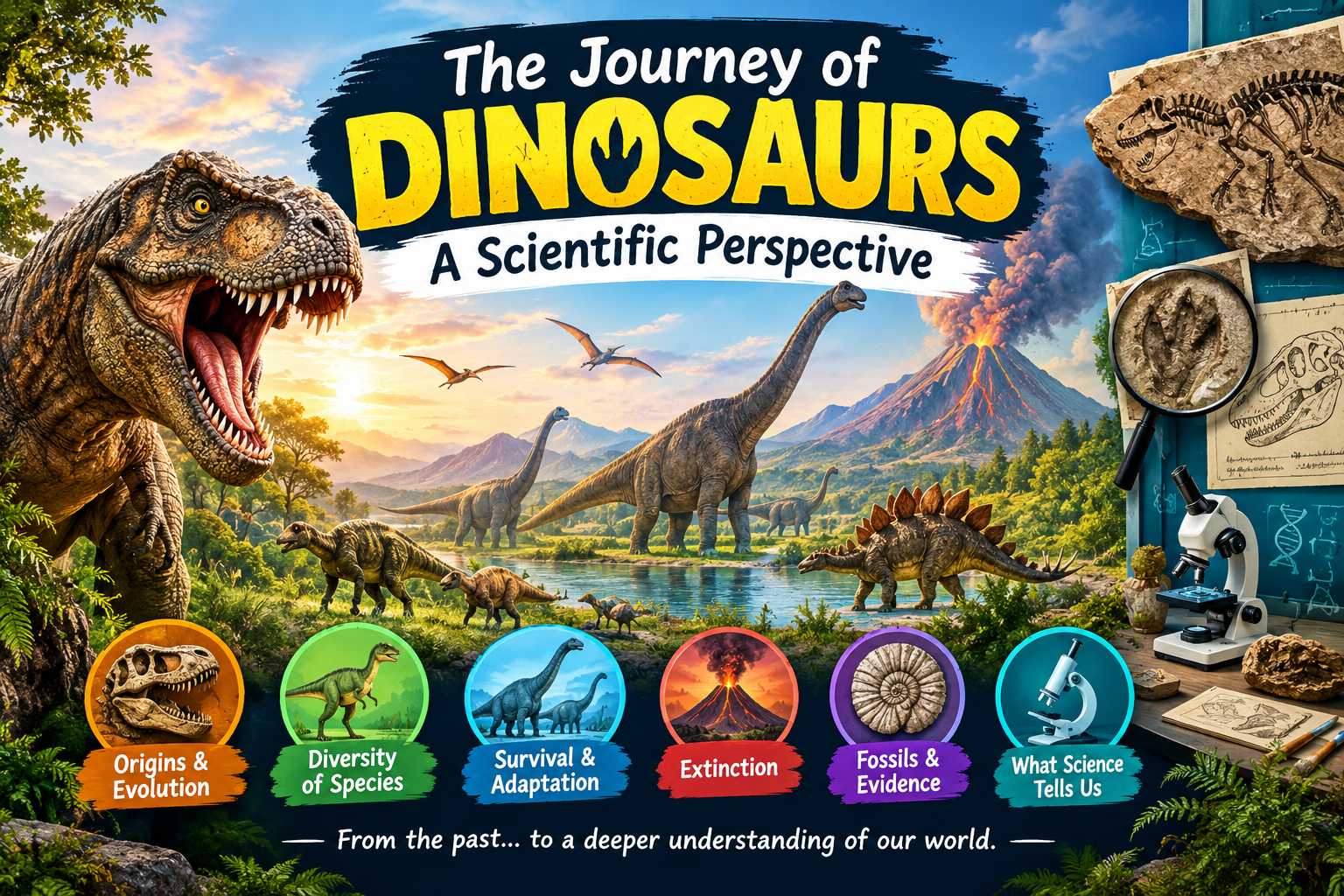
    The Journey of Dinosaurs: A Scientific Perspective

    Travel back hundreds of millions of years and discover the extraordinary story of dinosaurs—some of the most fascinating creatures to ever inhabit our planet. Their journey began during the Triassic Period, approximately 230 million years ago, when the Earth looked vastly different from the world we know today. Continents were joined together in a giant landmass called Pangaea, and early dinosaurs emerged as small, agile reptiles. Over time, these ancient creatures evolved into a diverse range of species, occupying nearly every ecological niche and becoming the dominant animals on Earth for more than 160 million years.

    During the Jurassic Period, dinosaurs flourished and diversified into countless forms. Massive herbivores such as Brachiosaurus and Diplodocus roamed lush forests, while formidable predators like Allosaurus hunted across vast landscapes. Their remarkable adaptations allowed them to thrive in changing environments, demonstrating the power of evolution and natural selection. As ecosystems became increasingly complex, dinosaurs developed specialized characteristics that enabled them to survive and dominate their habitats.

    The Cretaceous Period marked the peak of dinosaur diversity. Iconic species such as Tyrannosaurus rex, Triceratops, and Velociraptor appeared during this era. Scientists believe that many dinosaurs displayed advanced behaviors, including social interaction, parental care, and migration. Fossil evidence has even revealed that some dinosaurs possessed feathers, providing strong support for the evolutionary link between dinosaurs and modern birds. These discoveries have transformed our understanding of dinosaurs, showing that they were dynamic, intelligent, and highly adaptable creatures rather than the slow-moving reptiles once imagined.

    Our knowledge of dinosaurs comes primarily from the study of fossils. Paleontologists carefully examine fossilized bones, footprints, eggs, and even preserved skin impressions to reconstruct the lives of these prehistoric animals. Modern technologies.
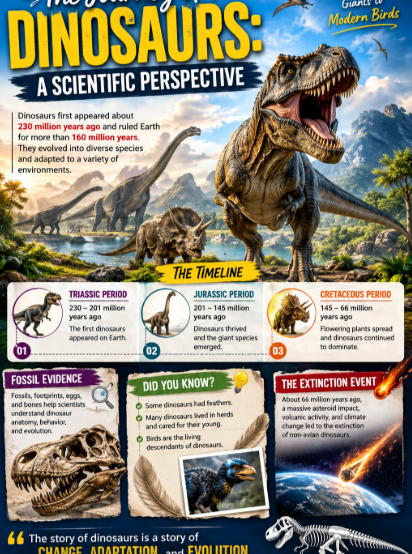
    Mohsin #RSF8πŸŽ“βœ¨ #Storypostt6 Class: Foundation level πŸ“š Made by Me πŸ’»πŸš€ rool no:13 πŸ¦– The Journey of Dinosaurs: A Scientific Perspective Travel back hundreds of millions of years and discover the extraordinary story of dinosaurs—some of the most fascinating creatures to ever inhabit our planet. Their journey began during the Triassic Period, approximately 230 million years ago, when the Earth looked vastly different from the world we know today. Continents were joined together in a giant landmass called Pangaea, and early dinosaurs emerged as small, agile reptiles. Over time, these ancient creatures evolved into a diverse range of species, occupying nearly every ecological niche and becoming the dominant animals on Earth for more than 160 million years. During the Jurassic Period, dinosaurs flourished and diversified into countless forms. Massive herbivores such as Brachiosaurus and Diplodocus roamed lush forests, while formidable predators like Allosaurus hunted across vast landscapes. Their remarkable adaptations allowed them to thrive in changing environments, demonstrating the power of evolution and natural selection. As ecosystems became increasingly complex, dinosaurs developed specialized characteristics that enabled them to survive and dominate their habitats. The Cretaceous Period marked the peak of dinosaur diversity. Iconic species such as Tyrannosaurus rex, Triceratops, and Velociraptor appeared during this era. Scientists believe that many dinosaurs displayed advanced behaviors, including social interaction, parental care, and migration. Fossil evidence has even revealed that some dinosaurs possessed feathers, providing strong support for the evolutionary link between dinosaurs and modern birds. These discoveries have transformed our understanding of dinosaurs, showing that they were dynamic, intelligent, and highly adaptable creatures rather than the slow-moving reptiles once imagined. Our knowledge of dinosaurs comes primarily from the study of fossils. Paleontologists carefully examine fossilized bones, footprints, eggs, and even preserved skin impressions to reconstruct the lives of these prehistoric animals. Modern technologies.
    0 Commenti 0 condivisioni 1774 Views
  • RSIF8
    Roll no:14
    story post no:8
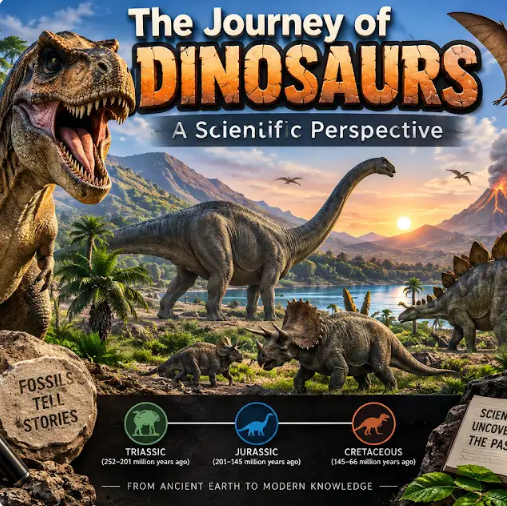
    story topic:The Journey of Dinosaurs: A Scientific Perspective

    **The Journey of Dinosaurs: A Scientific Perspective**

    Step into the fascinating world of dinosaurs and discover the incredible story of life on Earth millions of years ago!

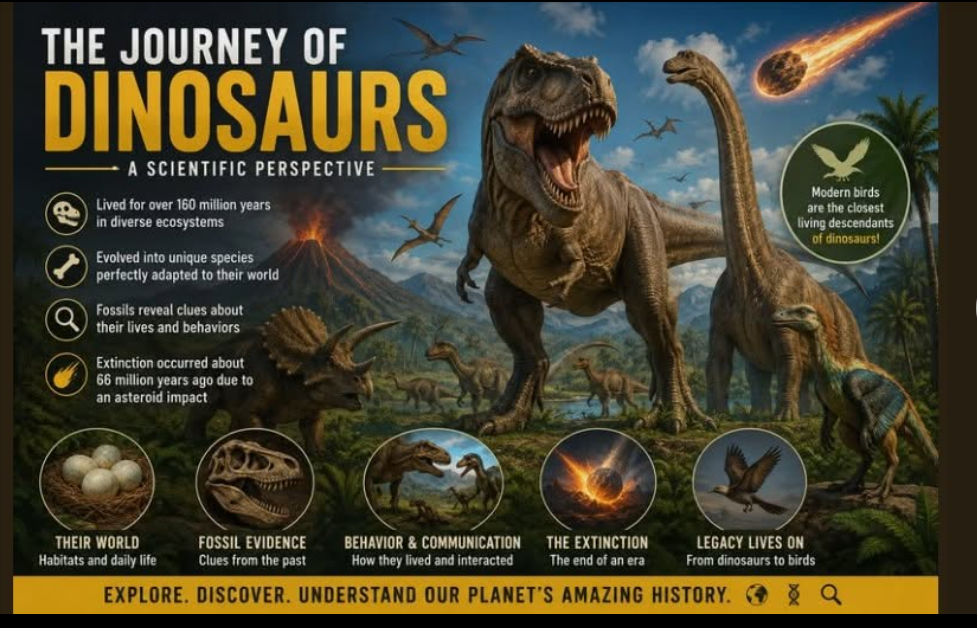
    **“The Journey of Dinosaurs: A Scientific Perspective”** explores the amazing history of dinosaurs through the lens of science. From their appearance during the **Triassic Period** to their incredible diversity during the **Jurassic and Cretaceous Periods**, dinosaurs ruled many parts of our planet for millions of years.

    Through fossils, footprints, bones, rocks, and other scientific evidence, paleontologists have been able to uncover clues about how dinosaurs lived, what they ate, how they moved, and how different species evolved over time.

    The journey also takes us through the changing prehistoric environment, including ancient forests, oceans, volcanic activity, climate changes, and the events that shaped life on Earth. Scientists continue to study these clues to understand the mysterious past of our planet.

    One of the most fascinating parts of dinosaur science is understanding their extinction around **66 million years ago** and discovering how their legacy continues today. Modern birds are considered living dinosaurs, giving us an amazing connection between the prehistoric world and the world we live in today!

    This topic helped me understand how **science, fossils, research, and evidence** allow us to explore a world that existed long before humans. It shows us that every fossil has a story and every discovery can teach us something new about Earth's history.

    **From ancient footprints to modern scientific discoveries, the journey of dinosaurs reminds us that the past is full of mysteries waiting to be explored!**

    #JourneyOfDinosaurs #Dinosaurs #ScientificPerspective #Paleontology #Fossils #DinosaurHistory #PrehistoricWorld #Science #EarthHistory #Evolution #Triassic #Jurassic #Cretaceous #DinosaurDiscovery #AncientEarth #Learning #Education #ScienceProject #FoundationLevel #ExploreAndLearn
    RSIF8 Roll no:14 story post no:8 story topic:The Journey of Dinosaurs: A Scientific Perspective πŸ¦–πŸŒ **The Journey of Dinosaurs: A Scientific Perspective** πŸŒπŸ¦• Step into the fascinating world of dinosaurs and discover the incredible story of life on Earth millions of years ago! πŸ”¬πŸ¦΄πŸŒ‹ **“The Journey of Dinosaurs: A Scientific Perspective”** explores the amazing history of dinosaurs through the lens of science. From their appearance during the **Triassic Period** to their incredible diversity during the **Jurassic and Cretaceous Periods**, dinosaurs ruled many parts of our planet for millions of years. 🌿🌎 πŸ¦• Through fossils, footprints, bones, rocks, and other scientific evidence, paleontologists have been able to uncover clues about how dinosaurs lived, what they ate, how they moved, and how different species evolved over time. πŸ”πŸ¦΄ πŸŒ‹ The journey also takes us through the changing prehistoric environment, including ancient forests, oceans, volcanic activity, climate changes, and the events that shaped life on Earth. Scientists continue to study these clues to understand the mysterious past of our planet. πŸŒ‹πŸŒ³β˜€οΈ πŸ’‘ One of the most fascinating parts of dinosaur science is understanding their extinction around **66 million years ago** and discovering how their legacy continues today. Modern birds are considered living dinosaurs, giving us an amazing connection between the prehistoric world and the world we live in today! πŸ¦πŸ¦– πŸŽ“ This topic helped me understand how **science, fossils, research, and evidence** allow us to explore a world that existed long before humans. It shows us that every fossil has a story and every discovery can teach us something new about Earth's history. πŸ”¬πŸ“šβœ¨ 🌟 **From ancient footprints to modern scientific discoveries, the journey of dinosaurs reminds us that the past is full of mysteries waiting to be explored!** πŸš€πŸ¦΄ #JourneyOfDinosaurs #Dinosaurs #ScientificPerspective #Paleontology #Fossils #DinosaurHistory #PrehistoricWorld #Science #EarthHistory #Evolution #Triassic #Jurassic #Cretaceous #DinosaurDiscovery #AncientEarth #Learning #Education #ScienceProject #FoundationLevel #ExploreAndLearn πŸ¦–πŸ”¬πŸŒπŸ“šβœ¨
    0 Commenti 0 condivisioni 2125 Views
  • Day:-48
    rollno:-006
    foundation level
    Story Post
    # The Journey of Dinosaurs: A Scientific Perspective

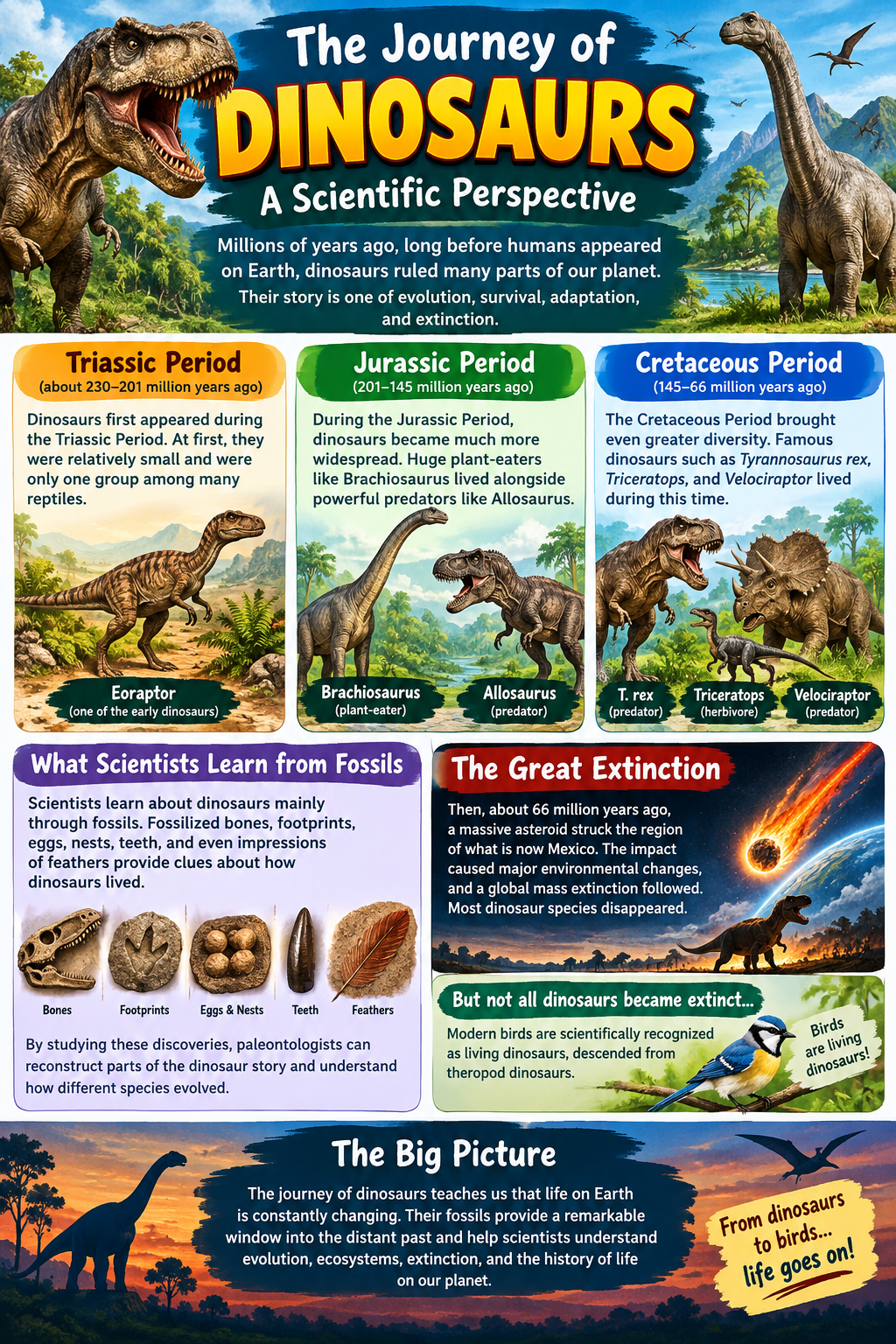
    Millions of years ago, long before humans appeared on Earth, dinosaurs ruled many parts of our planet. Their story is one of evolution, survival, adaptation, and extinction.

    Dinosaurs first appeared during the **Triassic Period, about 230 million years ago**. At first, they were relatively small and were only one group among many reptiles. Over millions of years, however, dinosaurs evolved into an incredible variety of species.

    During the **Jurassic Period**, dinosaurs became much more widespread. Huge plant-eating dinosaurs such as *Brachiosaurus* lived alongside powerful predators such as *Allosaurus*. Some dinosaurs developed long necks, sharp teeth, armor, horns, or other features that helped them survive in their environments.

    The **Cretaceous Period** brought even greater diversity. Famous dinosaurs such as *Tyrannosaurus rex*, *Triceratops*, and *Velociraptor* lived during this time. Scientists believe dinosaurs occupied many different habitats and had complex behaviors, including nesting, caring for young, hunting, and possibly communicating with one another.

    Scientists learn about dinosaurs mainly through **fossils**. Fossilized bones, footprints, eggs, nests, teeth, and even impressions of feathers provide clues about how dinosaurs lived. By studying these discoveries, paleontologists can reconstruct parts of the dinosaur story and understand how different species evolved.

    Then, about **66 million years ago**, a massive asteroid struck the region of what is now Mexico. The impact caused major environmental changes, and a global mass extinction followed. Most dinosaur species disappeared. However, not all dinosaurs became extinct.

    Modern birds are scientifically recognized as **living dinosaurs**, descended from theropod dinosaurs. This means that although non-avian dinosaurs such as *T. rex* are gone, their evolutionary legacy continues today in birds.

    The journey of dinosaurs teaches us that life on Earth is constantly changing. Their fossils provide a remarkable window into the distant past and help scientists understand evolution, ecosystems, extinction, and the history of life on our planet.
    Day:-48 rollno:-006 foundation level πŸ“– Story Post # πŸ¦– The Journey of Dinosaurs: A Scientific Perspective Millions of years ago, long before humans appeared on Earth, dinosaurs ruled many parts of our planet. Their story is one of evolution, survival, adaptation, and extinction. Dinosaurs first appeared during the **Triassic Period, about 230 million years ago**. At first, they were relatively small and were only one group among many reptiles. Over millions of years, however, dinosaurs evolved into an incredible variety of species. During the **Jurassic Period**, dinosaurs became much more widespread. Huge plant-eating dinosaurs such as *Brachiosaurus* lived alongside powerful predators such as *Allosaurus*. Some dinosaurs developed long necks, sharp teeth, armor, horns, or other features that helped them survive in their environments. The **Cretaceous Period** brought even greater diversity. Famous dinosaurs such as *Tyrannosaurus rex*, *Triceratops*, and *Velociraptor* lived during this time. Scientists believe dinosaurs occupied many different habitats and had complex behaviors, including nesting, caring for young, hunting, and possibly communicating with one another. Scientists learn about dinosaurs mainly through **fossils**. Fossilized bones, footprints, eggs, nests, teeth, and even impressions of feathers provide clues about how dinosaurs lived. By studying these discoveries, paleontologists can reconstruct parts of the dinosaur story and understand how different species evolved. Then, about **66 million years ago**, a massive asteroid struck the region of what is now Mexico. The impact caused major environmental changes, and a global mass extinction followed. Most dinosaur species disappeared. However, not all dinosaurs became extinct. Modern birds are scientifically recognized as **living dinosaurs**, descended from theropod dinosaurs. This means that although non-avian dinosaurs such as *T. rex* are gone, their evolutionary legacy continues today in birds. The journey of dinosaurs teaches us that life on Earth is constantly changing. Their fossils provide a remarkable window into the distant past and help scientists understand evolution, ecosystems, extinction, and the history of life on our planet.
    0 Commenti 0 condivisioni 1305 Views
  • #rsisb
    Roll no.239
    Foundation Level

    Dinosaurs are among the most fascinating creatures that ever lived on Earth. Their story is a remarkable journey through millions of years of evolution, adaptation, survival, and extinction. Scientists study dinosaur fossils, footprints, and ancient environments to understand how these incredible animals lived and how they shaped the history of our planet.
    **The Beginning of the Dinosaur Era**
    Dinosaurs first appeared around **230 million years ago** during the **Mesozoic Era**. They evolved from early reptiles and quickly became one of the most successful groups of animals on Earth. Over time, they adapted to different environments, developing unique features that helped them survive.
    **The Age of Dinosaurs**
    The Mesozoic Era is often called the **"Age of Dinosaurs"** and lasted for more than 180 million years. It was divided into three major periods:
    **Triassic Period** (about 252–201 million years ago)
    The first dinosaurs appeared and began spreading across the planet. Small, fast-moving dinosaurs evolved during this time.
    **Jurassic Period** (about 201–145 million years ago)
    Dinosaurs became larger and more diverse. Giant plant-eaters like long-necked sauropods and powerful predators ruled many landscapes.
    **Cretaceous Period** (about 145–66 million years ago)
    Dinosaurs reached their greatest variety. Famous species such as **Tyrannosaurus rex** and **Triceratops** lived during this time.
    **How Scientists Study Dinosaurs**
    Scientists called **paleontologists** uncover clues from the past by studying:
    Fossilized bones
    Ancient footprints
    Dinosaur eggs
    Fossil plants
    Geological evidence
    These discoveries help researchers learn about dinosaur behavior, diets, movement, and habitats.
    **Dinosaur Adaptations and Survival**
    Dinosaurs developed amazing adaptations to survive:
    Sharp teeth for hunting
    Armor and horns for protection
    πŸͺ½ Feathers in some species
    Strong legs for movement
    Different feeding strategies
    Some dinosaurs evolved into birds, making modern birds the living descendants of these ancient creatures.
    **The Great Extinction Event**
    Around **66 million years ago**, a massive asteroid impact contributed to the extinction of many dinosaur species. This event changed life on Earth forever and opened opportunities for new groups of animals, including mammals, to expand.
    **The Scientific Importance of Dinosaurs**
    Studying dinosaurs helps scientists understand:
    How life evolves over time
    How Earth’s environments change
    How species adapt and survive
    How ancient ecosystems worked
    Dinosaurs remind us that life on Earth is constantly changing. Their story teaches us about resilience, adaptation, and the incredible history of our planet.
    **The journey of dinosaurs is not just a story of the past — it is a scientific window into the evolution of life itself.** See less
    #rsisb Roll no.239 Foundation Level Dinosaurs are among the most fascinating creatures that ever lived on Earth. Their story is a remarkable journey through millions of years of evolution, adaptation, survival, and extinction. πŸŒŽπŸ¦• Scientists study dinosaur fossils, footprints, and ancient environments to understand how these incredible animals lived and how they shaped the history of our planet. πŸ”πŸ“š πŸ•°οΈ **The Beginning of the Dinosaur Era** πŸŒ±πŸ¦– Dinosaurs first appeared around **230 million years ago** during the **Mesozoic Era**. They evolved from early reptiles and quickly became one of the most successful groups of animals on Earth. Over time, they adapted to different environments, developing unique features that helped them survive. 🌿✨ 🌎 **The Age of Dinosaurs** πŸ¦•πŸžοΈ The Mesozoic Era is often called the **"Age of Dinosaurs"** and lasted for more than 180 million years. It was divided into three major periods: πŸŒ‹ **Triassic Period** (about 252–201 million years ago) ➑️ The first dinosaurs appeared and began spreading across the planet. Small, fast-moving dinosaurs evolved during this time. 🦎 🌿 **Jurassic Period** (about 201–145 million years ago) ➑️ Dinosaurs became larger and more diverse. Giant plant-eaters like long-necked sauropods and powerful predators ruled many landscapes. πŸŒ³πŸ¦• πŸ”₯ **Cretaceous Period** (about 145–66 million years ago) ➑️ Dinosaurs reached their greatest variety. Famous species such as **Tyrannosaurus rex** and **Triceratops** lived during this time. πŸŒŽβš”οΈ πŸ”¬ **How Scientists Study Dinosaurs** πŸ§ͺπŸ“– Scientists called **paleontologists** uncover clues from the past by studying: 🦴 Fossilized bones πŸ‘£ Ancient footprints πŸ₯š Dinosaur eggs 🌿 Fossil plants 🏞️ Geological evidence These discoveries help researchers learn about dinosaur behavior, diets, movement, and habitats. πŸ”βœ¨ πŸ¦– **Dinosaur Adaptations and Survival** πŸ’ͺ🌱 Dinosaurs developed amazing adaptations to survive: 🦷 Sharp teeth for hunting πŸ›‘οΈ Armor and horns for protection πŸͺ½ Feathers in some species πŸƒ Strong legs for movement 🌿 Different feeding strategies Some dinosaurs evolved into birds, making modern birds the living descendants of these ancient creatures. 🐦✨ β˜„οΈ **The Great Extinction Event** πŸŒ‘πŸŒ Around **66 million years ago**, a massive asteroid impact contributed to the extinction of many dinosaur species. This event changed life on Earth forever and opened opportunities for new groups of animals, including mammals, to expand. πŸŒŽπŸ’« 🌟 **The Scientific Importance of Dinosaurs** πŸ”¬ Studying dinosaurs helps scientists understand: 🌱 How life evolves over time 🌍 How Earth’s environments change 🧬 How species adapt and survive πŸ”­ How ancient ecosystems worked Dinosaurs remind us that life on Earth is constantly changing. Their story teaches us about resilience, adaptation, and the incredible history of our planet. πŸŒŽπŸ¦– ✨ **The journey of dinosaurs is not just a story of the past — it is a scientific window into the evolution of life itself.** πŸŒŸπŸ”¬ See less
    0 Commenti 0 condivisioni 1752 Views
  • #rsisb
    Roll no.279
    story post no.7
    Foundation Level


    # The Journey of Dinosaurs: A Scientific Perspective

    Long before humans walked on Earth, dinosaurs ruled many parts of our planet. Their story began more than 230 million years ago during the **Triassic Period**. At first, dinosaurs were relatively small and not the dominant animals everywhere. But over millions of years, they evolved into an incredible variety of species.

    During the **Jurassic Period**, dinosaurs became much more diverse. Huge plant-eaters such as long-necked sauropods lived alongside powerful predators. Some dinosaurs walked on two legs, while others used four. Scientists believe their different body shapes and behaviors helped them survive in changing environments.

    Then came the **Cretaceous Period**, when dinosaurs continued to evolve and spread across the world. Dinosaurs developed feathers, horns, armor, and many other fascinating features. Some were tiny, while others were enormous! Scientists learn about these animals by studying fossils, footprints, teeth, bones, and even preserved impressions.

    About **66 million years ago**, a massive asteroid struck Earth near what is now Mexico. The impact caused dramatic environmental changes, and many species disappeared. This event marked the end of the non-avian dinosaurs. However, their story did not completely end!

    Modern birds are scientifically recognized as living dinosaurs. This means that when we see birds today, we are seeing a surviving branch of the dinosaur family tree.

    Today, paleontologists continue searching for fossils and studying ancient rocks to understand how dinosaurs lived, evolved, and disappeared. Every new fossil can reveal another piece of Earth's incredible history.

    The journey of dinosaurs teaches us an important lesson: **life on Earth is constantly changing, and evolution can produce extraordinary forms of life.**

    **From ancient footprints to modern birds, the story of dinosaurs is still being discovered!**

    #Dinosaurs #DinosaurJourney #Science #Paleontology #Evolution #Fossils #AncientEarth #Learning #HistoryOfEarth

    Asma Shaheen EducationWali
    Saima Happinesswali
    Irum Asim
    #rsisb Roll no.279 story post no.7 Foundation Level # πŸ¦– The Journey of Dinosaurs: A Scientific Perspective 🌍 Long before humans walked on Earth, dinosaurs ruled many parts of our planet. 🌎✨ Their story began more than 230 million years ago during the **Triassic Period**. At first, dinosaurs were relatively small and not the dominant animals everywhere. πŸ¦•πŸŒΏ But over millions of years, they evolved into an incredible variety of species. During the **Jurassic Period**, dinosaurs became much more diverse. πŸŒ³πŸ¦• Huge plant-eaters such as long-necked sauropods lived alongside powerful predators. πŸ¦–πŸŒΏ Some dinosaurs walked on two legs, while others used four. Scientists believe their different body shapes and behaviors helped them survive in changing environments. Then came the **Cretaceous Period**, when dinosaurs continued to evolve and spread across the world. πŸŒŽπŸ¦– Dinosaurs developed feathers, horns, armor, and many other fascinating features. Some were tiny, while others were enormous! 🐾✨ Scientists learn about these animals by studying fossils, footprints, teeth, bones, and even preserved impressions. πŸ”¬πŸ¦΄ About **66 million years ago**, a massive asteroid struck Earth near what is now Mexico. β˜„οΈπŸŒ The impact caused dramatic environmental changes, and many species disappeared. This event marked the end of the non-avian dinosaurs. However, their story did not completely end! πŸ¦πŸ¦– Modern birds are scientifically recognized as living dinosaurs. 🐦✨ This means that when we see birds today, we are seeing a surviving branch of the dinosaur family tree. Today, paleontologists continue searching for fossils and studying ancient rocks to understand how dinosaurs lived, evolved, and disappeared. πŸ”ŽπŸ¦΄πŸ“š Every new fossil can reveal another piece of Earth's incredible history. The journey of dinosaurs teaches us an important lesson: **life on Earth is constantly changing, and evolution can produce extraordinary forms of life.** πŸŒπŸ’« πŸ¦–πŸ”¬ **From ancient footprints to modern birds, the story of dinosaurs is still being discovered!** 🐦🌿 #Dinosaurs πŸ¦– #DinosaurJourney πŸ¦• #Science πŸ”¬ #Paleontology 🦴 #Evolution 🧬 #Fossils 🌍 #AncientEarth 🌎 #Learning πŸ“š #HistoryOfEarth ⏳ Asma Shaheen EducationWali Saima Happinesswali Irum Asim
    0 Commenti 0 condivisioni 1554 Views
  • #rsisb
    Roll No.247
    foundation level
    # The Journey of Dinosaurs: A Scientific Perspective

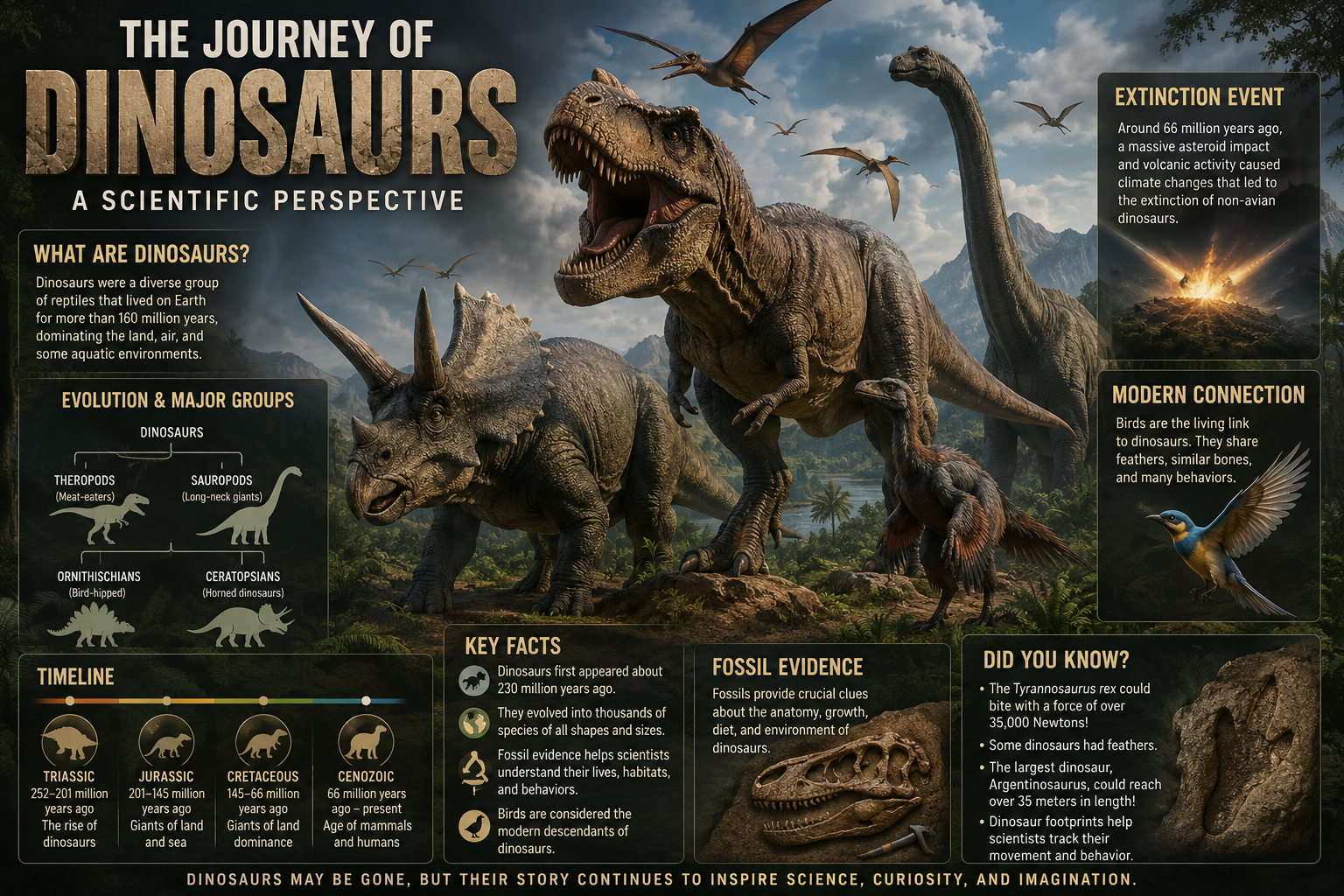
    Step into the fascinating world of dinosaurs and explore one of the most remarkable chapters in the history of life on Earth! Dinosaurs ruled many of the planet’s ecosystems for more than 160 million years, appearing during the Triassic Period and continuing through the Jurassic and Cretaceous Periods. Their incredible diversity included enormous plant-eaters, powerful predators, swift hunters, armored species, and many other extraordinary creatures.

    From a scientific perspective, the story of dinosaurs is not simply a tale of giant creatures—it is a story of evolution, adaptation, survival, extinction, and discovery. Scientists learn about dinosaurs through fossils, including bones, teeth, footprints, eggs, nests, and even traces of skin and feathers. By carefully studying these clues, paleontologists can reconstruct how dinosaurs lived, what they ate, how they moved, and how different species changed over millions of years.

    Dinosaurs first appeared roughly 230 million years ago. Over time, they adapted to changing environments and became one of the most successful groups of land animals in Earth's history. Some developed long necks and enormous bodies to reach vegetation, while others evolved sharp teeth and strong jaws for hunting. Their fossils have been discovered on every continent, showing just how widely they were distributed.

    The Jurassic Period is often remembered as a time when giant dinosaurs became especially prominent. Huge sauropods walked across ancient landscapes, while theropods hunted or scavenged. During the Cretaceous Period, dinosaurs continued to diversify, and many familiar species appeared. At the same time, flowering plants became increasingly important parts of many ecosystems.

    One of the most important scientific discoveries is that birds are living dinosaurs. Evidence from fossils, anatomy, and evolutionary studies shows that modern birds descended from theropod dinosaurs. This means that although non-avian dinosaurs disappeared from the fossil record about 66 million years ago, the dinosaur lineage continues today in the form of birds.

    The end of the Cretaceous Period brought a dramatic change. A large asteroid struck what is now the Yucatán Peninsula, contributing to major environmental disruptions around the world. This event, together with other environmental changes, played a major role in the extinction of non-avian dinosaurs. However, many other organisms survived, including early mammals, reptiles, and birds.

    Today, dinosaur research continues to evolve. ‍ New fossils, improved imaging technologies, computer modeling, and advances in genetics and evolutionary biology are helping scientists understand these ancient animals more accurately. Every newly discovered fossil can provide another piece of the enormous puzzle of Earth's past.

    The journey of dinosaurs reminds us that Earth has changed dramatically over geological time. Their story teaches us about adaptation, biodiversity, environmental change, and extinction. Most importantly, it shows how scientific evidence can help us understand a world that existed millions of years before humans appeared.

    Whether you are fascinated by enormous herbivores, fearsome predators, ancient ecosystems, or the origins of modern birds, the scientific journey of dinosaurs offers endless opportunities for discovery. Their fossils connect us to a distant past and inspire scientists, students, and curious minds to keep asking questions about the incredible history of life on our planet.

    #Dinosaurs #DinosaurJourney #Paleontology #Science #Fossils #Evolution #EarthHistory #JurassicPeriod #CretaceousPeriod #TriassicPeriod #DinosaurScience #AncientEarth #NaturalHistory #PrehistoricLife #ScientificDiscovery #Paleontologist ‍ #Biodiversity #Extinction #BirdsAreDinosaurs #LearnScience #ScienceEducation
    #rsisb Roll No.247 foundation level # The Journey of Dinosaurs: A Scientific Perspective πŸ¦–πŸŒπŸ”¬ Step into the fascinating world of dinosaurs and explore one of the most remarkable chapters in the history of life on Earth! πŸŒŽπŸ¦• Dinosaurs ruled many of the planet’s ecosystems for more than 160 million years, appearing during the Triassic Period and continuing through the Jurassic and Cretaceous Periods. Their incredible diversity included enormous plant-eaters, powerful predators, swift hunters, armored species, and many other extraordinary creatures. 🦴✨ From a scientific perspective, the story of dinosaurs is not simply a tale of giant creatures—it is a story of evolution, adaptation, survival, extinction, and discovery. Scientists learn about dinosaurs through fossils, including bones, teeth, footprints, eggs, nests, and even traces of skin and feathers. πŸ”¬πŸ¦΄ By carefully studying these clues, paleontologists can reconstruct how dinosaurs lived, what they ate, how they moved, and how different species changed over millions of years. Dinosaurs first appeared roughly 230 million years ago. πŸŒ‹πŸŒΏ Over time, they adapted to changing environments and became one of the most successful groups of land animals in Earth's history. Some developed long necks and enormous bodies to reach vegetation, while others evolved sharp teeth and strong jaws for hunting. πŸ¦•πŸŒ±πŸ¦– Their fossils have been discovered on every continent, showing just how widely they were distributed. The Jurassic Period is often remembered as a time when giant dinosaurs became especially prominent. πŸŒ΄β˜€οΈ Huge sauropods walked across ancient landscapes, while theropods hunted or scavenged. During the Cretaceous Period, dinosaurs continued to diversify, and many familiar species appeared. At the same time, flowering plants became increasingly important parts of many ecosystems. πŸŒΈπŸ¦– One of the most important scientific discoveries is that birds are living dinosaurs. πŸ¦πŸ¦• Evidence from fossils, anatomy, and evolutionary studies shows that modern birds descended from theropod dinosaurs. This means that although non-avian dinosaurs disappeared from the fossil record about 66 million years ago, the dinosaur lineage continues today in the form of birds. πŸŒπŸ”¬ The end of the Cretaceous Period brought a dramatic change. A large asteroid struck what is now the Yucatán Peninsula, contributing to major environmental disruptions around the world. 🌠🌎 This event, together with other environmental changes, played a major role in the extinction of non-avian dinosaurs. However, many other organisms survived, including early mammals, reptiles, and birds. Today, dinosaur research continues to evolve. πŸ§‘‍πŸ”¬πŸ”Ž New fossils, improved imaging technologies, computer modeling, and advances in genetics and evolutionary biology are helping scientists understand these ancient animals more accurately. Every newly discovered fossil can provide another piece of the enormous puzzle of Earth's past. 🦴🧩 The journey of dinosaurs reminds us that Earth has changed dramatically over geological time. 🌎⏳ Their story teaches us about adaptation, biodiversity, environmental change, and extinction. Most importantly, it shows how scientific evidence can help us understand a world that existed millions of years before humans appeared. Whether you are fascinated by enormous herbivores, fearsome predators, ancient ecosystems, or the origins of modern birds, the scientific journey of dinosaurs offers endless opportunities for discovery. πŸ¦–πŸ”¬πŸŒΏ Their fossils connect us to a distant past and inspire scientists, students, and curious minds to keep asking questions about the incredible history of life on our planet. 🌍✨ #Dinosaurs πŸ¦– #DinosaurJourney πŸ¦• #Paleontology πŸ”¬ #Science πŸ§ͺ #Fossils 🦴 #Evolution 🧬 #EarthHistory 🌍 #JurassicPeriod 🌿 #CretaceousPeriod πŸŒ‹ #TriassicPeriod 🌎 #DinosaurScience πŸ”Ž #AncientEarth ⏳ #NaturalHistory 🏞️ #PrehistoricLife πŸ¦• #ScientificDiscovery πŸ’‘ #Paleontologist πŸ§‘‍πŸ”¬ #Biodiversity 🌱 #Extinction 🌠 #BirdsAreDinosaurs 🐦 #LearnScience πŸ“š #ScienceEducation πŸ”¬βœ¨
    0 Commenti 0 condivisioni 8647 Views
  • ** ACCl Task 36 – Day 48: The Journey of Dinosaurs: A Scientific Perspective **

    I have successfully completed my thirty-sixth ACCl task titled **“The Journey of Dinosaurs: A Scientific Perspective”** .
    This task helped me explore how **dinosaurs lived, evolved, and disappeared**, deepening my understanding of Earth’s ancient history and the science of evolution .

    Part I: The Rise of Argentumdraco The world was the Mesozoic Era, a sprawling, humid greenhouse, and in the heart of what would one day be the Patagonia desert, the first Argentumdraco ("Silver Dragon") hatched. It was the early Late Cretaceous period, about 95 million years ago. Argentumdraco magnificens was a magnificent specimen of the Titanosauria, a subclass of the long-necked, plant-eating Sauropods.Unlike its ancient, bulkier ancestors, the Argentumdraco possessed a relatively slender frame, a long, flexible neck used to graze on the canopy's highest cycads and conifers, and skin that, when wet, shimmered with a faint, silvery-green iridescence—hence its name. Its feet, like those of all sauropods, were columnar, built for supporting its $60$-ton mass across the moist floodplain.The young Argentumdraco, who the paleontologists of the future would affectionately nickname "Ares," grew fast. His life was a constant, slow-motion migration, following the seasonal blooms of vegetation and avoiding the razor-toothed gaze of the massive Giganotosaurus that patrolled the forests. For millions of years, the species thrived. They were the undisputed, slow-moving monarchs of their ecosystem, a testament to evolutionary success.Part II: The Shadow of Chicxulub Then, $66$ million years ago, the environment began to subtly shift. Volcanic activity had been increasing across the globe—the Deccan Traps were pouring out vast sheets of lava and gas—straining the atmosphere. Ares, now old and scarred, felt the dryness in the air and the increasing scarcity of his preferred equatorial ferns.The true cataclysm, however, came in the form of a blinding flash from above. A massive asteroid, estimated to be $10$ kilometers wide, hurtled into the shallow waters of the Yucatán Peninsula, near what is now Chicxulub.The immediate effects were devastating: an immense shockwave, tsunamis, and a fiery blast that ignited global wildfires. But it was the aftermath that truly sealed the fate of the dinosaurs. The impact hurled colossal amounts of dust, soot, and sulfur aerosols into the stratosphere, blocking out the sun and plunging the Earth into years of "impact winter."Ares and his herd, thousands of miles away, did not die in the blast. They died of starvation. As the darkness persisted, photosynthesis failed. The massive ferns and conifers withered. Ares's immense bulk, once an advantage in warding off predators, became a metabolic liability. His $60$-ton body simply required too much energy from a world that had none left to give. Ares was among the last of his kind, his final resting place a muddy riverbed, an end not of violence, but of slow, cold inevitability.Part III: The Legacy of a Bone For $66$ million years, Ares's fossilized skeleton lay undisturbed. The continents drifted, the climate cooled, and new life—the small, resilient mammals that had scurried in the dinosaurs' shadow—inherited the Earth.Then, in the 21st century, a team of paleontologists, using geological mapping and seismic surveys, unearthed Ares's massive femur. It was enormous, a pale, petrified column of calcium and time.The scientists named the site "The Silver Bed." Through painstaking excavation and laboratory analysis, they didn't just find a skeleton; they reconstructed a story.CT scans revealed lines of arrested growth, like tree rings, detailing Ares's rapid juvenile growth rate.Geochemical analysis of the rock surrounding the bones confirmed the precise dating—$95.2 \pm 0.4$ million years ago.The unique pelvic structure was analyzed, helping to refine the evolutionary tree of sauropods.Ares, the Argentumdraco, became a key piece of the puzzle, a Type Specimen illustrating the magnificence of the dinosaurian world and the fragility of even the greatest life forms against a cosmic event.The scientists realized that while the asteroid wiped out all non-avian dinosaurs, it didn't truly end the dinosaur journey. The small, feathered theropods—birds—survived. The robin on your windowsill and the mighty Argentumdraco share an ancient, unbroken lineage.Ares’s bone now rests in a museum, a silent, monumental testament to a biological empire that spanned $165$ million years. It is a scientific narrative written in stone: the ultimate power of evolution, the devastating force of extinction, and the endless cycle of life on a tumultuous planet.
    **πŸ“˜ ACCl Task 36 – Day 48: The Journey of Dinosaurs: A Scientific Perspective πŸ¦–** I have successfully completed my thirty-sixth ACCl task titled **“The Journey of Dinosaurs: A Scientific Perspective”** 🌍. This task helped me explore how **dinosaurs lived, evolved, and disappeared**, deepening my understanding of Earth’s ancient history and the science of evolution πŸ”¬βœ¨. Part I: The Rise of Argentumdraco 🌍The world was the Mesozoic Era, a sprawling, humid greenhouse, and in the heart of what would one day be the Patagonia desert, the first Argentumdraco ("Silver Dragon") hatched. It was the early Late Cretaceous period, about 95 million years ago. Argentumdraco magnificens was a magnificent specimen of the Titanosauria, a subclass of the long-necked, plant-eating Sauropods.Unlike its ancient, bulkier ancestors, the Argentumdraco possessed a relatively slender frame, a long, flexible neck used to graze on the canopy's highest cycads and conifers, and skin that, when wet, shimmered with a faint, silvery-green iridescence—hence its name. Its feet, like those of all sauropods, were columnar, built for supporting its $60$-ton mass across the moist floodplain.The young Argentumdraco, who the paleontologists of the future would affectionately nickname "Ares," grew fast. His life was a constant, slow-motion migration, following the seasonal blooms of vegetation and avoiding the razor-toothed gaze of the massive Giganotosaurus that patrolled the forests. For millions of years, the species thrived. They were the undisputed, slow-moving monarchs of their ecosystem, a testament to evolutionary success.Part II: The Shadow of Chicxulub πŸ”₯Then, $66$ million years ago, the environment began to subtly shift. Volcanic activity had been increasing across the globe—the Deccan Traps were pouring out vast sheets of lava and gas—straining the atmosphere. Ares, now old and scarred, felt the dryness in the air and the increasing scarcity of his preferred equatorial ferns.The true cataclysm, however, came in the form of a blinding flash from above. A massive asteroid, estimated to be $10$ kilometers wide, hurtled into the shallow waters of the Yucatán Peninsula, near what is now Chicxulub.The immediate effects were devastating: an immense shockwave, tsunamis, and a fiery blast that ignited global wildfires. But it was the aftermath that truly sealed the fate of the dinosaurs. The impact hurled colossal amounts of dust, soot, and sulfur aerosols into the stratosphere, blocking out the sun and plunging the Earth into years of "impact winter."Ares and his herd, thousands of miles away, did not die in the blast. They died of starvation. As the darkness persisted, photosynthesis failed. The massive ferns and conifers withered. Ares's immense bulk, once an advantage in warding off predators, became a metabolic liability. His $60$-ton body simply required too much energy from a world that had none left to give. Ares was among the last of his kind, his final resting place a muddy riverbed, an end not of violence, but of slow, cold inevitability.Part III: The Legacy of a Bone 🦴For $66$ million years, Ares's fossilized skeleton lay undisturbed. The continents drifted, the climate cooled, and new life—the small, resilient mammals that had scurried in the dinosaurs' shadow—inherited the Earth.Then, in the 21st century, a team of paleontologists, using geological mapping and seismic surveys, unearthed Ares's massive femur. It was enormous, a pale, petrified column of calcium and time.The scientists named the site "The Silver Bed." Through painstaking excavation and laboratory analysis, they didn't just find a skeleton; they reconstructed a story.CT scans revealed lines of arrested growth, like tree rings, detailing Ares's rapid juvenile growth rate.Geochemical analysis of the rock surrounding the bones confirmed the precise dating—$95.2 \pm 0.4$ million years ago.The unique pelvic structure was analyzed, helping to refine the evolutionary tree of sauropods.Ares, the Argentumdraco, became a key piece of the puzzle, a Type Specimen illustrating the magnificence of the dinosaurian world and the fragility of even the greatest life forms against a cosmic event.The scientists realized that while the asteroid wiped out all non-avian dinosaurs, it didn't truly end the dinosaur journey. The small, feathered theropods—birds—survived. The robin on your windowsill and the mighty Argentumdraco share an ancient, unbroken lineage.Ares’s bone now rests in a museum, a silent, monumental testament to a biological empire that spanned $165$ million years. It is a scientific narrative written in stone: the ultimate power of evolution, the devastating force of extinction, and the endless cycle of life on a tumultuous planet.
    0 Commenti 0 condivisioni 1983 Views